
A complete issue · 20 pages · 1880
The Wasp — February 14, 1880

I can see this is a measurement/calibration page for archival photography, not a cartoon or satirical content page. The image shows an Oregon Rule Co. ruler (marked 0-5 inches) and a grayscale reference chart with varying tones from light to dark, positioned on a black background with a horizontal measurement scale at the bottom. This appears to be a standard archival documentation tool used when photographing historical materials to ensure accurate color/tone reproduction and scale reference in the final images. It's not a page from The Wasp magazine itself, but rather a technical documentation aid used in the preservation and digitization process of historical materials.
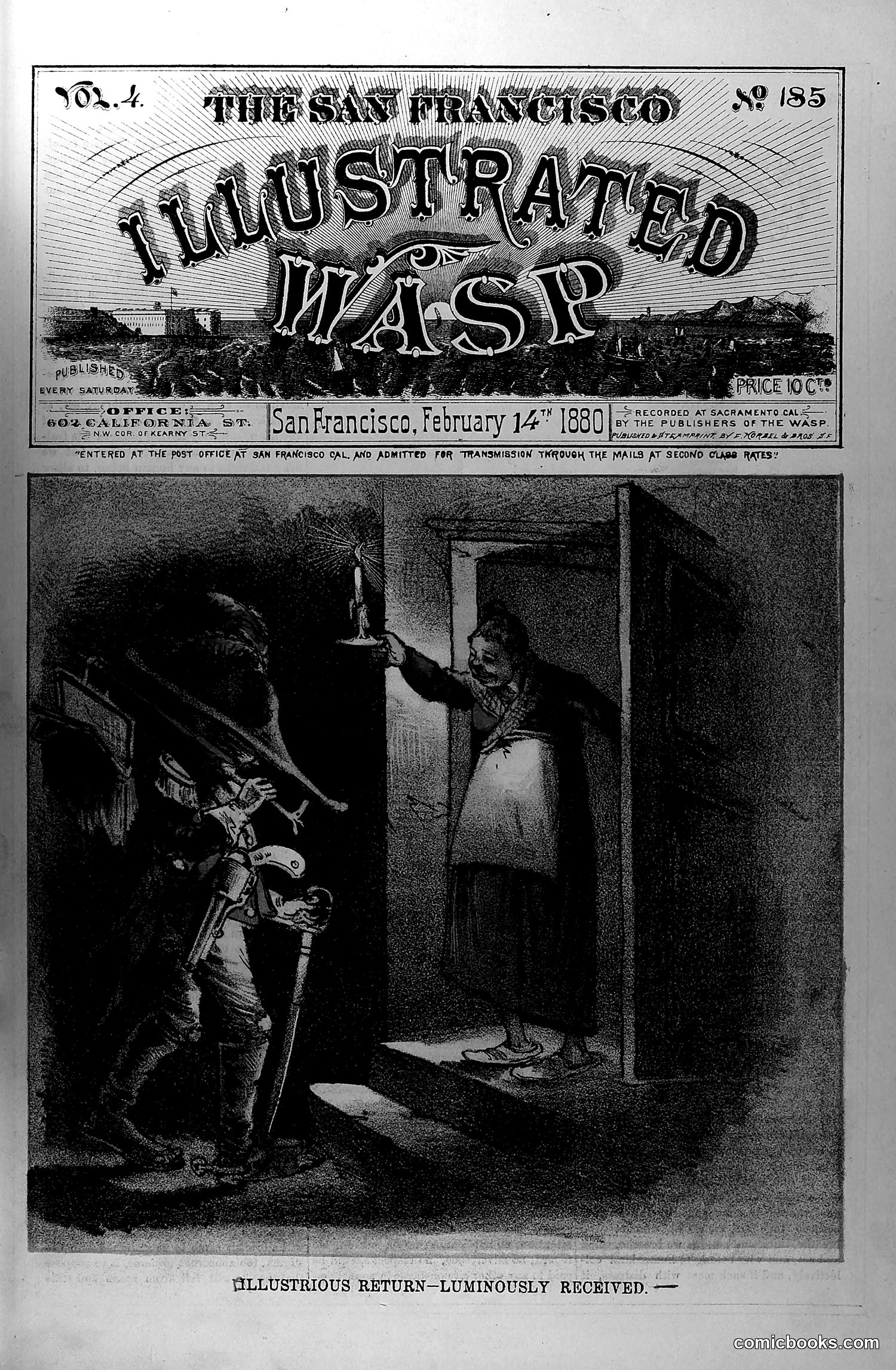
This appears to be a satirical illustration titled "Illustrious Return—Luminously Received," showing a ghostly or supernatural figure appearing at a doorway while a person with a sword stands guard outside. The exact political or social reference is unclear without additional context. The "luminous" reference in the caption and the ghostly appearance suggest this may be commenting on a real event or person returning to San Francisco in 1880—possibly someone controversial whose return was unexpected or unwelcome, warranting armed defense. The supernatural imagery could represent either mockery of someone's influence or a satirical take on fear surrounding their arrival. Without knowing the specific historical event referenced, the precise satirical target cannot be determined with certainty.
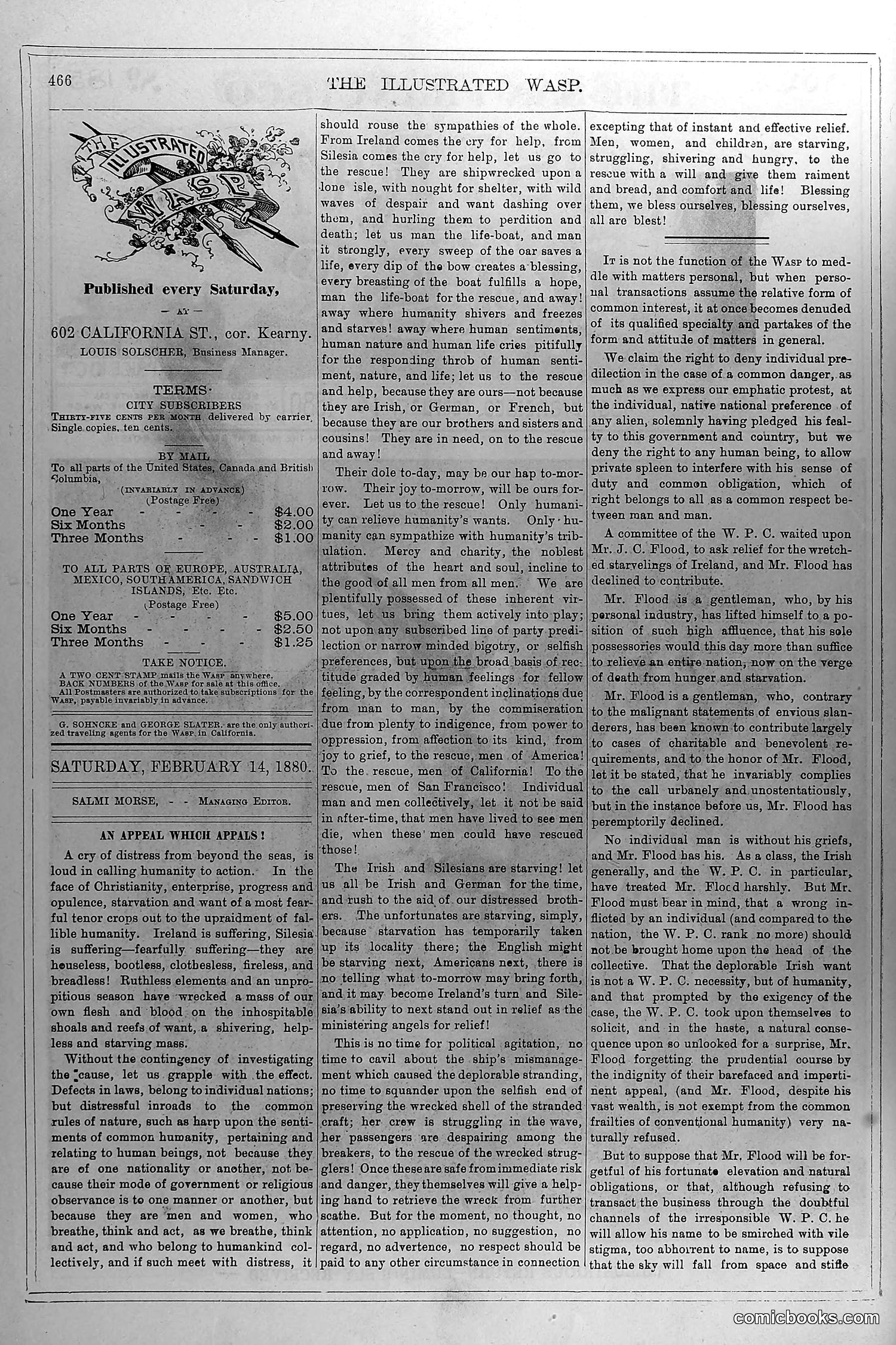
The page is primarily text-based editorial content rather than cartoons. The masthead illustration shows the Wasp logo (a wasp attacking). **Main Content:** An editorial titled "AN APPEAL WHICH APPALS!" addresses humanitarian relief for starving Irish and Silesian populations. The author criticizes what appears to be the W.P.C. (likely a charitable organization) for their inadequate response to famine crises. **The Satire:** The piece mocks the W.P.C.'s bureaucratic indifference and suggests that Mr. Flood, seemingly a prominent figure, has refused to properly champion relief efforts. The satire targets organizational apathy toward human suffering—arguing that politics and administrative procedures shouldn't obstruct compassionate action during humanitarian emergencies. **Context:** This reflects 1880s debates over charitable responsibility and Irish famine relief.
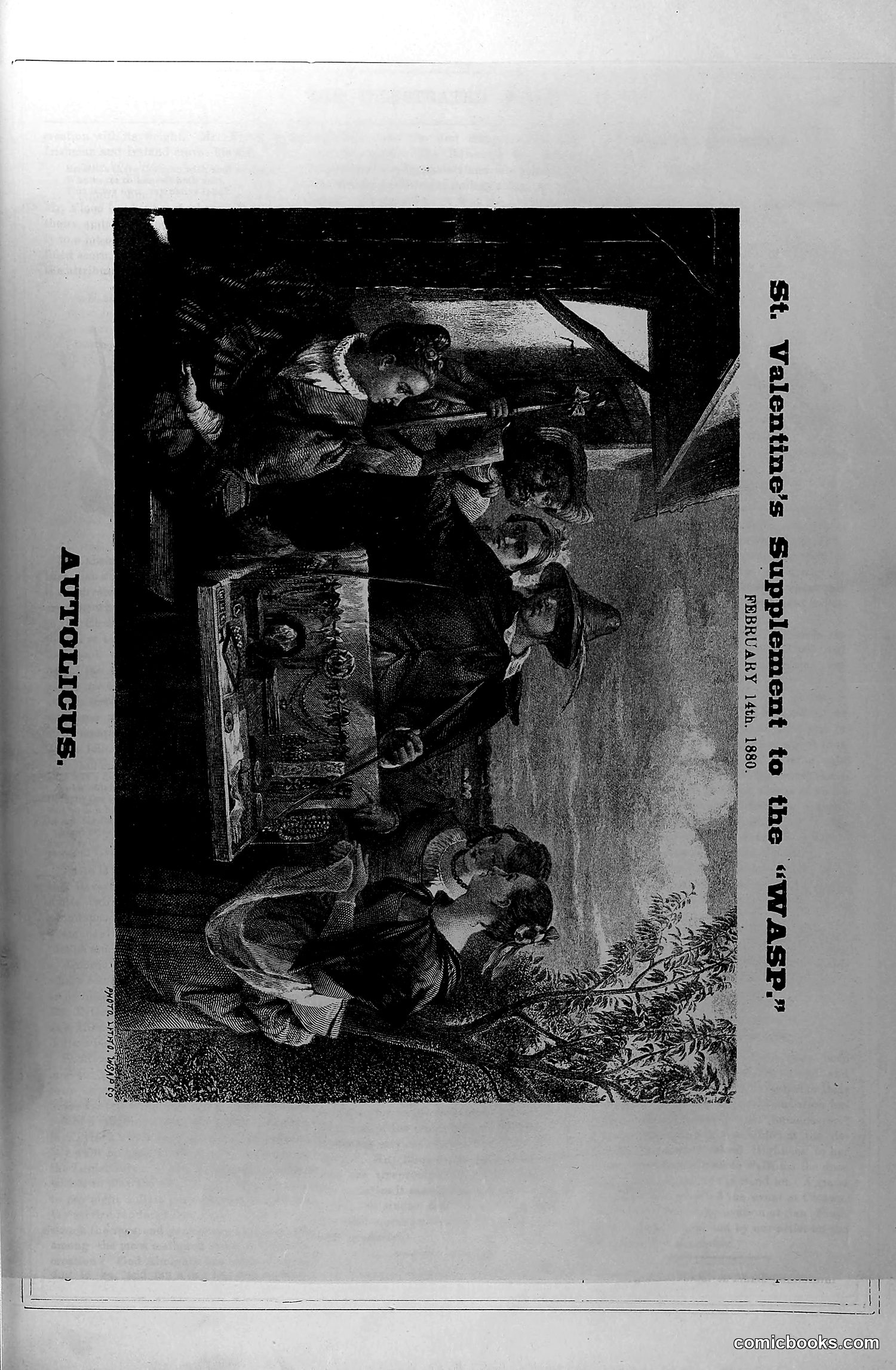
**AUTHORITIES** This satirical image depicts what appears to be a domestic or social scene being observed or scrutinized, with the title referencing St. Valentine's Day. The composition suggests commentary on courtship, romance, or relationship dynamics of the era. The "WASP" in the title refers to *The Wasp* magazine itself—a San Francisco-based satirical publication known for biting social and political commentary. The phrase "Suppliance to the WASP" suggests someone (possibly a public figure) is appealing to the magazine's editorial judgment or public opinion. Without clearer identification of the specific figures or the exact historical moment this references, I cannot definitively explain which relationship or social scandal this satirizes. The dramatic staging and multiple observers suggest mockery of either prominent individuals or broader social hypocrisy around romance and propriety.
I can see this is a page from *The Wasp*, a satirical publication, but the image quality is too degraded for me to read the OCR text reliably or identify specific figures in the central cartoon with confidence. The page appears to contain a large illustration with accompanying text, and there seem to be additional smaller items or advertisements around it, but the heavy grain and poor contrast prevent me from discerning: - Which political or public figures are depicted - What specific event or issue is being satirized - The precise nature of the joke or critique To provide accurate historical context as requested, I would need a clearer reproduction of this page. I cannot responsibly guess at identities or meanings without stronger visual evidence.
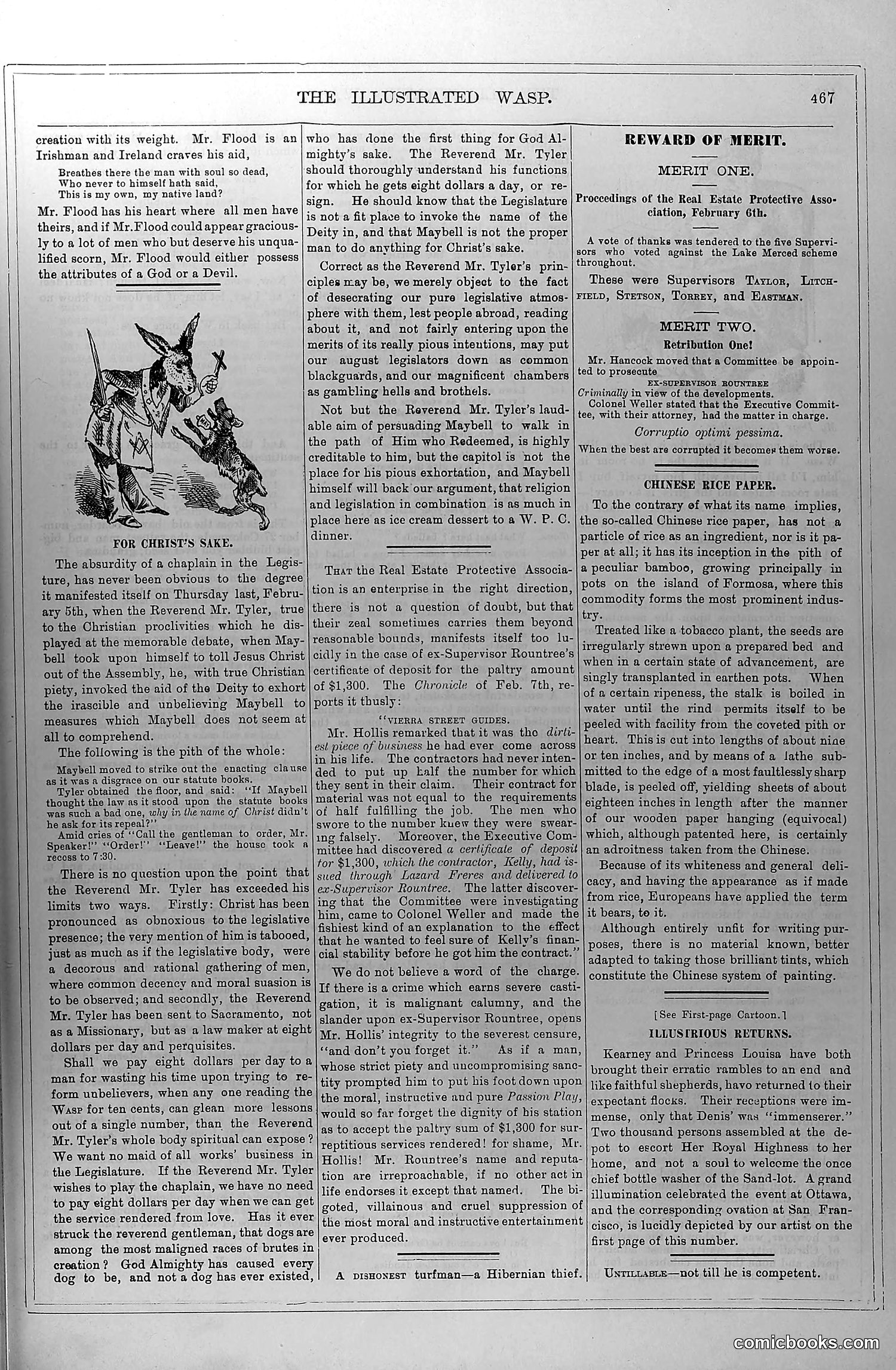
The prominent cartoon titled "FOR CHRIST'S SAKE" depicts a donkey being led by a figure in clerical dress. This satirizes the role of chaplains in legislative bodies. The accompanying text criticizes Reverend Mr. Tyler for his involvement in securing an eight-dollar daily salary through the Legislature, arguing this represents improper mingling of religion and politics. The satire contends that Tyler's push to have a chaplain walk "in the path of Him who was Redeemed" compromises both religious and legislative integrity. The donkey likely symbolizes foolishness or stubbornness, suggesting the absurdity of using Christian rhetoric to justify questionable political appointments and expenditures. The cartoonist attacks what it views as the inappropriate commercialization of clergy influence in government.
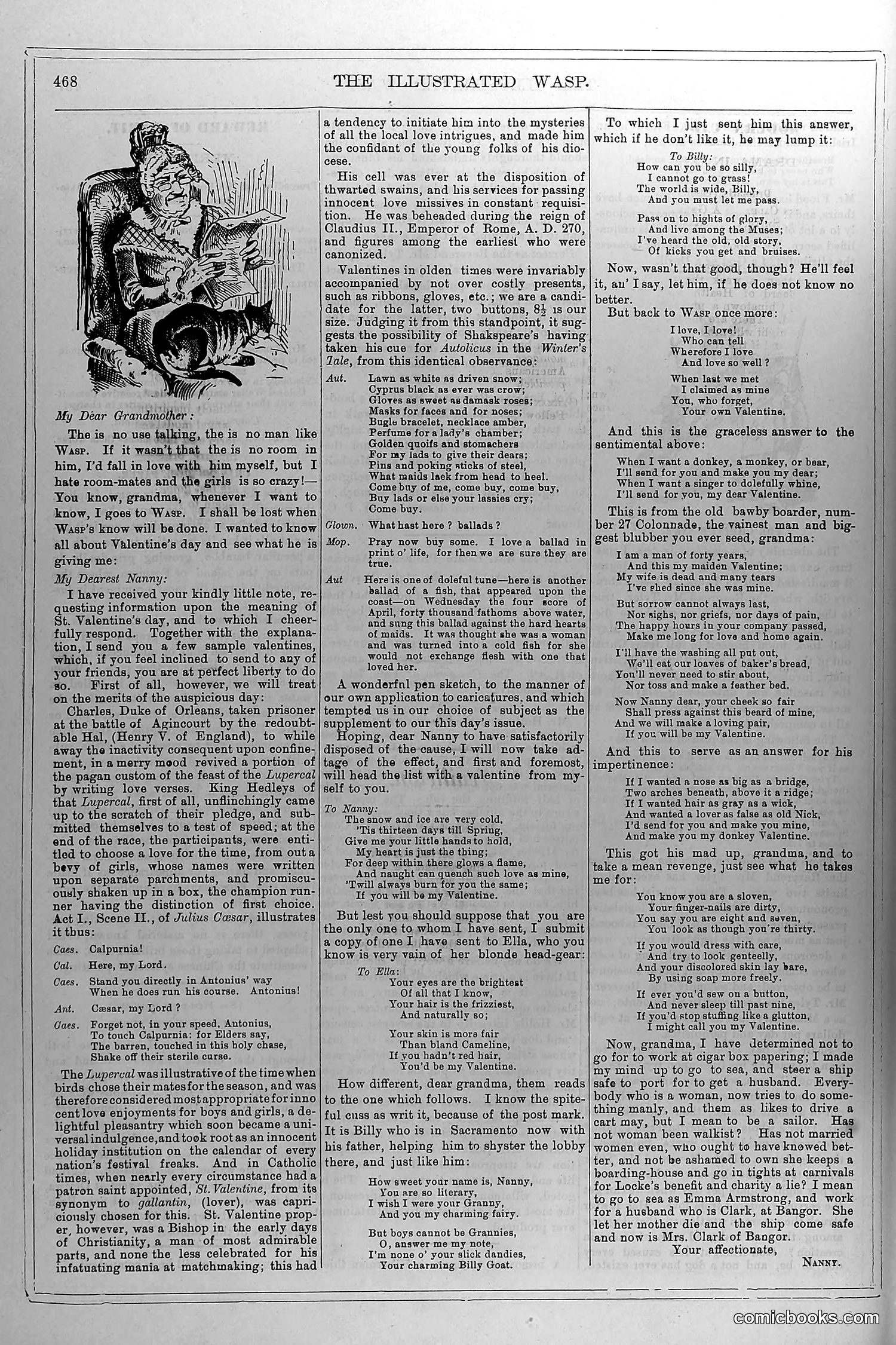
This page contains primarily **literary content rather than political satire**—it appears to be a humorous epistolary piece titled "My Dear Grandmother" featuring correspondence about Valentine's Day traditions. The main illustration shows an elderly woman with two young people, likely depicting a grandmother receiving valentines. The text consists of playful, flirtatious Valentine letters exchanged between characters with names like "Wasp," "Nanny," and "Charles, Duke of Orleans." Rather than political commentary, this represents **19th-century satirical humor targeting romantic conventions and social etiquette**—poking fun at Valentine's Day sentimentality, courtship rituals, and the supposed innocence of young people's love letters. The page demonstrates *The Wasp*'s lighter editorial content alongside its political cartoons.
This page contains three distinct pieces: 1. **"Modern Cadeism" (drama)**: A one-act play satirizing corrupt municipal politics. Characters include a "Modern Cade" (likely referencing Jack Cade, the historical rebel) who exploits a Board of Health position, and a "German Mister" representing foreign business interests. The satire targets municipal officials who leverage their positions for personal profit and use public nuisances as leverage. 2. **"Female Walking Matches"**: A brief note mocking women's athletic competitions and exhibition walking matches gaining public attention—likely poking fun at the novelty and propriety concerns surrounding women's public physical activities. 3. **"Sacramento"**: A letter from February 1880 detailing railroad corruption and political maneuvering in California, describing schemes involving the Southern Pacific Railroad and state politics. The page is primarily text-based satire rather than visual cartooning.
This page consists primarily of theater criticism and gossip columns rather than political cartoons. The masthead shows "Music and Drama" commentary. The main targets are theatrical productions and personalities: the critic discusses Mr. Vogrigh's unsuccessful opera debut, praises the "Marmion" composition, and critiques Ketton's performance. There's discussion of the masked ball at the Sazerac Palace and upcoming performances. The "Les Affaires Font Les Hommes" section shifts to social commentary, chronicling a young man named Leon who rises through professional success and becomes wealthy, eventually winning favor from prominent Parisian society figures like the Bard of Avon and Napoleon. The page functions as entertainment journalism rather than political satire—focusing on San Francisco's cultural elite and their theatrical pursuits.
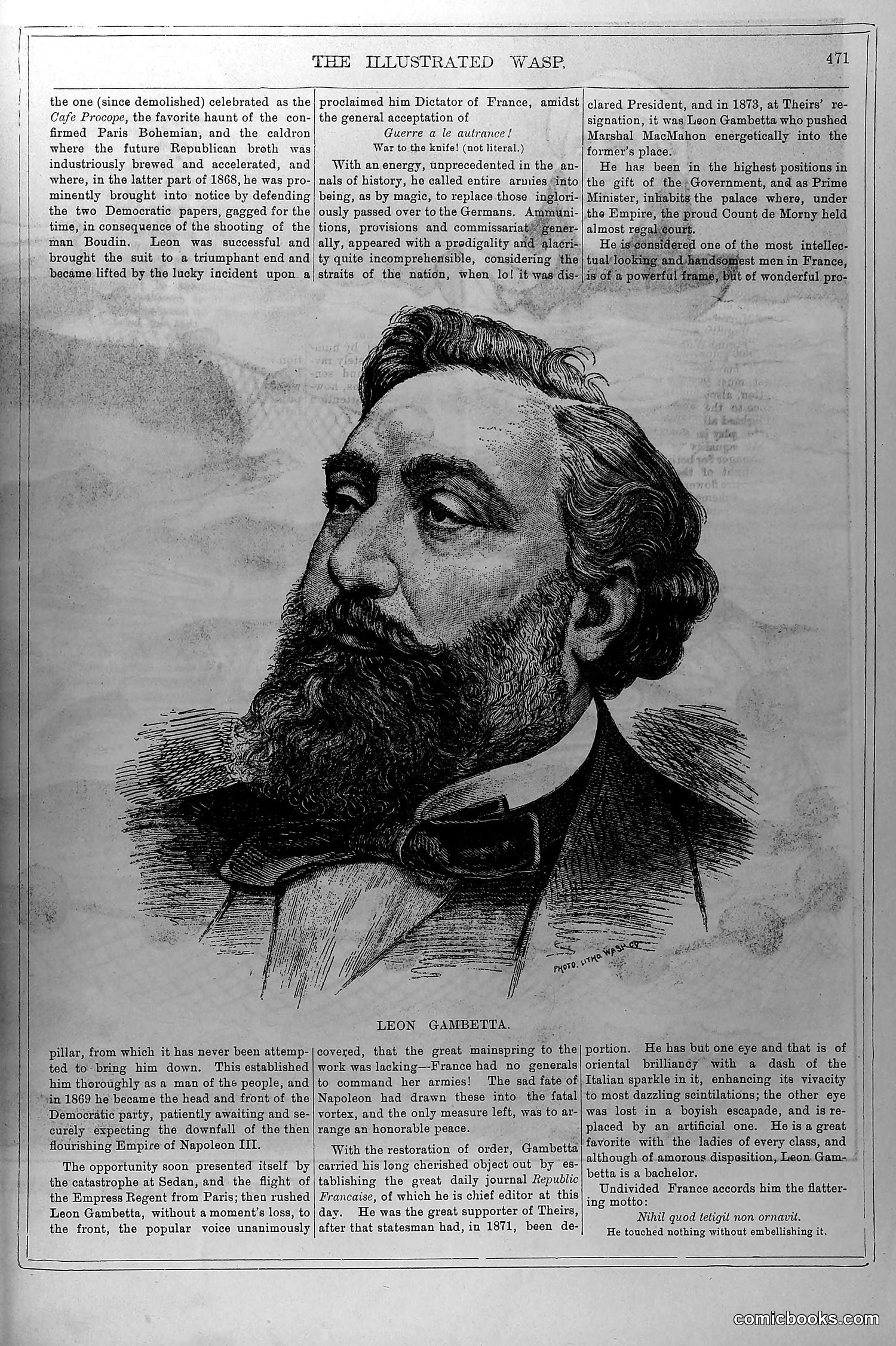
This page from *The Illustrated Wasp* features a biographical portrait and engraving of **Leon Gambetta**, a prominent French Republican politician. The text celebrates him as an intellectual and skilled orator who rose through Republican ranks during the turbulent 1860s-70s period. The article notes his role defending the Democratic newspaper *Avenir* and his involvement in the 1868 shooting incident involving Baudin. He notably became a leading figure during the Franco-Prussian War and subsequently served as French Prime Minister and other high offices. The caption emphasizes his oratorical power and political influence, describing him as "one of the most intellectual looking and handsomest men in France." The portrait shows a bearded man in formal dress—standard representation for respected statesmen of this era.
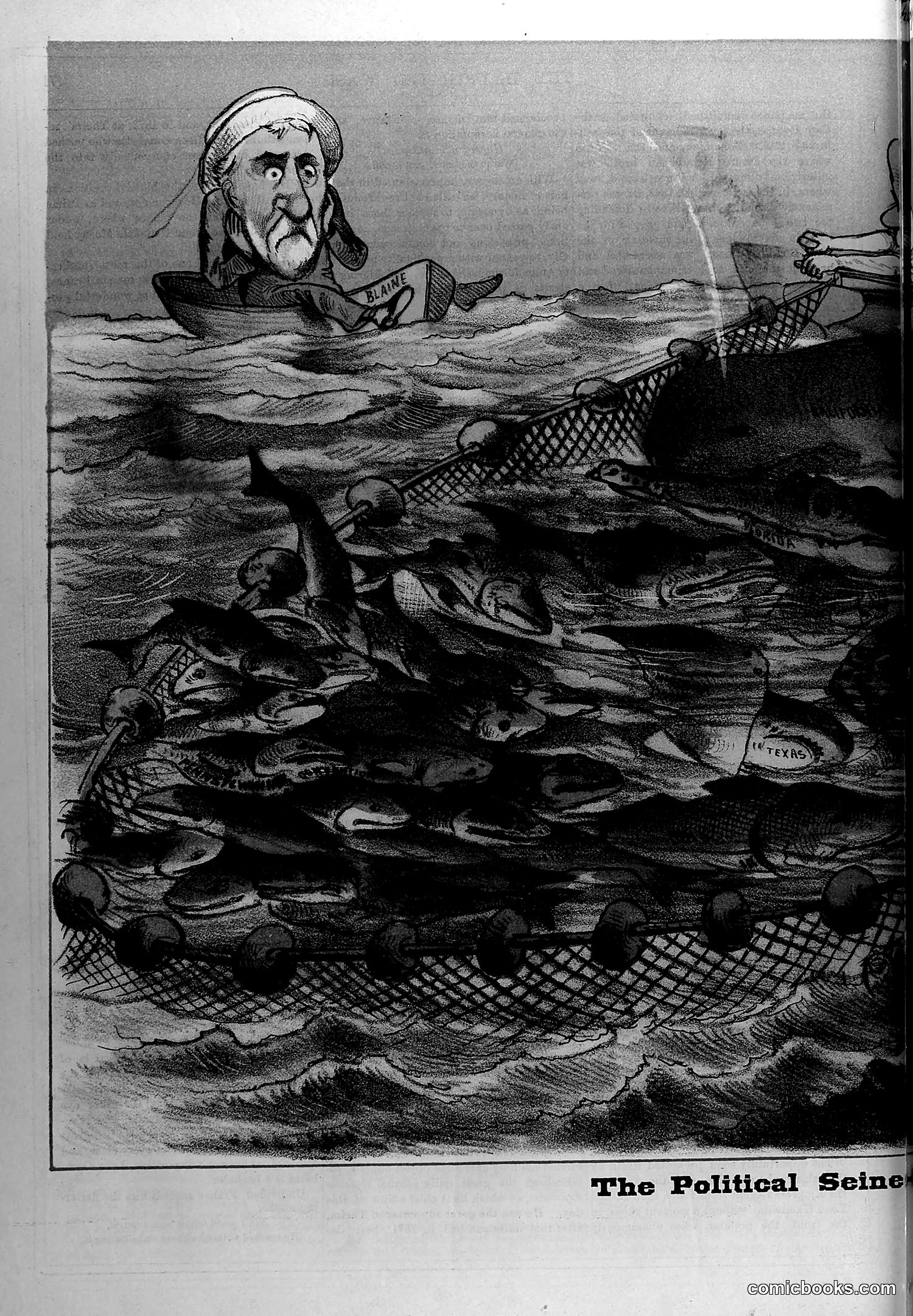
This satirical cartoon depicts a bearded fisherman in a boat labeled "BLAKE" pulling in a massive catch from the Seine River (France's famous river). The "catch" consists entirely of fish labeled with what appear to be political figures or entities—visible labels include "TEXAS." The cartoon uses fishing as a metaphor for political maneuvering or opportunism. The fisherman (likely representing a specific politician, possibly Blake) is reaping substantial political benefits or "catches" from turbulent political waters. The abundance of the catch suggests successful political manipulation or exploitation of circumstances. Without clearer date context or additional visible labels, the specific political situation remains somewhat unclear, though the image clearly critiques someone's political opportunism during a period of political controversy or change.
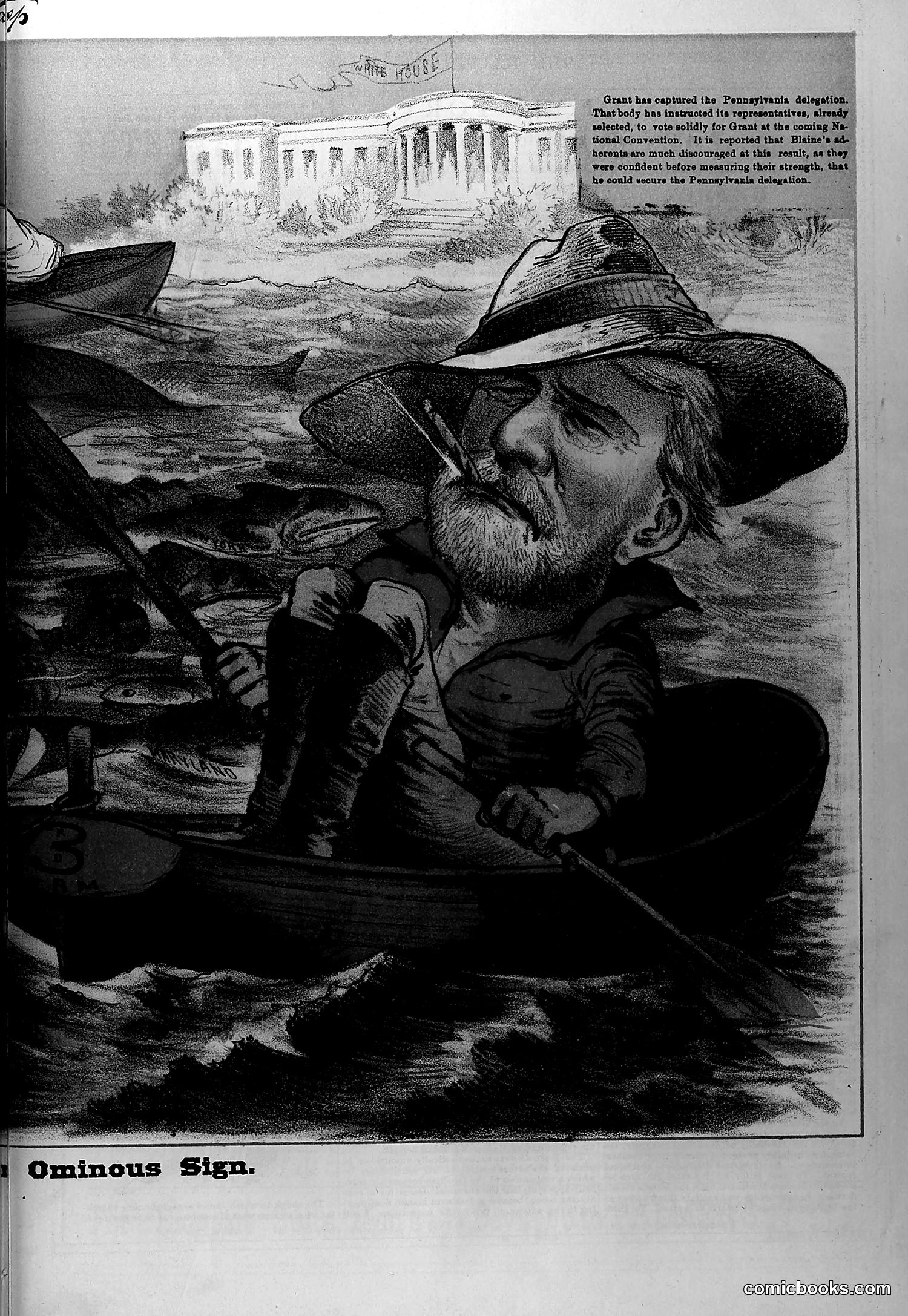
This political cartoon depicts a bearded man in a boat approaching the White House, labeled an "Ominous Sign." The accompanying text references Grant capturing Pennsylvania's delegation at a national convention, with Blaine reportedly discouraged about securing that delegation beforehand. The cartoon appears to satirize the 1880 Republican presidential race between Ulysses S. Grant and James G. Blaine. The boatman approaching Washington represents Grant's growing political momentum and threat to Blaine's nomination hopes. The "ominous" nature suggests the cartoonist views Grant's resurgence as a dangerous development for Blaine's candidacy. The White House in the background emphasizes the stakes of presidential politics at play.
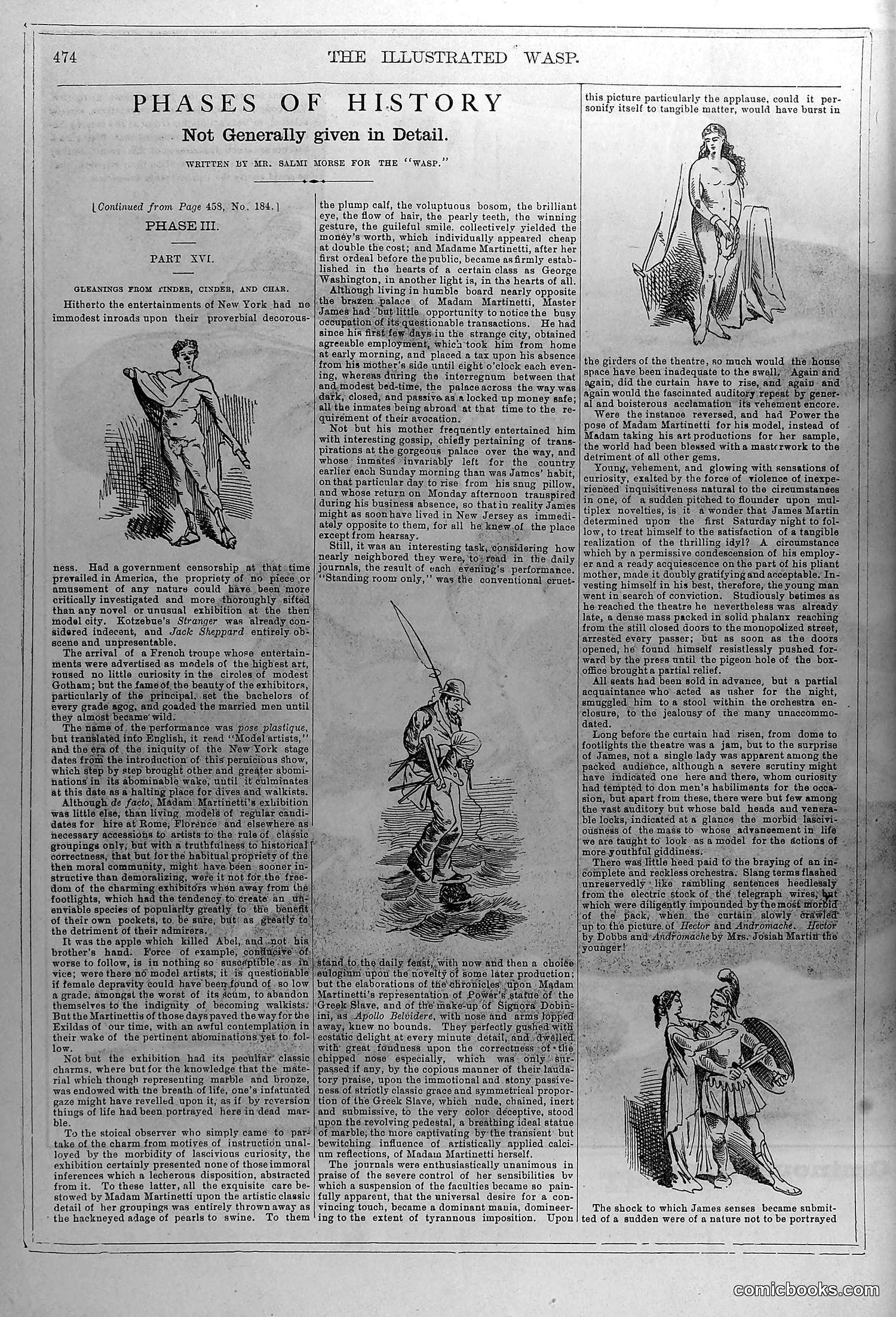
This page contains a serialized article titled "Phases of History Not Generally Given in Detail," written by Mr. Salmi Morse for *The Wasp*. The text discusses theatrical history, specifically focusing on James Martinetti's career and performances in New York. The accompanying illustrations show theatrical figures in period costume. The article critiques Martinetti's acting and productions, describing his performances with satirical commentary on his artistic choices and commercial ambitions in theater. The engravings depict characters in various dramatic poses, likely representing scenes from the theatrical productions being discussed. Without clearer labeling, specific character identification is difficult, but the overall intent appears to be mocking Martinetti's theatrical pretensions through both text and visual caricature.
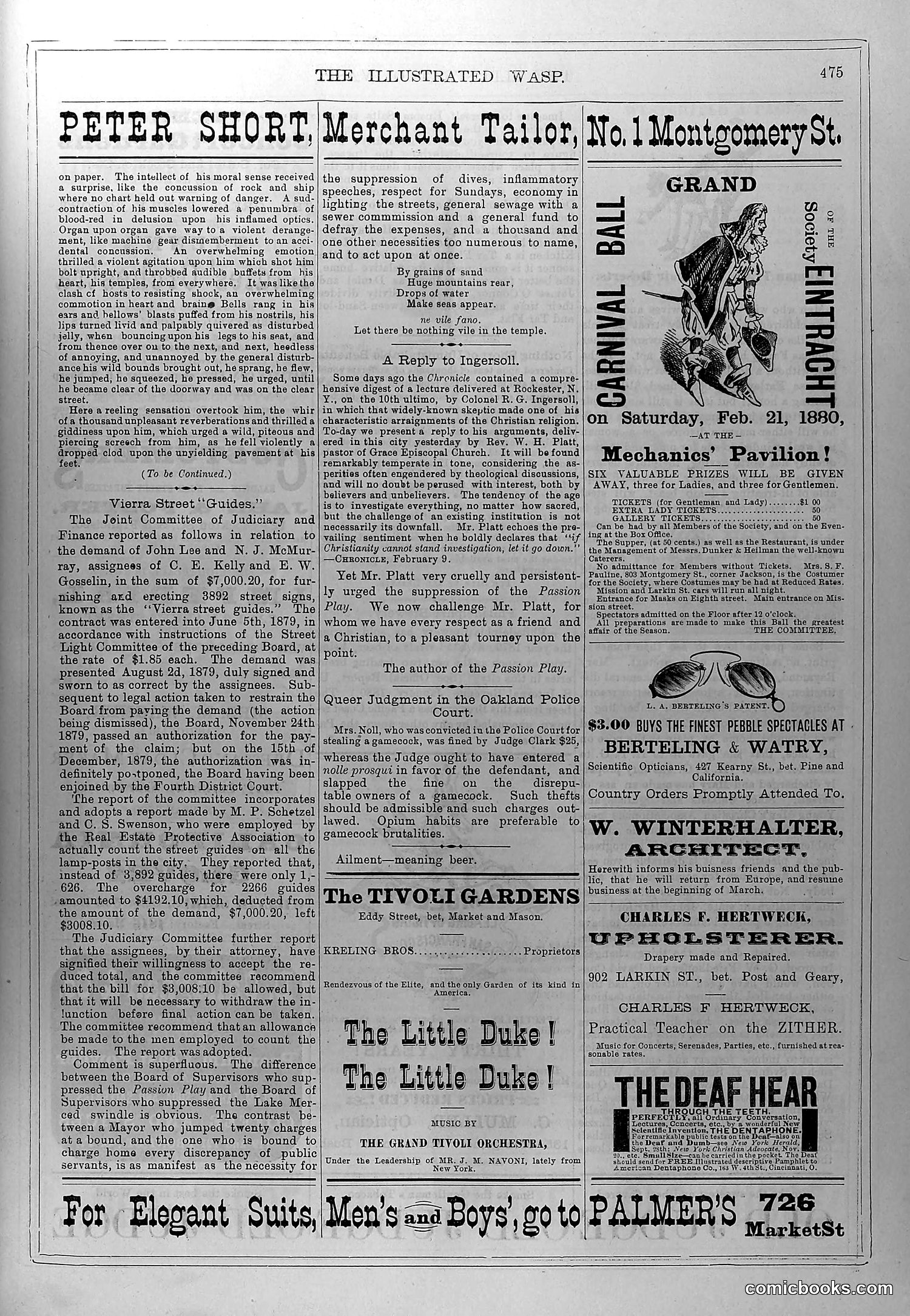
This page is primarily **advertising and announcements** rather than political satire. The dominant content includes: - A large **Carnival Ball advertisement** for Saturday, February 21, 1890, at Mechanics Pavilion, listing ticket prices and event details - Multiple business advertisements (tailor, architect, upholsterer, teacher, spectacle company) - Notices about "The Little Duke!" theatrical production with music by the Grand Tivoli Orchestra - A "Deaf Hear" device advertisement The upper portion contains a brief **satirical article** about "Vierra Street Guides" critiquing the Joint Commission of Judiciary and Finance's handling of street signage contracts and expense disputes—a local bureaucratic matter. The page reflects The Wasp's mixed model: combining local San Francisco satire with commercial advertisements.
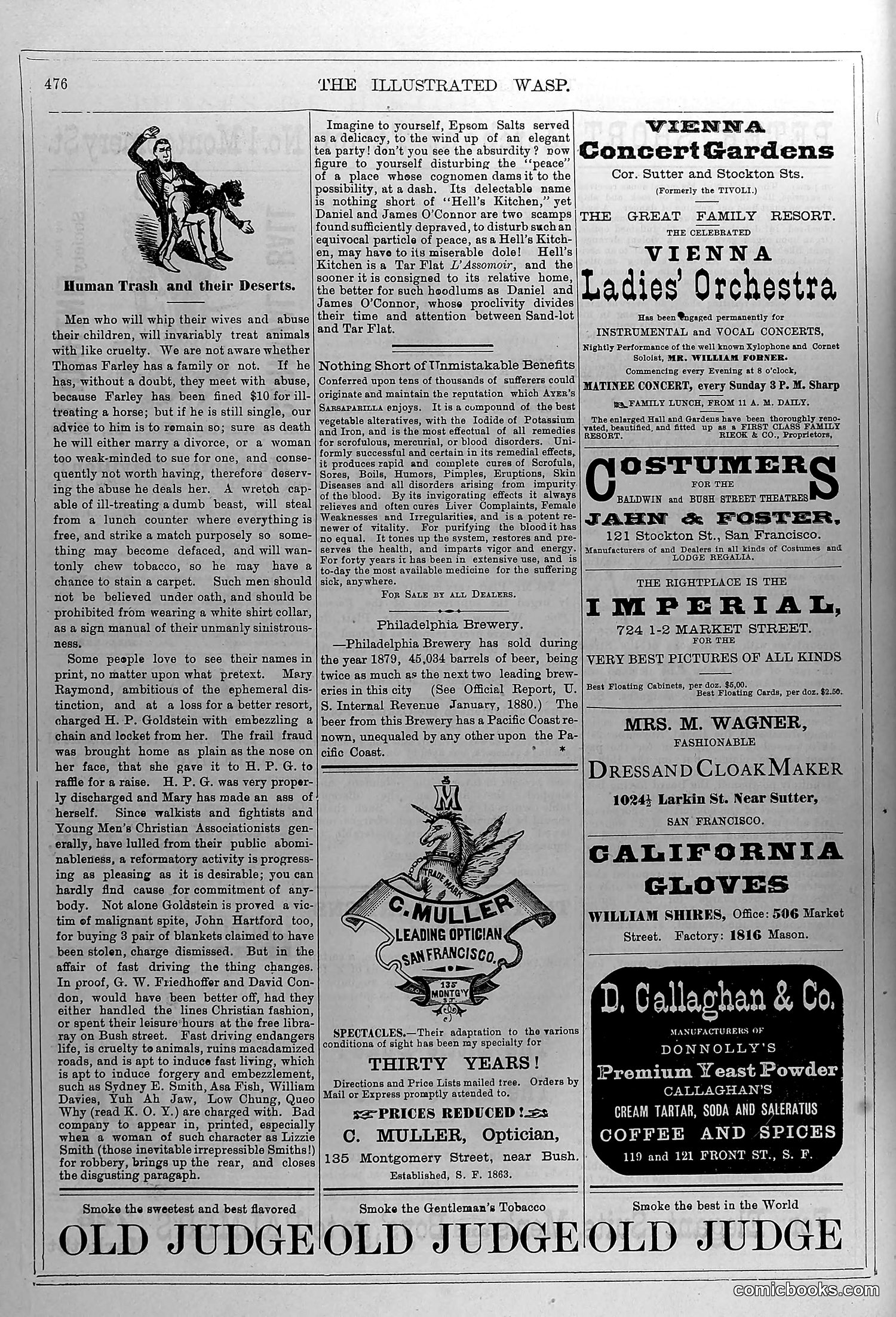
This page is primarily **advertising content** rather than satirical cartoons. The main illustrated article, "Human Trash and their Deserts," features a woodcut showing a man striking a woman and child. The accompanying text argues that men who abuse their families and animals deserve severe punishment, including execution. It cites Thomas Farley as an example of someone sentenced to death for ill-treating animals. The remainder of the page consists of period advertisements for San Francisco businesses: musical performances, costume rentals, optical services, glove makers, breweries, coffee suppliers, and tobacco products. The social message criticizes domestic violence and animal cruelty as indicators of moral degeneracy deserving capital punishment—reflecting Victorian-era attitudes about crime and punishment.
This page is primarily **advertising**, not editorial content or political satire. It contains commercial advertisements for various San Francisco businesses and products from the late 19th century, including: - Damiana Bitters (patent medicine for kidney/bladder ailments) - Tatum & Bowen (machinery) - Westerfeld & Page's Bakery - Golden Gate Laundry - B. Curtaz's Pianos - Emil Frese's Hamburg Tea (multiple remedies) - P. Liesenfeld (billiards tables) - Old Judge Cigarettes The only illustrations are decorative elements accompanying product ads—a goat, mechanical device, and spiky creature—not political cartoons. This reflects how satirical magazines funded themselves through advertising revenue.
This page is **primarily advertisements** interspersed with brief news items, not political cartoons. The main advertisements are: - **Nicoll, the Tailor** (New York branch) promoting clothing and an "Electric Light" display - **C. Herrmann** hat shop (San Francisco) - **F. Hertel & Co.** printing/lithography business (San Francisco) The news section includes a story about a **young woman named Dillingham** arrested in Manchester, NH for assault at Londonderry, and brief gossip items about society scandals and celebrity news (Mrs. Sarah Smith, the Empress of Russia). The satirical content is minimal—mostly confined to brief, mild commentary on social scandals rather than pointed political satire. This appears to be a typical late-19th century magazine page mixing advertising revenue with light scandal reporting.
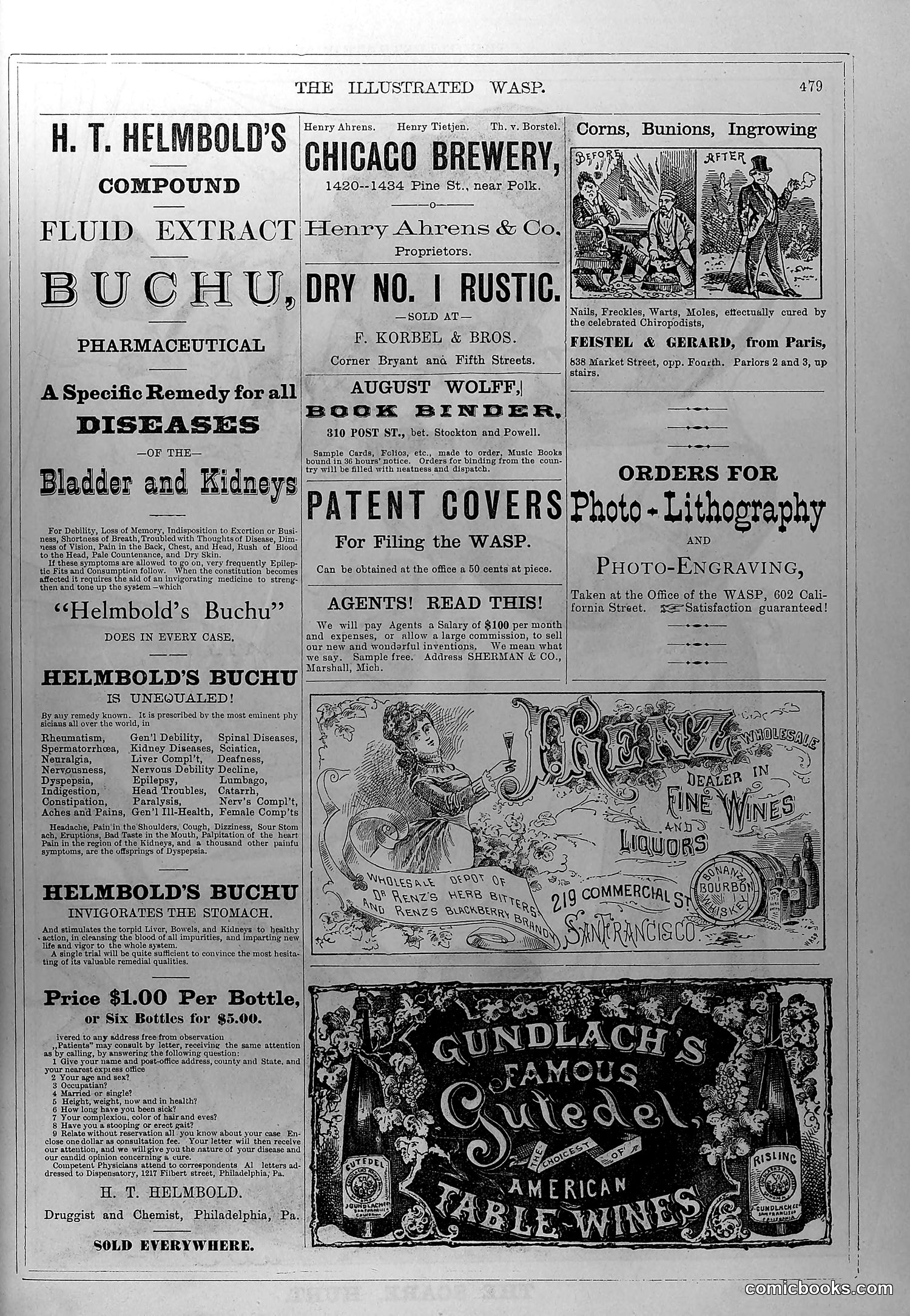
This page is primarily **advertising, not editorial content**. It contains commercial notices for patent medicines, breweries, and services typical of late-19th-century publications. The main advertisements include: - **H.T. Helmboldt's Buchu**: A patent medicine claiming to cure bladder and kidney diseases—a common medical fraud of the era - **Chicago Brewery**: Beer advertisement - **Patent Covers for Filing the Wasp**: Archival supplies - **Photo-Lithography services** - **Wine and liquor merchants**: Including Gundlach's and a San Francisco wine depot The decorative illustrations are generic commercial art, not political satire. There are no identifiable political figures or satirical commentary visible. This appears to be a revenue page supporting the magazine through advertisements rather than editorial content.
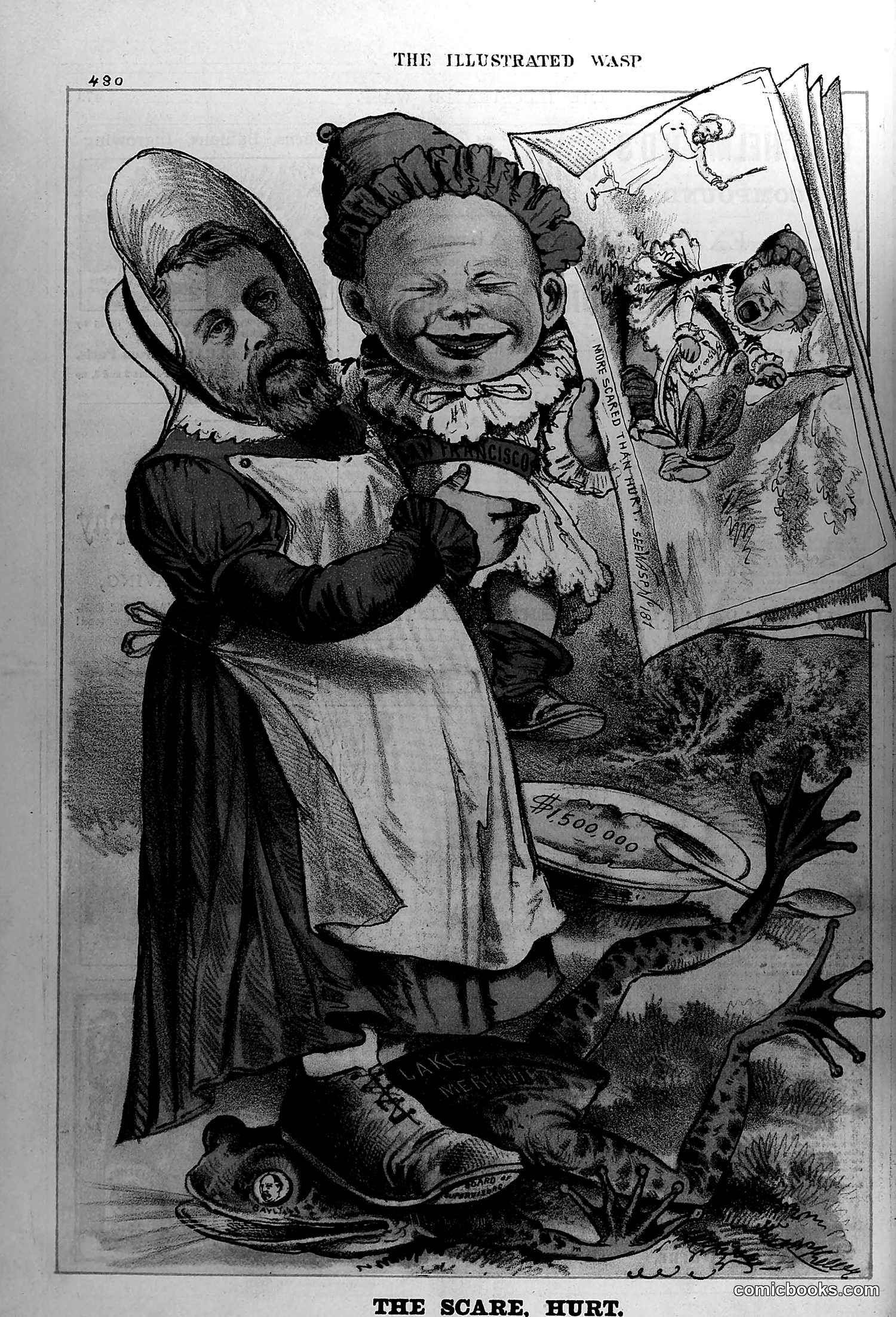
This satirical cartoon depicts a woman in Victorian dress holding a grotesque baby doll or caricatured infant. The title "The Scare, Hurt" suggests the image comments on public reaction to something disturbing or frightening. The woman's exaggerated expression and the baby's distorted features appear designed to mock or ridicule. In the background, smaller figures react with apparent alarm or distress, reinforcing the theme of fear or scandal. Without additional context from the publication date or accompanying text, the specific political or social target remains unclear. However, the grotesque imagery typical of 19th-century American satirical magazines likely addressed contemporary anxieties about maternity, social morality, or a particular public figure or event that caused public concern.

I can see this is a test or reference page containing a grayscale checkerboard pattern of varying tones positioned next to measurement scales. This appears to be a **calibration or reference chart** rather than editorial cartoon content from *The Wasp* magazine. The page includes numbered vertical and horizontal rulers (marking measurements 6-11 and extending to 10), likely used for documenting photograph size and exposure quality during printing or archival processes. This type of chart was standard in early-to-mid 20th century publishing to ensure consistent reproduction and accurate scaling of images. Without visible satirical imagery, caricatures, or editorial content, this page functions as a technical apparatus rather than satire material.