
A complete issue · 20 pages · 1880
The Wasp — February 7, 1880
I can see this is a page from *The Wasp* magazine with Oregon Rule Co. measurement scales visible, but the actual cartoon content is not legible enough in this black and white image for me to identify specific figures, caricatures, or satirical references with confidence. The image shows what appears to be a test pattern or color chart on the right side of the page, which suggests this may be a reproduction or archival document rather than the original cartoon artwork. Without being able to read any text or clearly distinguish the illustrated content, I cannot reliably explain the satire or political/social commentary to a modern reader. A higher-resolution or clearer image would be needed for accurate analysis.
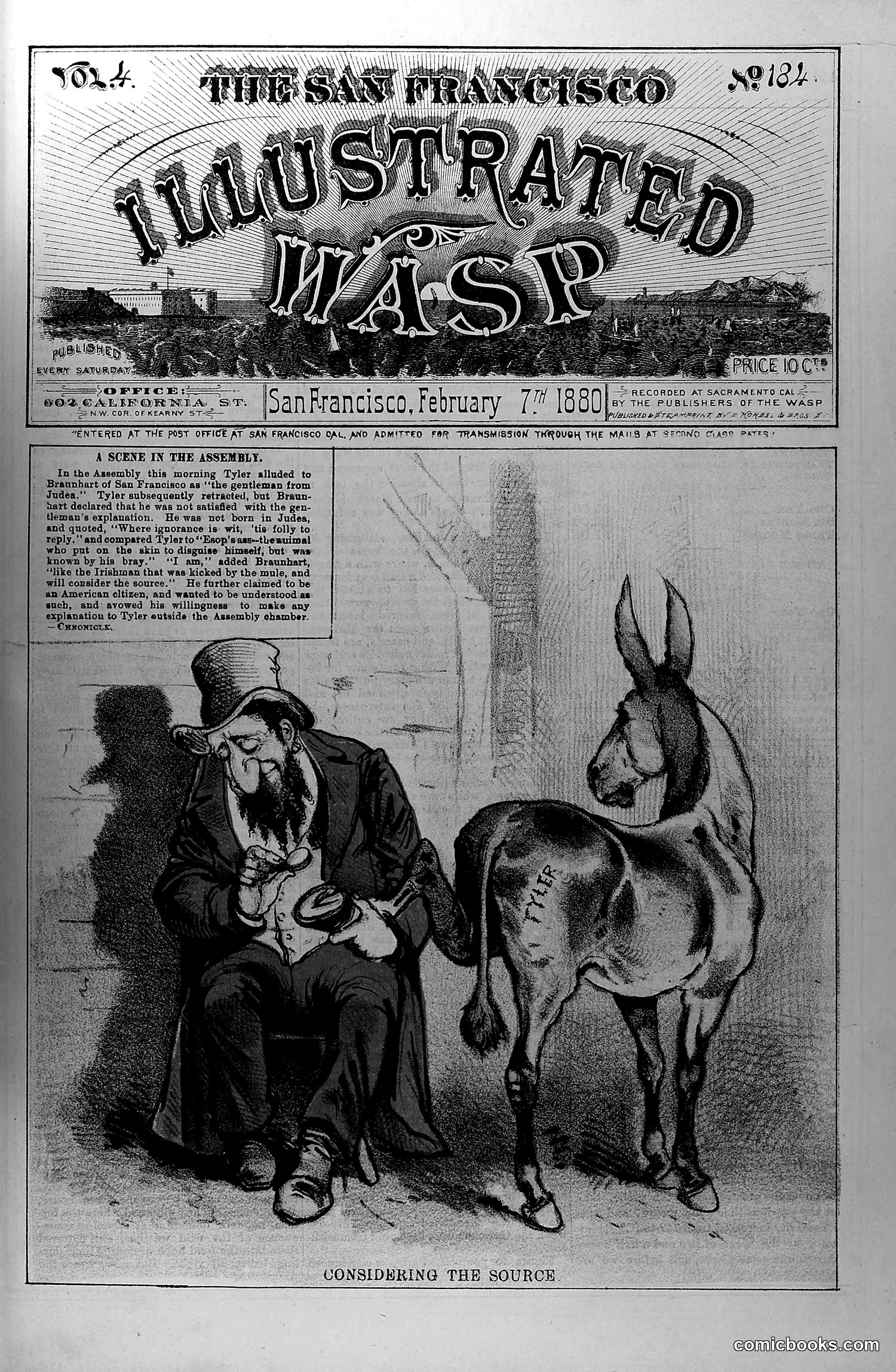
**The Cartoon:** "Considering the Source" depicts a man in formal dress examining a donkey labeled "THE" (likely representing a newspaper or political rival). **The Context:** The accompanying text describes a dispute in the California State Assembly between Braunhart (described as "the gentleman from Judea") and Tyler over Jewish identity and assimilation. Braunhart objected to Tyler's characterization, declaring he was born an American citizen and demanding respect. **The Satire:** The donkey represents dismissing someone's argument as unreliable or foolish—"considering the source." The cartoon satirizes the assembly dispute, suggesting one party's claims should be disregarded. The antisemitic undertones are evident in the text's emphasis on Braunhart's Jewish identity as relevant to the debate.
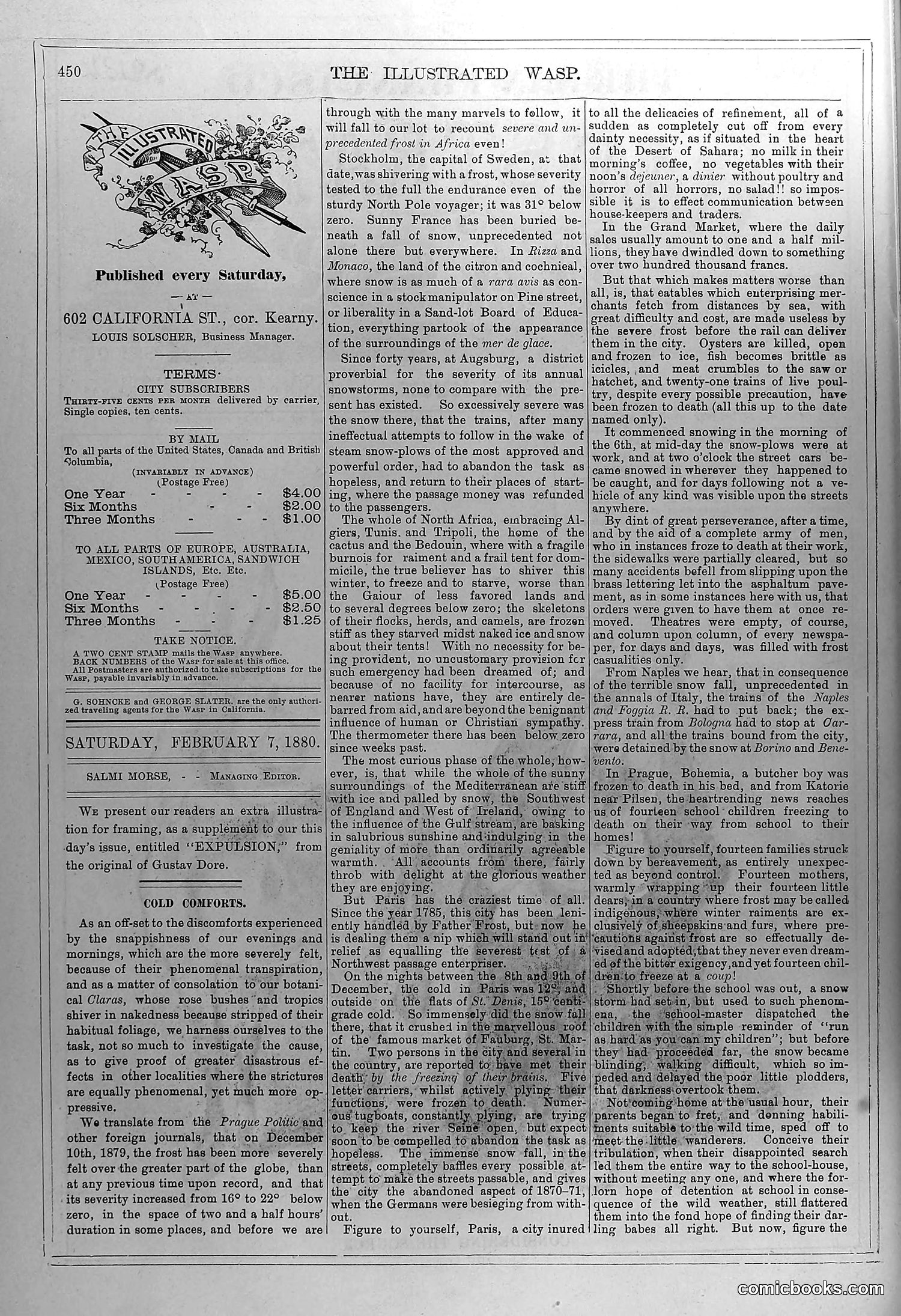
This page from *The Wasp* (February 10, 1880) is primarily **publication information and subscription rates** rather than satirical content. The masthead indicates this was a San Francisco-based weekly magazine edited by Saimi Morse. The page includes subscription pricing ($4.00/year domestically, $5.00 internationally) and business details. The only illustrated content visible is a small decorative header image showing what appears to be a wasp amid flora. The substantial text discusses severe winter weather across Europe and North Africa—extreme cold in Paris, snow in North Africa, and frozen conditions affecting transportation and populations. This appears to be a straightforward informational/administrative page rather than satirical commentary, though *The Wasp* was known for political satire and social criticism in other issues.
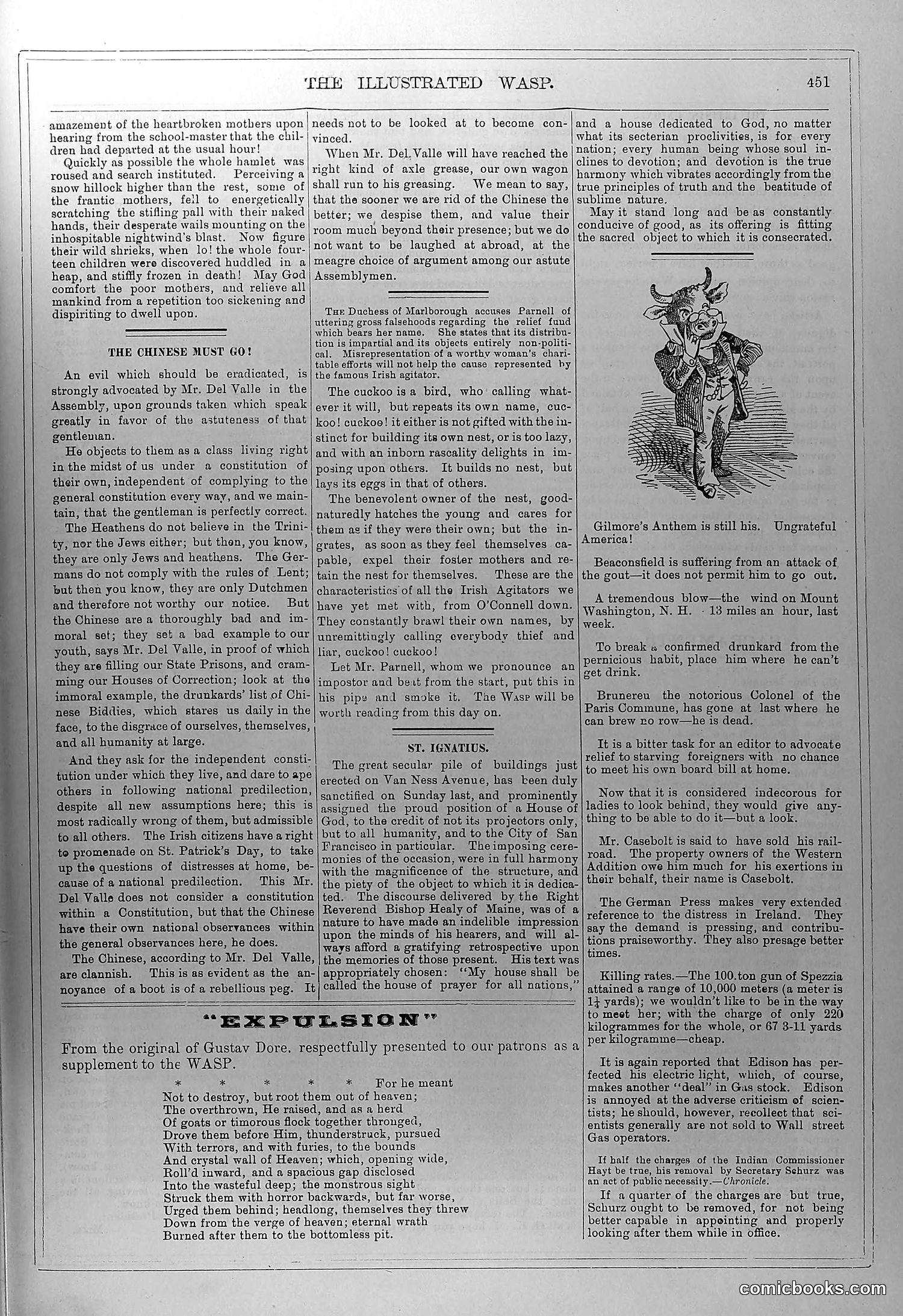
This page contains several satirical articles rather than a single cartoon. The main illustrated piece shows a caricatured cow or bull being driven forward—likely representing Chinese laborers or Chinese immigration policy, given the adjacent article "THE CHINESE MUST GO!" The article argues against Chinese workers as a "class living right in the midst of us," claiming they don't assimilate and compete unfairly with American labor. It references Mr. Del Valle's assembly speech advocating their expulsion. The page also includes commentary on Irish agitators, European relief efforts, and other contemporary issues. The central message is xenophobic—arguing for removal of Chinese workers from America on economic and cultural grounds, a common anti-Chinese sentiment during California's late 19th-century labor disputes.
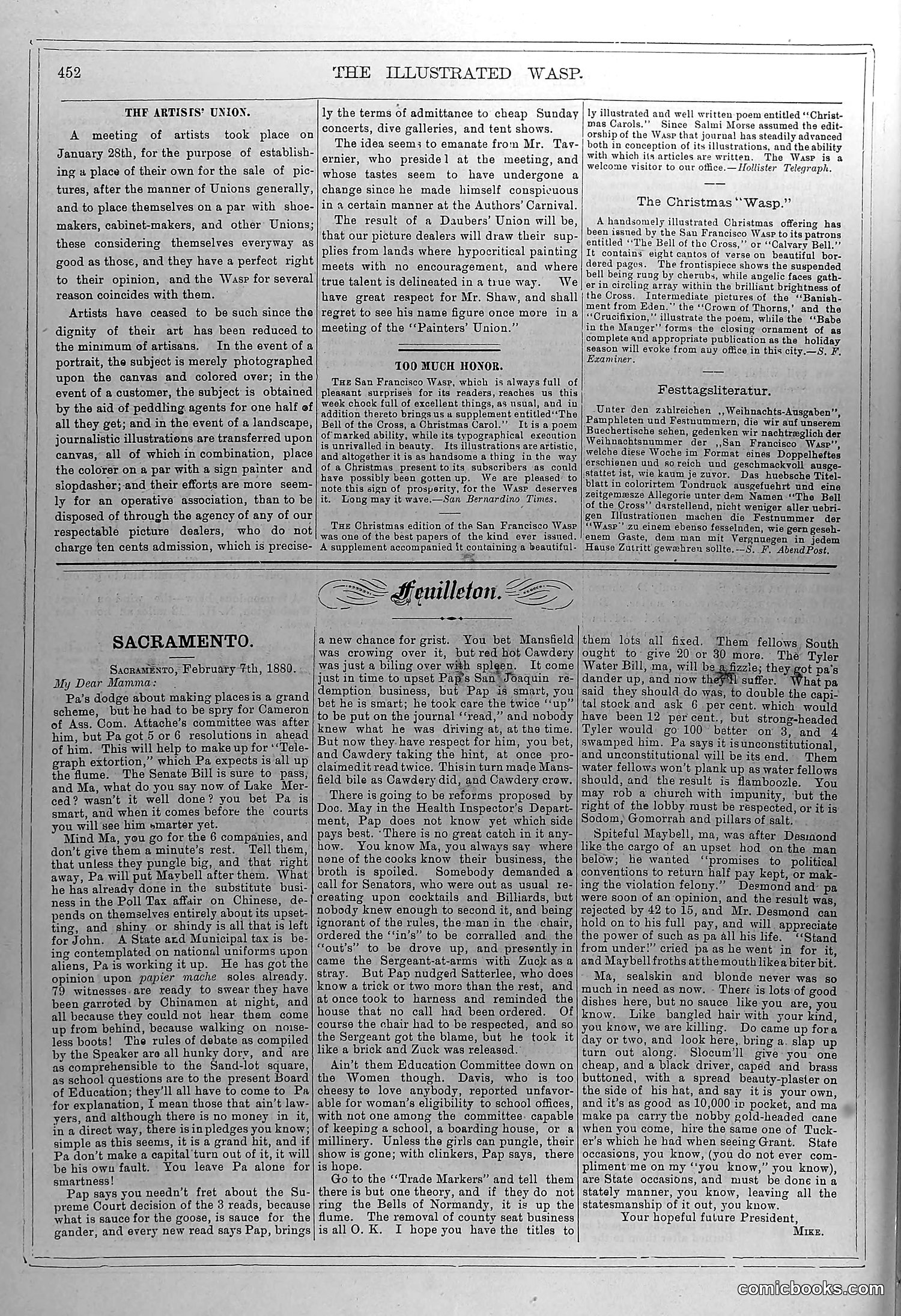
This page primarily contains **text sections rather than political cartoons**. The main content includes: 1. **"The Artists' Union"** - Reports on a January 28th meeting establishing a cooperative organization for artists to sell their work directly, bypassing traditional dealers. The satire critiques picture dealers who allegedly "draw their supplies from lands where hypothetical painting needs to be encouraged." 2. **"100 Much Honor"** - Praises the San Francisco Wasp's Christmas edition, calling it one of the finest papers ever issued. 3. **"Feuilleton"** section - Contains a letter from Sacramento (Feb 7, 1889) discussing local political issues and court cases, written in a humorous, gossipy tone typical of the publication's satirical style. The page appears primarily editorial rather than featuring illustrated political cartoons.
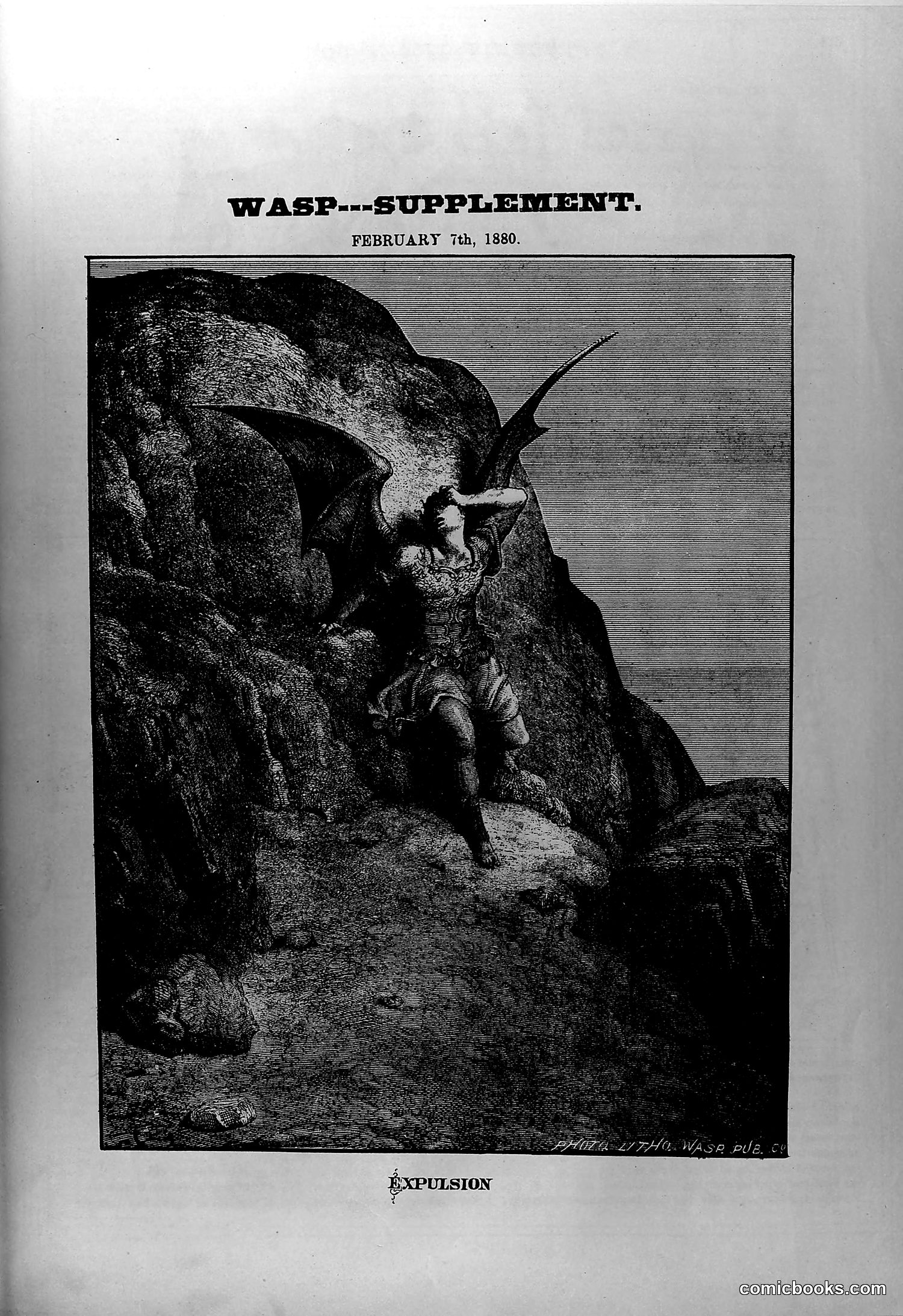
This engraving depicts a figure being forcibly expelled from what appears to be a confined space—likely a cave or chamber formed by large rocks or architectural elements. The expelled figure has exaggerated facial features characteristic of 19th-century caricature. Without additional context from the full article, the specific target of this "expulsion" cartoon remains unclear. However, given The Wasp's role as a San Francisco satirical publication in 1880, it likely addresses a contemporary political or social controversy—possibly involving immigration, labor disputes, or local politics. The violent imagery suggests strong disapproval of whoever is being depicted. The full caption or accompanying text would be necessary to identify the specific figure and event being satirized.
I can see this appears to be a page from *The Wasp*, a satirical publication, but the image quality is too degraded for me to reliably identify specific figures, read the OCR text clearly, or determine what cartoon or content is being depicted. The page shows what appears to be an illustration or photograph in the center, but the grainy, low-contrast black-and-white reproduction makes it impossible to discern details with confidence. To provide accurate analysis of the satire, political references, and historical context you're asking about, I would need a clearer source image. I'd rather acknowledge this limitation than guess at identities or meanings not clearly visible.
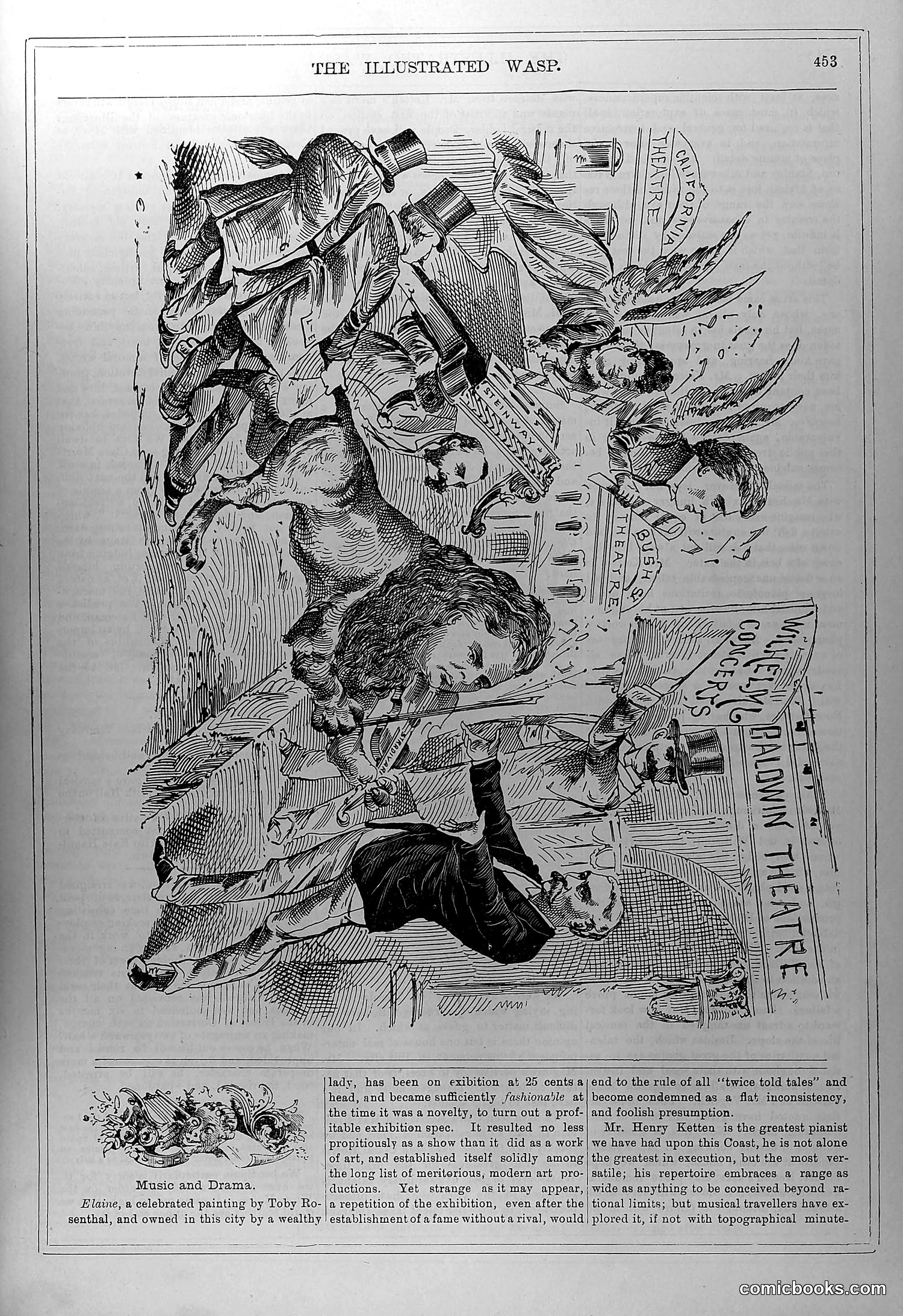
This page satirizes the art world and musical establishment. The main cartoon shows elegantly dressed figures in top hats examining or dismissing artworks at what appears to be an exhibition or theater. The illustration is titled "Music and Drama" and references "Blaine, a celebrated painting by Toby Rosenthal" that had been displayed at 25 cents admission. The text criticizes how this valuable painting became fashionable among wealthy patrons through repeated exhibition, suggesting artificial hype drives art appreciation rather than genuine merit. The satire mocks both the pretentious art establishment and gullible collectors who follow trends. The caption also mentions pianist Henry Katten, implying similar criticism of musical celebrity culture driven by reputation rather than actual talent.
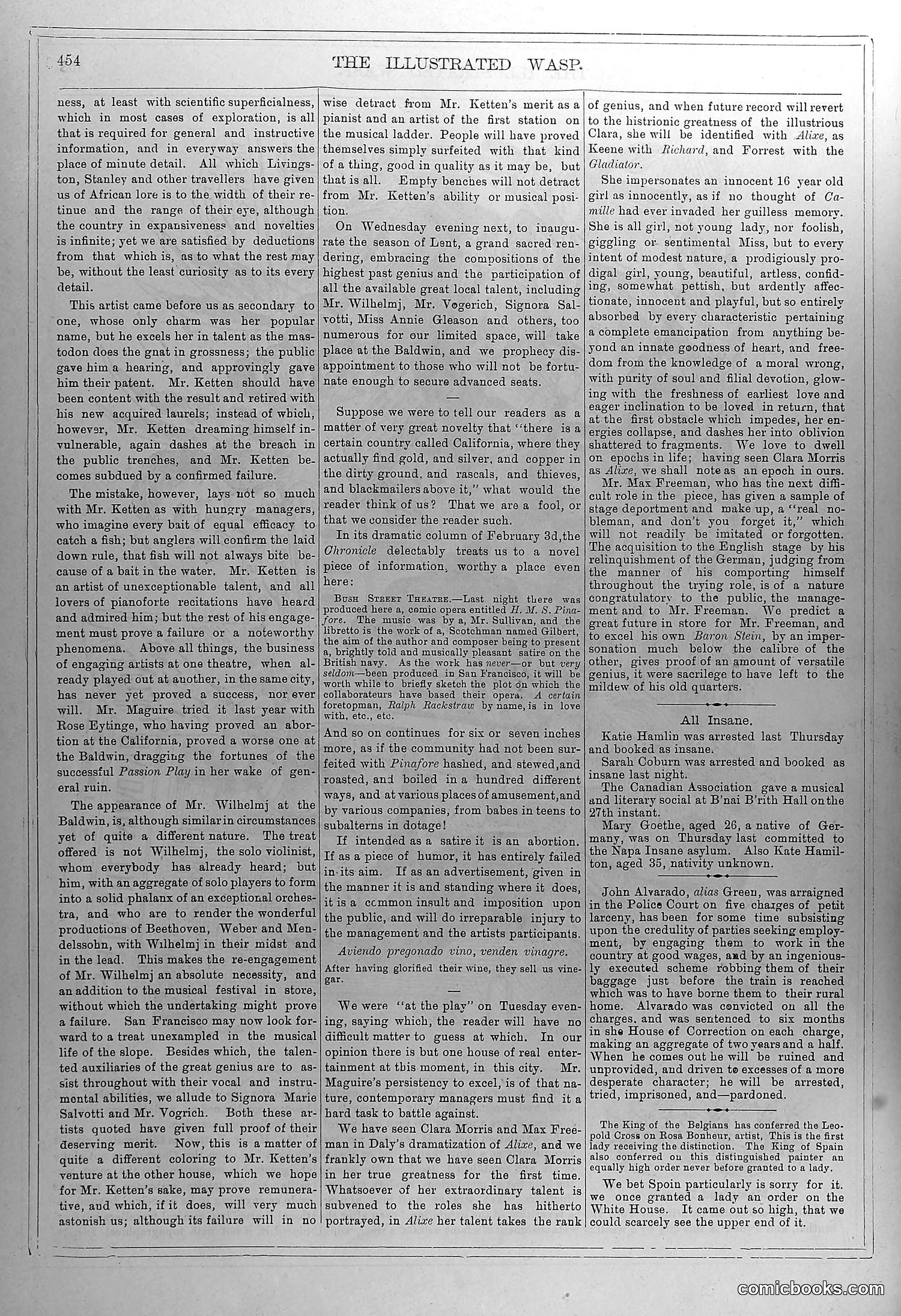
This appears to be a text-heavy editorial/review page rather than a cartoon page. The content discusses theatrical and artistic performances in San Francisco, including reviews of opera productions and artist appearances. The page critiques various performers and productions, with particular attention to Mr. Ketten (described as a pianist and artist) and discussions of other theatrical ventures. There are also brief news items about arrests and social events. The writing employs typical satirical magazine commentary—mixing praise with barbed criticism of artistic merit and public taste. However, **without visible cartoon illustrations on this particular page**, the satire operates through editorial voice rather than visual caricature. The page functions as social commentary on San Francisco's cultural scene rather than graphic satire.
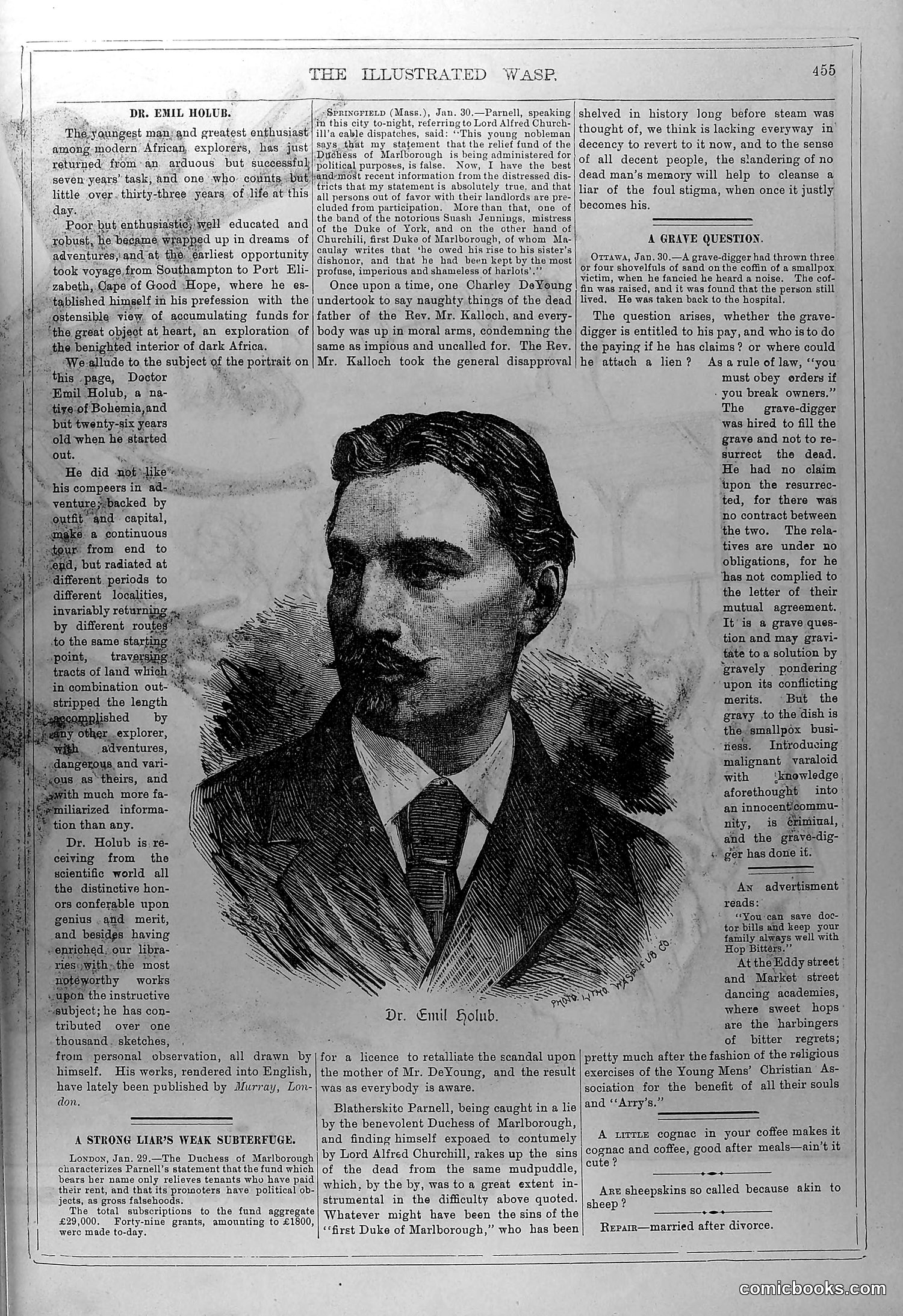
This page is primarily a biographical profile of **Dr. Emil Holub**, a Bohemian explorer and African adventurer. The accompanying engraved portrait shows a bearded man in formal attire. The page is not primarily satirical cartoon content, but rather feature journalism with three short news items appended below: 1. **"A Strong Liar's Weak Subterfuge"** — addressing a Duchess of Marlborough scandal involving fund-raising 2. **"A Grave Question"** — a legal problem about grave-diggers' liens on unclaimed bodies 3. Brief advertisements and miscellaneous notes The Holub profile celebrates his scientific contributions and African explorations, contrasting his individualistic approach with other explorers' methods. This appears to be straightforward biographical journalism rather than satire.
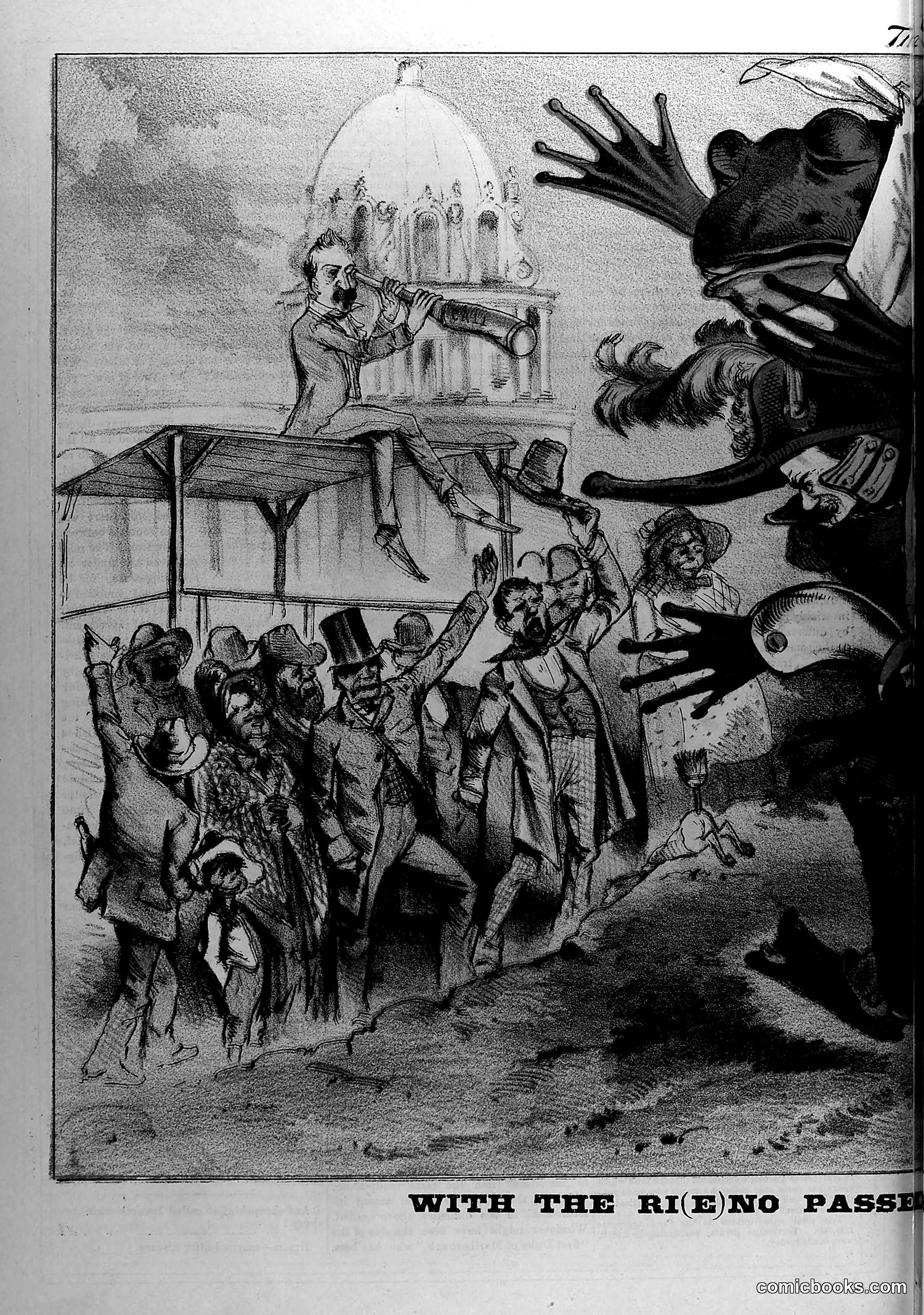
This satirical engraving depicts a crowd of common people gathering beneath a domed building (likely a capitol or government structure) while a figure stands elevated on scaffolding, viewing the scene through a telescope or spyglass. The caption's wordplay on "RENO PASSE" (playing on the word "passed") appears to reference something deemed outdated or obsolete. The crowd below, shown in caricatured style typical of 19th-century satire, gestures upward toward the elevated observer. The cartoon likely satirizes political detachment—how those in power (the elevated figure) observe common citizens below with distance and remove. The specific historical reference remains unclear without additional context about which issue of *The Wasp* this represents.
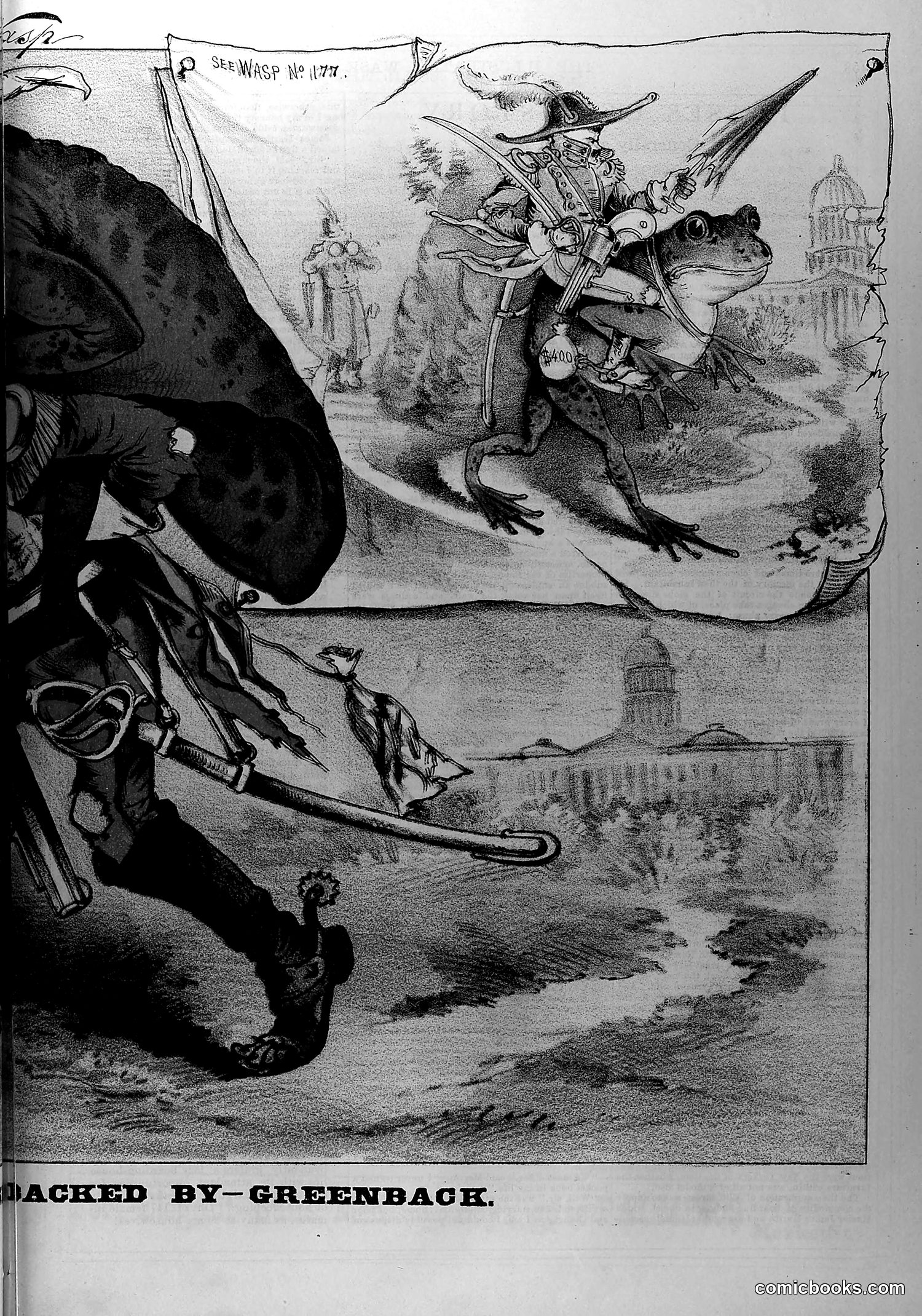
This satirical cartoon from *The Wasp* magazine presents a surreal scene where a frog-headed figure (wearing military attire with a sword) is being attacked or confronted by what appears to be a large monetary note or "greenback" (visible on the left side). The title "ATTACKED BY GREENBACK" suggests commentary on financial or monetary issues. The frog-soldier's exaggerated features and military costume indicate this is caricatured political commentary, likely critiquing a political figure or policy related to currency or financial matters. The architectural elements visible in the background suggest an American governmental setting. However, without additional context about the specific date and political figures involved, the precise target of this satire remains unclear.
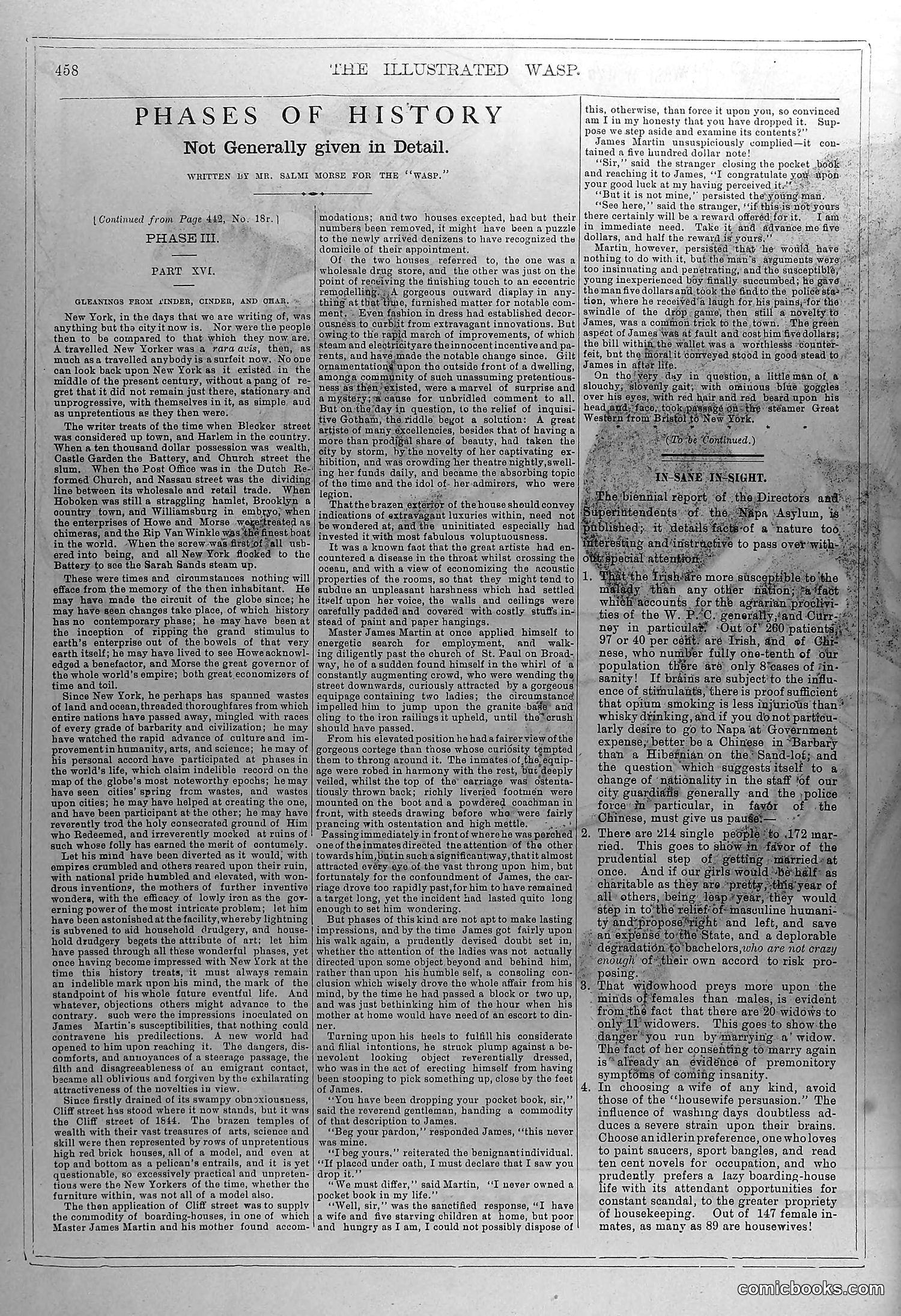
This page contains primarily text rather than cartoons—it's a serialized article titled "Phases of History Not Generally Given in Detail," written by Salmi Morse for The Wasp magazine. The content discusses 19th-century New York history, describing neighborhoods, buildings, and notable figures like Jenny Lind (the Swedish singer). It includes social commentary about boarding houses, tenements, and working-class life. The right column contains a separate piece titled "In Sane in Sight," reporting on the Napa Asylum, with discussion of mental health issues and unmarried widows. This appears to be historical narrative and social commentary rather than satirical cartooning—typical of Wasp's mix of illustrated journalism and opinion content.
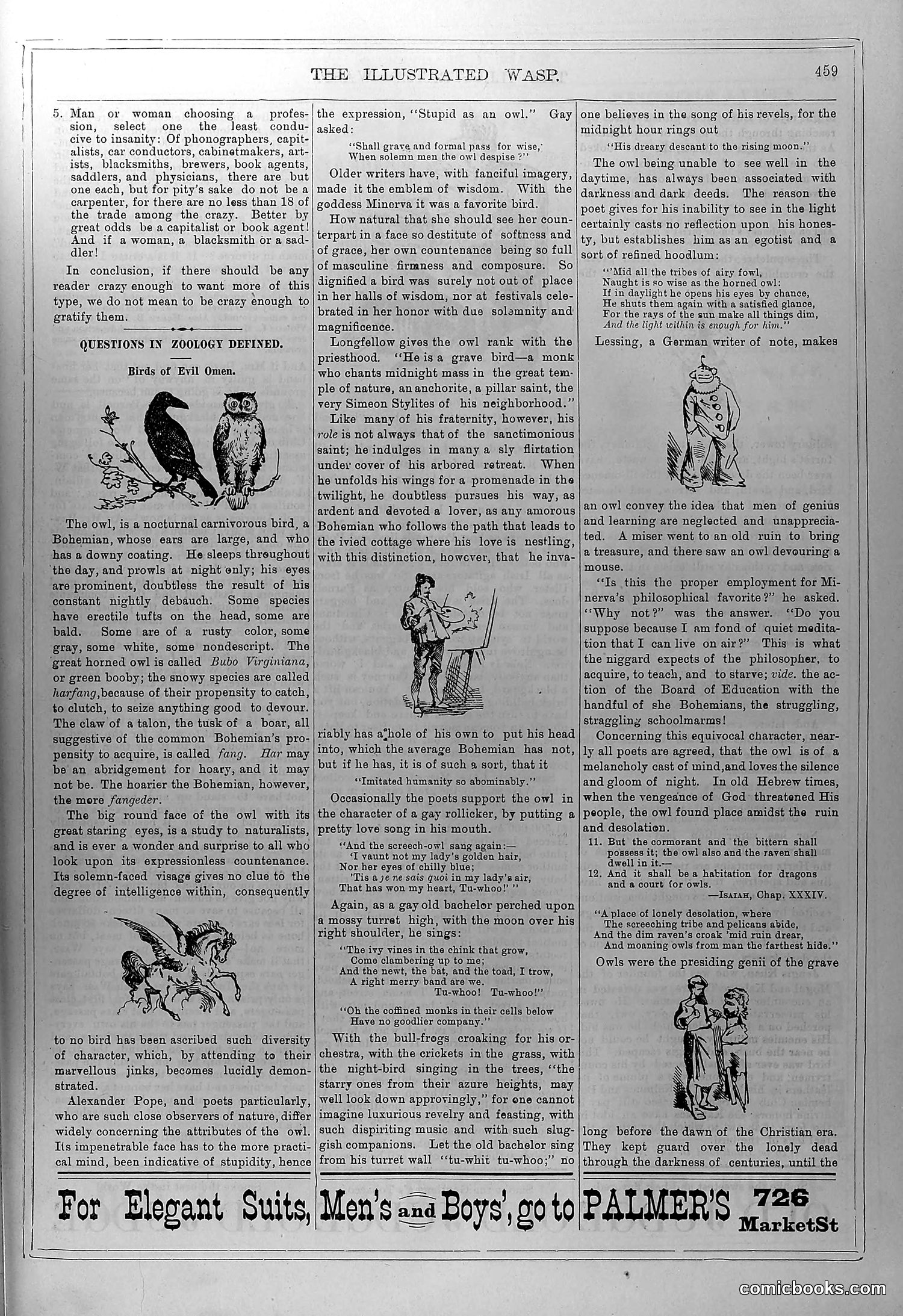
This page is primarily educational content about owls, titled "Questions in Zoology Defined: Birds of Evil Omen." The text discusses owl characteristics—their nocturnal habits, appearance, and cultural symbolism across various traditions. The few illustrations show owls and related figures, including what appears to be a man at a desk (possibly representing a scholar) and period-appropriate sketches. Rather than political satire, this page functions as natural history instruction with cultural commentary. The "evil omen" framing references historical superstitions about owls in European folklore and Hebrew tradition, which the text explains. This appears to be an educational rather than satirical page—part of *The Wasp's* broader content mix beyond its better-known political cartoons.
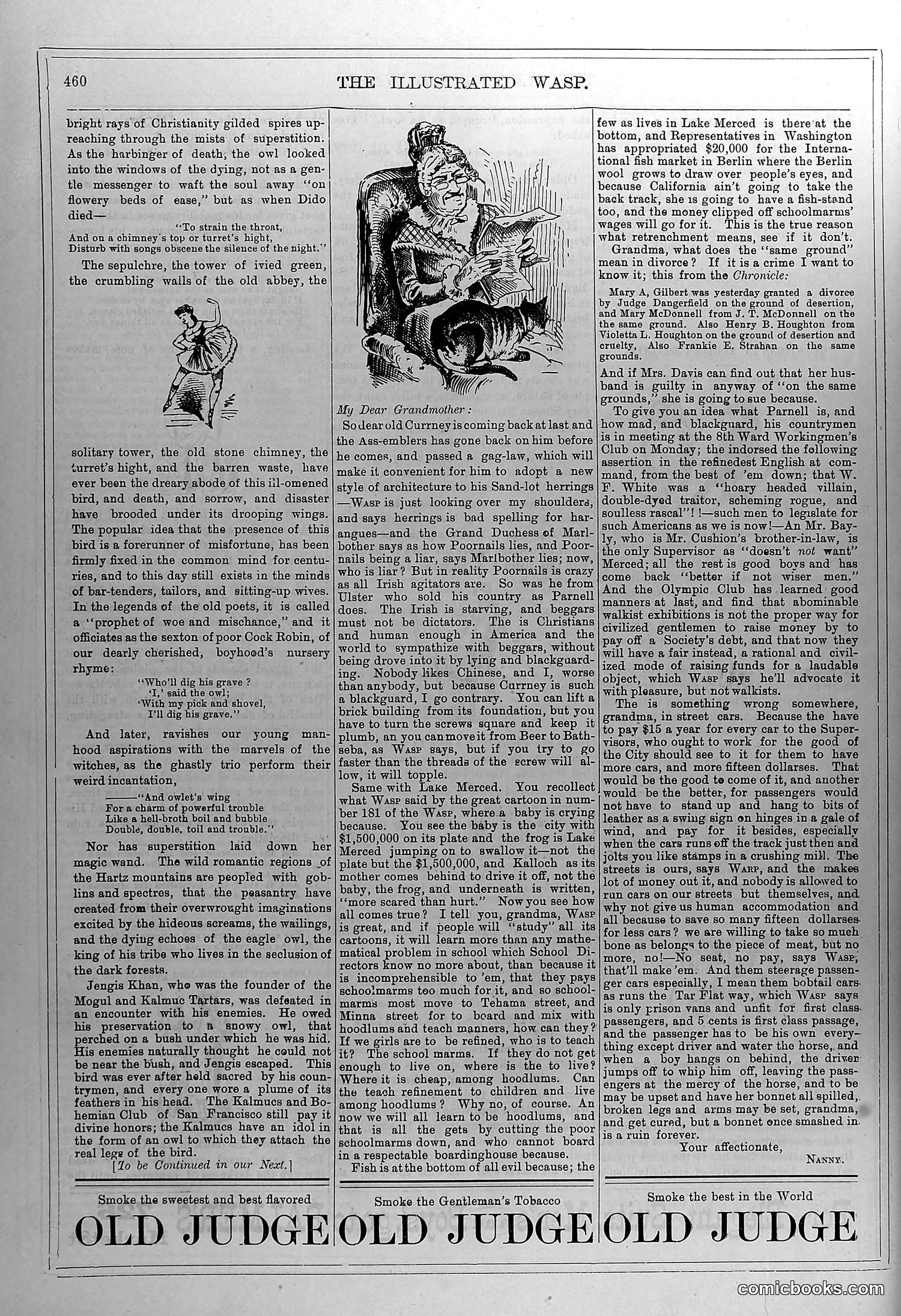
This page combines a satirical letter ("My Dear Grandmother") with advertisements. The main cartoon depicts two elderly figures in an intimate domestic scene, illustrating the letter's social commentary. The letter, signed "Nanny," critiques California labor practices and wealthy San Francisco society. It references specific divorce cases (Mary A. Gilbert, Henry B. Houghton), labor disputes (the Berlin wool market controversy), and the Olympic Club's exclusionary policies. The satire targets both the hypocrisy of the wealthy—who exploit workers while claiming respectability—and their resistance to reform. The cartoon supports this critique, showing the gap between public propriety and private reality among San Francisco's elite. The page uses humor to expose class contradictions and social injustice in Gilded Age California.
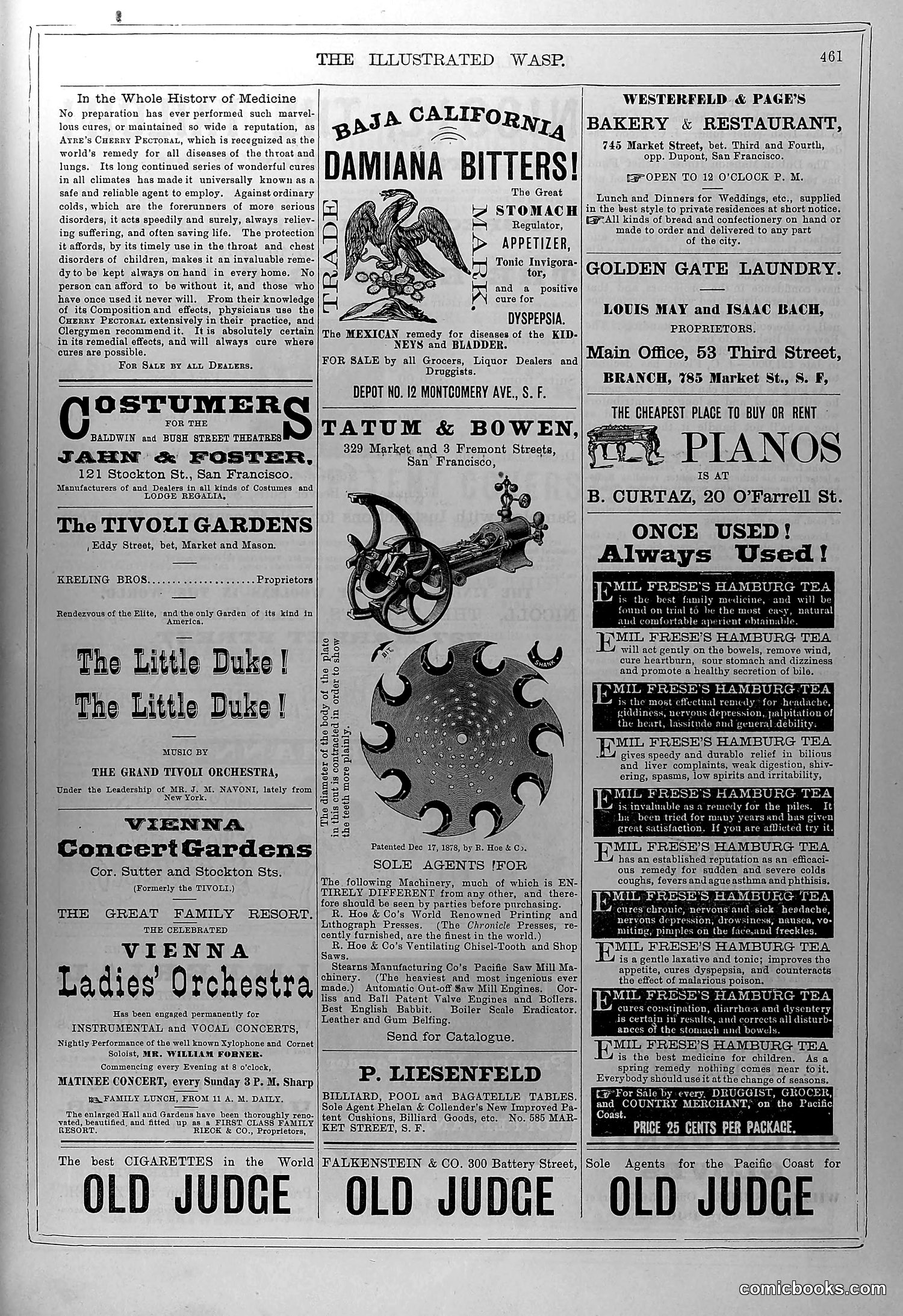
This page is primarily **advertisements** for San Francisco businesses and products (bakeries, laundries, theaters, pianos, medicines). The main visual content is a **mechanical illustration** labeled "Patented Dec 17, 1878" depicting an ornate industrial device or engine with decorative scrollwork. The accompanying text describes it as a "Highly Improved" machine for printing/manufacturing, noting it's "finest in the world." This appears to be a genuine product advertisement rather than satire. The page's satirical content is minimal. The layout and advertising dominance suggest this is a commercial space allocation within the magazine rather than editorial commentary. No clear political cartoons or caricatures are evident on this particular page.
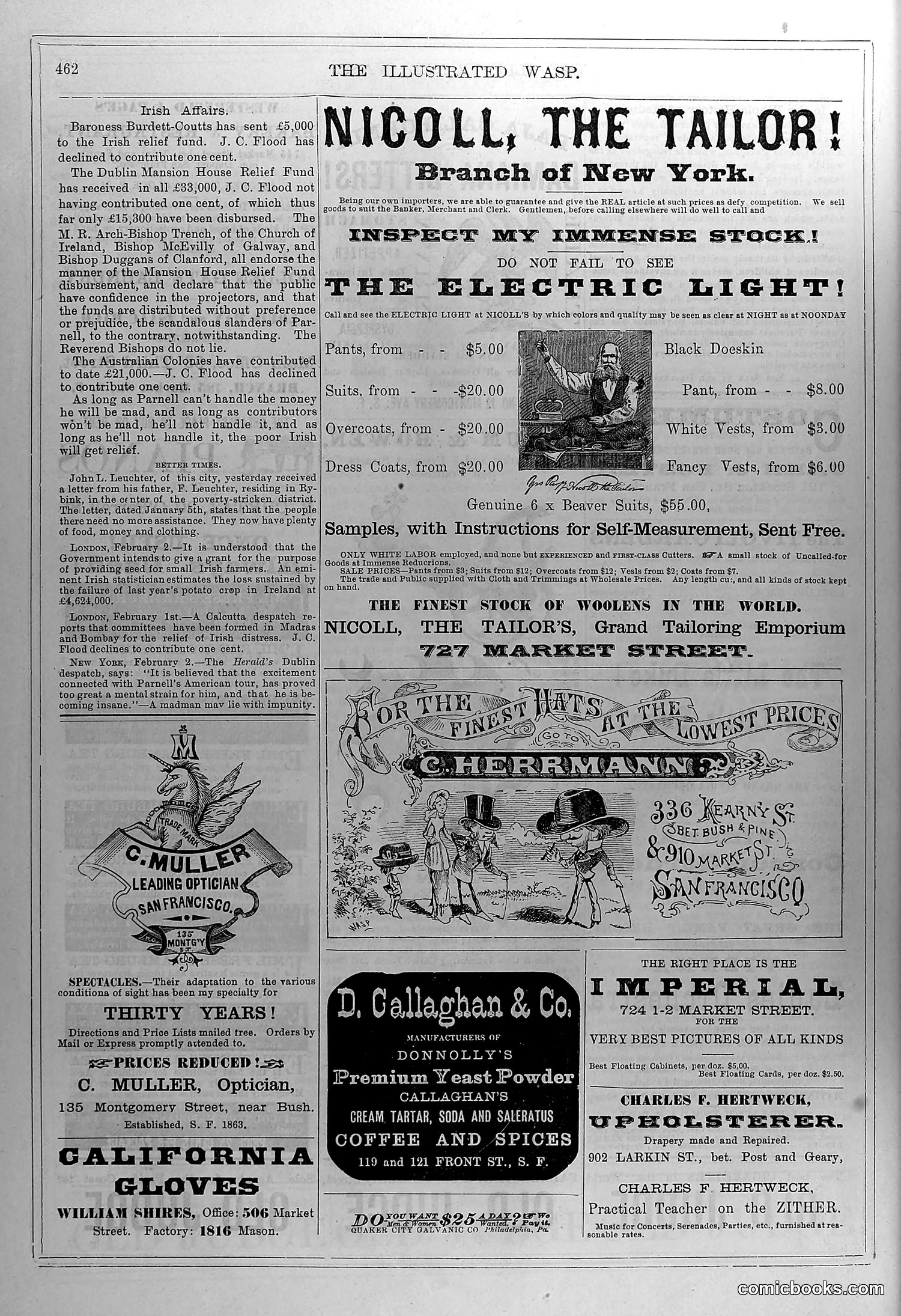
This page is primarily **advertising**, not political satire or editorial cartooning. It contains commercial advertisements for: - **Nicoll, the Tailor** (New York branch) - featuring clothing prices and an illustration of a man in formal wear - **C. Miller** (optician in San Francisco) - **Cherryman's** (hat shop, San Francisco) - **D. Callaghan & Co.** (yeast powder manufacturer) - **Imperial** (picture framing) - **Charles F. Hertweck** (upholsterer) - **California Gloves** and other local businesses The page also includes an "Irish Affairs" news section discussing relief funds for Irish famine relief. No significant political cartoons or satire appear on this page—it's a typical late-19th-century magazine advertisement section mixed with brief news items.
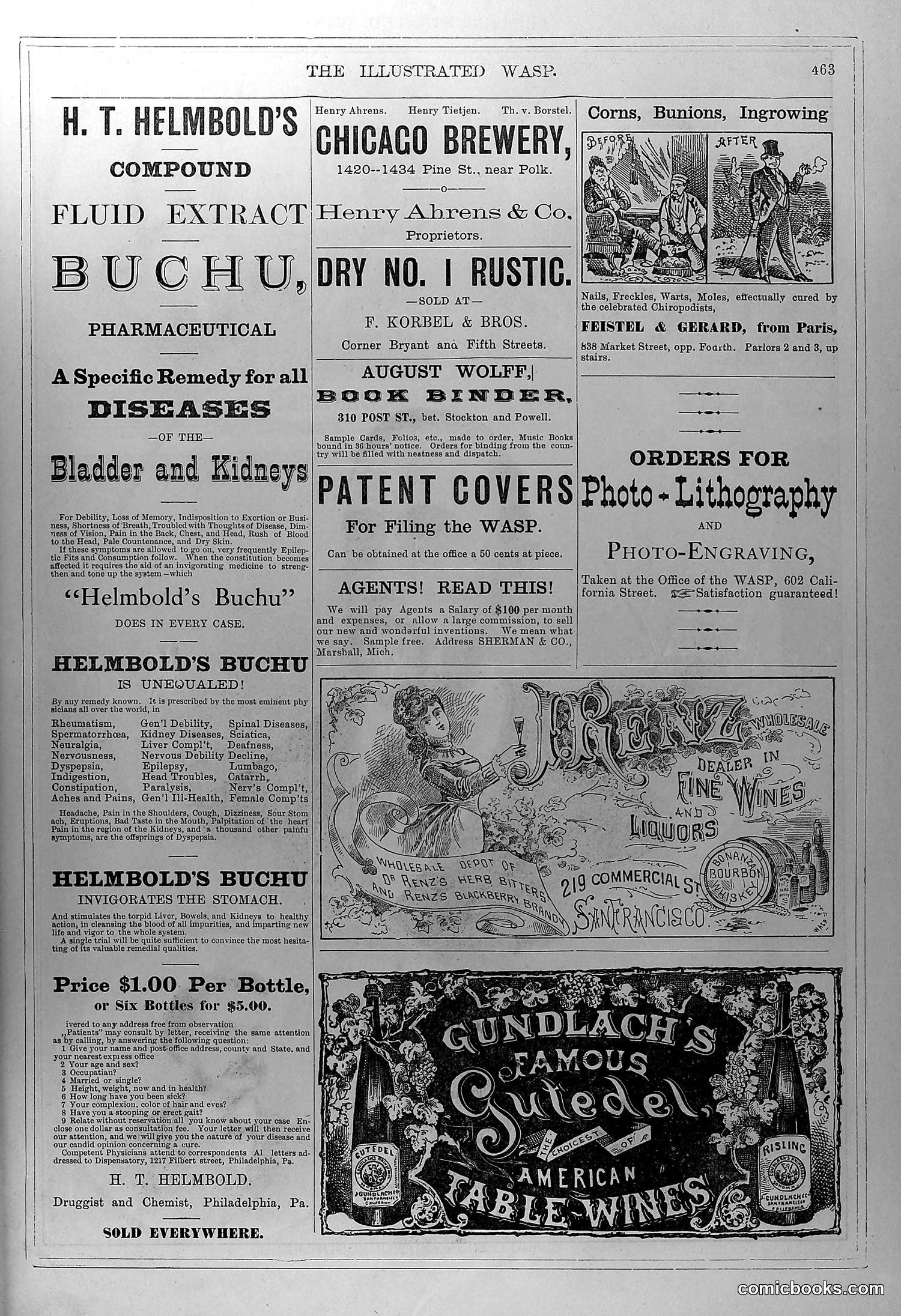
This page is predominantly **advertising**, not satirical content. The visible advertisements include: - H.T. Helmbold's patent medicine for bladder and kidney diseases (priced $1.00/bottle) - Chicago Brewery products - A book binder service - Photo-lithography services - Kenz's herb bitters (San Francisco) - Gundlach's famous Sludel wine The only image with potential satirical intent appears in the lower portion—a decorative wine merchant advertisement featuring ornamental classical figures and scrollwork, though it reads as straightforward commercial promotion rather than social commentary. This appears to be a typical late 19th-century magazine page where satirical content shared space with patent medicine and liquor advertisements—the primary revenue sources for such publications.
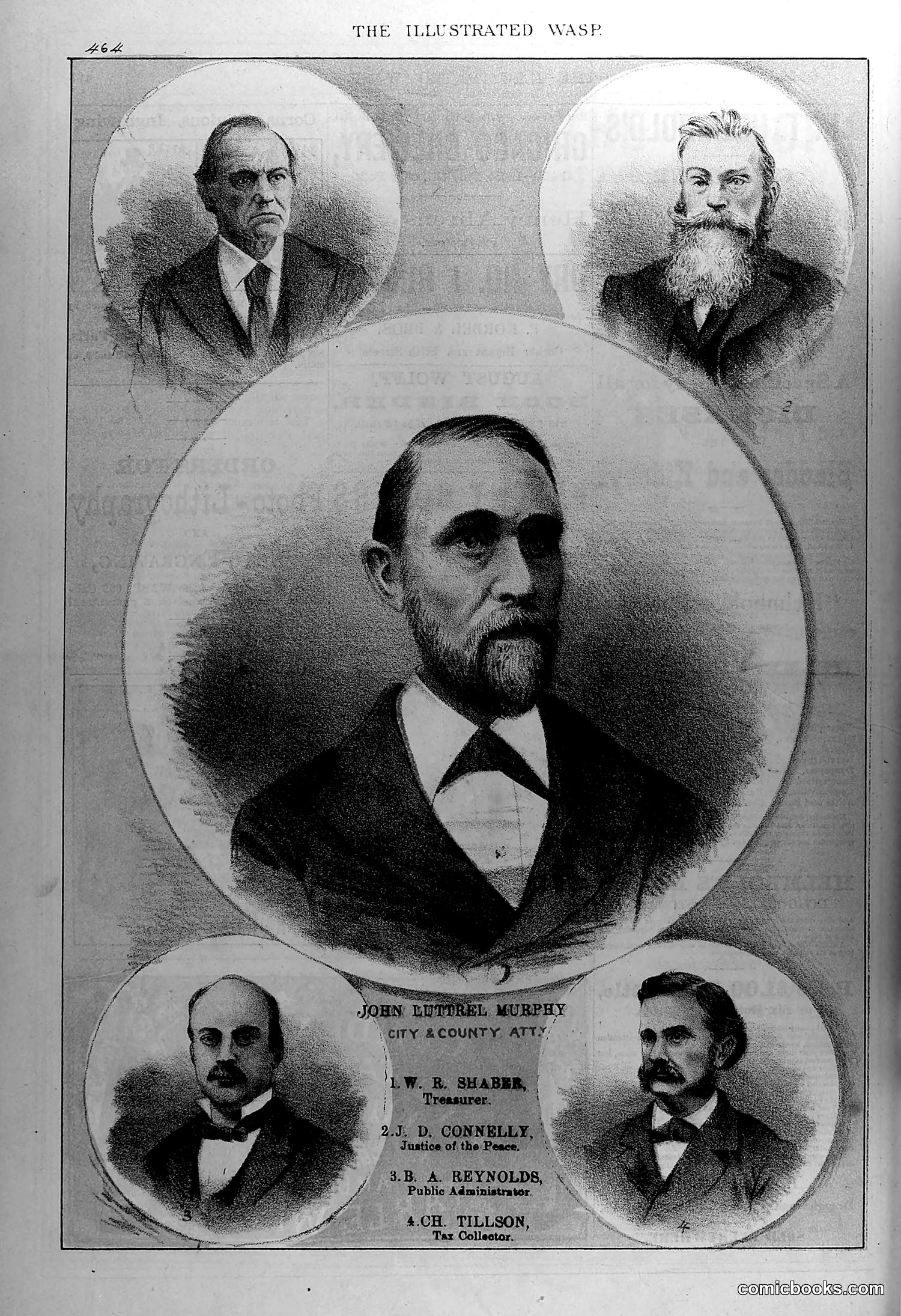
This page from *The Wasp* presents five portraits of San Francisco officials arranged hierarchically, with John Lutherel Murphy (City & County Attorney) prominently centered. Below him are four subordinates: W.R. Shaber (Treasurer), J.D. Connelly (Justice of the Peace), B.A. Reynolds (Public Administrator), and O.H. Tillson (Tax Collector). The layout suggests these were likely targets of *The Wasp*'s satirical commentary—probably regarding political corruption, mismanagement, or incompetence in local government. Without additional article text, the specific charges remain unclear, but the prominence given to these officials indicates they were newsworthy figures in San Francisco politics at the time of publication. The magazine was known for muckraking local governance.
I can see this image contains a measurement scale/ruler and what appears to be a grayscale chart or test pattern with various gray squares of different tones on a black background. However, this appears to be a **technical calibration or reference page** rather than a satirical cartoon or comics content. The page shows no visible text beyond the ruler markings, and the grayscale squares appear to be standard tools used in photography or printing to test exposure and tonal range — not political or social satire. Without readable satirical content, illustrations of recognizable figures, or explanatory text visible in the image, I cannot identify any cartoon, caricatures, or historical references. This may be a test page or technical documentation rather than editorial content from *The Wasp* magazine.