
A complete issue · 16 pages · 1880
The Wasp — January 17, 1880
I can see this is a measurement reference page from *The Wasp* magazine, showing Oregon Rule Co. and USA rulers for scale purposes. However, the image quality and the nature of this particular page make it difficult to identify specific cartoon content or satirical commentary. The page appears to be primarily a technical/reference element rather than a standalone cartoon or article. The checkerboard pattern on the right may be a color or tone reference chart used in the magazine's production process. Without clearer visibility of any accompanying text, captions, or illustrations on this page, I cannot reliably explain what political or social satire it contains. If there is specific cartoon content here, it's not legible enough in this reproduction for accurate interpretation.
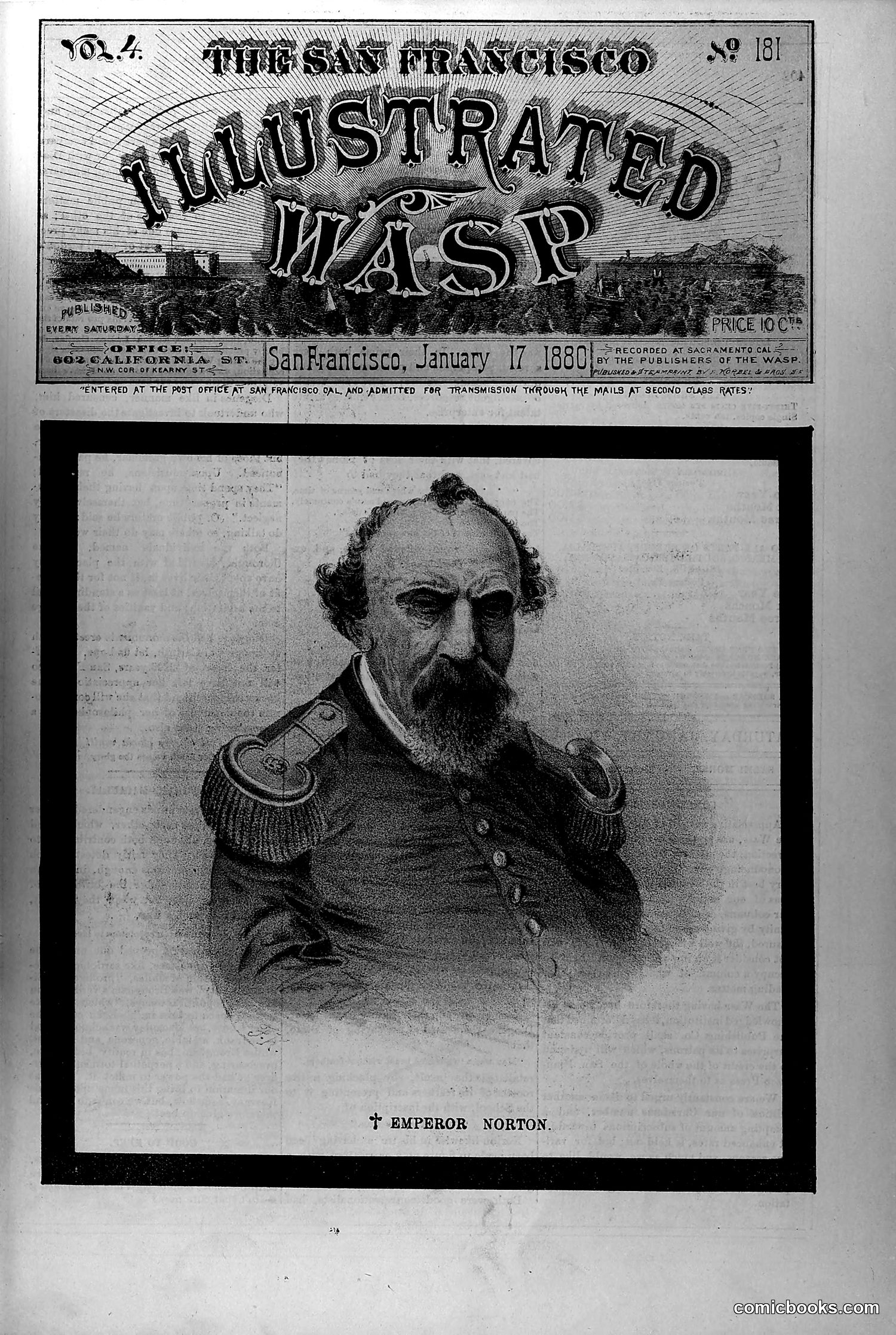
This page from The Wasp (January 17, 1880) features a portrait labeled "† EMPEROR NORTON," depicting a bearded man in a military uniform with ornate shoulder epaulettes. Joshua Norton was a real San Francisco eccentric who declared himself "Emperor of the United States and Protector of Mexico" in 1859. He issued his own currency, wore a military uniform, and was tolerated—even celebrated—by the city's residents as a harmless oddity. The † symbol indicates Norton had recently died (January 8, 1880). The Wasp's satirical tribute presents him respectfully in formal military dress, likely mocking both Norton's delusions of grandeur and San Francisco's sentimental embrace of him. The piece represents the city's affection for its most famous eccentric character.
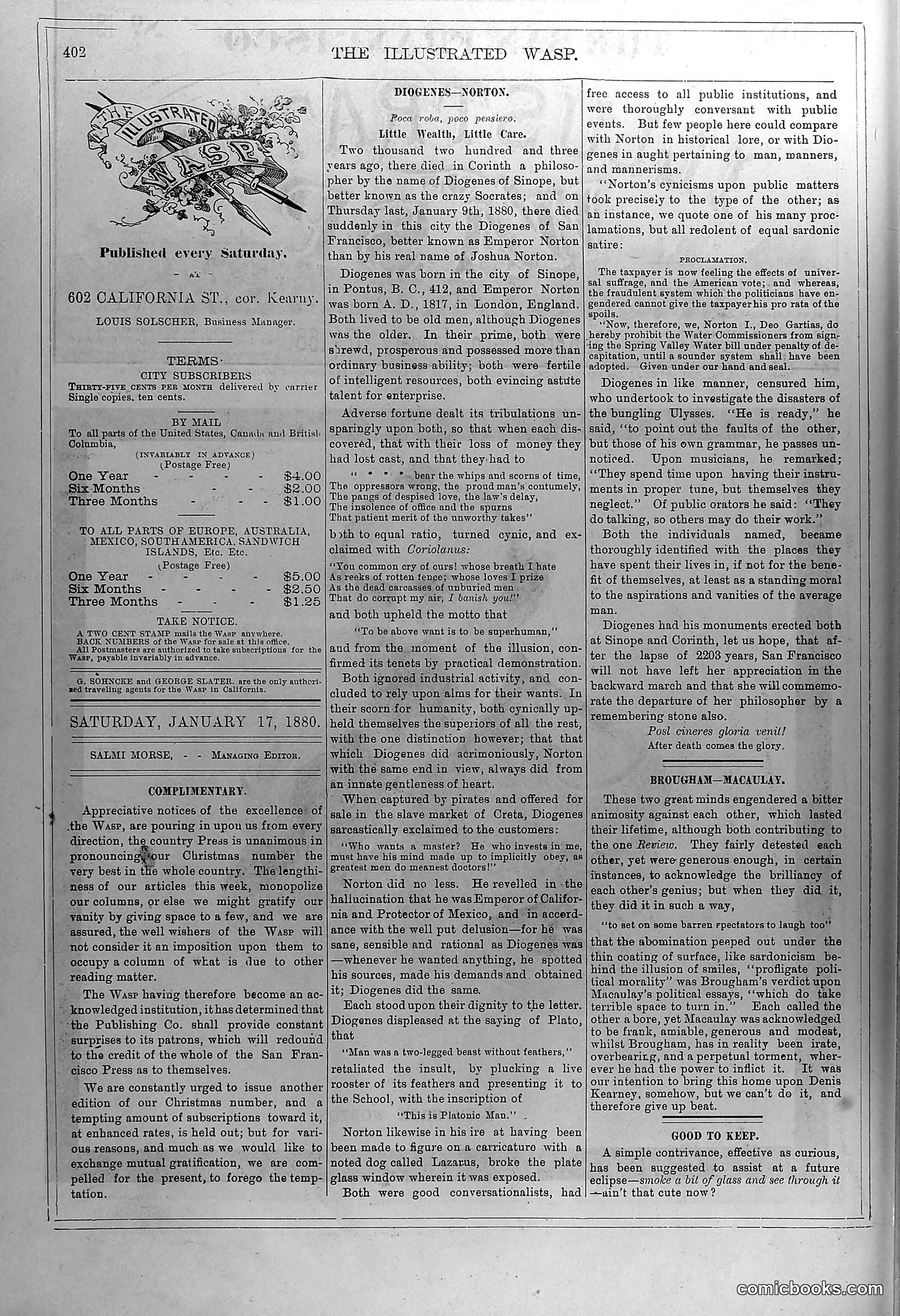
This page is primarily **editorial and business content** rather than political cartoons. The masthead and subscription information dominate the layout. The main article discusses **Diogenes of Sinope** (ancient Greek philosopher) and compares him to a contemporary figure named **Joshua Norton**, who apparently claimed to be "Emperor of California." The text humorously parallels their respective eccentricities and public personas. A secondary piece titled "BROUGHAM—MACAULAY" contrasts two historical British figures, apparently examining their intellectual legacies and disagreements. The page includes a small decorative illustration (the "Wasp" logo) but no clear political cartoons. The satire is primarily **textual and philosophical** rather than visual, targeting intellectual pretension and eccentric public figures of the era.
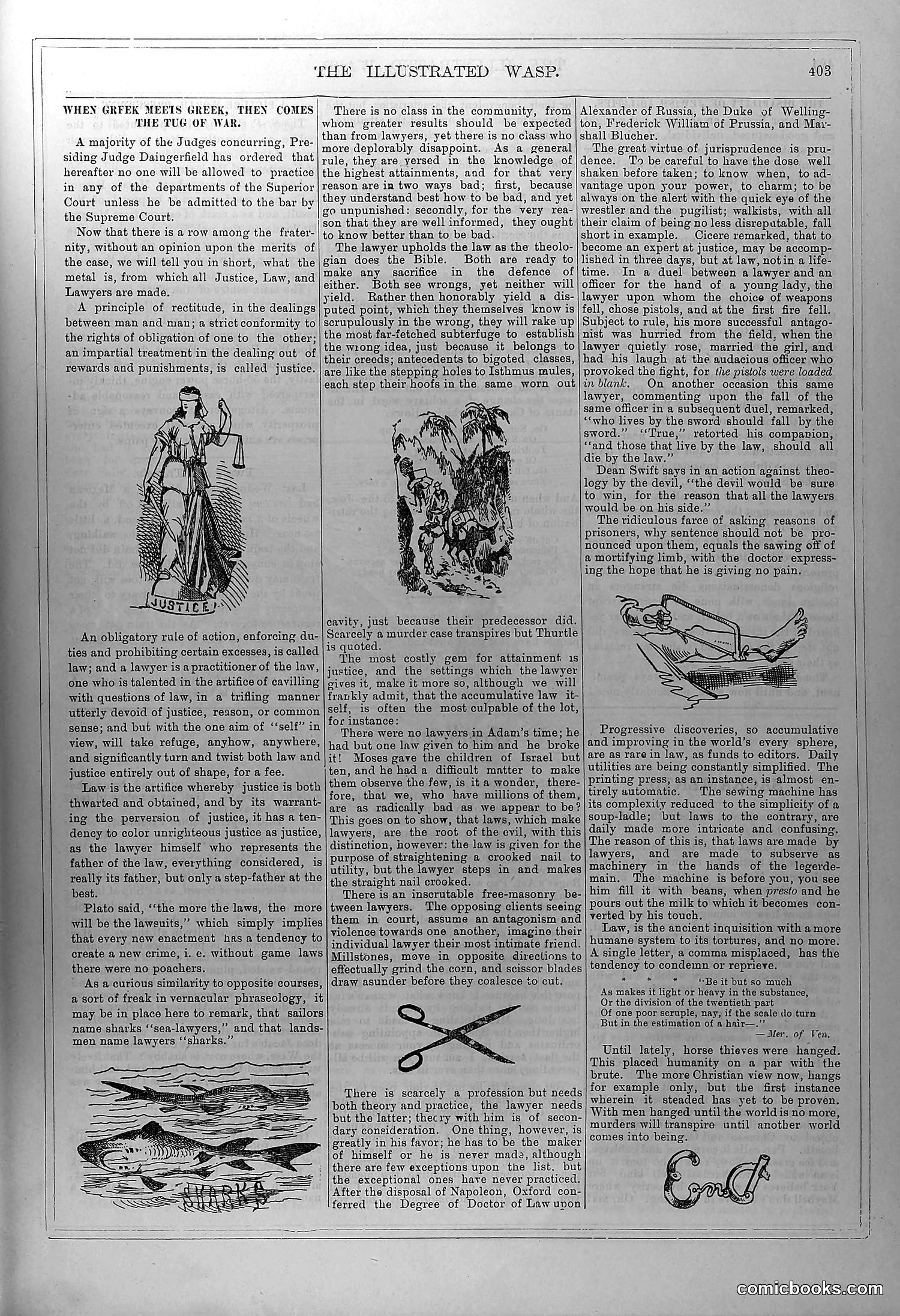
This page is primarily a satirical essay about lawyers and the legal profession, illustrated with symbolic engravings rather than political cartoons. The text mocks lawyers as "sharks," criticizing their adversarial nature and willingness to twist law for profit. The illustrations support this theme: Lady Justice holding scales, robed figures in conflict (representing opposing counsel), and crucially, actual sharks and fish at the bottom—visual puns equating lawyers with predatory sea creatures. The essay argues lawyers create unnecessary complexity, manufacture disputes, and prioritize winning over justice. References to historical figures (Plato, Adam, Moses) suggest this is a timeless human problem. This is social satire targeting the legal profession's perceived greed and moral flexibility—a recurring theme in 19th-century American humor magazines.
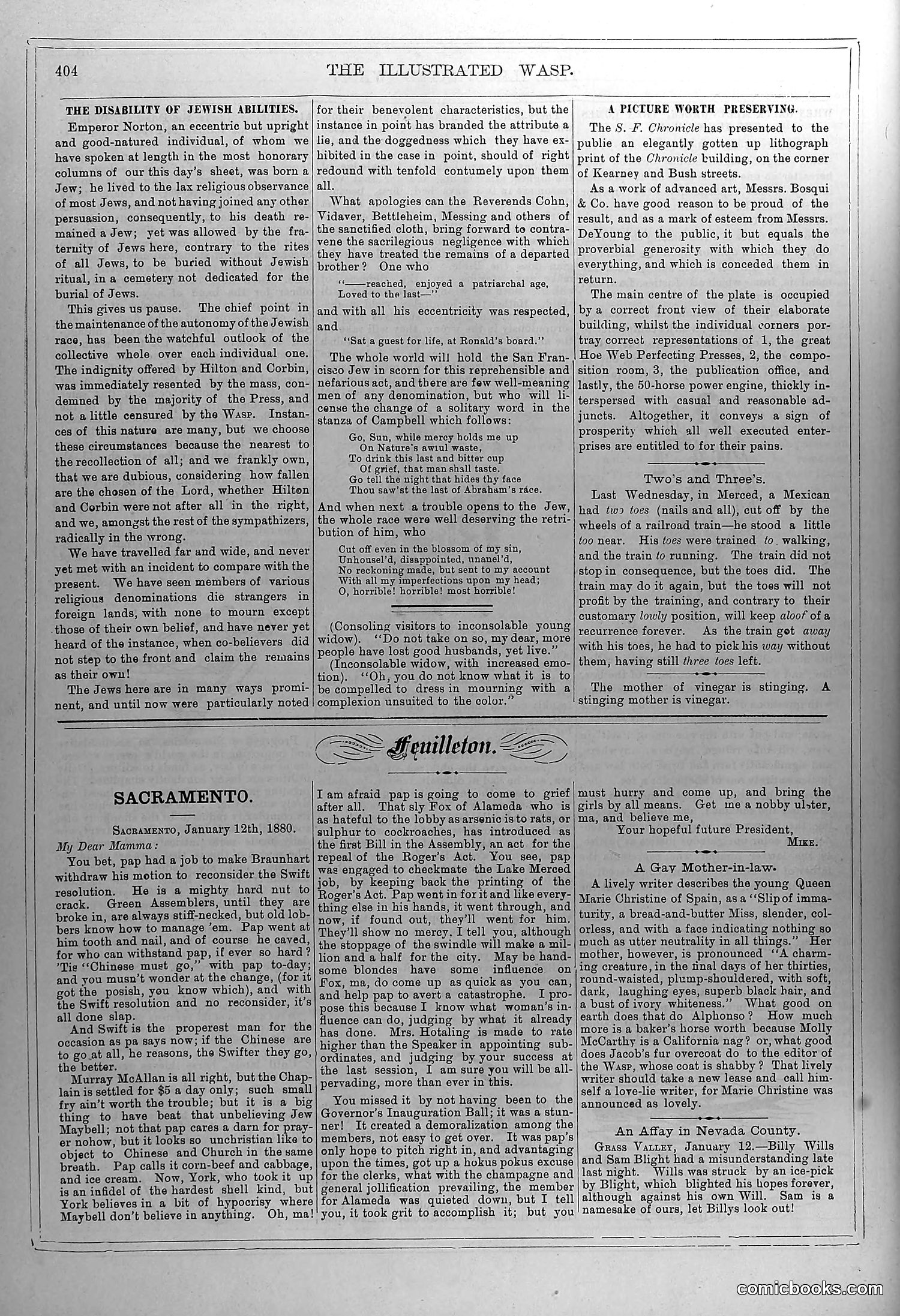
This page contains three distinct sections: **"The Disability of Jewish Abilities"** - A lengthy editorial arguing that Jewish people were capable and industrious despite discrimination. It references specific cases where Jewish individuals were denied opportunities (burial rites, employment) and defends their character against prejudice. **"A Picture Worth Preserving"** - An advertisement for a lithograph of the Chronicle building on Kearney and Sutter streets, promoting Messrs. Bosqui & Co.'s printing work. **Letters section** - Including "Sacramento" (about political maneuvering regarding the Lake Merced Bill), "Two's and Three's" (a humorous anecdote about a Mexican with untrained mules), and other brief correspondence. The page appears primarily editorial and advertorial rather than cartoon-focused, addressing social prejudice while promoting commercial services.
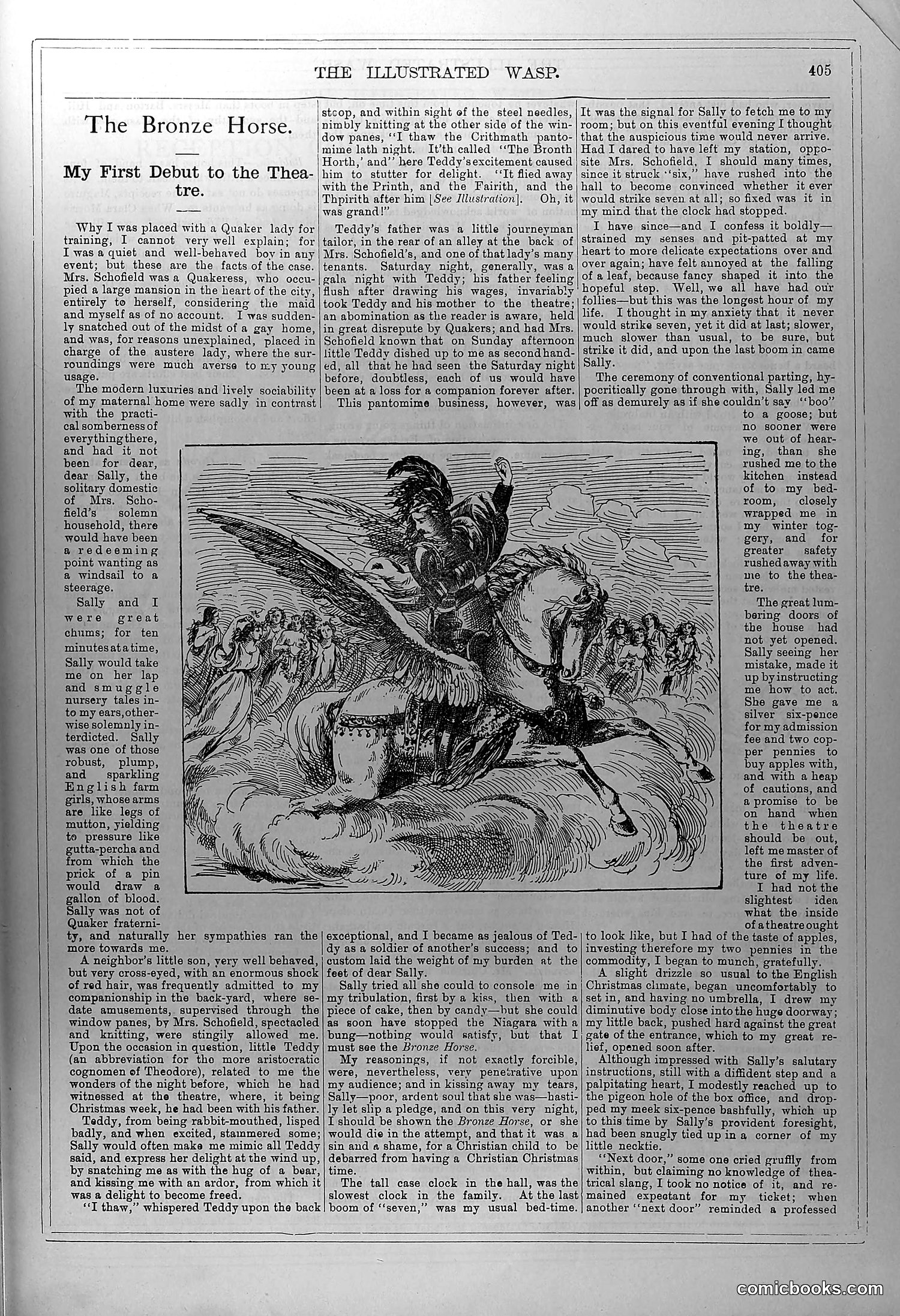
This page presents a nostalgic personal essay rather than political satire. The author recounts their theatrical debut as a child performer, describing their experience in a Quaker household and mentioning a character named "Teddy" who performed in a play called "The Bronze Horse." The accompanying engraving depicts a dramatic scene with a large horse and multiple figures in period costume, consistent with theatrical staging of the 19th century. The text focuses on domestic life, theatrical training, and childhood memories—particularly relationships with a girl named Sally and various family dynamics. There is no apparent political commentary or satirical critique present on this page. It reads as a sentimental reminiscence published in The Wasp magazine.
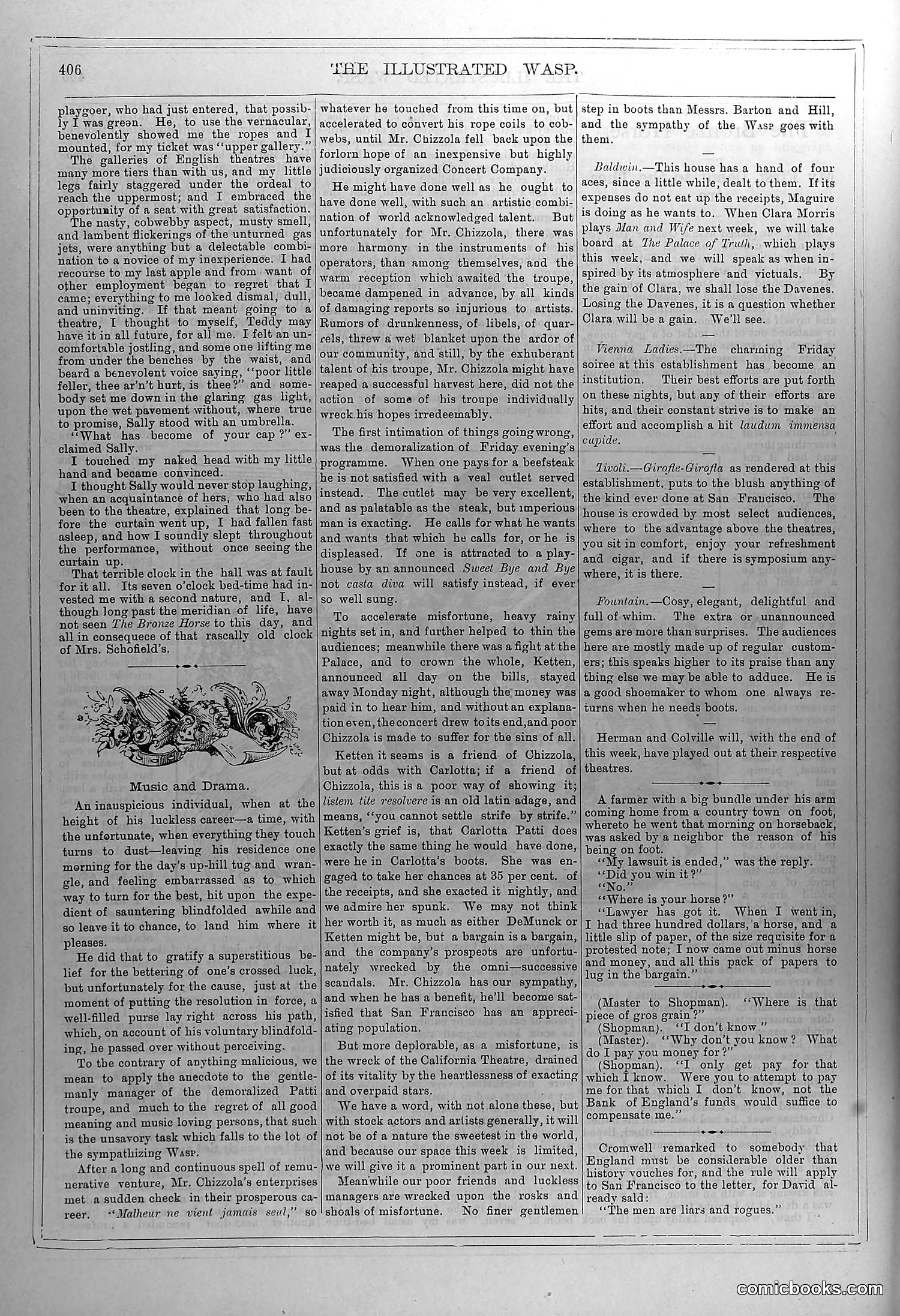
This page is primarily **text-based social commentary** rather than a political cartoon. It critiques the San Francisco theatrical world, focusing on Mr. Chizola's mismanagement of a concert company. The satire targets: - **Chizola**: A theater operator whose poor planning (damaged scenery, billing disputes, unpaid artists) reflects incompetence and unreliability - **Carlotta Patti**: A performer who negotiated unfavorable terms, satirized for accepting bad conditions - The **omni-undecided scandals** affecting San Francisco theater The piece mocks both the unprofessional management and the performers' desperation. Brief notices review various theaters and shows, maintaining the magazine's gossipy tone about local entertainment figures and venues. The overall message: San Francisco's theatrical scene is troubled by incompetent operators and unethical practices.
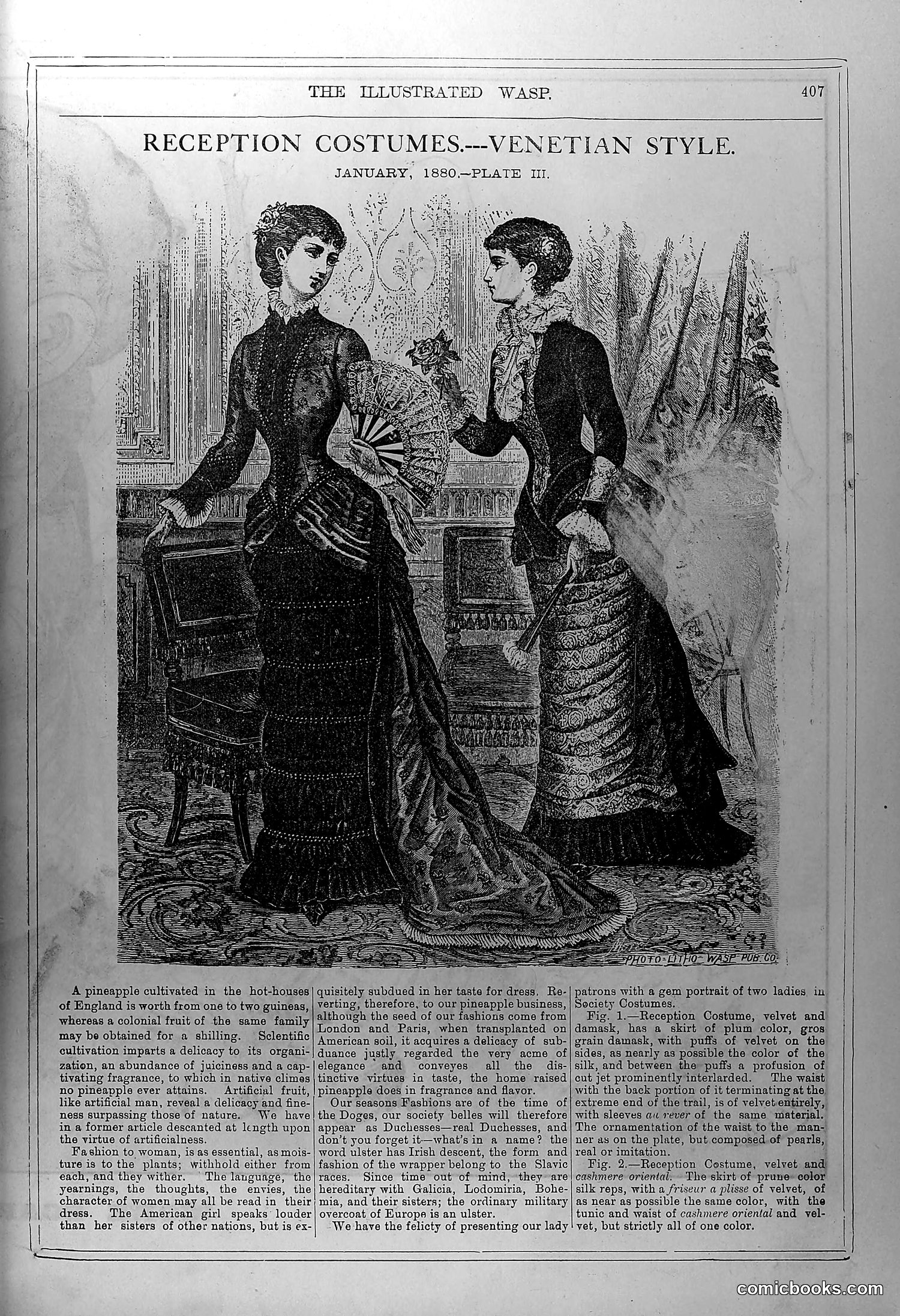
This page is primarily a **fashion illustration** rather than political satire. It depicts two women in elaborate Victorian reception wear, labeled as "Venetian style" costumes from January 1880. The accompanying text discusses fashion trends, specifically praising velvet garments and detailed ornamentation. The article makes cultural observations—noting that American girls speak louder than European counterparts, and comparing fashion preferences across nations (mentioning Galicia, Londonderry, and Paris). The satirical element appears mild: the text gently mocks cultural differences and fashion pretensions rather than attacking specific political figures. This represents *The Wasp's* fashion commentary side, blending style criticism with light social observation about American versus European manners and taste.
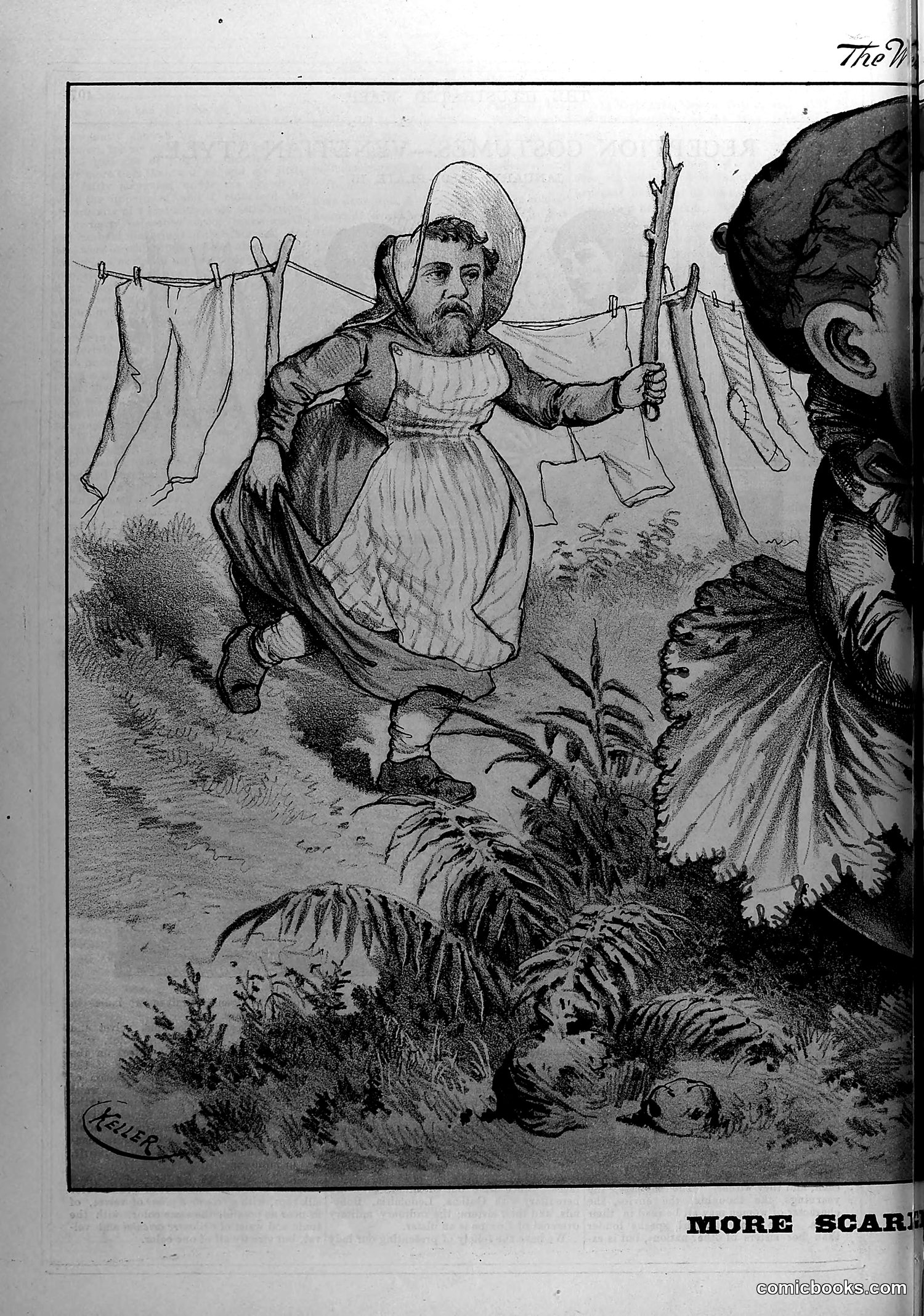
This satirical cartoon from *The Wasp* magazine depicts a rotund, bearded man in period dress (appearing late 19th century) holding a stick among clotheslines with laundry. The caption reads "MORE SCARE," suggesting he's attempting to frighten something—likely scarecrows or household pests. The figure's exaggerated physical features and domestic setting suggest social or political commentary typical of *The Wasp*'s satirical style. The presence of what appear to be caricatured figures on the right margin implies this is mocking a specific public figure or political personality of the era, though the identity remains unclear without additional publication context. The artist's signature appears lower left. The overall tone suggests ridicule of someone's ineffectual or bumbling efforts.
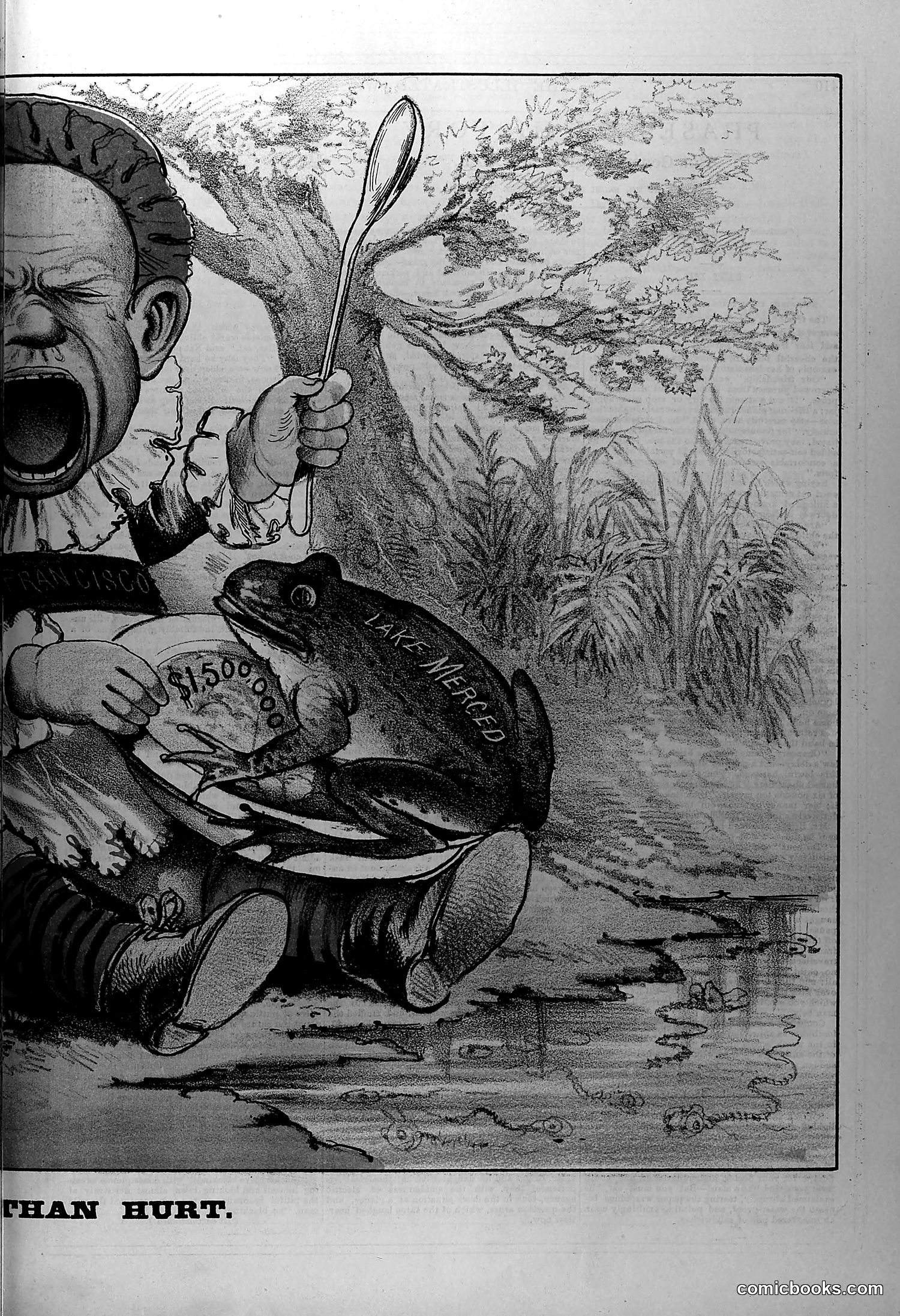
This cartoon depicts a figure with an exaggerated caricatured face (appearing to reference anti-Chinese stereotypes common to the era) being struck or attacked. The figure holds what appears to be a large fish or similar object labeled "HATCHET" (visible on the weapon). The title "CHAN HURT" suggests this commentary concerns Chinese individuals or Chinese-American communities experiencing violence or persecution. Given *The Wasp* was a San Francisco publication from an era of intense anti-Chinese sentiment, this likely references real violence—possibly the Chinese Massacre of 1877 or similar incidents of discrimination and physical attacks against Chinese immigrants and Chinese-Americans. The cartoon appears to satirize such violence, though the exact intent (condemnation or mockery) remains unclear from the image alone.
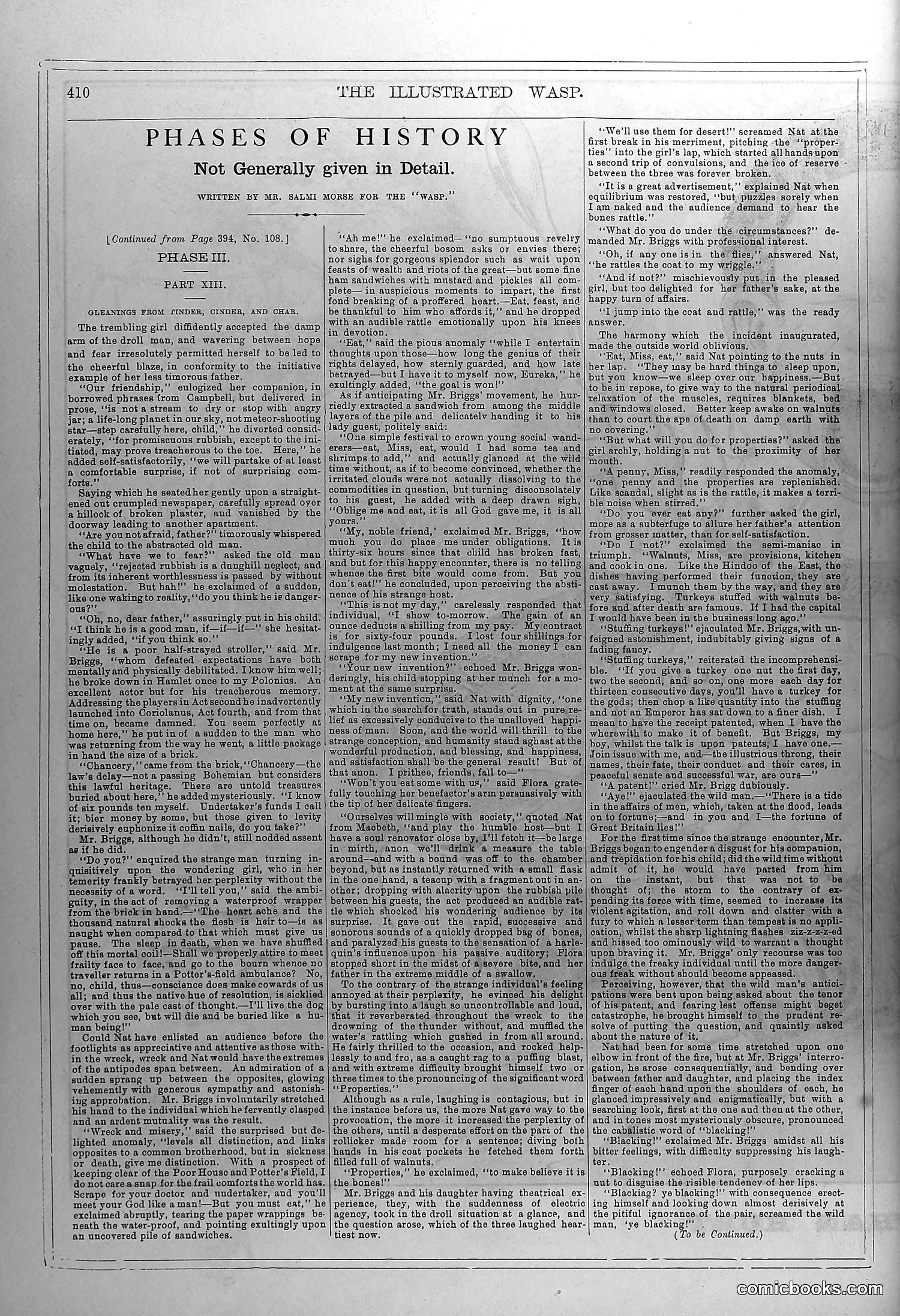
This page is primarily **text-based editorial content**, not a cartoon. It's Part XIII of "Phases of History Not Generally Given in Detail," written by Mr. Salmi Morse for *The Wasp* magazine. The piece appears to be a **satirical narrative dialogue** featuring characters named Nat and Mr. Briggs discussing social hypocrisy and class disparities. Through their conversation, Morse critiques the contradictions between wealthy individuals' public morality and private conduct—specifically targeting business practices, worker treatment, and economic inequality of the era. The satire targets **self-righteous wealthy people** who preach virtue while engaging in exploitative practices. Without additional visual elements, the full satirical impact depends on recognizing the literary style typical of *The Wasp*'s muckraking journalism.
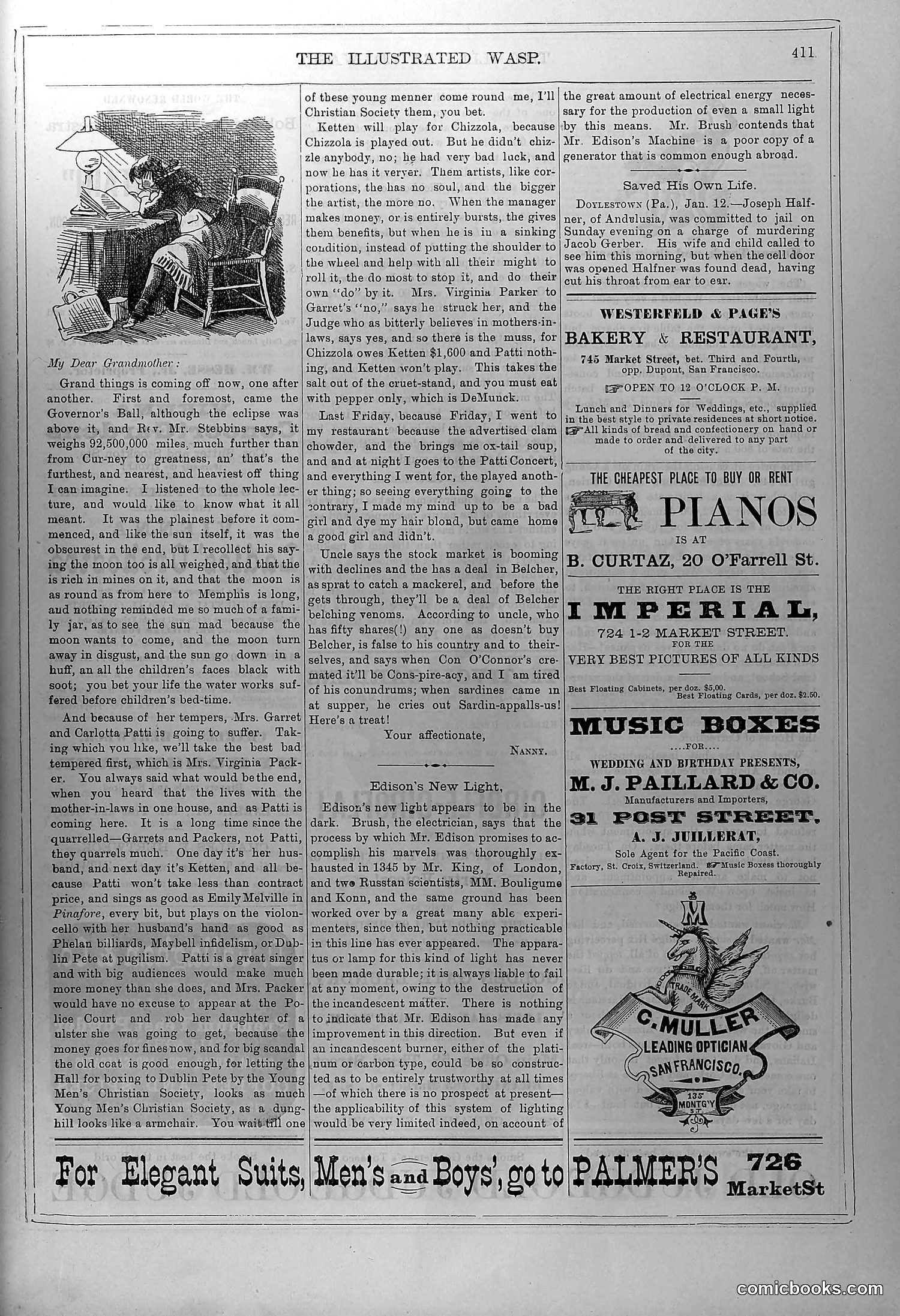
This page is primarily **advertising content** rather than political satire. The main illustration shows a woman at a spinning wheel in a domestic scene, accompanying a letter titled "My Dear Grandmother" discussing family matters and social gossip. The surrounding advertisements promote San Francisco businesses: a bakery and restaurant, piano rentals, music boxes, and optical services. The letter's domestic focus—discussing theater, stock market news, and social gatherings—appears designed to frame these ads within relatable middle-class life. **The satire element** is subtle: the framing device uses social commentary about women's lives and family drama as context for consumer advertising, reflecting how commercial publications embedded marketing within editorial content. The specific political or social critique, if present, is unclear from this page alone.
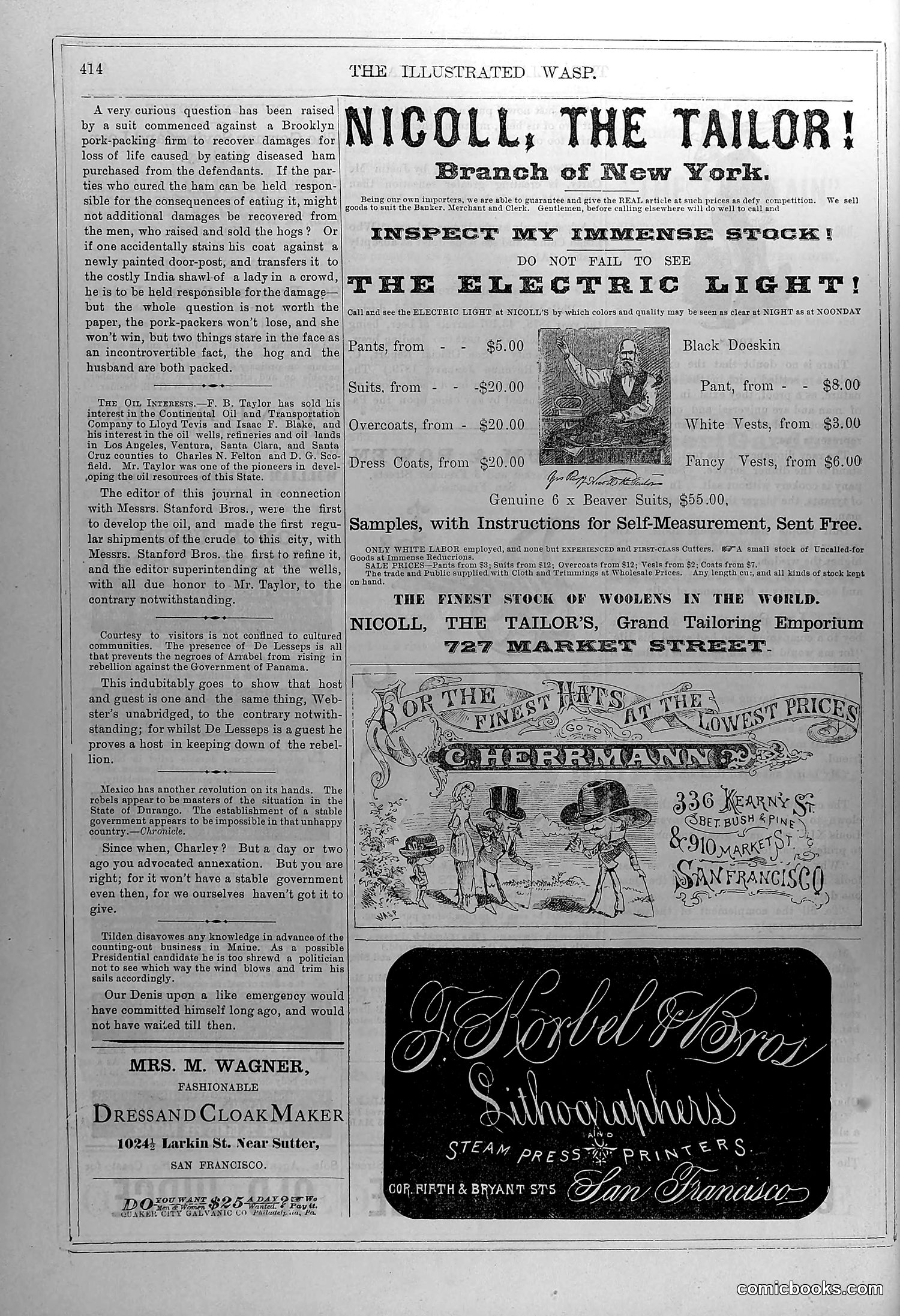
This page is primarily **advertising content**, not satirical editorial material. The dominant features are commercial advertisements for: - **Nicoll, the Tailor** (New York branch) — promoting clothing at competitive prices with an "electric light" display feature - **C. Herrmann & Co.** — hat merchant in San Francisco - **Mrs. M. Wagner** — dress and cloak maker - **J. Barbel & Ford** — lithographers and steam printers The left column contains brief news items and commentary on unrelated topics (oil interests, Mexican politics, Maine elections), but these are not illustrated or cartoons. **The actual satirical or cartoon content is not visible or identifiable** on this page — it functions primarily as a revenue-generating advertisement section typical of period magazines.
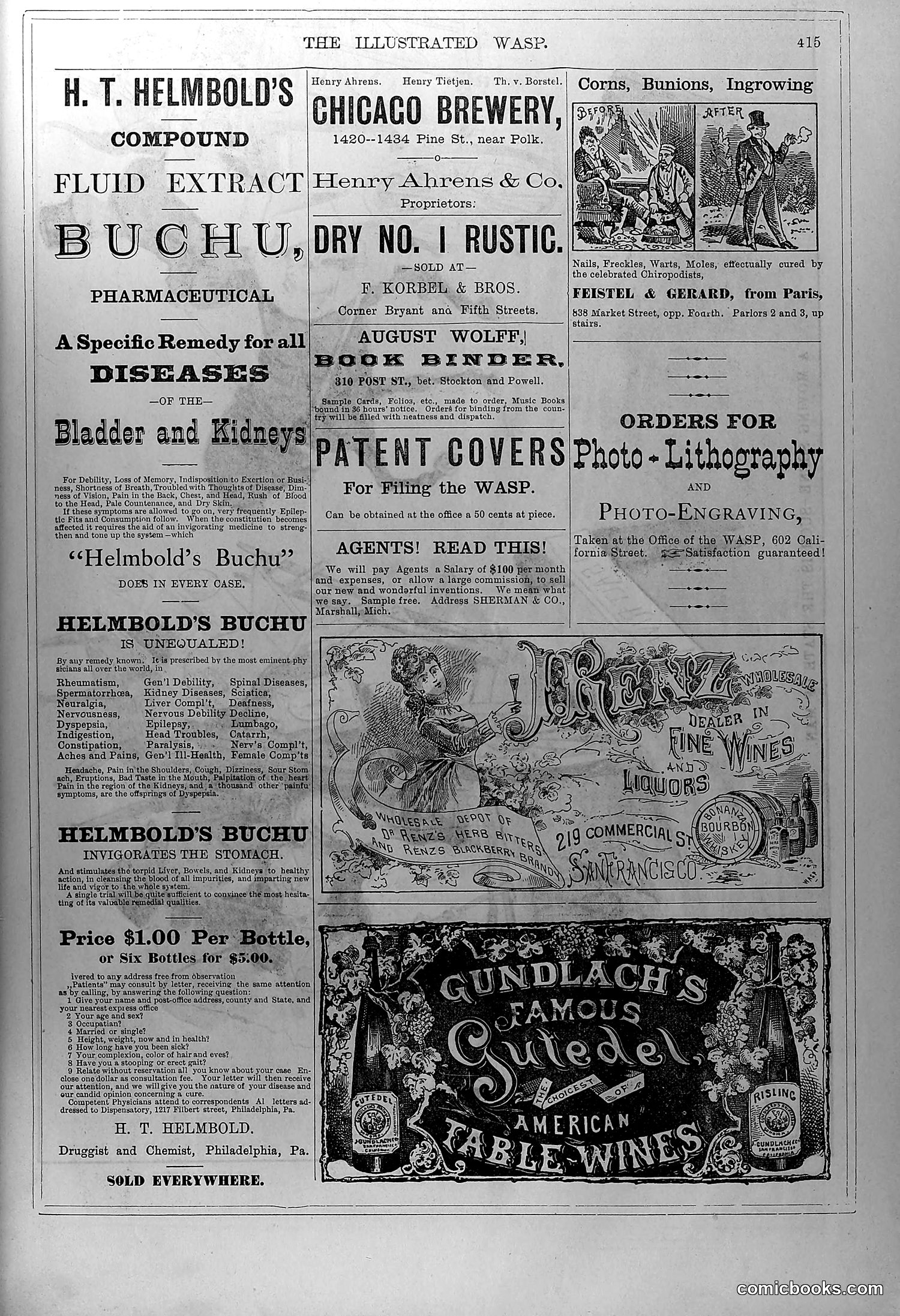
This page is predominantly **advertising**, not political satire. It contains commercial notices for patent medicines, breweries, book binding services, and wines typical of late 19th-century publications. The main content includes H.T. Helbold's "Buchu" fluid extract (a bladder and kidney remedy), Chicago Brewery beer, August Wolff's book binding services, and Gundlach's table wines. There are two small illustrations showing medical treatments for corns and warts by "Feistel & Gerard." The only potentially satirical element is the decorative wine merchant advertisement featuring ornate Victorian graphics, but this appears to be standard commercial artwork rather than editorial commentary. The page primarily reflects how satirical magazines of this era relied heavily on patent medicine and alcohol advertising for revenue.
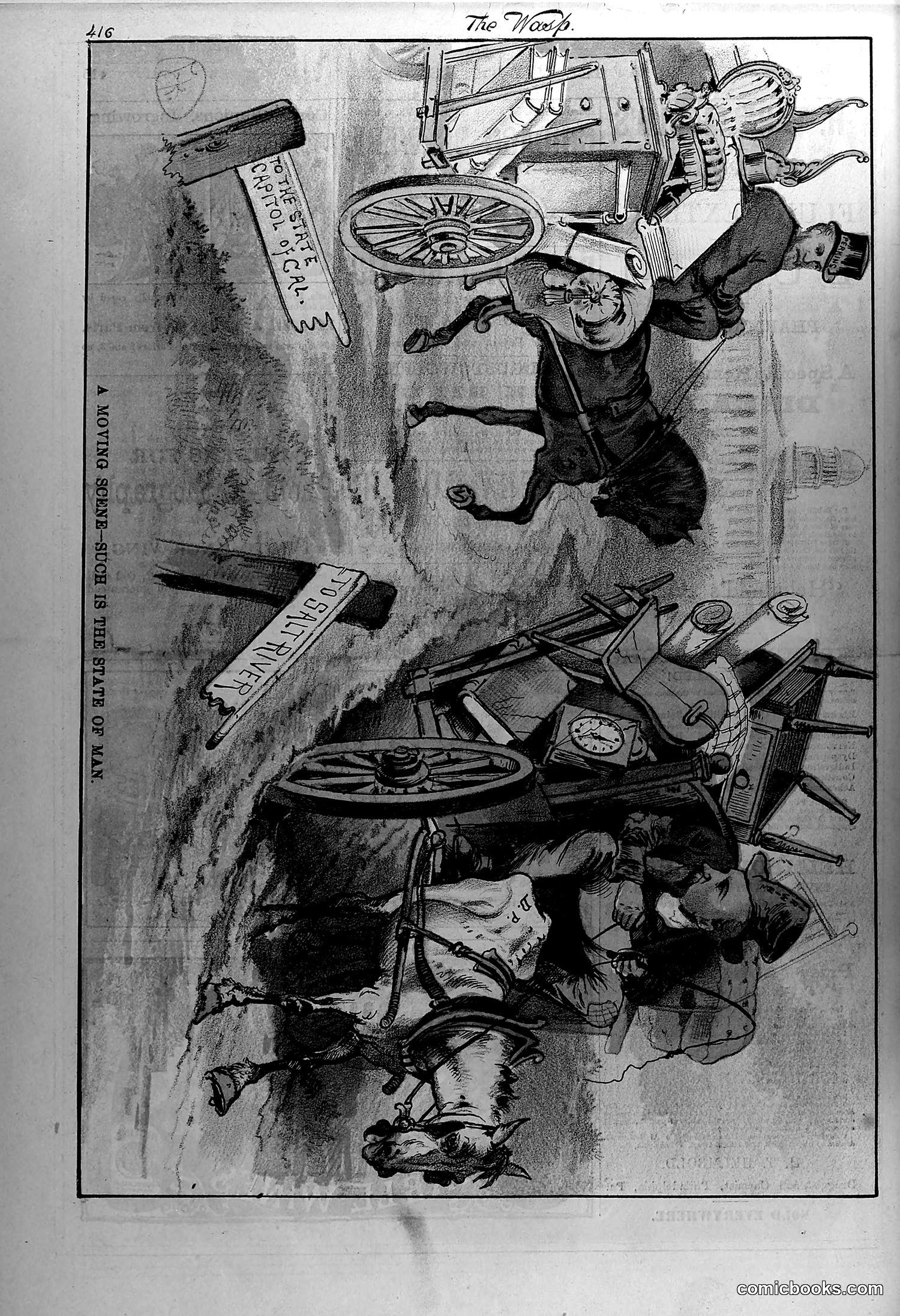
This appears to be a satirical cartoon about early automobile culture and traffic accidents. The image shows a chaotic street scene with multiple vehicles colliding or in disarray, with figures being thrown about. The text on the left reads "WHY DO ENTER SIR FORDS BULLOT" (likely OCR errors for something about Ford automobiles). The visible signs reference "SAFE AND SANE" and what appears to be "LIMIT" regulations. The cartoon likely satirizes the dangerous driving conditions of the early automotive era and possibly mocks safety campaigns or speed limit laws as ineffective against reckless drivers. The chaotic composition emphasizes the absurdity and violence of uncontrolled vehicle traffic, a genuine public hazard during this period of rapid automobile adoption.
I can see this is a test/calibration page from *The Wasp* magazine featuring a grayscale checker pattern and measurement scales. The page contains no visible cartoon, text content, or satirical imagery—only technical reference tools used in photo reproduction and archival documentation. This appears to be a blank or setup page rather than actual magazine content. The checker squares and rulers helped printers calibrate exposure and ensure accurate reproduction of pages during the printing or microfilming process. Without actual cartoon imagery or OCR'd article text to analyze, I cannot identify political figures, historical references, or satirical intent on this particular page.