
A complete issue · 18 pages · 1880
The Wasp — January 1880

I can see this is a measurement/calibration page from *The Wasp* magazine, featuring Oregon Rule Co. rulers and a grayscale color chart used in photographic reproduction. This appears to be a technical documentation page rather than a cartoon or satirical content page. The image shows: - A vertical ruler marked 0-5 inches (Oregon Rule Co., USA) - A horizontal ruler at the bottom with similar markings - A grayscale reference chart with varying tones from light to dark This type of page was standard in early 20th-century publications for quality control during printing and reproduction processes. Without visible satirical content or readable cartoon material, I cannot identify specific political or social commentary on this particular page.
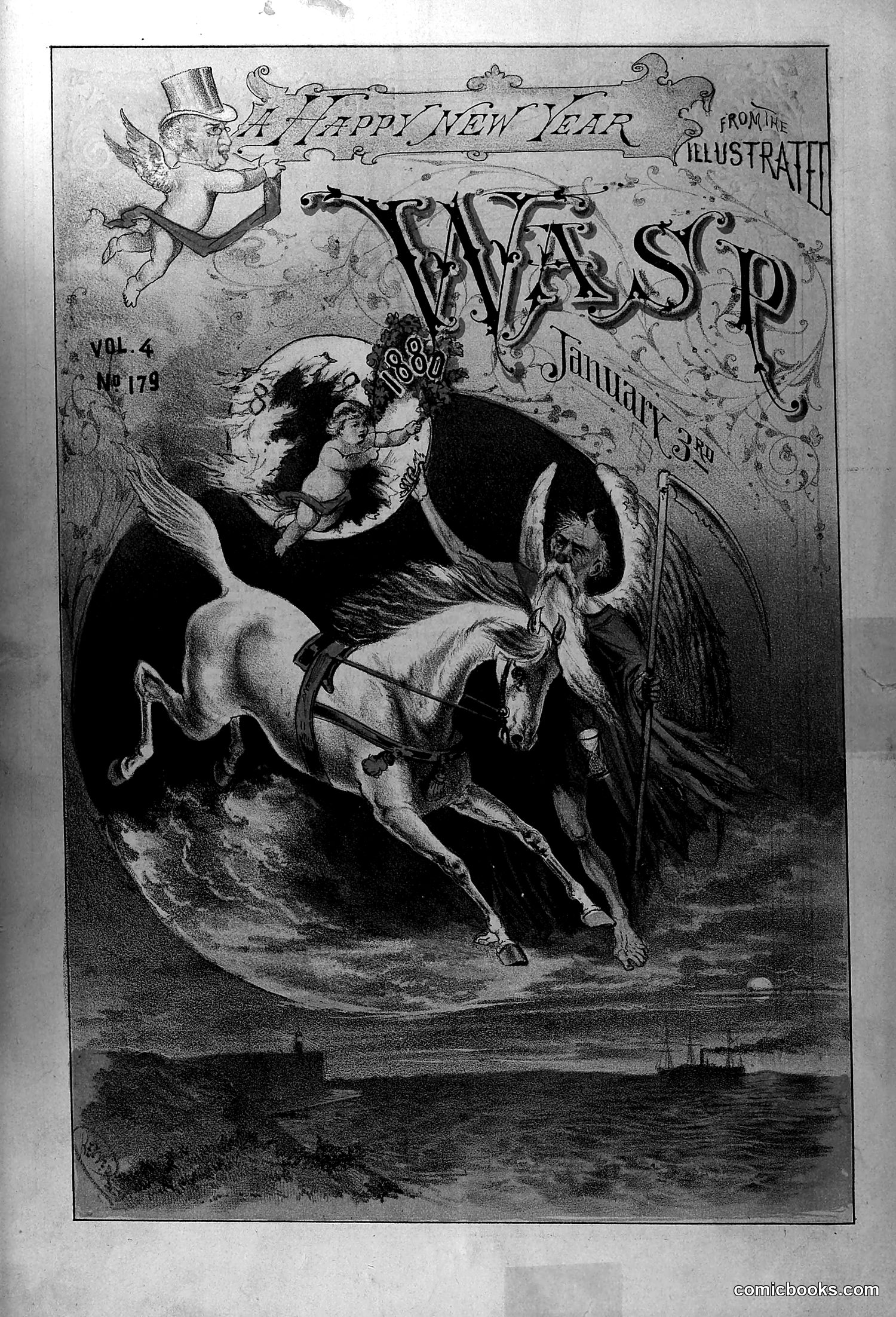
This is a New Year's greeting cover (Vol. 4, No. 179) featuring classical allegorical imagery typical of Victorian satirical art. The central figure appears to be Father Time or a similar personification of the old year, riding a horse while carrying what looks like an hourglass or temporal symbol. Cherubs or putti float above, one wearing a top hat—possibly representing the incoming new year or fortune. The satirical approach uses mythological/fantastical elements common to 19th-century American humor magazines. Without additional context about specific 1880s events, the precise political targets remain unclear, though The Wasp generally targeted local San Francisco politics and national figures through such allegorical New Year imagery.
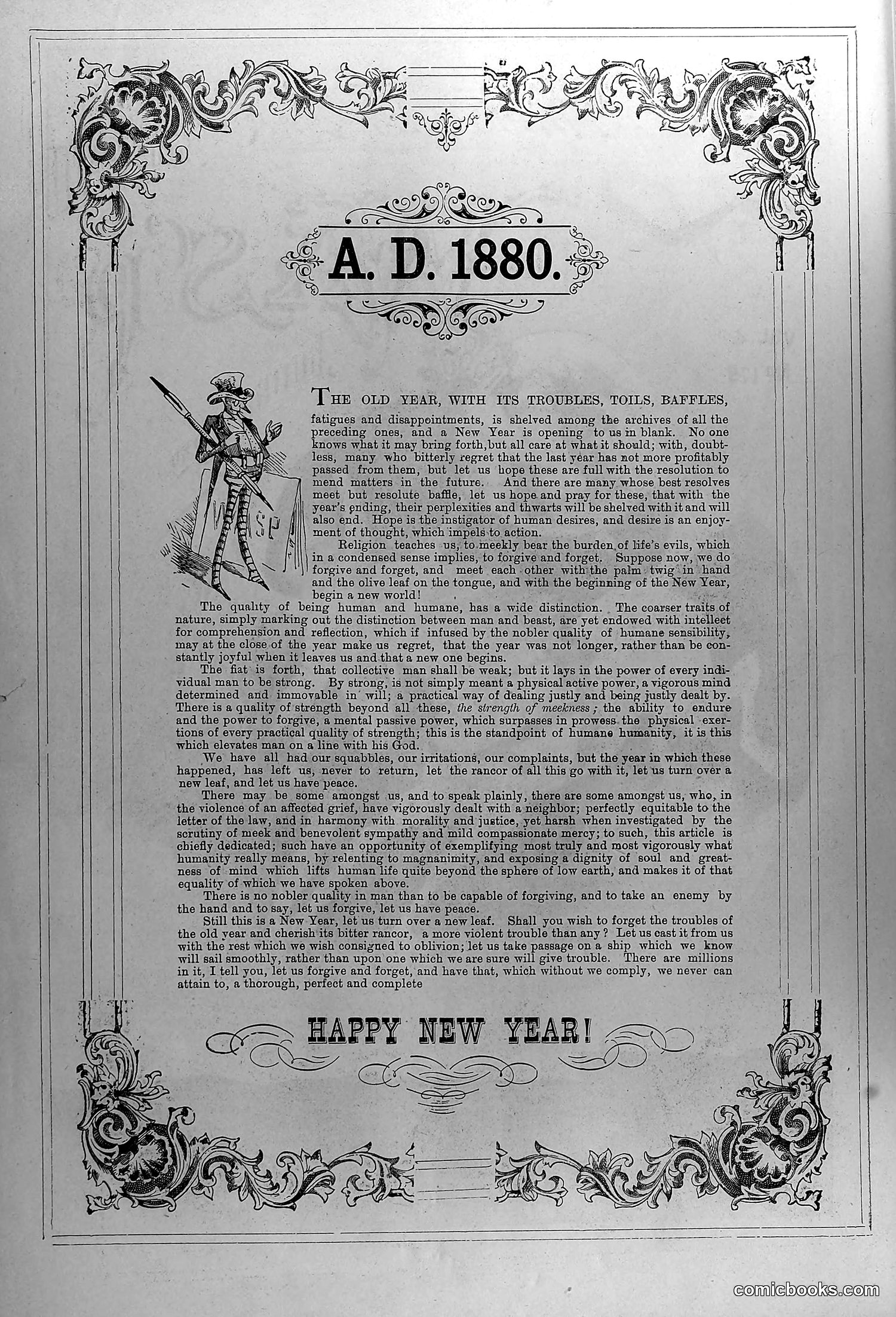
This page is a New Year's editorial rather than a political cartoon. The decorative border and central illustration of a figure (possibly representing Time or the old year) frame a philosophical essay about the past year's troubles and the opportunity for renewal. The text urges readers to forgive grievances, strengthen character through meekness and mercy, and approach the new year with hope and resolution. It emphasizes that true strength lies in endurance and moral fortitude—the "strength of meekness"—rather than physical power or vindictive action. The piece advocates for personal and social reconciliation, suggesting readers cast off resentments and move forward peacefully. It's primarily motivational rather than satirical, typical of New Year's reflective journalism from this period.
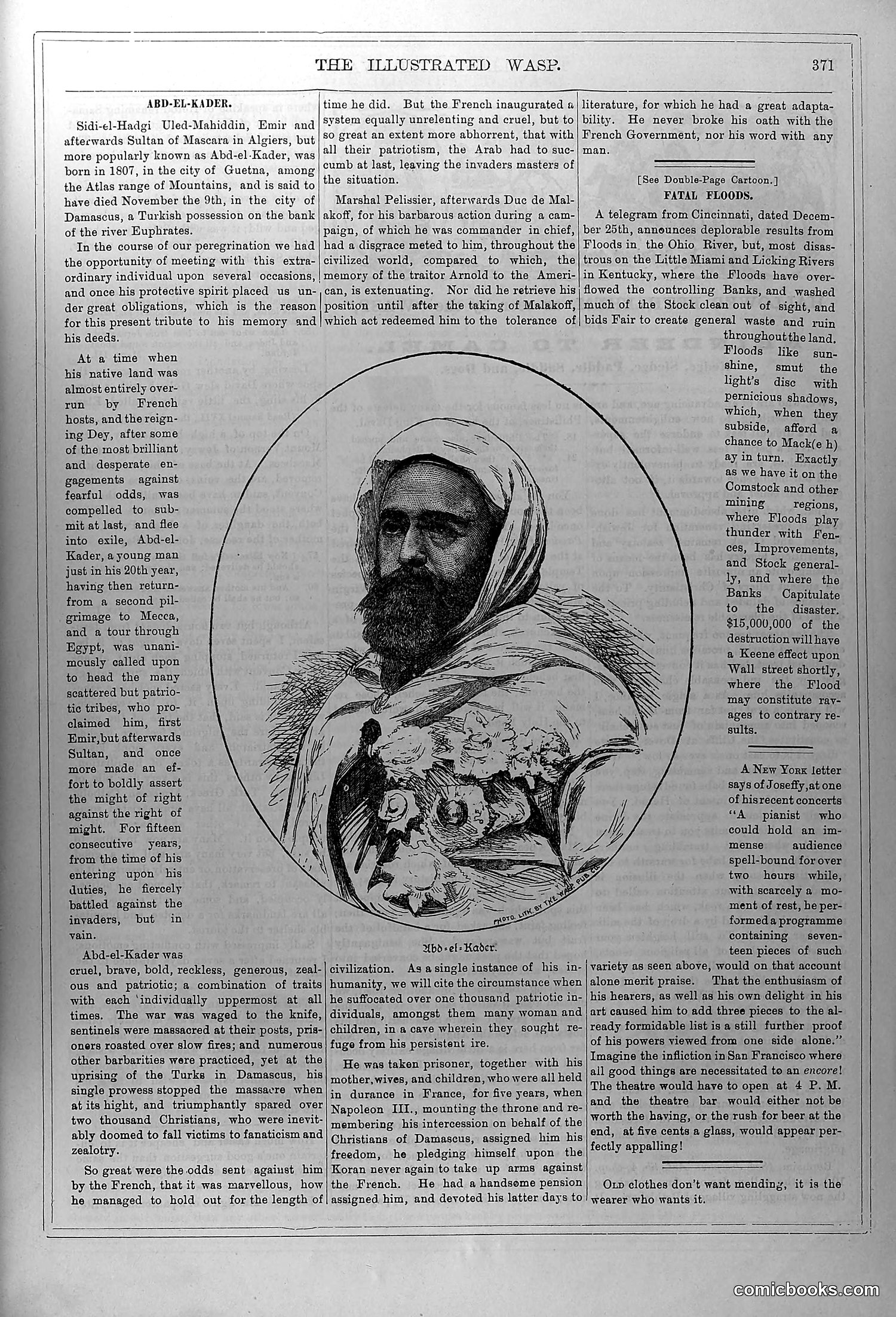
This page is primarily biographical rather than satirical. It features a portrait of **Abd-el-Kader**, a 19th-century Arab resistance leader who fought French colonial expansion in North Africa. The text describes his military campaigns, his eventual exile, and his character—presenting him as a dignified, humanitarian figure despite his opposition to French forces. The accompanying article praises his "bold, reckless, generous" nature and notes his imprisonment in France. The page appears to present Abd-el-Kader sympathetically to American readers, emphasizing his nobility and principles rather than mocking him. A brief sidebar anecdote about a New York pianist appears unrelated. This is primarily historical/biographical content rather than political satire.
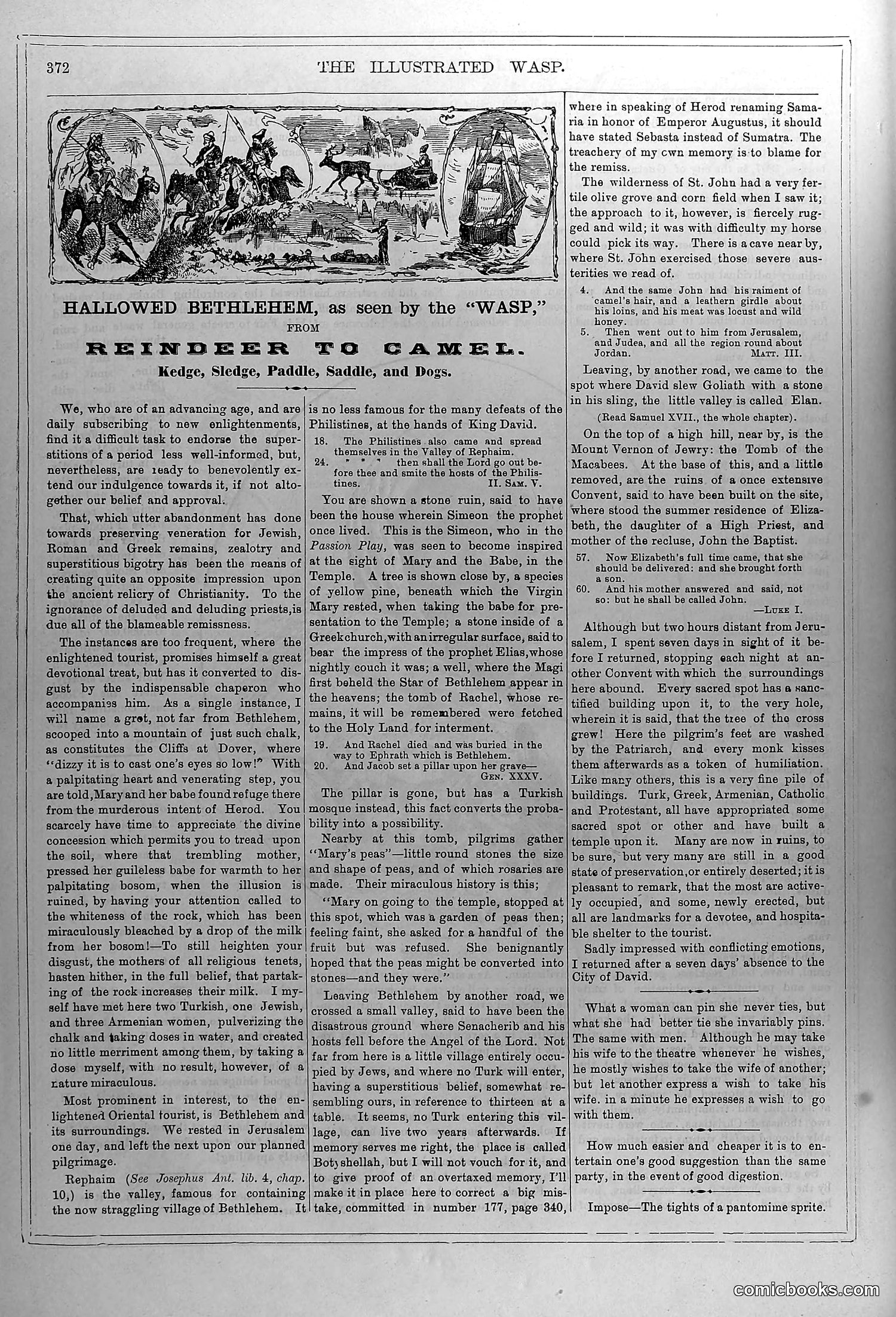
The main illustration depicts "Hallowed Bethlehem, as seen by the Wasp" with a subtitle referencing "Reindeer to Camel" — comparing transportation methods from Christian nativity imagery to Middle Eastern settings. The accompanying article discusses Bethlehem's sacred sites and pilgrimage destinations, describing various religious structures and their histories. It mentions Turkish occupation and religious communities (Catholic, Protestant, Armenian) claiming sacred spaces. The satire appears to critique the commercialization and competing claims over holy sites in Bethlehem, where multiple religious groups have "appropriated some sacred spot." The contrast between "reindeer" and "camel" likely mocks the incongruity between Western Christmas imagery and the actual Middle Eastern geography and politics of the Holy Land.
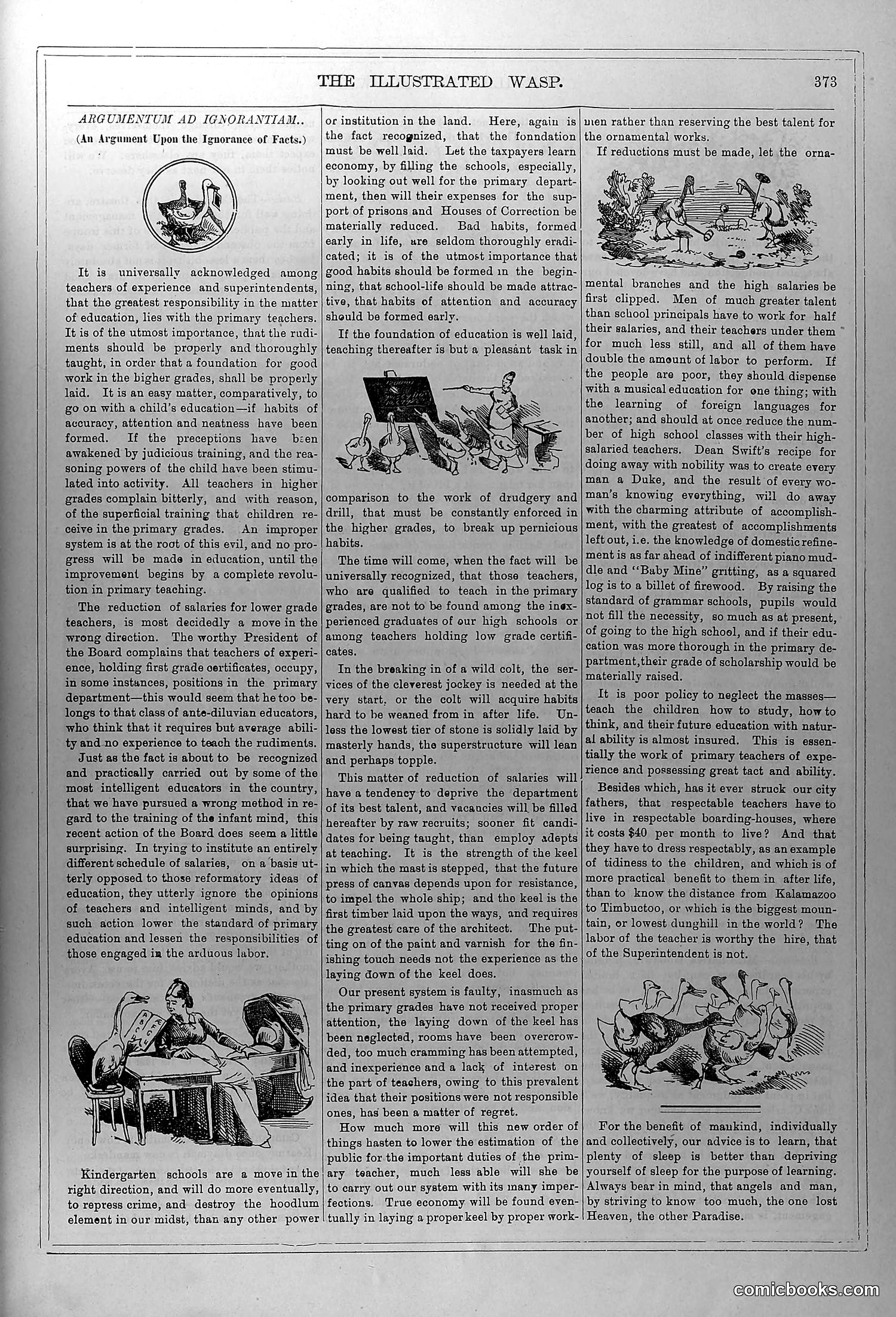
This page contains no political cartoon. Instead, it presents "Argumentum ad Ignorantiam" (An Argument Upon the Ignorance of Facts)—an editorial essay critiquing California's education system. The accompanying illustrations are generic scenes depicting schoolchildren and teachers, not caricatures of specific figures. The text argues that primary education receives insufficient funding and attention compared to higher grades, and that qualified teachers avoid primary positions due to low salaries. The author advocates for better primary education, claiming it forms children's foundational habits and character. The satirical point targets institutional neglect of elementary schools rather than specific individuals or political events. It's social criticism rather than political satire.
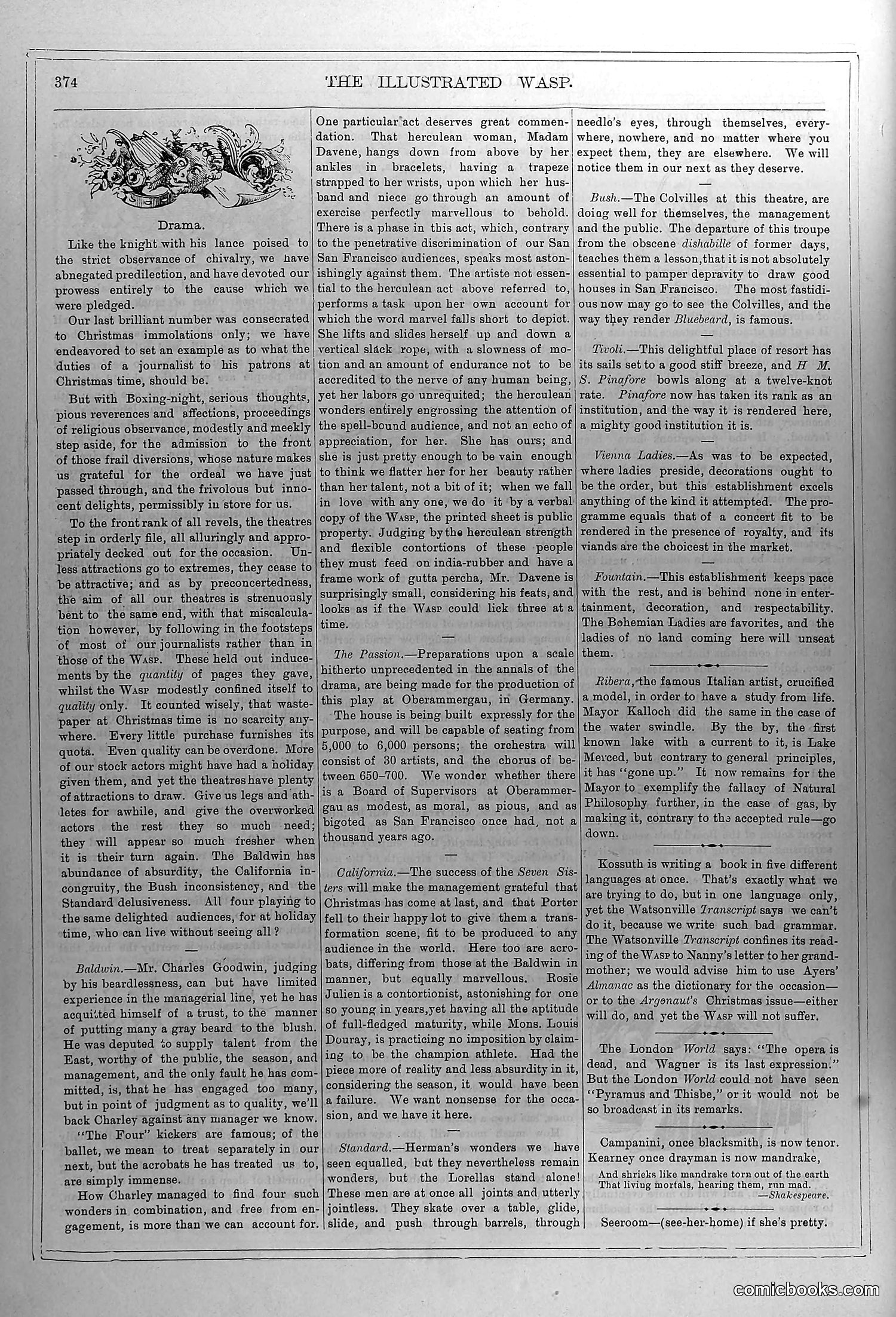
This page contains theatrical reviews rather than political cartoons. The small illustration at the top ("Drama") shows a woman in classical dress, accompanying reviews of San Francisco stage productions. The text critiques various performances and establishments: it praises Madame Davene's trapeze work at one venue, comments on the Colville troupe's departure, reviews the resort "Tivoli," discusses the "Vienna Ladies" establishment, and critiques "The Passion" production at Obammergau in Germany. There's also commentary on Charles Goodwin's management of the Baldwin theater, and brief notes on various performers like Rosie Philips and the Lorelles acrobats. The page functions as entertainment journalism with mild satire of theatrical management and performer abilities rather than political commentary.
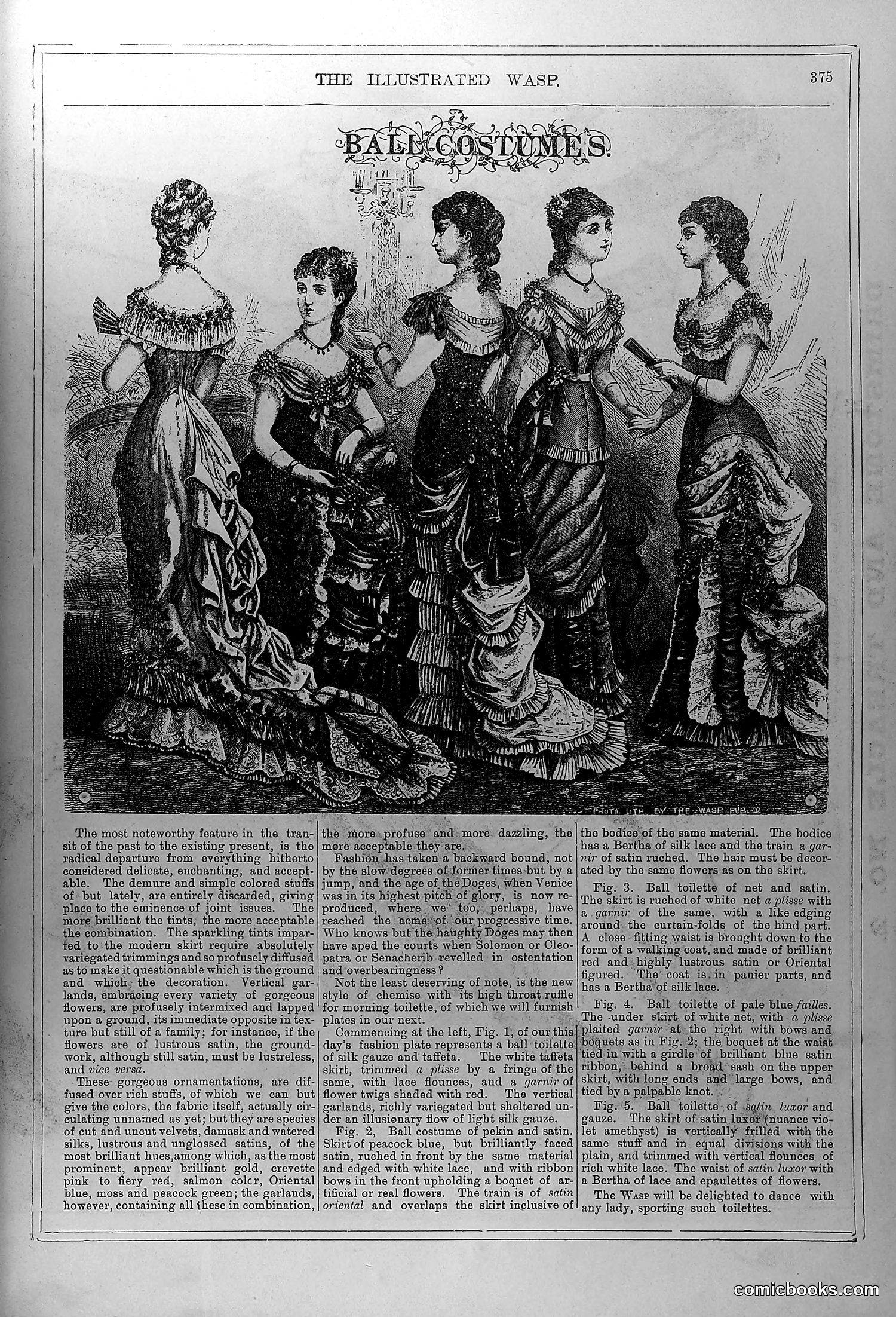
This page from *The Wasp* is primarily a **fashion illustration**, not satire. It depicts five women in elaborate ball gowns from what appears to be the 1880s-1890s era, showcasing contemporary formal wear details. The detailed text describes the gowns' construction: silk berths, satin trim, lace overlays, and decorative flourishes. Specific figures highlight fashionable elements like off-shoulder designs, bustles, and ornamental flowers. Rather than political satire, this represents *The Wasp*'s coverage of **social high society and women's fashion trends**. The illustrations serve as style guides for wealthy readers, documenting the elaborate dress codes of Victorian-era formal occasions. The content reflects the magazine's dual function as both satirical publication and lifestyle guide for San Francisco's upper classes.
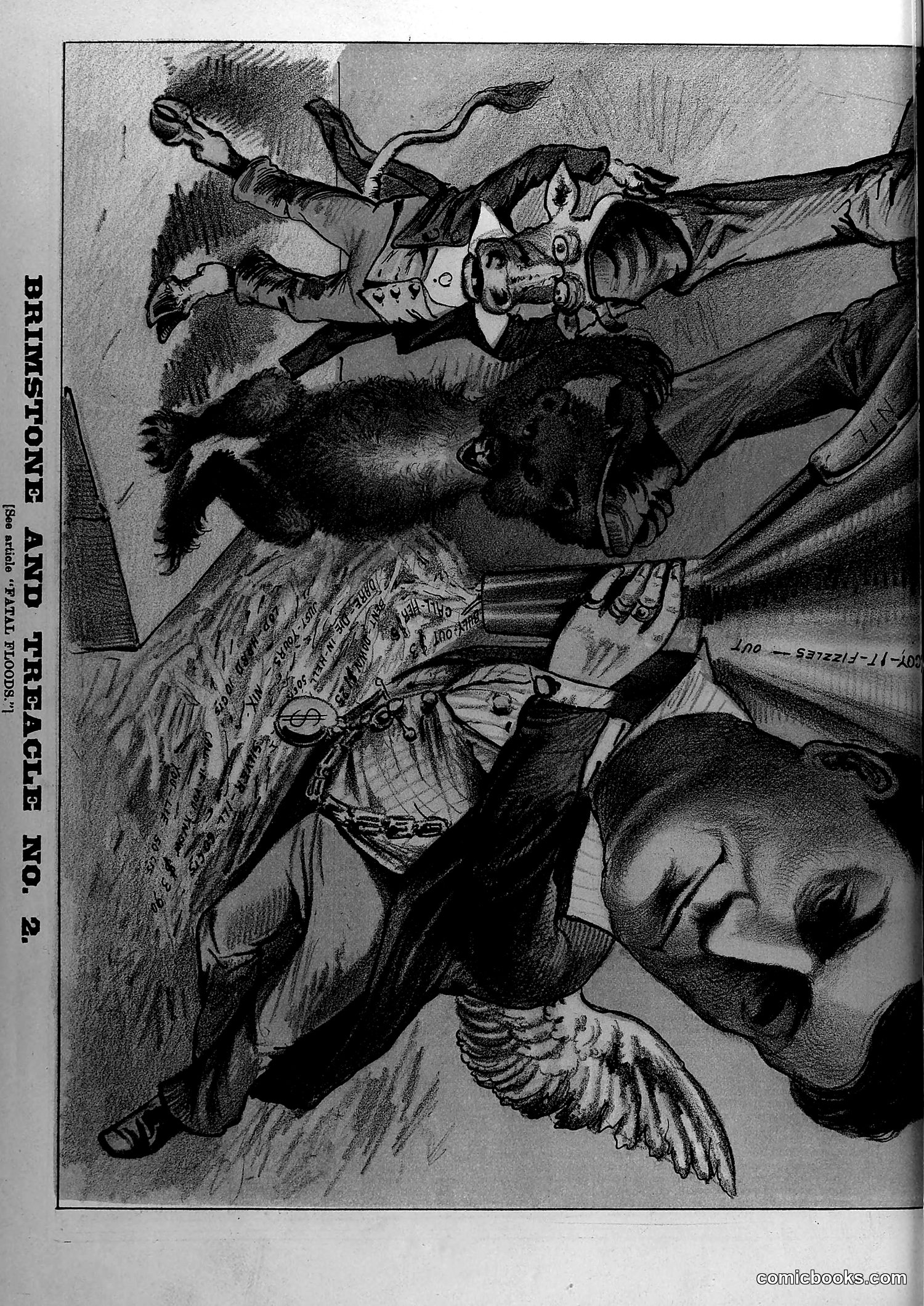
This appears to be a satirical illustration from *The Wasp* magazine featuring two winged figures engaged in what seems to be a physical altercation or struggle. The text identifies them as "Briststone and Trebaggle," though without additional historical context, I cannot definitively identify who these figures represent or what specific political or social event this cartoon satirizes. The exaggerated facial features and winged forms suggest these are caricatured characters, possibly representing political opponents or rival factions. The dramatic, chaotic composition emphasizes conflict and discord. However, without clearer identification of "Briststone" and "Trebaggle" or knowledge of the publication's date and context, I cannot accurately explain the cartoon's specific satirical point to a modern reader.
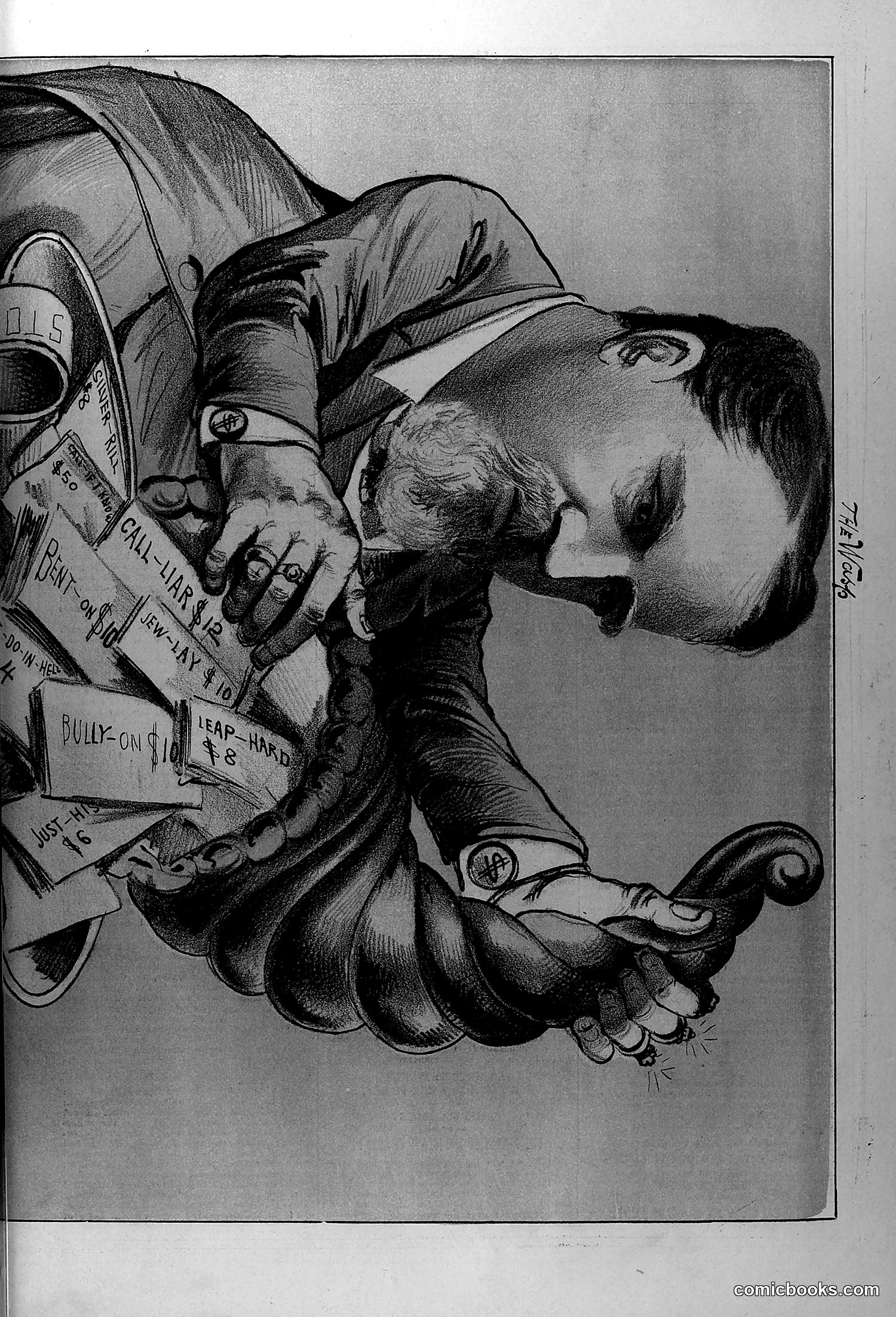
This appears to be a satirical cartoon from *The Wasp* magazine depicting a figure labeled with corporate/industrial terms being force-fed various products and schemes. The visible text on items includes references like "BULLY-ON," "LEAF-HARD," and other partially legible labels suggesting business practices or financial instruments. The caricature's exaggerated features and the force-feeding imagery suggest criticism of corporate or industrial excess and deceptive business practices. The multiple labels on the products being consumed likely mock various fraudulent or exploitative commercial schemes of the era. However, without clearer text visibility or date confirmation, I cannot definitively identify the specific figure, companies, or historical events being targeted. The cartoon's exact satirical point remains partially unclear from this image alone.
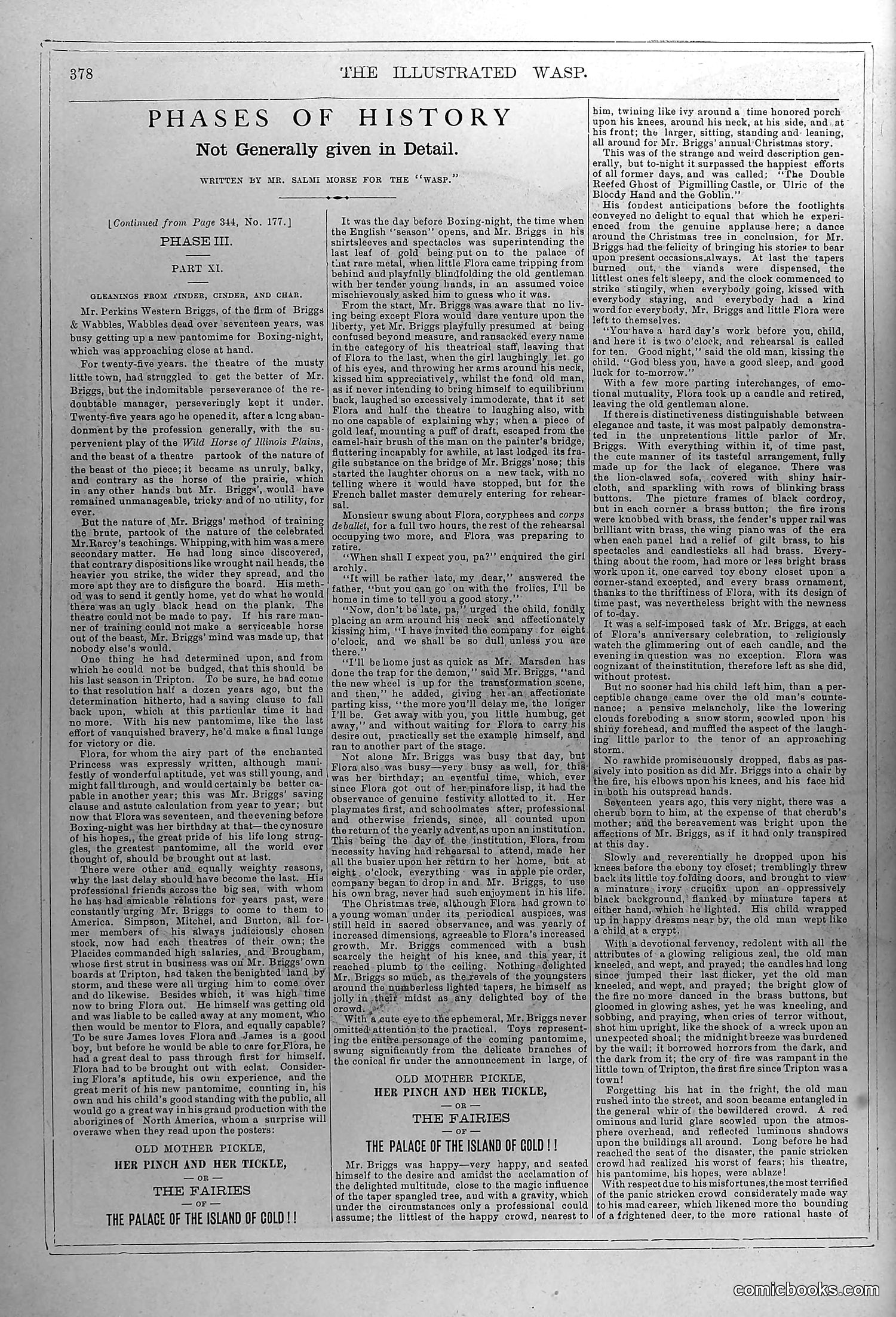
This page from *The Wasp* contains serialized fiction rather than political cartoons. The visible content includes: **"Phases of History Not Generally Given in Detail"** — Part XI, a satirical narrative by Salmi Morse about Mr. Perkins Western Briggs and his theatrical endeavors. The piece mocks Victorian-era theater, describing Briggs's attempts to maintain a "Wild West of Illinois" pantomime despite various mishaps and his cast's incompetence. Below that are story titles: **"Old Mother Pickle, Her Pinch and Her Tickle"** and **"The Palace of the Island of Gold!!"** This appears to be primarily a literary/fiction page rather than visual satire, focusing on humorous serialized stories that were typical *Wasp* content. The satire operates through narrative rather than illustration.
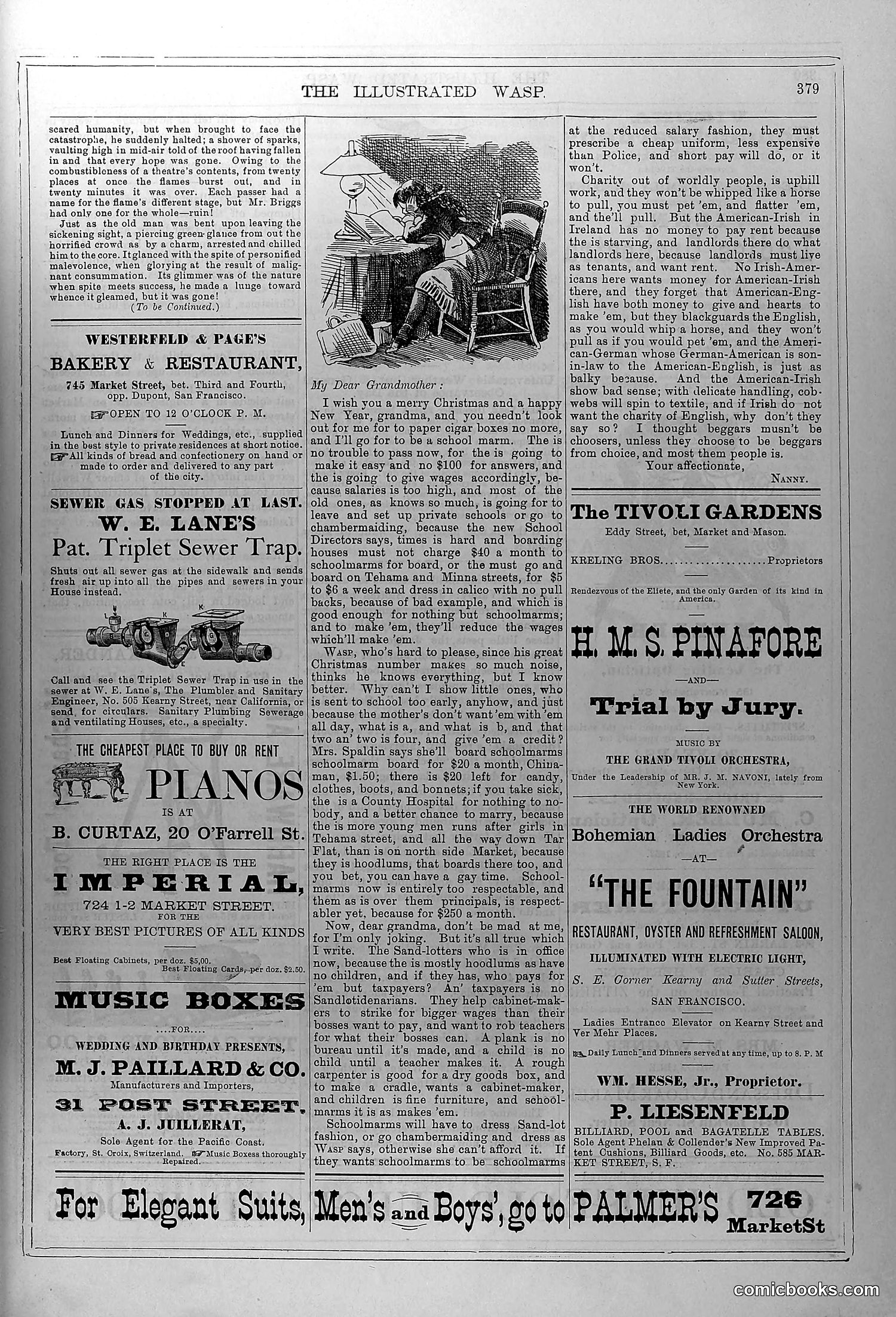
This page is predominantly **advertising and classified listings** rather than editorial content or political cartoons. The visible illustration shows a domestic scene of someone writing at a desk, accompanying a letter titled "My Dear Grandmother." The letter itself appears to be satirical advice about **Christmas finances and social expectations**—specifically addressing wage issues, schooling costs, and the financial pressures on working-class families. The writer critiques employers' inability to pay living wages while criticizing the poor for various perceived failings. The satire targets **economic hypocrisy**: wealthy employers/landlords refusing adequate wages while expecting poor families to somehow afford schooling, housing, and respectability. The remainder of the page consists of typical period business advertisements for pianos, bakeries, restaurants, and clothing—not political cartoons.
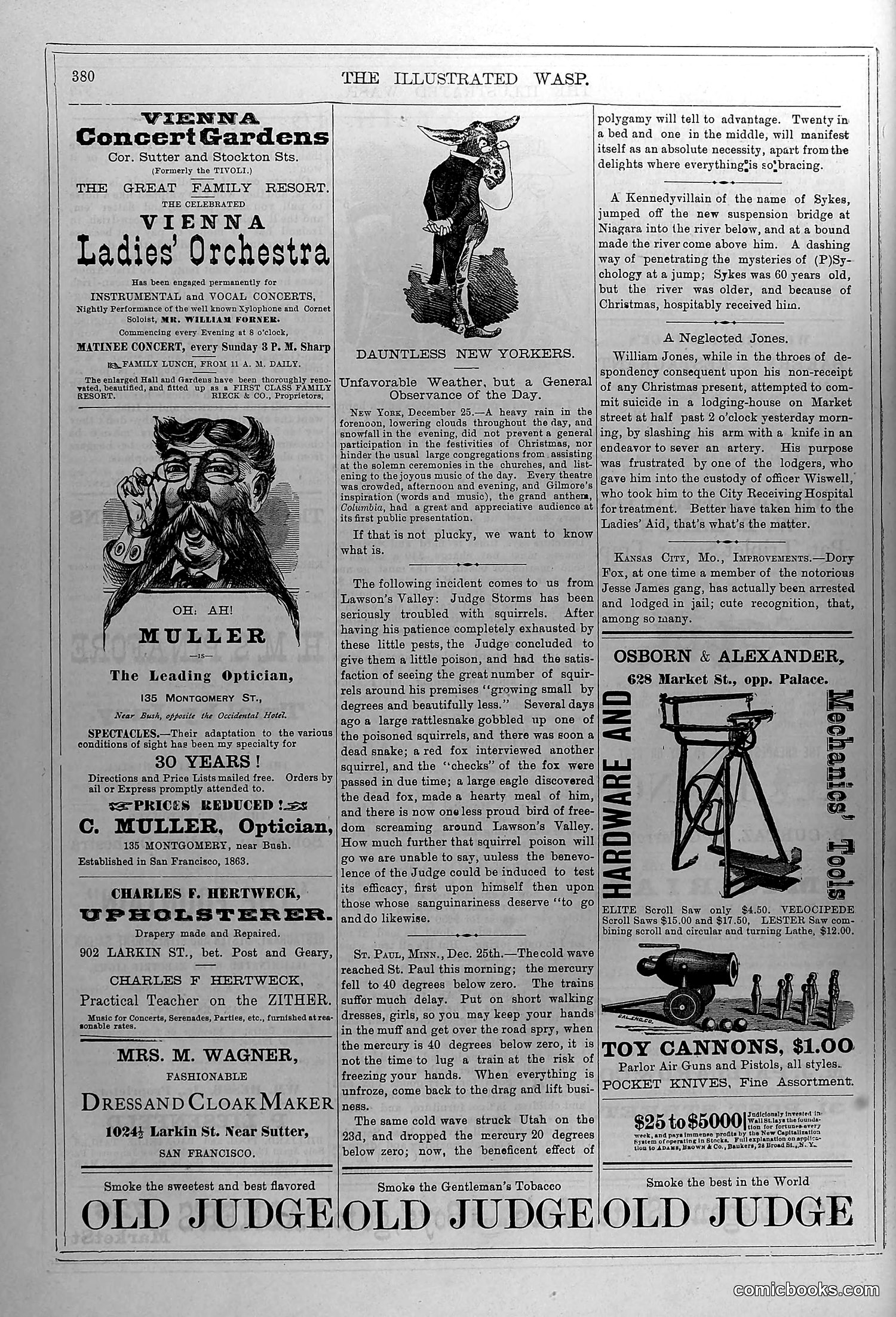
This page is primarily **advertising and notices**, not political satire. The main illustrated element is a caricatured goat's head labeled "OH, AH! MULLER," promoting an optician's business. The exaggerated features appear to mock the advertiser's name for humorous effect. The page contains various business advertisements (opticians, dressmakers, musical instruction, saw manufacturers) interspersed with brief news items about local incidents—including a suicide attempt, squirrel poisoning, and weather reports from St. Paul and Utah. The only satirical content is the embedded "Dauntless New Yorkers" section, which mockingly describes New Yorkers' indifference to bad weather and hardship. The tone suggests mild social commentary rather than pointed political critique. This appears to be a typical late-19th-century satirical magazine mixing ads, local news, and light humor.
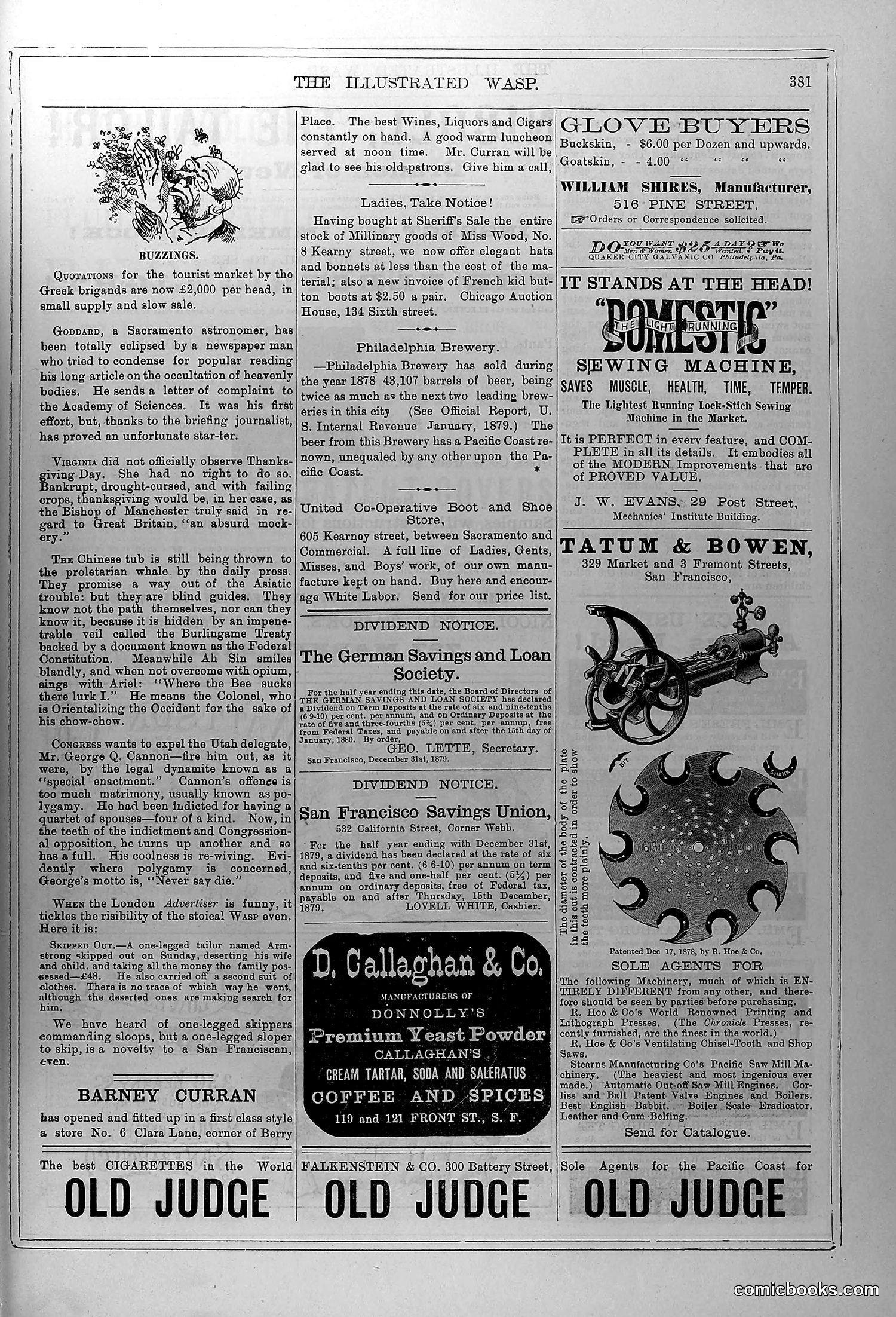
This page is **primarily advertising** with minimal satirical content. The main illustrated item is labeled "BUZZINGS" and appears to be a decorative vegetable or produce illustration, likely serving as a visual anchor for humorous market commentary. The text discusses various topics including Great Britain's agricultural prices, an astronomer eclipsed by newspaper scandal, and anecdotes about Chinese guides and Utah delegates—typical of *The Wasp's* satirical gossip column format. Below the editorial content are numerous period advertisements for local San Francisco businesses (sewing machines, savings societies, yeast powder, cigars). The page demonstrates how 19th-century satirical magazines relied heavily on advertising revenue to sustain publication.
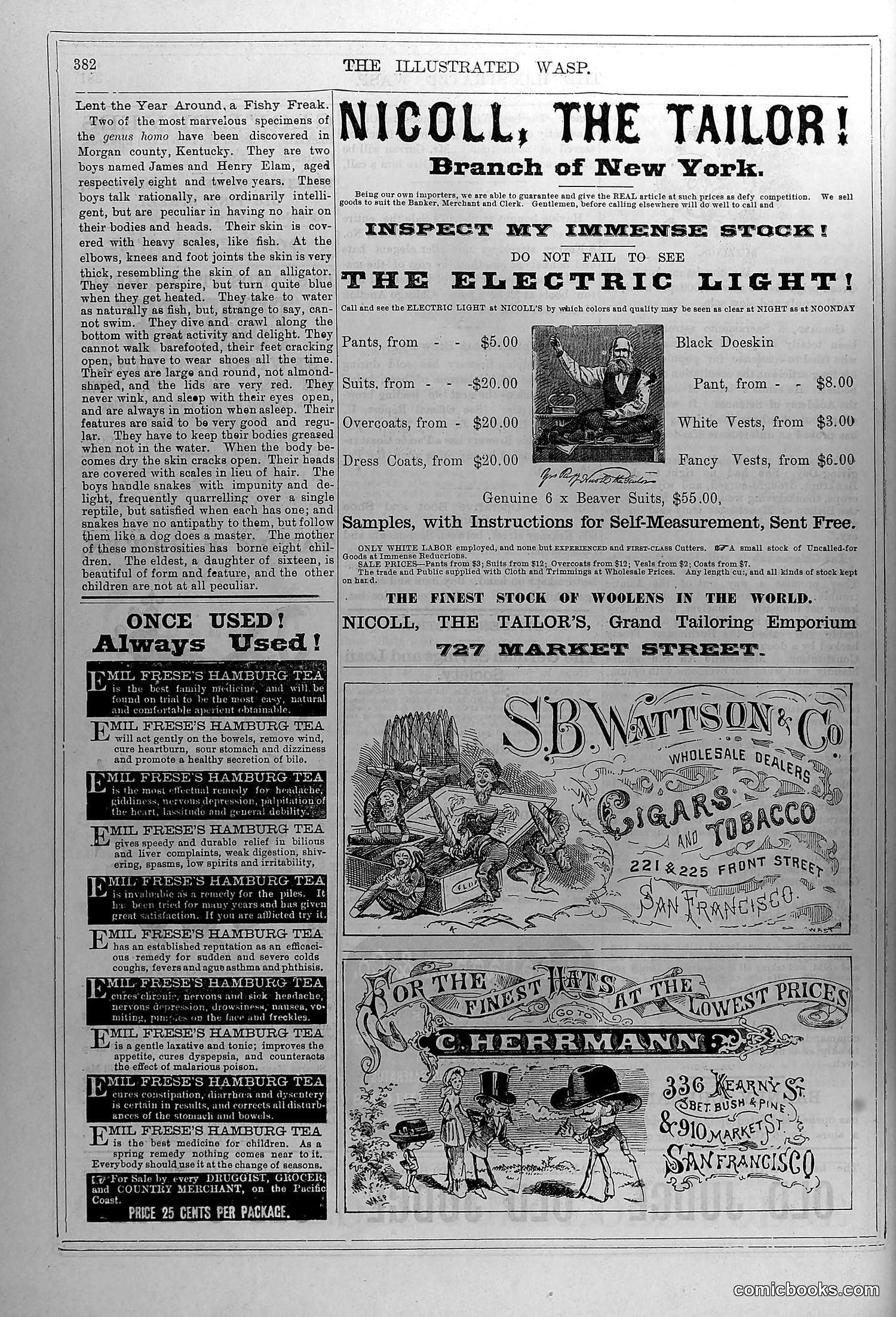
This page is **primarily advertising**, not political satire. The dominant content includes: - A large advertisement for **Nicoll, The Tailor** (Branch of New York), promoting clothing at various prices ($5-$20 range) with an illustration of a well-dressed man - Multiple advertisements for **Emil Fresse's Hamburg Tea**, claiming medicinal benefits for various ailments (headaches, constipation, colds, etc.) - Ads for **S.B. Wattson & Co.** (cigars and tobacco in San Francisco) - **Cherrmann's** hat advertisement - A brief article at top about unusual specimens discovered in Kentucky (two boys with alligator-like skin conditions) There is **no clear political cartoon or satire** visible on this page. It appears to be a typical late-19th-century magazine page mixing editorial content with commercial advertisements, reflecting the era's advertising practices.
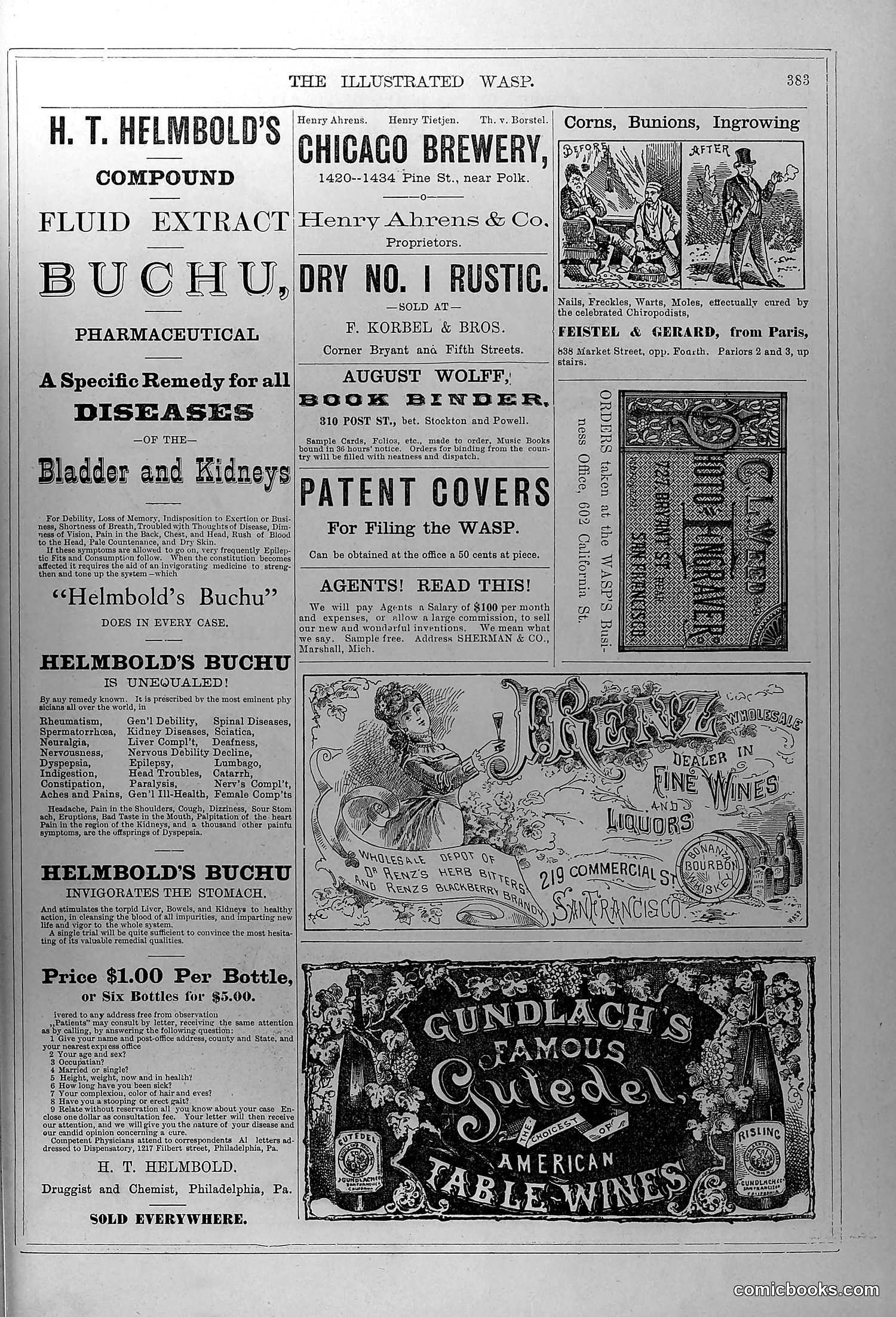
This page is primarily **advertising content** rather than editorial satire. It contains multiple commercial advertisements including: - H.T. Helmbold's "Buchu" patent medicine (a bladder/kidney disease remedy) - Chicago Brewery advertisement - Book binder services - Patent covers for filing documents - A wine and liquor dealer in San Francisco - Gundlach's Famous Spätlese American Cable Wines The only illustration with potential satirical content shows a cherub or cupid figure advertising wine and liquor products. There are no identifiable political cartoons or caricatures of named public figures on this page. The content reflects typical late 19th-century magazine advertising practices, where patent medicines and alcohol products were heavily promoted through illustrated ads.
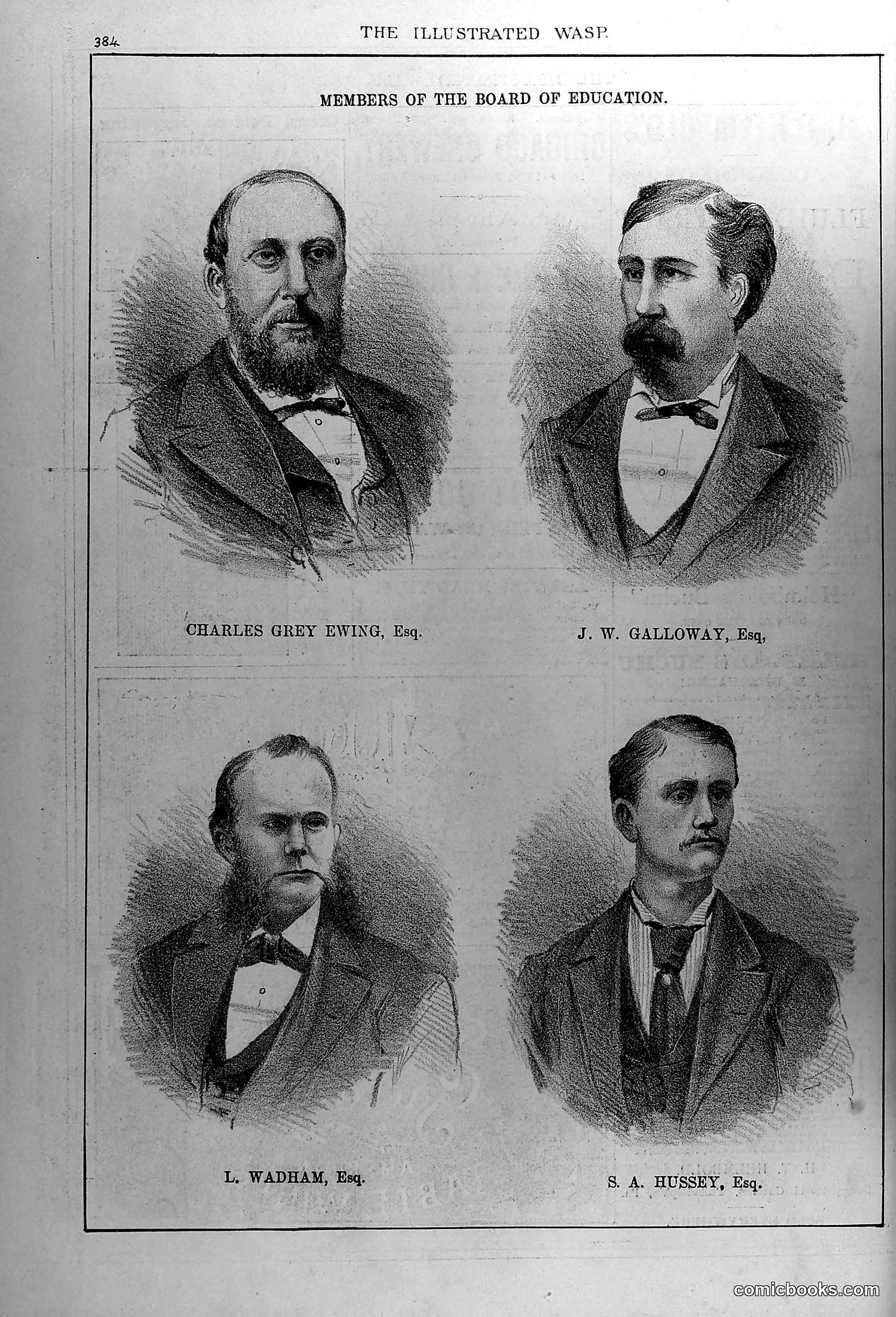
This page presents four portrait engravings of men identified as members of a Board of Education: Charles Grey Ewing, J. W. Galloway, L. Wadham, and S. A. Hussey. Without additional context from *The Wasp's* accompanying articles or commentary (not visible here), the specific satirical point remains unclear. However, given *The Wasp's* reputation for political satire, this likely either praised or criticized these officials' educational policies. The formal portrait format suggests the magazine may have been highlighting these public figures for readers' scrutiny—potentially to mock their competence, expose corruption, or critique their educational decisions. The page number (384) indicates this is from a larger issue whose context would clarify the intended satire.

I can see this page contains a color-reference chart or test pattern featuring graduated gray squares arranged in a grid, along with measurement scales (rulers marked 6-11 inches vertically and approximately 6-10 inches horizontally). This appears to be a technical or production element rather than editorial cartoon or satirical content. Without visible cartoon artwork, caricatured figures, or legible text describing political or social commentary, I cannot identify specific satire, jokes, or historical references. This looks like a calibration or quality-control page used in printing or publishing processes—possibly included in *The Wasp* for technical purposes rather than as editorial content meant to convey political meaning to readers.