
A complete issue · 18 pages · 1879
The Wasp — December 25, 1879

I can see this is a measurement/calibration page from The Wasp magazine, featuring Oregon Rule Co. rulers and a grayscale color checker chart used for photographic reproduction quality control. This appears to be a technical documentation page rather than editorial content with cartoons or satire. The page shows no visible cartoon figures, caricatures, or satirical commentary. Instead, it contains reference tools—rulers for measuring dimensions and a standardized color/tone chart—which would have been included in magazine production to ensure consistent printing quality across issues. Without visible satirical content, political figures, or social commentary on this particular page, I cannot identify the cartoon's subject or intent. This seems to be archival/production material rather than the magazine's editorial or humor content.
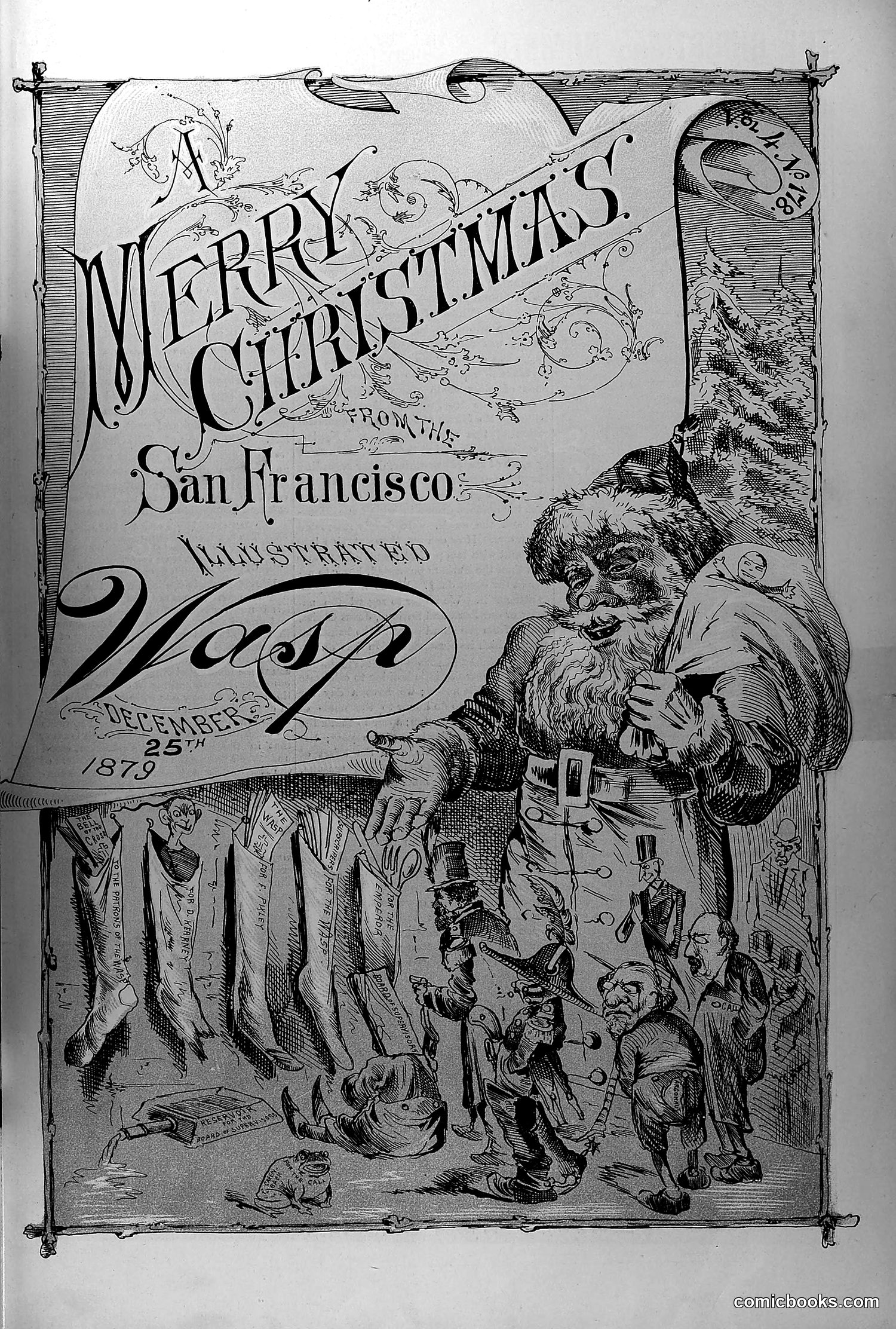
This is a Victorian-era Christmas greeting card illustrated in satirical style. The main image shows Santa Claus distributing gifts to children below, with stockings hung in the background. The composition uses typical 19th-century engraving techniques with cross-hatching. Without additional context from *The Wasp* magazine's specific political stance that week, the exact satirical targets remain unclear. However, given *The Wasp*'s reputation for sharp social commentary, this likely contains coded criticism—possibly targeting wealthy San Francisco merchants, labor conditions, or class disparities—hidden within the festive Santa imagery. The children's expressions and their interaction with Santa merit closer inspection for ironic intent, though the specific social commentary isn't immediately apparent from the image alone.
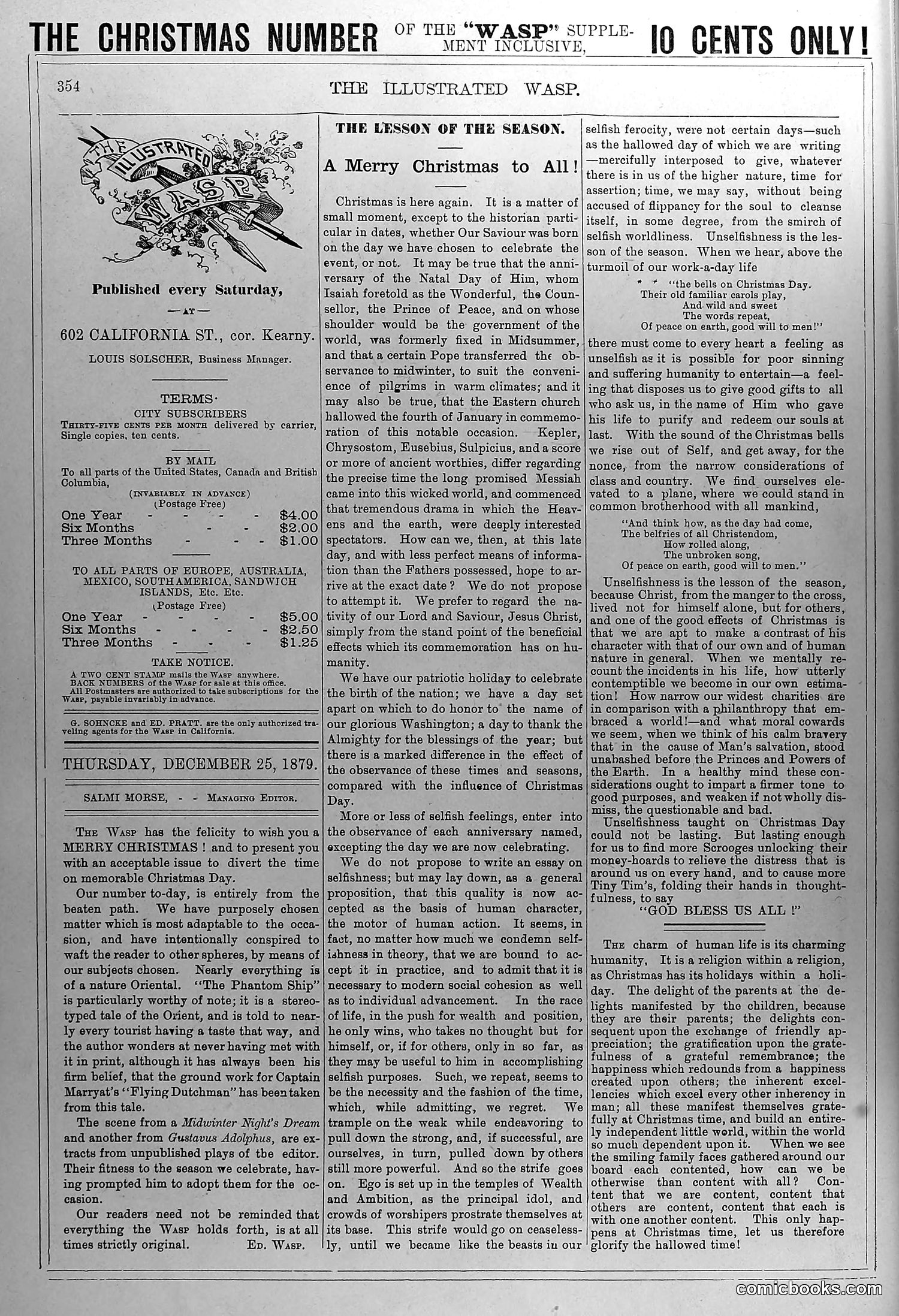
This page is primarily **editorial content rather than political satire**. The masthead illustration shows "The Illustrated Wasp" logo with decorative flourishes, but the bulk of the page contains a lengthy Christmas editorial titled "The Lesson of the Season." The article argues that **unselfishness should be Christmas's central lesson**, encouraging readers to look beyond material concerns and practice philanthropy toward "singing and suffering humanity." It critiques how selfishness pervades society and calls for the holiday to inspire moral reform and "human brotherhood." The text emphasizes that **Christmas should prompt reflection on character and social responsibility** rather than mere celebration. This appears to be **moral advocacy journalism** rather than satirical cartooning—the Wasp using its platform for earnest social commentary on the true meaning of Christmas.
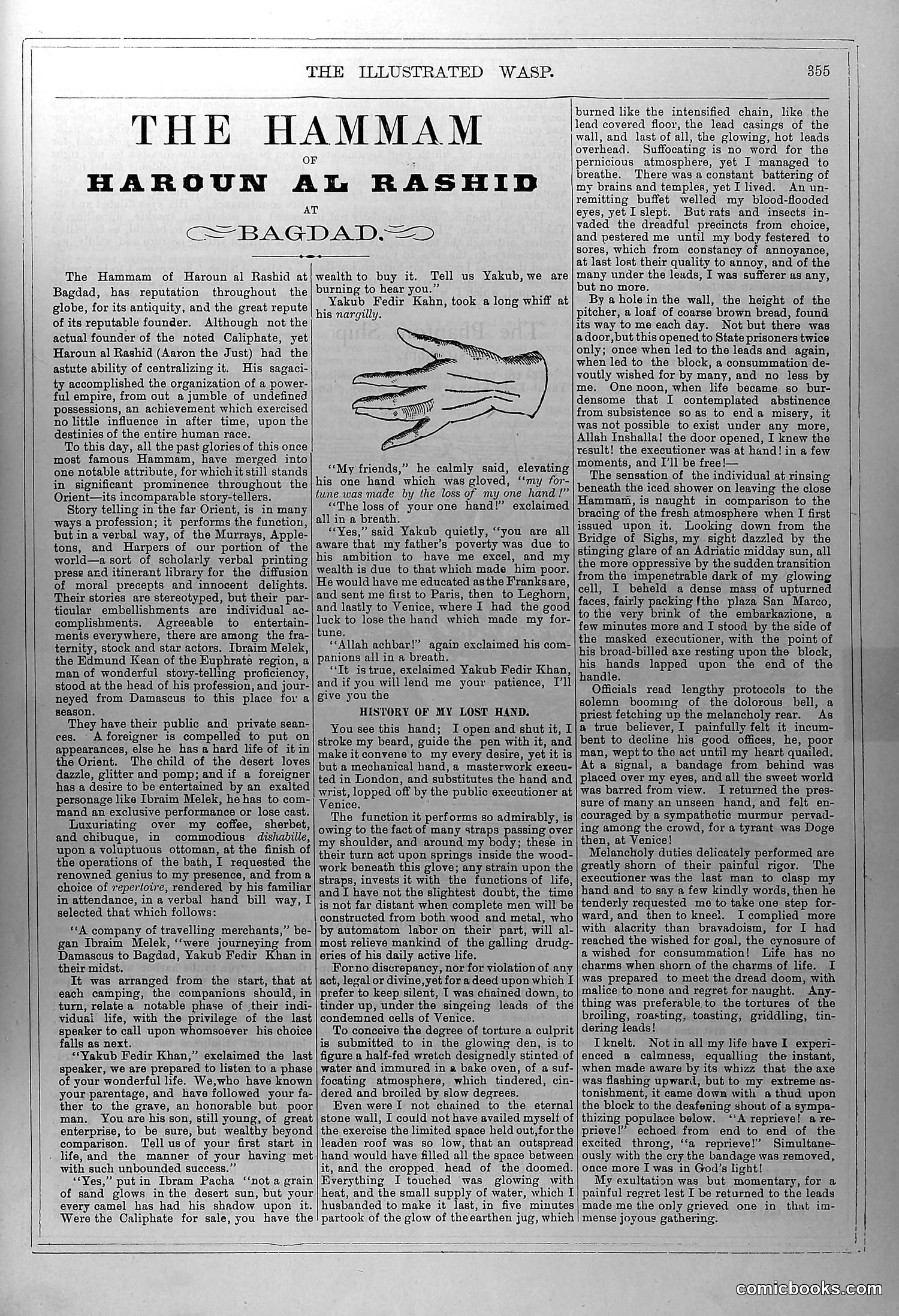
This page from *The Wasp* features "The Hammam of Haroun al Rashid at Bagdad"—a serialized story rather than a political cartoon. The text describes an exotic narrative about a Hammam (Turkish bath) and includes a dramatic account titled "History of My Lost Hand," wherein a character describes losing his hand to execution in Venice. The content appears to be orientalist fiction/entertainment rather than satire. It reflects late 19th-century American fascination with Middle Eastern and Islamic settings, popular in periodicals of the era. The elaborate prose and melodramatic narrative suggest this was serialized fiction designed to entertain readers with tales of exotic locales and dramatic misfortune—a common magazine feature of the period, not political commentary.
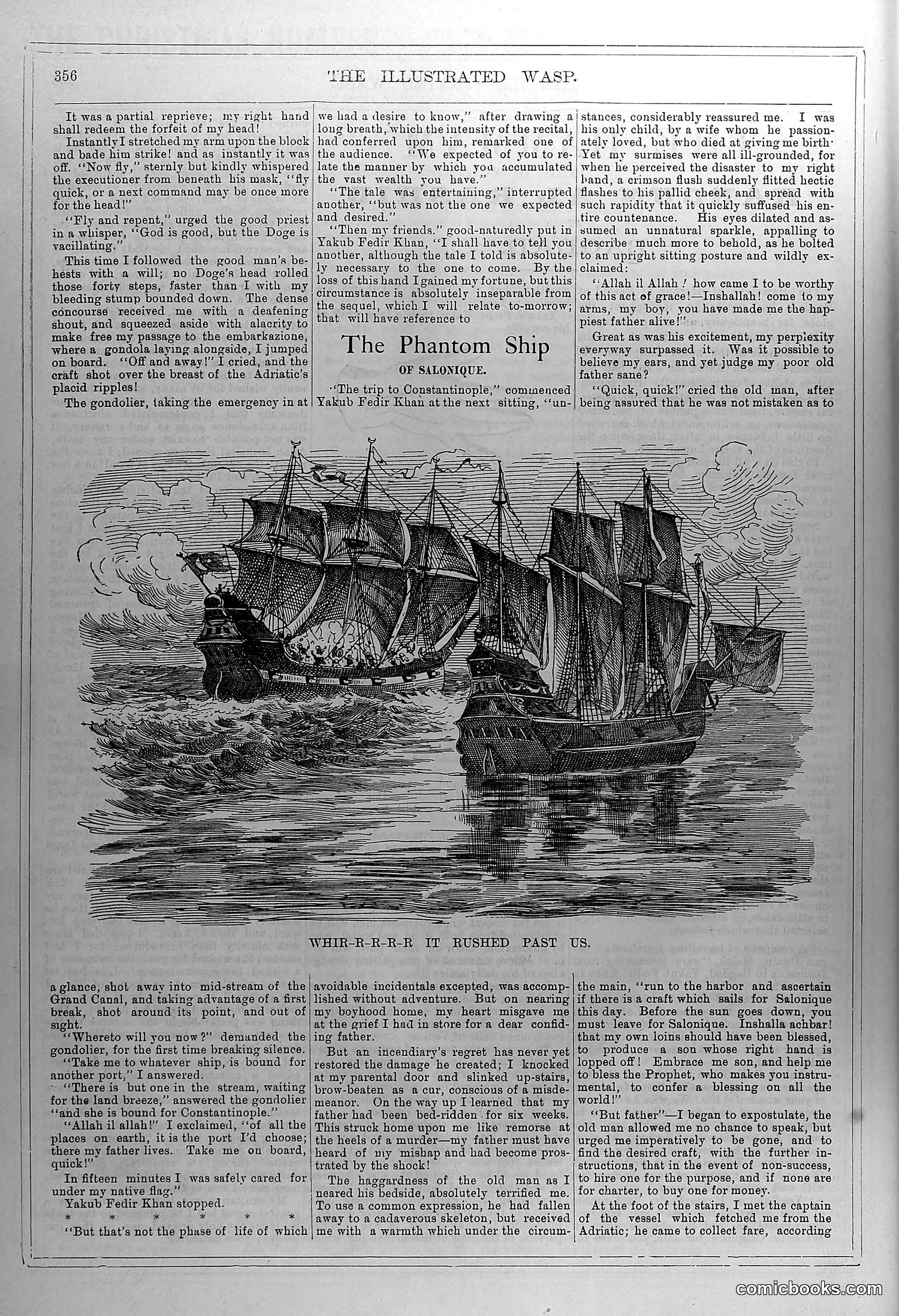
This page from *The Wasp* presents a fictional nautical adventure narrative titled "The Phantom Ship of Saloniqu[e]" rather than political satire. The illustrated engraving depicts two period sailing vessels at sea, with dramatic waves and full rigging. The story recounts an encounter near Constantinople involving the narrator's supernatural experiences aboard a ship. The text references "Yakub Pedir Khan" and discusses mystical or ghostly occurrences at sea. This appears to be entertainment fiction—adventure storytelling rather than political or social commentary. Without additional context identifying specific historical figures or events referenced in the narrative, the piece functions primarily as serialized imaginative literature typical of late 19th-century periodicals.
This page from *The Wasp* (page 357) contains serialized fiction rather than political cartoons. The text is a maritime adventure story titled "The Phantom Ship of Saloniqu[e]" with a "Sequel" section beginning midpage. The narrative describes a harrowing sea voyage involving a becalmed ship, a crew in distress, and supernatural or mysterious events—including references to a "phantom ship" and curses. The story features dialogue between sailors and appears designed for serialized entertainment. This represents *The Wasp*'s literary content rather than its satirical cartooning. Without visible illustrations on this particular page, the satirical or political commentary—if any—would depend on how the fictional narrative might allegorically reference contemporary events, which isn't clearly apparent from the text alone.
This page appears to be primarily **literary and editorial content** rather than political satire or comics. It features: 1. **"Gustavus Adolphus"** — a dramatic poem/extract about seizing a spade at Nuremberg, presented as "an unpublished Tragedy." The verses mock grandiose language about digging earth, establishing the spade as a metaphor for labor and human progress. 2. **Bottom section** contains brief satirical notes mocking current events: British military operations in Kabul, champagne-related social pretensions, and political commentary about Democrats and elections. The page's primary humor derives from **linguistic parody and mock-heroic treatment** of mundane subjects rather than visual caricature. The specific political references remain unclear without additional historical context about when this issue was published.
This page presents Act III, Scene IV of an unpublished dramatic work by Salmi Morse, a Shakespearean parody set in a frozen landscape. The scene features fantastical characters including a Snow King, Minister of Content, and various snowmen engaging in philosophical dialogue about fate and destiny. The text is primarily a literary work rather than political satire. It contains a Shakespearean dramatic structure with choruses and character exchanges about spiritual matters and human condition. At the bottom, footnotes discuss noses in relation to man's horn, and reference "hogging games" and police "spasms" in almanacs. Without visible caricatures or clear contemporary political references in the image, this appears to be entertainment-focused creative writing rather than satirical commentary.
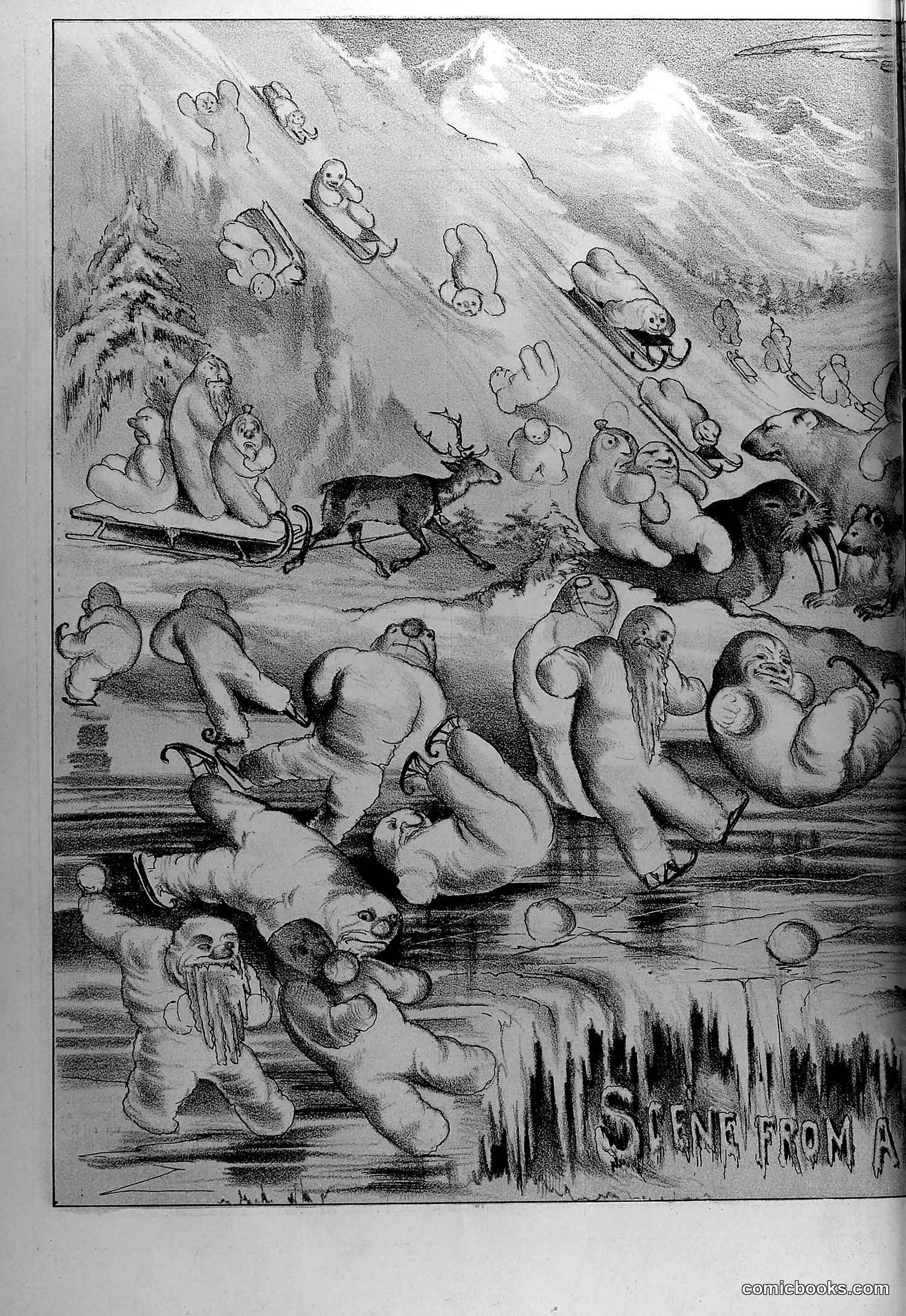
This appears to be a winter scene satirizing what the caption identifies as "SCENE FROM A" (text cut off). The image depicts numerous rotund, cherub-like figures engaged in winter activities on a snowy mountainside—sledding, playing, and frolicking in the snow. The style suggests this is either a whimsical fantasy scene or possibly a satirical commentary on winter leisure among wealthy or privileged classes, given *The Wasp*'s typical satirical focus. The exaggerated, corpulent figures with caricatured features were common visual tropes in 19th-century American satirical publications. Without the complete caption text, I cannot definitively identify the specific political or social reference intended. The inclusion of animals (deer, possibly reindeer) suggests possible holiday or seasonal themes, but the exact target of satire remains unclear from the visible portion.
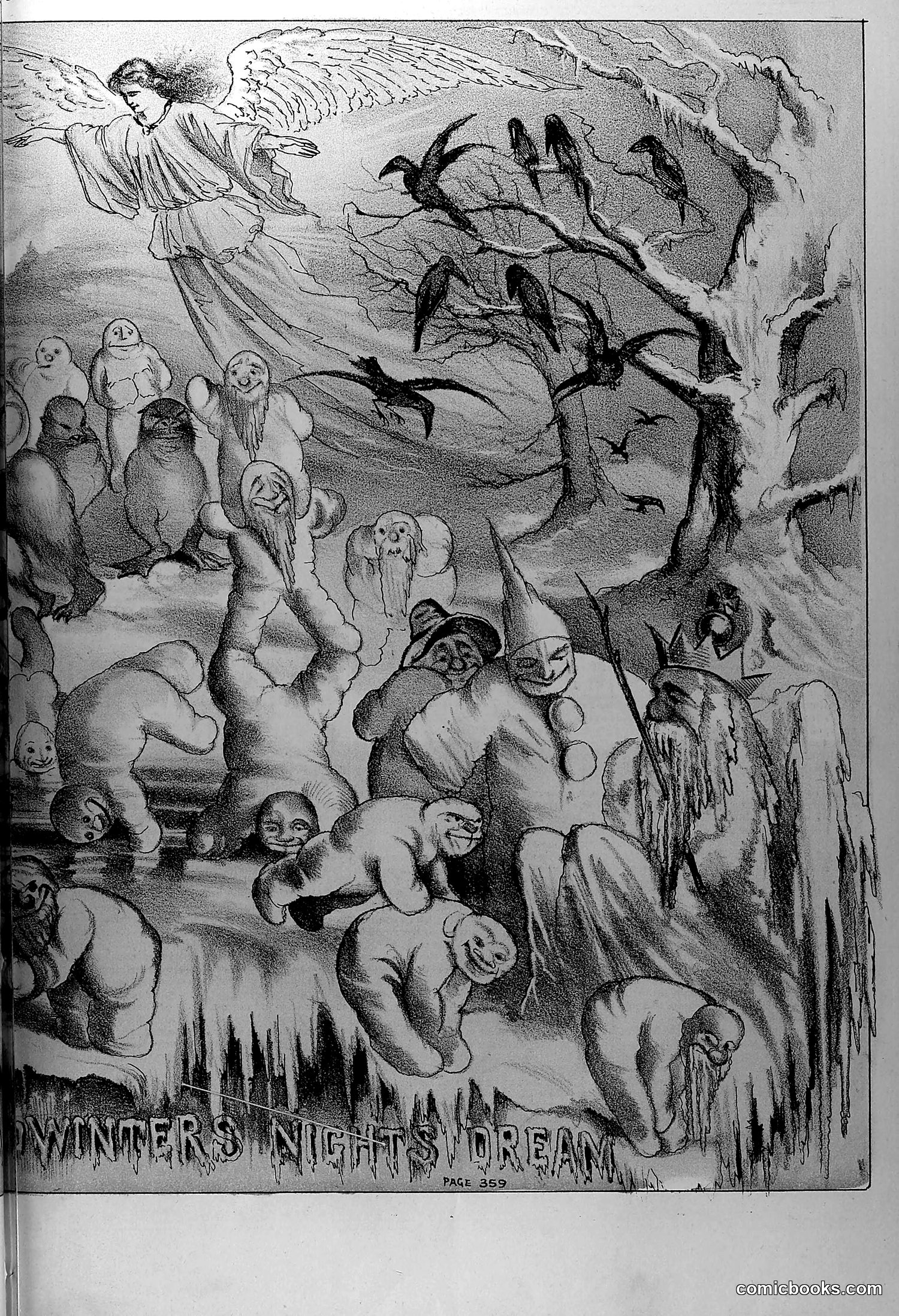
This satirical illustration depicts a chaotic winter scene populated by cherubs, demons, and supernatural figures. An angel hovers above while black birds swirl through bare trees. Below, numerous putti (cherubic infant figures) interact with darker, more sinister characters including what appears to be a bearded demon or devil figure on the right. The title "Winter's Night's Dream" likely parodies Shakespeare's "A Midsummer Night's Dream," suggesting a nightmarish inversion—a winter/dark counterpart to the original comedy. The mix of heavenly and infernal imagery, combined with chaotic composition, suggests social or political disorder. Without additional context, the specific satirical target remains unclear, though the grotesque figures and supernatural chaos typically indicated Wasp magazine's commentary on contemporary social corruption or upheaval.
This page presents a satirical story crediting Jules Verne with an "impossible tale," likely mocking both Verne's imaginative science fiction and the magazine's claim to expose literary hoaxes. The text is a first-person narrative describing a fantastical journey through space, featuring encounters with impossible atmospheric conditions, strange creatures, and extraordinary phenomena. The satire appears to target Verne's popular science-fiction novels (particularly *From the Earth to the Moon*, published 1865) by presenting an absurdly exaggerated adventure as if it were a discovered manuscript. The magazine presents this as exposing a fictional "Christmas lie"—suggesting both Verne's tall tales and the gullibility of readers who believed such fantastic narratives were plausible.
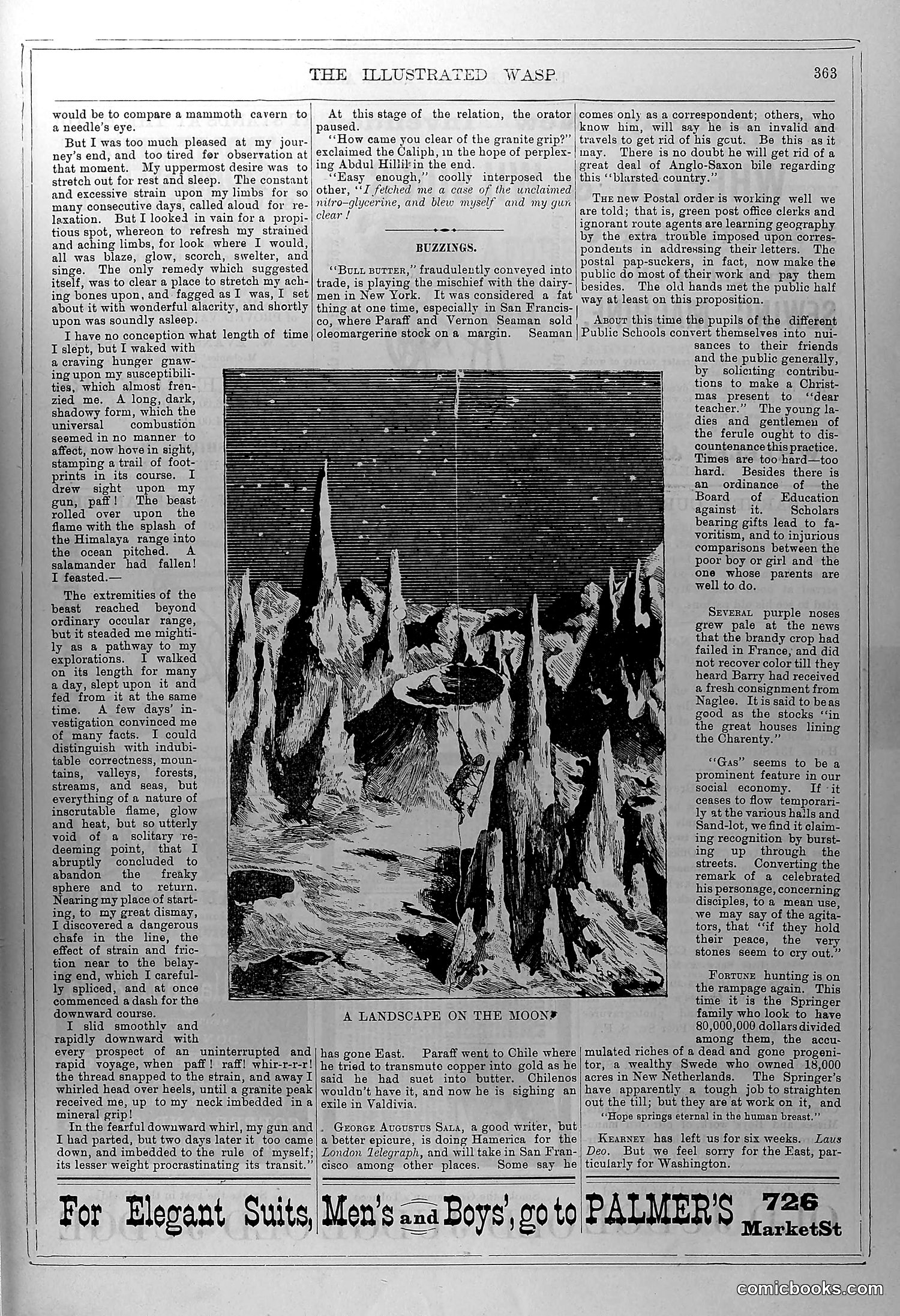
This full-page illustration depicts a stark, barren lunar landscape with jagged rock formations and shadows. The caption identifies it as "A LANDSCAPE ON THE MOON." The accompanying text is a personal narrative about the author's cave exploration and geological observations. It mentions comparisons to mammoth caverns, descriptions of stalactites and stalagmites, and concludes with reflections on abandoning "the freaky sphere" to return to Earth. This appears to be **satirical science fiction or fantastical travel writing** rather than political commentary. The humor likely derives from the absurdity of presenting a fictional moon landscape as documentary illustration—a common 19th-century literary device mocking credulous readers or pretentious scientific claims. The page also contains sections on "Buzzings" (gossip/short items) and advertisements, which were standard *Wasp* magazine features.
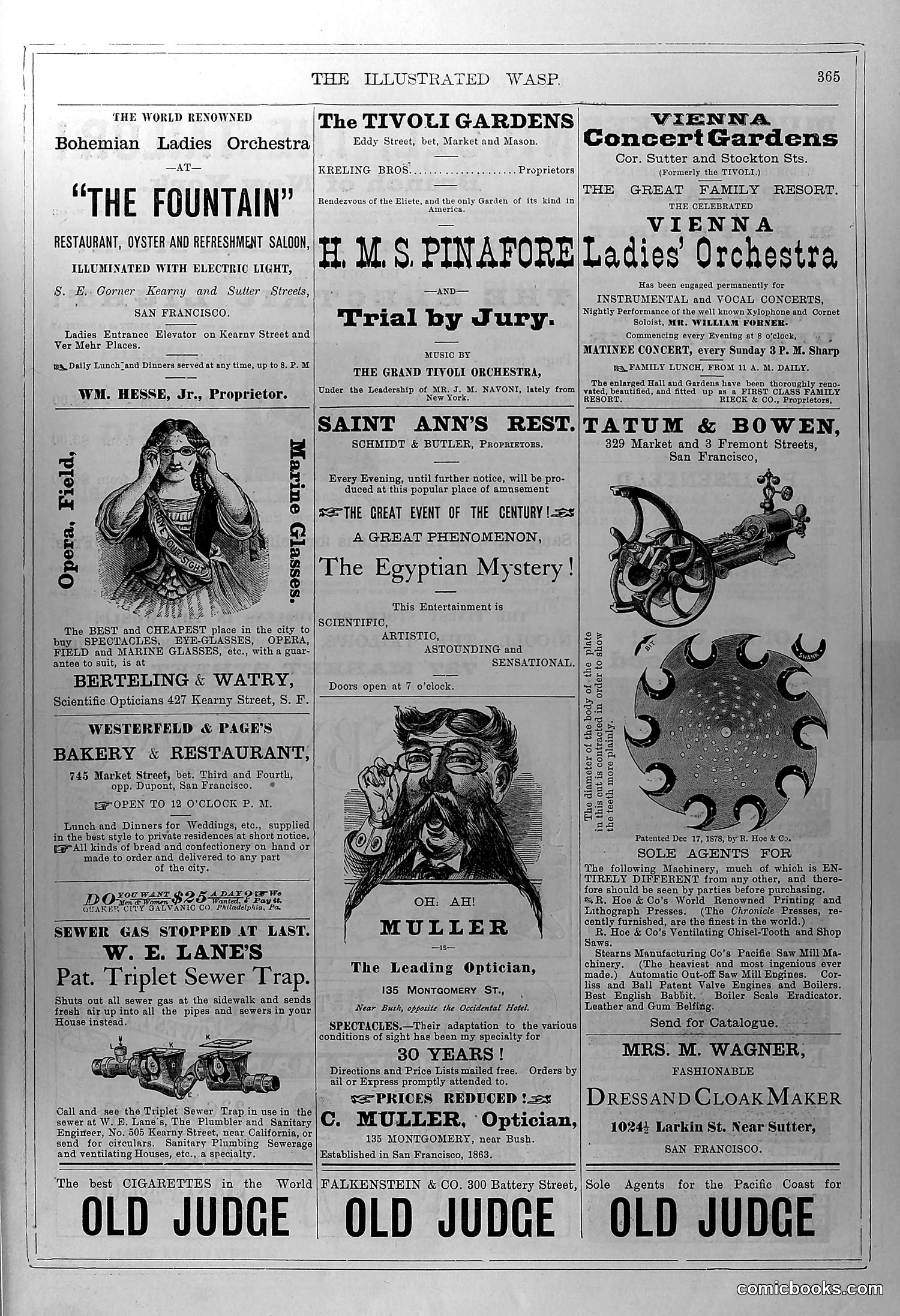
This page is primarily **advertising content** rather than political satire or editorial cartoons. It features numerous San Francisco business advertisements from the late 19th century, including restaurants, orchestras, optical shops, and other services. The only notable illustrations are **decorative advertisements**: a classical female figure (for opera glasses), a bearded man's face labeled "OH! AH! MULLER" (promoting an optician), and mechanical/astronomical imagery (for a printing company). There is **no clear political cartoon or satirical message** on this page. The word "WASP" suggests the magazine typically contained satire, but this particular page functioned as a revenue-generating advertising section rather than editorial content.
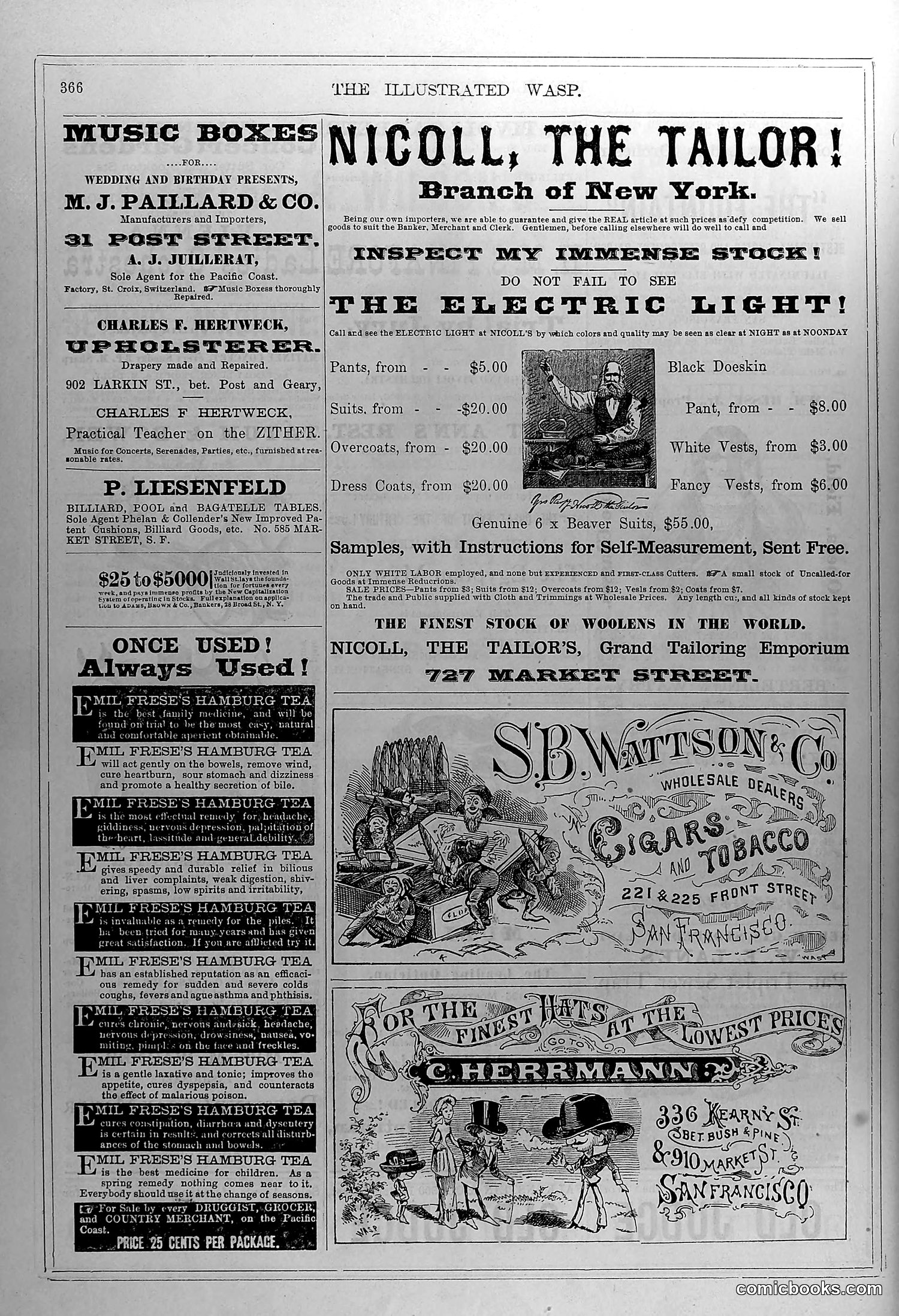
This page is primarily **advertising**, not political satire. It contains commercial notices for various San Francisco businesses including: - Music boxes and tailoring services (Nicoll, the Tailor) - An upholsterer (Charles F. Hertweck) - A zither instructor - Investment opportunities - Emil Frese's Hamburg Tea (prominently advertised with repeated endorsements) - S.B. Watson & Co. (cigars and tobacco) - C. Herrmann (hats) The only illustrative elements are **decorative engravings** accompanying the advertisements—depicting cherubs, figures in period dress, and ornamental flourishes typical of Victorian-era commercial design. There is no discernible political or social satire on this particular page.
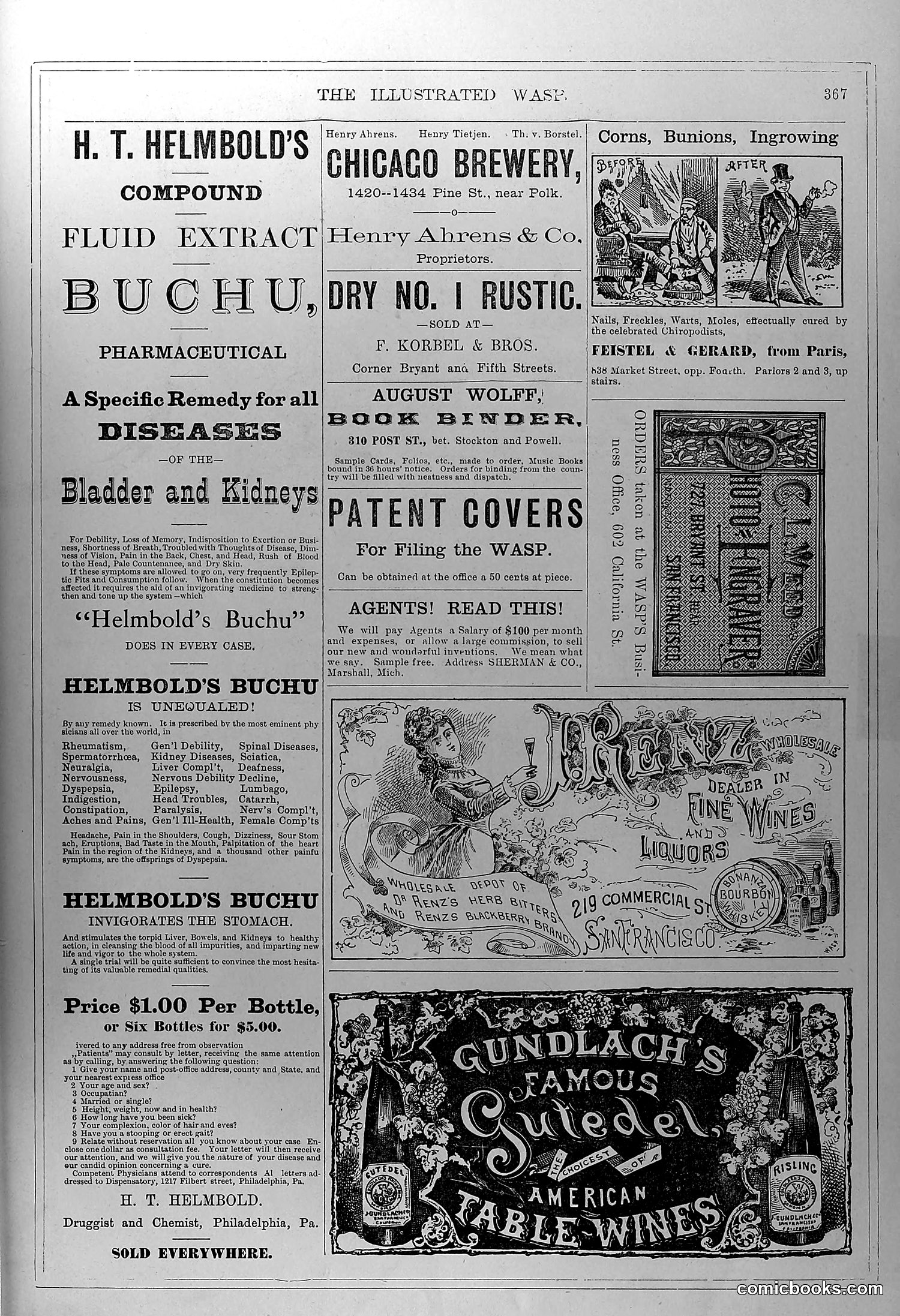
This page is primarily **advertisements**, not political satire. It contains commercial notices for various products typical of late 19th-century America: - H.T. Helmboldt's "Buchu" (a patent medicine claiming to cure bladder and kidney diseases) - Chicago Brewery - Book binding services - Patent covers for filing "The Wasp" - Wine and liquor dealers - Gundlach's "Sauledel" (American table wines) The only illustrative content consists of decorative engravings accompanying these ads—a cherub figure with wine bottles, period-dressed figures, and ornamental designs. These are typical commercial artwork, not satire. **No political cartoon or social satire appears on this page.** It represents standard magazine advertising revenue rather than editorial content.
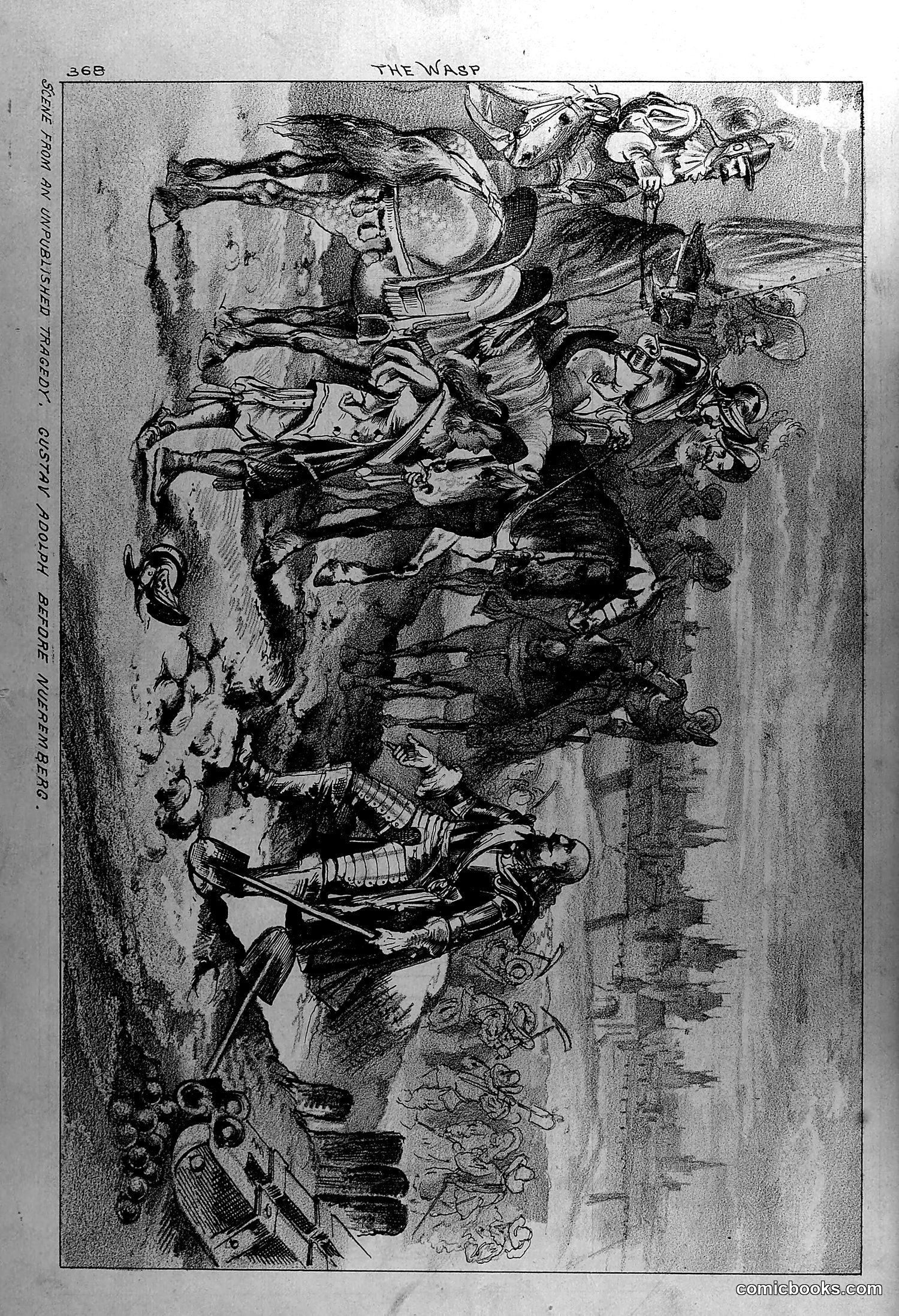
This page appears to be a single satirical illustration titled "The Wasp" showing a chaotic scene of multiple figures in what looks like a confrontational or violent situation. The figures appear to be caricatured political or public personalities of the era engaged in some kind of struggle or conflict. However, the OCR text provided is incomplete—it contains only the page header and no actual descriptive text that would clarify which specific individuals are depicted, what political event or scandal is being satirized, or what the cartoon's central message is. Without clearer text or identifying labels within the image itself, I cannot confidently identify the specific figures or explain the particular political context and satire intended by this cartoon. The artistic style and composition suggest social or political commentary typical of *The Wasp's* satirical mission, but the specific target remains unclear from the available information.

I can see this page contains a calibration chart or color/tone reference card typical of photographic documentation, with a grayscale gradient palette on the left side and measurement scales along the edges. This appears to be a technical or archival page rather than editorial cartoon content from *The Wasp* magazine. Without visible satirical imagery, caricatured figures, or legible text content, I cannot identify specific political or social references, targeted individuals, or the satirical point being made. This may be a cover page, technical insert, or the cartoon content may not be clearly visible in this particular scan. To properly explain the satire and historical context, I would need a page showing actual editorial illustrations or readable text content.