
A complete issue · 18 pages · 1879
The Wasp — December 20, 1879
I can see this image contains an Oregon Rule Co. ruler as a measurement scale and a color test chart (checkerboard pattern of varying gray tones) on a black background. However, I cannot discern any actual political cartoon, satirical illustration, or readable text content that would constitute the page from *The Wasp* magazine you're describing. This appears to be a **documentation photograph** — likely a calibration or reference image used in archival work, photography, or document scanning — rather than the actual magazine page itself. Without visible cartoon artwork, caricatures, or legible satirical content, I cannot identify political figures, social references, or the intended satire. Could you verify this is the correct image?
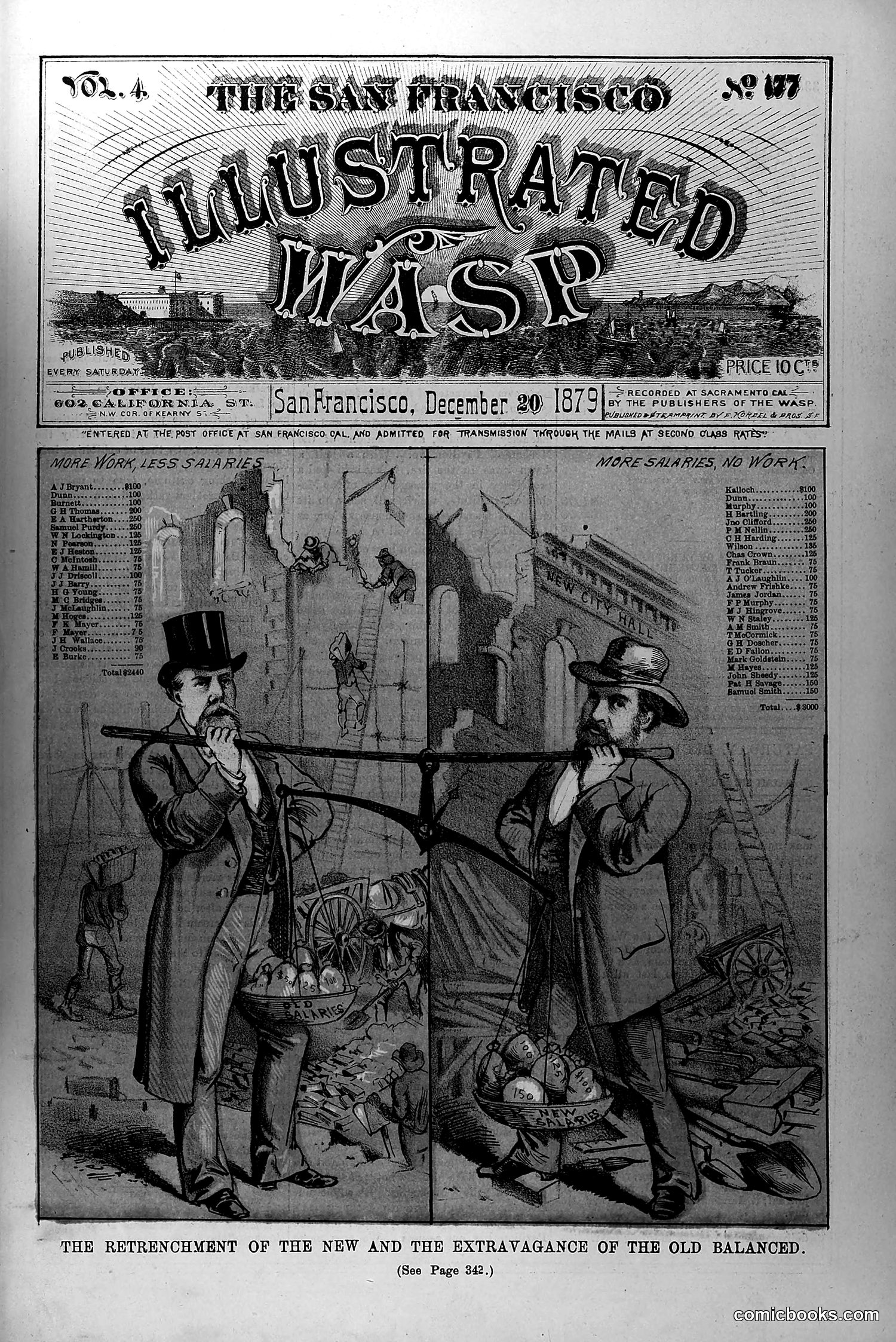
This satirical cartoon depicts two well-dressed men operating scales labeled "SALARIES," seemingly weighing workers or labor. The left side shows "MORE WORK, LESS SALARIES" while the right shows "MORE SALARIES, NO WORK." The caption reads: "THE RETRENCHMENT OF THE NEW AND THE EXTRAVAGANCE OF THE OLD BALANCED." The cartoon appears to critique economic inequality and labor practices of the era. The two figures—likely representing competing business philosophies or political factions—are portrayed as deliberately manipulating the system: one exploits workers through increased labor with decreased pay, while the other wastes money on unnecessary salaries for idle workers. The scales suggest both approaches are equally problematic, satirizing how different economic systems claim balance while perpetuating inefficiency or exploitation.
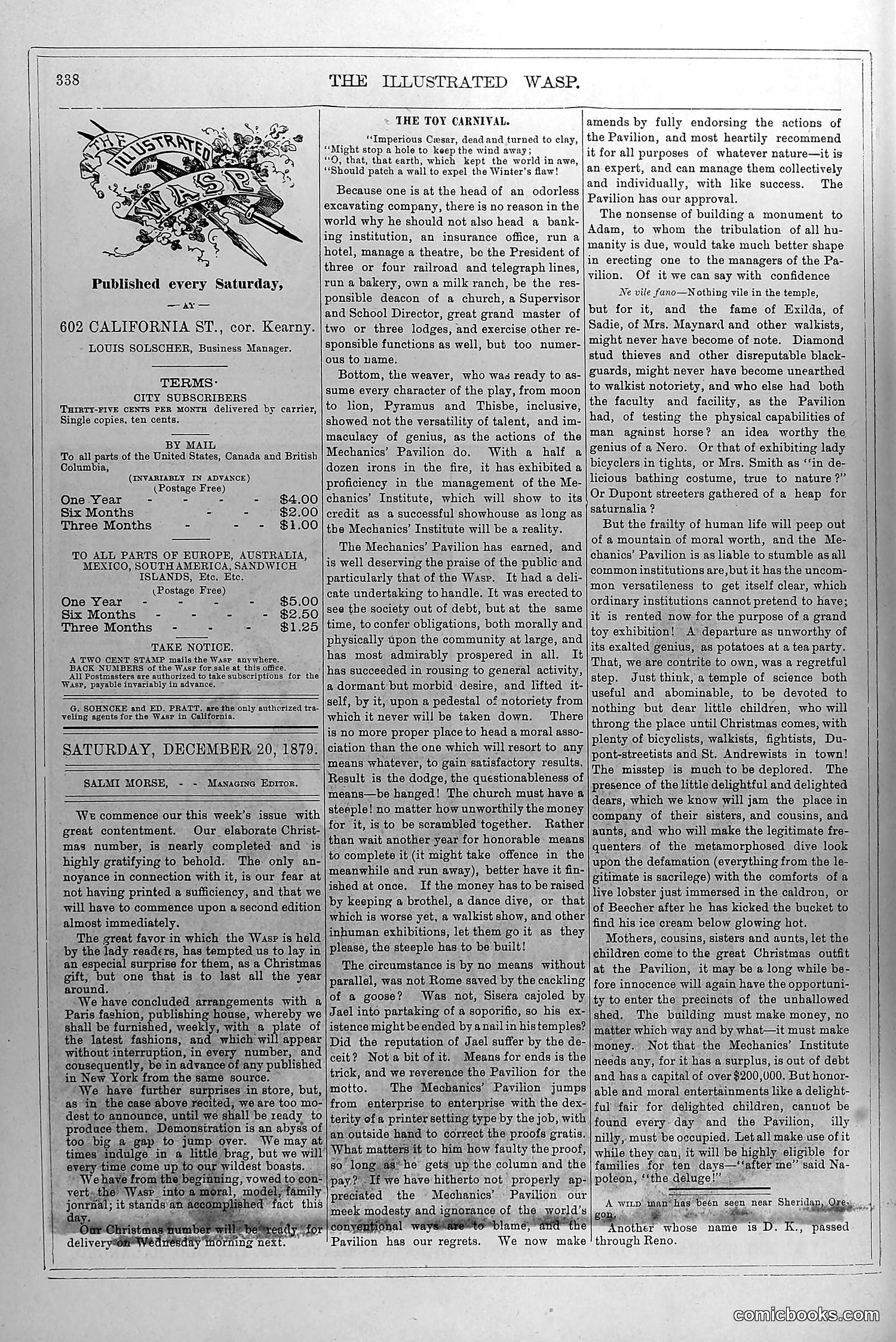
This page is primarily **editorial and advertising content** rather than political cartoons. The small decorative masthead at top left is ornamental. The main editorial, "The Toy Carnival," criticizes the **Mechanics' Pavilion** in San Francisco. The author argues it's wasteful—a grand building requiring constant money and management. He sarcastically suggests that instead of housing the Pavilion's exhibits, it should serve practical purposes: banking, insurance, theater, school operations, or a church. The piece mocks the Pavilion's pretensions while acknowledging it was built with good intentions. It's local San Francisco satire targeting municipal spending and institutional management rather than national politics. The tone is skeptical rather than vicious.
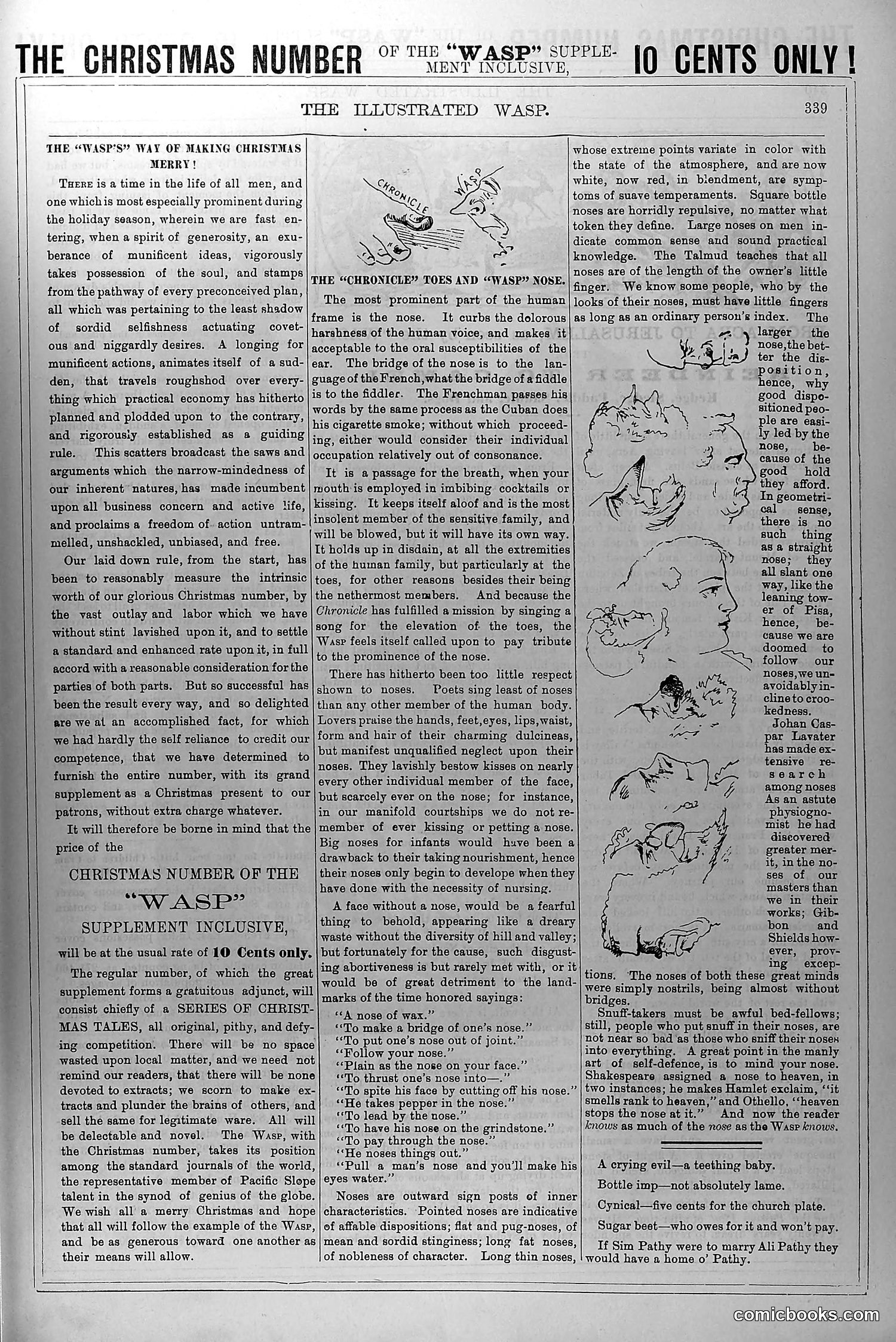
This page presents a humorous essay about noses as a Christmas gift idea, illustrated with various nose sketches and caricatures. The satirical piece argues that noses deserve respect and attention—listing folk sayings and literary references celebrating them ("A nose of wax," "To put one's nose out of joint"). The illustrations show exaggerated nose profiles, likely mocking Victorian physiognomy pseudoscience, which used facial features to judge character. The essay is essentially a tongue-in-cheek celebration of an overlooked body part, using absurdist humor typical of *The Wasp*'s irreverent style. The page also includes brief humorous classified advertisements at bottom (wedding notices, church donations jokes), standard *Wasp* filler content. No specific political figures or events appear to be targeted here—it's primarily comedic social observation.
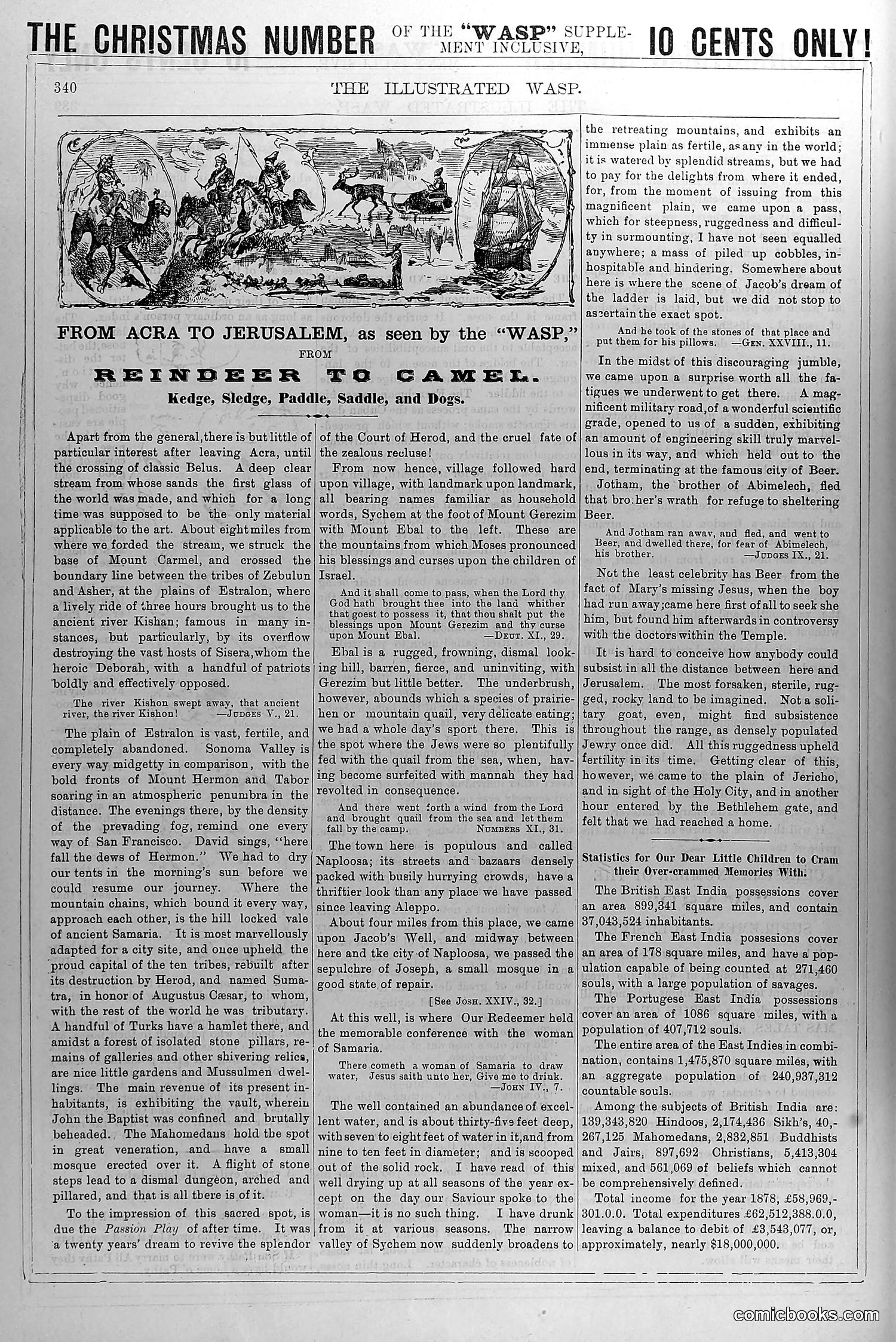
This page is primarily **travel writing, not satire**. The main illustrated article describes a journey "From Acra to Jerusalem" with detailed descriptions of the landscape, settlements, and conditions encountered along the route—including references to the Plain of Esdraelon, Mount Carmel, and various biblical sites. The accompanying engraving shows a caravan with camels, horses, and travelers, illustrating the modes of transport (reindeer, camel, sledge, etc.) mentioned in the subtitle. The bottom section shifts to statistical content about British India's population and finances, presented as "Statistics for our Dear Little Children to Cram their Over-crammed Memories With." This appears to be a **Christmas special issue** (note the header) mixing travel reportage with educational statistics—not political commentary or satirical cartooning in the traditional sense.
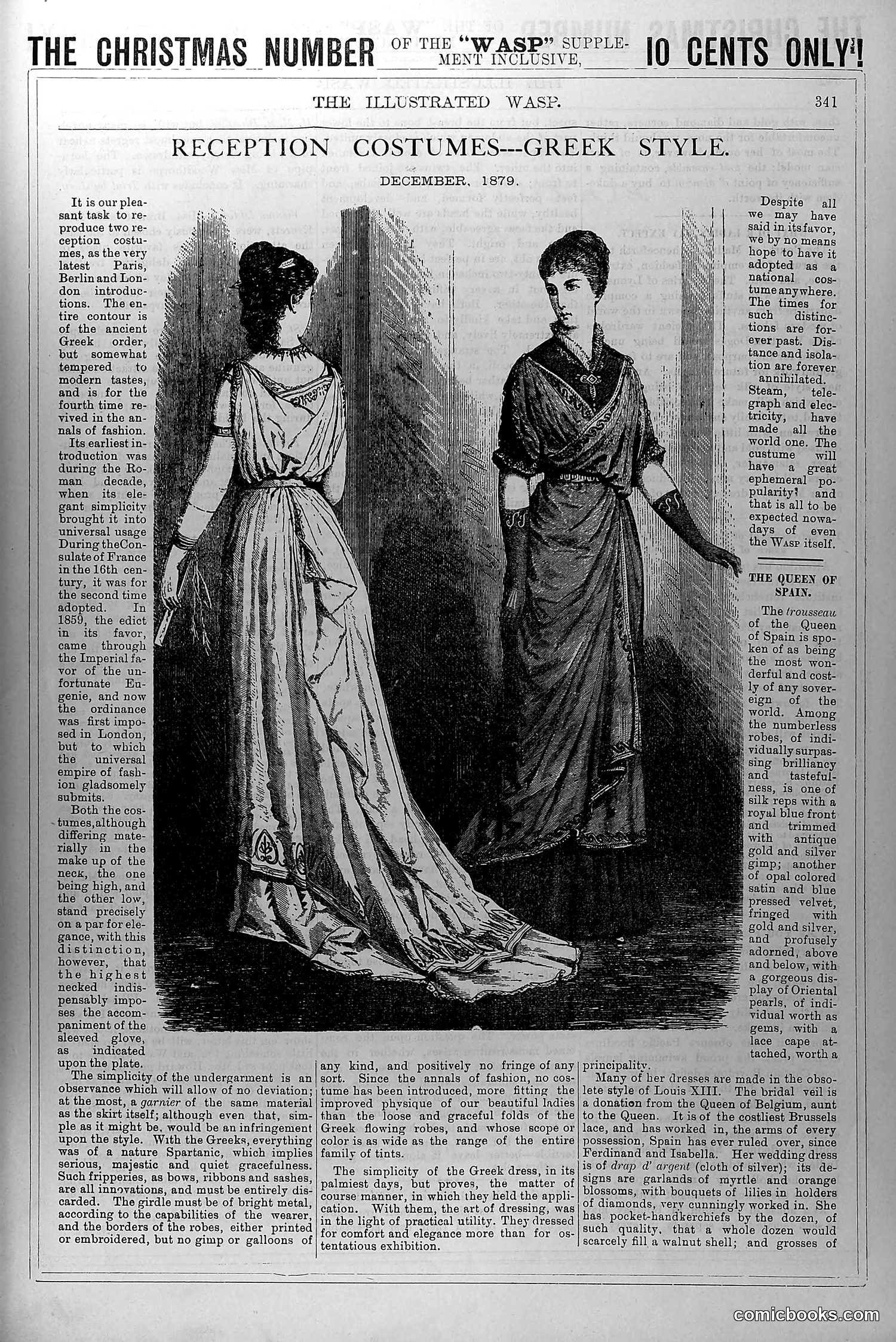
This page is **not satirical commentary** but rather **fashion journalism**. It presents two women wearing Greek-inspired reception gowns, a fashionable style for formal Victorian occasions. The text explains that Greek dress represents a return to classical simplicity after centuries of elaborate European fashion. It describes the garments' construction in detail—draped fabrics, minimal ornamentation, and high necklines—emphasizing how the style prioritizes comfort and elegance over ostentatious display. The right column specifically details "The Queen of Spain's" elaborate costume, featuring silk, royal blue, gold, silver trim, and opal-colored satin, suggesting this was fashionable among European nobility. This is **educational fashion content**, not satire—typical of how *The Wasp* supplemented its political cartoons with lifestyle and aesthetic material.
This is primarily **text content, not a political cartoon**. It's the Christmas issue of *The Wasp*, a San Francisco satirical magazine, priced at 10 cents. The page contains several articles and letters discussing fashion, local society events, and social commentary. Topics include: - Court fashions in Madrid and Paris - Descriptions of wealthy San Francisco society figures ("Vienna Ladies") - Natural history notes on gopher snakes - A personal letter about Christmas charity for poor widows The writing demonstrates typical period satirical humor—mocking fashion trends, social pretension, and philanthropic gestures—but **no identifiable political figures or specific events are caricatured** on this particular page. It represents general social satire rather than focused political commentary.
This page is primarily **text from a three-act theatrical play**, not a political cartoon. The play was adapted from French and written by Salmi Morse for *The Wasp* magazine. Act III depicts a dramatic confrontation involving a wealthy innkeeper named Michel and a Chief Judge, with dialogue centered on accusations of murder and jewel theft. The text references "the murdered Jew" and discusses evidence and legal testimony. The title's reference to a "Polish Jew" suggests the play engages with 19th-century stereotypes and anti-Semitic themes common to period melodrama. The specific satirical or political point, however, is unclear from this text page alone without seeing accompanying illustrations or knowing *The Wasp's* editorial stance toward the work.
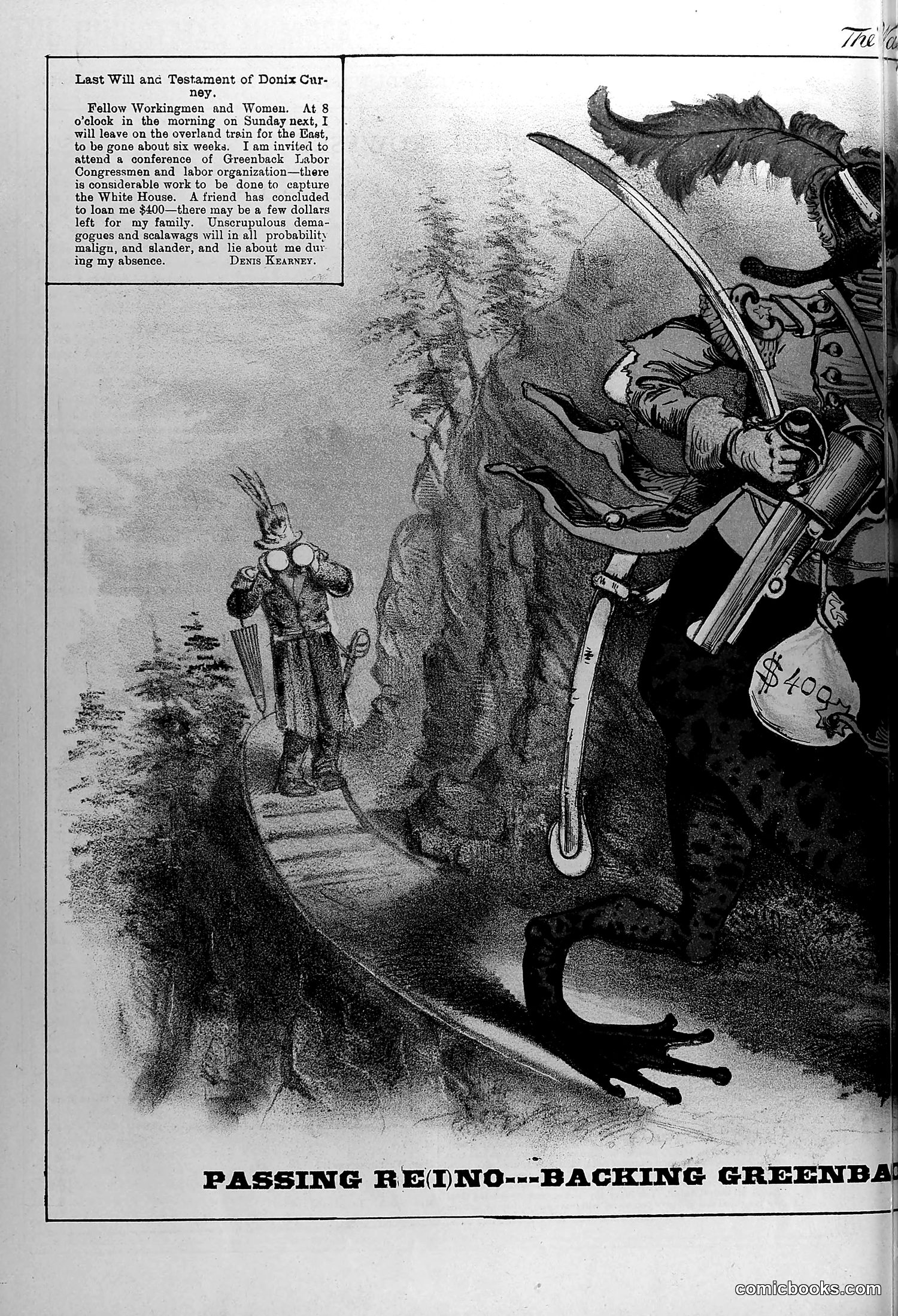
This political cartoon satirizes what appears to be a corrupt financial arrangement. On the right, a wealthy plutocrat or politician (depicted with exaggerated features) holds a large bag marked "$400" and wields a gun labeled "$400." On the left stands a smaller, uniformed figure—possibly a government official or soldier—being threatened or intimidated. The title suggests a play on "regno" (reign/rule) and "greenback" (money), implying that political power is being bought and sold through bribery or extortion. The cartoon critiques how wealth translates directly into political control, with money literally backing (supporting or forcing) governmental decisions. The gun imagery emphasizes the coercive, violent nature of this financial-political corruption.
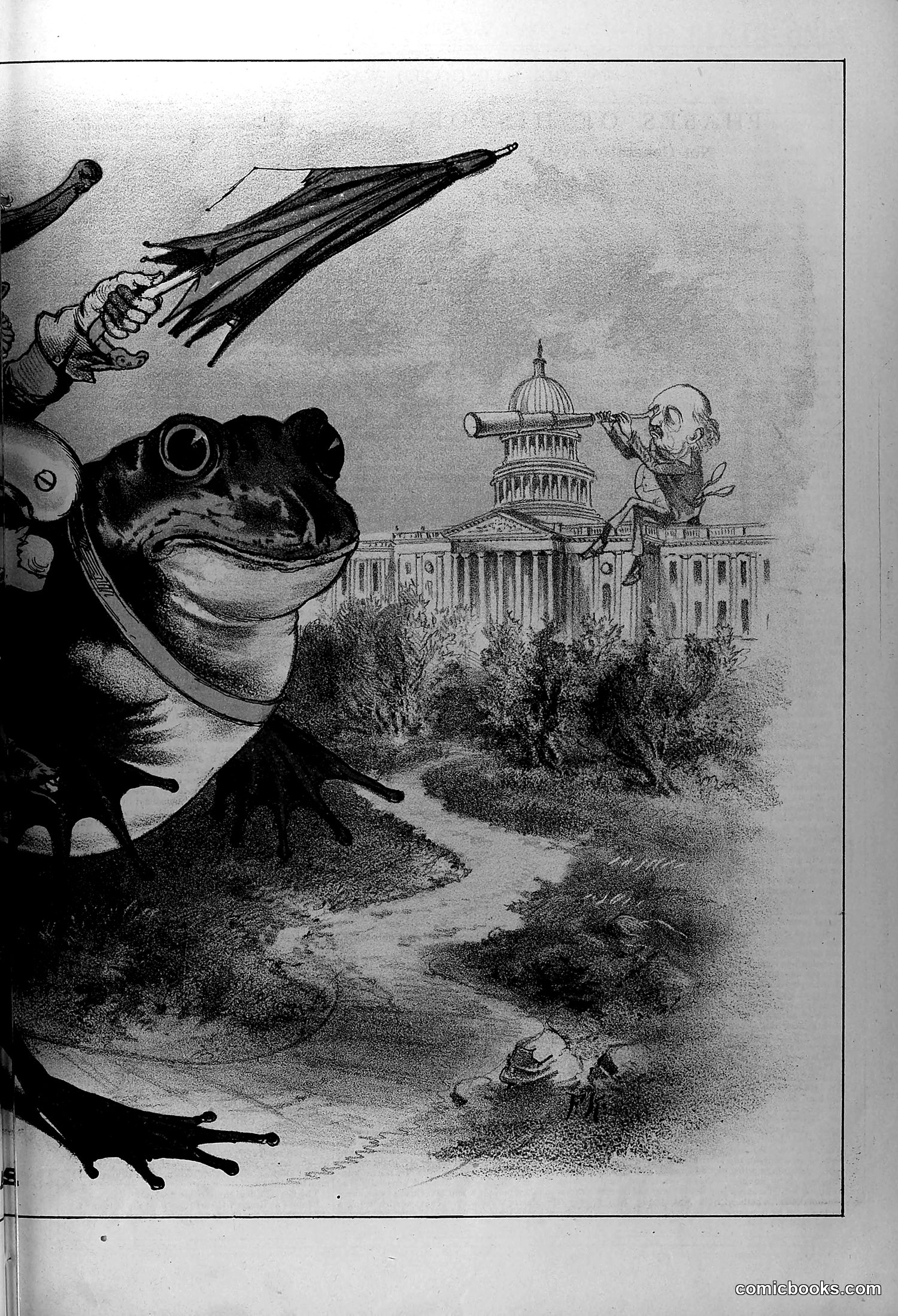
This satirical cartoon depicts a giant frog menacing the U.S. Capitol building. A man with binoculars stands on the Capitol steps, apparently observing or warning about the threat. The frog dominates the left side, rendered in exaggerated detail with prominent eyes and feet. The cartoon likely represents a political threat or danger to Congress—possibly corruption, foreign interference, or a specific political figure or movement depicted as monstrous and predatory. The frog's grotesque appearance suggests something alien or repulsive threatening American democracy. Without visible text identifying the specific frog or context, the exact reference remains unclear—this could target a particular scandal, political party, or public figure of The Wasp's era, but I cannot definitively state which without additional documentation.
This page is primarily text—a serialized story titled "Phases of History Not Generally Given in Detail," written by Salmi Morse for *The Wasp*. It's Part X, subtitled "Gleamings from Ginder, Ginger, and Chab." The narrative appears to be a satirical account involving characters named Mr. Martin, Mr. Cribbs, and Mrs. Josiah Martin, depicting scheming and moral compromises around business dealings and marital infidelity. The dialogue mocks pretension and exposes hypocrisy—typical *Wasp* targets. Without visible illustrations on this particular page, the satire relies entirely on the written narrative rather than visual caricature. The story seems designed to entertain readers through sharp dialogue and cynical social observation rather than political commentary.
This page contains advice columns and satirical letters rather than traditional political cartoons. The main content includes: **"My Dear Grandmother"** — A letter mocking American hypocrisy regarding foreign immigration. The writer sarcastically argues that foreign Americans are necessary for labor (railroads, farming, domestic work) while simultaneously being blamed for social problems. The satire targets American prejudice: voters want immigrant labor's benefits but resent immigrants themselves. **"Human Trash and their Deserts"** — A response column addressing workplace exploitation and poverty, mentioning specific individuals facing hardship. **Wrinkle Cure Advertisement** — A satirical classified offering a supposed cure for facial wrinkles. The page's satire focuses on class inequality and immigrant discrimination in late 19th/early 20th-century America, attacking both hypocritical voters and exploitative employers.
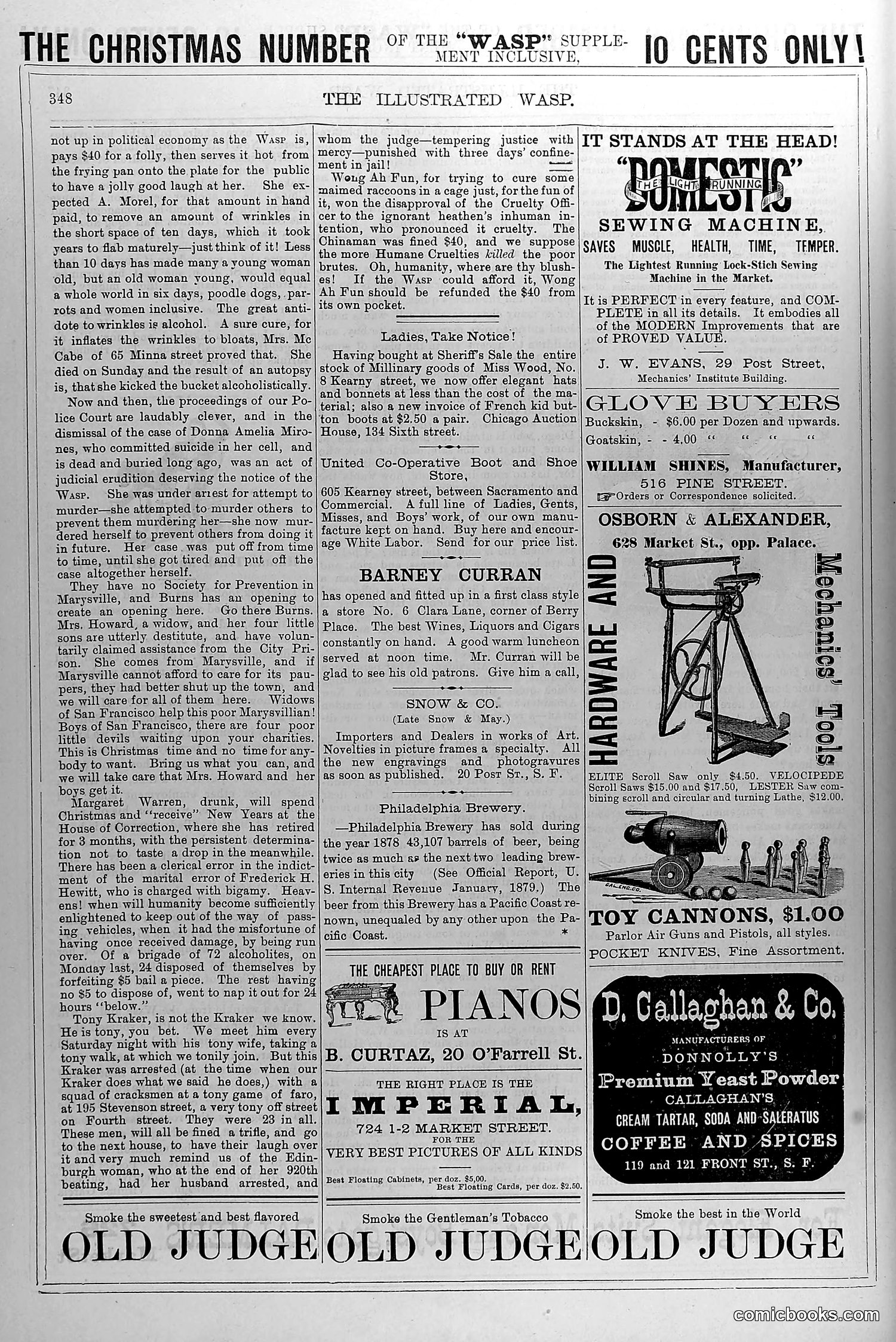
This page is primarily **advertising and announcements** rather than political satire. The Christmas Number of *The Wasp* supplement contains commercial notices for various goods and services: sewing machines, gloves, boots, pianos, toy cannons, yeast powder, and cigars. The only editorial content visible discusses local San Francisco matters—references to poverty relief, the Police Court, and a case involving suicide and murder prevention. These appear to be straightforward news items rather than satirical commentary. The page concludes with repeated advertisements for "Old Judge" tobacco, presented as the magazine's endorsement. Overall, this functions as a commercial issue blending holiday advertising with local civic reporting, not as a platform for political or social satire.
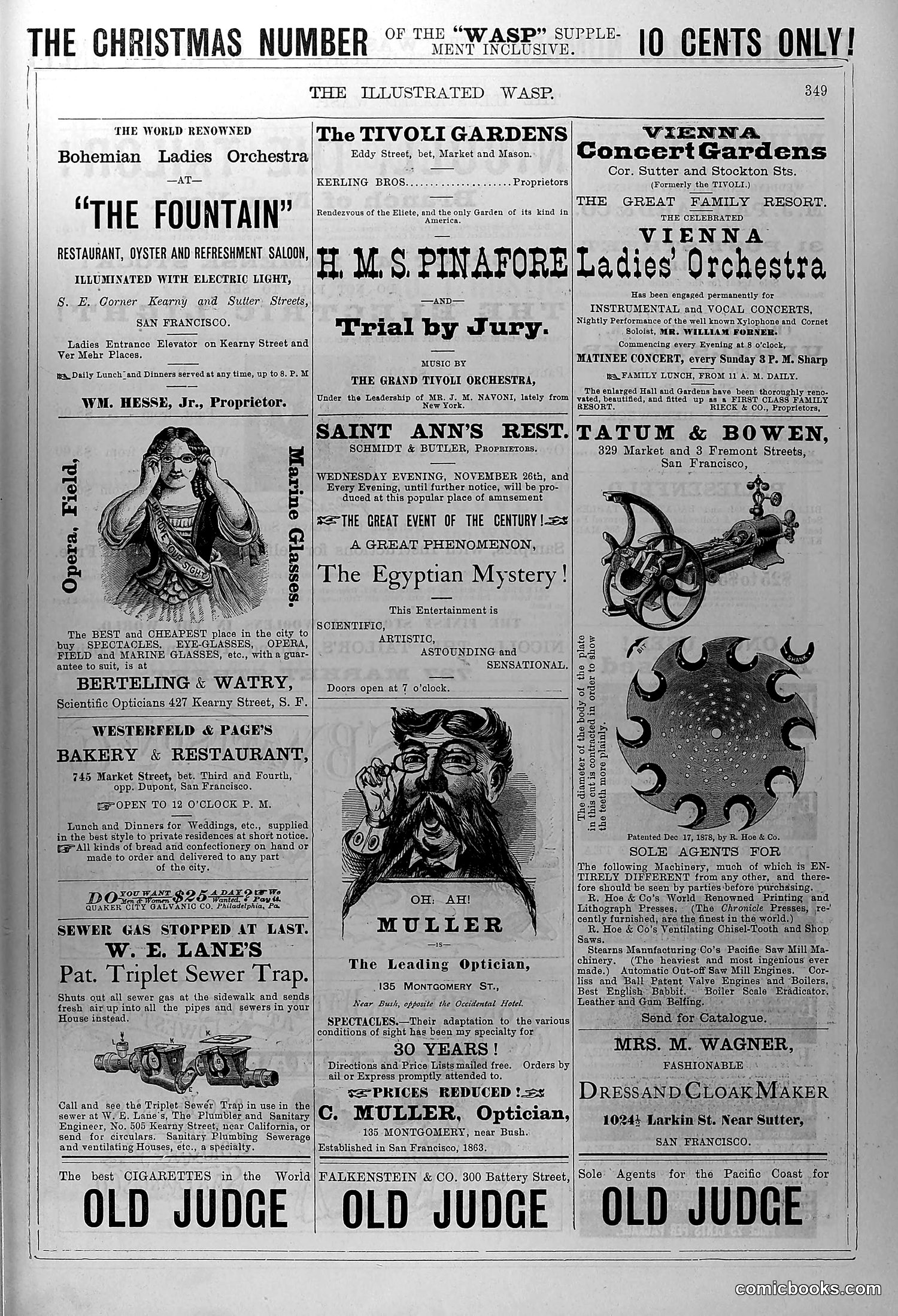
This is primarily an **advertising page** from The Wasp's Christmas supplement, not a satirical cartoon issue. The page contains numerous San Francisco business advertisements arranged around decorative illustrations. The two prominent illustrated faces appear to be **generic character types** rather than specific political figures: one showing a bearded man labeled "OH AH! MULLER" (advertising an optician), and another showing a woman's face (for "The Fountain" restaurant). These are standard commercial imagery of the era. The page also advertises entertainment venues, restaurants, bakeries, and optical services typical of 1880s San Francisco. The "Egyptian Mystery" theatrical entertainment and Vienna Ladies Orchestra performances represent popular entertainment of the period. **No identifiable political satire is present** on this page—it functions as a commercial supplement rather than editorial commentary.
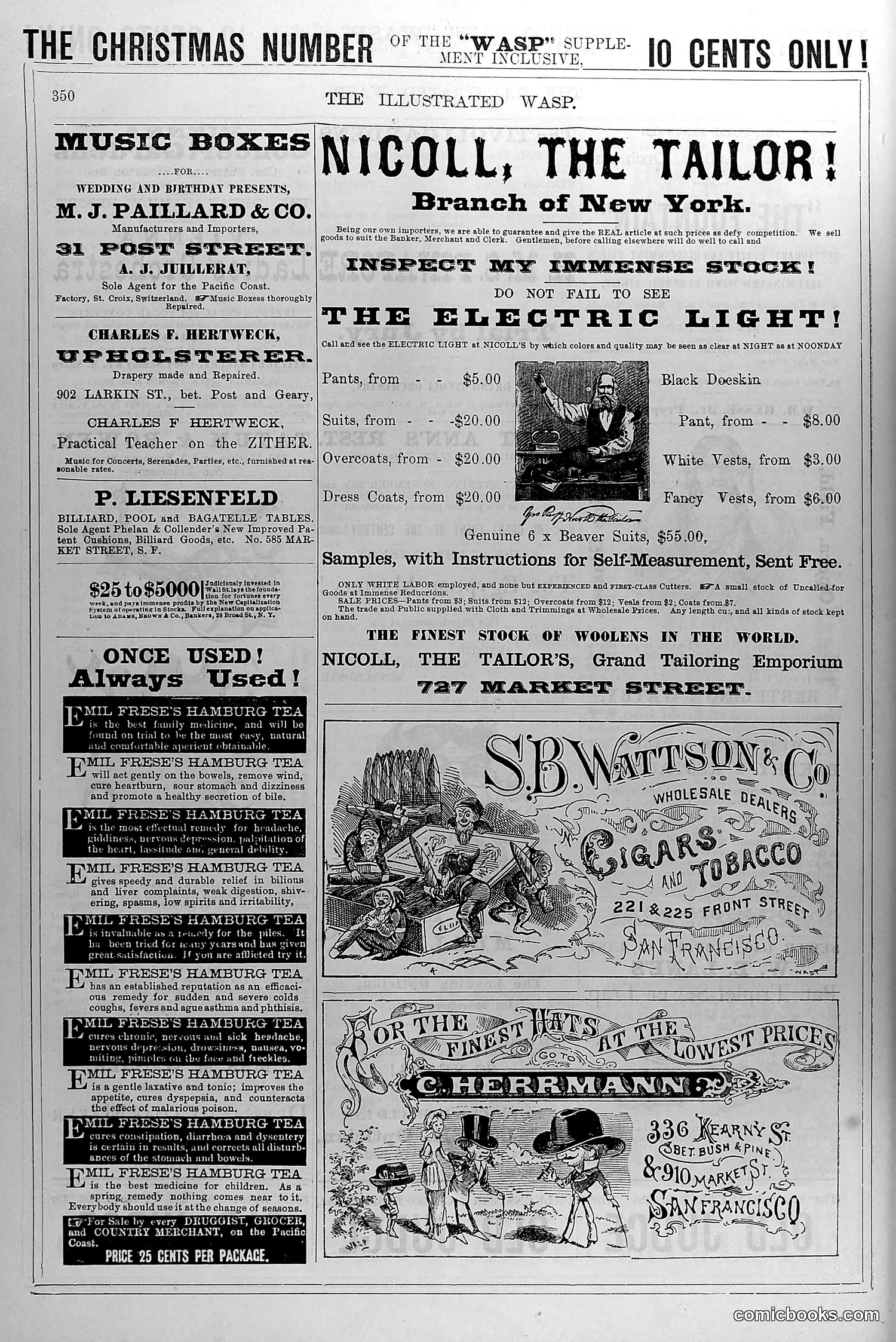
This is primarily an **advertising page** from The Wasp's Christmas supplement, not a political cartoon. The page contains various San Francisco business advertisements from the 1880s-1890s era, including: - Music boxes and wedding gifts (M.J. Paillard & Co.) - An umbrella repair shop - Billiard tables - A tailor's shop (Nicoll) prominently featuring "The Electric Light" as a sales attraction - Emil Frese's Hamburg Tea (heavily advertised with repeated testimonials) - Cigars and tobacco dealers - Hat shops The only visual content with potential satirical elements appears to be decorative illustrations accompanying the advertisements. The "Electric Light" reference in Nicoll's advertisement likely plays on the novelty and prestige of electric lighting technology in that era. Without clearer identification of specific caricatures or political references, the page appears primarily commercial rather than satirical in nature.
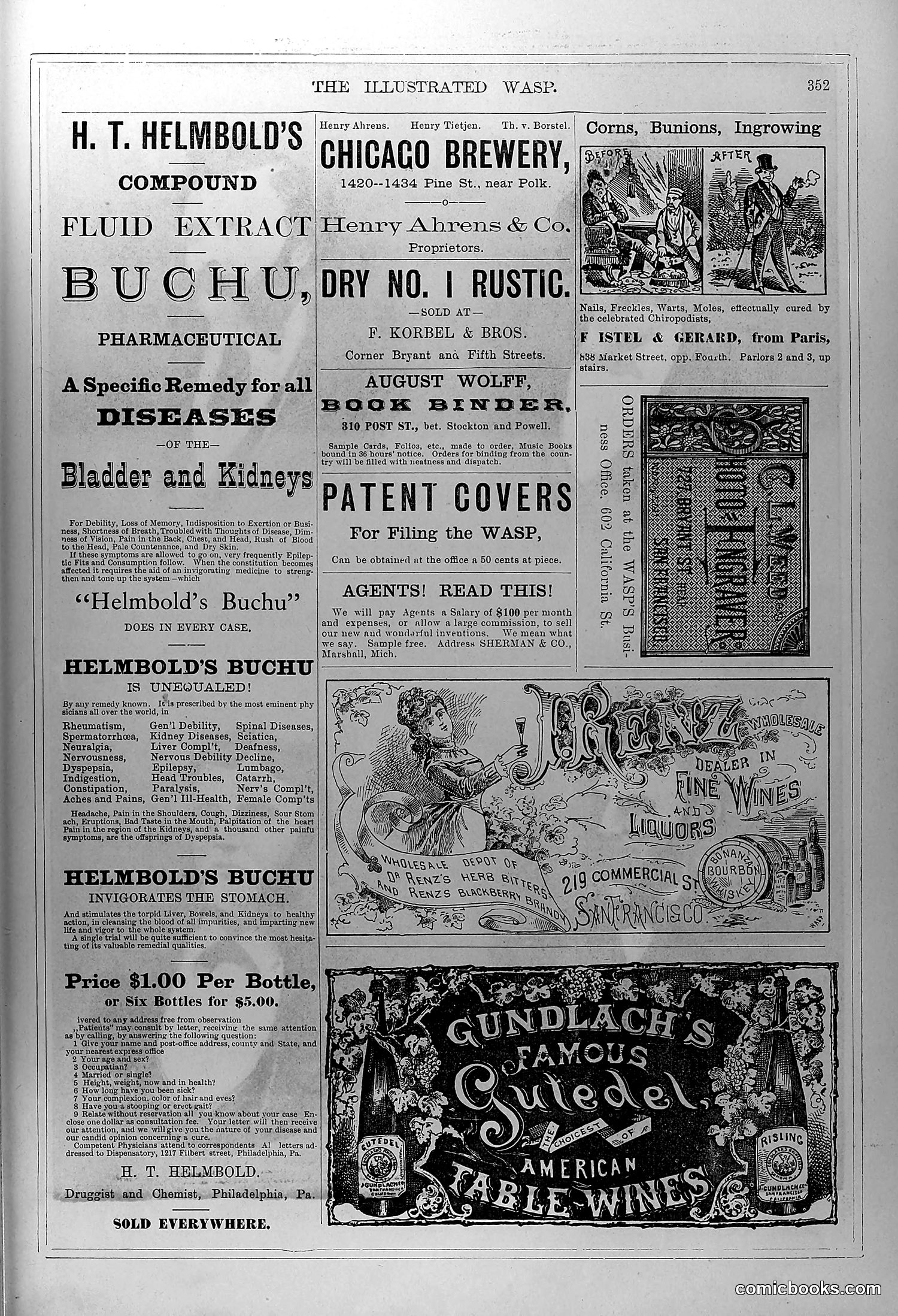
This page is primarily **advertising** for patent medicines and commercial products popular in late 19th-century America, not political satire. The main advertisements include: - **H.T. Helmbold's Compound Fluid Extract "Buchu"** — a purported cure-all for bladder/kidney diseases and general ailments - **Chicago Brewery** products - **August Wolff's Book Binder** services - **Patent covers** for filing documents - **Gundlach's Famous Seidel** wine - Various services (chiropodist, book binding) The small illustrations show generic Victorian-era scenes and product imagery rather than political commentary. This reflects *The Wasp's* business model: satirical editorial content funded by advertisements for dubious medicinal products and services typical of the period.
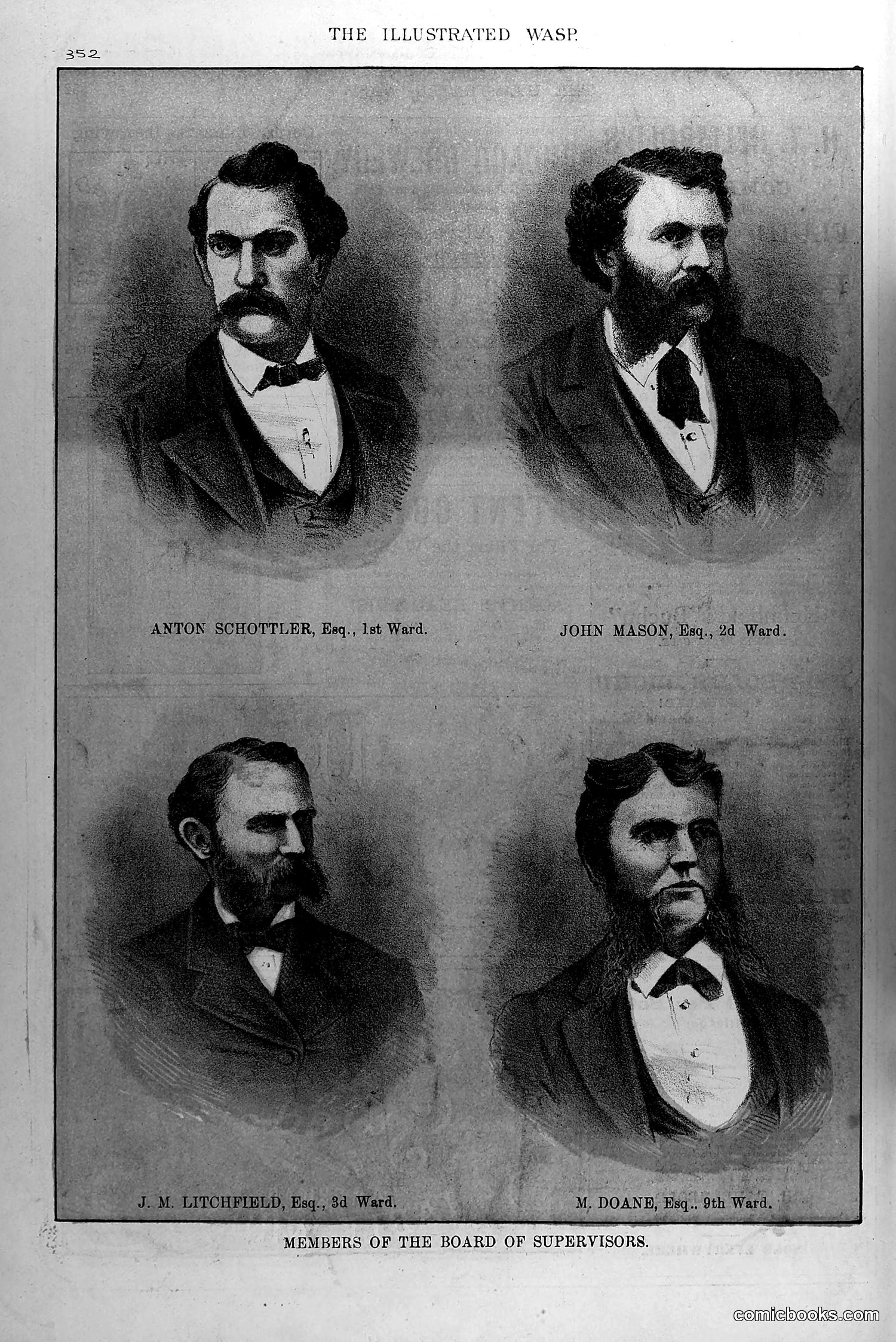
This page presents four portrait engravings of San Francisco Board of Supervisors members from different wards (1st, 2nd, 3rd, and 9th), labeled as: - Anton Schottler, Esq., 1st Ward - John Mason, Esq., 2nd Ward - J. M. Litchfield, Esq., 3rd Ward - M. Doane, Esq., 9th Ward The *Wasp* was known for mocking local politics. Without additional context or visible captions, the satire's specific target remains unclear—though the formal presentation of these officials in a satirical publication suggests the *Wasp* likely intended mockery of these particular supervisors, perhaps their incompetence, corruption, or other failings. The formal dignified poses ironically contrast with the publication's irreverent tone.

I can see this is a test page or calibration sheet from The Wasp magazine, featuring a standard photographic scale ruler (marked 6-11) on the left side and a grayscale color checker pattern (the grid of varying gray tones) to the left of the ruler. This appears to be a technical page used for photography and printing quality control rather than actual magazine content. There is no cartoon, satirical illustration, or readable text visible on this page that would contain political or social commentary. This is a documentation/reference page, likely used during the magazine's production or archival process to ensure proper image reproduction and exposure settings.