
A complete issue · 18 pages · 1879
The Wasp — December 13, 1879

I can see this is a measurement reference page from *The Wasp* magazine, featuring an Oregon Rule Co. ruler (marked 0-5 inches) and a standard U.S.A. ruler at the bottom, placed against a black background with a checkerboard pattern of grayscale squares to the right. However, this appears to be a **technical documentation page rather than a satirical cartoon**. The checkerboard pattern likely served as a photographic reference guide for image reproduction or printing purposes—common in early-to-mid 20th century publishing. Without visible caricatures, political figures, or satirical text on this particular page, I cannot identify specific cartoon content or its satirical message. This may be a filler page or technical apparatus page from the magazine's production.
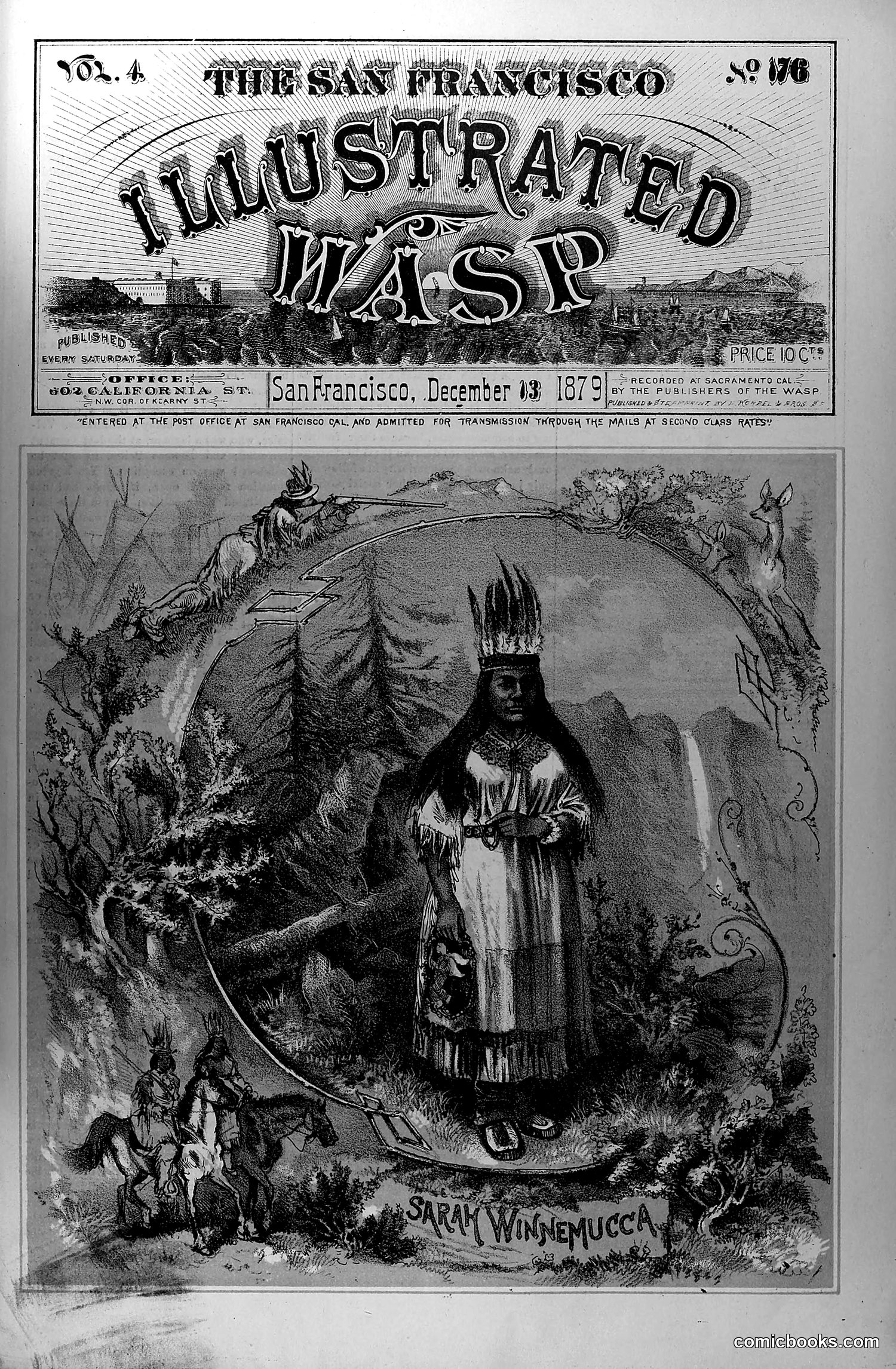
This illustration depicts **Sarah Winnemucca**, a Northern Paiute activist and interpreter who was a prominent public figure in late 1870s America. The engraving shows her in formal Native American dress with a distinctive crown or headdress, surrounded by symbolic imagery including deer, armed figures, and natural landscape elements. The satirical intent appears critical—likely mocking her activism, public speaking tours, or advocacy for Native American rights during a period when such voices faced considerable ridicule in mainstream American media. *The Wasp* was known for caustic political and social commentary. The romanticized/exoticized visual treatment suggests the magazine may be sardonically portraying her claims to authority or legitimacy within Euro-American society.
The masthead illustration depicts a wasp attacking what appears to be a beehive or nest—likely The Wasp's standard logo rather than a specific political cartoon. The main text is editorial commentary by Managing Editor Salmi Morse discussing an upcoming "Great Christmas number" and announcing a new cartoon series called "Brimstone Trail," featuring portraits of California's newly elected governors. The lengthy article critiques freethinkers and atheists who challenge Christian doctrine, arguing their arguments are logically weak. It references historical figures like Voltaire and Rousseau as examples of flawed atheist reasoning. This appears primarily a **magazine contents page** rather than political satire—mainly advertising subscription rates, announcing editorial plans, and featuring philosophical debate rather than visual humor or caricature.
This page contains two distinct sections: a lengthy satirical essay titled "CYNICISMS" occupying most of the space, and what appears to be a sidebar discussing San Domingo (Haiti) and political figures. The "CYNICISMS" section is a philosophical attack on atheism and moral relativism, arguing that atheists lack genuine ethical grounding. The text critiques those who claim "truth is stranger than fiction" while denying absolute morality. The sidebar discusses San Domingo's political situation and includes commentary on Republican political strategy regarding race and oppression, suggesting the GOP exploited racial issues opportunistically rather than from genuine principle. The page appears to be primarily text-based satire rather than illustrated cartoons, focusing on contemporary political and philosophical debates of the era.
This page is primarily **text-based debate content**, not a political cartoon. It presents a dialogue between skeptical and religious perspectives on science, faith, and evolution—apparently a continuation of an ongoing series called "After Death—What?" The exchange features two debaters (labeled P. and S.) arguing about whether religion and science are compatible, the nature of truth, and theories of evolution. The text references specific San Francisco figures: **Sarah Winnemucca** (Native American leader and activist) receives a brief biographical note praising her "merited success," and **Queen Victoria** is mentioned regarding California history. The debate itself satirizes Victorian-era tensions between scientific materialism and religious faith, common in 1880s-90s American periodicals. Without visible illustrations on this page, the satire operates through rhetorical argument rather than visual caricature.
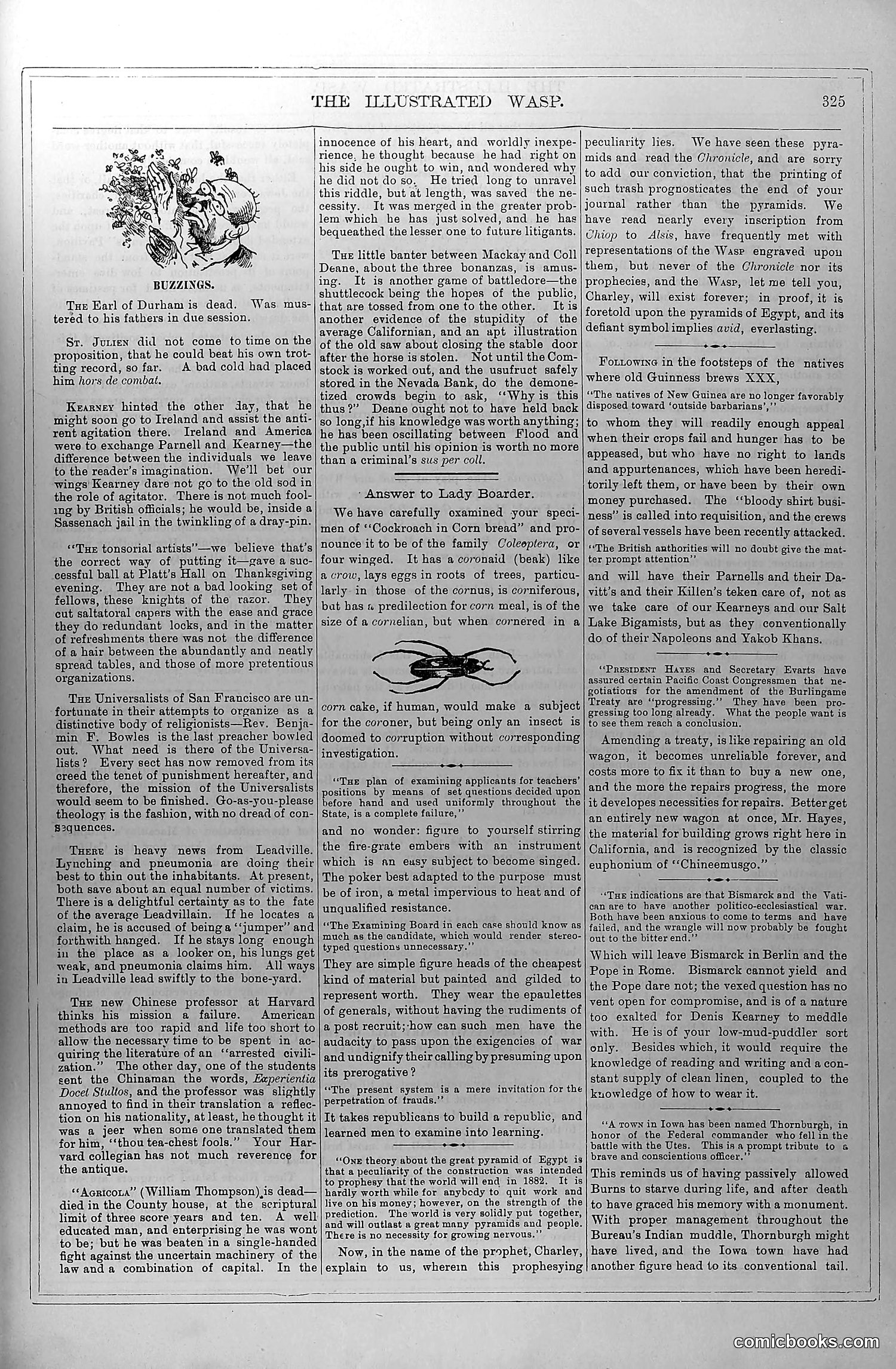
This page contains primarily text content rather than political cartoons. The visible illustrations are minor decorative elements (a floral design and an insect drawing). The text discusses several topics including comments on the Earl of Durham's political activities, debates about Irish and American agricultural policies, and various social observations. There are sections labeled "Buzzings" and responses to reader inquiries about technical matters (cork bread composition, teaching positions, pyramid prophecies). The page also addresses Pacific Coast Congressional matters and treaty negotiations, suggesting this issue engages with contemporary political debates of its era. Without clearer image resolution of any satirical cartoons or identifying specific historical figures mentioned in the fragmented text, precise interpretation of the satire's targets remains uncertain.
This page is primarily **text-based drama criticism and theatrical reviews**, not a political cartoon. The header illustration shows a decorative crest or emblem labeled "Drama." The content critiques theatrical productions, including plays like *Man and Wife*, *Don Cesar de Bazan*, and others performed at San Francisco theaters. Critics discuss performances by actors including Frank Mayo and Rose Osborn. Notable is a section titled "Twenty-First Anniversary Ball of the Ladies' United Hebrew Benevolent Society," describing a charitable event at B'nai B'rith Hall. The magazine appears to function as a **society and entertainment publication** rather than purely political satire on this particular page. The content reflects 19th-century San Francisco's cultural life and Jewish community institutions.
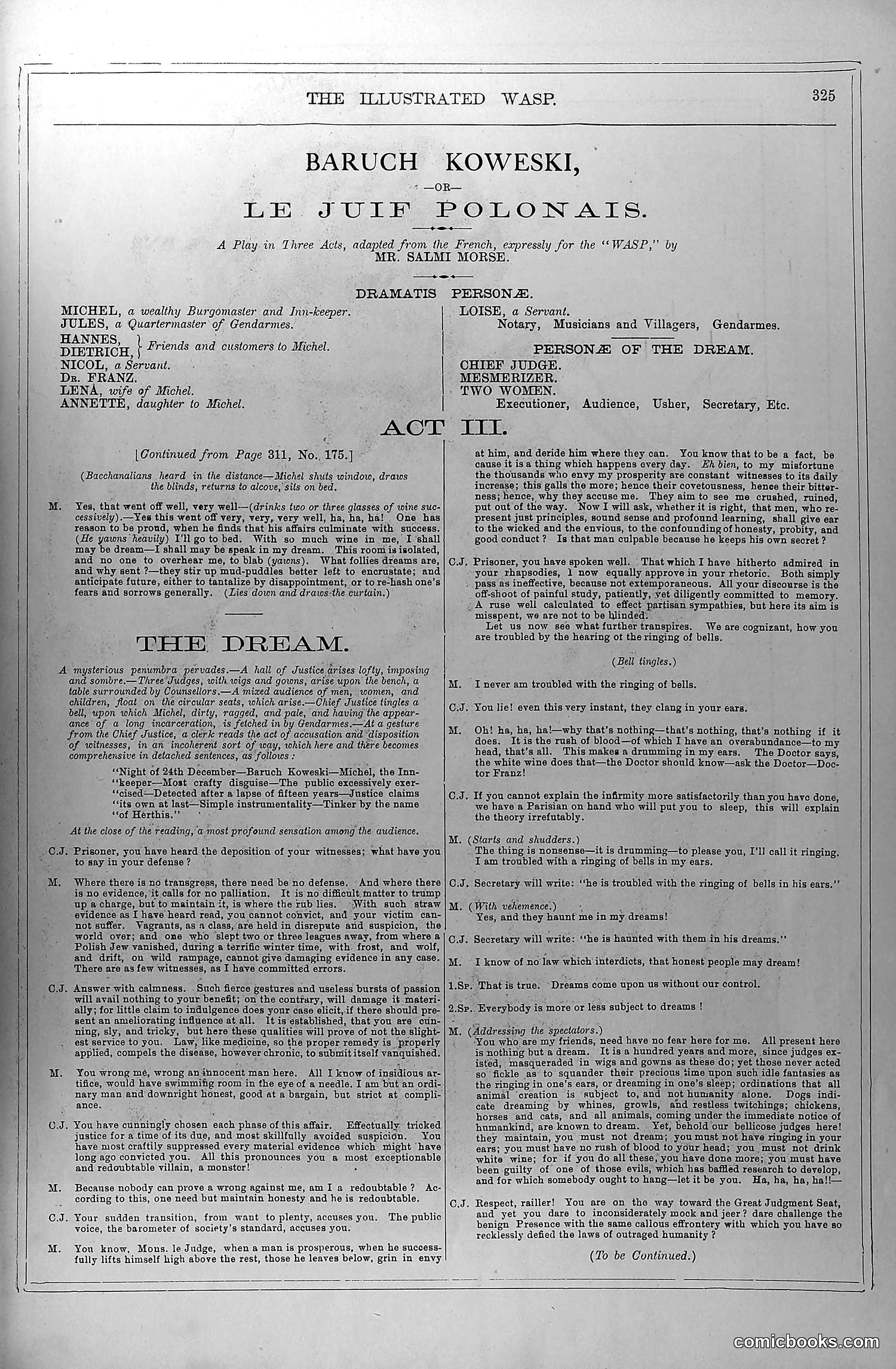
This page contains the text of a theatrical play rather than a political cartoon. "Baruch Kowski; or Le Juif Polonais" is a three-act drama adapted from French specifically for *The Wasp* magazine by Mr. Salmi Morse. The visible portion (Act III) shows a courtroom scene with dialogue between a prisoner, a chief judge, and other court officials debating matters of legal procedure, testimony, and justice. The exchange appears satirical in tone, with characters making pointed comments about legal incompetence and the nature of evidence. Without additional context about *The Wasp's* publication date or the original French source, the specific satirical targets remain unclear, though the legal/judicial setting suggests commentary on court systems or specific trials of the period.
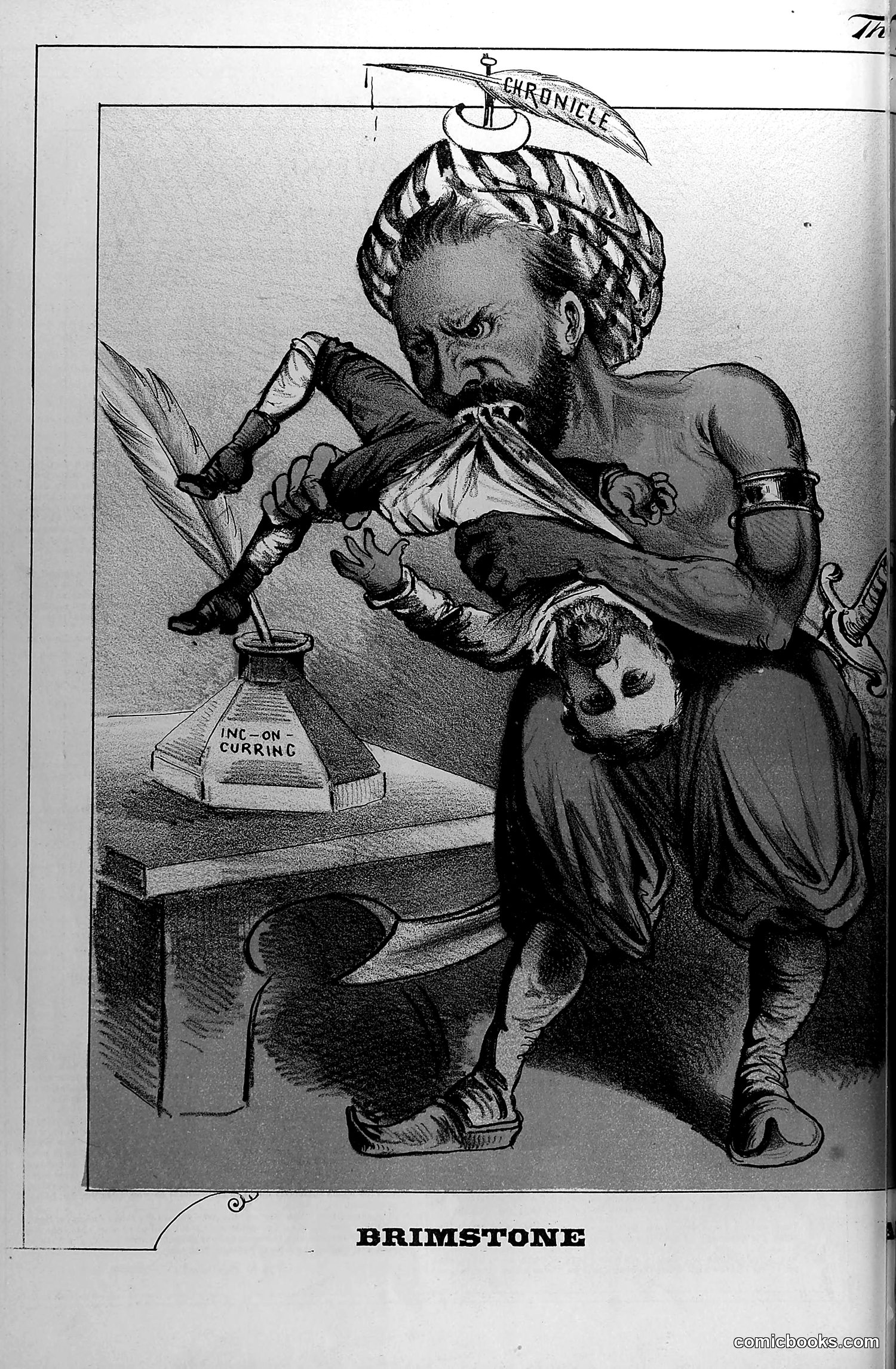
This satirical cartoon depicts a bearded man operating what appears to be a medical or alchemical apparatus labeled "INC-ON-CURRING" (possibly "Inconcurring"). A banner marked "CHRONICLE" floats above his head, suggesting connection to a publication or record-keeping. The figure appears to be engaged in some form of dubious practice—mixing or concocting something in a vessel. The dramatic styling and the word "Brimstone" (traditionally associated with hellfire and damnation) suggest the cartoon is attacking someone's character or methods as dishonest or morally corrupt. Without additional context about The Wasp's publication date and the specific figure depicted, I cannot definitively identify who "Brimstone" refers to. The cartoon likely criticizes a public figure's journalistic or editorial practices as fraudulent or inflammatory.
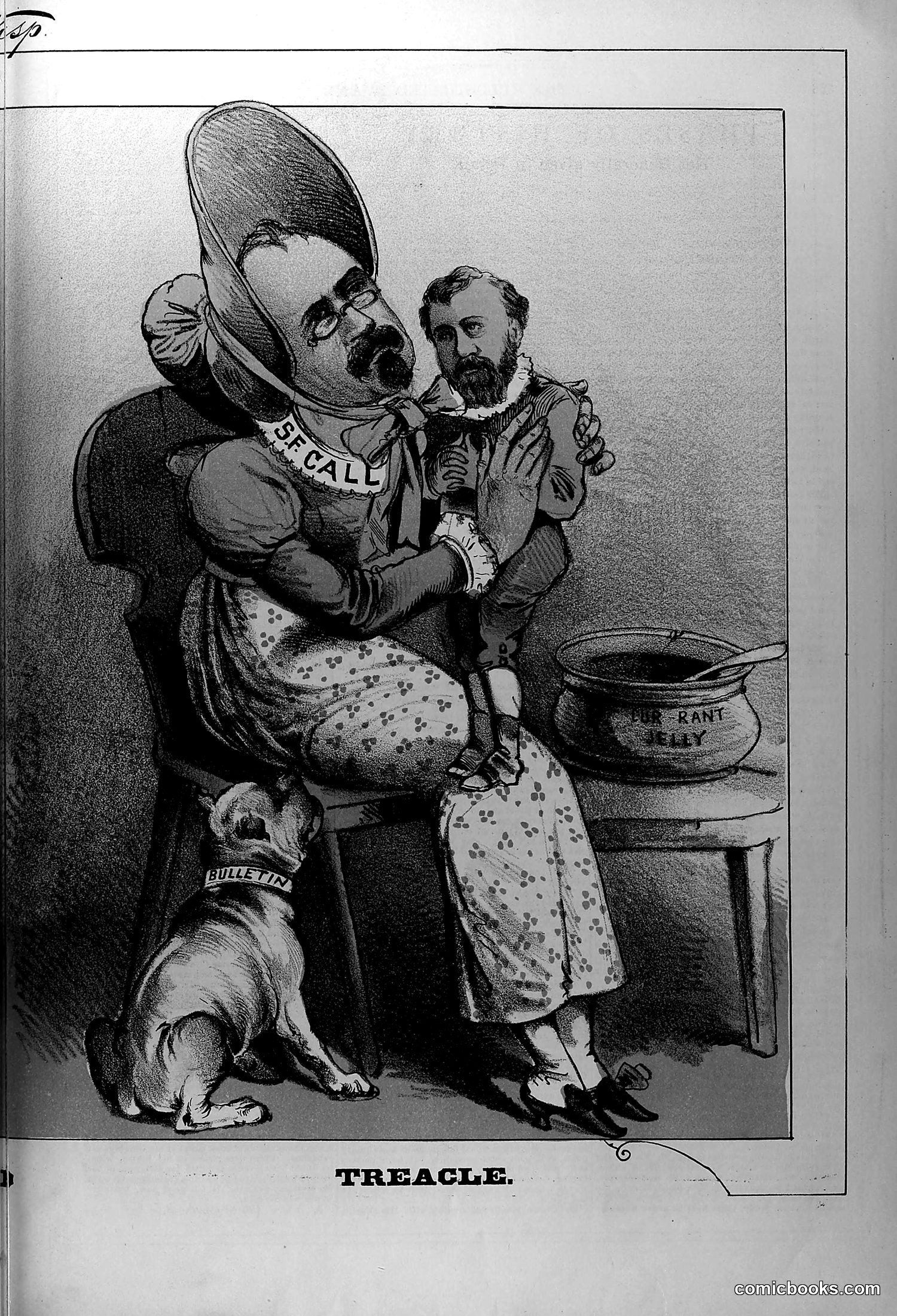
This political cartoon depicts a large caricatured figure labeled "S.F. CALL" (San Francisco Call newspaper) being held like a baby by a woman wearing a bonnet labeled "BULLETIN" (likely the San Francisco Bulletin newspaper). A bearded man on the right observes, while a dog labeled "BULLETIN" sits nearby. A pot labeled "RANT JELLY" sits on the table. The satire appears to mock the relationship between these competing San Francisco newspapers. "Treacle" (a sticky syrup, also British slang for sentimentality) suggests the cartoon criticizes overly sentimental or saccharine journalism. The image portrays one publication as infantilized or dependent, possibly commenting on editorial practices, rivalry, or journalistic credibility during this era of San Francisco newspaper competition.
This page contains the continuation of "Phases of History Not Generally Given in Detail," a serialized narrative by Mr. Salmi Morse. The text is primarily a detailed fictional story about Mrs. Martin, Dobbs, and other characters, featuring dialogue and domestic situations. **No clear political cartoon or satire is visible on this page.** The content appears to be a humorous serial narrative rather than a visual cartoon. The satire operates through the written text—depicting interpersonal conflicts, social pretensions, and character absurdities—rather than through illustration. Without seeing other pages of this series or having additional context about these fictional characters, the specific satirical targets remain unclear, though the narrative style suggests commentary on Victorian-era social dynamics and human nature.
This page contains a satirical letter titled "My Dear Grandmother" mocking Indian women's labor and fashion choices on ranches. The accompanying illustration shows a caricatured figure in exaggerated dress, likely depicting Native American stereotypes common to 1880s-90s American satire. The letter ridicules Indian women as "Digger squaws," questions their education and work ethic, and includes offensive commentary about their appearance and marital practices. A secondary section titled "Cast-Away Genius" addresses various social topics including chemistry, scalp-taking, and a reference to someone named "Ulysses Grant." The satire reflects deeply prejudiced attitudes toward Native Americans typical of the era, using dehumanizing language and stereotypes for comedic effect.
This page is primarily **advertising and editorial content**, not political satire. The main article, "The Great Toy Exposition," describes Christmas holiday shopping and a toy bazaar at Leipzig and Nuremberg that influenced the arrangement of San Francisco's Pavilion enterprise. The text emphasizes making the holiday season commercially attractive, discussing how merchants use Christmas to clear inventory at inflated prices—a critique of commercialized holiday consumerism disguised as festive celebration. The remainder consists of period advertisements for bicycles, sewing machines, yeast powder, sewer traps, and tobacco. No identifiable political figures or satirical cartoons appear on this page.
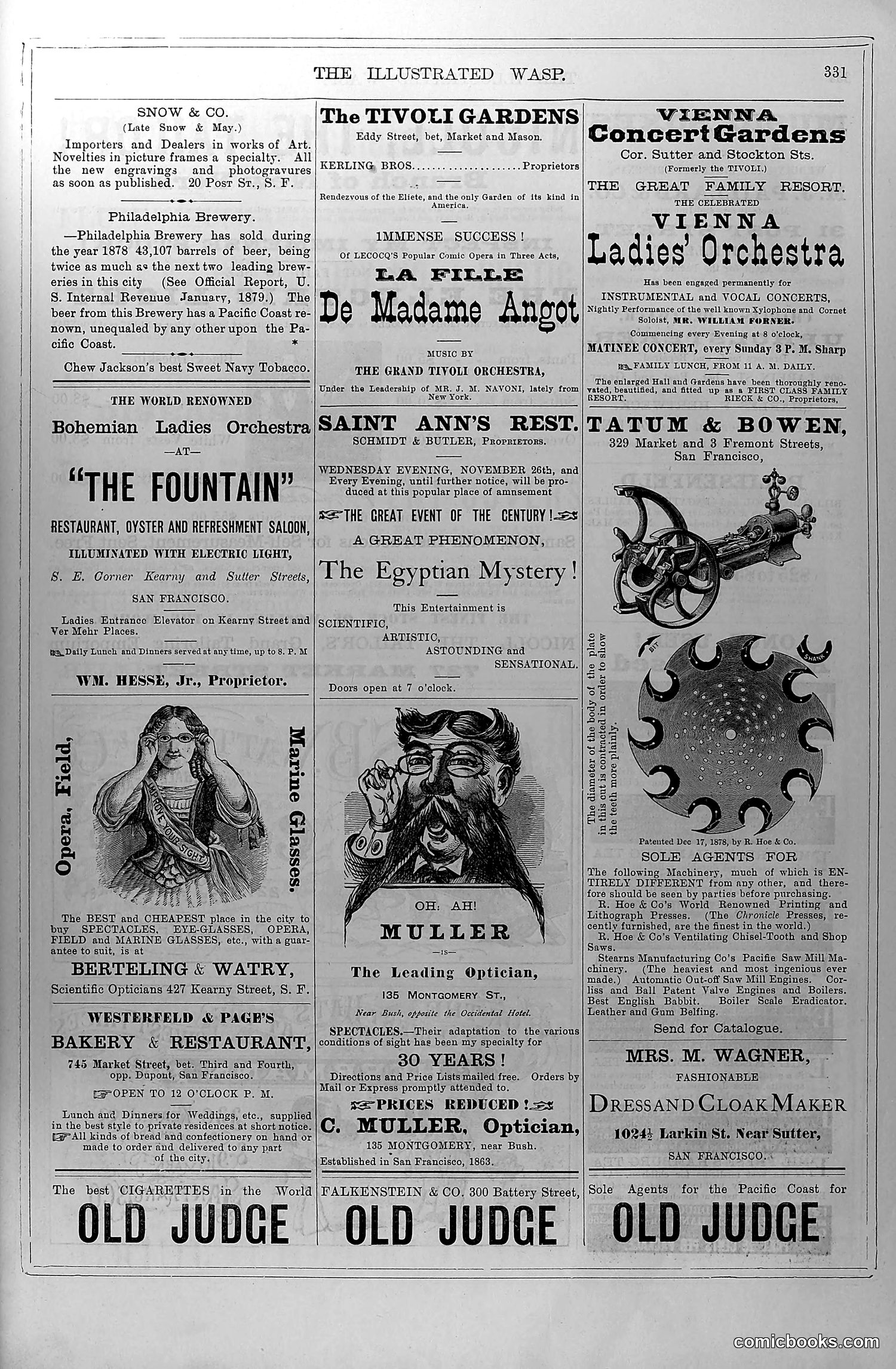
This page is predominantly **advertising and announcements** rather than political satire. It contains commercial notices for San Francisco businesses including restaurants, orchestras, optical services, and tobacco products. However, two **caricatured faces** appear: one labeled "Opera Fold" (left) and one labeled "OH! AH! MULLER" (center), identified as "The Leading Optician" at 135 Montgomery Street. The exaggerated facial features and grotesque styling are typical of 19th-century commercial caricature used to make advertisements memorable and humorous. The page reflects **late 1880s San Francisco commerce** rather than political commentary, showcasing how satirical magazines supplemented editorial content with paid advertising featuring comedic illustrations.
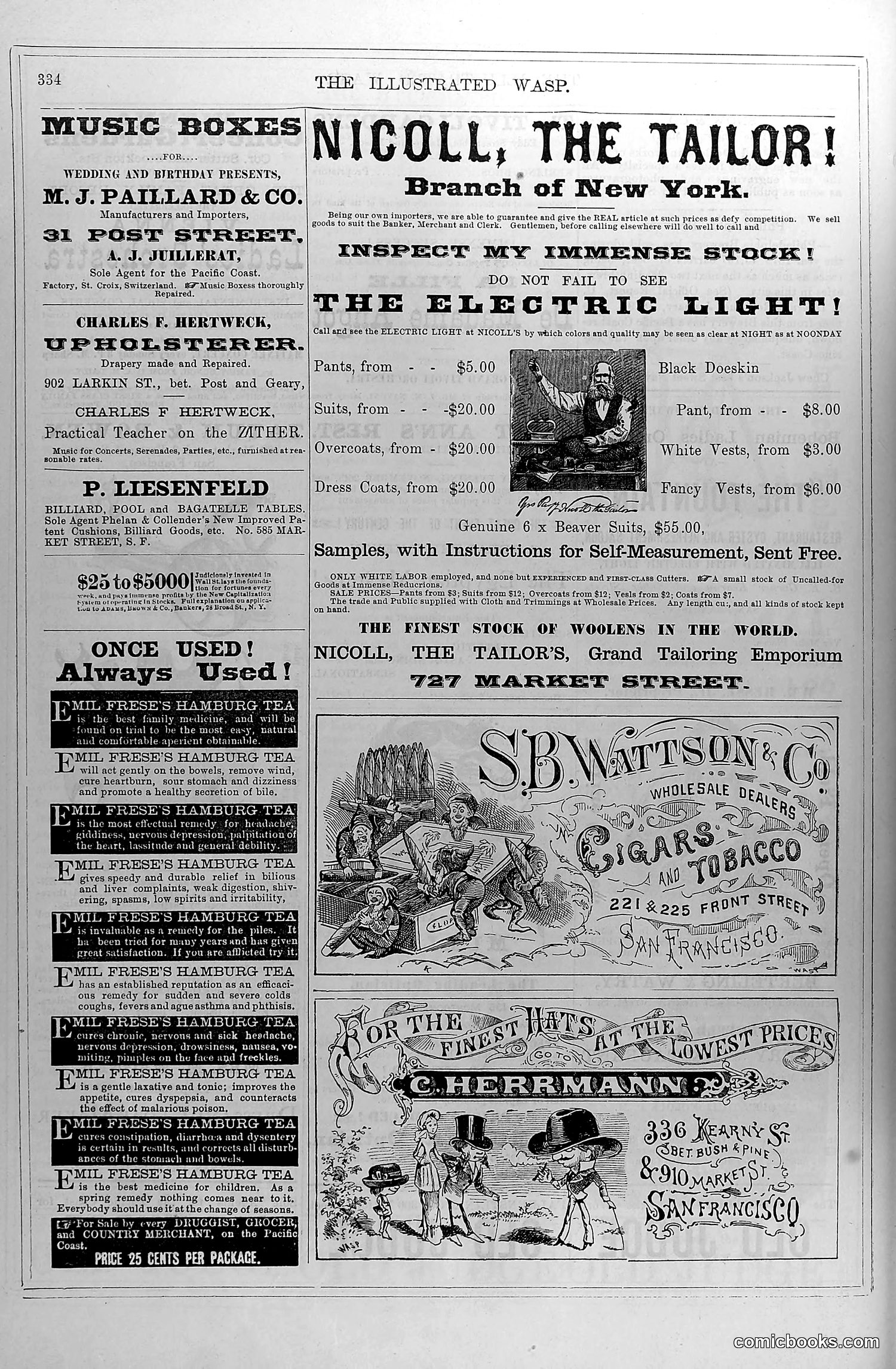
This page is primarily **advertising content** rather than political satire. It features multiple commercial advertisements from San Francisco businesses circa late 1800s, including: - **Nicoll, the Tailor** (prominent central ad) advertising clothing and an "electric light" display at their Market Street location - **S.B. Wattson & Co.**, wholesale cigars and tobacco dealers - **C. Herrmann**, a hat retailer - Various other local businesses (music boxes, upholstery, billiards, zithers) - **Emil Frese's Hamburg Tea** (repeated extensively), marketed as a medicinal remedy for numerous ailments The page demonstrates how 19th-century satirical magazines funded operations through paid advertisements. The repeated Hamburg Tea ads suggest either significant advertiser investment or editorial endorsement. No political figures or social satire appear on this particular page.
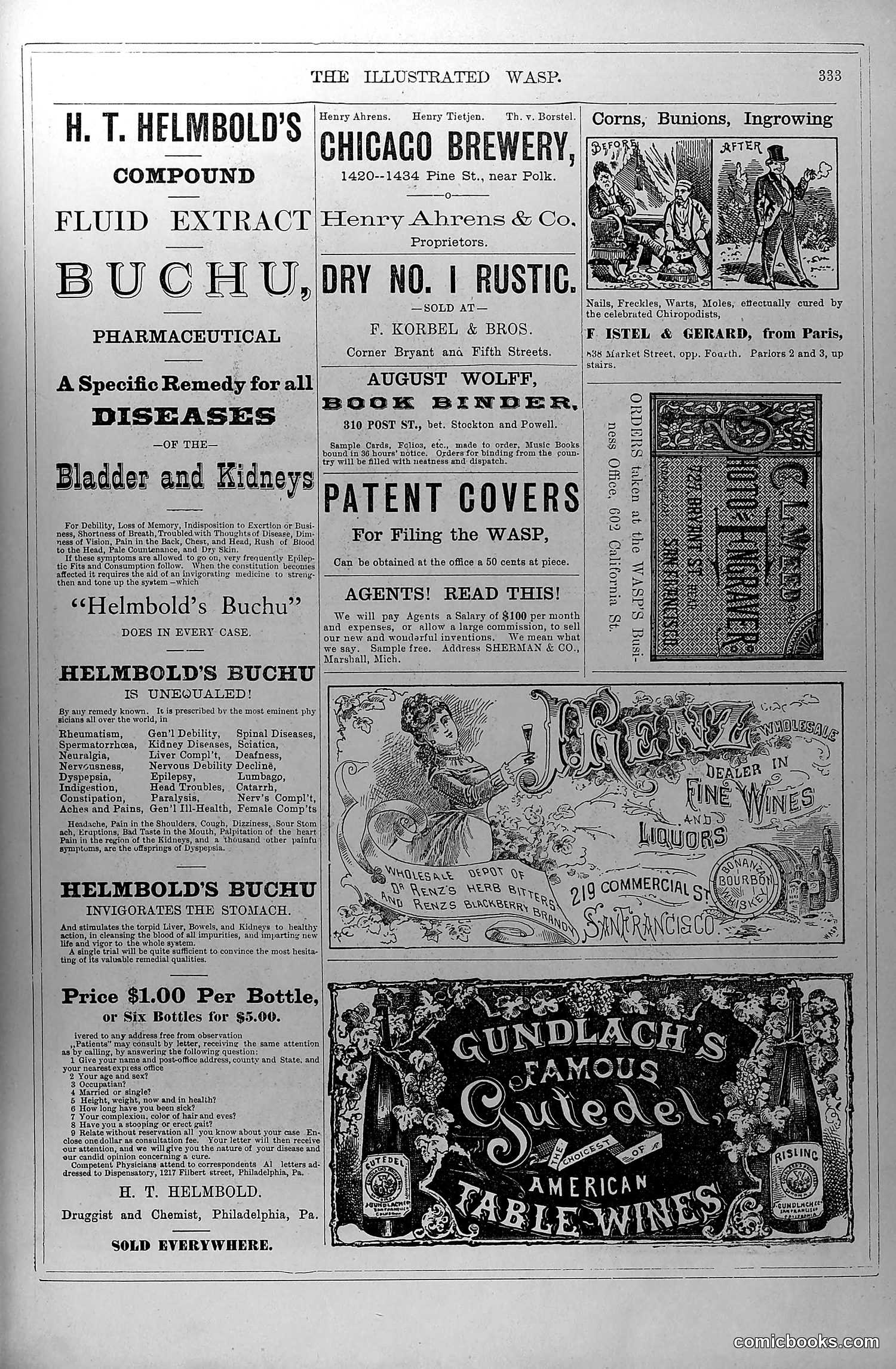
This page is primarily **advertising**, not editorial content or satire. It consists of patent medicine and commercial advertisements typical of late 19th-century American magazines. The main advertisements include: - **H.T. Helmbold's Buchu**: A patent medicine claiming to cure bladder, kidney, and various other diseases—common fraudulent remedies of the era - **Chicago Brewery** and book binding services - **Gundlach's Famous American Table Wines** from San Francisco The only illustration with potential satirical intent appears to be a small upper-right panel about skin treatments (corns, bunions, warts), but it lacks clear political meaning. The page demonstrates how *The Wasp* funded itself through advertisements for dubious health products rather than through serious satire or journalism.
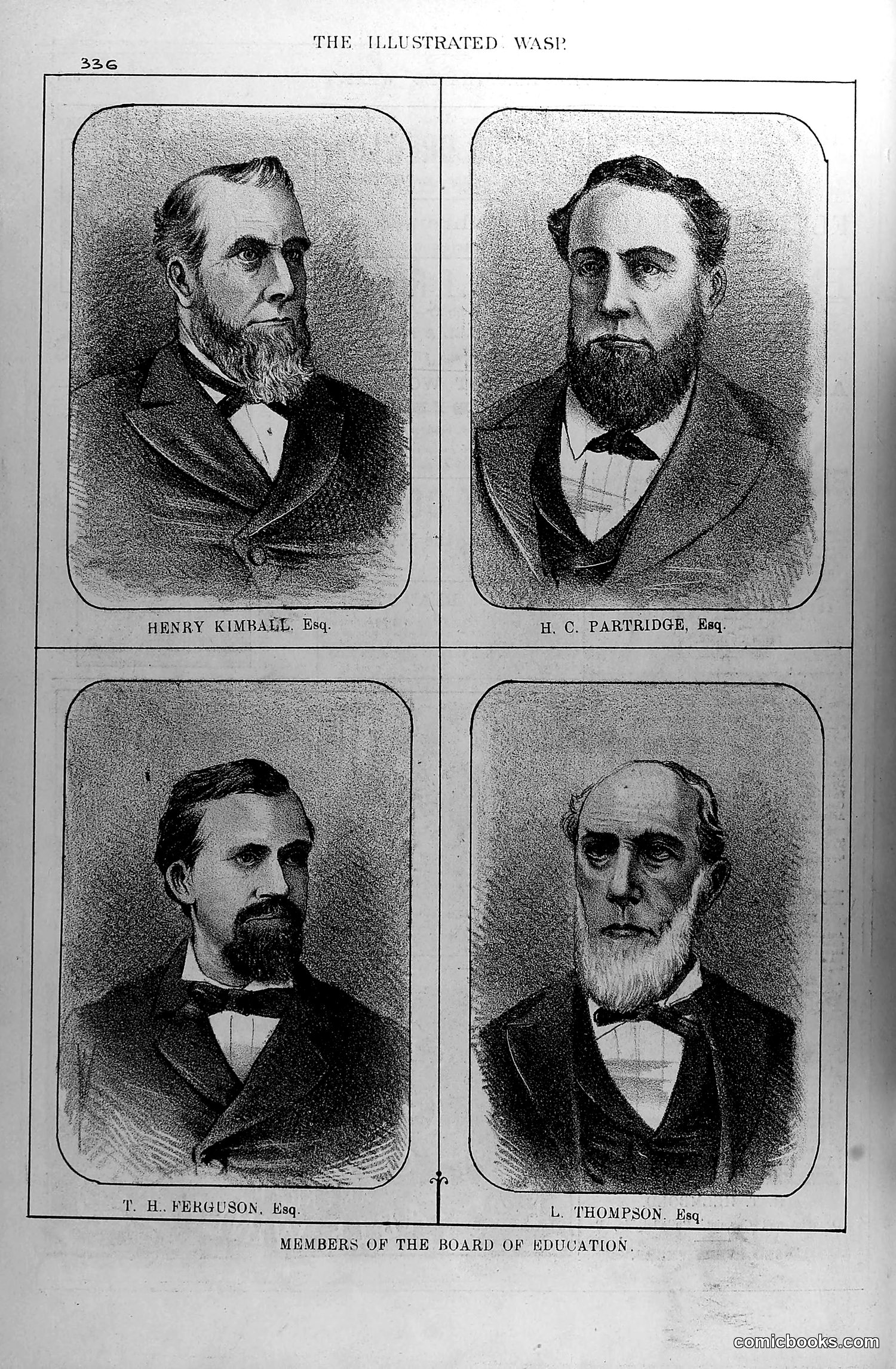
This page from *The Wasp* presents portraits of four men identified as "Members of the Board of Education": Henry Kimball, H.C. Partridge, T.H. Ferguson, and L. Thompson (all listed as "Esq."). This appears to be a straightforward informational illustration rather than satirical content—a common feature in 19th-century satirical magazines that mixed reportage with humor. The formal engravings document prominent San Francisco education officials, likely from the 1870s-1880s based on style and printing technique. Without additional context from accompanying articles, the specific satirical point—if any—remains unclear. The page may simply introduce these figures for readers' recognition, or critique may appear elsewhere in the issue.

I can see this is a calibration/test page for The Wasp magazine, containing a grayscale reference chart and measurement rulers rather than editorial content or cartoons. The image shows a standard photographic test target with numbered gray squares (ranging from dark to light) and measurement scales, used to ensure consistent reproduction quality in printing and archiving. This appears to be a technical page used during the magazine's production or preservation process, not a page intended for readers. Without visible satirical illustrations or readable text content, I cannot identify specific political figures, social references, or the satirical point of any cartoon.