
A complete issue · 18 pages · 1879
The Wasp — December 6, 1879
I can see this page contains an Oregon Rule Co. measurement scale and what appears to be a color reference chart or test pattern on a black background, but I cannot make out any satirical cartoon content, political figures, or readable text that would allow me to explain the satire or social commentary to a modern reader. The image appears to be a documentation or technical reference page rather than a finished cartoon or editorial content from *The Wasp* magazine. Without legible cartoon illustrations or identifiable caricatures and without OCR text that clarifies the subject matter, I cannot accurately explain what political or social commentary this page contains. If you have a clearer image or can confirm the page number and date, that context would help identify the intended satire.
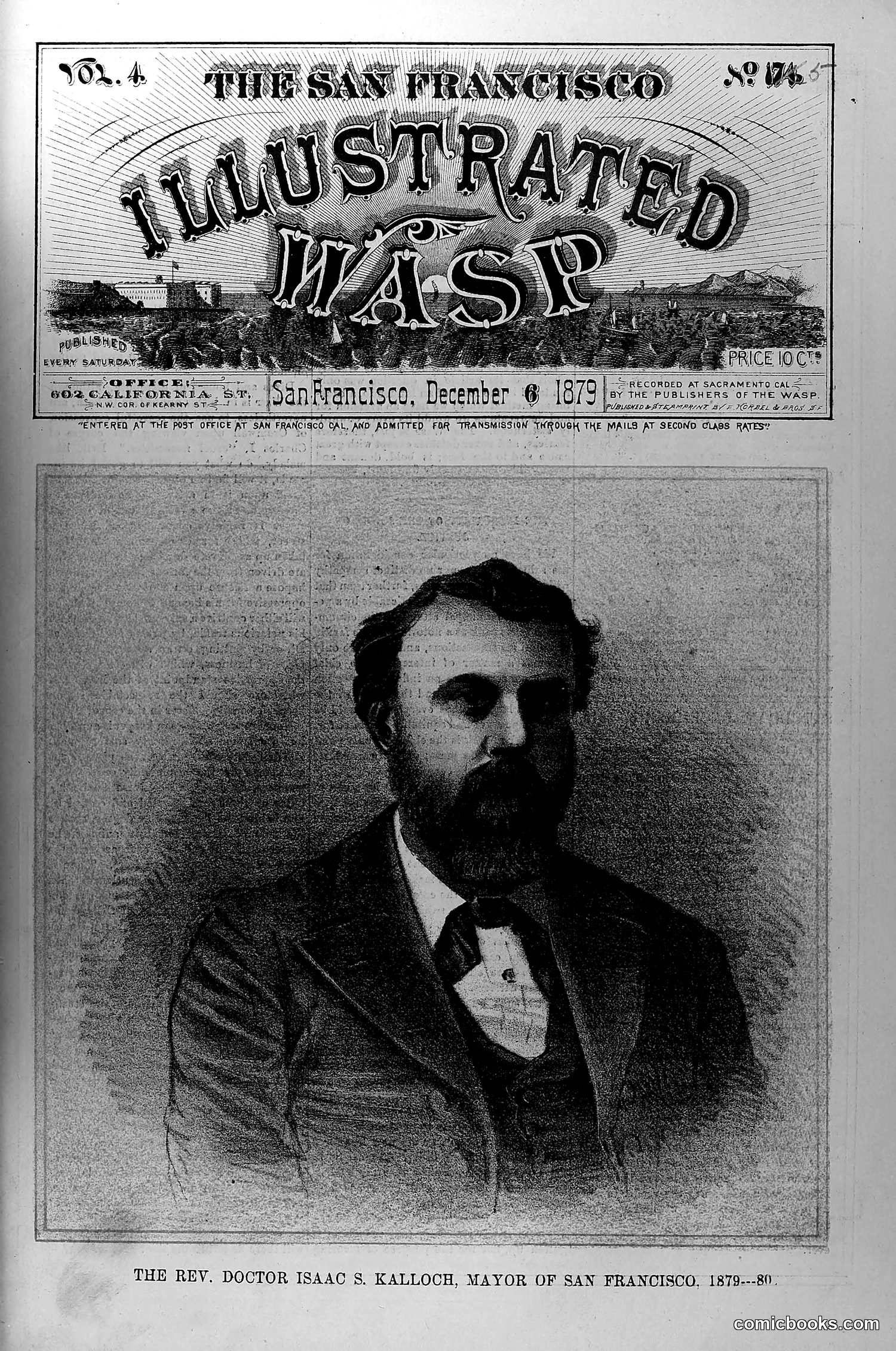
This page features a portrait of **Rev. Doctor Isaac S. Kalloch**, identified as Mayor of San Francisco (1879-80). The Wasp was a satirical publication known for political commentary, though this particular page appears primarily to be a straightforward portrait introduction rather than explicit satire or caricature. Kalloch was a prominent but controversial San Francisco figure—a clergyman who entered politics. The Wasp's inclusion of his portrait suggests he was newsworthy enough for their readership, though the image itself shows formal presentation rather than mocking exaggeration typical of the magazine's cartoons. Without additional context or visible satirical commentary on this specific page, the precise satirical intent remains unclear.
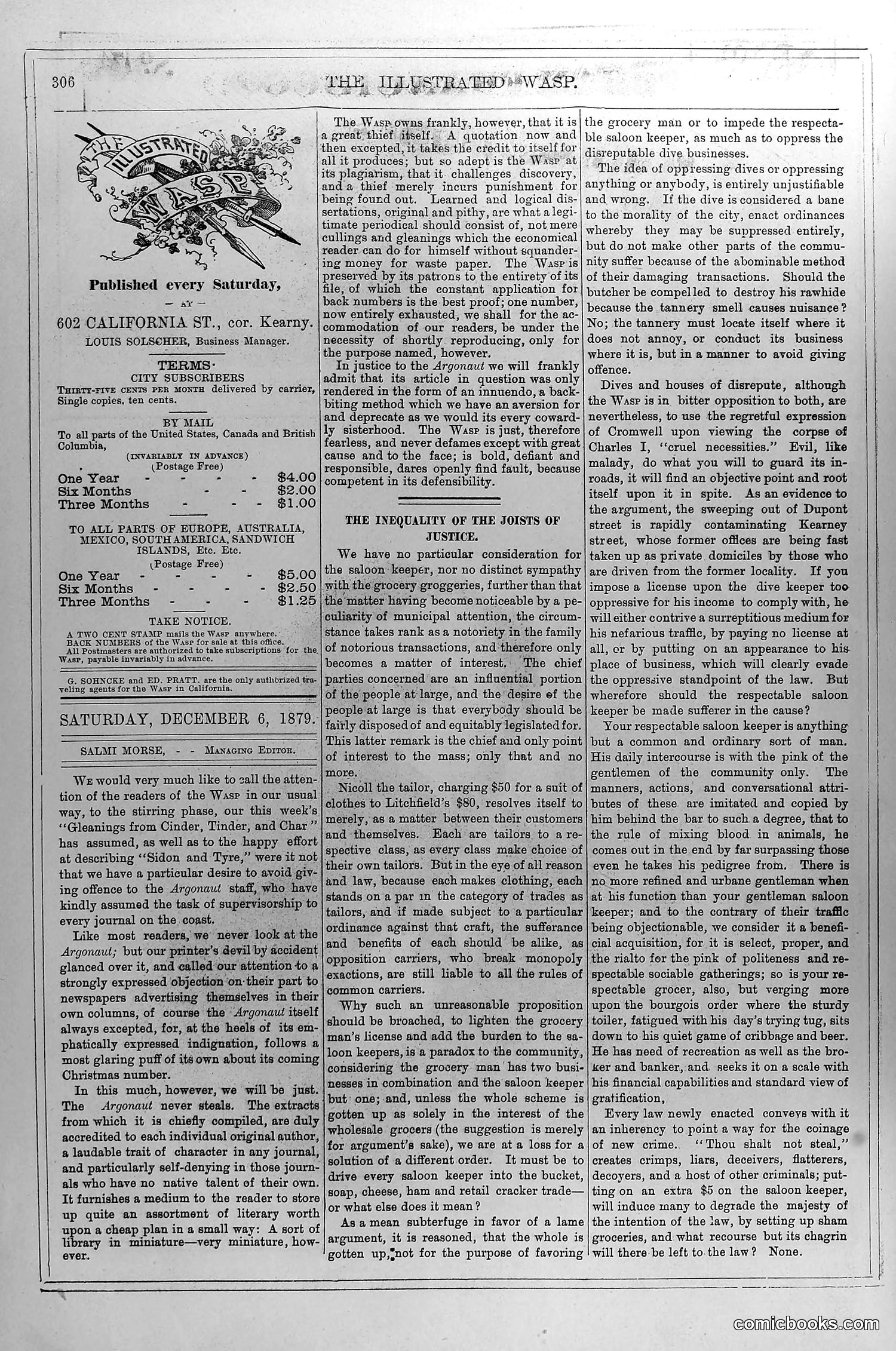
This page contains no political cartoon. Instead, it's primarily the magazine's masthead, subscription information, and editorial content by Managing Editor Salmi Morse. The main article—"The Inequality of the Joists of Justice"—argues against oppressive enforcement of business regulations on saloon keepers. Morse criticizes selective prosecution: authorities target dive bars while ignoring grocery stores that sell alcohol illegally. He argues this unfairly burdens honest saloon proprietors and suggests the real problem lies with corrupt officials and unequal enforcement, not the saloon business itself. The piece exemplifies The Wasp's satirical critique of municipal corruption and arbitrary lawmaking in 1870s San Francisco.
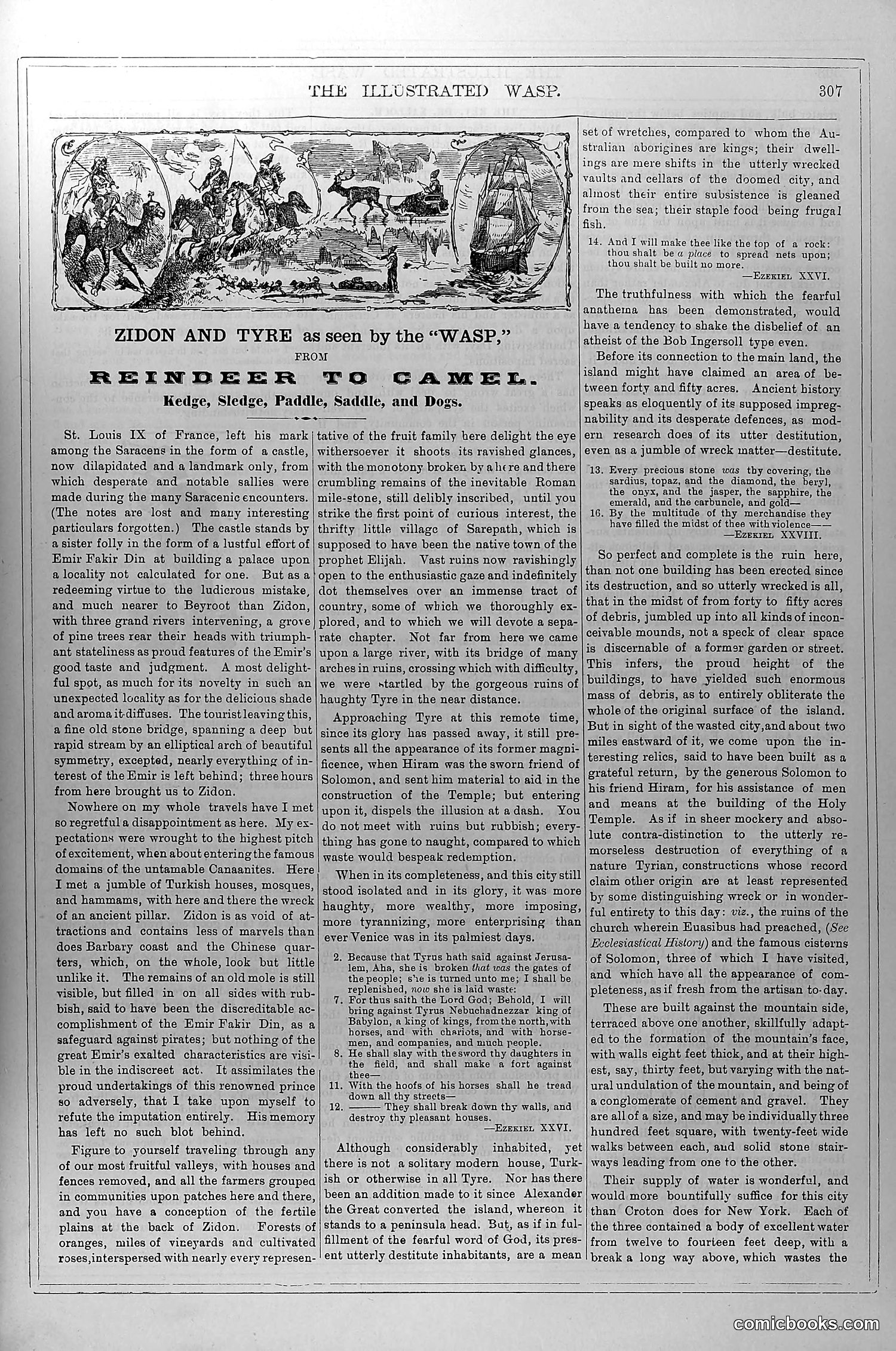
This satirical illustration compares ancient biblical cities (Zidon and Tyre) to contemporary San Francisco. The engraving shows historical scenes of these Phoenician trading centers alongside Victorian-era imagery. The accompanying text critiques San Francisco's urban decay and destruction following (likely) the 1906 earthquake and fire. The author uses the biblical parallel to argue that the city's former prosperity—built on commerce and industry—has been obliterated as thoroughly as the ancient cities were by conquest. The "Reindeer to Camel" subtitle suggests a contrast between different modes of transportation and civilization levels, possibly mocking San Francisco's reduced circumstances or pretensions to grandeur despite its devastation.
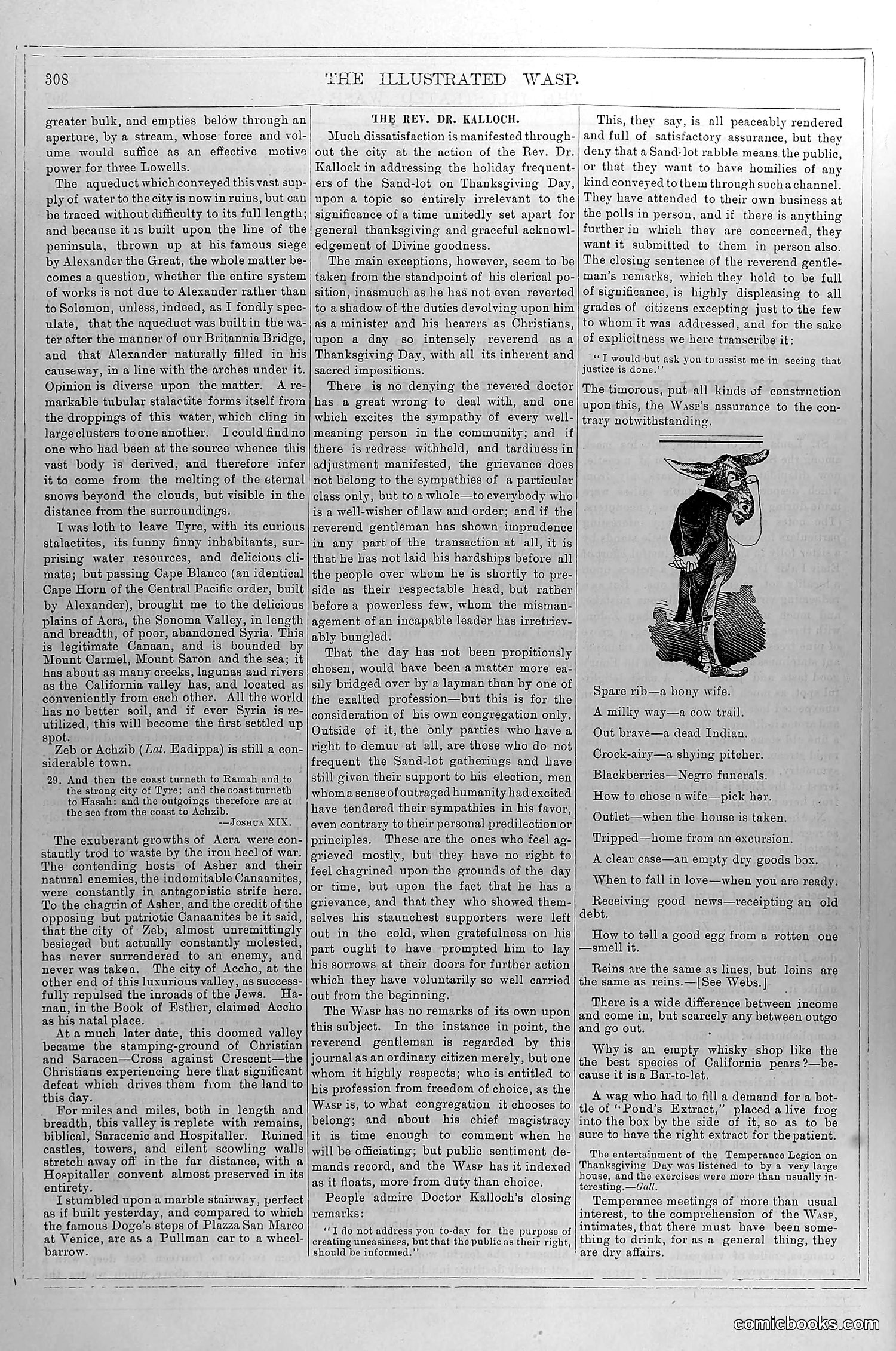
This page from *The Wasp* consists primarily of **text commentary rather than political cartoons**. The main article discusses **Rev. Dr. Kallock** and his controversial Thanksgiving address to San Francisco's Sand-lot movement—a working-class political faction of the 1870s-80s. The piece criticizes Kallock for injecting irrelevant religious messaging into a secular gathering, arguing he failed to address the Sand-lot's actual concerns. The text suggests this was poor judgment that undermined labor solidarity. The small illustration labeled "Spare rib—a bony wife" appears to be a **generic satirical sketch** rather than commentary on the main article. The page concludes with miscellaneous definitions and jokes typical of *The Wasp*'s format. The primary interest here is the **Sand-lot political criticism**, not visual satire.
This page is primarily **text content** rather than cartoon satire. It contains: 1. **"Three Twelve-Year-Old's"** — a humorous letter-form piece mocking romantic/domestic entanglements among young people, with gossipy details about courtships, divorces, and family drama in a small community. 2. **"Proclamation!"** — a brief notice about the scheduled execution of individuals named Killus and the "Burning and Sacking" of San Francisco, ordered for December 1st. This appears to be **satirical commentary** on some contemporary crisis or threatened action, though the specific historical reference is unclear without additional context. The page uses humor and mock-formal language typical of satirical magazines to critique social behavior and current events, but lacks the visual cartoons one might expect from this publication.
This page contains theater and social criticism rather than political cartoons. The main content includes reviews of theatrical productions and performances: **Drama section** discusses actors like Urbane (praised as "charitable, affable, sensible, and conscientious") and critiques of various plays including "St. Ann's Rest" and "Forget Me Not." **Social commentary** addresses contemporary issues: criticism of Thanksgiving sermons for being "dreadfully tedious," commentary on Miss Canada's theatrical prospects, and remarks about Irish agitator Kenealy proposing to leave Ireland. The scattered illustrations show theatrical scenes. The satire is primarily directed at theater quality and social pretension rather than specific political figures. This reflects *The Wasp*'s focus on San Francisco cultural criticism and entertainment reviews during the late 19th century.
This page contains Act III of "Baruch Kowski, or Le Juif Polonais" (The Polish Jew), a three-act play adapted from French for *The Wasp* magazine by Salmi Morse. It's a dramatic script rather than a political cartoon. The scene depicts Michel, a wealthy innkeeper, entertaining guests while dealing with domestic and moral dilemmas. The dialogue involves themes of conscience, family obligation, and social propriety typical of 19th-century melodrama. Without additional context about the play's original French source or *The Wasp*'s editorial intent, the specific satirical target remains unclear. The play may parody contemporary theatrical conventions, ethnic stereotypes (suggested by the title's reference to a Polish Jew), or social hypocrisy—common *Wasp* subjects—but the page alone doesn't decisively establish which.
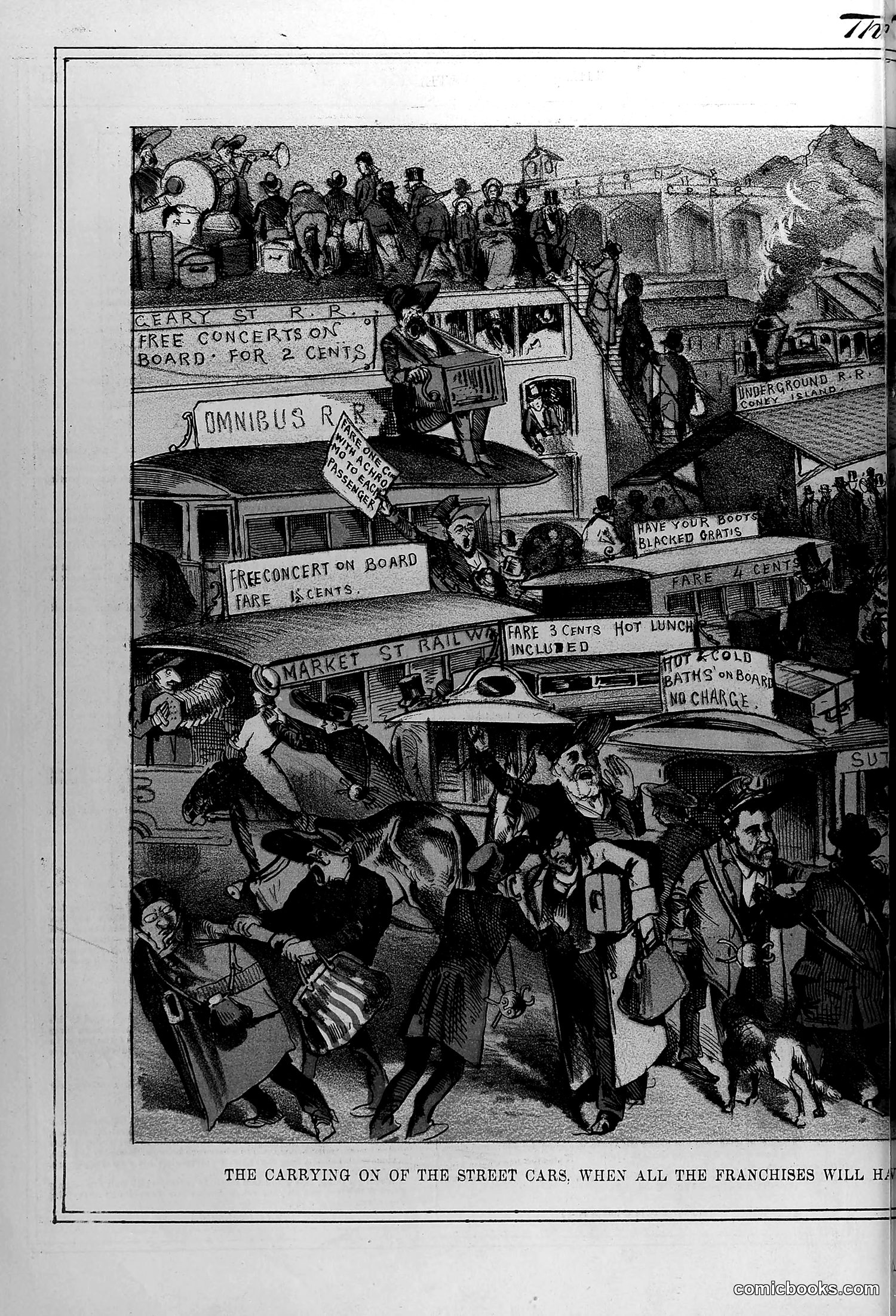
This satirical engraving depicts San Francisco's street car system during a period of franchise disputes. The cartoon shows overcrowded omnibuses and rail cars advertising "Free Concerts on Board" and cut-rate fares (2-3 cents), with signs promising amenities like "Hot & Cold Baths on Board, No Charge" and "Hot Lunch Included." The satire targets what appears to be competitive street car companies making absurd promotional claims to attract passengers during franchise competition. The crowded, chaotic scene suggests the system's dysfunction. The caption references "when all the franchises will have" (text cuts off), likely critiquing municipal franchise allocation policies. The common people depicted at street level represent ordinary San Franciscans navigating this commercialized transit chaos, highlighting how public infrastructure had become a competitive marketplace.
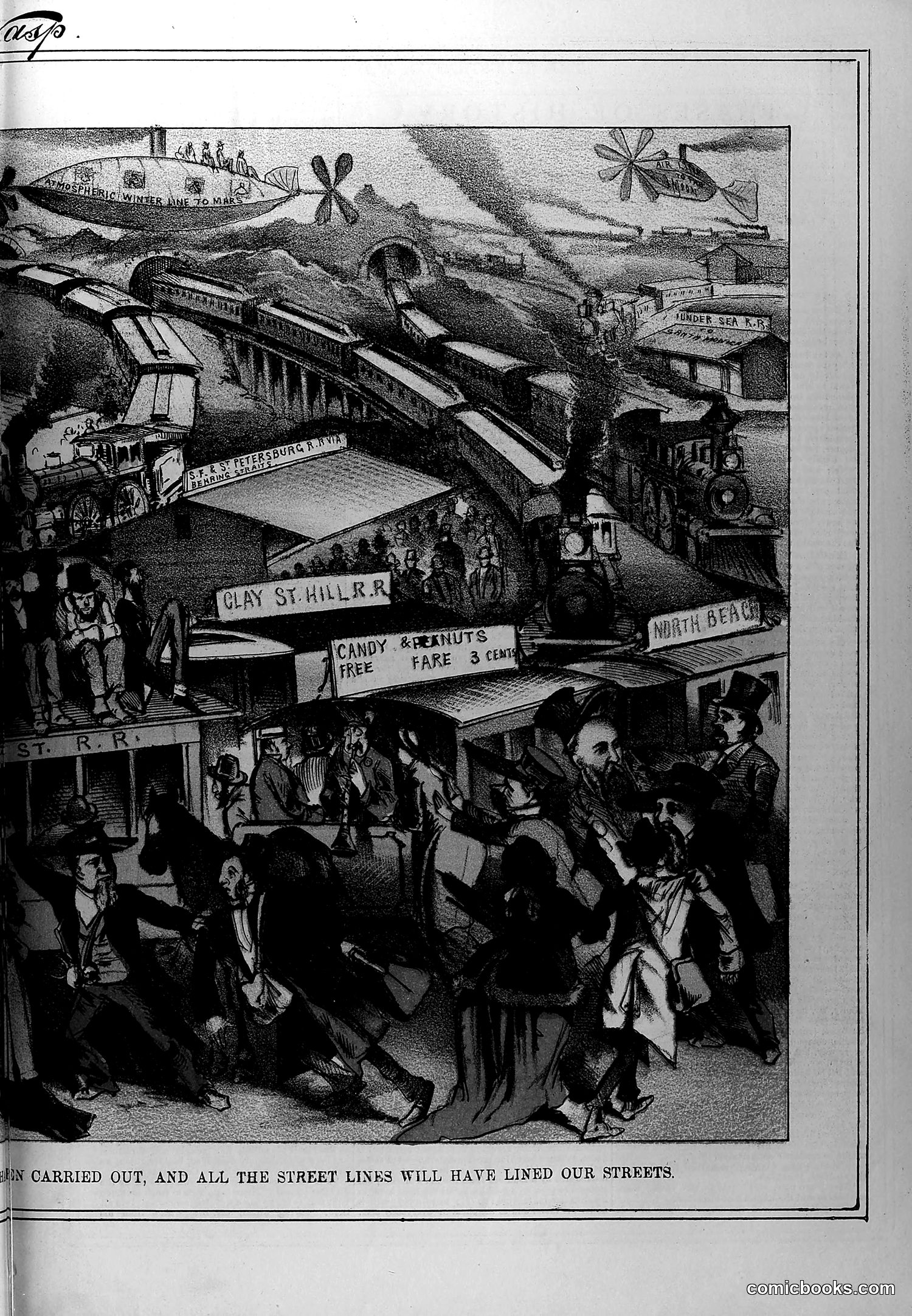
This satirical illustration depicts a futuristic vision of San Francisco with multiple transportation modes—airships, trains, and transit lines—converging on a crowded street scene below. Visible signs reference "Clay St. Hill R.R.," "North Beach," and offer "Candy & Peanuts" and "3 Cent Fare," suggesting contemporary local transit and commerce. The caption states: "...PLAN CARRIED OUT, AND ALL THE STREET LINES WILL HAVE LINED OUR STREETS." This appears to be satirizing San Francisco's ambitious urban development plans, likely from the late 1800s or early 1900s. The cartoon mocks proposals to modernize the city's transportation infrastructure—perhaps criticizing overcrowding, excessive development, or the disruption such projects would cause to established neighborhoods and street life.
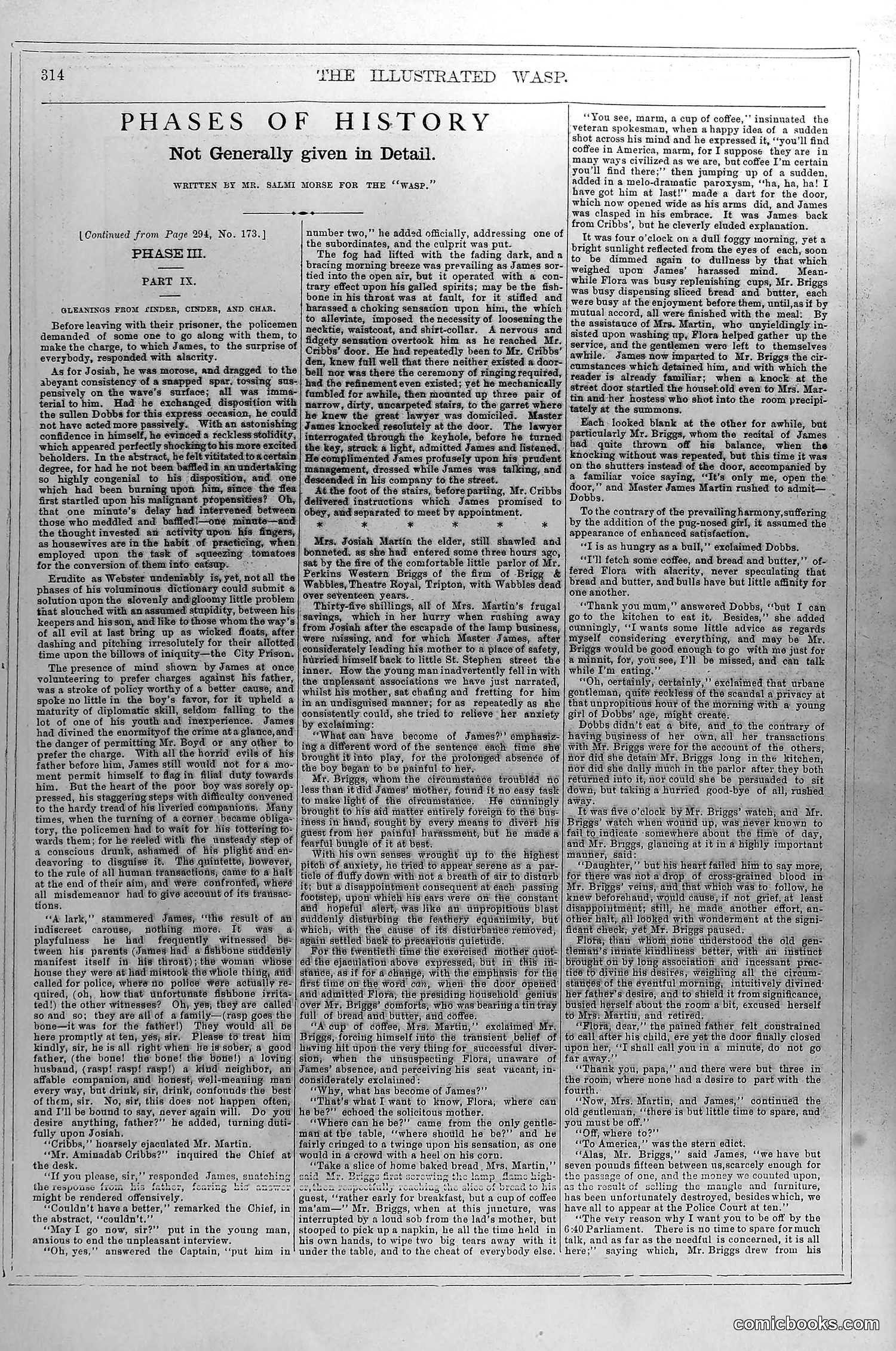
This page contains serialized fiction ("Phases of History," Part IX, continued from a previous issue) rather than political cartoons. The text depicts a Victorian-era domestic drama involving characters named James, Mrs. Josiah Martin, Mr. Briggs, and others in what appears to be a working-class household dispute. The narrative concerns quarrels over household management, money, and propriety—including discussions of coffee, boarding arrangements, and whether someone should call the police. It's a melodramatic story exploring class tensions and domestic conflict typical of 19th-century serialized literature. **No political satire or cartoon content is visible on this page.** It represents The Wasp's fiction offerings rather than its satirical cartoons.
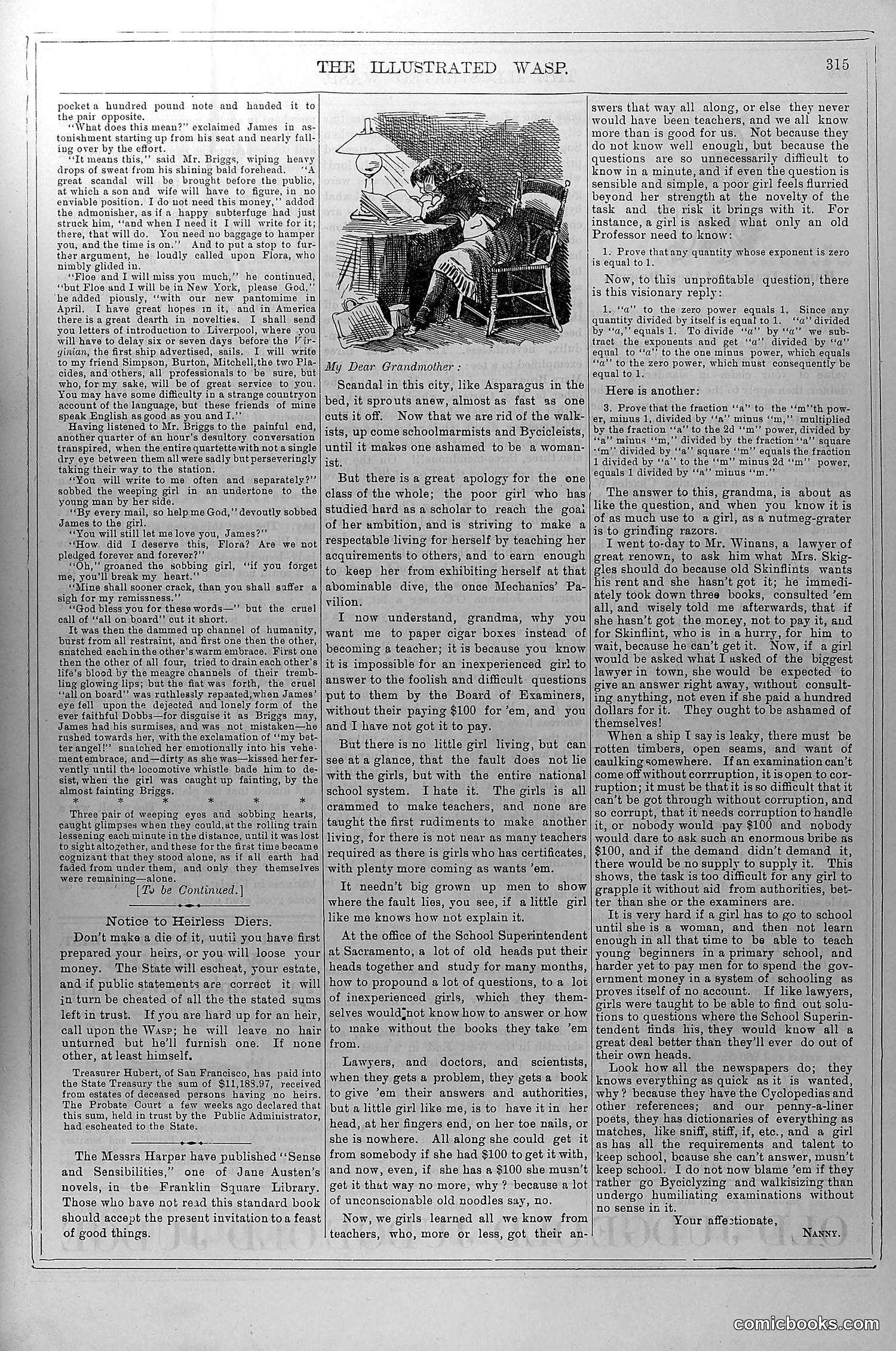
The main illustration shows a woman writing at a desk, titled "My Dear Grandmother." The accompanying letter-to-the-editor satirizes women's education and employment barriers of the era. The piece mocks the impractical arguments used to exclude women from professions. A female correspondent explains she cannot become a teacher because she's unmarried and poor—yet respectable women were expected to be financially dependent. The text ridicules how society simultaneously demands women be educated, self-sufficient, and modest, while denying them the means to achieve these goals. The satire highlights the catch-22 facing women seeking professional work: they need money to qualify, but cannot earn it without already being qualified. This critiques the hypocrisy of Victorian-era gender restrictions on women's economic independence and career advancement.
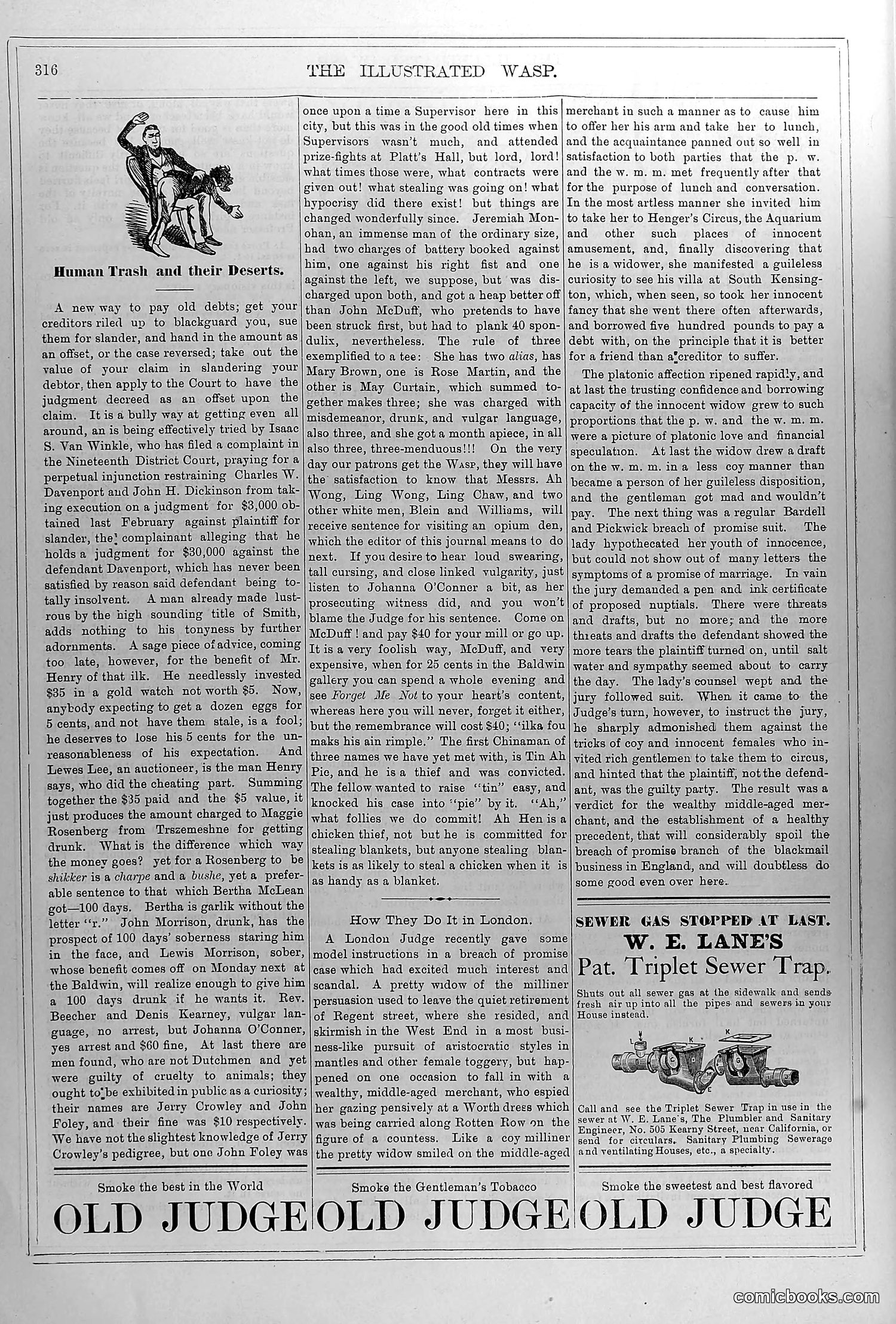
This cartoon satirizes the wealthy and corrupt, depicting what appears to be a well-dressed gentleman kicking or striking a working-class figure. The accompanying text discusses using lawsuits as debt collection—a practice the author views as enabling the rich to exploit the poor through the legal system. The satire targets prominent San Francisco figures including "Jeremiah Monahan" and others accused of battery and misconduct. The piece criticizes how wealthy defendants can afford legal protection while ordinary people suffer consequences. The title "Human Trash and their Deserts" suggests the cartoonist believes corrupt wealthy individuals deserve punishment (their "deserts"), yet the legal system protects them. This reflects broader Gilded Age criticism of class-based justice where money determines legal outcomes.
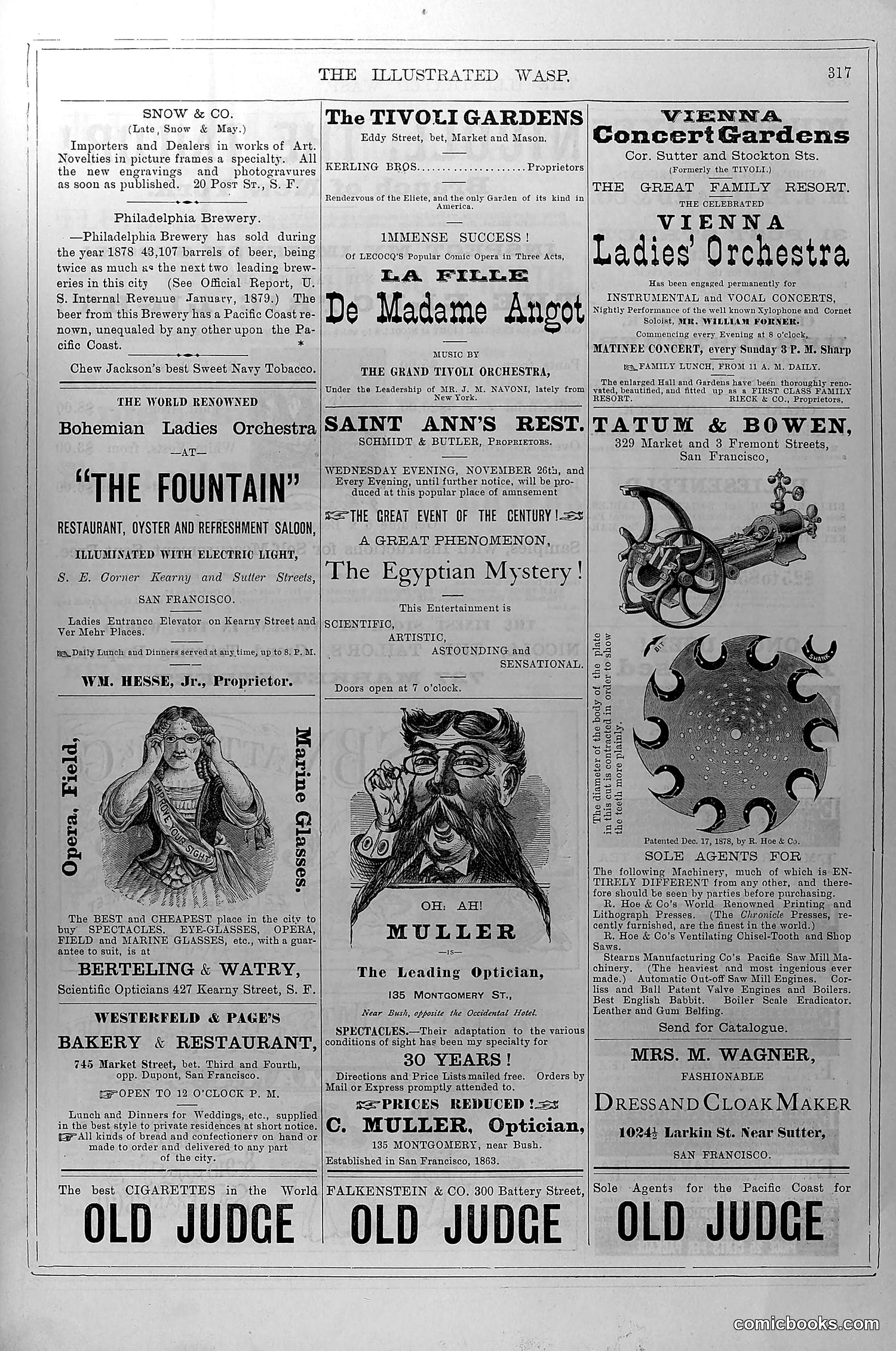
This page is primarily **advertisements and entertainment listings** from a San Francisco publication, likely from the 1870s-1880s based on the style. The only cartoon element is a caricatured face labeled **"OH, AH! MULLER"** advertising an optician's shop. The exaggerated facial features (prominent nose, wild hair, beard) and the "OH, AH!" exclamation appear designed as humorous branding—suggesting either the optician's distinctive appearance or making a visual pun about eyeglasses/vision. The page otherwise contains ads for restaurants, breweries, orchestras, theaters (including "La Fille de Madame Angot"), and consumer goods. Most advertisements target San Francisco's urban middle and upper classes. There is no coherent political satire visible—this is a commercial publication page using caricature primarily for attention-grabbing advertising purposes.
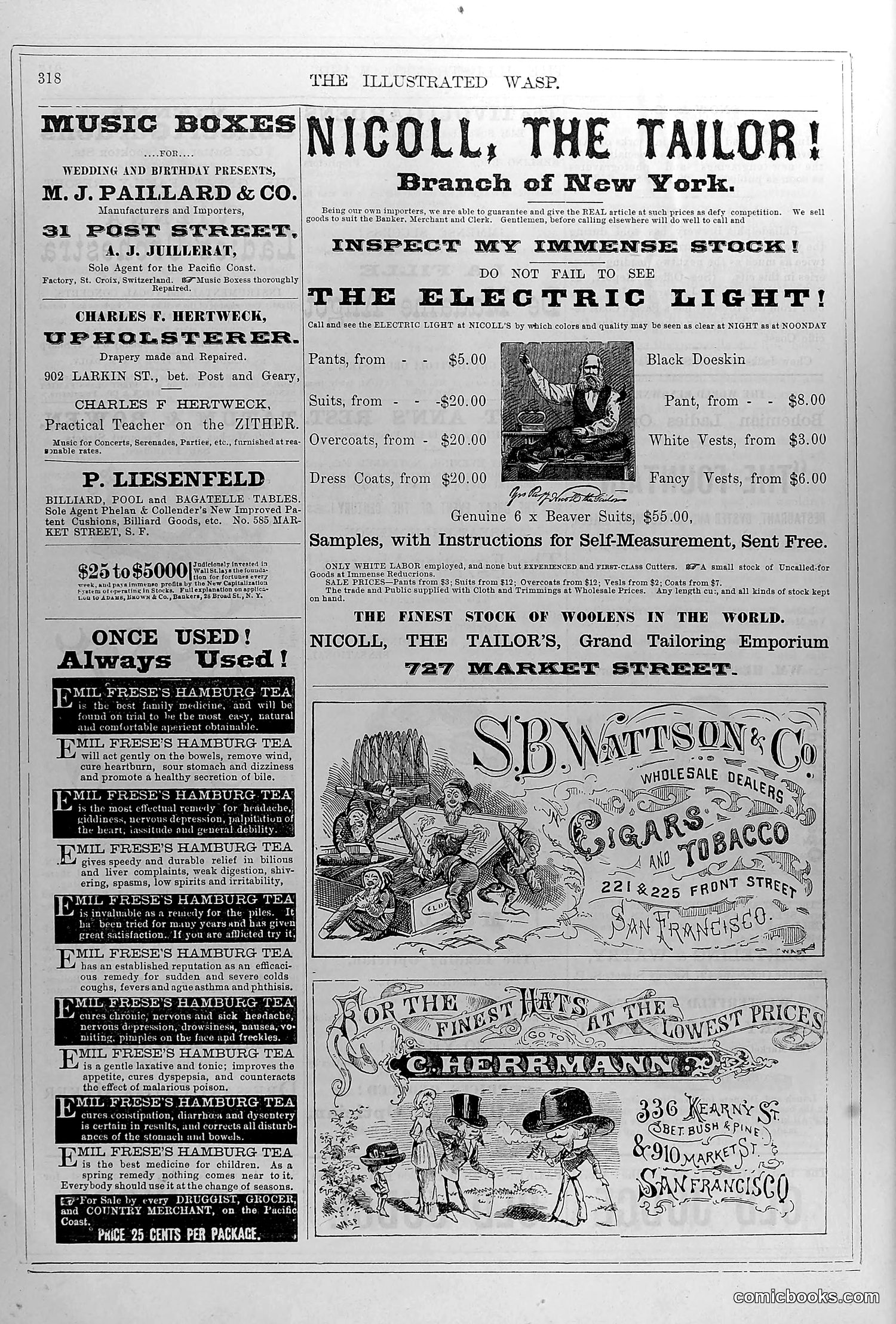
This page is primarily **advertising**, not political satire. It contains commercial notices for San Francisco businesses circa the late 1800s, including: - Music boxes and tailoring services - Nicoll's tailor shop (branch of New York), prominently featuring "THE ELECTRIC LIGHT" as a sales gimmick - Emil Frese's Hamburg Tea (a patent medicine advertised with multiple health claims) - S.B. Wattson & Co. (cigars and tobacco) - C. Herrmann's (hats) The page demonstrates how **electric lighting was still novel enough to be a major marketing attraction**. The Hamburg Tea ads exemplify 19th-century patent medicine marketing—listing exaggerated medicinal benefits for a generic herbal product. There is **no identifiable political cartoon or satire** on this page; it represents typical period advertising copy.
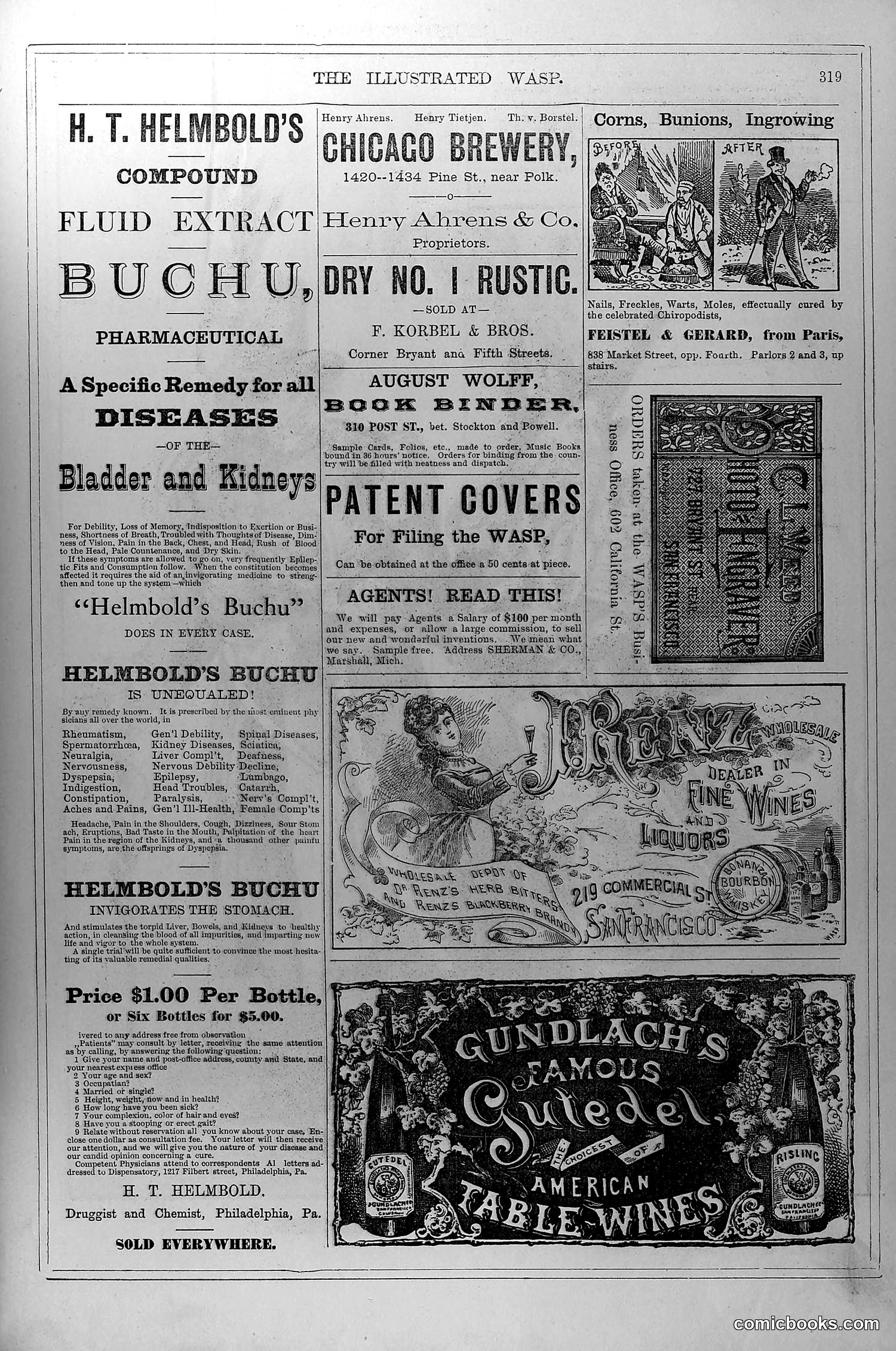
This page is predominantly **advertising**, not political satire. It contains numerous product advertisements from late 19th-century San Francisco businesses: - H.T. Helmbold's "Buchu" remedy (kidney/bladder treatment) - Chicago Brewery and book binding services - Patent covers for filing documents - Wine and liquor dealers The only cartoon content is a small illustration labeled "Corns, Bunions, Ingrowing" showing figures discussing foot ailments, advertising Feistel & Gerard's treatment services. The page reflects typical magazine monetization of the era, where satirical publications relied heavily on patent medicine and local business advertising to fund operations. The advertisements themselves, promoting dubious medical "cures," are arguably the real satire of 19th-century consumer culture.
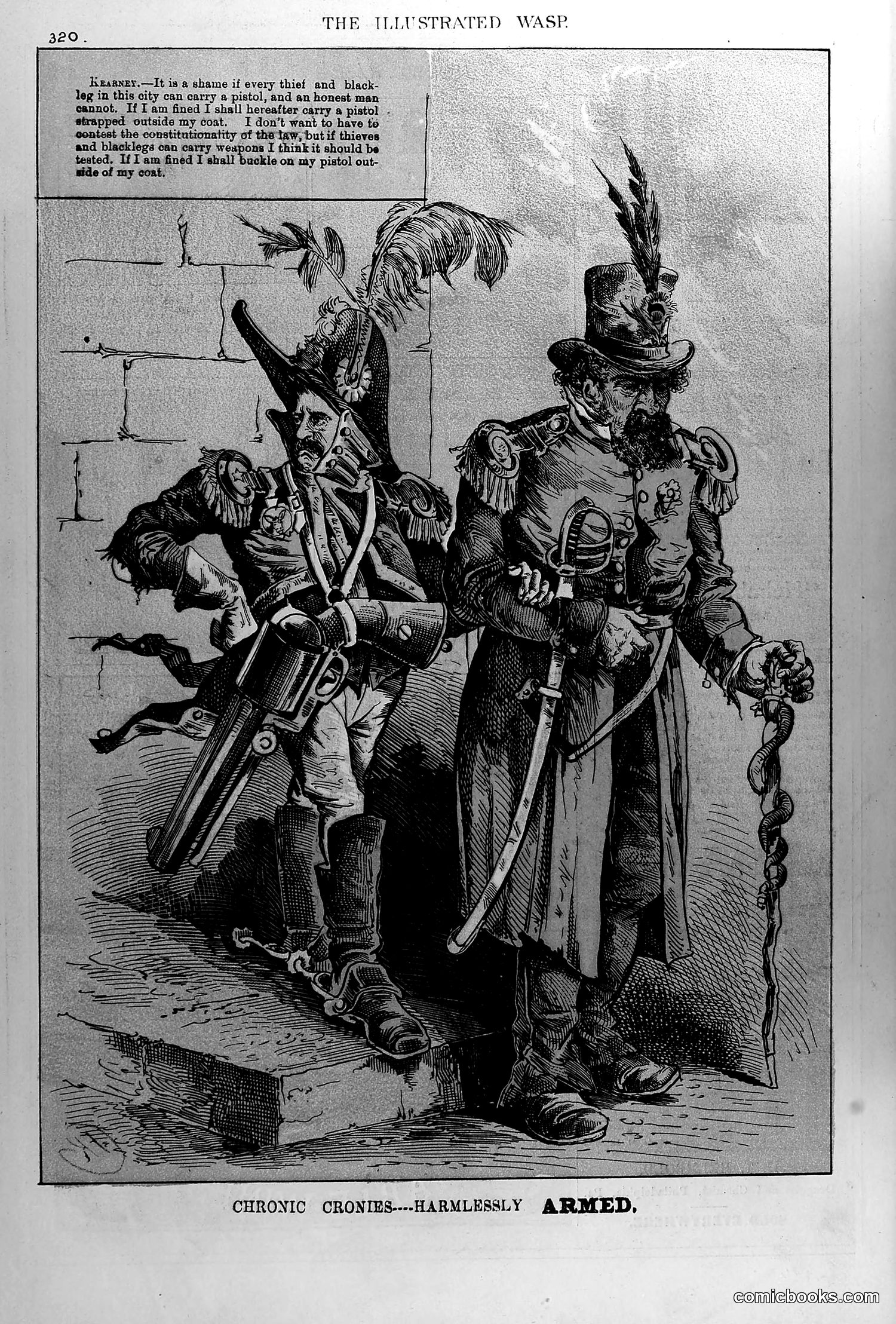
This political cartoon satirizes armed civilians and law enforcement carrying concealed weapons in cities. The accompanying text argues this is shameful, stating that "every thief and black leg in this city can carry a pistol" while honest citizens cannot safely do so without legal consequences. The speaker advocates for either universal gun-carrying rights or a complete ban on concealed weapons. The cartoon depicts two elaborately uniformed military or police figures, caricatured with exaggerated features, festooned with weapons, insignia, and ornamental plumage. The phrase "harmlessly armed" is sarcastic—suggesting these pompous officials are anything but harmless despite their ridiculous accoutrements. This appears to critique Gilded Age hypocrisy regarding who could legally carry weapons and the absurdity of official versus civilian firearm regulations.
I can see this is a calibration/reference page used in document reproduction—a standard technical testing sheet rather than editorial content from The Wasp magazine itself. The page displays a grayscale reference chart (the grid of squares at varying tones on the left) alongside measurement rulers (vertical and horizontal), which photographers and printers used to ensure accurate reproduction of photographs and printed materials. This was essential technical equipment for early-to-mid 20th century publishing. There is no cartoon, satirical content, or political commentary visible on this page. It appears to be a blank or test page from a magazine issue rather than a page containing actual editorial material.