
A complete issue · 18 pages · 1879
The Wasp — November 29, 1879

I can see this is a calibration/reference page for a document or photograph, containing Oregon Rule Co. measuring scales and a grayscale test chart with various shades from black to white arranged in a grid pattern. This is **not** a page from The Wasp magazine with political cartoons or satirical content. It appears to be a technical document used in archival photography or document reproduction—the rulers, scale markers, and grayscale chips help ensure accurate color reproduction and measurement when digitizing historical materials. To analyze actual Wasp magazine content with political cartoons and satire, I would need a page showing illustrations, caricatures, and text-based commentary rather than this technical calibration chart.
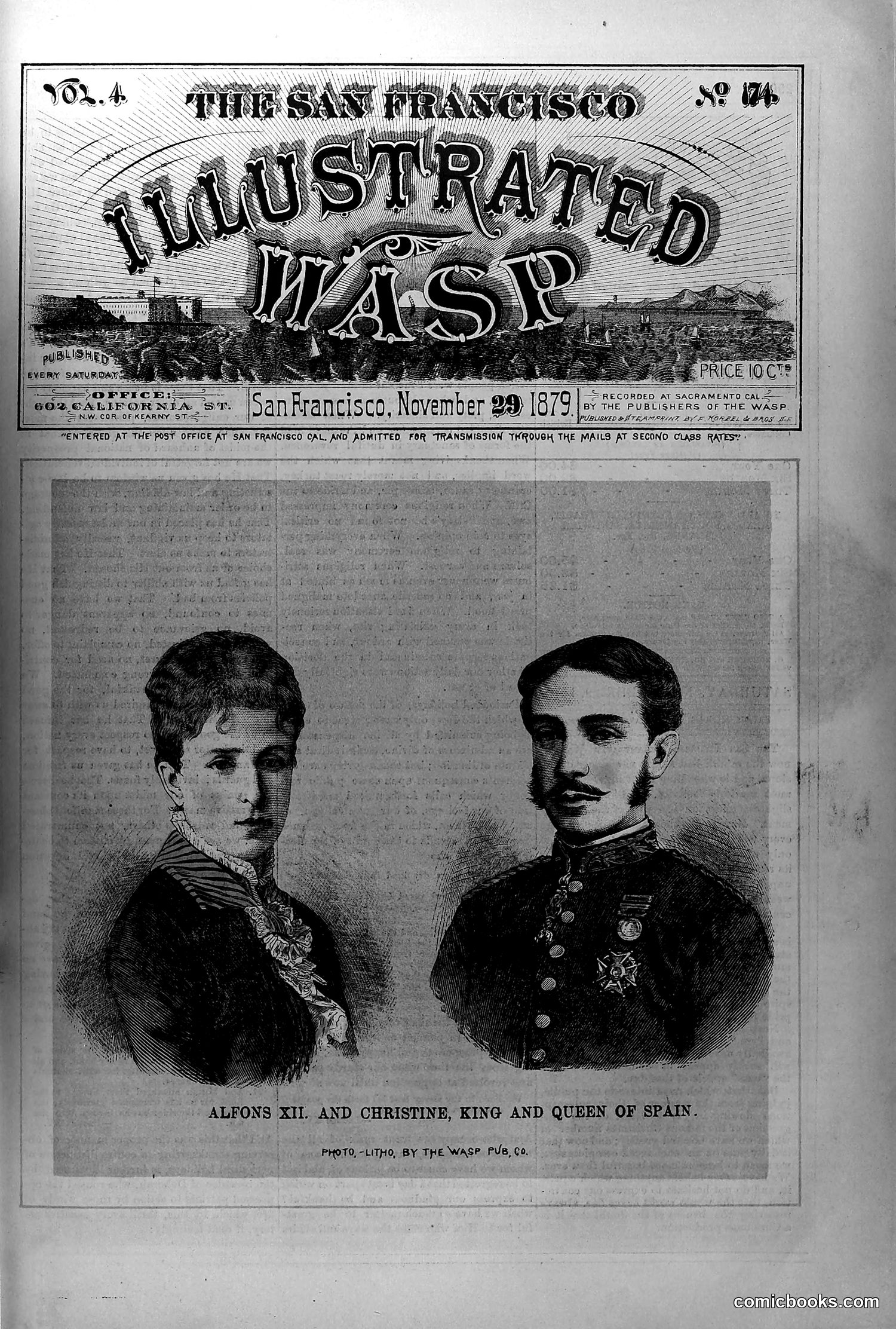
This issue features formal portraits of **Alfonso XII and Christine, King and Queen of Spain**, identified in the caption. The image appears to be a straightforward news illustration rather than satirical cartoon—a photo-lithograph reproduction showing the Spanish royal couple in official dress. The Wasp, as a satirical weekly, likely ran this as contemporary news coverage of the Spanish monarchy. Alfonso XII had recently restored the Spanish throne after a period of republican government. This appears to be standard illustrated journalism rather than political satire, offering San Francisco readers visual documentation of European royalty during an era when such royal imagery held public interest.
This page is primarily **editorial and administrative content** rather than political satire. The masthead and publication information dominate the layout. The visible cartoon depicts **a wasp** in the header logo—the magazine's recurring mascot symbolizing sharp, stinging satire. The main text comprises: - Subscription rates and pricing notices - A "Take Notice" section about stamped envelopes - Editorial commentary on the magazine's success and mission - Lengthy passages about **Thanksgiving observance**, emphasizing religious gratitude, national prosperity, and divine providence—reflecting 19th-century American civic values **No specific political figures or scandals are identifiable** on this particular page. The content reflects the magazine's general editorial stance promoting patriotic, religious sentiment rather than partisan attack.
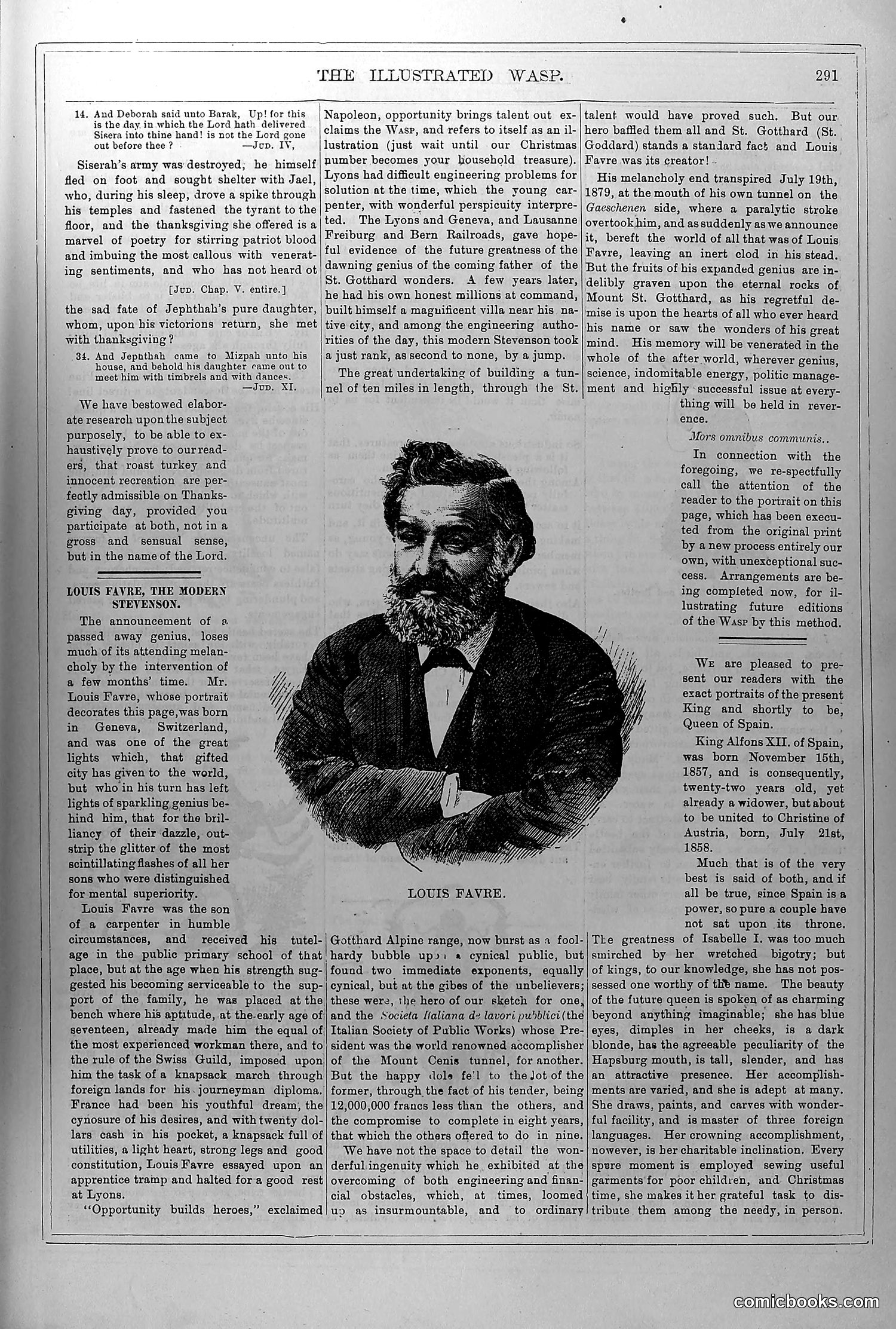
This page features a portrait of **Louis Favre**, a Swiss engineer and construction pioneer. The accompanying text celebrates him as a "modern Stevenson" (referencing engineering achievement). The article praises Favre's major accomplishment: engineering the **St. Gotthard tunnel through the Alps**—described as a massive ten-mile undertaking through the mountains. The text emphasizes his humble origins as a carpenter's son and his rise to prominence through talent and perseverance. The page also contains brief notes on **King Alfonso XII of Spain**, described as young and about to marry. Rather than satirical, this appears to be celebratory journalism highlighting contemporary engineering achievement and international notable figures for an American audience.
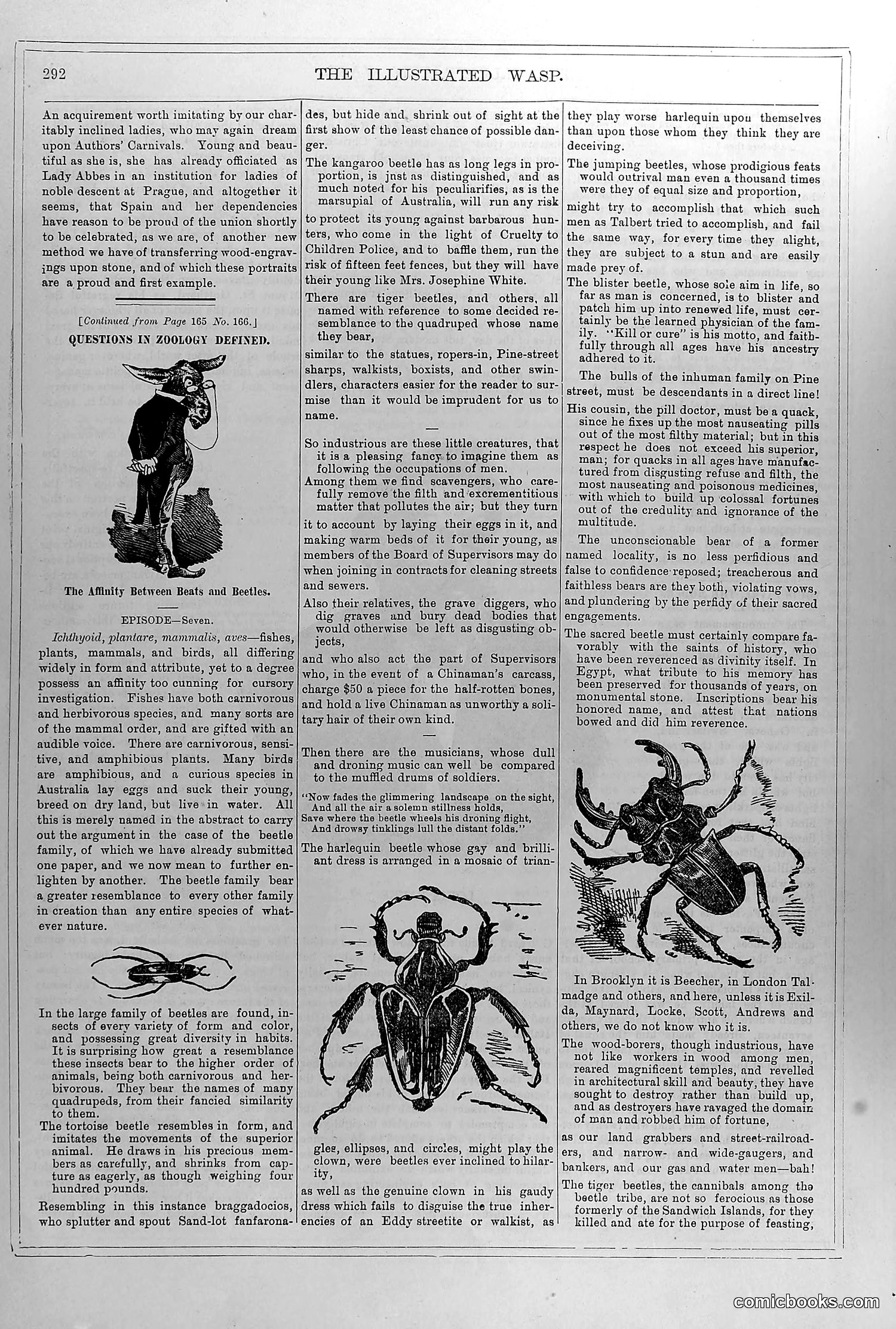
This page is primarily **educational content rather than political satire**. It presents "Questions in Zoology Defined," a natural history essay on the affinity between beetles and bats. The illustrations show various beetle species in detailed scientific drawings. The text explains biological classifications and anatomical similarities across different creatures—comparing insects to mammals, birds, and amphibians. There is **no apparent political cartoon or satirical content** on this page. The Wasp appears to have included scientific/educational material alongside its typical satirical offerings. The elaborate beetle illustrations and discussion of zoological relationships suggest this section was meant to entertain readers while providing factual information about natural history. The tone is straightforward educational rather than humorous or pointed social commentary.
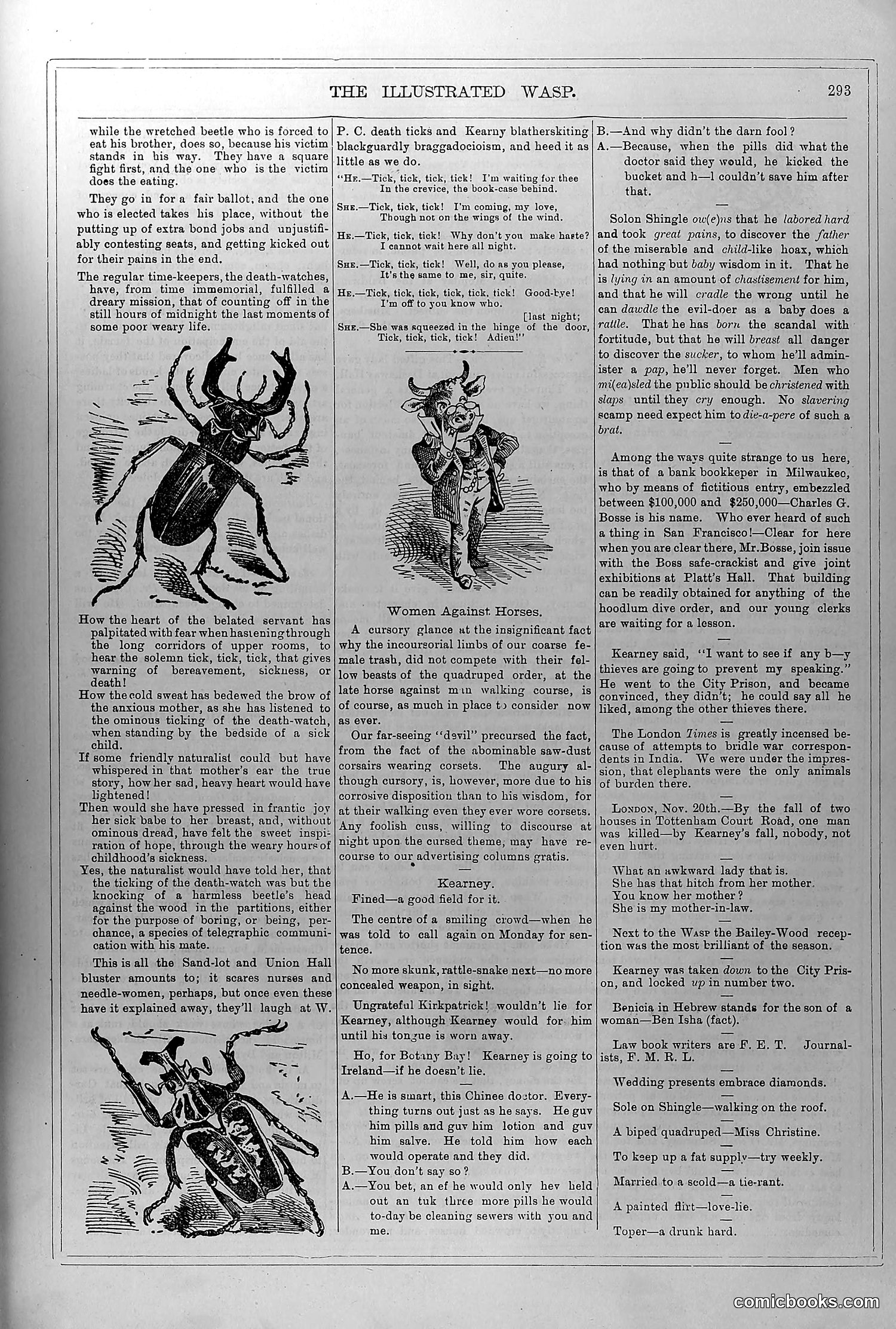
This page contains a satirical dialogue between two insects (a beetle and wasp) discussing a court case involving a man named Kearney. The dialogue mocks Kearney's legal troubles—he's been sentenced and must return to City Prison on Monday. The cartoon ridicules Kearney through the insects' commentary, particularly his claim of being a "Chinee doctor" who dispensed fake pills and lotion. The satire suggests Kearney was a fraud exploiting gullible patients. The page also includes brief satirical notices at bottom (marriage and occupation jokes) typical of period magazines. Without identifying specific historical context, the content appears to mock both a particular criminal defendant and broader themes of medical fraud and courtroom proceedings in late 19th-century America.
This page consists primarily of **dramatic criticism and theater reviews** rather than political cartoons. The masthead illustration shows a decorative theatrical emblem. The reviews critique several San Francisco theatrical performances, including: - *The Turkish March* (a musical piece) - *Miss Ellen Coursen* (a concert performance at Dashaway Hall) - Various opera and play productions The critic takes a satirical tone regarding amateur theatrical productions and costume choices, mocking performers who lack professional skill. There's commentary on San Francisco's theater scene and audience tastes. A small section titled "**Chronicle Cries**" discusses reprinting old newspaper pieces, with particular praise for *Gardiner's Hours of Nature*. The page functions as **entertainment journalism and social commentary** rather than political satire, reflecting late 19th-century San Francisco cultural life.
This page is a **playscript**, not a political cartoon. It's Act II of a three-act play written by Salmi Morse, performed expressly for *The Wasp* magazine. The drama concerns Michel, a wealthy innkeeper, his family, and various characters including servants and a notary. The dialogue involves marriage articles, inheritance disputes, and family conflicts—typical Victorian-era theatrical fare. While the play's title emphasizes the protagonist's Polish-Jewish identity, the visible dialogue focuses on mundane domestic matters: property disputes, parental concerns about children's marriages, and legal documents requiring a notary's signature. Without additional context about Morse's intent or contemporary Jewish stereotypes in 1870s satire, the satirical angle remains unclear from this page alone.
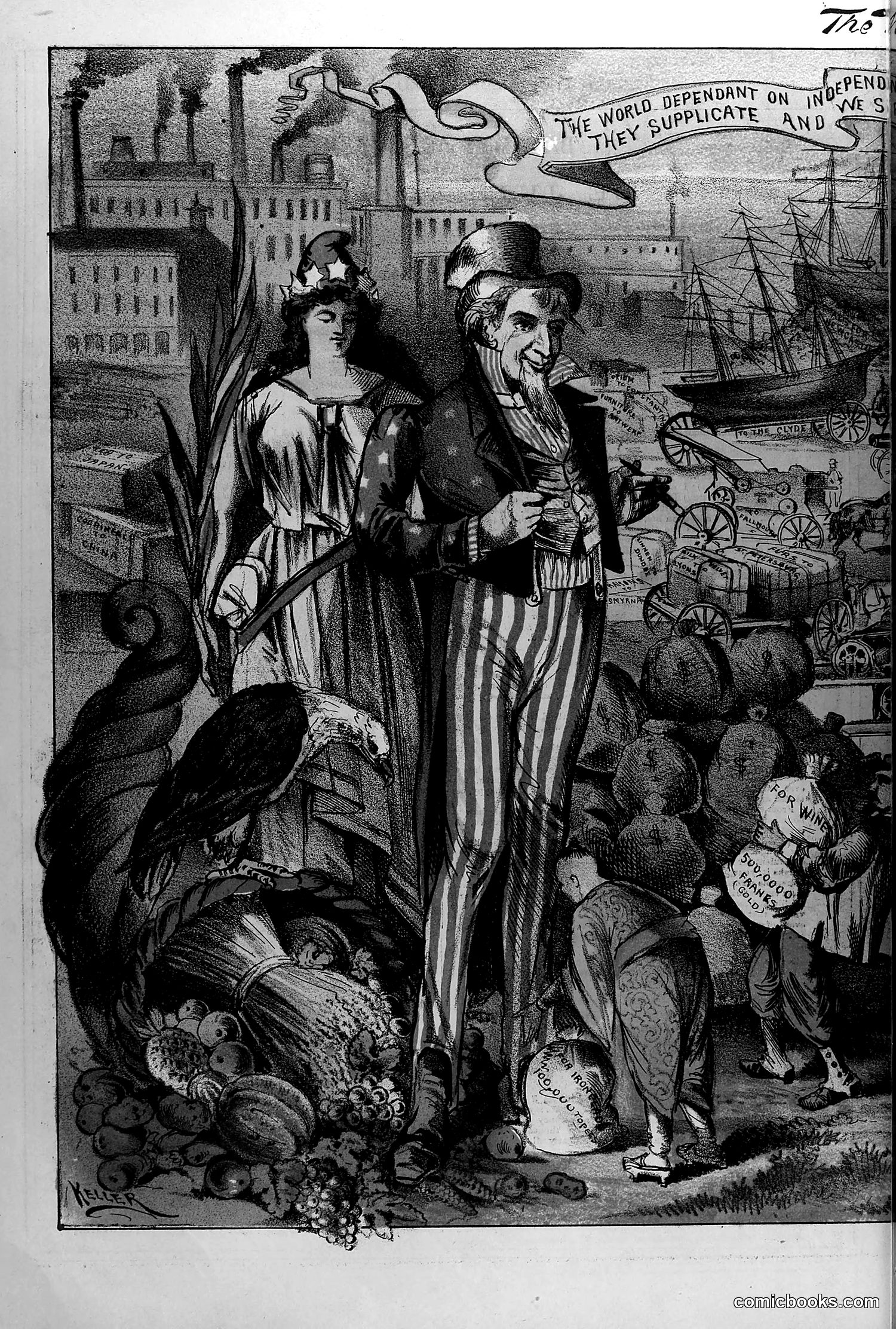
This political cartoon depicts two figures—a woman (representing America or Liberty, based on her classical dress and crown) and a caricatured man in striped pants (appearing to represent a foreign trader or merchant)—surrounded by goods, animals, and industrial imagery. The banner reads: "THE WORLD DEPENDANT ON THEY SUPPLICATE AND—" (text appears cut off). The satire critiques America's economic dependence on foreign trade and supplies. The surrounding imagery—ships, factories, agricultural products (corn, grapes), and manufactured goods—suggests the cartoon argues that other nations rely on American commerce while America must "supplicate" (beg) for their favor. The caricatured merchant's exaggerated features may reference ethnic or national stereotypes common to 1800s satirical press. The cartoon's precise date and specific political context remain unclear without additional source information.
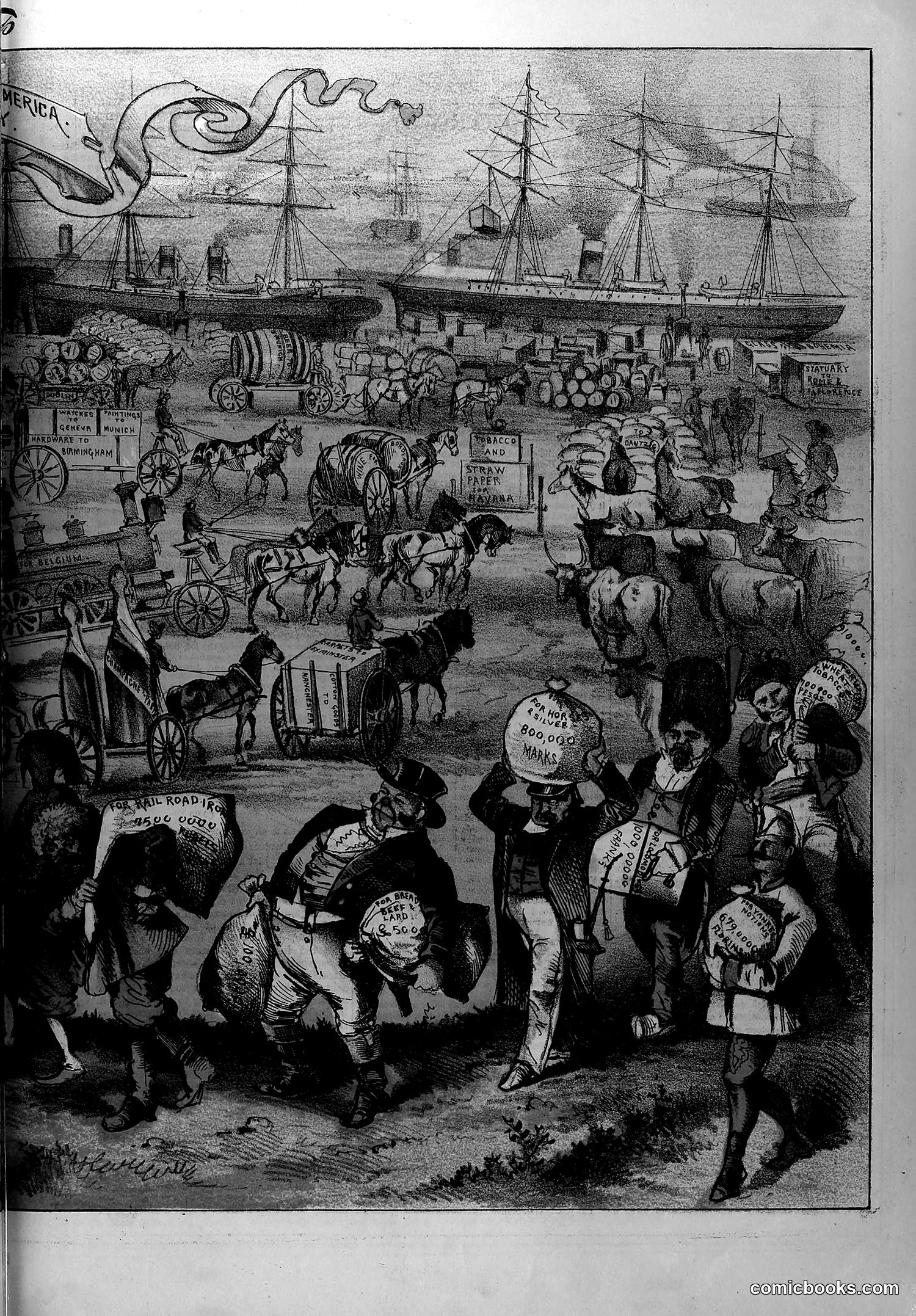
This appears to be a late 19th-century satirical engraving depicting a busy port or shipping scene. The cartoon shows multiple figures wearing hats labeled with large monetary amounts (visible denominations include "$500,000" and "$860,000"), suggesting they represent wealthy investors or corporate interests. The foreground depicts these labeled figures amid cargo, wagons, and horses, while steamships and sailing vessels crowd the harbor background. Visible text references "RAIL ROAD" and other commercial enterprises. The satire likely critiques **monopolistic capitalism and wealth concentration**—the grotesquely oversized labels emphasize how massive fortunes dominate commerce and infrastructure. The crowded, chaotic scene suggests corporate interests controlling transportation and trade networks. The specific historical context and identities of depicted figures remain unclear without additional documentation.
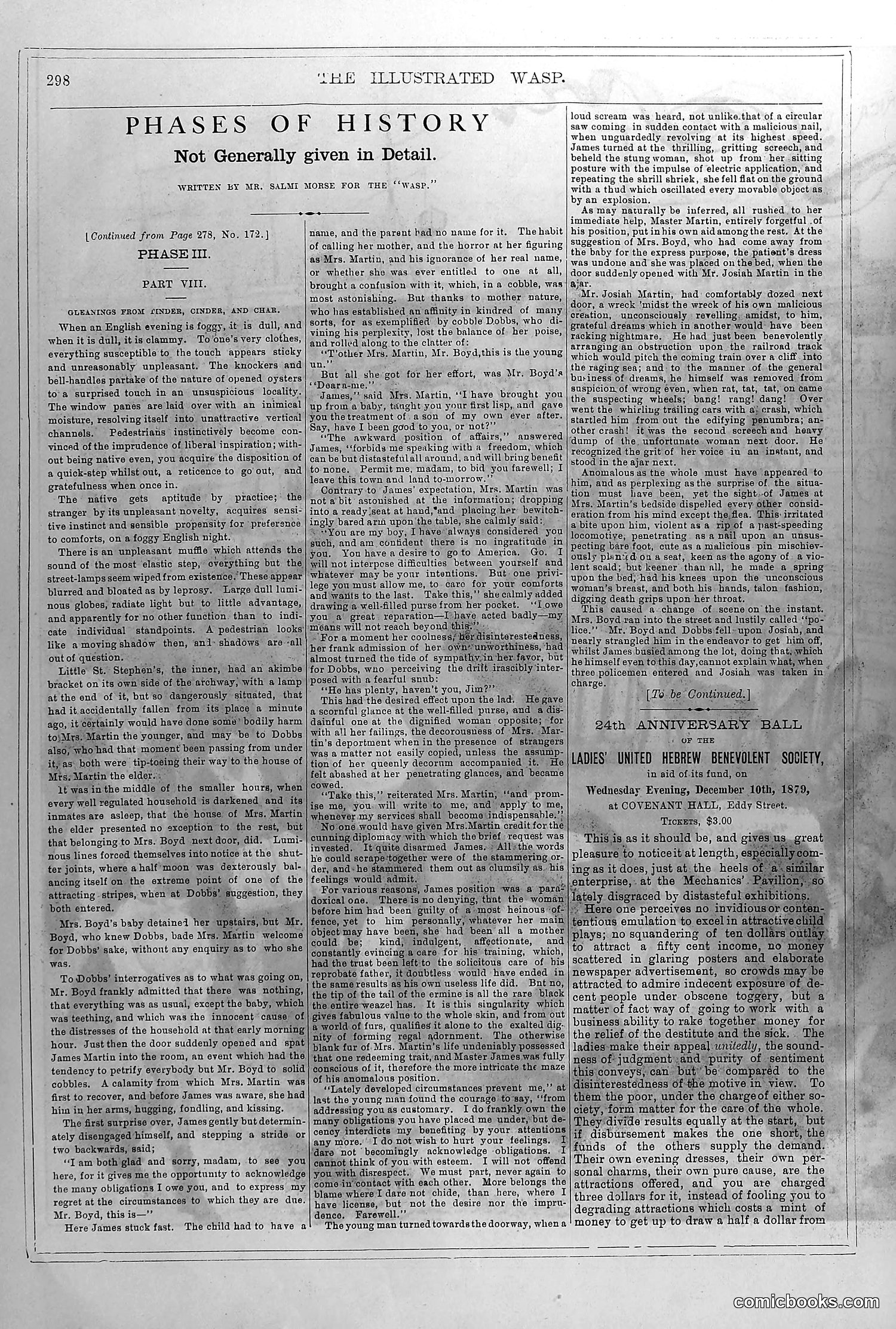
This page is primarily **text-based serialized fiction** rather than political satire. It continues "Phases of History" (Part VIII: "Guardians from Zinder, Cinder, and Char"), a narrative story about characters named James, Mrs. Martin, and Mr. Boyd set in an English seaside town. The page also contains an **advertisement** for the "24th Anniversary Ball of the Ladies United Hebrew Benevolent Society," scheduled for December 10th, 1879, at Turnverein Hall in San Francisco. The serialized story focuses on domestic drama and character relationships rather than political commentary. **No political cartoons or satirical illustrations are visible** on this page—it represents The Wasp's content mix of serialized fiction and local event advertising typical of 19th-century American magazines.
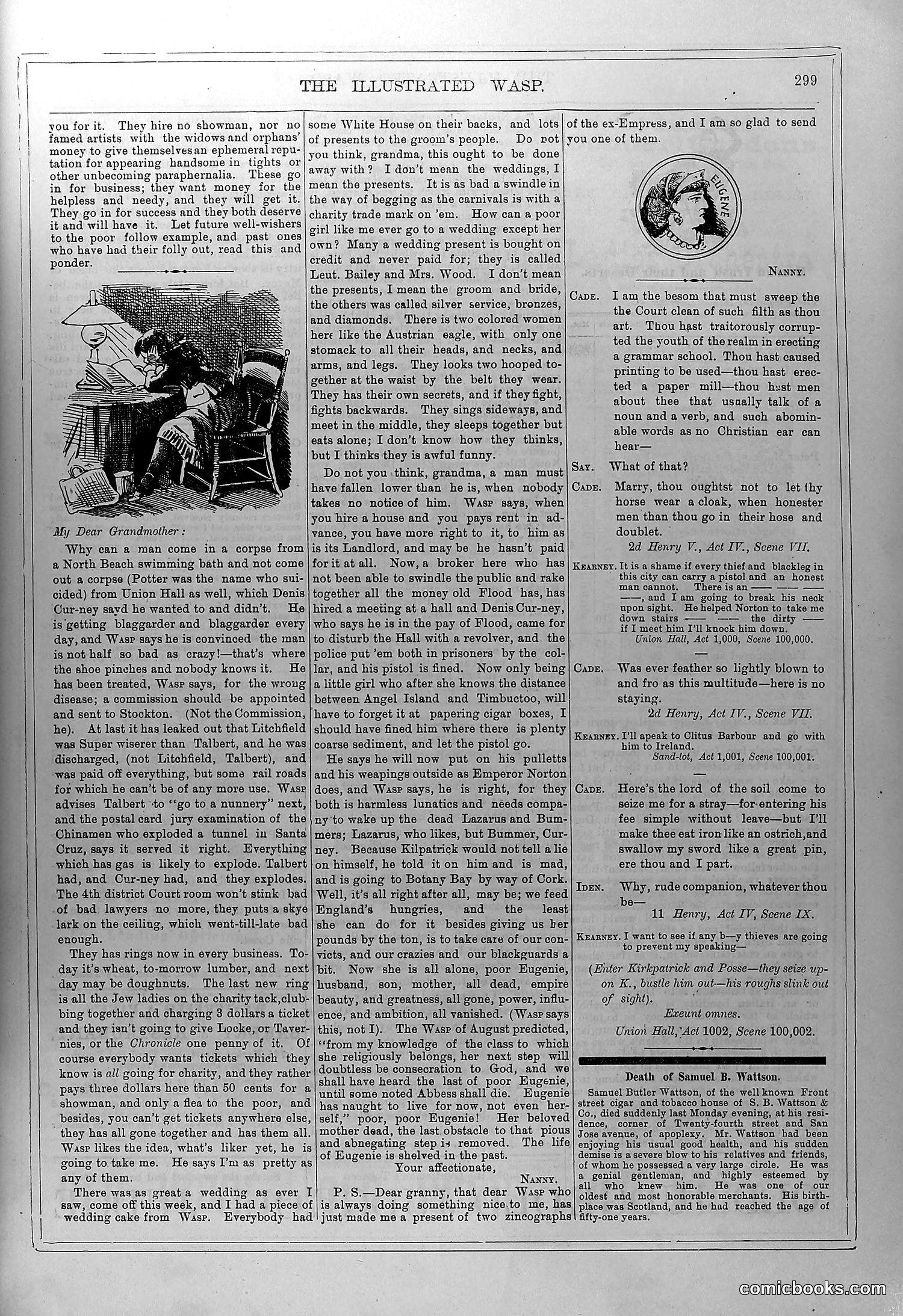
This page combines satirical advice columns with a political cartoon. The main illustration (upper left) shows two figures in what appears to be a domestic dispute or confrontation scene. The text discusses various social issues including: - Wedding gift etiquette and fraud - A scandal involving money and the "Flood" case (likely a specific legal matter) - References to "Wass" and corrupt officials, suggesting commentary on political corruption - Discussion of poor conditions and charity The "Dear Grandmother" advice column format allows the magazine to critique social hypocrisy—particularly around wealth, charity, and class pretense. References to "Express," "Union Hall," and specific legal cases suggest this addresses San Francisco local politics and scandals of its era. The overall tone mocks the wealthy and powerful while defending the poor and vulnerable against exploitation.
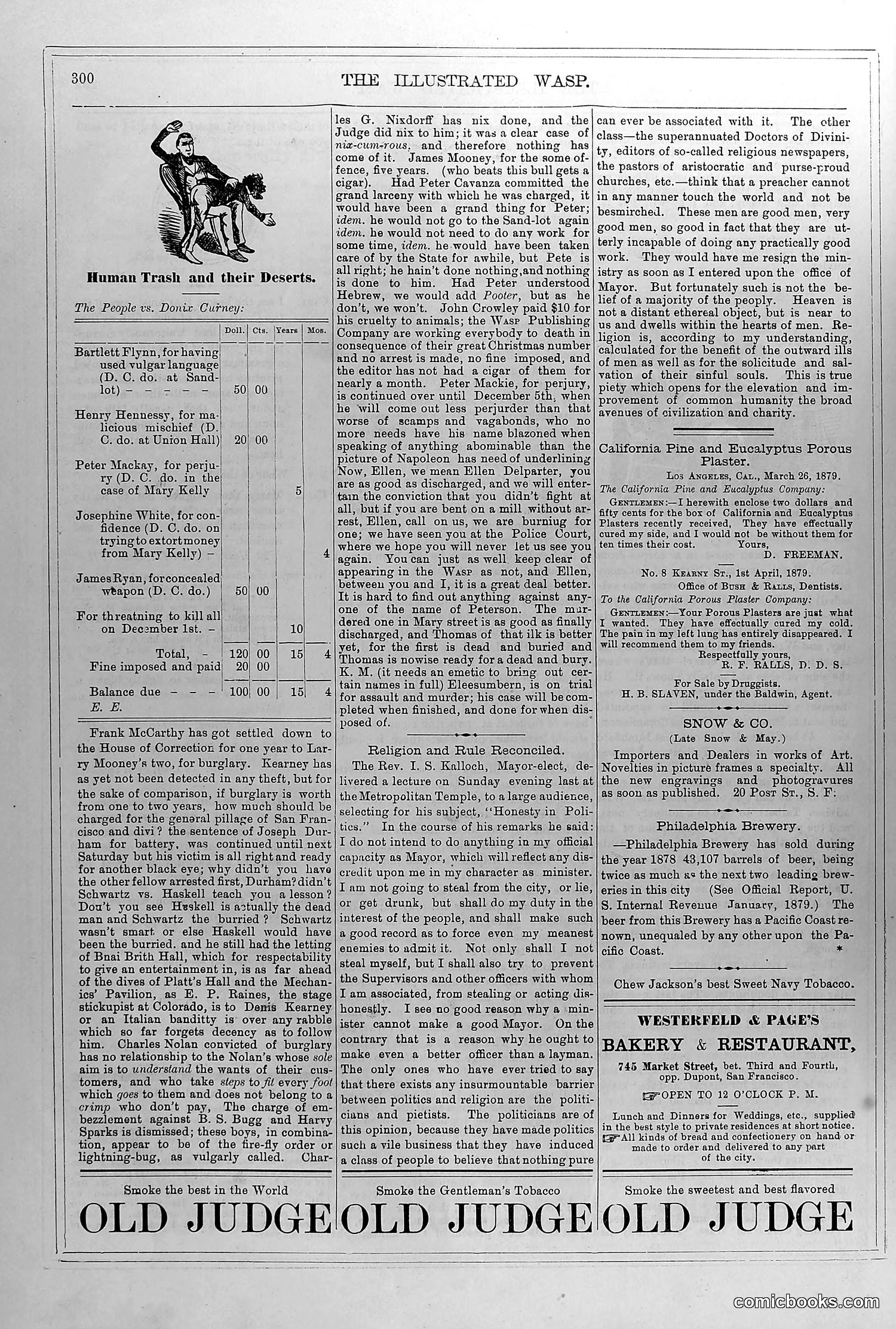
This page is primarily **text and advertisements** rather than political cartoons. The main content appears to be a court records section titled "Human Trash and their Deserts," listing criminal cases and sentences—including assault, perjury, and theft charges with corresponding jail time and fines. The visible cartoon shows a figure labeled as relating to the cases discussed. The page includes commentary criticizing local officials and addressing issues of corruption and justice. Below the text are advertisements for tobacco products ("Old Judge") and other commercial goods, which was typical for satirical magazines of this era. The overall intent appears to be exposing local San Francisco criminality and judicial proceedings for public ridicule.
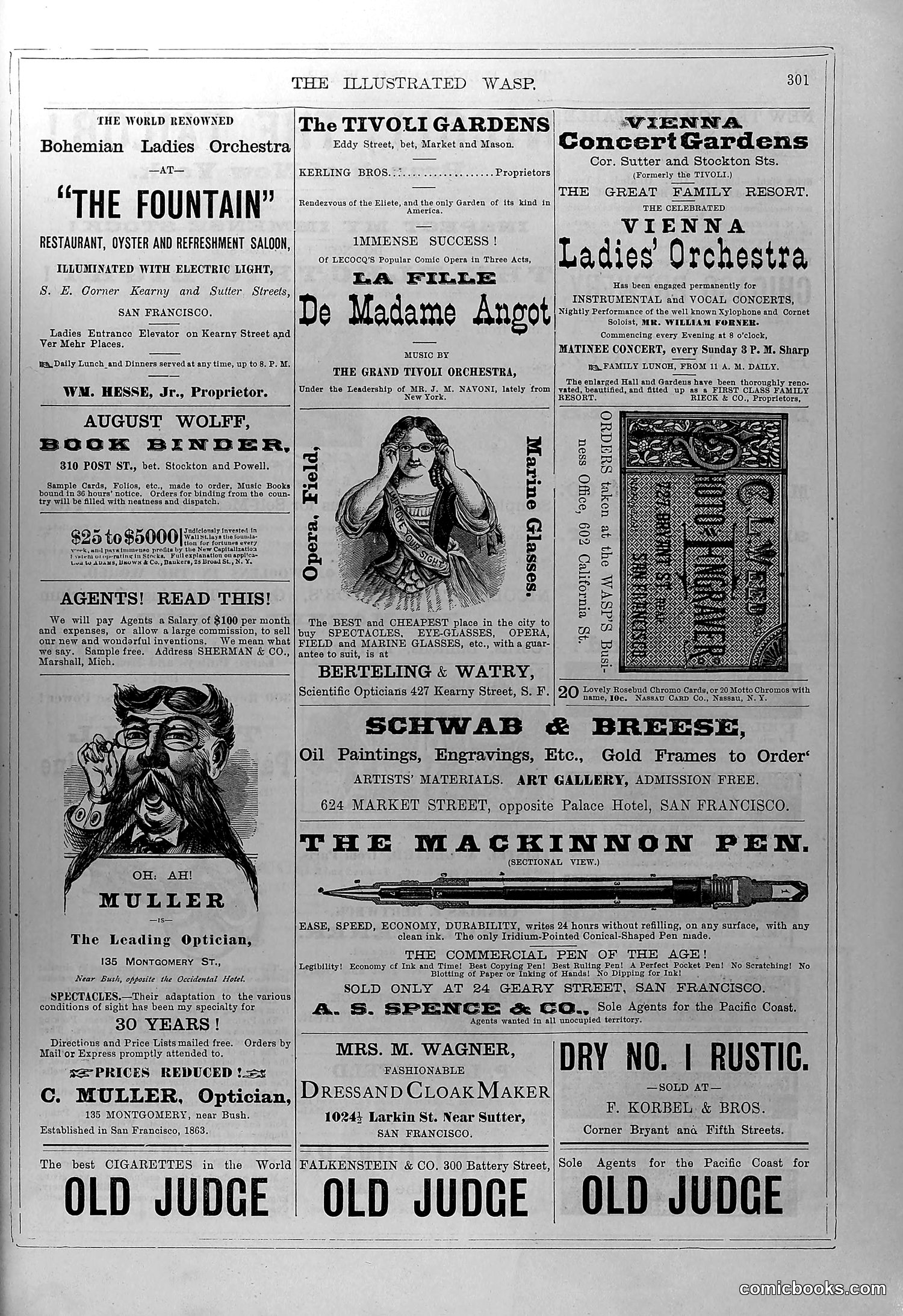
This page is primarily **advertising content** rather than satirical cartoons. The advertisements showcase San Francisco businesses from what appears to be the late 19th century, including restaurants, orchestras, optical shops, and art suppliers. Notable visual elements include caricatures in advertisements: a mustachioed face labeled "OH! AH!" promoting Muller's optician services, and an illustrated operatic figure advertising "Madame Glasser" for the Tivoli Gardens' production of *La Fille de Madame Angot*. The repeated "OLD JUDGE" cigarette advertisement at the bottom suggests this brand was a major publication sponsor. Without satirical cartoon content, this page primarily reflects period commercial culture and San Francisco's entertainment venues, rather than offering political or social commentary.
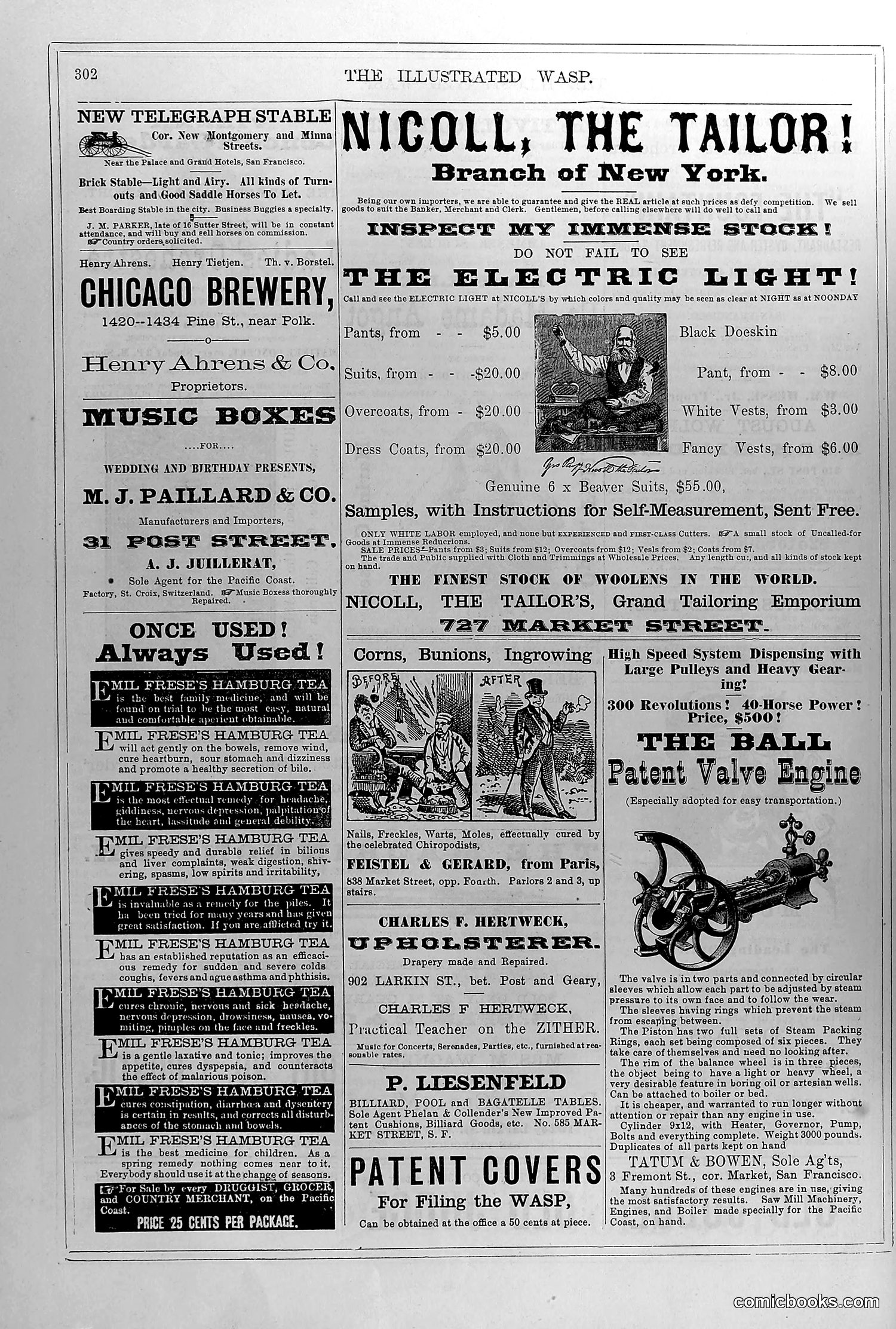
This page is primarily **advertising and business listings** rather than political satire or editorial cartoons. The dominant content includes: - Multiple ads for local San Francisco businesses (tailors, breweries, music boxes, tea products) - A prominent advertisement for "Nicoll, the Tailor" featuring a bearded man's portrait and clothing prices - Various commercial notices for services (upholstering, billiard tables, patent covers) - Small illustrations accompanying product ads (a chiropodist treatment diagram, engine equipment) The page contains **no identifiable political cartoons or satirical commentary**. The illustrations present are product-related rather than editorial. This appears to be a typical late 19th-century magazine page mixing editorial space with revenue-generating advertisements, which was standard practice for publications like *The Wasp*.
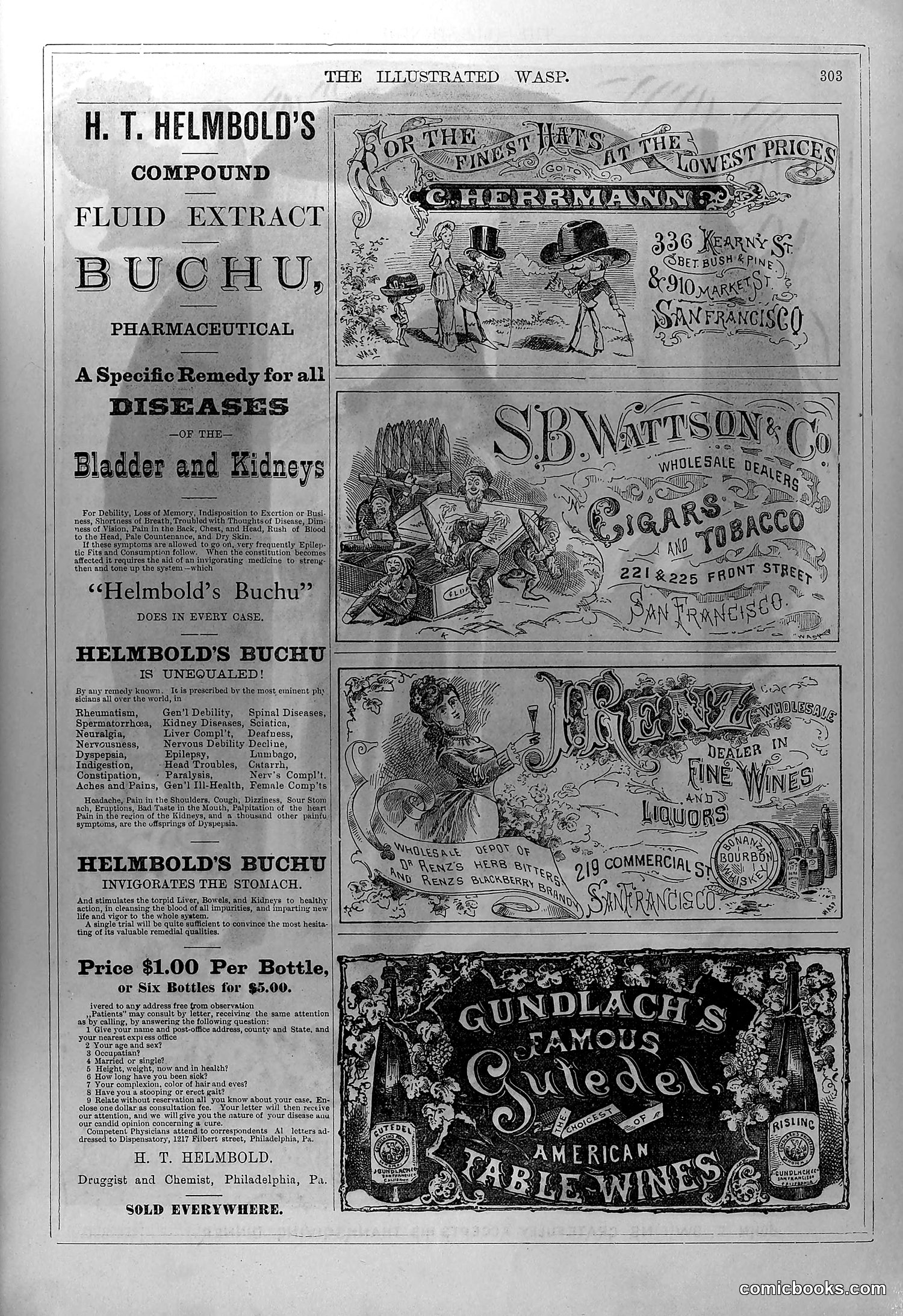
This page is **primarily advertising**, not political satire. It contains four commercial advertisements from San Francisco businesses circa late 1800s: 1. **H.T. Helmbold's Compound Fluid Extract Buchu** — a patent medicine claiming to cure bladder and kidney diseases (and numerous other ailments listed) 2. **C. Herrmann** — a hat shop 3. **S.B. Wattson & Co.** — cigars and tobacco wholesaler 4. **Gundlach's Famous Sauterne** — American table wines The decorative illustrations are period advertisements featuring Victorian-era figures and ornamental designs typical of the era. There is **no evident political cartoon or social satire** on this page—it represents the revenue-generating advertising that filled pages of satirical magazines like *The Wasp*.
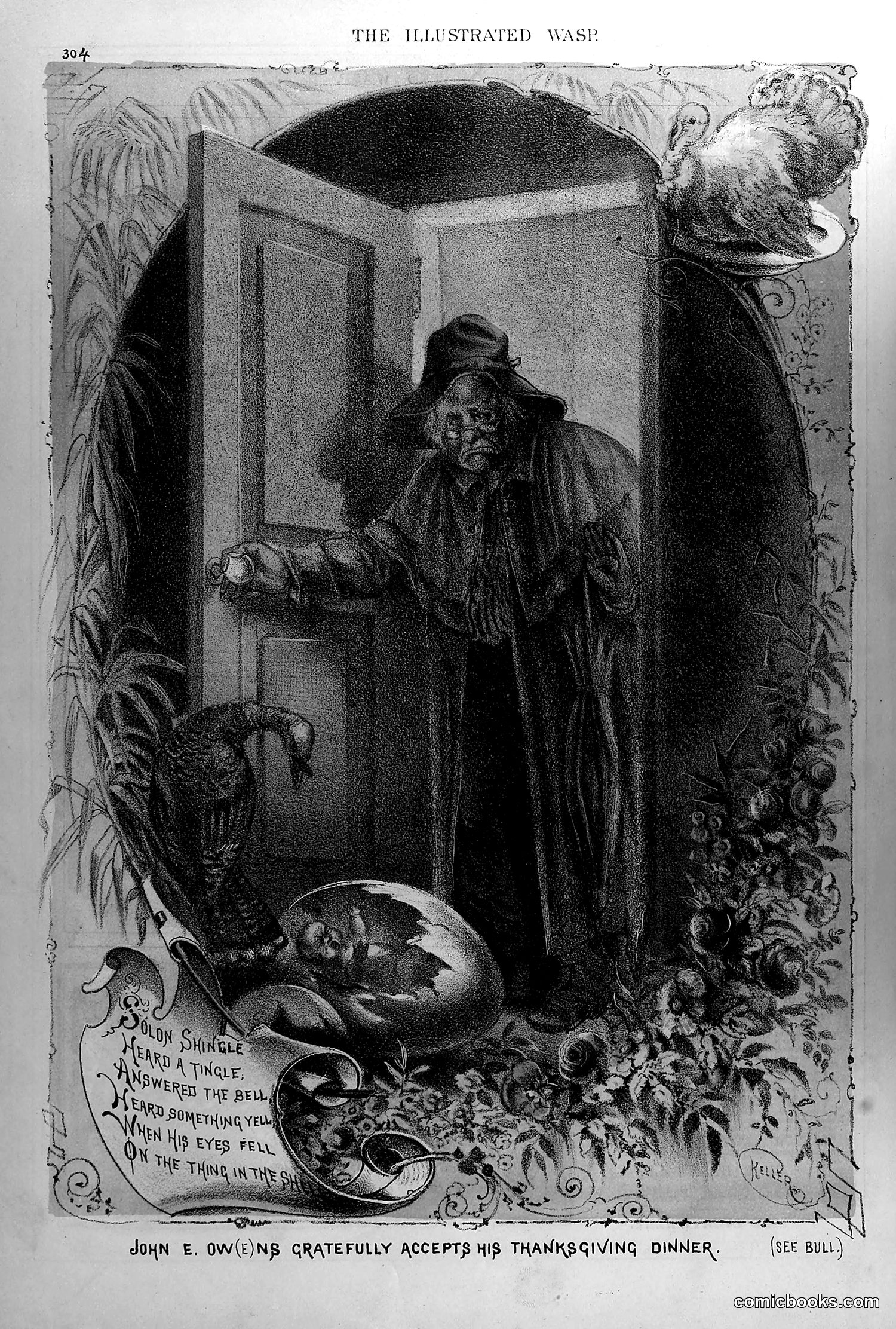
This cartoon appears to satirize **John E. Owens** (the name is spelled "OW(E)NS" in the caption), likely a political figure or public personality of the era. The image depicts a gaunt, menacing figure in a dimly-lit space receiving what appears to be a meager meal—suggesting he's receiving inadequate or insufficient compensation or treatment. The surrounding decorative elements (vegetables, fruits, bells) contrast sharply with the dark, austere interior, amplifying the satire. The accompanying verse fragment about "shingle" and "bell" remains unclear without fuller context, but the overall implication is mockery: Owens is portrayed as ungratefully or inappropriately accepting something insufficient, or conversely, the "dinner" itself is presented as inadequate recompense for services rendered. The reference to "(SEE BULL)" suggests a related cartoon or continued narrative elsewhere in the publication.
I can see this is a test page or calibration sheet rather than actual satirical content from The Wasp magazine. The image shows a black rectangle containing a grayscale color checker chart (the grid of gray and white squares) positioned next to measurement rulers—both a vertical ruler marked 6-11 and horizontal rulers at the bottom marked 6-10. This appears to be documentation photography, likely used for archival purposes or quality control when scanning historical materials. There is no cartoon, political satire, or readable editorial content visible on this page.