
A complete issue · 18 pages · 1879
The Wasp — November 22, 1879

I can see this is a scale/measurement reference page from The Wasp magazine, showing Oregon Rule Co. rulers (both vertical and horizontal) against a black background with a checkerboard pattern of grayscale squares to the right. However, this appears to be a **technical reference page rather than a cartoon or satirical content**. The rulers and grayscale checker pattern suggest this served a practical purpose—likely for photographic reproduction, calibration, or layout reference in the magazine's printing process. Without satirical imagery, caricatures, or accompanying text visible in the actual cartoon area, I cannot identify political figures or explain satirical intent. This seems to be production/technical documentation rather than editorial content meant for readers.
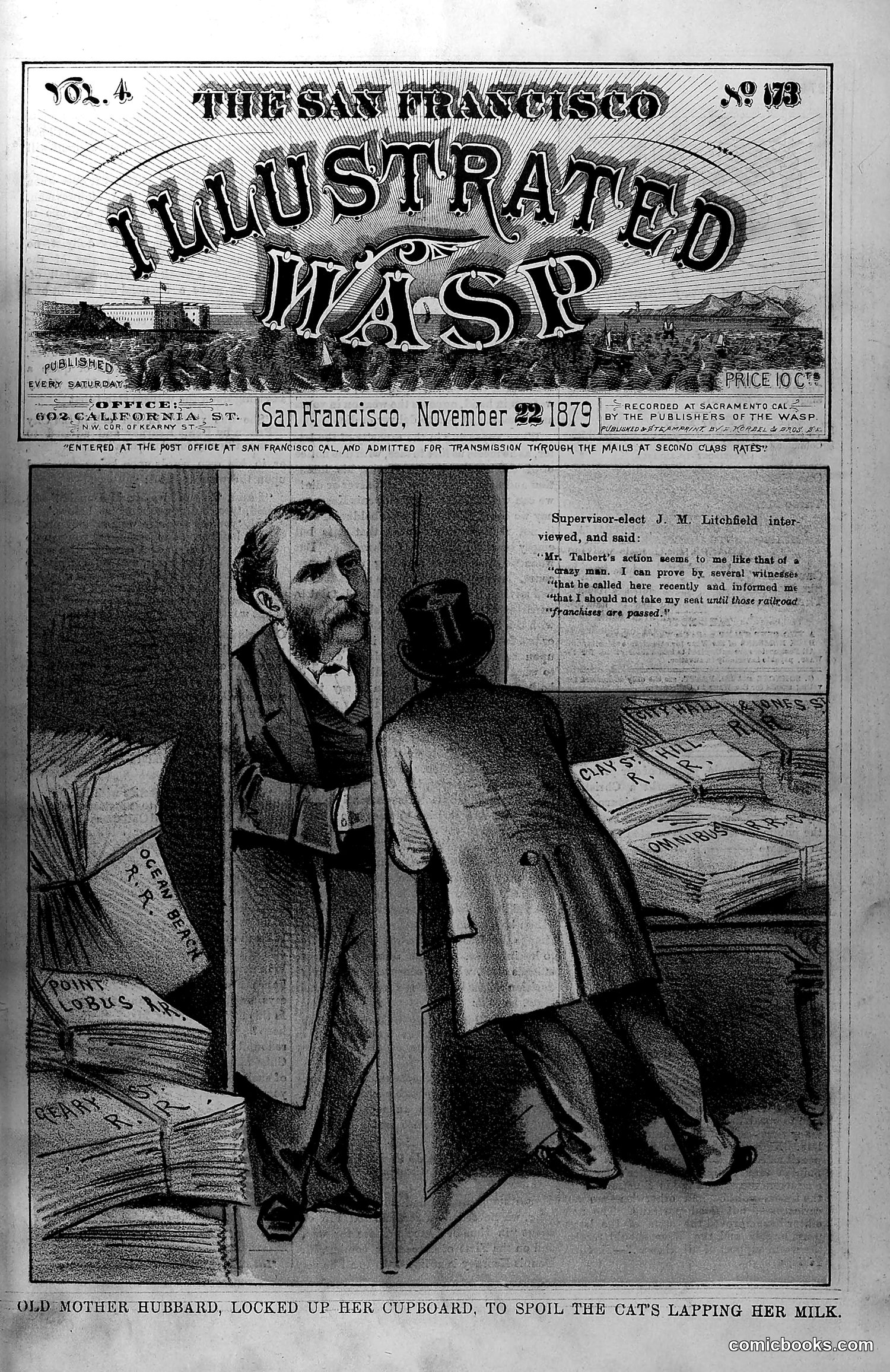
This page depicts "Old Mother Hubbard, Locked Up Her Cupboard, To Spoil the Cat's Lapping Her Milk" — a satirical adaptation of the nursery rhyme. The cartoon shows Supervisor-elect J.M. Litchfield being interviewed. According to the accompanying quote, when asked about his qualifications, Litchfield compares himself to "a grocery man" rather than a "lawyer man," and states he cannot prove his competence by witnesses, only claiming he's "ordinarily sensible." The satire likely criticizes Litchfield's fitness for office, suggesting his self-assessment as merely "ordinary" is unsuitable for a position requiring expertise. The nursery rhyme framing implies he's inadequate — "spoiling" public resources like the cupboard spoils the cat's milk. The stacks of documents on the desk emphasize the bureaucratic duties he may be unqualified to handle.
This editorial cartoon uses the classical allusion of Damocles' sword—a blade hanging by a thread, symbolizing imminent danger—to warn against deception and dishonest practices. The text criticizes "artisans or practice which misleads another" as a "considerable crime," distinguishing between bold operators and "rascally tricksters." The piece appears to address Denis Kearney and labor disputes in California, referencing a woman witness's testimony about false promises regarding relocation to Australia. The satire targets unprincipled swindlers and con artists who prey on vulnerable citizens, arguing such villainy operates without peer in its brazen dishonesty. The Damocles metaphor suggests such fraudsters face eventual justice or ruin.
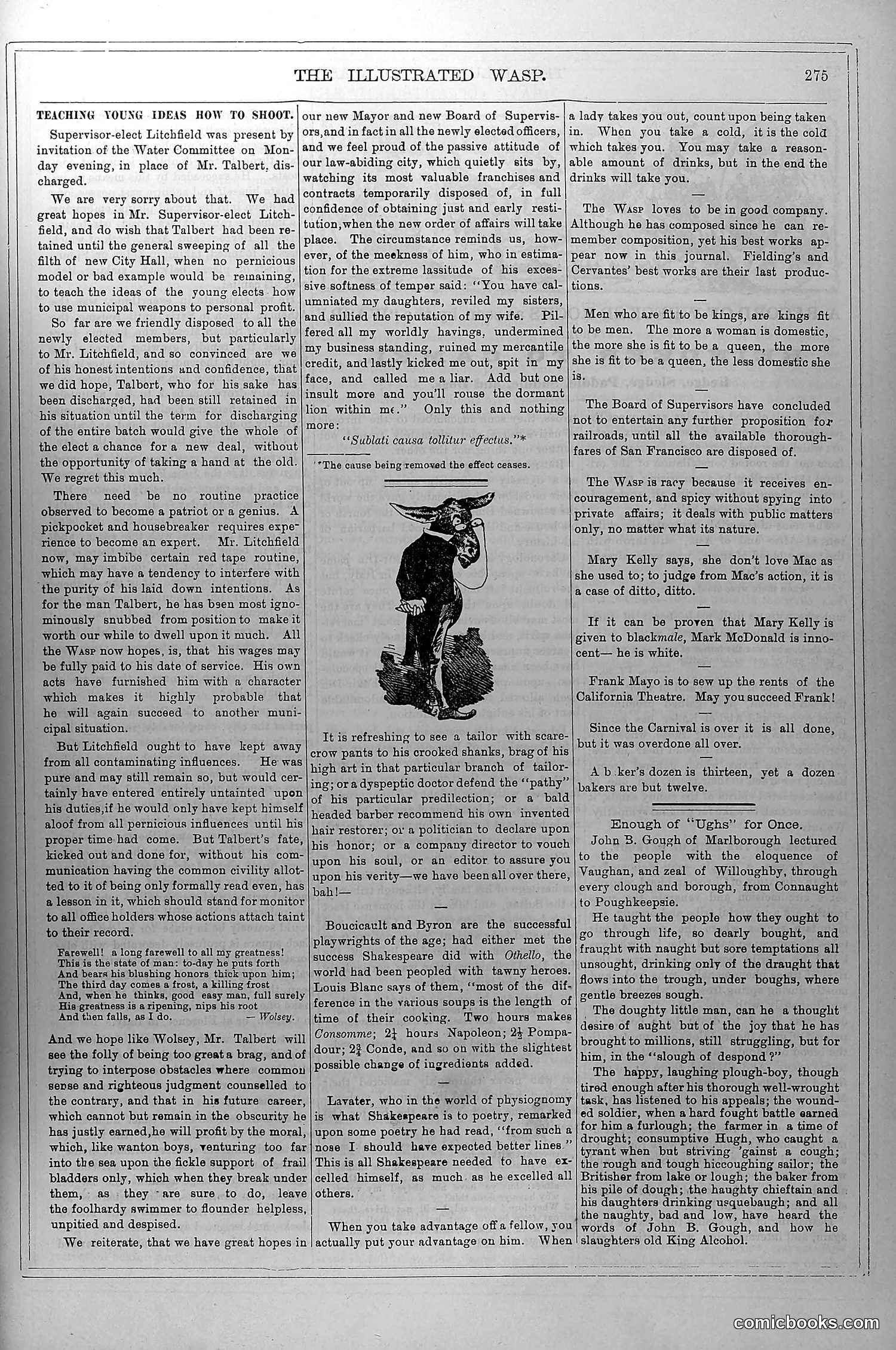
This page primarily contains editorial commentary rather than illustrated cartoons. The single cartoon depicts **a rotund figure (likely representing a politician or public figure) carrying a large sack or burden**, though the specific identity isn't entirely clear from the image alone. The text addresses local San Francisco matters: criticism of Supervisor Talbert's removal, praise for new city leadership, commentary on Mary Kelly and Mark McDonald, and discussion of Frank Mayo and the California Theatre. There's also commentary on various social figures and their reputations. The overall tone is satirical commentary on San Francisco civic affairs, local personalities, and social behavior rather than national politics. Without clearer identification of the cartoon figure, the specific satirical target remains somewhat unclear.
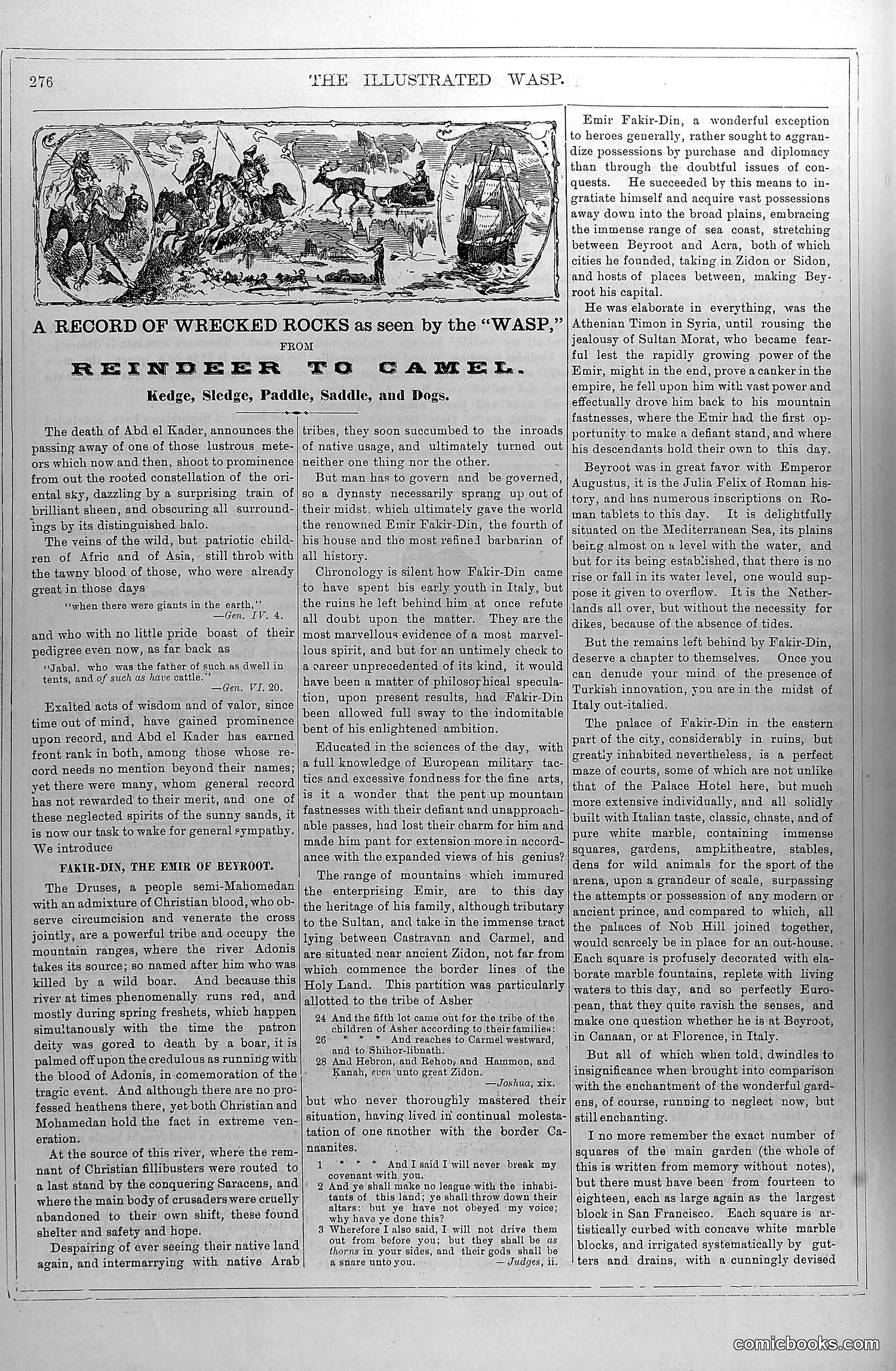
This page is primarily **editorial content rather than political satire**. It features a detailed biographical article about **Fakir-Din, the Emir of Beyrout** (Beirut), a 19th-century Syrian leader who expanded his territory through military strategy and diplomacy rather than conquest through "doubtful issues of conquests." The ornamental header shows "A Record of Wrecked Rocks as seen by the 'WASP'" with maritime scenes, illustrating Fakir-Din's establishment of ports and naval power along the Mediterranean coast between Beirut and Acre. Rather than satirizing Fakir-Din directly, *The Wasp* presents him admiringly as a statesman who "succeeded by this means to ingratiate himself and acquire vast possessions." The article emphasizes his palace architecture, military knowledge, and administrative sophistication—treating him as a subject of geographical and historical interest for American readers.
This page is primarily **text-based rather than cartoon-based**. It contains two pieces: 1. **Continuation of a travel narrative** describing gardens, landscapes, and social observations—appears to be a humorous travelogue. 2. **"Three Twelve-Year-Olds of Forty Years Ago" (Part Four)** — a satirical letter series mocking someone named Heidelberg, criticizing his pretentious behavior and affected manner. The author uses exaggerated descriptions of Heidelberg's pomposity and social climbing to ridicule him as an insufferable character. The satire targets **personal vanity and social pretension** rather than specific political events. Without seeing related illustrations or previous installments, the exact identities and specific grievances remain unclear, but the mockery of affected superiority appears central to The Wasp's satirical approach.
This page contains primarily **literary content and social commentary** rather than political cartoons. The main elements include: **"His Name is Love"** — A poem by Sarah Morse celebrating romantic devotion and faithfulness, appearing to be sentimental Victorian verse. **Drama and Entertainment Reviews** — Critical commentary on theatrical performances, including references to plays like *California* and *Baldwin*, discussing their merits and contemporary actors. **Social Satire** — A brief section titled "The Frequency of Suicide" critiques New England's high suicide rates, attributing them to business troubles, educational pressures, and the grim climate. It contrasts this with California's more optimistic environment. **Miscellaneous Commentary** — Notes on topics like Boston school books and preserving tomatoes. The page reflects *The Wasp*'s mix of culture criticism, entertainment coverage, and social observation rather than direct political satire.
This page presents Act II of a three-act dramatic work titled "Baruch Kowski, or Le Juif Polonais" (The Polish Jew), adapted by Salmi Morse for *The Wasp* magazine. The play appears to be a satirical drama featuring characters including Michel (a wealthy inn-keeper), his wife Lena, and various servants and villagers. The dialogue focuses on themes of family obligation, wealth, and social standing. Without seeing accompanying illustrations, the specific satirical targets aren't entirely clear from text alone. However, the title's emphasis on a "Polish Jew" character suggests the piece may satirize contemporary ethnic stereotypes or social attitudes of the era. The plot involves moral dilemmas around money and familial duty. This appears to be serialized theatrical content rather than a traditional cartoon.
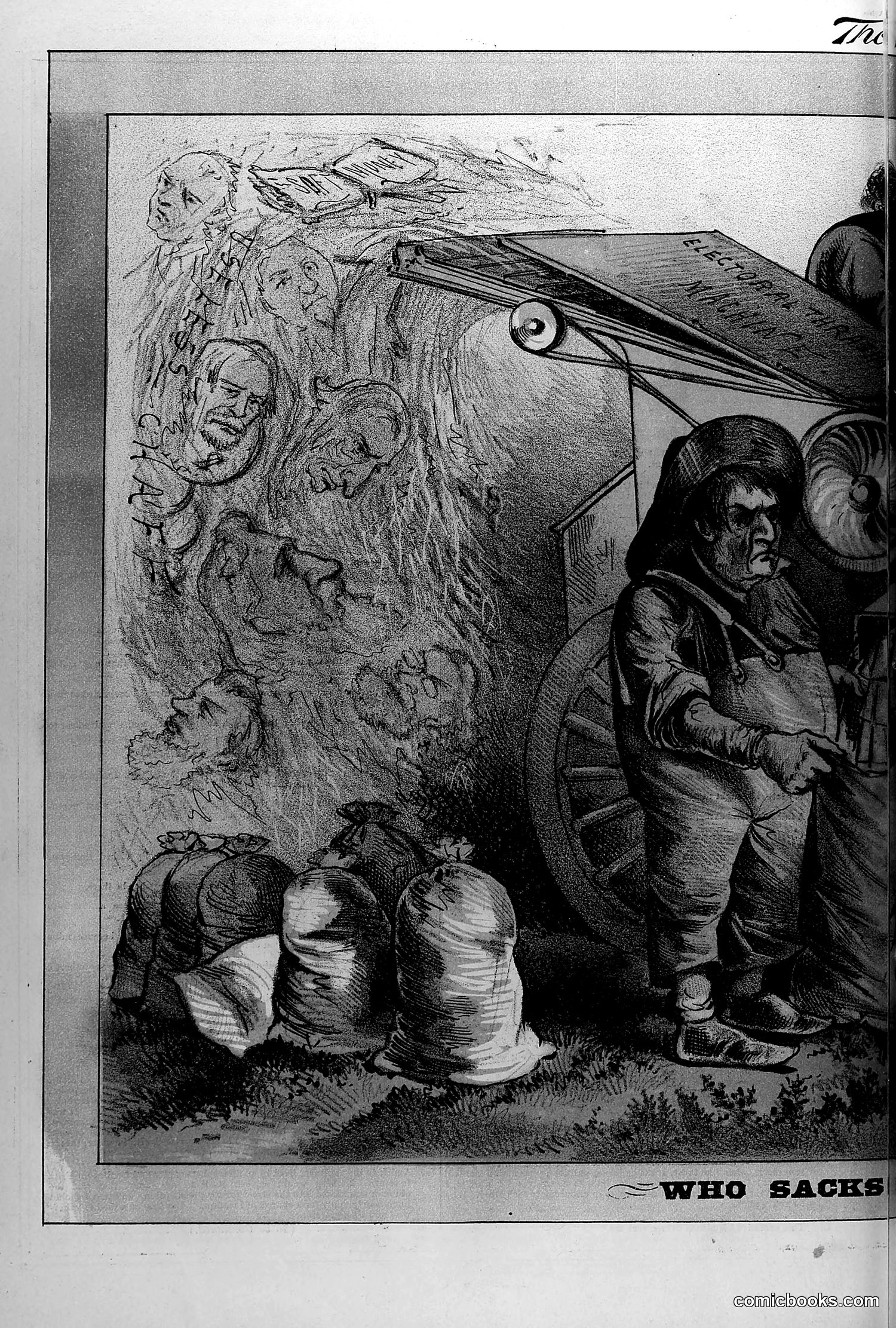
This satirical cartoon from *The Wasp* depicts what appears to be a firing or dismissal scenario. On the right stand two figures—one pointing accusingly at the other—suggesting a confrontation about employment termination. On the left is a large caricatured head (appearing grotesque or monstrous) mounted like a trophy or display, with several wrapped bundles or "sacks" stacked beneath it. The title "WHO SACKS" plays on the word "sack" (to fire someone). The cartoon likely critiques a specific dismissal or personnel matter involving a political or public figure, though without additional context, the exact identities and situation remain unclear. The grotesque head imagery suggests the cartoon is satirizing someone's character or reputation in relation to the firing depicted.
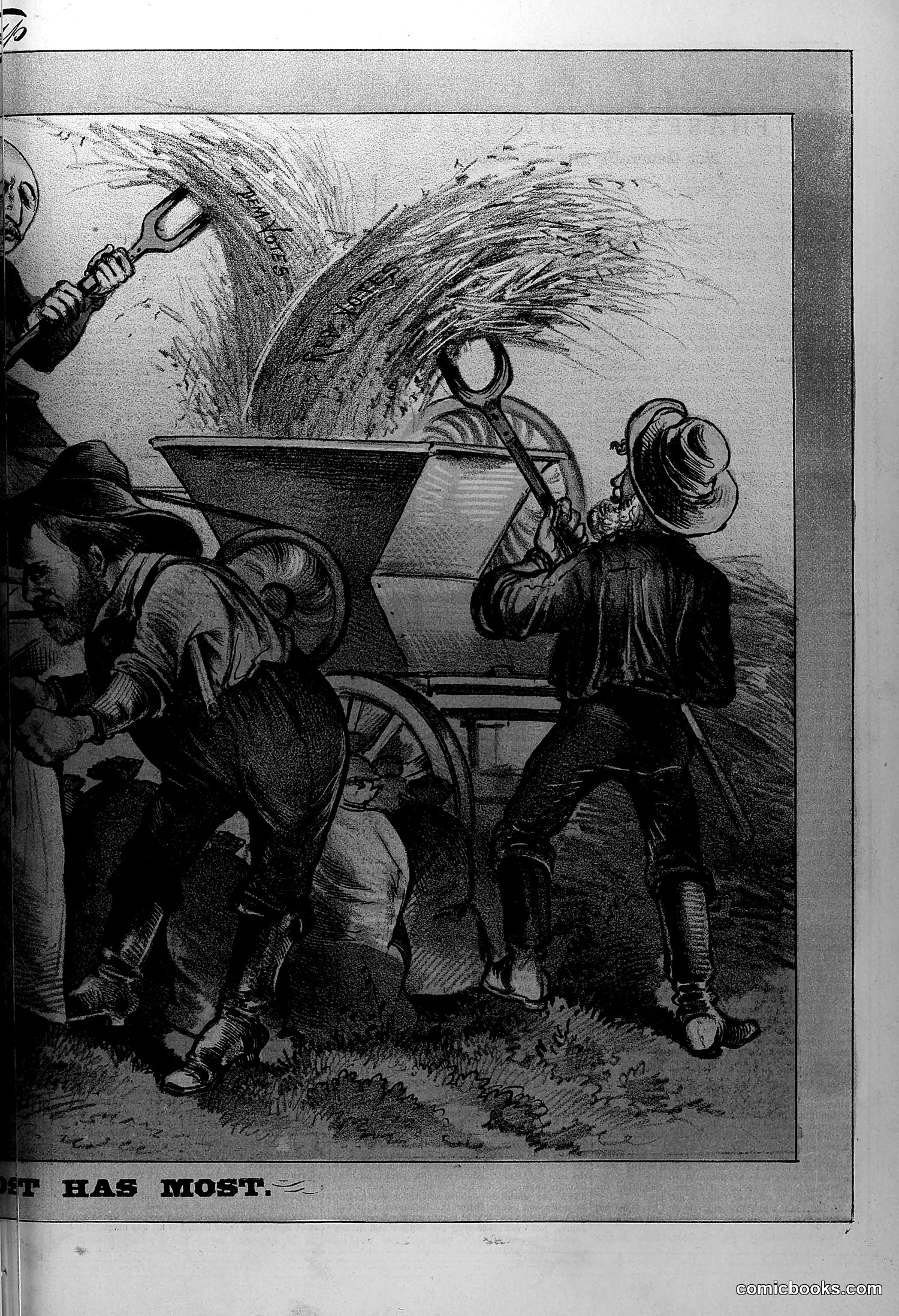
This appears to be a satirical cartoon from *The Wasp*, a 19th-century American satirical magazine. The image depicts laborers operating a large mining or agricultural cart/equipment with dramatic force—grain or ore sprays forcefully upward. The visible text fragment "HAS MOST" suggests this is part of a larger caption about wealth or resources. The cartoon likely satirizes labor exploitation or class inequality: workers are shown strenuously toiling while material wealth erupts from their labor. The dramatic spray of resources contrasts with the workers' strained effort, suggesting the disparity between the value created by labor and the compensation workers receive. Without the complete caption, the specific political target remains unclear, but the theme appears critical of labor conditions or capitalist wealth extraction.
This page contains primarily text rather than illustrations—it's the continuation of a serialized story titled "Phases of History: Not Generally Given in Detail," written by Mr. Salmi Morse. The narrative appears to be a dramatic domestic tale involving characters named James, Dobbs, and Mrs. Martin. The dialogue depicts conflict over a woman's autonomy and social standing, with themes of marital tension and class considerations typical of late 19th-century social satire. Without visible cartoons or caricatures on this particular page, the satirical content relies on the written narrative itself rather than visual commentary. The story likely uses fictional scenarios to critique contemporary social attitudes and relationships among the era's middle and working classes.
This page features a satirical essay titled "Human Trash and their Deserts," attributed to "Washington." The piece argues for **arbitrary power and absolute authority**, claiming it's justified when exercised with moral excellence and reason. The cartoon illustration (upper left) depicts a woman in an armchair—likely representing a boarding-house keeper or landlady, a common satirical target in The Wasp. The accompanying letter from "Nassy" complains about boarding-house life and fashion-conscious residents. The satire appears to critique both **excessive authoritarianism** and the petty tyrannies of boardinghouse culture. The juxtaposition suggests mockery of those who claim moral superiority while exercising minor domestic power over vulnerable residents—a recurring theme in Gilded Age American satire about class and domestic servitude.
This page is primarily **advertising and miscellaneous content** rather than political satire or cartoons. It contains: - A letter about a legal case involving a Police Judge and disputed judgment - An article titled "LOCOMOTIVES' SPEED" quoting engineer Charley Fraser discussing locomotive acceleration - Several business advertisements (California Pine and Eucalyptus Plaster Company, Philadelphia Brewery, Westerfeld & Page's Bakery & Restaurant, California Theatre) - Advertisement for "Cocoche and Cocolet" theatrical performance - Multiple "OLD JUDGE" tobacco advertisements at the bottom There are **no political cartoons or caricatures visible** on this page. The content is typical of 19th-century magazine filler—a mix of reader letters, technical articles, and paid advertising common in publications like *The Wasp*.
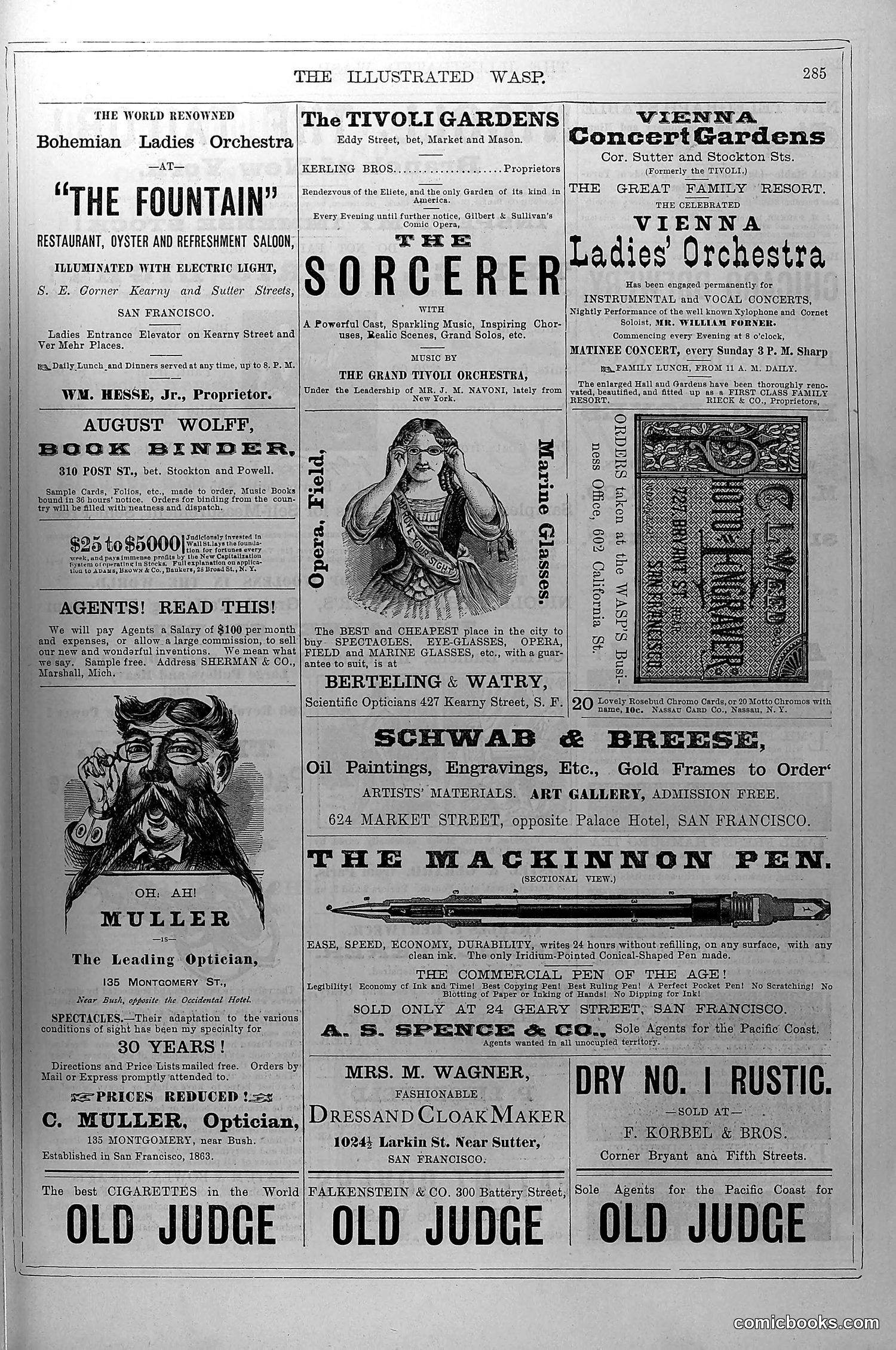
This page is primarily **advertising content** from a San Francisco publication, circa late 1800s. The central illustration shows a woman's face with ornate headwear, accompanying an advertisement for "Opera Bread" (a food product). The page contains multiple business advertisements for San Francisco establishments: restaurants, orchestras, opticians, art galleries, pen manufacturers, and cigarettes. The large caricatured face labeled "OH! AH! MULLER" at bottom-left advertises an optician's services, using exaggerated facial features typical of period advertising to draw attention. **This is not political satire.** Rather, it's a commercial page using contemporary advertising conventions—including caricature and illustration—to promote local businesses. The humor is mild and product-focused rather than politically pointed.
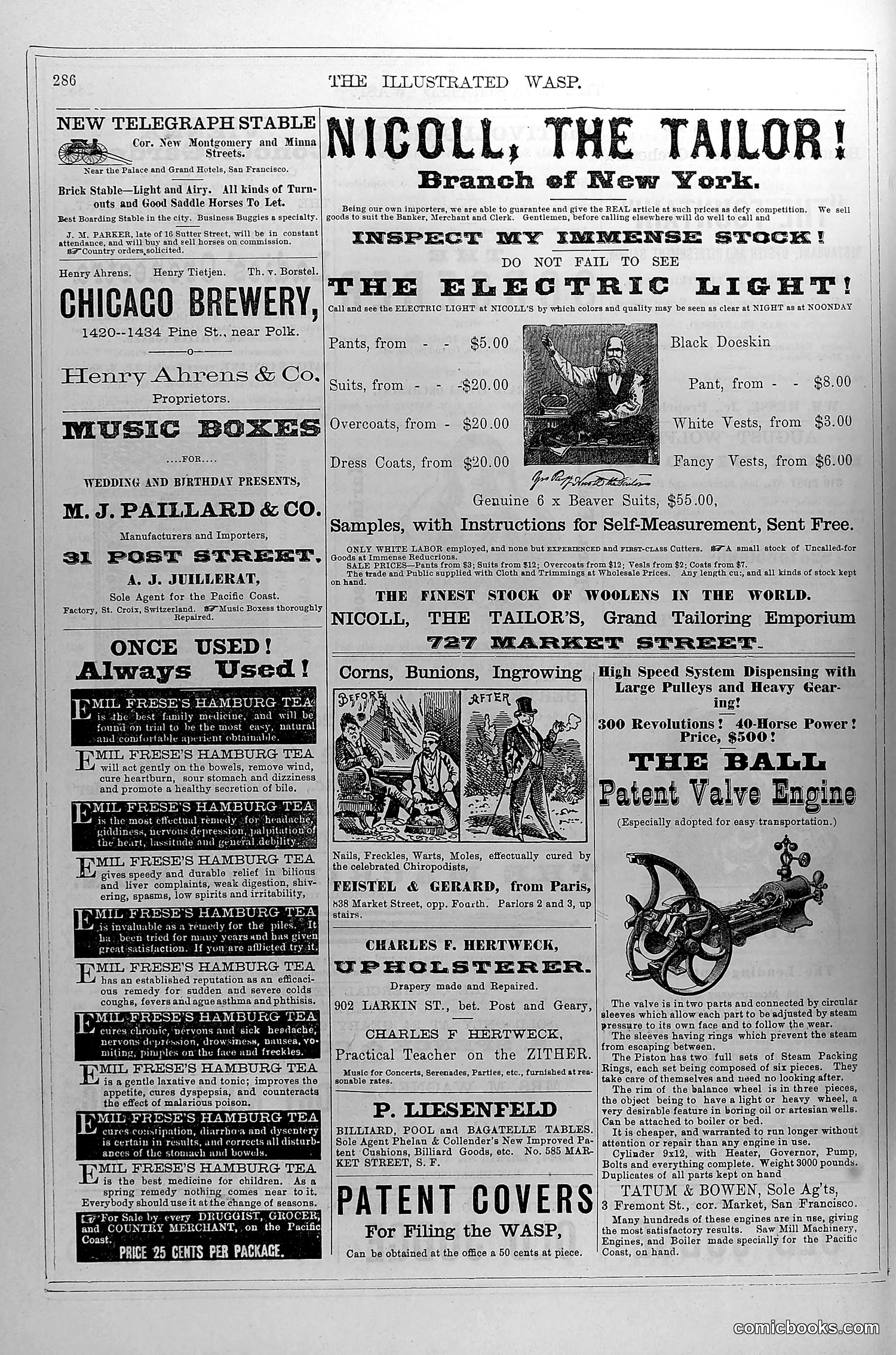
This page is primarily **advertising**, not satire or political commentary. It's page 286 from *The Illustrated Wasp*, a San Francisco publication. The main content promotes **Nicoll, the Tailor** at their New York branch (727 Market Street), advertising clothing like suits ($20), overcoats ($20), and pants ($5). The central image shows a man in formal dress demonstrating "The Electric Light" by Nicoll's—likely referring to electric lighting effects used to display merchandise quality. Secondary ads include Emil Frese's Hamburg Tea (a patent medicine), Chicago Brewery, music boxes, and various other goods typical of late 19th-century American commerce. The "Ball Patent Valve Engine" advertisement shows an early mechanical device, apparently marketed for transportation purposes. No political satire or cartoon caricatures are evident on this page—it's straightforward commercial advertising of the period.
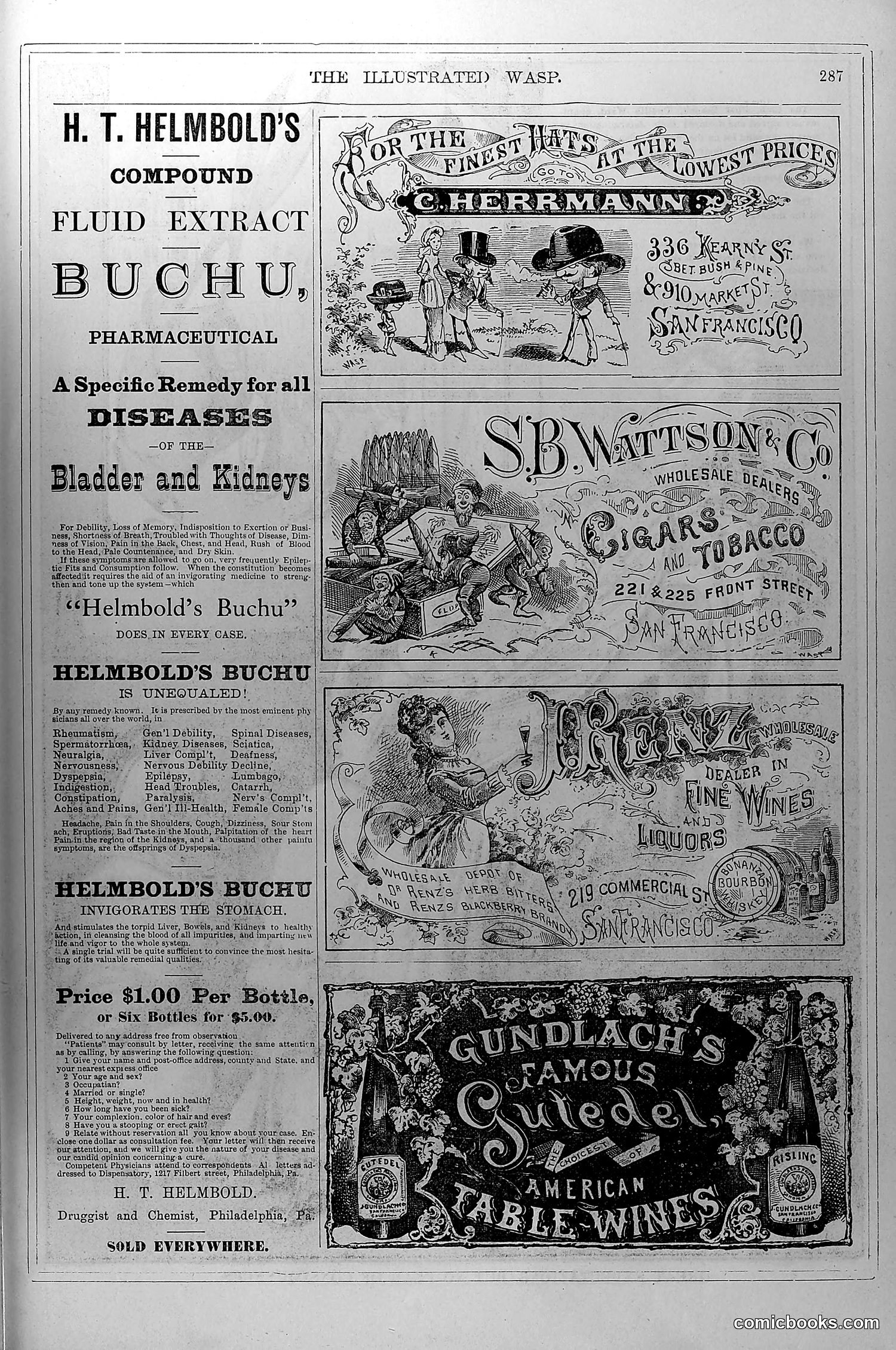
This page is primarily **advertisements**, not satirical content. The left side features H. T. Helmbold's Compound Fluid Extract "Buchu"—a patent medicine claiming to cure bladder and kidney diseases. The right side contains ads for San Francisco businesses: C. Herrmann (hats), S.B. Watson & Co. (cigars/tobacco), J. Grelot (wines/liquors), and Gundlach's table wines. The only visual humor appears in the decorative illustrations accompanying these ads—small comic vignettes showing stylized figures in exaggerated poses, typical of period advertising design rather than editorial satire. This represents the magazine's revenue model: satirical content subsidized by commercial advertisements, common in 19th-century American periodicals. The "Buchu" ad's grandiose health claims reflect widespread patent medicine hucksterism of the era, though *The Wasp* itself isn't explicitly mocking it here.
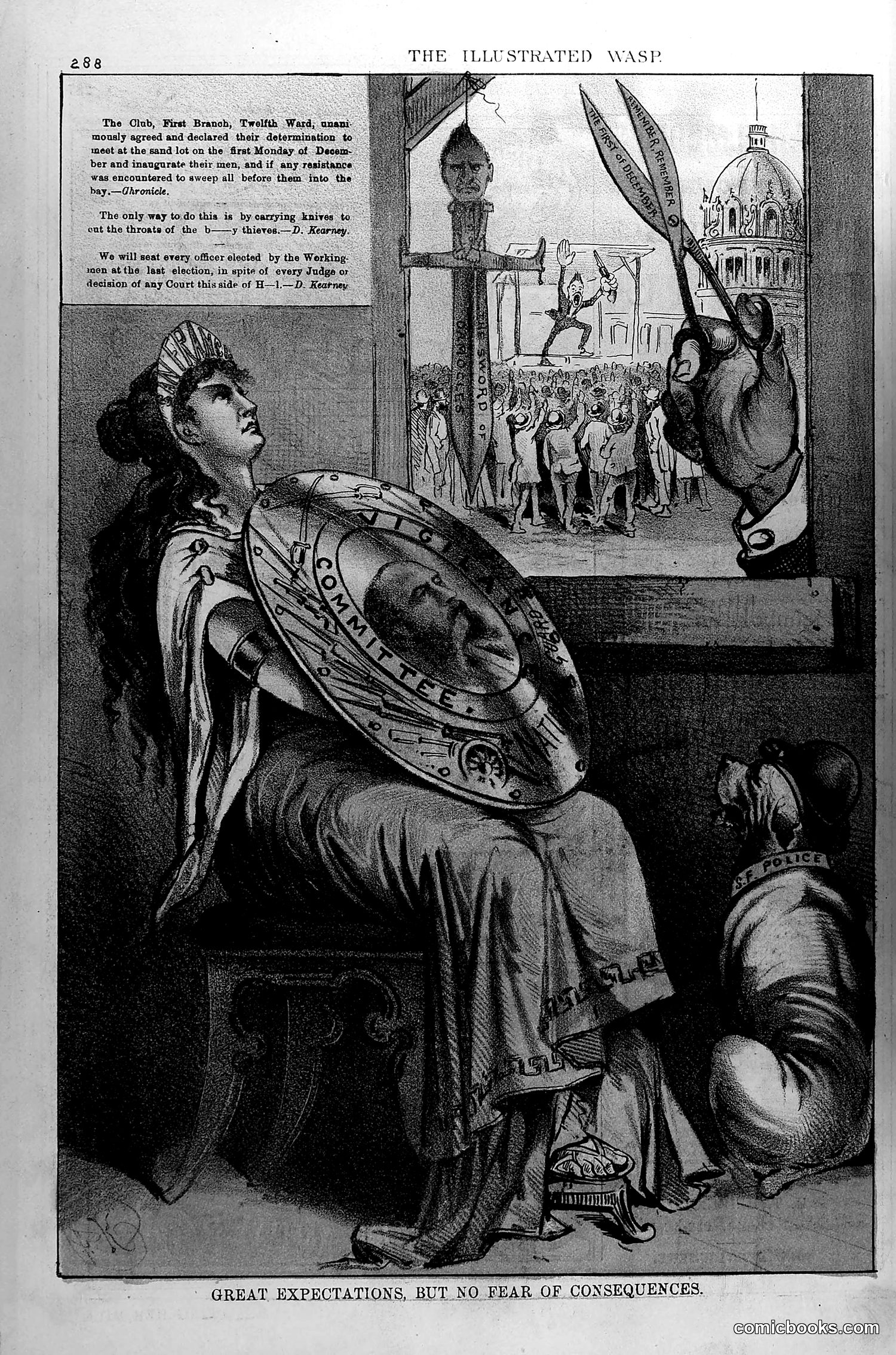
This satirical cartoon depicts **Britannia** (personification of Britain, identifiable by her shield and classical dress) looking fearfully at a wasp—likely representing *The Wasp* magazine itself or aggressive political criticism. The figure holds a shield labeled "COMMITTEE" and appears anxious despite her traditional position of power. The accompanying text quotes criticize working-class organization and judicial decisions, suggesting the cartoon addresses tensions between labor movements and the British establishment. The phrase "Great Expectations, but No Fear of Consequences" implies the cartoon mocks Britain's imperial confidence while facing growing internal threats from organized workers or political challengers. The shield and classical imagery emphasize the contrast between traditional British authority and emerging social forces challenging it.

I can see this is a test page or calibration sheet for *The Wasp* magazine, not an actual editorial page with cartoons or satire content. The image shows: - A color reference chart (grid of gray squares in varying tones) on the left - A measurement ruler in the center (marked 6-11) - A scale ruler along the bottom (marked 6-10) These are standard tools used in photographic reproduction and printing to ensure accurate color and size calibration when documenting or reproducing printed materials. This appears to be documentation of the magazine itself rather than content meant for readers. Without visible cartoon imagery, satirical text, or recognizable political figures, I cannot identify the intended satire or commentary.