
A complete issue · 18 pages · 1879
The Wasp — November 15, 1879

I can see this is a measurement/calibration page from *The Wasp* magazine, showing an Oregon Rule Co. ruler (0-5 inches) and a grayscale color reference chart with various gray and white squares arranged in a grid pattern on a black background. This appears to be a **technical reference page** rather than satirical content—likely used for photographic reproduction, printing calibration, or archival documentation purposes. The ruler and color chart would help standardize measurements and tonal values when reproducing magazine pages. This type of page was standard in periodical production but wouldn't have contained editorial or satirical cartoons. Without seeing actual cartoon or text content from *The Wasp*, I cannot identify political figures or explain satirical meaning.
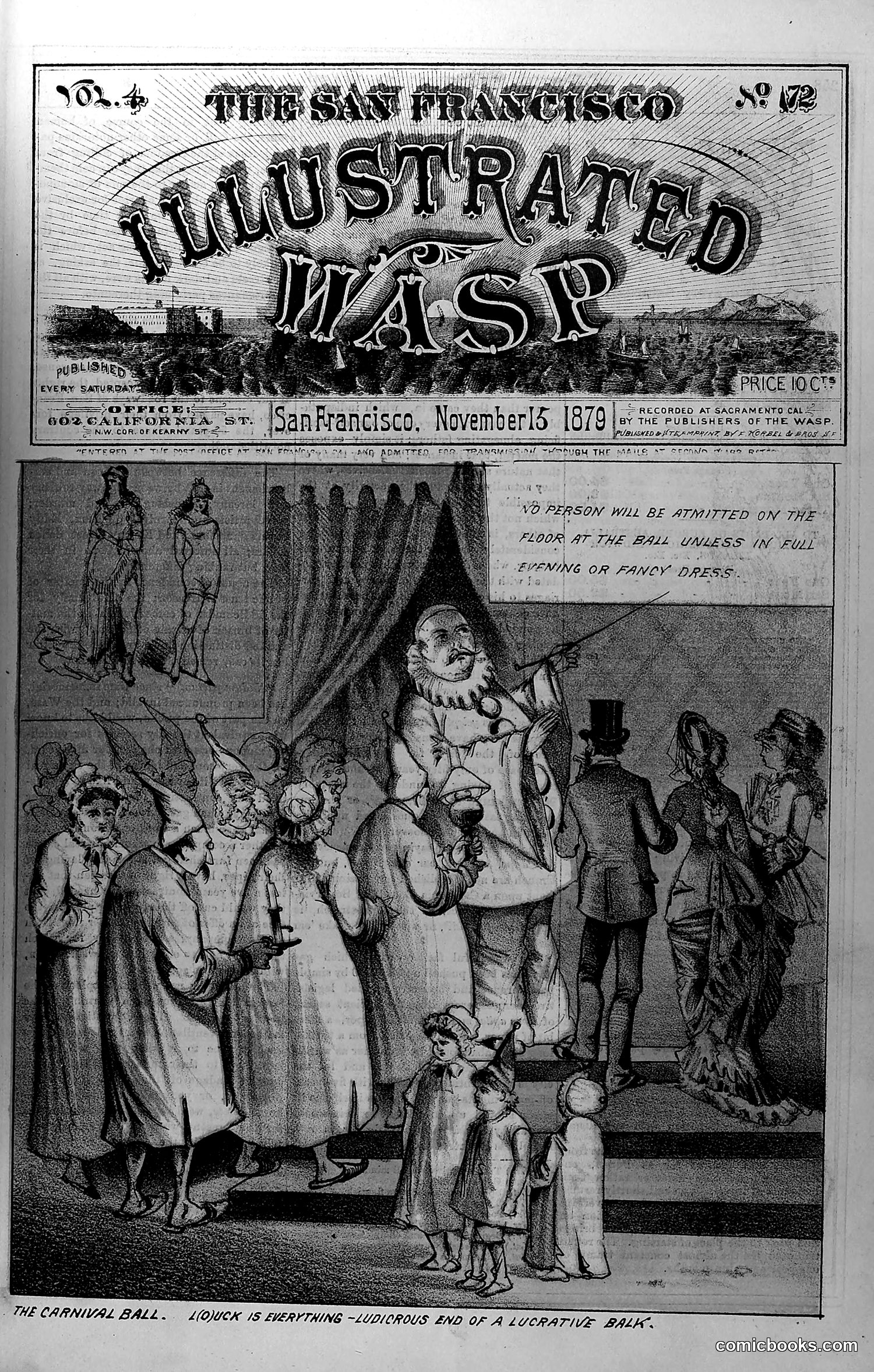
This satirical cartoon depicts a masquerade ball where attendees wear elaborate costumes and masks. The central figure appears to be a grotesque caricature—likely representing a political or social figure of the era—surrounded by formally dressed guests in evening wear. The caption states "No person will be admitted on the floor at the ball unless in full evening or fancy dress," suggesting this critiques exclusionary social practices or hypocrisy among San Francisco's elite. The subtitle reads "Lousck is everything—Ludicrous end of a lucrative ball," though "Lousck" is unclear—possibly an OCR error for a person's name. The overall satire appears to mock pretentious high-society gatherings and the artificiality of masked balls, where social status and appearances matter above substance.
This page is primarily **editorial and administrative content** rather than political cartoons. The masthead shows *The Wasp's* logo and publication details (602 California St., San Francisco; Louis Solscher, Business Manager). The main article, "The Incomings, Outcomings and Short-Comings of Our City," critiques San Francisco municipal governance. The editor attacks city officials for granting monopoly charters to private companies (railroads, gas utilities) that exploit residents through high rates and poor service. The satire argues these officials should be "honest" stewards instead of corrupt enablers of corporate greed—a common Gilded Age complaint about American urban corruption and monopolistic practices disadvantaging ordinary citizens.
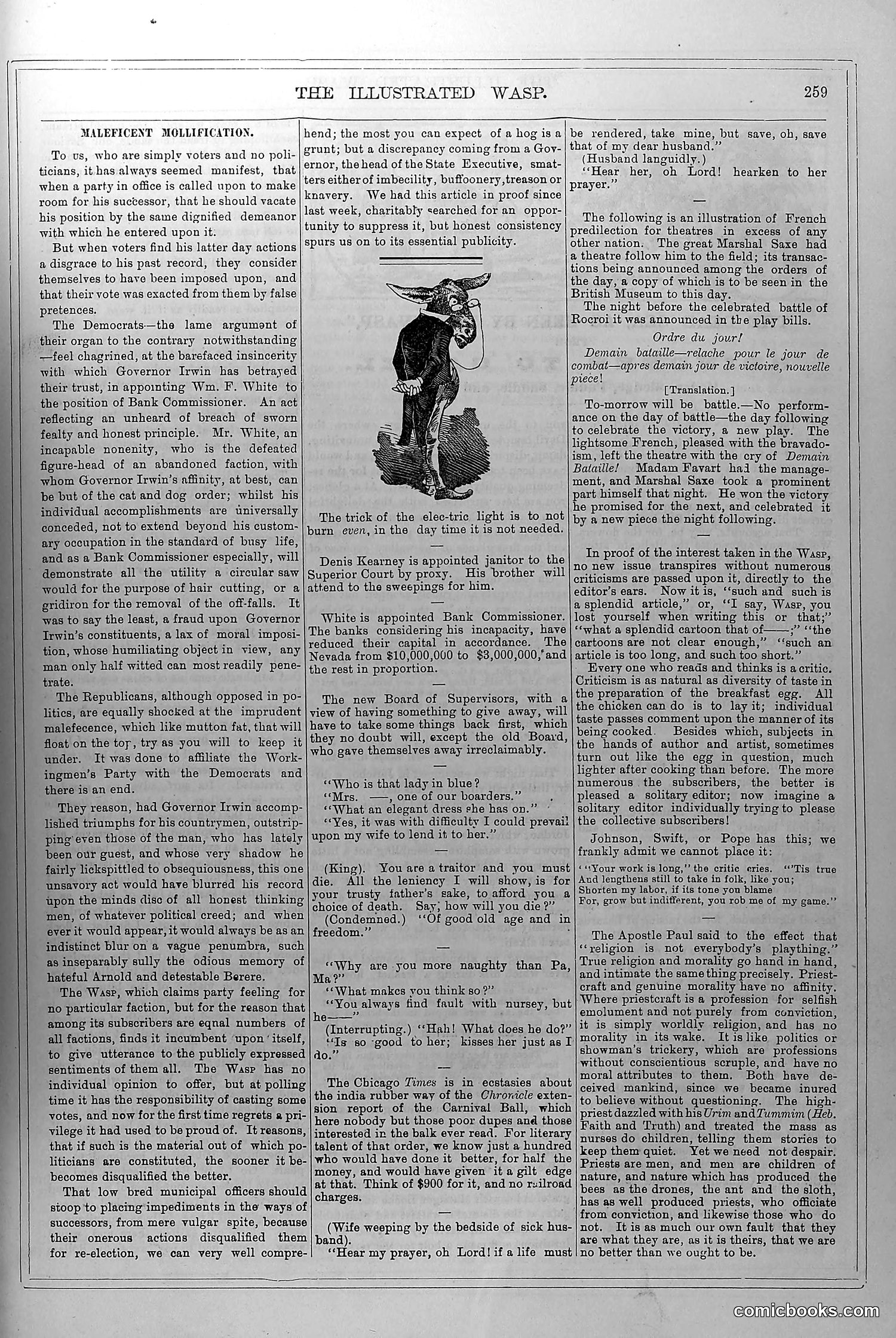
This page primarily contains political commentary rather than a single cartoon. The main illustration shows a figure in formal dress striking a theatrical pose, captioned "The trick of the elec-tric light is to not burn one, in the day time it is not needed." The text discusses California Republican politics, specifically criticizing Governor Irwin's appointment of William F. White as Bank Commissioner. The article argues this represents a "discrepancy" and breach of trust, calling White "an incapable nonentity" unfit for the position. The commentary also attacks Democratic politicians using similar harsh language, suggesting partisan hypocrisy from both parties. The "electric light" illustration appears to metaphorically critique political theater and deception—the idea that politicians use flashy displays that serve no real purpose.
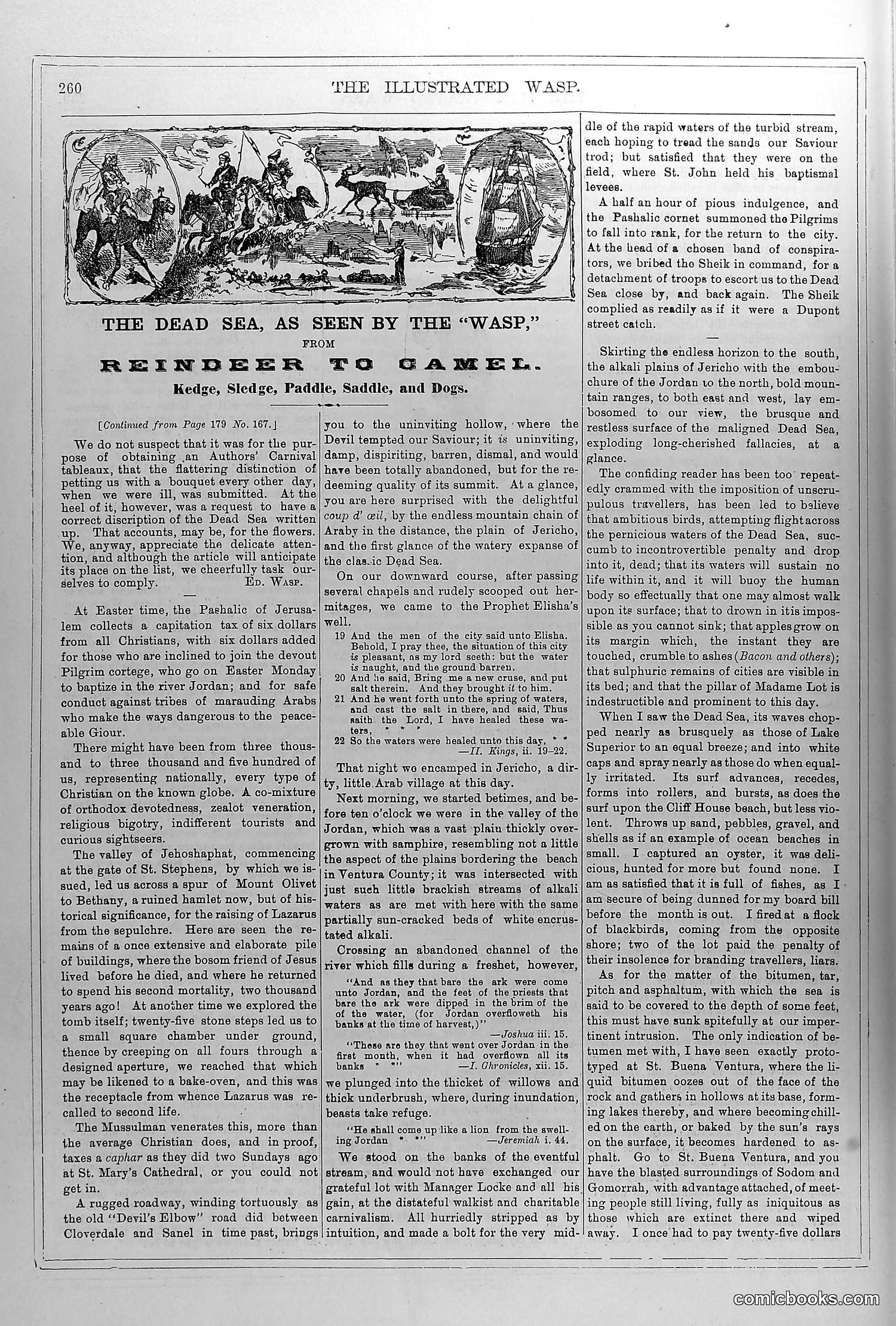
This satirical illustration depicts a pilgrimage to the Dead Sea and Holy Land sites, presented as a travel narrative "from Reindeer to Camel." The cartoon mocks tourists and pilgrims visiting biblical locations—showing various modes of transport and travelers encountering local guides and landscapes. The satire appears to ridicule both the commercialization of religious tourism (the "Authors' Carnival" mentioned in text) and the naiveté of Western visitors. References to bribing local officials, encounters with "unscrupulous travellers, liars," and exorbitant costs suggest The Wasp is criticizing how tourists are exploited while seeking authentic spiritual experiences. The work reflects 19th-century American skepticism toward organized religious tourism and its perceived phoniness.
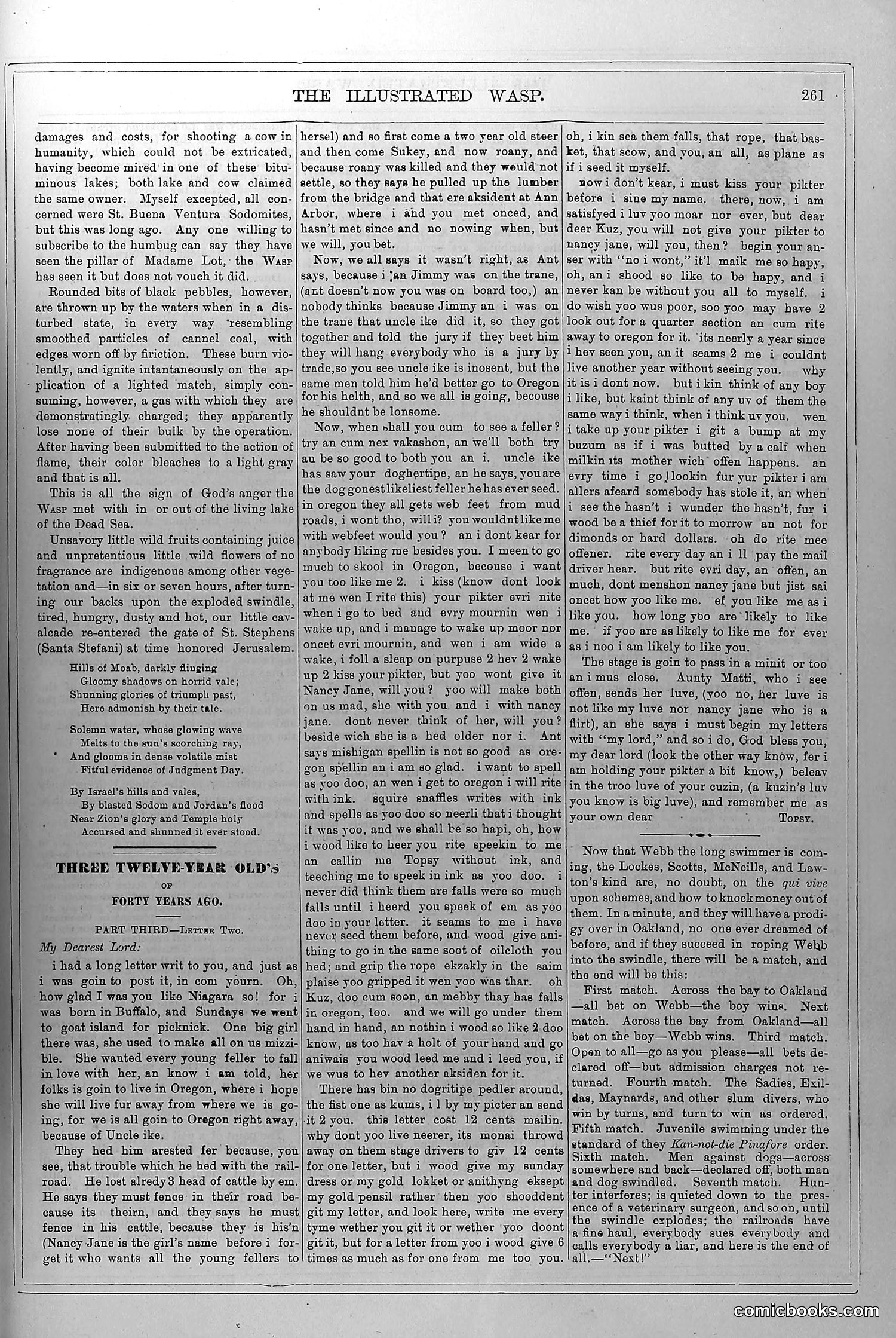
This page appears to be primarily **literary content** rather than political cartoon material. It contains what seems to be a serialized story or correspondence section titled "THREE TWELVE-YEAR OLD'S or FORTY YEARS AGO," labeled "PART THIRD—Letters Two." The text consists of lengthy personal letters discussing life in frontier Oregon, including mentions of cattle, travel, and domestic life. References include places like "Buffalo" and "Oregon," suggesting 19th-century American frontier settlement experiences. **No political satire or caricature is evident** on this visible page. The content appears to be nostalgic personal narratives or fiction rather than the satirical cartoons *The Wasp* magazine was known for. The page functions as editorial/literary content filling the magazine's space.
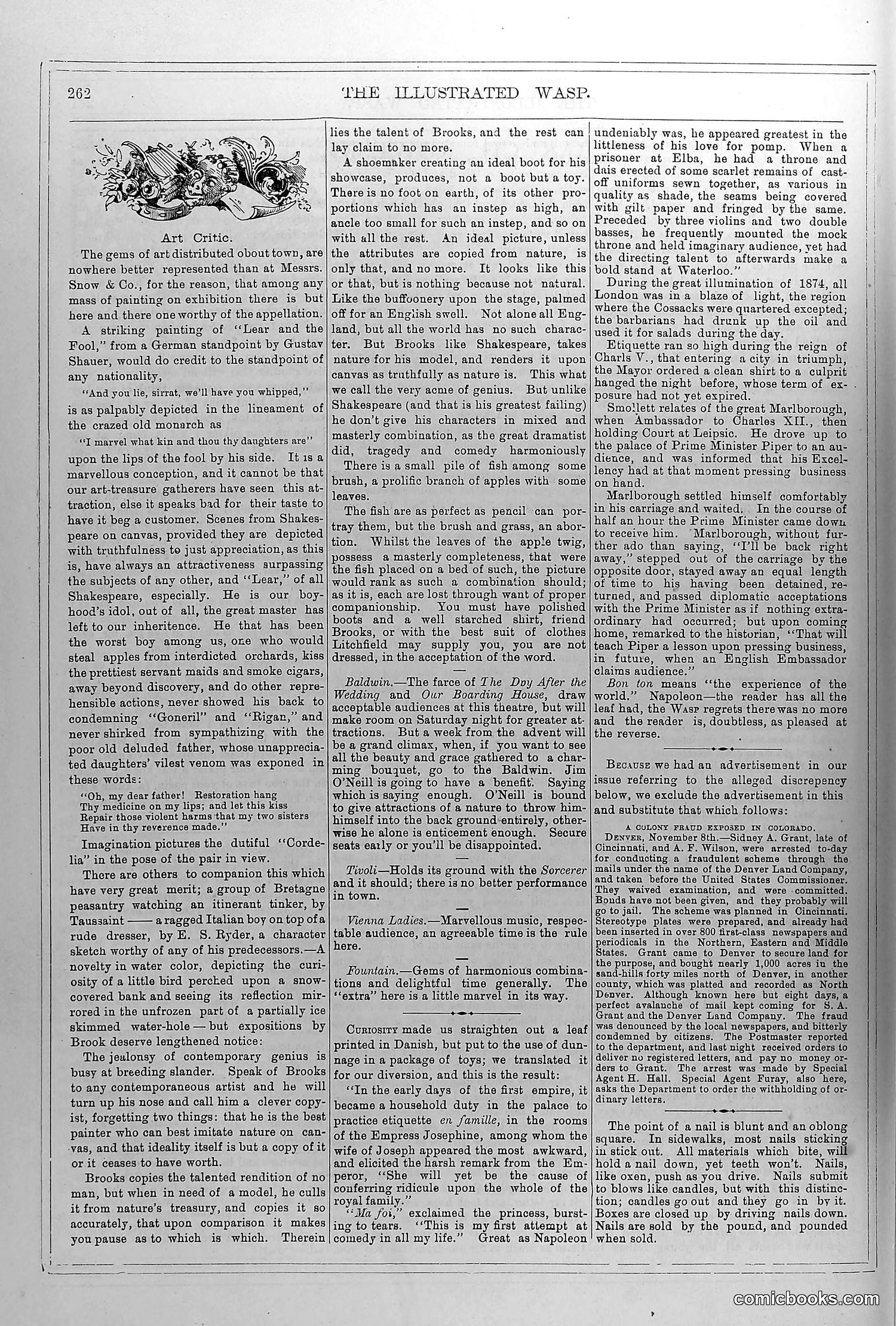
This page is primarily **literary criticism and theater reviews**, not political satire or cartoons. The content discusses artistic merit in theater, particularly critiquing the work of dramatist Brooks and comparing him to Shakespeare. The main visible cartoon at the top appears to be decorative rather than satirical—a classical ornamental design. The bulk of the page consists of **theater reviews** under headers like "Baldwin," "Tivoli," "Grand Ladies," and "Fountain," evaluating performances and productions. There's also discussion of a **Denver Land Company advertisement** correction. The final section contains practical advice about nails and boxes, suggesting miscellaneous editorial content. **No clear political figures or social satire are identifiable** on this page—it functions as an entertainment and commerce section rather than the satirical commentary The Wasp was known for.
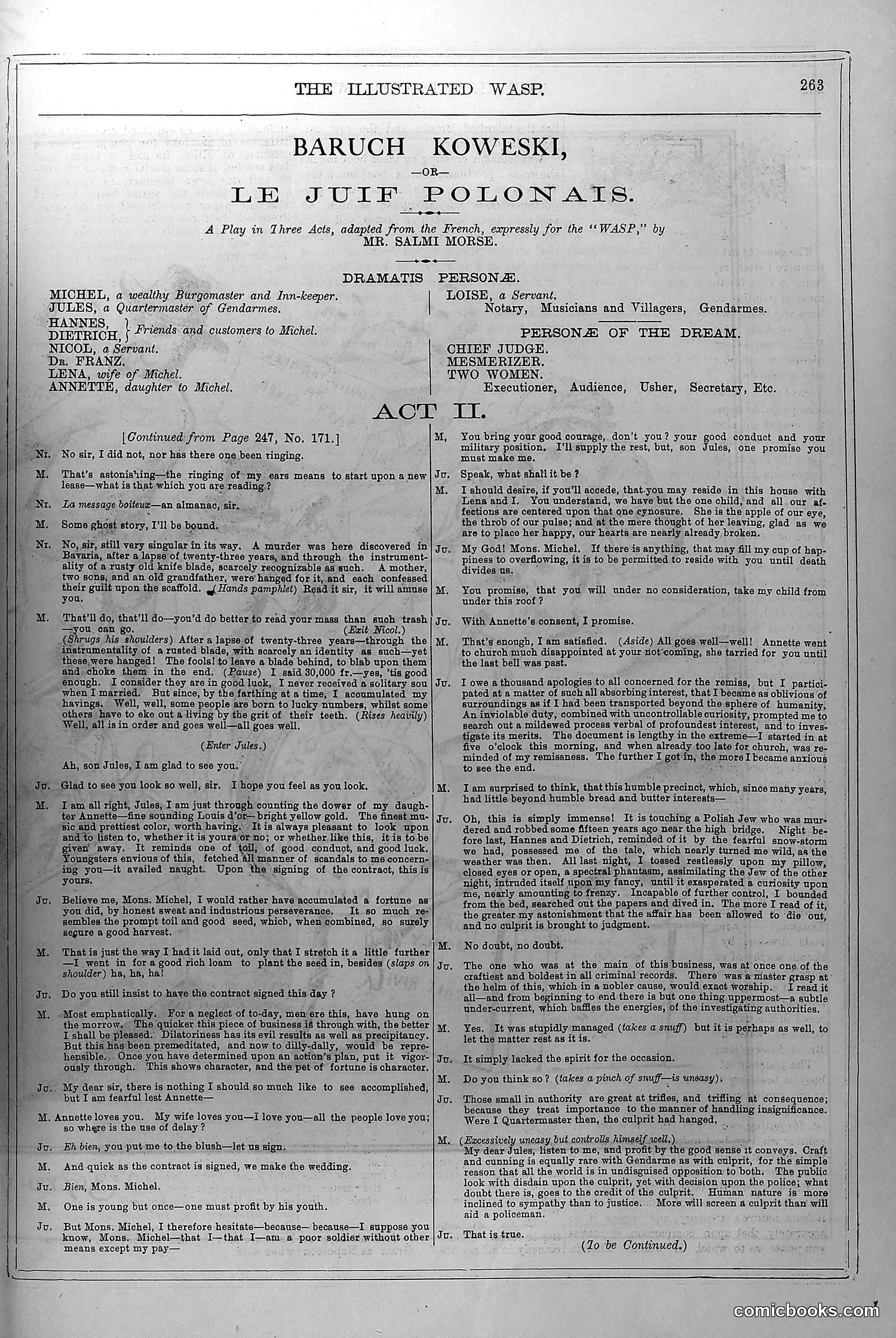
This page contains a dramatic script rather than a political cartoon. It's Act II of "Baruch Kowski, or Le Juif Polonais" (The Polish Jew), a three-act play adapted from French by Mr. Salmi Morse for *The Wasp* magazine. The script features characters including Michel (a wealthy burgmaster), Jules, and others in what appears to be a melodramatic narrative involving family conflicts, inheritance disputes, and moral dilemmas. The dialogue discusses contracts, marriages, and accusations of wrongdoing. Without seeing accompanying illustrations or knowing the broader context of *The Wasp's* satirical intent, the specific targets of any satire are unclear. The Jewish protagonist's name and Polish setting suggest possible ethnic stereotyping common to 19th-century American satire, but the exact satirical point requires additional context.
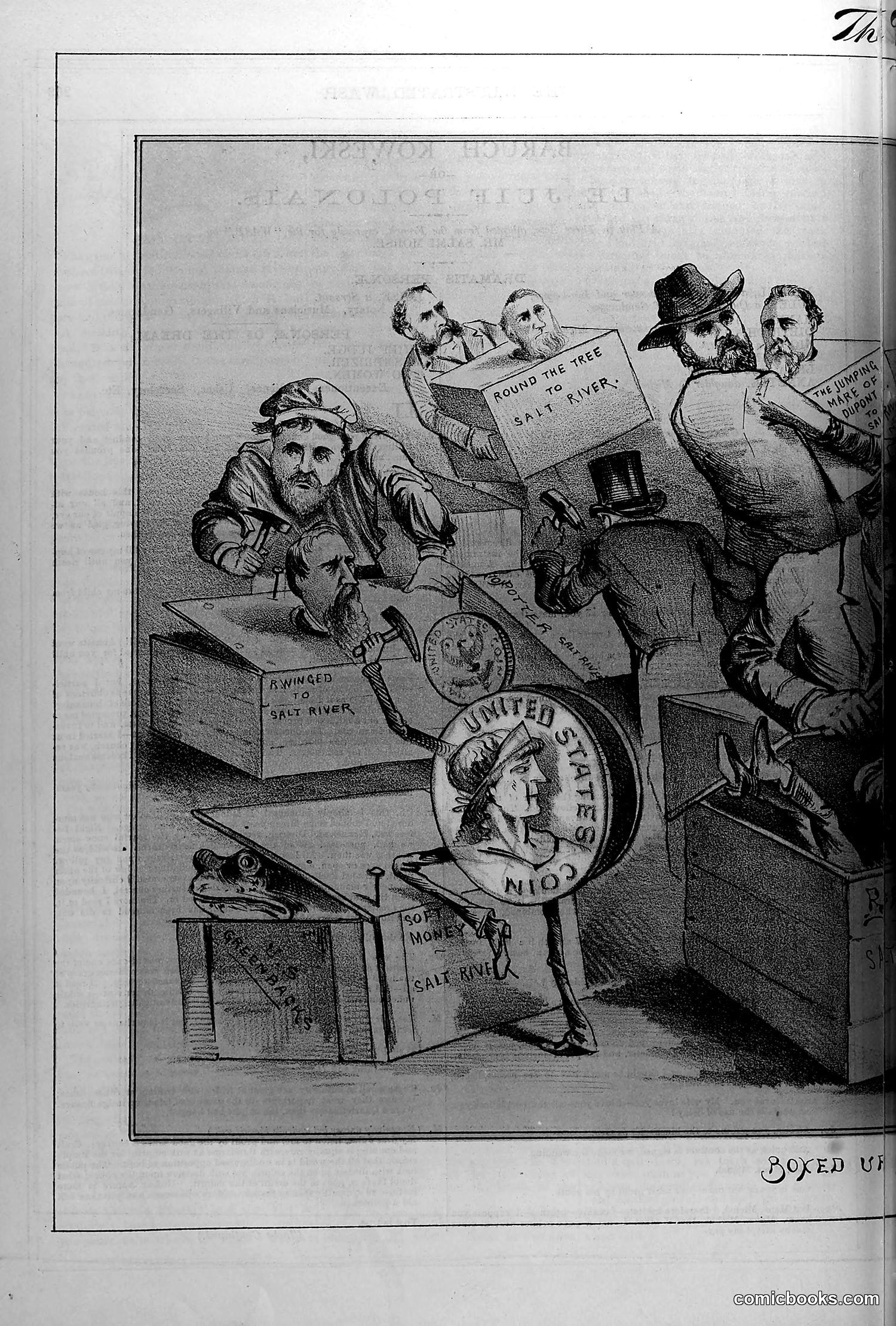
This 1870s-era satirical cartoon depicts politicians "boxed up" around the Salt River—a period metaphor for political defeat or being sent away as punishment. The central coin bears Lady Liberty, labeled "United States," suggesting the nation itself is at stake. Several bearded men in period dress surround boxes labeled "SWINGED BY SALT RIVER" and "ROUND THE TREE SALT RIVER," indicating they've been politically defeated or ousted. The cartoon likely satirizes a specific political scandal or electoral loss involving multiple figures, though their identities aren't clearly labeled here. The "Salt River" references suggest these men have been removed from power or influence—a common fate for corrupt or failed politicians of the Gilded Age. The composition emphasizes their collective disgrace.
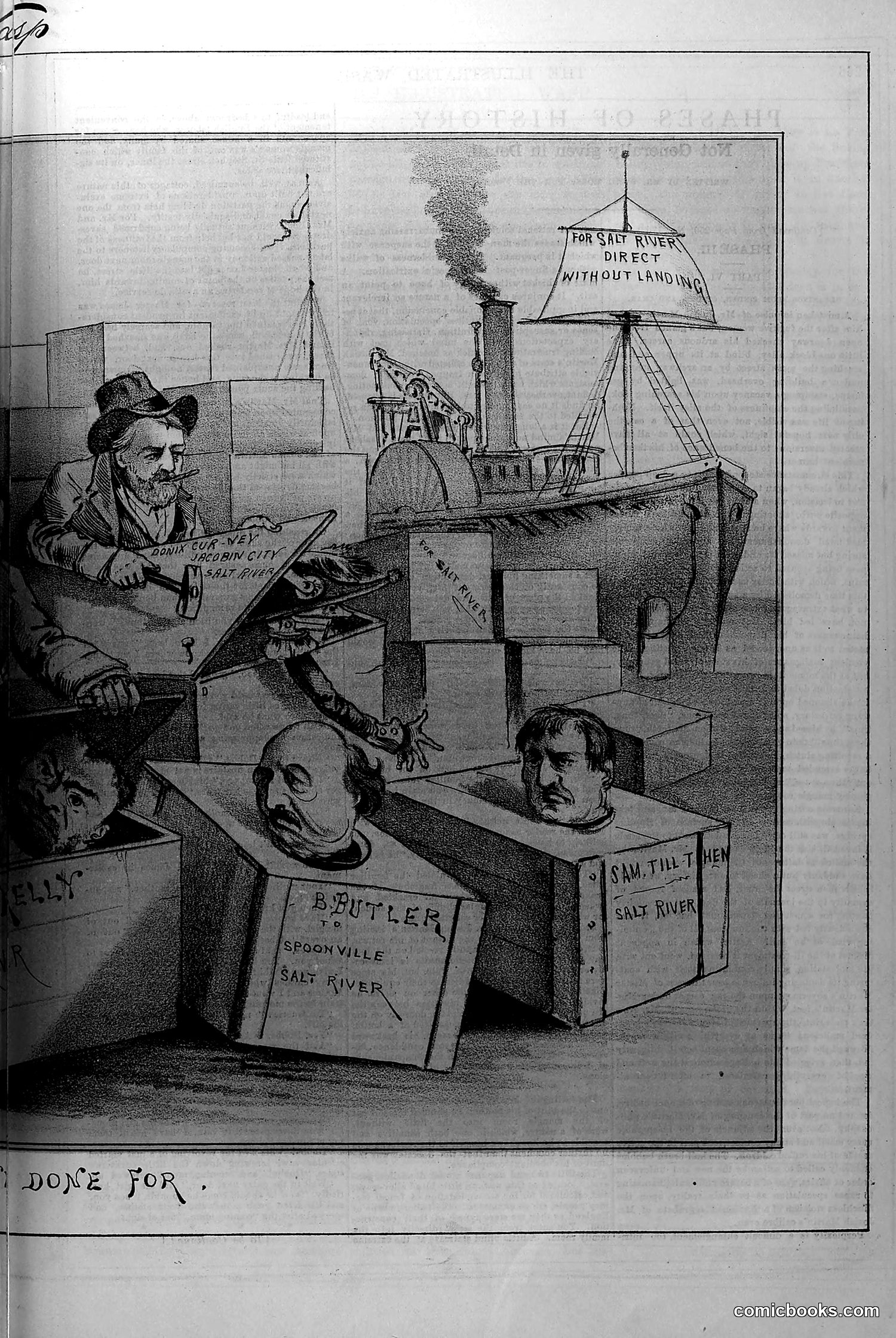
This satirical cartoon depicts three political figures depicted as severed heads in boxes labeled with Salt River locations (Spoonville, and Sam Till then Salt River). A fourth figure on the left—appearing to be a boatman or ferryman with a shovel—operates a steamboat marked "SALT RIVER" with a banner reading "FOR SALT RIVER DIRECT WITHOUT LANDING." "Going up Salt River" was period slang meaning political defeat or ruin. The cartoon satirizes politicians being "sent up Salt River"—politically eliminated. The severed heads suggest their political careers are finished. The steamboat captain appears to be the force sending them there, likely representing a political rival or reform movement. This appears to reference a specific electoral defeat or political purge, though the exact figures and date remain unclear.
This page is primarily text rather than a cartoon. It's a serialized story titled "Phases of History: Not Generally given in Detail," written by Mr. Salmi Morse for The Wasp. The narrative concerns Josiah Martin's domestic troubles—specifically his wife's infidelity and his own questionable financial dealings. The story appears to be satirizing middle-class hypocrisy and marital discord of the era. References to "the mangle woman" and working-class characters suggest social commentary on class distinctions. The tone is mordant and sarcastic, exposing the gap between respectable appearances and actual behavior. The detailed, gossipy narrative style was typical of satirical magazines using fictional scenarios to critique contemporary social conventions and morality.
The main illustration depicts a crowded streetcar with passengers in discomfort—one man appears ill. The accompanying letter addresses San Francisco's cable car system, complaining about overcrowding, inadequate ventilation, and poor maintenance. The writer ("WASP") sarcastically praises the system while cataloging specific grievances: passengers packed like "rope dancers," constant sick passengers, worn-out cars, and negligent supervisors who ignore complaints. The satire targets the cable car company's indifference to public welfare and safety. References to "General Sherman" and specific locations (Spring Valley Water Company, Park Commission) suggest this critiques actual San Francisco infrastructure mismanagement circa the 1880s-90s. The page also contains preliminary advertising for "Dashaway Hall" and Ella Corsen's opera debut.
This page is primarily text-based satire rather than a cartoon. The article attacks Senator Bayard of Delaware, returning from Europe, for accepting honors from Democratic Party and Judge Clark. The satire ridicules what it characterizes as Bayard's compromised acceptance of honors despite his questionable moral standing—calling him "human trash" worthy of society's "deserts" (punishments/consequences). The piece also critiques Denis Kearney, a labor agitator, sarcastically suggesting he represents the common man while actually pursuing self-interested political goals. The remainder consists of advertisements for local San Francisco businesses (breweries, bakeries, opticians, tobacco) and recruitment notices. The editorial tone is sharply critical of Democratic political figures and labor organizers.
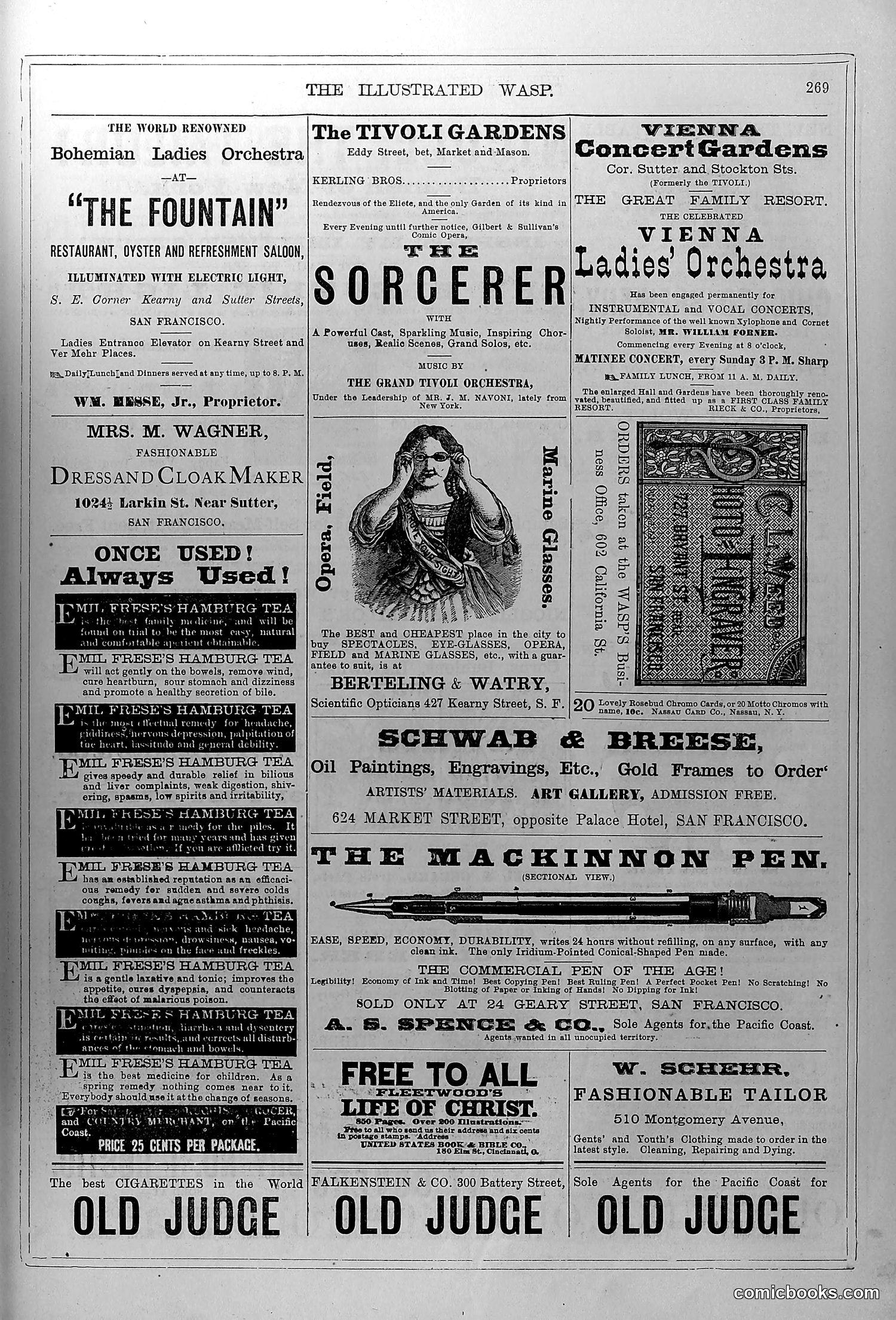
This page is primarily **advertising content** rather than editorial cartoons or satire. It features a large central engraving of a woman's face (labeled "The SORCERER") promoting an opera performance by the Grand Tivoli Orchestra, surrounded by various San Francisco business advertisements. The "SORCERER" reference likely pertains to Gilbert & Sullivan's 1877 operetta of the same name, which was popular during this period. The engraving appears to be promotional material for a theatrical production rather than political satire. The rest of the page contains typical period advertisements: restaurants, tailors, tea products, art galleries, and cigarettes. There is **no discernible political cartoon or satirical commentary** visible on this page—it serves primarily as a commercial vehicle for local San Francisco businesses and entertainment venues.
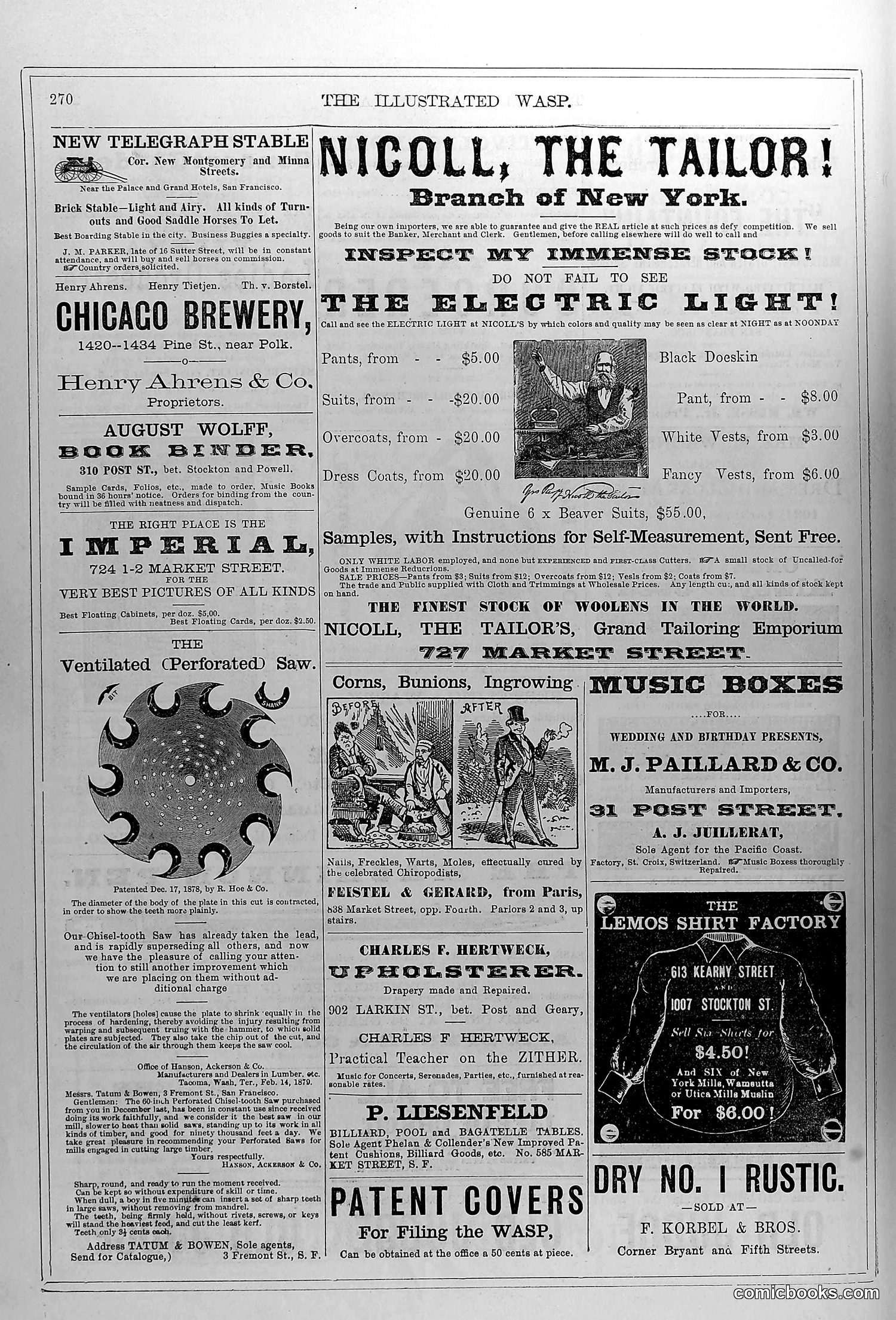
This page is primarily **advertising**, not satirical content. It features various San Francisco businesses from what appears to be the late 19th century, including: - **Nicoll, the Tailor** (prominently featured with an illustration of a well-dressed man), advertising suits, pants, overcoats, and vests - Chicago Brewery - A book binder - Picture framing services - A ventilated saw manufacturer - Music box and shirt factory advertisements - Various other local merchants The only potential satirical element is the large **ventilated saw illustration** (with crescent-shaped perforations), which includes technical descriptions of its function—though this appears to be legitimate product advertising rather than satire. The page serves primarily as a commercial directory for *The Wasp* readers rather than containing political or social commentary.
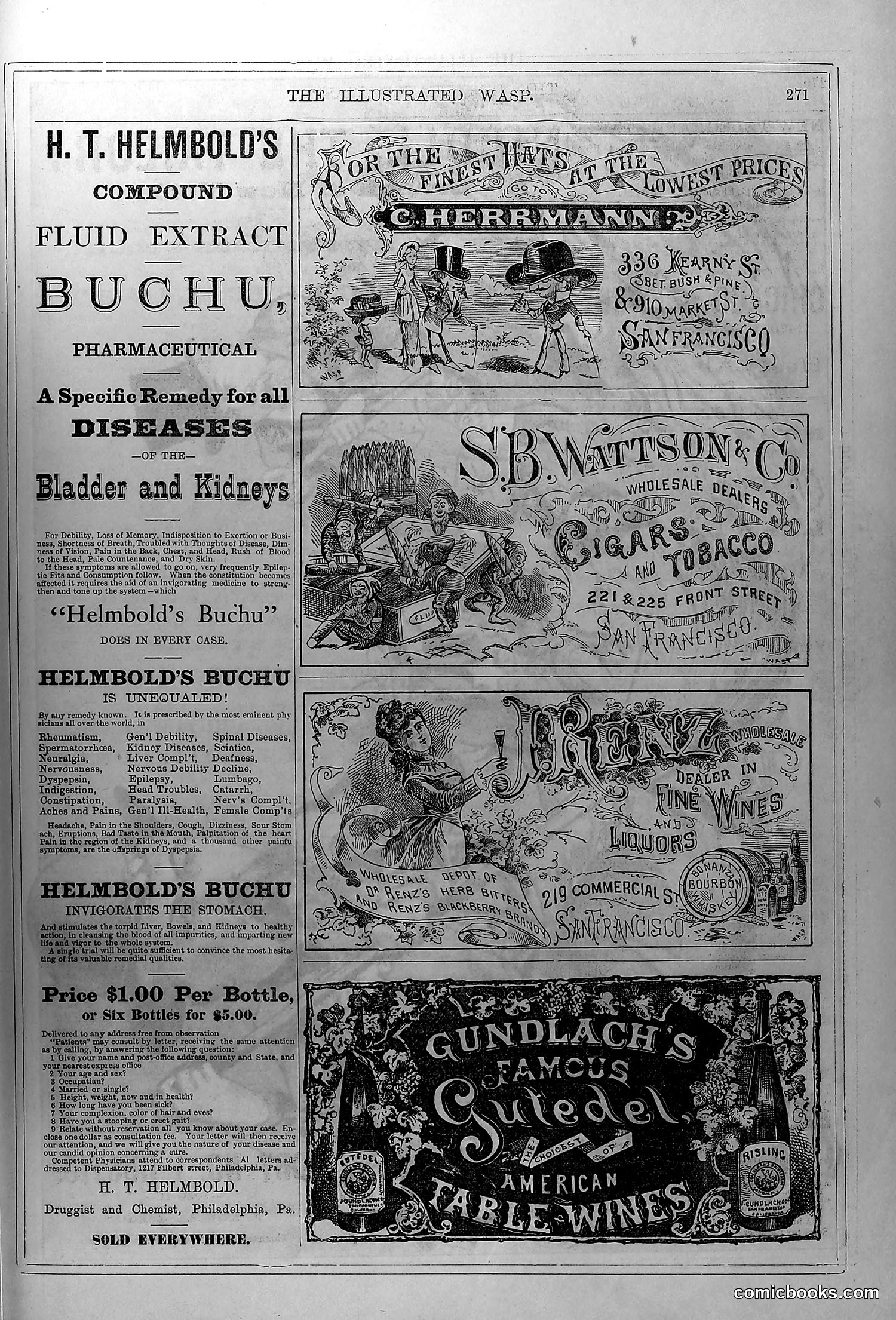
This page is primarily **advertising, not satire or political commentary**. It contains: 1. **Left column**: An advertisement for "Helmbold's Buchu," a patent medicine claiming to cure bladder and kidney diseases. The ad lists numerous ailments and promises the remedy "invigorates the stomach." Priced at $1.00 per bottle. 2. **Right side**: Four separate commercial advertisements for San Francisco businesses—a hat company (Chermann & Co.), a cigar and tobacco wholesaler (S.B. Wattson & Co.), a wine and liquor dealer, and Gundlach's Famous Sludel American table wines. The page reflects 19th-century American advertising practices, featuring unregulated patent medicine claims and ornate decorative typography typical of the era. No political figures or satirical content are present.
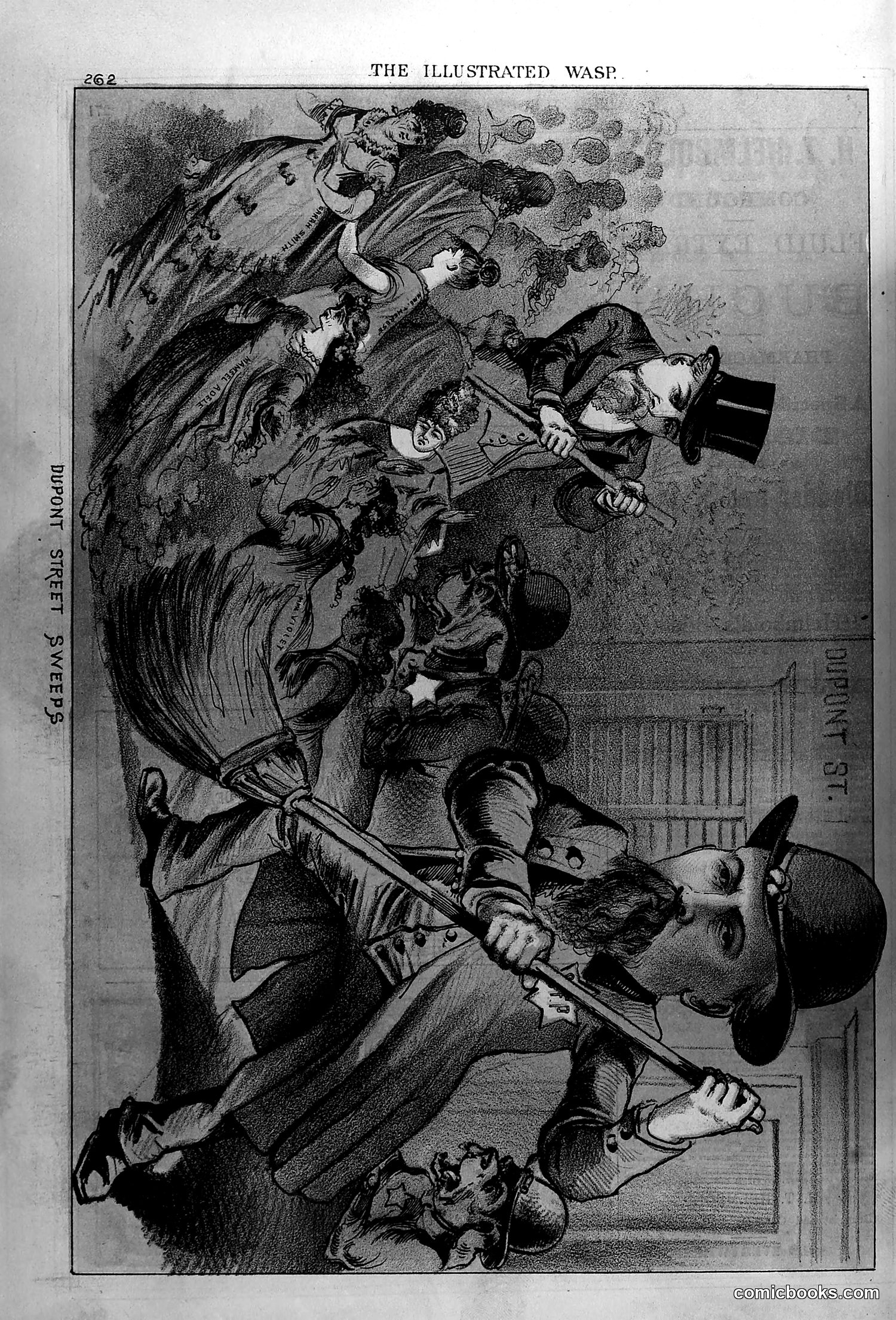
This page presents a satirical illustration titled "Limping Street Sweepers" (visible on the spine). The cartoon depicts multiple figures being swept up or blown away by what appears to be a large broom or sweeping motion, suggesting forcible removal or expulsion. The central figure holding the broom appears to be an authority figure or political leader, while those being swept include various caricatured individuals. This likely satirizes a political or social "cleaning out" campaign—possibly referencing police action, deportations, or removal of unwanted groups from a city or institution. Without clearer identification of specific figures or date context, the precise political event remains unclear, though the imagery clearly mocks an aggressive removal campaign.

I can see this page contains a calibration/test chart used in photographic reproduction, rather than actual comic or satirical content. The image shows a grayscale reference scale with numbered markings (6-11 visible) and a grid of tonal squares ranging from black to white on the left side. At the bottom are measurement rulers. This appears to be a technical page from *The Wasp* magazine's printing or archival process, used to ensure proper exposure and contrast during reproduction. It's not a cartoon or editorial content, but rather a quality-control document. Without visible satirical imagery or OCR text corresponding to actual editorial material, I cannot analyze political or social commentary from this particular page.