
A complete issue · 18 pages · 1879
The Wasp — November 1, 1879
I can see this page contains an Oregon Rule Co. measurement scale and what appears to be a color reference or calibration chart on a black background, but I cannot discern any cartoon imagery, political figures, or satirical content from the image provided. The visible elements are primarily technical/photographic tools—a ruler for scale and a gray-scale/color checker for photography or document reproduction purposes. These appear to be reference materials used in archival or reproduction work rather than editorial content from The Wasp magazine itself. Without visible cartoon artwork or accompanying OCR text that clarifies the satirical content, I cannot identify the political or social references this page was meant to convey to readers.
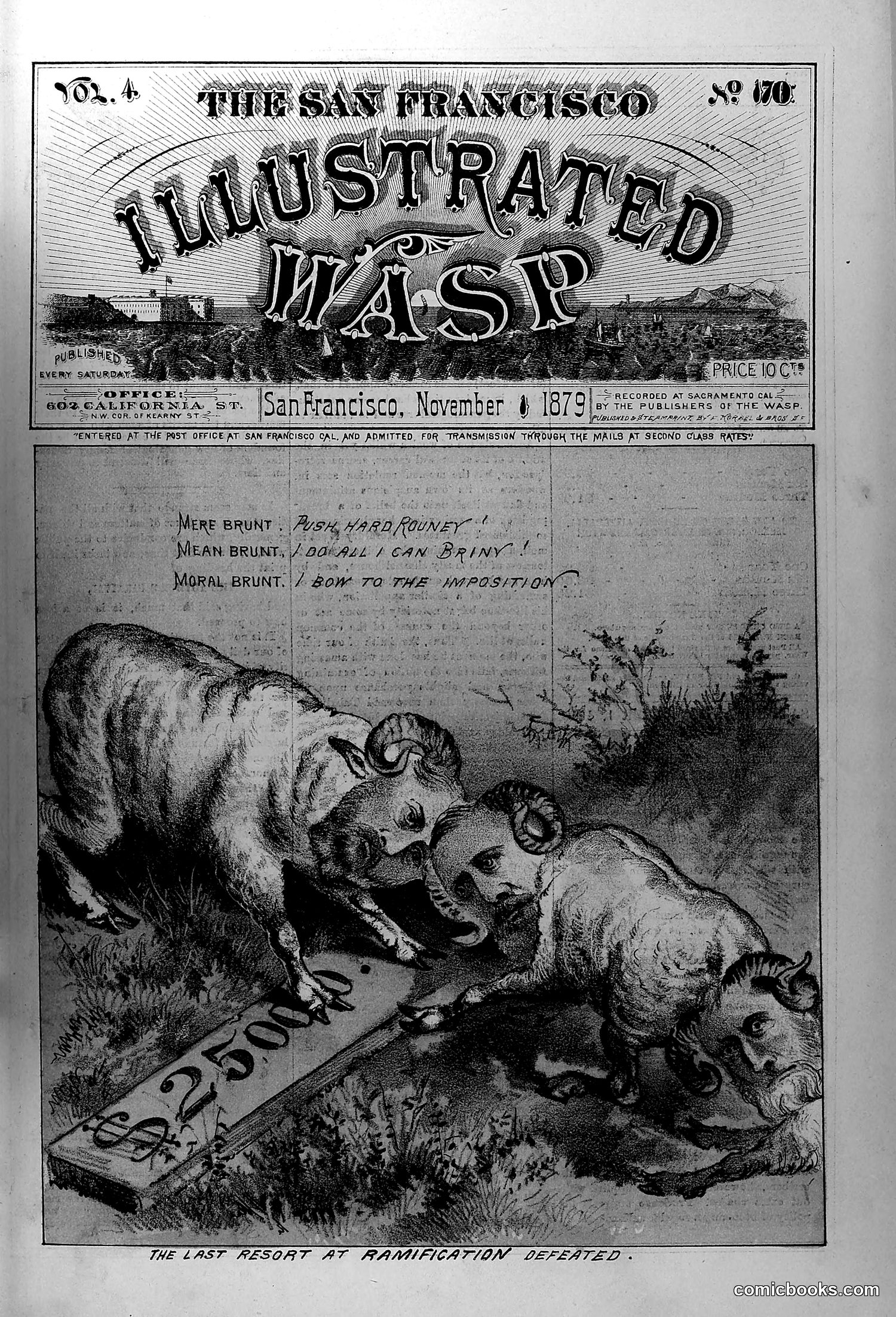
This 1879 San Francisco *Wasp* cartoon depicts three rams with human faces locked in combat over a fallen sign reading "2 SORE." The caption identifies three types of "brunt": - **Mere Brunt**: "Push Hard Bunney!" - **Mean Brunt**: "I'll Do All I Can Bring!" - **Moral Brunt**: "Bow to the Imposition" The rams appear to represent different factions or political opponents engaged in stubborn, circular conflict. The wordplay on "brunt" (meaning the main force or impact) suggests the cartoon critiques how various groups are butting heads while actually agreeing on something ("Bunney" may reference a contemporary figure, though unclear from context). The satirical point seems to be that competing political forces are ultimately indistinguishable—all locked in pointless confrontation.
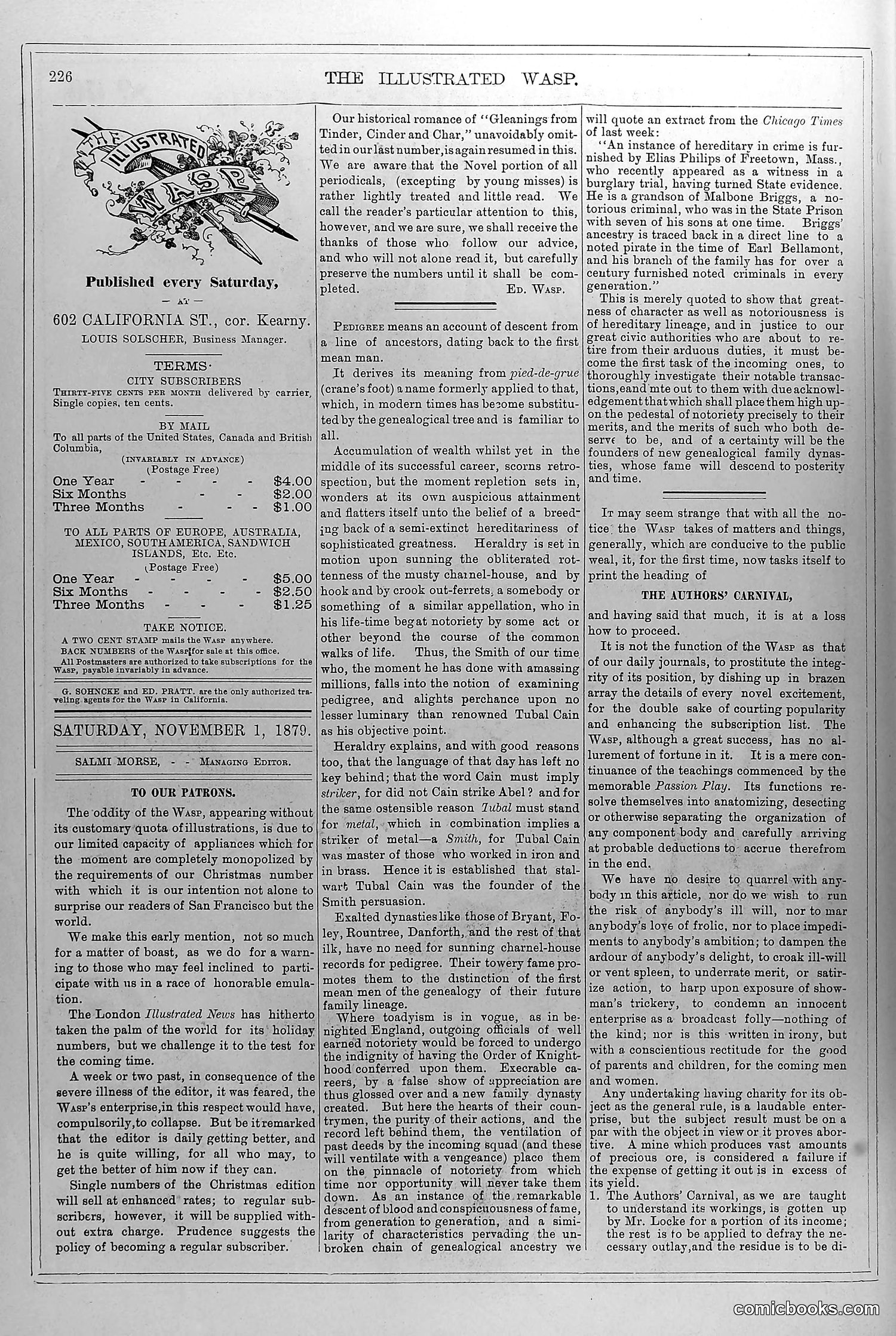
This page is primarily **editorial and advertising content** rather than political cartoons. The masthead shows the magazine's publication details and subscription rates. The main editorial discusses **genealogy and heredity**, arguing that character and reputation are inherited traits passed through family lines. The piece critiques how prominent families sometimes overlook disreputable ancestors, suggesting that inherited social status doesn't guarantee inherited virtue. A secondary piece, "The Authors' Carnival," defends *The Wasp*'s literary merit and explains its editorial functions—separating fact from fiction in serialized stories. The content reflects 1870s-80s concerns about **class, ancestry, and social legitimacy** in post-Civil War America, mocking pretensions to respectability based solely on genealogy.
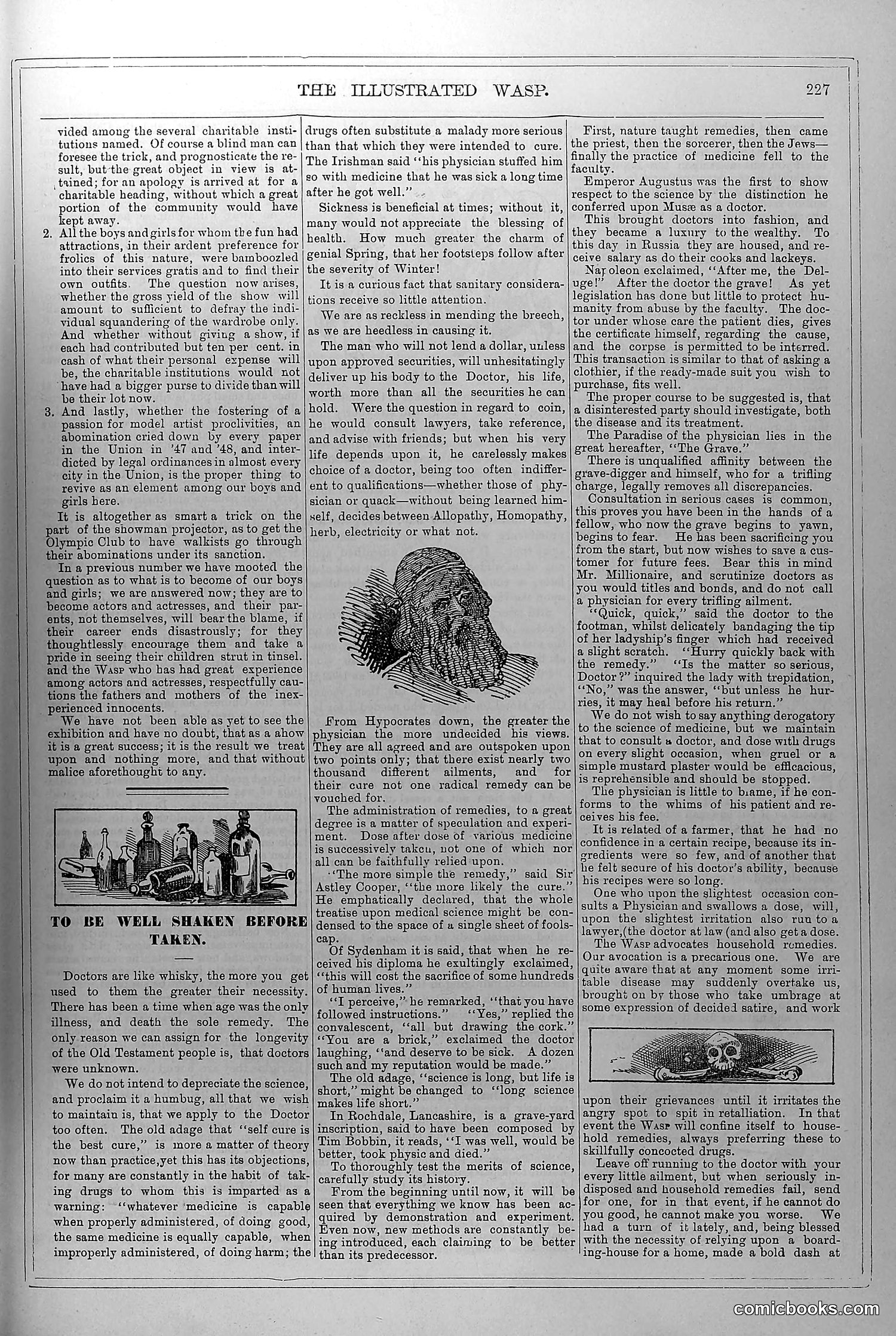
This page contains **satirical editorial text** rather than political cartoons. The content critiques the medical profession, arguing that doctors are often unreliable and that their expertise is overstated. The two illustrations shown are **generic images of medicine bottles and medical implements**—not caricatures of specific figures. They function as decorative elements supporting the text's mockery of medical practice. The satire targets **medical quackery and charlatanism** prevalent in the era, suggesting physicians frequently prescribed ineffective or harmful treatments. The text advocates for skepticism toward doctors' claims while acknowledging some legitimate medical knowledge exists. This reflects 19th-century American distrust of professionalized medicine, which lacked modern scientific standards and was often indistinguishable from folk remedy practices.
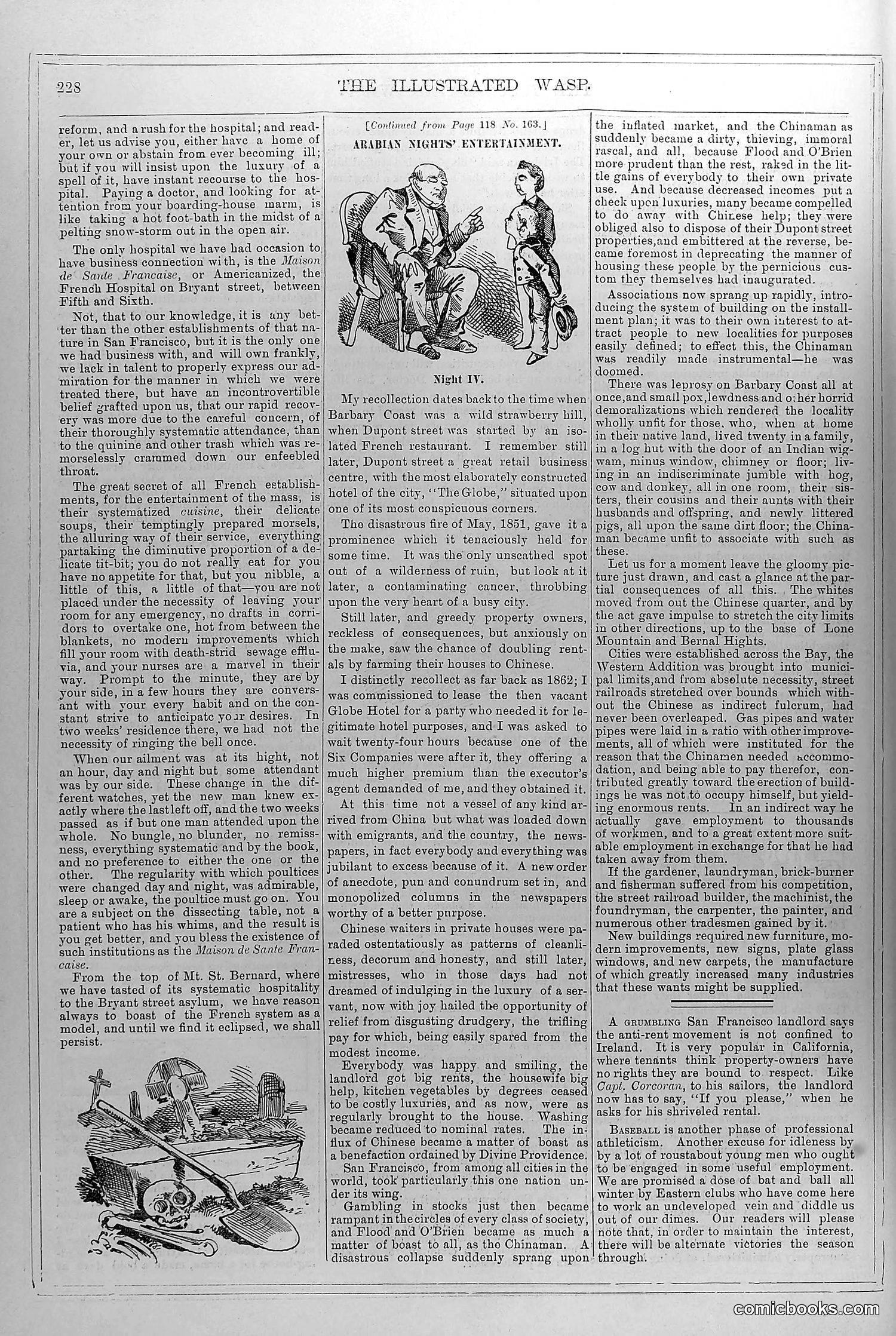
This page contains two distinct cartoons and satirical text about Chinese immigration and San Francisco life circa 1880s. The upper cartoon, titled "Night IV," depicts what appears to be a French restaurant scene with exaggerated caricatures—likely mocking both French culinary pretension and Chinese workers in San Francisco establishments. The accompanying text describes Barbary Coast entertainment and Chinese laborers' working conditions. The lower cartoon shows figures around what appears to be gambling or drinking activities, reflecting contemporary anxieties about Chinese immigration's social effects. The satirical text criticizes both San Francisco's landlord practices and Chinese workers' exploitation, while mocking French establishments' affectations. The overall tone suggests *The Wasp* was using humor to comment on labor conditions, immigration, and class dynamics during California's rapid urbanization—though the racial caricatures reflect deeply problematic 19th-century attitudes.
This page contains theater and cultural commentary rather than political cartoons. The main illustrations show scenes labeled "Buzzings" and "Baldwin," depicting theatrical productions and performers. The text discusses Grant's visit to California, critiques various theatrical establishments and performers (including references to Baldwin's theatre and specific actors), and comments on San Francisco cultural institutions. There's commentary on the Viennese ladies' theatrical troupe and criticism of their performances. The "Buzzings" section offers scattered social observations, including remarks about Sunday amusements, clerical matters, and various entertainment venues. The cartoons appear to be decorative vignettes rather than pointed political satire—they illustrate the theatrical subjects discussed in the adjacent articles rather than delivering sharp satirical commentary on specific figures or events.
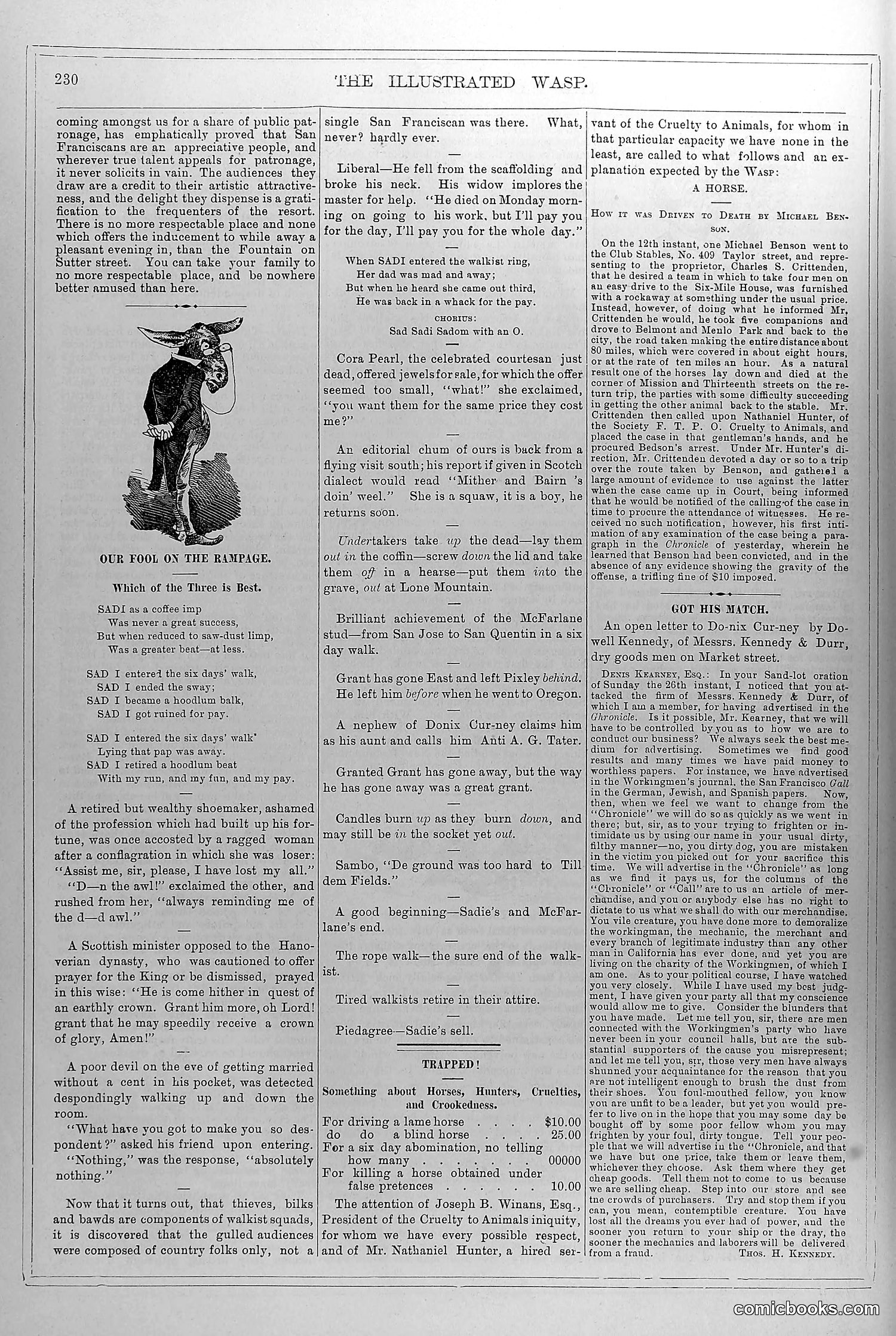
This page contains satirical anecdotes and humor rather than traditional political cartoons. The small illustration labeled "OUR FOOL ON THE RAMPAGE" depicts a jester or fool figure, accompanying stories about San Francisco social commentary. The content mocks various local figures and situations: a failed San Francisco coffee importer named Sadi; criticisms of San Jose's "Adi A. G. Udier"; and jabs at the McFarlane and Grant families regarding a walk. The "TRAPPED!" section ridicules horse-drawn transportation practices and includes pricing for services like "driving a lame horse" ($10) and "false pretences" ($10), suggesting fraud in local commerce. The final section attacks the "Chronic" newspaper in characteristic Wasp fashion, using satire to critique local institutions and business practices.
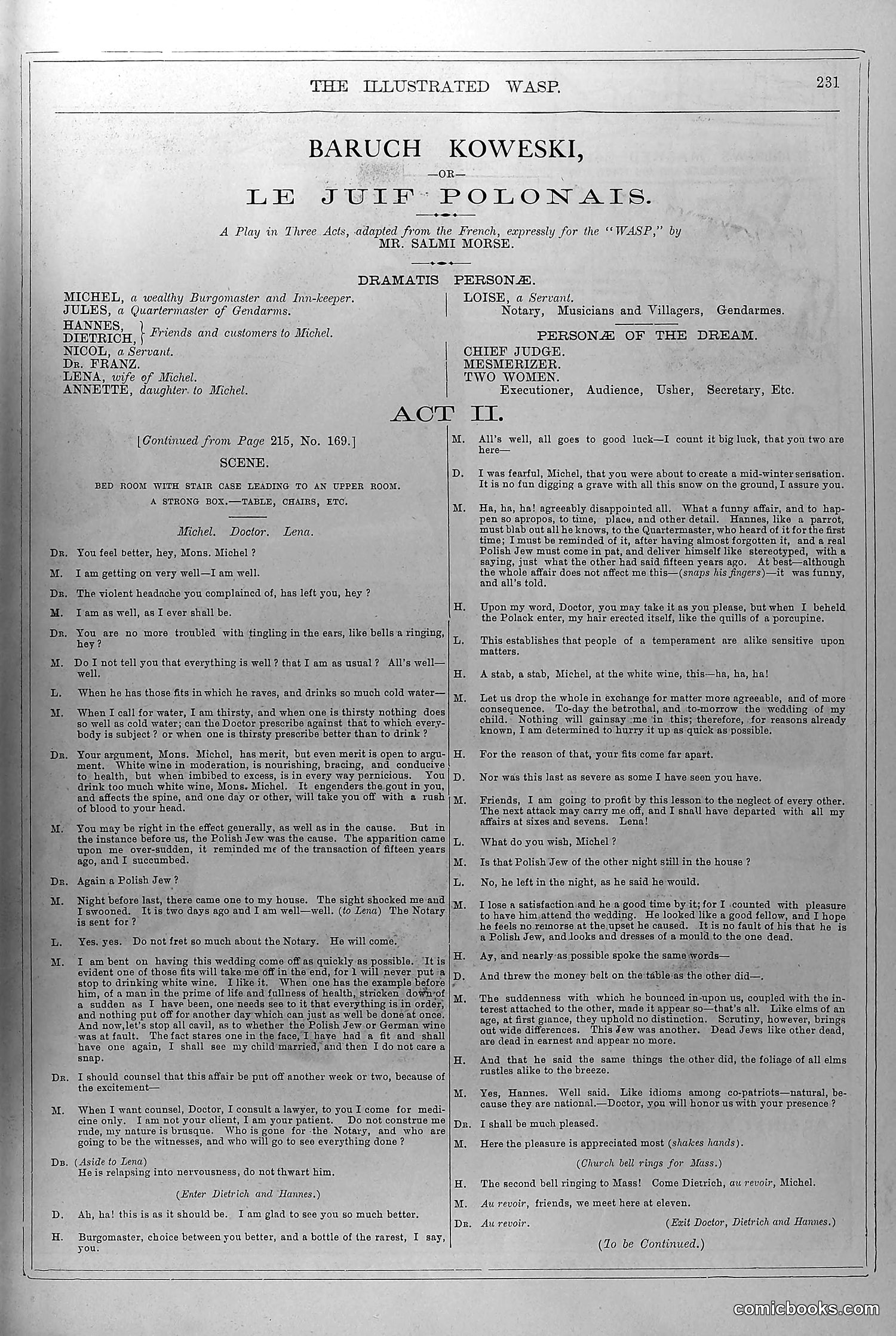
This page is primarily a **theatrical script**, not a political cartoon. It presents "Baruch Kowski, or Le Juif Polonais" (The Polish Jew)—a three-act play adapted from French for *The Wasp* magazine by Mr. Salmi Morse. The page displays cast lists and Act I dialogue between characters including Michel (a wealthy innkeeper), a Doctor, and Lena. The script appears to be a serialized drama rather than satirical commentary. Without seeing accompanying illustrations or editorial framing, I cannot identify specific political references or satirical targets. The Jewish character in the title might suggest period anti-Semitic stereotyping typical of 19th-century theater, but the actual dramatic content here is straightforward theatrical text, not overt satire.
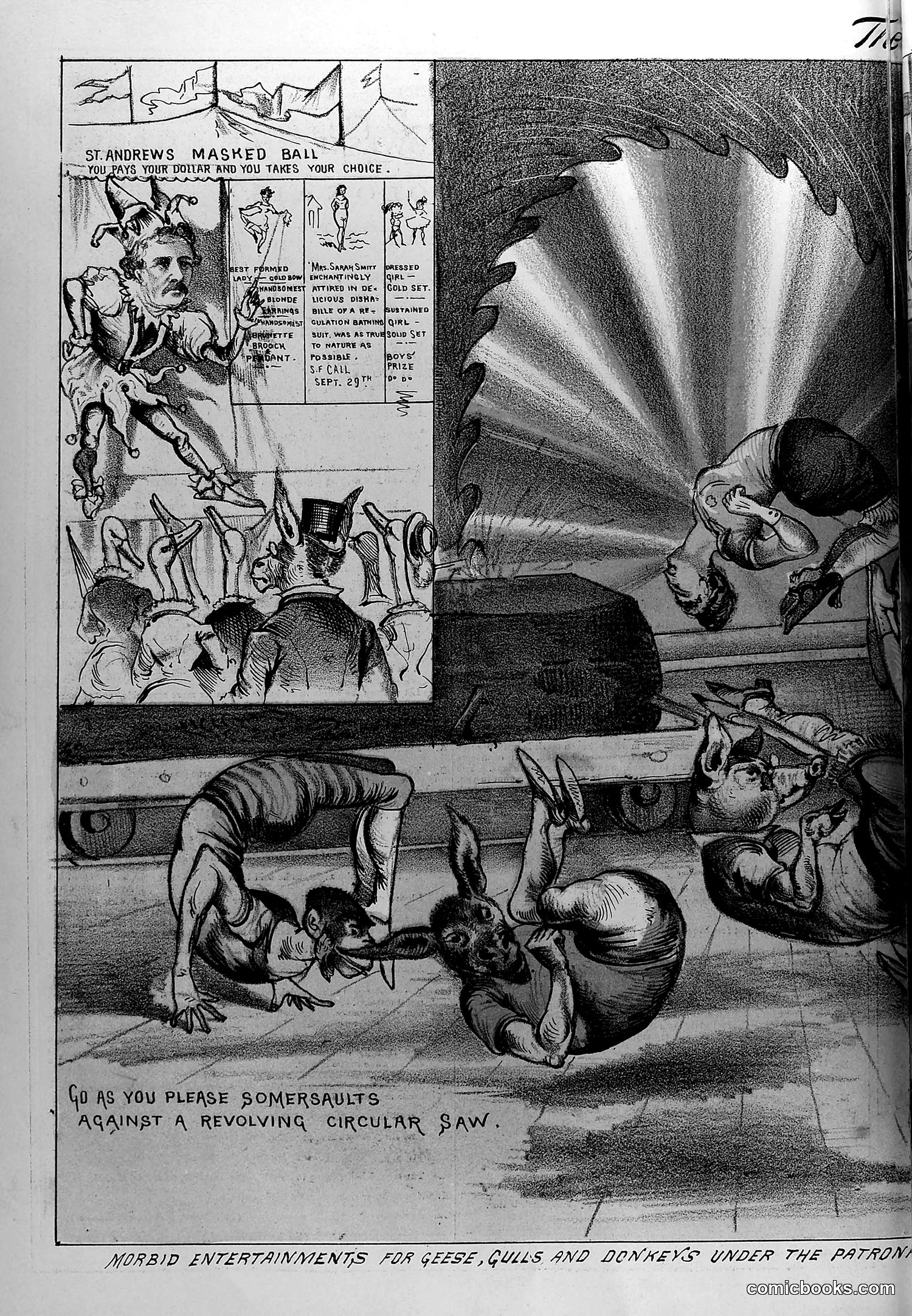
This page from *The Wasp* contains two satirical pieces mocking what appears to be aristocratic or wealthy social events in San Francisco. The upper left advertises "St. Andrews Masked Ball" with costumed figures and descriptions of attendees' outfits—satirizing the pretentious pageantry of high-society masquerade balls. The larger lower illustration, titled "Morbid Entertainments for Geese, Gulls and Donkeys Under the Patronage," depicts grotesque animal-human hybrids engaged in dangerous acts like acrobatics near a circular saw. The caption "Go as You Please Somersaults Against a Revolving Circular Saw" suggests *The Wasp* is ridiculing wealthy society's appetite for increasingly absurd, dangerous entertainment—comparing their tastes to those of barnyard animals. The satire targets upper-class decadence and poor judgment through crude visual exaggeration.
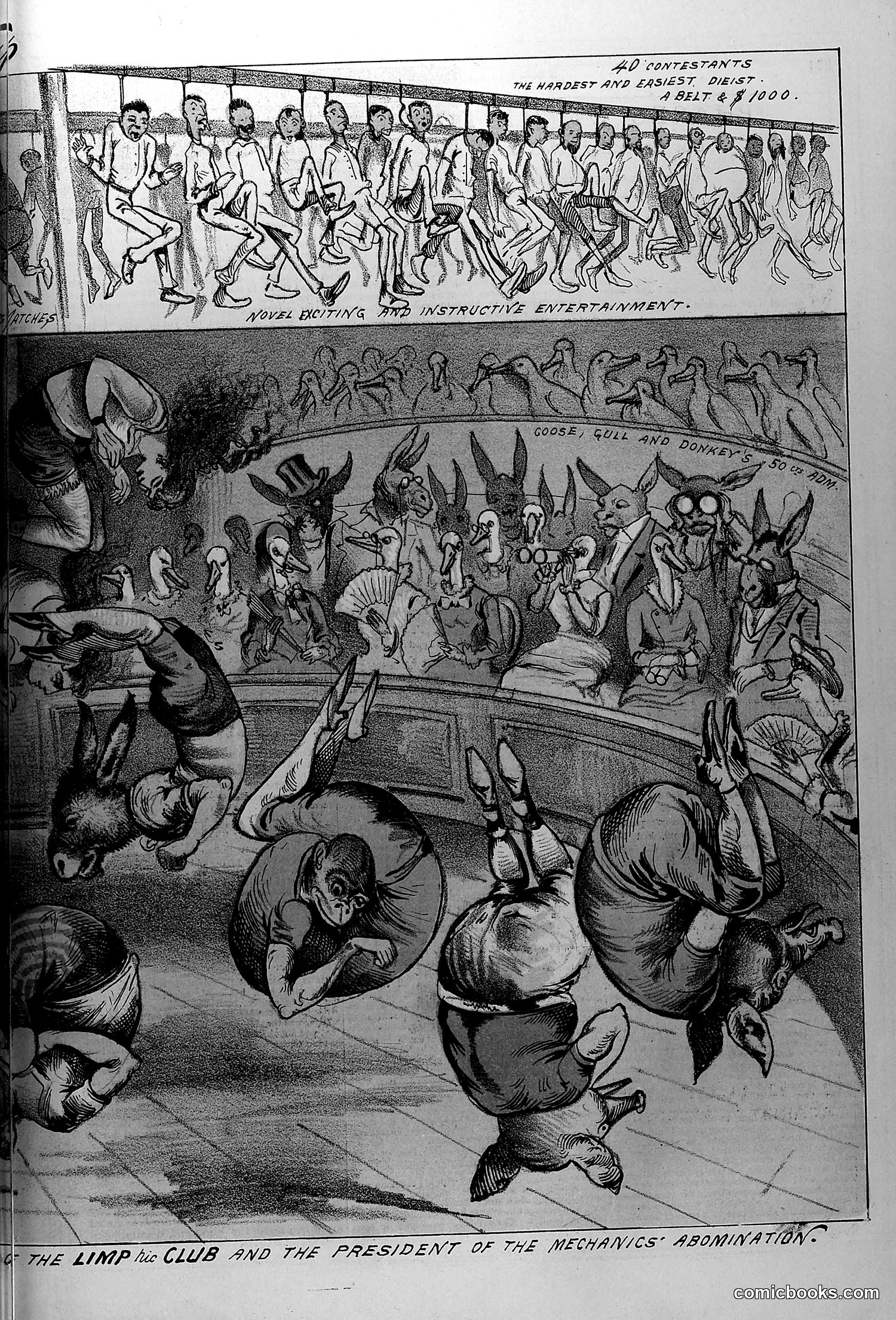
This page satirizes a public entertainment event—a contest featuring "40 contestants" competing for "the hardest and easiest belt & $1000," described as "novel exciting and instructive entertainment." The top panel shows human contestants in athletic poses. The bottom panel depicts them competing against animals (goose, gull, donkey) and fantastical creatures with horns and exaggerated features, likely representing devils or demons—appearing to be a circus or carnival-style competition. The caption references "The Limp in Club and the President of the Mechanics' Abomination," suggesting this mocks a specific organization or event. The satire critiques such spectacles as lowbrow entertainment, ridiculing both the absurd competition format and the organizations promoting it as supposedly "instructive."
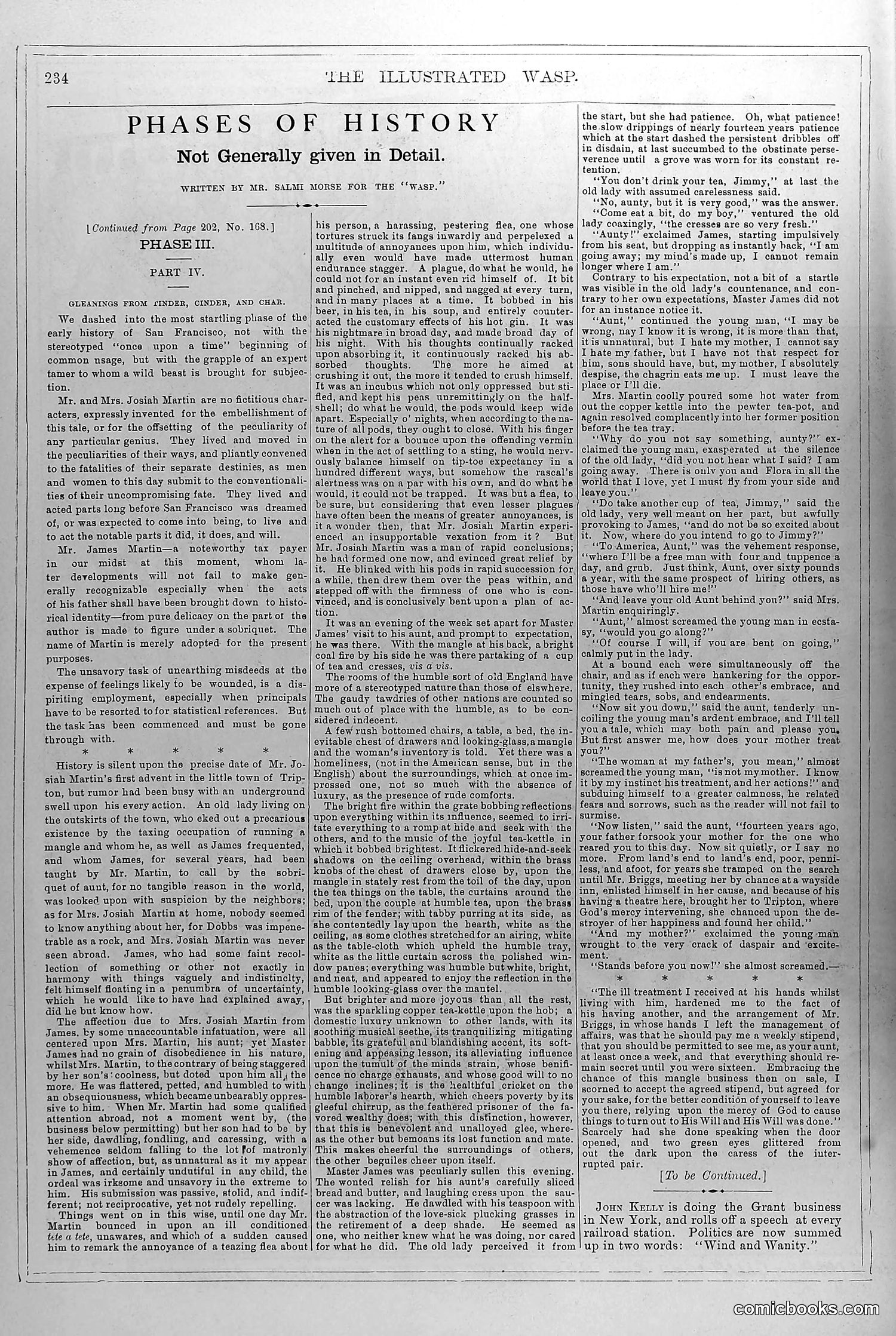
This page contains serialized fiction rather than political cartoons. It's Part IV of "Phases of History," a narrative story by Salmi Morse about the Martin family—specifically focusing on Mr. and Mrs. Josiah Martin and their interactions with servants and social acquaintances. The text describes domestic scenes: tensions between the Martins and their hired help, interactions with neighbors, and period social conventions. There's dialogue revealing class tensions and social awkwardness typical of the era. **No political cartoons or caricatures appear on this page.** It's primarily text-based satirical fiction exploring social hierarchies and domestic life rather than topical political commentary. The humor derives from character interactions and social observations rather than current events satire.
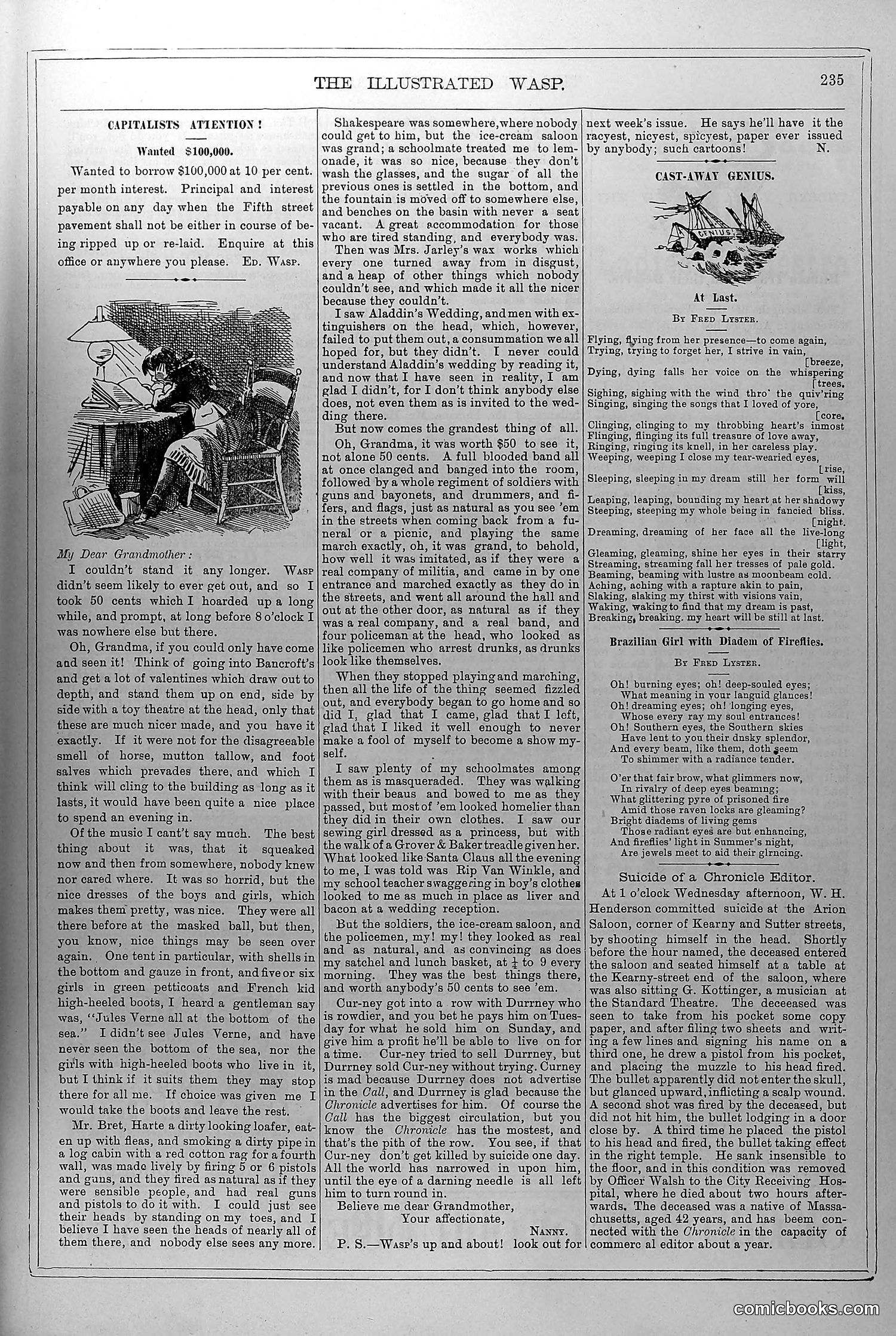
This page contains several distinct pieces rather than a unified cartoon. The main illustration shows a well-dressed woman being propositioned by a man—appearing to depict a social or romantic encounter, likely satirizing courtship customs of the era. The "My Dear Grandmother" letter is a humorous complaint about attending a masked ball where the writer encountered soldiers, sailors, and working-class people dressed in fine clothes, mixing social classes uncomfortably. This satirizes anxieties about class boundaries and the democratizing effect of masquerade balls. The poetry sections ("Cast-Away Genius," "Brazilian Girl with Maiden of Fireflies," "Suicide of a Chronicle Editor") appear to be satirical verse commenting on contemporary events or social types. The "Suicide of a Chronicle Editor" references a real suicide, suggesting The Wasp was responding to local San Francisco news with dark humor typical of 19th-century satirical magazines.
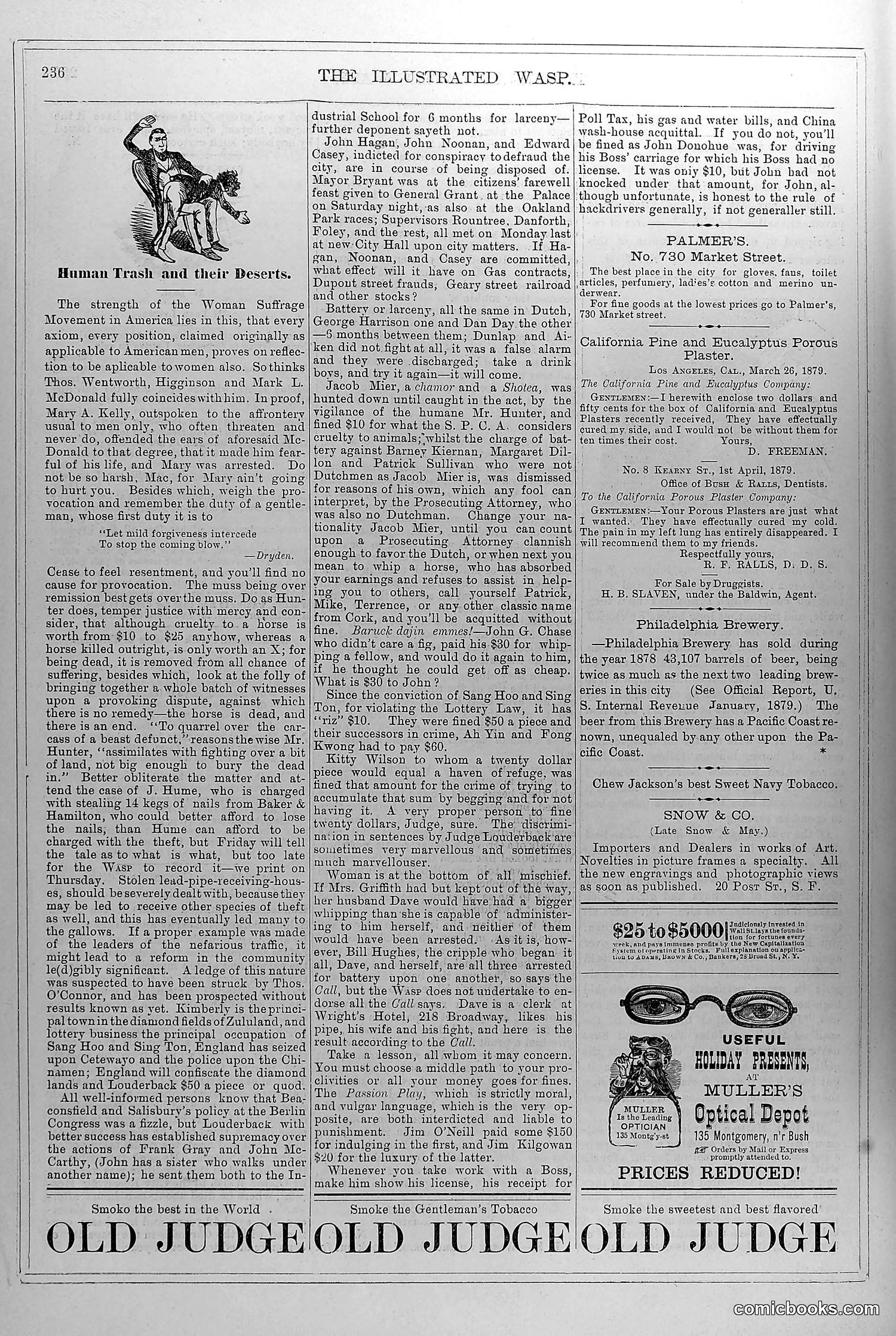
This page is primarily **advertising and miscellaneous content** rather than political satire. The main illustrated article, "Human Trash and their Deserts," appears to critique the Women's Suffrage Movement in America, arguing sarcastically that women deserve equal legal protections—though the author seems opposed to this idea. The text references specific local San Francisco cases involving fraud, theft, and legal disputes from 1879. Without clearer image resolution of the cartoon header, I cannot identify the specific figures depicted. The bulk of the page contains **commercial advertisements** for Palmer's products, California Pine and Eucalyptus plasters, Philadelphia Brewery, and notably, **three identical "Old Judge" tobacco advertisements** at the bottom, suggesting this was a paid advertorial page rather than primarily satirical content.
This page is primarily **advertising content** rather than political satire or editorial cartoons. The layout consists of commercial advertisements for San Francisco businesses (1890s era), including: - Restaurant and entertainment venues - A dress and cloak maker - Patent medicines (Emil Frese's Hamburg Tea, heavily promoted) - Optical goods and art supplies - The Mackinnon Pen - Cigarettes (Old Judge brand) The only illustrated element is a **bust portrait of a woman** accompanying the Tivoli Gardens advertisement—likely promoting their Vienna Ladies' Orchestra performance rather than serving satirical purpose. The page demonstrates how satirical magazines like *The Wasp* relied heavily on advertising revenue, with commercial content dominating editorial space. There is no discernible political commentary or social satire present on this particular page.
This page is predominantly **advertising**, not political satire. It contains commercial notices for San Francisco Bay Area businesses from what appears to be a late 19th-century issue of *The Wasp* magazine. The largest advertisement features **Nicoll, the Tailor** on Market Street, promoting clothing prices and "The Electric Light" as a shopping attraction. Other ads include the Chicago Brewery, music boxes, shirt factories, billiard tables, and various services. There is one small illustrated item showing a **ventilated perforated saw** with decorative circular blades, accompanied by text about treating corns and bunions—a medical/health product advertisement. The page functions primarily as a revenue source through paid advertisements rather than as satirical content.
This page is primarily **advertising content** rather than satirical editorial material. It contains multiple commercial advertisements from San Francisco businesses circa the late 1800s, including: - H.T. Helmbold's Compound Fluid Extract "Buchu" (a patent medicine claiming to cure bladder and kidney diseases) - Cherrmann & Co. (hat seller) - S.B. Wattson & Co. (cigars and tobacco) - J. Renz (wine and liquors dealer) - Gundlach's Spiced American Table Wines The decorative illustrations accompanying these ads are **commercial artwork**, not political cartoons. They feature period-typical imagery (gentlemen in top hats, cherubs, grape vines) designed to make products appealing. The page demonstrates how *The Wasp* generated revenue through paid advertising, which often filled substantial portions of satirical publications of this era.
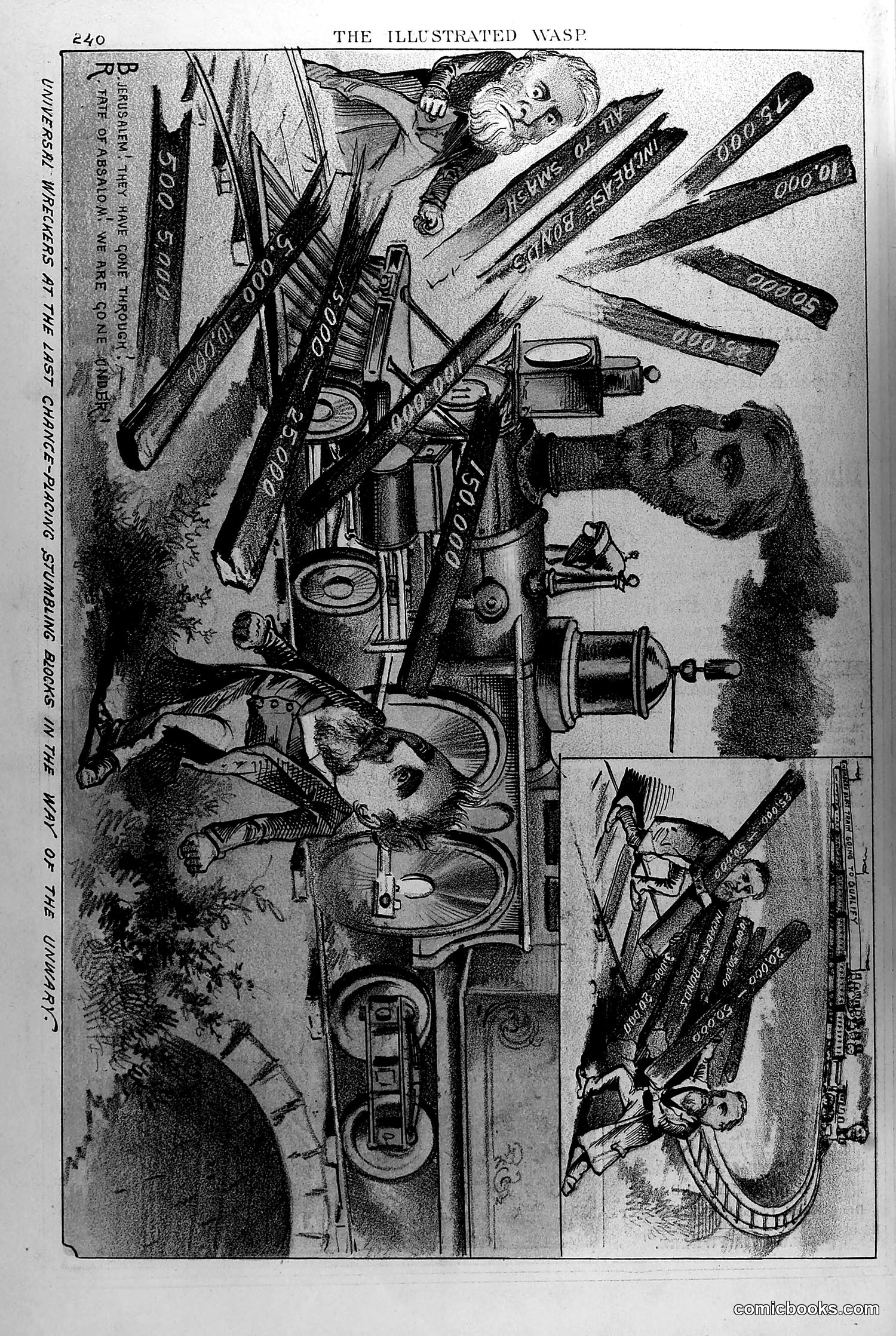
This page appears to contain a political cartoon satirizing military spending or armament expenditures. The image shows what looks like a large cannon or artillery piece labeled with monetary amounts (appearing to show "000,000" figures), suggesting criticism of vast sums spent on weapons. Several human figures are depicted around and operating this military equipment. Without clearer text identification, the specific political figures or context remain unclear, though the general satire appears to mock excessive military budgeting or arms proliferation. The cartoon's orientation (printed sideways) and the Wasp magazine's reputation for sharp political commentary suggest this critiques either government military spending priorities or a specific arms controversy of its era. The exact historical event referenced requires additional contextual information beyond what's clearly legible here.

I can see this image contains a photographic test card or calibration chart with a checkerboard pattern of varying gray tones on the left side and a measurement ruler on the right side showing marks from 6 to 11 inches, plus a horizontal ruler at the bottom showing marks from 6 to 10. This appears to be a technical documentation page rather than actual satirical cartoon content from The Wasp magazine. It's likely a reference image used for photographic reproduction quality control or archival documentation purposes. Without visible satirical imagery, political caricatures, or editorial content, I cannot identify specific historical figures, events, or the social commentary that would typically characterize a Wasp magazine page.