
A complete issue · 18 pages · 1879
The Wasp — October 25, 1879

I can see this page contains an Oregon Rule Company ruler placed against a black background with what appears to be a grayscale color reference chart or test pattern to its right. However, I cannot read any clear OCR text from the image that would help identify specific cartoon content, political figures, or satirical commentary. Without legible text or visible cartoon illustrations that I can definitively interpret, I cannot reliably explain what satirical point this page from *The Wasp* was making or what social/political references it contained. The page appears to be primarily a technical measurement/documentation image rather than displaying readable cartoon art or text suitable for historical analysis. To properly explain the satire, I would need clearer visibility of any artwork or printed text.
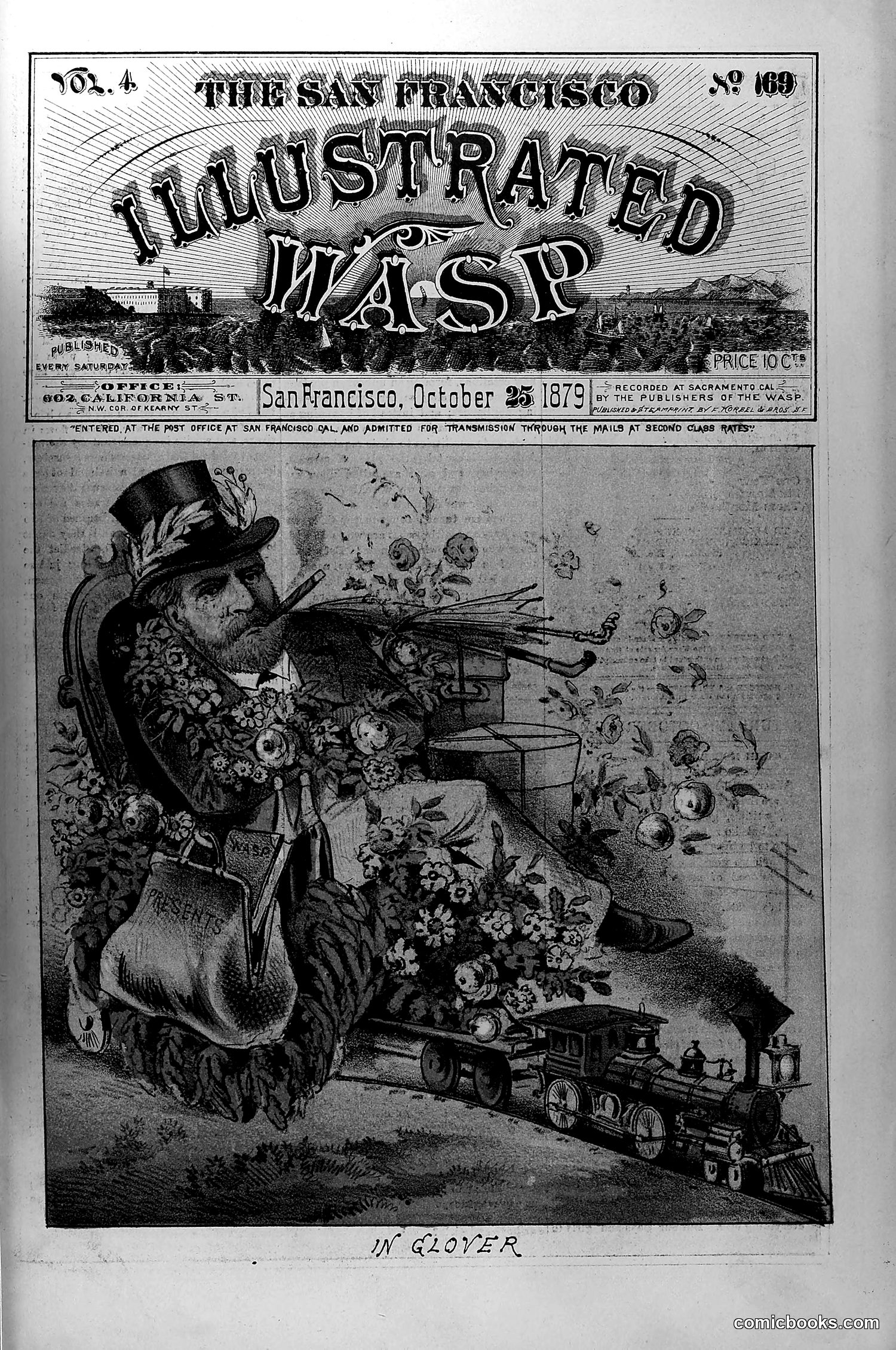
This satirical cartoon depicts a bearded man in a top hat playing a trumpet, surrounded by abundant flowers and fruit flowing from his instrument into a train car below. The title "IN GLOVER" suggests this references someone named Glover, likely a California political or business figure of 1879. The satire appears to mock agricultural prosperity or promises—the cornucopia imagery of overflowing harvest from the trumpet suggests grandiose claims about California's bounty or economic potential. The man's theatrical pose and the exaggerated abundance imply he's making inflated, boastful pronouncements about agricultural wealth or regional development. Without identifying Glover specifically, the cartoon satirizes hyperbolic promotional rhetoric about California's agricultural advantages.
This page is primarily an **editorial article** by Managing Editor Salmi Morse, not a political cartoon. The masthead illustration shows the Wasp logo/mascot. The piece debates whether boys and girls should be educated in traditional academics or practical trades. Morse argues for **automatic labor and machinery** to replace manual work, questioning why children should learn obsolete skills. He critiques the emerging tension between manual labor and emerging industrial automation—suggesting that as machines replace workers, education focused on traditional trades becomes pointless. The underlying social concern is the **industrial revolution's displacement of workers**, particularly young people entering a labor market rapidly transformed by mechanization. Morse advocates reorienting education toward the new technological reality rather than clinging to craft traditions.
This page appears to be primarily **text content rather than a political cartoon**. It's a lengthy narrative story titled "THREE TWELVE-YEAR-OLD'S OF FORTY YEARS AGO," recounting the author's childhood adventures in the Mohawk valley during fall, including an encounter with a sternwheeler steamboat. The narrative includes dialogue about Indian encounters, descriptions of railroad travel, and nostalgic reflections on youth. There's discussion of steamships, Yorkshire and Great Western vessels, and various boyhood pranks involving candy and mischief. **No clear political satire or caricature is evident** on this particular page. It functions as a **memoir-style feature story** rather than satirical commentary, typical of how 19th-century magazines mixed entertainment content with their satirical missions.
This page is primarily **text-based narrative fiction** rather than political satire or cartooning. It's a serialized story titled "The Illustrated Wasp," appearing to be a domestic comedy involving characters named Topsy, Aunt Matty, and various family members during a train journey. The narrative focuses on mundane social situations—travel preparations, family dynamics, and interpersonal humor—rather than political commentary. There's no identifiable political satire, caricature of public figures, or topical social criticism visible. The content represents typical late-19th century magazine entertainment: lighthearted domestic fiction designed for general readership amusement. Without additional context about *The Wasp's* broader editorial mission or other pages, this particular installment appears devoted to storytelling rather than satirical commentary.
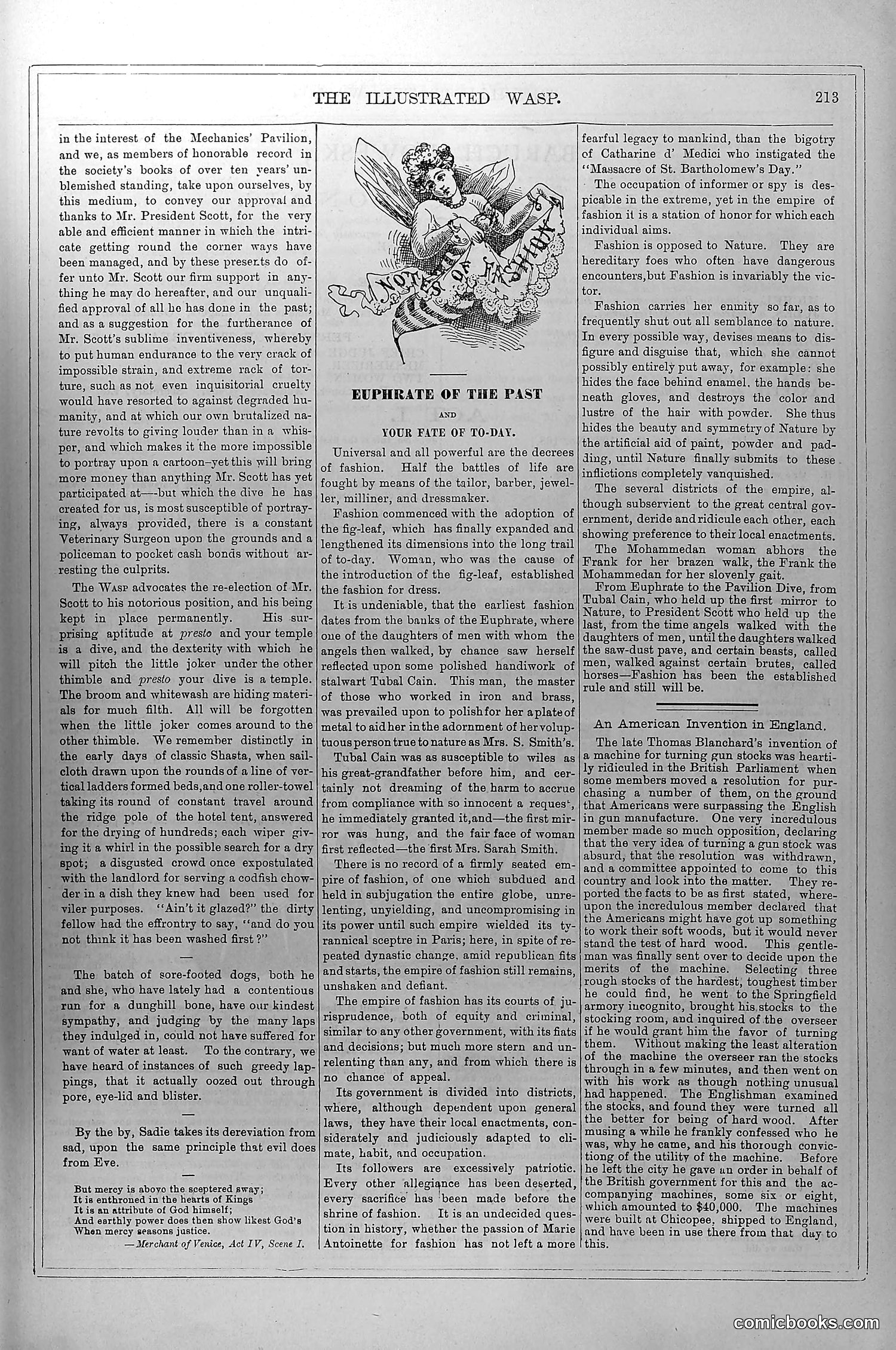
The central illustration, titled "EUPHRATE OF THE PAST AND YOUR FATE OF TO-DAY," depicts a skeletal or death-like figure representing Fashion, shown as a destructive force throughout history. The accompanying text argues that Fashion is humanity's enemy, a "hereditary foe" that causes people to abandon reason and nature. The article traces Fashion's tyranny from ancient times (referencing the Euphrates civilization and the "bigtry of Catharine d' Medici") through contemporary Victorian society. The satire criticizes how Fashion compels people—particularly women—to adopt absurd, uncomfortable, and unhealthy practices in pursuit of style, making them complicit in their own suffering. The piece advocates for rejecting Fashion's dictates in favor of rational dress and natural beauty.
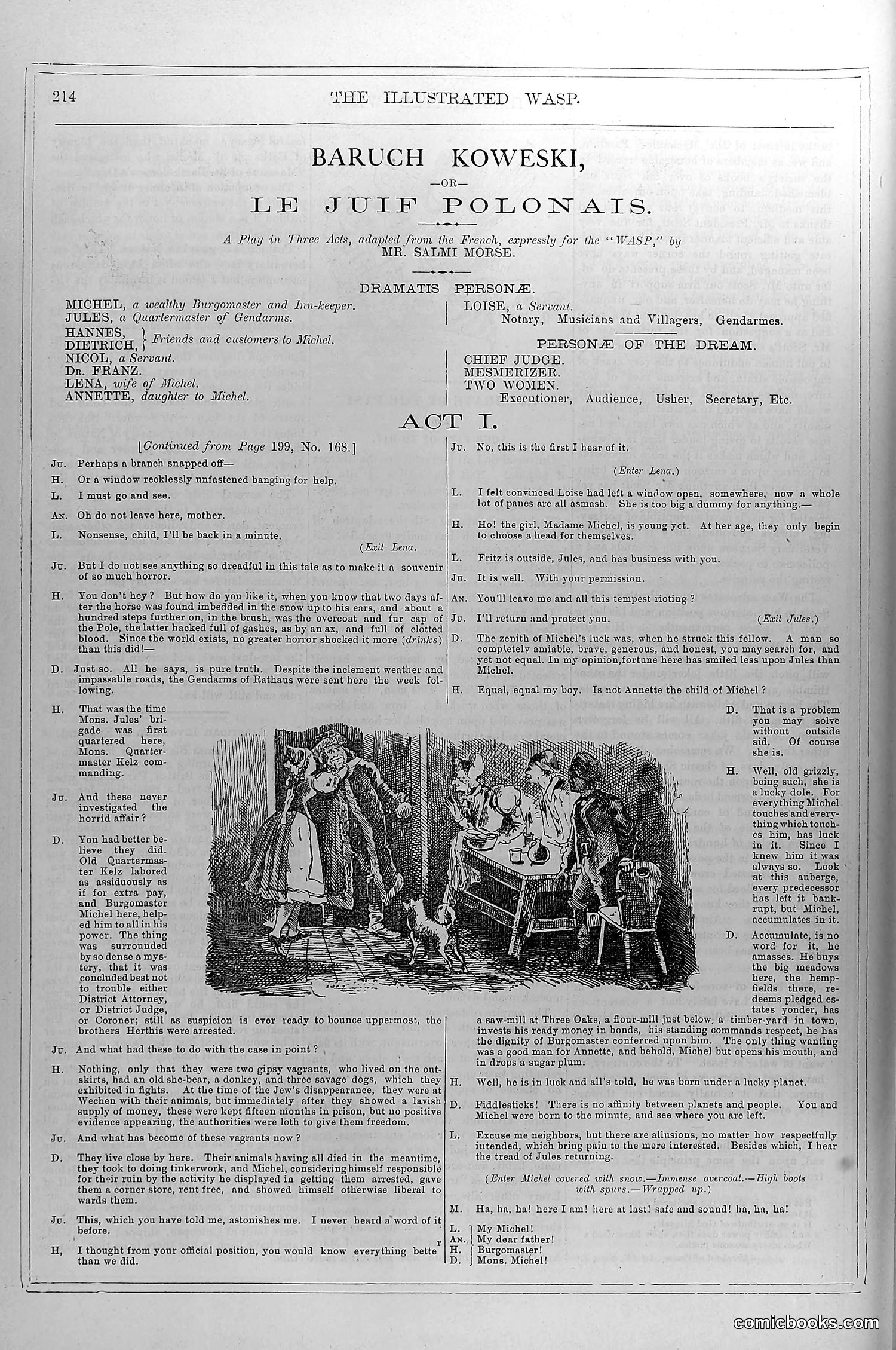
This is a theater script page from *The Wasp*, presenting "Baruch Kowski, or Le Juif Polonais" (The Polish Jew)—a play adapted from French for the magazine by Salmi Morse. The page shows Act I dialogue and includes a wood-engraved illustration depicting what appears to be a domestic interior scene with multiple figures in Victorian-era clothing. Rather than political satire, this represents *The Wasp's* theatrical content—the magazine published plays alongside its cartoons. The title references a Polish-Jewish character, reflecting 19th-century theatrical interest in ethnic stereotypes and comedic character types common to the period. Without additional context about the specific plot or *The Wasp's* editorial stance toward this material, the exact satirical intent remains unclear.
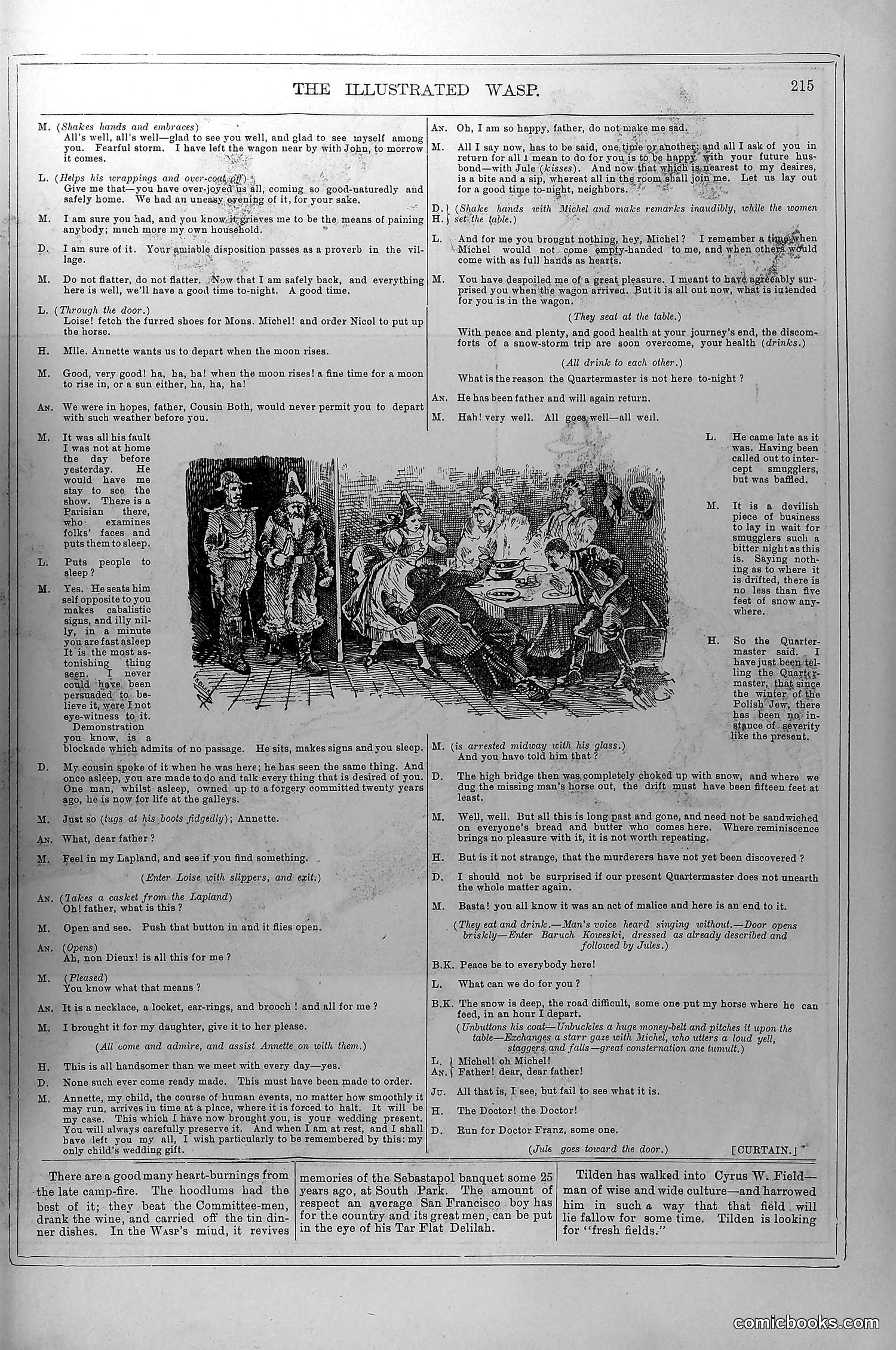
This page contains a dramatic scene from what appears to be a serialized story or play called "The Illustrated Wasp." The narrative depicts characters in an inn or tavern during winter, dealing with a missing man and a snowstorm. The central illustration shows multiple figures gathered indoors, seemingly discussing a critical situation. The dialogue references a Quartermaster who hasn't appeared, a missing horse, and a search effort in deep snow—suggesting this is a mystery or adventure narrative rather than political satire. The surrounding text consists entirely of dramatic dialogue advancing a plot involving deception, weather hardship, and missing persons. Without additional context about the serialized story's premise, characters, or timeframe, the specific satirical or political references remain unclear.
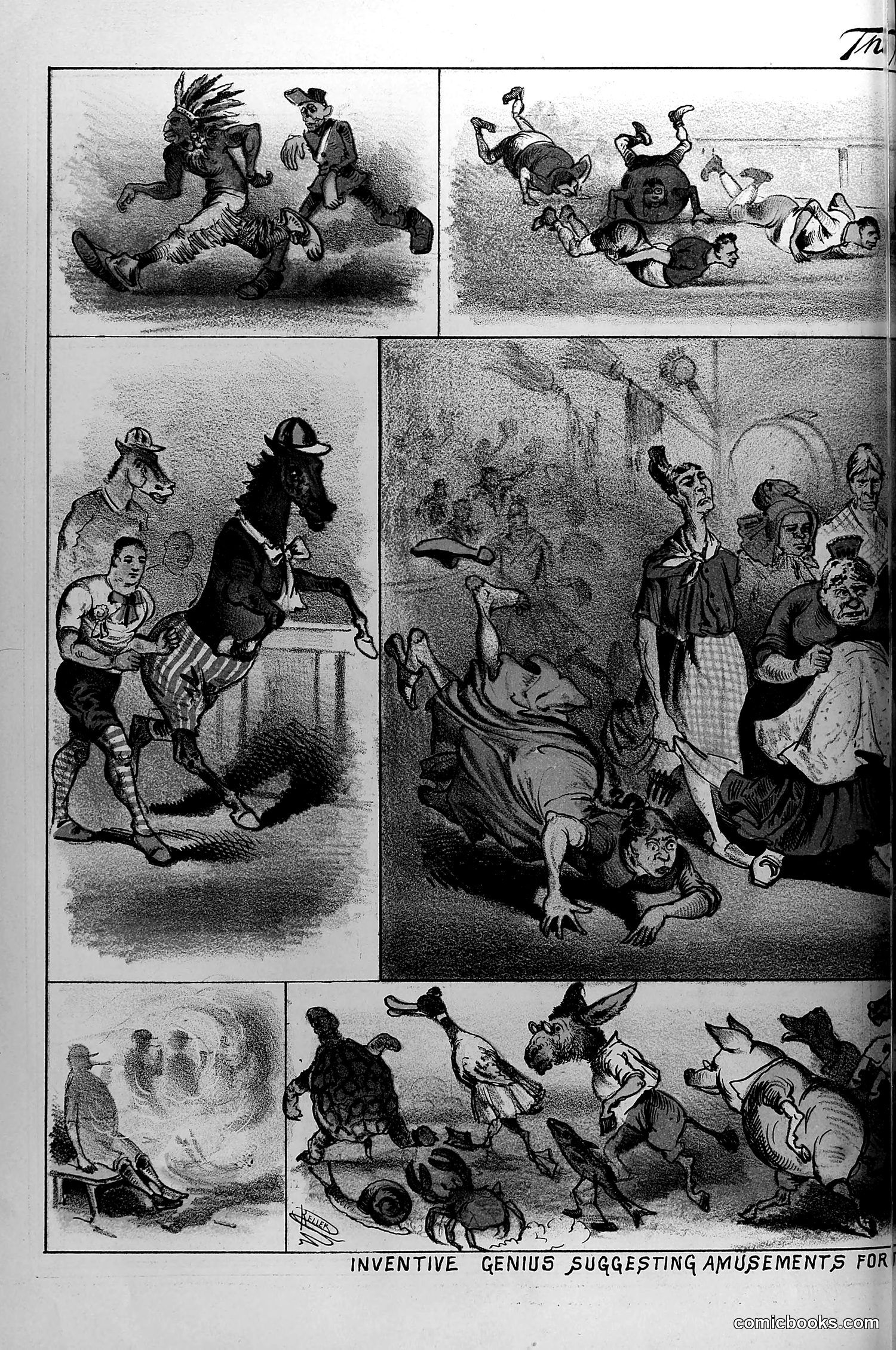
This satirical comic strip (title incomplete) depicts various acrobatic and circus-style performances, likely mocking entertainment proposals or performers of the era. The panels show people in exaggerated positions—tumbling, performing with animals, and engaging in physical stunts. The title suggests someone is "inventively" proposing novel amusements, possibly satirizing: - Entertainment industry figures or promoters pitching ridiculous ideas - Vaudeville or circus performance trends - Public taste in spectacle and physical comedy The crude, undignified positions of the performers, combined with the caricatured faces and anthropomorphic animals, suggest mockery of either the entertainers themselves or those promoting such performances as serious art. Without the complete title or byline visible, the specific target remains unclear, but the humor derives from absurdist physical comedy.
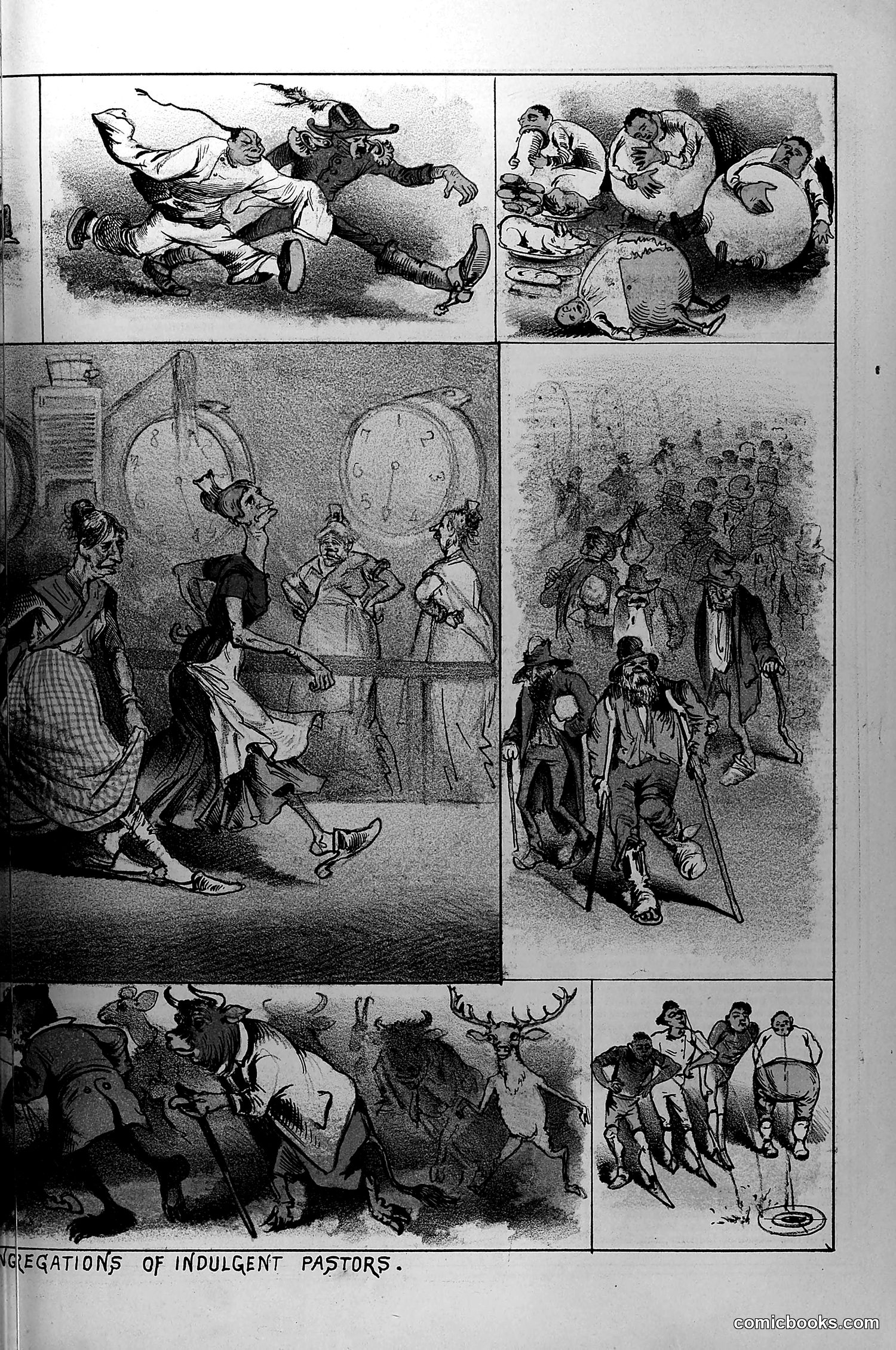
This satirical comic strip critiques clergy who are overly lenient with their congregants. The six-panel narrative follows what appears to be a pastor's increasingly poor judgment: The panels depict scenes of moral laxity—including what looks like drunkenness, gambling with large spheres (possibly representing wealth or vice), people gathering in disorderly crowds, and interactions with animals in absurd situations. The title "Elegations" (likely "Allegations") of "Indulgent Pastors" suggests the cartoonist is attacking religious leaders who fail to enforce moral discipline among their flocks. This reflects 19th-century American debates about pastoral responsibility and church authority. The exaggerated, grotesque caricatures emphasize the cartoonist's disapproval of such permissiveness, portraying it as leading to societal disorder and moral decay.
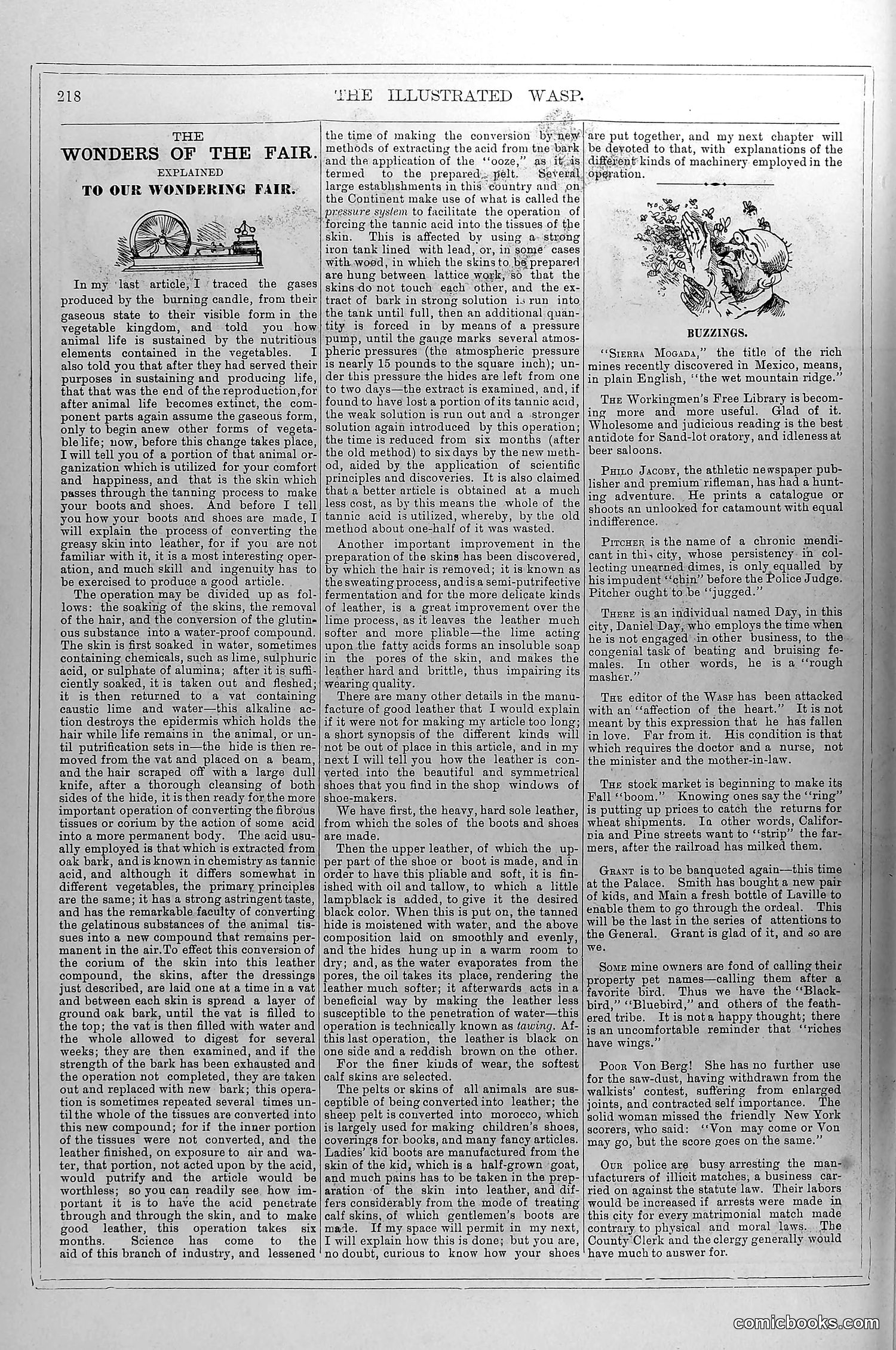
This page is primarily **educational text**, not satire. The article explains tanning and leather-working processes at length—how animal hides are converted to wearable leather through soaking, treating with acids and alkali solutions, and drying techniques. The small illustrations show tanning vats and leather products. The text mentions "our wondering fair," suggesting this explanatory series accompanied the 1893 World's Columbian Exposition in Chicago, where visitors could observe industrial processes. The sidebar items are brief social notes and advertisements unrelated to the main article—mentions of a mining discovery, a lending library, and police activity. This is **technical journalism**, not political cartoon content.
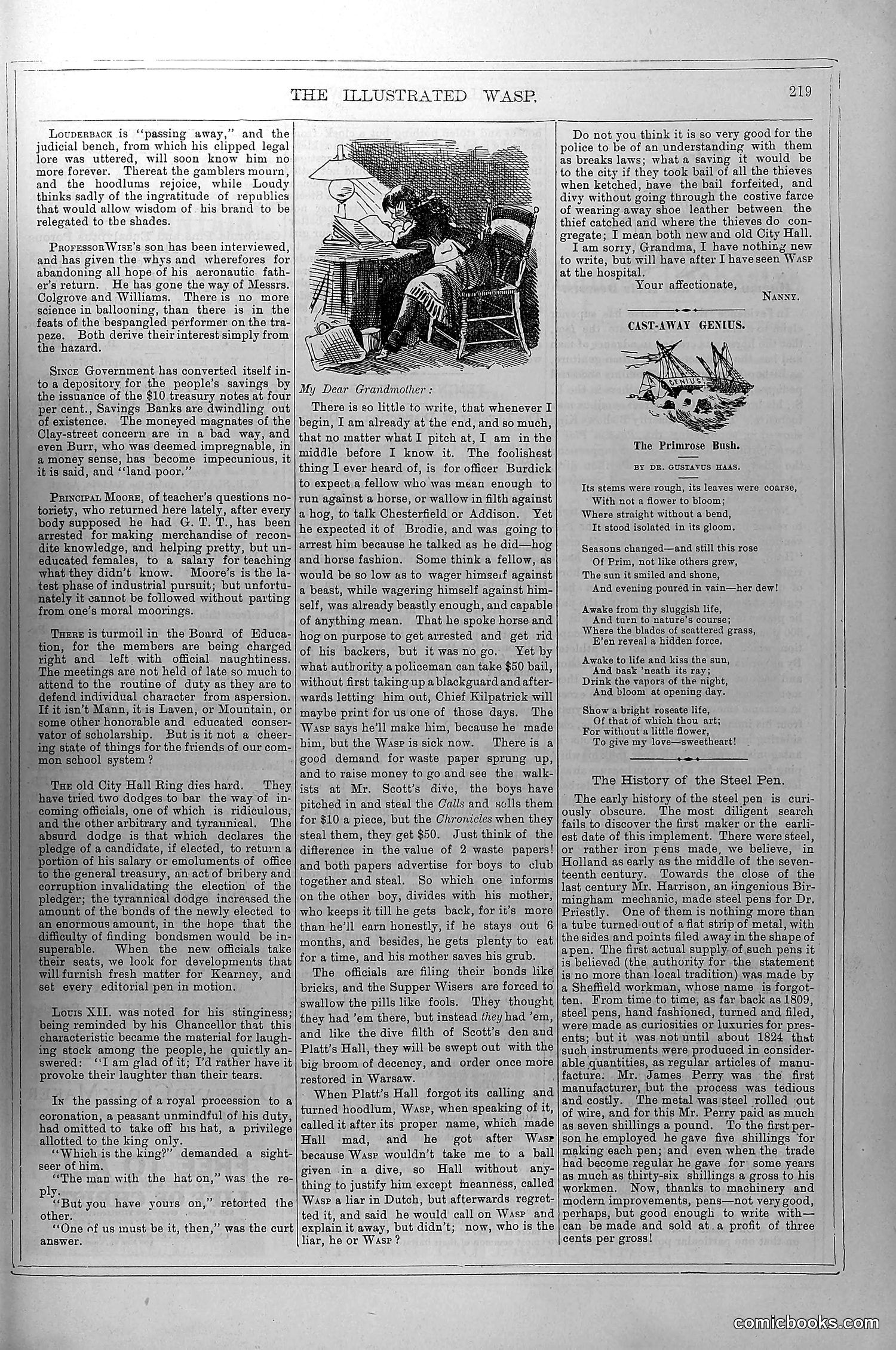
The main cartoon depicts a grandmother figure confronting a well-dressed man about his behavior toward her. Based on the accompanying letter, this satirizes a specific scandal: a man (likely named Brodie, though the exact identity isn't entirely clear from the visible text) who bragged about committing a crime but escaped punishment through aristocratic connections or legal technicalities. The satire criticizes the justice system's apparent favoritism toward well-connected individuals. The grandmother's confrontation represents public moral outrage over his unpunished misdeeds. The page suggests that wealth and social status allowed this man to evade consequences that would have ruined an ordinary person—a common theme in Wasp's social criticism.
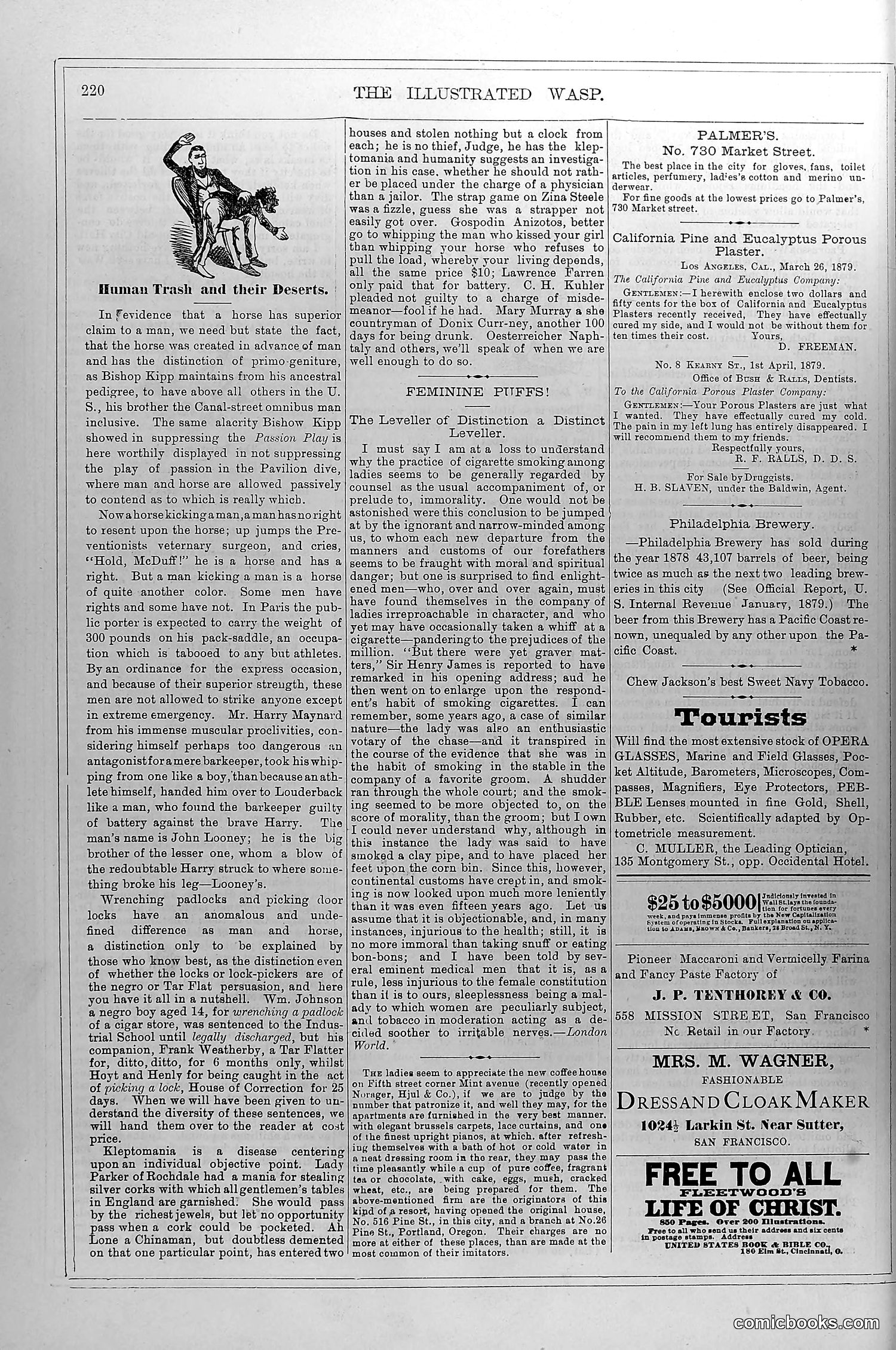
This page contains primarily **advertisements and editorial content rather than political cartoons**. The small illustration at the top left shows a figure labeled "Human Trash and their Deserts," depicting someone in tattered clothing—likely satirizing homelessness or poverty. The bulk of the page consists of **classified advertisements** (Palmer's gloves, California Pine Plaster, Philadelphia Brewery, etc.) and **social commentary articles**. One notable piece titled "Feminine Puffs" discusses women smoking cigarettes, treating it as a novel and morally questionable behavior worth editorial attention. The overall tone reflects **late 19th-century San Francisco attitudes** toward social issues, health, and commercial enterprise, presented through both advertising and commentary rather than visual satire.
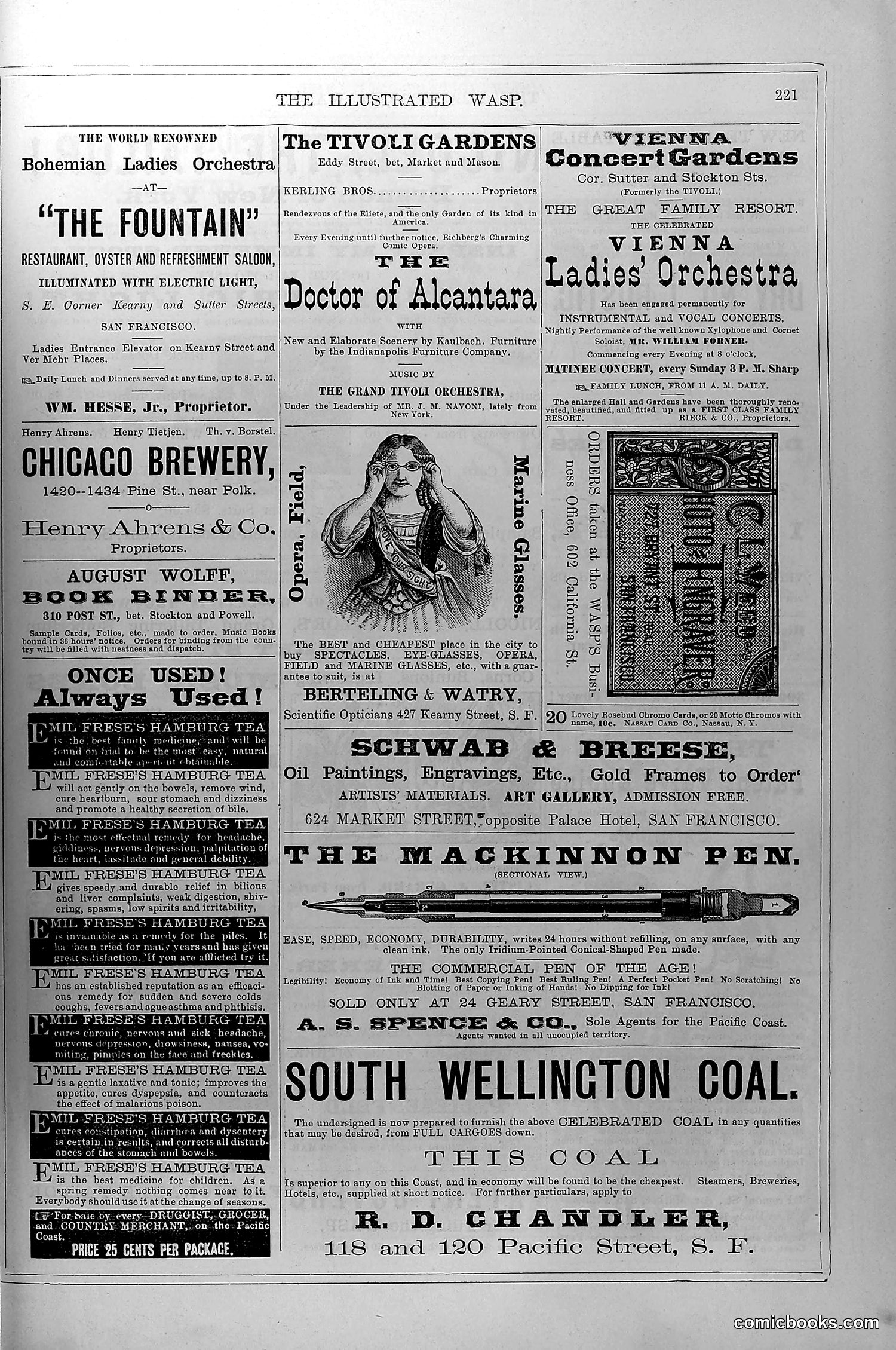
This page is **primarily advertising** with no political cartoons or satirical comic content visible. The page contains commercial advertisements for San Francisco-area businesses from what appears to be the late 19th or early 20th century, including: - Restaurants and bars (The Fountain, Chicago Brewery) - Entertainment venues (Tivoli Gardens, Vienna Concert Gardens with a Ladies' Orchestra) - Retail services (book binding, optician, art gallery) - Commercial products (The Mackinnon Pen, South Wellington Coal) The only illustration is a portrait of a woman's face accompanying the Vienna Concert Gardens Ladies' Orchestra advertisement—likely promoting their performances. There is no political satire or social commentary evident on this page. It functions as a standard advertising section of the magazine.
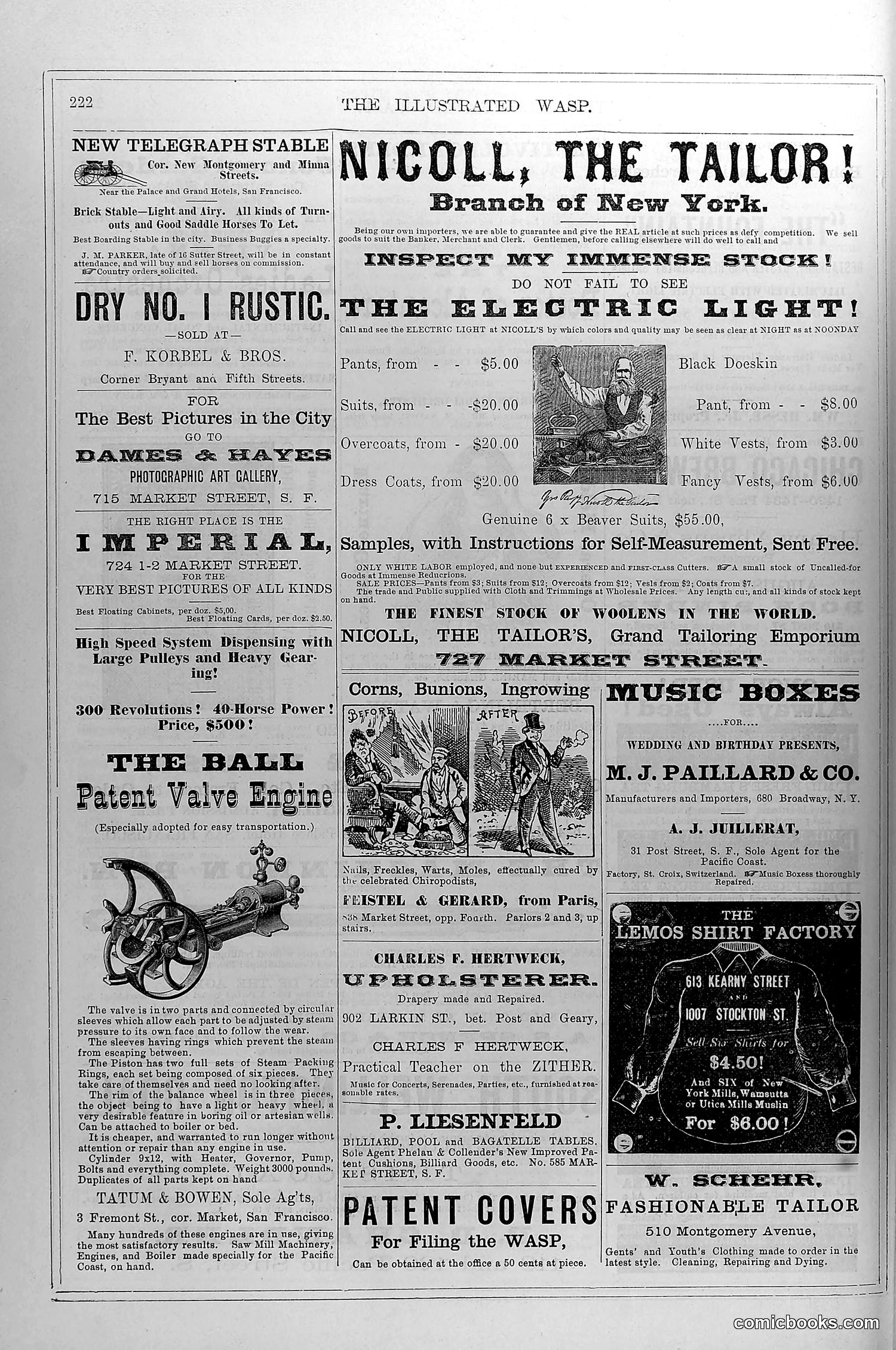
This page is primarily **advertising content** rather than political satire or editorial cartooning. It features multiple commercial advertisements from late 19th-century San Francisco businesses, including: - Nicoll the Tailor (prominently featured with pricing) - Photography galleries - A patent valve engine manufacturer - Medical treatments (for corns, bunions, and ingrown nails by Feissel & Gerard) - Music boxes and shirt factories The only cartoon imagery shows a medical/chiropody theme—a "before and after" sequence illustrating foot ailment treatment, used to advertise Feissel & Gerard's services. **No political figures or satirical commentary are present.** This appears to be a standard advertising section from *The Wasp* magazine, demonstrating how 19th-century publications funded operations through paid advertisements rather than editorial content alone.
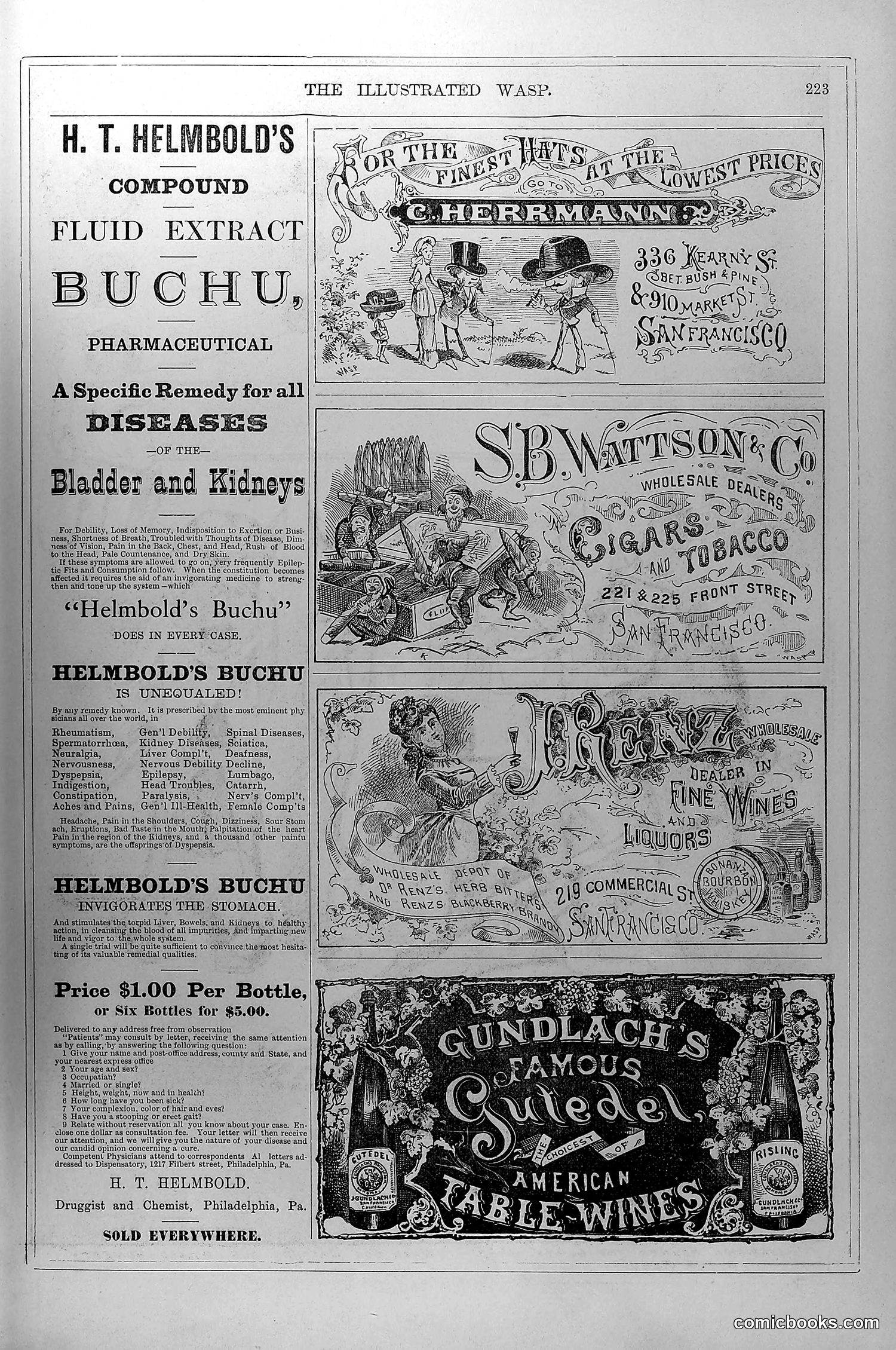
This page is primarily **advertising**, not political satire. It contains four commercial advertisements: 1. **H.T. Helmbold's Compound Fluid Extract Buchu** — a patent medicine claiming to cure bladder and kidney diseases 2. **Cheermann & Co.** — fine arts dealer in San Francisco 3. **S.B. Wattson & Co.** — wholesale cigars and tobacco 4. **J. Renz** — fine wines and liquors dealer 5. **Gundlach's Famous Smedel** — American table wines The ads feature typical 19th-century visual rhetoric: engravings of satisfied customers, ornate typography, and exaggerated health claims. The Buchu advertisement exemplifies the era's unregulated patent medicine industry, making sweeping medical promises without scientific basis. This page reflects how satirical publications funded themselves through advertisements, even for dubious products.
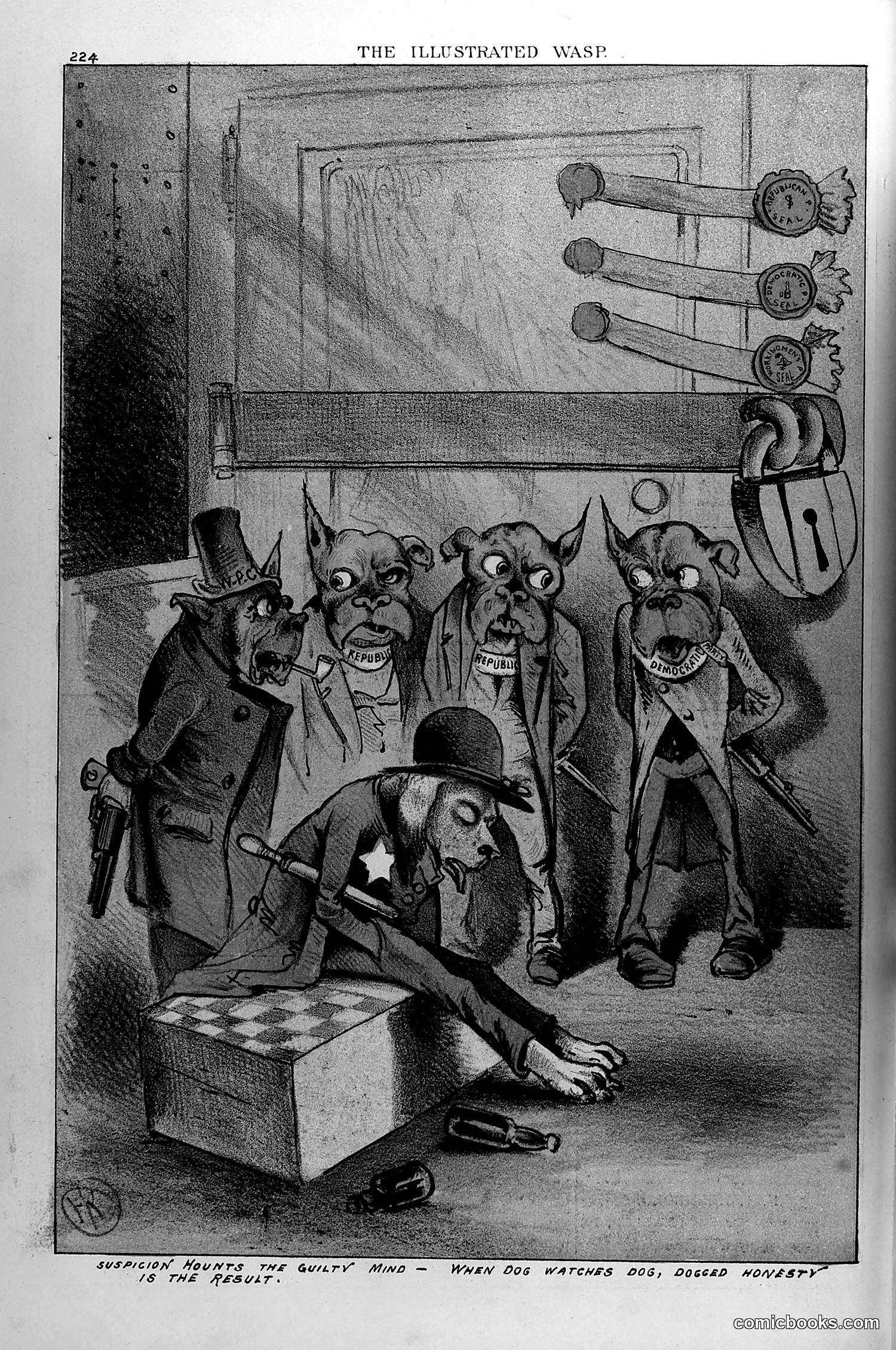
This political cartoon depicts anthropomorphized dogs in formal attire, labeled "REPUBLIC," watching a smaller figure on the ground wearing a star (suggesting Uncle Sam or American leadership). The figure appears caught or cornered, with bottles scattered nearby. The caption reads: "When dog watches dog, dogged honesty is the result." This appears to be commentary on political accountability and oversight, likely from the early 20th century. The cartoon suggests that vigilant scrutiny among political figures (the "dogs" watching each other) theoretically ensures honest conduct. However, the composition—with one figure prone and surrounded by accusatory observers—may satirize how such oversight can become persecution or how guilt (real or imagined) creates paranoia within political circles.

I can see this page contains a measurement scale/calibration reference card with grayscale squares and a ruler marked with numbers 6-11. This appears to be a technical documentation page rather than satirical cartoon content. The grayscale squares of varying tones served as a reference for photographers and printers to ensure accurate reproduction of tonal values and color balance in printed materials. The ruler provides scale reference. This type of page was commonly included in archival or documentary publications to help standardize image quality and allow readers to assess reproduction accuracy. Without visible cartoon imagery, text, or political commentary on this particular page, I cannot identify satirical content, caricatures, or social references that would be typical of *The Wasp* magazine's editorial material.