
A complete issue · 18 pages · 1879
The Wasp — October 11, 1879

I can see this is a measurement/calibration page from The Wasp magazine, showing an Oregon Rule Co. ruler and a grayscale color reference chart (the grid of varying gray and white squares on the right). This appears to be a technical page used for photograph reproduction and quality control during the printing process, rather than satirical content. The ruler and color checker were essential tools for maintaining consistency when reproducing photographs in print media. This type of calibration page would be photographed alongside actual magazine content to ensure proper exposure, contrast, and tonal reproduction during the printing process. Without visible cartoon or satirical content, this page documents the technical standards The Wasp used in its production rather than conveying political or social commentary.
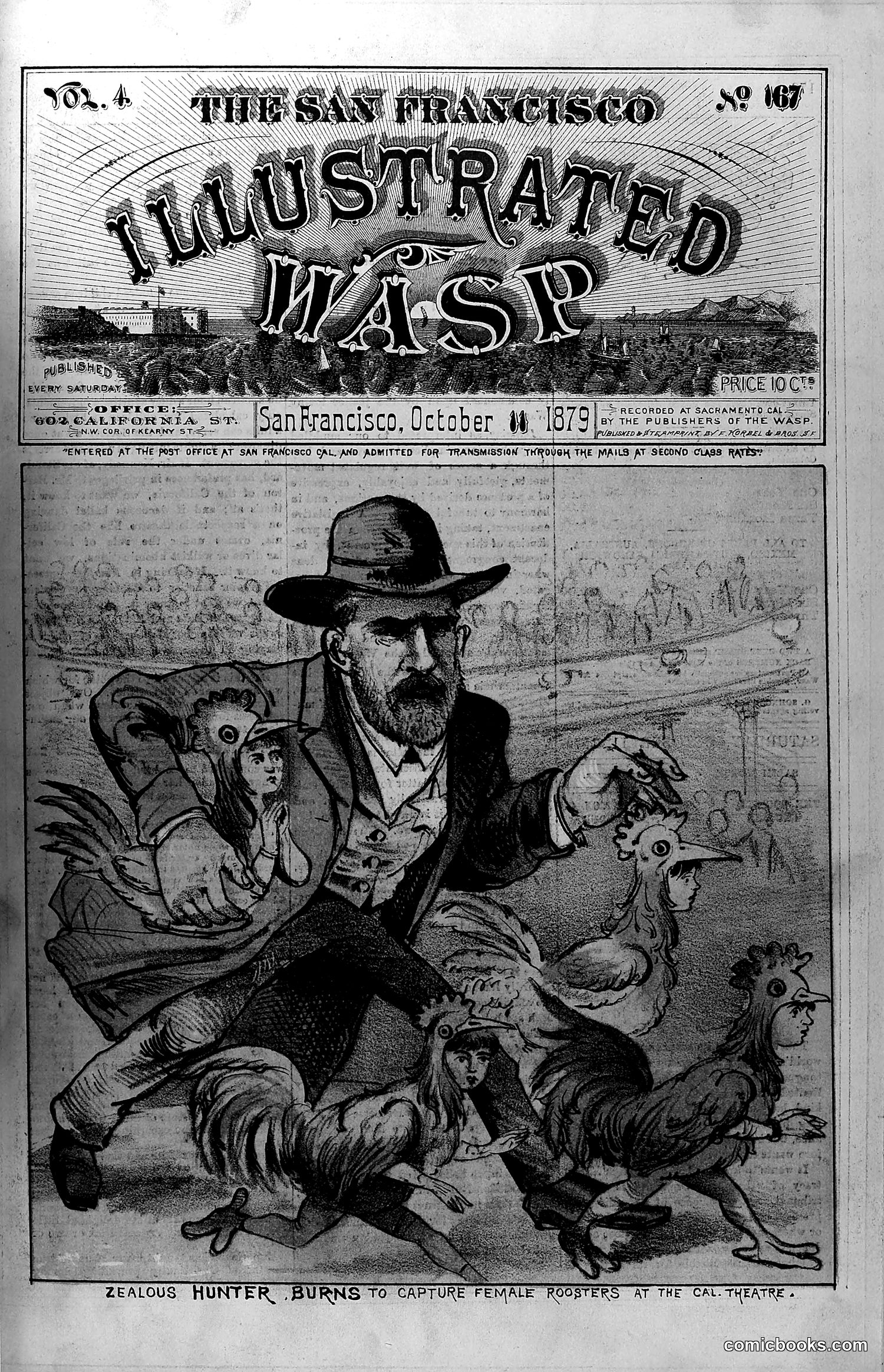
This satirical cartoon depicts a bearded man in a cowboy hat juggling multiple figures with human heads and rooster bodies. The caption reads "Zealous Hunter Burns to Capture Female Roosters at the Cal. Theatre." The cartoon appears to mock someone (identity unclear from available text) attempting to capture female roosters—likely a crude euphemism for women or a specific female performer—at the California Theatre. The juggling imagery suggests chaotic, frenetic activity, while the rooster-headed figures may represent either the women being pursued or perhaps the absurdity of the endeavor itself. The satire targets the subject's overeager or inappropriate behavior, presenting it as ridiculous spectacle for public mockery.
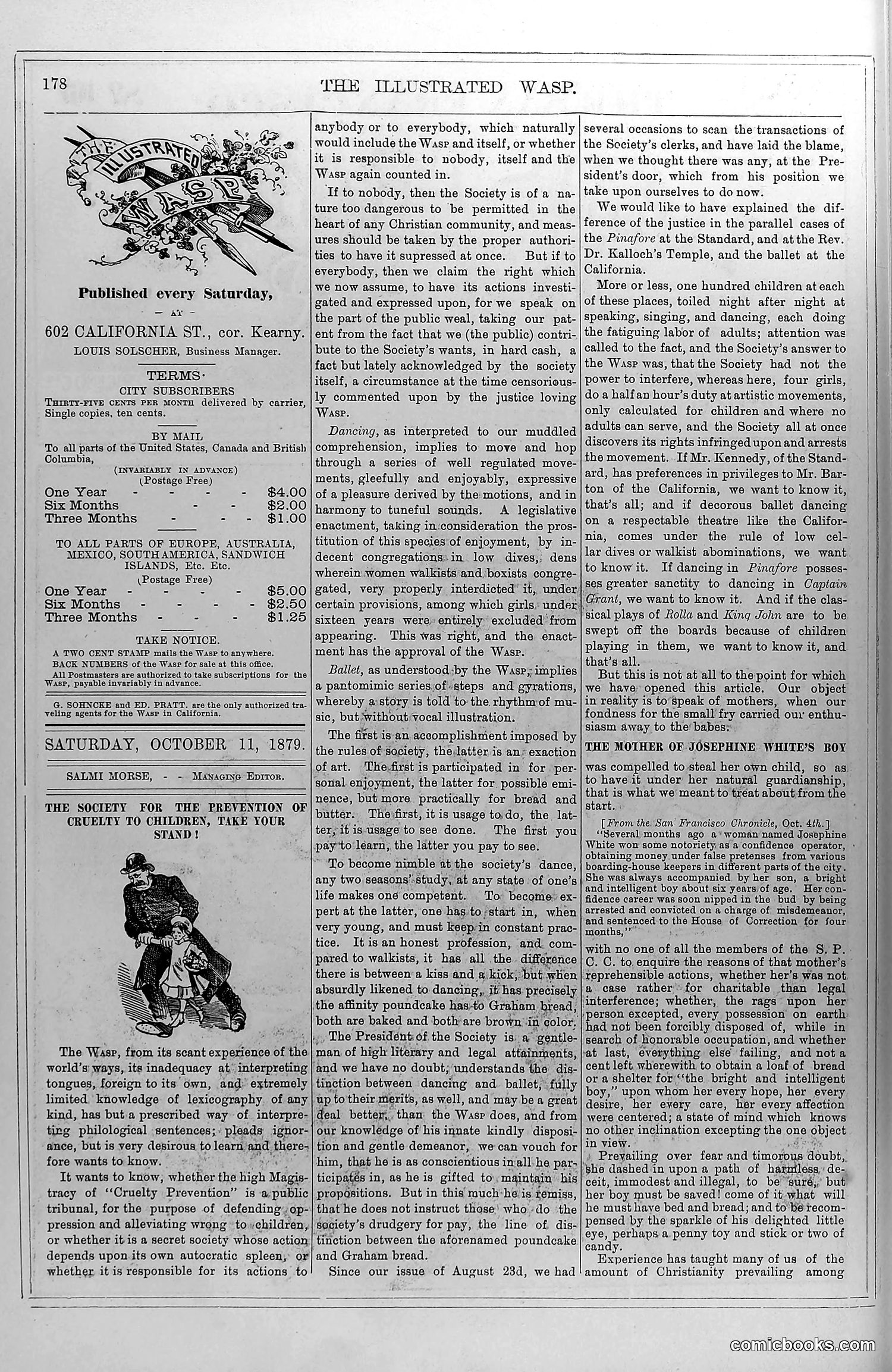
This page contains editorial commentary rather than political cartoons. The main illustrated content shows two vignettes: one depicting a wasp at the masthead, and another showing what appears to be a poorly dressed woman with a child. The lengthy text addresses "The Society for the Prevention of Cruelty to Children," satirizing the organization's selective enforcement. The editorial argues the Society focuses on trivial offenses while ignoring systemic poverty and parental desperation—particularly targeting poor mothers forced into moral compromises for survival. The piece criticizes the Society for prosecuting charitable case workers while ignoring the actual causes of child suffering: poverty and class inequality. This reflects 1879 progressive critique of charity organizations that punished the poor rather than addressing structural injustice.
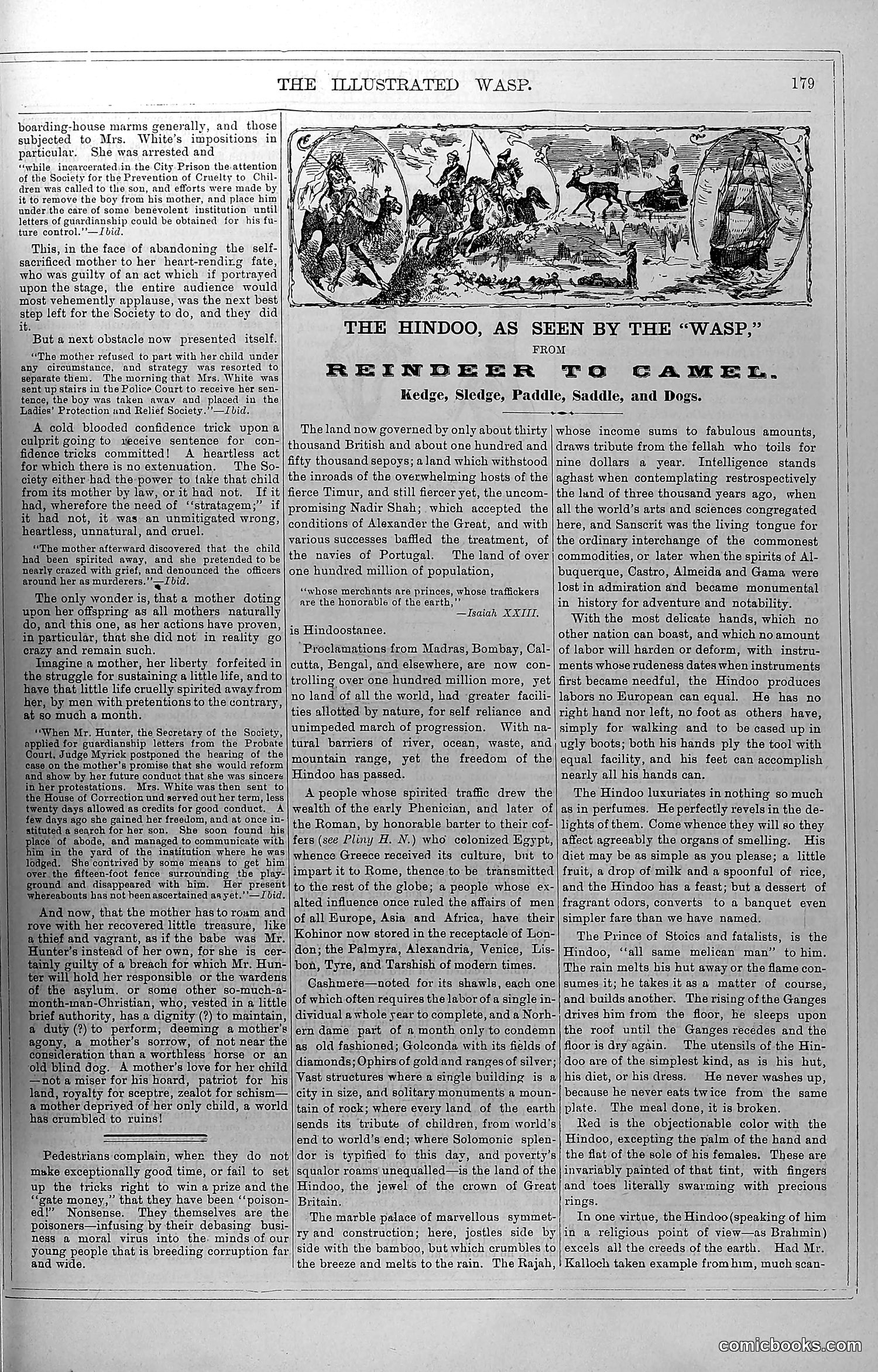
This page features an illustrated section titled "The Hindoo, As Seen By the 'Wasp,' from Reindeer to Camel: Hedge, Sledge, Paddle, Saddle, and Dogs." The engraving depicts various scenes of Indian life and culture as perceived by the magazine. The accompanying text discusses India's governance under British rule, describing the land's resources, population, and characteristics. It mentions India's role in trade and colonial commerce, referencing cities like Madras, Bombay, and Calcutta. The satire appears to present a dismissive, orientalist perspective typical of 19th-century American periodicals—portraying Indian culture and people through stereotypical lenses while emphasizing British colonial dominance and Western commercial interests in the subcontinent.
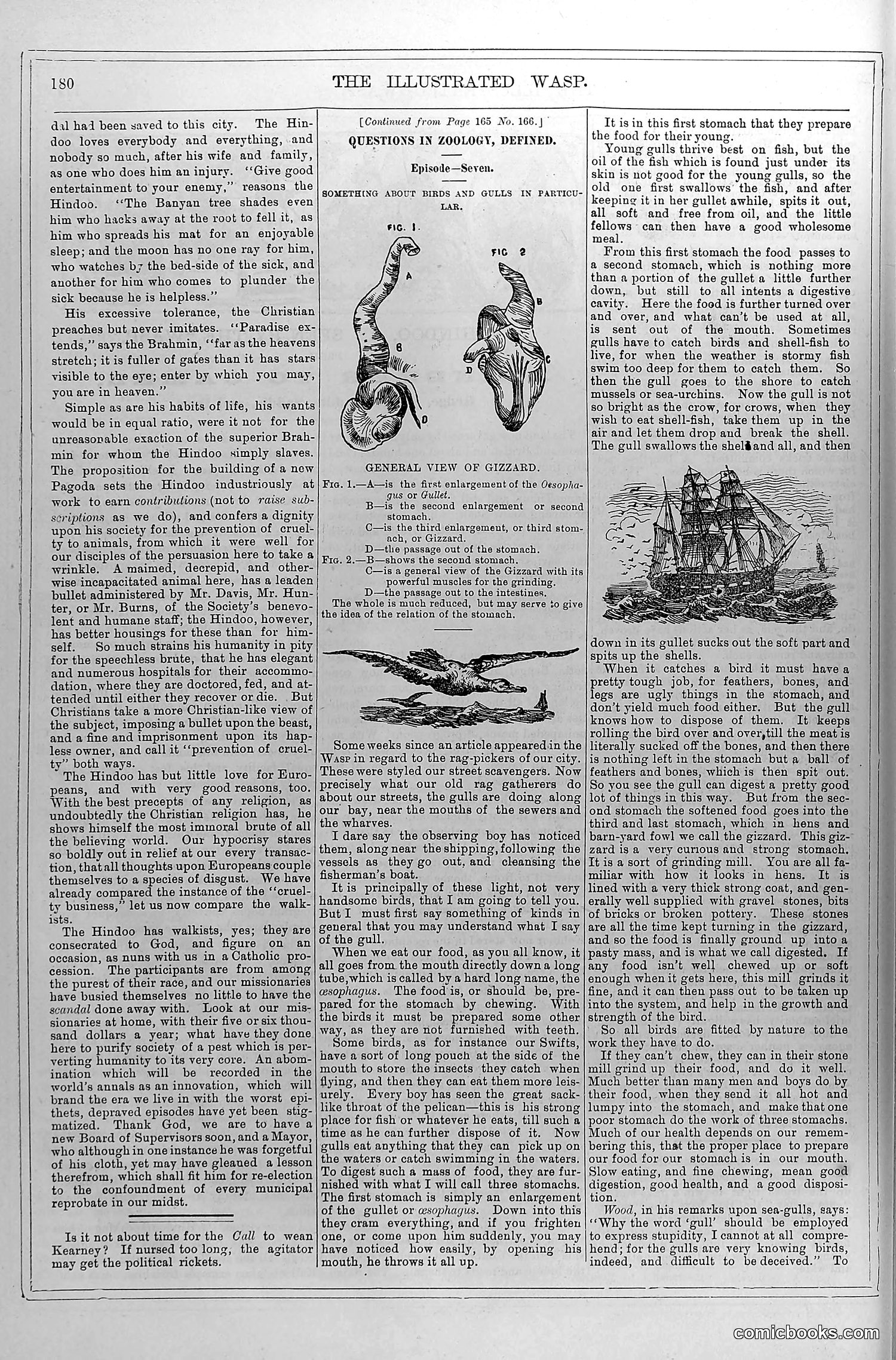
This page contains **educational/scientific content rather than political satire**. The main illustrations are anatomical diagrams of a gizzard (digestive organ of birds), labeled with letters A-D showing different stomach chambers and the passage of food through the digestive system. The accompanying text, titled "Questions in Zoology, Defined: Episode—Seven," discusses how birds digest food using gizzard stones and explains the mechanics of avian digestion. It references gulls specifically and contrasts their dietary capabilities with those of other birds. The page also includes a maritime scene illustration (a ship) and discusses sea-gulls' feeding habits. This appears to be **instructional science journalism** rather than satirical commentary, typical of Wasp's educational content alongside its political humor.
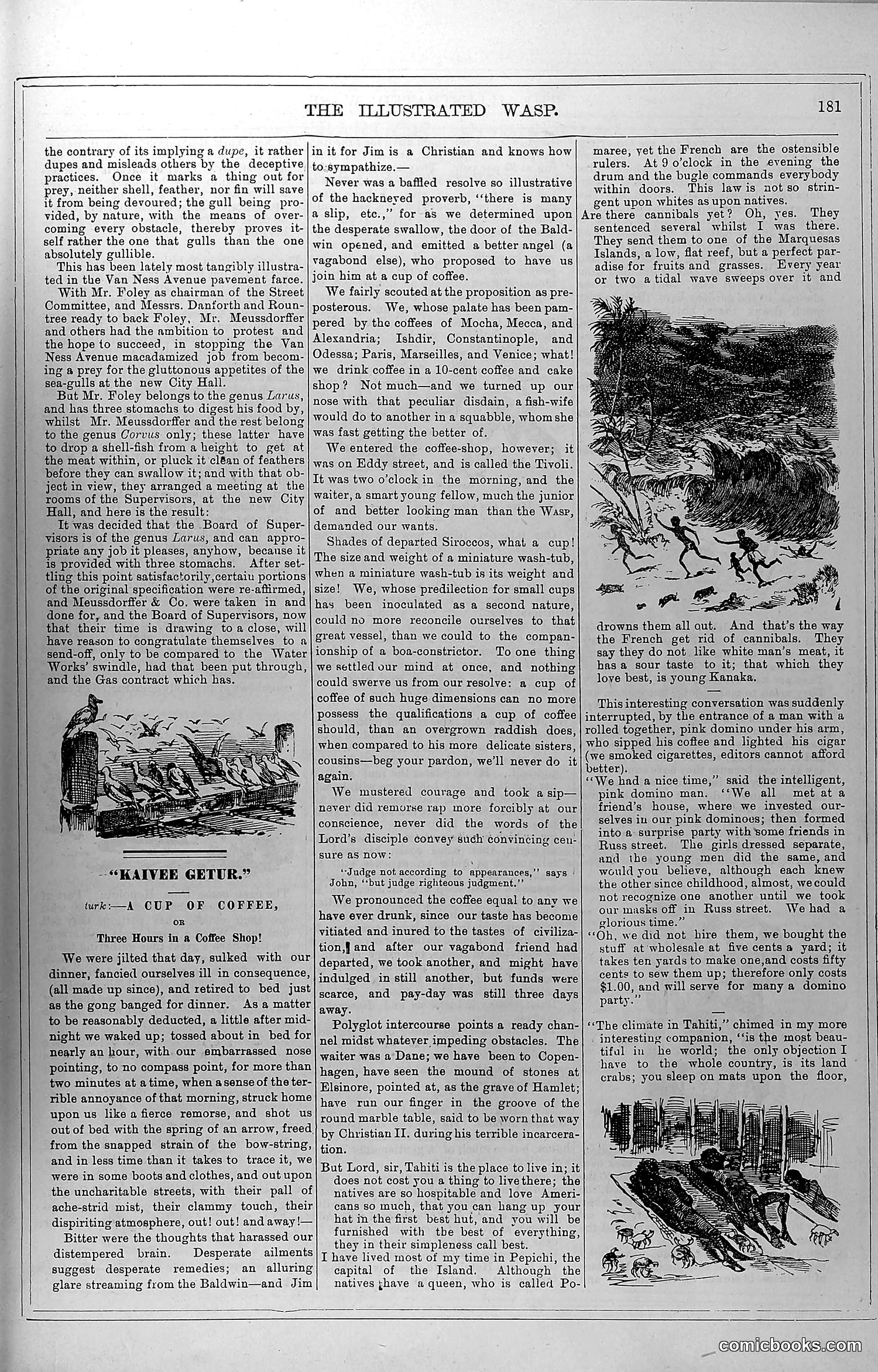
This satirical piece mocks San Francisco's pretentious coffee culture. The text describes visiting a fancy coffee shop on Eddy Street, where the narrator and companions encounter absurdly oversized coffee cups and an affected waiter. The satire targets the affectation of San Francisco society—people adopting cosmopolitan airs by referencing exotic coffee origins (Mocha, Alexandria, Constantinople) while paradoxically serving enormous, vulgar portions in what amounts to a "wash-tub." The cartoons show working-class figures amid the absurdity, emphasizing the contrast between pretension and reality. The joke: San Francisco's elite fashion themselves sophisticated through imported coffee culture, yet their execution remains crude and laughable. It's social commentary on class aspiration and the gap between cosmopolitan pretense and local reality.
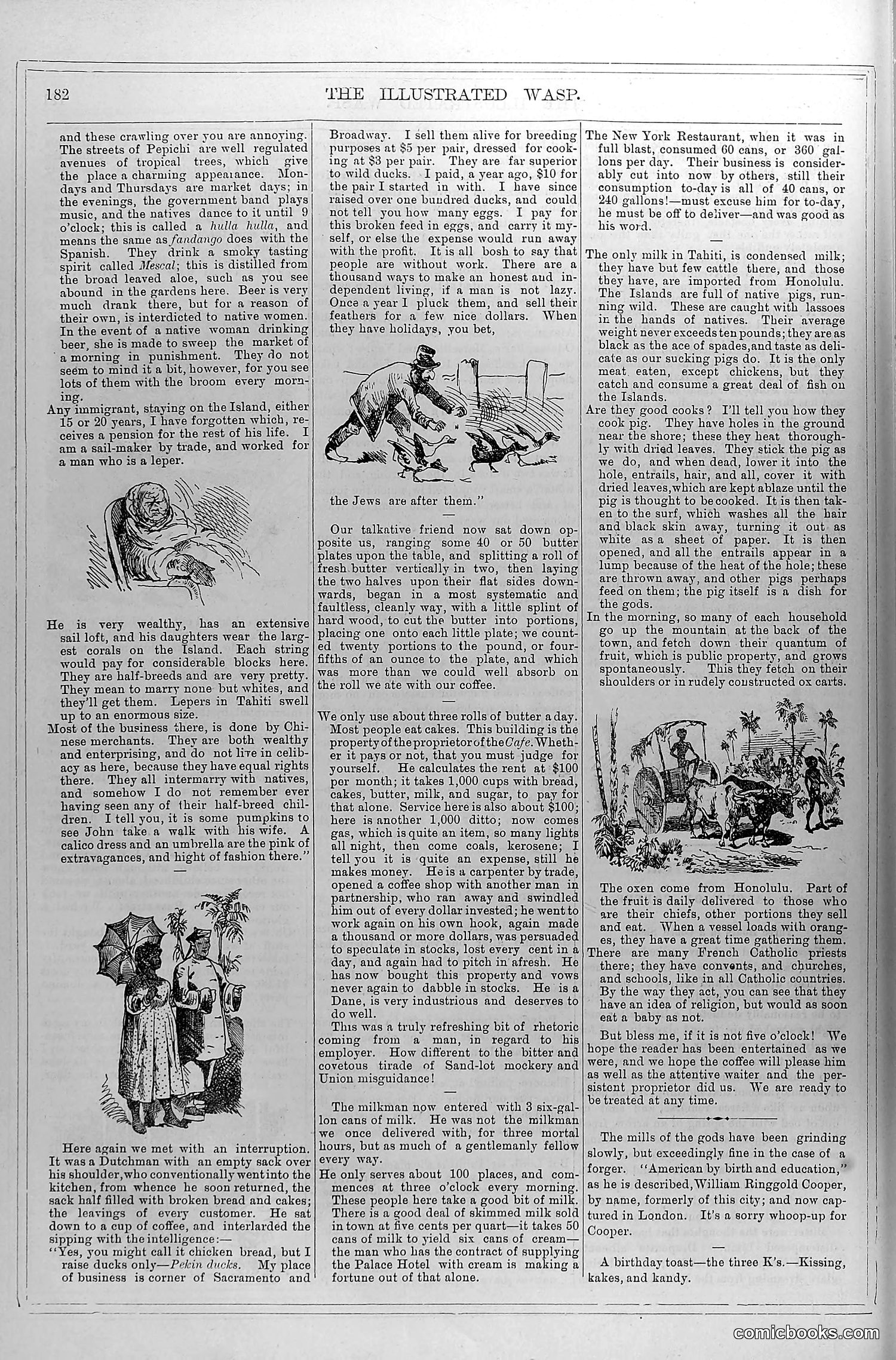
This page contains satirical travel writing rather than political cartoons. The author describes life in various locations—Pepiculi, Broadway, and Tahiti—with accompanying illustrations. The main satirical targets are: 1. **Broadway merchants** selling live ducks at inflated prices ($5/pair) to wealthy customers 2. **Tahitian society**, mocking indigenous practices like cooking pigs in ground ovens and the casual attitudes toward cattle and fruit distribution 3. **Wealthy white settlers** in the islands who exploit local resources and labor while maintaining class hierarchies The text uses condescending descriptions of non-Western practices to amuse readers, typical of 19th-century American magazines. The illustrated vignettes show locals engaged in daily activities, presented as exotic curiosities for middle-class entertainment. This reflects contemporary colonial attitudes toward indigenous peoples.
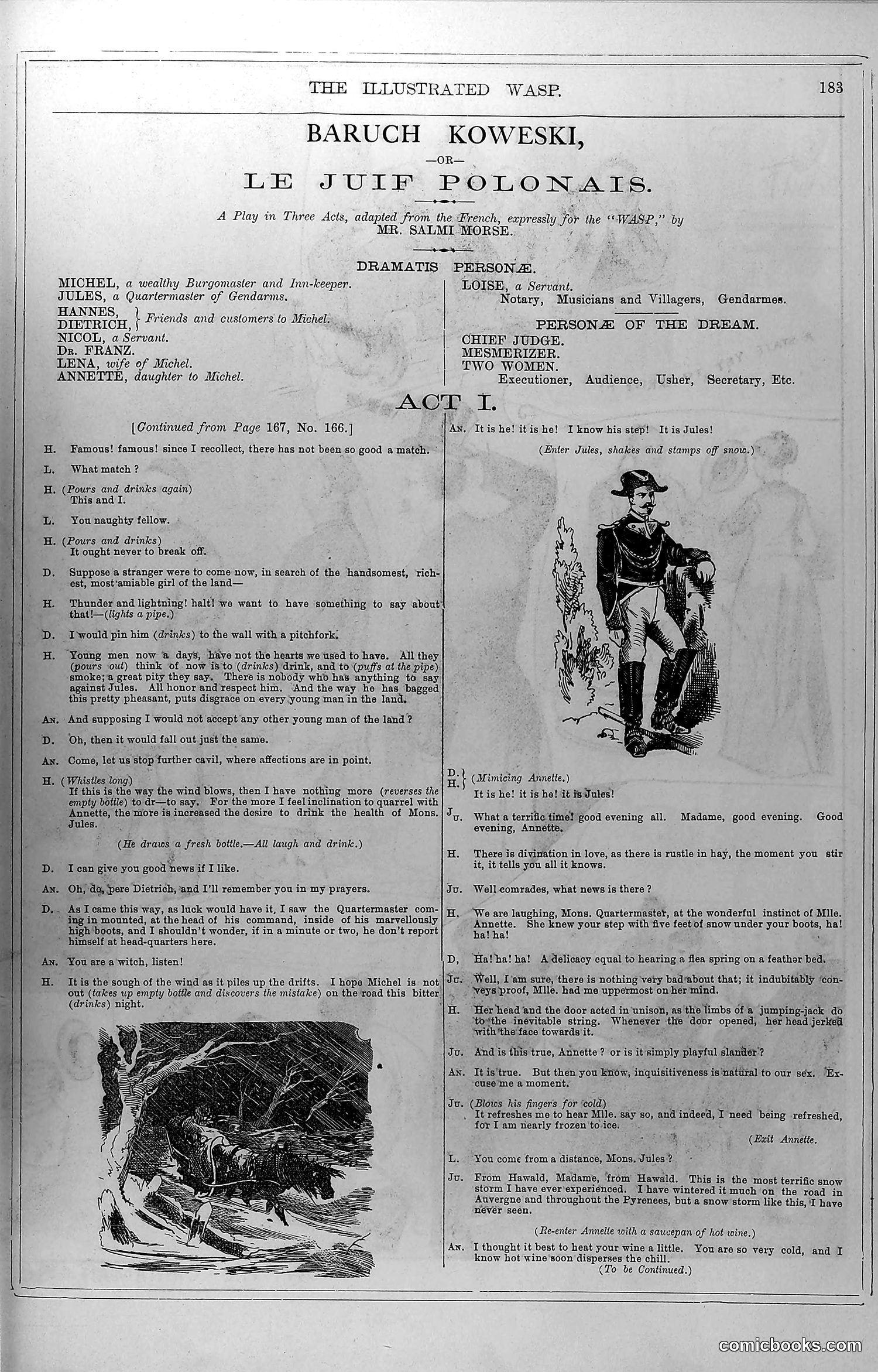
This page presents a theatrical play adapted from French specifically for The Wasp magazine. The content is a dramatic script featuring characters including Michel (an innkeeper), Jules, Hannes, and others, with two illustrations of period-dressed male figures. The title references a "Polish Jew" character type. The play appears to be satirical comedy exploiting ethnic and religious stereotypes common to 19th-century popular entertainment. The dialogue involves drinking, financial dealings, and comedic misunderstandings typical of period farce. Without additional context about The Wasp's specific political stance or publication date, the precise satirical target remains unclear—whether the piece mocks Polish Jews, French theatrical conventions, or something else. The work reflects era-typical prejudicial entertainment conventions.
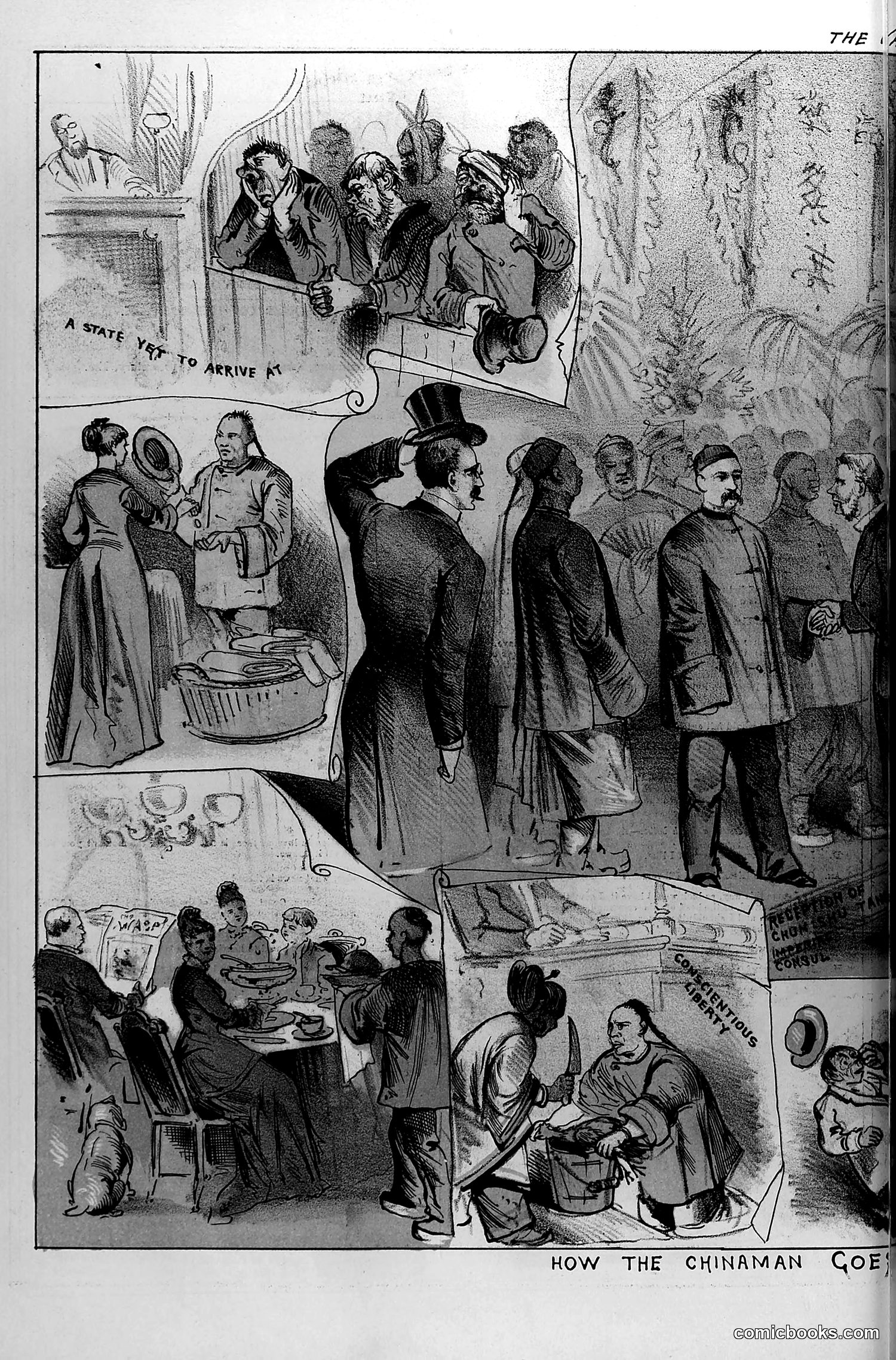
This multi-panel cartoon satirizes Chinese immigration and treatment in America, likely from the late 19th century based on *The Wasp's* publication period. The panels depict stages of a Chinese immigrant's journey: arrival ("A state yet to arrive at"), interactions with officials/authorities, food service encounters, and domestic situations. The title and imagery employ crude ethnic stereotypes common to the era, portraying Chinese immigrants through exaggerated caricatures. The cartoon appears to mock both Chinese newcomers and American bureaucratic/social responses to immigration, though the satire's exact target—whether xenophobic Americans or Chinese immigrants themselves—remains ambiguous from the image alone. The overall tone reflects period anti-Chinese sentiment prevalent in American popular media.
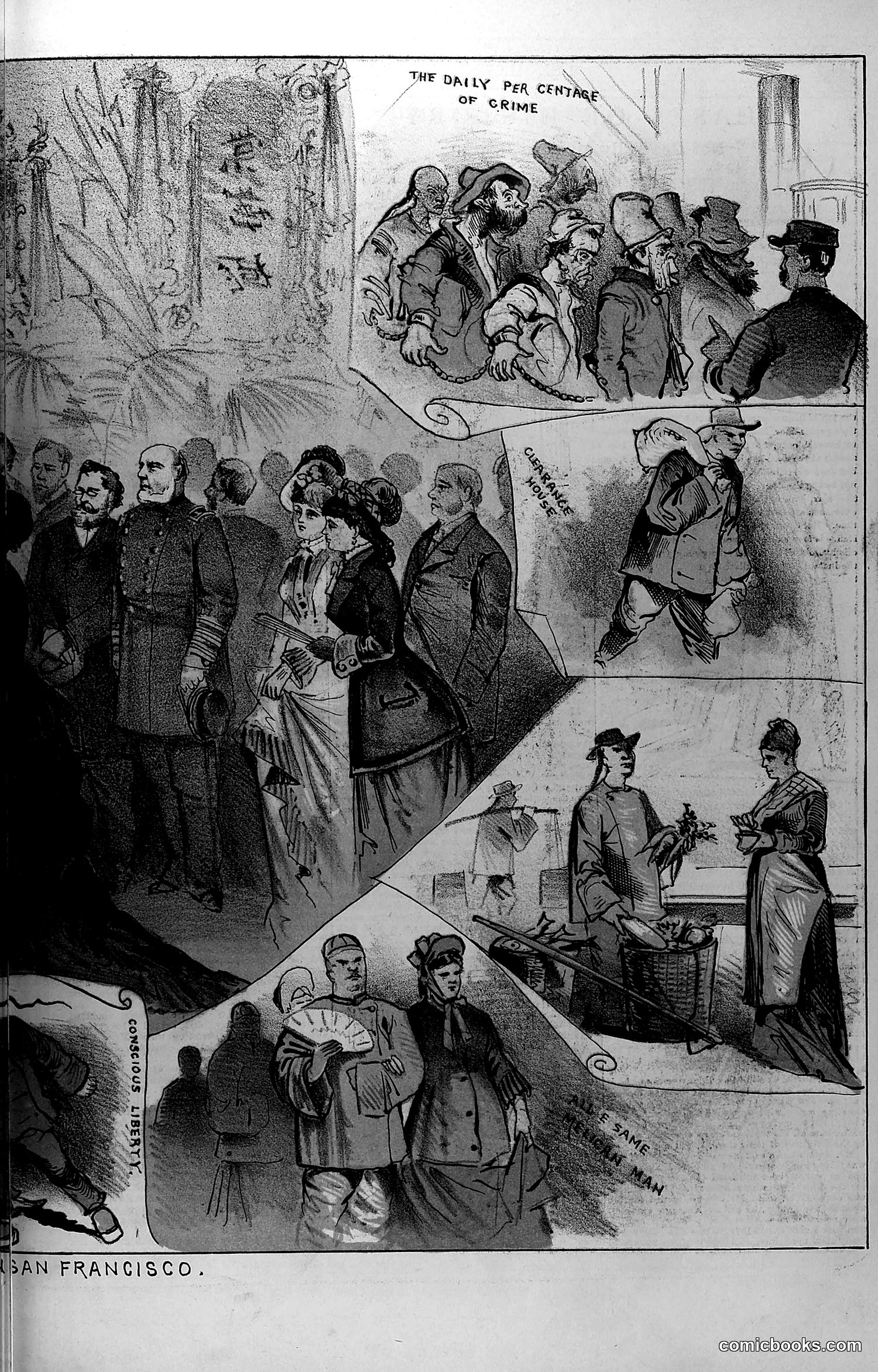
This satirical comic depicts crime in San Francisco as endemic to multiple social classes and occupations. The top panel shows rougher criminals (pickpockets, street criminals), while subsequent panels portray crime among respectable society: wealthy businessmen, fashionable women, and merchants. The titled phrase "daily per centage of crime" suggests crime occurs predictably across all economic levels. The satire argues that while working-class crime receives public attention and policing, white-collar crime by the wealthy and respectable citizens goes largely unnoticed or unpunished. By showing crime as distributed across society rather than concentrated among the poor, the cartoon critiques selective law enforcement and hypocrisy in how San Francisco society judges criminality based on class status.
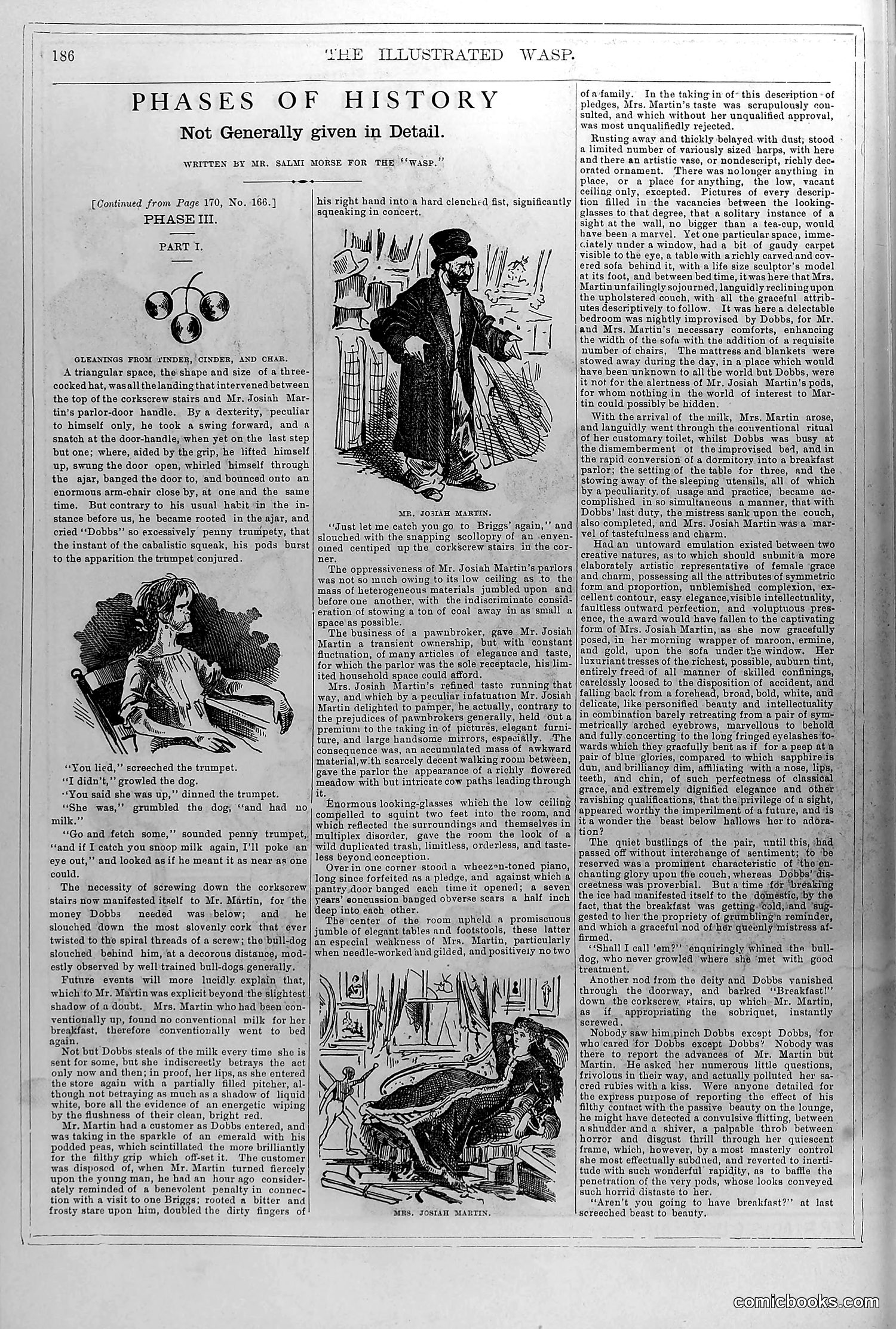
This page presents a serialized satirical story about Mr. Josiah Martin, featuring illustrations and detailed prose narrative. The story appears to be social satire focused on Martin's domestic life and interactions with servants, particularly a character named "Dobbs." The narrative mocks Martin's pretensions and household management, depicting him as pompous yet ineffectual. The text describes various humiliating domestic incidents—interactions with servants, breakfast mishaps, and general household chaos—presented in exaggerated comic detail. The illustrations show Martin in various states of discomposure, emphasizing the satirical point: that despite aspirations to respectability and control, he's constantly undermined by circumstance and his own character. The satire targets middle-class pretension and the gap between social aspirations and reality.
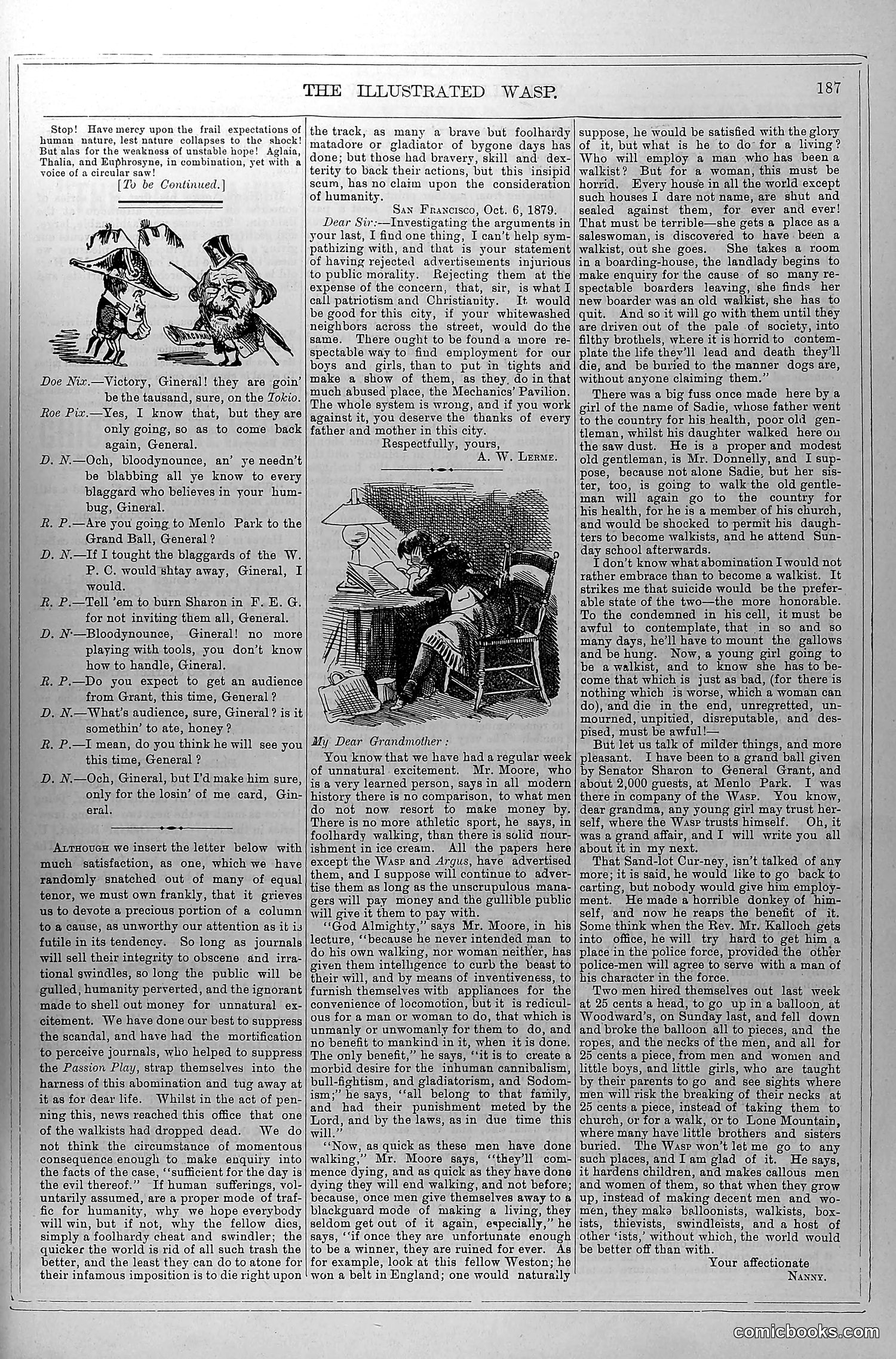
This page contains a satirical letter section rather than a cartoon. The main illustration shows an elderly woman in a chair, apparently the "Dear Grandmother" referenced in a prominent letter. The text discusses San Francisco social issues of 1870, including criticism of inadequate charitable institutions, the plight of poor women forced into boarding houses, and concerns about walking as exercise. One letter mocks General Grant's expected visit and dancing expectations. Another letter (signed "Nancy") argues against women becoming "walkers"—likely referring to either female pedestrians or possibly those engaged in sex work—advocating instead for respectable domestic roles. The satire targets both the pretensions of San Francisco society and contemporary debates about women's proper place and activities.
This page is primarily **text-based editorial and advertising content** rather than a political cartoon. The main article discusses **operatic performances**, specifically critiquing Mr. Oscar Weil's conducting and composition work. The author praises Weil's knowledge while noting his opera *Phryne and Thisbe* lacks originality and relies too heavily on familiar musical structures. The piece also discusses **Baldwin's theatrical production** at the Baldwin Theatre, offering detailed criticism of the cast and performance quality. The bottom half contains **commercial advertisements** for Palmer's (a shop), Philadelphia Brewery, Chew Jackson's tobacco, and optical/theatrical goods. This appears to be a typical 19th-century satirical magazine layout mixing arts criticism with local business advertising—no identifiable political cartoons are present on this particular page.
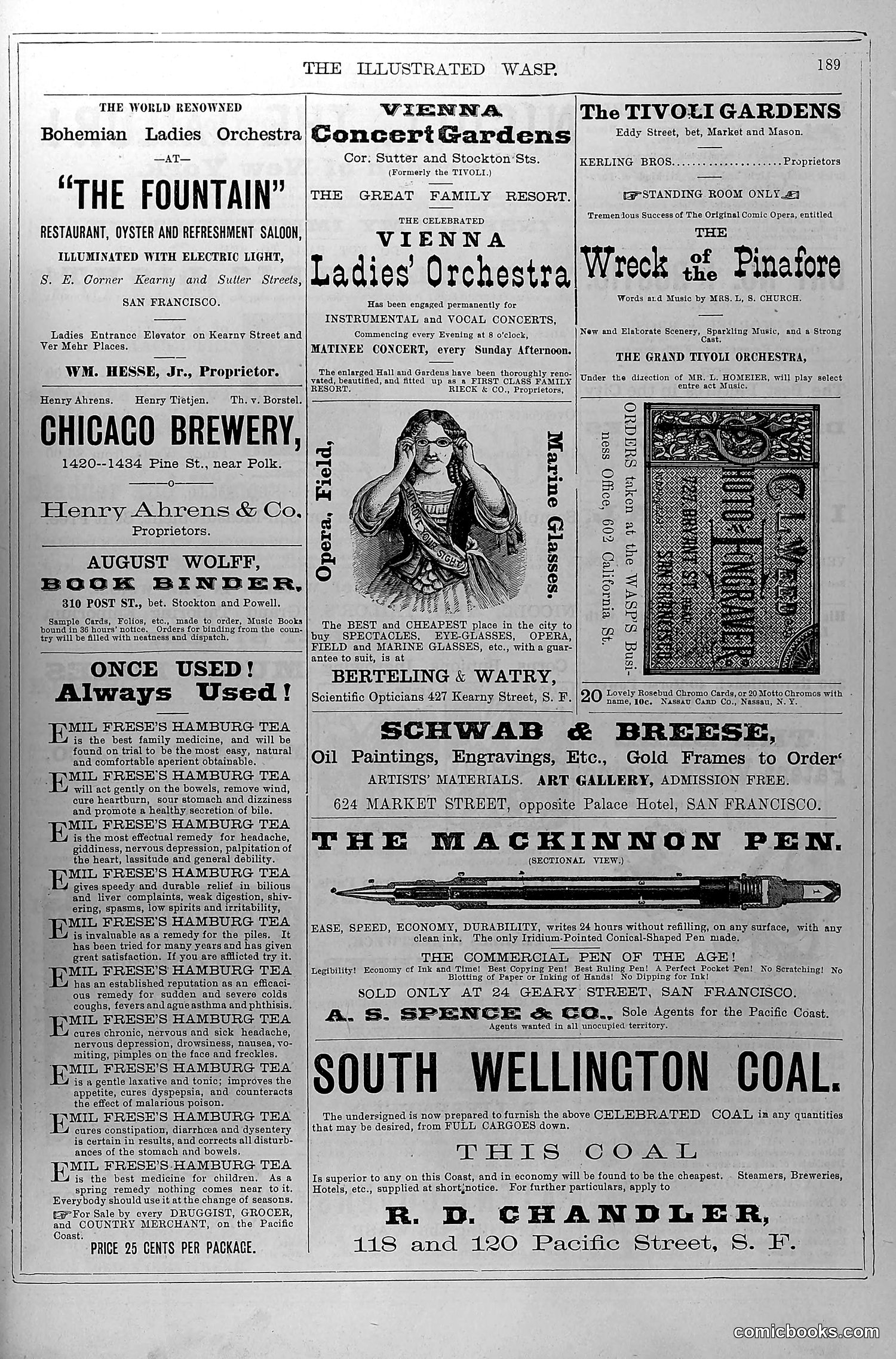
This page is primarily **advertising**, not political satire. It contains commercial notices for San Francisco businesses from what appears to be the late 19th century, including: - Restaurants and bars (The Fountain, Chicago Brewery) - Musical venues (Vienna Concert Gardens, Tivoli Gardens) - Optical services (Berteling & Watry) - Art supplies (Schwab & Breese) - The MacKinnon Pen (writing instrument) - Coal supplier (R.D. Chandler) The only illustration is a **profile portrait of a woman's head** accompanying "Opera Frau" text, likely advertising eyeglasses or optical services. The page functions as **revenue-generating advertising space** rather than editorial content with satirical intent. No clear political commentary or social satire is evident from the visible content.
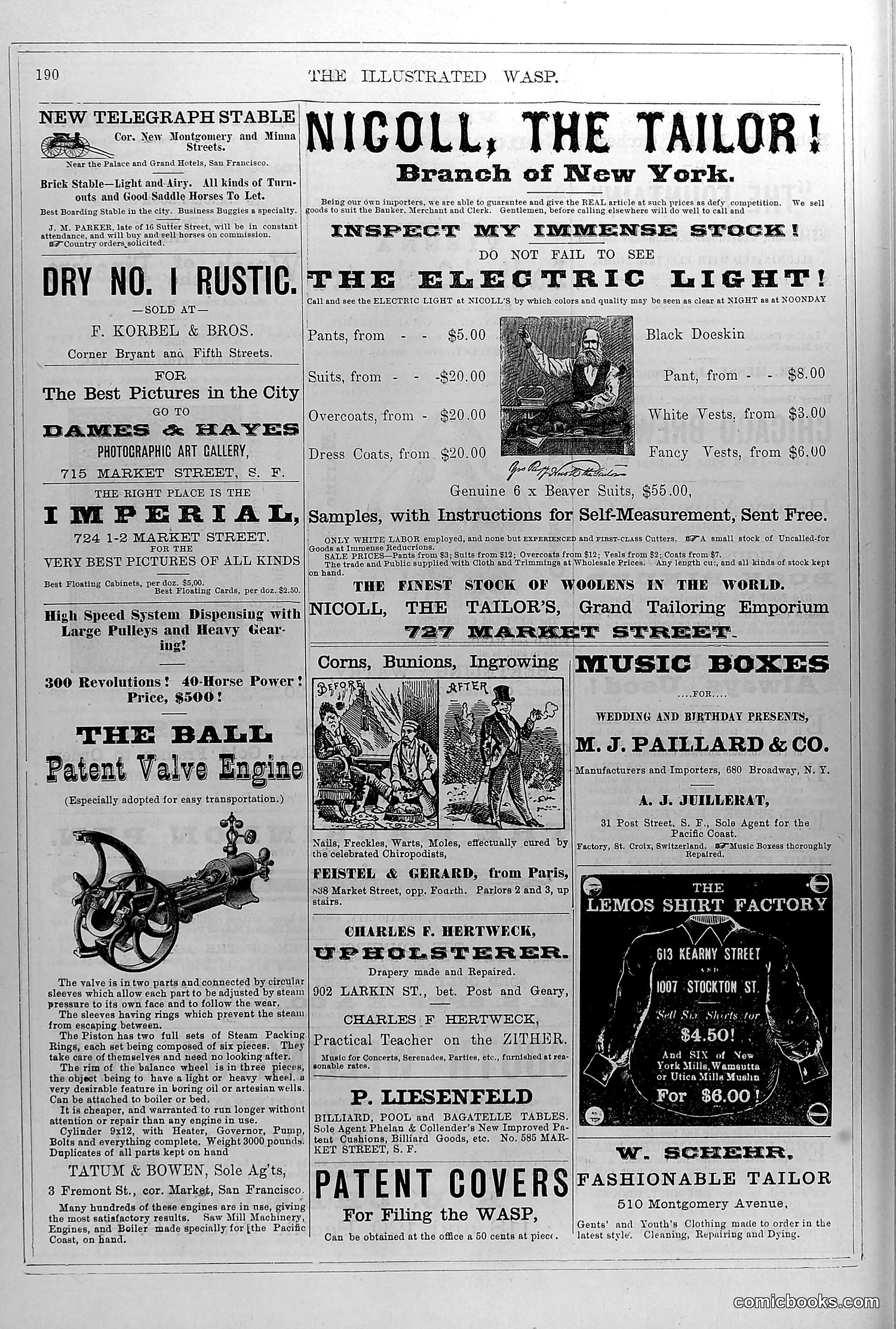
This page is primarily **advertising**, not satire or political commentary. It consists of commercial notices for San Francisco businesses circa the late 1800s, including: - Nicoll's tailor shop (prominently featured with an illustration of a well-dressed man) - Photography galleries - Patent valve engines - Music boxes - Shirt factories - Various tailoring and clothing services The one illustration showing "before and after" scenes (labeled "BEFORE" and "AFTER") appears to advertise Dr. Fiestel & Gerardi's medical treatment for corns, bunions, and warts—depicting a transformation from discomfort to wellness. There is **no political satire or social commentary** visible on this page. It functions as a standard classified advertising section within *The Wasp*.
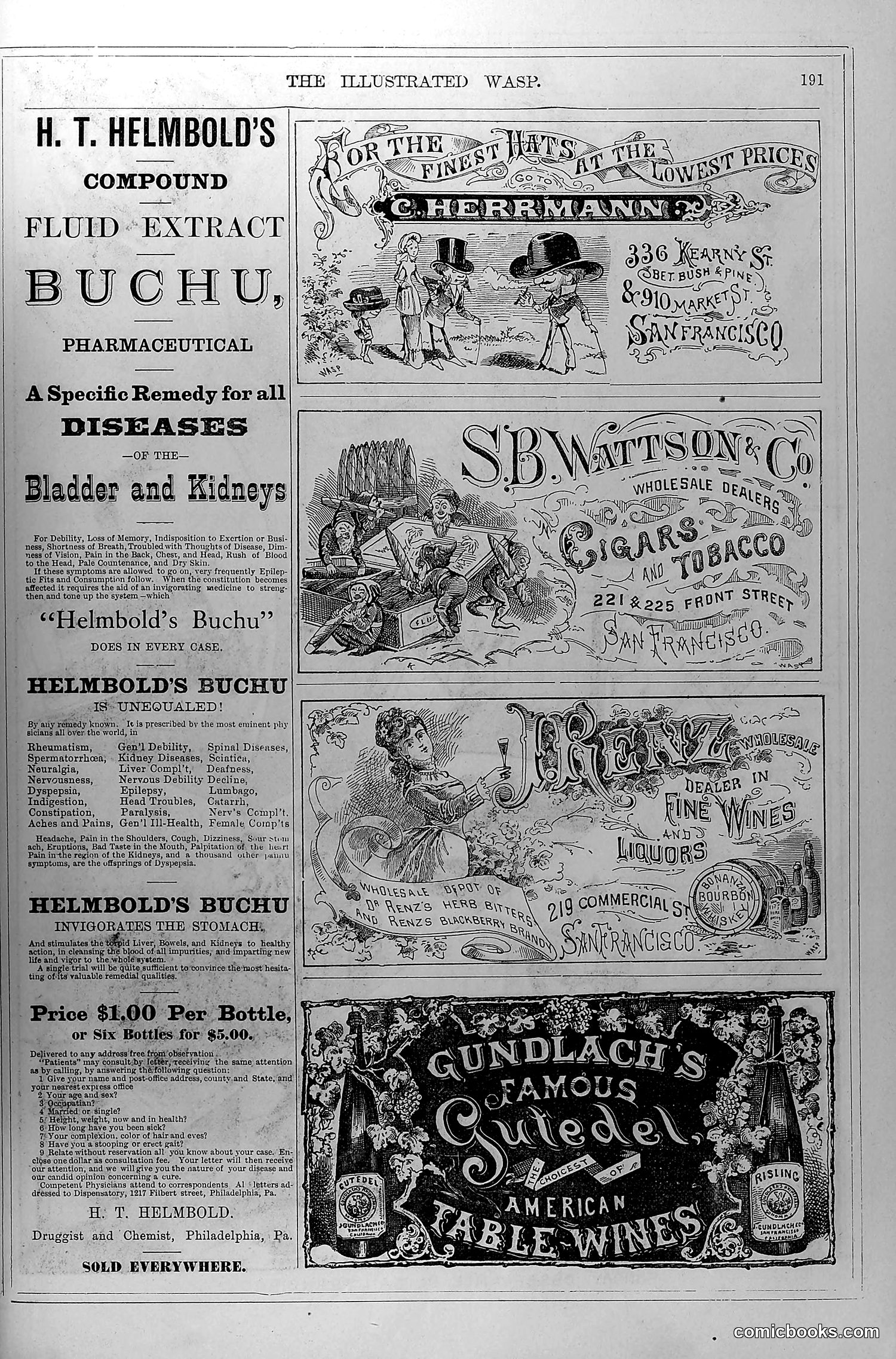
This page is primarily **advertising**, not satirical content. The left side features a full advertisement for "Helmbold's Buchu," a patent medicine claiming to cure bladder and kidney diseases, with testimonials and a $1.00 price point. The right side contains four separate commercial advertisements for San Francisco businesses: Cherrmann & Co. (hats), S.B. Wattson & Co. (cigars and tobacco), Henz (wines and liquors), and Gundlach's Celebrated Sludel (table wines). These ads are typical of 19th-century magazines, mixing dubious medical claims with legitimate retail advertising. The elaborate Victorian illustrations and ornate typography reflect period design standards. **No political satire or cartoon commentary is present on this page.**
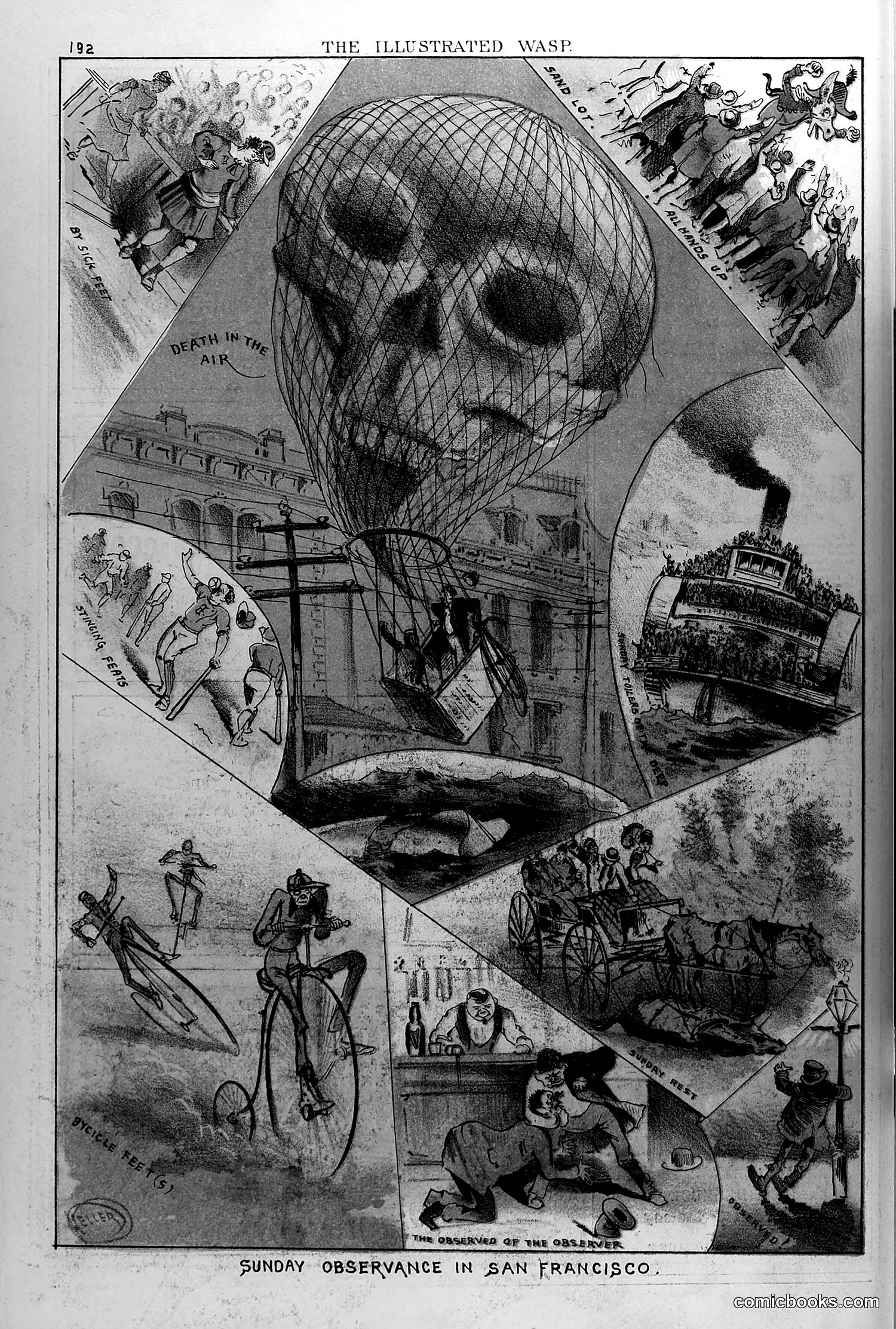
This satirical cartoon critiques the hypocrisy of San Francisco's Sunday religious observance. The central skull represents "Death in the Air"—likely referencing a specific contemporary disaster or public health crisis. Surrounding vignettes show various violations of the Christian Sabbath: people cycling, boating, drinking at bars, gambling, and engaging in street activities. The cartoon's point appears to be that despite San Francisco's professed Christian values and Sunday observance laws, citizens openly violate these religious principles through leisure, commerce, and vice. The skull looming over these scenes suggests this hypocrisy carries serious moral or social consequences. The satire targets the gap between public piety and actual behavior in the city.

I can see this is a test page or calibration sheet for The Wasp magazine, rather than actual satirical content. The image shows a grayscale reference chart with numbered squares (appearing to demonstrate tonal gradations from dark to light) positioned against measurement rulers for photographic or printing purposes. This type of page typically appeared at the beginning or end of publication runs to ensure consistent reproduction quality across print batches. The checkerboard pattern and numerical markers helped printers verify proper exposure, contrast, and registration during the printing process. Without visible cartoon artwork or readable satirical content on this particular page, I cannot identify specific political figures, social references, or the intended satirical message.