
A complete issue · 18 pages · 1879
The Wasp — October 4, 1879
I can see this is a measurement/reference page from *The Wasp* magazine featuring an Oregon Rule Co. ruler for scale purposes. The page shows a checkerboard pattern of gray and white squares to the right of the ruler, which appears to be a color/tone reference chart rather than satirical content. Without visible cartoon imagery, text, or caricatures on this particular page, I cannot identify specific political figures, social references, or satirical commentary. This appears to be a technical page—possibly a printing reference sheet or the back matter of an issue—rather than a page containing editorial cartoons or satirical commentary that would require historical context to interpret.
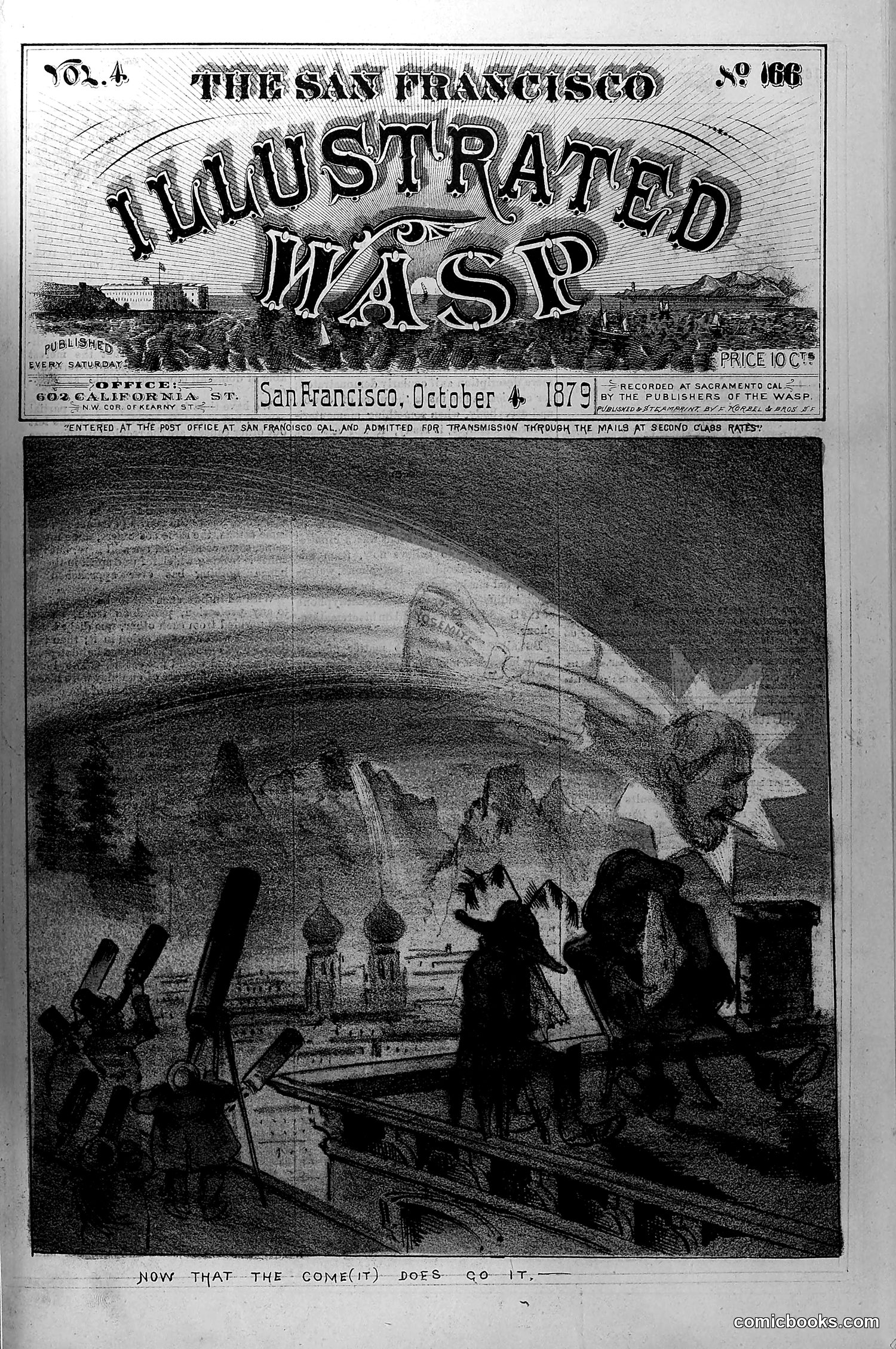
This October 4, 1879 *Wasp* cartoon satirizes a comet sighting through a telescope. The silhouetted figures observe what appears to be a comet in the night sky, with the caption making a pun: "come(it)" suggests the comet is finally arriving or appearing as predicted. The satire likely mocks either: - Failed astronomical predictions about a comet's visibility or trajectory - Public excitement or anxiety about celestial events - Charlatan astronomers or false scientific claims circulating in San Francisco The figures with telescopes represent observers trying to witness the phenomenon. The joke plays on unfulfilled expectations—the comet wasn't visible when predicted, but "now that [it] does go it," people can finally see it. This reflects 19th-century public fascination with astronomy mixed with skepticism about expert predictions.
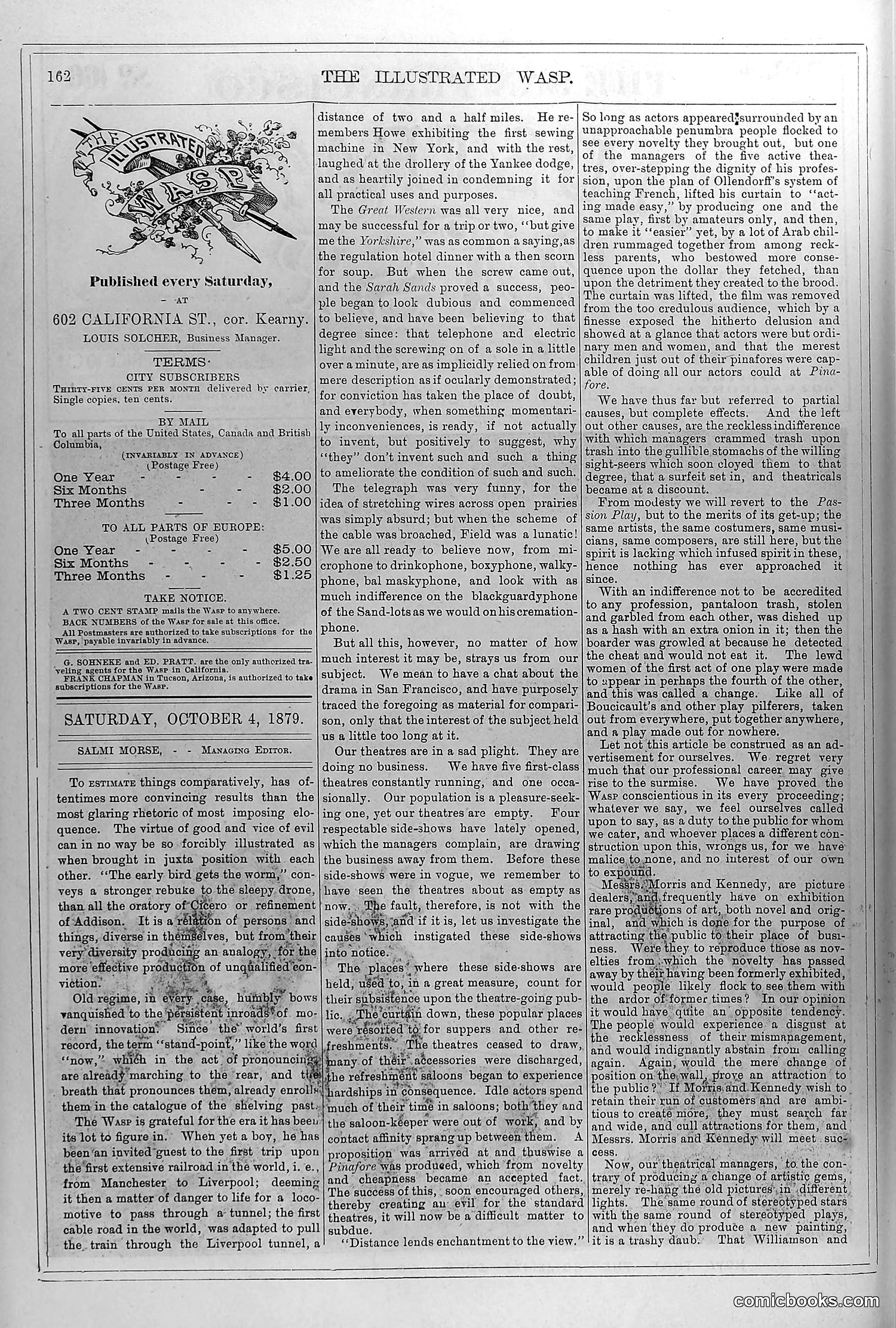
The page is primarily editorial and advertising content rather than a political cartoon. The masthead illustration shows a wasp, the magazine's logo. The main editorial, titled "Salmi Morse," discusses theatrical productions and actors' professional standards. Morse, apparently a prominent playwright or theater figure of the era, is criticized for theatrical practices the editor finds objectionable—likely involving side-shows, sensationalism, or ethical lapses in production. The piece argues that San Francisco theaters are declining due to poor management and cheap entertainment prioritizing novelty over quality. The author advocates for higher artistic standards in theater, criticizing producers who exploit rather than educate audiences. The remainder consists of subscription rates and publication notices. No clear political satire is evident on this page.
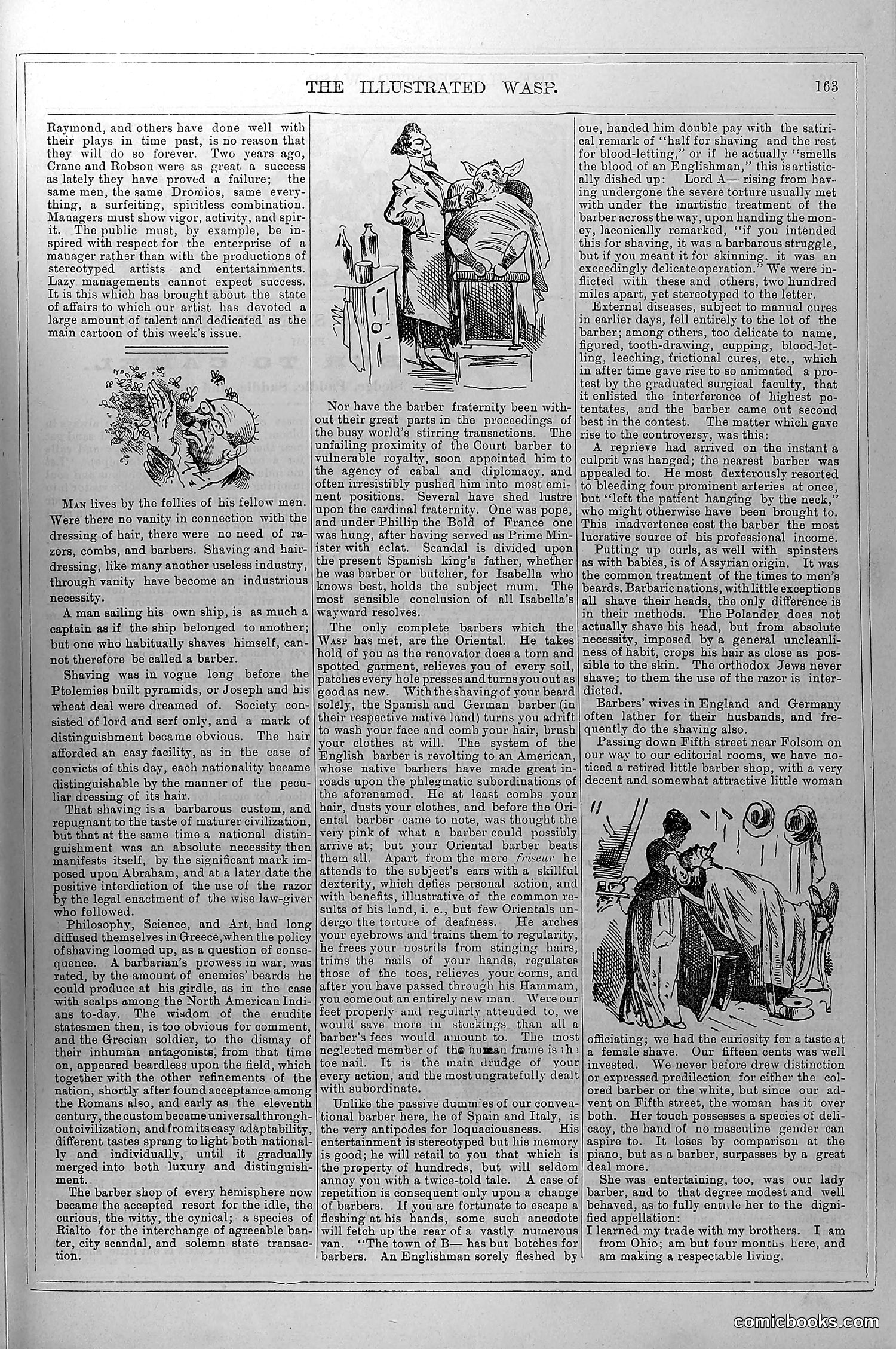
This page contains an essay about barbers and barbering rather than political cartoons. The accompanying illustrations show barber shop scenes and a woman client. The text satirizes barbers as a profession, arguing they've historically held social importance despite being "useless" tradesmen. It traces barbering from ancient times through various cultures, noting how barbers in different nations—Spanish, German, English, and American—developed distinct styles and pretensions. The satire mocks barbers' self-importance and their stereotypical mannerisms, suggesting they inflate the significance of their work. The piece humorously critiques both barbers' affectations and clients who tolerate their behavior, presenting barbering as an industry built on unnecessary ritual and professional vanity rather than genuine skill.
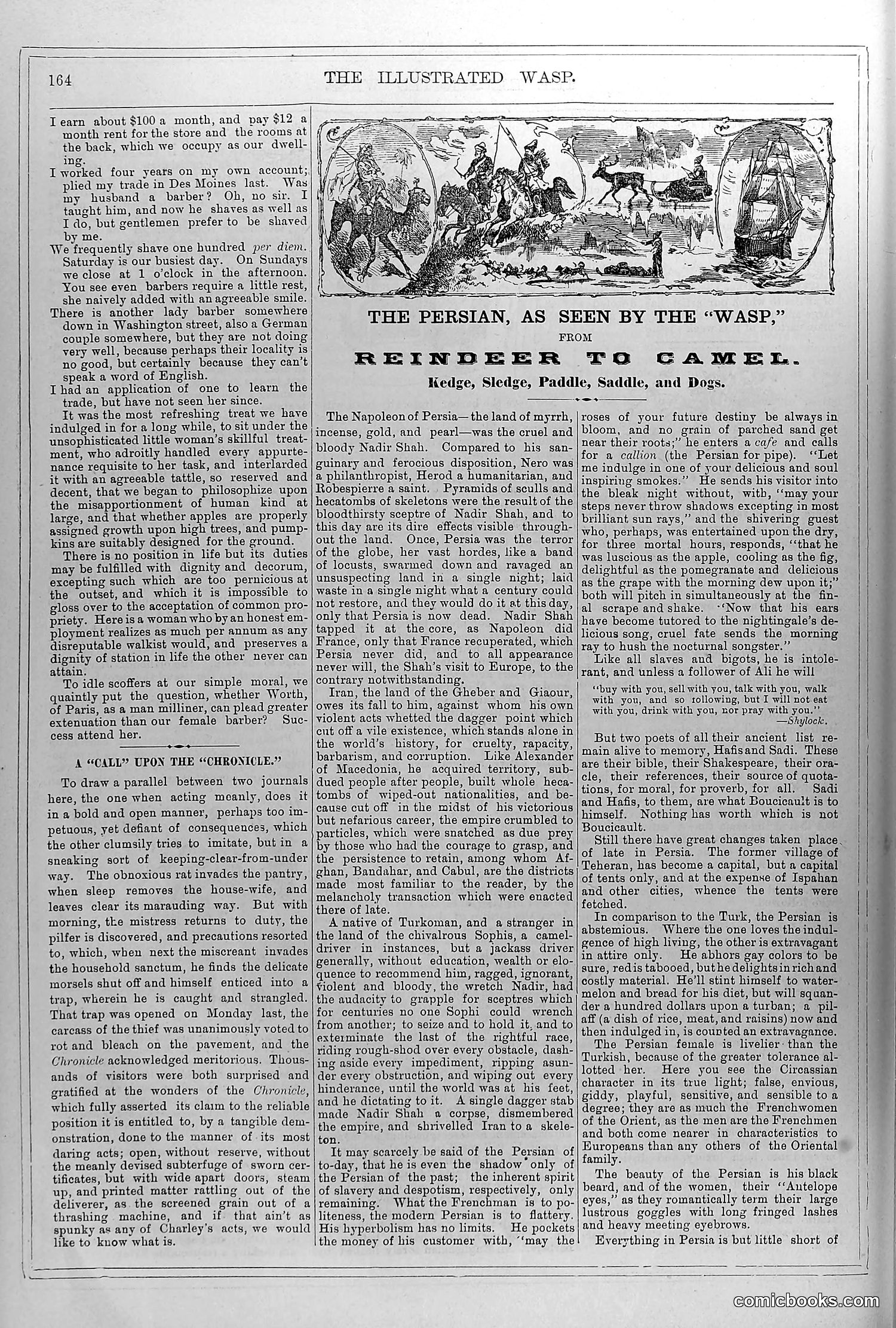
This page contains two distinct sections: **Left column**: A personal narrative about a working-class barber discussing his modest income ($100/month), household expenses, and observations about San Francisco's barber trade. It includes social commentary on gender and class. **Main illustration and right column**: "The Persian, as Seen by the Wasp" presents a satirical illustrated essay about Persia (Iran), featuring caricatured depictions of Persian people, culture, and governance. The text critiques the Persian ruler (Nadir Shah) as brutal and corrupt, contrasting Western civilization with Persian "barbarism." This reflects 19th-century Orientalist attitudes common in American satirical publications, using exaggerated stereotypes to portray Persians as exotic, uncivilized, and inferior—a typical rhetorical strategy of the era's imperial-minded satire.
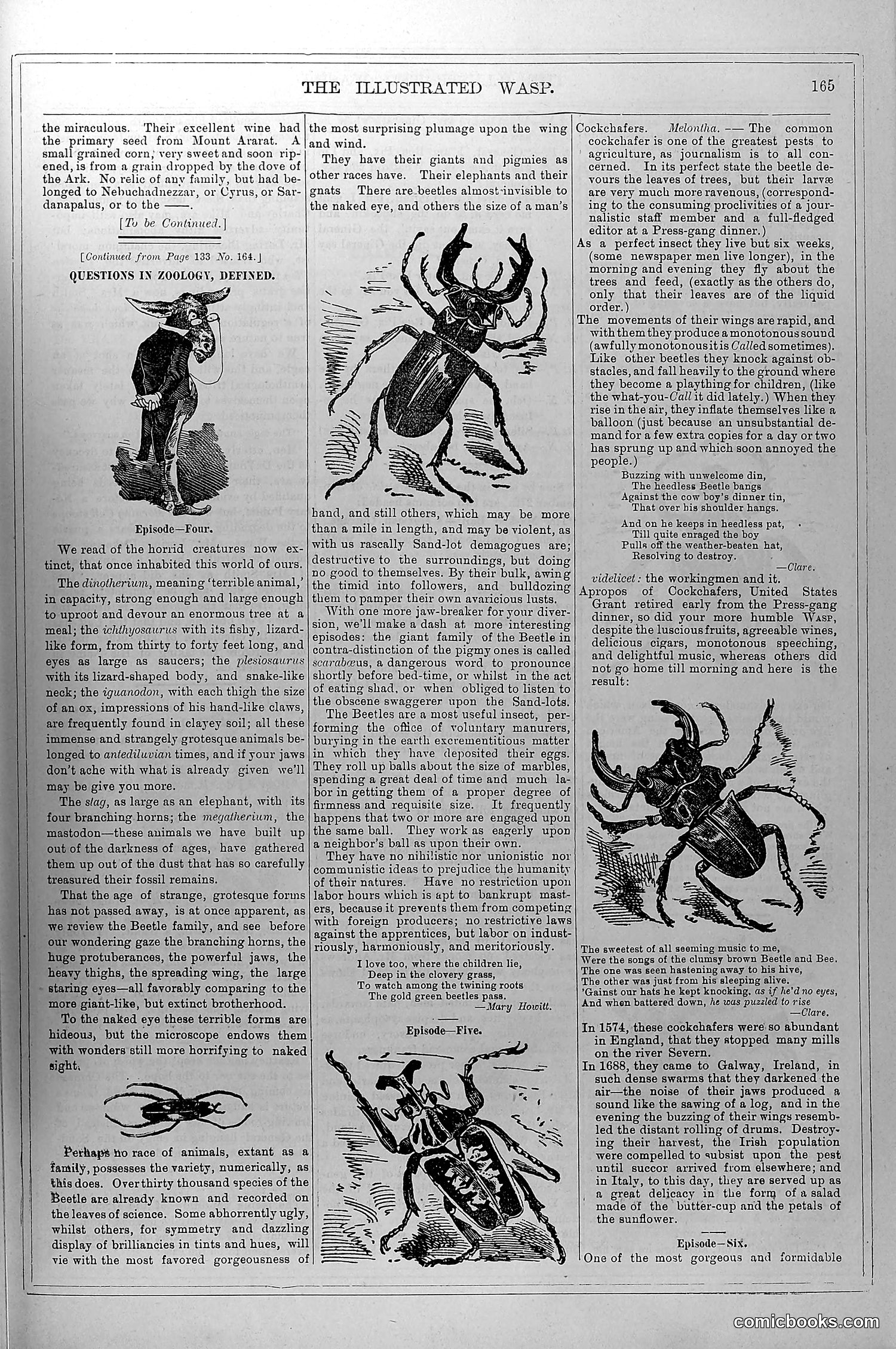
This page is primarily **educational rather than satirical**, presenting natural history content about beetles and insects rather than political commentary. The text discusses various beetle species, including the "Cockchafer" (a common agricultural pest), and describes their physical characteristics, behaviors, and historical impacts. Several numbered "Episodes" feature detailed illustrations of different beetles. A notable section mentions **1574 England and 1688 Ireland**, when cockchafers were so abundant they damaged mills and crops, with their noise likened to "the sawing of a log." The text emphasizes scientific observation of these "terrible forms" revealed by microscopes. The page includes poetry about beetles and concludes discussing another "gorgeous and formidable" species. This appears to be part of a serialized natural history series rather than satirical commentary on contemporary politics or society.
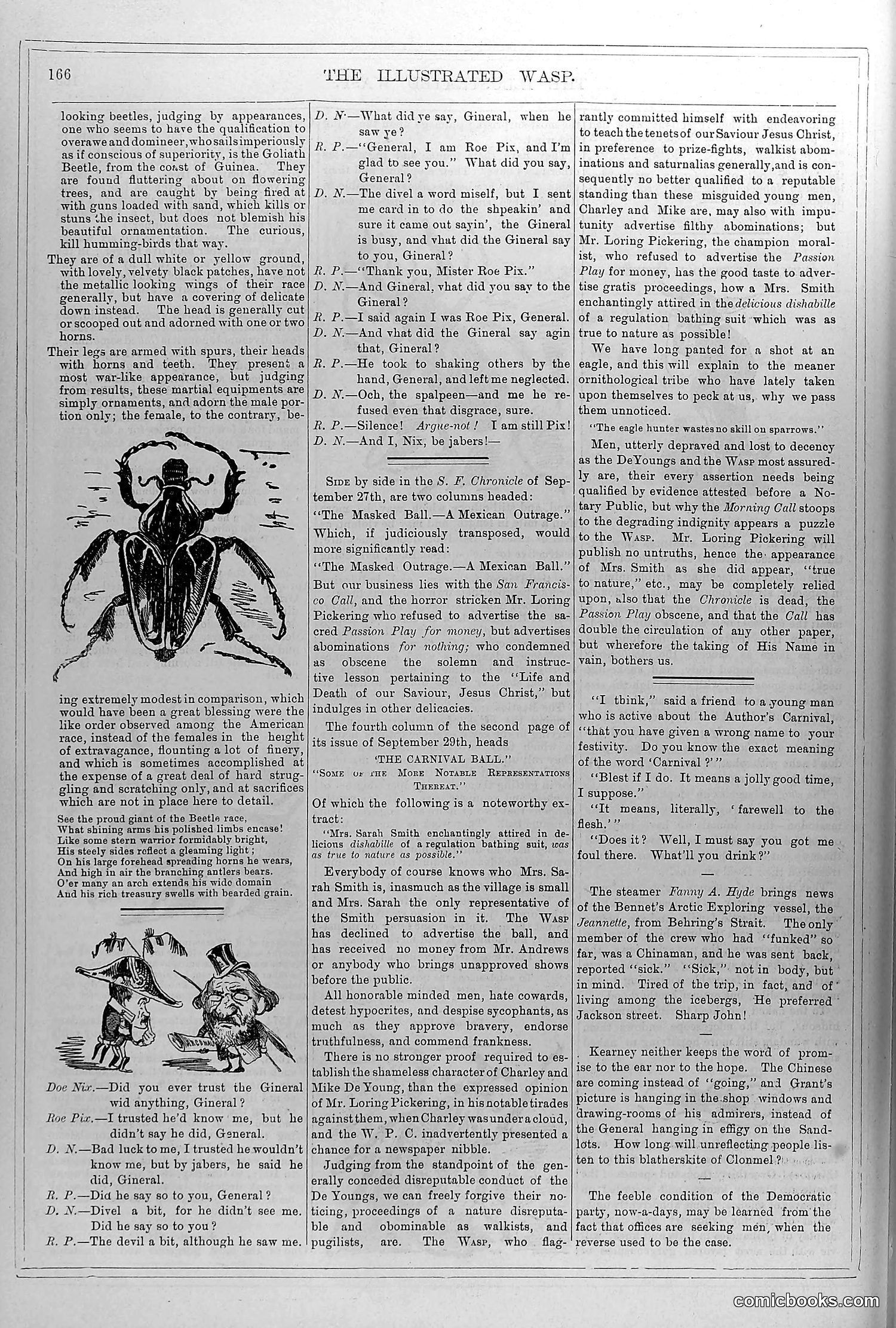
This page consists primarily of dialogue and literary commentary rather than political cartoons. The main text discusses "The Masked Ball," a Mexican play/entertainment, and debates about Mrs. Sarah Smith's "regulation bathing suit" and theatrical advertising practices. The two illustrations show beetles—likely decorative rather than satirical. The text mentions "looking beetles, judging by appearances" and describes their physical features in naturalistic detail. The page appears to focus on San Francisco's cultural and entertainment scene, critiquing theatrical advertisements and moral sensibilities around bathing suits. The debate involves figures named General, Roe Pix, and references to Mr. Loring Pickering's advertising practices, but without additional historical context, the specific satirical targets remain unclear.
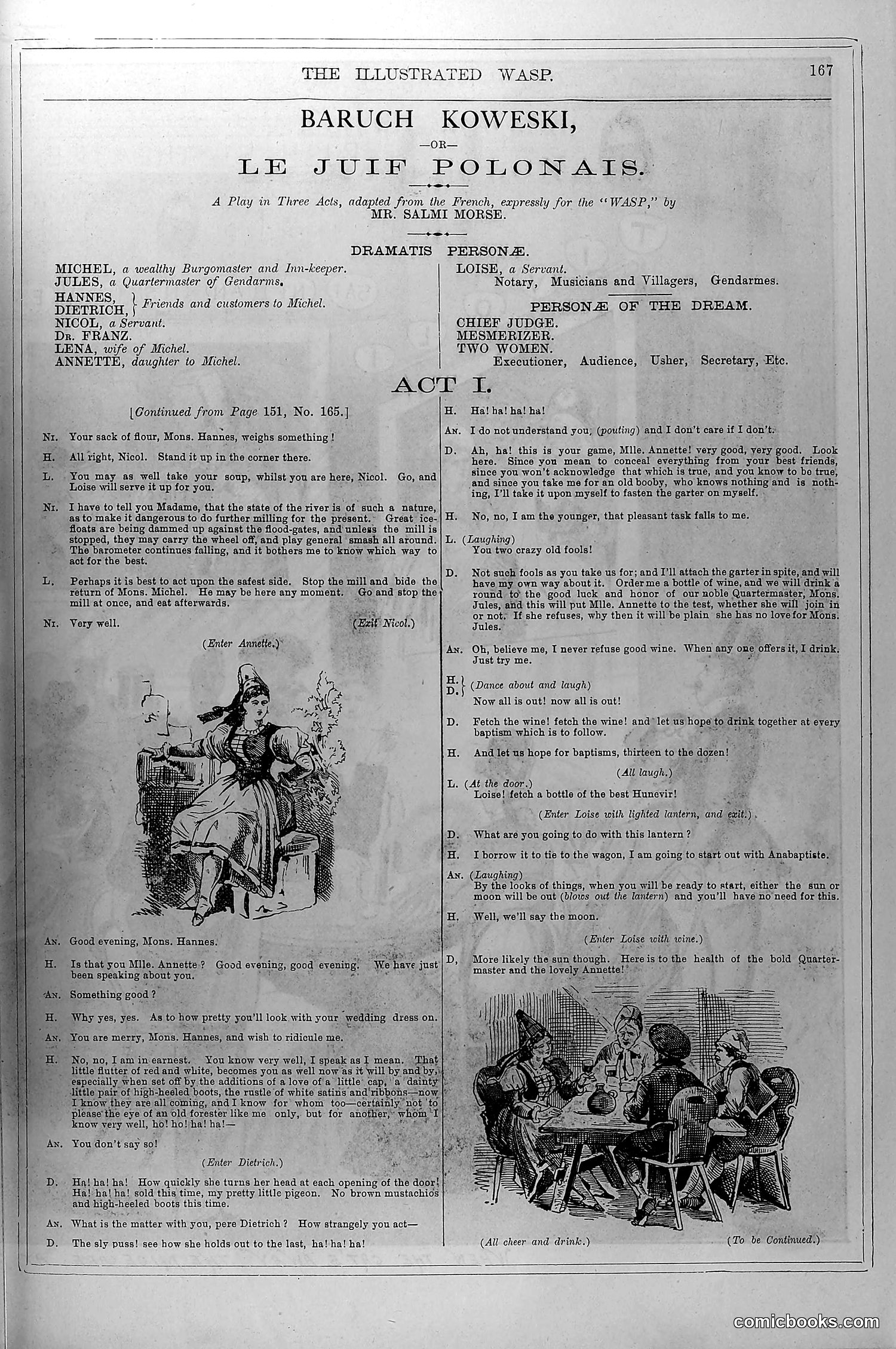
This page presents a theatrical play adapted by Salmi Morse for *The Wasp* magazine. The content depicts a scene involving working-class characters—a Burgomaster, inn-keeper, Quartermaster, and servants—in what appears to be a comedic domestic scenario about a wedding and drinking. The two illustrations show a woman in period dress and a group dining/drinking scene. The play's title references a Polish Jewish character ("Le Juif Polonais"), suggesting period ethnic stereotyping common to 19th-century theater. The comedic dialogue revolves around courtship, practical jokes, and wine-drinking—typical farce elements. Without additional historical context about this specific play or *The Wasp's* editorial stance, the precise satirical target remains unclear, though the ethnic naming suggests commentary on immigrant or Jewish characters.
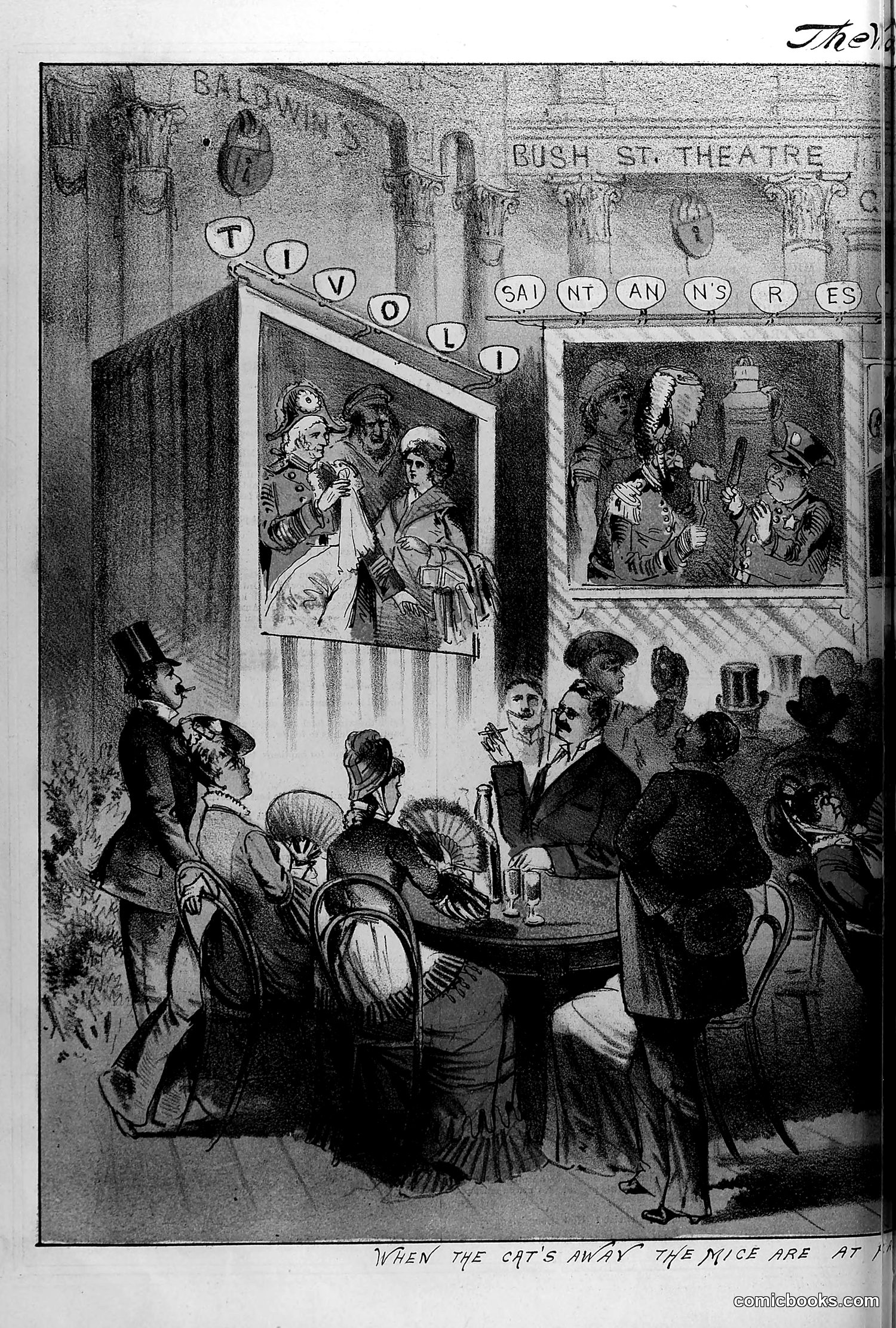
This cartoon depicts the **Bush Street Theatre** in San Francisco, with the marquee spelling "TIVOLI" downward. The scene shows elegant patrons and performers outside the theatre in what appears to be a moment of revelry or transgressive behavior. The caption "When the Cat's Away, The Mice Are At..." references the proverb suggesting misbehavior occurs in the absence of authority/supervision. The satire likely critiques either: - Theatrical performers or patrons engaging in scandalous conduct - Theater management's questionable practices when oversight is absent - Or possibly the venue's reputation for loose moral standards The specific historical context and identities of figures remain unclear without additional documentation about this particular Wasp publication date.
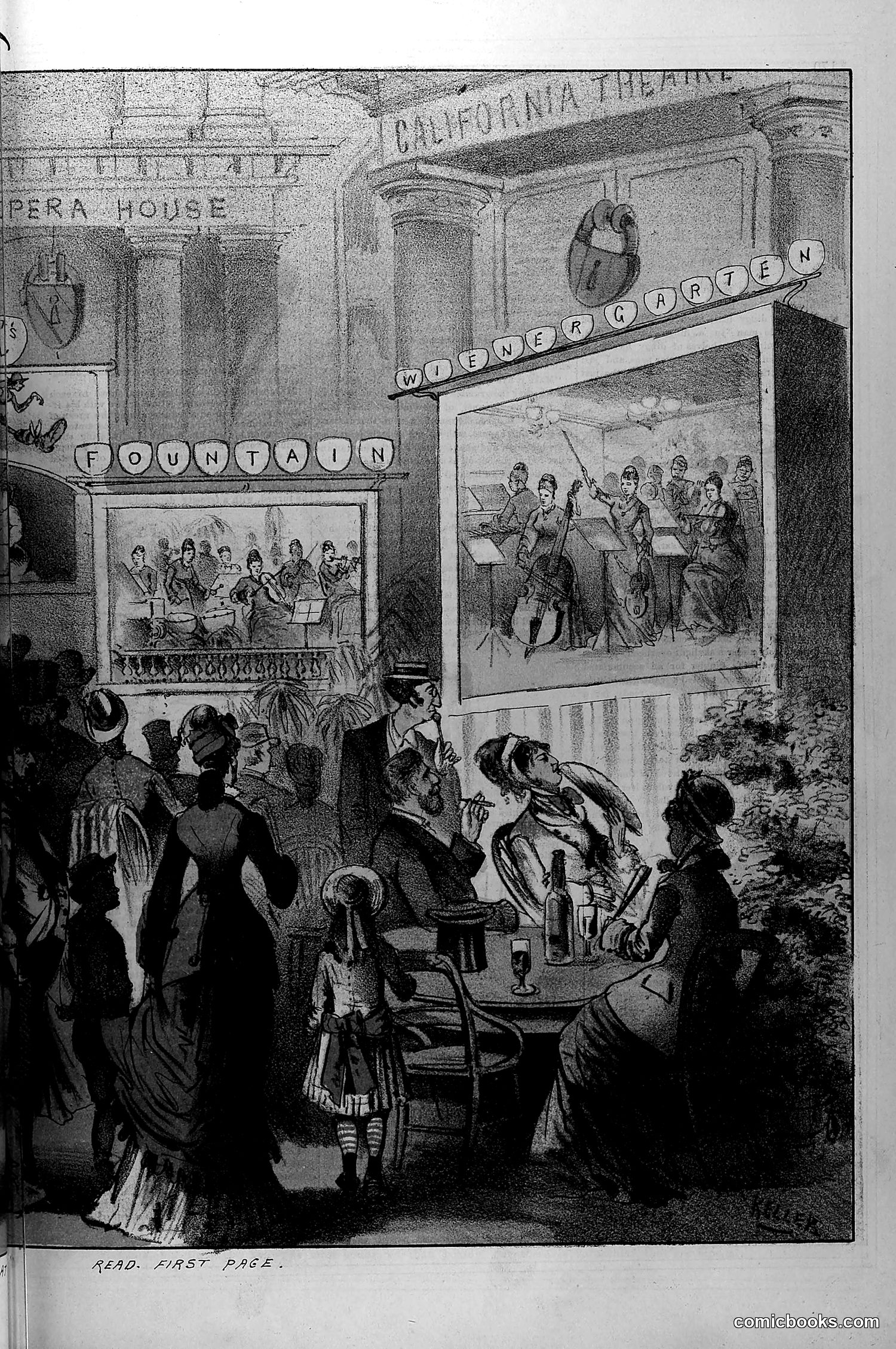
This satirical illustration depicts San Francisco's California Theatre during what appears to be the late 19th century. The scene shows two entertainment venues: a "Fountain" display (left) and a "Wine Garden" (right), both featuring orchestras performing for crowds of well-dressed patrons. The satire likely critiques the theatrical and entertainment culture of San Francisco's elite—the juxtaposition of refined "culture" (opera house references visible in background architecture) with commercial amusement venues suggests commentary on how high art and popular entertainment competed for the same affluent audience. The crowds enjoying wine and music alongside formal performances may mock the era's pretensions to sophistication, or satirize how wealth concentrated in entertainment districts. Without additional context about The Wasp's specific editorial stance, the exact target remains somewhat unclear.
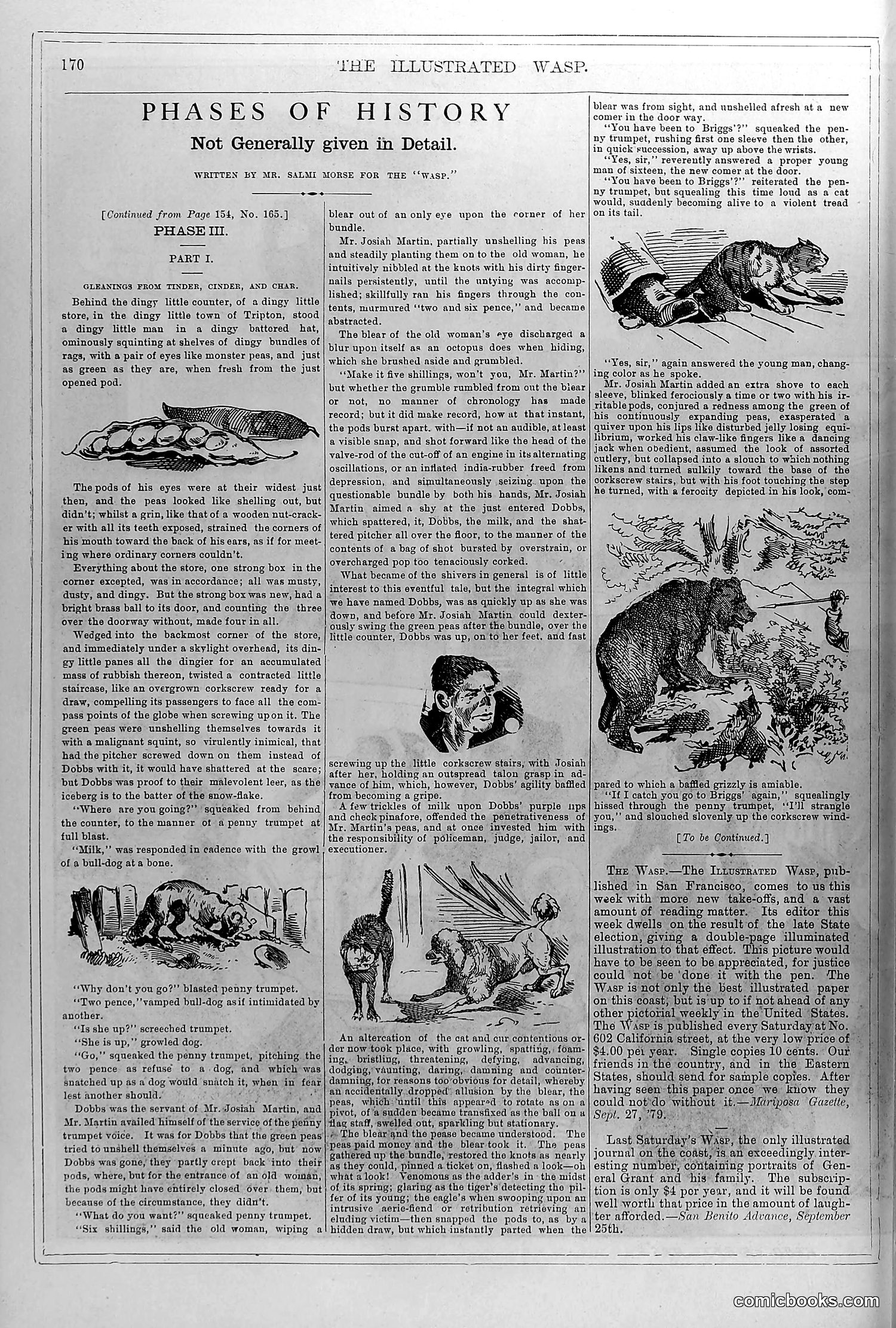
This page presents a serialized story titled "Phases of History: Not Generally given in Detail" by Mr. Salmi Morse for *The Wasp*. The narrative describes a dingy London tenement where poor residents conduct daily struggles. Multiple illustrations accompany the text, depicting working-class characters in squalid conditions—pigs rooting in filth, a woman in distress, and figures on cramped stairs. The satire appears to mock Victorian-era social realism literature and melodrama, while documenting actual poverty conditions. The detailed, unsentimental descriptions of "dingy bundles of rags" and desperate characters suggest social commentary on urban poverty and class inequality in industrial England, presented with dark humor typical of satirical publications.
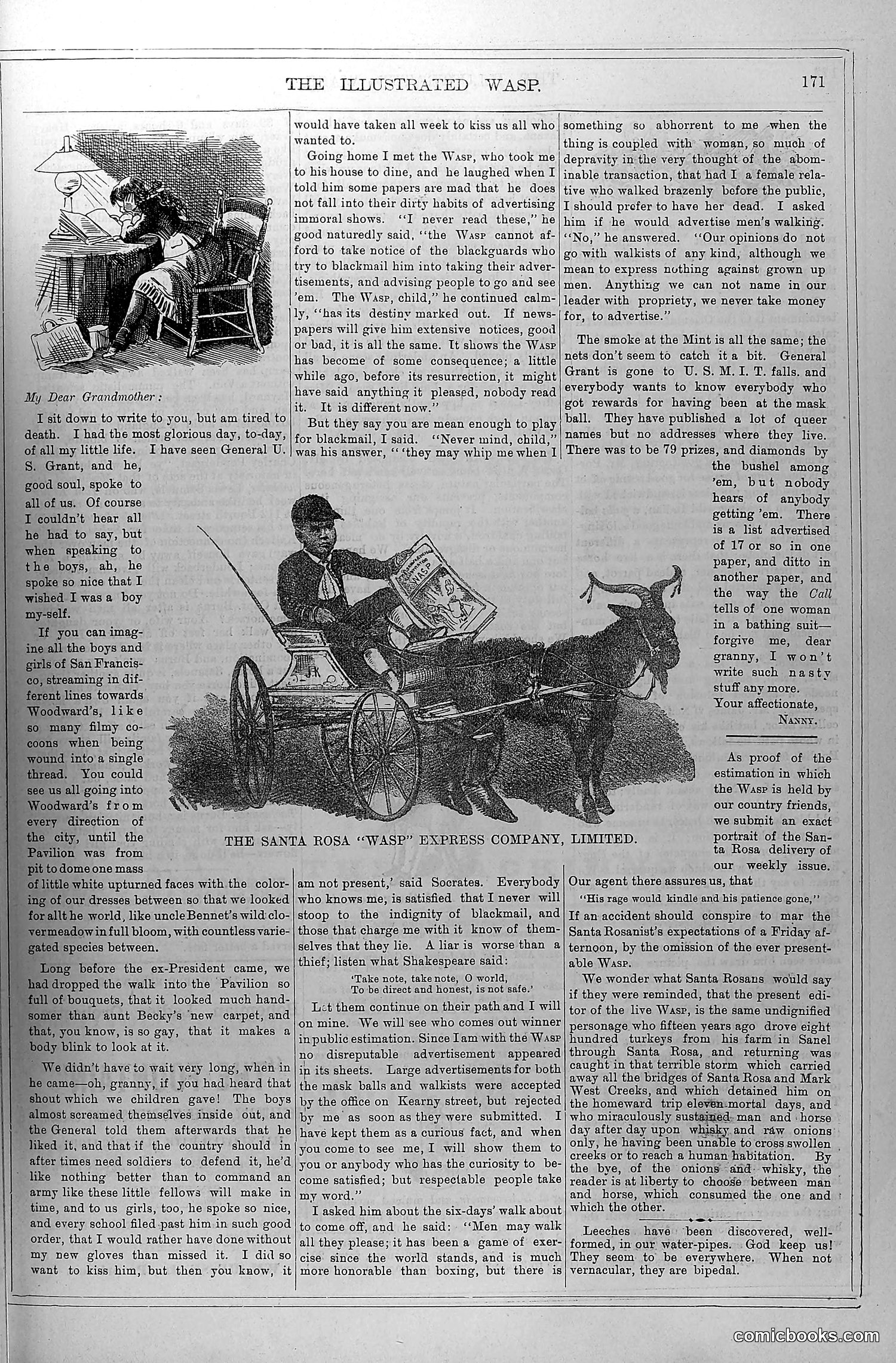
This page contains a letter to "My Dear Grandmother" describing the writer's observations of San Francisco society and the "Wasp" publication itself. The main illustration shows **the Santa Rosa "Wasp" Express Company**, depicted as a cart pulled by a horned animal (possibly a bull or goat), carrying newspapers. The satirical point appears to be about the Wasp's circulation and influence in spreading gossip and scandal throughout San Francisco and surrounding areas. The letter humorously describes how the Wasp's advertisements and content circulate widely, referencing its impact on public perception. The beast-drawn cart satirizes the somewhat crude but effective distribution method of this scandal-focused satirical magazine reaching readers across the region.
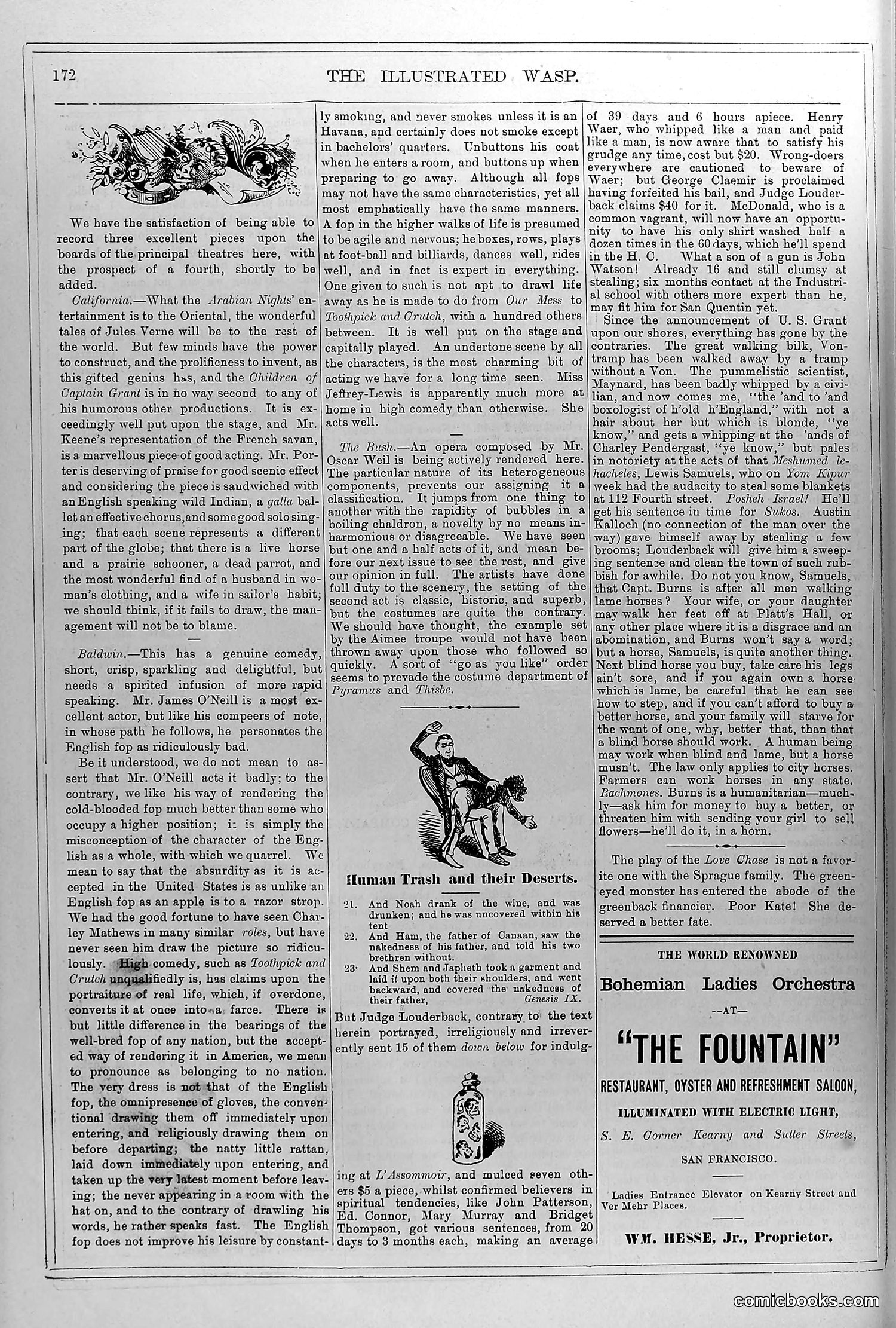
This page is primarily **theatrical criticism and advertisement**, not political satire. The main content reviews several stage productions: 1. **"Arabian Nights"** - praised for Oriental entertainment value 2. **"Topsy-turvy and Crucible"** - critiqued for weak acting, particularly Miss Jeffrey-Lewis 3. **"The Hush"** - an open comedy praised for preventing character assignment issues 4. **"Baldwin"** - genuine comedy featuring Mr. James O'Neill as an English fop in America, noting his skilled character work The cartoon (lower left) appears to show a man in period costume, likely illustrating one of these theatrical productions. The page concludes with advertisements for San Francisco establishments, including "The Fountain" restaurant. This reflects **1880s-90s American popular culture**, with emphasis on theatrical entertainment criticism rather than political commentary.
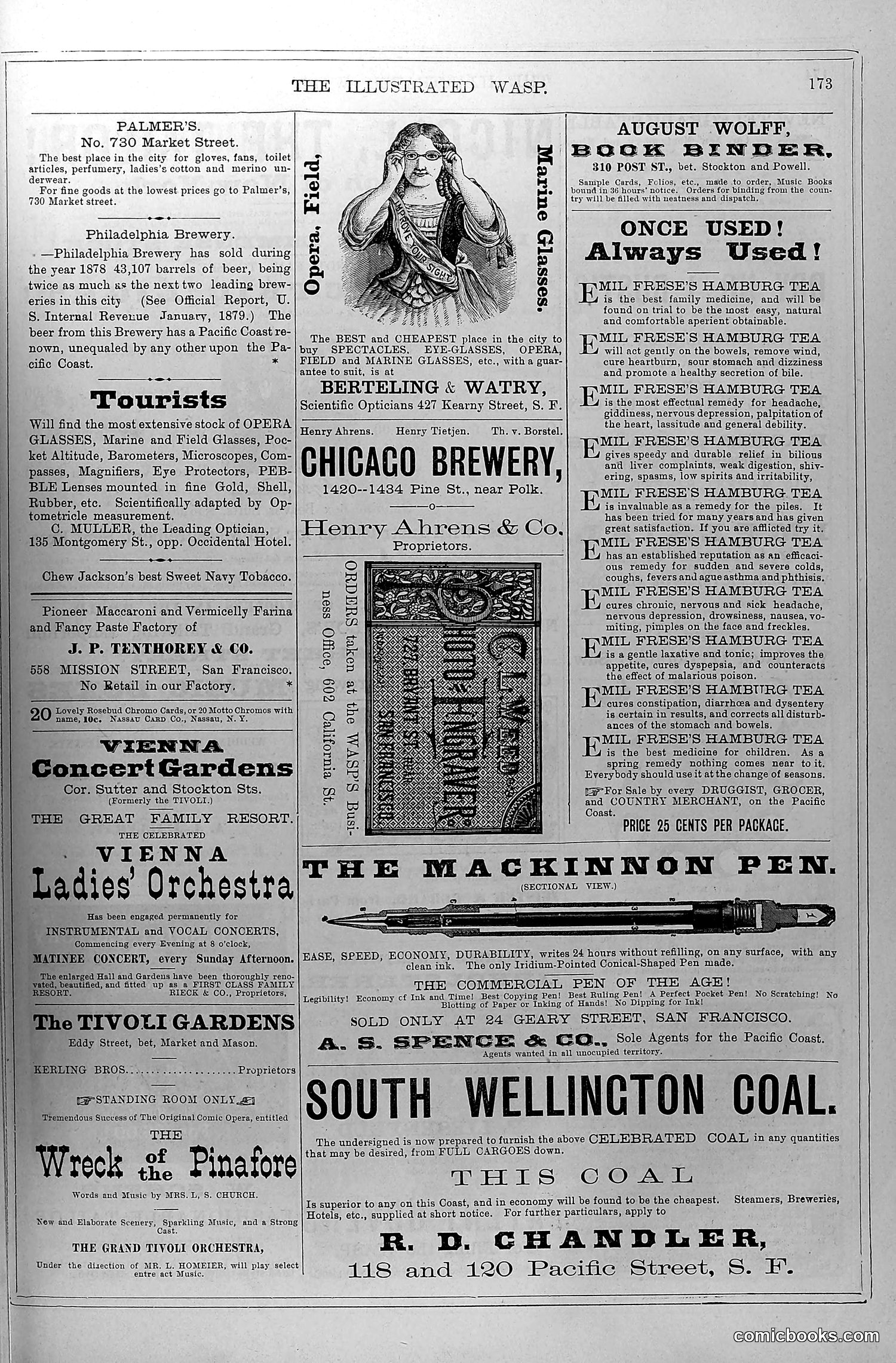
This page is primarily **advertising content** rather than satirical cartoons. It contains numerous commercial advertisements for San Francisco-area businesses from what appears to be the late 19th century, including: - Palmer's glove shop - Philadelphia Brewery - Chicago Brewery - Vienna Concert Gardens - The Tivoli Gardens (theater) - Emil Frese's Hamburg Tea (with repeated testimonial ads) - The Mackinnon Pen - South Wellington Coal The only illustrated element is a **portrait of a woman** in the upper center (possibly "Mande Gladesse" based on the vertical text), but without clear context or caption, her identity and relevance to the page remain unclear. The page functions essentially as a classified advertisement section rather than editorial satire.
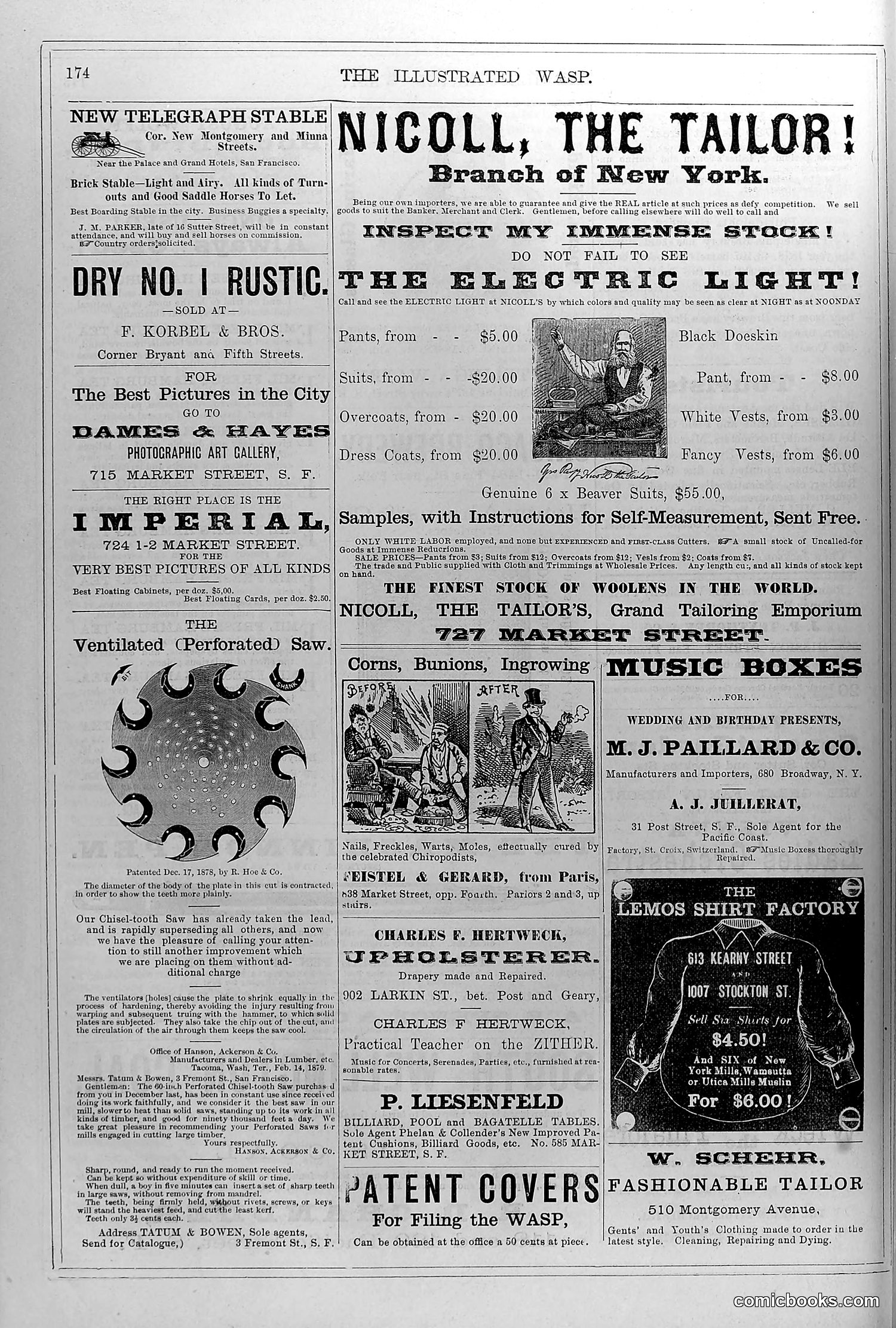
This page is **primarily advertising**, not satirical content. It contains commercial advertisements for San Francisco businesses circa the 1870s-1880s, including: - Nicoll the Tailor (branch of New York operation) featuring "Electric Light" as a novelty attraction - Dry goods retailers, photography galleries, furniture makers - Medical practitioners offering treatments for corns, bunions, and ingrown nails - Music boxes and shirt factories The single illustration shows a "before and after" medical treatment scenario (corns/bunions), a common Victorian advertising trope. There is **no discernible political cartoon or satirical content** on this page. It represents The Wasp's revenue model: satirical editorial content subsidized by classified advertisements. The page demonstrates how 19th-century magazines mixed entertainment with commercial notices to remain financially viable.
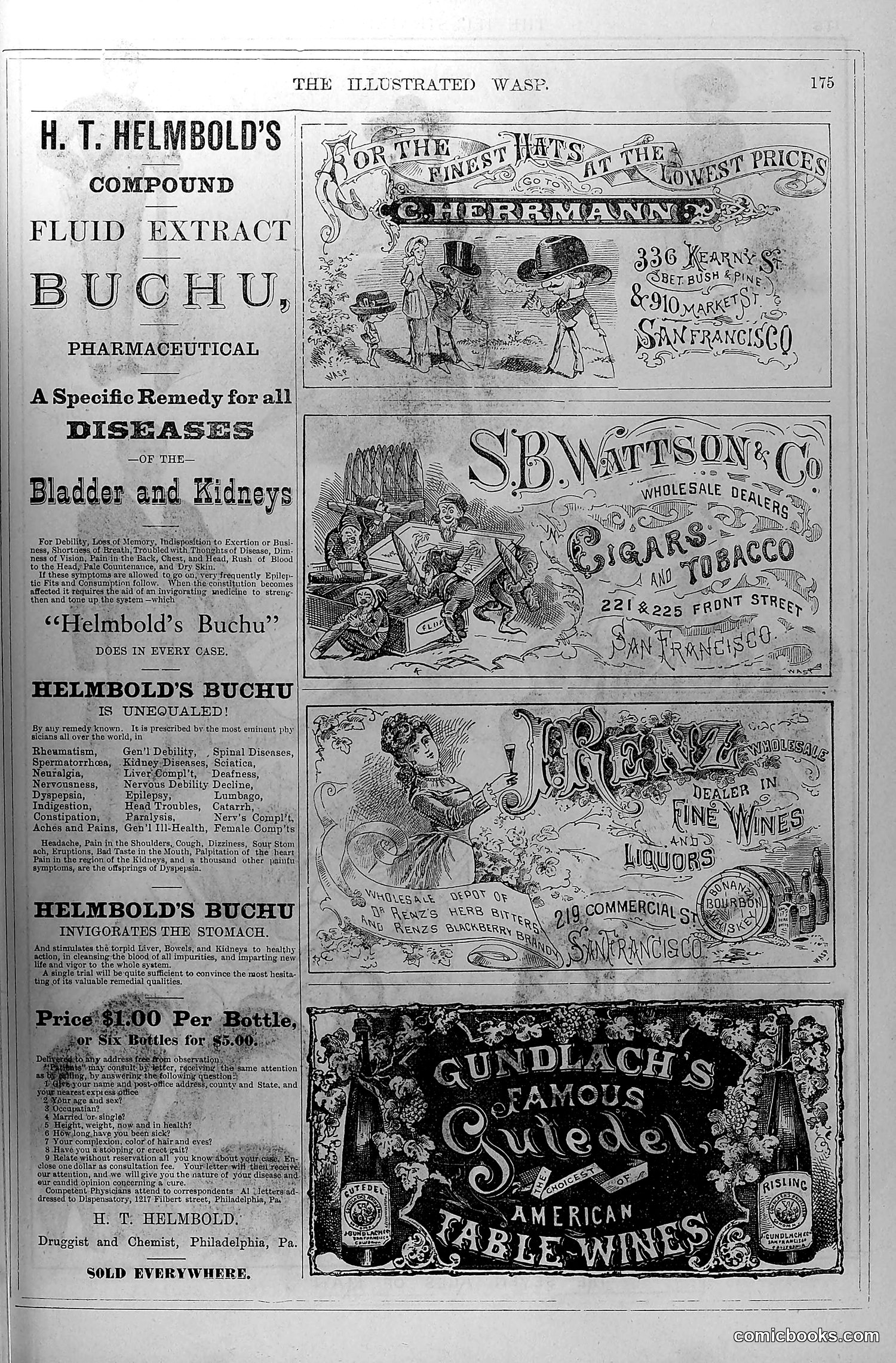
This page is **primarily advertising content**, not satirical editorial material. The left side features a medical advertisement for "Helmboldt's Buchu," a patent medicine claiming to treat bladder and kidney diseases. The right side contains four separate commercial advertisements for San Francisco businesses: C. Herrmann (hats), S.B. Wattson & Co. (cigars and tobacco), J. Potz (wines and liquors), and Gundlach's Sprudel (table wines). The illustrations are decorative commercial artwork typical of 19th-century advertising—whimsical vignettes designed to attract attention rather than satirize. While *The Wasp* was known for satire, this particular page serves as a revenue-generating advertisement section rather than editorial content with political or social commentary.
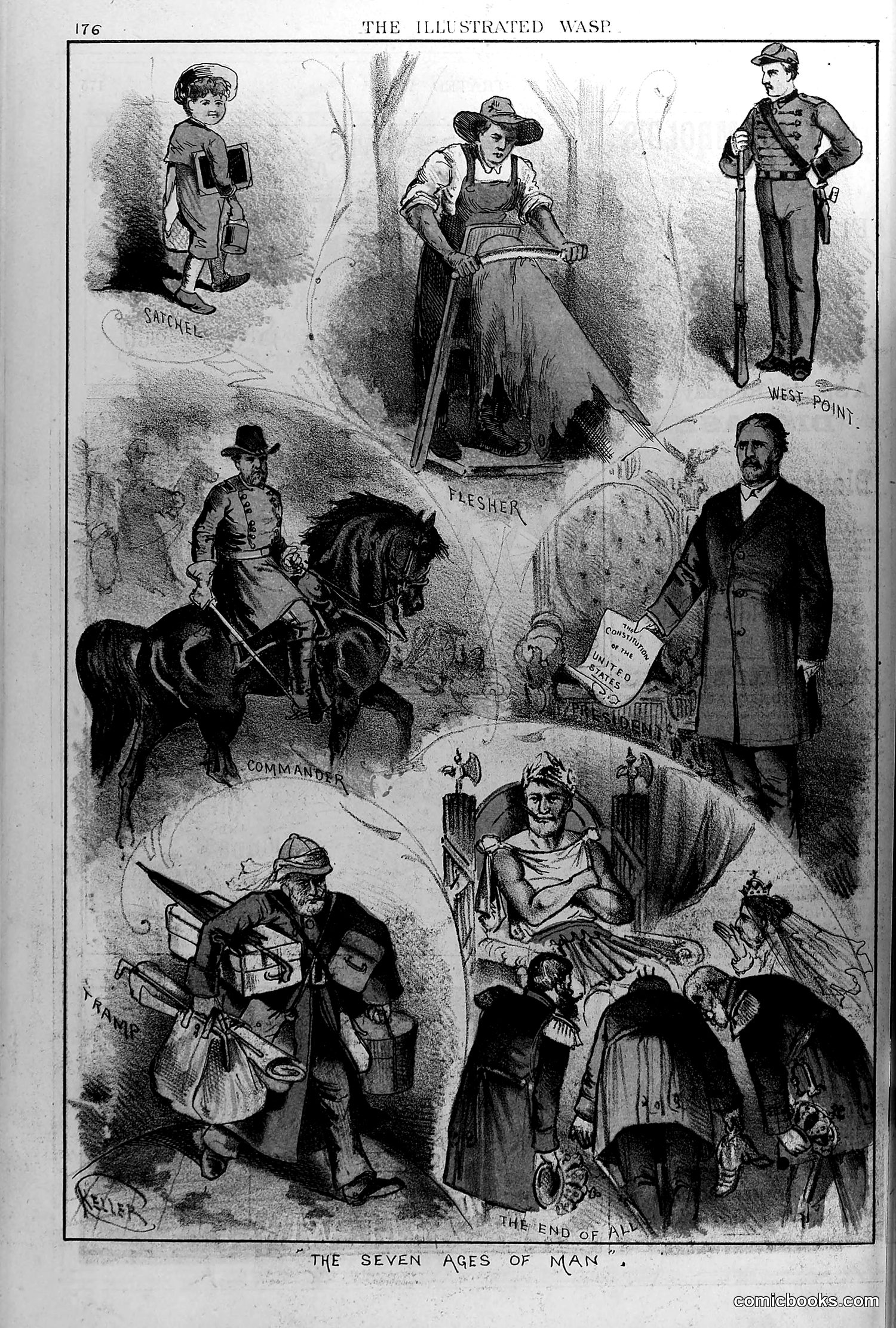
This page from *The Wasp* depicts "The Seven Ages of Man" reimagined through a military lens, likely commenting on American military recruitment and service during the late 19th century. The progression shows figures labeled "Satchel," "Flesher," "West Point," "Commander," and "The End of All," presenting stages from boyhood through old age. The final panel depicts soldiers in what appears to be conflict or death, with an eagle symbol suggesting American military authority. The satire appears to critique how military life encompasses all stages of existence—from innocent youth (the boy with his satchel) to eventual destruction or death ("The End of All"). The cartoon suggests a cynical view of military service as humanity's inevitable trajectory, mocking the institution's recruitment of young people into a system culminating in warfare and mortality.
I can see this is a test or calibration page from *The Wasp* magazine, not an actual cartoon or editorial content. The page displays a grayscale reference chart with various tonal squares (ranging from dark to light gray) on the left side, accompanied by measurement rulers both vertically and horizontally. This type of page was standard in archival photography and reproduction work, used to ensure proper exposure, contrast, and color balance when photographing or scanning documents. It's a technical tool rather than satirical content, likely included in the original publication's documentation or in the archival materials used to preserve this magazine.