
A complete issue · 18 pages · 1879
The Wasp — September 27, 1879

I can see this is a measurement/calibration page from *The Wasp* magazine, featuring an Oregon Rule Co. ruler and a color reference checker (the grid of gray and white squares on the right). This appears to be a technical page used for photographic reproduction and quality control rather than a satirical cartoon page. The ruler and color checker were standard tools in printing and publishing to ensure accurate scaling and color reproduction when reproducing images in magazines. This is a production/technical artifact rather than editorial content with political or social satire. Without visible cartoon imagery or OCR'd text content about specific figures or events, I cannot identify satirical targets or jokes on this particular page.
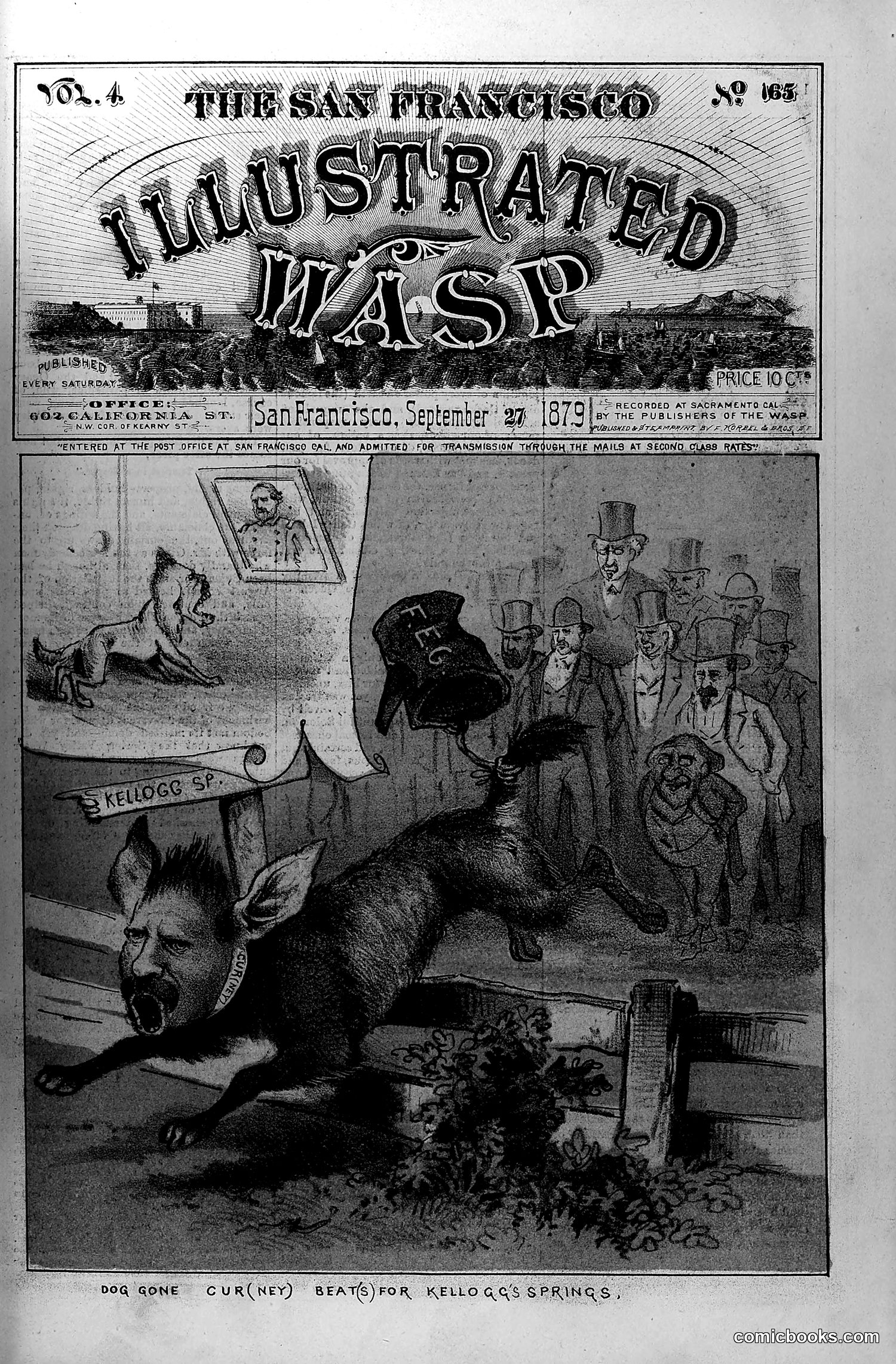
This satirical cartoon depicts a large dog with a human face labeled "DOG GONE CUR(NEY) BEAT(S) FOR KELLOGG'S SPRINGS." The dog appears to be fleeing from a group of well-dressed men in top hats who are chasing it. The cartoon likely references a political or social scandal involving someone with "Curney" or similar in their name, possibly related to Kellogg's Springs (a California location). The transformation into a dog suggests humiliation or degradation of the figure. The pursuing gentlemen appear to represent authorities or an angry public seeking retribution. Without additional historical context about 1879 San Francisco politics, the specific individuals and incident remain unclear, but the imagery conveys mockery of a disgraced public figure fleeing justice or public shame.
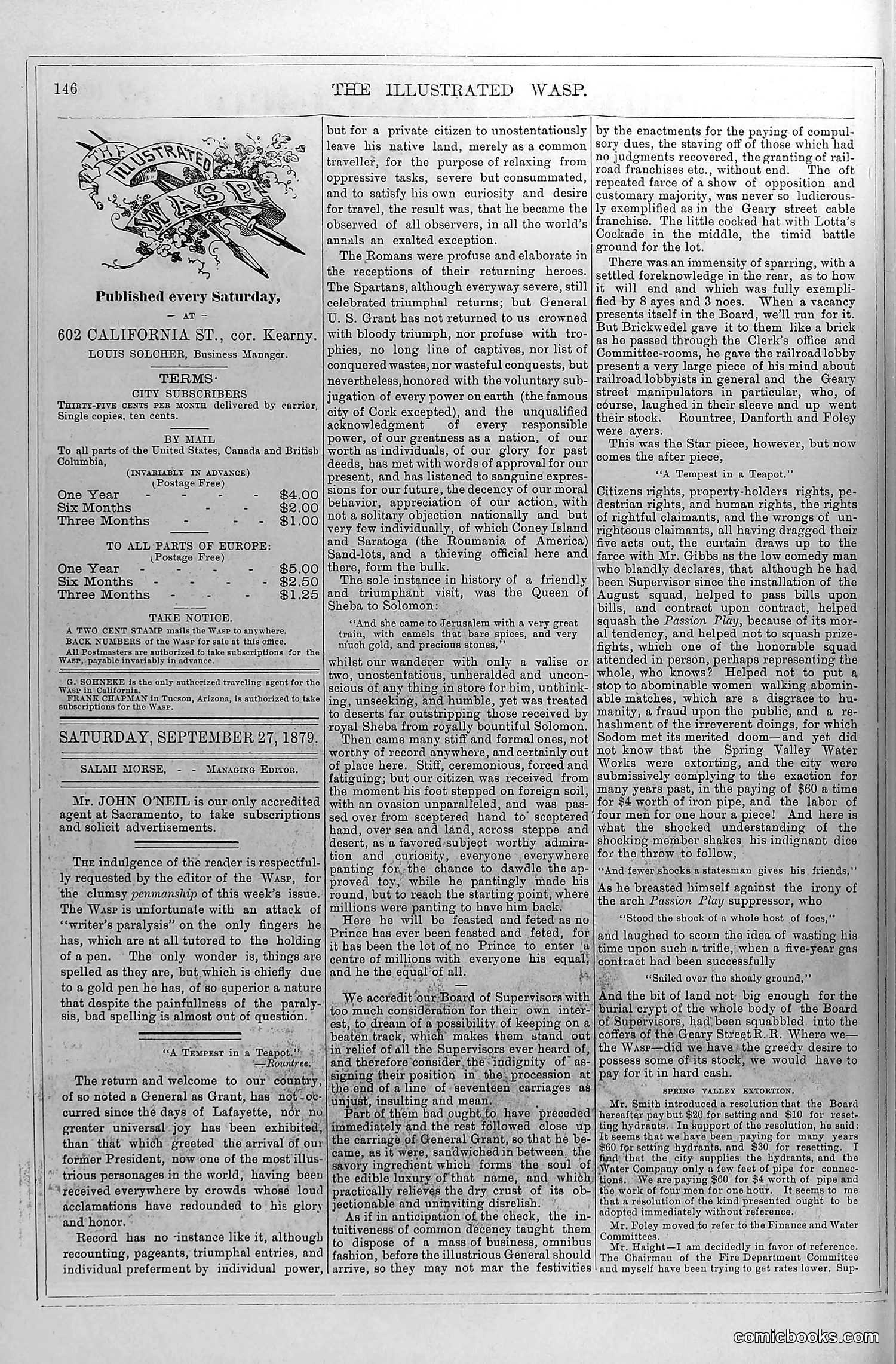
The page is primarily **subscription information and business content** rather than editorial cartoons. The masthead shows "The Illustrated Wasp" logo with a wasp illustration. The visible text discusses General Grant's return from travel, praising his accomplishments and expressing joy at his homecoming. There are editorial notes about the magazine's operations, including that John O'Neill is their Sacramento agent for subscriptions. The lengthy article discusses various San Francisco civic matters—Board of Supervisors proceedings, water works, and street issues—typical political commentary for a satirical publication of this era. **No distinct political cartoon or caricature is clearly visible** in the image provided. The page appears to be mostly typeset editorial and advertising content rather than illustrated satire.
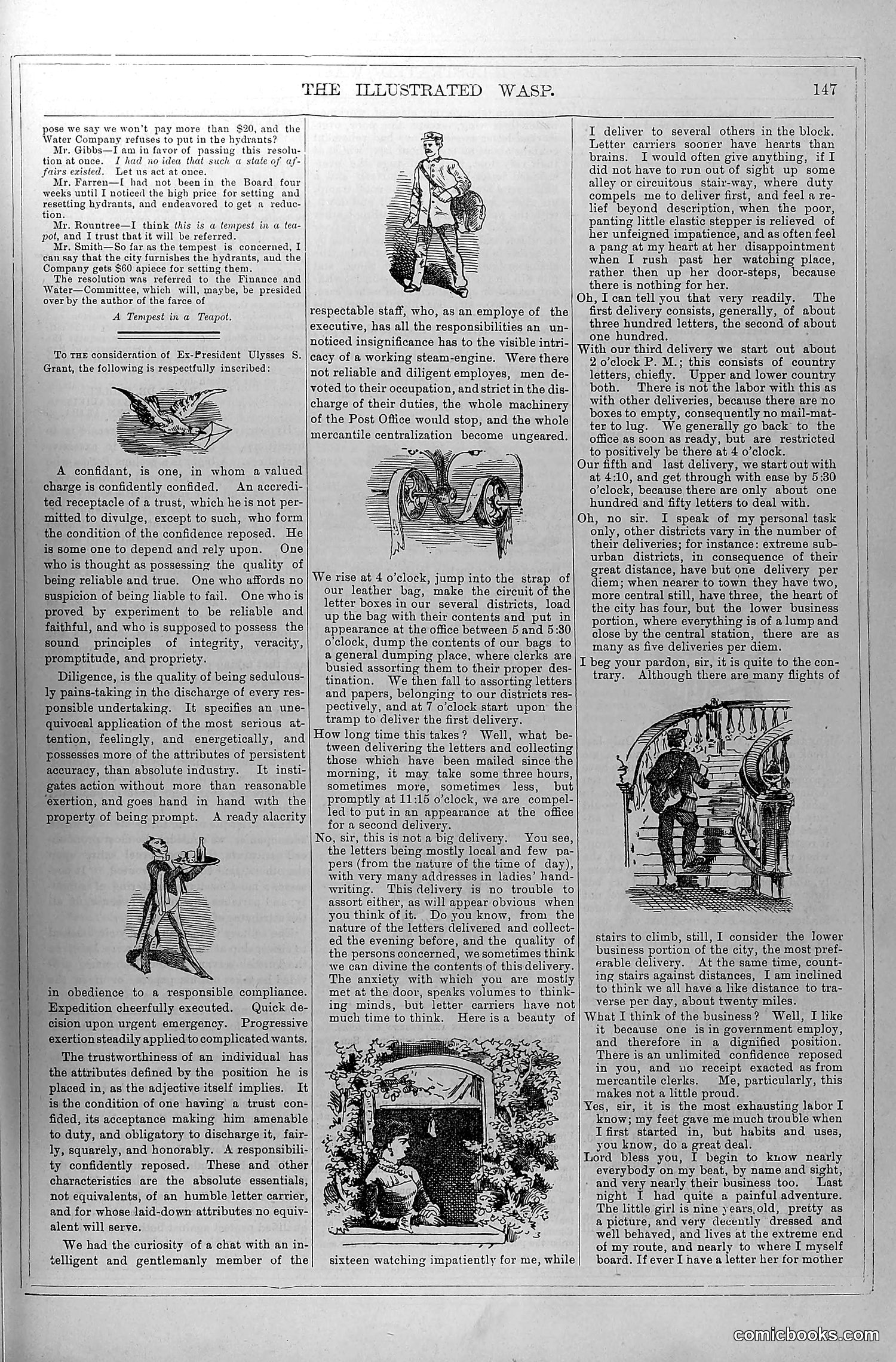
This page from *The Wasp* features a dialogue about postal delivery efficiency, specifically addressing **Ex-President Ulysses S. Grant**. The text discusses complaints about mail carrier performance and Post Office management, debating whether carriers should be paid more (proposed at $20) to improve service reliability. The accompanying illustrations show postal workers and delivery routes. The satire criticizes **postal service inefficiency** — carriers are portrayed as unreliable, and the text suggests systemic problems with how the Post Office operates. The author argues that better pay might attract more dependable employees, while another speaker contends the system itself needs reform, not just wage increases. This reflects **Gilded Age complaints** about government bureaucracy and worker competence during the Grant administration.
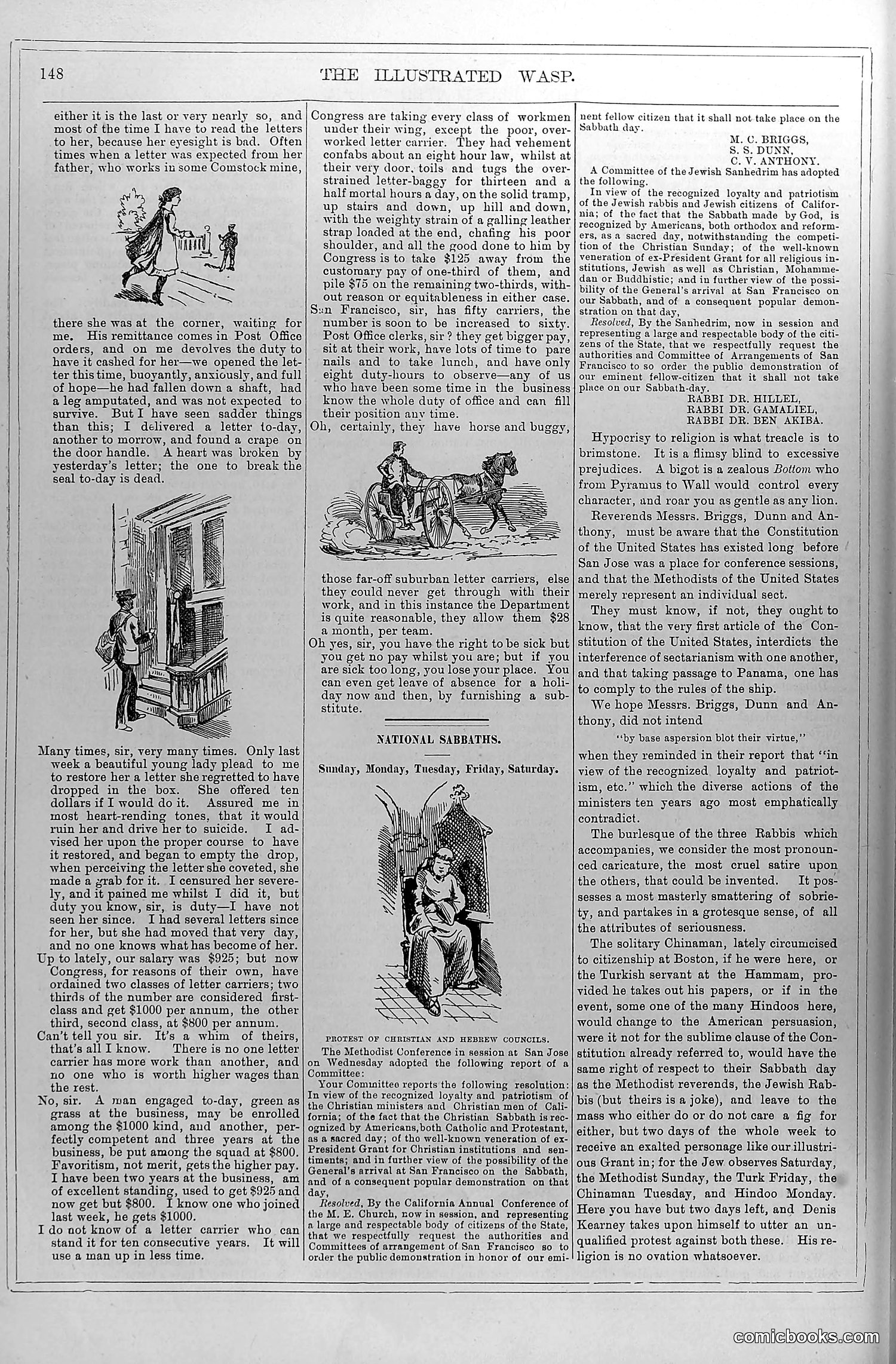
This page contains no prominent political cartoon. Instead, it's primarily text discussing two distinct topics: 1. **Letter carriers' working conditions**: A narrative complaint about overworked postal employees, describing their difficult daily tasks and the inadequate compensation they receive. 2. **"National Sabbaths" and religious conflict**: A section critiquing what appears to be interfaith tensions, specifically mentioning Methodist, Christian, Hebrew, and Hindu observances. The text satirizes proposed legislation or public demonstrations regarding Sabbath observance, suggesting hypocrisy among those claiming religious devotion while opposing others' religious practices. Small illustrations accompany the text but appear decorative rather than satirically pointed. The page emphasizes labor exploitation and religious intolerance as targets for satire.
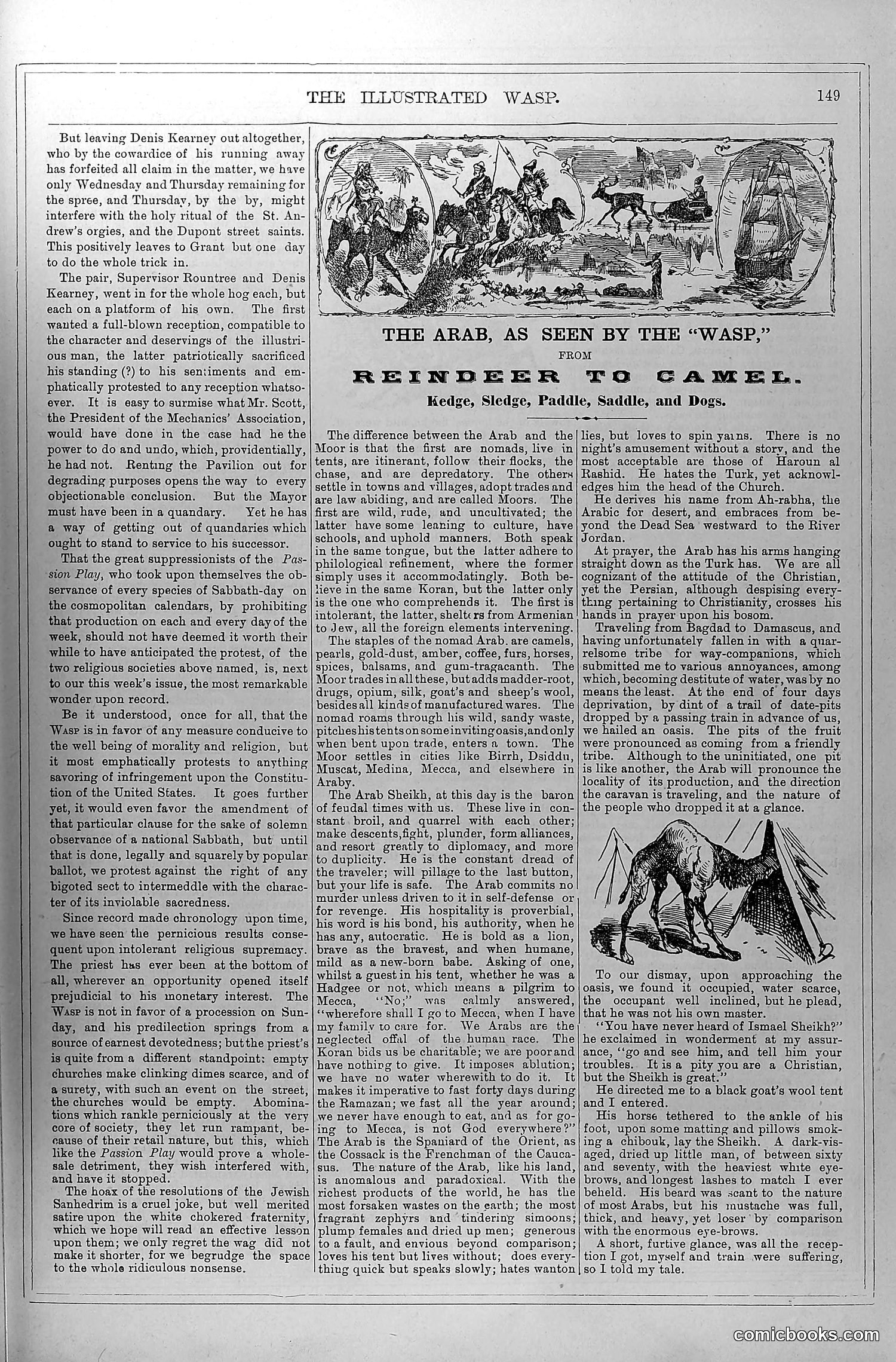
This page contains two distinct elements: a lengthy editorial critique and an illustrated article titled "The Arab, As Seen by the 'Wasp': From Reindeer to Camel." The editorial attacks Denis Kearney and the labor movement's anti-Chinese agitation, criticizing their attempt to interfere with religious observances (specifically mentioning the St. Andrew's Drew orgies and Dupont Street saints). The writer sarcastically suggests only Kearney could accomplish the "whole trick" of disrupting these events. The illustrated section describes Arab character and customs—their nomadic nature, appearance, and behavior—with ethnographic detail typical of 19th-century Western periodicals. The accompanying sketches depict an Arab figure and a camel. The page reflects The Wasp's pattern of mixing labor-politics critique with exoticized cultural commentary, representing period attitudes toward both domestic labor agitators and foreign peoples.
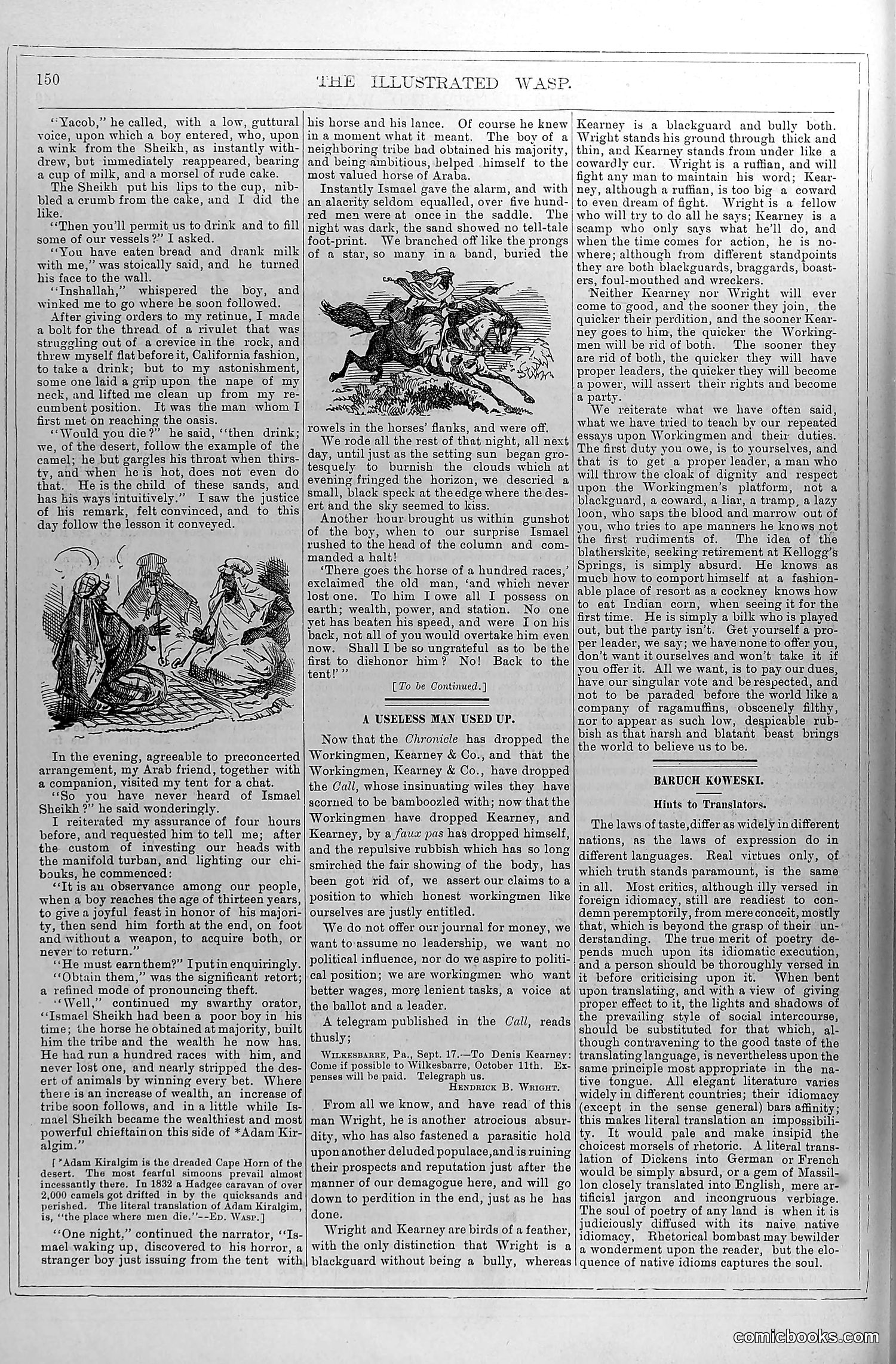
This page contains a serialized story ("To be Continued") titled "A Useless Man Used Up," featuring narrative text and two illustrations of what appears to be desert/colonial adventure scenes with figures on horseback and armed men. The main article discusses the *Chronicle's* coverage of labor disputes involving "Workingmen, Kearney & Co." and "the Call" newspaper. It criticizes these publications for sensationalism and poor journalism, arguing they prioritize political agitation over substantive worker advocacy. The piece advocates for dignity, respect, and proper leadership in labor movements, suggesting radical publications harm workers' causes through inflammatory rhetoric and crude presentation. The bottom section is a book review of translations from various languages, discussing translation theory and literature. This reflects late 19th-century San Francisco labor journalism conflicts.
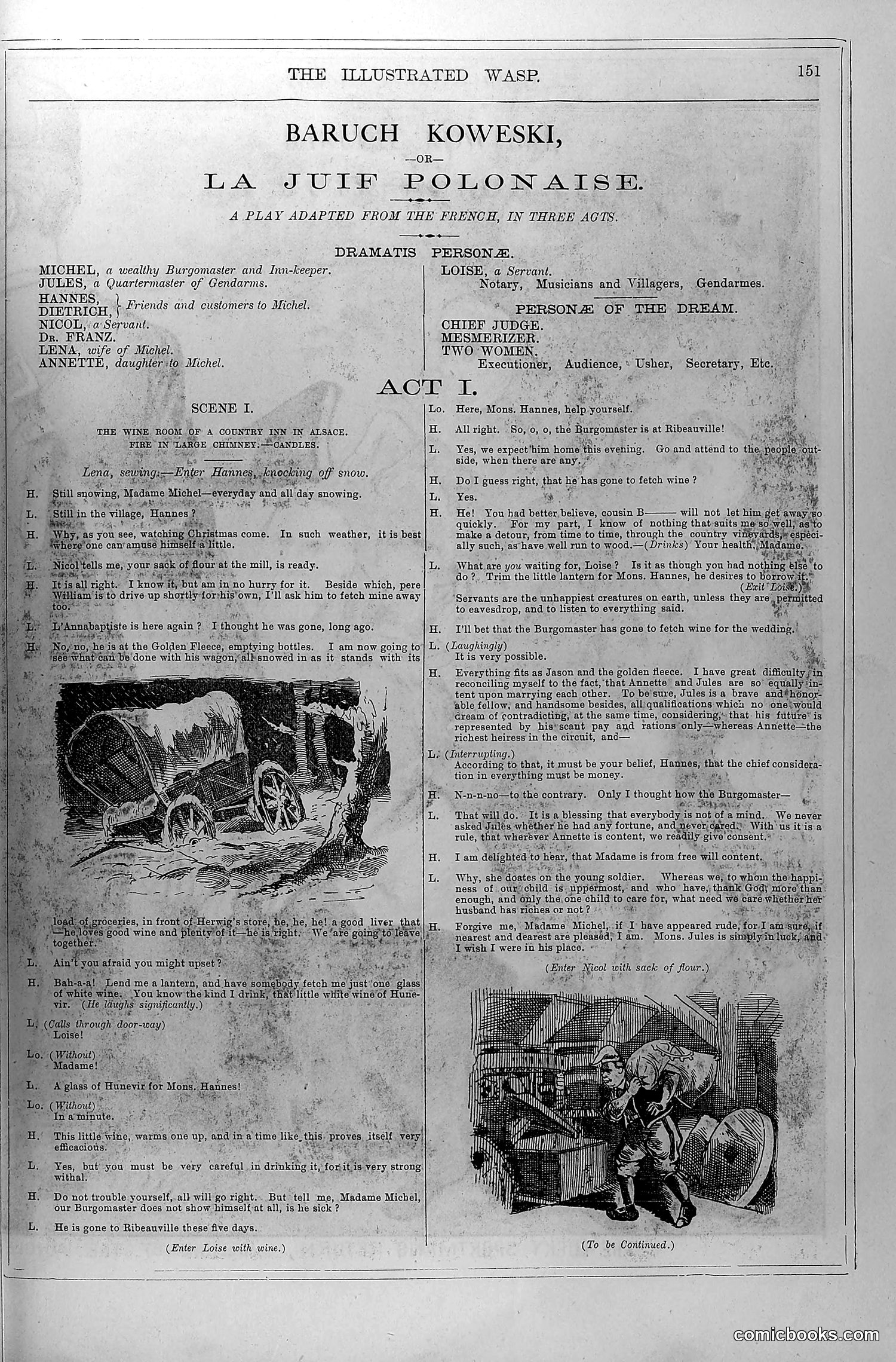
This page presents a three-act play adapted from French. The content is a dramatic script with stage directions rather than a political cartoon. The title's reference to a "Polish Jew" (Juif Polonaise) appears to be a comedic theatrical work featuring working-class characters—an innkeeper, servants, and townspeople in Alsace. Two illustrations show domestic scenes: a wagon/cart, and figures in what appears to be a cellar or storage room. The script itself contains period dialogue about wine, fetching supplies, and village life. Without clear historical context about this specific play or The Wasp magazine's satirical intent, I cannot definitively identify the political message or whether ethnic caricature is intended. The theatrical format dominates this page over explicit satire.
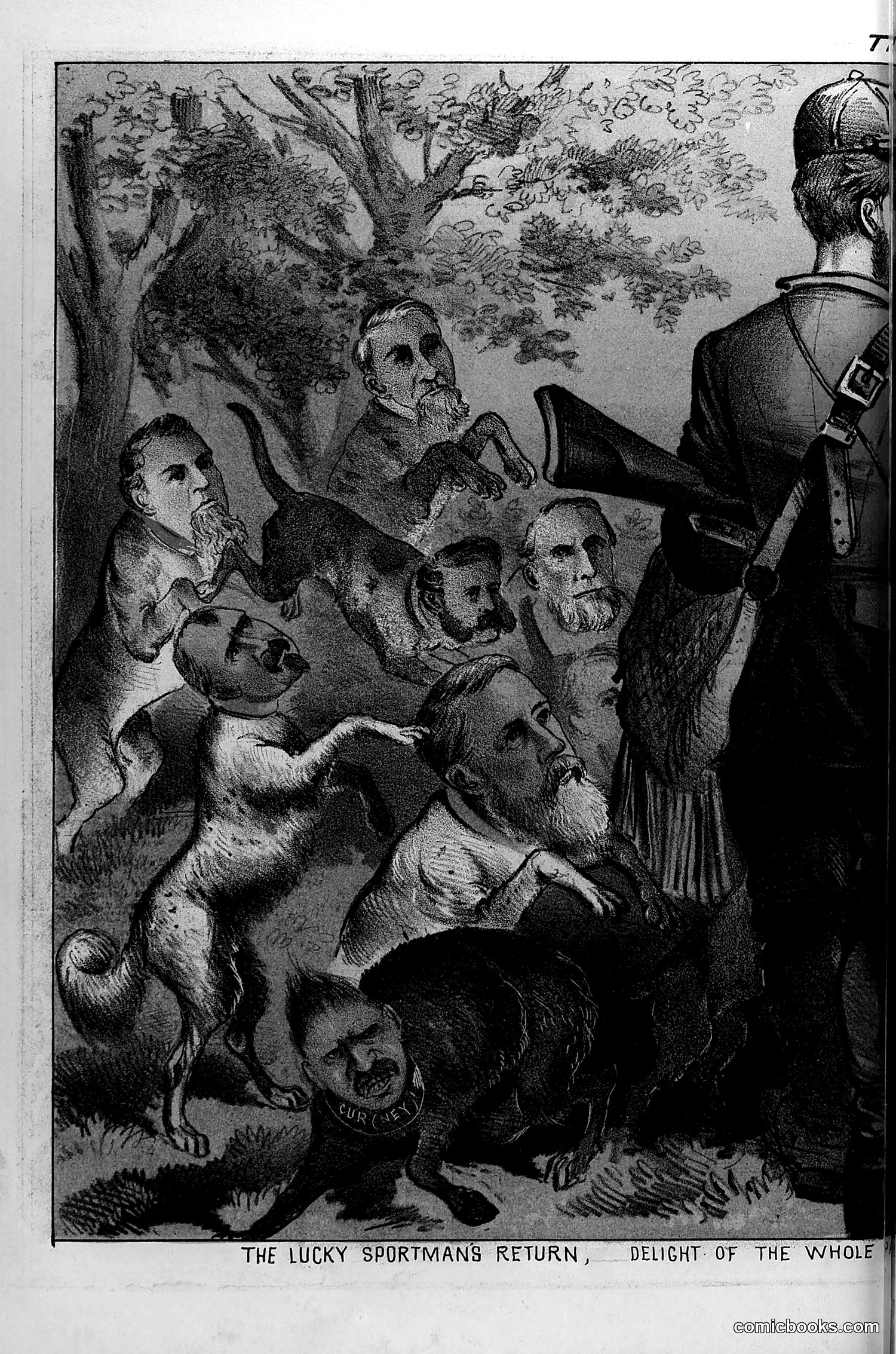
This engraving depicts a successful hunter returning home to jubilant reception. A uniformed soldier or official stands at right, while a bearded man in the center displays his kill to a gathered crowd of men and cherubs. Dogs surround the scene, and large game animals (possibly deer or similar) are prominently featured. The caption's phrase "lucky sportsman" and "delight of the whole" suggests satirical commentary on hunting as a leisure activity or perhaps on a political figure's return from a military campaign portrayed ironically as sport. The mix of allegorical cherubs with realistic military dress suggests this likely comments on 19th-century military adventures or expeditions being celebrated disproportionately. Without additional context or visible date, the specific historical reference remains unclear.
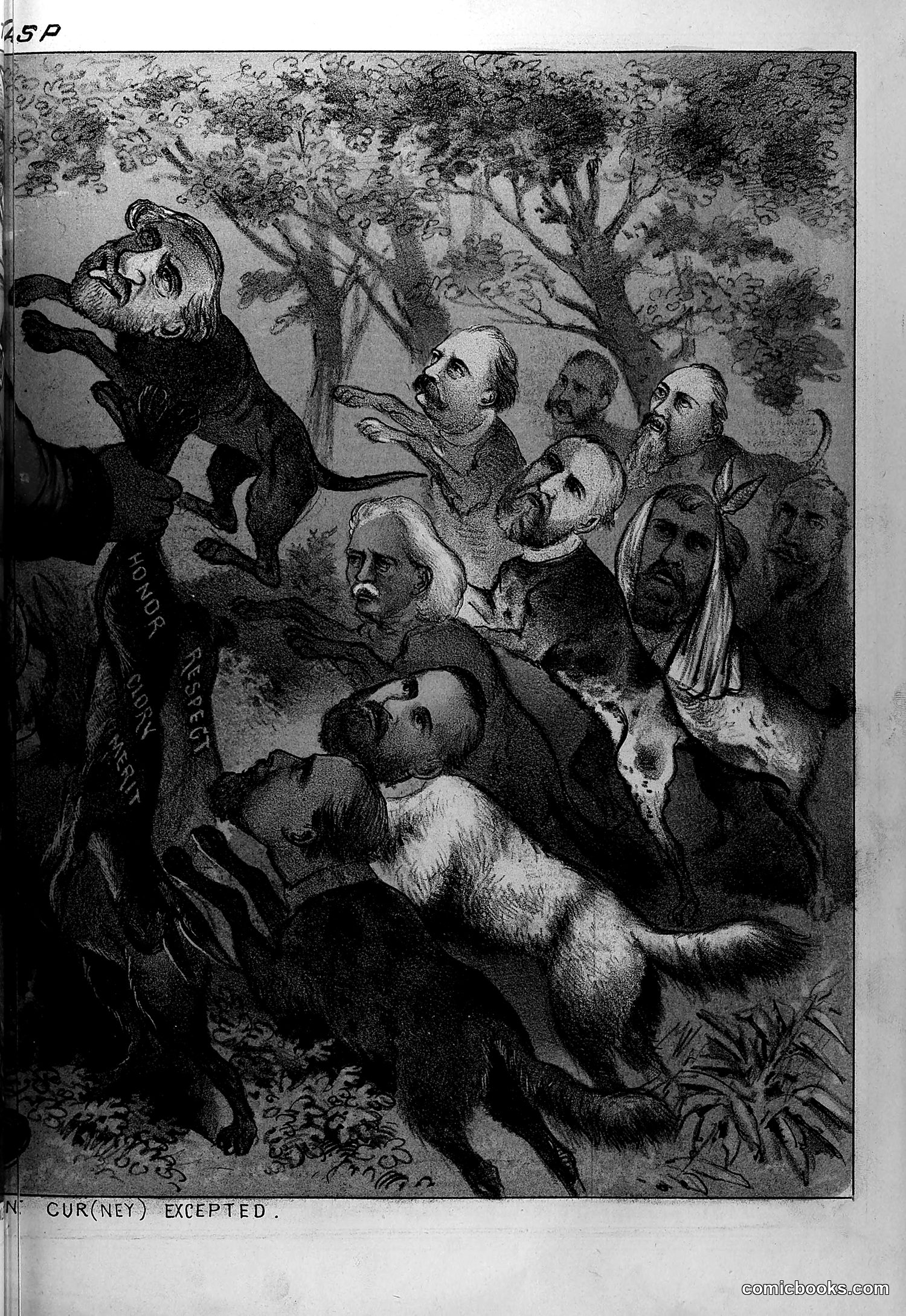
This satirical engraving depicts a group of men gathered beneath a tree, apparently receiving judgment or punishment from an ape-like figure above them. The caption "CUR(NEY) EXCEPTED" suggests this is political commentary about someone named Curney being excluded from whatever fate befalls the others. The style and composition suggest this is 19th-century American political satire, likely targeting specific political figures or groups. The ape imagery was a common (and deeply problematic) satirical device of that era for depicting opponents or rival political groups as base or primitive. Without additional context about *The Wasp* magazine's publication date and contemporary political circumstances, I cannot definitively identify which specific figures or events this cartoon references.
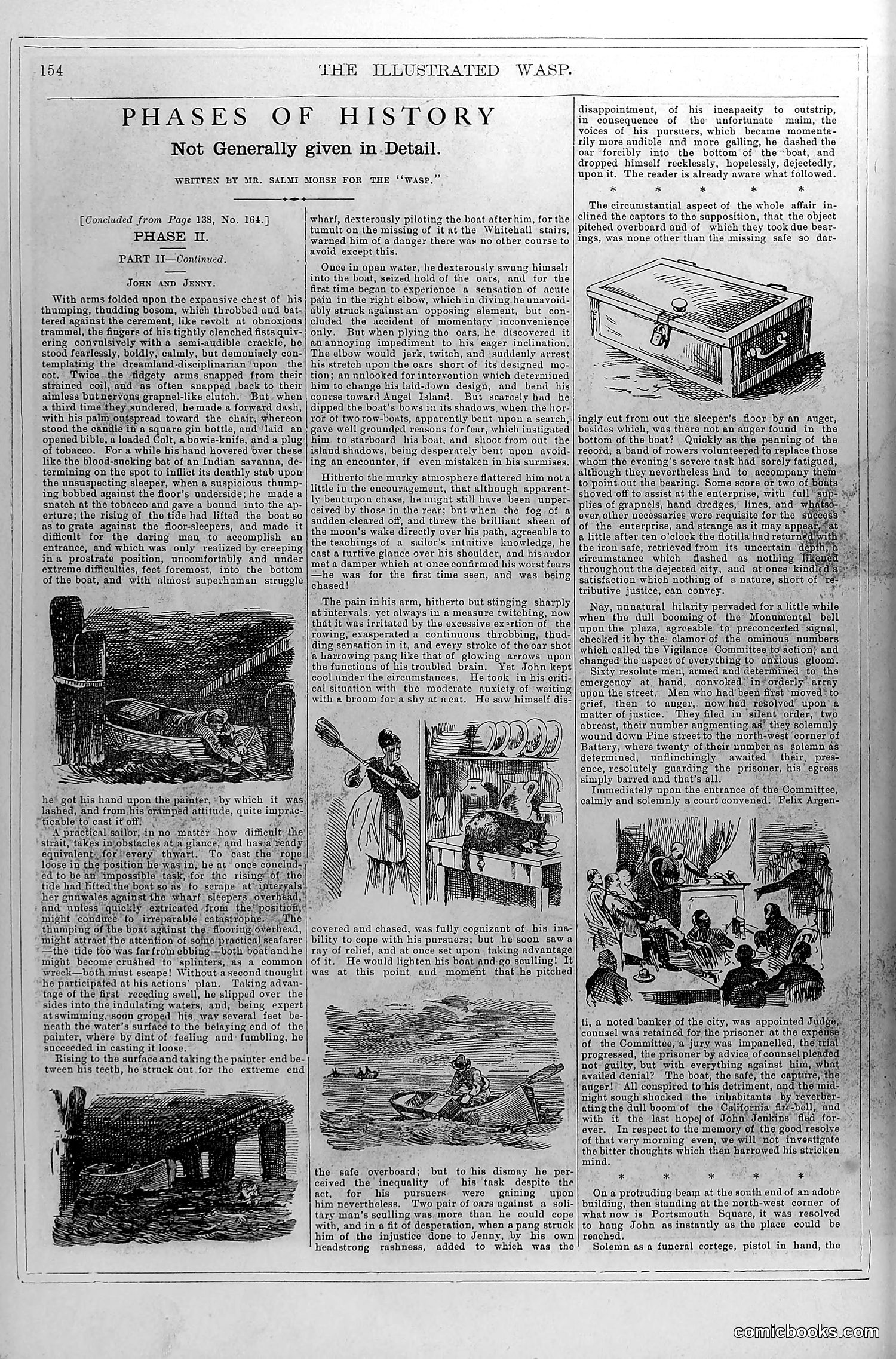
This page continues a serialized narrative story rather than presenting political cartoons. The text describes John and Jenny's dramatic escape during what appears to be a civil unrest incident, involving pursuit, a boat chase, and attempts to reach safety. Several illustrations depict their harrowing journey: people in a boat being chased, someone swimming, figures in period dress indoors, and scenes of conflict or pursuit. Without clear historical context identifying the specific "John and Jenny" narrative or the historical event referenced, I cannot definitively explain the satirical intent. The page appears focused on storytelling with accompanying illustrations rather than political commentary or caricature typical of satirical magazines.
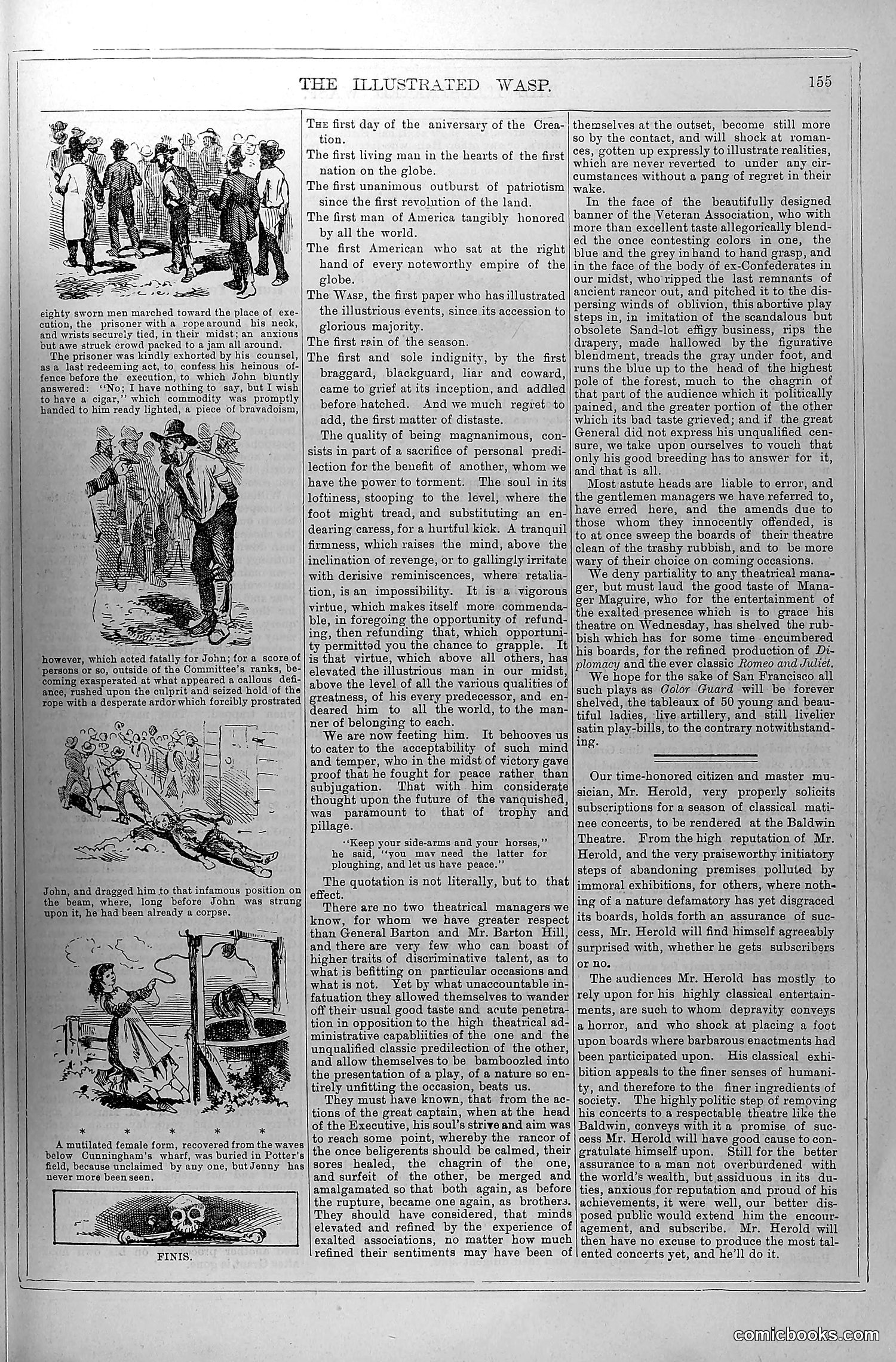
This page contains satirical commentary on theatrical management and entertainment rather than explicit political cartoons. The text discusses theatrical managers, particularly referencing General Barton and Mr. Barton Hill, criticizing their discriminatory talent selection and administrative capabilities. The article praises Mr. Herold, a musician and entertainer, for soliciting subscriptions for classical music concerts at the Baldwin Theatre. The satire targets theatrical management's poor judgment and suggests that refined individuals like Herold demonstrate superior taste compared to established theatrical producers. The accompanying illustrations appear to depict theatrical scenes and everyday situations, though their specific satirical targets are unclear from the image quality. The overall tone critiques San Francisco's entertainment establishment for lacking sophistication and proper judgment in cultural programming.
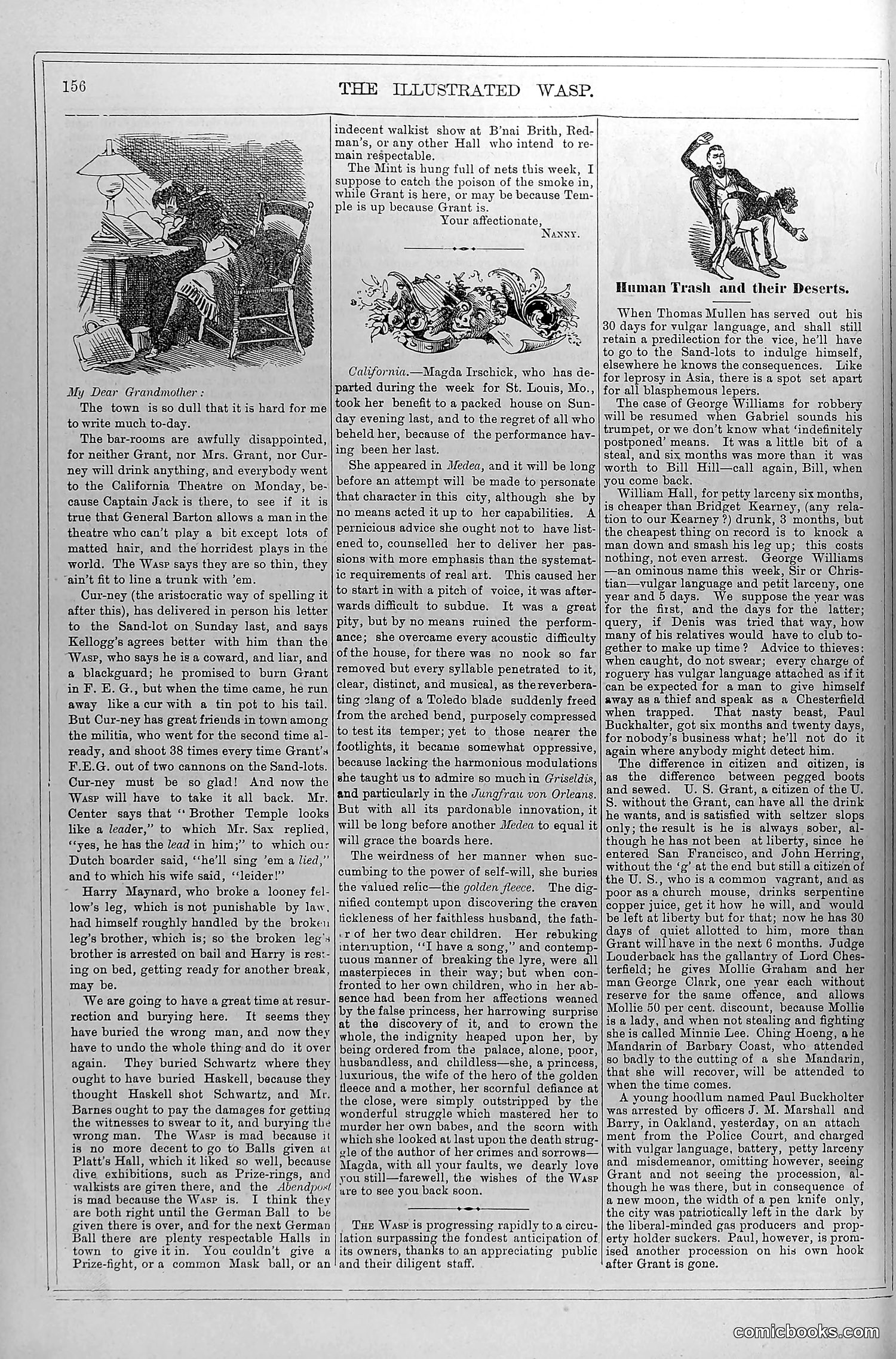
This page contains several satirical sections rather than a unified cartoon. The left illustration shows a domestic scene with figures engaged in what appears to be household activity, though specific identities are unclear from the image alone. The main text sections include letters and commentary addressing social and political topics of the era. References include criticism of theatrical performances, commentary on San Francisco society figures, and discussion of criminal behavior and moral failings among citizens. One section titled "Human Trash and their Deserts" discusses punishment and social consequences for various individuals. The tone throughout is distinctly moralistic and judgmental, typical of period satirical magazines that mixed entertainment with social criticism and scandal-mongering about local figures. The exact identities of specific individuals referenced require additional historical context beyond what's visible here.
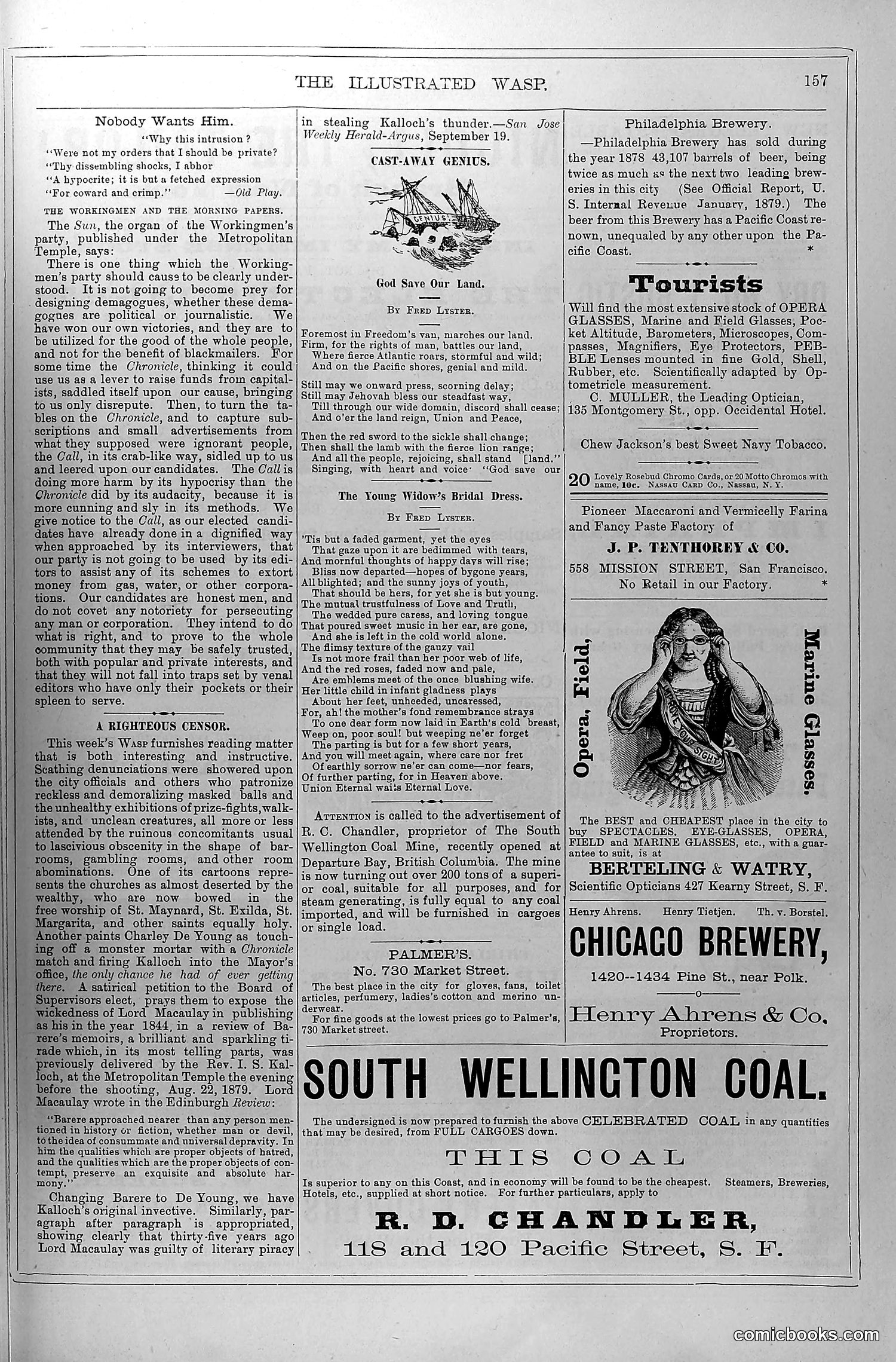
This page is primarily **advertising**, with satirical editorial content occupying the upper left portion. The editorial pieces include: 1. **"Nobody Wants Him"** — a brief political commentary mocking an unnamed figure's unwanted political intrusion 2. **"A Righteous Censor"** — satire attacking Lord Macaulay for allegedly censoring obscene cartoons and imagery, arguing his selective morality is hypocritical 3. References to **Kalloch's thunder** (likely Mayor Frank Kalloch) and literary piracy accusations The remainder consists of period advertisements for breweries, coal, optical services, tobacco, and other San Francisco businesses. The single illustration shows a demonic face, likely decorative for an advertiser rather than editorial commentary. The page reflects 1879 San Francisco politics and commercial interests rather than coherent satirical narrative.
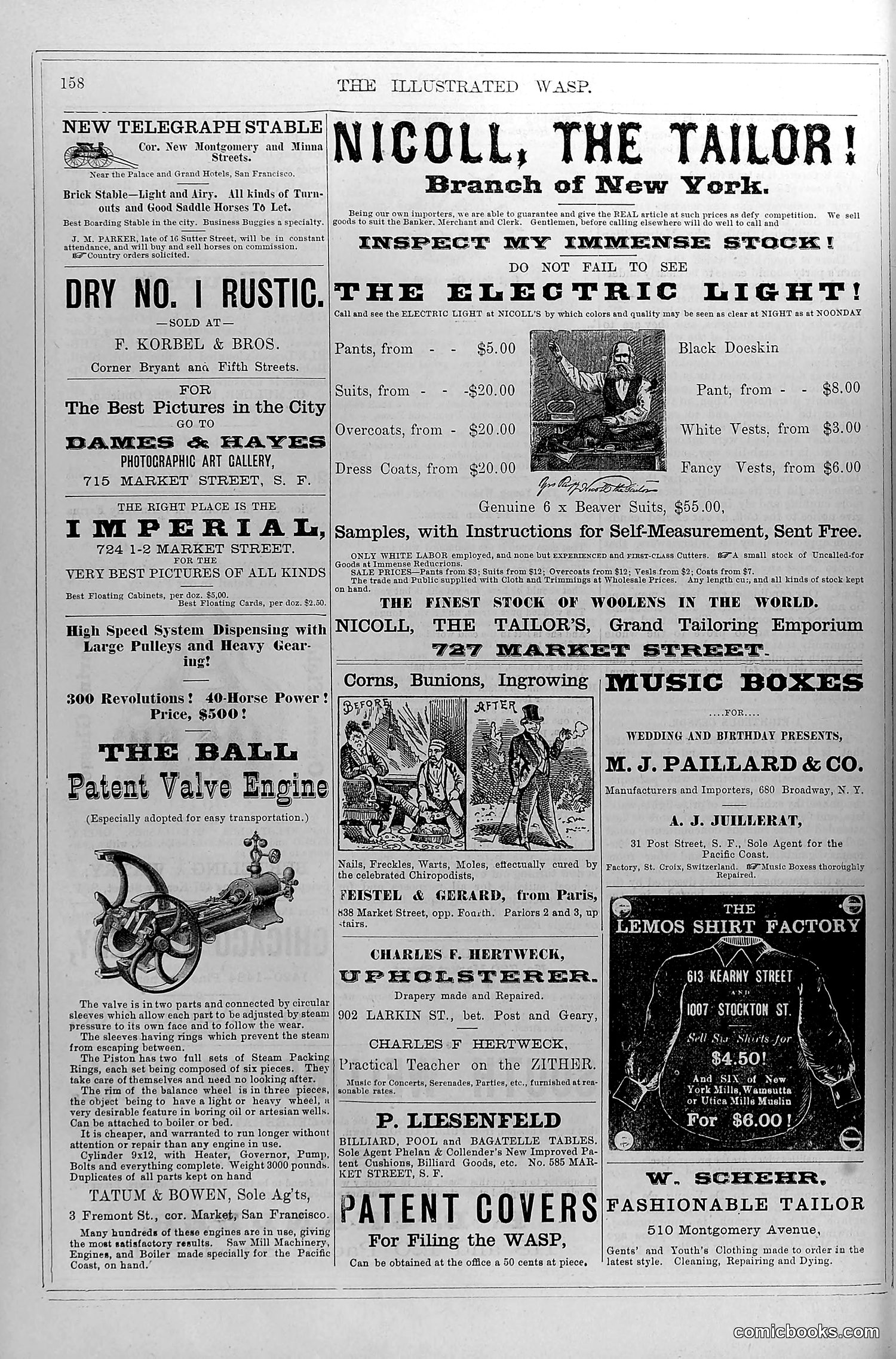
This page is primarily **advertising content**, not satirical commentary. It features multiple commercial advertisements for San Francisco businesses circa the late 1800s, including: - Nicoll the Tailor (clothing merchant) - Photography studios and picture galleries - Stable and livery services - Industrial equipment (valve engines, dispensing systems) - Medical services (chiropodists, upholsterers) - Music boxes and shirt factories The only illustration with potential satirical content shows two figures labeled "BEFORE" and "AFTER" regarding corn/bunion treatment by "Fristel & Gerard" chiropodists. This appears to be standard advertising humor rather than political satire—a before/after testimonial common in patent medicine advertising of the era. The page serves primarily as a commercial revenue source for *The Wasp* rather than delivering satirical editorial content.
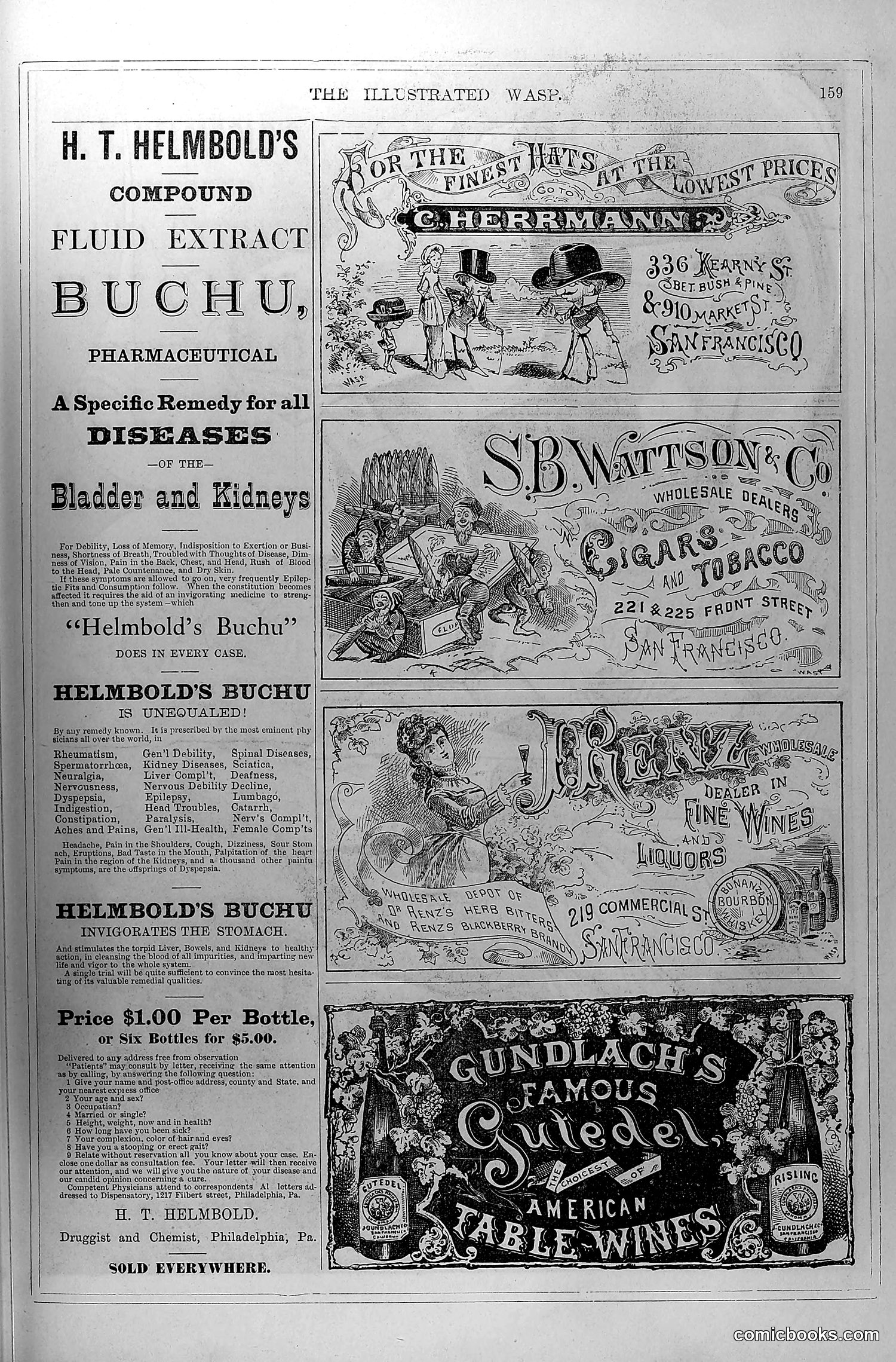
This page is primarily **advertising, not satire**. It contains commercial advertisements for patent medicines and consumer goods typical of late 19th-century American magazines. The dominant left-column ad promotes **Helmbold's Buchu**, a "fluid extract" claimed to cure bladder and kidney diseases. Such patent medicines were common, often containing alcohol and dubious ingredients, marketed with exaggerated health claims. The right side features ads for **S.B. Wattson & Co.** (cigars/tobacco), **Kerkz** (wine/liquors), and **Gundlach's Famous Siedel** (wine)—all San Francisco businesses. The decorative illustrations accompanying these ads are generic period imagery meant to attract buyers, not political commentary. This represents typical Wasp magazine revenue, where advertising subsidized satirical content elsewhere in the publication.
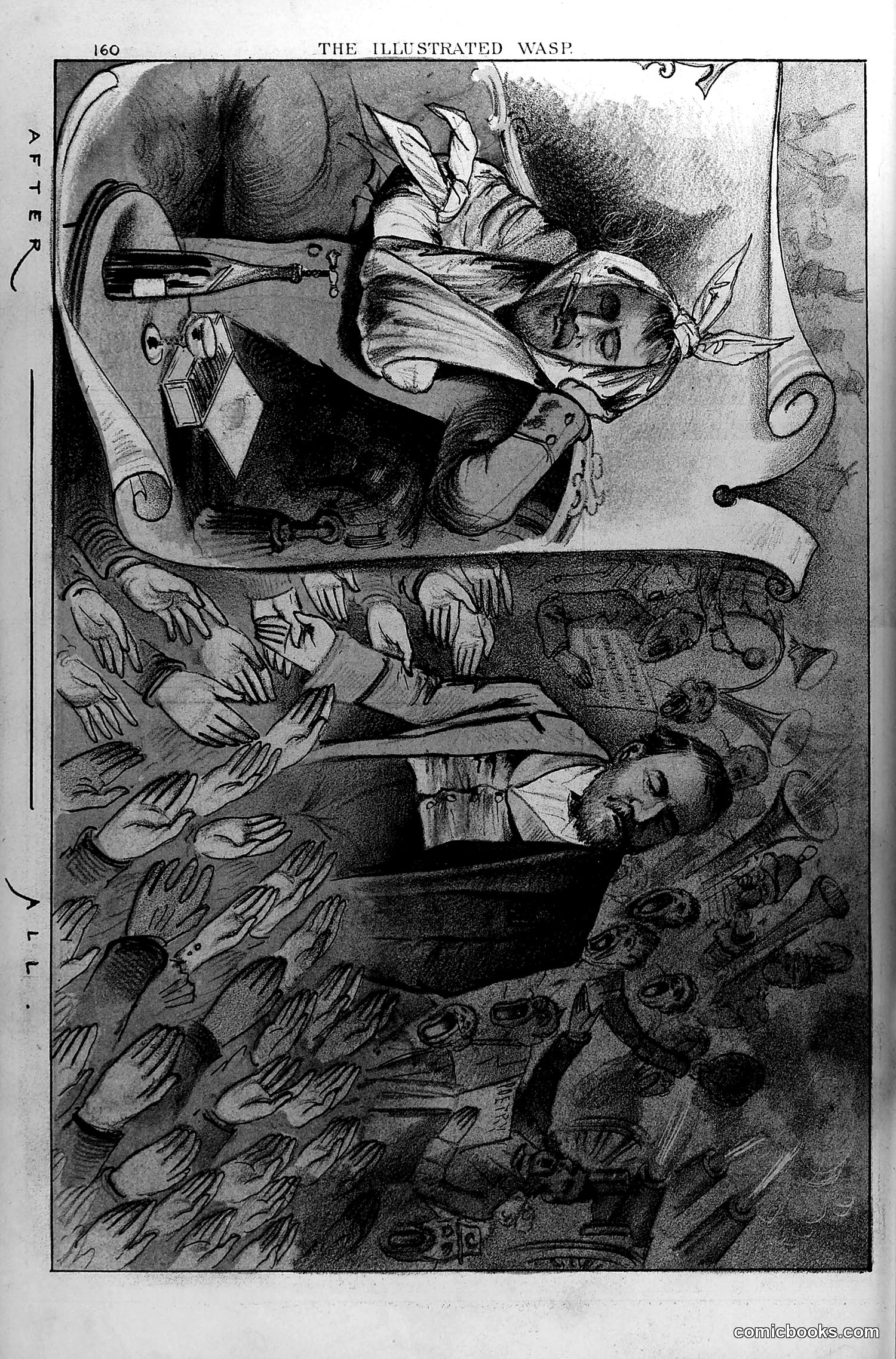
I can see this is a page from *The Wasp* titled "THE ILLUSTRATED WASP" (page 160), but the OCR text provided is blank, making it difficult to identify specific figures or understand the intended satire with certainty. The image appears to show two scenes: an upper panel with what seems to be a social gathering or dramatic moment with multiple figures, and a lower panel depicting a group of people (possibly workers or citizens) arranged together. The artistic style and composition suggest political or social commentary typical of 19th-century American satirical magazines. Without legible text or clear identifying labels, I cannot reliably determine which specific political figures, events, or social issues are being satirized. To properly explain this cartoon's meaning to a modern reader, I would need either clearer OCR text or visible captions/labels within the image itself.

I can see this is a test page or calibration sheet from *The Wasp* magazine, featuring a grayscale color checker (the grid of tonal squares on the left) and measurement scales. This appears to be a technical documentation page used for printing quality control rather than an actual satirical cartoon or editorial content. The checkerboard pattern and ruler markings indicate this was used to verify proper reproduction of tones and dimensions during the printing process. Without actual cartoon imagery, political figures, or satirical text visible on this page, I cannot identify specific caricatures or explain contemporary political/social references. This is likely an archival or production document rather than publishable editorial material from *The Wasp*.