
A complete issue · 18 pages · 1879
The Wasp — September 20, 1879

I can see this is a measurement/reference page from *The Wasp* magazine featuring Oregon Rule Co. rulers and a grayscale color chart, but I cannot discern any actual cartoon or satirical content from the image itself. The page appears to be a technical reference tool—possibly used for photographic reproduction or printing purposes—rather than editorial or satirical material. The checkerboard pattern of varying gray tones is a standard color/tone reference chart used in printing and photography. Without visible cartoon imagery, caricatures, or legible text content beyond the ruler markings, I cannot identify political references, satirical figures, or the intended joke or commentary this page might contain.
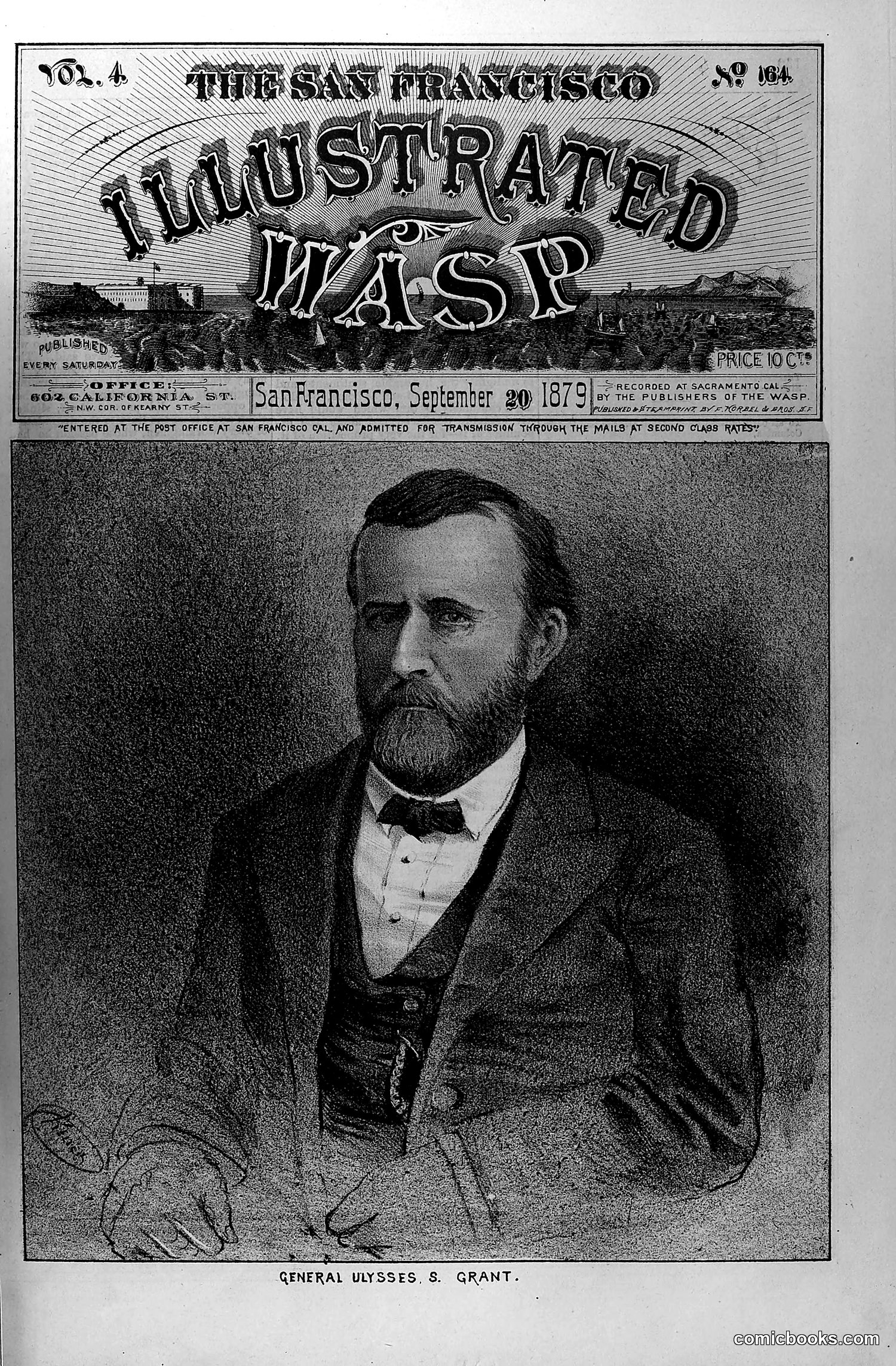
This cover features a portrait labeled "GENERAL ULYSSES S. GRANT," the former U.S. President (1869-1877). The Wasp was a satirical publication, so this portrait likely accompanied commentary about Grant, who was a controversial political figure after his presidency. In 1879, Grant was traveling abroad and remained influential in Republican politics, making him a frequent target for satire. Without accompanying article text visible, the specific satirical angle is unclear—it could address his post-presidency activities, political ambitions, or personal conduct. The dignified portrait style contrasts with The Wasp's typically irreverent approach, possibly itself part of the satire.
This page is primarily **editorial text rather than a political cartoon**. The masthead shows "The Illustrated Wasp" but the visible content is dominated by subscription information and a lengthy editorial essay. The editorial discusses **General U.S. Grant's potential return to politics**, debating whether his military background qualifies him for elected office. The author argues against nominating Grant for the presidency, suggesting his experience doesn't translate to political leadership and questioning whether working-class voters should support him. The piece emphasizes workingmen's interests and appeals to their judgment, concluding with the rallying cry "KEEP YOUR SIDE-ARMS AND YOUR HORSES"—likely referencing labor/populist concerns about maintaining independence from elite political manipulation. No cartoon illustration is clearly visible on this page.
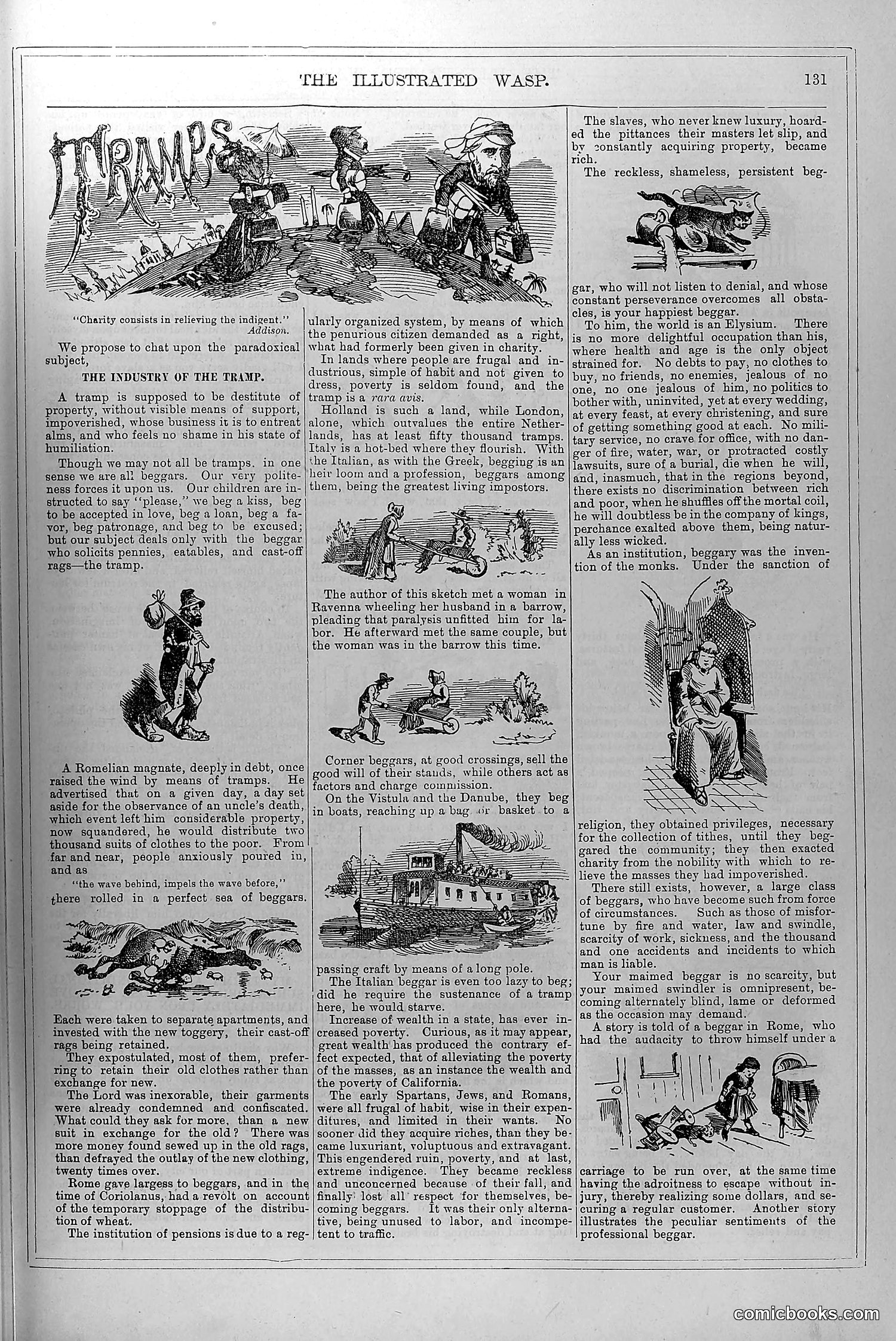
This satirical article examines vagrancy and begging as an organized "profession" rather than genuine destitution. The accompanying illustrations depict various tramp scenarios—figures wheeling barrows, begging at crossings, and traveling on vessels. The text argues that beggary became systematized, with practitioners employing deliberate strategies to extract charity. The author presents anecdotes of specific beggars, including a Romelian magnetist feigning debt and a woman in Ravenna using paralysis as a ploy. The satire criticizes how organized begging operates like a business, with beggars stationed at profitable locations and employing emotional manipulation. By framing trampdom as calculated "industry" rather than unfortunate circumstance, The Wasp mocks both the beggars' deceptions and society's gullible charity.
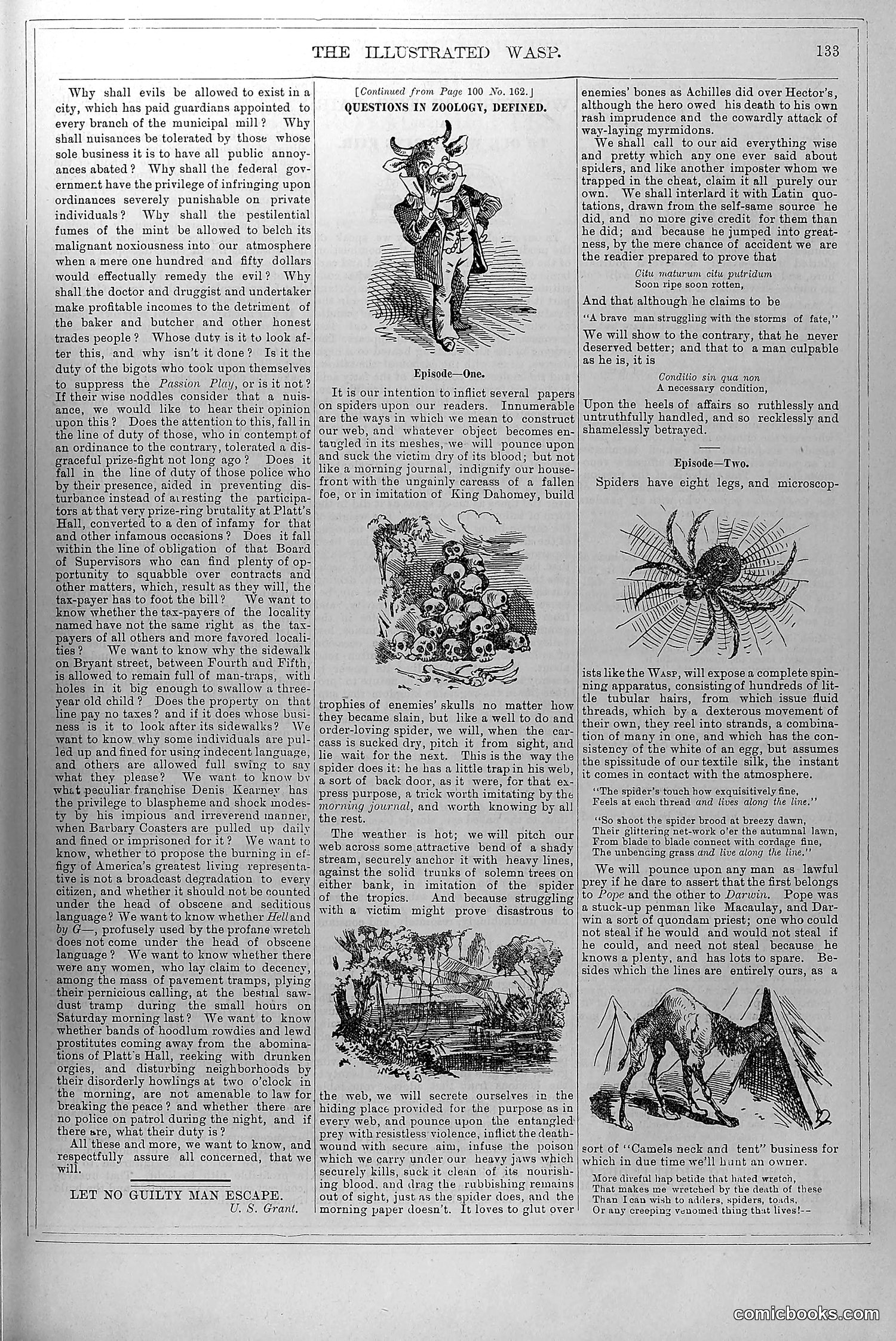
This page mixes satirical editorial content with natural history illustrations. The left column contains rhetorical questions attacking municipal corruption and negligence—addressing why nuisances persist despite ordinances, why certain officials profit from illegal activities, and why law enforcement fails. The tone suggests criticism of San Francisco's government tolerance of vice and unlawful businesses. The right side features three labeled episodes on zoological topics: spiders' anatomy and hunting behavior, and what appears to be a venomous creature ("Camels neck and tent" business). These seem unrelated educational illustrations rather than political cartoons. The juxtaposition suggests the magazine mixed hard-hitting civic critique with lighter instructional content.
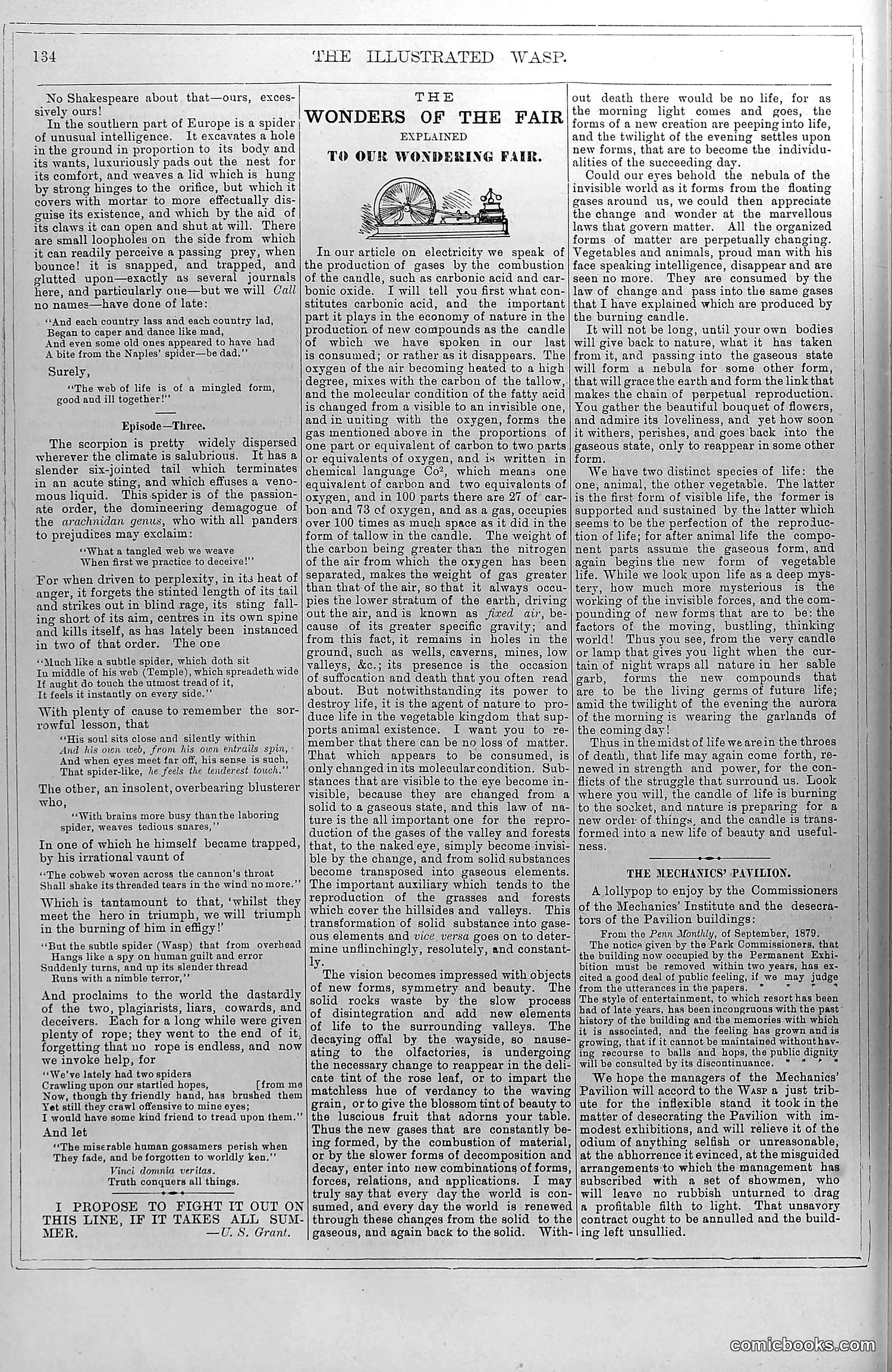
This page from *The Wasp* contains primarily text content rather than political cartoons. The main articles discuss scientific and philosophical topics: "The Wonders of the Fair" examines electricity and gases at what appears to be a world's fair exhibition, exploring combustion and molecular theory. A second piece, "The Mechanics' Pavilion," announces plans for a new building to house the Mechanics' Institute and Pavilion. The page includes serialized fiction ("Episode Three") and poetry. At the bottom, there's a brief editorial line about fighting on a particular issue, attributed to C.S. Grant. No clear political caricatures or satirical targets are visible in the image itself—this appears to be a literary and scientific issue rather than primarily cartoonist-driven satire.
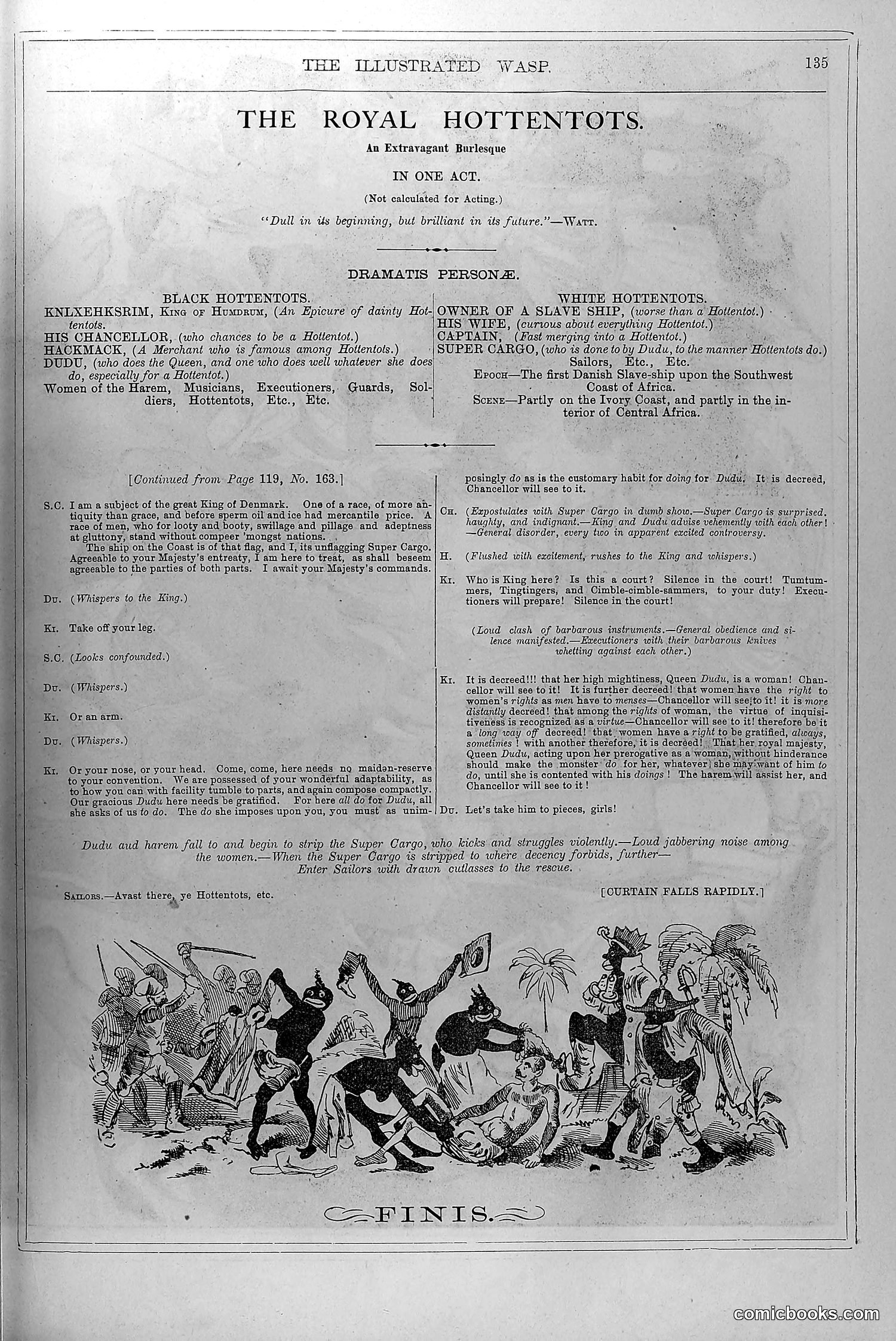
This is a theatrical script and accompanying illustration for a one-act burlesque play. The satire mocks both pseudo-scientific racial hierarchies and Victorian attitudes toward African peoples through exaggerated caricature. The play features two opposing groups: "Black Hottentots" (ruled by a King of Humbug) and "White Hottentots" (European colonists). The script's dialogue ridicules claims of civilization and superiority, particularly through Chancellor's pompous speeches about women's rights and governmental authority—presented as absurdly hypocritical. The chaotic illustration depicts the theatrical chaos promised by the script. The satire targets both racist pseudoscience (the "Hottentots" label itself was a dehumanizing European term) and colonial pretensions to superiority, exposing them as equally ridiculous.
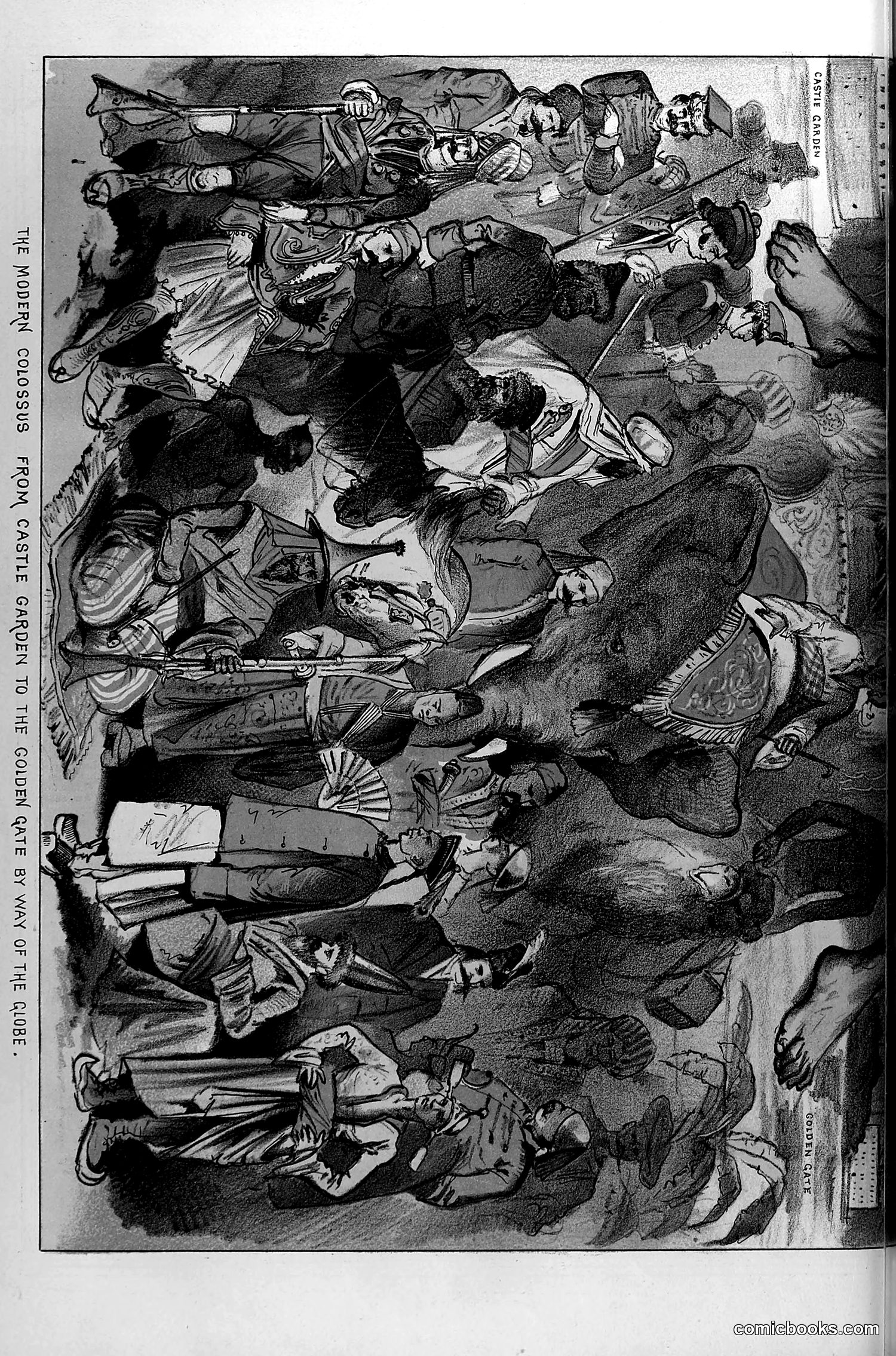
This page appears to show a chaotic scene at what the text identifies as "Casse Garten to the Corner Gte" (likely a public gathering place or garden). The satirical image depicts multiple figures in 19th-century dress engaged in what seems to be a disorderly confrontation or riot scene. However, I cannot definitively identify the specific political figures or event being satirized from the image alone. The OCR text is unclear, making it difficult to determine the exact context—whether this references a specific riot, political scandal, or social commentary of the era. To accurately explain this cartoon's meaning and targets, I would need clearer OCR text or additional contextual information about when this *Wasp* issue was published.
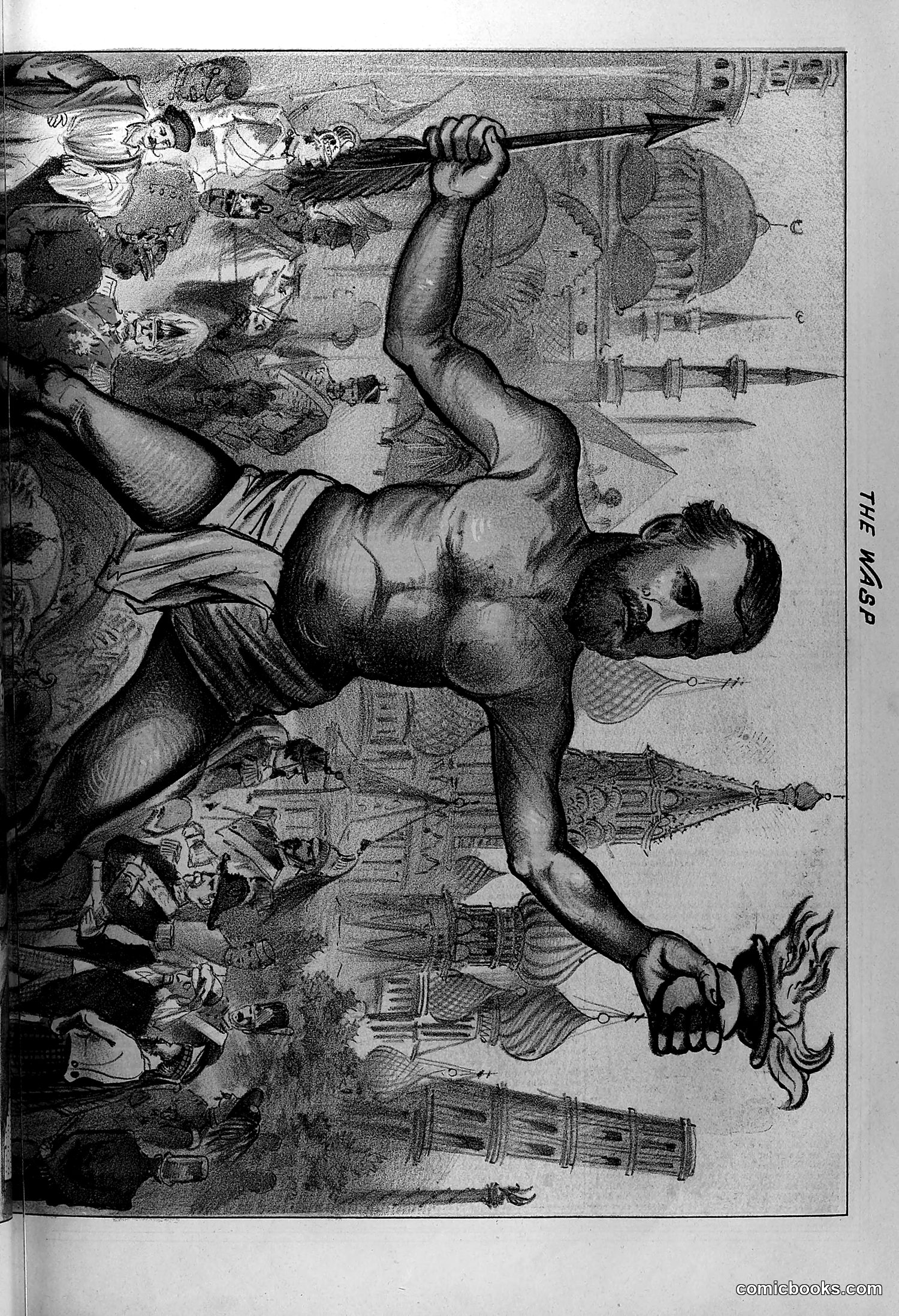
I can see this is a satirical engraving showing a muscular male figure wielding a large spear or weapon, surrounded by various smaller figures and decorative elements. The figure appears to be in a classical or mythological style. However, I cannot reliably read the OCR text provided, and without clear identification of the specific figures, caricatures, or historical context labeled in the image itself, I cannot accurately explain what political or social commentary this cartoon intended. To properly analyze this, I would need either: clearer text identifying the main figure and references, or confirmation of the publication date and issue number visible in the page header, which would help establish the historical context and targets of the satire. I cannot responsibly guess at identifications.
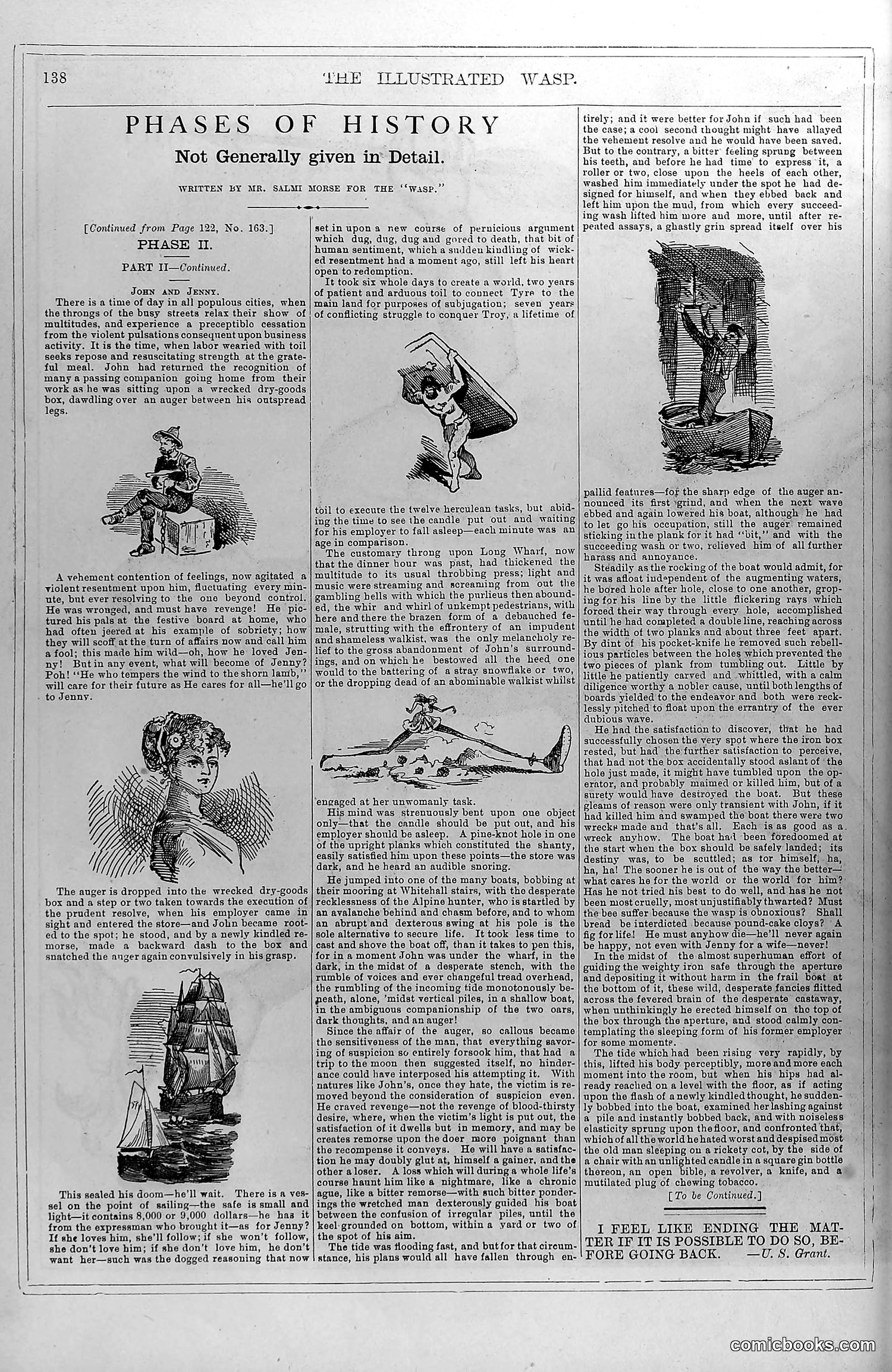
This page continues a serialized story titled "Phases of History: Not Generally given in Detail," written by Salmi Morse. The narrative appears to be a dramatic tale about John and Jesse, characters navigating urban hardship and conflict. The illustrations depict scenes of struggle and desperation—figures in contorted positions suggesting violence or distress, consistent with the text's references to anger, execution, and survival. One illustration shows a woman's face, possibly Jesse. Rather than political satire, this appears to be serialized fiction using melodramatic imagery typical of 19th-century sensationalism. The "satire" lies in mocking overwrought literary conventions of the era through exaggerated emotional plotting and theatrical illustrations.
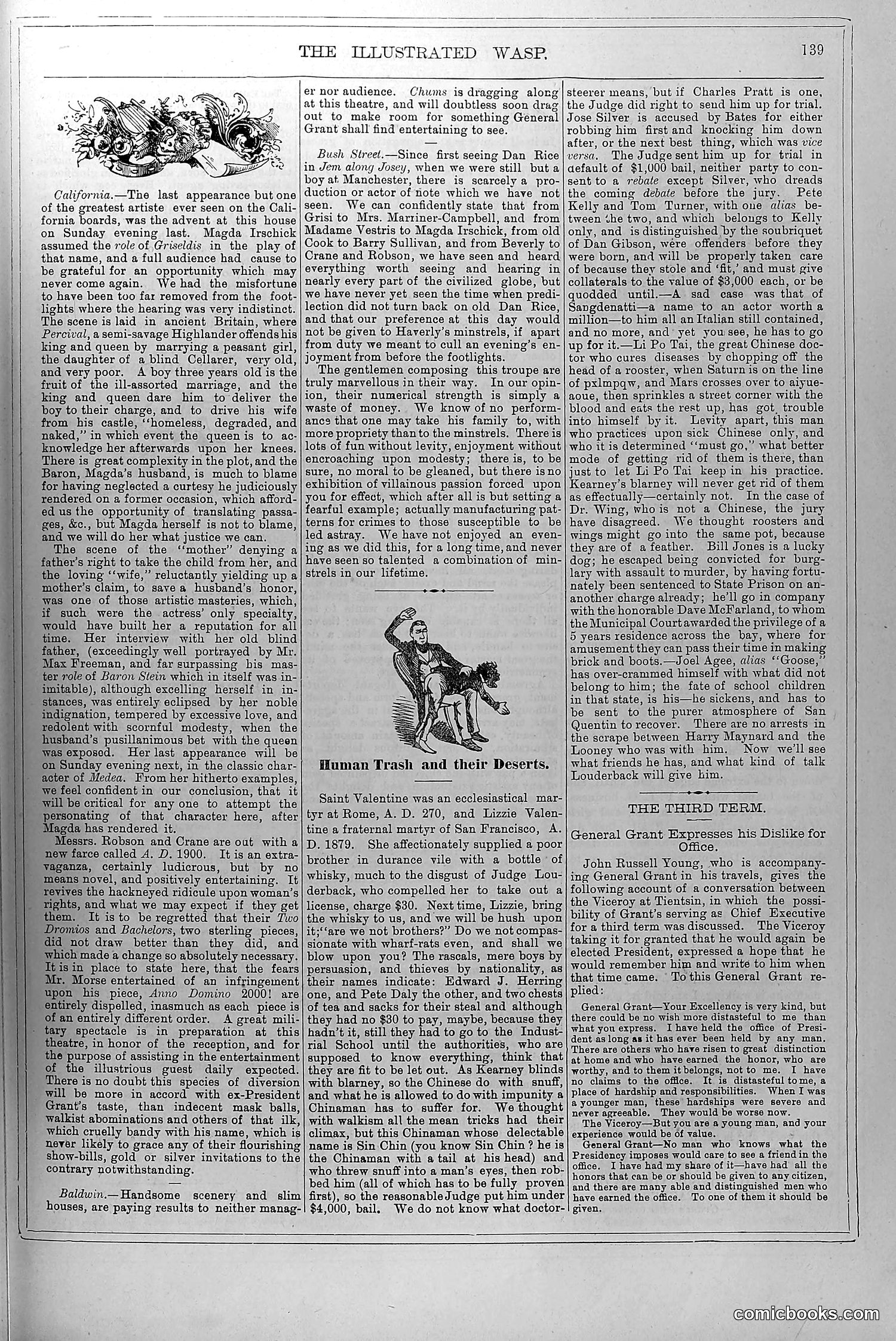
This page contains several distinct sections rather than unified political cartoons. The main illustrated content is titled "Human Trash and their Deserts," showing a figure in ragged clothes—likely a caricature representing a vagrant or poor person. The accompanying text discusses various San Francisco social scandals and court cases, including references to Judge Lynch, Dan Rice (apparently a performer), and various criminal matters. There's also discussion of General Grant's travels and a "Viceroyalty" position. The satire appears to target San Francisco's justice system and social problems of the era, using sharp commentary on how the poor and marginalized were treated. Without clearer image resolution, the specific caricatures and their identities remain somewhat unclear, but the overall thrust mocks judicial corruption and social inequality.
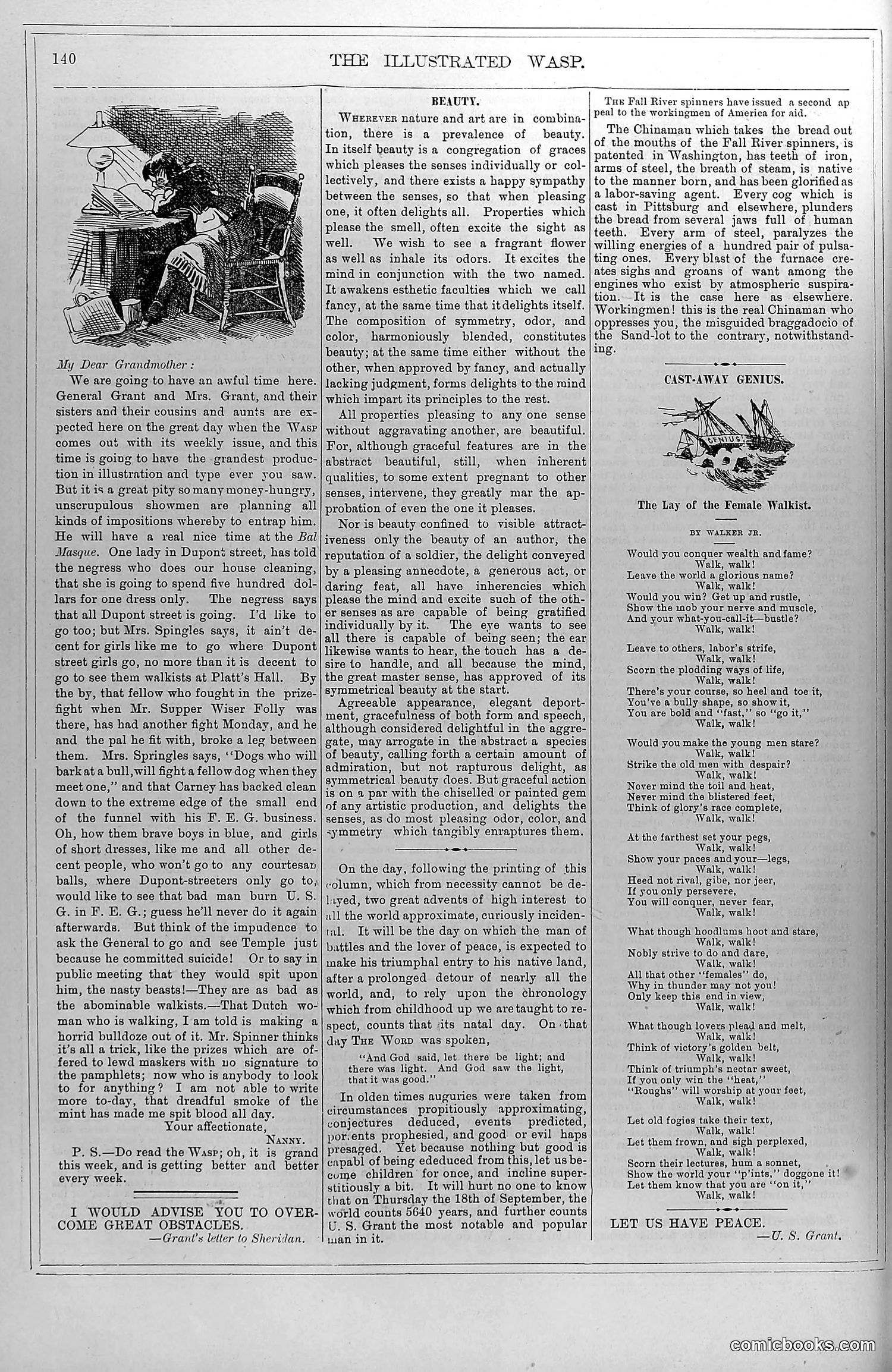
This page contains three distinct sections rather than a unified cartoon: 1. **"My Dear Grandmother"** (left): A letter from "Nancy" discussing San Francisco society, mentioning General Grant's visit, Dupont Street gossip, and various local figures and establishments. It's social satire targeting high society pretensions. 2. **"Beauty"** (center): An essay on aesthetics and sensory pleasure, discussing how beauty combines multiple pleasant sensory experiences. 3. **"Cast-Away Genius"** and **"The Lay of the Female Walkist"** (right): Poetry sections, with the latter being satirical verse mocking women pedestrians ("walkists"), using humorous rhyming couplets to poke fun at this social activity. The page primarily features literary satire and social commentary rather than visual political cartoons.
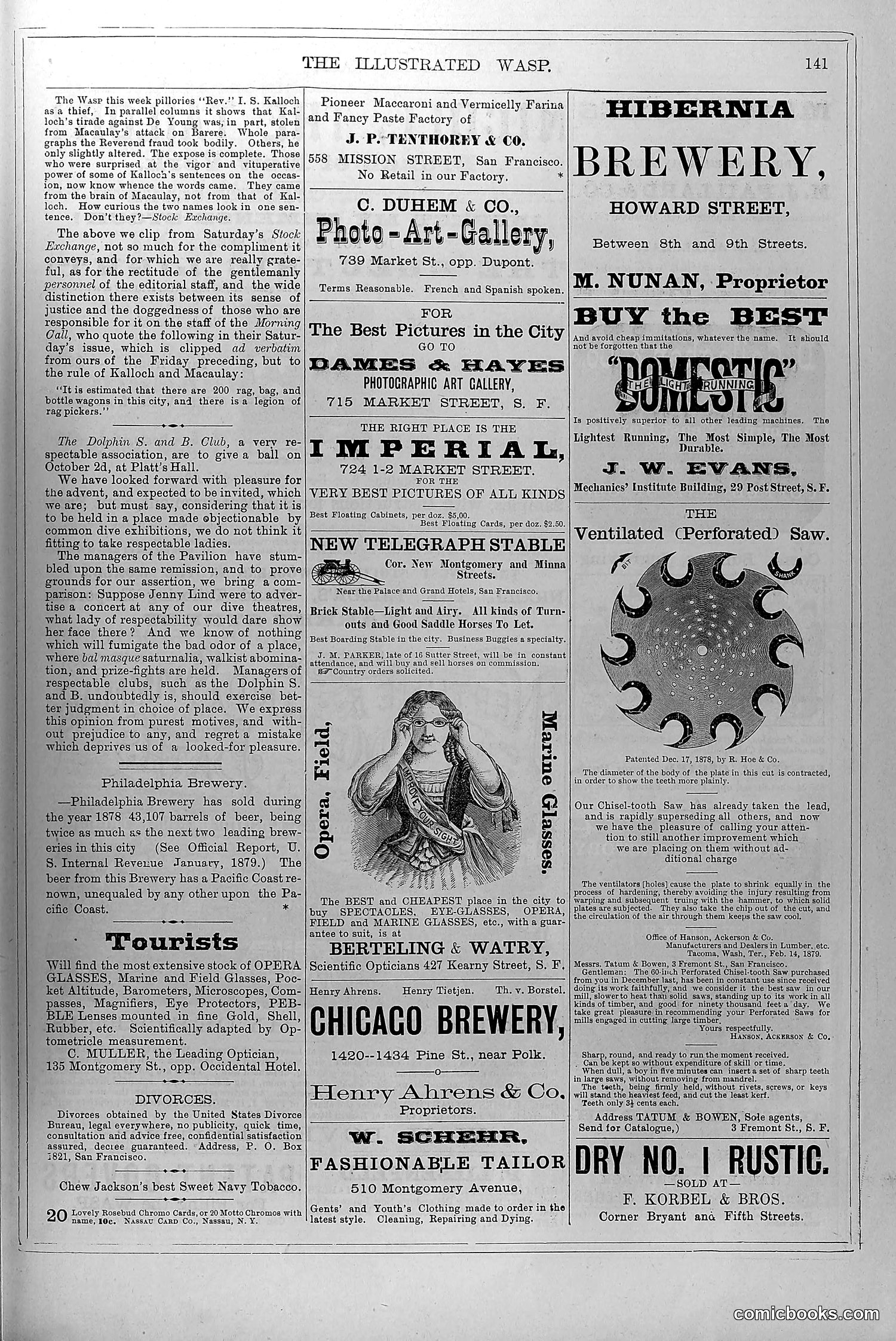
This page is primarily **advertising content** rather than satirical cartoons. It contains numerous commercial advertisements for San Francisco businesses, including breweries (Hibernia Brewery, Chicago Brewery, Philadelphia Brewery), a photo gallery, photographers, a saw manufacturer, and various services. The only illustration appears to be a **portrait of a woman wearing an ornate headdress** (labeled "Opera Pearls" and "Mascara Glassware"), which accompanies advertisements for spectacles and optical goods—likely a decorative element rather than political satire. The page reflects late 19th-century San Francisco commerce and contains no discernible political cartoons or satirical commentary visible in either text or imagery.
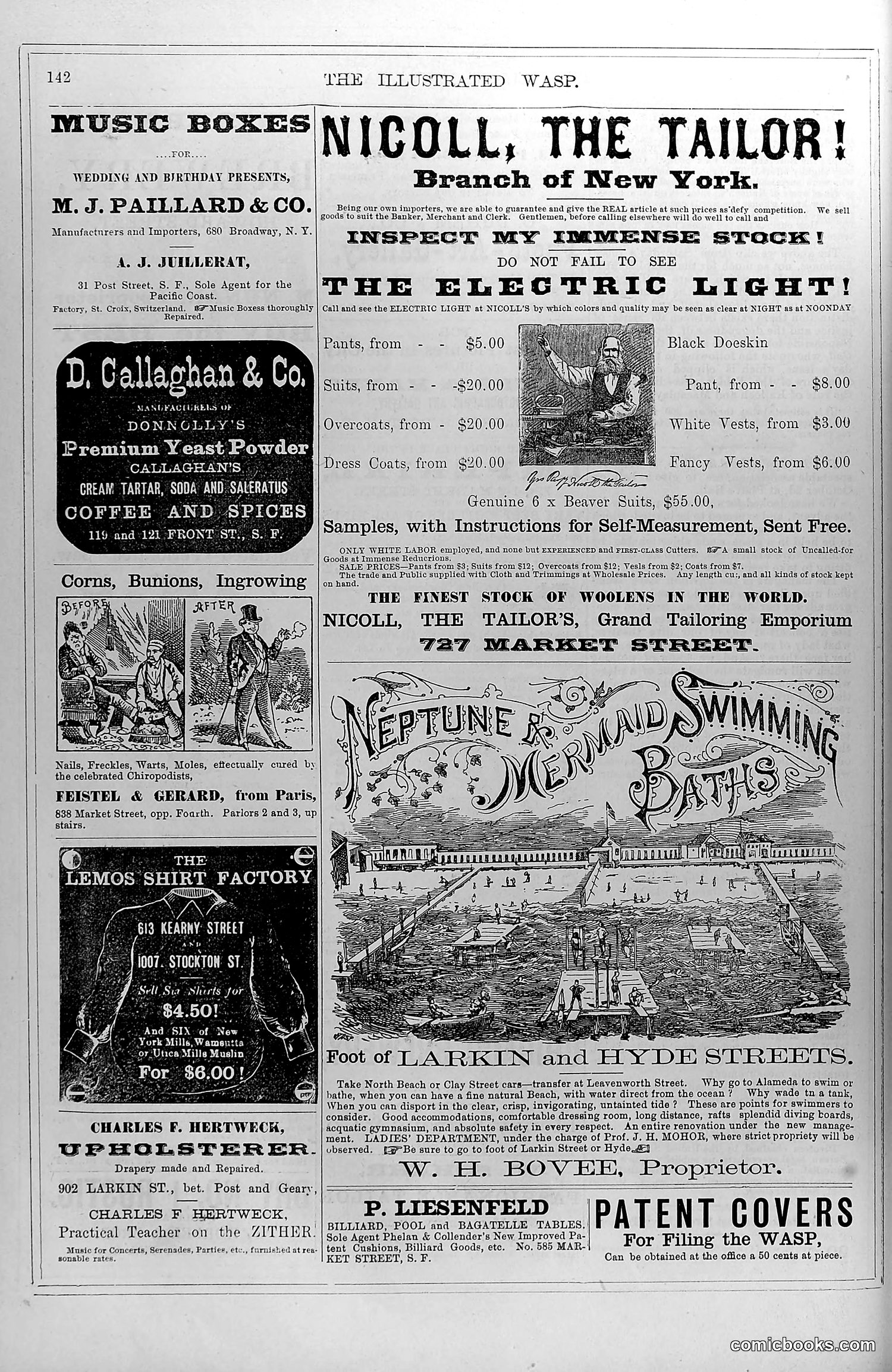
This page is **primarily advertising**, not political satire. It contains multiple commercial advertisements for San Francisco businesses from what appears to be the late 19th century, including: - Nicoll, the Tailor (New York branch) promoting suits and overcoats - Music boxes and wedding gifts - D. Callaghan & Co.'s yeast powder and spices - Neptune Mermaid Swimming Baths (a public bathing facility) - The Lemos Shirt Factory - Charles F. Hertweck's upholstering services - Patent covers for filing *The Wasp* The only illustrated content is a decorative engraving of the Neptune Mermaid Baths facility. There are no political cartoons, caricatures, or satirical commentary visible on this page. It functions as a standard advertising section within the publication.
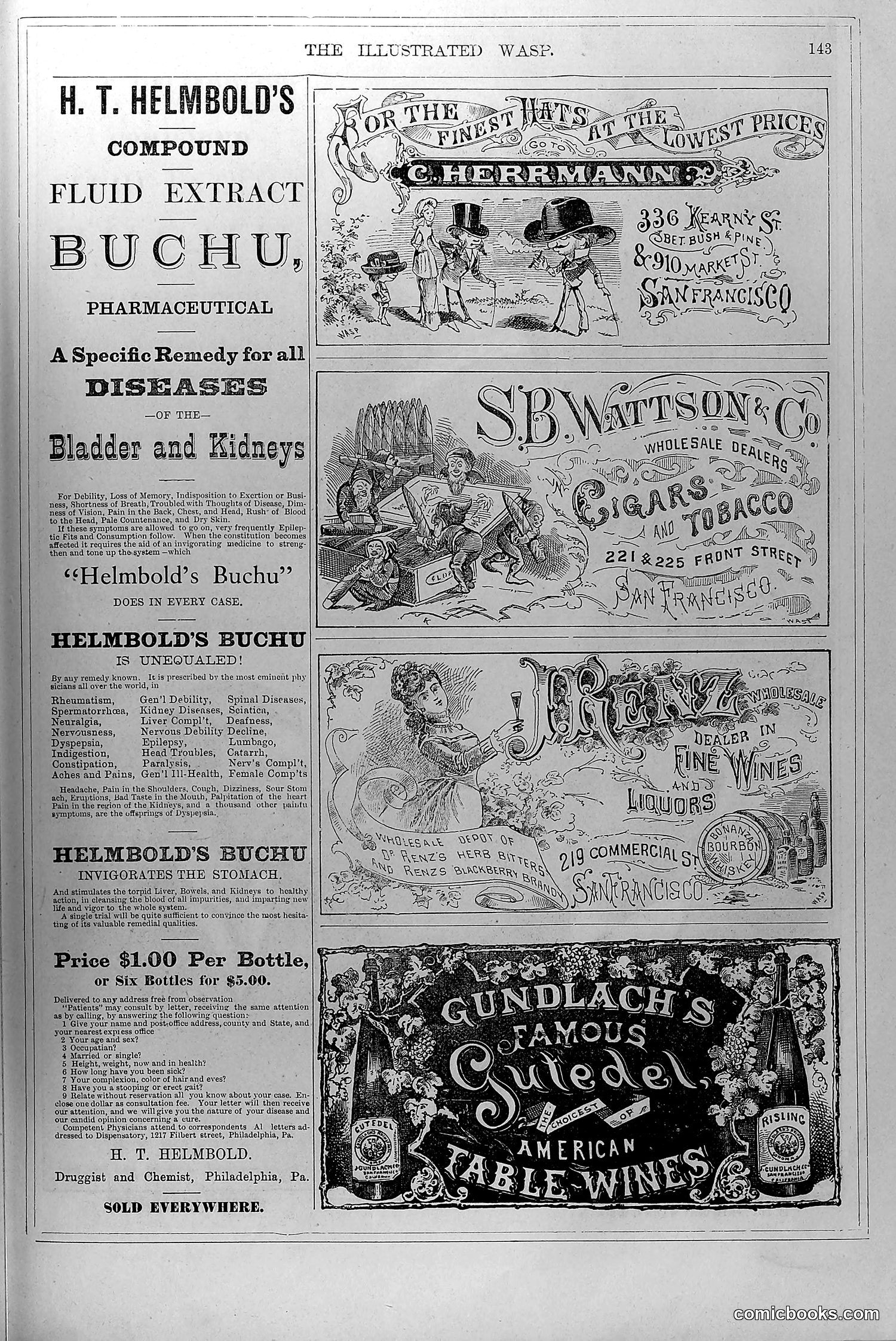
This page is primarily **advertising**, not satirical content. It contains multiple commercial advertisements from late 19th-century San Francisco businesses: 1. **H.T. Helmbold's Buchu Extract** - a patent medicine claiming to cure bladder and kidney diseases, priced at $1.00 per bottle 2. **Cuermann & Co.** - hat merchant (336 Kearny Street) 3. **S.B. Wattson & Co.** - wholesale cigar and tobacco dealers (221-225 Front Street) 4. **J. Rentz** - wine and liquor dealer (919 Commercial Street) 5. **Gundlach's Celebrated Sludel** - American table wines The illustrations are decorative Victorian-era engravings typical of period advertising, featuring ornamental vignettes and product imagery rather than political satire or caricature.
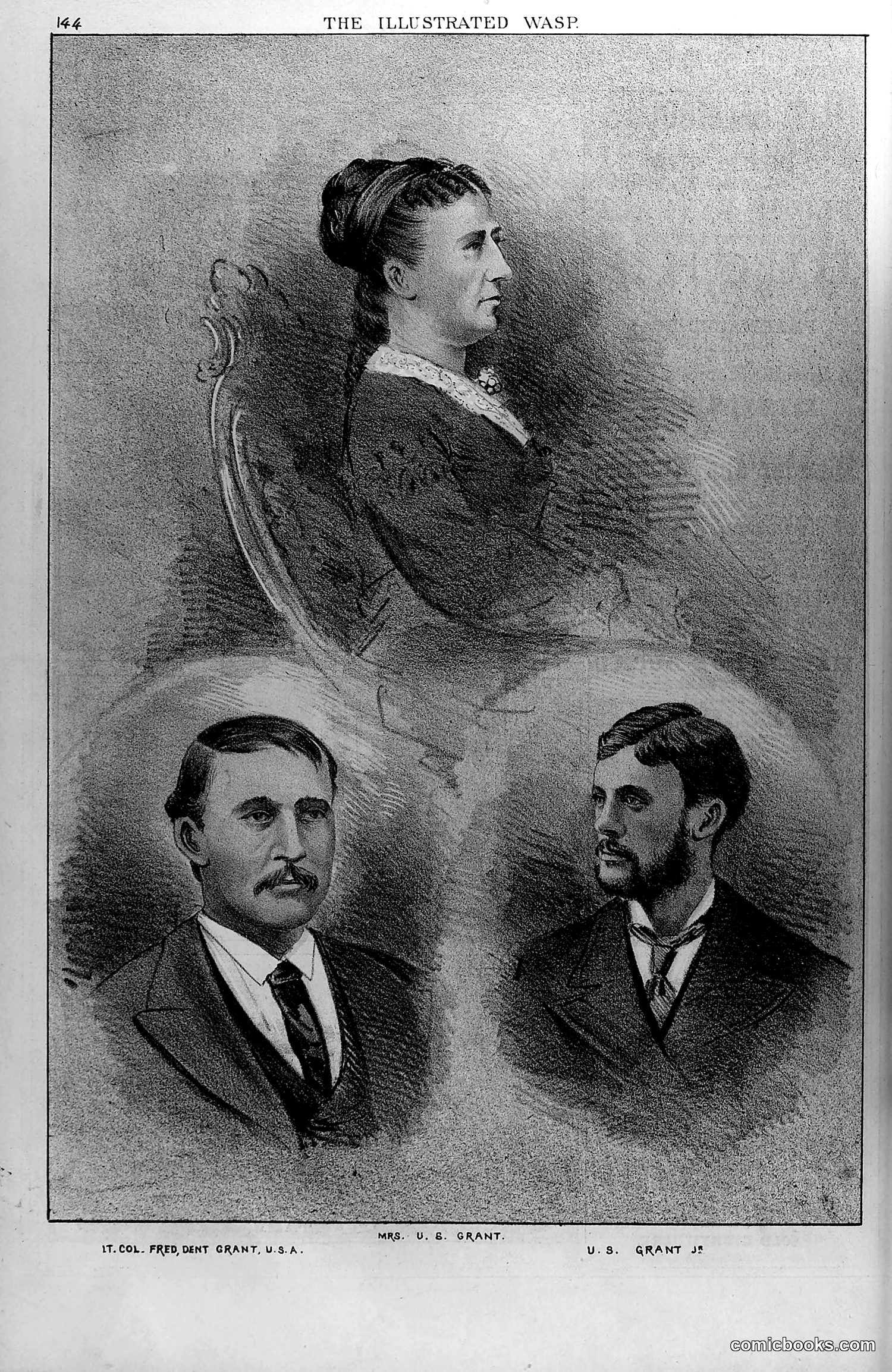
This page from *The Wasp* presents three portraits labeled as members of the Grant family: "Lt. Col. Fred Dent Grant, U.S.A." (lower left), "Mrs. U.S. Grant" (center/top), and "U.S. Grant Jr" (lower right). The inclusion suggests satire regarding the Grant family's prominence and public prominence during the Reconstruction era. The formal presentation style mimics serious portraiture, which *The Wasp* likely used ironically to critique or mock the family's social status or political influence. Without additional context from surrounding pages, the specific satirical point—whether attacking nepotism, wealth, military privilege, or personal conduct—remains unclear, though the deliberate framing suggests the magazine viewed them as fit subjects for public ridicule or commentary.

I can see this is a test/calibration page from *The Wasp* magazine, used for photographic documentation rather than editorial content. The page displays a grayscale reference chart on the left side with varying tones from dark to light, and two measurement rulers—one vertical and one horizontal—positioned against a black background. This type of page typically appears in archival materials to establish image quality, contrast, and measurement standards during the scanning or microfilming process. There is no cartoon, political commentary, or satirical content visible on this particular page. It serves a purely technical, administrative function in the publication's documentation.