
A complete issue · 18 pages · 1879
The Wasp — September 6, 1879
I can see this is a measurement/calibration page from *The Wasp* magazine, featuring an Oregon Rule Co. ruler and a grayscale color chart - standard elements used in photographic reproduction and archival documentation rather than editorial content. The page itself contains no visible cartoon, caricature, or satirical imagery. The checkerboard pattern on the right appears to be a standard color/tone reference card used to ensure accurate reproduction of photographs and images when printing. Without OCR'd text content visible or readable cartoon imagery, I cannot identify specific political figures, social references, or satire. This appears to be a production/technical page rather than editorial content suitable for historical analysis.
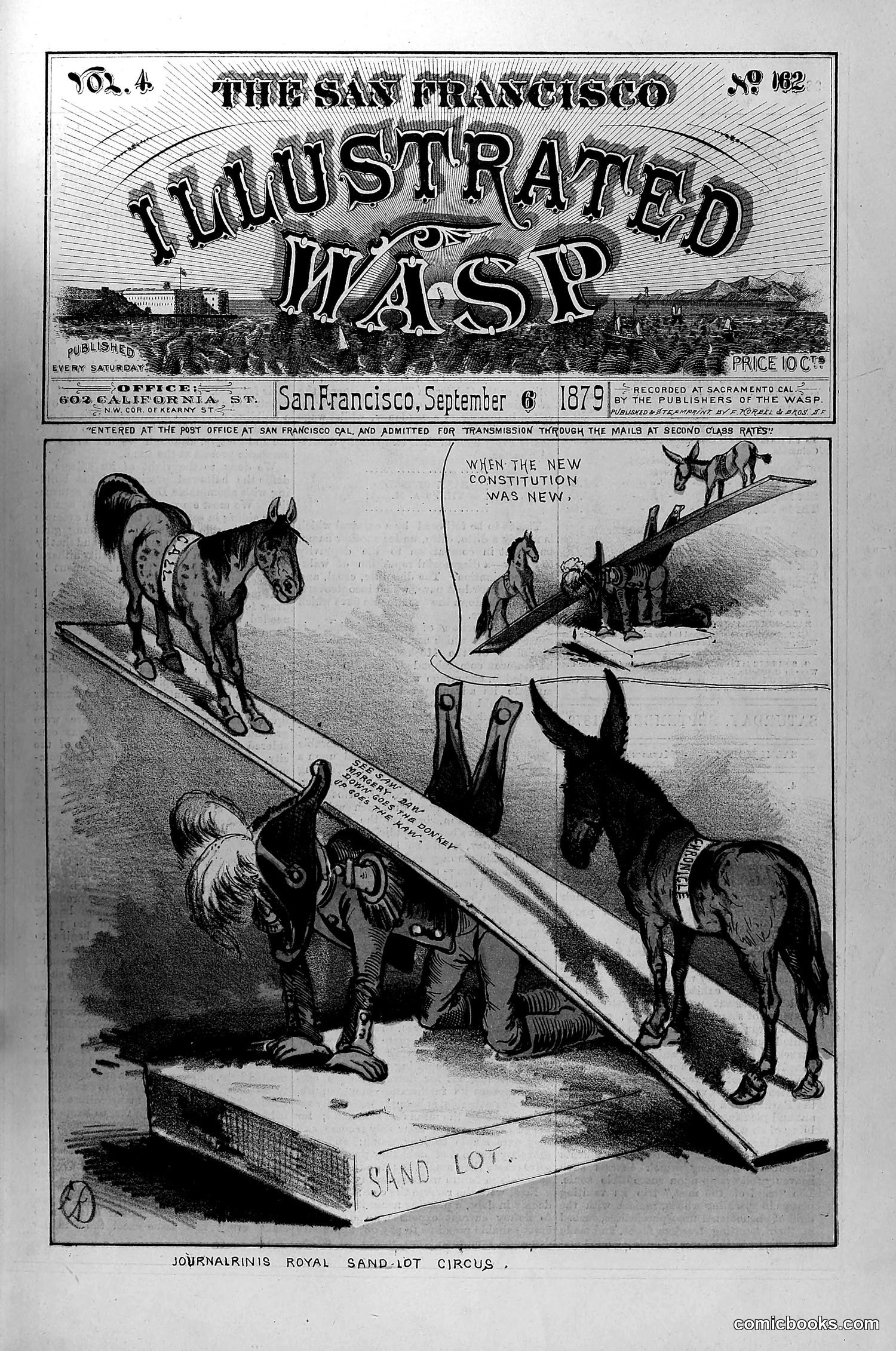
This September 1879 *Wasp* cartoon satirizes the California constitutional convention and its aftermath. The image depicts various political figures as circus performers struggling on a "Sand Lot" — a reference to the Sand Lot Party, a working-class political movement that gained prominence during California's economic turmoil in the late 1870s. The cartoon mocks the chaos of state politics, showing politicians as animals (donkeys, goats) engaged in an unstable balancing act. The "New Constitution" referenced in the caption suggests the contentious 1879 California Constitutional Convention, which was heavily influenced by anti-Chinese sentiment and labor concerns. The satire criticizes the circus-like nature of political proceedings and the questionable figures involved in shaping California's governance during this turbulent period.
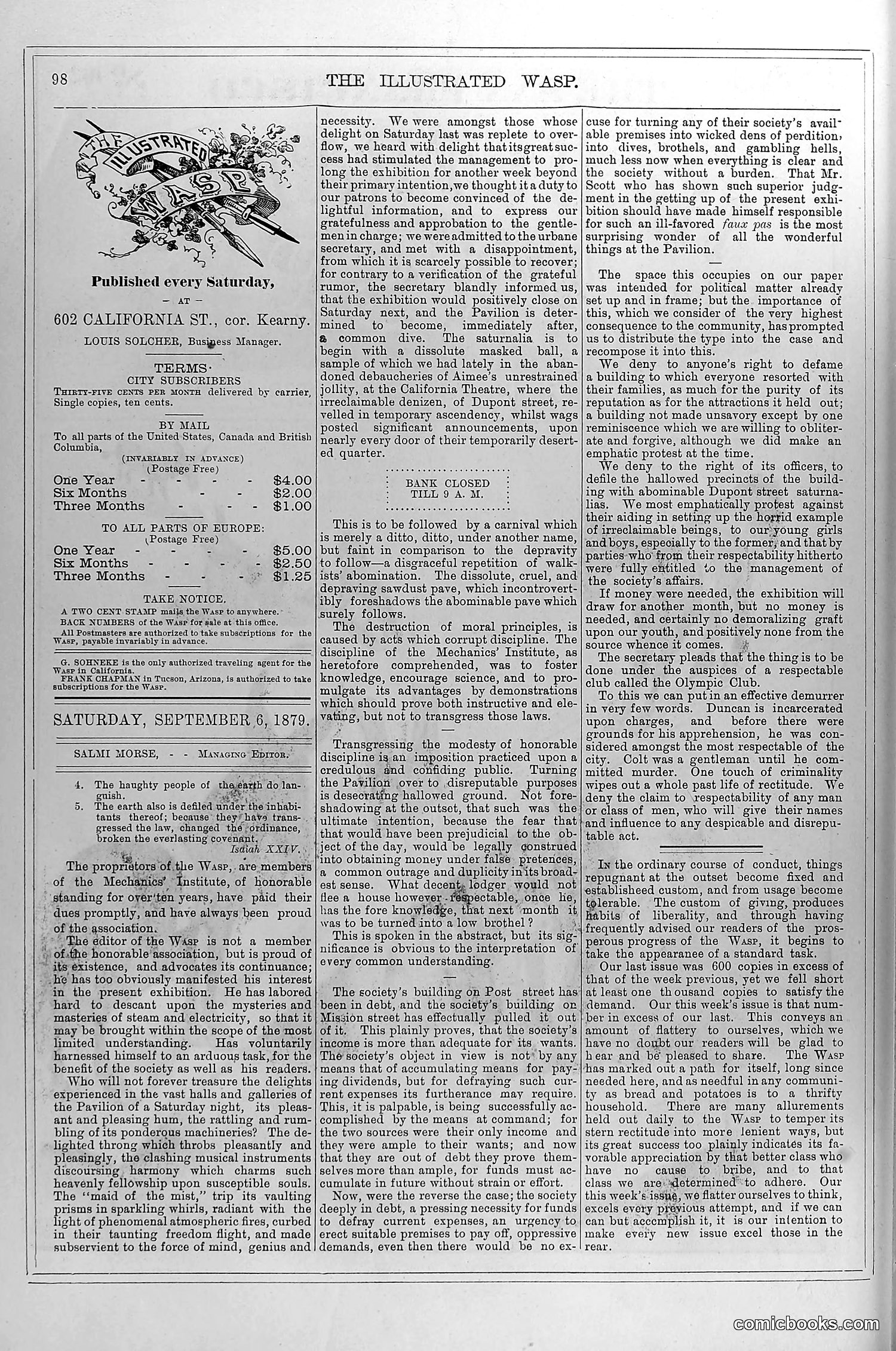
This page is primarily **text and masthead information** rather than political cartoons. The main content consists of: 1. **Masthead and subscription details** for The Wasp magazine (published Saturdays at 602 California St., San Francisco) 2. **Editorial commentary** defending the magazine's coverage of a local exhibition/Pavilion controversy, emphasizing their right to criticize while denying attacks on specific individuals' reputations 3. **A brief satirical item** ("SALMI MORSE") appearing to mock a theatrical figure, though the specific reference is unclear without additional context The page demonstrates The Wasp's typical approach: aggressive defense of editorial independence and moral criticism of San Francisco society, rather than visual satire. The tone is confrontational and self-justifying.
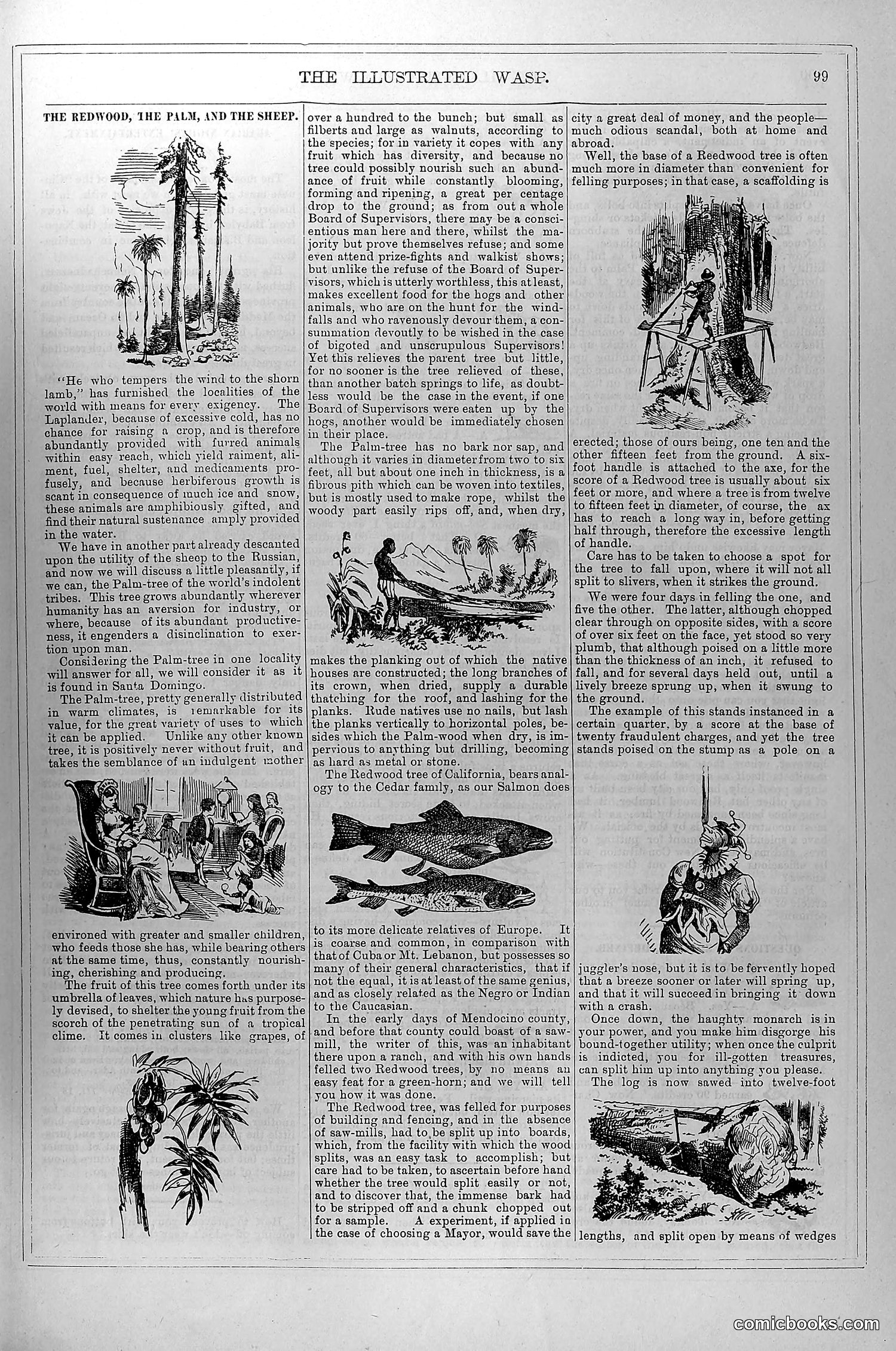
This page from *The Wasp* combines naturalistic illustrations with social commentary. The title references California's distinctive flora and fauna. The text discusses practical uses of redwood trees—their abundance, utility for construction and scaffolding, and resistance to decay—alongside observations about palm trees and sheep raising. The satirical edge appears subtle here; the article critiques inefficient land management and possibly the Board of Supervisors' handling of public resources. References to "bigoted and unscrupulous Supervisors" suggest political incompetence. The detailed technical discussion of tree-felling, combined with humor about livestock management, implies *The Wasp* is mocking California officials' mismanagement of natural resources and public lands during this period.
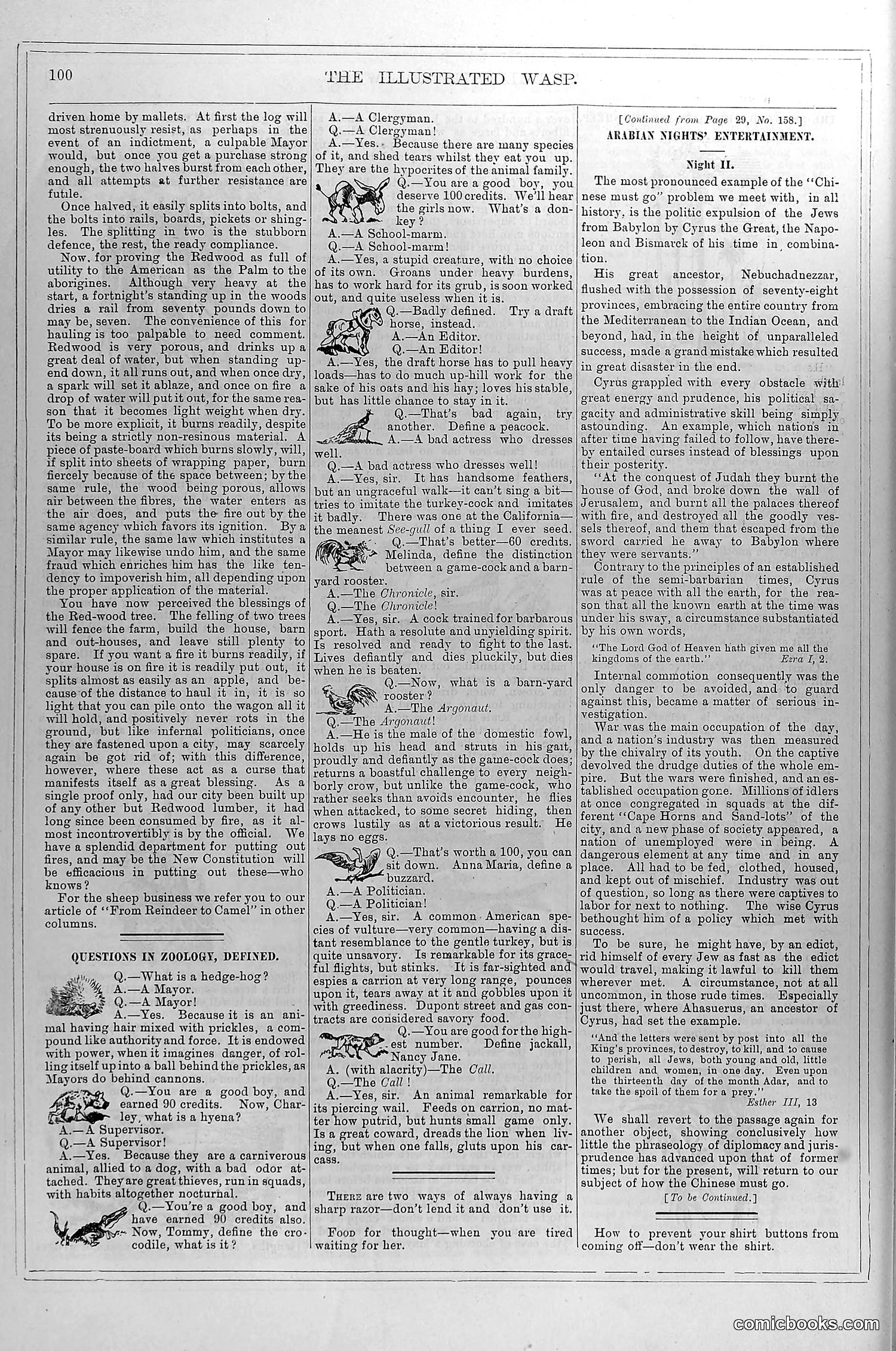
This page consists primarily of a **humor advice column** titled "Questions in Zoology, Defined" rather than political cartoons. The content features illustrated Q&A exchanges with animal drawings, using animals as metaphors for human types. The satire targets social types: a "Clergyman" (hypocritical authority figure), a "School-marm" (prissy educator), an "Editor" (pompous journalist), and a "Politician" (corrupt operator). Each entry mocks these archetypes through animal comparisons—the politician is compared to a vulture, for example. The humor relies on **Victorian-era social commentary**, depicting recognizable character types readers would encounter. While specific political figures aren't identified, the satire aims at institutions and professional classes rather than individual politicians or events.
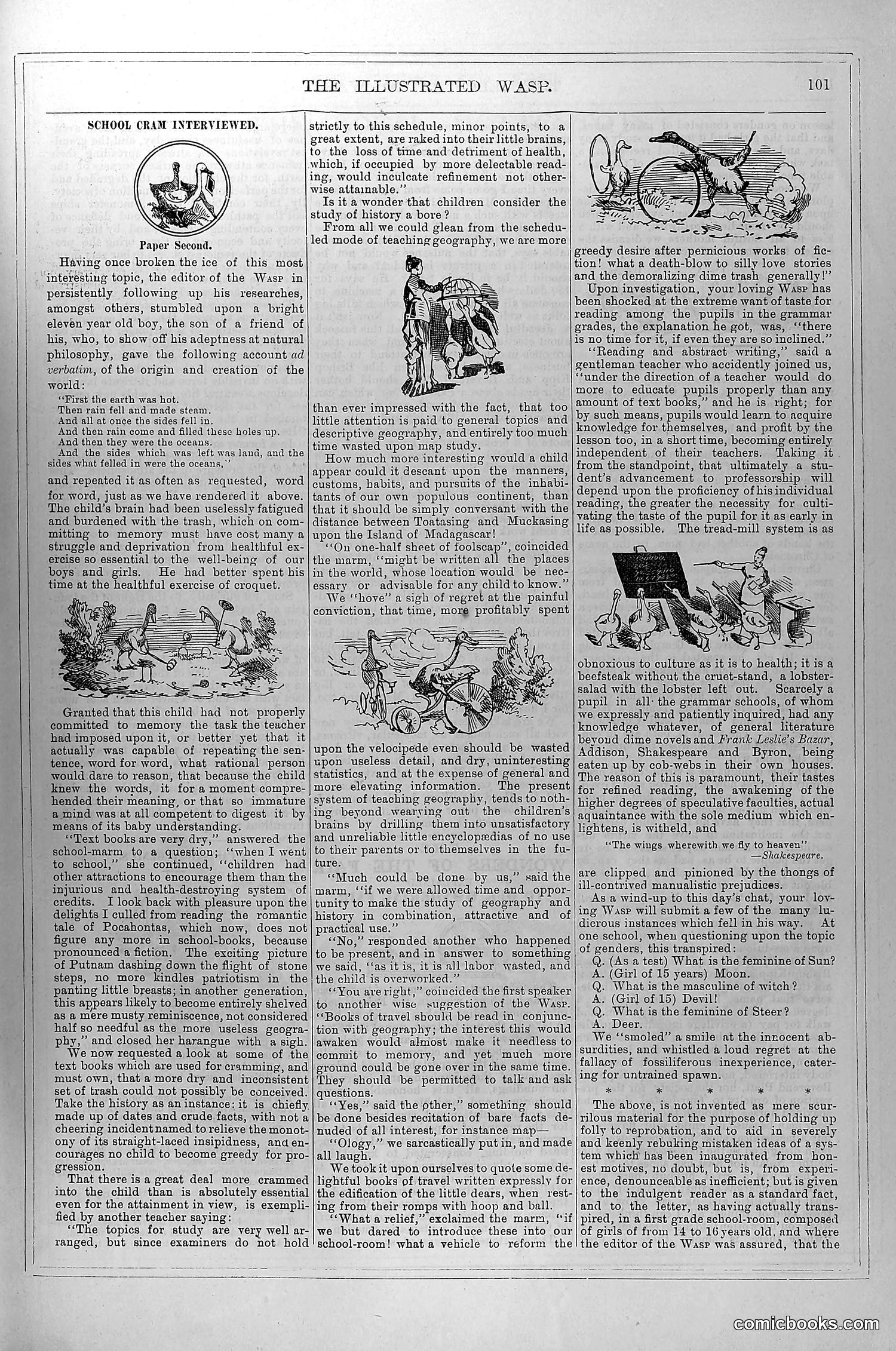
This page is primarily **editorial content, not political satire**. It's an article titled "School Cram Interviewed" critiquing Victorian education methods. The small illustrations depict children studying and playing, supporting an argument that rote memorization and excessive textbooks damage student health and interest. The text advocates for teaching geography and history through engaging travel narratives rather than dry facts, and criticizes how schools overload pupils with disconnected information. The "interview" format allows the editor to present educational reform arguments—emphasizing that children should develop independent thinking rather than merely memorize text. This reflects late-19th-century debates about modernizing pedagogy away from rigid cramming methods. The satire targets education policy itself, not political figures.
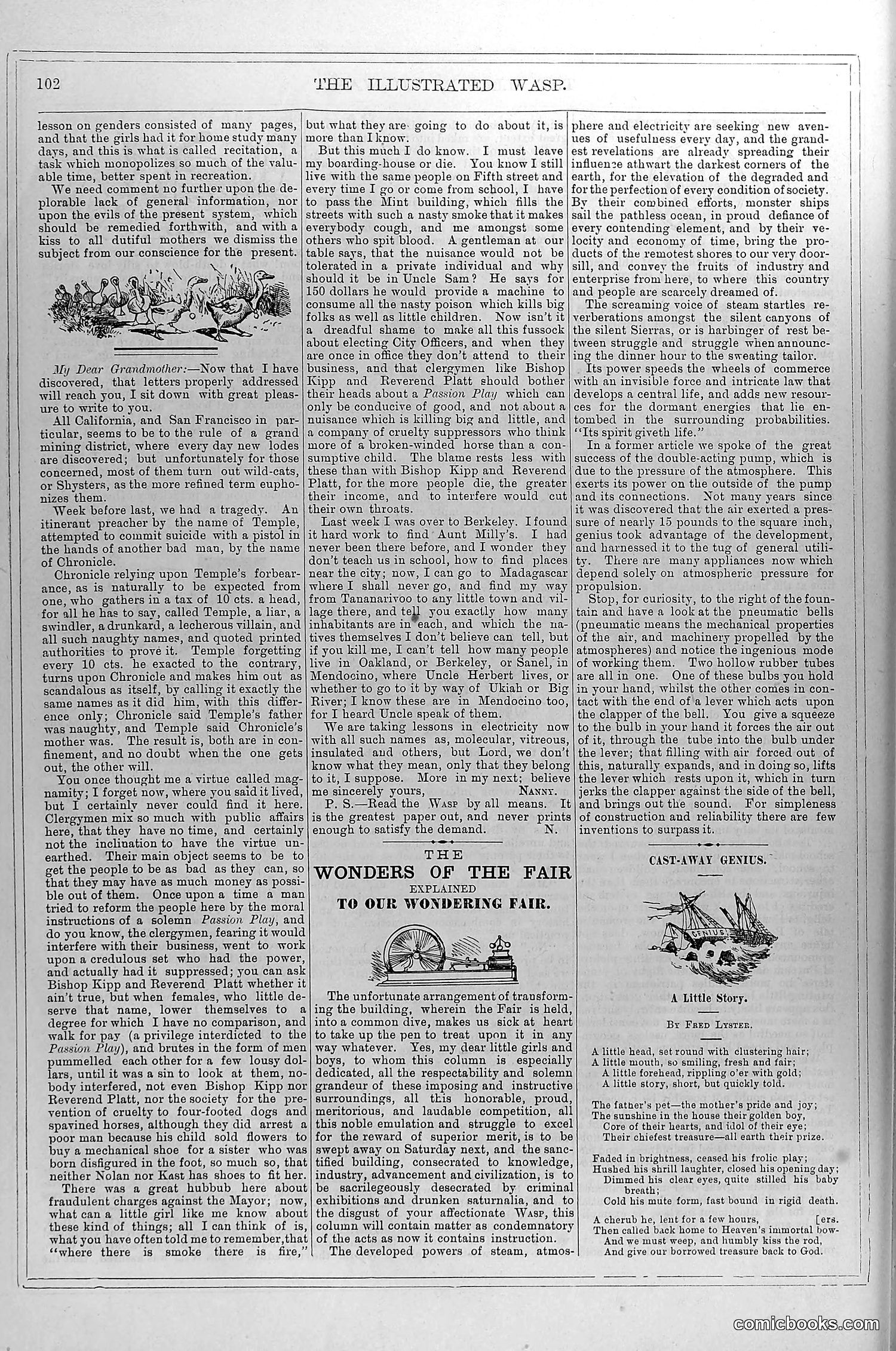
This page contains two main sections: personal correspondence and an article titled "Wonders of the Fair Explained to Our Wondering Fair." The left column features a letter from "Nancy" discussing San Francisco society, clergymen, and local politics. It includes gossip about various public figures and social commentary on civic behavior. The right section begins an article about the mechanical wonders of what appears to be the World's Fair (likely the 1893 Columbian Exposition), explaining innovations like pneumatic tubes and electric bulbs to general readers. Below this is a poem titled "A Little Story" by Fred Lister. The page is primarily text-based rather than cartoon-heavy, functioning as satirical social commentary and educational exposition typical of Wasp's format as a weekly literary and political magazine.
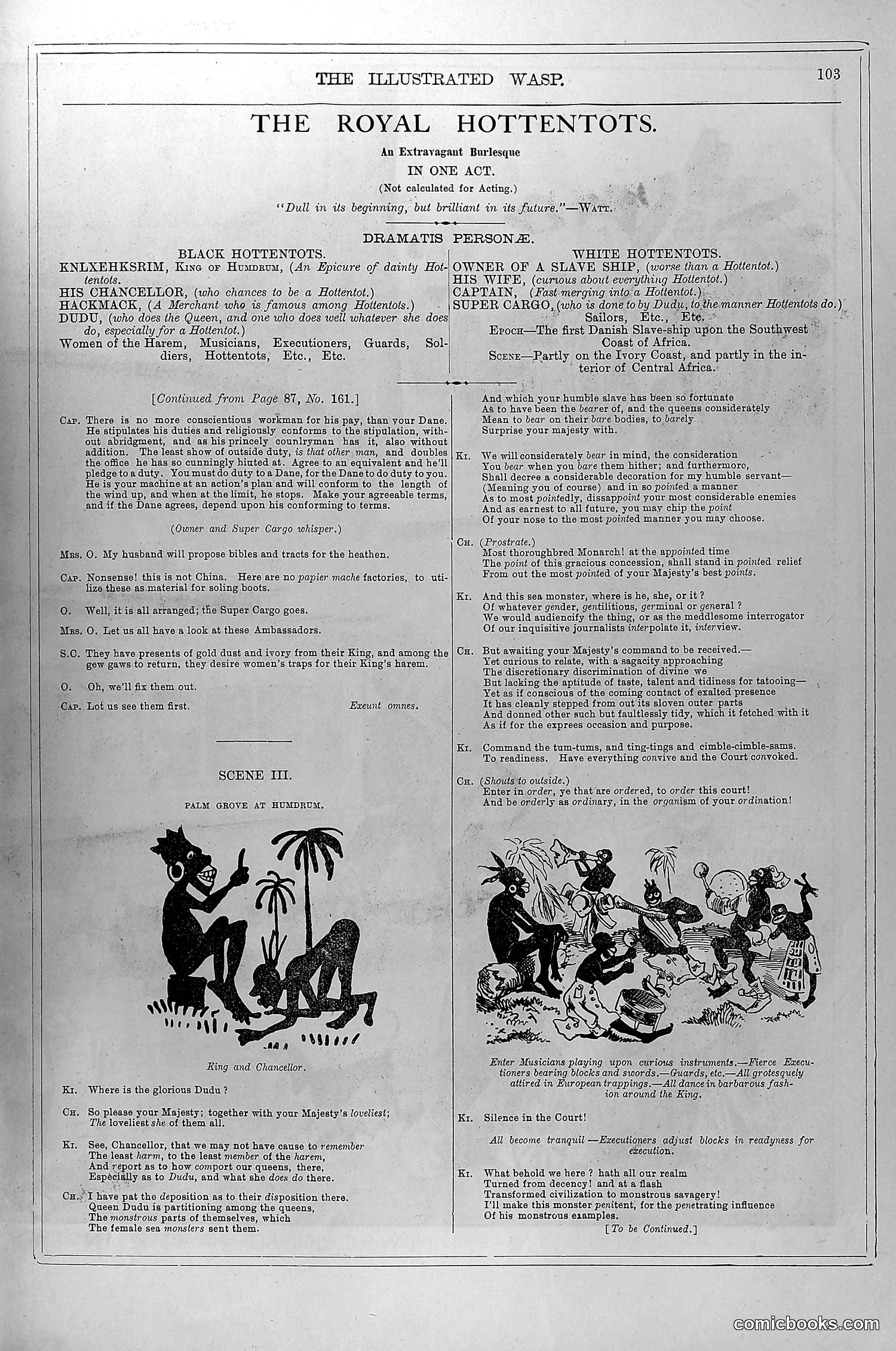
This is a theatrical burlesque script and illustrations satirizing Victorian attitudes toward colonialism and race. The play mocks British imperial pretensions by depicting African characters ("Black Hottentots" and "White Hottentots") in absurd situations involving a slave ship and colonial hierarchy. The left illustration shows a figure labeled "King and Chancellor" in exaggerated caricature style typical of 19th-century racist imagery. The right illustration depicts a chaotic court scene with multiple characters. The satire appears to ridicule both the colonizers' pomposity and their casual brutality toward colonized peoples, though the execution relies heavily on dehumanizing racial caricatures standard to the era. The "burlesque" format suggests mock-heroic treatment of imperial ventures. This reflects Victorian-era entertainment that was simultaneously critical of colonialism while employing deeply offensive stereotypes.
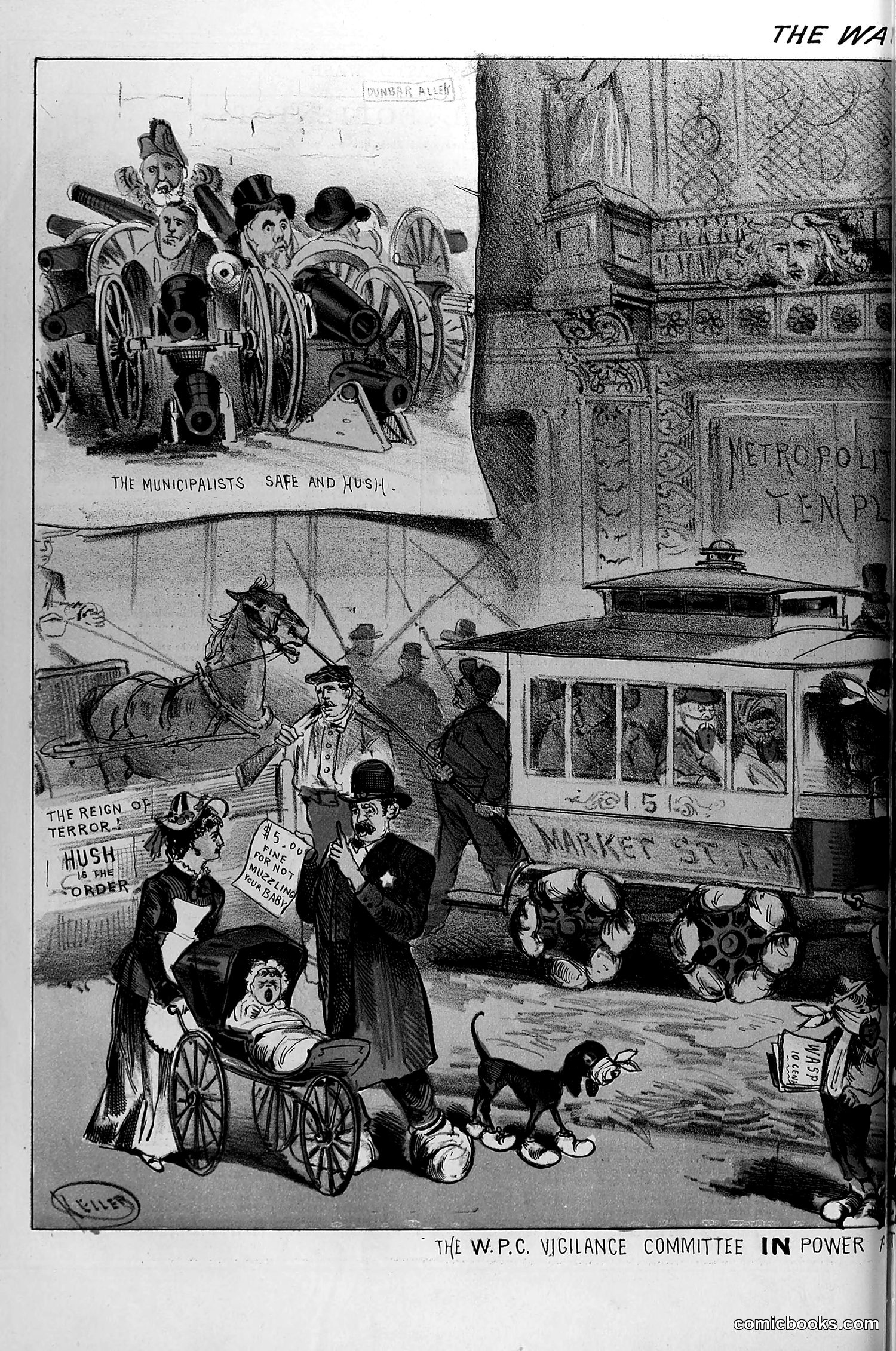
This satirical cartoon critiques the Women's Protective and Charitable (W.P.C.) Vigilance Committee's municipal oversight. The top panel shows "The Municipalists Safe and Hush" — officials surrounded by cannons, suggesting aggressive governance. The bottom panel depicts "The Reign of Terror" under W.P.C. control. A street scene shows the committee enforcing strict order: confiscating goods (baskets of produce), arresting citizens, and imposing martial-law-like conditions. A trolley is inspected, people huddle nervously, and a dog appears caught in the chaos. The satire suggests the committee's regulatory zeal has created an oppressive, police-state atmosphere rather than protective governance. The cartoon mocks what it portrays as excessive, heavy-handed moral policing affecting ordinary citizens' daily commerce and freedom.
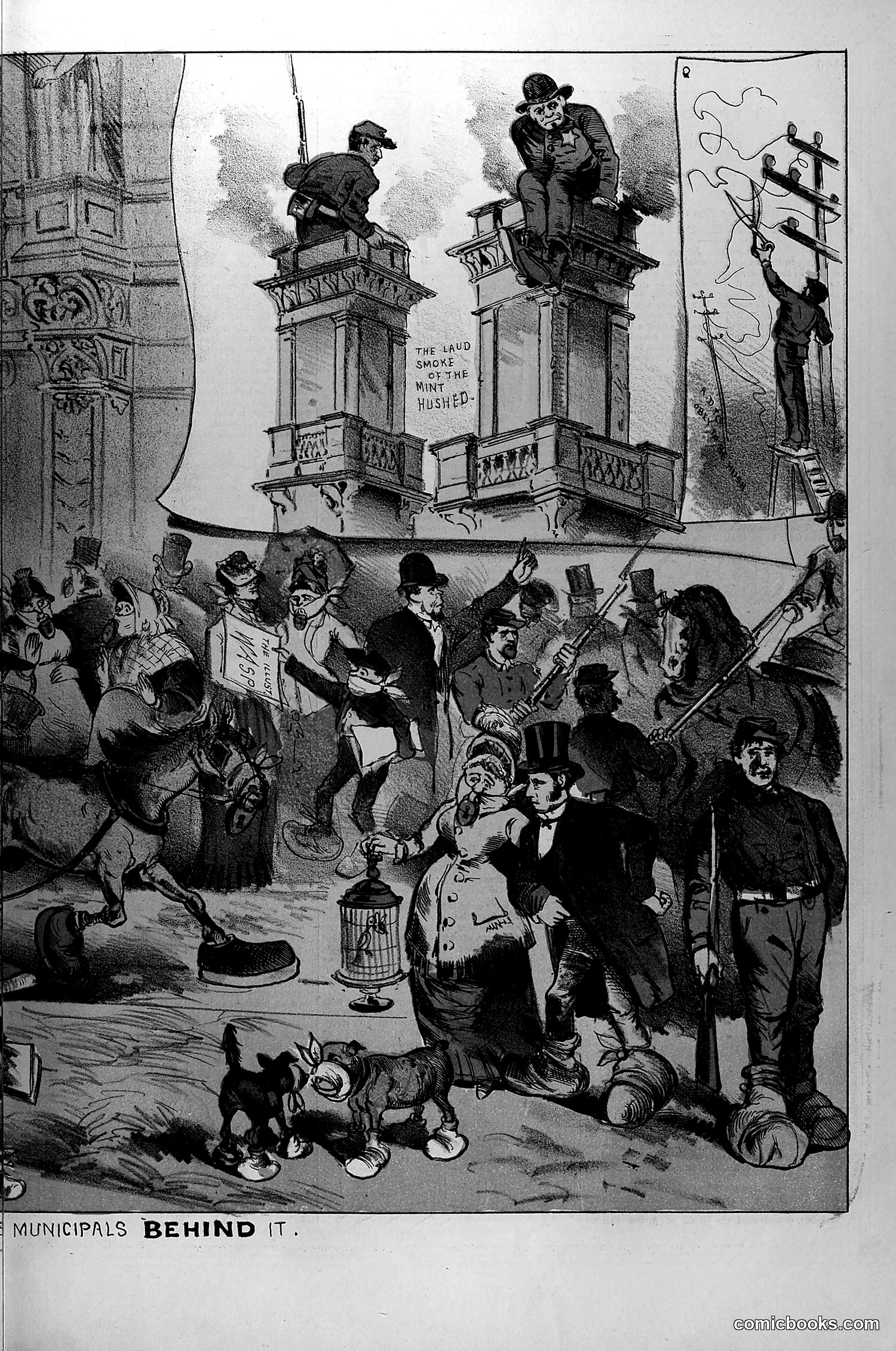
This political cartoon satirizes municipal government corruption in late 19th-century America. The scene depicts a crowd of working-class citizens gathered below two ornate civic towers, where officials perch on balconies. A banner reads "The Laud Smoke of the Mint is Hushed" — likely referencing municipal misuse of public funds or mint operations. The title "Municipals Behind It" suggests city officials are orchestrating or concealing something from the public below. The contrast between elevated officials and the street-level crowd emphasizes power disparity. The dogs and chaotic crowd suggest disorder or manipulation. The cartoon appears to criticize how municipal governments operated behind closed doors while ordinary citizens remained ignorant of corruption or financial schemes affecting their communities.
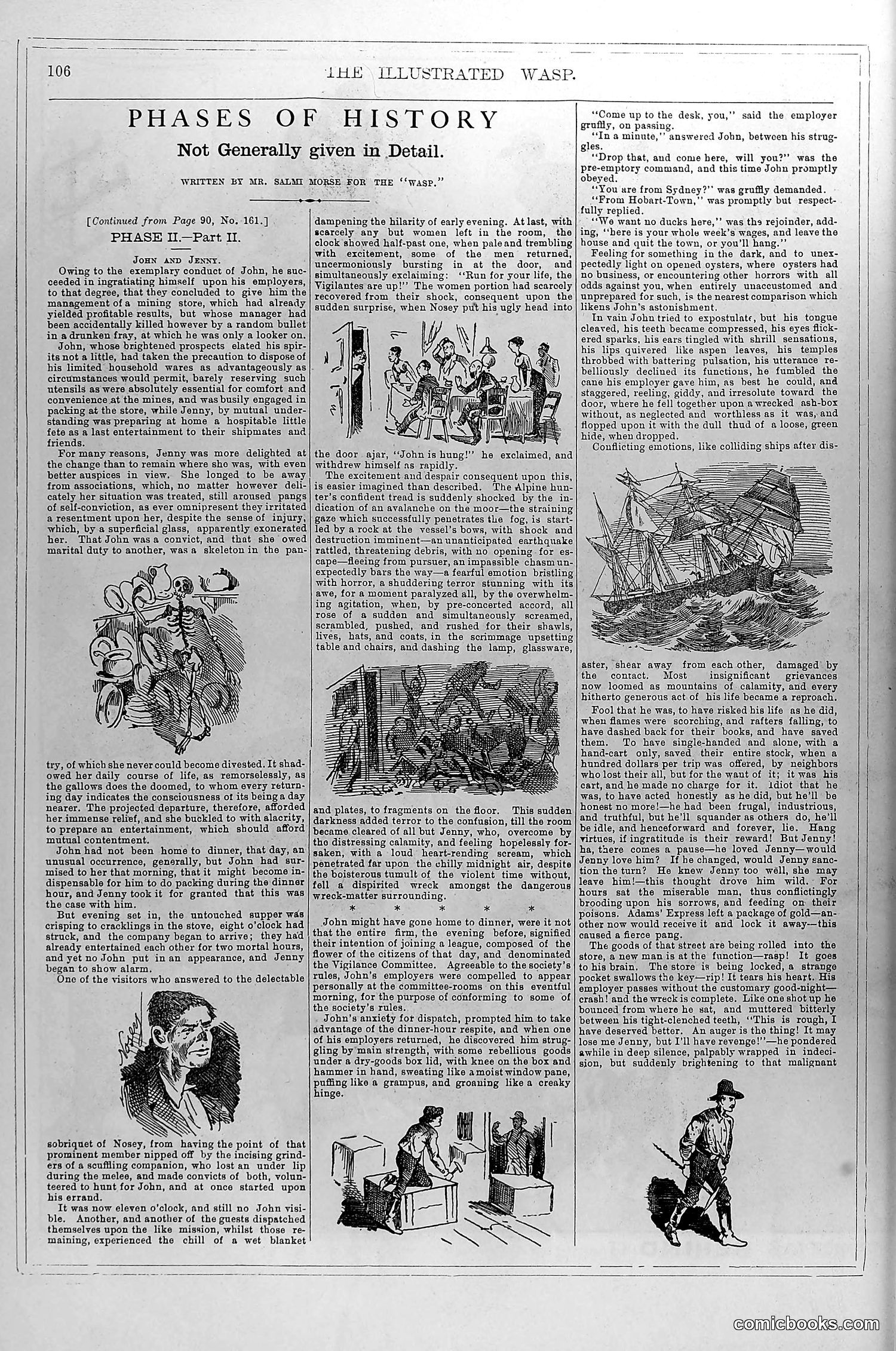
This page continues a serialized story about John and Jenny, working-class characters navigating industrial-era employment conflicts. The narrative describes John's mistreatment by his employer, including wage disputes and dangerous working conditions at mines. The accompanying illustrations depict domestic conflict and workplace turmoil: workers in chaotic scenes, a ship in distress, and figures in various states of distress or confrontation. The satire critiques exploitative labor practices of the period—low wages, unsafe conditions, and employer indifference to workers' welfare. John's desperation and potential for violent retaliation represent broader anxieties about class conflict and labor unrest in late 19th-century America. The story functions as social commentary wrapped in melodramatic narrative, using working-class characters to highlight economic injustice.
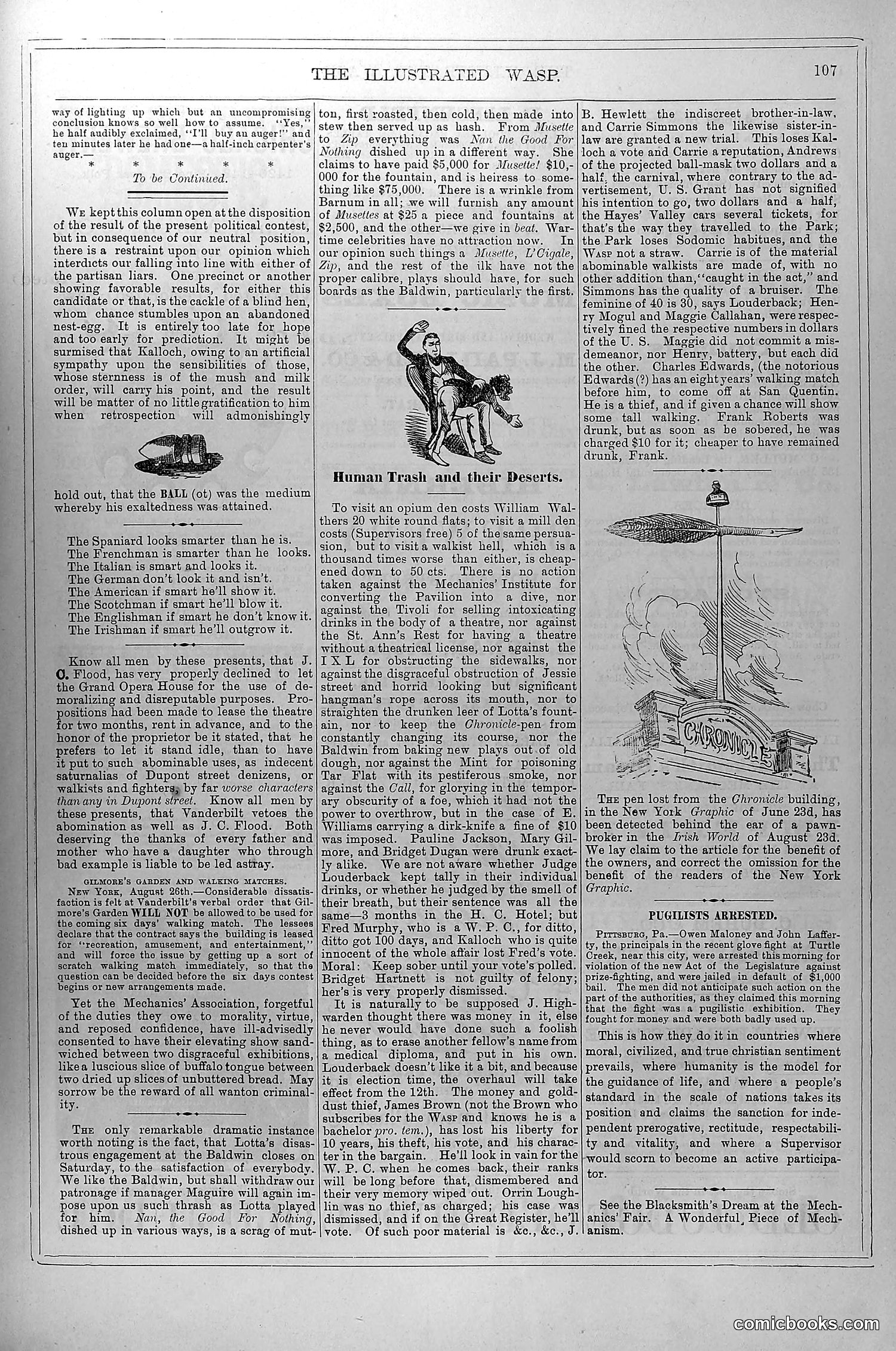
The main cartoon depicts a well-dressed man dismissing a ragged, desperate figure—illustrating the article's discussion of visiting opium dens and "walkist hells" in San Francisco. The satire mocks the hypocrisy of respectable society touring the city's underworld attractions while ignoring the human misery they encounter. The accompanying text criticizes several individuals for moral failings: William Walthers (opium dens), an unnamed "walkist hell" visitor, and notably Charles Edwards, described as "notorious Edwards," who apparently faced legal consequences. The satire targets selective moralism—society's willingness to view poverty and vice as entertainment while condemning those trapped within such circumstances as undeserving of sympathy or justice.
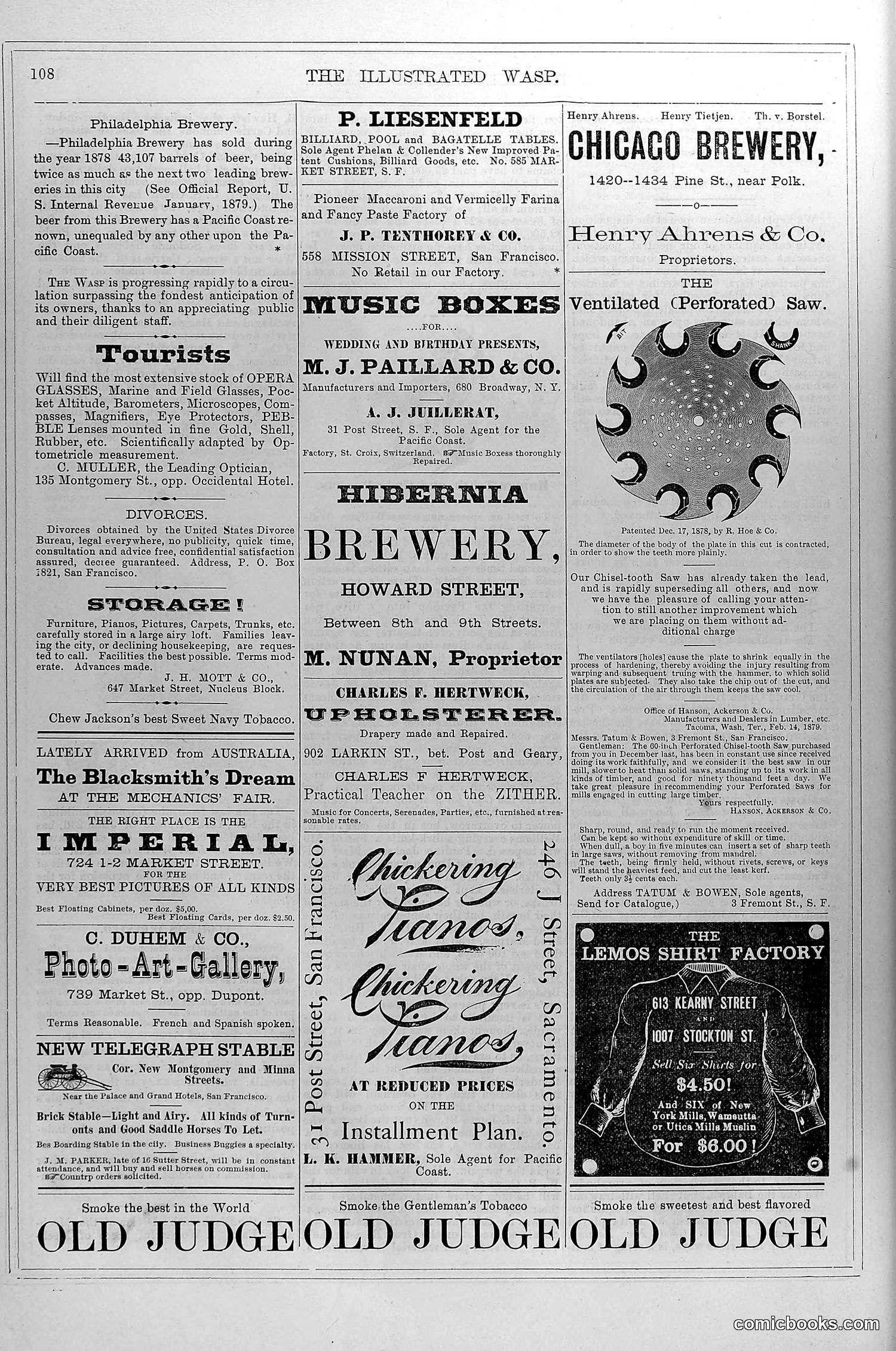
This page is primarily **advertising**, not satire or political commentary. It consists of classified ads and business notices from late 19th-century San Francisco, including: - Breweries (Philadelphia, Chicago, Hibernia) - Storage and furniture services - Photography galleries - Musical instruments (pianos) - Tobacco products ("Old Judge" brand, repeated three times at bottom) - Shirt factory advertisements - Various professional services (upholstery, legal aid) The "Old Judge" tobacco ads at the page bottom appear to be the primary paid advertising focus. There is no visible political cartoon on this page—it functions as a directory of commercial businesses and services available to San Francisco readers of *The Wasp* magazine during this period.
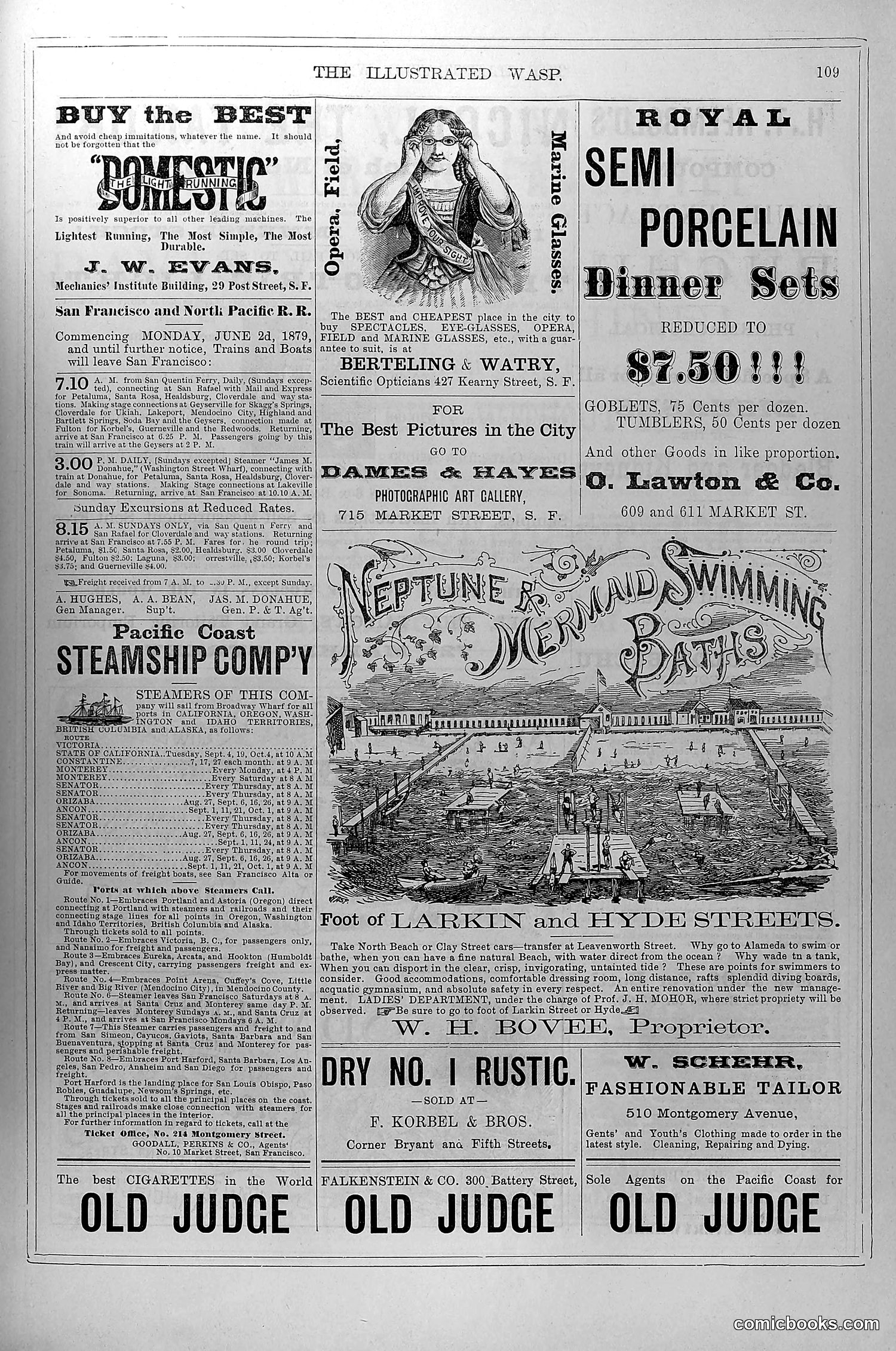
This page is primarily **advertising content** rather than editorial cartoons or satire. It contains numerous commercial advertisements for 1870s San Francisco businesses, including: - Steamship companies (Pacific Coast Steamship Company) - Dinner sets and tableware (O. Lawton & Co.) - Photography galleries (Dames & Stayes) - A swimming bath facility (Neptune Mermaid Swimming Baths) - A tailor (W. Schehr) - Cigarettes (Old Judge brand) The only illustrative content includes decorative engravings—an ornate banner for Neptune Mermaid Swimming Baths and a portrait of a woman at top—but these are commercial art serving advertisements rather than political satire or commentary. **No satirical cartoons or political messaging is evident on this page.**
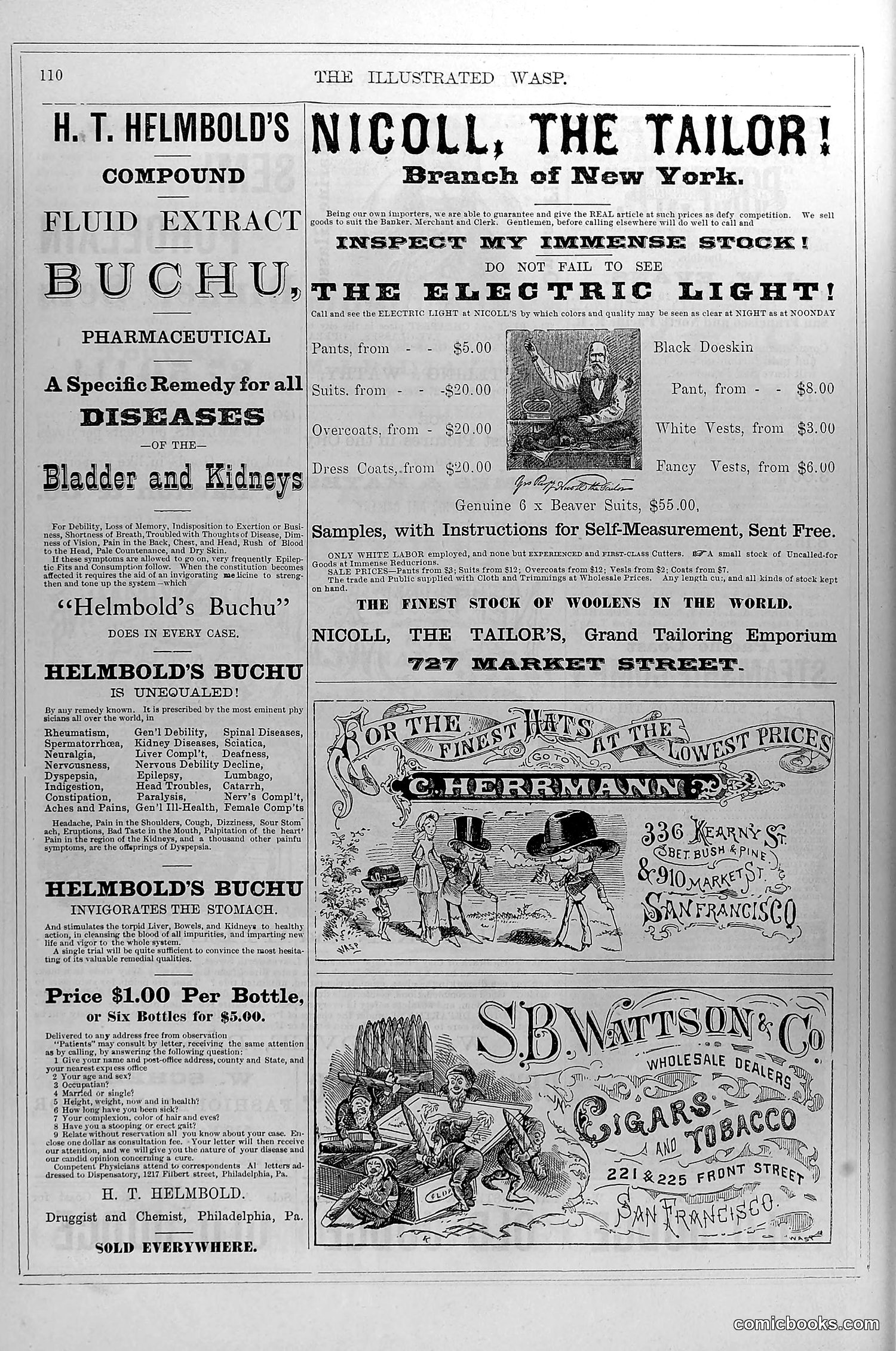
This page is primarily **advertising, not satire**. It contains commercial notices for patent medicines and retail businesses typical of late 19th-century American magazines. The main advertisements include: - **H.T. Helbold's Fluid Extract Buchu**: a purported remedy for bladder and kidney diseases, claiming to treat numerous ailments from rheumatism to nervousness - **Nicoll, the Tailor** (New York branch): promoting clothing and an "electric light" display - **C. Herrmann**: San Francisco hat merchant - **S.B. Wattson & Co.**: San Francisco tobacco and cigar wholesaler The illustrations are decorative commercial art rather than political commentary—showing fashionable gentlemen and women advertising clothing and lifestyle products. This reflects the magazine's reliance on paid advertising revenue, standard for 19th-century publications.
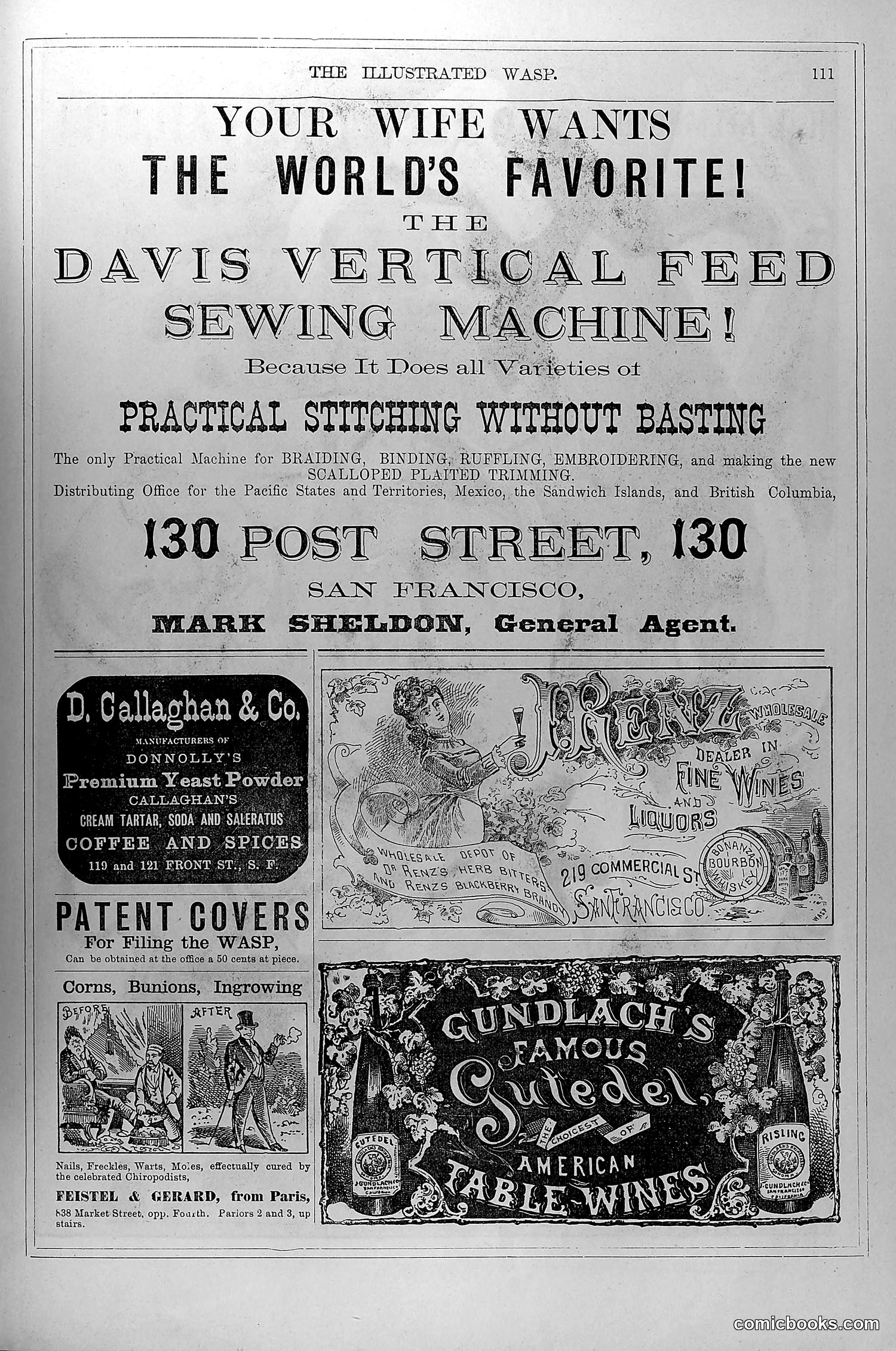
This is primarily an **advertising page** from *The Illustrated Wasp*, not a political cartoon. The page is dominated by commercial advertisements for various San Francisco businesses: - **Davis Vertical Feed Sewing Machine** (main top advertisement) - **D. Callaghan & Co.** (yeast powder, coffee, spices) - **J. Pieretti** (wines and liquors dealer) - **Patent Covers** (foot ailment treatments) - **Gundlach's Famous Suedel** (American table wines) The "Your Wife Wants" headline is a sales pitch typical of period advertising, appealing to male readers by suggesting domestic purchase decisions. There is **no discernible political satire or social commentary** on this page—it functions as a standard advertisement section of the magazine, not editorial content.
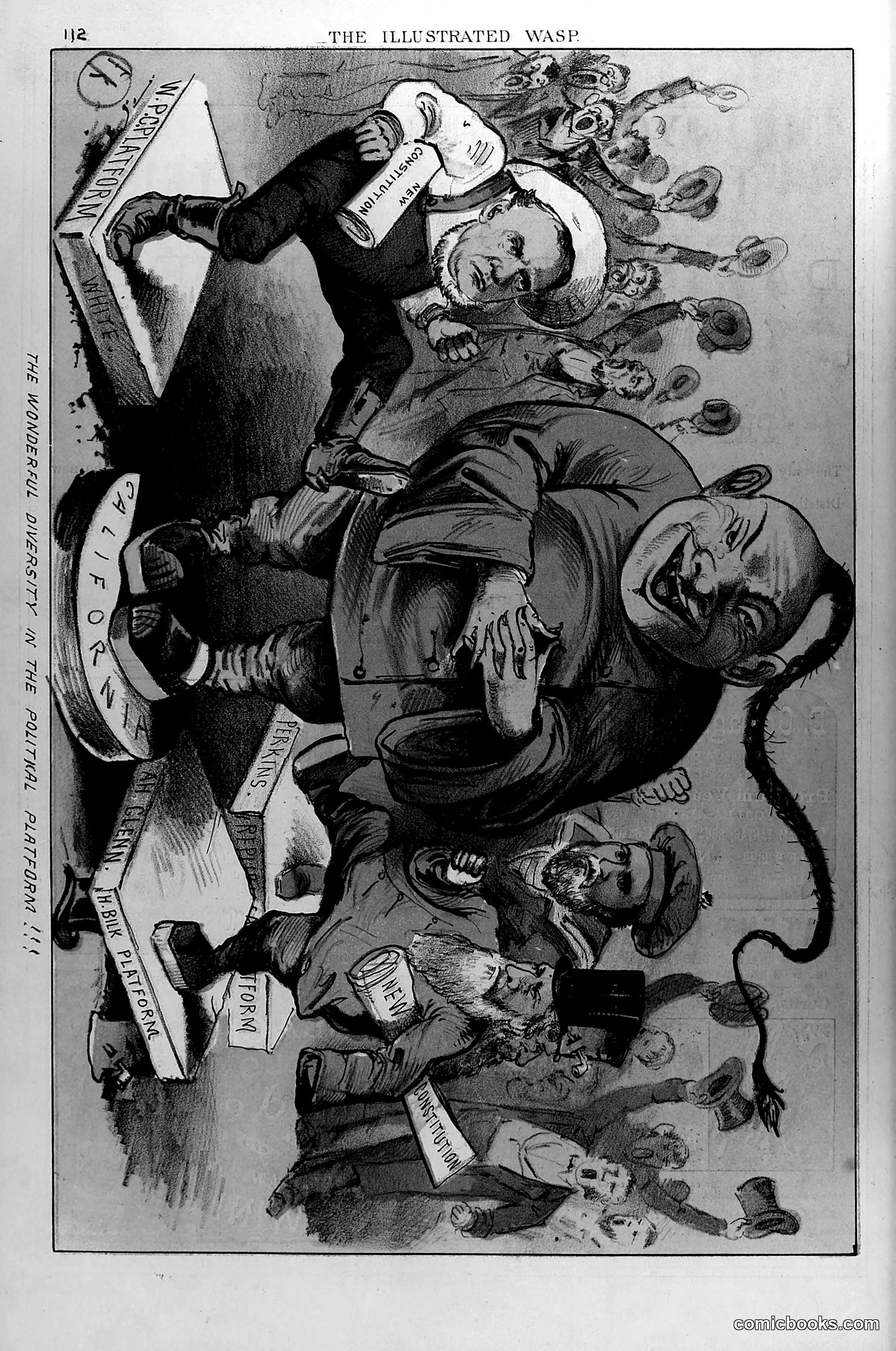
This appears to be a satirical political cartoon, though the OCR text provided contains only fragmented labels that are difficult to read clearly in the image. The cartoon depicts multiple caricatured figures in what seems to be a chaotic scene—possibly representing politicians or public figures engaged in some form of conflict or controversy. The style is characteristic of late 19th-century American satirical journalism, using exaggeration and grotesque facial features typical of that era's political cartooning. Without legible text identifying the specific figures or the historical moment being satirized, I cannot confidently identify which political events or personalities are being targeted. The general composition suggests commentary on political discord or corruption, but the specific context remains unclear from this page alone.

I can see this page contains a scale/ruler for photographic reproduction purposes (standard in archival documentation) and a checkerboard pattern of varying gray tones used for calibrating image contrast and exposure in printing and scanning. However, I cannot discern any actual cartoon, satirical illustration, or readable text content on this page that would allow me to explain political or social satire to a modern reader. The page appears to be a technical calibration sheet rather than editorial content from *The Wasp* magazine itself. If there is cartoon content present, the image resolution or contrast makes it illegible to me. You may want to verify the image quality or check if this is the correct page.