
A complete issue · 18 pages · 1879
The Wasp — August 23, 1879
I can see this is a measurement/calibration page from *The Wasp* magazine, featuring Oregon Rule Co. rulers and a grayscale color reference chart. However, the image quality and angle make it difficult to discern any actual cartoon content or satirical illustrations. What's visible is technical documentation—rulers marked 0-5 inches and a checkerboard pattern of varying gray tones, likely used for photography calibration or printing purposes. This appears to be a back-of-page or insert used for archival documentation rather than editorial content. Without clearer visibility of any cartoon figures, caricatures, or accompanying text explaining the satirical subject matter, I cannot reliably identify the political or social references this page may have contained. The actual content requiring historical interpretation is not legible here.
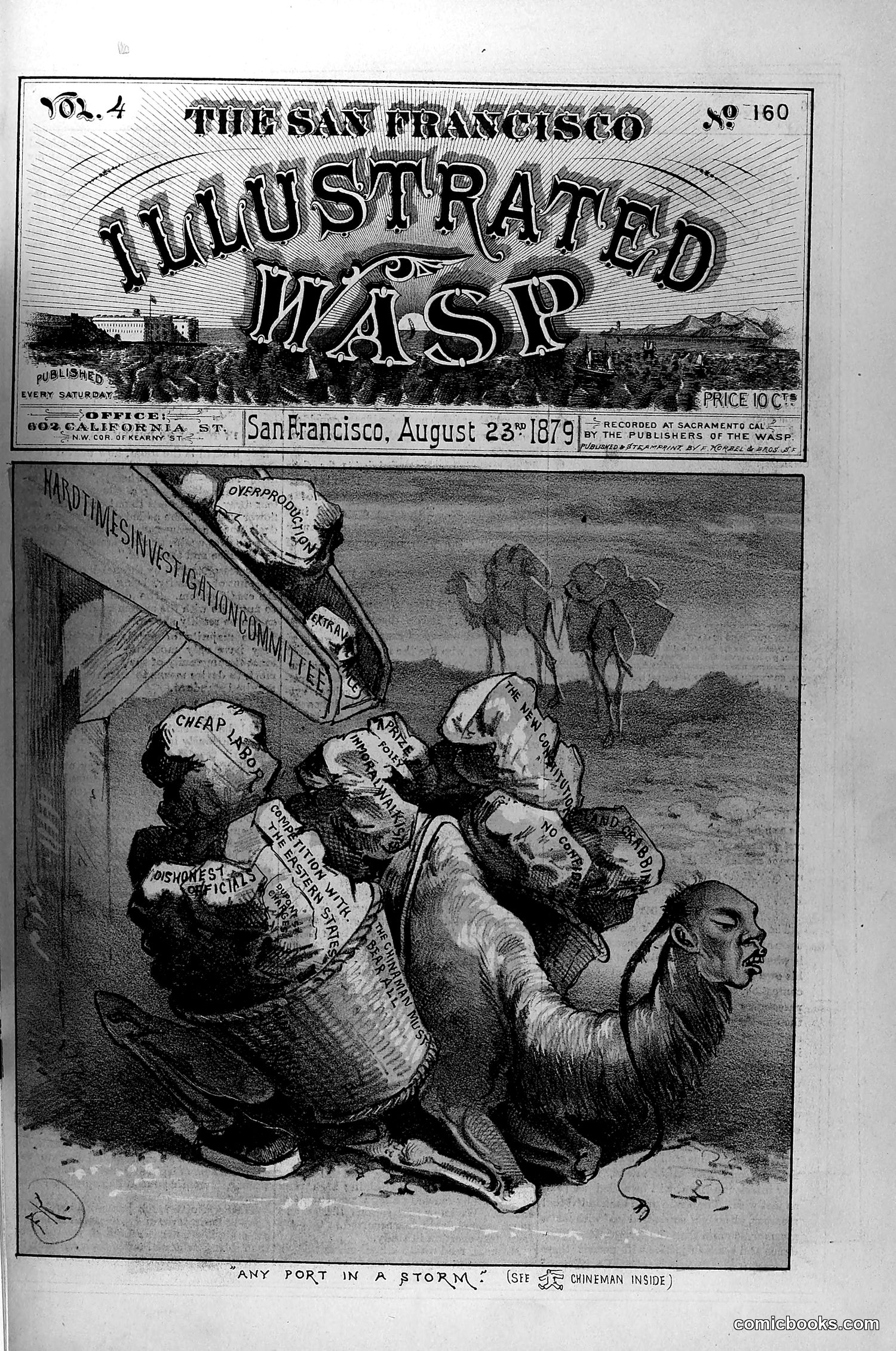
This August 23, 1879 *San Francisco Illustrated Wasp* cartoon satirizes the "Hard Times Investigation Committee" during an economic crisis. The central figure (right) appears to be a laborer or worker being burdened by multiple sacks labeled with social problems: "Cheap Labor," "Dishonest Speculators," "Monopolies," "Strikes," and other economic ills. These burdens are literally weighing him down as he struggles. The title "Any Port in a Storm" suggests people will accept any solution during hardship. The desert landscape with camels in the background may reference foreign labor or exotic outsiders blamed for economic woes—a common 19th-century American anxiety. The cartoon critiques how investigative committees address worker suffering: by piling abstract problems onto workers themselves rather than solving systemic issues.
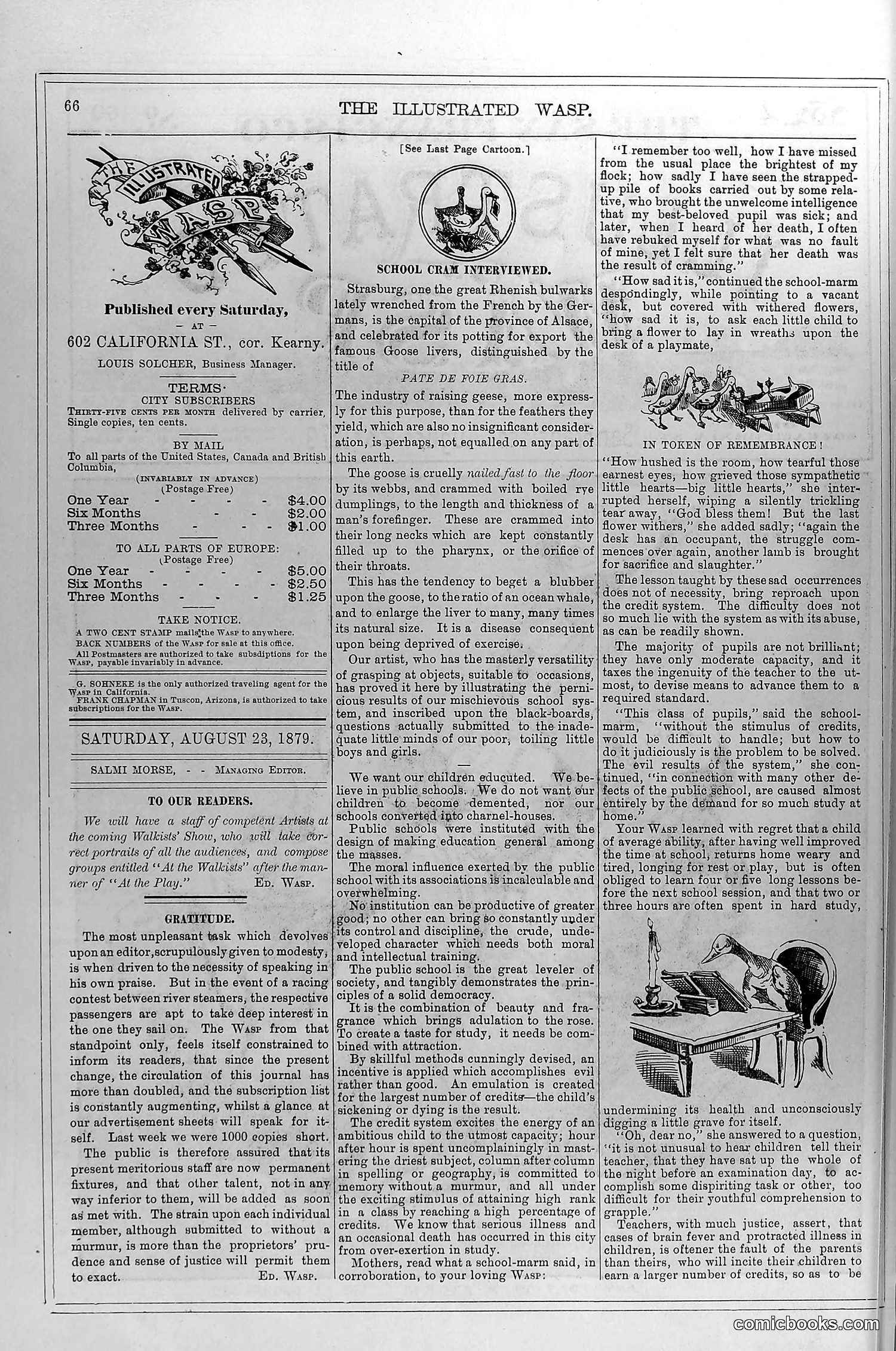
This page is primarily editorial and advertising content rather than political cartoons. The main illustrated elements are small vignettes accompanying articles about education and geese-raising ("Pâté de Foie Gras"). The substantive content critiques California's public school system. The editorial argues schools fail students through poor teaching methods, excessive homework, and insufficient rest—causing illness and poor comprehension. The author advocates for better teacher training and curriculum design emphasizing understanding over rote memorization. The cartoons appear decorative rather than satirical, illustrating the accompanying articles without clear political targets. The page reflects late-19th-century Progressive Era concerns about educational reform, a common topic in American satirical publications of this period.
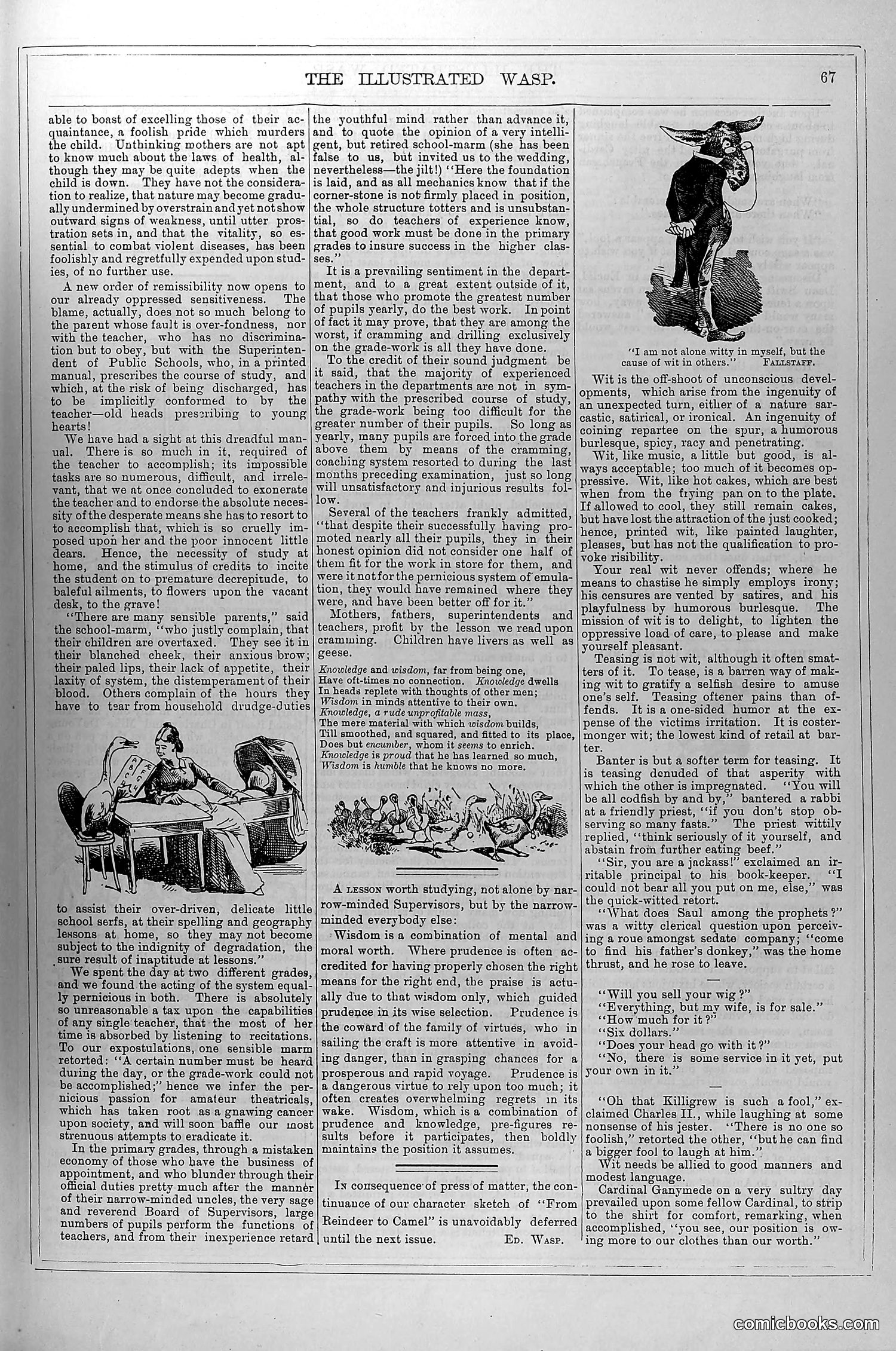
The page contains primarily satirical text commentary rather than political cartoons. The illustrated vignettes show schoolroom scenes and what appears to be a confrontation between figures. The main content critiques California's education system, specifically attacking "narrow-minded" school supervisors and their rigid adherence to prescribed curricula. The author argues this stifles teacher initiative and pupil engagement. Several anecdotes mock specific supervisors and administrators—one refusing a teacher's sensible suggestion, another obsessing over minor procedural violations rather than educational outcomes. The satirical point: bureaucratic rigidity in schools prioritizes rule-following over actual learning and teacher competence. This reflects late 19th-century Progressive Era debates about education reform versus administrative inflexibility. The specific individuals referenced remain unclear from this page alone.
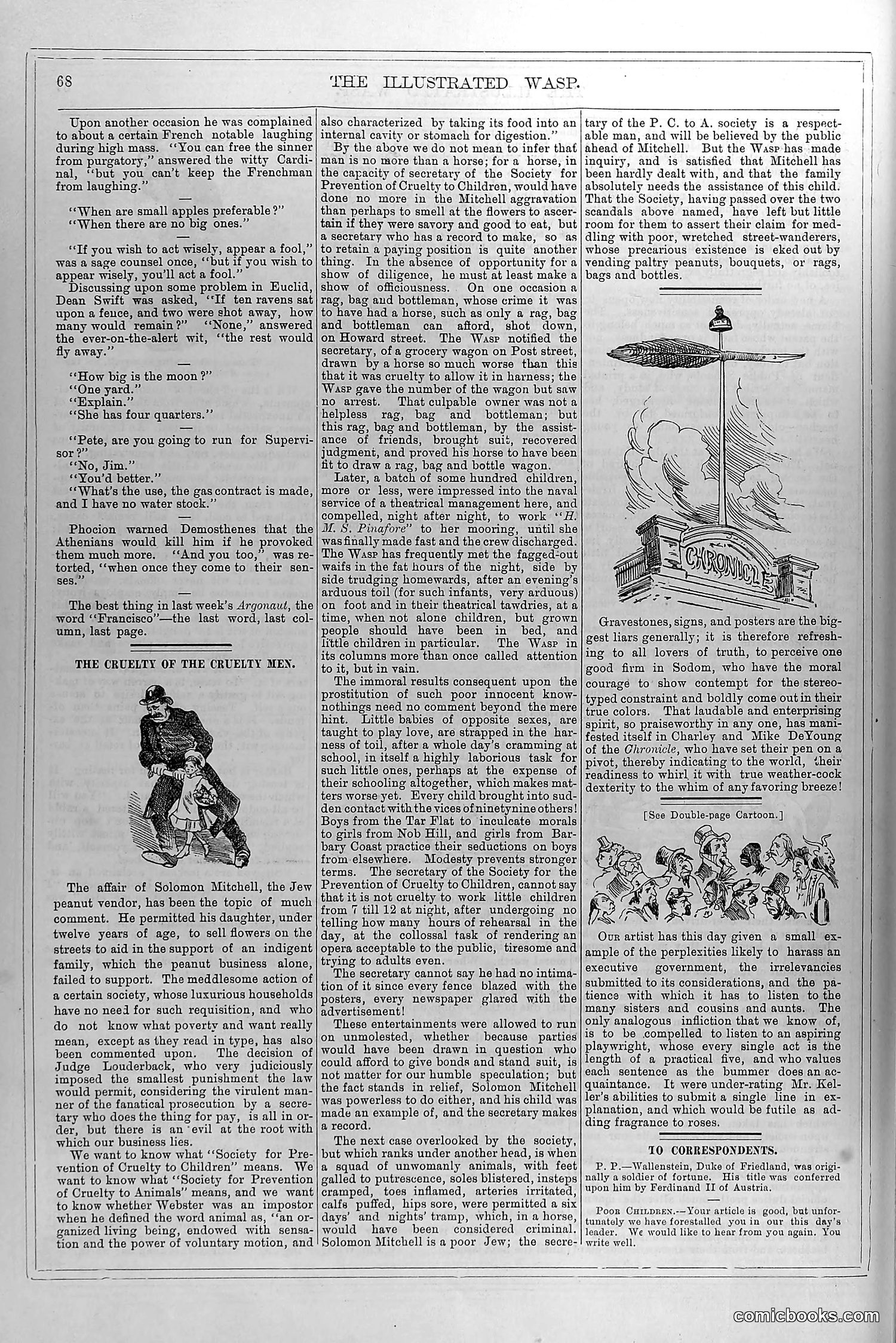
This page contains two main sections: a column of satirical commentary about social issues and a cartoon titled "The Cruelty of the Cruelty Men." The left column discusses the case of Solomon Mitchell, a Jewish peanut vendor whose daughter was allegedly exploited by theatrical management. The satire attacks the "Society for Prevention of Cruelty to Children" for selectively enforcing rules—appearing indifferent to children laboring in theaters while aggressively prosecuting street vendors. The cartoon depicts what appears to be a social worker or inspector accosting a street vendor with children, satirizing the organization's apparent hypocrisy in targeting working-class immigrants while ignoring child exploitation in more "respectable" venues. The satire exposes class bias in progressive-era child welfare enforcement, suggesting reformers targeted vulnerable poor and immigrant populations rather than addressing systemic exploitation.
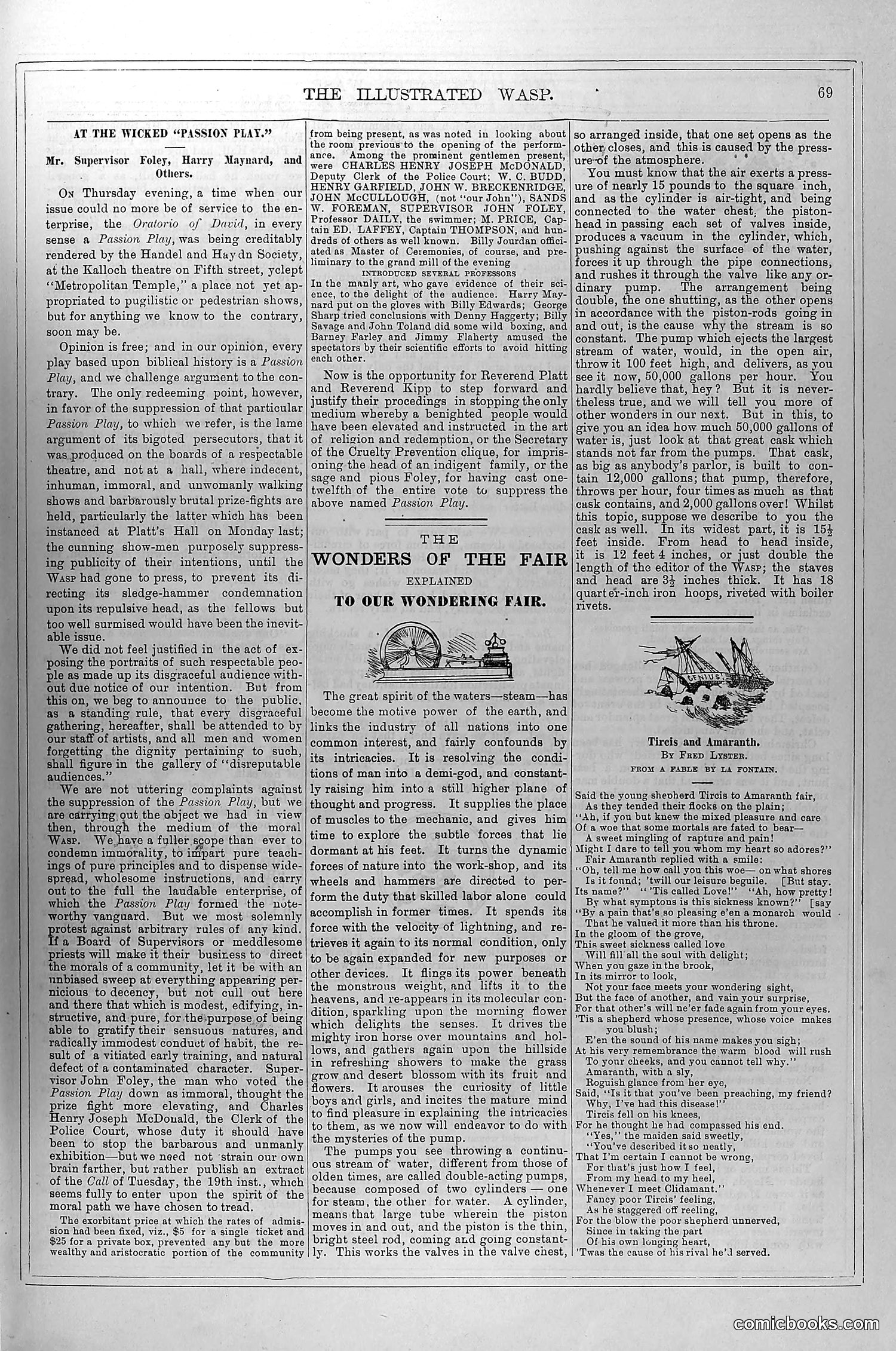
This page contains two distinct sections: a lengthy editorial about the "Passion Play" controversy and an illustrated article titled "The Wonders of the Fair" about pumping mechanisms. The editorial criticizes opponents of a biblical drama production, defending it against charges of immorality while attacking those who sought to suppress it. The author argues the play's historical and religious basis justifies its performance, dismissing censorship efforts. The illustrated section features a poem titled "Tireds and Amaranth" by Eros Lysses, accompanying a sketch of what appears to be fair machinery or industrial equipment. This reflects the page's dual purpose: political commentary and celebration of technological progress at contemporary expositions. The page demonstrates The Wasp's typical mix of social criticism and celebration of modern innovation.
This page from *The Wasp* contains theater criticism and social commentary rather than political cartoons. The main illustrated element shows a figure in classical pose, accompanying discussion of stage performances. The text critiques theatrical productions, including references to "Passion Play," "Piatt's Hall," and Italian circus performances. It discusses the acting of characters named Brunhilde and Siegfried, praising their performances while commenting on the "pre-Christian era" themes. The "Proverbs" section offers satirical social commentary on everyday life—women, marriage, employment, and behavioral observations—typical of *Wasp's* satirical approach to San Francisco society. The page concludes with a tragic anecdote about female pedestrianism, suggesting social anxieties about women's independence and property rights during this period.
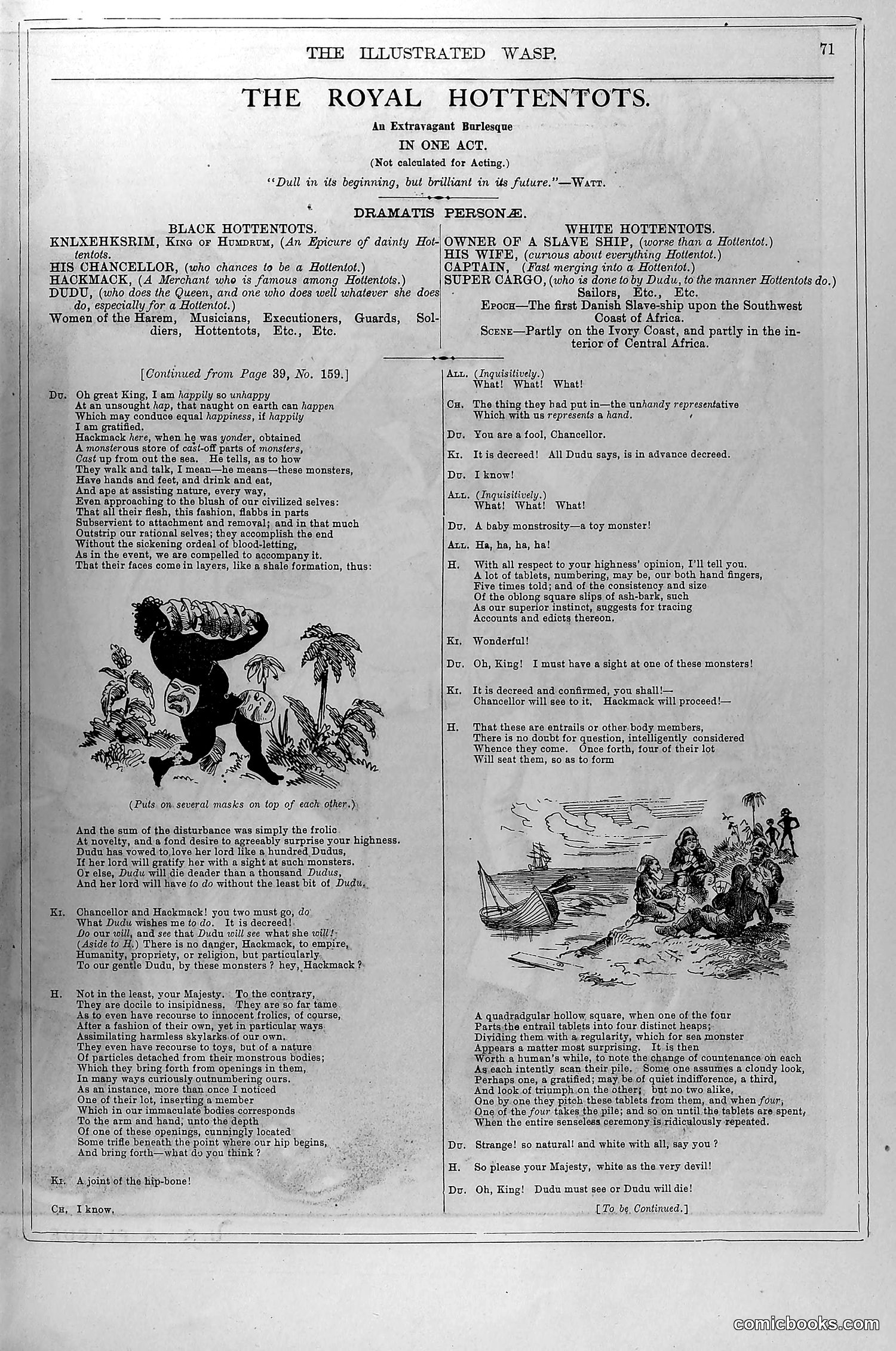
This is a theatrical script for a one-act farce mocking Victorian attitudes toward African peoples. The cast includes caricatured "Black Hottentots" and "White Hottentots" (the latter suggesting satirical reversal). The dialogue ridicules both colonial pretensions and scientific racism. Characters discuss "monsters" with anatomically exaggerated features, apparently mocking pseudo-scientific accounts of African people that were popular in Victorian society. The humor relies on absurdist descriptions and the incongruity of treating colonial subjects as exotic curiosities. The accompanying illustrations show grotesque figures, reinforcing the satire's crude caricature style. The piece appears designed to mock Victorian sensationalism about non-European peoples while simultaneously perpetuating the same racist stereotypes it ostensibly critiques—typical of 19th-century "satirical" comedy that punched down rather than up.
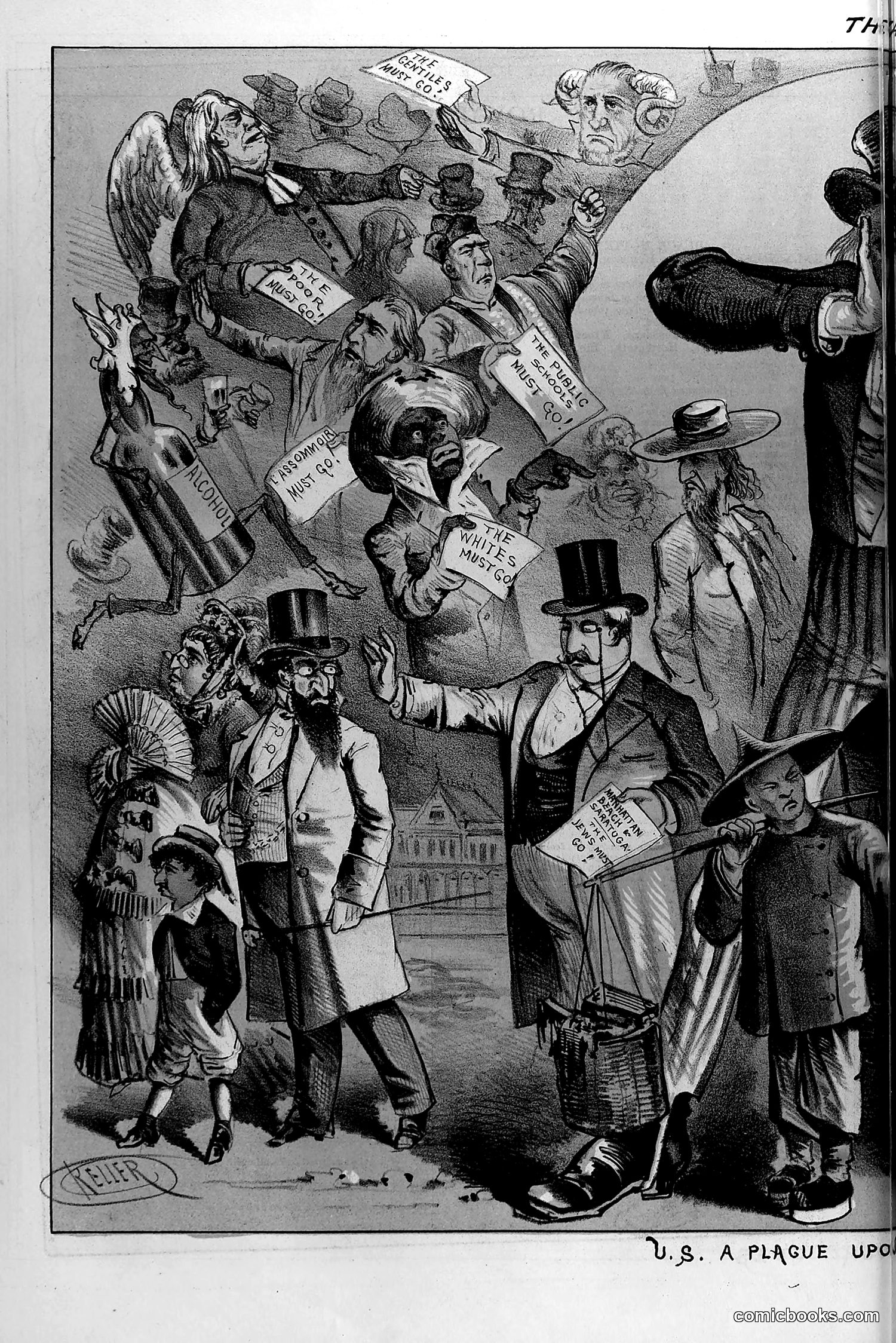
This political cartoon satirizes various American social problems through caricature. Multiple figures wear signs reading "THE MUSIC MUST GO" (appearing multiple times), suggesting criticism of popular entertainment or cultural frivolity during serious times. The composition depicts a chaotic crowd of exaggerated characters—including what appear to be politicians, wealthy businessmen (top hats), and other societal figures—engaged in disorder or moral decay. One figure appears angelic or allegorical (top left). The cartoon likely criticizes American society's obsession with entertainment and pleasure-seeking while ignoring serious social ills. The "plague" reference suggests the cartoonist views these problems as widespread disease afflicting the nation. Without the magazine's date, the specific crisis being referenced remains unclear, though the style suggests late 19th or early 20th century.
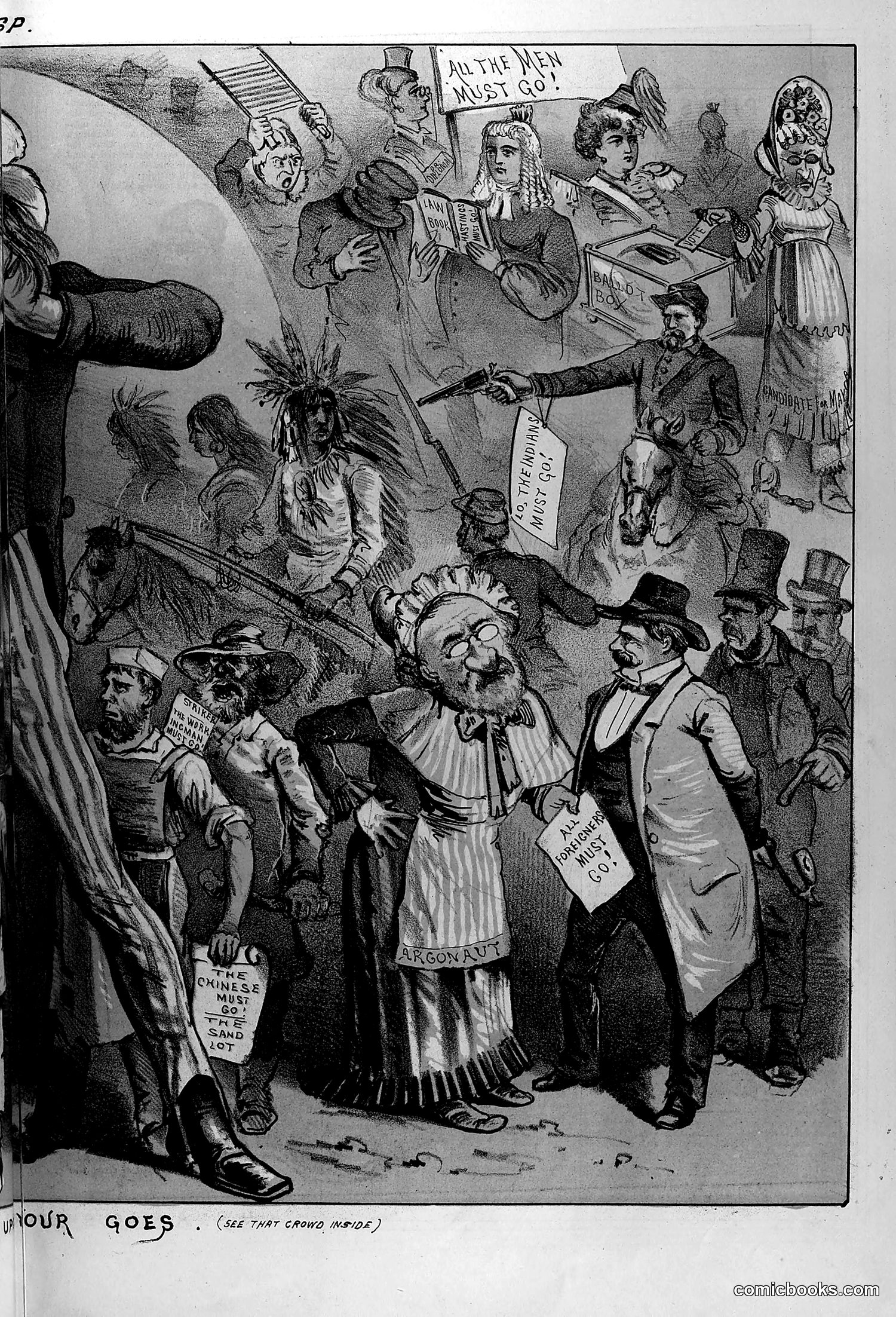
This satirical cartoon from *The Wasp* depicts a chaotic scene titled "The Hour Goes" with various figures holding signs demanding expulsion of different groups. Visible signs read "All the Men Must Go," "The Chinese Must Go," and "The Argonaut" (likely referencing a publication). The cartoon satirizes nativist and exclusionary movements of the era—likely the late 19th century—mocking simultaneous demands to expel Chinese immigrants, women, and other groups. A figure on horseback appears to be driving or herding these diverse characters, suggesting the absurdity of competing expulsion movements. The satire critiques how exclusionary rhetoric becomes contradictory and ultimately ridiculous when multiple factions each demand removal of *different* populations simultaneously.
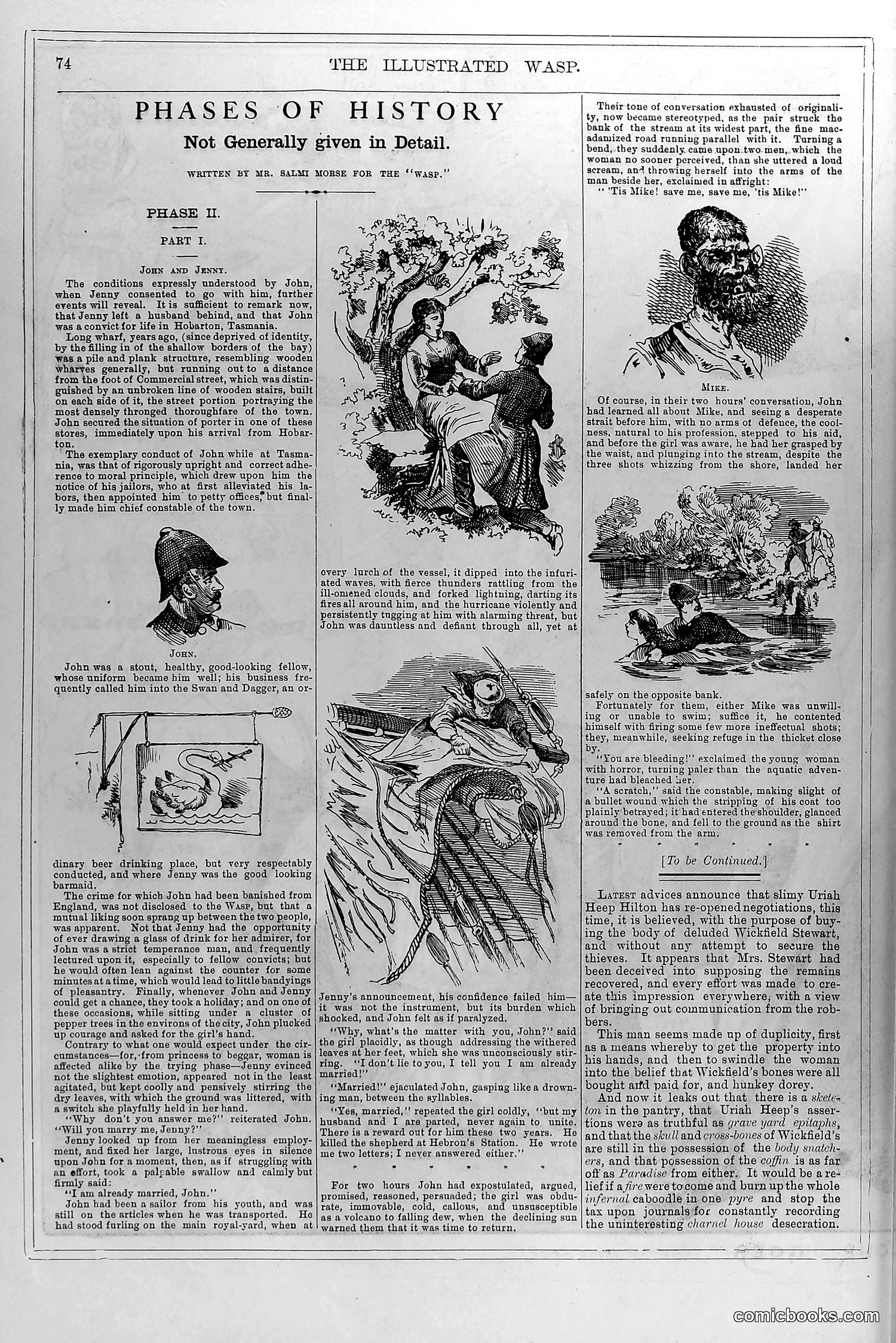
This page presents a serialized story ("Phase II") about working-class characters named John and Jenny, illustrated with multiple engravings. The narrative describes John as "a stout, healthy, good-looking fellow" whose uniform identifies him as a policeman or constable. Jenny is portrayed as an attractive working-class woman. The story depicts their romantic entanglement—John pursues Jenny despite her initial resistance and existing attachment to another man. The illustrations show dramatic river scenes and physical altercation, suggesting melodramatic adventure rather than political satire. The text emphasizes class-typical scenarios: Jenny works as a barmaid, there are references to drinking establishments and street life. This appears to be popular serialized fiction using satire's platform for entertainment rather than political commentary—typical filler content for 19th-century satirical magazines.
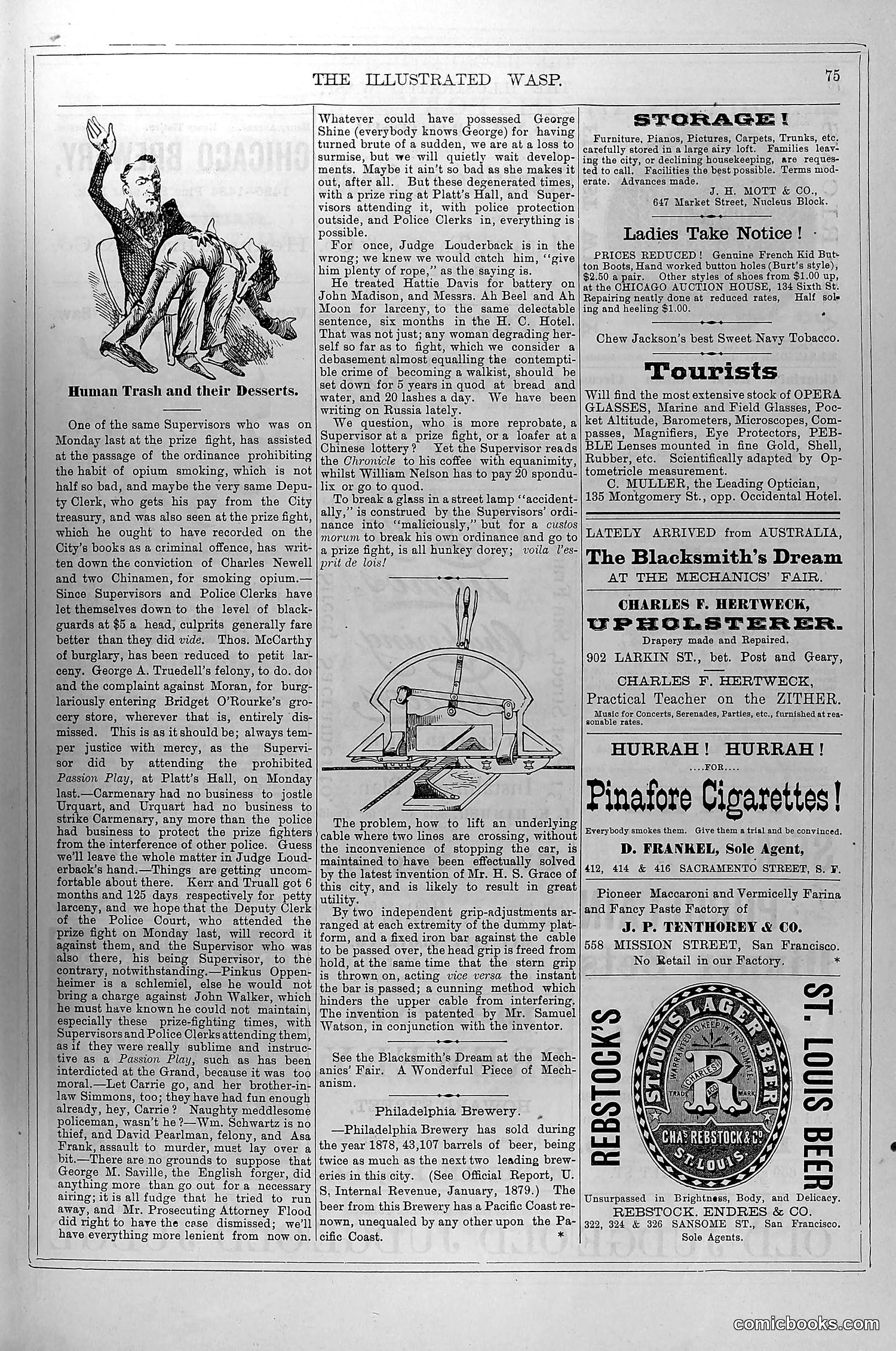
This cartoon satirizes San Francisco's corrupt police and political system. The illustration depicts a supervisor—one of the city officials mentioned in the accompanying text—portrayed as morally decrepit, literally embodied as "trash." The text discusses how supervisors and police have become corrupt, accepting bribes (reduced from $5 to smaller amounts) and overlooking crimes. Specific officials named include George Shite, Judge Louderback, and others accused of bribery, battery, and larceny. The article details how these authorities manipulate the legal system—a "Cinderella lottery" where wealthy individuals escape punishment while poor defendants face harsher treatment. The cartoon's crude depiction reflects The Wasp's scathing critique of San Francisco's governmental corruption during this period.
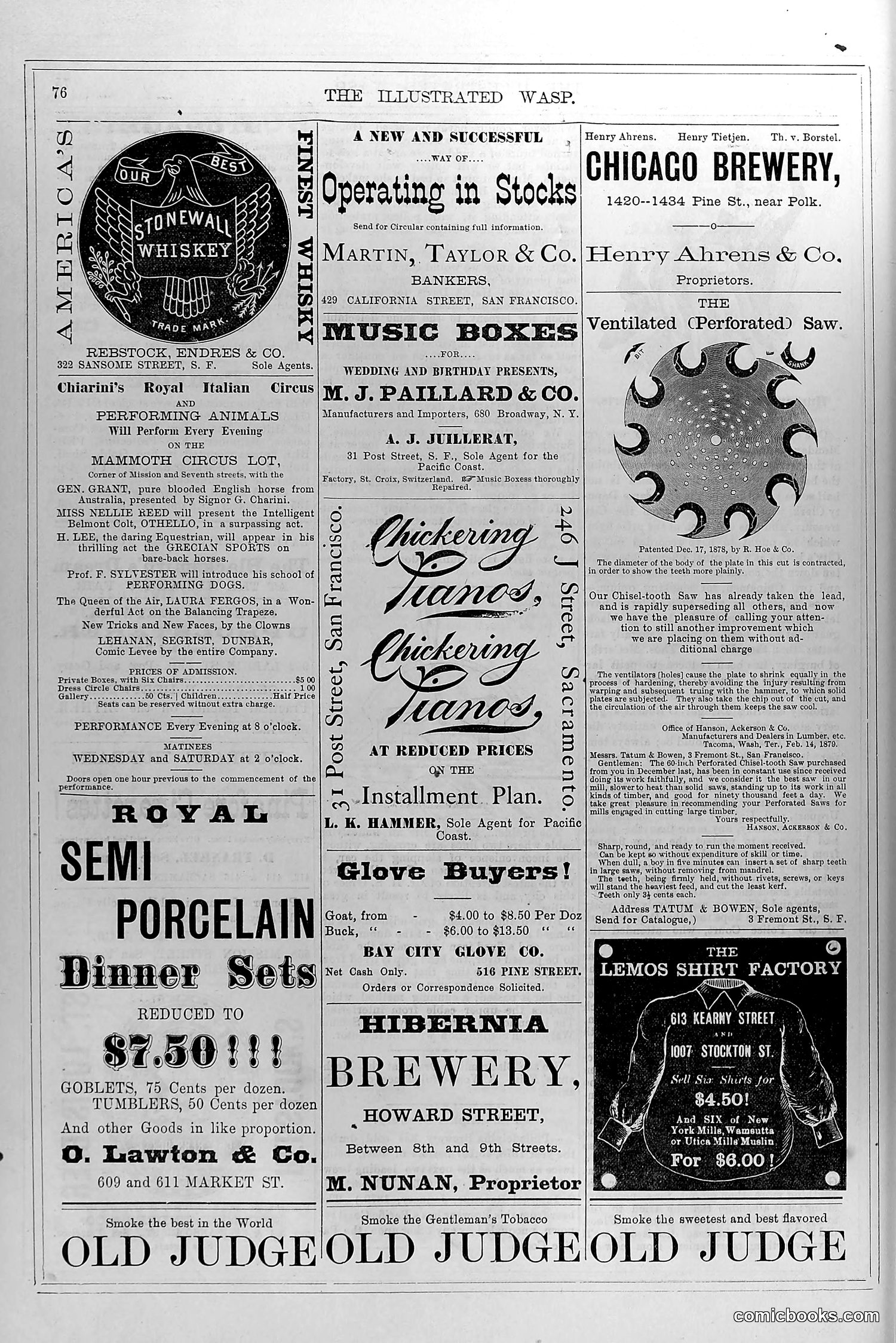
This page is primarily **advertising**, not political satire or editorial cartoons. The content consists of commercial notices for San Francisco-area businesses circa the 1870s-1880s, including: - A circus performance advertisement (Chiariaris' Royal Circus with performing animals) - Brewery and liquor advertisements (Stonewall Whiskey, Chicago Brewery, Hibernia Brewery) - Household goods (semi-porcelain dinner sets, perforated saws, gloves) - Entertainment venues and performers There are no political cartoons or satirical figures visible on this page. The only illustration is a decorative seal for Stonewall Whiskey and a product image of a ventilated saw. **This appears to be a typical advertising section from a 19th-century satirical magazine**, where revenue from local business ads supported the publication's editorial content.
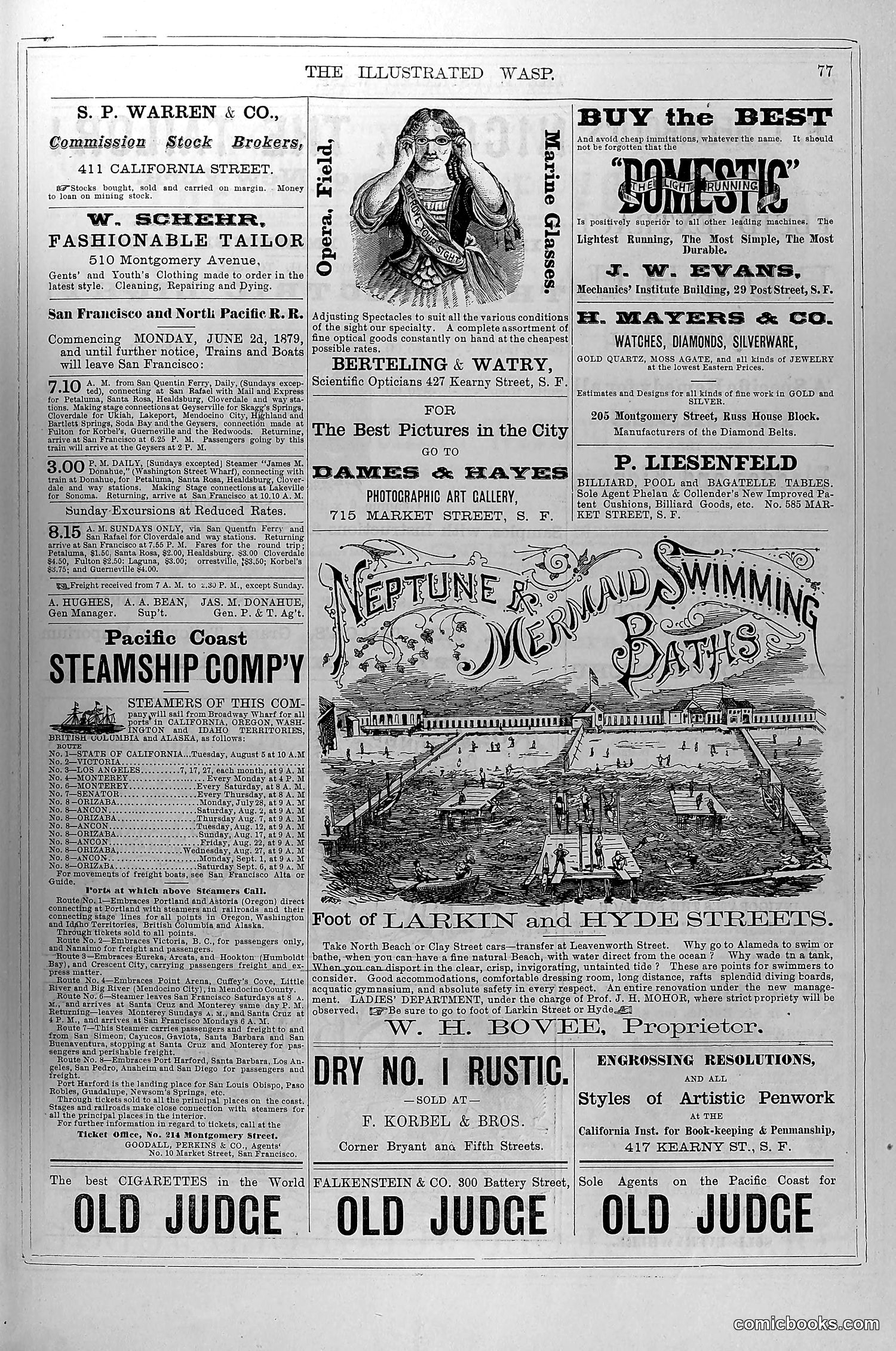
This is primarily an **advertising page** from *The Illustrated Wasp* (page 77), containing commercial notices rather than political satire or editorial cartoons. The main visual element is a large illustration for **Neptune Mermaid Swimming Baths** at Larkin and Hyde Streets in San Francisco—a public bathing facility. The image depicts a seaside swimming establishment with Victorian-era bathers. The remaining content consists entirely of **business advertisements**: steamship company schedules, tailor services, stock brokers, jewelry dealers, photographers, and notably, repeated ads for **Old Judge cigarettes** at the bottom. No political cartoon or satirical content is present on this page. It appears to be a standard revenue-generating advertising section typical of 19th-century periodicals.
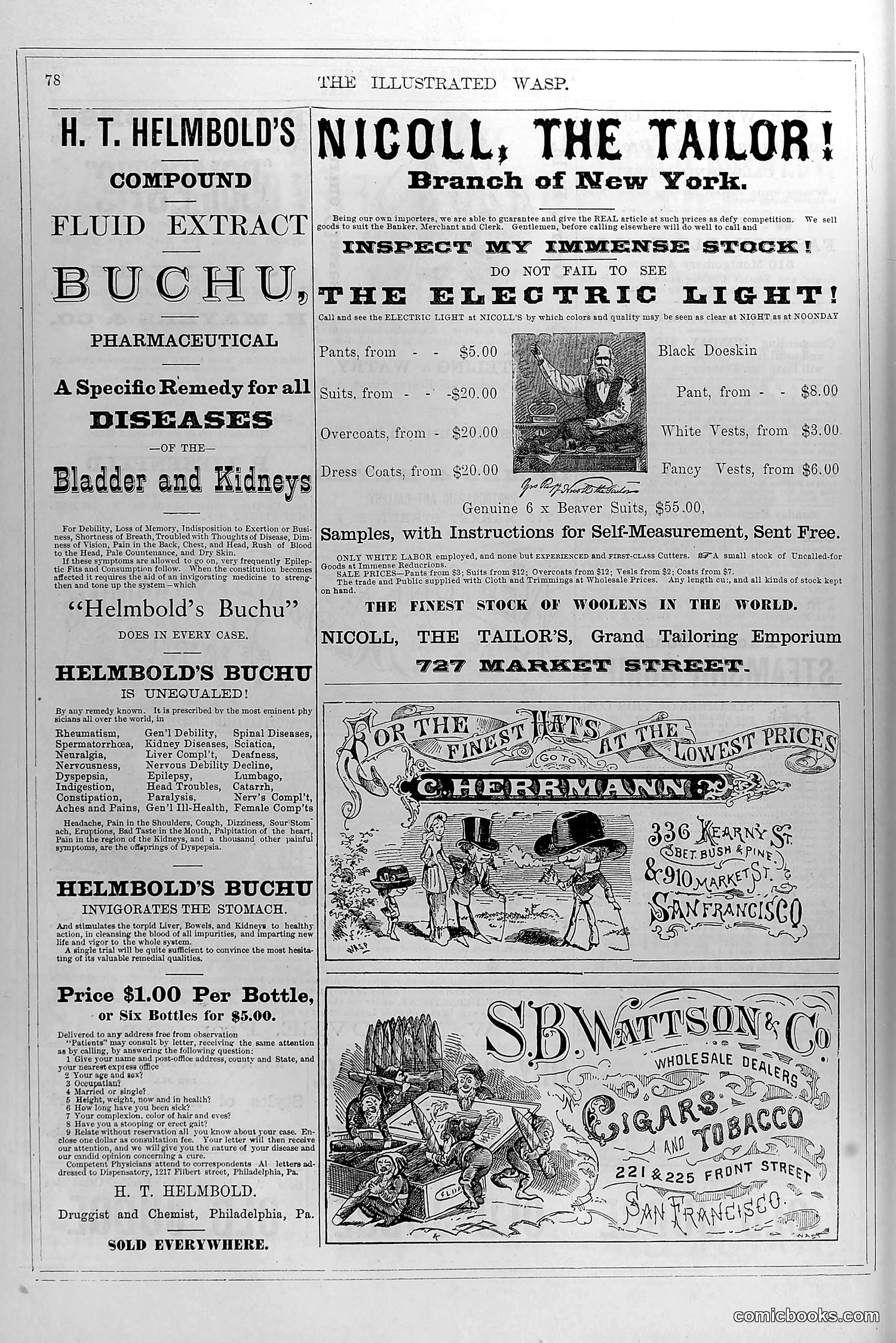
This page is primarily **advertising**, not satirical content. It contains multiple commercial advertisements from the 1800s, including: - **Helmbold's Buchu**: A patent medicine claiming to treat bladder and kidney diseases, sold for $1.00 per bottle - **Nicoll, The Tailor**: A San Francisco clothier advertising suits, pants, and overcoats with prices ranging $5-$55 - **C. Herrmann**: A hat retailer in San Francisco - **S.B. Wattson & Co**: Cigar and tobacco wholesaler The decorative illustrations accompanying these ads (men in top hats, cherub figures) are generic commercial artwork typical of the era, not political satire. There are no identifiable political figures or satirical commentary visible on this page—it represents The Wasp's revenue model through paid advertisements rather than its editorial content.
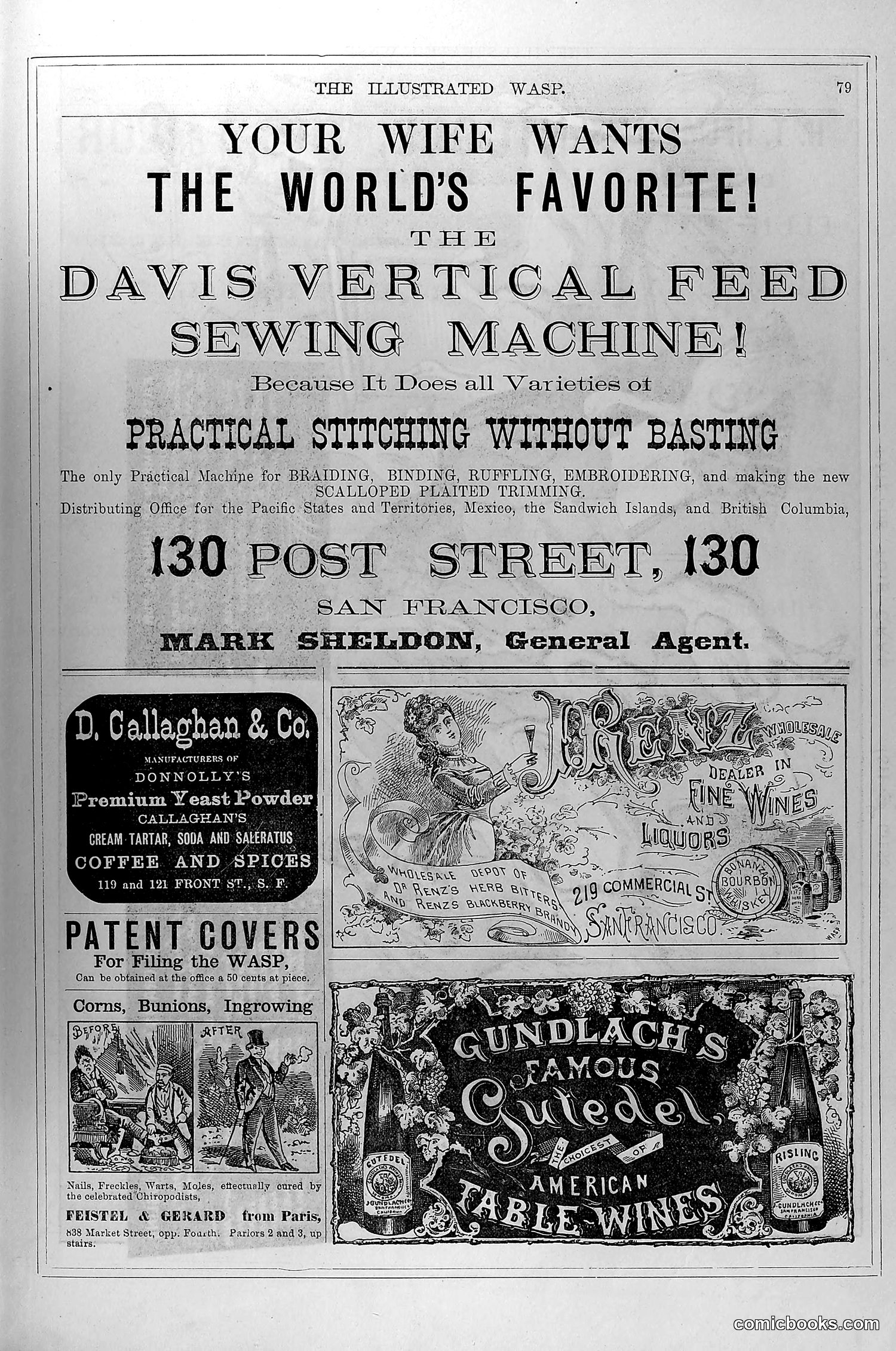
This is primarily an **advertising page** rather than satirical content. The page features commercial advertisements for products marketed to San Francisco residents, circa late 19th century: - **Davis Vertical Feed Sewing Machine** - the main advertisement, emphasizing it performs stitching without basting - **D. Callaghan & Co.** - yeast powder and spice merchant - **Patent Covers** - foot care products for corns and bunions - **Renz** - wine and liquor dealer - **Gundlach's Suldel** - American table wines - **Feistel & Gerard** - Parisian medical treatments The advertisements use period-typical marketing appeals (addressing wives, emphasizing quality, listing locations). There is no discernible political satire or cartoon commentary on this page—it functions as a revenue-generating advertising section within *The Wasp* magazine.
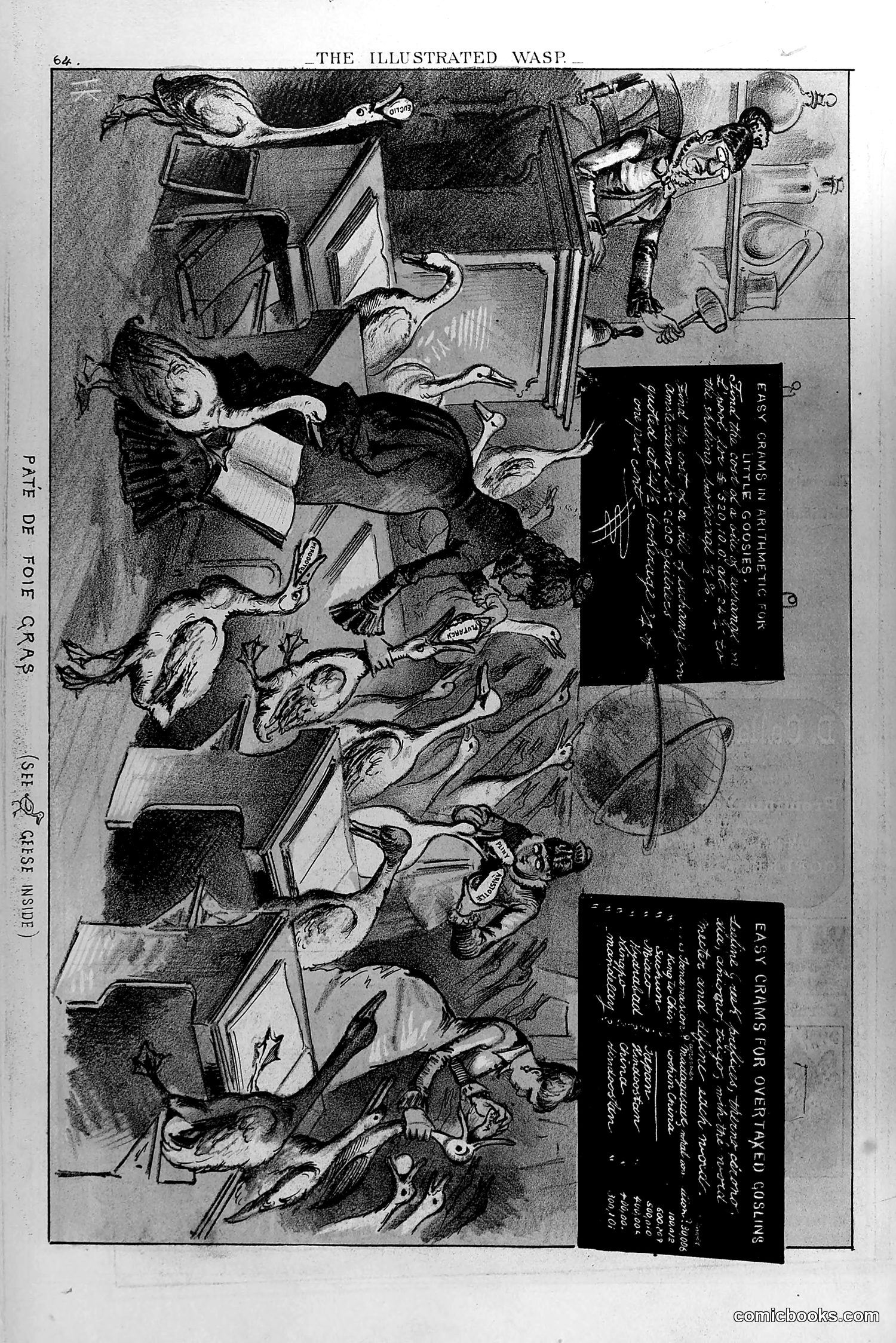
This page appears to be from a satirical magazine featuring multiple cartoon vignettes arranged vertically. The cartoons depict various figures in what seems to be a boarding house or communal living situation, with exaggerated caricatures showing people engaged in different activities around furniture and doorways. While the OCR text is largely illegible in the image provided, the visual style suggests social satire typical of 19th-century American humor magazines—likely mocking domestic life, social pretensions, or urban living conditions. The exaggerated facial features and physical comedy are characteristic of period political and social satire. Without clearer text, specific identifications of the figures or particular social references remain unclear.
I can see this is a test page or calibration sheet from *The Wasp* magazine, rather than an actual cartoon or editorial content. The page displays a grayscale reference chart with various gray-toned squares arranged in rows on the left side, and a measurement ruler marked with numbers 6-11 on the right side. At the bottom is a standard measurement scale. This appears to be used for photographic or printing quality control and color/tone calibration—ensuring accurate reproduction of images and text in the publication. No satirical content, political figures, or editorial commentary is present on this particular page.