
A complete issue · 18 pages · 1879
The Wasp — August 16, 1879
I can see this page contains a standard ruler/measurement scale (Oregon Rule Co., U.S.A.) and a grayscale color reference chart with various shades from light to dark. These appear to be technical tools used in the archival photography or reproduction process for documenting historical materials. However, I cannot identify any actual cartoon content, satirical illustrations, or political commentary visible on this page. The image shows what appears to be a documentation or calibration page rather than editorial content from The Wasp magazine itself. Without visible cartoon imagery, caricatures, or satirical content to analyze, I cannot provide the historical and political context you're requesting. This may be a blank page, a separator page, or a technical reference sheet rather than a content page from the publication.
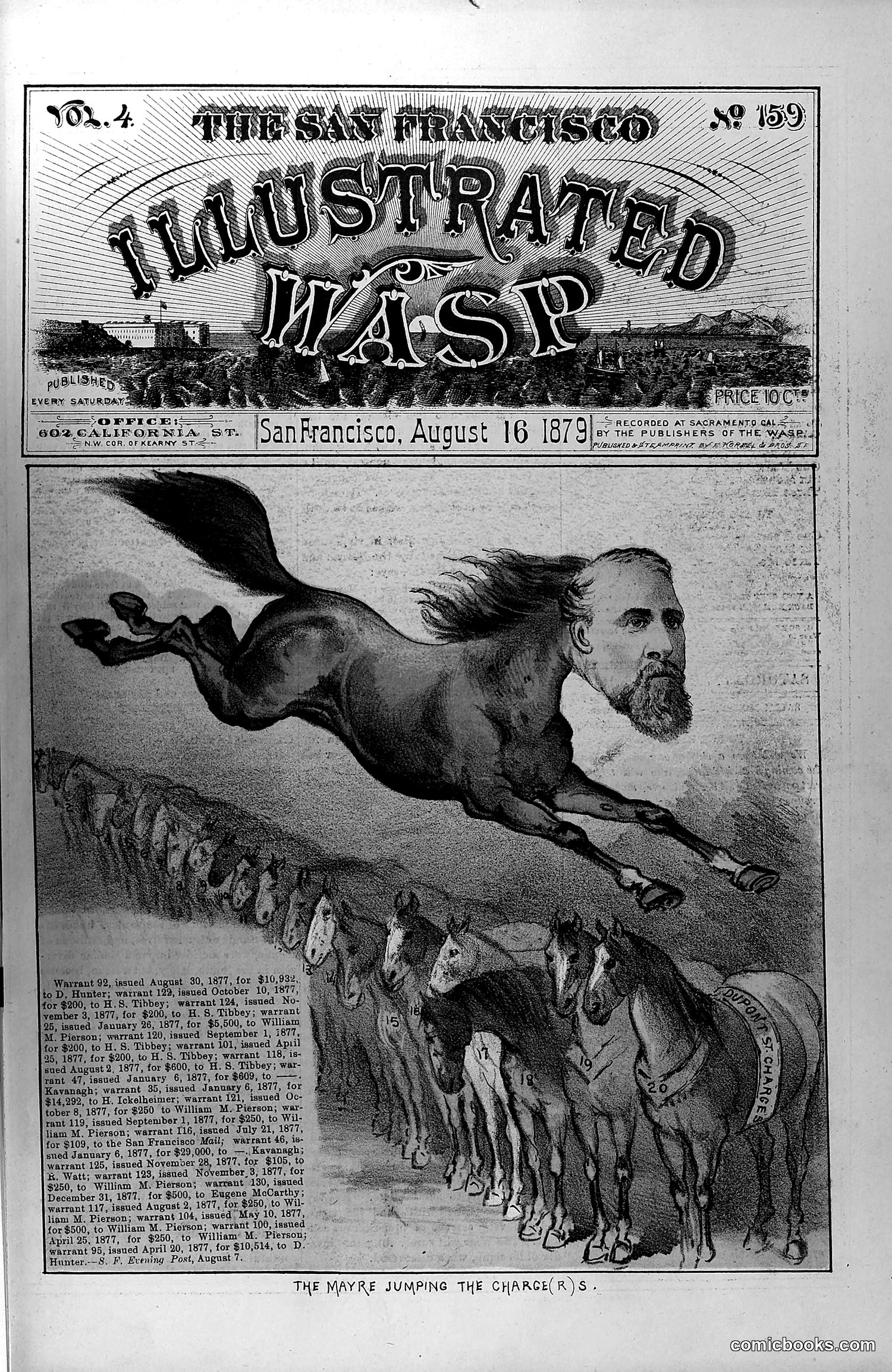
This satirical cartoon depicts a bearded man with a horse's body leaping over a cliff while being chased by a line of figures below. The title "The Mayfe Jumping the Charge" suggests this is political satire, likely referencing a public official (possibly a mayor or similar figure) fleeing from legal consequences or criminal charges. The extensive list of warrant numbers and dates below the image indicates multiple legal charges or indictments. The cartoon uses the fantastical image of a man-horse hybrid escaping as metaphor for someone attempting to evade justice or accountability. Published in *The Wasp* (August 16, 1879), this reflects the magazine's satirical focus on local San Francisco corruption and legal malfeasance during the Gilded Age.
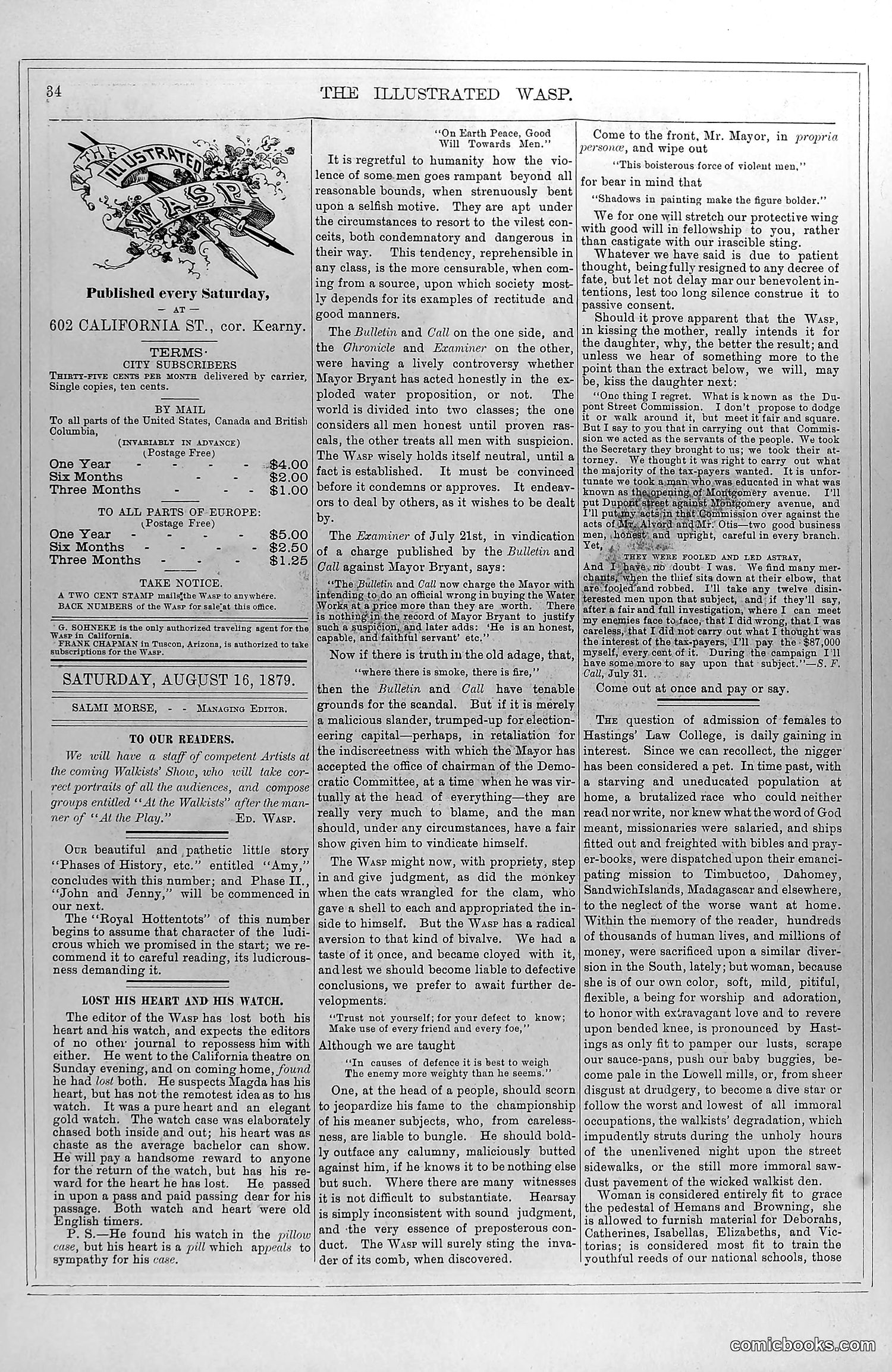
This page is primarily **masthead, subscription information, and editorial content** rather than satirical cartoons. The only illustration is the magazine's logo at top left. The editorial addresses **two local San Francisco controversies**: a dispute between the *Chronicle* and *Examiner* newspapers over water proposition claims, and criticism of Mayor Bryant's handling of a Democratic Committee chairmanship appointment. The editor also discusses admitting females to Hastings Law College and critiques Hastings' promotional mission to lumber towns and Pacific islands, which the *Wasp* considers hypocritical given the neglect of California's own poor. A brief item reports the editor's lost heart and watch, appealing for their return. The tone is biting social commentary on local politics and institutional pretension.
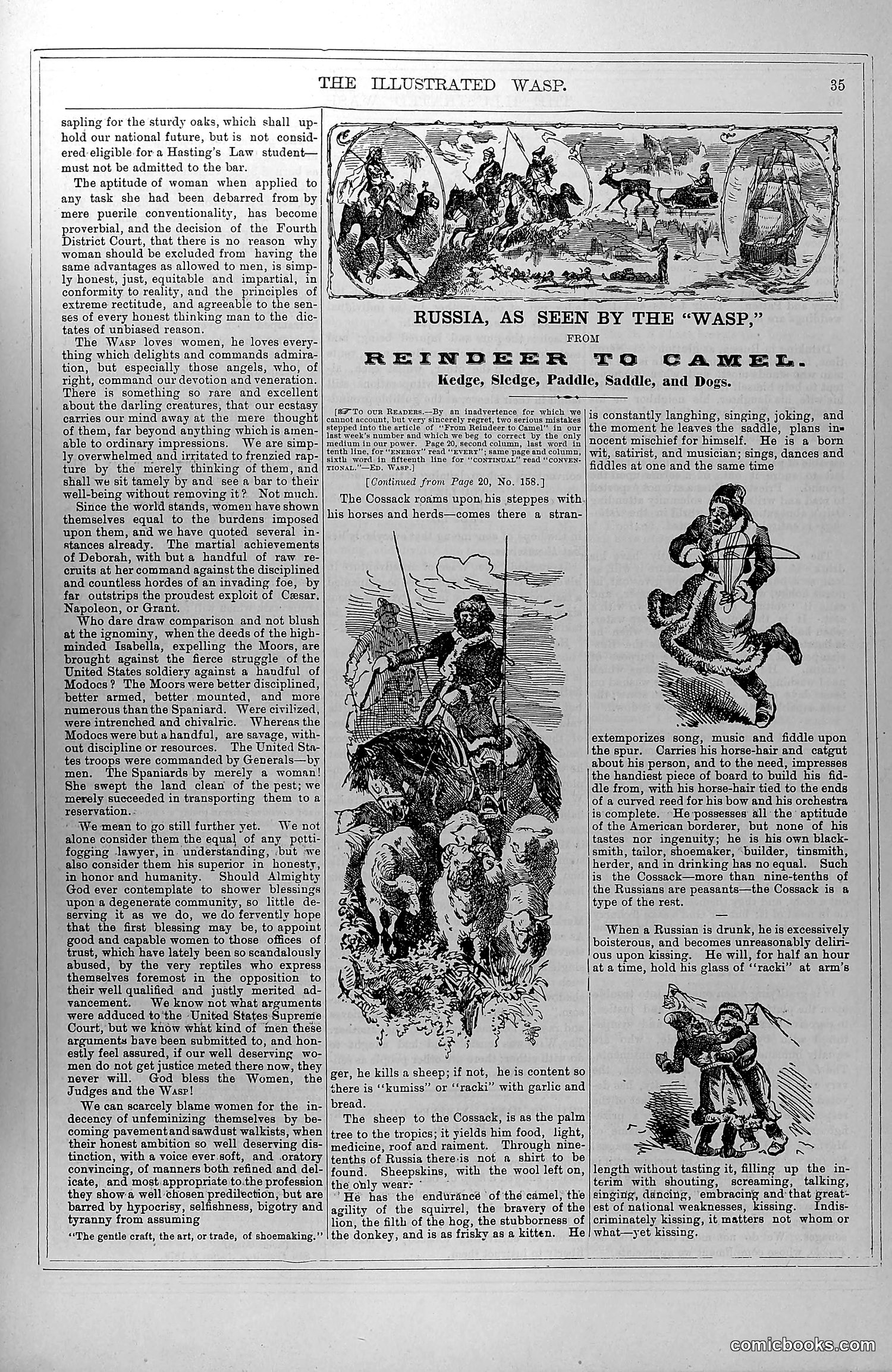
This page satirizes Russian society through the lens of Cossack culture. The text and illustrations depict Cossacks as crude, violent, and uncivilized—portraying them as savage warriors on horseback who embody Russian barbarism. The satire contrasts Western (American) civilization with Russian "savagery," emphasizing the Cossack's brutality, drunkenness, and primitive lifestyle. The left column's preceding argument about women's rights frames this: the text suggests that if barbarous societies like Russia exclude women from advancement, surely enlightened America should grant women equal status. The Cossack illustrations serve as a foil—representing everything civilized society should reject. This reflects 19th-century American attitudes depicting Russia as backward and threatening, while positioning the U.S. as culturally superior.
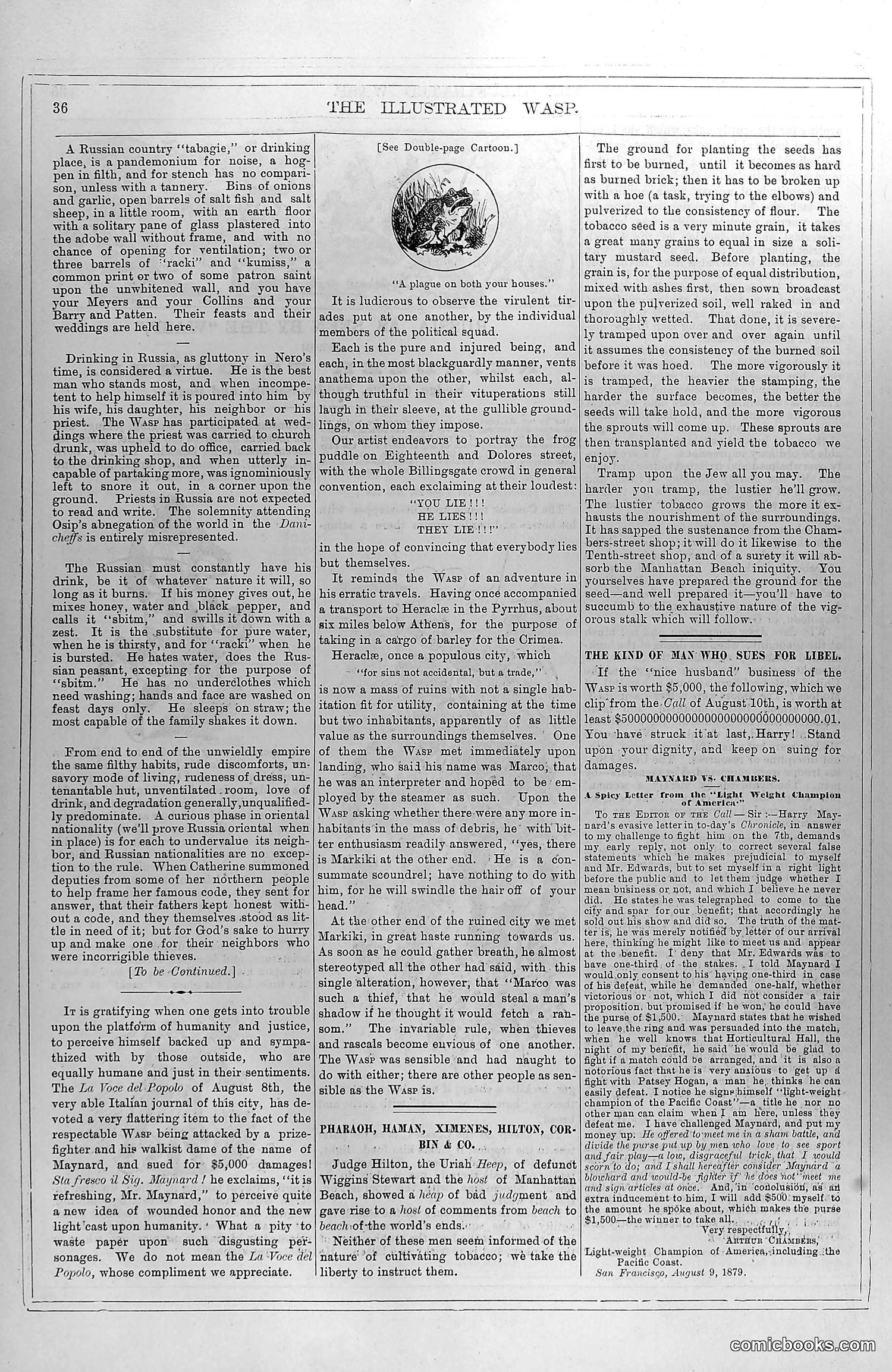
This page primarily contains **satirical text articles** rather than political cartoons. The main content includes: 1. **Russian drinking culture satire** - mocking Russian habits and stereotypes about excessive vodka consumption and low living standards. 2. **A small circular cartoon** labeled "A plague on both your houses" - appears to reference a dispute, possibly related to a contentious legal or social issue. 3. **A libel lawsuit section** - discussing a "nice husband" suing for damages over an article in the *Call of August 10th*, worth $30,000. This appears to satirize frivolous lawsuits. 4. **"Maynard vs. Chambers"** - covering a boxing/sporting dispute involving the "Light Weight Champion of America," suggesting satire of athletic disputes and monetary claims. The page emphasizes satirizing Russian stereotypes, frivolous legal action, and sporting controversies typical of 1870s-1880s American satire.
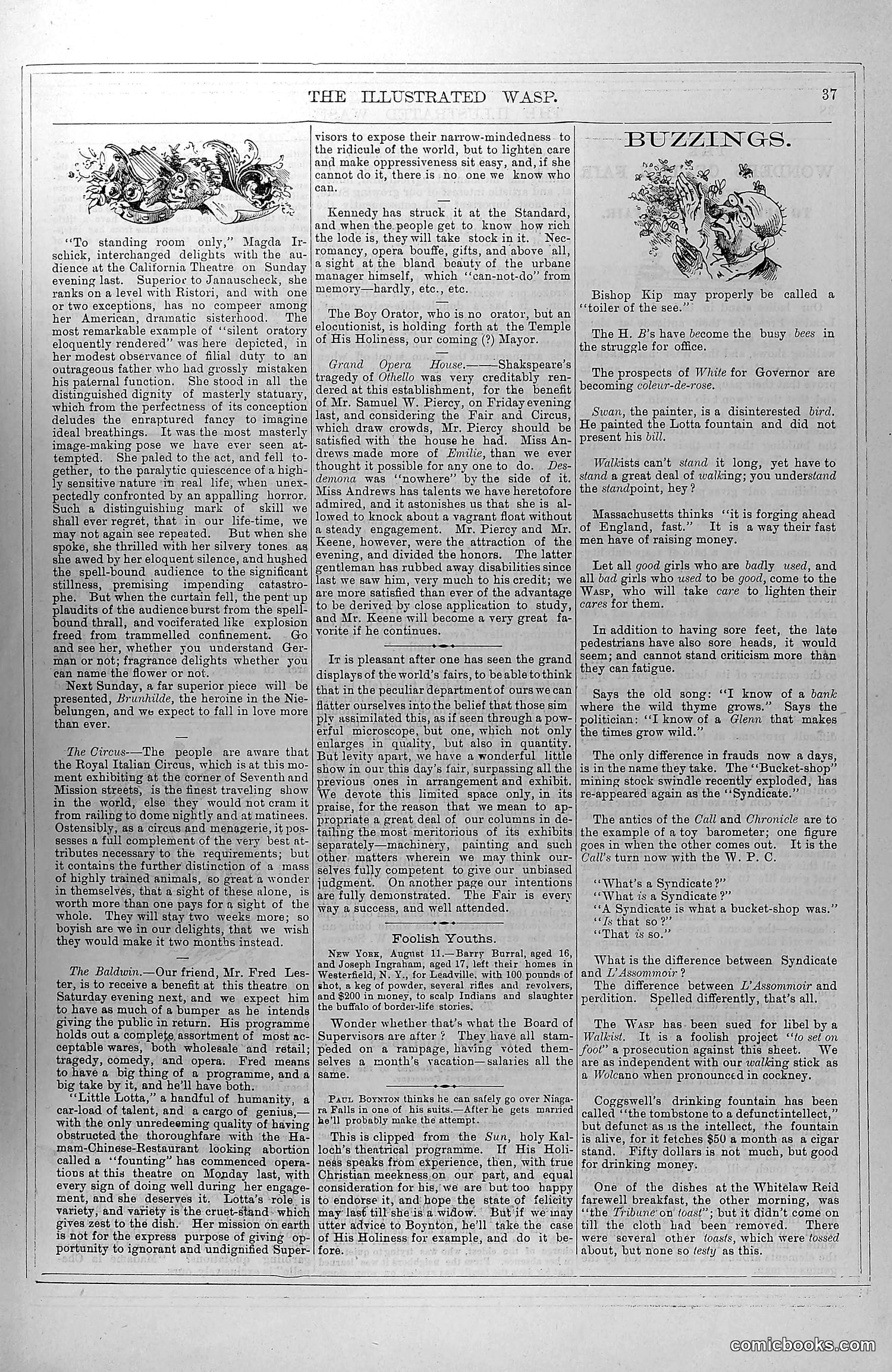
This page contains primarily **text content rather than political cartoons**—it's a "Buzzings" gossip/commentary column typical of satirical magazines. The visible content includes theatrical and society commentary, notably: - Criticism of a performance at the California Theatre involving actress Magda Irschick - Commentary on Shakespeare's *Othello* and a production by Samuel Piercy - References to San Francisco's Royal Italian Circus and various entertainments The humor relies on **social satire and theatrical criticism** rather than visual caricature. The magazine critiques performances, society figures' pretensions, and public events through witty written commentary. Without clear visual caricatures visible in this section, the satire operates through pointed remarks about cultural figures and entertainment rather than through pictorial exaggeration or political cartooning.
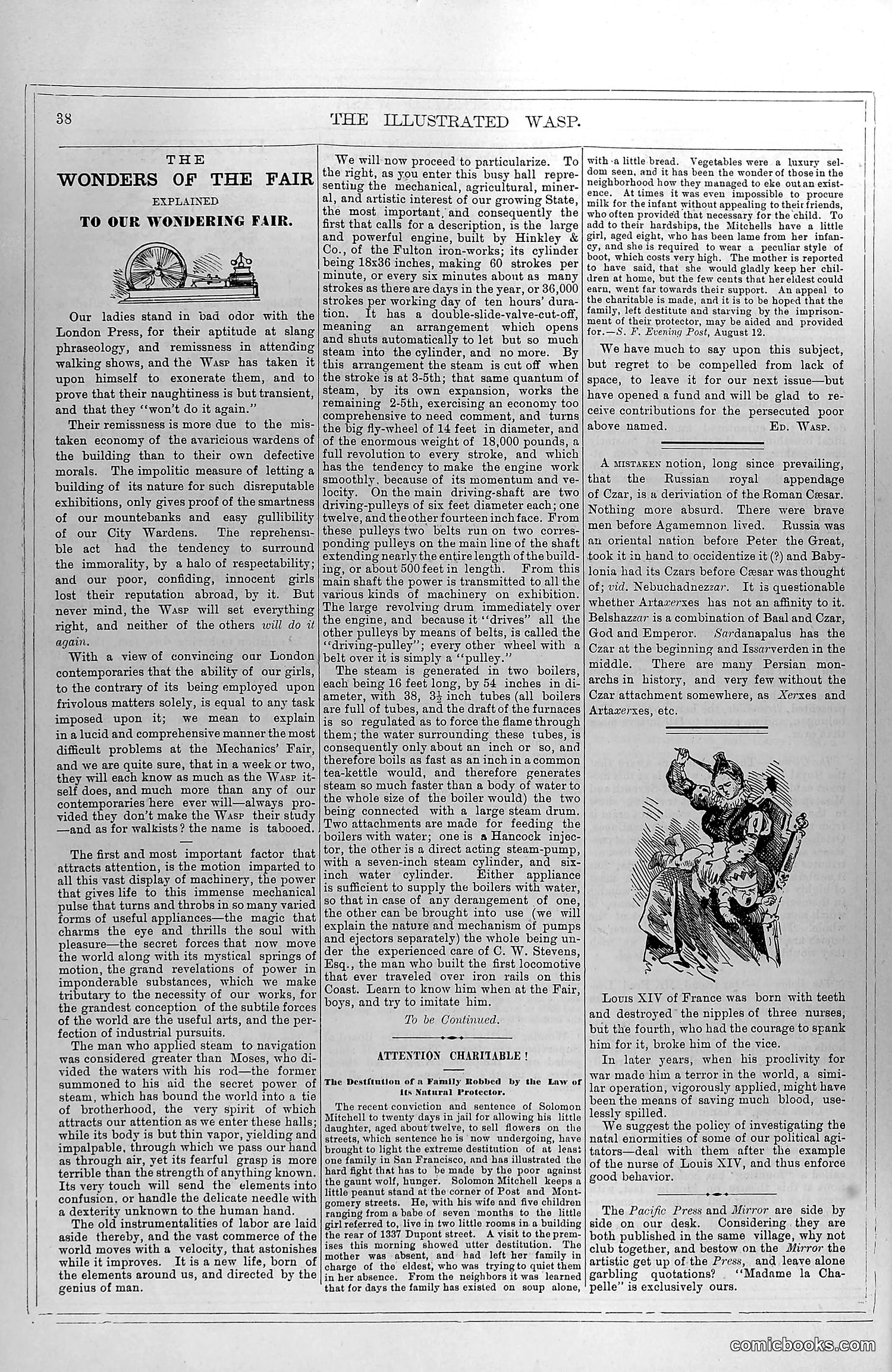
This page contains two distinct sections: **Main Article**: "The Wonders of the Fair Explained" discusses machinery at what appears to be a major exhibition (likely the 1876 Centennial Fair, based on references). The text describes steam engines, pumps, and mechanical innovations in accessible terms for fair visitors unfamiliar with industrial technology. **Cartoon/Illustration**: Shows what appears to be complex mechanical machinery with gears and moving parts—a visual representation of the industrial equipment being discussed. **Satirical Notice**: A separate article titled "Attention Charitable!" criticizes a family (the Mitchells) who sold their young daughter to support themselves, using this as commentary on poverty and moral degradation in society. The page primarily celebrates industrial progress while simultaneously critiquing social problems, typical of Wasp's satirical approach to contemporary American issues.
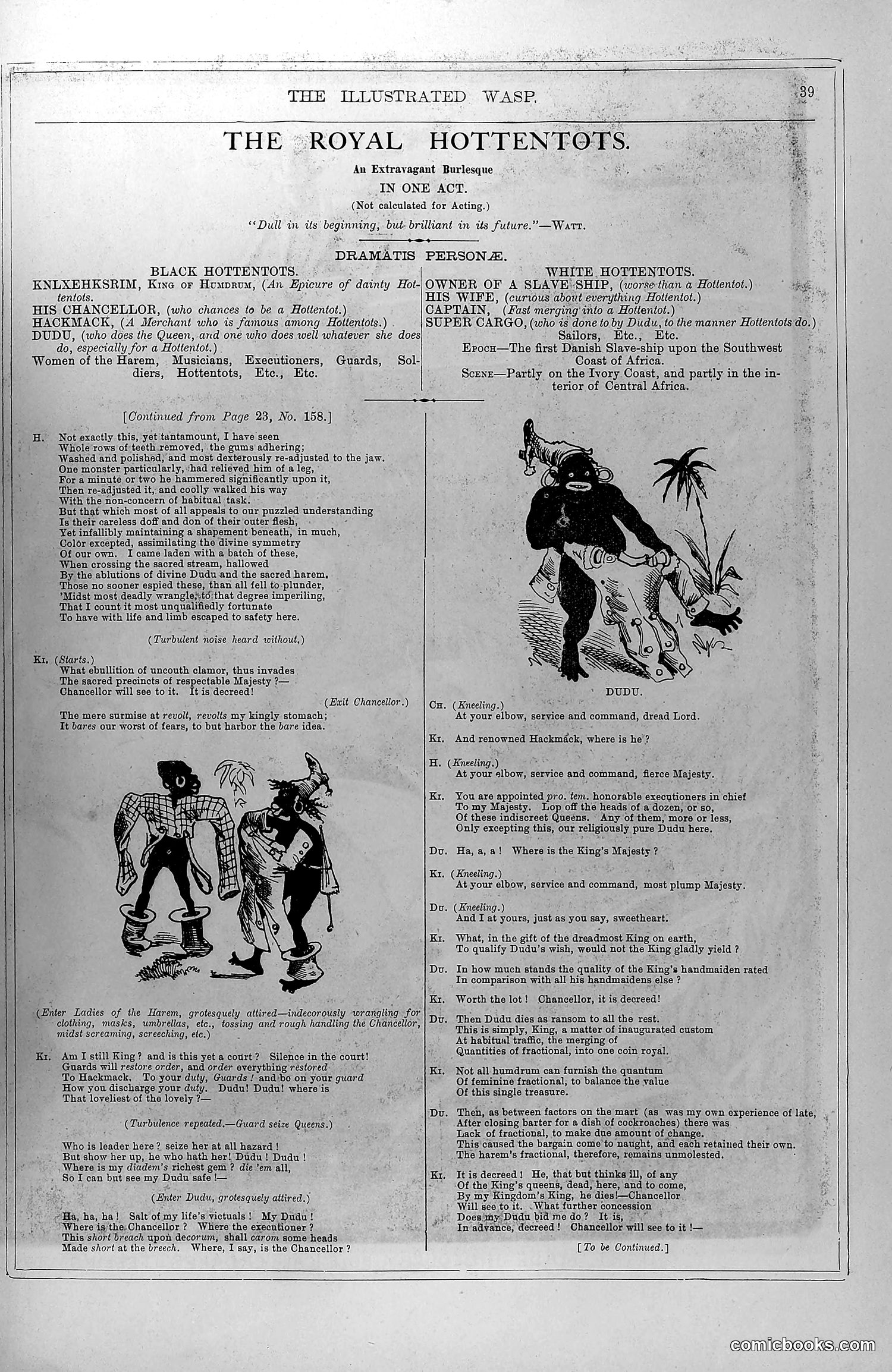
This is a burlesque play script mocking Victorian society by inverting racial hierarchies. The title character "Dudi" appears in the illustrations as a caricatured Black African figure, while the "White Hottentots" are European colonists portrayed as the "savage" or uncivilized ones. The satire works by swapping expected roles: enslaved and colonized peoples become nobility, while European characters display ignorance and poor behavior. References to "Hottentots" (a derogatory historical term for Khoisan peoples) and the slave trade context suggest the piece critiques European colonial racism and slavery by absurdly reversing who civilization deems "civilized." The humor relies on uncomfortable inversion—making white audiences the butt of the joke through exaggerated stereotypes typically applied to colonized peoples.
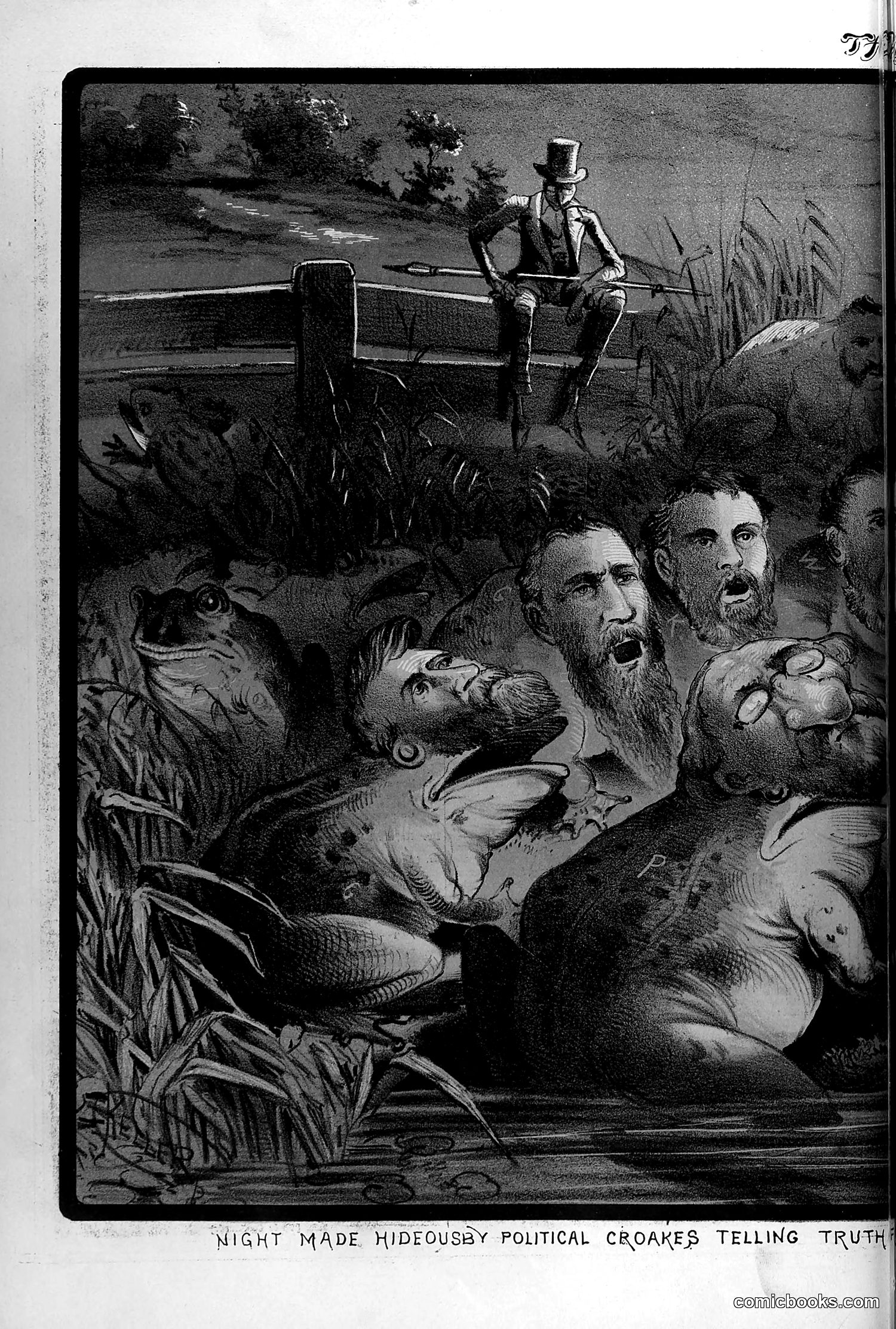
This satirical cartoon from *The Wasp* magazine depicts aquatic creatures—frogs and other amphibians—gathered in water at night, with the caption "NIGHT MADE HIDEOUSLY POLITICAL CROAKS TELLING TRUTH." The image uses anthropomorphic animals (giving them human facial features and expressions) to satirize political figures or groups engaged in public discourse. The "croaks telling truth" suggests these figures are making inflammatory or harsh political statements under cover of darkness—implying secretive or underhanded political activity. The gentleman fisherman perched on a fence above observes this nocturnal scene, possibly representing the public or press witnessing political machinations. The satire likely critiques specific politicians or political movements of the era for their aggressive rhetoric or behind-the-scenes dealings, though without additional context, the precise political targets remain unclear.
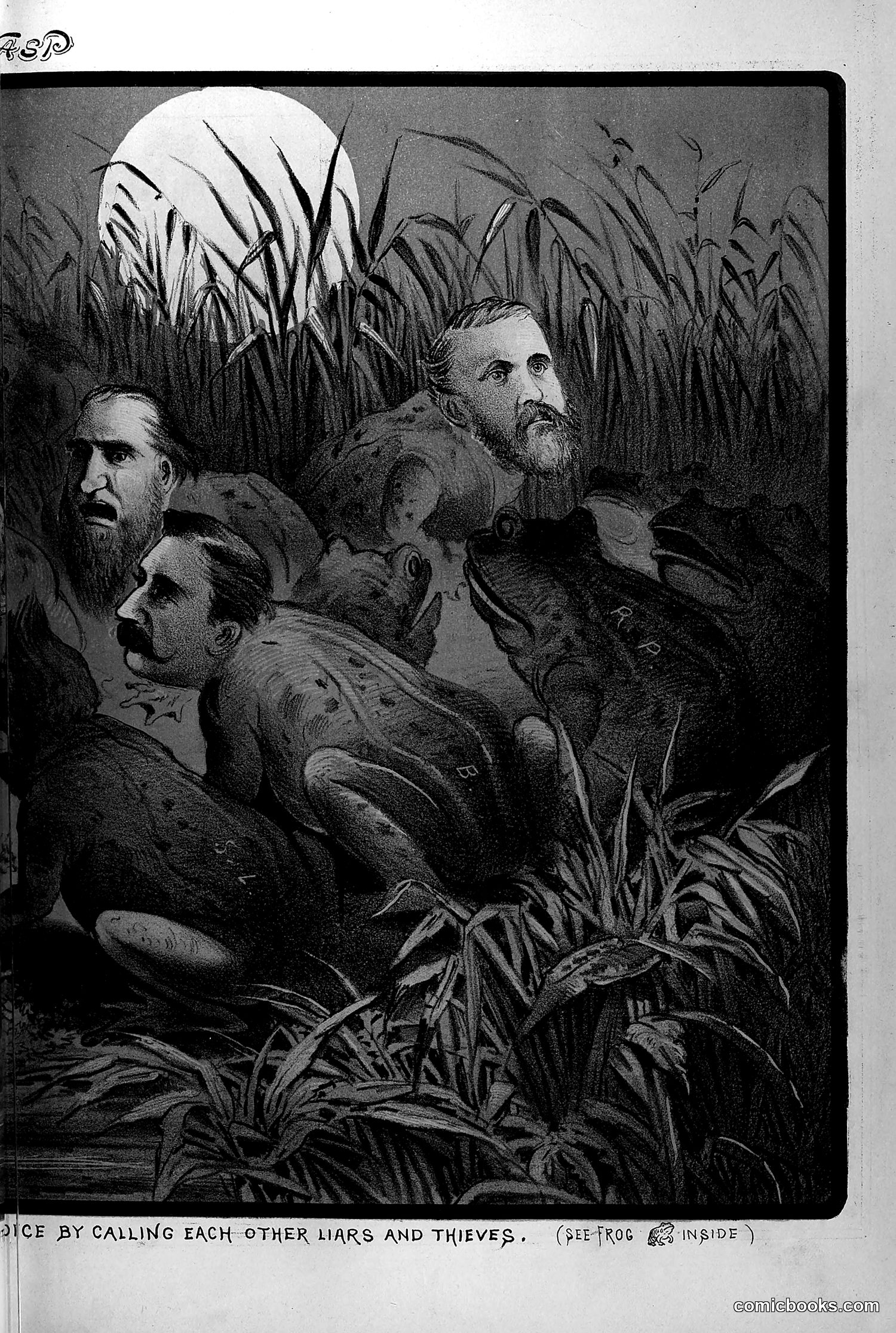
This political cartoon from *The Wasp* satirizes corrupt politicians and businessmen through the metaphor of "liars and thieves." The image shows four men huddled together in a cornfield beneath a large moon, depicted in a conspiratorial manner. Their body language—leaning close, looking furtive—suggests secretive dealings. The caption's reference to "calling each other liars and thieves" indicates the cartoon mocks how corrupt figures engage in mutual accusation while all participating in dishonest schemes. The rural setting may reference agricultural or land-related corruption common in 19th-century American politics. Without identifying specific individuals, the cartoon's intent appears to critique widespread corruption among political and business elites, portraying them as equally culpable despite their public accusations against one another.
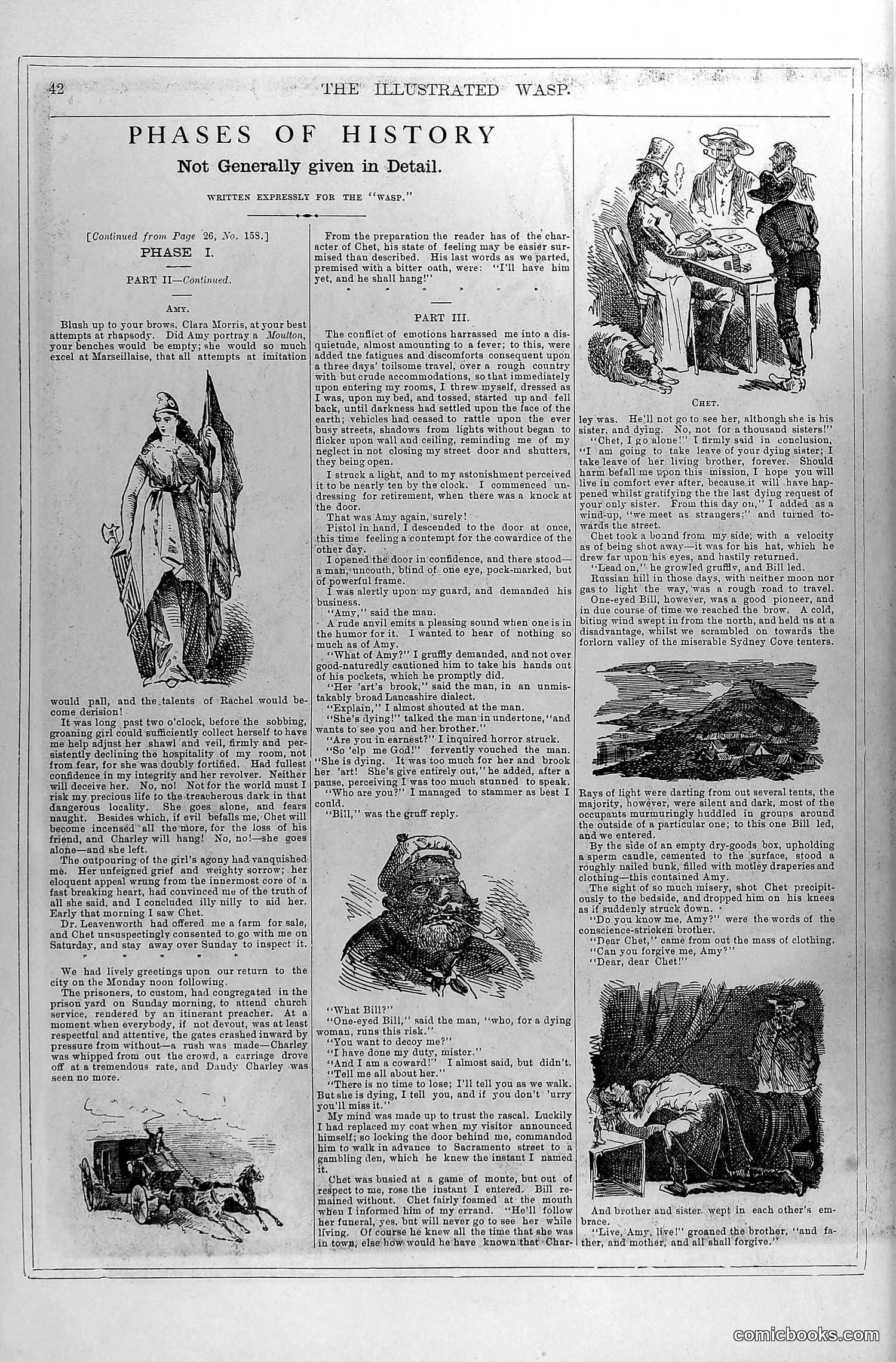
This page presents a serialized narrative story titled "Phases of History: Not Generally given in Detail," illustrated with engravings. The main content is **not political satire** but rather a dramatic melodrama about characters named Chet, Amy, and Bill. The plot involves Chet's dying sister Amy requesting he care for her living brother, Bill—apparently impoverished or troubled. The narrative focuses on class struggle and family obligation: Bill becomes Chet's burden, eventually requiring Chet to take leave from his dying sister to care for Bill's welfare. The illustrations depict various scenes of distress and poverty—a man in rags, a carriage, figures in emotional turmoil—supporting this sentimental narrative about duty, sacrifice, and social hardship rather than political commentary.
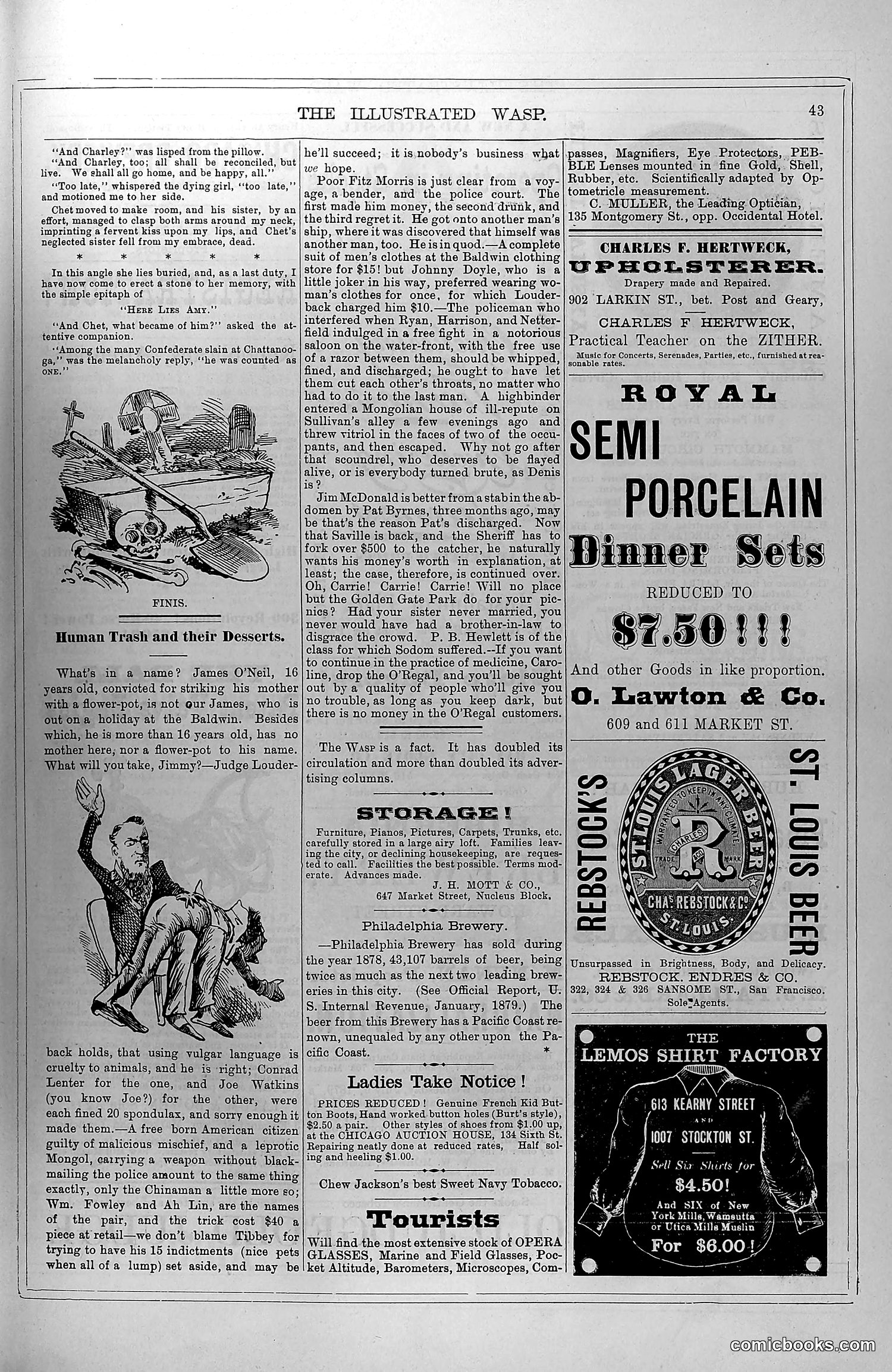
This page is primarily **advertisements** interspersed with brief satirical pieces. The main illustration titled "PINIS" shows a figure in what appears to be a wheelbarrow or cart, though its exact satirical meaning is unclear without additional context. The satirical article "Human Trash and their Desserts" mocks a man named James O'Neil, a 10-year-old "conductor" managing a flower pot at the Baldwin Hotel. Another piece ridicules "Conrad Lander" for cruel treatment of animals and his boastful, vulgar language—presenting him as a disreputable character unworthy of respect. The bulk of the page features commercial advertisements for furniture storage, a brewery, porcelain dinnerware, shoes, and other goods typical of 1870s San Francisco commerce.
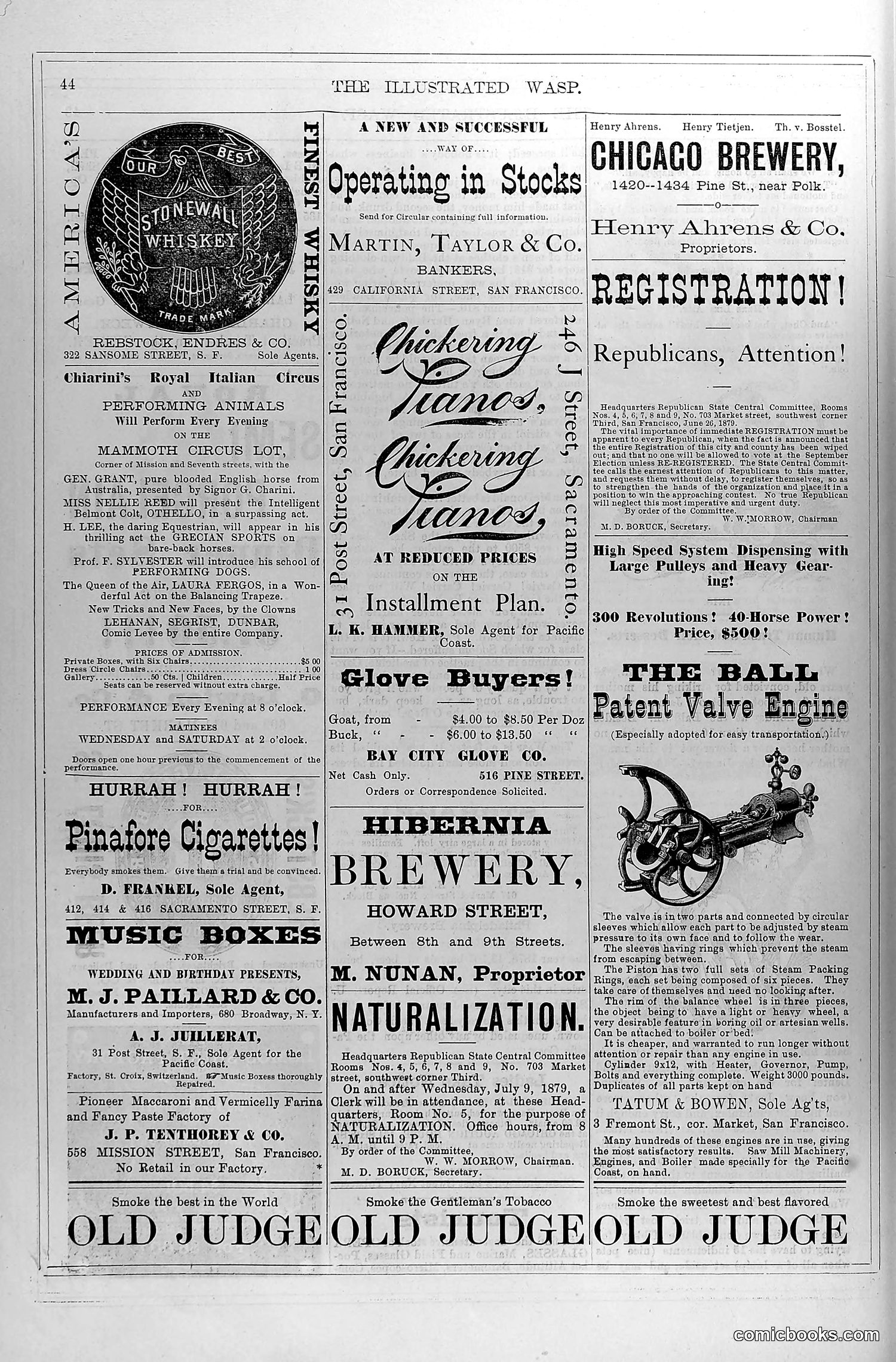
This is primarily an **advertising page** from *The Wasp* magazine (page 44), containing commercial advertisements rather than political cartoons or satirical content. The page features various business advertisements including: - Stonewall Whiskey (with a trade mark seal) - Chiarini's Royal Italian Circus (performing animals) - Pinafore Cigarettes - Chicago Brewery - Music boxes - A Patent Valve Engine (with technical diagram) - Hibernia Brewery - Naturalization services The only potentially satirical element is a Republican Party registration notice ("Republicans, Attention!"), which appears straightforward rather than cartoonish in tone. The page represents typical late 19th-century magazine advertising mixed with civic announcements, rather than the satirical illustrations *The Wasp* was known for.
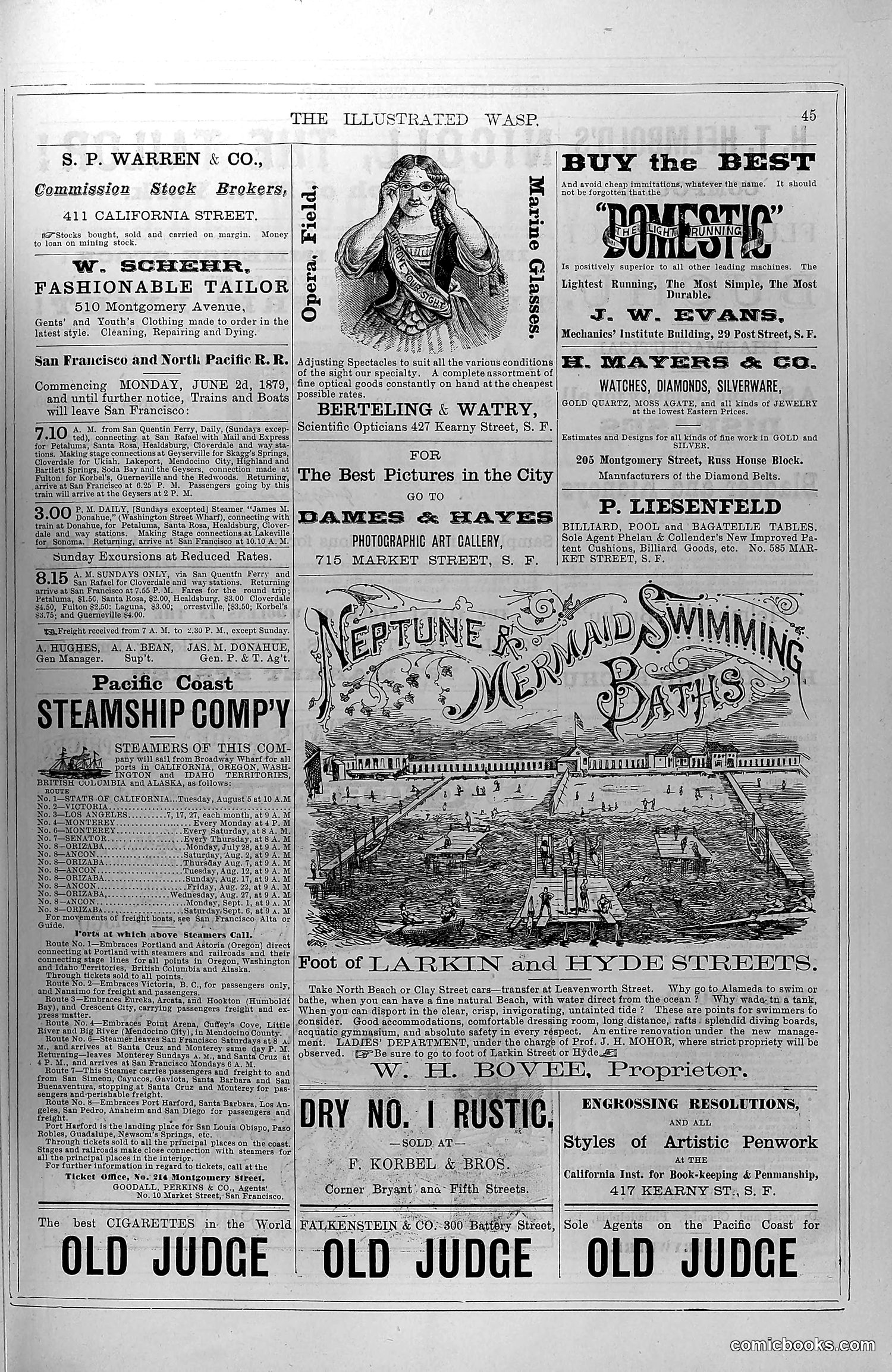
This page is primarily **advertising and commercial content** rather than political satire. The dominant feature is a large illustrated advertisement for "Neptune Mermaid Swimming Baths" at the foot of Larkin and Hyde Streets in San Francisco, showing a Victorian-era public bathing facility with swimmers. The page contains numerous business advertisements for San Francisco services: steamship companies, tailors, photographers, jewelry makers, and various retailers. There is one small illustrated mascot (a woman's face) at the top, but it appears to be decorative branding for "Domestic" sewing machines rather than political commentary. The content reflects late 19th-century San Francisco commerce rather than satirical editorial content.
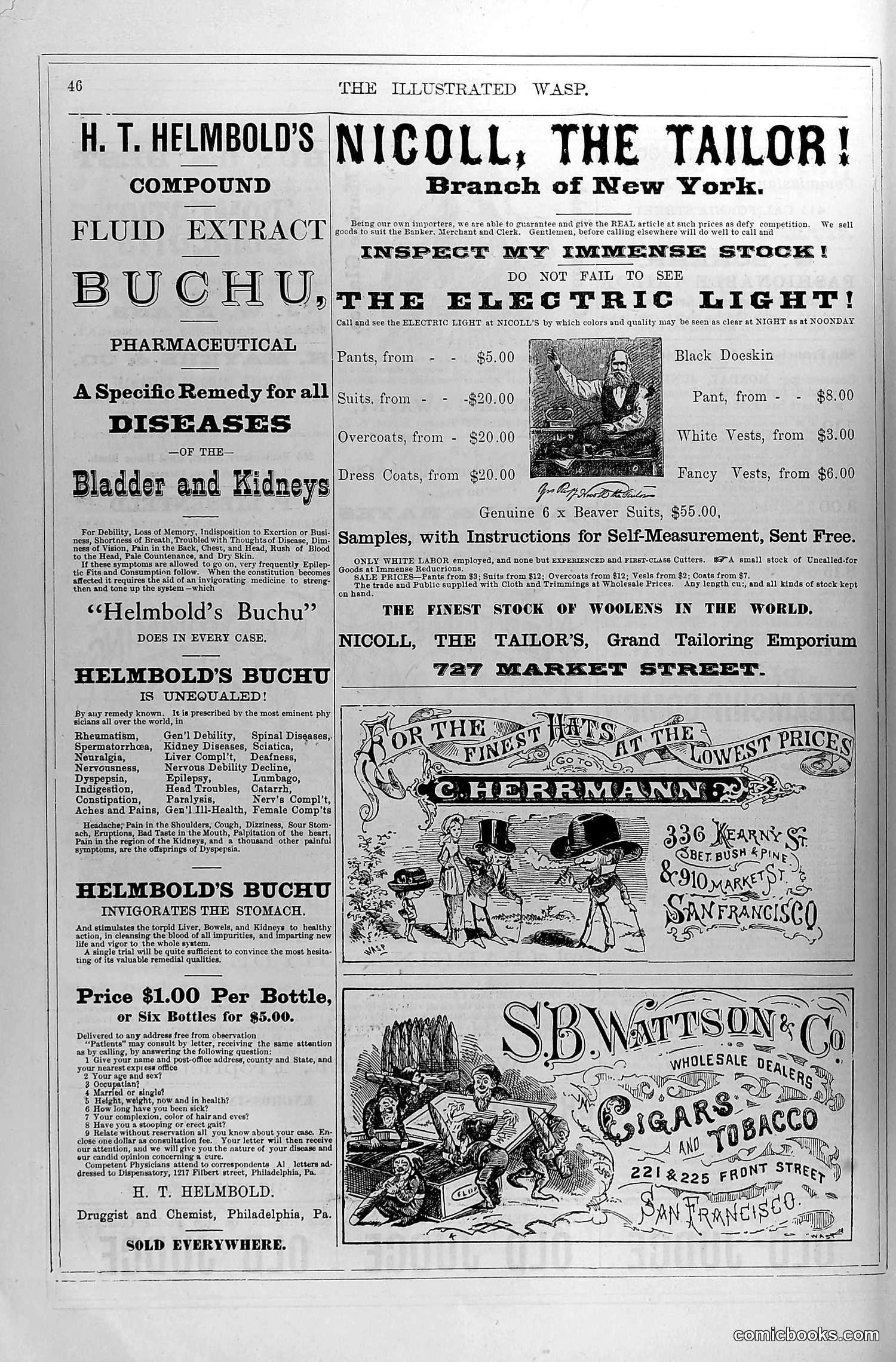
This page is primarily **advertising content**, not satirical cartoons. It contains commercial advertisements for: - **Helmhold's Buchu** (a patent medicine claiming to cure bladder and kidney diseases) - **Nicoll, the Tailor** (a San Francisco clothier advertising suits, pants, and coats with prices) - **Cherrmann** (a hat shop in San Francisco) - **S.B. Wattson & Co.** (a wholesale cigar and tobacco dealer) The page includes product illustrations and pricing information typical of 19th-century magazine advertising. While *The Wasp* was known for satire, this particular page serves as revenue-generating advertising rather than political or social commentary. The small decorative illustrations accompanying the ads are commercial graphics rather than satirical cartoons.
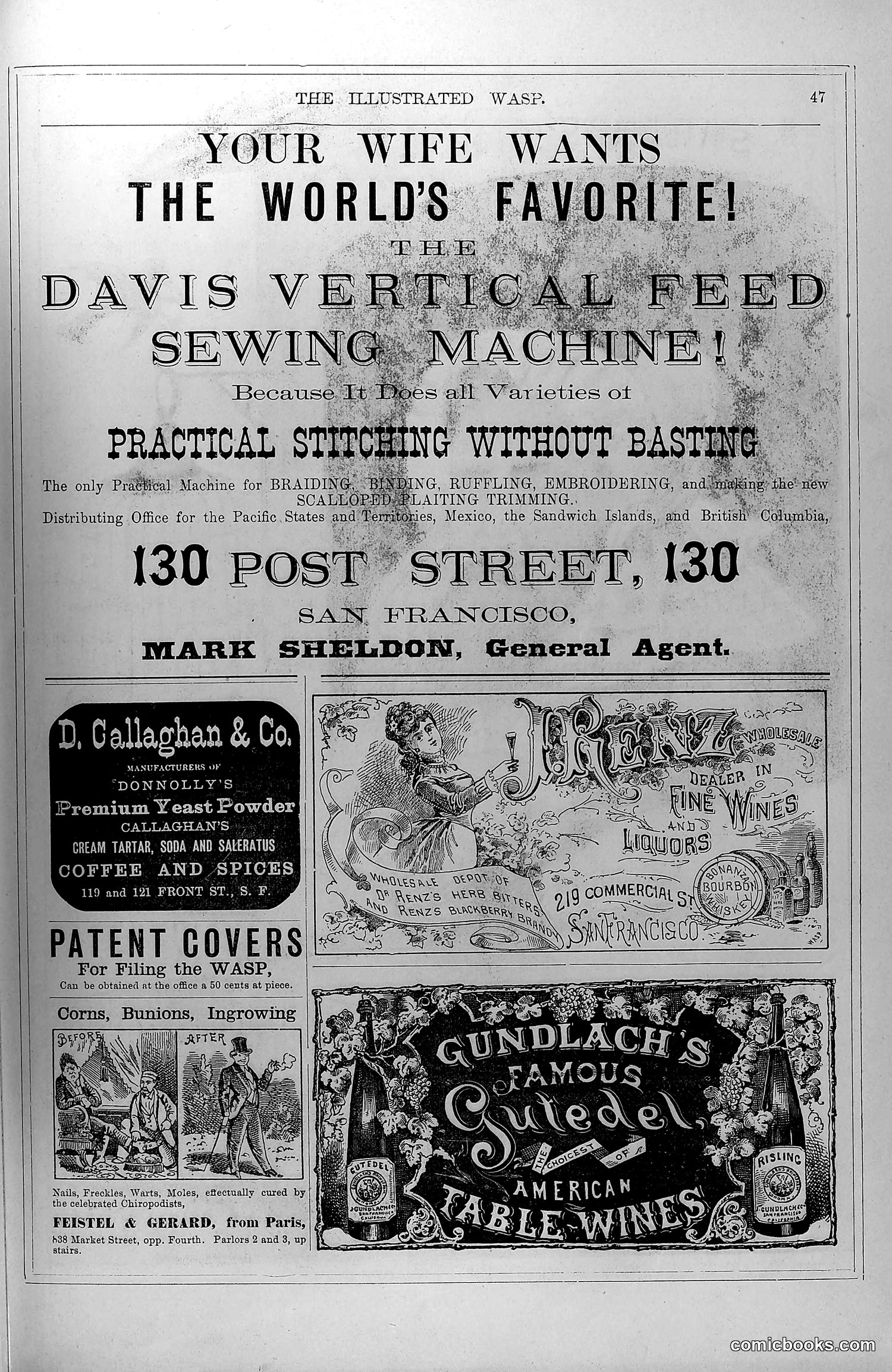
This page is primarily **advertising content**, not satire or political commentary. It features multiple commercial advertisements typical of late 19th-century American publications. The dominant advertisement promotes the **Davis Vertical Feed Sewing Machine**, marketed directly to wives with the appeal that it performs "practical stitching without basting." The copy emphasizes its practical applications for domestic sewing. Below are advertisements for: - **D. Callaghan & Co.**: yeast powder and spices - **Hertz**: wine and liquor merchant - **Gundlach's Sauerkraut**: American table wines - **Feistel & Gerard**: chiropodist services (treating corns, bunions, warts) - **Patent covers** for filing The Wasp magazine The page reflects period consumer culture targeting domestic life and personal health rather than containing political satire.
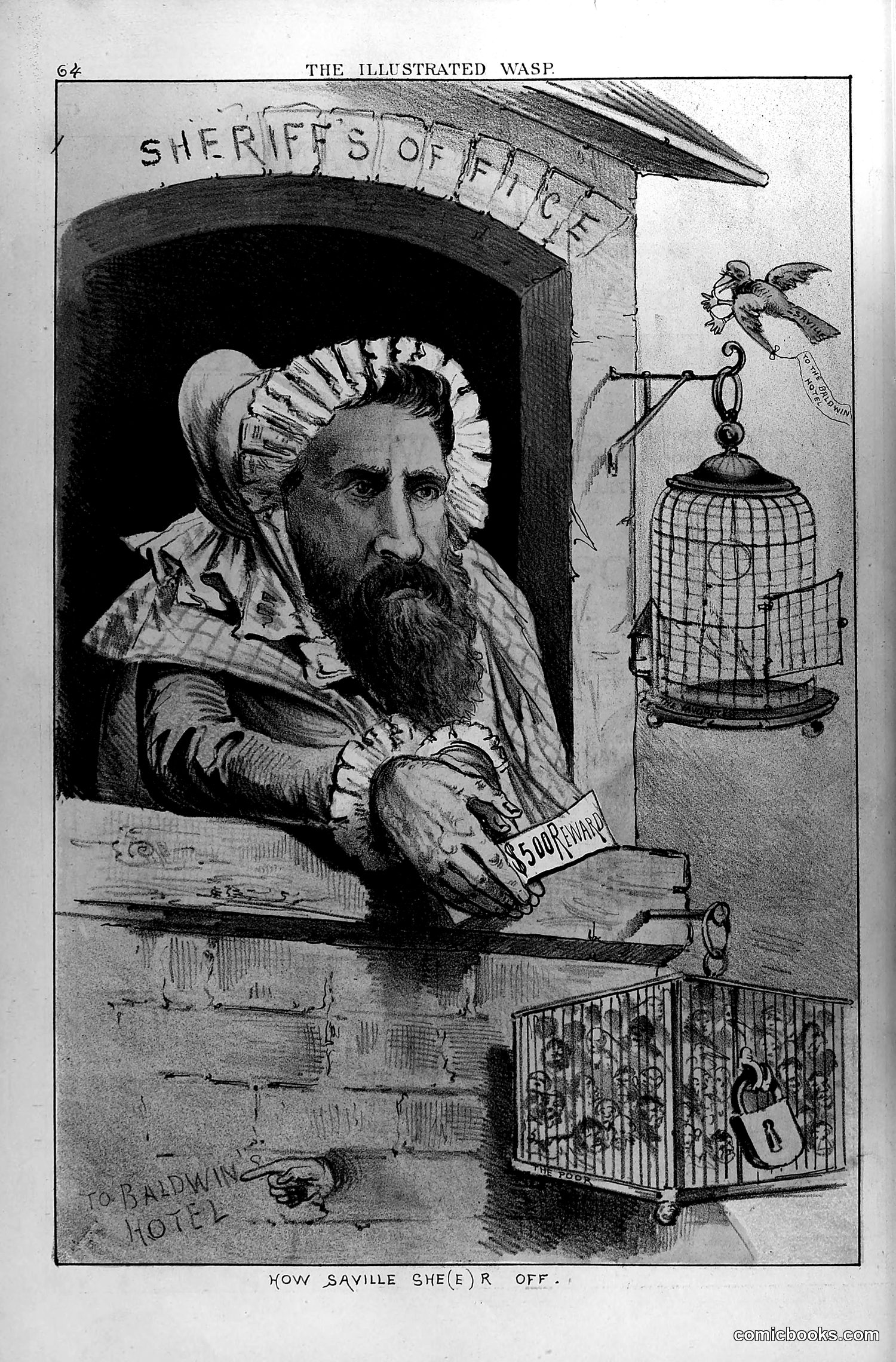
This satirical cartoon from *The Wasp* depicts a bearded man in a Sheriff's Office window holding a "$5,000 Reward" notice. The title appears to be a pun on "Saville" (likely a person's name) and "shear/sheer." The cartoon includes a birdcage labeled with what appears to be a location name, and references "Baldwin Hotel" at the bottom. A wasp (the magazine's mascot) flies overhead. The satire likely concerns a local criminal matter or scandal involving law enforcement, possibly mocking either the sheriff's competence or a fugitive's evasion. The specific historical context—who Saville was, what crime prompted the reward, and the Baldwin Hotel's relevance—remains unclear without additional documentation, though this appears to be San Francisco-based satirical commentary.
I can see this is a calibration page from *The Wasp* magazine featuring a photographic test chart with gray-scale squares and measurement rulers. This type of page was standard in print production—used to verify image reproduction quality, tonal range, and accurate sizing during the printing and scanning process. There is no political cartoon, satirical content, or social commentary visible on this page. It appears to be a technical reference page included in the magazine's production materials rather than editorial content intended for readers. Without visible illustrations, caricatures, or text conveying satire, I cannot identify specific political figures or historical references on this particular page.