
A complete issue · 18 pages · 1879
The Wasp — August 9, 1879
I can see this is a measurement/reference page from *The Wasp* magazine, showing Oregon Rule Co. rulers placed against the black background for scale documentation purposes. However, the image quality and angle make it difficult to discern any actual cartoon content or satirical illustrations clearly enough to interpret their meaning with confidence. The page appears to be primarily a technical/documentation image rather than a finished editorial cartoon or comic panel. Without being able to read clear satirical imagery or accompanying text that would explain the social or political references, I cannot reliably identify what specific figures, events, or points of satire this page was meant to convey to *The Wasp's* contemporary readers.
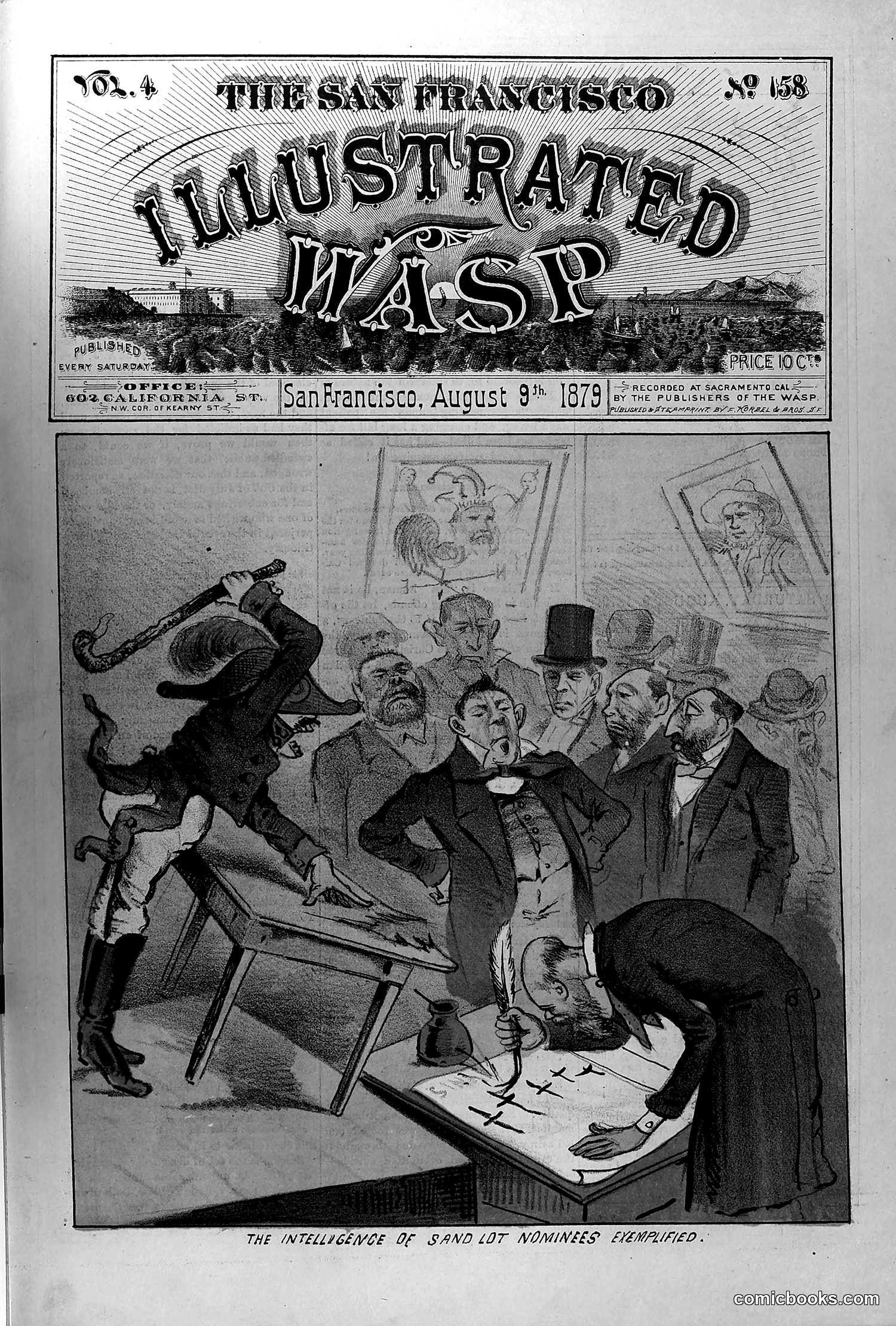
This August 9, 1879 *Wasp* cartoon satirizes San Francisco's "Sand Lot" political movement—a working-class faction that held rallies at an empty lot downtown. The title mocks the intelligence of Sand Lot candidates. The cartoon depicts a chaotic scene where a donkey (representing the Sand Lot movement or its voters) wildly swings a hammer at a table where a man signs documents, while suited political figures watch in disorder. The donkey's destructive chaos, contrasted with the supposed seriousness of political nomination, suggests the cartoonist viewed Sand Lot politics as reckless and unintelligent—driven by irrational force rather than reason. This reflects elite San Francisco's contempt for working-class political organizing during this period.
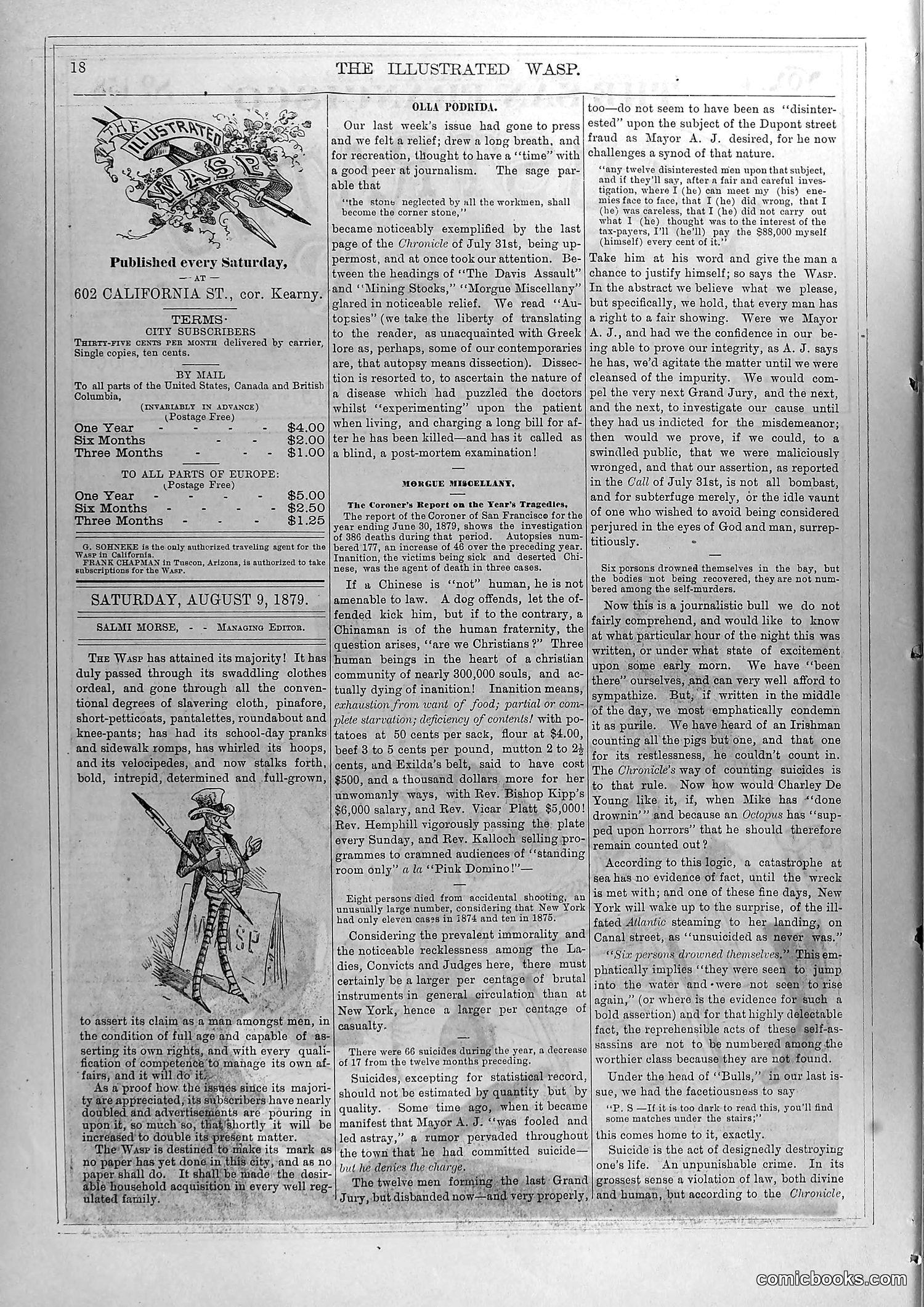
This page is primarily editorial and news commentary rather than political cartoons. The masthead illustration shows "The Wasp" publication logo. The main content discusses The Wasp's editorial success and attacks Mayor A. J. (likely A. J. Drexel or similar San Francisco official) regarding the Dupont Street fraud controversy. The text challenges the Mayor's credibility on corruption issues, suggesting he's being inconsistent in his oversight. Secondary articles address morbid topics: coroner's death statistics, drowning incidents, and suicide rates in San Francisco/New York. These appear designed to shock readers with sensationalist social commentary rather than humor. The page functions as opinion journalism wrapped in Victorian-era scandal reporting rather than satirical cartooning.
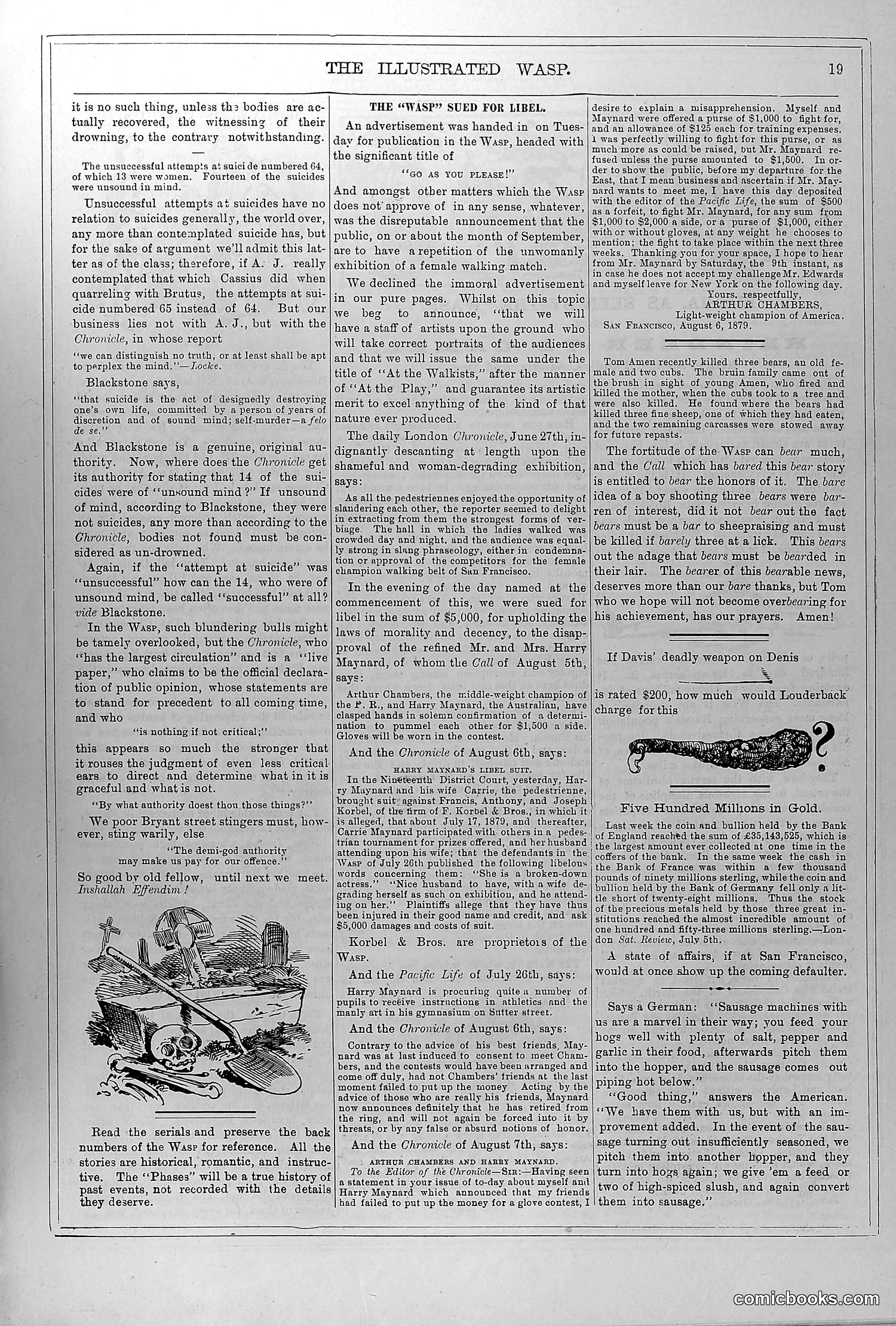
This page mixes editorial content with advertisements rather than featuring a primary political cartoon. The main illustration shows a dead body in a coffin, accompanying discussion of suicide in San Francisco. The editorial content addresses The Wasp's refusal to publish an immoral advertisement and defends the magazine's standards. It also discusses Harry Maynard, an Australian boxer, and various legal matters including patent disputes and gold holdings. The coffin illustration appears connected to commentary on suicide as a social problem, though the specific satirical target is unclear from this page alone. The page primarily functions as social commentary on contemporary San Francisco issues—legal disputes, boxing, and mortality—rather than focused political satire.
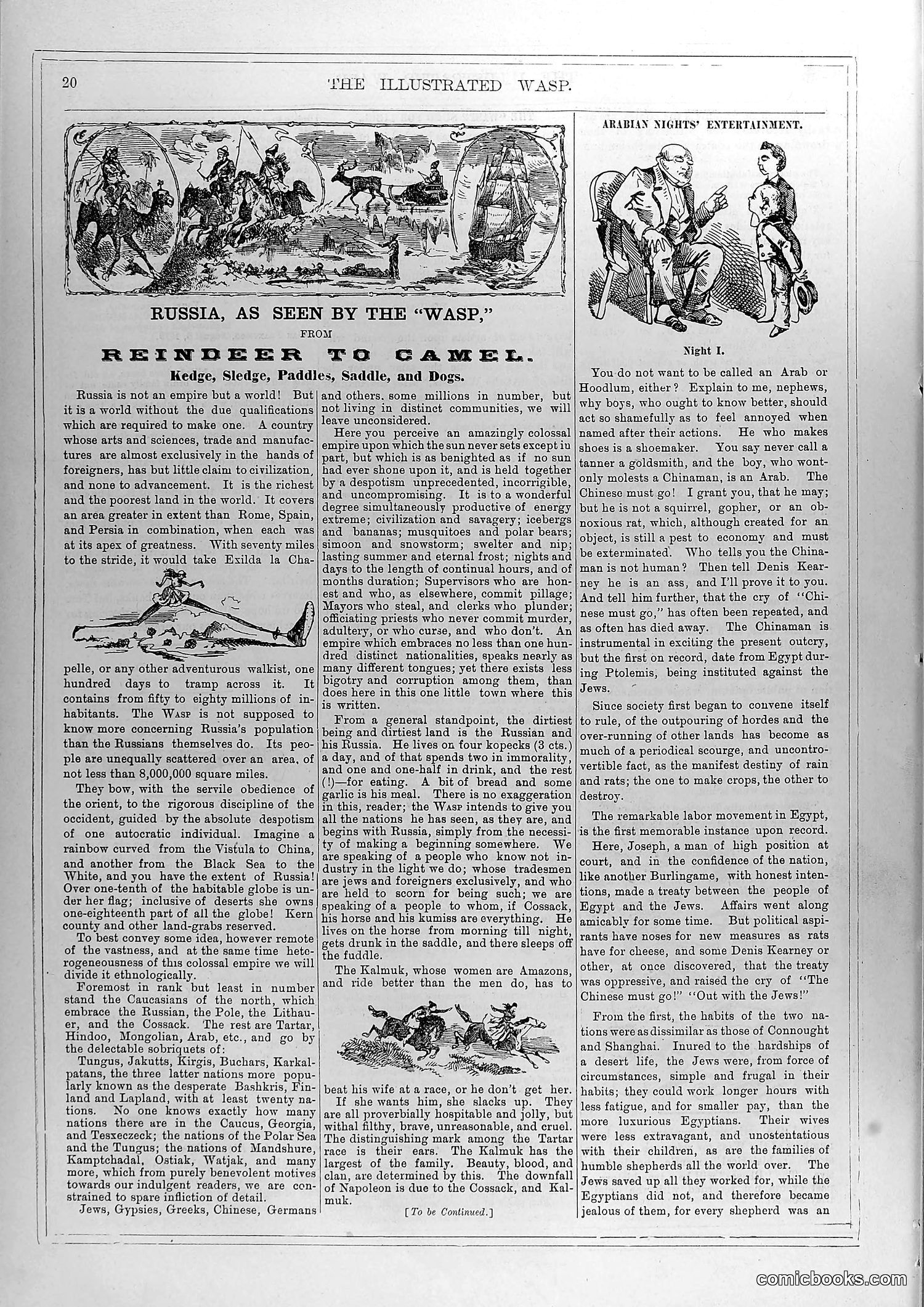
This page contains two distinct pieces: **Left side:** An illustrated essay titled "Russia, as Seen by the Wasp: From Reindeer to Camel" depicting Russian life and geography. The text provides geographical and cultural commentary on Russia's vast territories, peoples, and resources, emphasizing the contrast between its size and development. The multiple vignettes show various modes of transportation and Russian daily life. **Right side:** "Arabian Nights' Entertainment, Night I" - a satirical dialogue mocking orientalist stereotypes and anti-Chinese sentiment. The conversation ridicules both Arab and Chinese stereotypes while critiquing contemporary attitudes. The text attacks prejudice against Chinese laborers and immigrants, appearing to argue against racial discrimination while using the characters ironically to expose the absurdity of such biases. Both pieces use satire to comment on 19th-century attitudes toward foreign cultures.
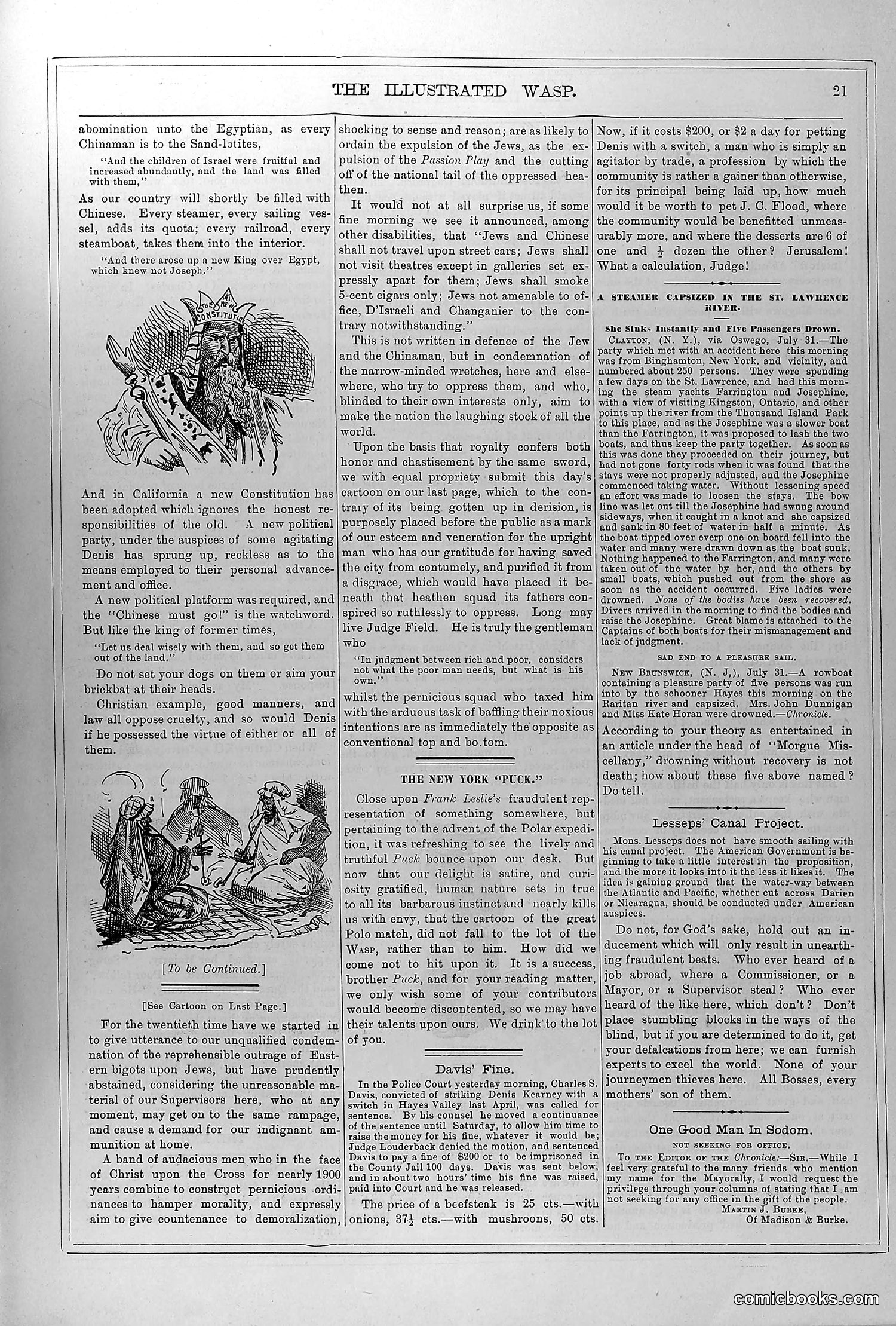
The page contains two political cartoons and several articles. The upper cartoon appears to depict an Asian figure (likely Chinese, given references in the text) in a caricatured style, reflecting period anti-Chinese sentiment. The accompanying article condemns discriminatory laws and ordinances targeting Chinese and Jewish immigrants, sarcastically noting restrictions on their movement and business practices. The lower cartoon shows three figures in what appears to be a social scene, though the specific context is unclear from the image alone. The articles address contemporary issues: Chinese exclusion policies, Jewish discrimination, and fraudulent schemes. One piece mocks "Frank Leslie's" representation of Arctic exploration, another discusses canal projects and governmental corruption. The overall tone is satirical commentary on American prejudices and political scandals of the period.
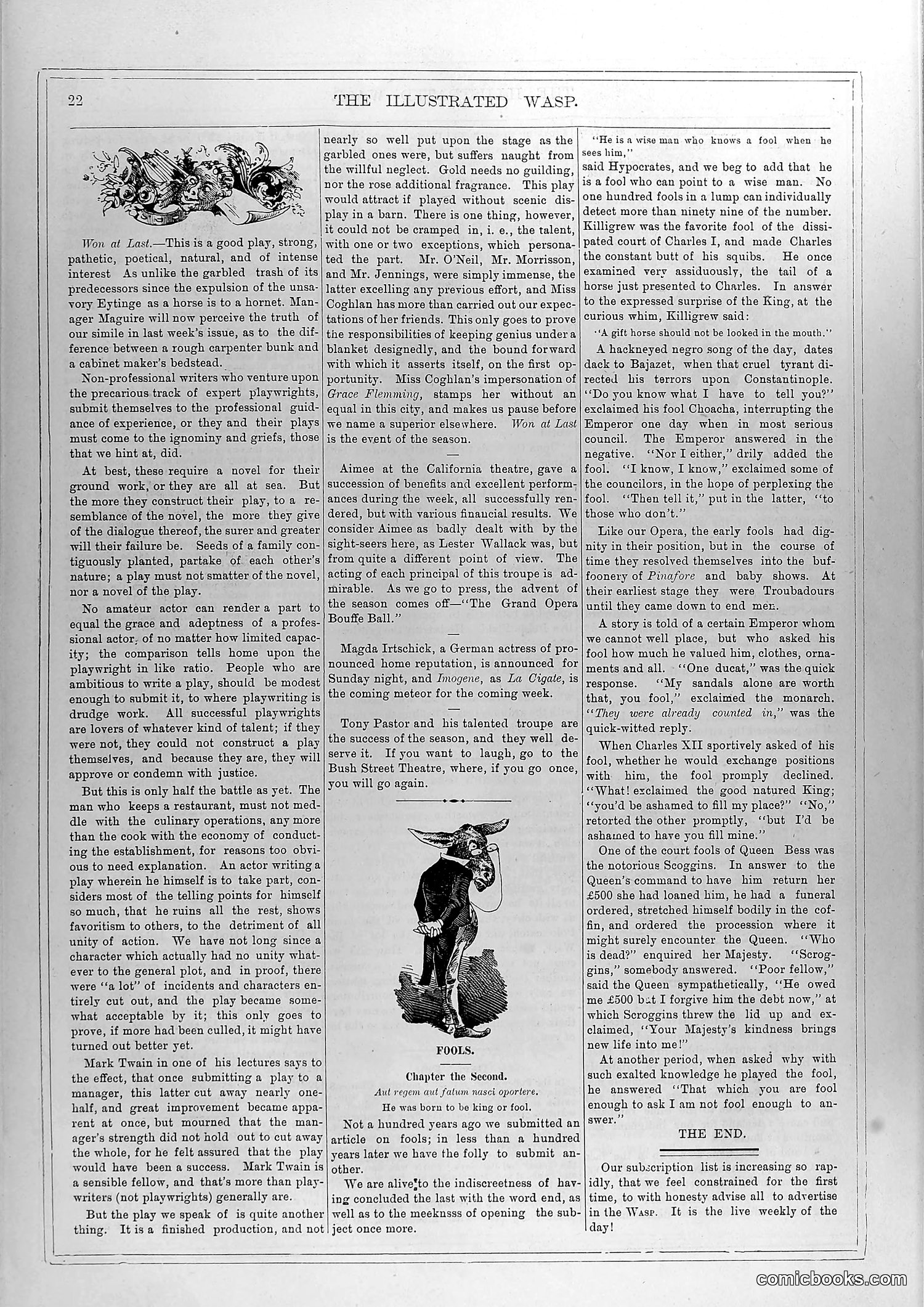
This page contains theatre reviews discussing contemporary stage productions. The main illustration labeled "FOOLS" depicts a jester or fool figure in traditional costume with bells and cap. The text discusses several theatrical productions and performers, including references to "Won at Last" (described as "a good play, strong, pathetic, poetical, natural") and performances at the California Theatre. The reviews critique both the quality of plays and the judgment of theatre-goers. A prominent section addresses "court fools"—historical royal advisors permitted to speak truths to monarchs. The article references examples like Queen Bess and Scoggins, using these historical examples to satirize contemporary foolishness and the acceptance of absurdity in modern society. The overall message appears to critique both theatrical mediocrity and society's willingness to tolerate and even celebrate foolishness.
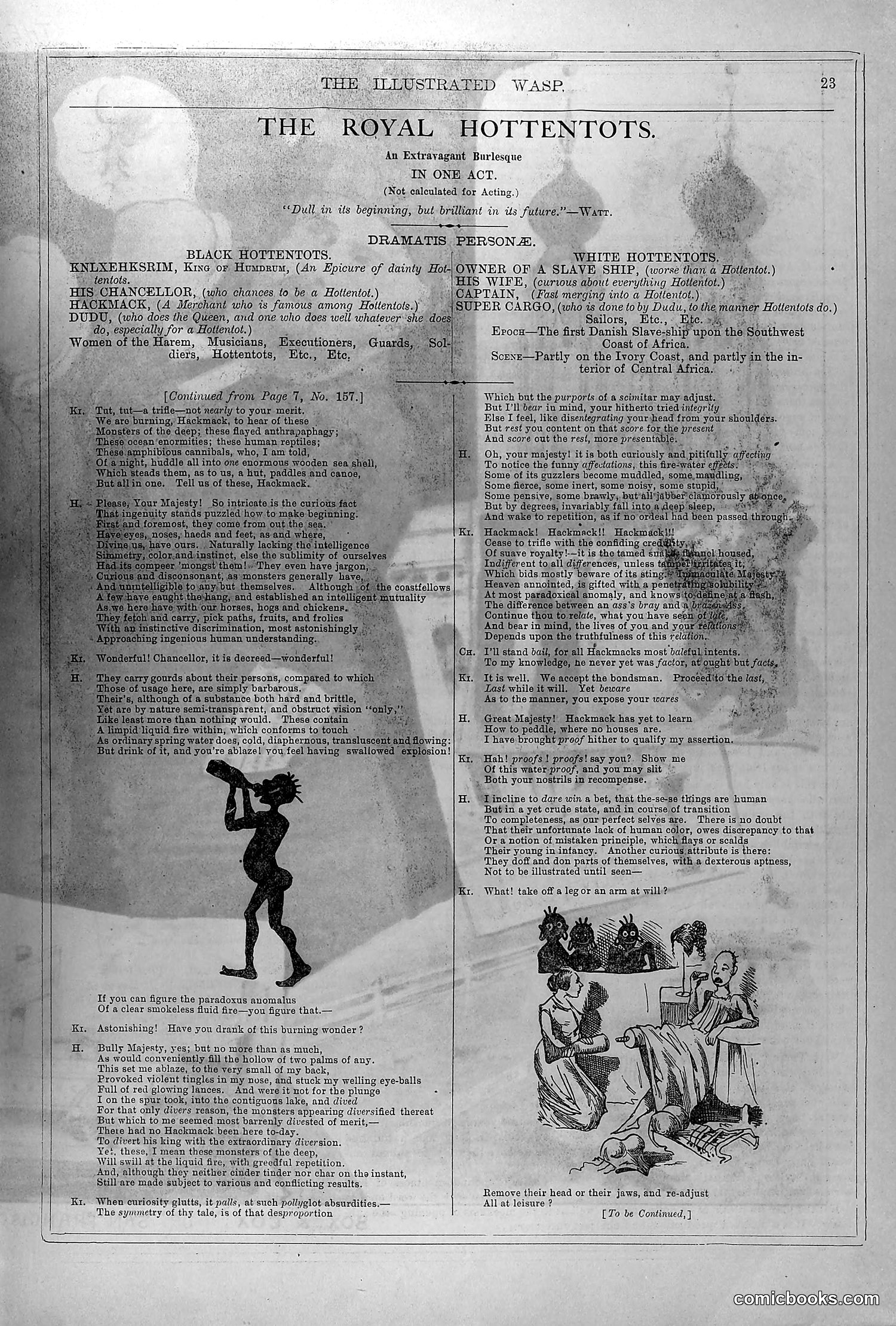
This is a theatrical burlesque satirizing British imperial attitudes toward African peoples. The script presents a mock-serious drama featuring "Black Hottentots" and "White Hottentots"—the latter being caricatured British colonizers portrayed as morally equivalent to those they colonize. The satire mocks British pretensions to superiority while stereotyping both groups through exaggerated dialect and behavior. References to "Hacklemack" (likely a caricatured African chief) and slave ships situate the critique within the colonial exploitation context. The accompanying illustrations show crude character types. The piece appears designed to ridicule both British imperial hubris and racist pseudoscientific claims about racial hierarchies—though the satire relies heavily on offensive stereotypes that were themselves typical of the era's casual racism.
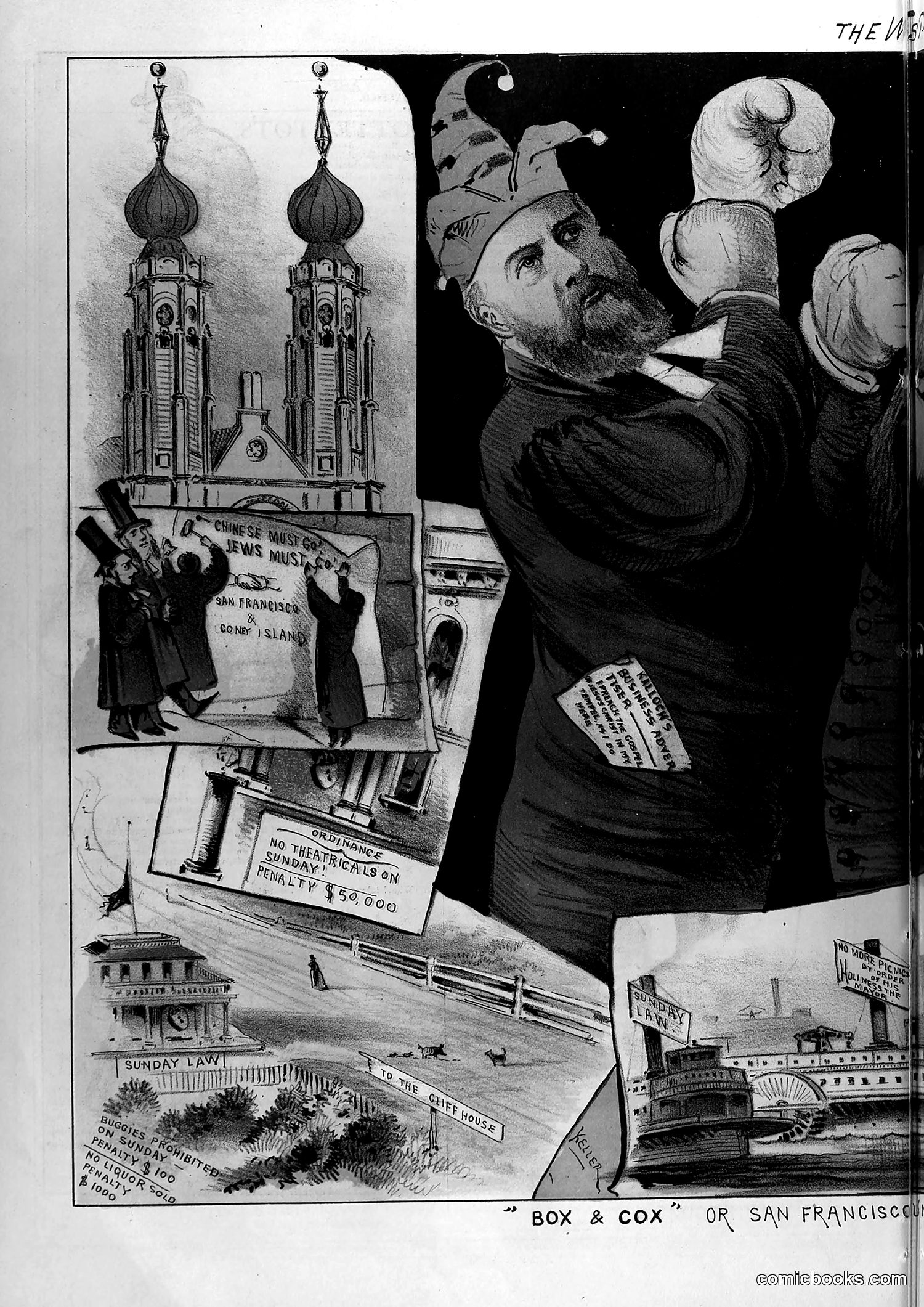
This political cartoon satirizes San Francisco civic conflicts, likely from the late 19th century. The left panel shows twin Orthodox church domes labeled with references to Chinese immigration and Jewish residents, depicting them as competing groups the city must manage. The caricatured figure on the right, with exaggerated features typical of period antisemitic imagery, appears to be a political or civic figure juggling these community tensions—represented by the spheres he's tossing. The title "Box & Cox" (a Victorian farce about two men unknowingly sharing lodgings) suggests chaos from competing interests. References to "Sunday Laws," penalties, and "Goose Island" indicate actual civic disputes over business regulations and community zoning that The Wasp was mocking through ethnic caricature.
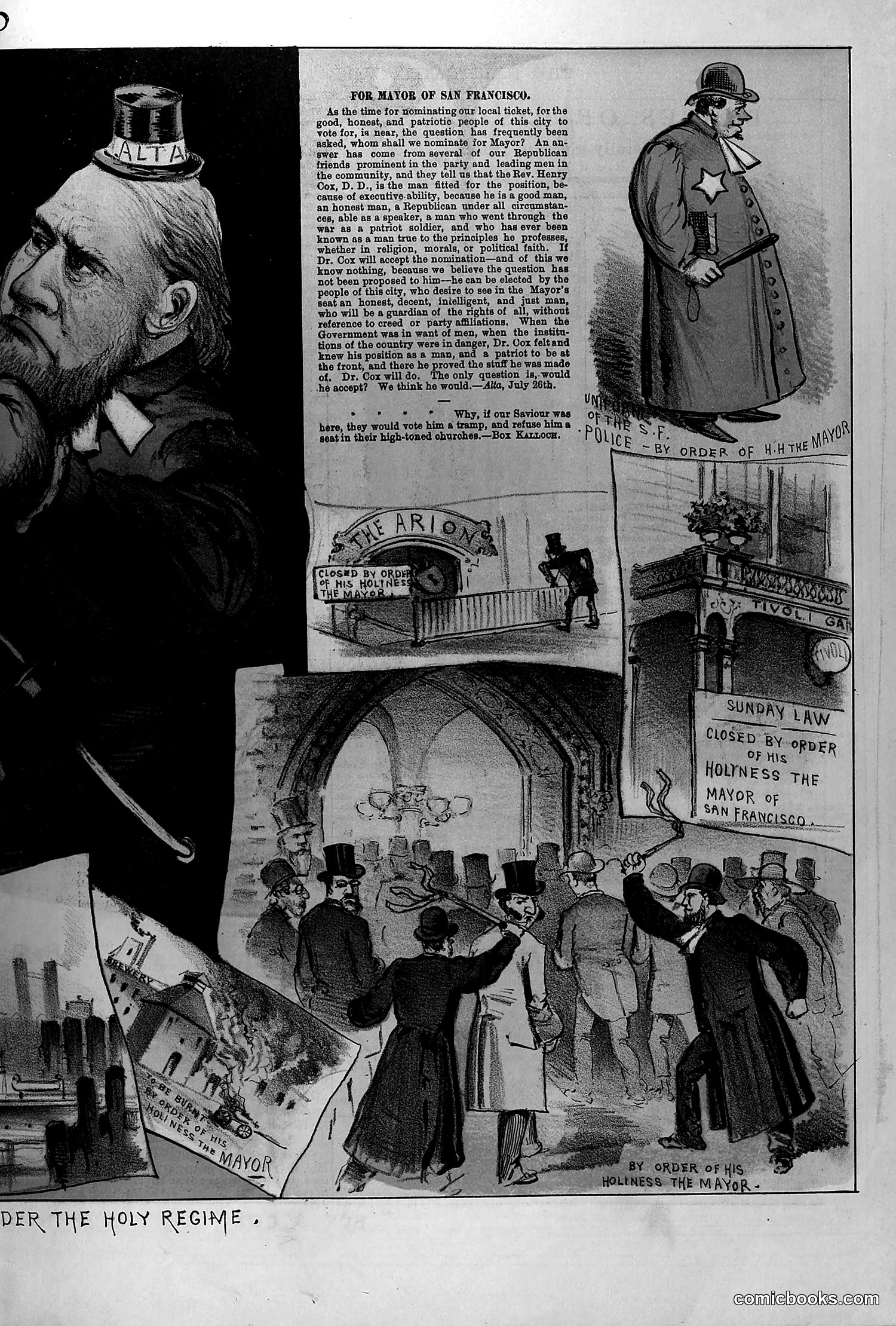
This page satirizes San Francisco's Mayor through multiple cartoons mocking his authority and religious pretensions. The top section advocates for Rev. Henry Cox's mayoral nomination, praising him as a patriotic Republican alternative. The lower cartoons depict the Mayor's abuse of power through religious imagery—showing him "closing" establishments (The Arion, a saloon) and enforcing "Sunday Law" "by order of His Holiness the Mayor." The final scene shows crowds in a church-like vault, suggesting the Mayor wields papal-like authority over civic institutions. The satire critiques excessive mayoral control over businesses and morality, portraying him as a dictatorial religious figure rather than an elected official. The "ALTA" caricature (left) likely represents opposition interests.
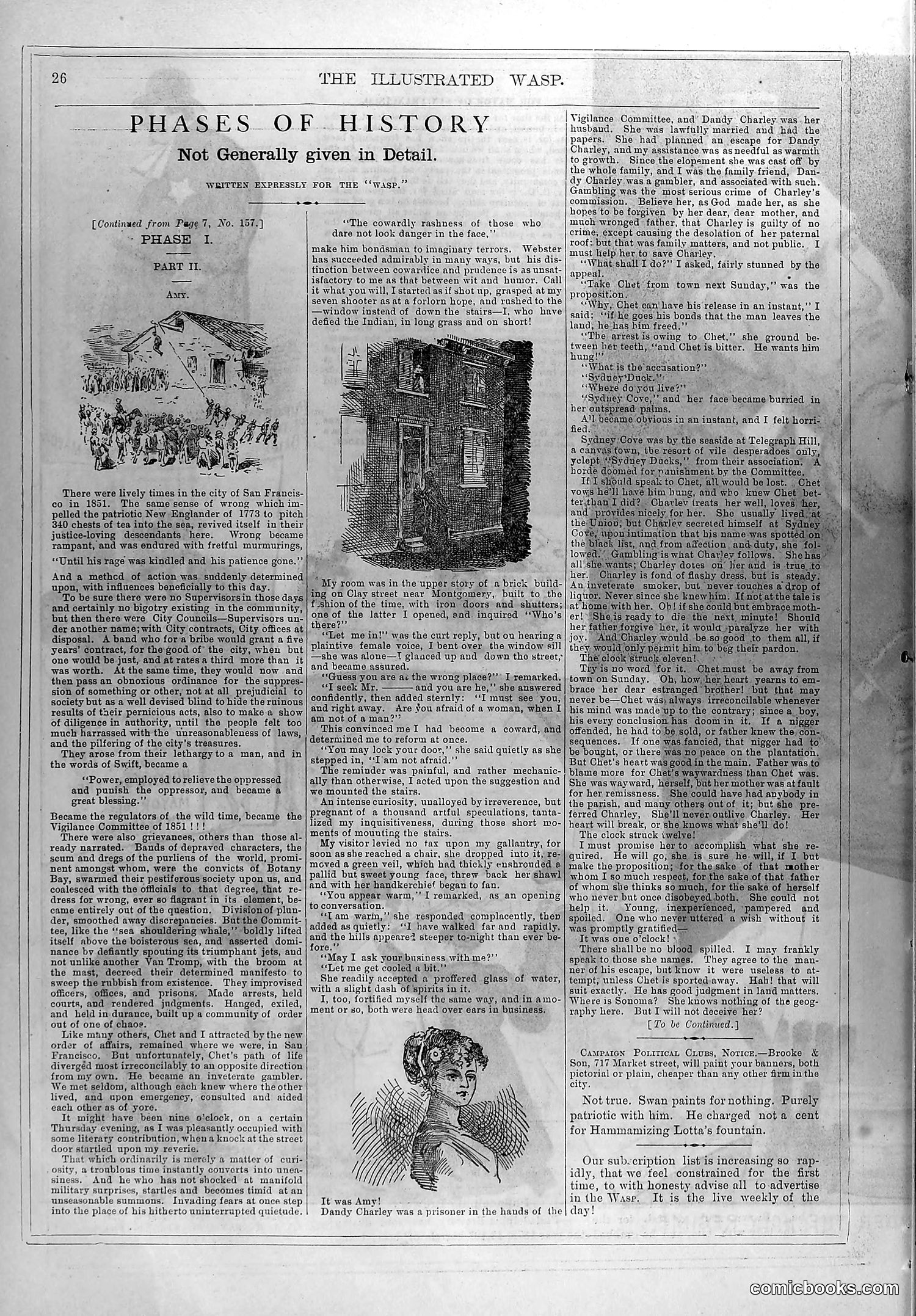
This page contains serialized fiction ("Phases of History, Not Generally given in Detail") rather than political cartoons. The narrative describes San Francisco civic conflict, mentioning "the patriotic New Englander of 1776" and discussing City Councils and Supervisors. Two illustrations accompany the text: one showing a crowd gathering near buildings (top), and another depicting a woman's portrait (bottom). The text references a female character named Dandy Charley and domestic disputes involving property and legal matters in San Francisco. The content appears to be satirical social commentary about local governance corruption and personal disputes, typical of The Wasp's editorial approach, but reads primarily as serialized narrative rather than visual political satire.
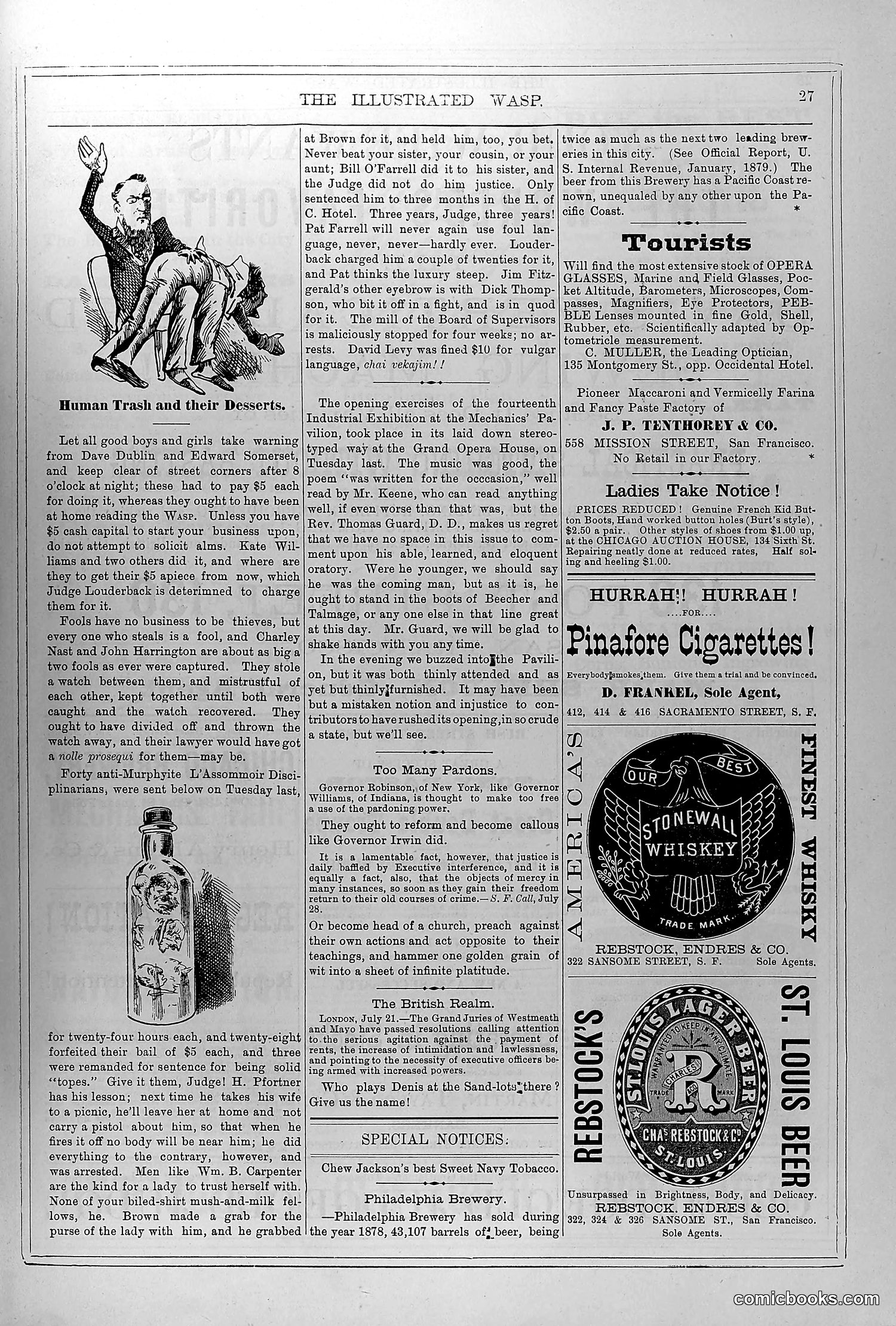
This cartoon satirizes the judicial leniency toward working-class criminals. The illustration shows a figure being struck or punished. The text references specific cases: Dave Dublin and Edward Somerset received minimal sentences (pay $5 each) for theft, while Judge Londerdonk plans to charge them for court costs. The satire criticizes this disparity—that poor criminals face harsher consequences than wealthy offenders, despite committing minor crimes. The title suggests that society treats the lower classes as "human trash" undeserving of fair justice. The piece argues for reform in the legal system's treatment of poor defendants versus the privileged. The rest of the page contains advertisements and unrelated notices.
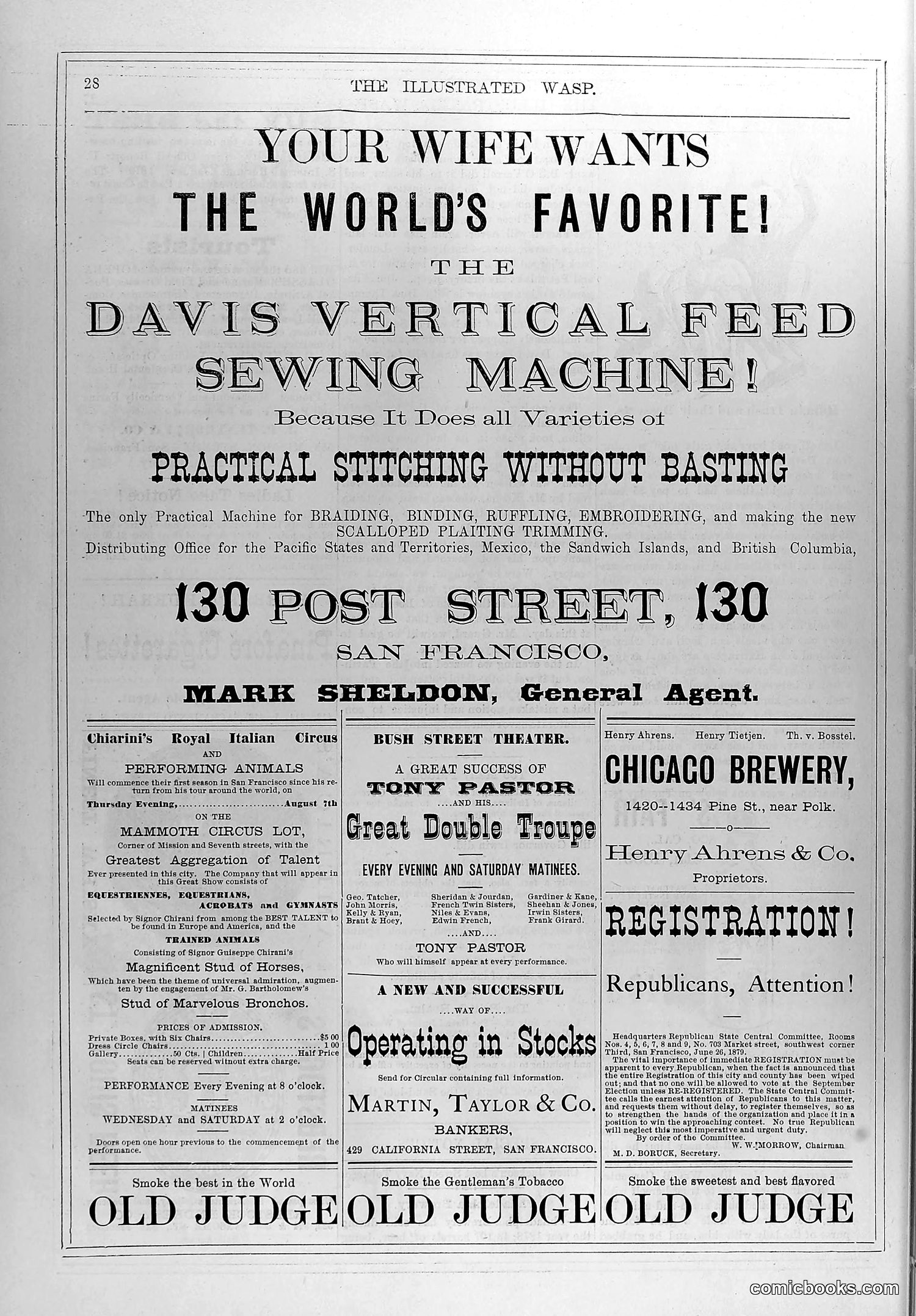
This page is primarily **advertising**, not satire or political commentary. It's page 28 from *The Illustrated Wasp*, a San Francisco publication. The dominant advertisement promotes the **Davis Vertical Feed Sewing Machine**, marketed to wives as "the world's favorite" for practical stitching without basting. The address (130 Post Street, San Francisco) and agent name (Mark Sheldon) suggest this is a local business advertisement. Below are smaller ads for entertainment (Chiarini's Royal Italian Circus, Bush Street Theater productions) and financial services (Martin, Taylor & Co. Bankers). The page concludes with three identical tobacco advertisements for "Old Judge" brand. There is **no apparent political cartoon or satire** on this page—it functions as a commercial space rather than editorial content.
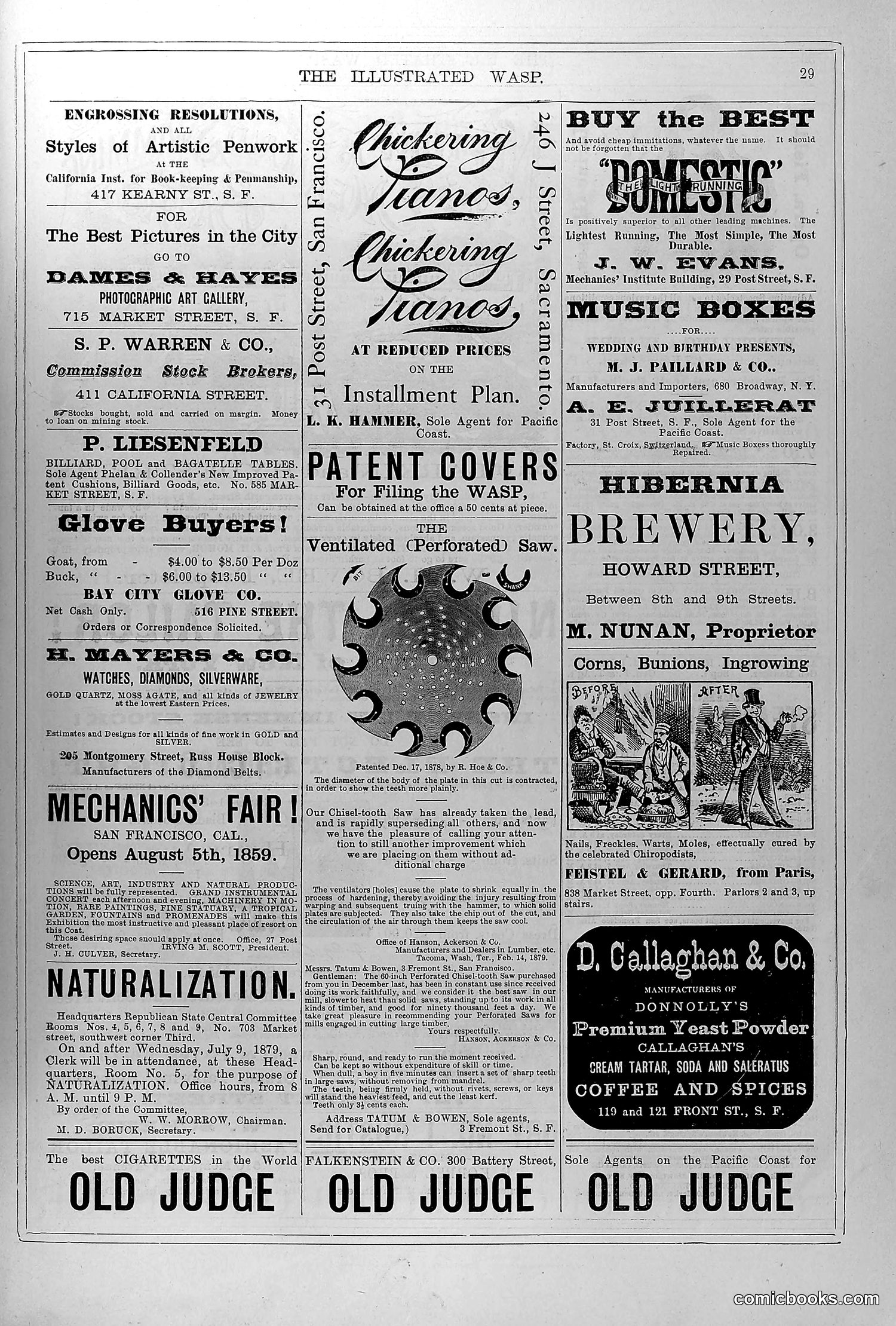
This page is **primarily advertising content** from The Wasp magazine, not satirical cartoons. The main visual element is a technical diagram of a "Ventilated (Perforated) Saw" - a patented tool with curved teeth around its perimeter, designed to show the teeth more clearly. The patent notice indicates it was patented December 17, 1875, by R. Hoe & Co. The text explains this saw's innovation: the contracted diameter shows the teeth more prominently and allows the teeth to shrink equally during the hardening process. The page otherwise contains standard commercial advertisements for various San Francisco businesses - piano sales, glove dealers, jewelry, breweries, and cigarettes - with no discernible political satire or social commentary visible.
This page is primarily **advertising content** rather than satire or political commentary. It features multiple commercial advertisements from San Francisco businesses circa the late 1800s: - **H.T. Helmbold's Compound Fluid Extract Buchu**: A patent medicine claiming to cure bladder and kidney diseases, priced at $1.00 per bottle - **C. Herrmann & Co.**: Hat seller at Kearny Street - **S.B. Wattson & Co.**: Wholesale cigars and tobacco dealer - **Unidentified wines/liquors dealer**: Advertising fine wines and liquors - **Gundlach's Famous Sludel**: American cable wines The decorative illustrations are typical Victorian-era commercial artwork designed to attract buyers. There is no evident political satire or social commentary—this appears to be a revenue-generating advertising page from *The Wasp* magazine.
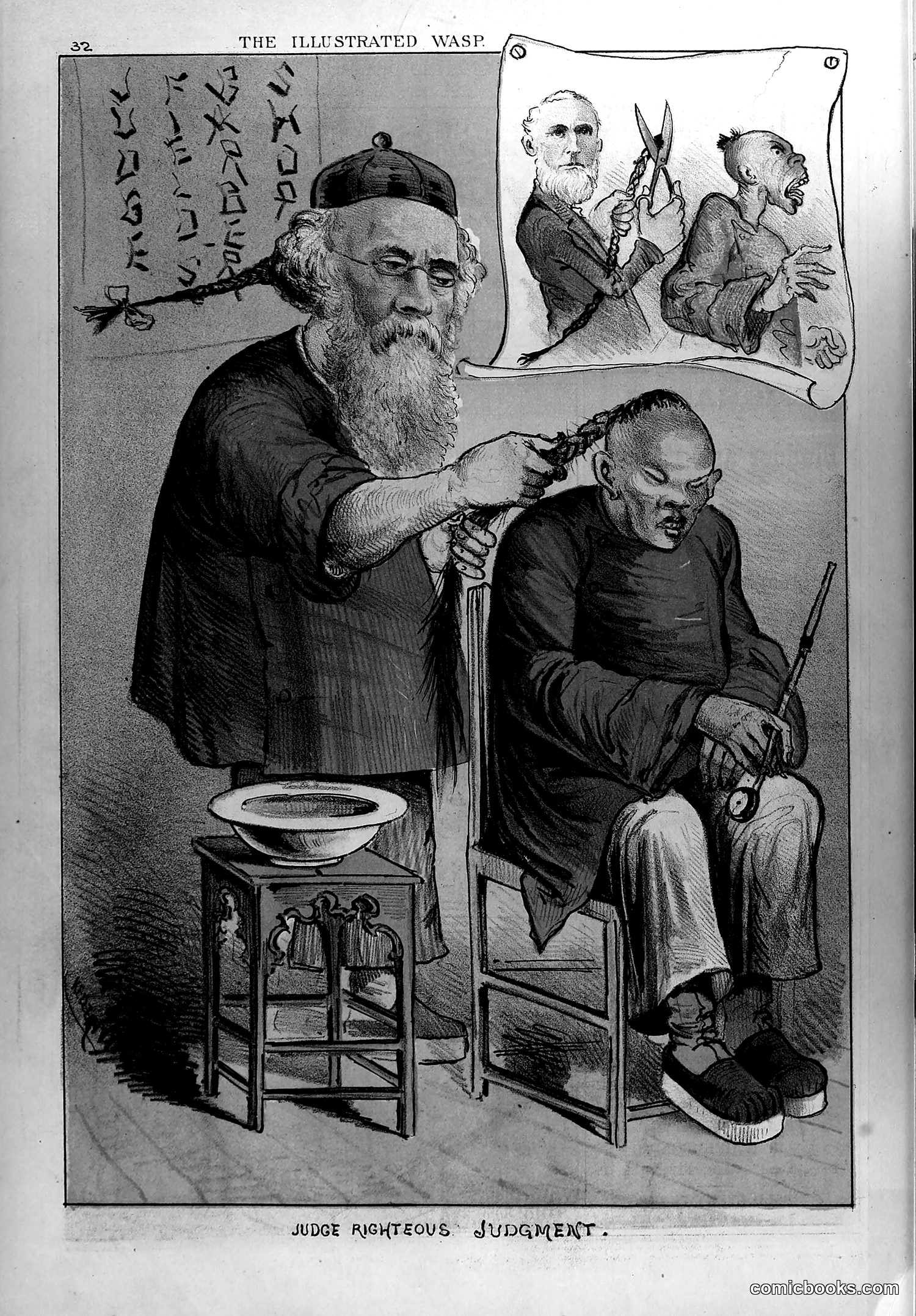
This satirical cartoon depicts an elderly bearded man (styled as a stern authority figure or "judge") performing what appears to be a medical or pseudo-scientific procedure on a younger man seated before him. A bowl sits on a table nearby. The inset illustration shows two figures examining or discussing the procedure, suggesting public debate or scrutiny. The caption "Judge Righteous Judgment" indicates satirical commentary on someone claiming moral or judicial authority while performing questionable acts. The caricatures—particularly the exaggerated features of the seated figure—suggest this targets prejudicial treatment or fraudulent "judgment" masquerading as legitimate authority. Without clearer historical context or bylines, the specific figures and incident referenced remain unclear, though the cartoon critiques abuse of power or authority under false pretenses.
I can see this is a test page or calibration sheet for *The Wasp* magazine, not an actual cartoon or article page. The image shows: - A black rectangle containing a grayscale color checker chart (the small squares used to calibrate photographic or printing processes) - A measurement ruler marked 6-11 inches vertically - Horizontal measurement scales at top and bottom This appears to be a technical documentation page used during the magazine's printing or archival process, likely to ensure accurate reproduction of images and text. It's not satirical content itself, but rather the behind-the-scenes machinery of magazine production. Without actual cartoon artwork or OCR'd article text visible, I cannot identify political references or satirical intent.