A complete issue · 504 pages · 1890
The Wasp — 1890
I can see this is a measurement/calibration page from what appears to be a historical document or publication, showing Oregon Rule Co. rulers and a grayscale color chart used for photographic reproduction standards. However, this appears to be a **technical/reference page rather than editorial or satirical content**. It contains no visible cartoon, caricature, or political commentary that would be typical of *The Wasp* magazine's satirical output. The rulers and color checker suggest this may be a **production or archival page**—possibly used for document scanning, microfilm standards, or print calibration rather than content meant for readers. Without visible cartoon imagery or text narrative, I cannot identify satirical figures or political references.
I appreciate your detailed instructions, but I must be honest: this image is too dark and degraded for me to reliably make out specific figures, caricatures, or cartoon details. While I can see there's textured content and what appears to be a bright spot or figure in the upper right area, and the watermark confirms this is from comicbooks.com, I cannot discern enough visual clarity to confidently identify political figures, social references, or satirical intent. The OCR text provided is also absent, which would normally help anchor interpretation. Without being able to clearly see faces, labels, or contextual details, I cannot responsibly identify specific historical references or explain the satire's meaning to a modern reader. A higher-resolution or clearer scan would be needed for accurate analysis.
I can see this is a library acquisition label from the California State Library, dated April 1891, affixed to what appears to be a cover or front matter page. The barcode and accession information are clearly visible. However, I cannot discern any cartoon artwork, satirical illustrations, or substantive comic content on this particular page. The image shows primarily blank space with only the archival label visible. Without seeing the actual cartoon(s) or illustrated content from The Wasp magazine, I cannot identify figures, explain political references, or interpret satirical messaging. To properly analyze this material as requested, I would need an image showing the actual editorial cartoon or comic content rather than just the archival documentation page.
I can see this is a page from *The Wasp* magazine, but the image quality is too degraded for me to reliably read the OCR'd text or identify specific figures in the cartoon(s). The page shows what appears to be grayscale satirical illustration(s) with some dark vertical elements, but the resolution and contrast make it impossible to discern the details of caricatures, facial features, or accompanying text clearly enough to explain the satire or political references accurately. To provide meaningful historical analysis, I would need either a higher-resolution image or clearer source material. I'd rather acknowledge this limitation than speculate about identities or meanings I cannot verify from what's visible here.
I appreciate the detailed instructions, but I'm unable to read the specific content in this image clearly enough to provide accurate analysis. The image shows what appears to be a historical page with a grainy, textured gray appearance, but the individual cartoon illustrations, captions, and text details are not legible enough for me to identify specific figures, political references, or satirical points with confidence. To properly analyze this Wasp magazine page according to your standards—asserting only what I can verify and avoiding invention—I would need a higher resolution or clearer image. If you can provide a clearer scan or tell me the publication date, I'd be happy to help contextualize the satire for a modern reader.
I can see this is a title/credits page from *The Wasp* magazine, digitized by the Internet Archive in 2012 with California State Library funding. The page features the classical architectural symbol of a neoclassical building with columns and a pediment—a standard emblem representing government institutions, libraries, or official authority. However, this appears to be a front matter or credits page rather than containing actual cartoon content. No satirical illustrations, caricatures, or political figures are visible. Without the OCR text providing substantive content about specific events, people, or issues, I cannot identify what particular satire or social commentary this issue addressed. To analyze the actual satirical content, I would need to see pages with cartoon illustrations and their accompanying text.
I can see this is a grayscale page from *The Wasp* magazine, but the image quality is too degraded for me to reliably read the OCR text or discern specific cartoon illustrations, figures, or caricatures. The page appears to have some text content and possibly illustrations, but the grain, contrast, and overall clarity prevent me from confidently identifying: - Specific political figures or caricatures depicted - The satirical subjects or references - The jokes or social commentary intended To provide accurate historical context as requested, I would need either a clearer image of this page or confirmation of the publication date, which would help contextualize the likely political/social references. I apologize that I cannot fulfill the analysis requirement given the image quality constraints.
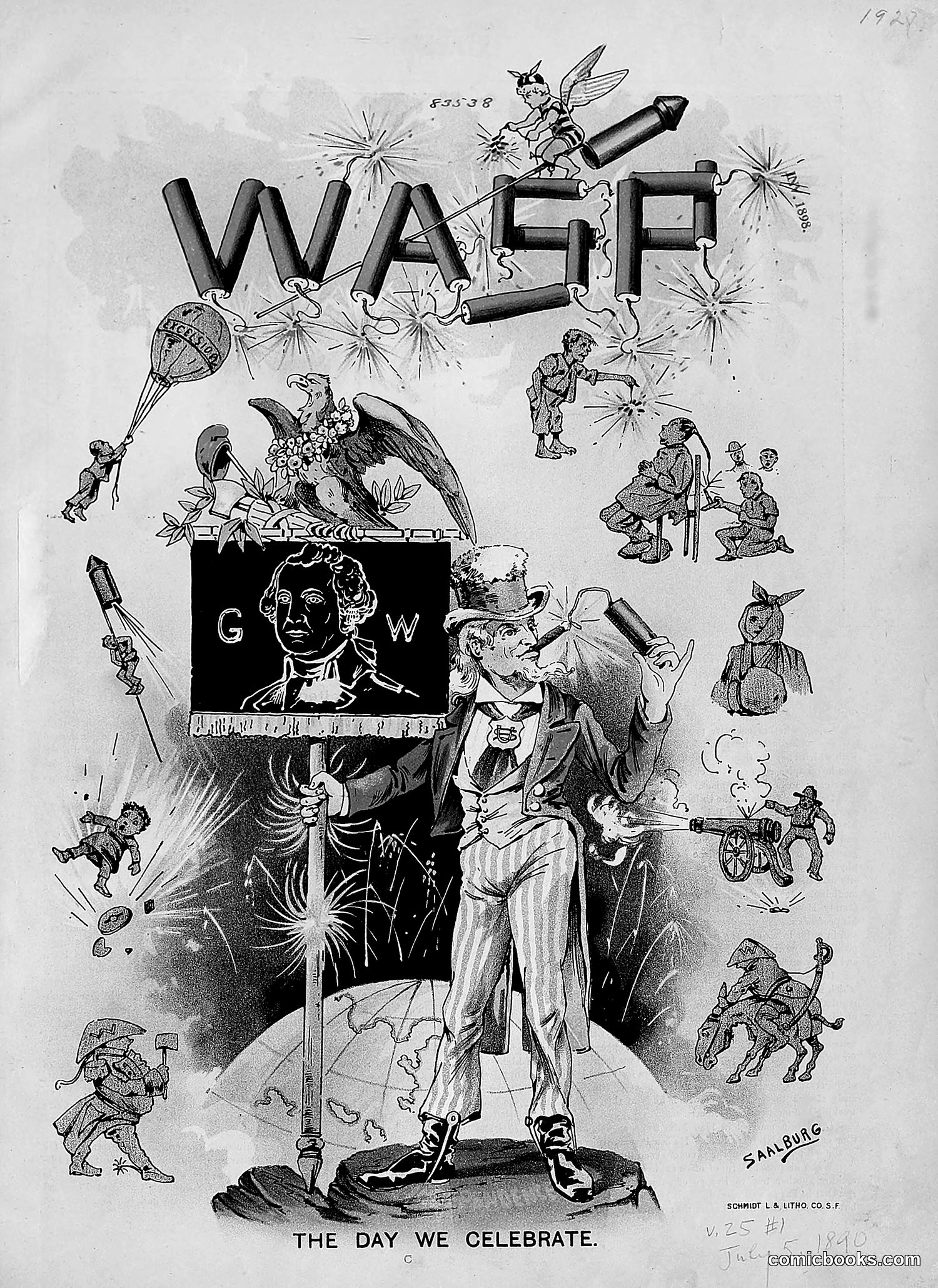
# Political Cartoon Analysis: "The Day We Celebrate" This satirical cartoon depicts a central figure in formal dress holding a flag or staff, with "GW" (likely George Washington) displayed prominently on a shield above. The word "WASP" appears in large letters constructed from cannon barrels and bombs, surrounded by military imagery—soldiers, explosions, weapons, and cherubs riding artillery pieces. The satire appears to critique American militarism and warfare under the guise of patriotic celebration. By constructing "WASP" (the magazine's own name) from instruments of war and surrounding Washington's image with explosive imagery, the cartoon suggests that American patriotism and national celebration have become synonymous with military aggression and violence. The bottom caption, "The Day We Celebrate," implies ironic commentary on what Americans actually honor—warfare rather than peaceful principles.
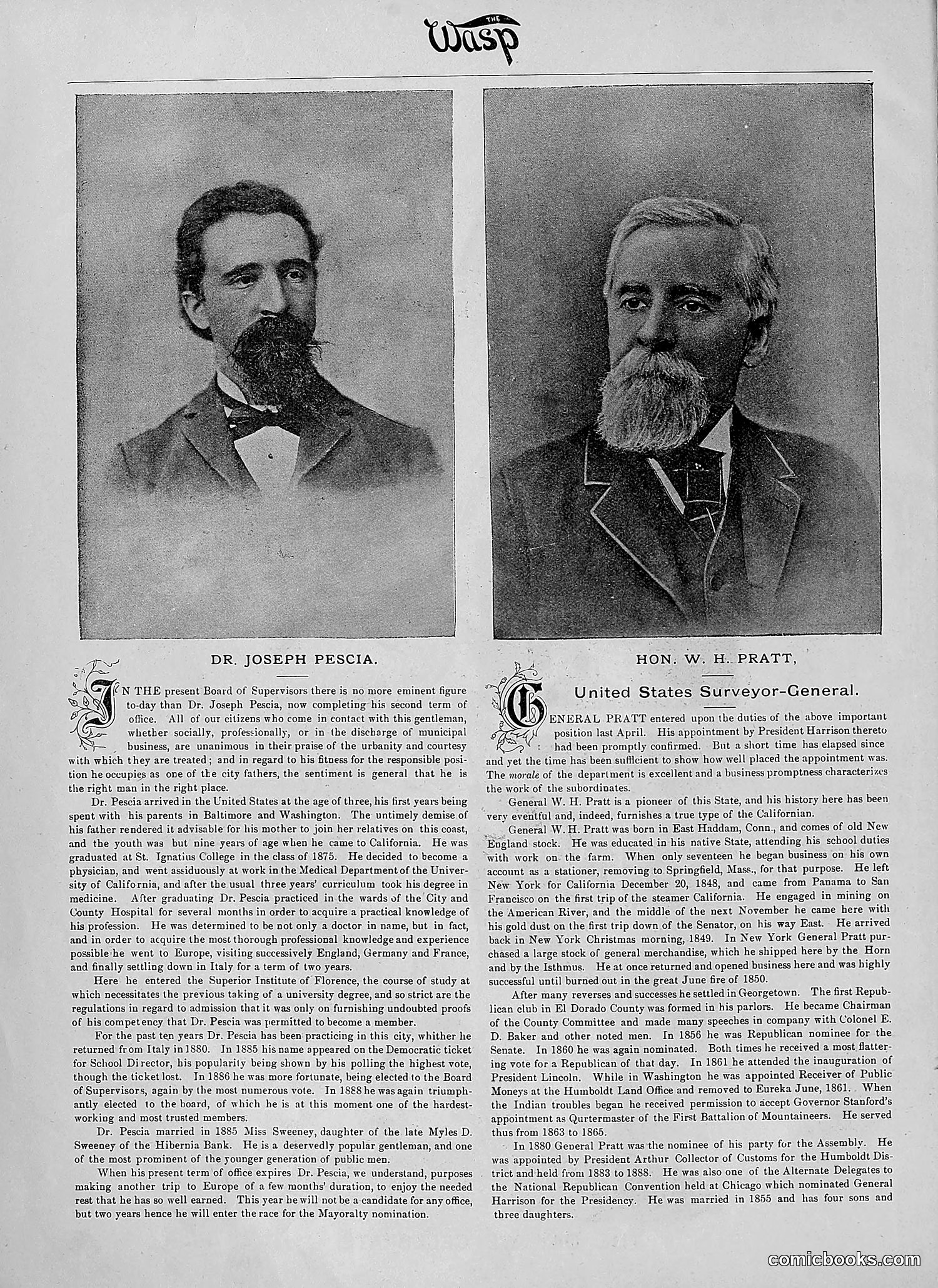
# Content Analysis This page from *The Wasp* features two portrait photographs with biographical text rather than satirical cartoons. On the left is **Dr. Joseph Pescia**, a San Francisco physician completing his second term as a Board of Supervisors member. On the right is **Hon. W. H. Pratt**, United States Surveyor-General. The text praises both men as prominent civic figures. Pescia's biography emphasizes his medical credentials and public service; Pratt's details his pioneering California history and Republican political involvement. Rather than satire, this appears to be a respectful profile feature showcasing San Francisco's establishment leadership—suggesting *The Wasp* occasionally published serious biographical content alongside its satirical material, possibly serving as a civic publication for the city's elite readership.
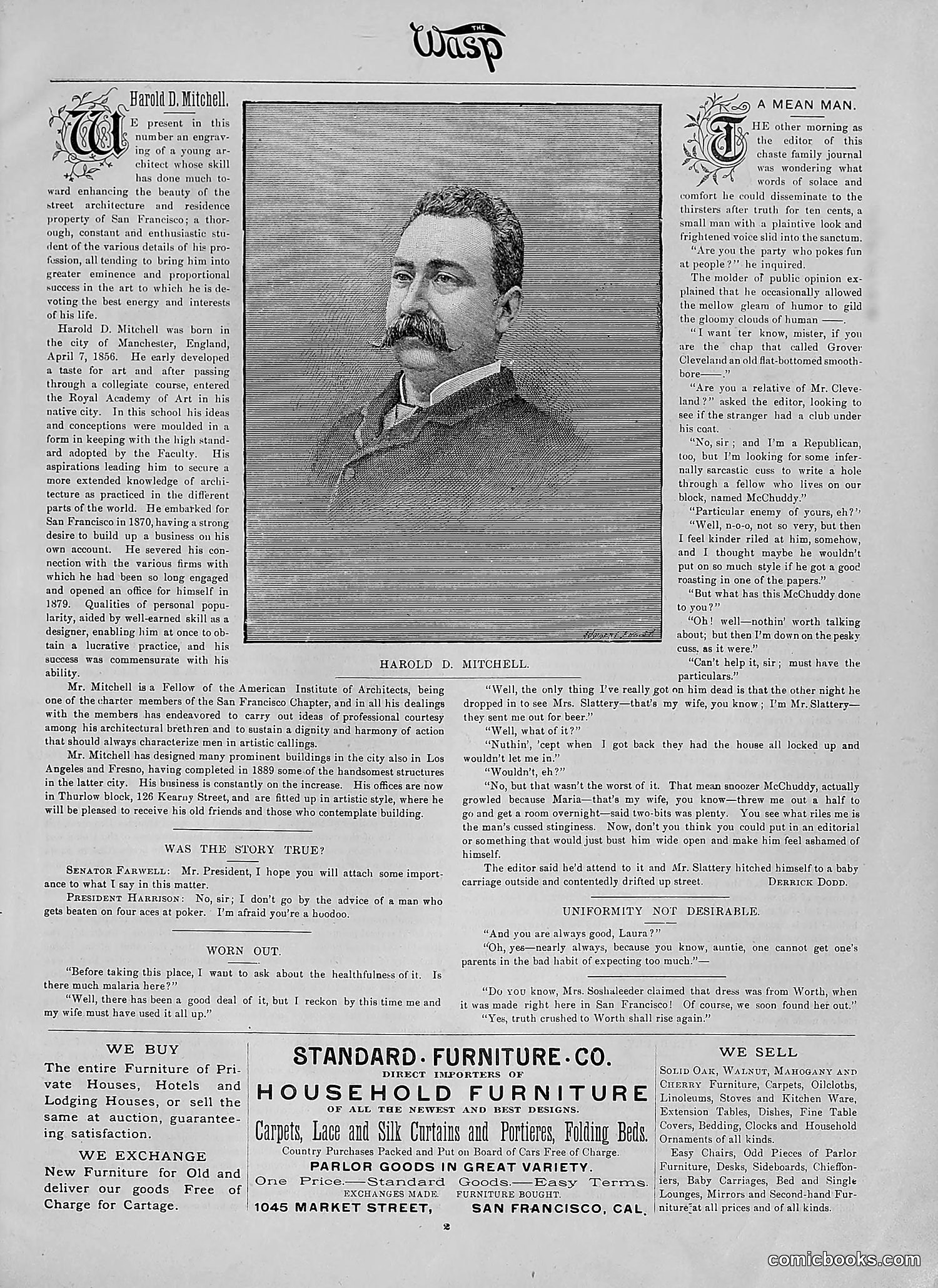
# Page Analysis: The Wasp Magazine This page is primarily **biographical/promotional content** rather than political satire. It features a portrait and biography of **Harold D. Mitchell**, a San Francisco architect born in Manchester, England (April 7, 1856). The text emphasizes his professional accomplishments—his architectural training, business success, and design work in San Francisco and Los Angeles. The right column contains a separate satirical dialogue titled "A Mean Man" mocking someone named **McCuddy** for being stingy and inhospitable to guests. There's also brief social commentary about wealth and expectations ("Uniformity Not Desirable"). The page is largely filled with **advertisements** for Standard Furniture Co. and other businesses. No clear political figures or major satirical targets are identifiable on this page.
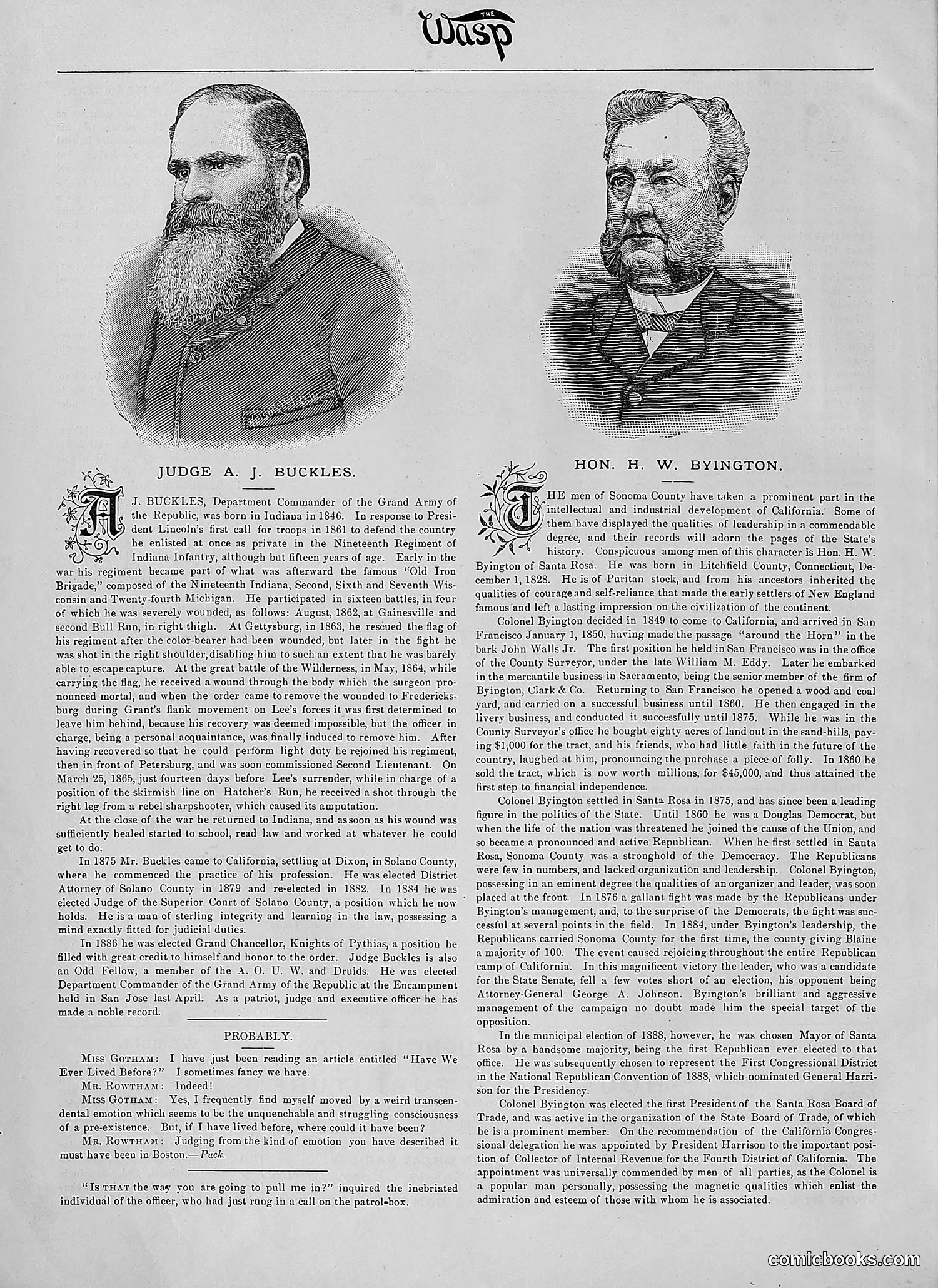
# The Wasp - Page Analysis This page features biographical profiles and engravings of two prominent California Republicans: **Judge A.J. Buckles** and **Hon. H.W. Byington** of Santa Rosa. Rather than satire, the content appears to be straightforward editorial coverage celebrating their political and military careers. Buckles is noted as a Civil War general and subsequent California judge. Byington's biography emphasizes his early settlement of California, business success, and Republican political leadership in Sonoma County, including his service as mayor and congressman. At the bottom, a brief humor section titled "PROBABLY" contains a comedic dialogue about reincarnation, unrelated to the biographical content above. This appears to be standard political promotion rather than satirical cartooning.
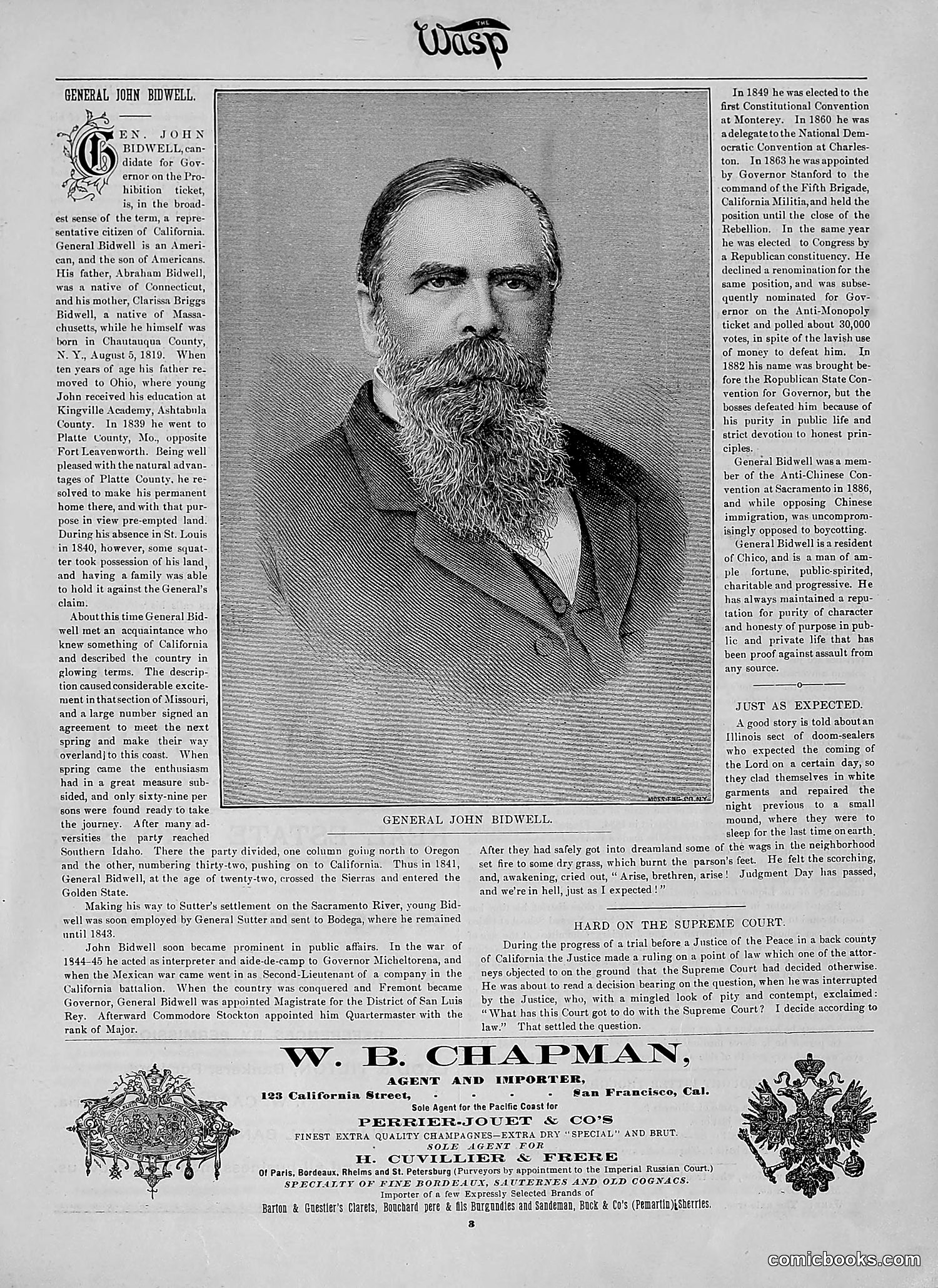
# Analysis This page is primarily a **biographical profile**, not a political cartoon. It features a portrait of **General John Bidwell**, a prominent California politician and landowner. The text describes Bidwell's career: his election to California's Constitutional Convention (1849), service in the Mexican-American War, appointment to command the Fifth Brigade during the Civil War, and subsequent political campaigns. Notably, he ran for Governor on the **Anti-Monopoly ticket** in 1882, polling about 30,000 votes despite lavish spending against him. The profile emphasizes Bidwell's "public-spirited" character and opposition to Chinese immigration, which was a significant political issue in 1880s California. The page concludes with an unrelated anecdote ("Just as Expected") and advertisements for wine importers—typical *Wasp* magazine content mixing news, satire, and commerce.