
A complete issue · 14 pages · 1858
The Bank Charter Act cannot be maintained...
This is a title or cover page for a Victorian publication. The visible text identifies the work as "The Bank Charter Act cannot be maintained..." by Edward Lloyd, published in London in 1858. The catalog reference number 98-84326-22 appears at the top. The page is predominantly blank white space with black text, typical of period title pages. The subject matter—concerning the Bank Charter Act—suggests this is a political or economic tract rather than sensational fiction, though the attribution to Edward Lloyd (a known penny dreadful publisher) indicates it may have been distributed through popular serial channels. The ellipsis suggests the title continues beyond what is shown.
This is a **bibliographic microform target page** — a preservation document, not a Victorian penny dreadful itself. It records metadata for microfilming a work by Edward Lloyd titled *The bank charter act cannot be maintained without a relaxing clause: a suggestion addressed to Sir G. C. Lewis* (London, 1858), a 19-page political pamphlet. The page documents the original material's catalog information, film specifications (35mm film, 10:1 reduction ratio, filmed 2/5/98), and tracking data for Columbia University Libraries' preservation division.
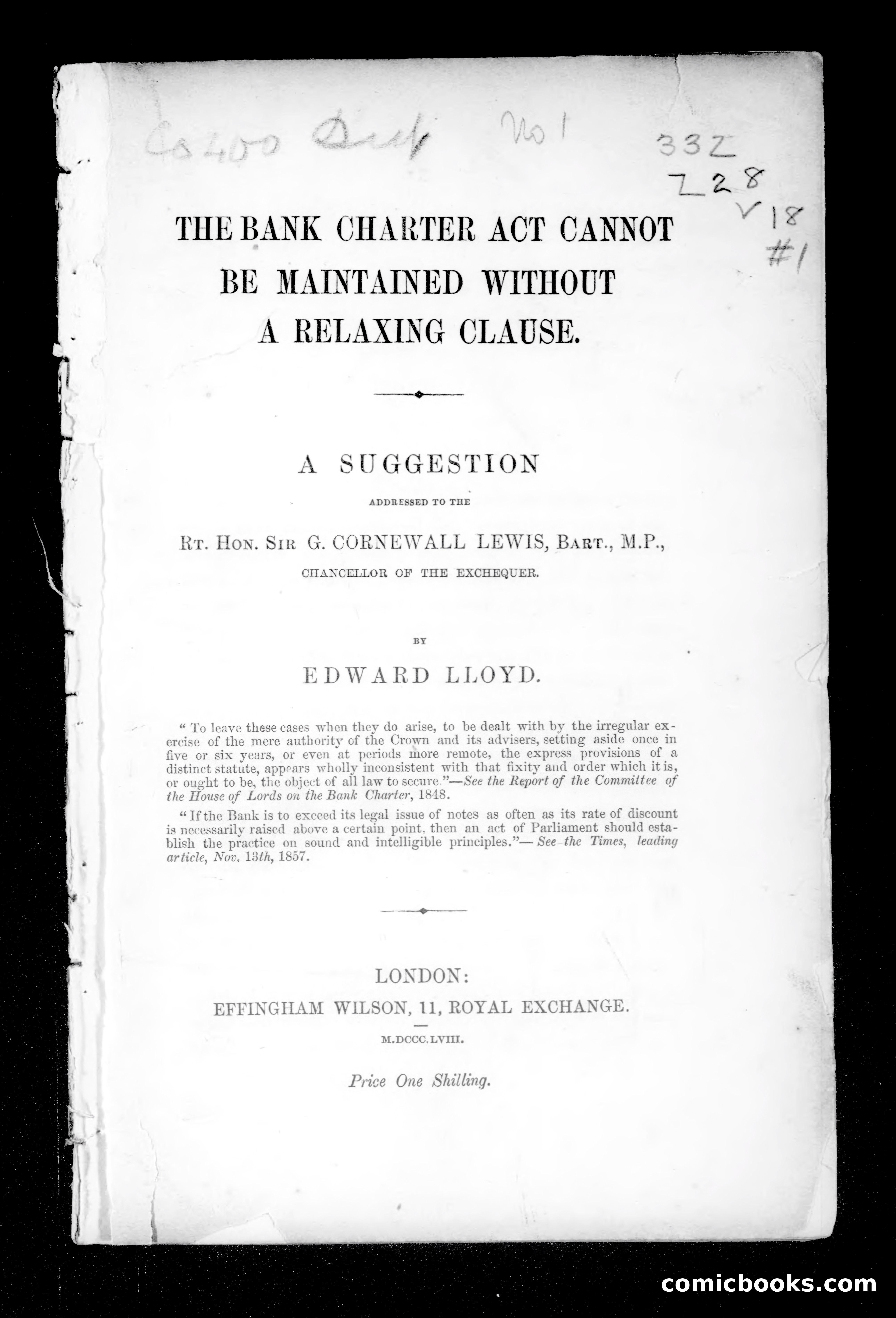
# What This Page Is This is a **title page** of a Victorian-era political pamphlet, not a penny dreadful as the framing suggests. ## Content The page announces a suggestion addressed to Sir G. Cornewall Lewis (Chancellor of the Exchequer) by Edward Lloyd, arguing that "The Bank Charter Act Cannot Be Maintained Without A Relaxing Clause." It includes two epigraphs—one from an 1848 House of Lords report on the Bank Charter, another from *The Times* (November 15th, 1857)—supporting Parliament's intervention in banking practice. Published in London by Effingham Wilson in 1858 (M.DCCC.LVIII), priced at one shilling, this appears to be serious financial/political advocacy rather than sensation fiction.
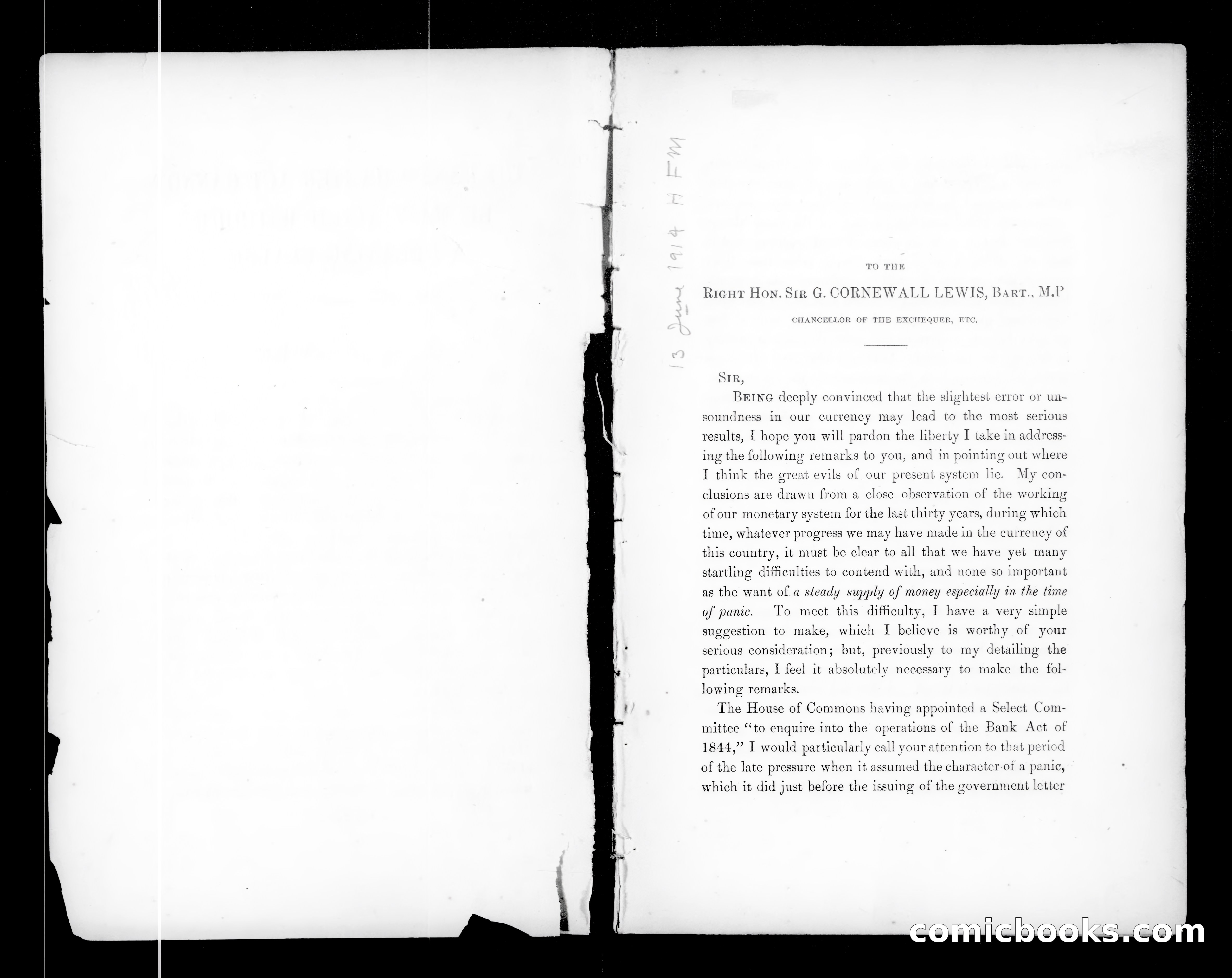
This is a formal letter page addressed to "the Right Hon. Sir G. Cornewall Lewis, Bart., M.P., Chancellor of the Exchequer, etc." The text discusses concerns about the country's monetary system and currency supply, particularly referencing difficulties in the monetary system over the past thirty years. The writer mentions the House of Commons appointing a Select Committee "to enquire into the operations of the Bank Act of 1844" and references a period of financial panic preceding the issuance of a government letter. The page appears to be the opening of a substantial correspondence or treatise on financial matters, written in formal Victorian prose style, rather than fiction.
# Page Description This is a page of running prose from what appears to be a letter or formal argument on currency and banking policy. The text discusses the distinction between financial "pressure" and "panic," argues that the Act of 1844 has worsened monetary crises rather than solved them, and contends that during times of financial strain, the lack of adequate currency representation prevents even wealthy individuals and merchants from accessing credit. The writer appeals to the Bank of England as the potential source of relief (text cuts off mid-sentence at page bottom).
# Page Description This is running prose text (pages 6-7 of what appears to be a Victorian-era economic or political treatise, not a penny dreadful). The visible text discusses monetary policy and banking reform, specifically critiquing the Bank Charter Act of 1844. The author argues that the Act has failed and advocates for a new system of currency contraction during economic ease and expansion during pressure. The passage references historical financial panics (1720, 1784, 1847, 1857) and quotes Sir Robert Peel's 1848 Commons speech about how low interest rates have historically preceded commercial depression. The discussion centers on technical financial policy rather than sensation fiction.
# Victorian Page Analysis This is running prose text from pages 8-9 of what appears to be a political or economic treatise (not a penny dreadful, despite the question's framing). The author argues that Sir Robert Peel, despite his expertise in monetary systems, made a critical error in his 1844 Bank Charter Bill by overlooking the "panic element" in currency policy. The text contends that public credit expansion—not contraction—successfully mitigated the panics of 1793 and 1847, and suggests Peel's 1839 experience with gold shortages may have biased his 1844 legislation. The passage advocates for legislative intervention to prevent financial crises through controlled credit expansion.
# Page Analysis This is running prose from pages 10-11 of what appears to be a Victorian-era financial or political commentary (not a penny dreadful). The text debates Bank of England monetary policy, specifically whether the Bank should restrict or expand currency circulation during financial panics. The author argues against rigidly maintaining a one-to-one ratio of gold reserves to banknotes, contending instead that the Bank has a duty to supply extra circulation during crises to prevent economic collapse. References include historical panics (1825, 1793) and figures like Daniel Hardcastle of *The Times*.
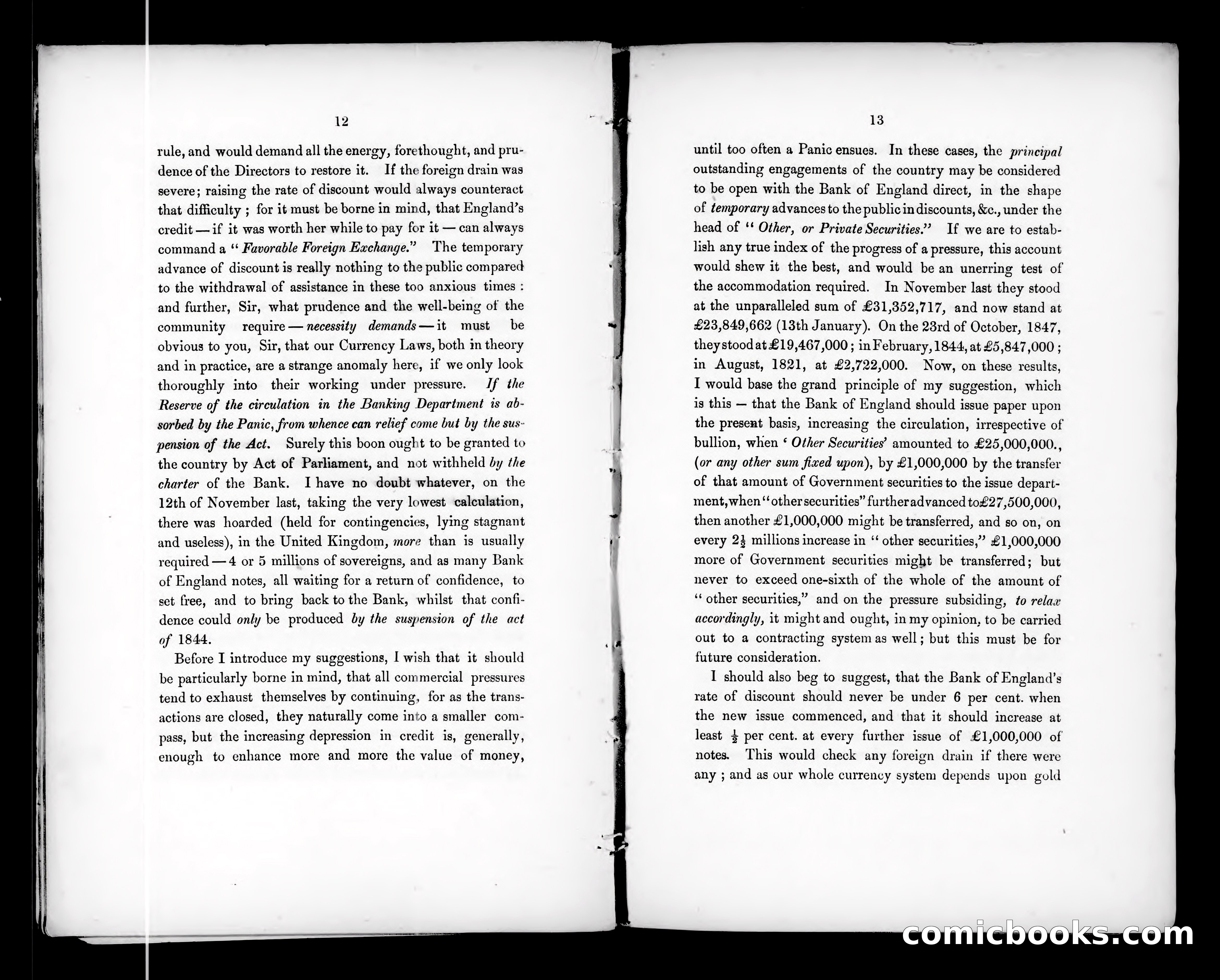
# Victorian Document Analysis This is **running prose** from pages 12-13 of what appears to be a Victorian-era financial or political document—likely a pamphlet or parliamentary paper rather than penny dreadful fiction. The text discusses Bank of England monetary policy, currency regulations, and banking crises, arguing for reforms to the Banking Act of 1844. The author presents statistical evidence about discounts and securities from various dates (1821, 1844, 1847) to support proposals for managing financial panics through flexible note issuance. This is serious economic commentary, not serialized sensation fiction.
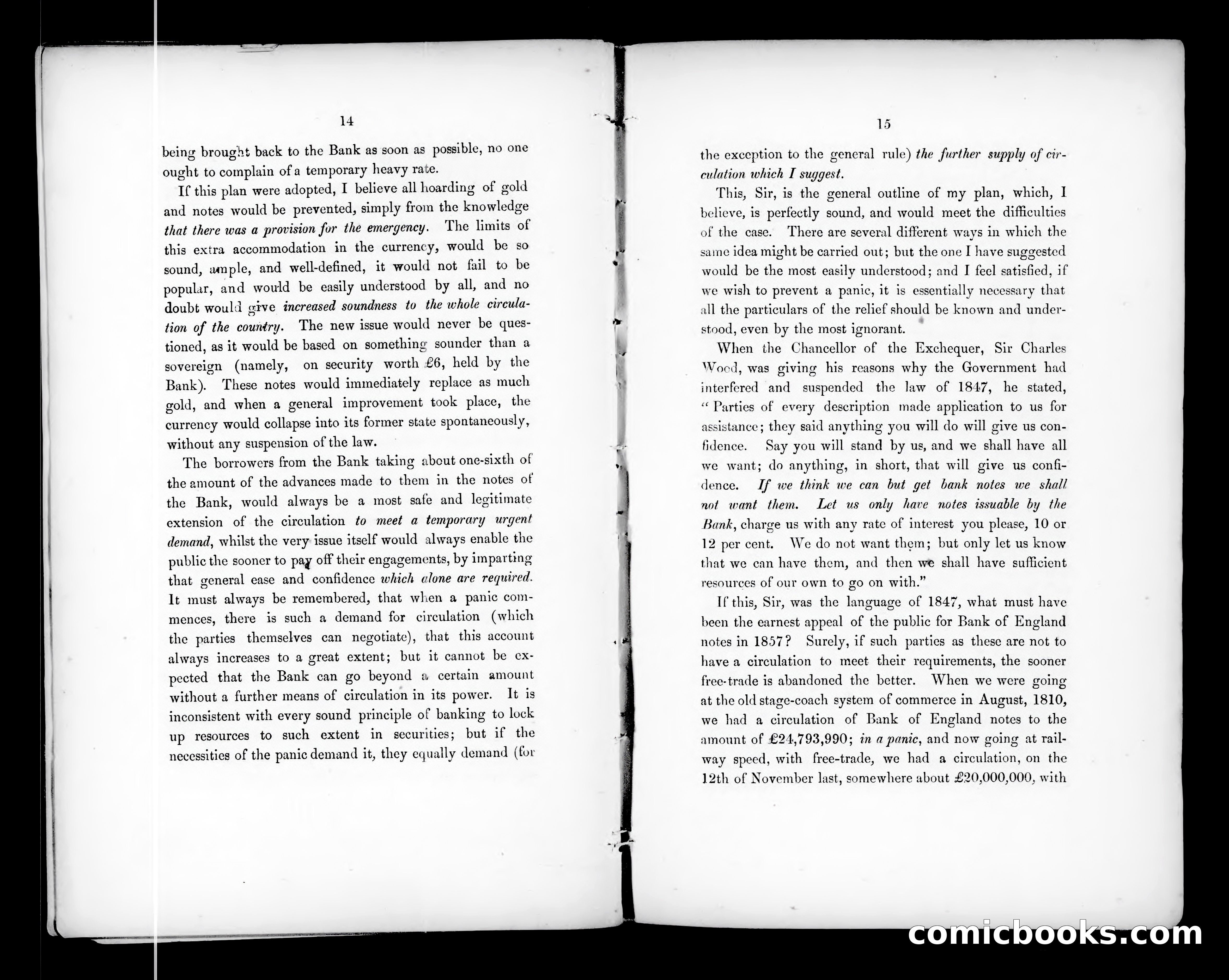
# Page Analysis This is running prose from pages 14-15 of what appears to be a Victorian-era economic or political treatise (not a penny dreadful). The text discusses a proposed banking plan to prevent financial panics through controlled note issuance by the Bank of England. The author argues that a well-defined system of emergency currency circulation, backed by securities, would inspire public confidence and prevent hoarding during crises. The passage references Sir Charles Wood's 1847 statement about government intervention and compares circulation amounts from 1810 to the present (apparently 1857), advocating that access to Bank notes be guaranteed to prevent panic.
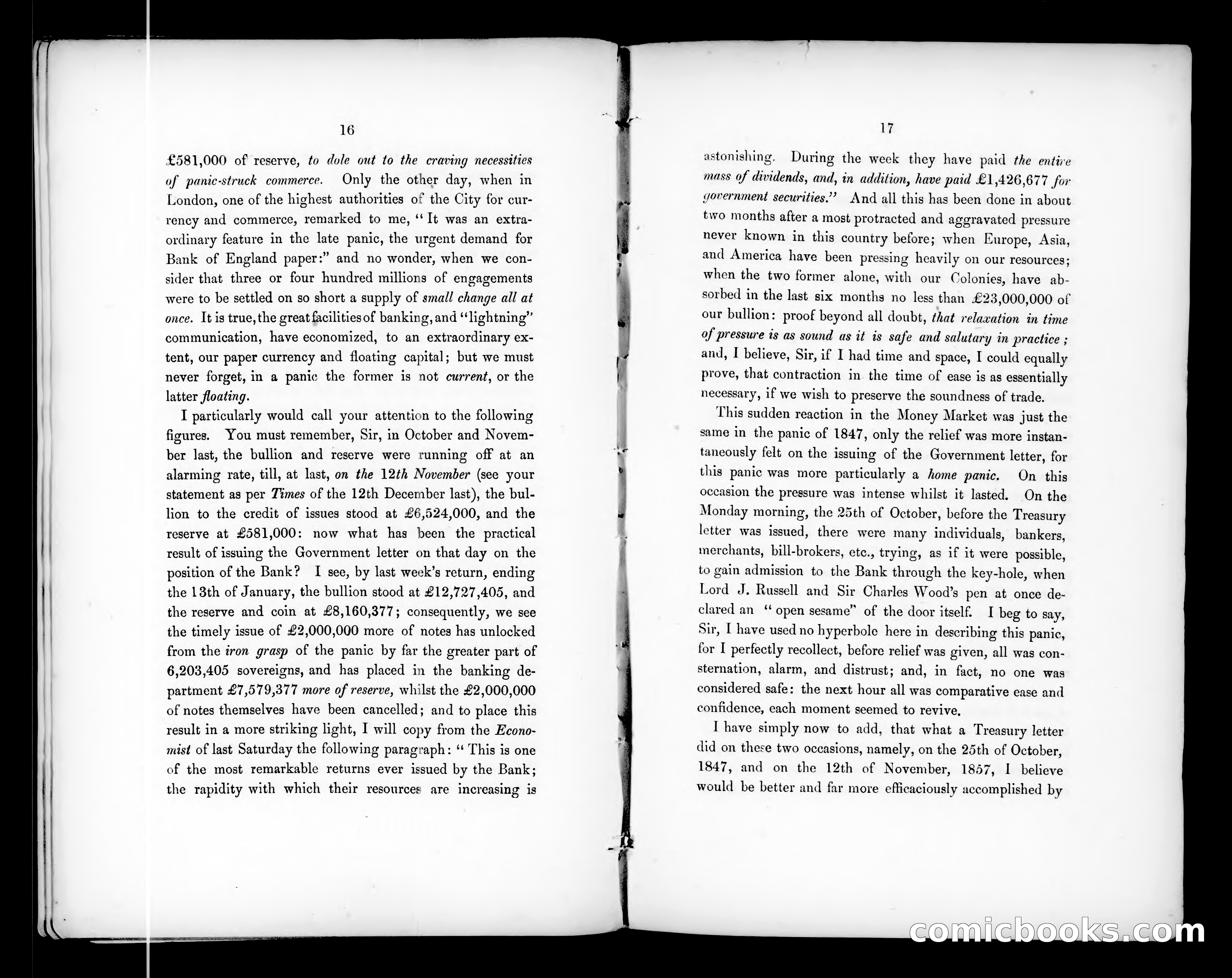
# Victorian Page Analysis This is **running prose text** from pages 16-17 of what appears to be a financial or political pamphlet, not a penny dreadful. The visible text discusses banking crises, specifically the panic of 1847 and another more recent panic (appears to be 1857). The author cites statistics about the Bank of England's bullion and reserve positions, quotes from *The Times* and *The Economist*, and argues that government intervention through Treasury letters effectively relieved financial pressure. The passage compares how relief operated differently in the two panics, describing the 1847 crisis as a "home panic" when desperate individuals and bankers sought admission to the Bank itself before Lord J. Russell and Sir Charles Wood's intervention.
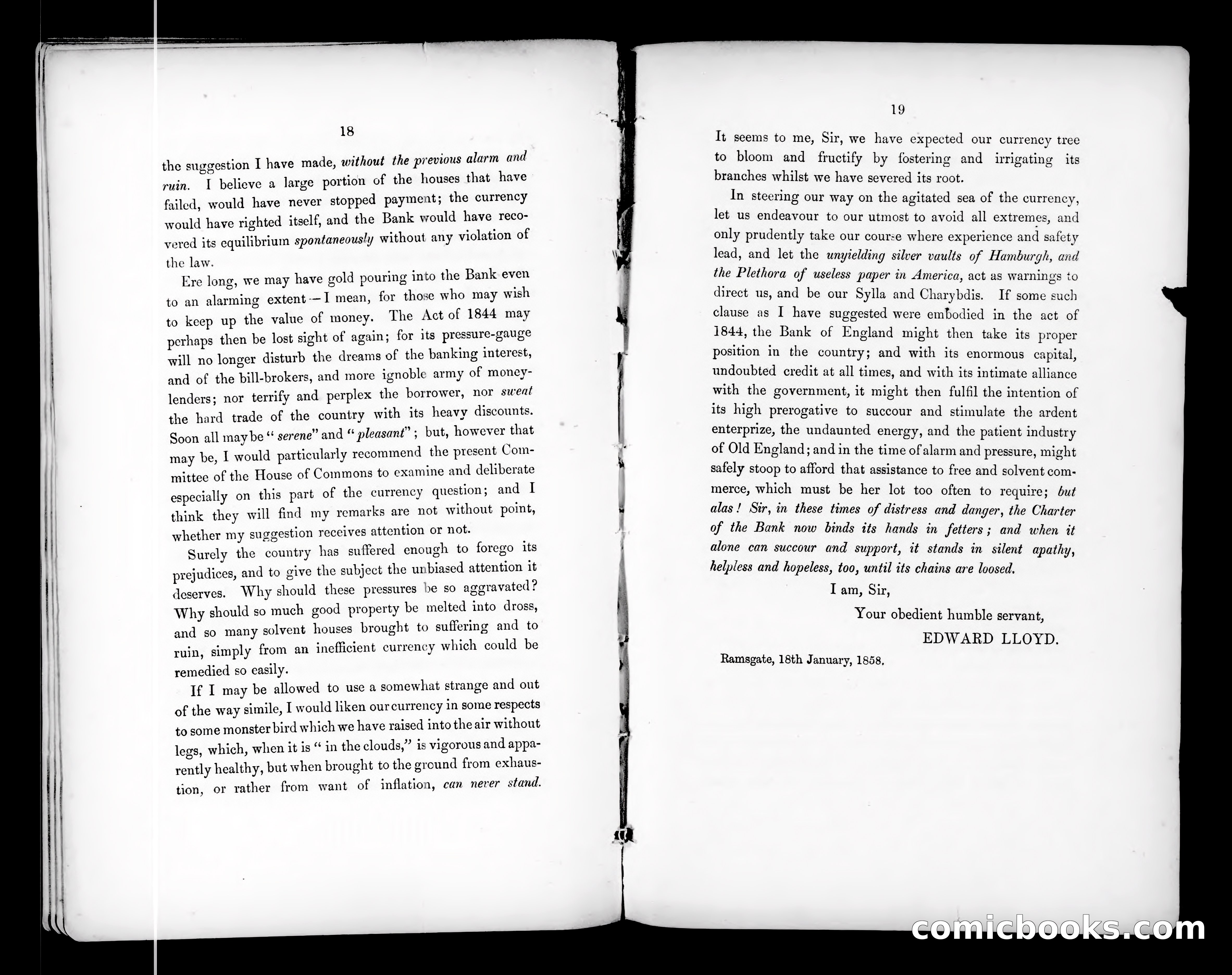
# Page Description This page contains running prose from pages 18-19 of what appears to be a letter or pamphlet concerning British currency policy. The text, signed by Edward Lloyd from Ramsgate dated January 18, 1858, argues for reforms to the Bank of England's Charter of 1844. Lloyd contends that currency restrictions harm solvent businesses and advocates for legislative changes that would allow the Bank greater flexibility to support commerce during financial crises. The prose employs metaphorical language (comparing currency to a flightless monster bird) to illustrate his economic arguments about monetary inflation and deflation.
This page is almost entirely blank with only a reference number "MS4 30515" handwritten at the top and a "comicbooks.com" watermark at the bottom. The OCR text is largely illegible and appears to be corrupted scanning artifacts rather than actual printed content. The page shows no visible illustration, title, heading, or running prose that can be reliably read. It appears to be either a blank leaf from within a bound volume, a severely degraded scan, or an endpaper. Without legible text or imagery, the specific content and purpose of this particular page cannot be determined.

This is a title page or section divider from a Victorian penny dreadful. The page displays only the text "END OF TITLE" in large, bold black letters centered on a plain white background. The stark, minimalist design is typical of these cheap serialized publications, which often used simple typography and formatting to separate different sections or stories. This page marks the conclusion of a title section, likely indicating the end of an introductory or header material before the main narrative or next installment begins. The plain presentation reflects the economical printing methods and modest production values characteristic of penny dreadfuls.