
Penny Dreadfuls, 1858 · page 11 of 14
The Bank Charter Act cannot be maintained... — page 11: what you’re looking at
What you’re looking at
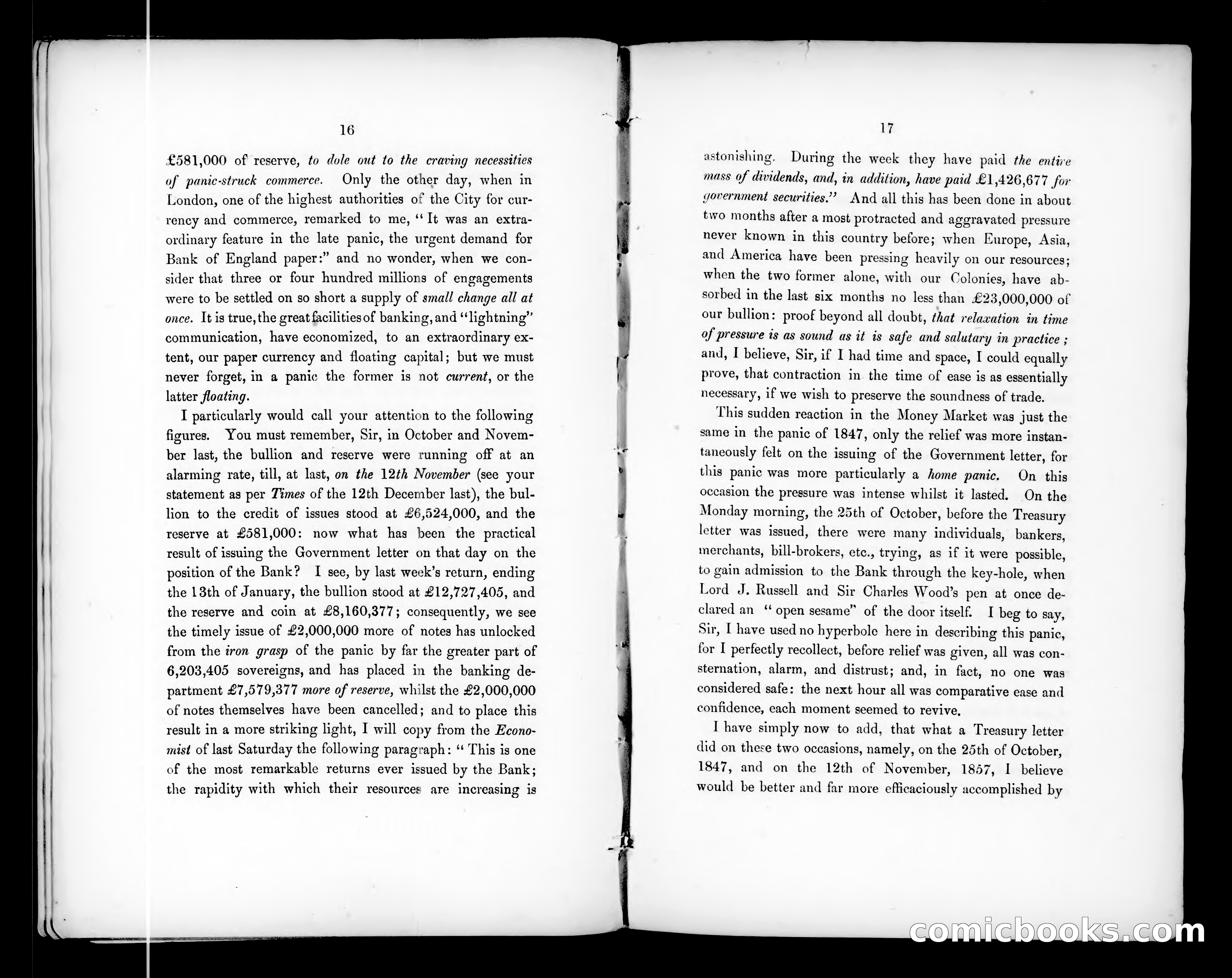
# Victorian Page Analysis This is **running prose text** from pages 16-17 of what appears to be a financial or political pamphlet, not a penny dreadful. The visible text discusses banking crises, specifically the panic of 1847 and another more recent panic (appears to be 1857). The author cites statistics about the Bank of England's bullion and reserve positions, quotes from *The Times* and *The Economist*, and argues that government intervention through Treasury letters effectively relieved financial pressure. The passage compares how relief operated differently in the two panics, describing the 1847 crisis as a "home panic" when desperate individuals and bankers sought admission to the Bank itself before Lord J. Russell and Sir Charles Wood's intervention.
📄 Transcribed text from this page (OCR, searchable)
Machine-transcribed from the original scan — historical spelling and the odd misread are preserved.
16 £581,000 of reserve, to dole out to the craving necessities of panic-struck commerce. Only the other day, when in London, one of the highest authorities of the City for cur- rency and commerce, remarked to me, ‘‘ It was an extra- ordinary feature in the late panic, the urgent demand for Bank of England paper:’ sider that three or four hundred millions of engagements ) and no wonder, when we con- were to be settled on so short a supply of small change all at once. It is true, the great facilitiesof banking, and “lightning” communication, have economized, to an extraordinary ex- tent, our paper currency and floating capital; but we must never forget, in a panic the former is not current, or the latter floating. I particularly would call your attention to the following figures. You must remember, Sir, in October and Novem- ber last, the bullion and reserve were running off at an alarming rate, till, at last, on the 12th November (see your statement as per Zimes of the 12th December last), the bul- lion to the credit of issues stood at £6,524,000, and the reserve at £581,000: now what has been the practical result of issuing the Government letter on that day on the position of the Bank? I see, by last week’s return, ending the 13th of January, the bullion stood at £12,727,405, and the reserve and coin at £8,160,377; consequently, we see the timely issue of £2,000,000 more of notes has unlocked from the iron grasp of the panic by far the greater part of 6,203,405 sovereigns, and has placed in the banking de- partment £7,579,377 more of reserve, whilst the £2,000,000 of notes themselves have been cancelled; and to place this result in a more striking light, I will copy from the Econo- mist of last Saturday the following paragraph: “ This is one of the most remarkable returns ever issued by the Bank; the rapidity with which their resources are increasing is ig : bet | 17 astonishing. During the week they have paid the entire mass of dividends, and, in addition, have paid £1,426,677 for government securities.’ And all this has been done in about two months after a most protracted and aggravated pressure never known in this country before; when Europe, Asia, and America have been pressing heavily on our resources; when the two former alone, with our Colonies, have ab- sorbed in the last six months no less than £23,000,000 of our bullion: proof beyond all doubt, that relaxation in time of pressure is as sound as it is safe and salutary in practice ; and, I believe, Sir, if I had time and space, I could equally prove, that contraction in. the time of ease is as essentially necessary, if we wish to preserve the soundness of trade. This sudden reaction in the Money Market was just the same in the panic of 1847, only the relief was more instan- taneously felt on the issuing of the Government letter, for this panic was more particularly a home panic. On this occasion the pressure was intense whilst it lasted. On the Monday morning, the 25th of October, before the Treasury letter was issued, there were many individuals, bankers, merchants, bill-brokers, ete., trying, as if it were possible, to gain admission to the Bank through the key-hole, when Lord J. Russell and Sir Charles Wood’s pen at once de- clared an ‘ open sesame” of the door itself. I beg to say, Sir, [ have used no hyperbole here in describing this panic, for I perfectly recollect, before relief was given, all was con- sternation, alarm, and distrust; and, in fact, no one was considered safe: the next hour all was comparative ease and confidence, each moment seemed to revive, I have simply now to add, that what a Treasury letter did on these two occasions, namely, on the 25th of October, 1847, and on the 12th of November, 1857, I believe would be better and far more efticaciously accomplished by