
Penny Dreadfuls, 1858 · page 12 of 14
The Bank Charter Act cannot be maintained... — page 12: what you’re looking at
What you’re looking at
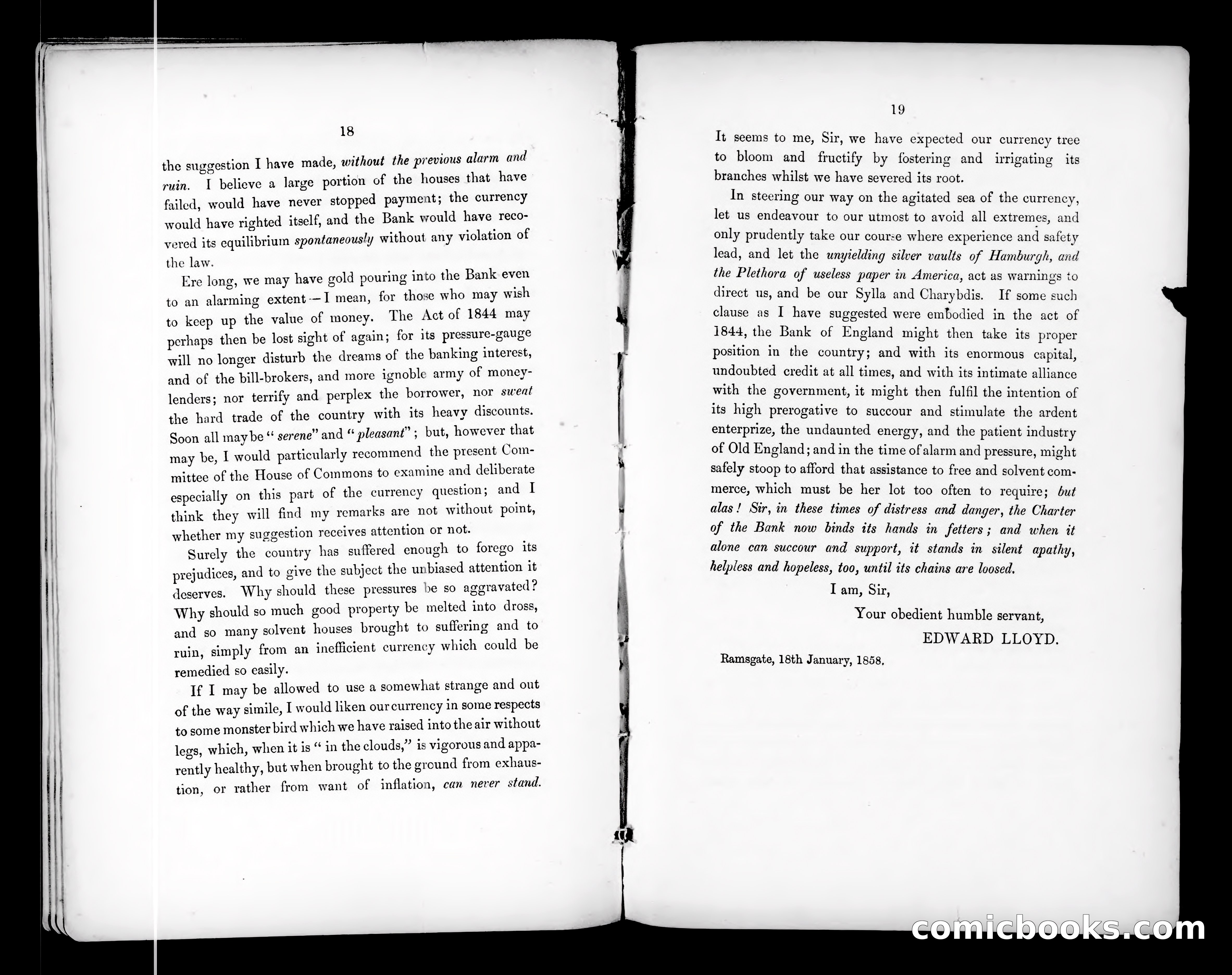
# Page Description This page contains running prose from pages 18-19 of what appears to be a letter or pamphlet concerning British currency policy. The text, signed by Edward Lloyd from Ramsgate dated January 18, 1858, argues for reforms to the Bank of England's Charter of 1844. Lloyd contends that currency restrictions harm solvent businesses and advocates for legislative changes that would allow the Bank greater flexibility to support commerce during financial crises. The prose employs metaphorical language (comparing currency to a flightless monster bird) to illustrate his economic arguments about monetary inflation and deflation.
📄 Transcribed text from this page (OCR, searchable)
Machine-transcribed from the original scan — historical spelling and the odd misread are preserved.
18 the suggestion I have made, without the previous alarm and ruin. 1 believe a large portion of the houses that have failed, would have never stopped payment; the currency would have righted itself, and the Bank would oe vered its equilibrium spontaneously without any violation 0 the law. wns Ere long, we may have gold pouring into the Bank un to an alarming extent —I mean, for those who may wis to keep up the value of money. The Act of 1844 may perhaps then be lost sight of again; for its pressunsiennee will no longer disturb the dreams of the banking interest, and of the bill-brokers, and more ignoble army of money- lenders; nor terrify and perplex the borrower, nee sweat the hard trade of the country with its heavy discounts. Soon all may be “‘ serene” and “ pleasant” ; but, Ramescr Wee may be, I would particularly recommend — present Com- mittee of the House of Commons to examine and deliberate especially on this part of the currency question ; and I think they will find my remarks are not without point, whether my suggestion receives attention or not. Surely the country has suffered enough to forego its prejudices, and to give the subject the unbiased attention deserves. Why should these pressures be so aggravated Why should so much good property be melted = dross, and so many solvent houses brought to suffering and to ruin, simply from an inefficient currency which could be remedied so easily. If I may be allowed to use a somewhat sicange and out of the way simile, I would liken ourcurrency in game cape to some monster bird which we have raised into the air without legs, which, when it is “in the clouds,” is vigorous and appa- rently healthy, but when brought to the ground from exhaus- tion, or rather from want of inflation, can never stand. 19 It seems to me, Sir, we have expected our currency tree to bloom and fructify by fostering and irrigating its branches whilst we have severed its root. In steering our way on the agitated sea of the currency, let us endeavour to our utmost to avoid all extremes, and only prudently take our course where experience and safety lead, and let the unyielding silver vaults of Hamburgh, and the Plethora of useless paper in America, act as warnings to direct us, and be our Sylla and Charybdis. If some such clause as I have suggested were embodied in the act of 1844, the Bank of England might then take its proper position in the country; and with its enormous capital, undoubted credit at all times, and with its intimate alliance with the government, it might then fulfil the intention of its high prerogative to succour and stimulate the ardent enterprize, the undaunted energy, and the patient industry of Old England; and in the time of alarm and pressure, might safely stoop to afford that assistance to free and solvent com- merce, which must be her lot too often to require; but alas! Sir, in these times of distress and danger, the Charter of the Bank now binds its hands in fetters; and when it alone can succour and support, it stands in silent apathy, helpless and hopeless, too, until its chains are loosed. I am, Sir, Your obedient humble servant, EDWARD LLOYD. Ramsgate, 18th January, 1858,