
Penny Dreadfuls, 1858 · page 9 of 14
The Bank Charter Act cannot be maintained... — page 9: what you’re looking at
What you’re looking at
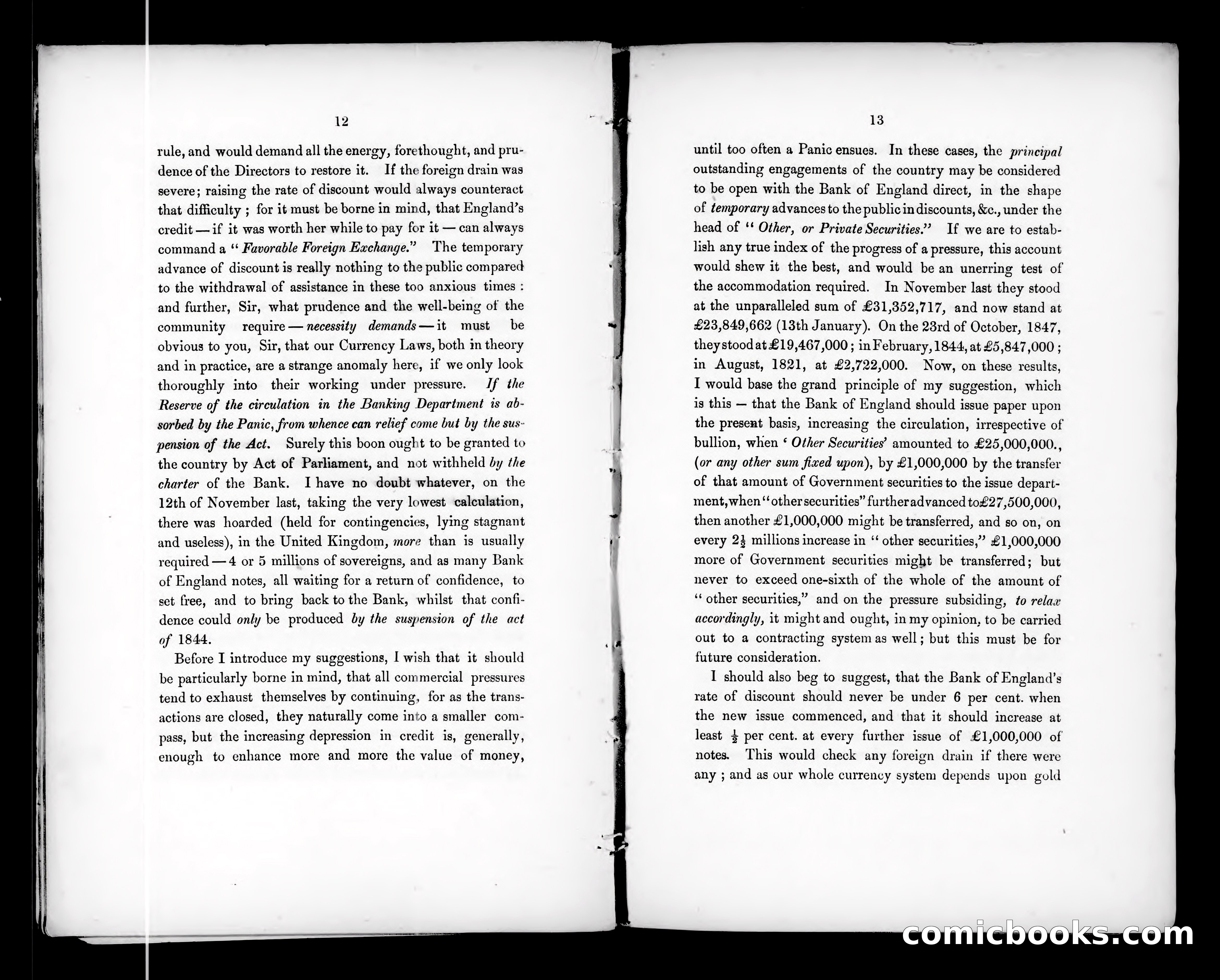
# Victorian Document Analysis This is **running prose** from pages 12-13 of what appears to be a Victorian-era financial or political document—likely a pamphlet or parliamentary paper rather than penny dreadful fiction. The text discusses Bank of England monetary policy, currency regulations, and banking crises, arguing for reforms to the Banking Act of 1844. The author presents statistical evidence about discounts and securities from various dates (1821, 1844, 1847) to support proposals for managing financial panics through flexible note issuance. This is serious economic commentary, not serialized sensation fiction.
📄 Transcribed text from this page (OCR, searchable)
Machine-transcribed from the original scan — historical spelling and the odd misread are preserved.
12 rule, and would demand all the energy, forethought, and pru- dence of the Directors to restore it. If the foreign drain was severe; raising the rate of discount would always counteract that difficulty ; for it must be borne in mind, that England’s credit —if it was worth her while to pay for it — can always command a * Favorable Foreign Exchange.” The temporary advance of discount is really nothing to the public compared to the withdrawal of assistance in these too anxious times : and further, Sir, what prudence and the well-being of the community require— necessity demands—it must be obvious to you, Sir, that our Currency Laws, both im theory and in practice, are a strange anomaly here, if we only look thoroughly into their working under pressure. Jf the Reserve of the circulation in the Banking Department 1s ab- sorbed by the Panic, from whence can relief come but by the sus- pension of the Act. Surely this boon ought to be granted to the country by Act of Parliament, and not withheld by the charter of the Bank. Ihave no doubt whatever, on the 12th of November last, taking the very lowest calculation, there was hoarded (held for contingencies, lying stagnant and useless), in the United Kingdom, more than is usually required — 4 or 5 millions of sovereigns, and as many Bank of England notes, all waiting for a return of confidence, to set free, and to bring back to the Bank, whilst that confi- dence could only be produced by the suspension of the act of 1844. Before I introduce my suggestions, I wish that it should be particularly borne in mind, that all commercial pressures tend to exhaust themselves by continuing, for as the trans- actions are closed, they naturally come into a smaller com- pass, but the increasing depression in credit is, generally, enough to enhance more and more the value of money, 13 until too often a Panic ensues. In these cases, the principal outstanding engagements of the country may be considered to be open with the Bank of England direct, in the shape of temporary advances to the public in discounts, &c., under the head of ‘* Other, or Private Securities.’ If we are to estab- lish any true index of the progress of a pressure, this account would shew it the best, and would be an unerring test of the accommodation required. In November last they stood at the unparalleled sum of £31,352,717, and now stand at £23,849 ,662 (13th January). On the 28rd of October, 1847, they stood at £19,467 ,000; in February, 1844, at £5,847 ,000 ; in August, 1821, at £2,722,000. Now, on these results, I would base the grand principle of my suggestion, which is this — that the Bank of England should issue paper upon the present basis, increasing the circulation, irrespective of bullion, when ‘ Other Securities’ amounted to £25,000,000., (or any other sum fixed upon), by £1,000,000 by the transfer of that amount of Government securities to the issue depart- ment, when “ other securities” furtheradvanced to£27,500,000, then another £1,000,000 might be transferred, and so on, on every 23 millions increase in ‘ other securities,” £1,000,000 more of Government securities might be transferred; but never to exceed one-sixth of the whole of the amount of ‘‘ other securities,” and on the pressure subsiding, to relax accordingly, it might and ought, in my opinion, to be carried out to a contracting system as well; but this must be for future consideration. I should also beg to suggest, that the Bank of England’s rate of discount should never be under 6 per cent. when the new issue commenced, and that it should increase at least 4 per cent. at every further issue of £1,000,000 of notes. This would check any foreign drain if there were any ; and as our whole currency system depends upon gold