
A complete issue · 36 pages · 1929
Life — January 11, 1929
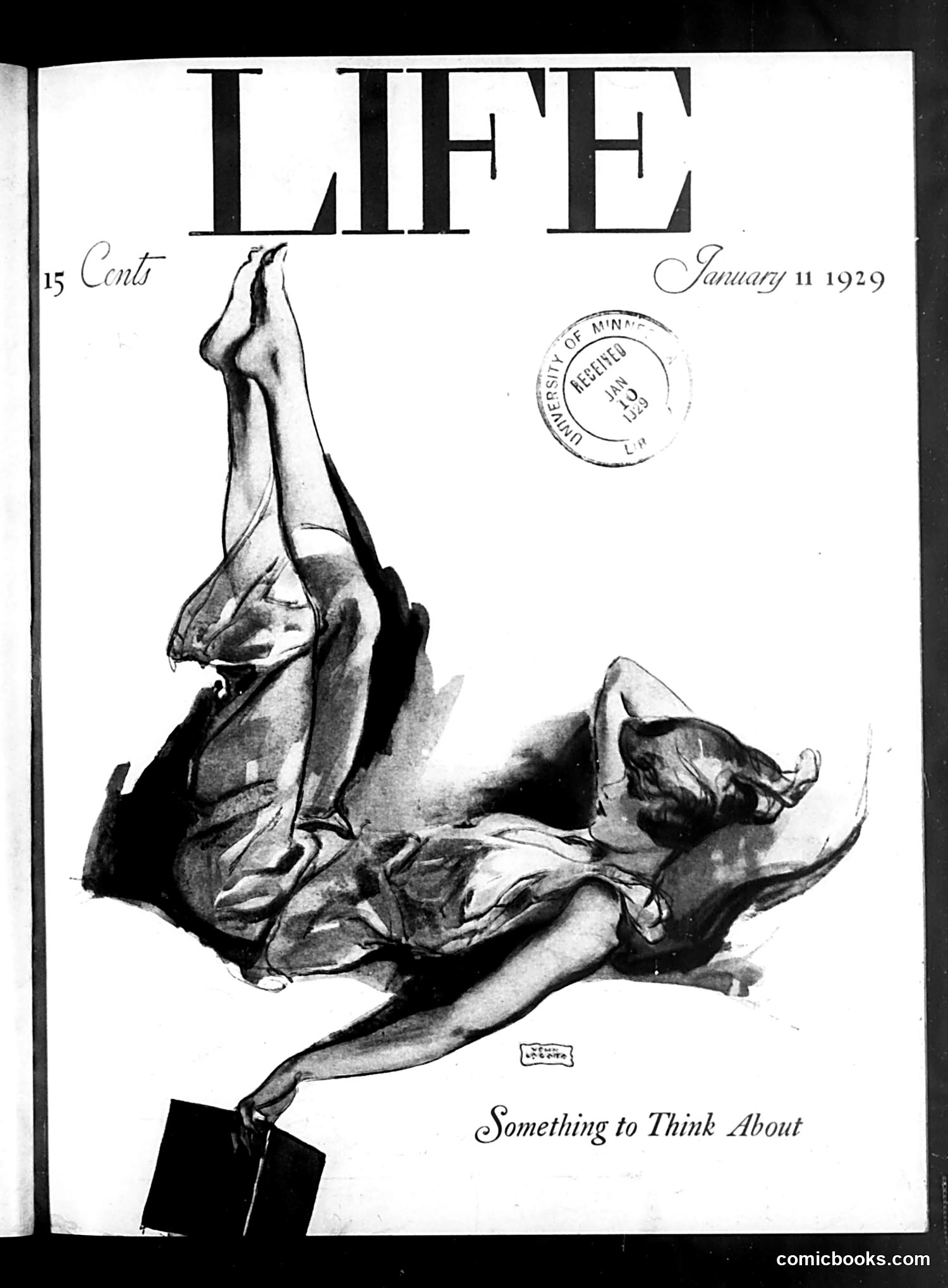
This cover illustrates "Something to Think About"—likely commentary on the Stock Market Crash of October 1929 and its aftermath. The figure tumbling upside-down with legs in the air appears to represent an investor or speculator caught in financial freefall. The dramatic pose, with one shoe flying off, emphasizes the sudden loss of control and dignity. The $15 cent price and 1929 date place this during the Great Depression's onset. The satirical title suggests readers should contemplate the consequences of speculative excess and market volatility. The visual metaphor of literal falling captures the era's economic shock and the public's anxieties about wealth disappearing overnight.
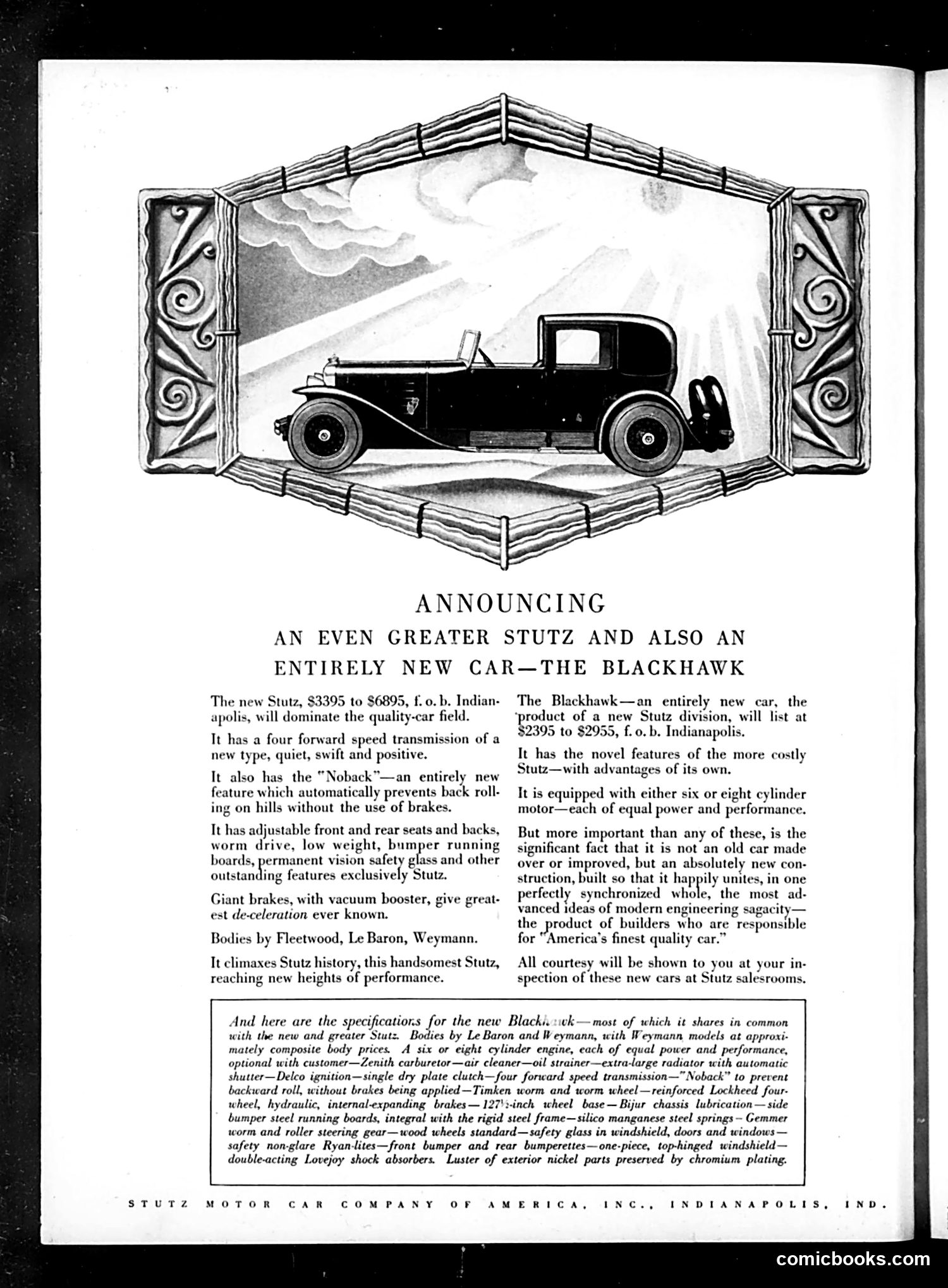
This is **not a cartoon or satire page** — it's a **straightforward automobile advertisement** from Stutz Motor Car Company of Indianapolis, Indiana. The page announces two vehicles: an improved Stutz (priced $3,395–$6,895) and an entirely new model called the Blackhawk ($2,395–$2,955). The illustration shows a luxury automobile displayed in an ornate wooden frame, emphasizing its prestige. The ad highlights technical features: four-speed transmission, "Noback" anti-rollback brakes, adjustable seats, and optional six or eight-cylinder engines. Bodies were made by prestigious coachbuilders Le Baron and Weymann. This represents typical 1920s luxury car marketing, targeting wealthy buyers with detailed mechanical specifications and craftsmanship appeals. There is no political satire or social commentary present — it's purely commercial promotion.
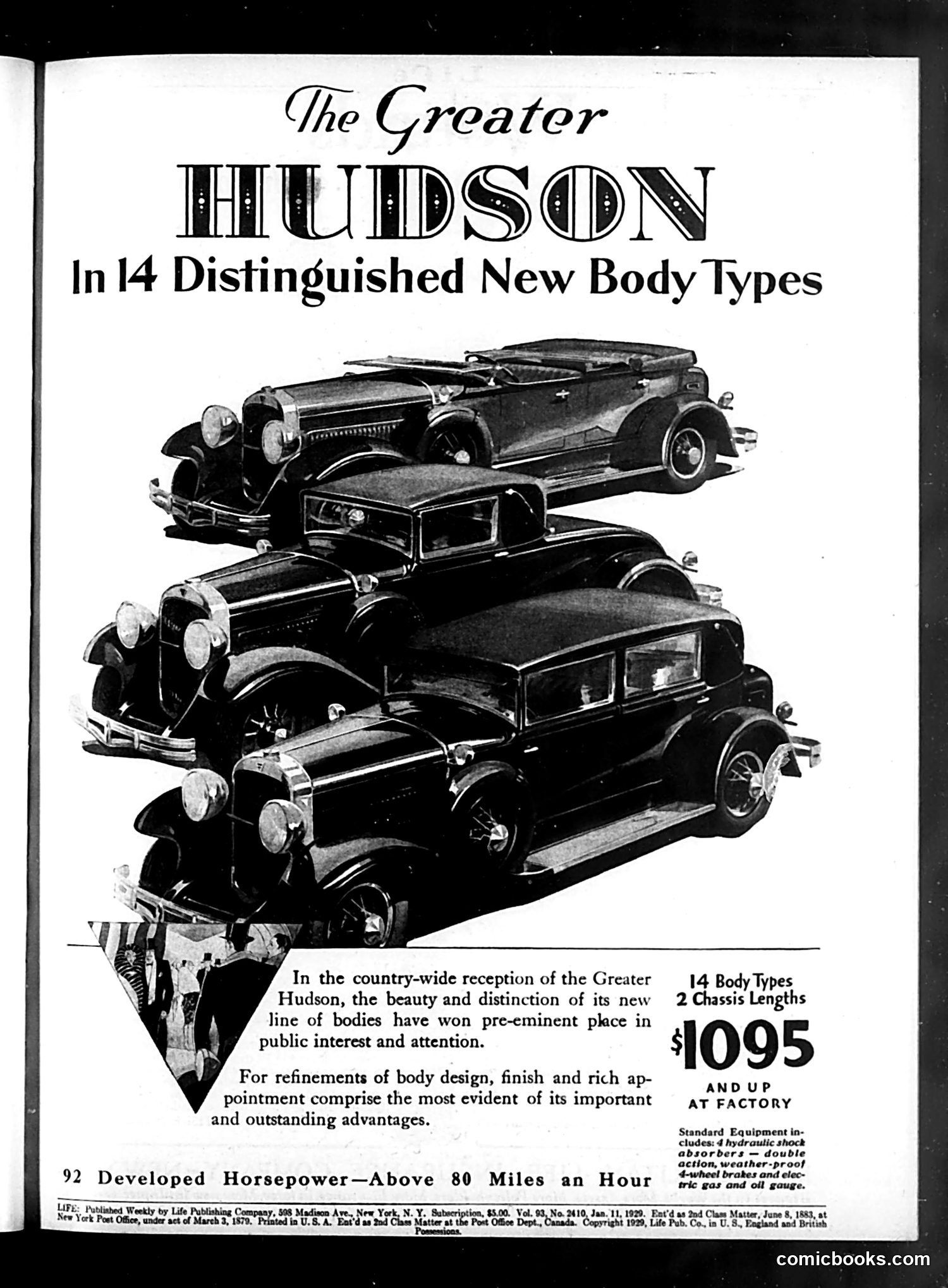
This is **not a cartoon or satire page**—it's a **straightforward automobile advertisement** for Hudson automobiles, published in Life magazine (January 11, 1929, based on the footer). The page advertises "The Greater Hudson" in 14 new body types, priced from $1,095 and up. The image shows four different Hudson car models stacked vertically to display the variety of body styles available. The marketing emphasizes features like "92 Developed Horsepower," "Above 80 Miles an Hour," and refinements in "body design, finish and rich appointment." This represents typical 1920s automobile advertising—offering consumers multiple configurations of the same chassis. There is no political satire or social commentary present; this is purely commercial content appearing in what was primarily a humor magazine.
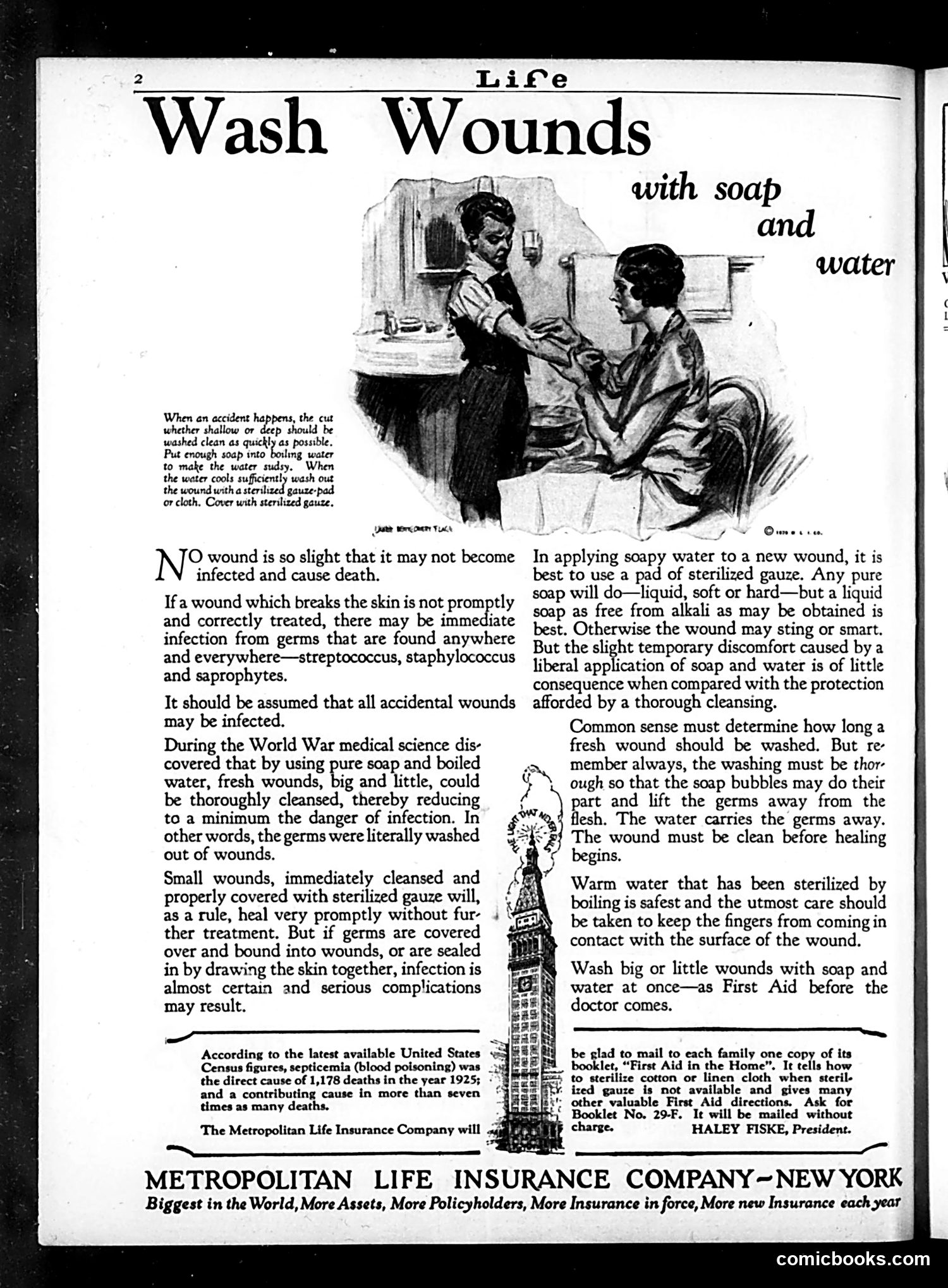
This is **not satire or political cartoon**, but rather a **public health advertisement** by Metropolitan Life Insurance Company. The illustration shows a nurse or caregiver washing a wound on a patient's arm. The ad promotes basic first aid hygiene—washing wounds with soap and boiled water—during an era (appearing to be 1920s based on the census reference to 1925) when infection from minor injuries was a serious cause of death. The text explains that even small wounds could become life-threatening if not properly cleaned, and that germs could be "literally washed out" through thorough soap and water treatment. This represents early 20th-century public health education, when companies used advertising to promote medical practices that reduced mortality and insurance payouts.
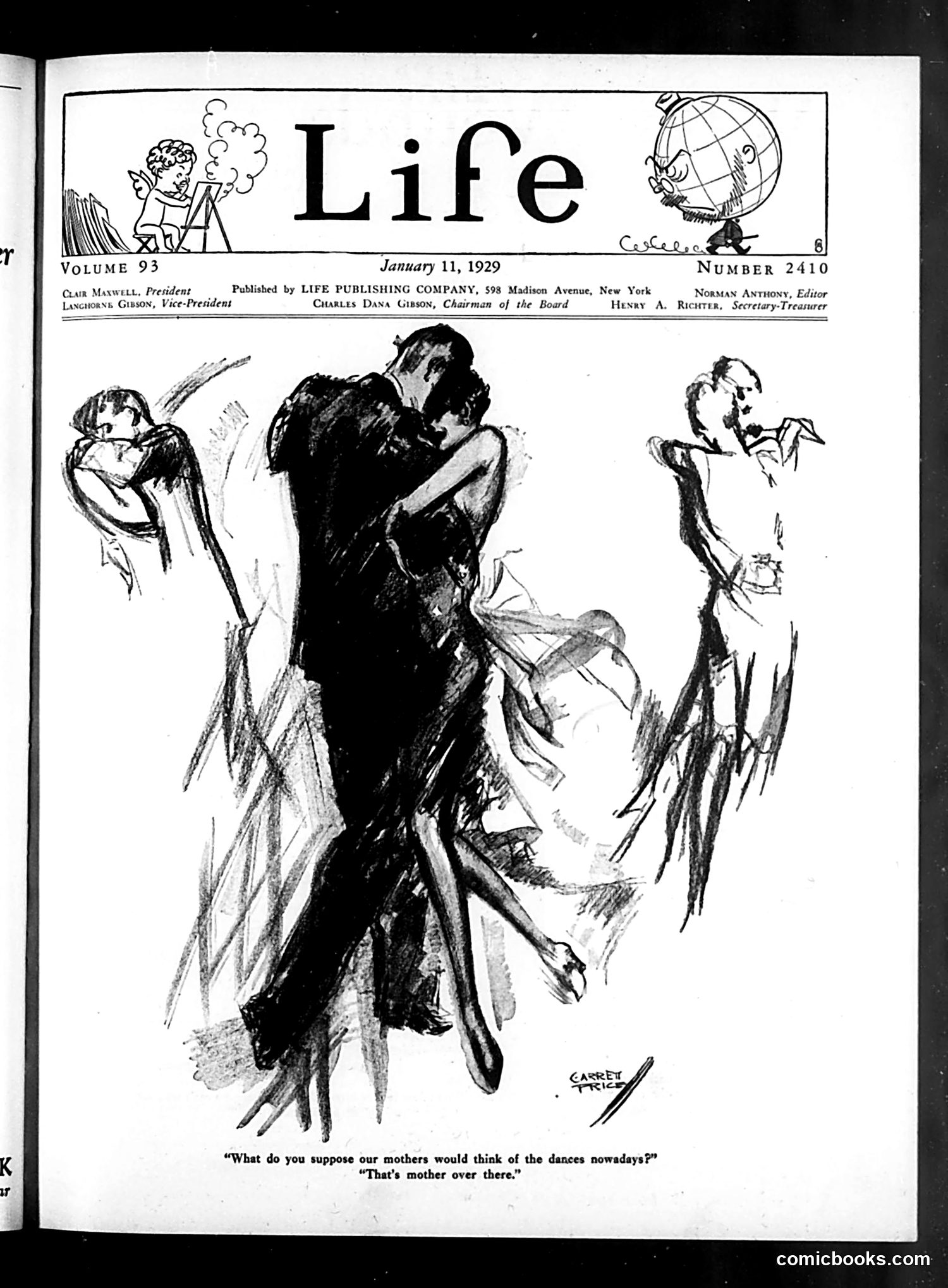
This cover cartoon by Carrey Price satirizes modern dancing of the Jazz Age. Three figures perform energetic, loose-limbed dances in a style that would have seemed scandalous to older generations. The caption reads: "What do you suppose our mothers would think of the dances nowadays?" "That's mother over there." The joke plays on generational anxiety about changing social norms. The 1920s saw dramatic shifts in youth culture—shorter skirts, jazz music, and uninhibited dancing shocked conservative parents. The punchline's implication that "mother" (representing the older generation) is herself dancing suggests that despite moral disapproval, even parents were adopting these modern behaviors. It's gentle satire on the gap between public disapproval and private participation in Jazz Age culture.
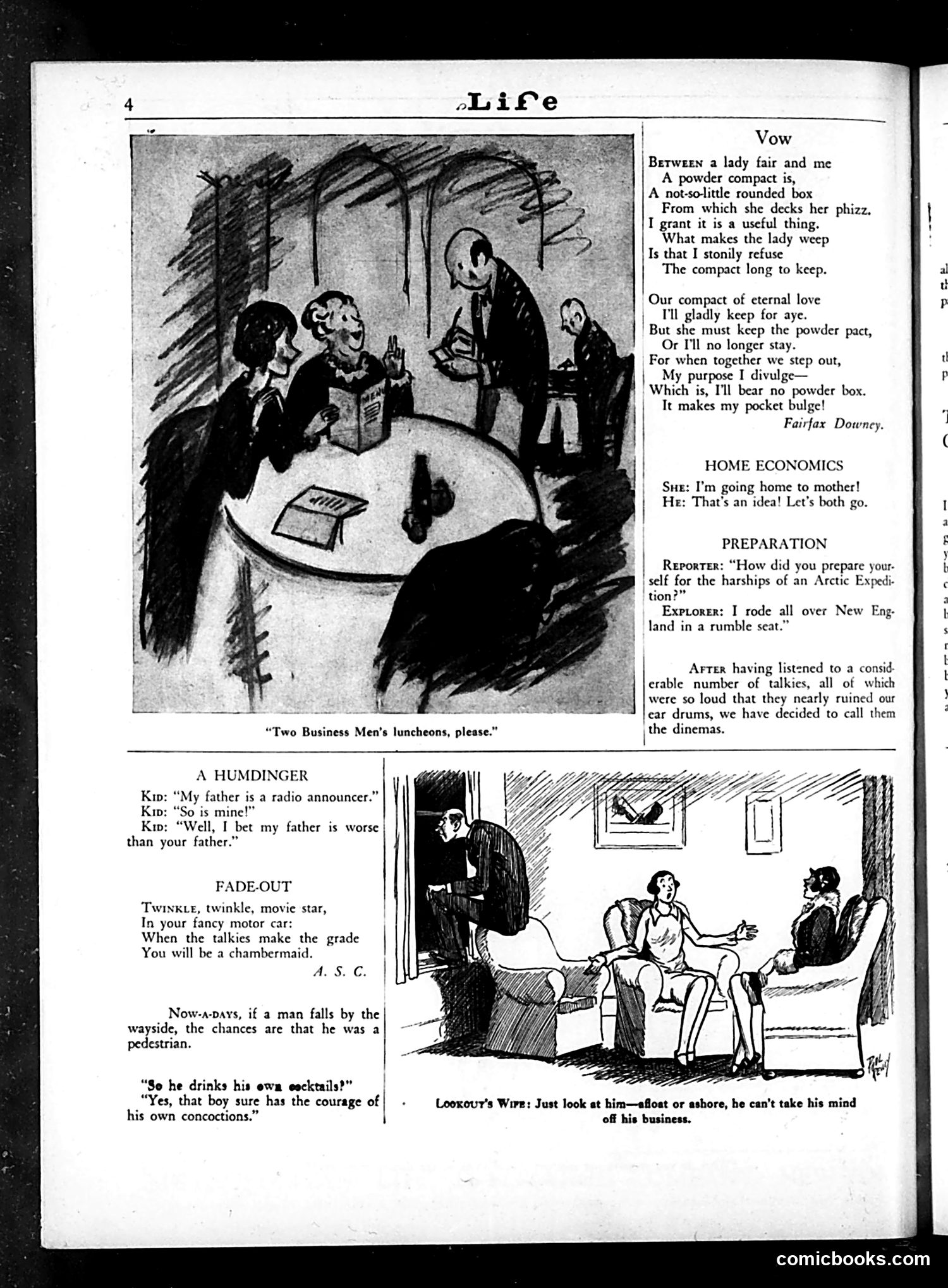
**Main Cartoon ("Two Business Men's luncheions, please"):** The top cartoon satirizes business culture by depicting two formally-dressed men at a restaurant table where the waiter presents an enormous powder compact instead of food. The joke mocks the pretense and frivolity of businessmen—suggesting they're so obsessed with appearance and vanity that they'd order cosmetics for lunch. It's social satire on masculine vanity and commercial superficiality. **Other Sections:** The page contains miscellaneous humor pieces: "A Humdinger" (children's joke), "Fade-Out" (movie-star verse), and social commentary on gender dynamics ("Lookout's Wife"). The bottom cartoon depicts a domestic scene where a wife observes her husband's distraction with business matters, commenting on his inability to focus on their relationship. The overall theme critiques commercialism, vanity, and work-life imbalance in 1920s-30s American society.
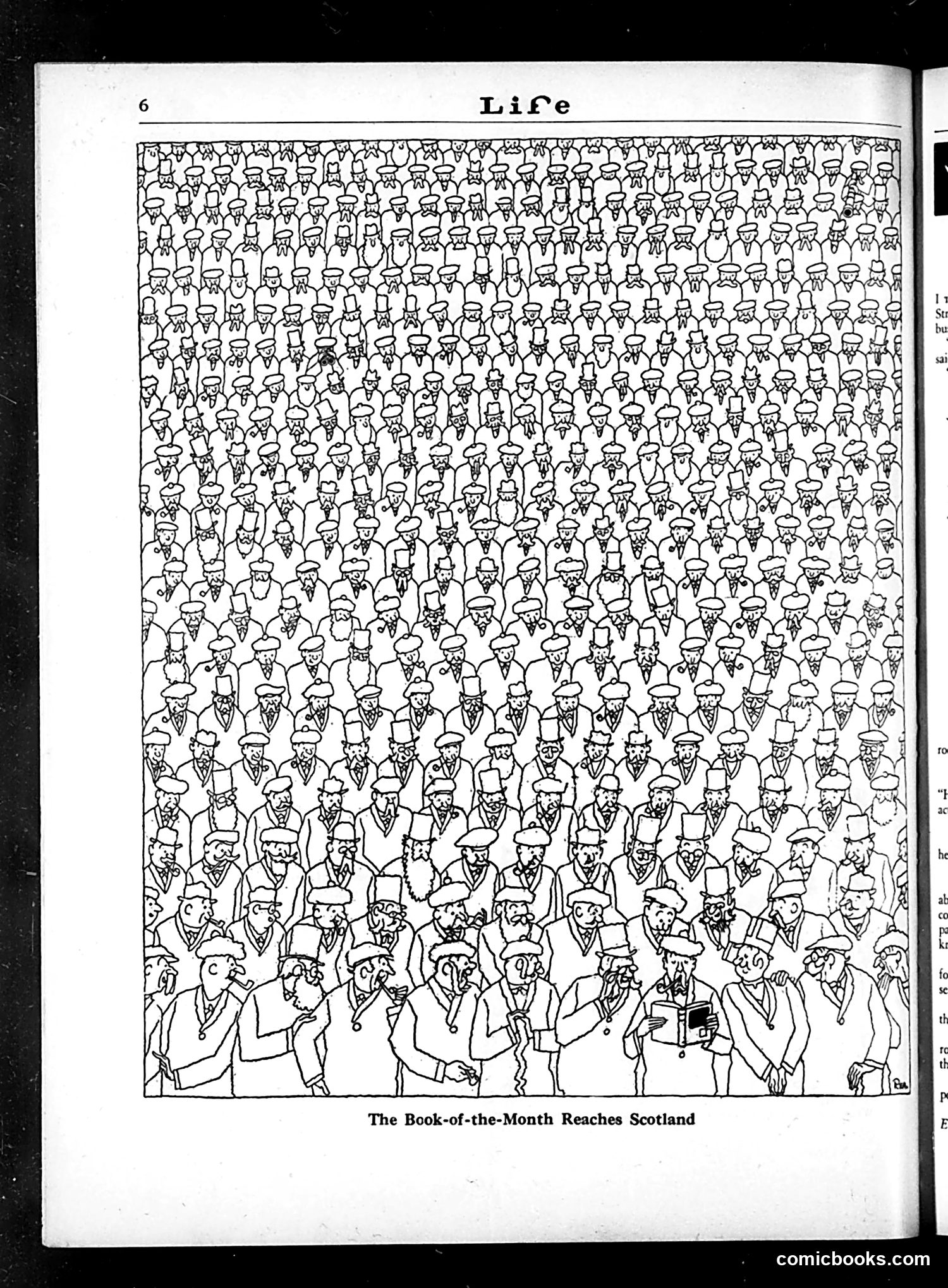
This cartoon satirizes the **Book-of-the-Month Club**, a popular American subscription service that mailed selected books to members monthly. The image shows a massive crowd of identical, conventionally-dressed men wearing hats and formal attire, with a small group of distinguished-looking figures (appearing to be club organizers or intellectuals) at the bottom presenting books. The satire targets **standardization and conformity** in American culture—the implication that the Book-of-the-Month Club produces uniform, mass-market taste rather than individual literary judgment. The title's reference to Scotland suggests the club's reach extending beyond America into the UK, emphasizing its growing commercial ubiquity. The sea of identical figures visually reinforces the joke about mass-produced culture and loss of individuality.
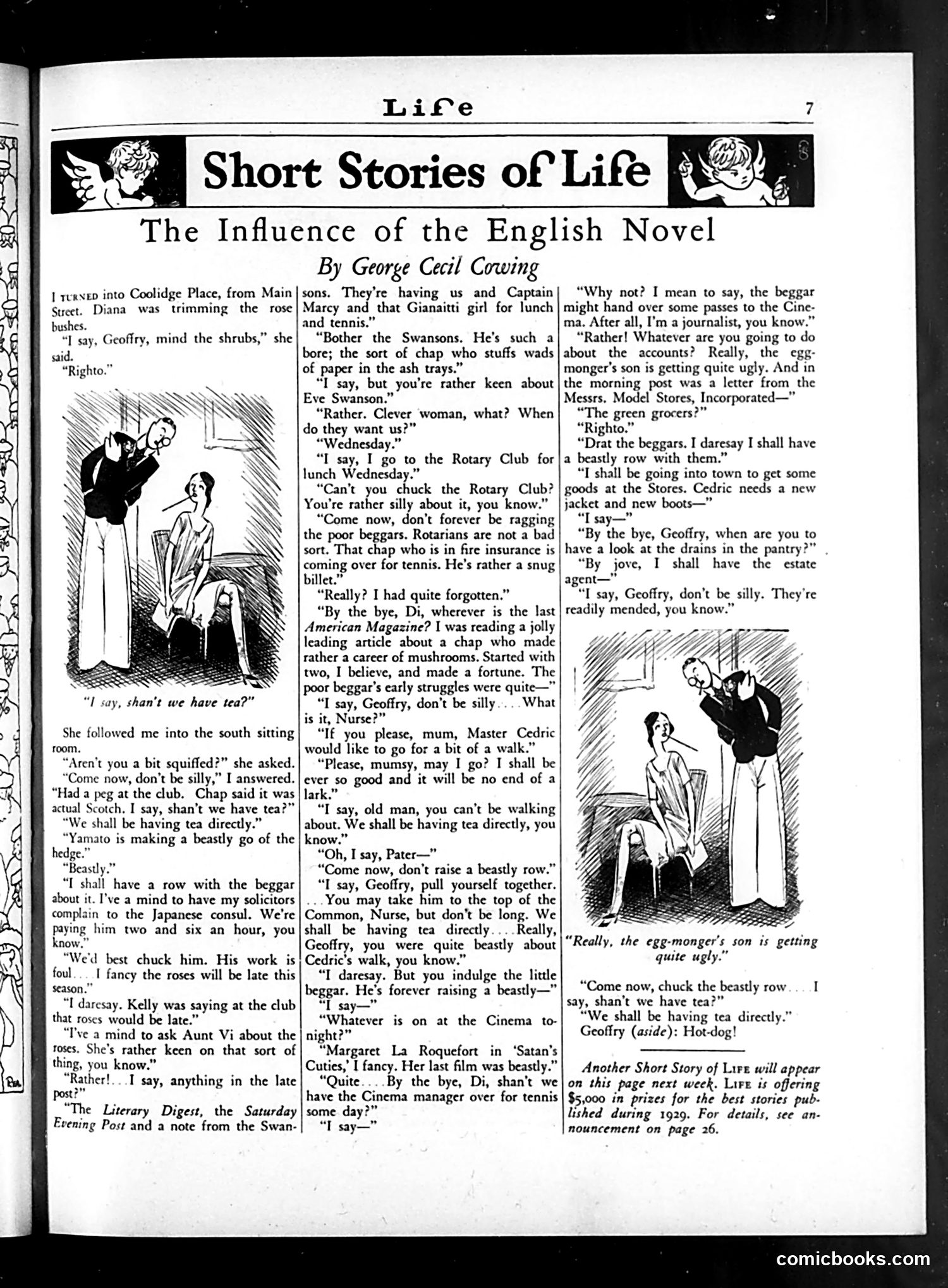
This satirical short story mocks the pretensions of upper-middle-class British society, specifically how people adopt affected mannerisms and concerns from reading novels. The narrative follows characters obsessed with appearing cultured—they reference the "Rotary Club," discuss trendy cinema, worry about rose gardens, and fret over servants and beggars. The satire targets how English novel-reading has made these characters overly dramatic, snobbish, and ridiculous in their everyday interactions. References to "Margaret La Roquefort" and concerns about whether to allow servants walks poke fun at both literary affectation and class anxiety. The illustrations show the characters in their drawing rooms, embodying the pretension the text mocks.
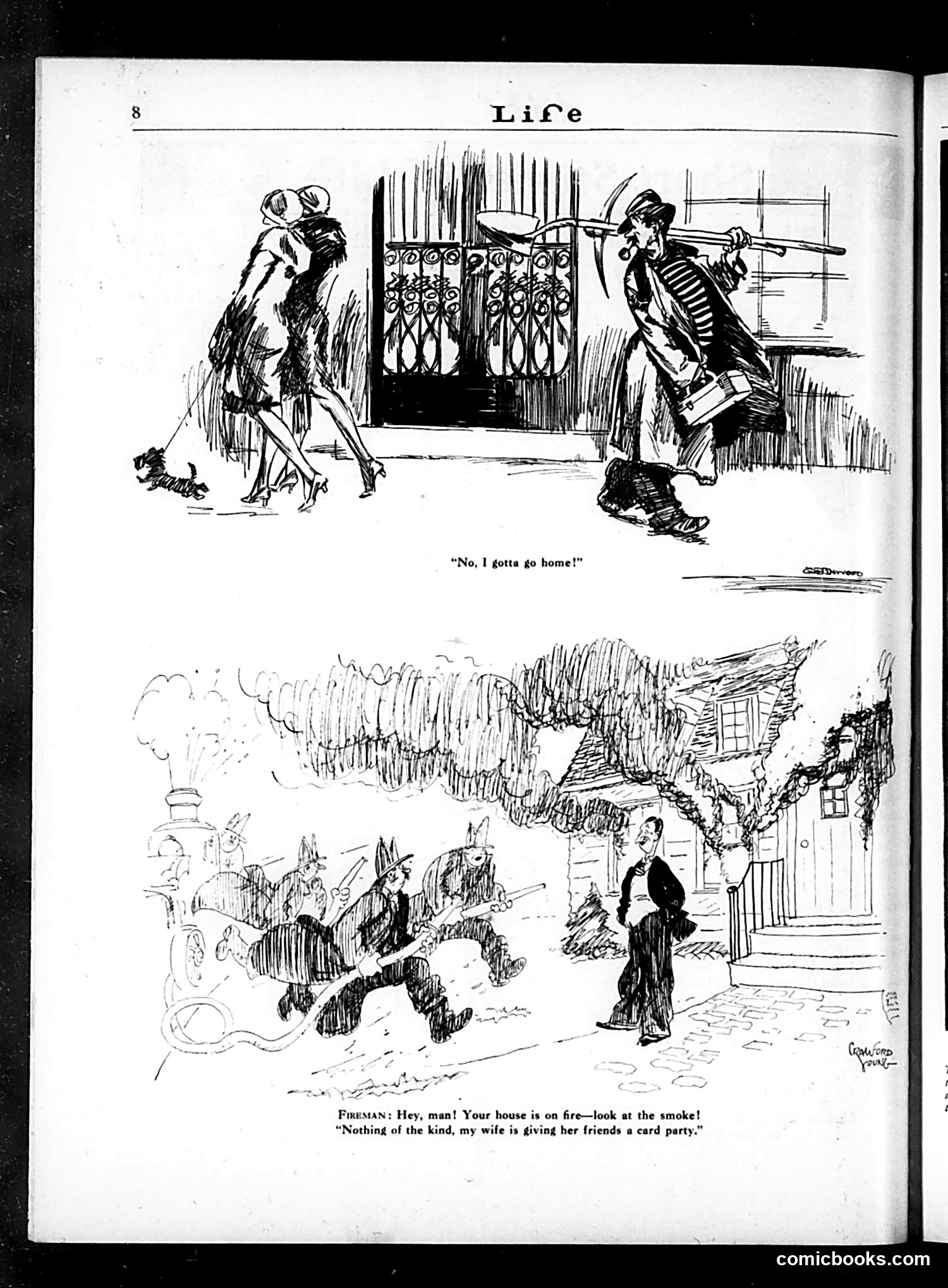
This page contains two satirical cartoons about domestic life and priorities: **Top cartoon** ("No. I gotta go home!"): A woman appears to be escaping or resisting a military officer's advances, suggesting tension between romantic pursuit and duty/propriety. **Bottom cartoon**: A fireman alerts a homeowner that his house is on fire, but the man dismisses the emergency, explaining his wife is hosting a card party. The satire mocks misplaced priorities—treating a social gathering as more important than a literal house fire. This reflects early 20th-century social commentary about domestic life and the perceived frivolousness of upper-class social activities among women, positioning a card party as absurdly prioritized over genuine danger. Both cartoons use exaggeration and situational humor typical of *Life* magazine's satirical style.
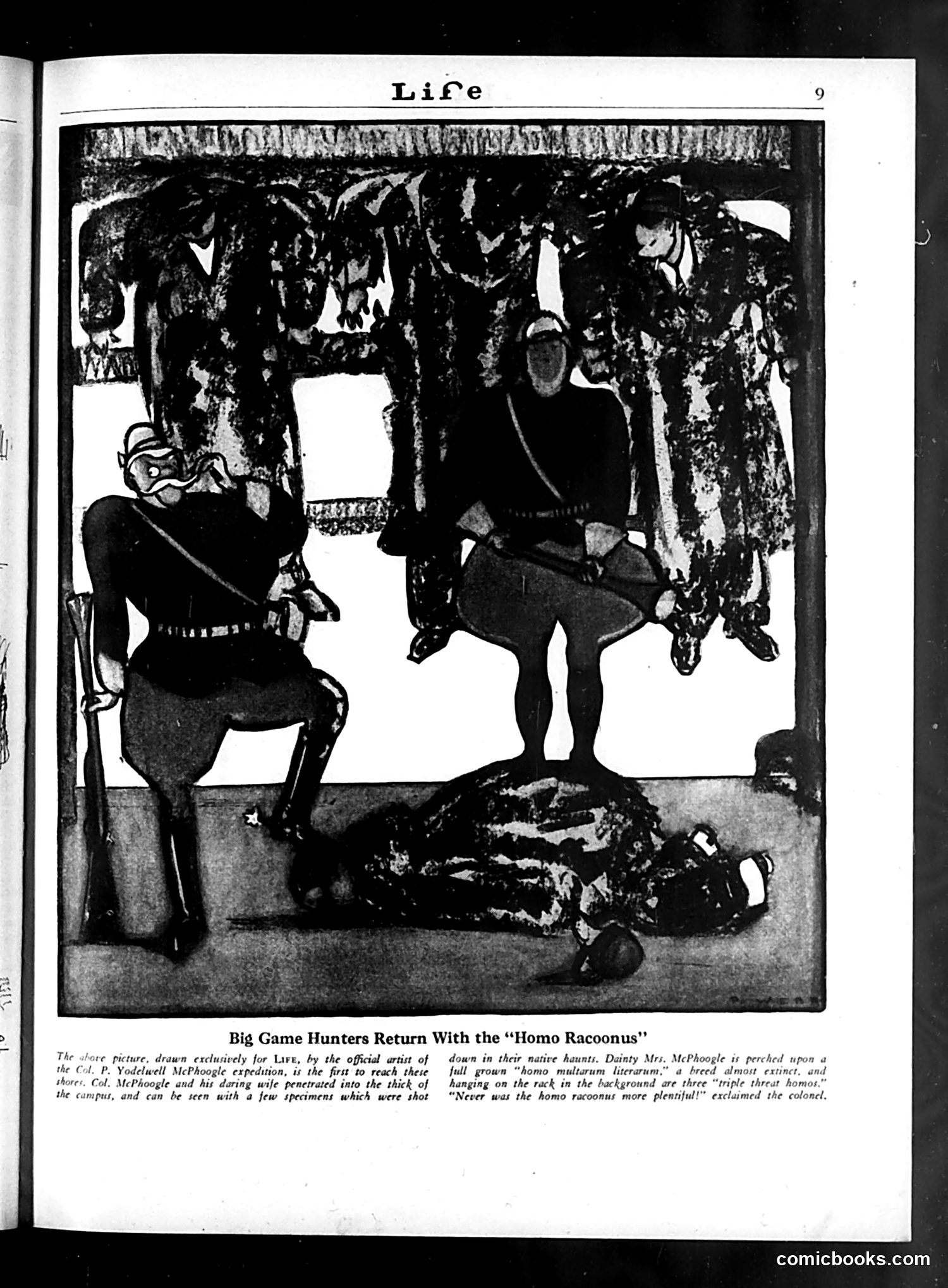
This satirical illustration mocks an expedition by Colonel P. Vosdewell McPhoogle and his wife, who claim to have discovered a previously unknown species called "homo mulierum litteratum"—literally "woman of letters" or educated woman. The cartoon presents the "discovery" as a stuffed specimen hanging alongside other game trophies, with hunters posing proudly beside it. The satire targets early 20th-century attitudes dismissing educated women as curiosities or oddities rather than normal members of society. By framing an intelligent woman as a rare "big game" find worthy of mounted display, the cartoon ridicules both the hunters' condescension and the broader cultural resistance to women's intellectual advancement and independence.
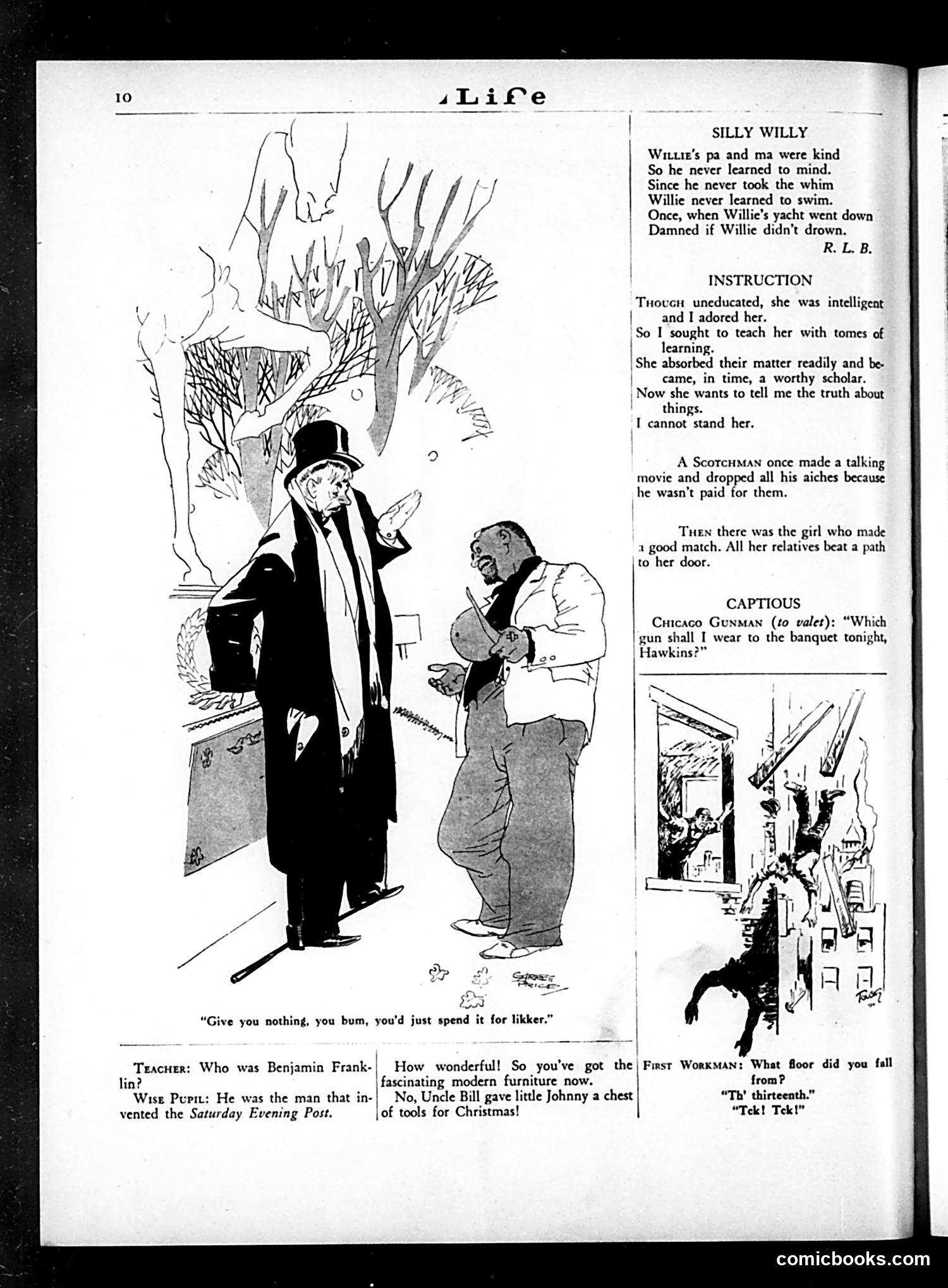
This page contains several brief humorous items typical of early 20th-century Life magazine. The main cartoon shows a well-dressed man in a top hat speaking to a shabby beggar, with the caption: "Give you nothing, you bum, you'd just spend it for likker." The humor targets hypocrisy—the wealthy man's moral judgment of the poor while implying alcoholism was their vice. The "Silly Willy" poem mocks parental permissiveness, suggesting that indulgent parents who spare the rod create incompetent adults (the drowning reference). "Instruction" satirizes educated women becoming insufferable pedants after learning. "Captious" features a Chicago gangster's concern about appropriate banquet attire—dark satire about violent criminals adopting social pretense. The remaining items are brief anecdotes mocking teachers, Christmas materialism, and workplace accidents.
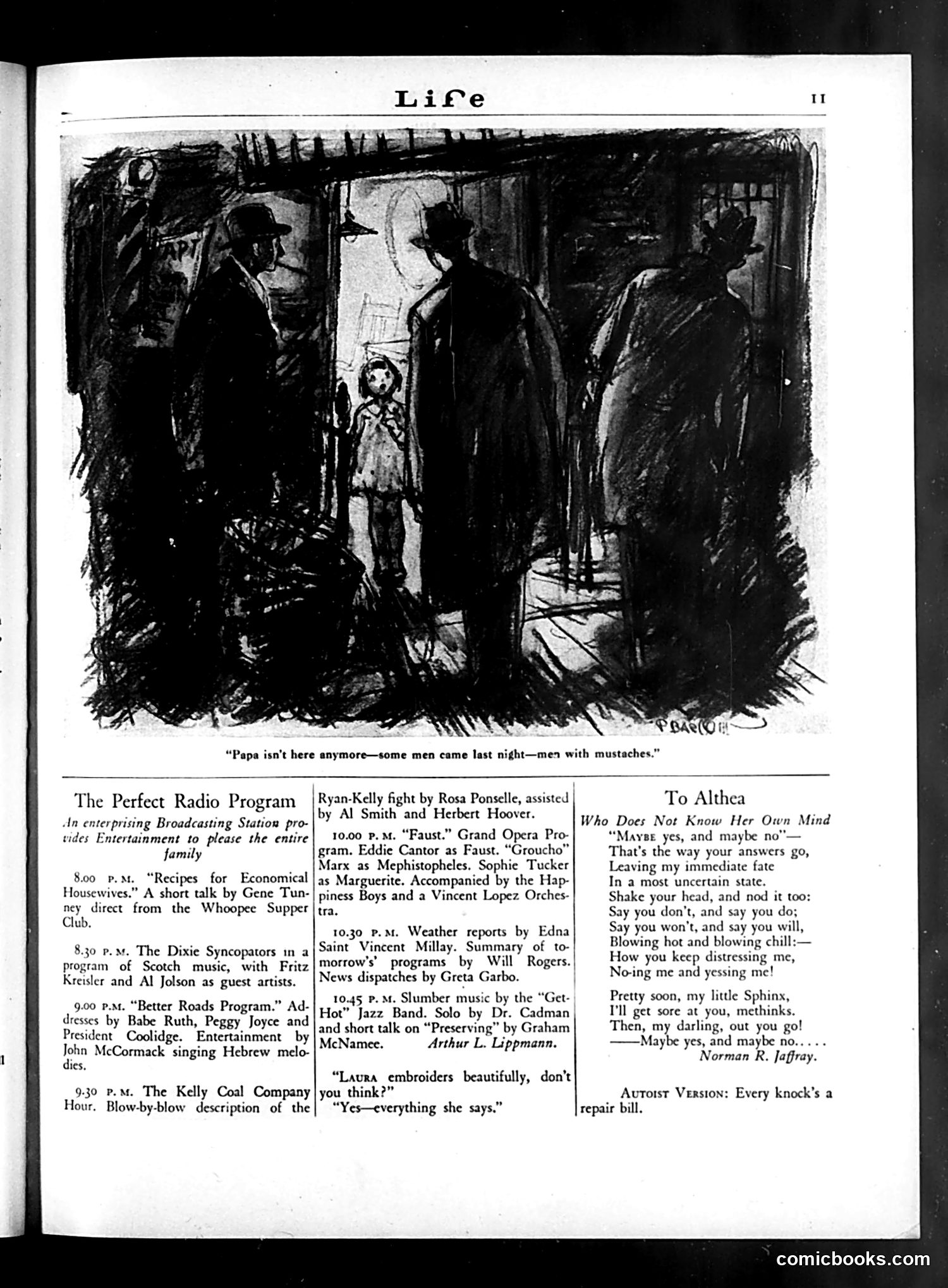
This Life magazine cartoon depicts a poignant social scene: a small child stands alone among tall, dark-silhouetted adult figures in what appears to be a crowded indoor space. The caption reads: "Papa isn't here anymore—some men came last night—men with mustaches." The image likely references the **disappearance or death of a father**, with "men with mustaches" being a veiled reference to authoritarian figures or police. Given Life's satirical nature and this being from the early-to-mid 20th century, this probably comments on **social upheaval, political persecution, or organized crime**—situations where men were taken away in the night, leaving families bereaved and confused. The child's isolation among towering adults emphasizes the vulnerability and abandonment created by such events. The satirical context suggests social commentary on power, loss, and the human cost of political or criminal violence.
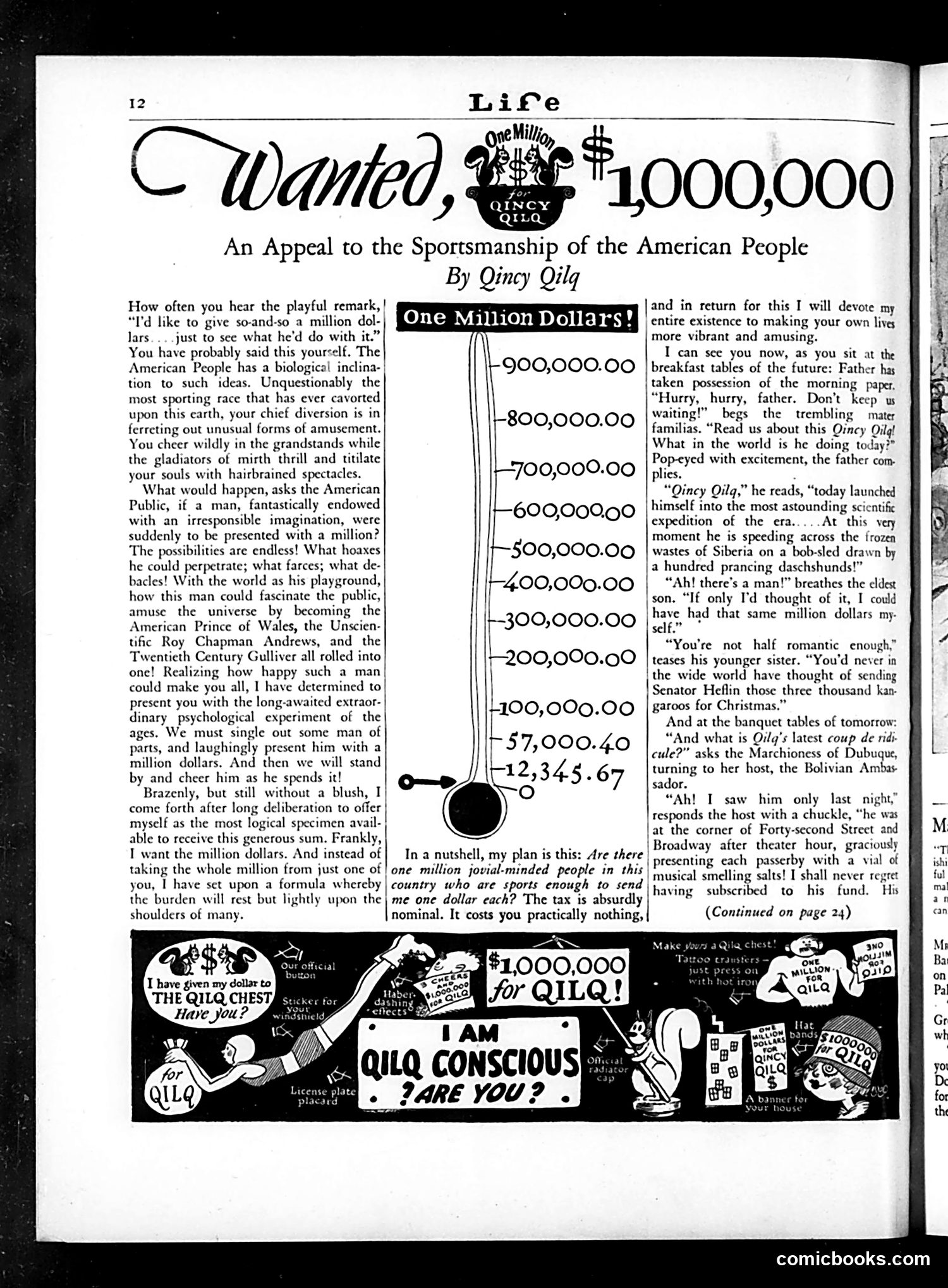
This satirical piece by Quincy Qilq mocks the American obsession with wealth and spectacle. The central thermometer visual shows someone (Qilq himself, apparently) offering to undertake an outlandish stunt—described as a dangerous scientific expedition across frozen Siberia by dogsled—in exchange for $1 million from the American public. The satire targets two things: (1) wealthy Americans' frivolous willingness to fund daring but meaningless exploits, and (2) the public's appetite for celebrity adventurers. The accompanying advertisements at bottom ("I AM QILQ CONSCIOUS—ARE YOU?") suggest this was a real publicity campaign, making the piece both parody and commentary on actual early-20th-century stunt culture and celebrity marketing.
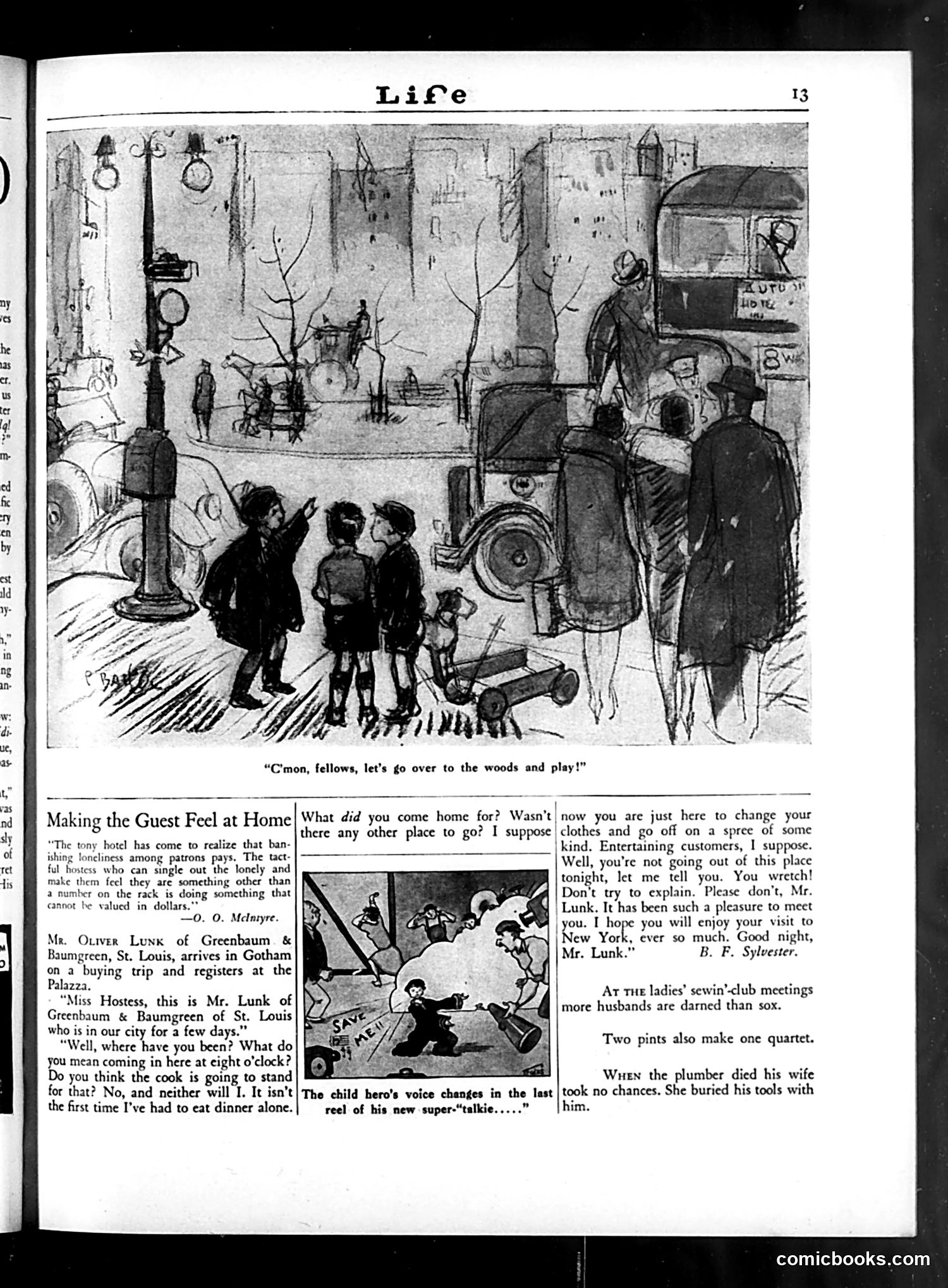
This page features a satirical article about hospitality, centered on Mr. Oliver Lunk of Greensbaum & Baumgreen (St. Louis), who arrives as a guest at a restaurant called the Piazza. The humor contrasts the **hostess's warm invitation** ("let me tell you. You wretch!") with her **obvious irritation** at his presence—she resents having to entertain a customer at dinner time, fearing disruption to her kitchen's routine. The accompanying cartoon shows children playing in an industrial/urban setting, captioned "C'mon, fellows, let's go over to the woods and play!"—satirizing how industrial cities offered little natural space for recreation. The page also includes comic one-liners about domestic life (darning husbands, plumbers' wives), typical of Life's humorous filler content of this era.
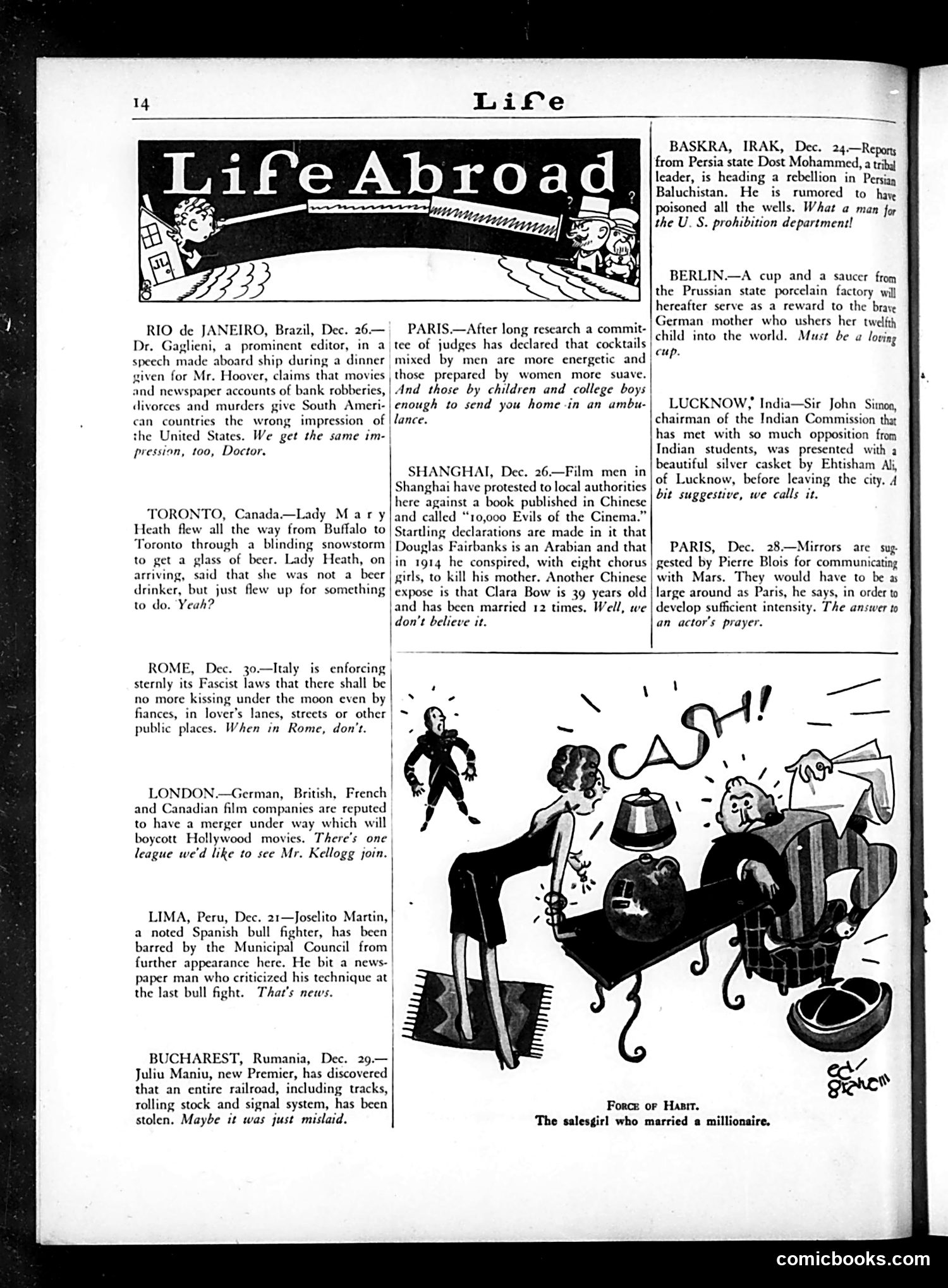
This page collects brief satirical dispatches from international correspondents. The main cartoon, titled "Force of Habit: The Salesgirl Who Married a Millionaire," depicts a woman who married wealth but retains working-class mannerisms—she's still scrubbing floors and handling domestic tasks with the urgency of her former job. The joke satirizes the idea that social class and habits are ingrained; money alone cannot transform behavior or refinement. The surrounding items mock various international figures and policies: Italy's Fascist kissing bans, a Chinese film claiming Clara Bow conspiracy, a bull-fighter banned for poor technique, and a Romanian official's implausible claim that an entire railroad was stolen. These combine mockery of authoritarian excess, Hollywood gossip, and bureaucratic absurdity.
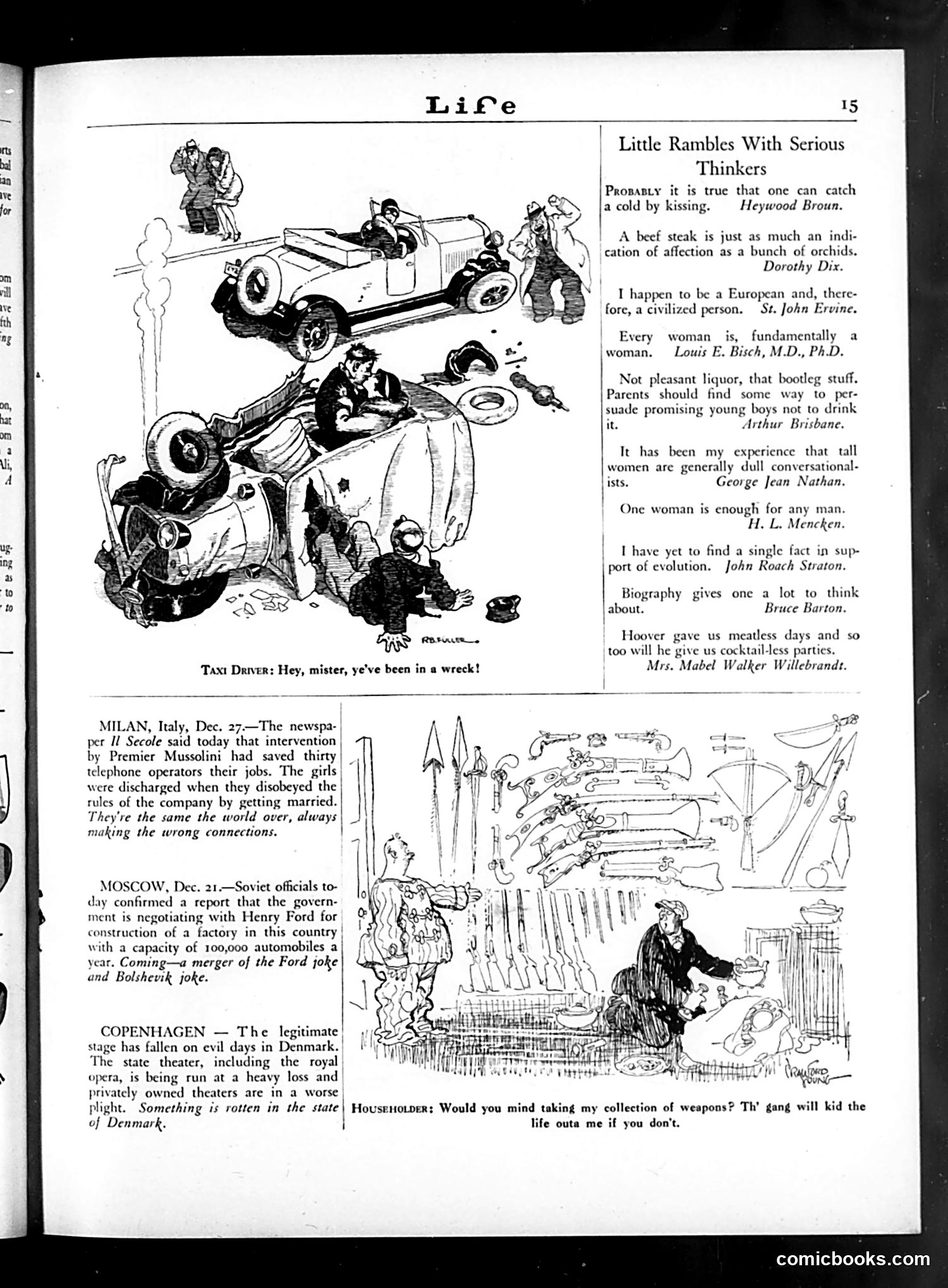
**Main Cartoon (Top):** "Taxi Driver: Hey, mister, ye've been in a wreck!" depicts a comically wrecked car surrounded by disheveled passengers and debris. This satirizes reckless driving or automobile accidents—a growing concern in the 1920s as cars became more common. **Bottom Section:** Three brief news items with satirical commentary: - **Milan**: Mussolini discharged thirty telephone operators for disobedience, with the italicized joke "They're the same the world over, always making the wrong connections." - **Moscow**: Soviet negotiations with Henry Ford regarding factory construction—mocking both Soviet-American relations and the "Ford joke/Bolshevik joke." - **Copenhagen**: Danish theaters facing financial hardship under state operation, satirizing government mismanagement. The secondary cartoon (bottom right) depicts a householder displaying weapons to someone, using threatening slang humor.
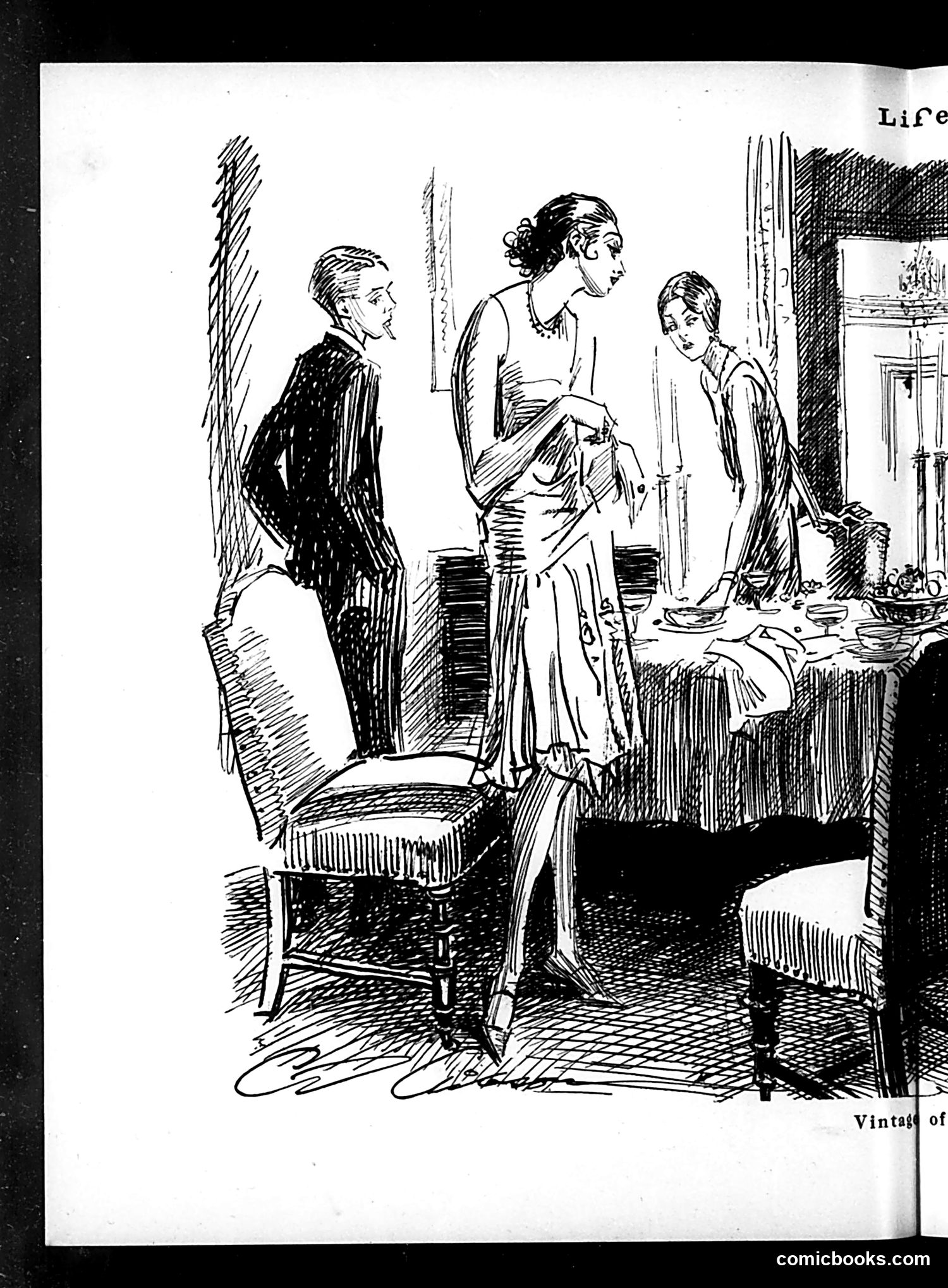
This appears to be a satirical cartoon from *Life* magazine depicting an interior domestic scene. The image shows four figures in what seems to be a dining room: a woman standing centrally in a dress, two men (one in dark formal wear on the left, another younger figure on the right), and additional figures in the background. Without visible caption text or clearer identifying details, I cannot definitively identify the specific political or social figures being caricatured. The scene suggests commentary on social interactions, possibly domestic relations or etiquette, given the formal dining-room setting. The artistic style and clothing suggest early-to-mid 20th century. To provide accurate historical context, I would need either visible captions, dated publication information, or clearer identifying markers on the page.
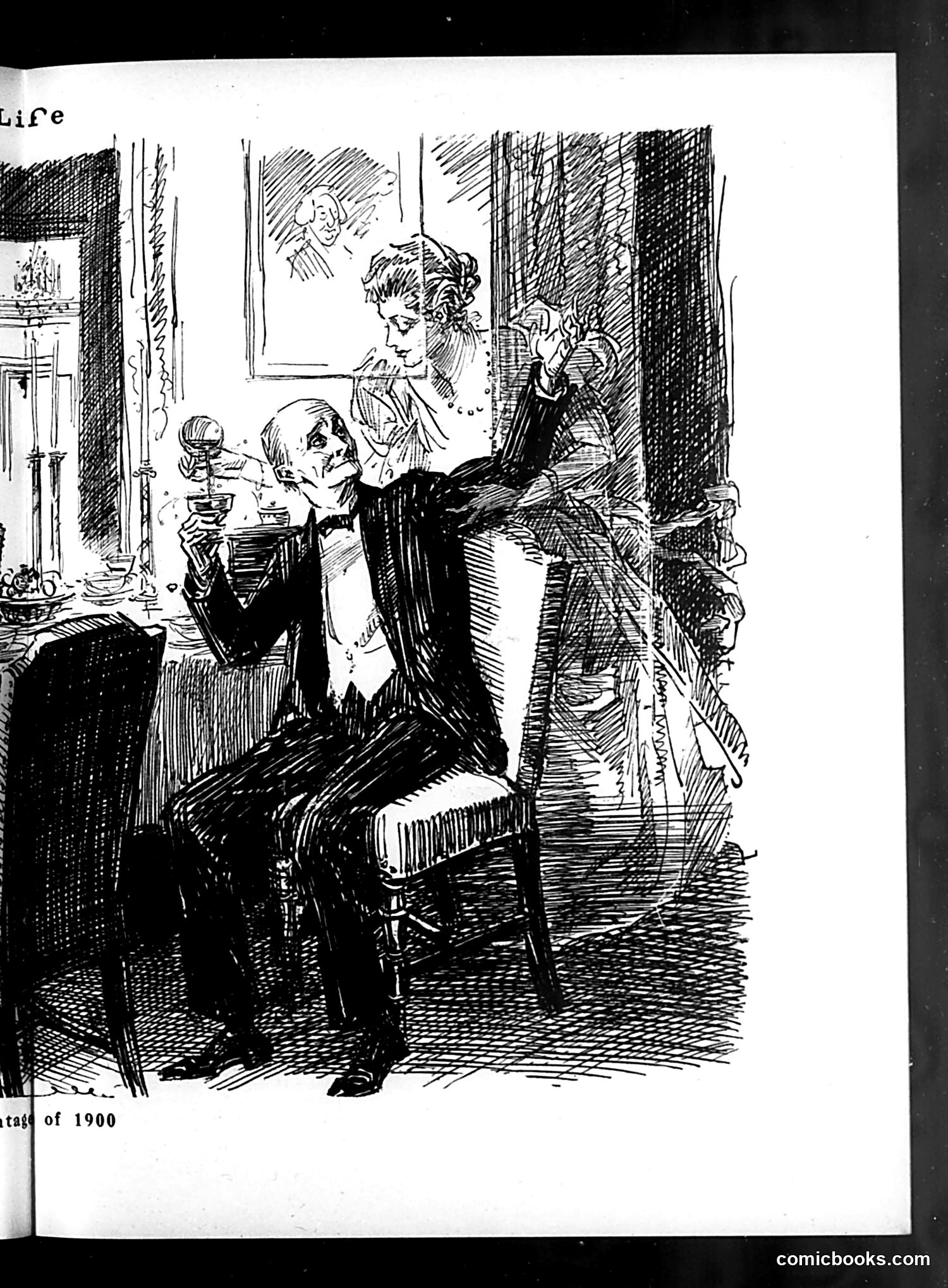
This is a satirical illustration from *Life* magazine (dated "of 1900" at bottom). The cartoon depicts a formal indoor scene with a well-dressed man in evening attire seated and gesturing expressively while speaking to a standing woman in an elegant dress. Additional figures appear in the background near doorways and windows. Without visible caption or clearer context, the specific political or social satire remains unclear. The formal setting and body language suggest commentary on social etiquette, courtship, or perhaps class dynamics of the 1900 era. The man's animated gesturing contrasts with the woman's composed demeanor, possibly mocking pretentious behavior or social posturing common to satirical *Life* content of this period. The exact point of satire cannot be determined with certainty from the image alone.
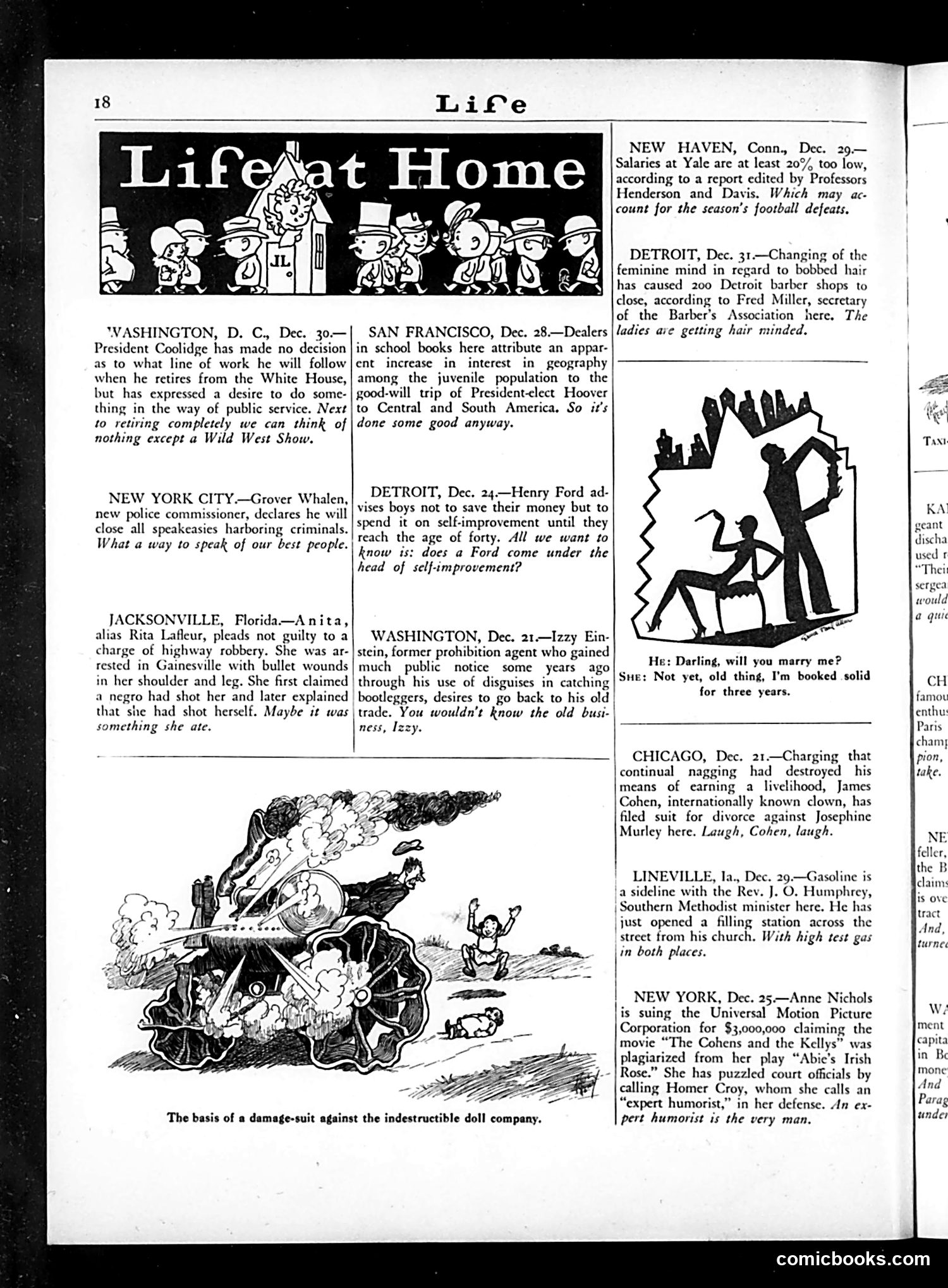
This December 1928 page collects brief satirical news items mocking contemporary figures and social trends. Key targets include: **President Coolidge**: Joked that upon retirement, he's fit only for a "Wild West Show"—suggesting his leadership lacks sophistication. **Police Commissioner Grover Whalen**: Mocked for calling speakeasies (illegal bars during Prohibition) "our best people"—satirizing the hypocrisy of enforcement. **Henry Ford**: Ridiculed for advising boys to spend money on "self-improvement" rather than saving, with the barb asking if a Ford car qualifies as self-improvement—a dig at Ford's product quality. **Prohibition Agent Izzy Einstein**: Told he shouldn't return to bootlegging, implying he should stay in law enforcement. **The cartoon** shows a damaged doll as "basis of a damage-suit against the indestructible doll company"—absurdist humor about product claims. The page exemplifies *Life*'s style: brief, punchy jabs at public figures, Prohibition-era references, and commentary on consumer culture and gender roles (bobbed hair, marriage hesitation).
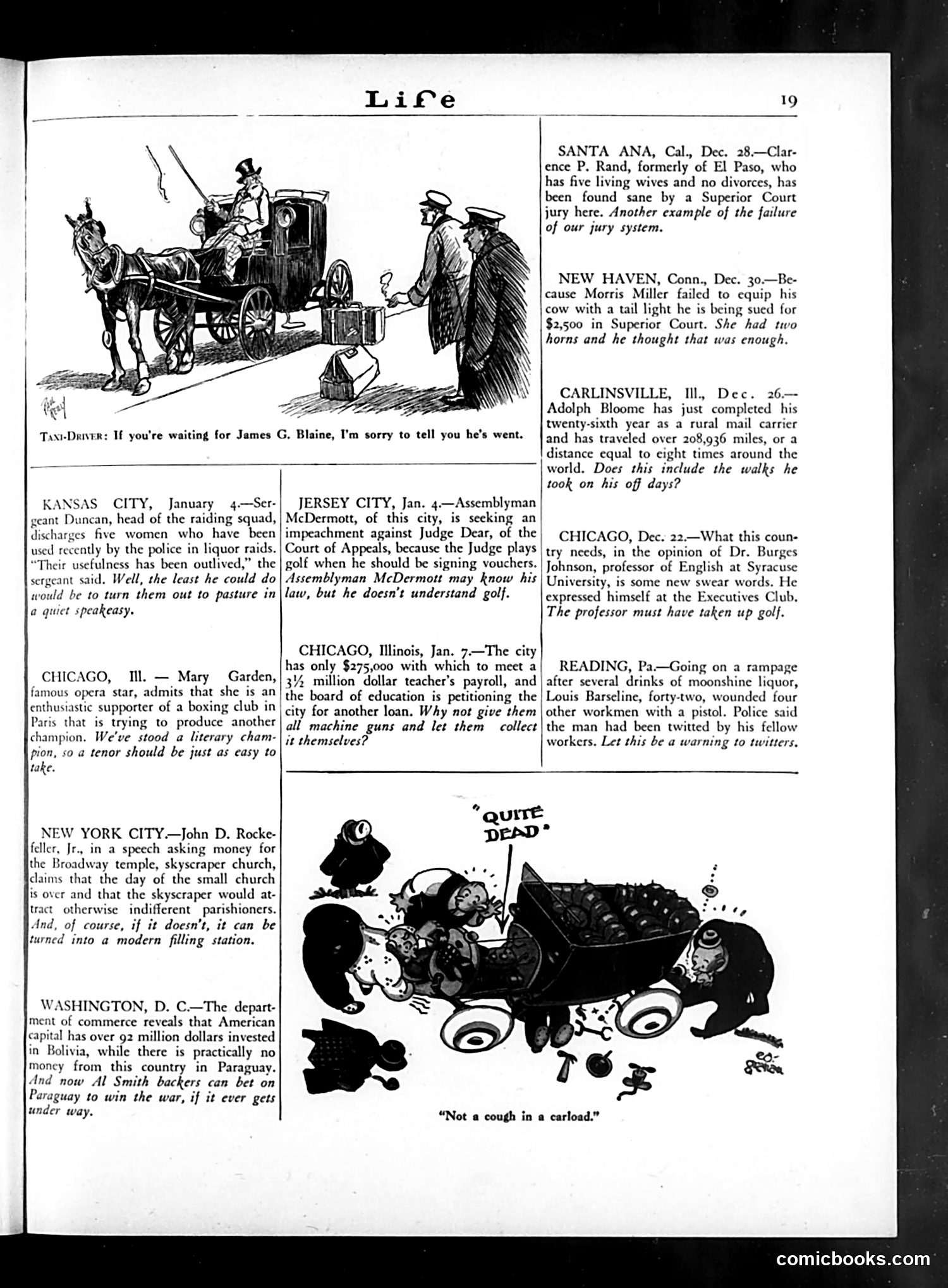
This page from *Life* magazine presents brief satirical news items mocking American institutions and current events, likely from the 1920s (references to Prohibition-era "speakeasies" and "moonshine" confirm this). The humor targets absurdity in law enforcement, religion, education, and the judiciary. Examples include: - **Kansas City police**: Discharging women used in liquor raids, sarcastically suggesting they be sent to speakeasies - **Judge Dear's golf**: A judge impeached for playing golf instead of signing vouchers—the satire notes the accuser doesn't understand golf's importance - **Chicago teacher shortage**: Suggesting the education board be given "machine guns" to collect unpaid salaries - **New Haven cow lawsuit**: A man sued for $2,500 for not equipping his cow with a tail light (unclear if absurdist invention or genuine oddity) The bottom cartoon titled *"Quite Dead"* ("Not a cough in a carload") appears to be a cigarette advertisement joke, showing a car crash—likely Prohibition-era dark humor about the slogan's ironic application.
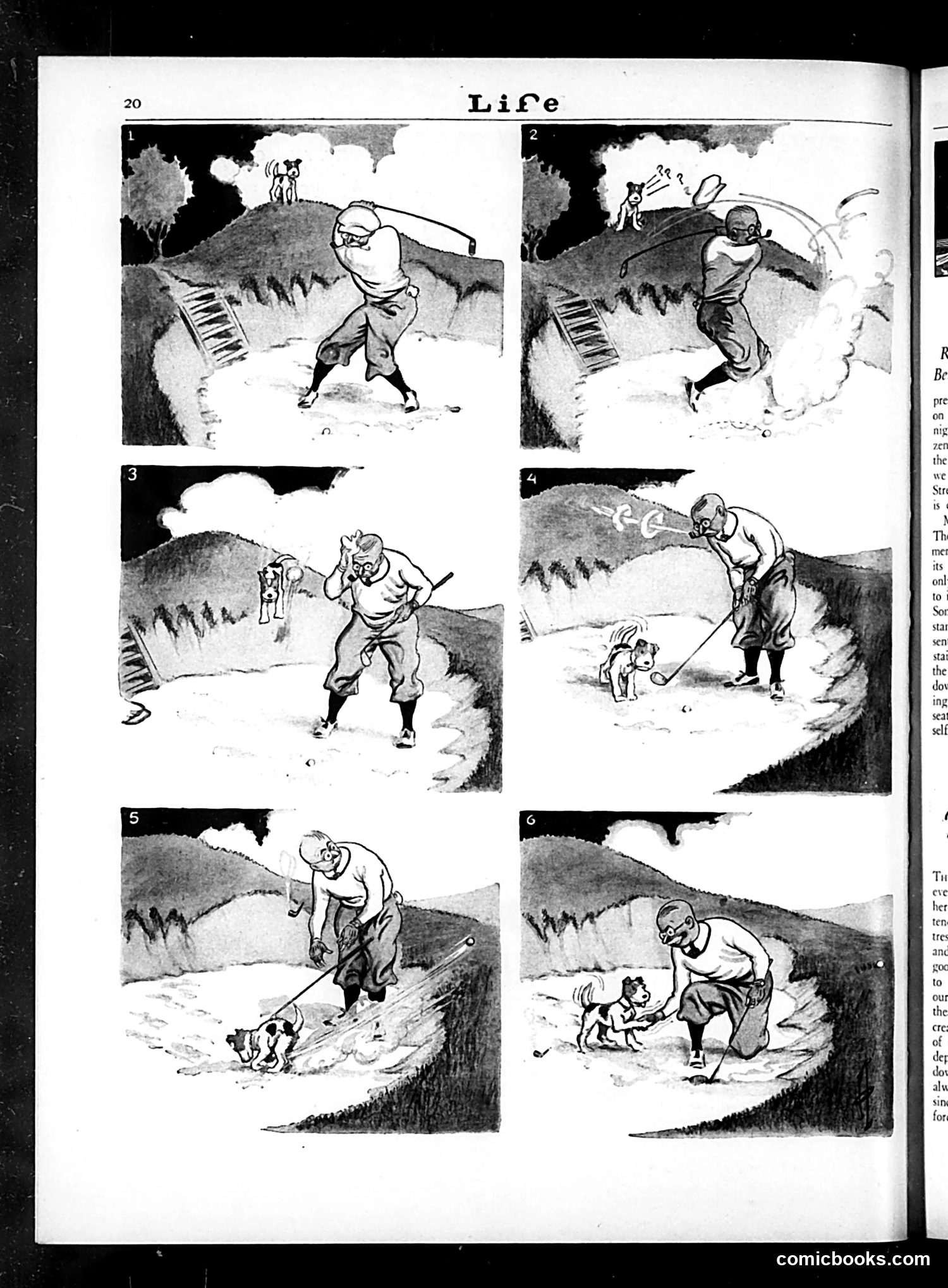
This page from *Life* magazine presents a six-panel comic strip titled "Life" showing a man and small dog in an outdoor setting. The sequence appears to depict the man teaching or training the dog through various activities—starting with the man wielding what looks like a rake or farming tool, progressing through different poses and interactions, and culminating in gentler engagement with the dog. The satirical point appears to be about **human-animal relationships or training methods**, possibly critiquing harsh or overly aggressive approaches to pet management. The progression from forceful gestures to calmer interaction suggests commentary on changing attitudes toward animal treatment or discipline. Without additional context from surrounding *Life* articles, the specific political or social reference remains **unclear**.
This theater review praises Eva Le Gallienne's Civic Repertory Theatre on Fourteenth Street, notably reversing Benchley's earlier skepticism about experimental theater. **The Context:** Benchley had dismissed Greenwich Village experimental theaters as earnest but talentless ventures, arguing that quality actors naturally gravitated toward profitable Broadway. He believed commercial theater's higher pay indicated superior talent. **The Point:** Le Gallienne proved him wrong. Her modestly-priced repertory theater—staging serious plays like *The Cherry Orchard* and *Peter Pan*—became so successful that seats required advance reservations and audiences stood in the aisles. She achieved commercial success while maintaining artistic integrity and affordability, contradicting Benchley's cynical theory that good theater requires high ticket prices. **The Satire:** Benchley humorously admits his miscalculation, acknowledging Le Gallienne's "quiet victory in Fourteenth Street" undermines his assumptions about theater economics and artistic merit.
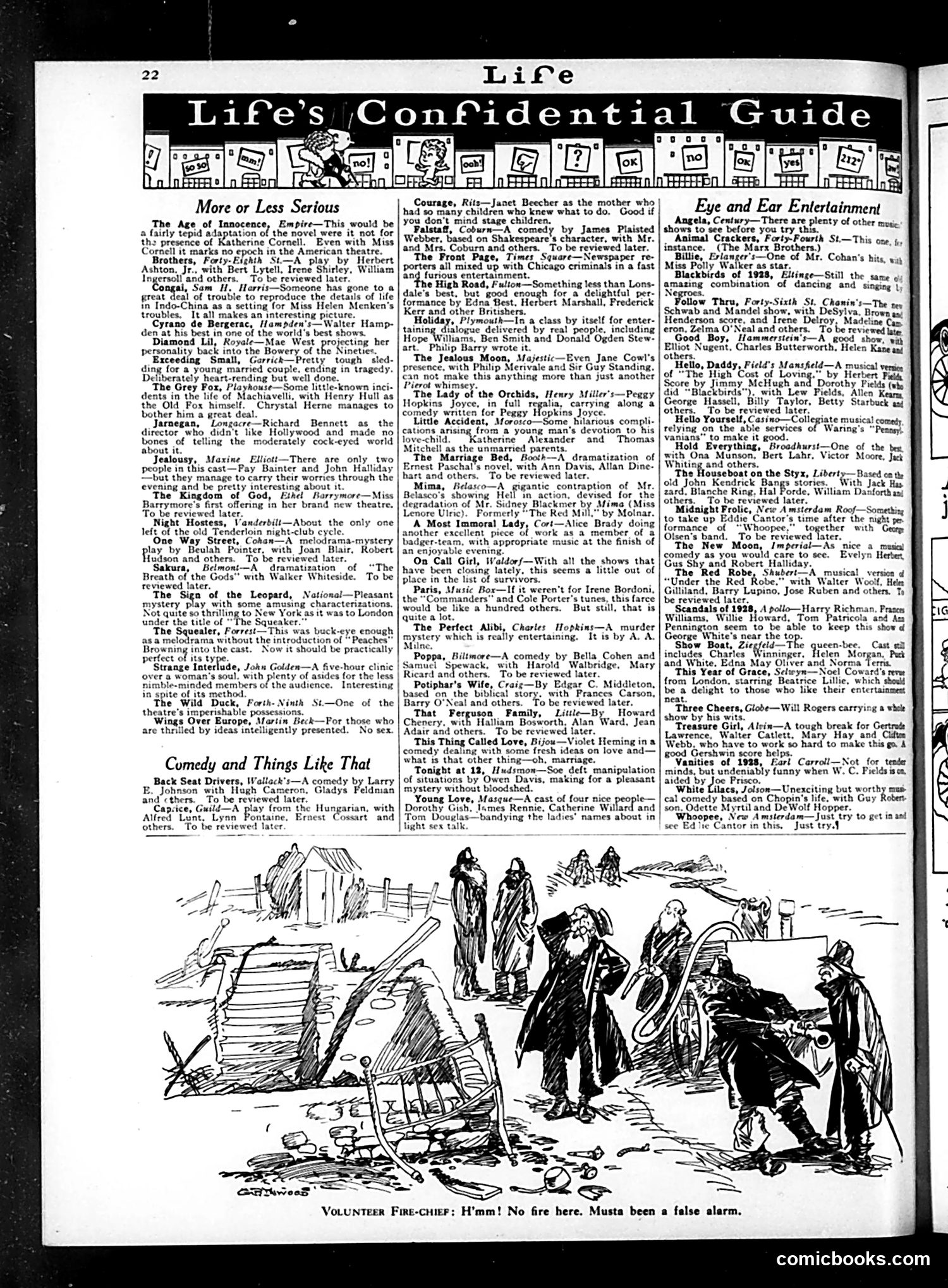
This page from *Life* magazine presents theater reviews in the magazine's signature satirical style. The top section lists Broadway productions with brief critiques, ranging from serious dramas (*Strange Interlude*, *The Wild Duck*) to comedies and lighter fare. The accompanying cartoon depicts a volunteer fire department responding to what appears to be a false alarm at a ramshackle structure, with the captain declaring "H'm! No fire here. Musta been a false alarm." The humor is straightforward physical comedy—the chaotic scene of firefighters mobilizing unnecessarily, playing on the era's common experience of volunteer fire brigades and small-town mishaps. The reviews themselves employ *Life*'s characteristic dry wit, often criticizing productions while occasionally praising performances (notably Katherine Cornell and Mae West). This reflects *Life*'s role as both entertainment guide and arbiter of theatrical taste for educated, urban American readers in the late 1920s.
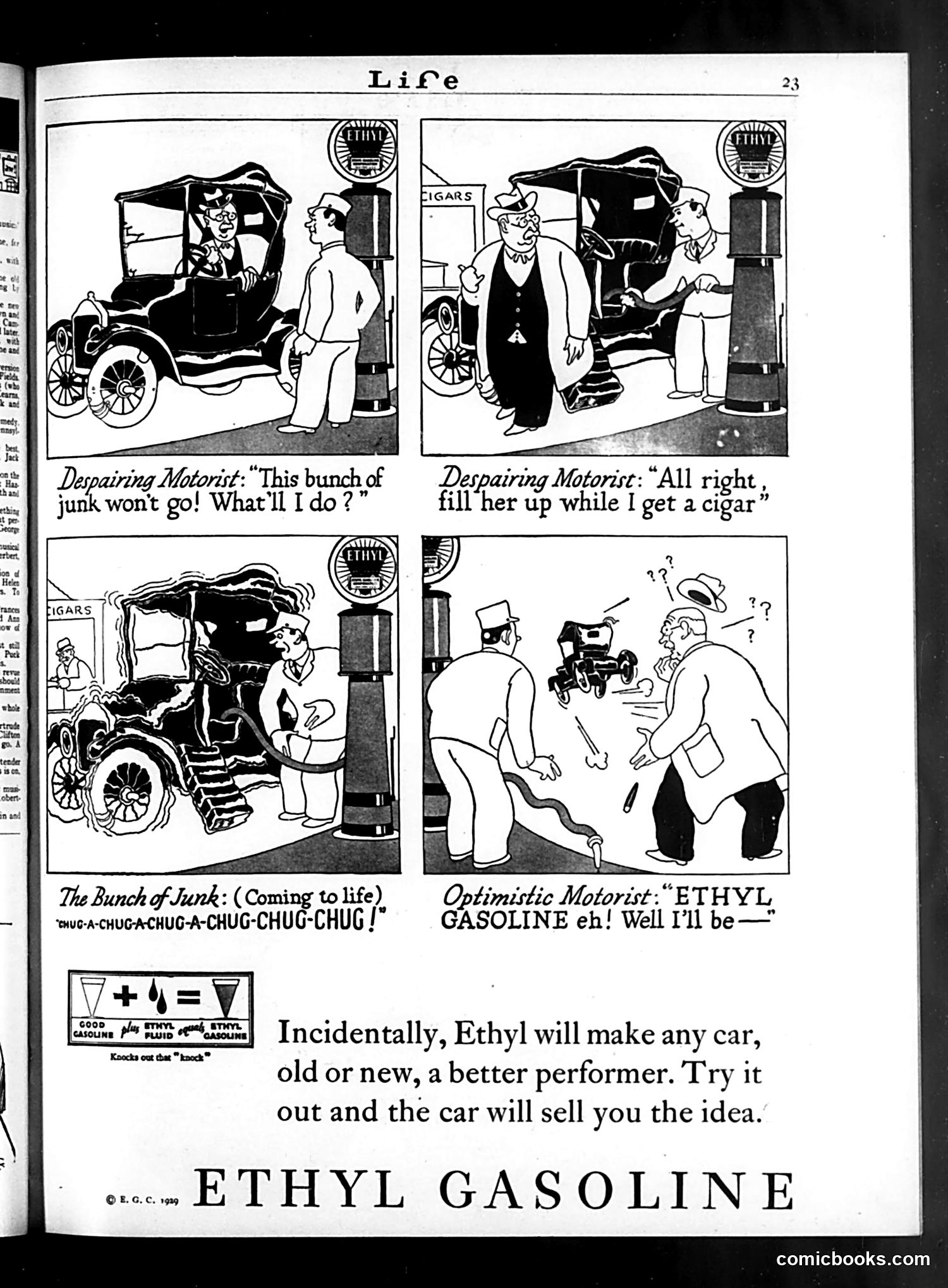
This is primarily a **product advertisement** for Ethyl Gasoline, disguised as satirical comic strips. The four-panel sequence depicts a "Desparing Motorist" with a broken-down, decrepit automobile at a filling station. When the attendant fills the car with Ethyl Gasoline, the vehicle miraculously comes to life, sputtering and revving ("chug-a-chug-a-chug"). The final panel shows an "Optimistic Motorist" who, upon hearing about Ethyl's benefits, becomes enthusiastically confident about the fuel's performance-enhancing properties. **The satire's message:** The ad humorously suggests that Ethyl Gasoline can transform even the worst vehicles into reliable performers. The exaggerated before-and-after contrast—from complete breakdown to enthusiastic operation—satirizes both consumer desperation and advertising's miraculous claims about automotive products. This reflects early-20th-century marketing tactics promoting leaded gasoline as a performance enhancer.
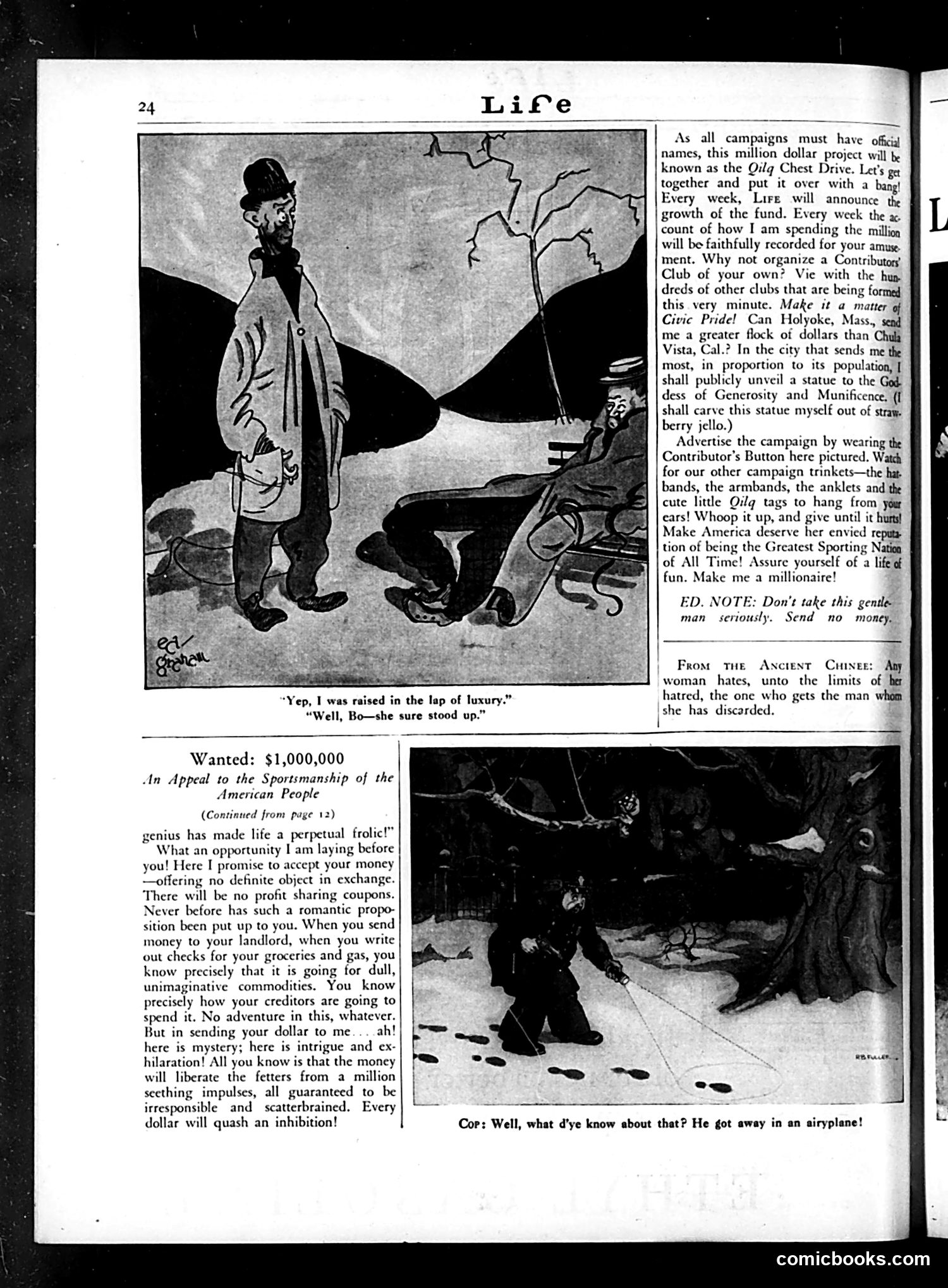
This page satirizes two distinct social phenomena of the 1920s era: **"Wanted: $1,000,000"** is a mock charitable appeal parodying fundraising campaigns of the period. The unnamed narrator (likely representing an editor or society figure) humorously solicits donations with *zero accountability*—explicitly promising "no definite object in exchange." The satire mocks both the era's craze for organized "drives" and charitable competitions between cities, while also satirizing the wealthy's self-indulgent spending. The editor's note ("Don't take this gentleman seriously. Send no money") signals the entire piece as ironic social commentary. **The two cartoons** depict separate scenarios: The top cartoon shows a man in poverty contrasting his past luxury; the bottom shows what appears to be a police or authority figure watching someone escape via airplane, with the caption joking about unexpected aerial getaways. The overall message critiques American materialism, charitable hype, and competitive civic pride—exposing how fundraising campaigns often prioritize spectacle over genuine charitable purpose.
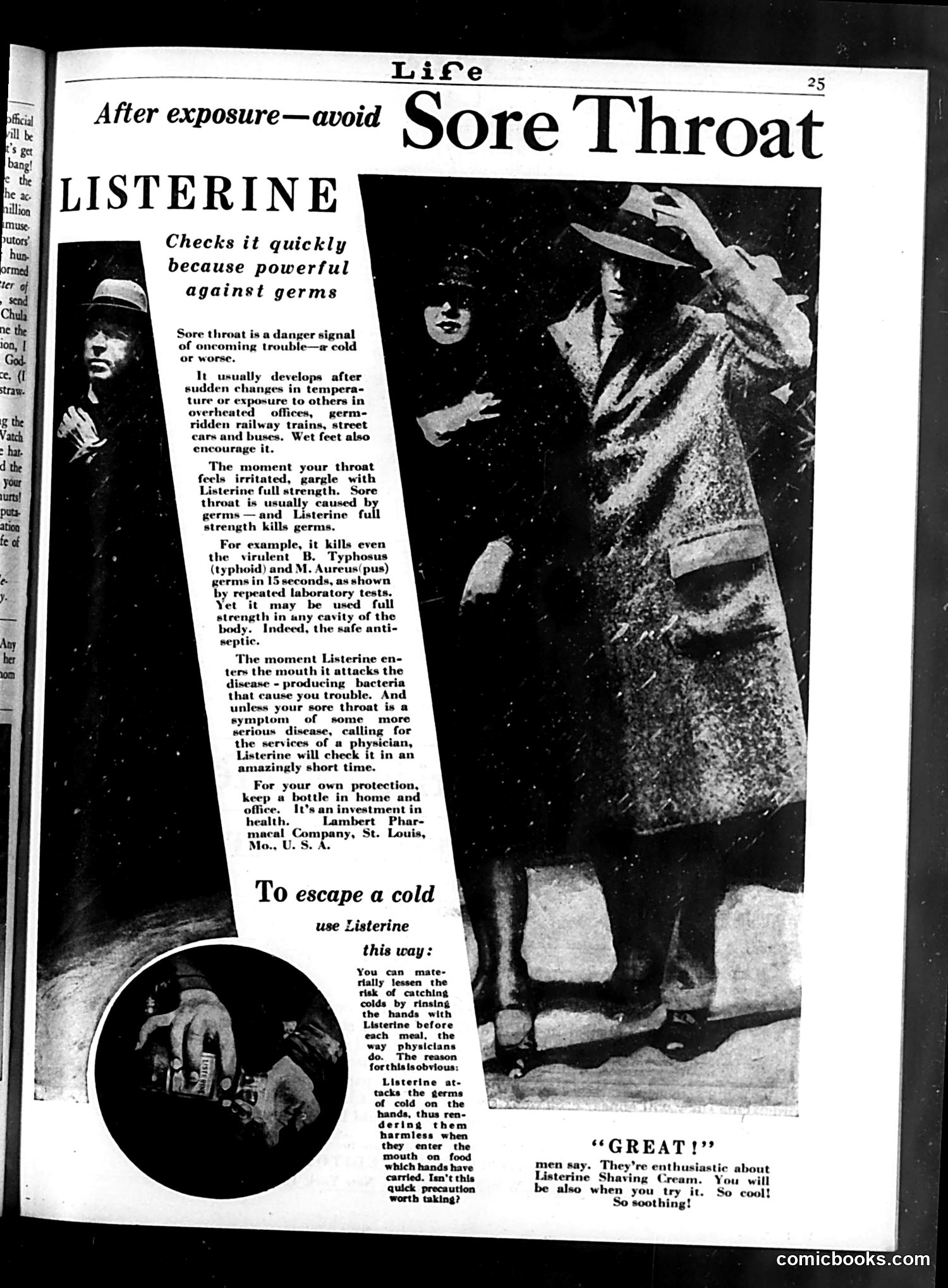
This is **not satire or political commentary**—it's a commercial advertisement for Listerine mouthwash from an early 20th-century *Life* magazine. The page promotes Listerine as a germicide for preventing and treating sore throats and colds. The imagery shows people in everyday situations (railway cars, offices, crowded spaces) where illness spreads. The advertisement claims Listerine kills specific bacteria (*B. Typhosus* and *M. Aureus*) in seconds and recommends gargling at the first sign of throat irritation. A secondary section promotes using Listerine to rinse hands before eating, to eliminate cold germs picked up from contaminated surfaces—reflecting early 20th-century germ-theory awareness. The final section advertises **Listerine Shaving Cream**, suggesting the product line's expansion beyond mouthwash. This is straightforward medical advertising typical of the era, before modern FDA regulations strictly limited health claims.
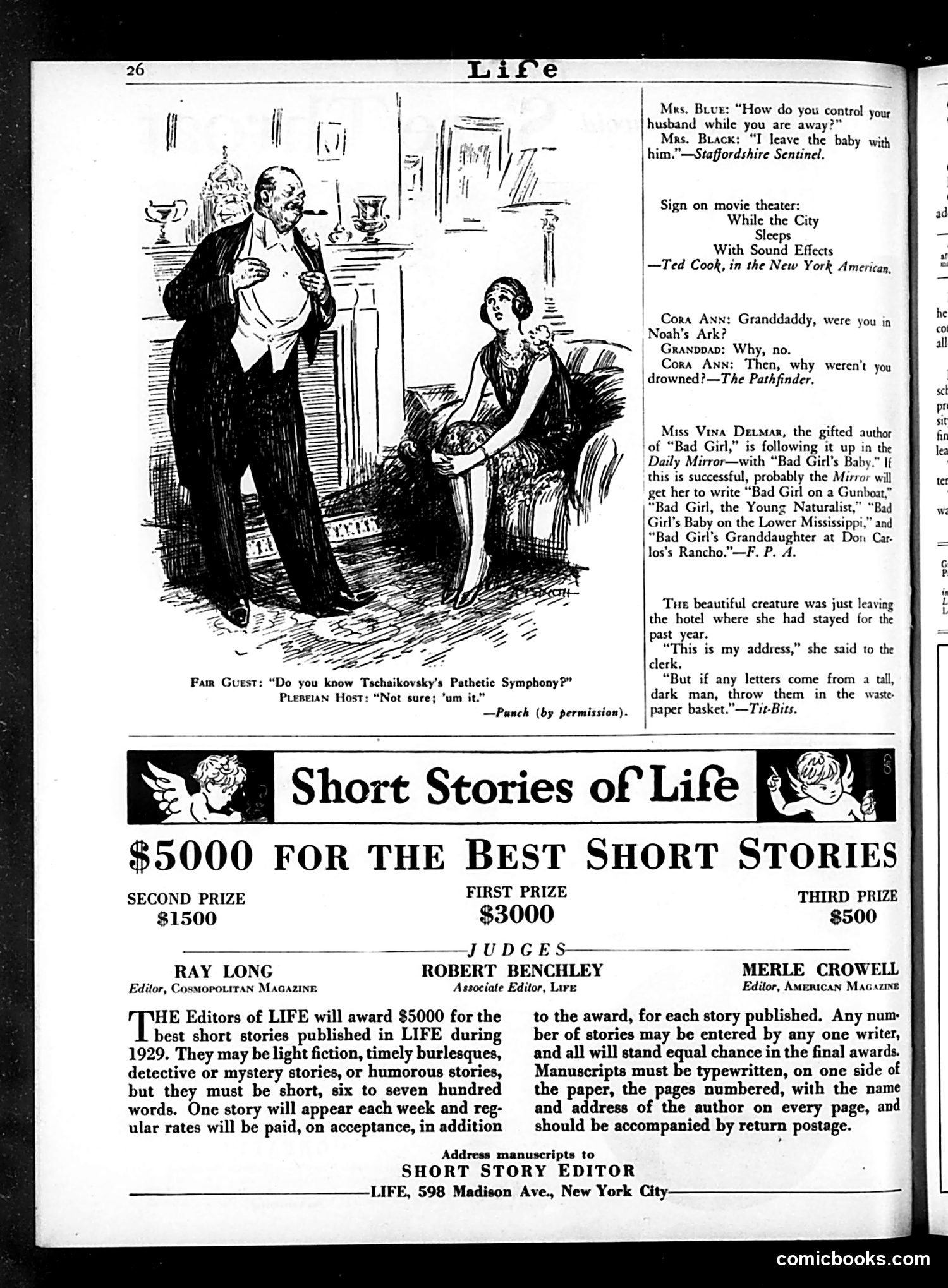
This page combines reprinted humor from other publications with a major contest announcement. The cartoon at top shows a snobbish host pretending to know classical music (Tchaikovsky's Pathetic Symphony) when he doesn't—a satirical jab at social pretension and cultural posturing among the wealthy. Below are various brief humorous anecdotes about marriage, aging, and social situations, typical of 1920s-era gentle satire. There's commentary on a popular author (Vina Delmar) and her "Bad Girl" series, mocking publishers' tendency to churn out sequels with increasingly absurd titles. The main feature is Life's $5,000 short story contest for 1929, soliciting fiction of 600-700 words. Judges include prominent editors Ray Long, Robert Benchley, and Merle Crowell. This reflects Life's role as a literary magazine, not merely a humor publication.
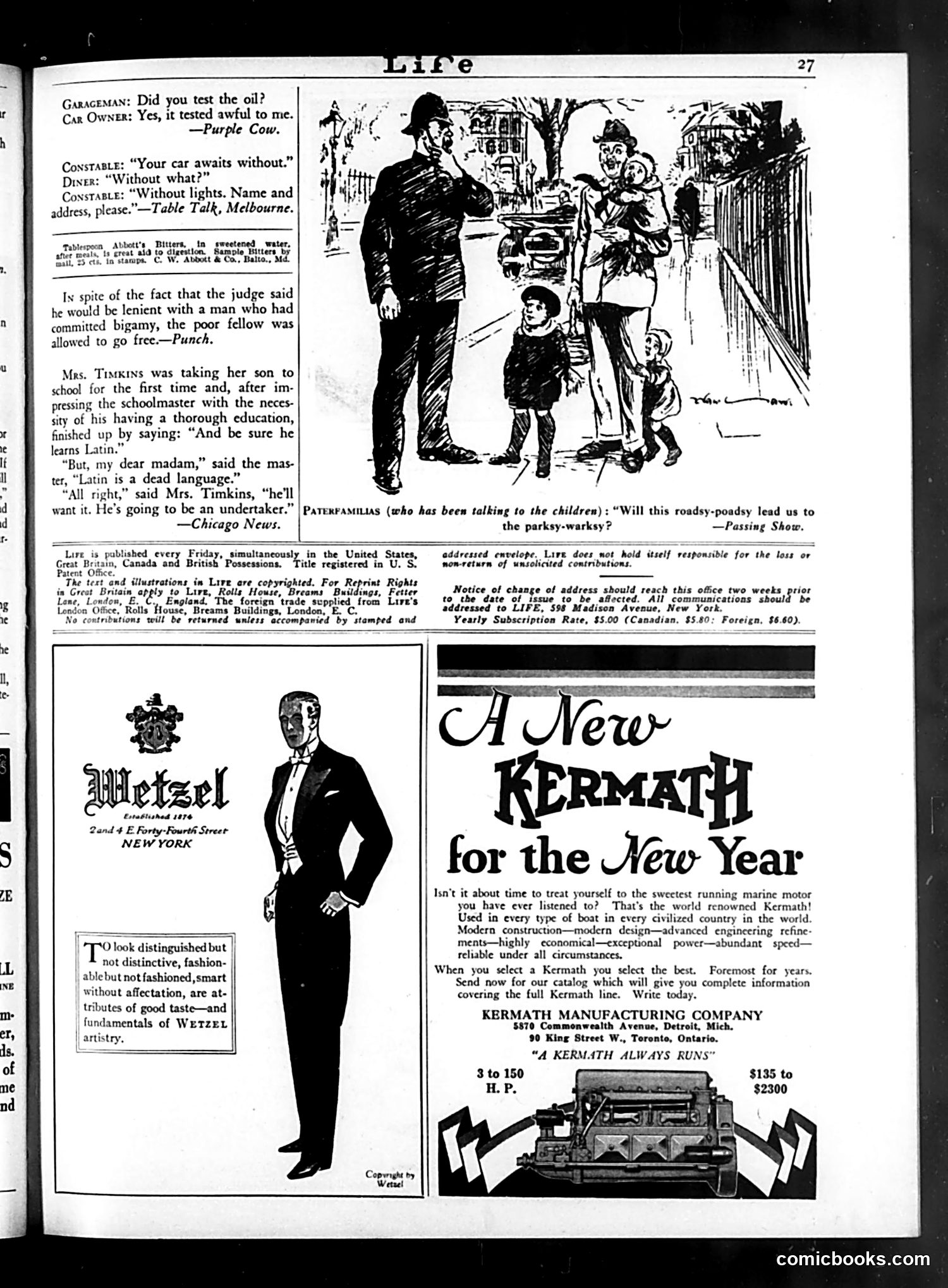
This page contains **short humorous anecdotes** and **advertisements** typical of early 20th-century Life magazine. **The humor pieces** are brief jokes from various sources (Purple Cow, Table Talk, Punch, Chicago News, Passing Show). They rely on wordplay and situational comedy: - A constable stopping a car for missing lights requests "name and address"—the driver interprets this as the car itself lacking these things - Mrs. Timkins insists her son learn Latin because "he's going to be an undertaker" (implying dead bodies need Latin prayers) - A woman asks if a "roadsy-poadsy" leads to the "parksy-warksy" (infantilized speech mocking baby-talk) **The illustration** shows a well-dressed policeman stopping a child on the street, likely related to one of these jokes about authority and misunderstanding. **The advertisements** promote **Wetzel** (formal wear, New York) and **Kermath** (marine motors), positioned as luxury/quality goods for affluent readers. No specific political figures or events are referenced—this is entertainment journalism for a general audience.
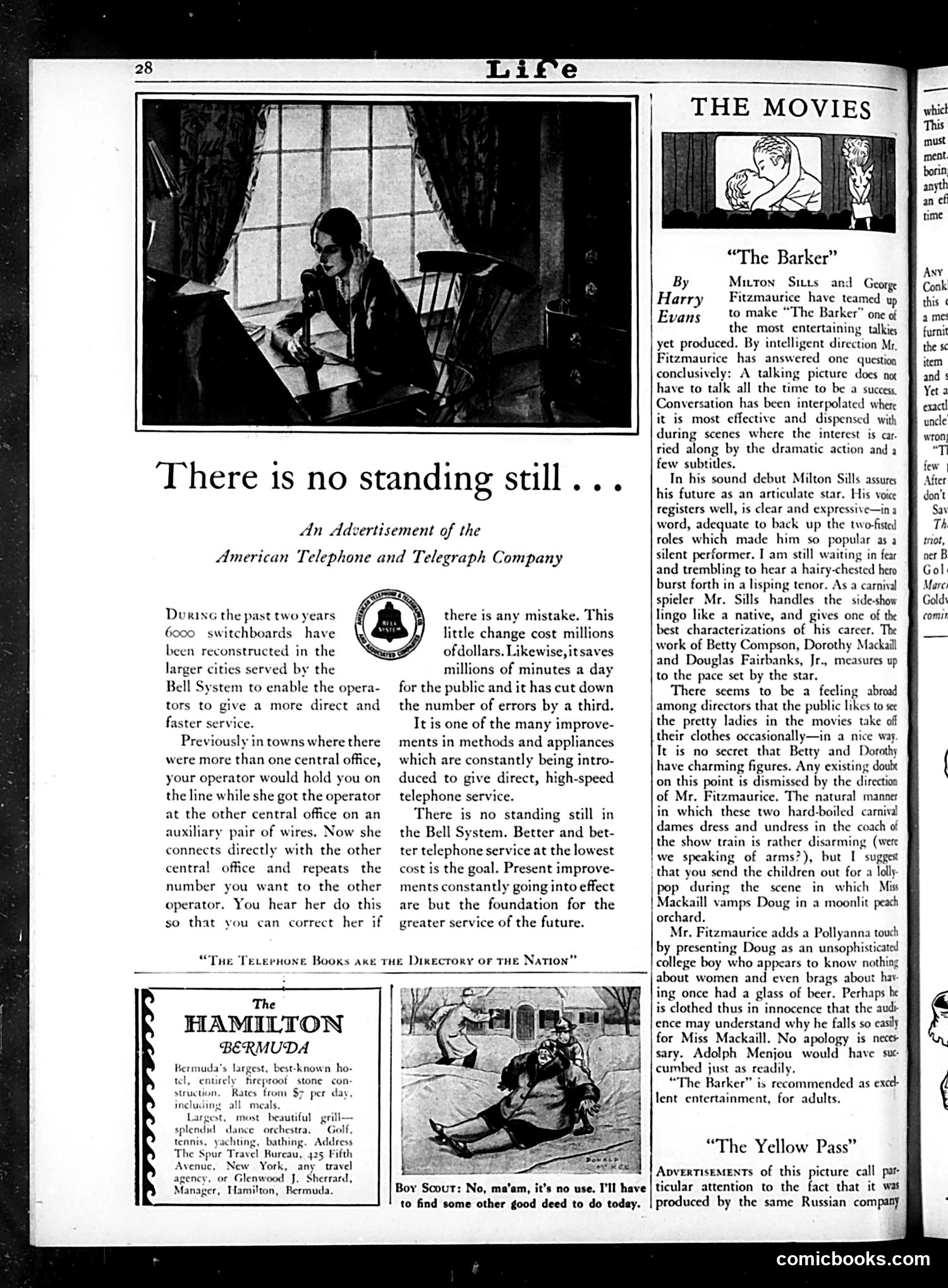
This page mixes advertising with film criticism from an early sound-film era (likely late 1920s). **The Main Advertisement** promotes AT&T's Bell System telephone improvements—specifically faster switchboard connections between central offices. The accompanying illustration shows a woman operator at a switchboard. The message: progress requires constant investment and technological advancement. The tagline "There is no standing still" was literal corporate messaging. **The Boy Scout Cartoon** (bottom left) is a small joke: a scout seeking a "good deed" finds telephone operators already doing them through improved service—a pun connecting scouting ethics to corporate virtue. **"The Barker" Film Review** discusses Milton Sills' sound-film debut, praising how director Fitzmaurice uses dialogue strategically rather than constantly (innovative for early talkies). The reviewer notes Sills' clear voice and carnival-barker accent work. References to actresses "taking off their clothes" reflect 1920s filmmaking's interest in glamour and partial nudity, treated as artistic rather than exploitative by this critic.
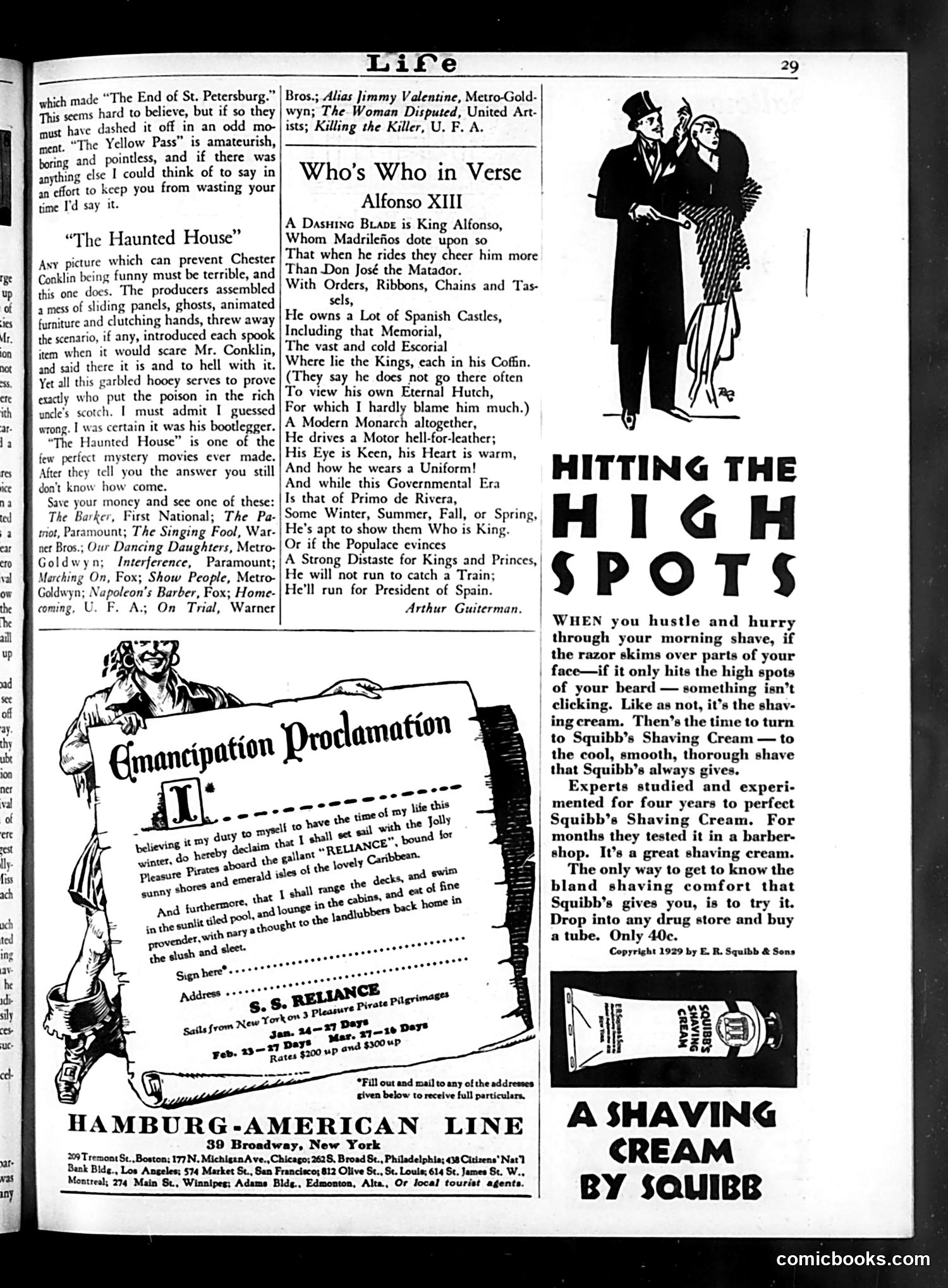
This page combines film reviews, satirical verse, and advertisements typical of *Life* magazine's format. **"Who's Who in Verse: Alfonso XIII"** is a humorous poem about Spain's king by Arthur Guiterman. It portrays Alfonso as a modern, energetic monarch who drives fast, wears uniforms smartly, and remains popular with Madrid crowds—contrasting him favorably with the traditional matador Don José. The poem's final couplet contains political satire: it jokes that if the Spanish public grows tired of kings and princes, Alfonso will simply "run for President of Spain," suggesting the instability of Spanish governance and the tension between monarchy and republican movements (Spain did experience political turbulence in this era, eventually becoming a republic in 1931). The **Hamburg-American Line advertisement** depicts an "Emancipation Proclamation" offering Caribbean cruise packages—using the language of freedom humorously to sell leisure travel. The **Squibb Shaving Cream ad** emphasizes product testing and reliability. The page primarily showcases *Life*'s satirical editorial voice through the Alfonso poem while selling products to affluent readers.
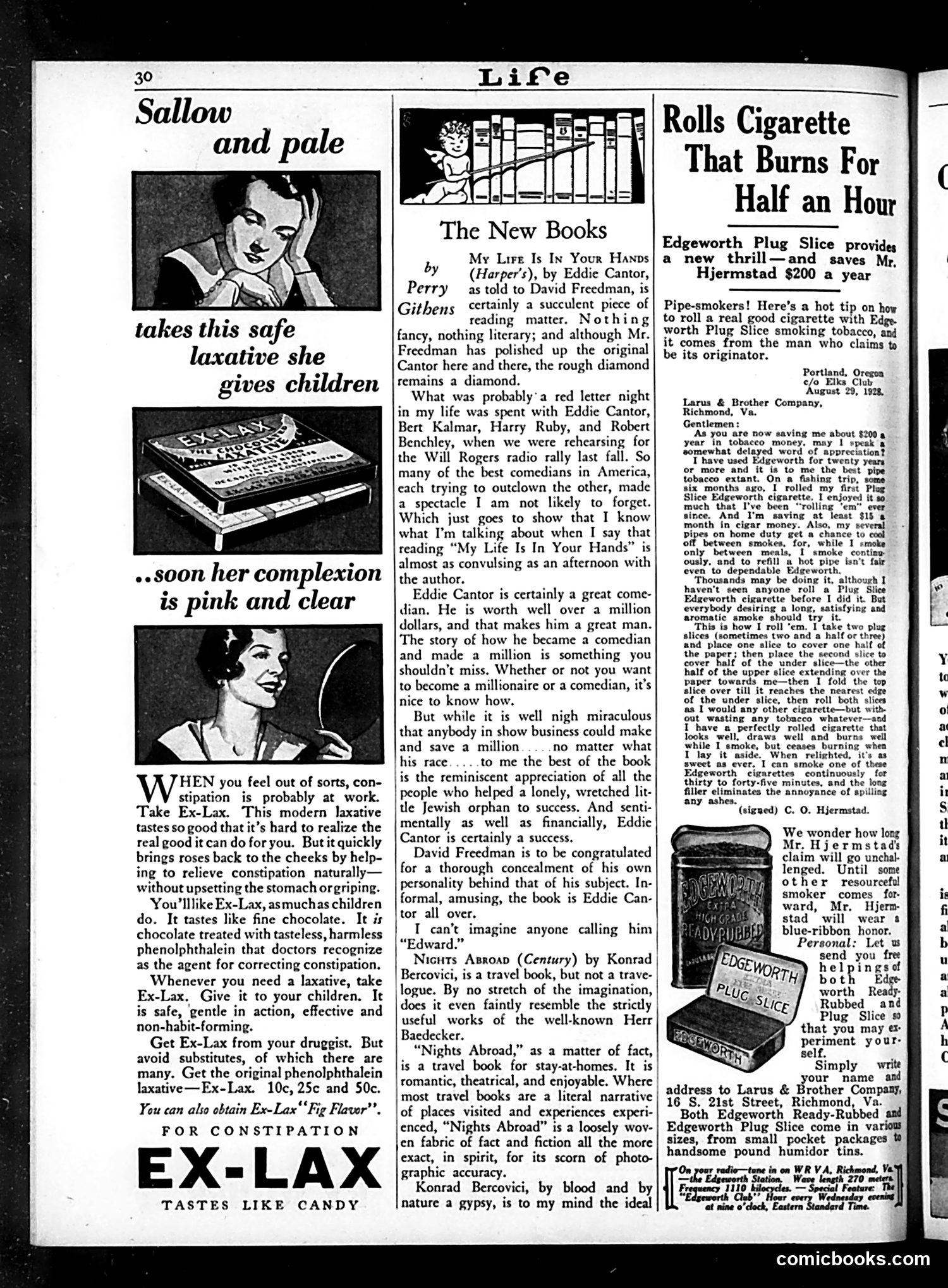
This page contains primarily **advertising**, not political cartoons or satire. The main content includes: 1. **Ex-Lax advertisement** (left): A laxative ad using before/after imagery of women, claiming the product will improve complexion by relieving constipation. The appeal is to mothers concerned about children's health and appearance—typical early-20th-century advertising that directly linked internal health to external beauty. 2. **Book reviews** (center): Brief reviews of contemporary publications, including Eddie Cantor's autobiography "My Life Is in Your Hands," praising Cantor as a successful entertainer and self-made millionaire. 3. **Edgeworth Plug Slice cigarette advertisement** (right): Marketing cigarettes as a convenient rolling tobacco product, featuring a customer testimonial claiming it saves money annually. The ads reflect 1920s consumer culture and marketing strategies—targeting health-conscious parents, celebrity biography readers, and male smokers. There is no political satire or cartoon content visible on this page.
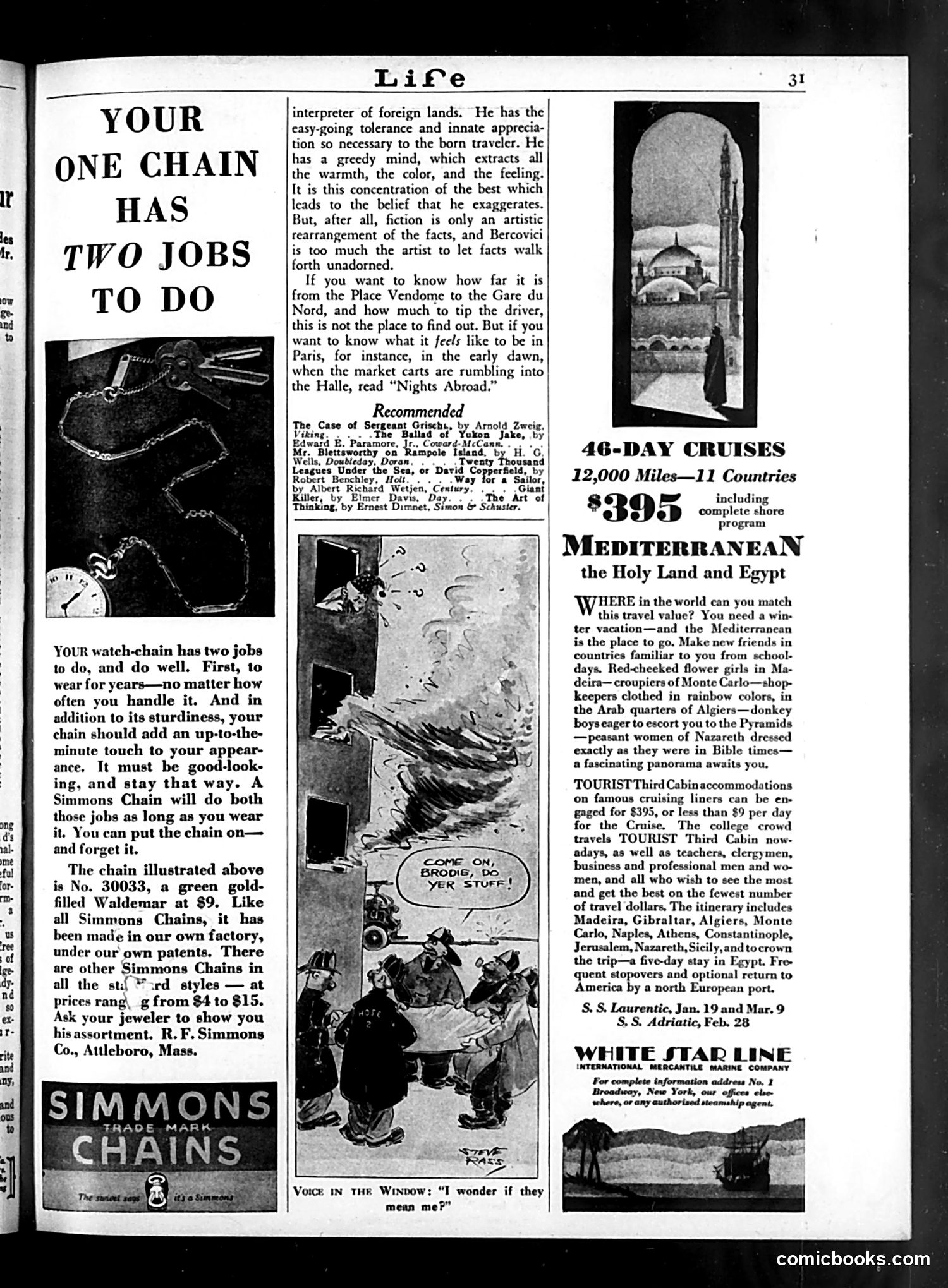
This page mixes product advertising with a cartoon commentary on travel writing. The main cartoon depicts a street scene where someone asks "I wonder if they mean me?"—likely commenting on travel writers who claim to capture authentic foreign experiences while potentially exaggerating or misrepresenting what they observe. The editorial text above critiques travel writer Bercovici, praising his ability to convey *feeling* and atmosphere over factual accuracy. It suggests travel literature prioritizes artistic interpretation ("what it *feels* like to be in Paris") rather than practical information (distances, tipping amounts). The implicit satire questions whether such subjective accounts are reliable representations or romanticized distortions. The surrounding advertisements—for Simmons watch chains and White Star Line Mediterranean cruises—suggest Life's audience: middle-class Americans with disposable income for travel and luxury goods, who might read travel literature before booking passage. The overall tone is gentle mockery of both travel writers' pretensions and tourists' appetite for curated, emotionally enhanced experiences.
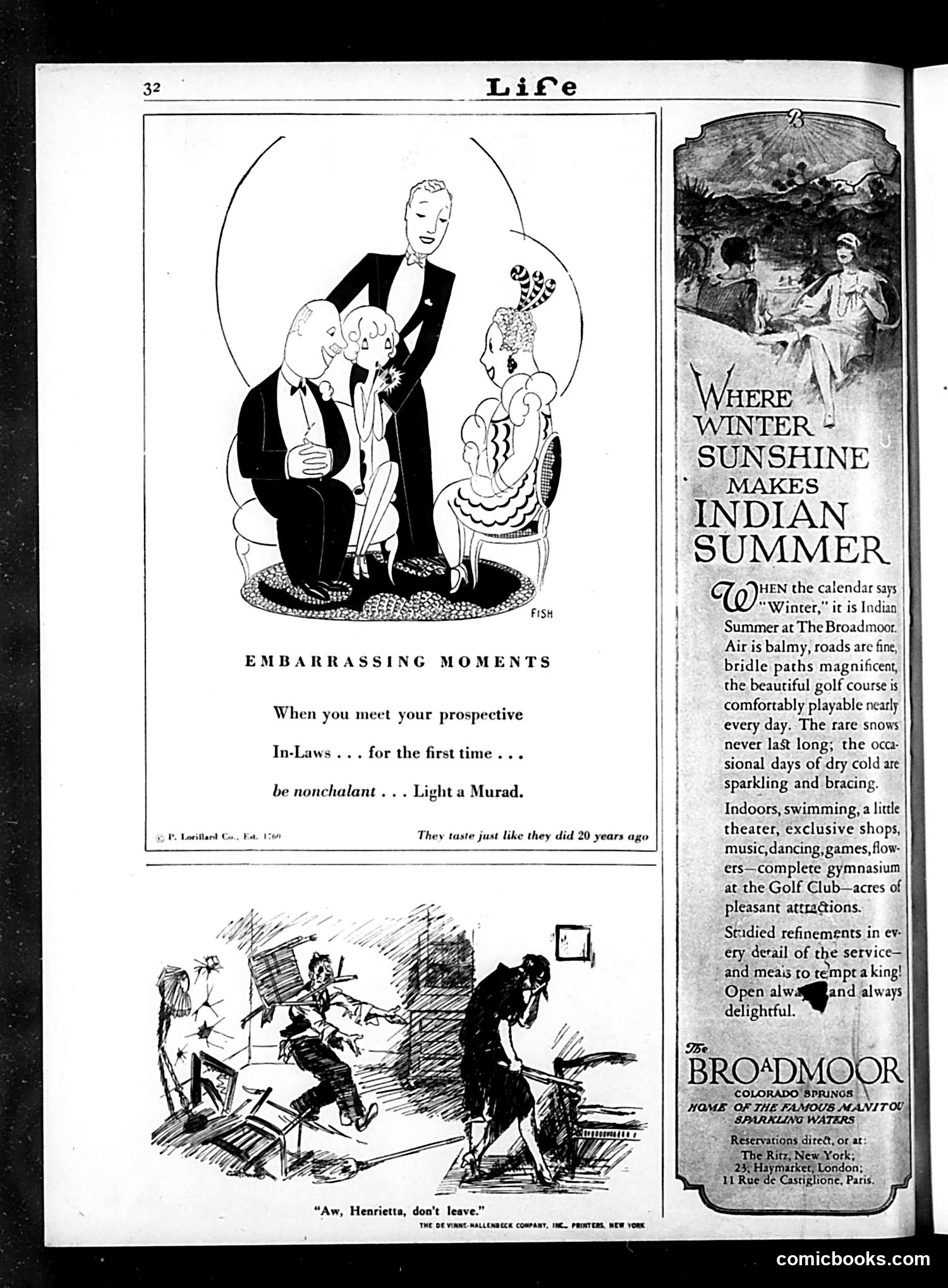
This page contains two distinct pieces: **Left side - "Embarrassing Moments" cartoon**: A humorous comic showing a nervous man meeting his prospective in-laws for the first time. The joke is that he's trying to appear calm by lighting a Murad cigarette—the advertisement's tagline suggests the cigarette brand itself hasn't changed in 20 years, implying stability and reliability. The humor relies on the social anxiety of meeting a partner's parents and the somewhat absurd solution of using a cigarette to appear sophisticated. **Bottom cartoon**: A slapstick scene of people falling or slipping, captioned "Aw, Henrietta, don't leave"—likely depicting domestic chaos or marital discord played for comedic effect. **Right side**: An advertisement for The Broadmoor resort in Colorado Springs, promoting its year-round amenities and winter weather conditions. The page is primarily **advertising-driven**, using humor to sell cigarettes and a luxury resort to readers. The "embarrassing moments" framing was a common magazine feature used to market consumer products.
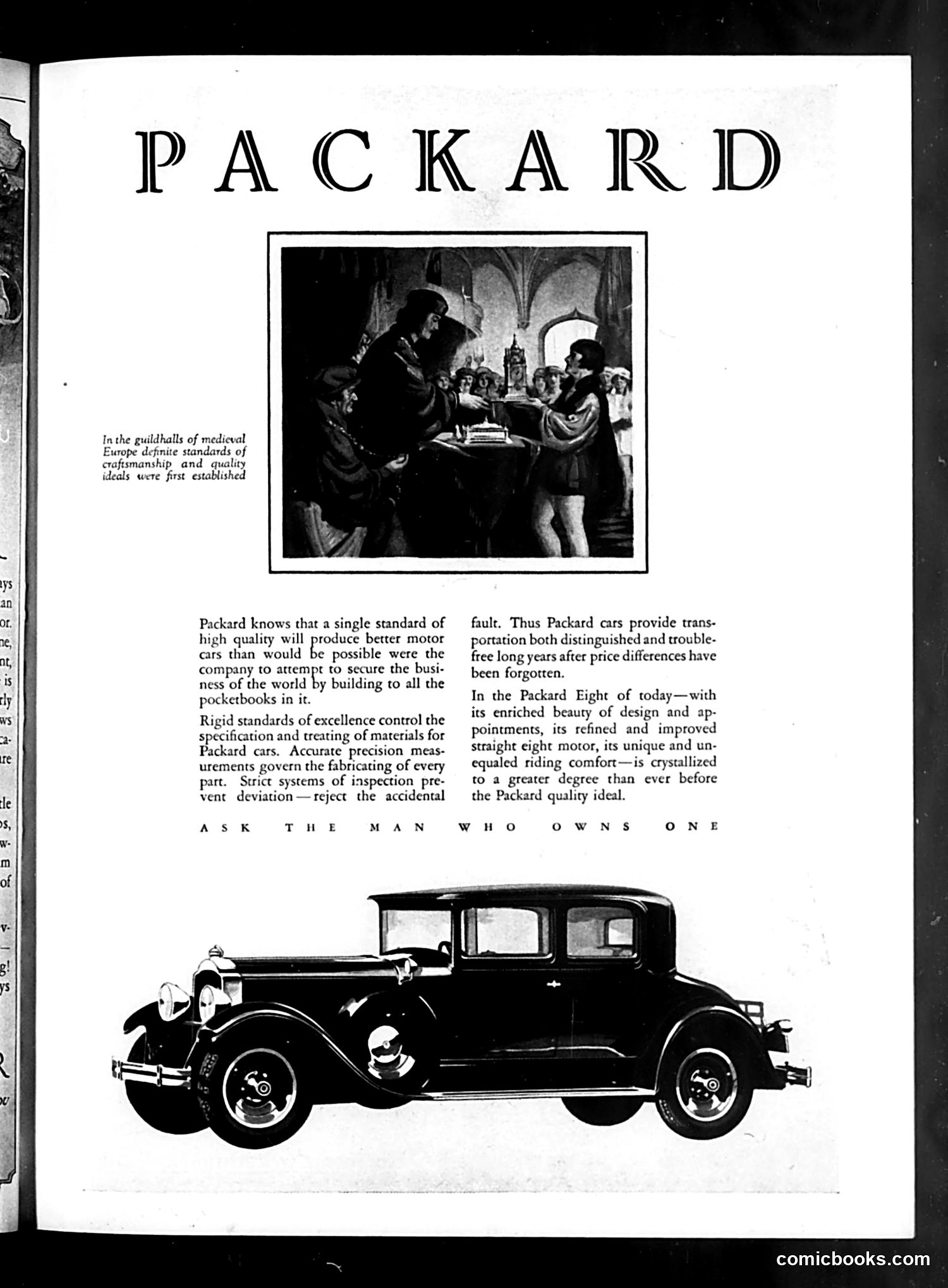
This is a **Packard automobile advertisement**, not political satire. The page promotes Packard cars by drawing a parallel between medieval guild craftsmanship standards and modern manufacturing quality. The top illustration depicts craftsmen in a medieval guild hall, establishing the historical precedent for quality control. The text argues that Packard, like those guilds, maintains rigorous standards rather than compromising to reach mass-market price points. The bottom shows a sleek Packard Eight automobile, presented as the embodiment of this quality ideal. The tagline "Ask the man who owns one" emphasizes customer testimonials as proof of reliability. This reflects 1920s-30s luxury car marketing: positioning Packard as a premium product for discerning buyers who value durability over affordability. The medieval guild reference lends prestige and timelessness to the brand's approach.
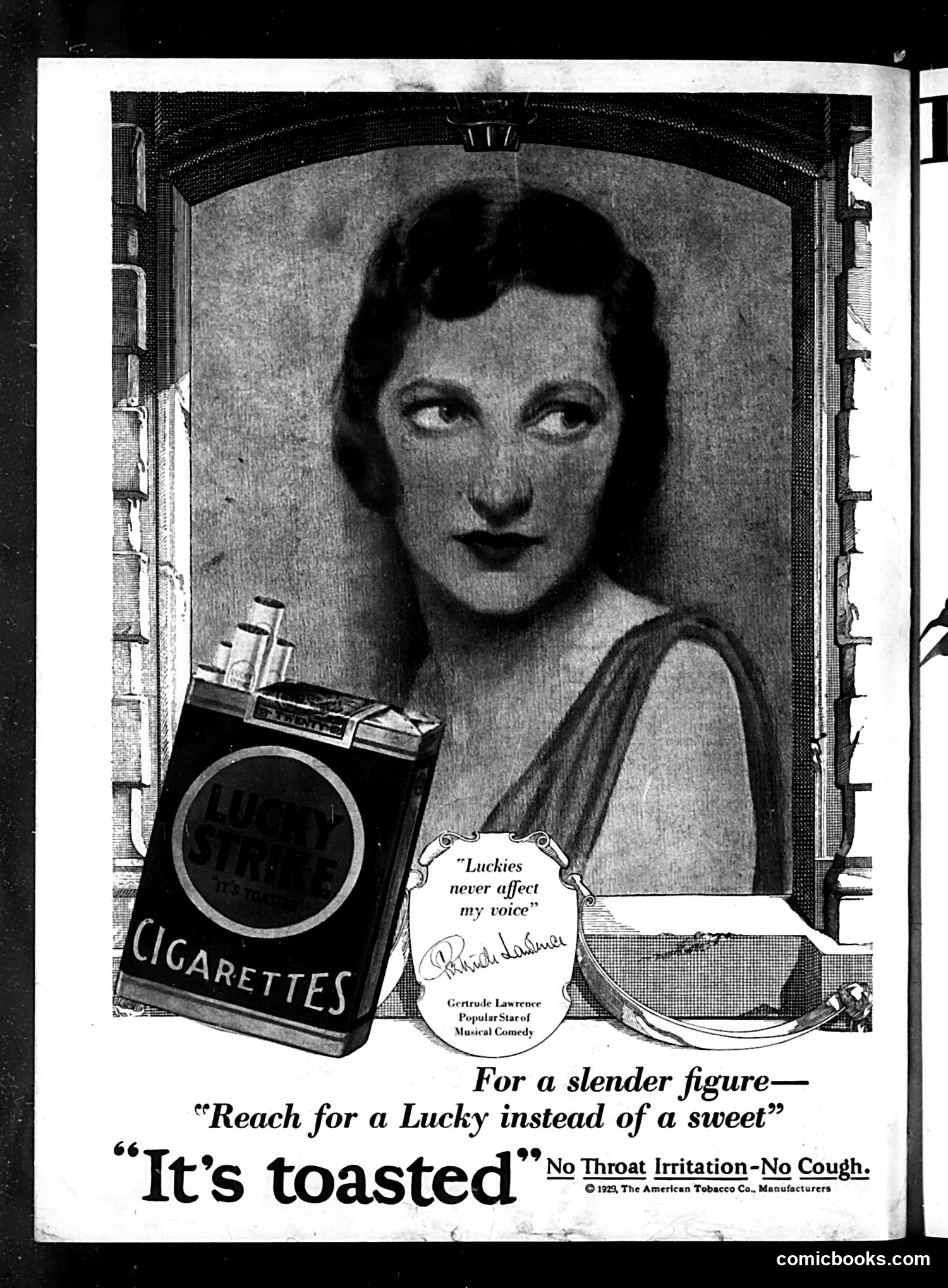
This is a **Lucky Strike cigarette advertisement** from 1923, not satire. The ad features Gertrude Lawrence, a genuine popular musical comedy star of that era, endorsing cigarettes with the claim "Luckies never affect my voice." The advertisement promotes smoking as a weight-control method ("For a slender figure—'Reach for a Lucky instead of a sweet'") and claims the toasting process prevents throat irritation. These were common tobacco marketing tactics of the 1920s before health dangers were widely acknowledged. The "no throat irritation" claim and celebrity endorsement were typical strategies to counter emerging health concerns about smoking, particularly among performers worried about vocal damage.