
A complete issue · 7 pages · 1910
Life — 1910
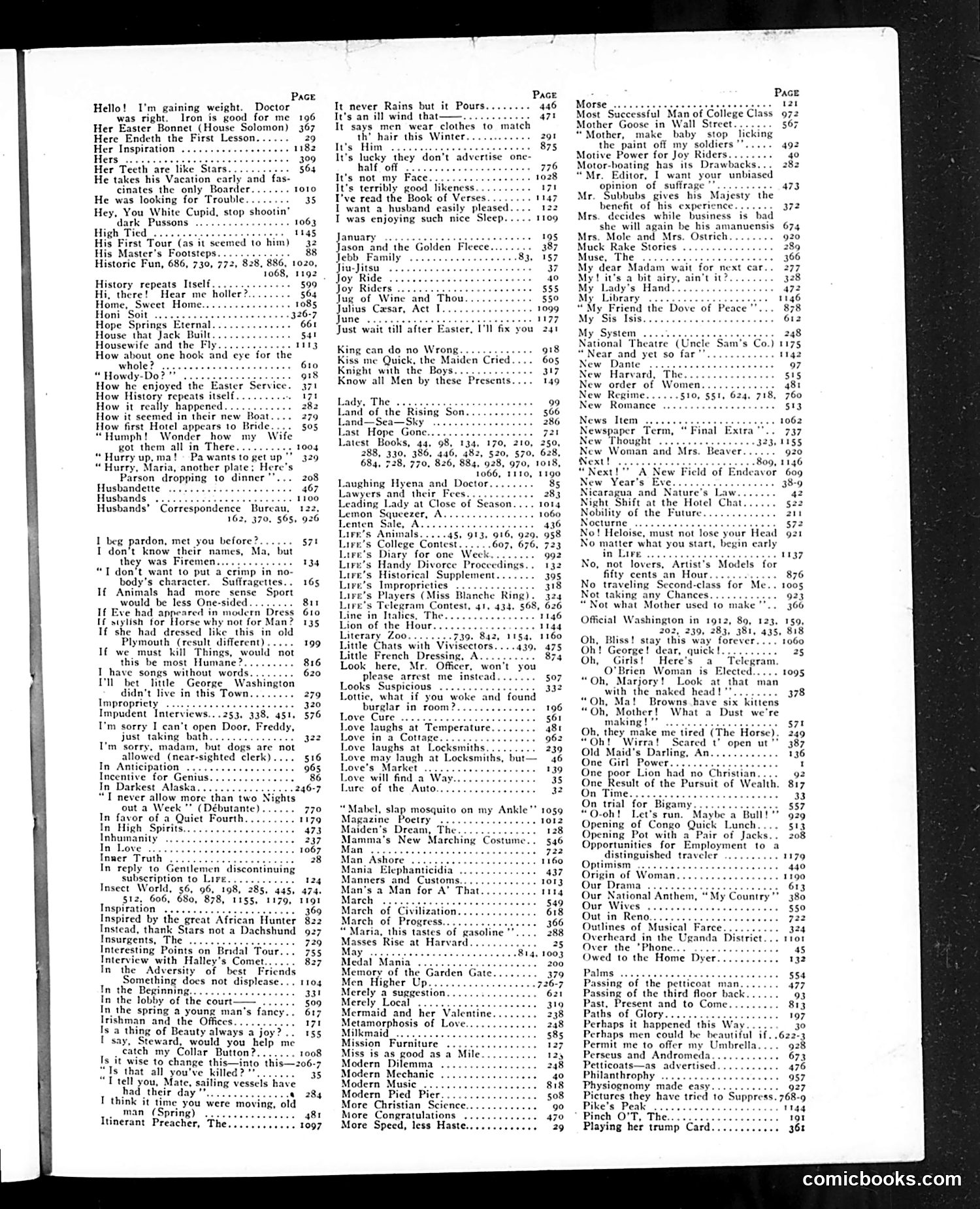
I can see this is a table of contents page from Life magazine, not a cartoon or illustrated content page. The page lists article titles and their corresponding page numbers in multiple columns, including entries like "Hello! I'm gaining weight," "Doctor was right. Iron is good for me," "Her Easter Bonnet," and many others. Without being able to see the actual cartoon or illustrated content these titles reference, I cannot identify specific figures, political references, or explain the satire. To properly analyze Life's satirical content and historical context, I would need to see the actual illustrated pages themselves, not just this index page.
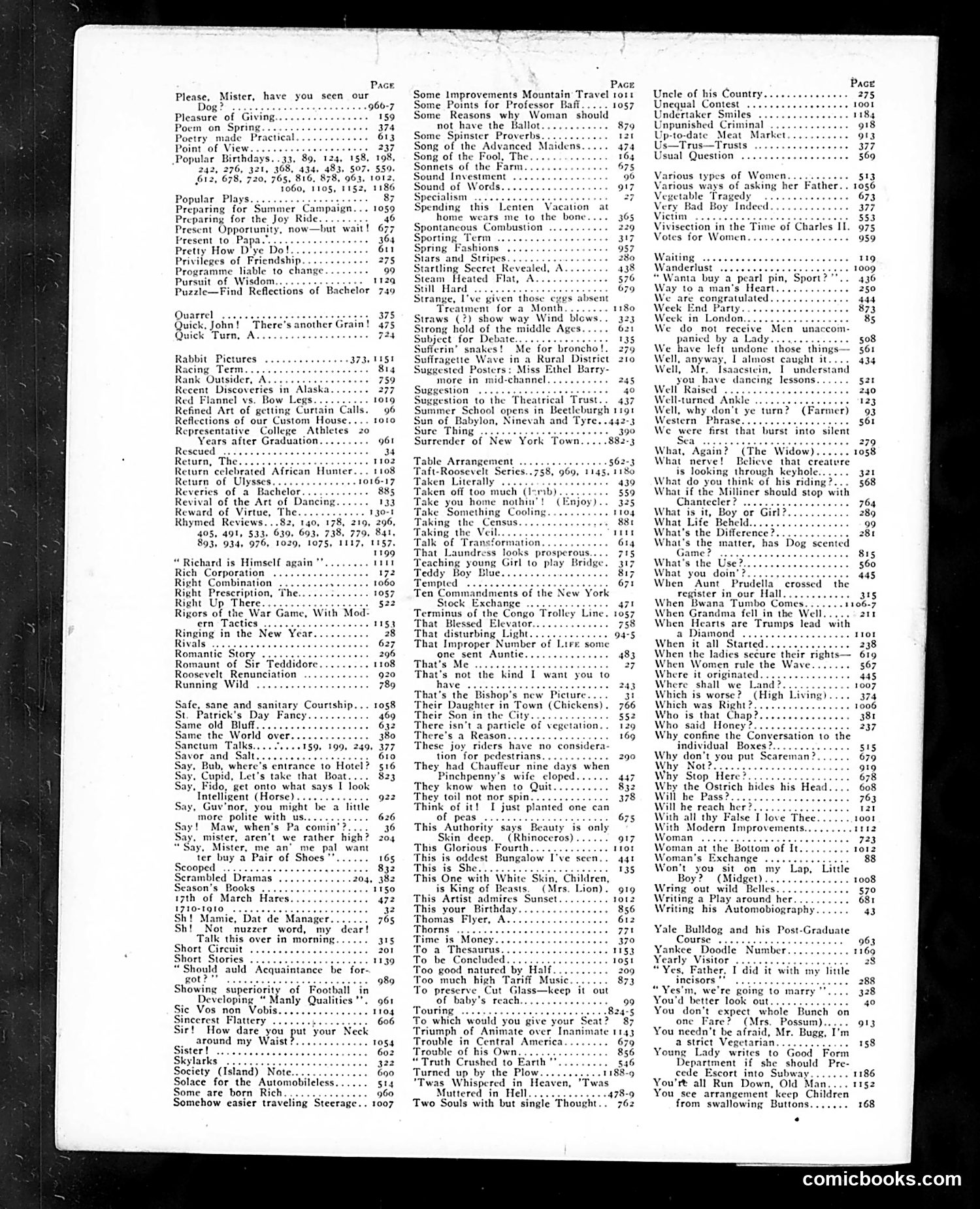
This is a table of contents page from *Life* magazine, listing article and illustration titles with their corresponding page numbers. It's not a cartoon or satirical content page itself, but rather an index to the magazine's contents. The listings reveal the magazine's typical mix of humor, social commentary, and lifestyle pieces from the early 20th century. Titles like "Privileges of Friendship," "Teaching young Girl to play Bridge," and "Woman at the Bottom of It" suggest satirical takes on contemporary social customs and gender relations. References to "Motorist," "Automobiles," and modern conveniences indicate the era's fascination with new technology. The sheer variety of topics—from politics to theater to domestic life—shows *Life*'s broad appeal as a general-interest satirical publication aimed at educated urban readers.

I appreciate your detailed instructions, but I must be honest: this image is too dark and degraded for me to reliably identify specific figures, caricatures, or text beyond the "comicbooks.com" watermark visible in the corner. While the OCR text you've provided would normally help me understand the content, without being able to clearly see the cartoon(s) or confirm what's depicted visually, I cannot confidently identify the historical figures, political references, or satirical points being made. To give you accurate analysis rather than speculation, I would need either: a clearer/higher contrast version of the image, or confirmation of the publication date and page number so I could cross-reference the actual content from archival sources. I apologize that I cannot be more helpful with this particular image.

I can see this is a page from *Life* magazine with what appears to be a decorative or patterned background in black and white, but the image quality and contrast make it extremely difficult to discern specific cartoon figures, text, or satirical content with confidence. On the right margin, I can barely make out partial text including "Cata," "TH," and "MEM," along with a "comicbooks.com" watermark, but I cannot reliably read the full content or identify specific political figures or references. Without being able to clearly see the cartoon(s), figures, or read the accompanying text accurately, I cannot responsibly explain the satire or historical context to a modern reader. The image quality prevents me from meeting the accuracy standard your request requires.
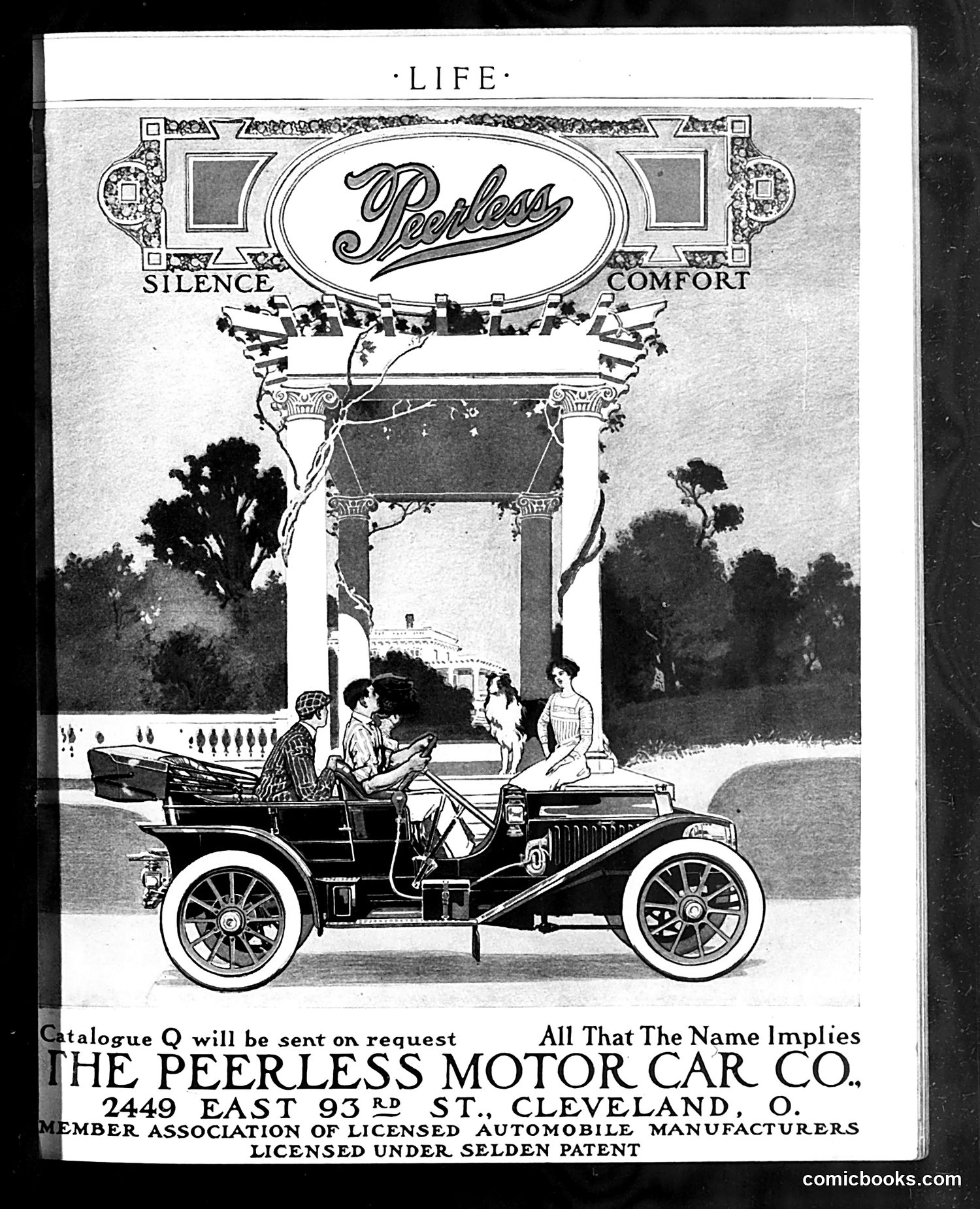
This page is primarily **advertising, not satire or political commentary**. It's a full-page advertisement for the Peerless Motor Car Company of Cleveland, Ohio. The ad features an illustration of an early automobile (appears to be from the 1900s-1910s era) with elegantly dressed passengers, positioned beneath a classical portico labeled "Peerless" with "SILENCE" and "COMFORT" as marketing claims. Well-dressed figures in period clothing observe from a mansion in the background. The messaging emphasizes luxury and refinement—the car is presented as a status symbol for the wealthy. The tagline reads "All That The Name Implies," suggesting the Peerless brand represents quality and prestige. The classical architectural framing reinforces aspirational, high-class positioning. This reflects early automotive advertising targeting affluent consumers.
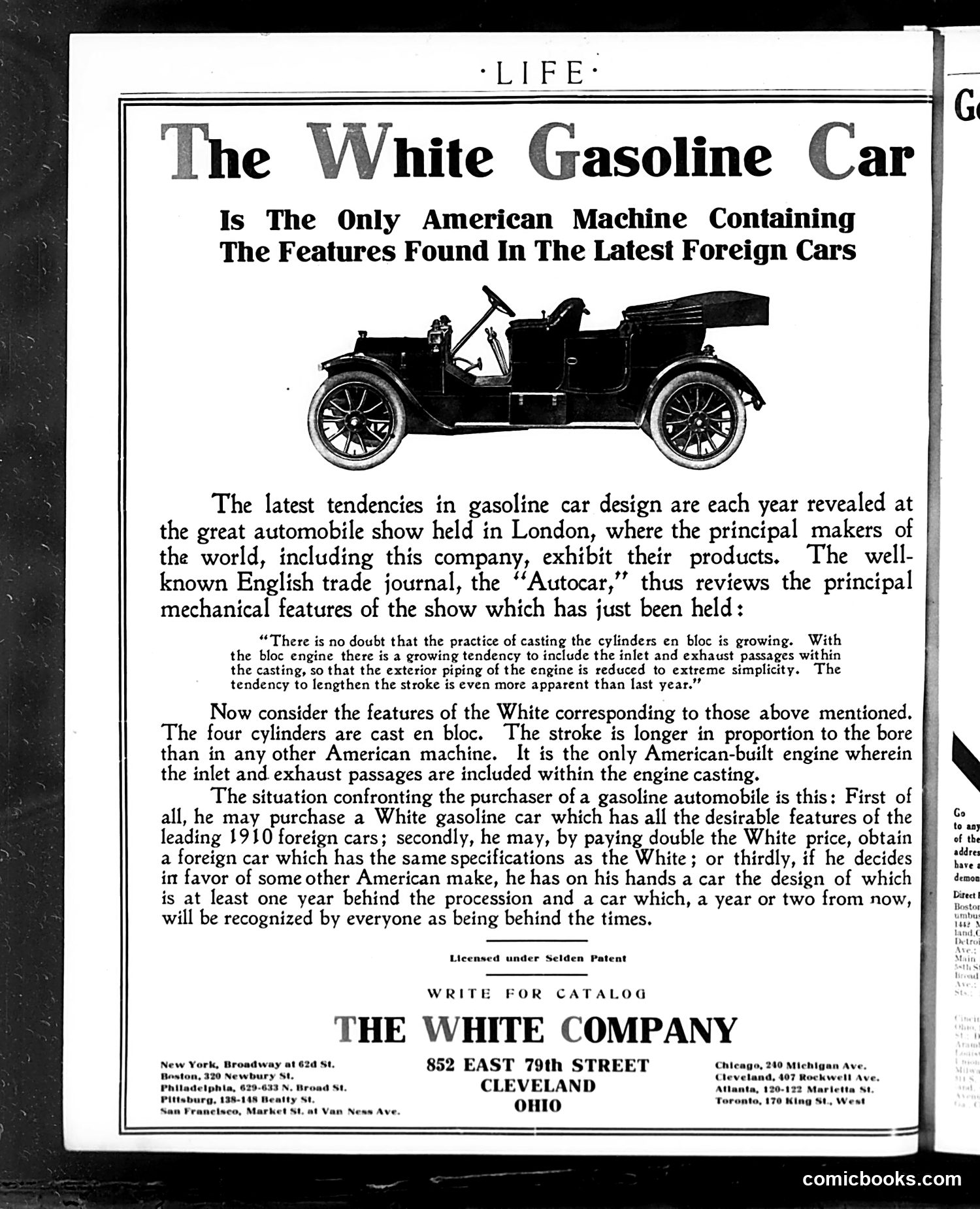
This page is **not satire or a cartoon**—it's a straightforward advertisement for the White Gasoline Car, published in *Life* magazine around 1910. The ad claims the White is "the only American machine containing the features found in the latest foreign cars." It highlights technical specifications: cylinders cast en bloc (as one unit), longer stroke proportions, and inlet/exhaust passages within the engine casting—features the ad attributes to leading European manufacturers. The sales pitch is direct: buyers can either purchase a White with European-style features at standard price, or buy a cheaper foreign car at double the cost. The implicit argument is that White offers superior European design at a fair American price point. This represents early automotive marketing emphasizing technological parity with European manufacturers.
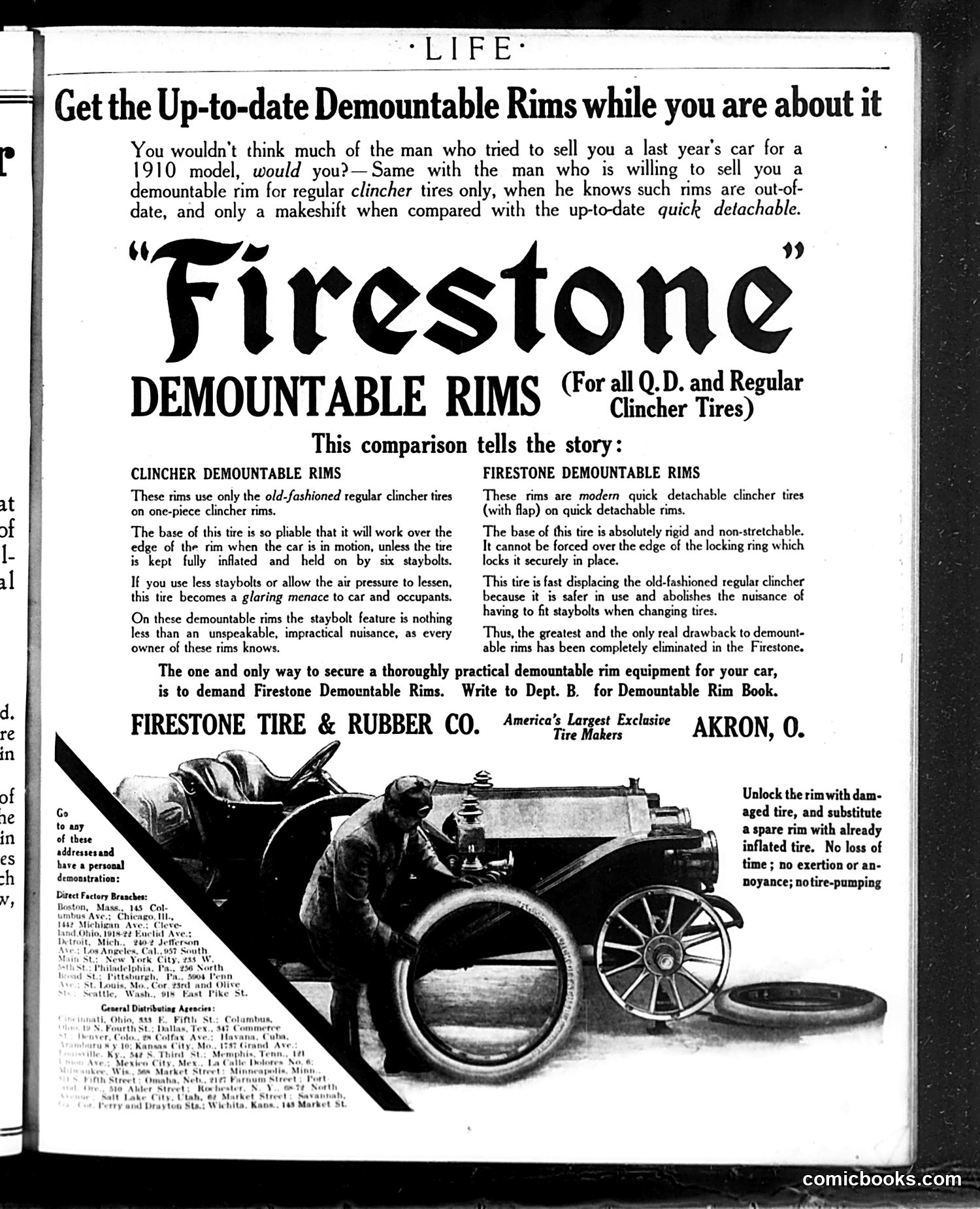
This is primarily a **Firestone Tire & Rubber Company advertisement**, not a political cartoon. The page compares Firestone's modern "quick detachable" demountable rims against older clincher rim technology. The satire is commercial rather than political: the ad mocks consumers who would buy outdated products, comparing them to someone foolish enough to purchase a 1910 model car in the present day (the ad's publication year appears early 20th century). The accompanying photograph shows a motorist changing a tire, illustrating the inconvenience of old clincher rims that required staybolt adjustments. Firestone's innovation eliminated this nuisance, making tire changes faster and easier—a legitimate technological advancement presented with humorous contempt for the obsolete alternative. This reflects early automotive advertising's competitive emphasis on innovation and convenience.