
A complete issue · 20 pages · 1901
Life — July 25, 1901
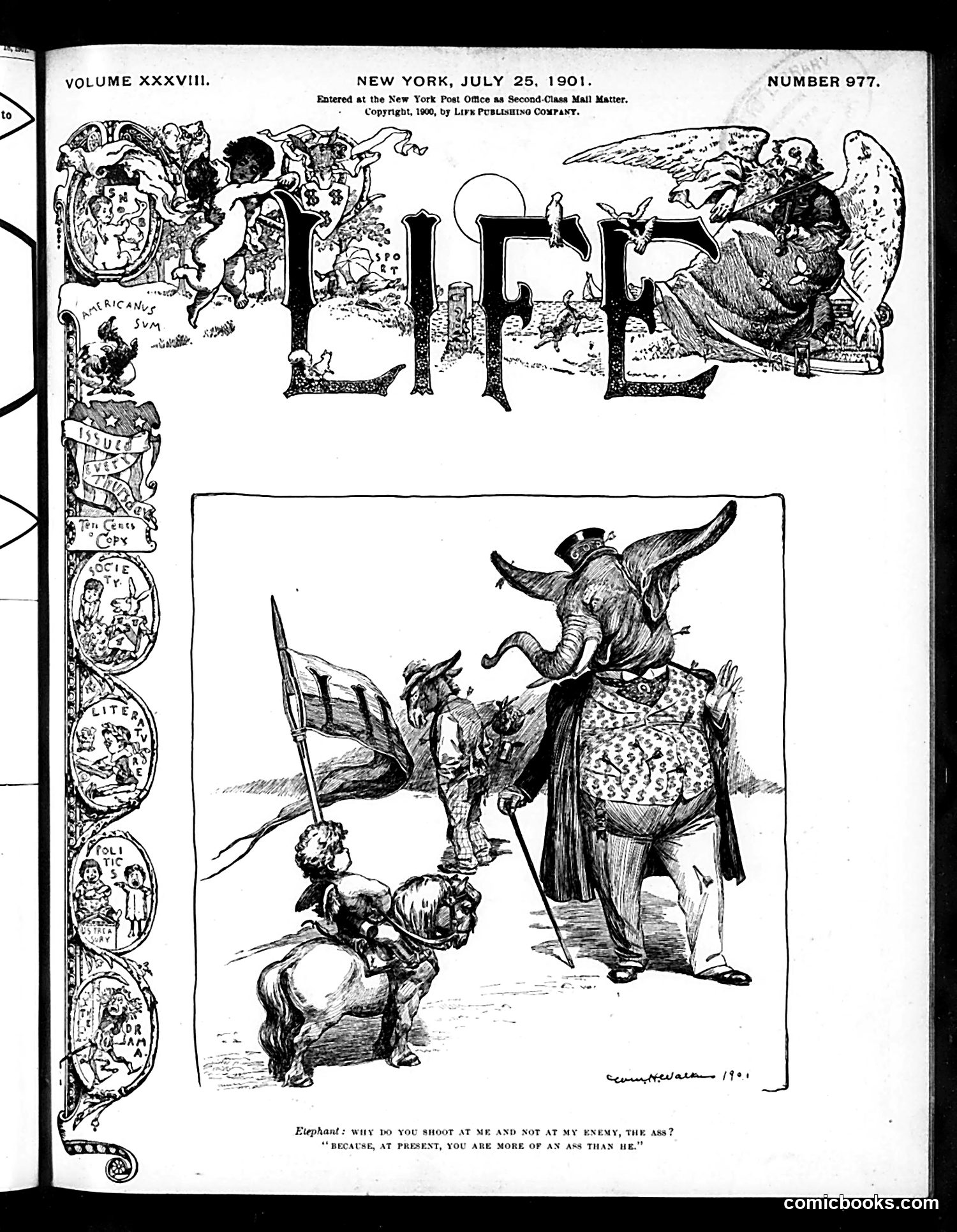
**Main Cartoon Caption:** "Elephant: Why do you shoot at me and not at my enemy, the ass? 'Because, at present, you are more of an ass than he.'" **Interpretation:** This is a political allegory using animals to represent political parties and figures. The elephant symbolizes the Republican Party (its traditional symbol). The cartoon critiques Republicans for attacking fellow Republicans or allies instead of targeting actual Democratic opponents (the "ass," the Democratic Party's symbol). The satire suggests Republican infighting or misplaced aggression—they're wasting energy fighting their own rather than focusing on the opposition. This likely reflects internal Republican party tensions from the McKinley era (1901), possibly regarding imperial policy, tariffs, or leadership disputes. The ornate left border contains decorative vignettes typical of Life's visual style.
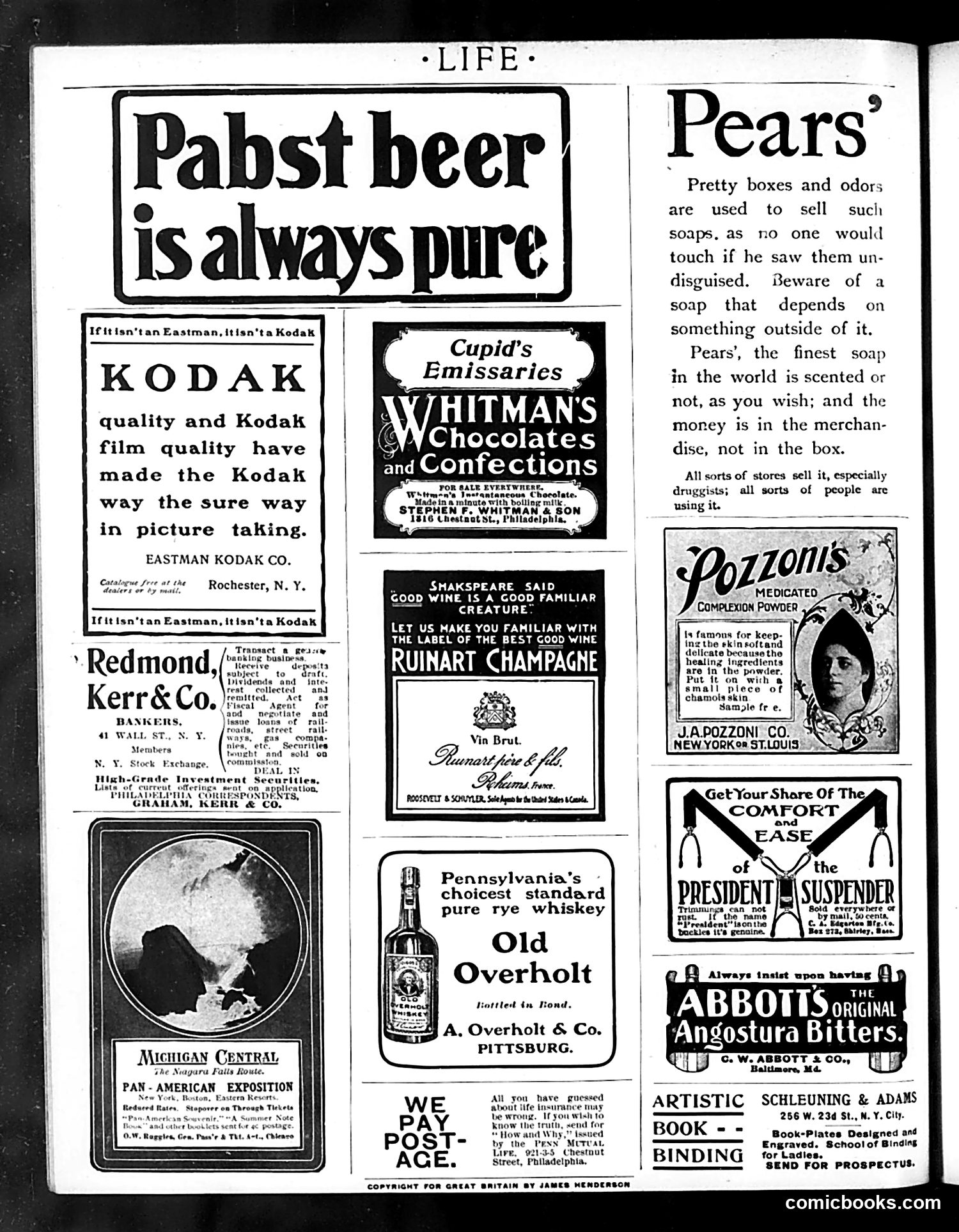
This page is **primarily advertising**, not satirical content. It features vintage product advertisements from what appears to be the early 20th century, including: - **Pabst Beer** (top left) - **Kodak film and cameras** - **Whitman's Chocolates** - **Ruinart Champagne** - **Old Overholt whiskey** - **Pozzoni's medicated powder** - **Abbott's bitters** - Various financial and publishing services The only substantive non-advertising content is a brief text block about **Pears' soap**, which warns consumers to beware of cheap imitations sold in plain boxes—the actual product quality matters more than fancy packaging. This reflects early advertising strategies: emphasizing brand reputation and cautioning against counterfeits in an era of unregulated products.
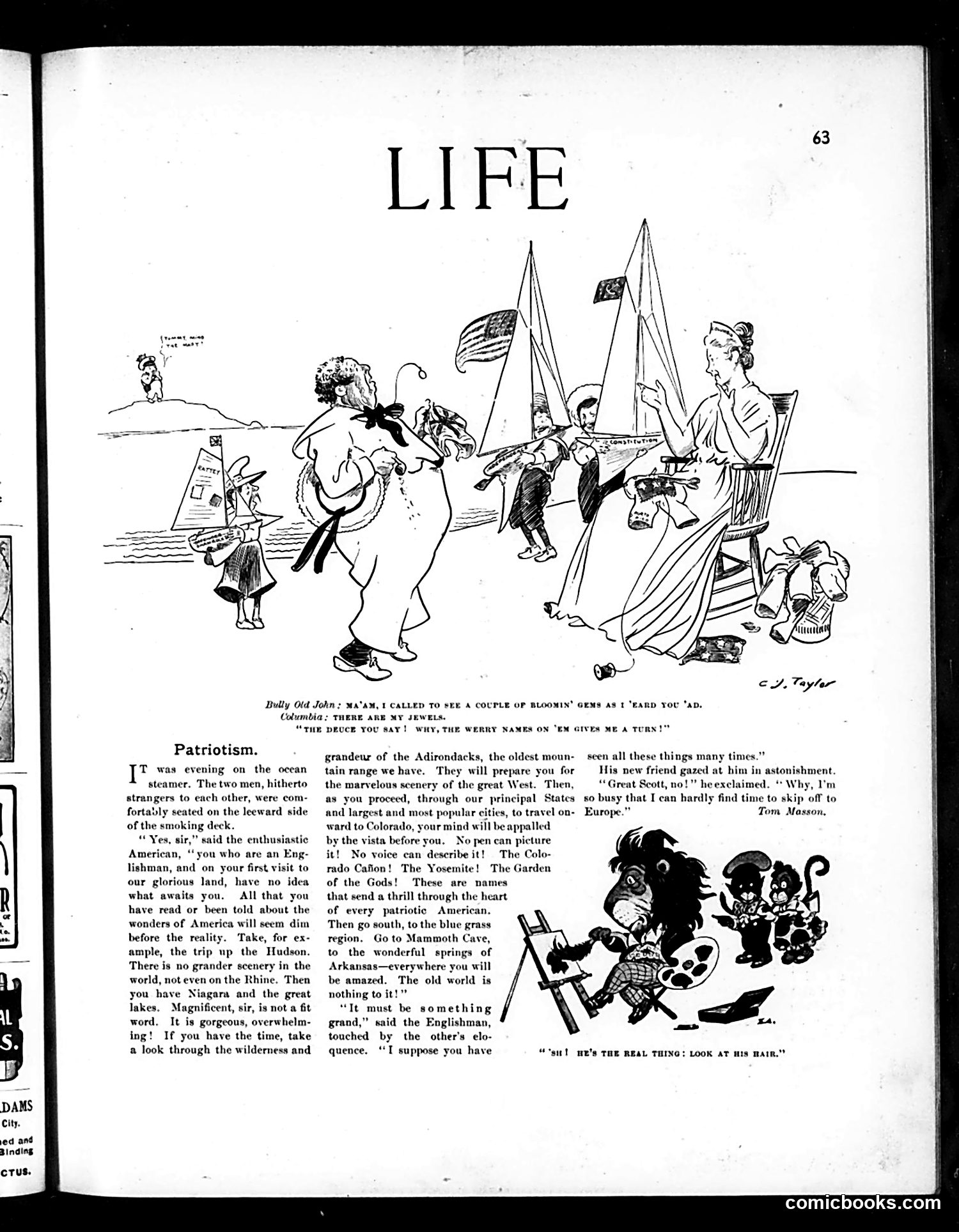
This page contains two distinct pieces: **Top cartoon**: A beach scene satirizing American tourism and patriotism. An enthusiastic American tourist lectures an English couple about American natural wonders (Colorado Canyon, Yosemite, Mammoth Cave). The satire mocks American boosterism—the tendency to aggressively promote American superiority to foreigners. The Englishman's dry response ("It must be something grand") deflates the American's overwrought enthusiasm. **Bottom cartoon**: Shows two figures examining what appears to be a small animal or doll, with the caption "Is it the real thing? Look at his hair." The specific reference is unclear without additional context, but it appears to mock some contemporary figure or trend through exaggerated physical characteristics. Both pieces exemplify Life's satirical approach to American social pretensions of the early 20th century.
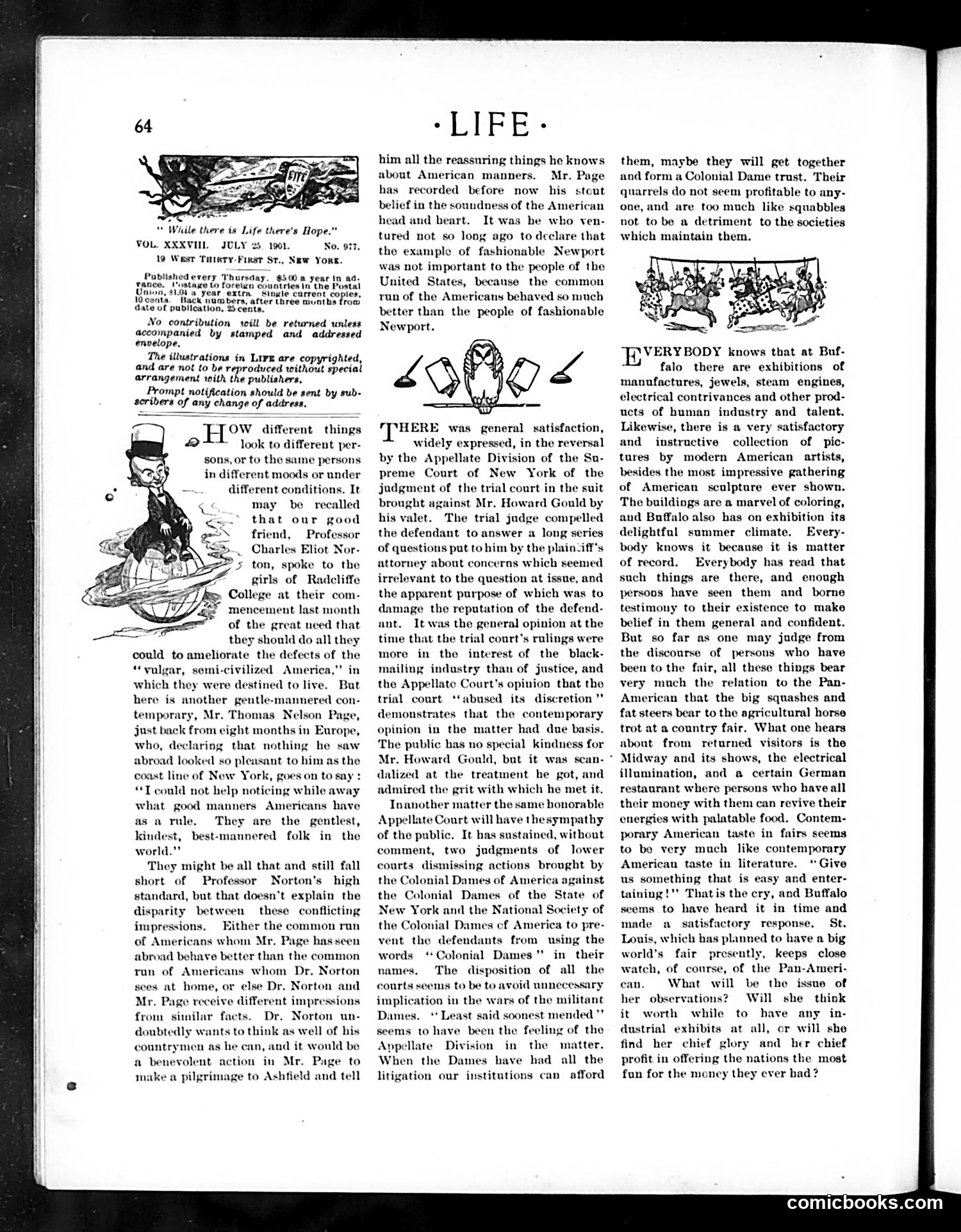
This page contains editorial commentary rather than political cartoons. The small illustration shows a caricatured figure in formal dress (top hat and monocle) sitting in what appears to be a chair or vessel, likely satirizing aristocratic pretension. The text discusses American manners and behavior, contrasting "fashionable Newport" society with ordinary Americans. It references a legal case involving "Mr. Howard Gould" and an Appellate Division ruling, suggesting concerns about wealthy elites and their influence on justice. The commentary advocates for American egalitarianism over European-style class distinctions, arguing that common Americans behave better than the fashionable set. The satire targets snobbish attitudes among the wealthy while praising democratic American values—typical Progressive Era critique of aristocratic pretension.
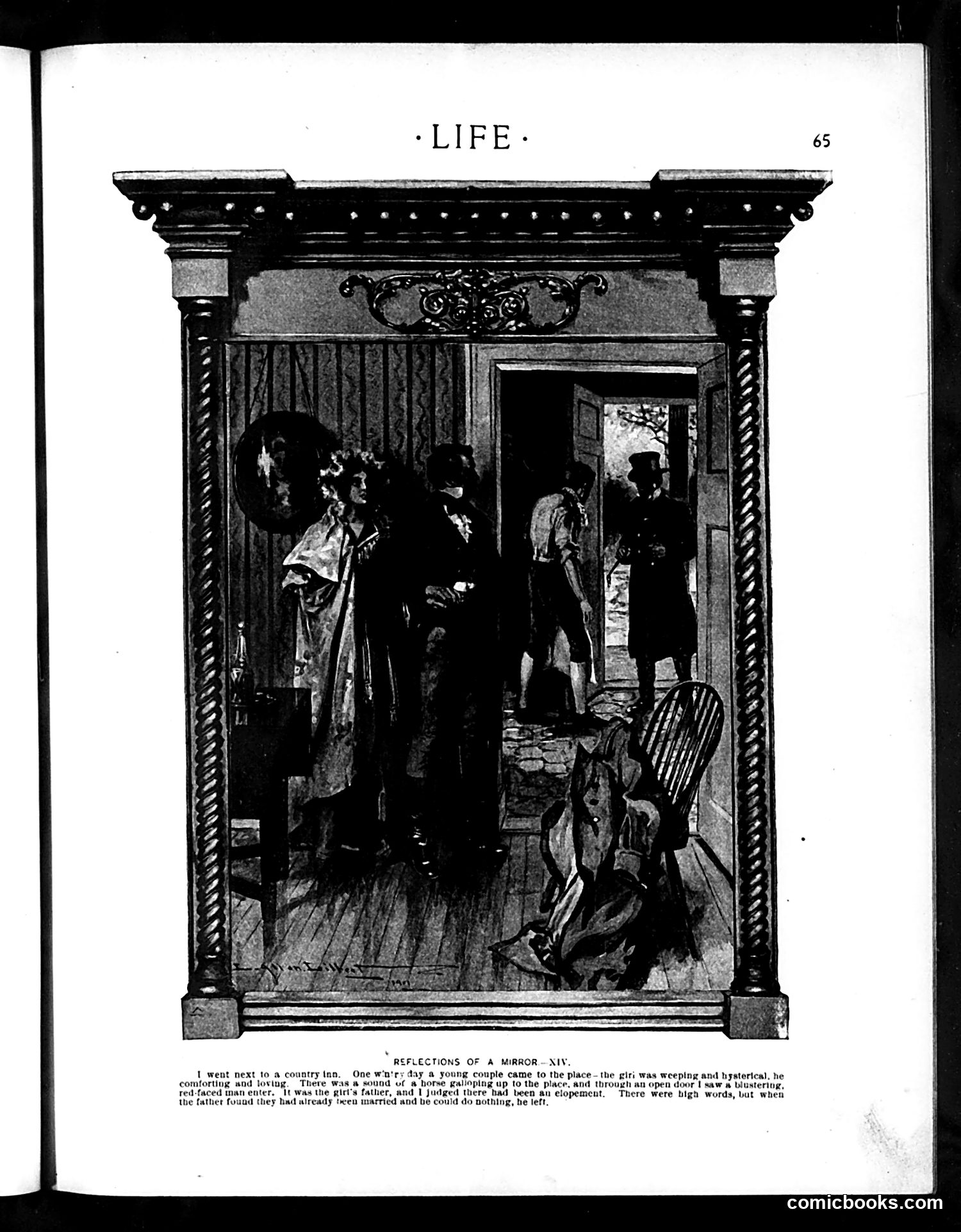
This illustration depicts a country inn scene where a young couple arrives—the girl is weeping and hysterical while the man appears agitated. The narrator observes them through an open door and notices a red-faced man entering. The caption explains the situation: the girl's father has arrived at the inn and discovered the couple. The father finds they've already been married, so he leaves without further confrontation—"be left." This appears to be a satirical commentary on Victorian-era sexual morality and parental authority. The humor lies in the father's impotent rage upon discovering his daughter has eloped with her lover and already secured marriage, thus making her situation socially respectable despite his disapproval. The "reflections of a mirror" framing device suggests observations of human nature and social hypocrisy.
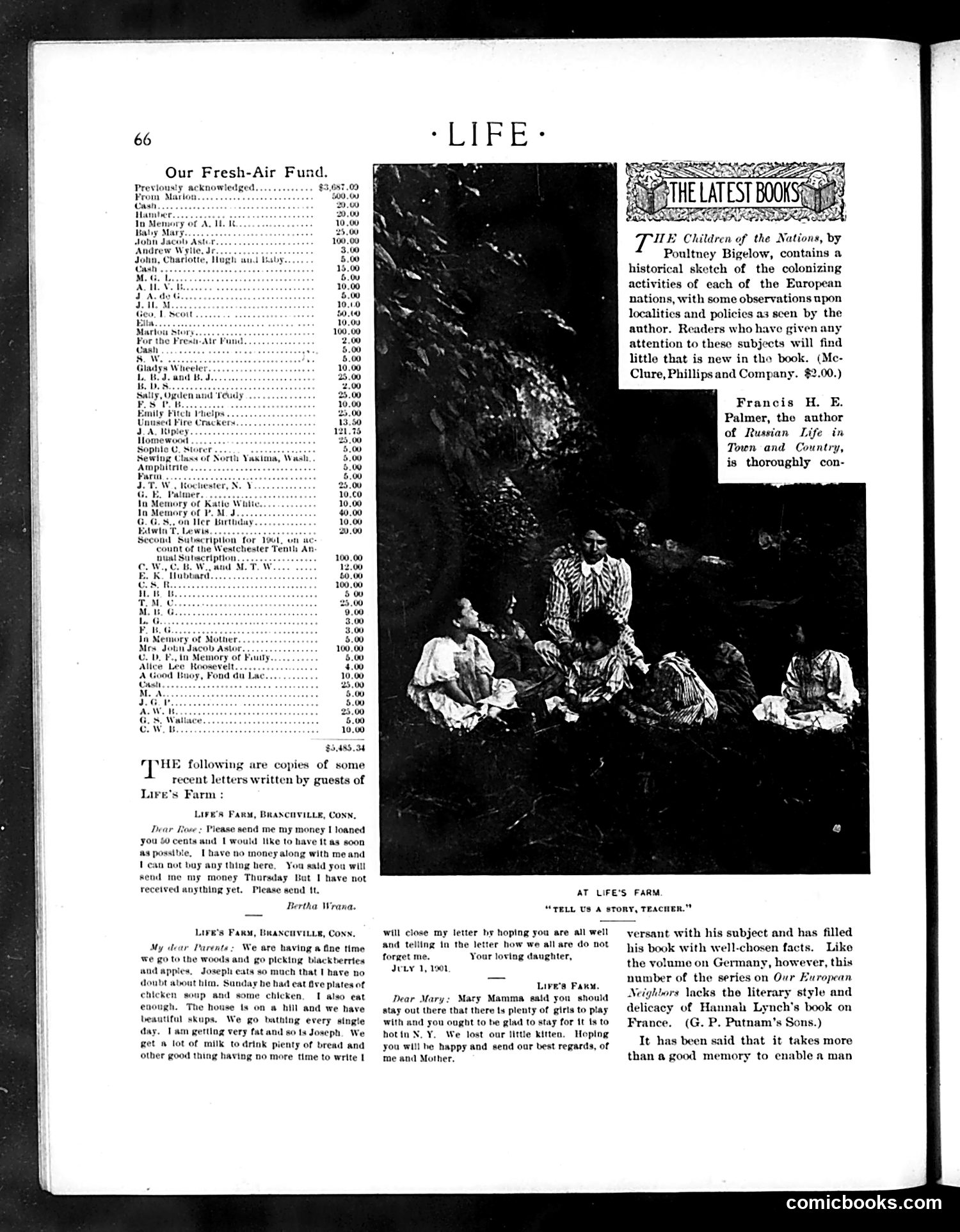
This page features a photograph titled "At Life's Farm" with the caption "Tell Us a Story, Teacher." The image shows an adult (likely a teacher or caregiver) seated outdoors with several children gathered around attentively. The photograph illustrates a scene of informal education or storytelling in a rural setting—Life's Farm, their Connecticut facility. The composition emphasizes the educational mission and wholesome environment the magazine promoted. The surrounding text consists of letters from farm visitors and book reviews, including discussion of Francis H. E. Palmer's *Russian Life: Town and Country*. The page primarily documents Life magazine's charitable activities and literary recommendations rather than presenting political satire or commentary.
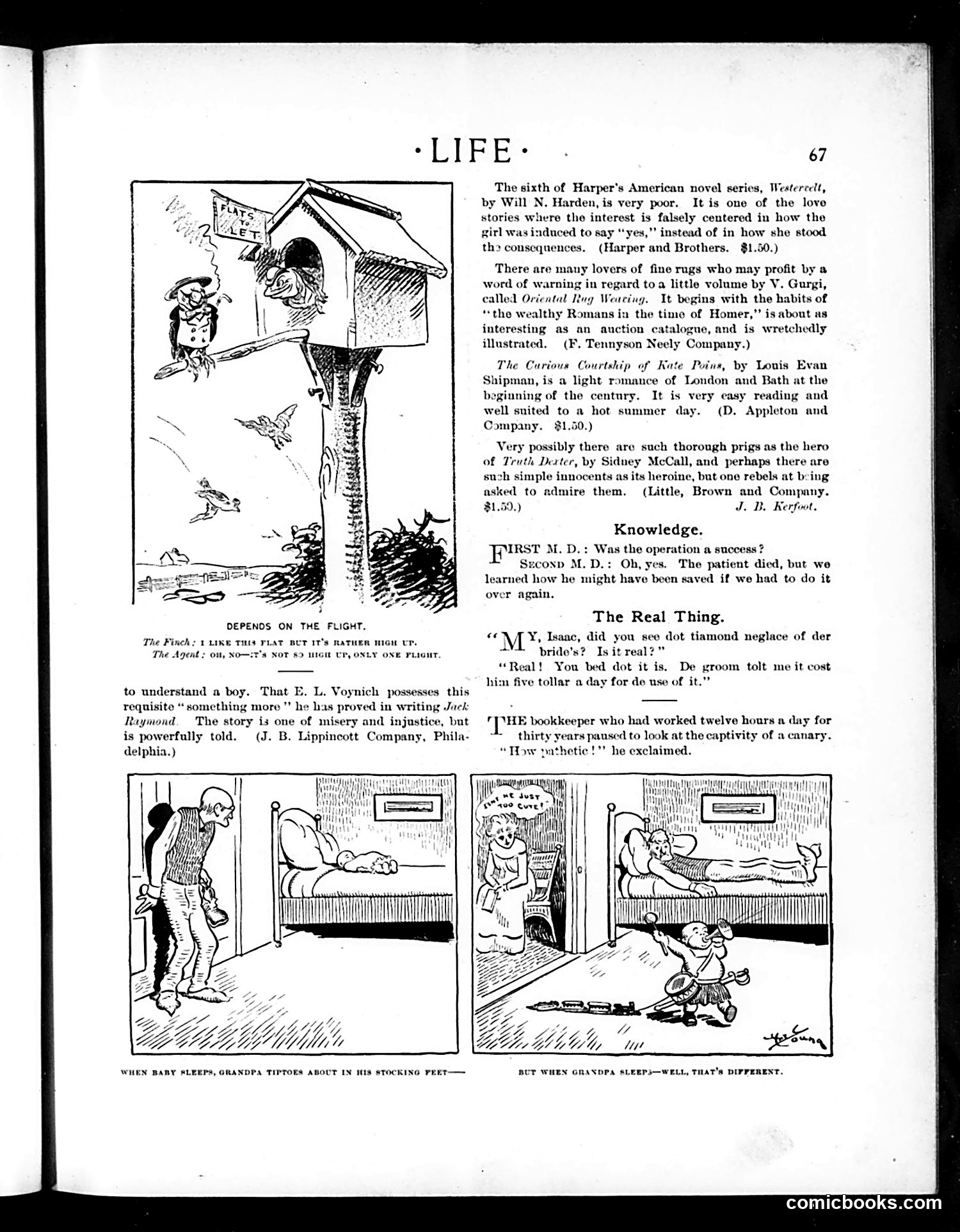
This page contains book reviews and humorous comic strips rather than political cartoons. The upper section reviews novels including works by Will N. Harden and Louis Evan Shipman. The main visual humor appears in two bottom comic panels titled "**When Baby Sleeps, Grandpa Tiptoes About in His Stocking Feet—But When Grandpa Sleeps—Well, That's Different.**" The joke depicts a grandfather carefully tiptoeing around a sleeping baby, then shows the baby playing loudly with toys while the grandfather tries to sleep upstairs—a reversal of expected consideration. This satirizes generational hypocrisy: adults demand quiet from children but don't reciprocate the courtesy. There's also a brief joke titled "**The Real Thing**" about a groom purchasing a diamond necklace for five dollars daily use.
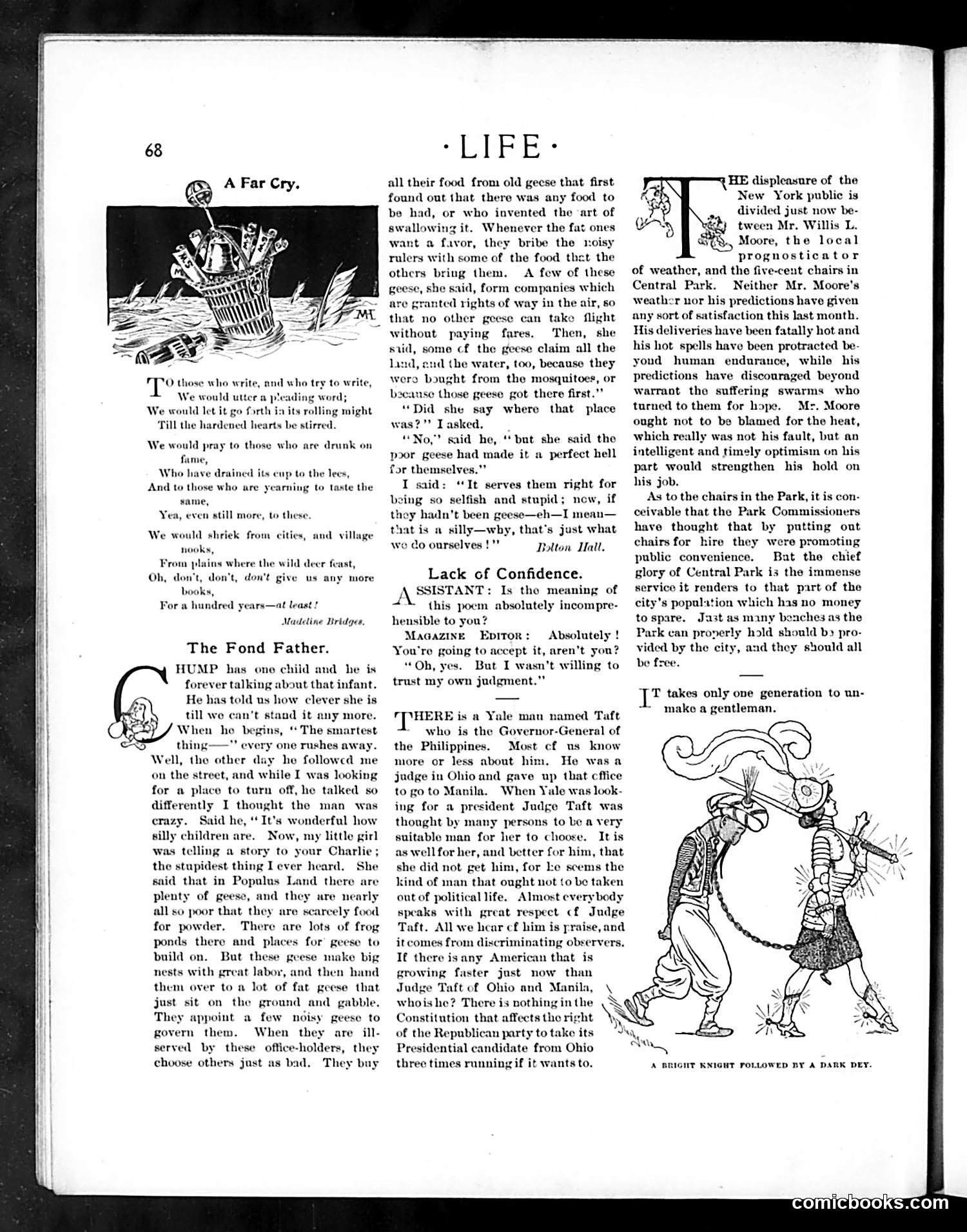
This political cartoon depicts **Judge William Howard Taft**, the U.S. Governor-General of the Philippines, paired with what the caption suggests is an opposing or contrasting figure (the "Dark Dey"). The accompanying text praises Taft's character and growing popularity as a potential Republican presidential candidate. It notes that "almost everybody speaks with great respect of Judge Taft" and suggests he represents suitable leadership, contrasting with existing political dynamics. The cartoon uses the "knight and dark dey" pairing as visual satire—likely suggesting conflict between progressive reform (Taft's administration) and corrupt or outdated political forces. The illustration style is typical of early 1900s political commentary in *Life* magazine.
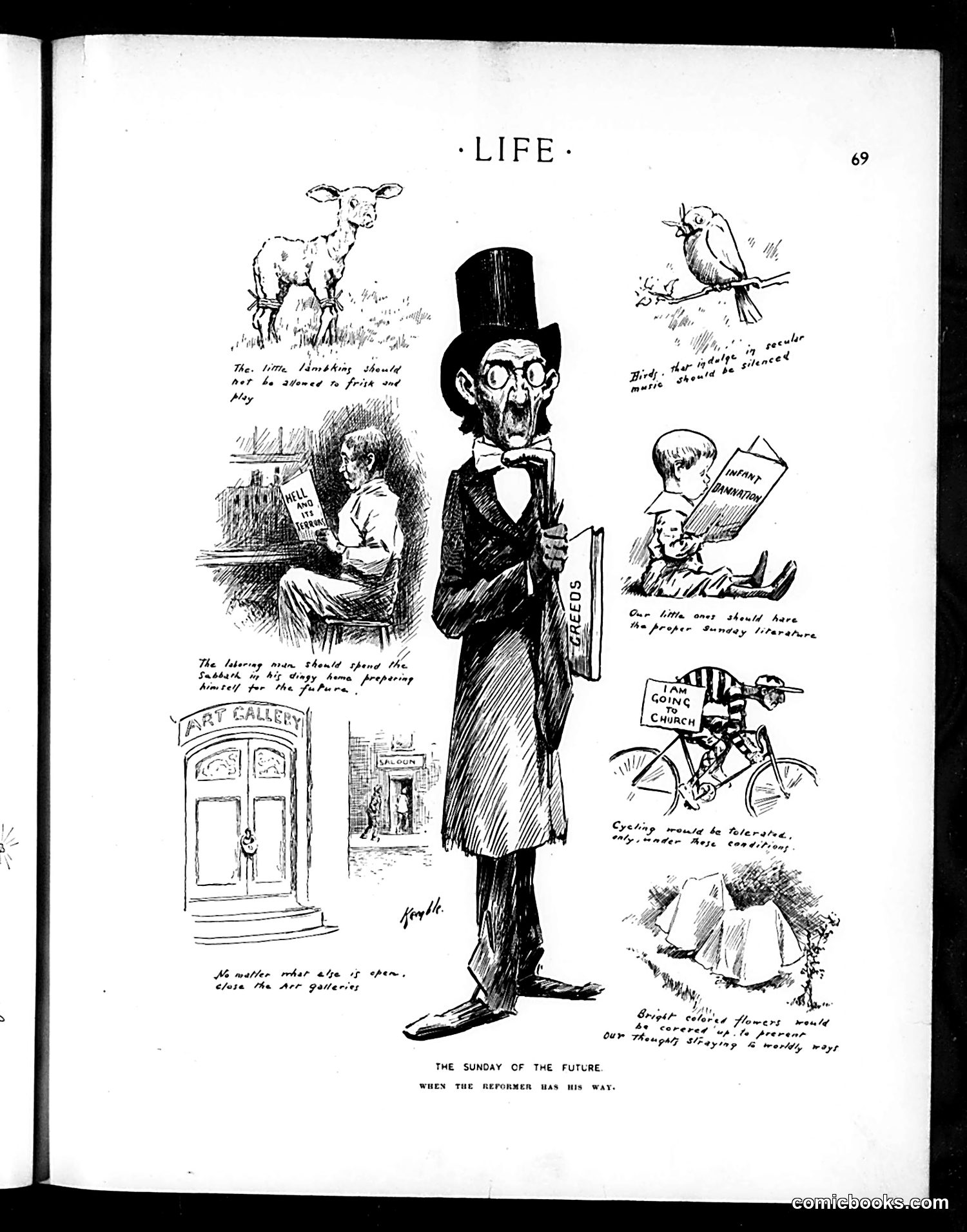
This satirical piece titled "The Sunday of the Future—When the Reformer Has His Way" depicts a skeletal, death-like figure in formal dress (top hat and morning coat) labeled a "reformer," holding what appears to be a list of prohibitions. The surrounding vignettes mock anticipated restrictions on Sunday activities: a goat can't be shown to children, a bird must be silent, children can't read comics, cycling requires special permits, and flowers cannot be displayed publicly. The cartoon satirizes moral reformers—likely those advocating for stricter Sabbath observance laws—by exaggerating their proposed restrictions into an absurd, life-denying vision. The skeletal reformer visually equates such restrictions with death itself, suggesting that eliminating ordinary Sunday pleasures would drain life of joy and vitality.
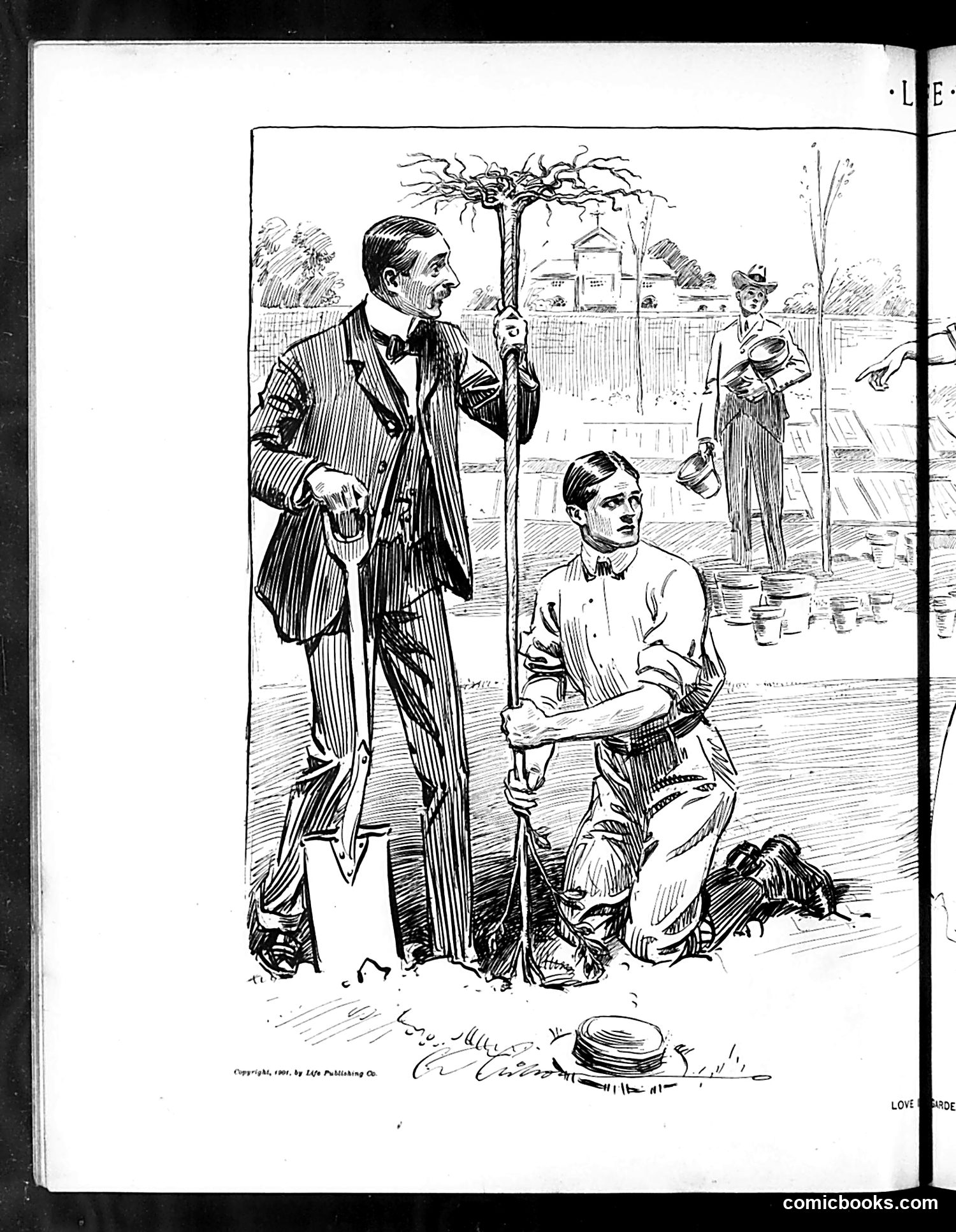
This appears to be a satirical illustration from *Life* magazine depicting a scene in a garden or park setting. A well-dressed man in a formal suit stands holding a spade, while a younger man kneels beside him working the soil. Other figures appear in the background. The caption references "LOVE GARDE" (likely "Love Garden"), suggesting a play on words about romantic pursuits. The contrast between the formally-dressed gentleman supervisor and the kneeling laborer suggests satire about class distinctions or the nature of romantic "work." Without clearer text or additional context, the specific political or social commentary remains uncertain, though it appears to mock either class pretensions, courtship rituals, or labor dynamics of the era. The exact subject and point of satire cannot be definitively determined from the visible elements alone.
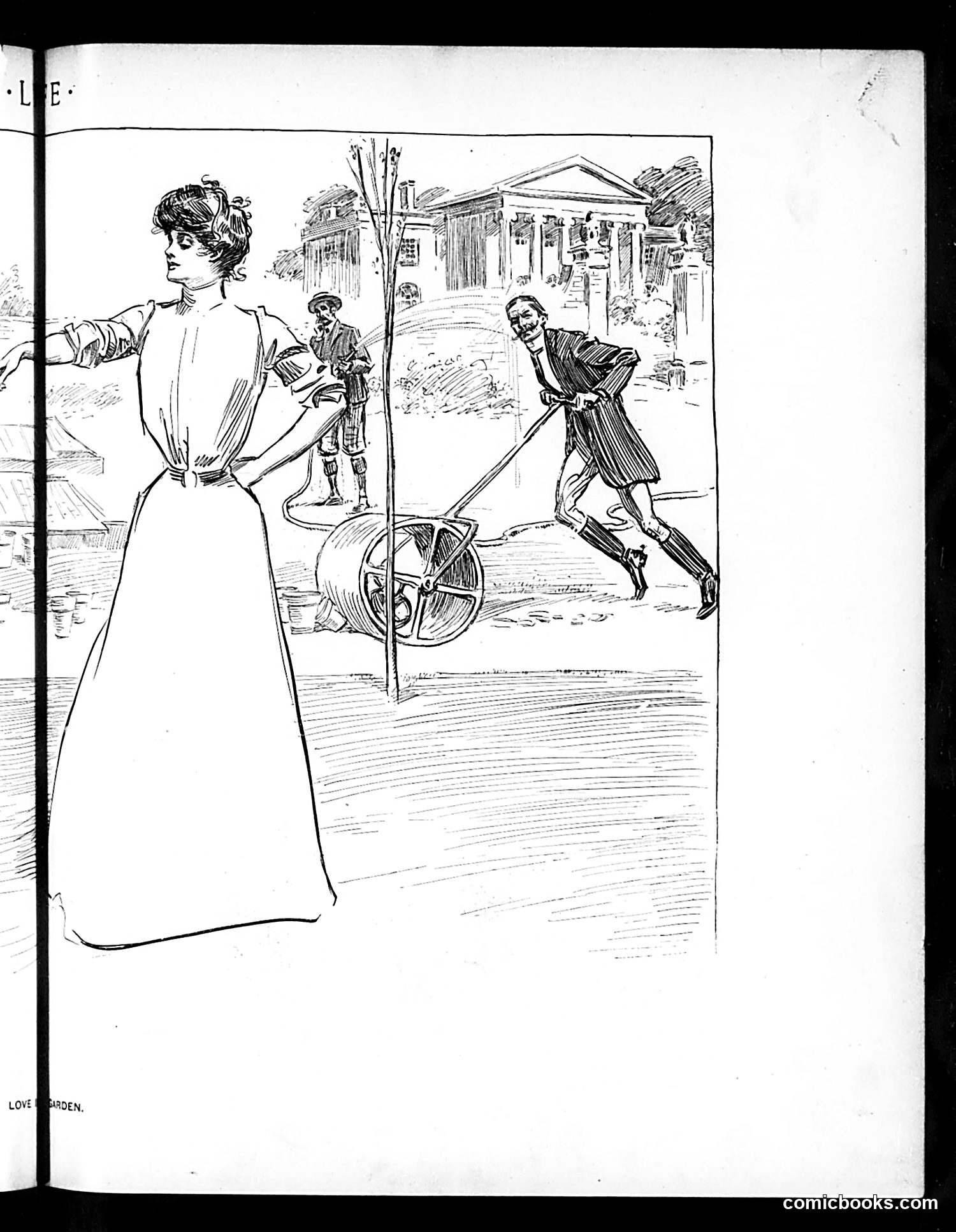
This illustration from *Life* magazine appears to depict a social satire about gender roles and courtship. A well-dressed woman in an elegant dress stands prominently on the left, holding what appears to be a pole or stick. On the right, a man in striped clothing is shown in an active, energetic pose—possibly playing a sport or game (the wheel-like object suggests lawn bowling or a similar recreational activity). The caption reads "LOVE'S GARDEN," suggesting commentary on romantic dynamics. The satire likely mocks either the "New Woman" of the early 20th century (who challenged traditional gender roles) or the reversal of typical courtship behaviors, where the woman appears commanding while the man appears subordinate or actively engaged in entertainment rather than courtship.
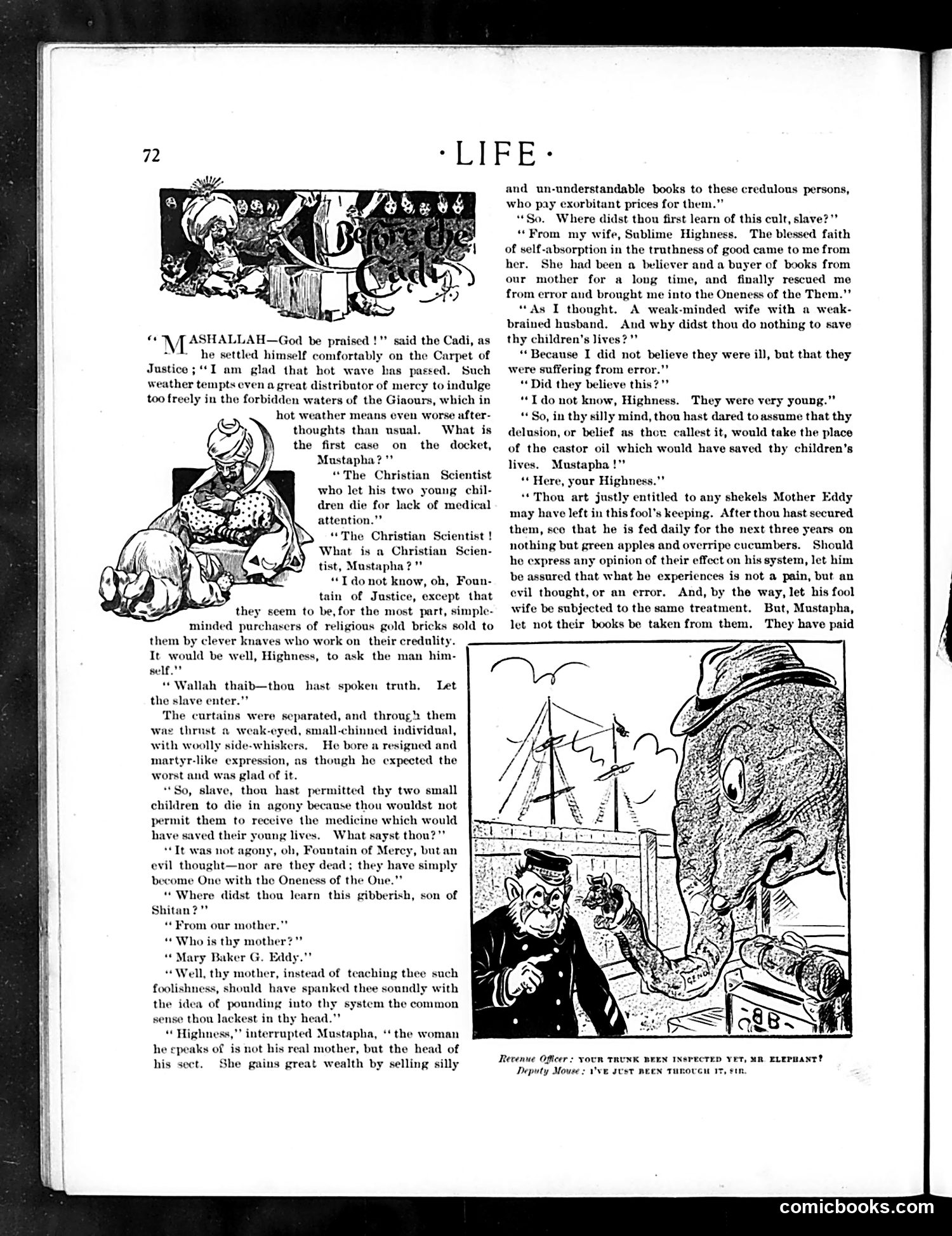
This page satirizes **Christian Science**, a religious movement prominent in early 20th-century America. The dialogue mocks Christian Scientists' belief that prayer and faith can cure illness without medical intervention. The narrative features a **Cadi (Islamic judge)** discussing children who died because their Christian Scientist parents refused medicine. The satire's logic: if Christian Science truly works, why do believers' children die? The pointed comparison to a "slave" selling false spiritual remedies suggests the religion exploits credulous followers financially. The bottom cartoon shows a **Revenue Officer and Deputy Mouse** inspecting a trunk, punning on the phrase "elephant in the room"—likely critiquing how Christian Science ignores obvious problems (illness, death) through faith alone. The satire attacks what it views as dangerous pseudoscience endangering children.
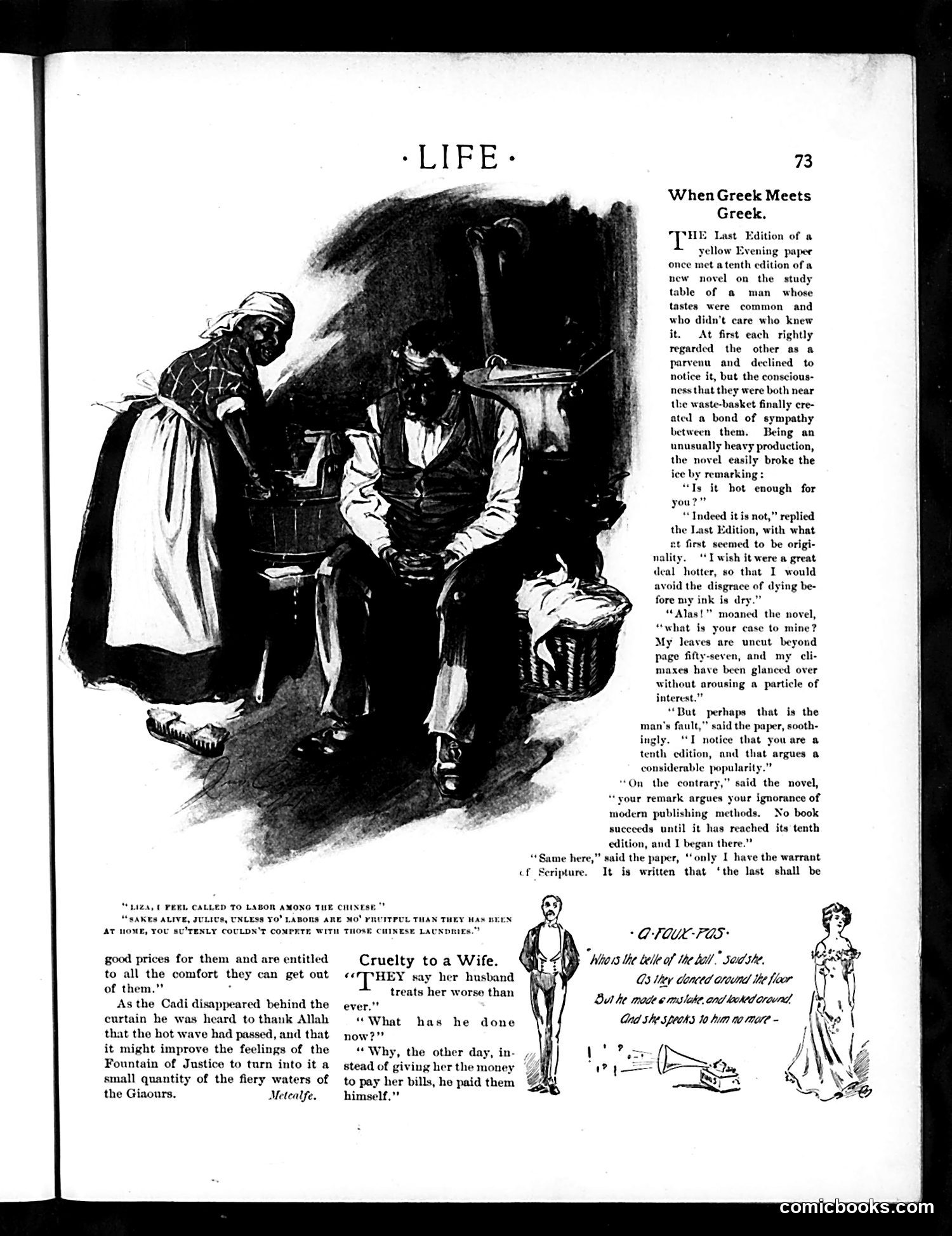
This page contains three separate satirical pieces from *Life* magazine: **"When Greek Meets Greek"** (main illustration): A witty dialogue between a newspaper's "Last Edition" and a new novel, both destined for the waste-basket. They bond over their shared failures—the paper fears dying before its ink dries; the novel admits it's already a tenth edition (implying poor sales, since successful books build gradually). The satire mocks both cheap newspapers and poorly-selling books as disposable, while playing on the proverb "the last shall be first." **Bottom left**: A joke about Chinese laundry workers undercutting American labor, reflecting period anxiety about immigrant competition. **Right section**: Two brief items—a sentimental poem illustration and a domestic cruelty anecdote where a husband's "cruelty" is actually financial responsibility (paying bills directly instead of giving money to his wife). The satire likely mocks either sentimental moralizing or unclear domestic dynamics. All reflect *Life*'s style: urbane mockery of contemporary American life.
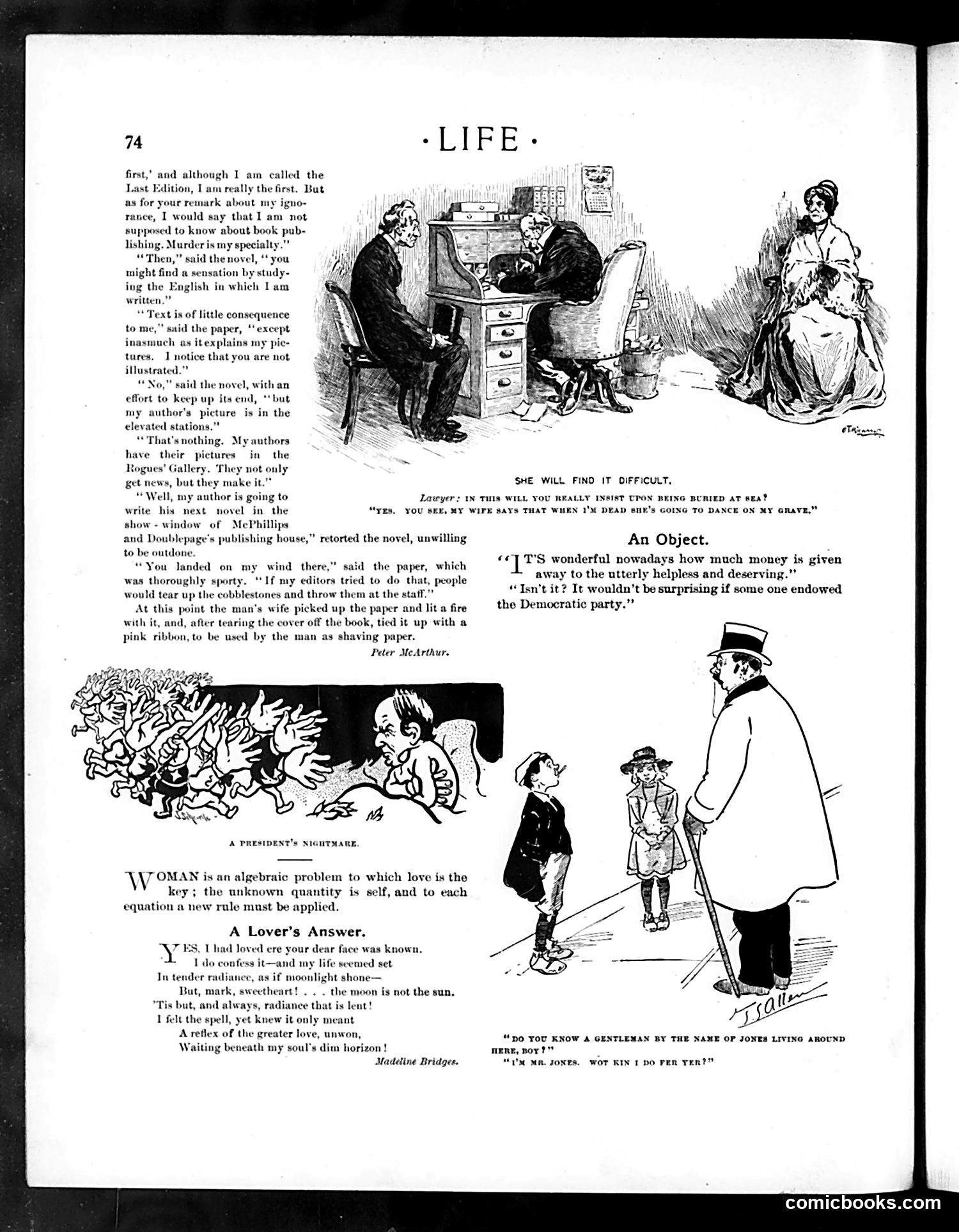
This page contains multiple brief satirical pieces typical of *Life* magazine's format: **"She Will Find It Difficult"** (top cartoon): A husband jokes with his lawyer about wanting to be buried at sea because his wife said she'll "dance on my grave" when he's dead—satirizing marital discord. **"A President's Nightmare"** (middle cartoon): An unclear political reference showing what appears to be a chaotic crowd scene, likely mocking a sitting president's anxieties. **"An Object"** (right): A brief dialogue satirizing wealthy philanthropists' selective charity, suggesting the Democratic Party is so worthless it would be a fitting object of charity—partisan political mockery. **Romantic poems** ("A Lover's Answer," etc.) and earlier dialogue about publishers, authors, and newspapers fill the rest—typical *Life* content mixing humor, sentiment, and social observation about literary and publishing worlds of the era. The overall tone reflects early 20th-century American satirical journalism: irreverent toward institutions and relationships alike.
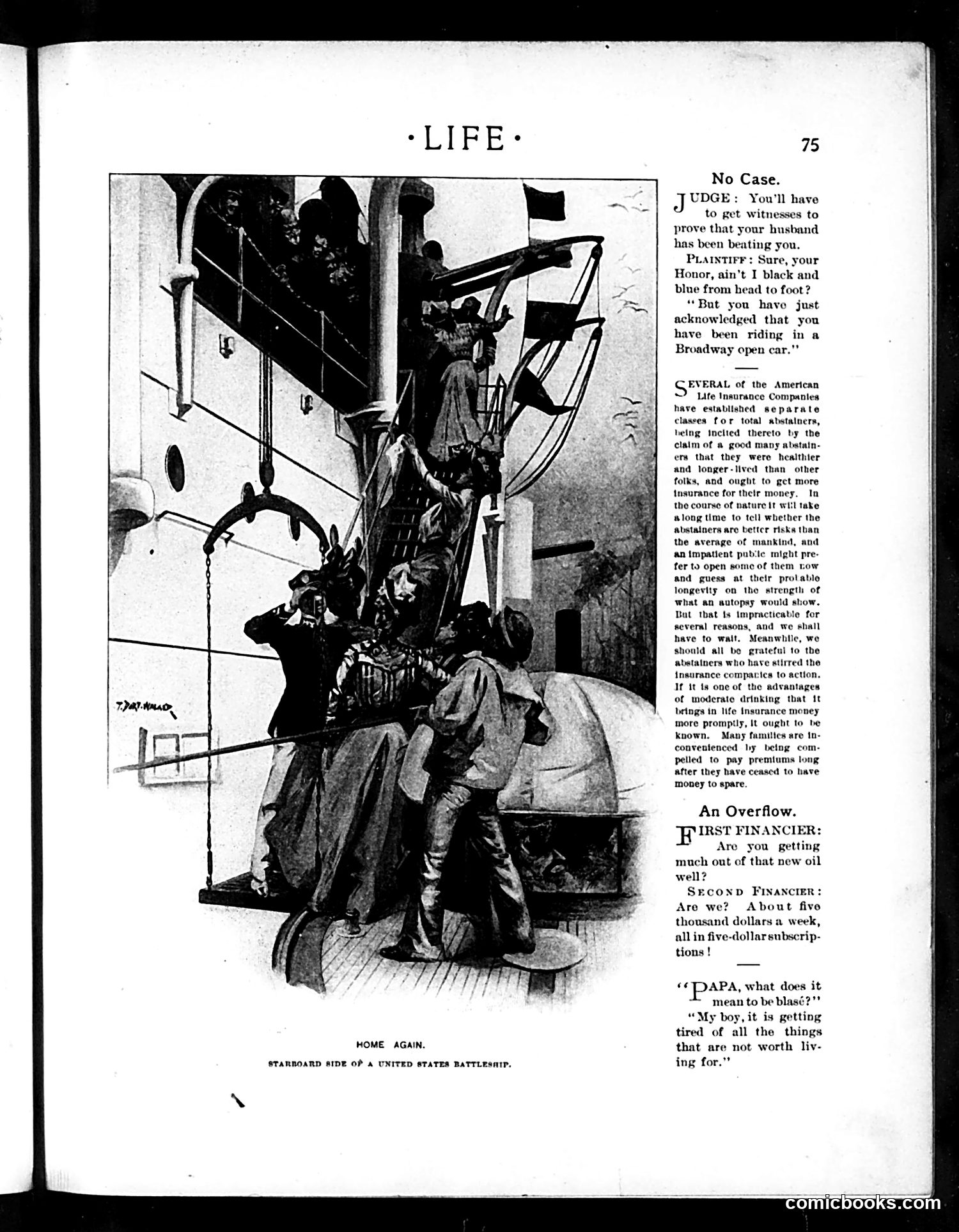
**Main Cartoon ("Home Again"):** Depicts sailors returning to a U.S. battleship, showing the cramped, chaotic conditions of naval life. The caption references the "starboard side," emphasizing the tight quarters sailors endured. **"No Case" Joke:** A woman suing for divorce shows bruises to the judge as evidence of abuse. The judge dismisses her claims, suggesting her injuries come from riding in a Broadway open car (convertible), not her husband's beatings. This satirizes how courts dismissed domestic violence claims and the common hazards of early 20th-century transportation—being jostled in open vehicles caused visible injuries. **Insurance Discussion:** Notes that life insurance companies now offer better rates to total abstainers, who claim healthier lifespans. The text wryly suggests this incentivizes moderate drinking—if drinking helps you collect insurance payouts faster, families benefit financially from the policyholder's earlier death. **"Blasé" Definition:** A father explains worldly exhaustion to his son: being tired of things "not worth living for"—satirizing aristocratic pretension and ennui.
This page contains three distinct pieces of satire: **"Bliggerson's Degree"** (left column): A poem mocking a man who donates his entire fortune to schools and libraries expecting honorary degrees in return, only to receive none. When creditors come calling, he's left with only the letters "O.D." (Overdraft?), satirizing both naive philanthropy and the hollow nature of academic honors. **"Mr. Dooley" excerpt** (center): Peter Dunne's Irish-American character comments on the warm reception American businessmen received in London, contrasting it with historical Anglo-American tensions. The satire suggests American-British relations have suddenly improved through commerce and shared language, reversing previous anti-American sentiment. **"The Scissors at Nulls" anecdote** (right): A humorous story about an Irish railway passenger who, when asked if the ride has improved, casually mentions they've derailed—suggesting Irish rail incompetence or dark humor about near-disaster. The page also contains period whiskey and hotel advertisements.
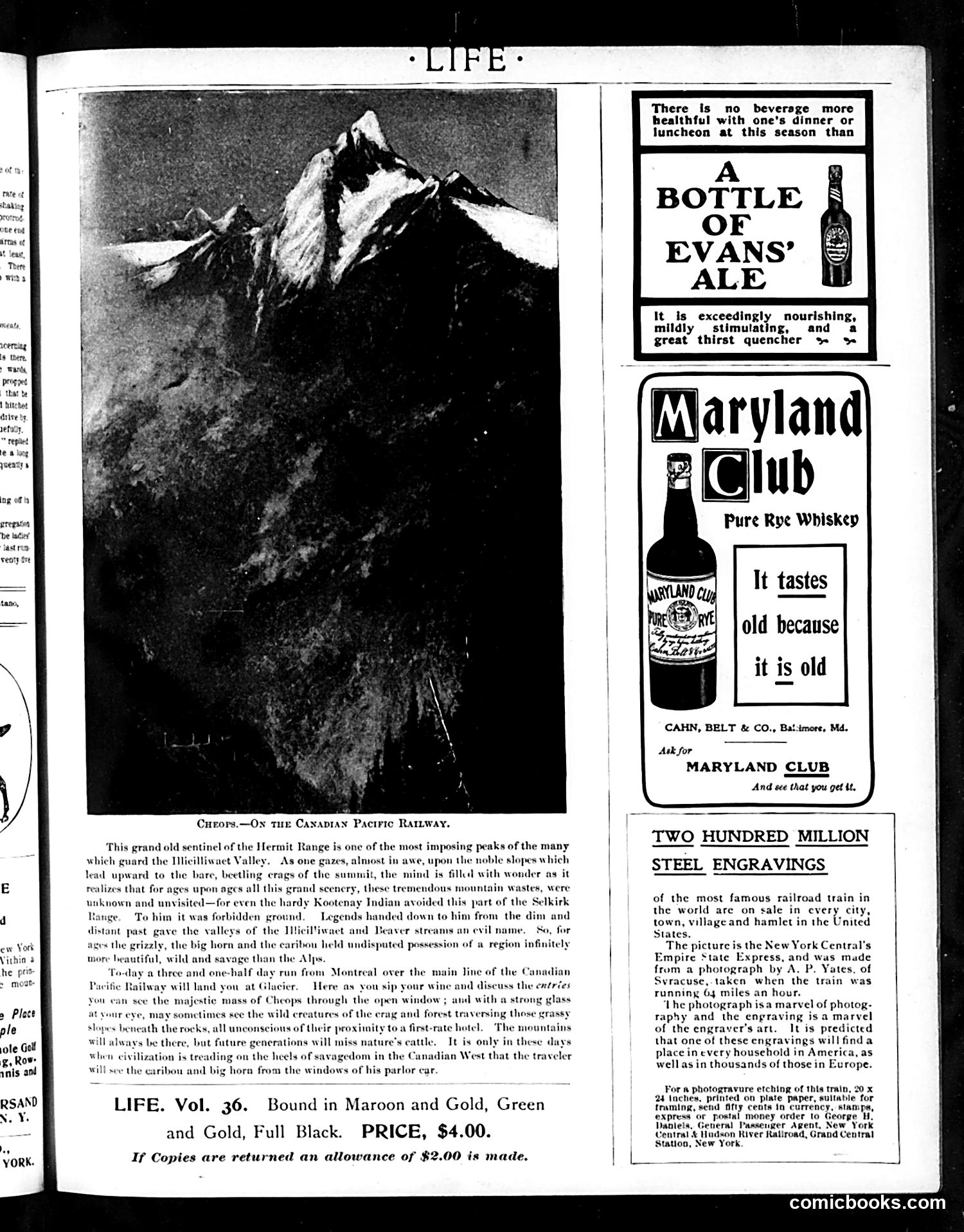
This page is primarily **advertising and promotional content** rather than political satire or editorial cartoons. The main image shows **Cheops Mountain in British Columbia's Selkirk Range** along the Canadian Pacific Railway. The accompanying text describes the scenic grandeur of the region and promotes rail travel to Glacier, British Columbia—a three-and-a-half-day journey from Montreal. The piece celebrates untamed wilderness and emphasizes that future generations won't experience such unspoiled nature as civilization advances westward. The right side contains **three liquor and beverage advertisements**: Evans' Ale, Maryland Club Pure Rye Whiskey, and a notice about steel engravings of the New York Central's Empire State Express train. The page reflects early 20th-century tourism marketing and advertising practices, with no apparent political commentary or satirical intent.
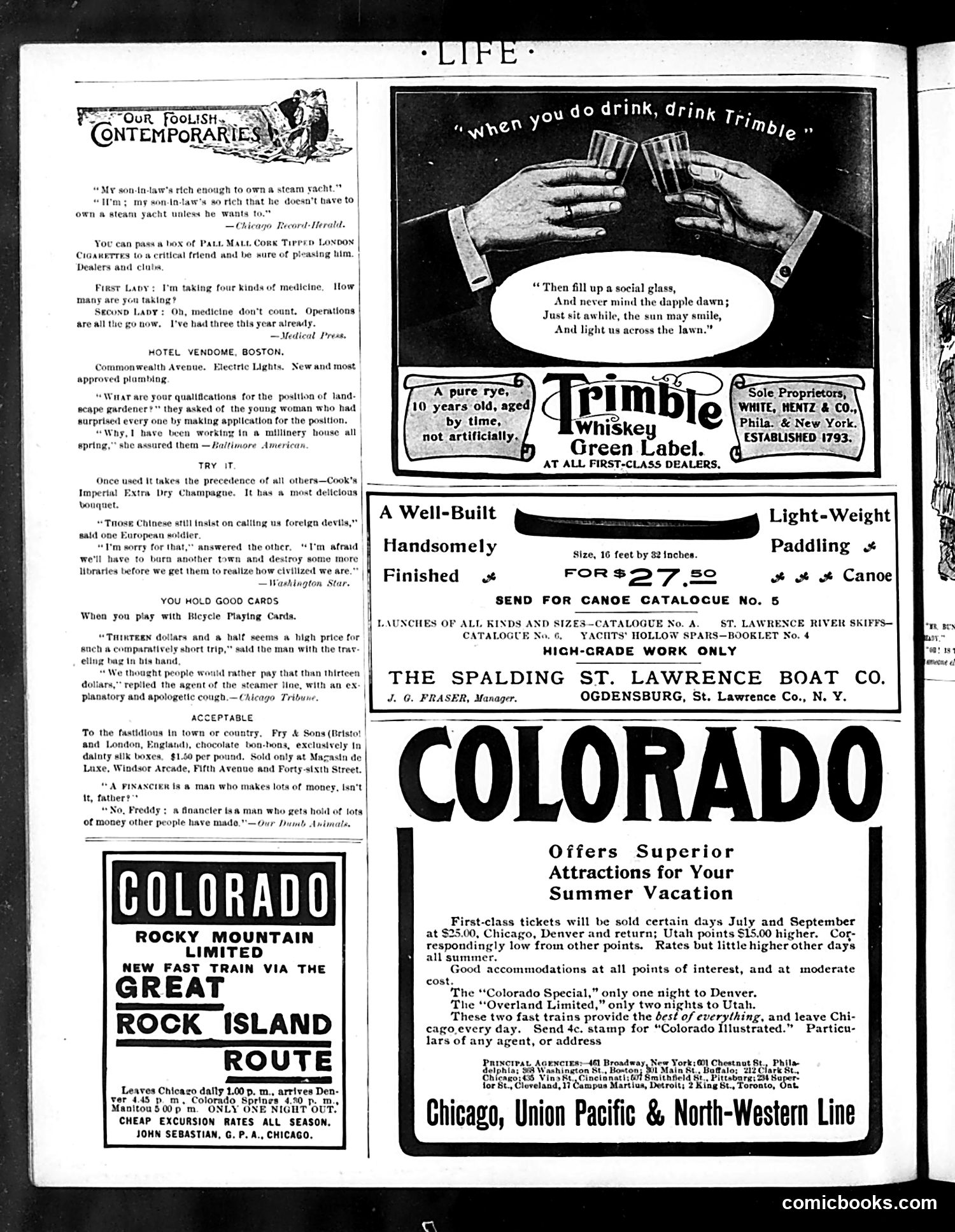
This page is primarily **advertising** with humor sections typical of early 1900s *Life* magazine. The cartoon/humor sections include: - **"Our Foolish Contemporaries"**: Brief satirical quotes mocking social pretension (wealthy people bragging about yachts) and absurd logic (a woman's millinery experience qualifying her as a landscape gardener). - **"You Hold Good Cards"**: A joke about traveling—a passenger protests paying $13.50 for a trip; the agent explains it's cheaper than paying $13 for the steamer line to destroy libraries teaching people civilization exists. - **Financier Definition**: Dark humor distinguishing a financier from ordinary rich people—a financier is someone who makes money from *other people's* money. The page's dominant content is **advertisements** for Trimble Whiskey, canoes, a boat company, and Colorado railroad tourism—typical turn-of-the-century promotions. The satirical humor reflects *Life*'s comedic tradition of mocking wealth, pretension, and social absurdities of the era.
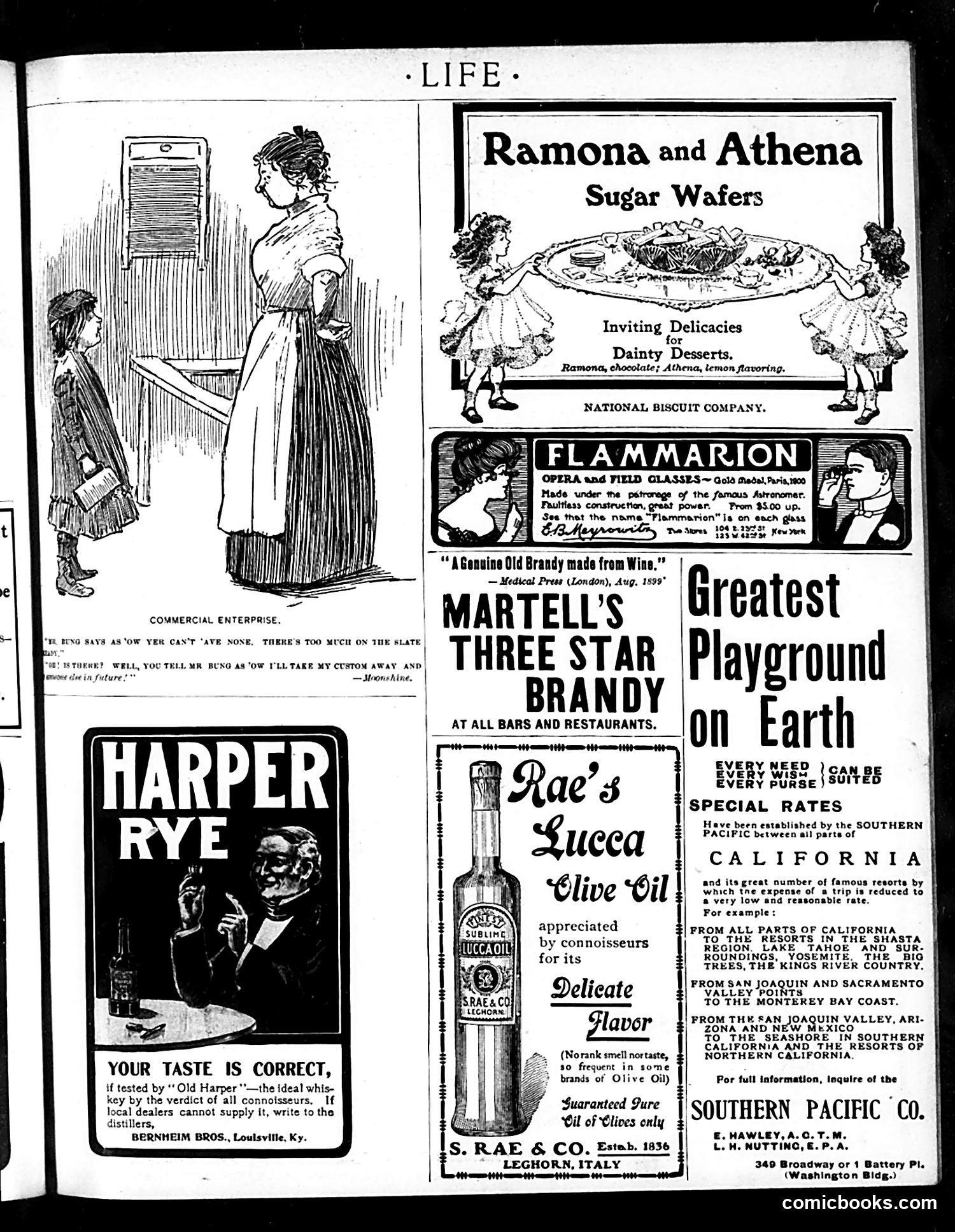
The cartoon satirizes working-class complaint about debt. A woman (likely a shopkeeper or landlady) stands stern-faced before a smaller figure, refusing credit. The dialogue—rendered in working-class dialect—captures the debtor's frustration: he's told he "can't 'ave none" because there's "too much on the slate" (too much owed), and he threatens to take his business elsewhere. The satire targets the tension between merchants extending credit and customers accumulating unpayable debts. The title "Commercial Enterprise" is ironic: the woman's refusal to extend further credit is presented as practical business necessity, yet the cartoon sympathizes with the customer's plight. For modern readers, "the slate" (a literal ledger of debts) represents the informal credit systems working people depended on before consumer finance existed. The humor lies in the powerlessness of both parties trapped in this system. The page is otherwise advertising—whiskey, biscuits, brandy, and California tourism.
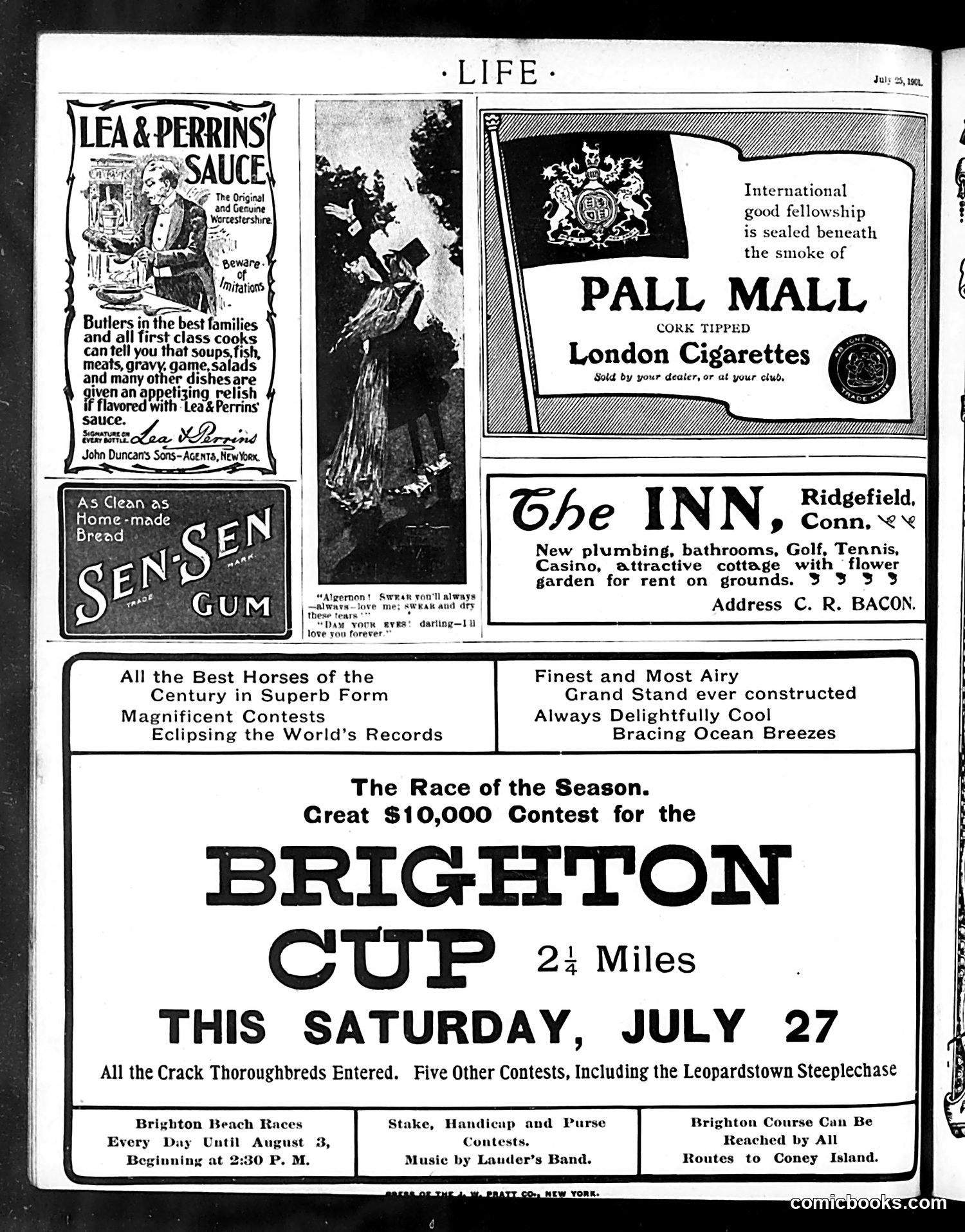
This is primarily an **advertising page** rather than satirical content. It features period product endorsements and event promotions typical of early 1900s magazines. Notable ads include: - **Lea & Perrins Sauce** and **Sensen Gum** (left column) - **Pall Mall cigarettes** promoting "international good fellowship" - **The Inn** resort in Ridgefield, Connecticut - Prominent promotion for the **Brighton Cup** horse race ($10,000 prize, 2½ miles, July 27) The central image appears to be a romantic illustration accompanying cigarette advertising—a common marketing tactic of the era linking products to elegance and social aspiration. The page reflects Edwardian consumer culture: luxury goods, leisure activities (golf, horse racing, resorts), and the normalized promotion of tobacco and alcohol. There is no apparent political satire—this represents straightforward commercial messaging from Life's revenue model.