
A complete issue · 20 pages · 1898
Life — February 24, 1898
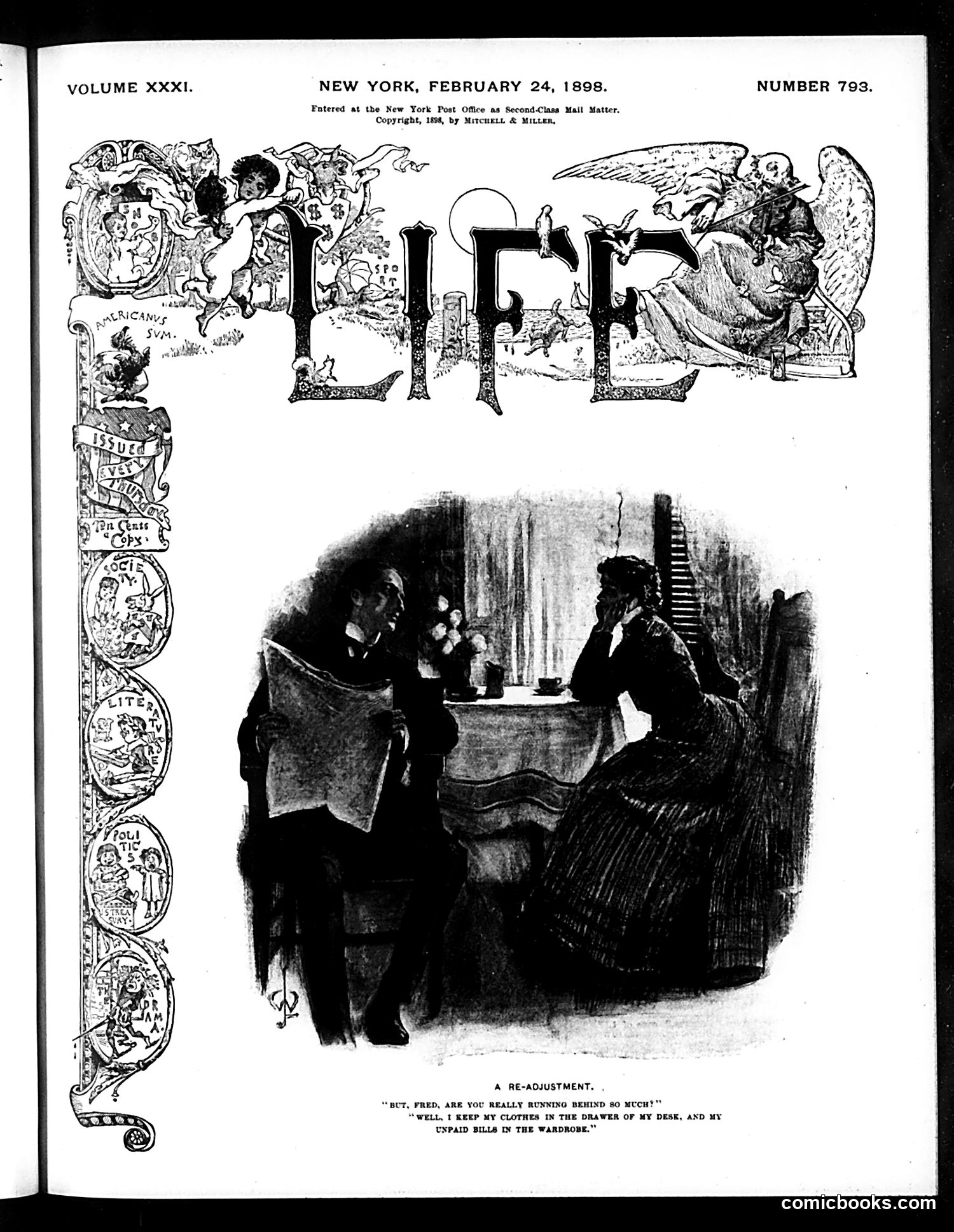
This cartoon satirizes marital discord through domestic conflict. The illustration shows a well-dressed man confronting a woman in their home, with the caption quoting his accusation: "But, Fred, are you really running behind so much?" Her response reveals financial anxiety: "Well, I kept my clothes in the drawer of my desk, and by unpaid bills in the wardrobe." The joke critiques late-19th-century domestic economics—specifically, the irony that a wife economizes by storing clothing modestly while accumulating unpaid debts hidden in the wardrobe. It satirizes both marital tension over spending and the financial pressures households faced during this era. The "re-adjustment" refers to the couple attempting to reconcile their economic conflicts.
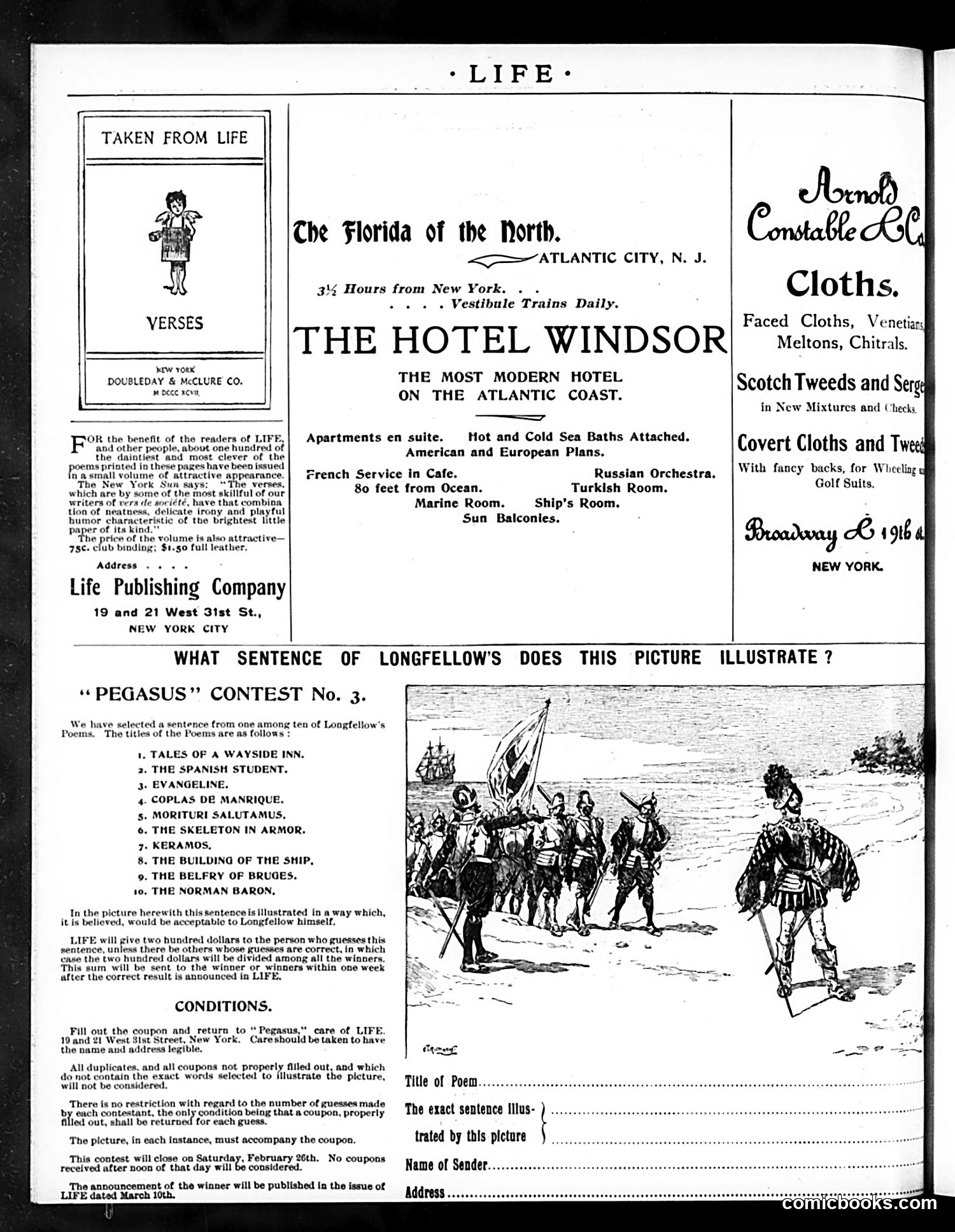
This page is primarily **advertising and a literary contest**, not political satire. The top section contains ads for a poetry book of verses, the Hotel Windsor in Atlantic City, and men's clothing. The main content is "Pegasus Contest No. 3"—a reader competition where Life magazine challenges subscribers to match an illustration to one of ten sentences from Henry Wadsworth Longfellow's poems. The illustration shows a historical beach scene with soldiers or military figures and ships, appearing to depict a colonial or early American naval encounter. Readers must identify which Longfellow poem sentence best describes this image. The contest offers monetary prizes for correct entries, with winners announced in a future issue. This represents typical early-20th-century magazine engagement with readers rather than political commentary.
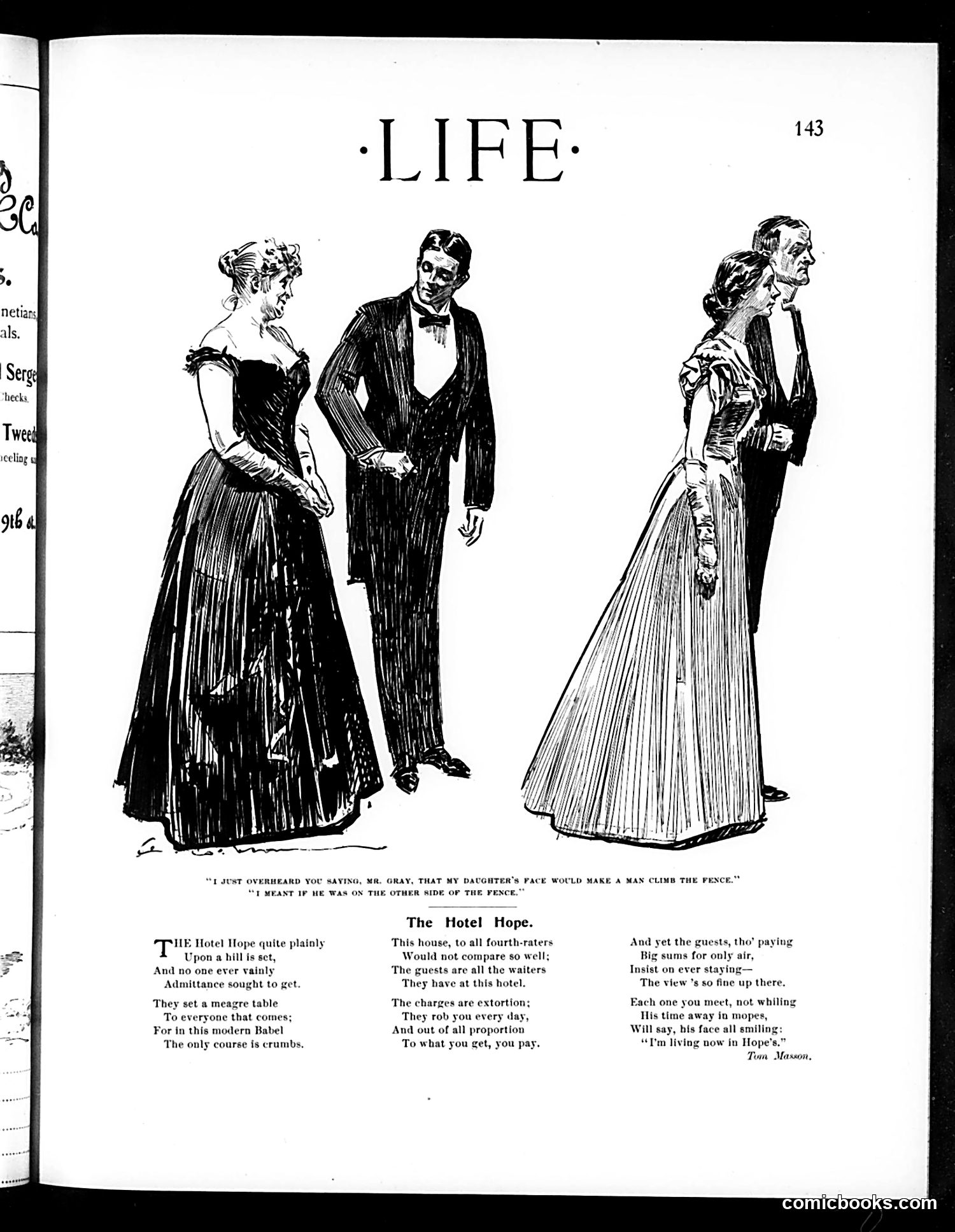
This page from *Life* magazine satirizes expensive hotels that charge exorbitant rates while providing poor service. The illustration shows well-dressed guests at a formal hotel, accompanied by dialogue mocking the premise that a daughter's beauty could make someone "climb the fence"—a crude reference to social climbing or impropriety. The poem "The Hotel Hope" critiques the business model: guests pay inflated prices ("extortion," "rob you every day") for mediocre accommodations and views. The final line—"I'm filing now in Hope's"—suggests the speaker is filing a legal complaint, implying guests feel cheated. The satire targets the contrast between hotels' pretensions and their actual service quality, a common complaint in early 20th-century American consumer culture.
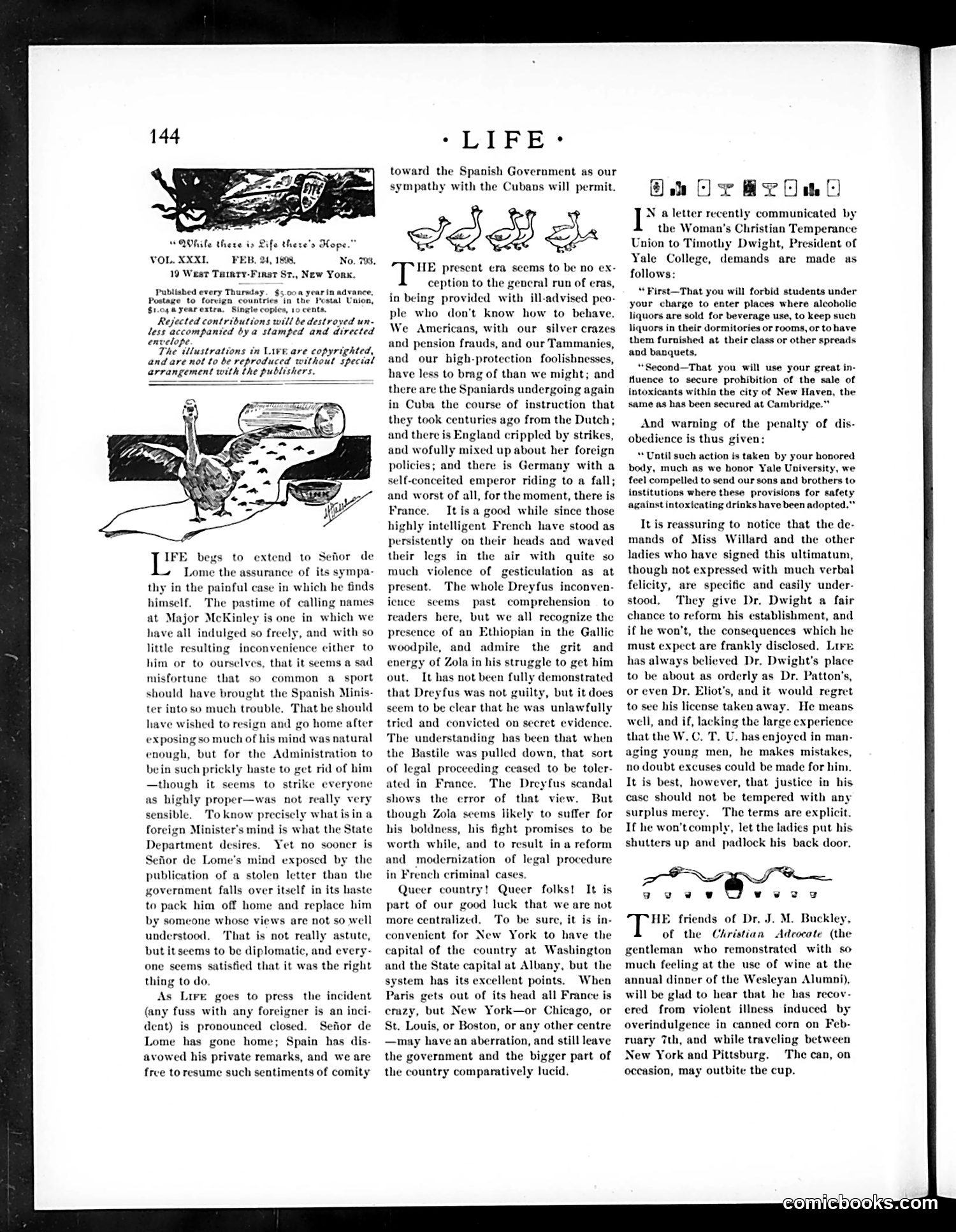
This page contains editorial commentary on international affairs and domestic politics, rather than illustrated cartoons. The text discusses: **International issues:** The Spanish Government's situation, Cuba, and European powers (France, Germany, England). The writer critiques American ignorance of foreign affairs while expressing concern about European instability. **Domestic scandal:** Extended commentary on the Dreyfus affair's American implications, criticizing how the "Administration" handled a stolen letter incident involving Señor de Lome (Spanish diplomat). The text advocates for proper legal procedures. **Temperance activism:** A letter from Yale's Woman's Christian Temperance Union demanding prohibition of alcohol sales near campus. The small decorative illustrations (geese, log, etc.) are generic vignettes, not political cartoons. This page emphasizes written opinion over visual satire.
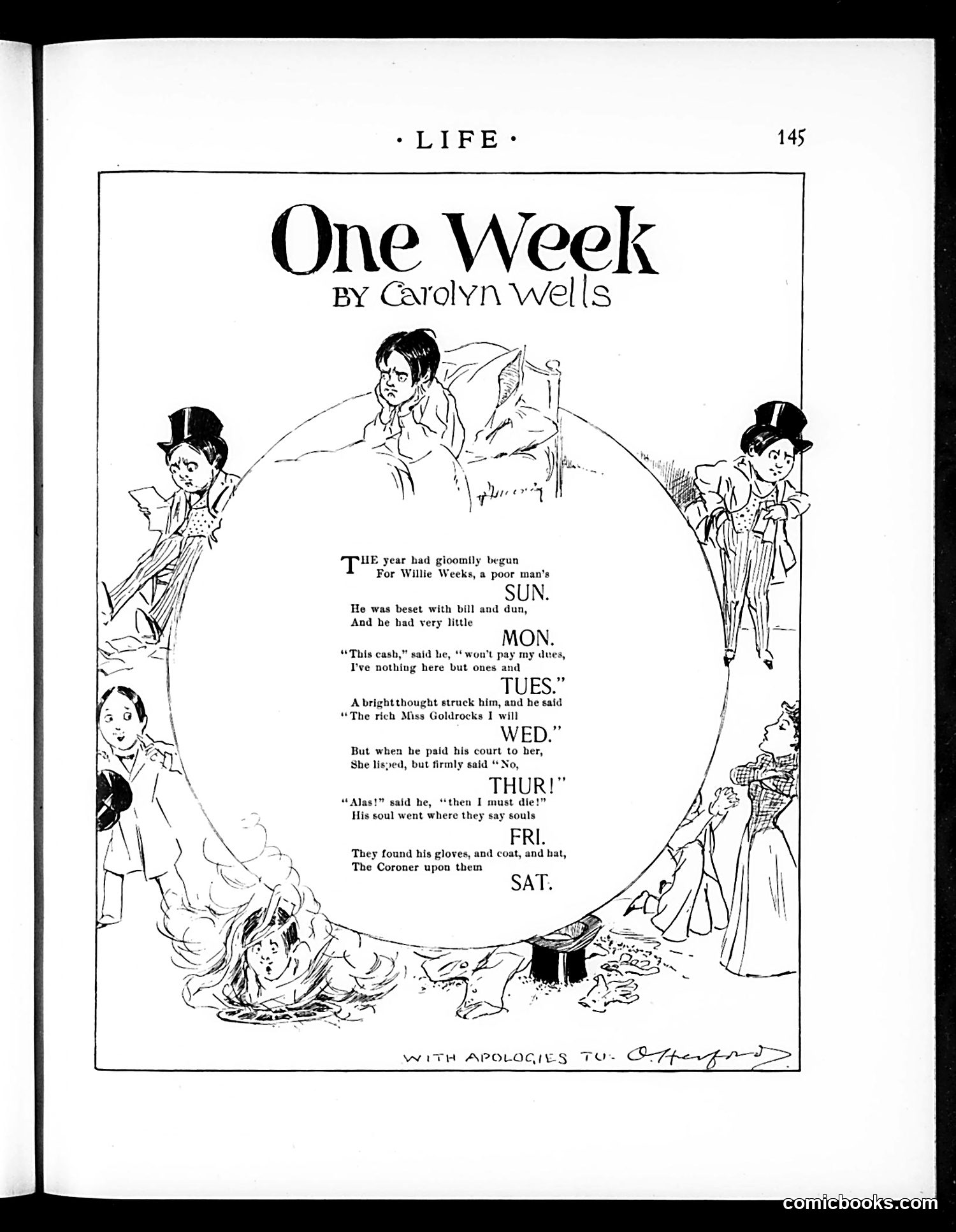
This is a darkly humorous poem illustrated as a circular narrative following Willie Weeks, a poor man, through seven days ending in his death. The progression moves clockwise around the circle: he faces unpaid bills (Monday-Tuesday), courts a wealthy woman Miss Gohbrocks who rejects him (Wednesday-Thursday), despairs and dies (Friday), and is found by authorities (Saturday). The satire critiques class inequality and economic hardship—a poor man's courtship of a rich woman is doomed, his financial desperation is hopeless, and death becomes his only "resolution." The illustrations of various figures (creditors, the woman, officials) surrounding the narrative emphasize society's indifference to his plight. It's sardonic social commentary on poverty and class divisions.
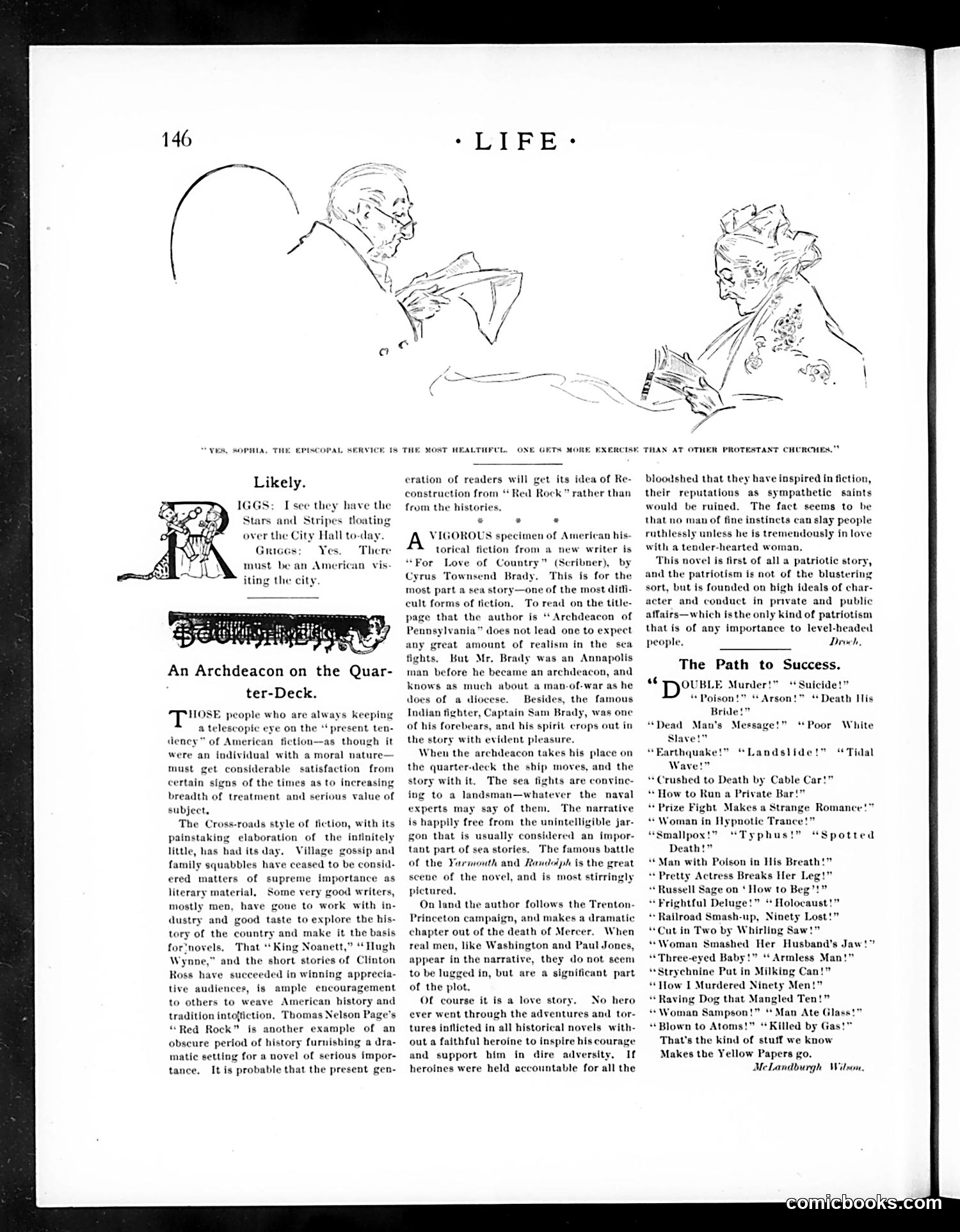
This page contains a satirical cartoon and literary discussion, not political commentary. The cartoon labeled "An Archdeacon on the Quar-ter-Deck" depicts two figures in conversation—one appears to be a clergyman (the "archdeacon") and another figure, likely aboard a ship. The humor appears to derive from the incongruity of religious authority appearing in a nautical setting, suggesting satire about clergy venturing into unfamiliar domains. The page's main content discusses "The Path to Success," reviewing American historical fiction, particularly "For Love of Country" by Cyrus Townsend Brady. The critique examines how sea stories and historical narratives function as popular literature, noting their importance in shaping American cultural narratives about patriotism and heroism.
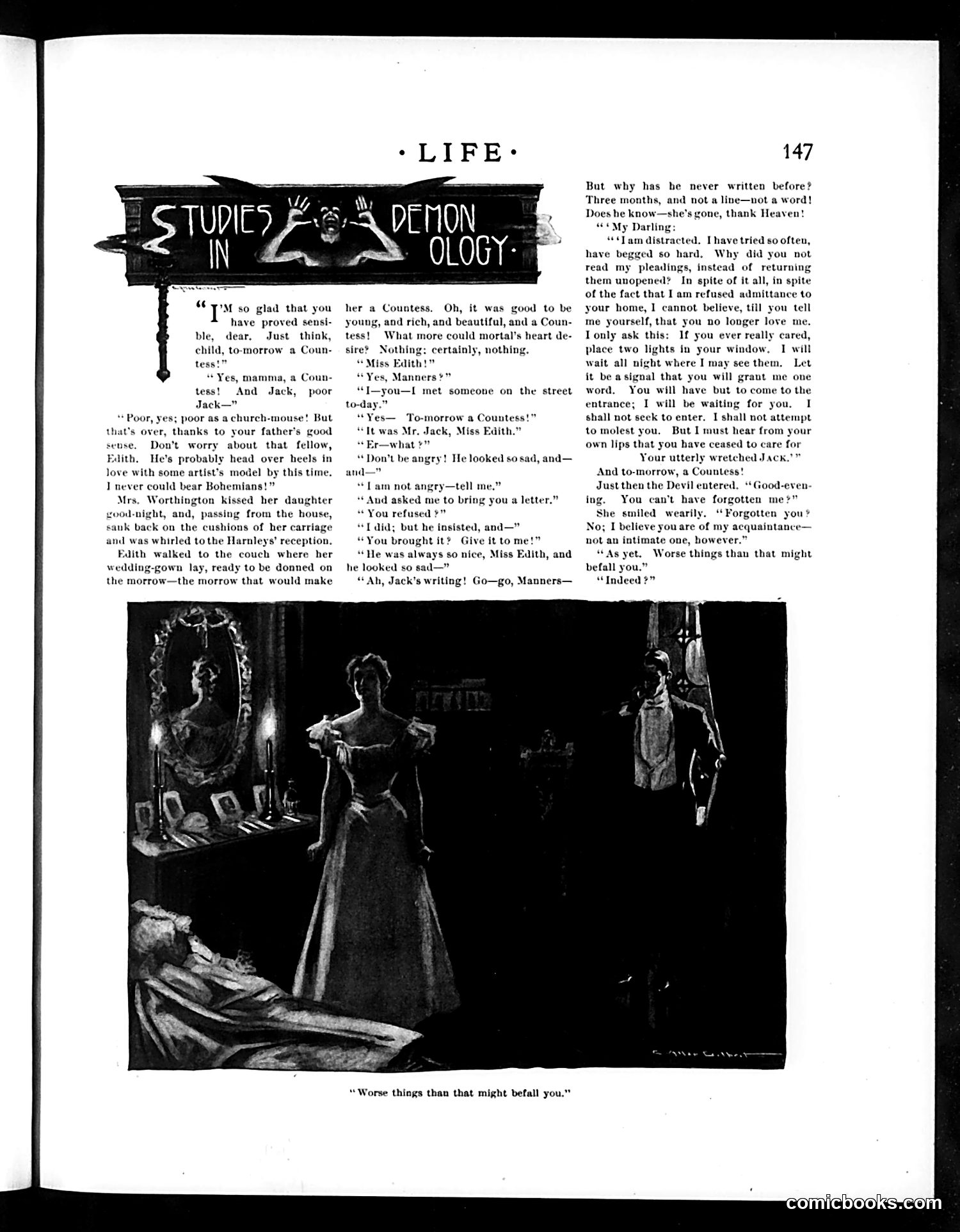
This page features a serialized story titled "Studies in Demonology" with both text and illustration. The narrative concerns a young woman (apparently named Edith) who has rejected a suitor's marriage proposal. The dialogue reveals the rejected man is pressuring her to reconsider, claiming she's being unfair and asking her to read his written pleading. The accompanying illustration shows a woman in an elegant dress confronted by demonic or supernatural figures in a dark interior—likely visualizing the psychological torment of unwanted romantic pursuit. The satire mocks persistent, manipulative courtship tactics of the era, where rejected suitors would appeal to women's sympathy rather than accept refusal. The "demonology" framing suggests such pressure is devilish behavior.
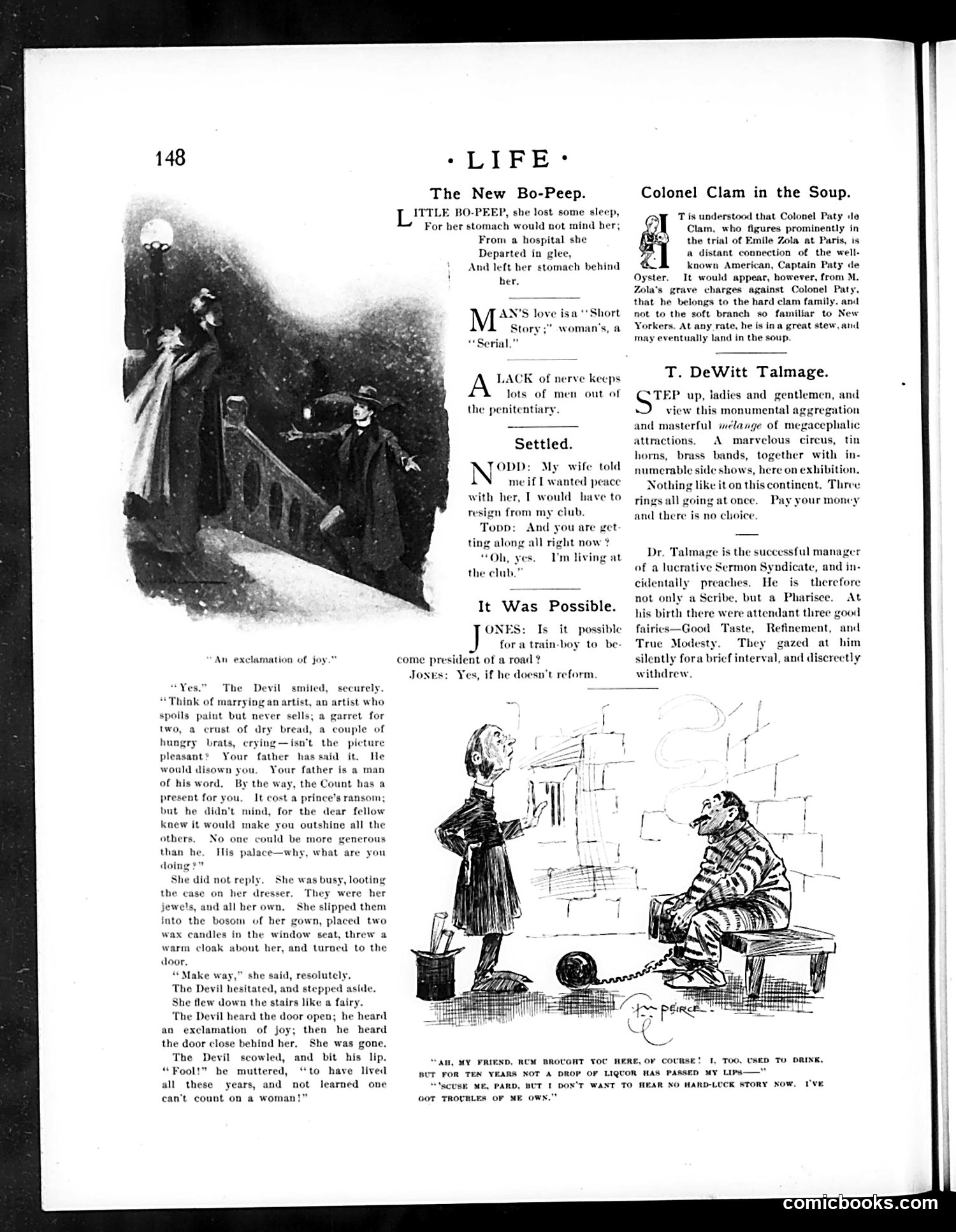
This page contains several short humorous pieces typical of early Life magazine's satirical format: **"The New Bo-Peep"** presents a joke about a woman who lost sleep due to stomach troubles at a hospital, then departed "in glee" leaving her stomach behind—a pun on the nursery rhyme. **"Colonel Clam in the Soup"** references a real legal case involving Émile Zola's trial in Paris and mentions "Captain Patty de Clam," suggesting a connection to the Dreyfus Affair scandal. **"T. DeWitt Talmage"** section mocks the famous preacher/sermon syndicate operator with satirical commentary on his theatrical sermons and business success. The cartoon shows a prisoner in chains, illustrating a joke about reform—questioning whether a train boy could become president without reforming. The humor relies on period-specific social hierarchies and assumptions about class mobility.
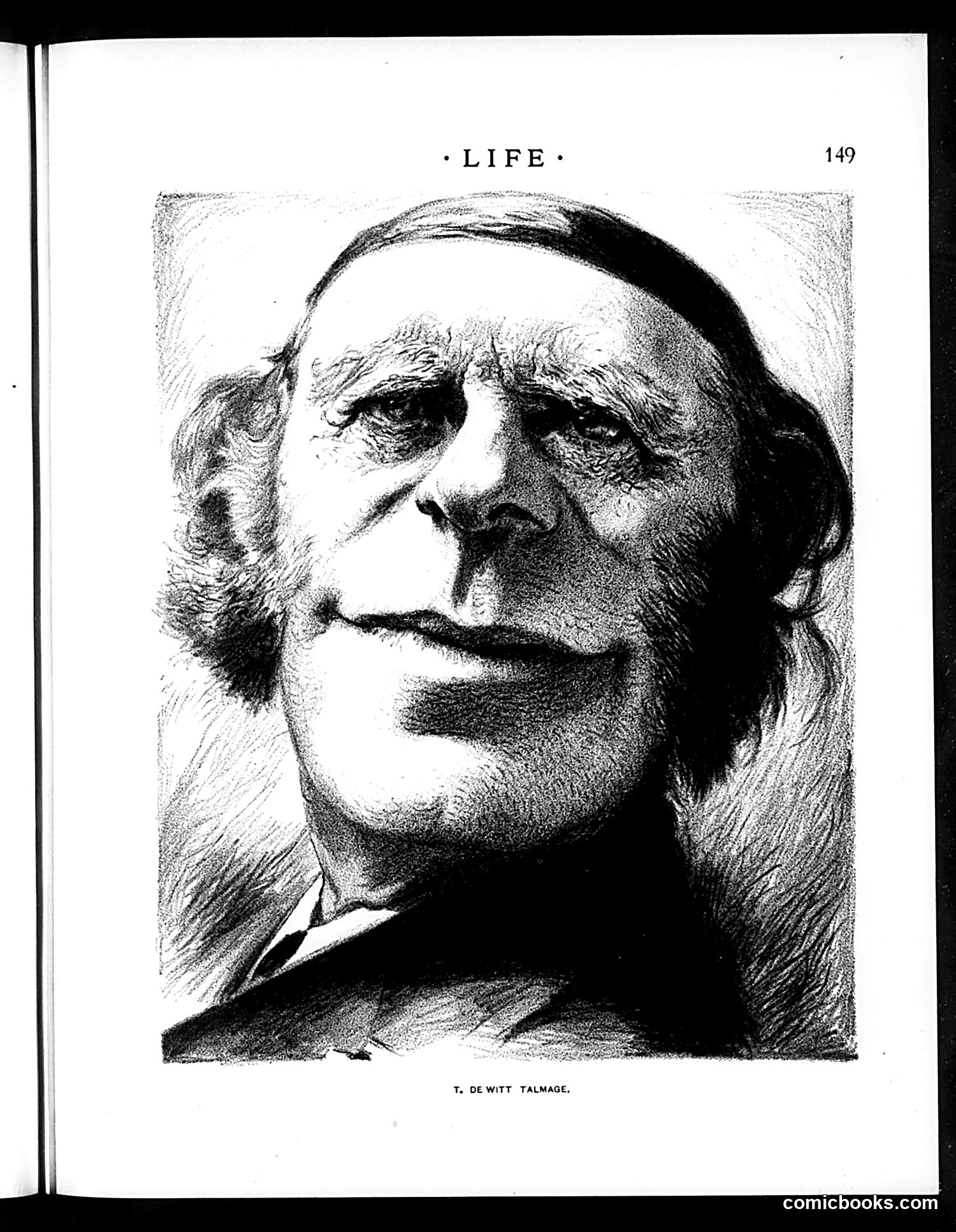
This page features a portrait sketch of T. De Witt Talmage, a prominent 19th-century American clergyman and public figure. The detailed engraving shows an elderly man with long, flowing hair and distinctive facial features. Talmage was known as a controversial preacher and social commentator. Life magazine, being satirical in nature, likely included this portrait to comment on or mock his public persona—possibly his theatrical preaching style, his outspoken social views, or his celebrity status among the public. Without additional text on this page, the specific satirical angle is unclear, but the inclusion in Life suggests Talmage was a figure of sufficient cultural prominence and controversy to warrant the magazine's attention.
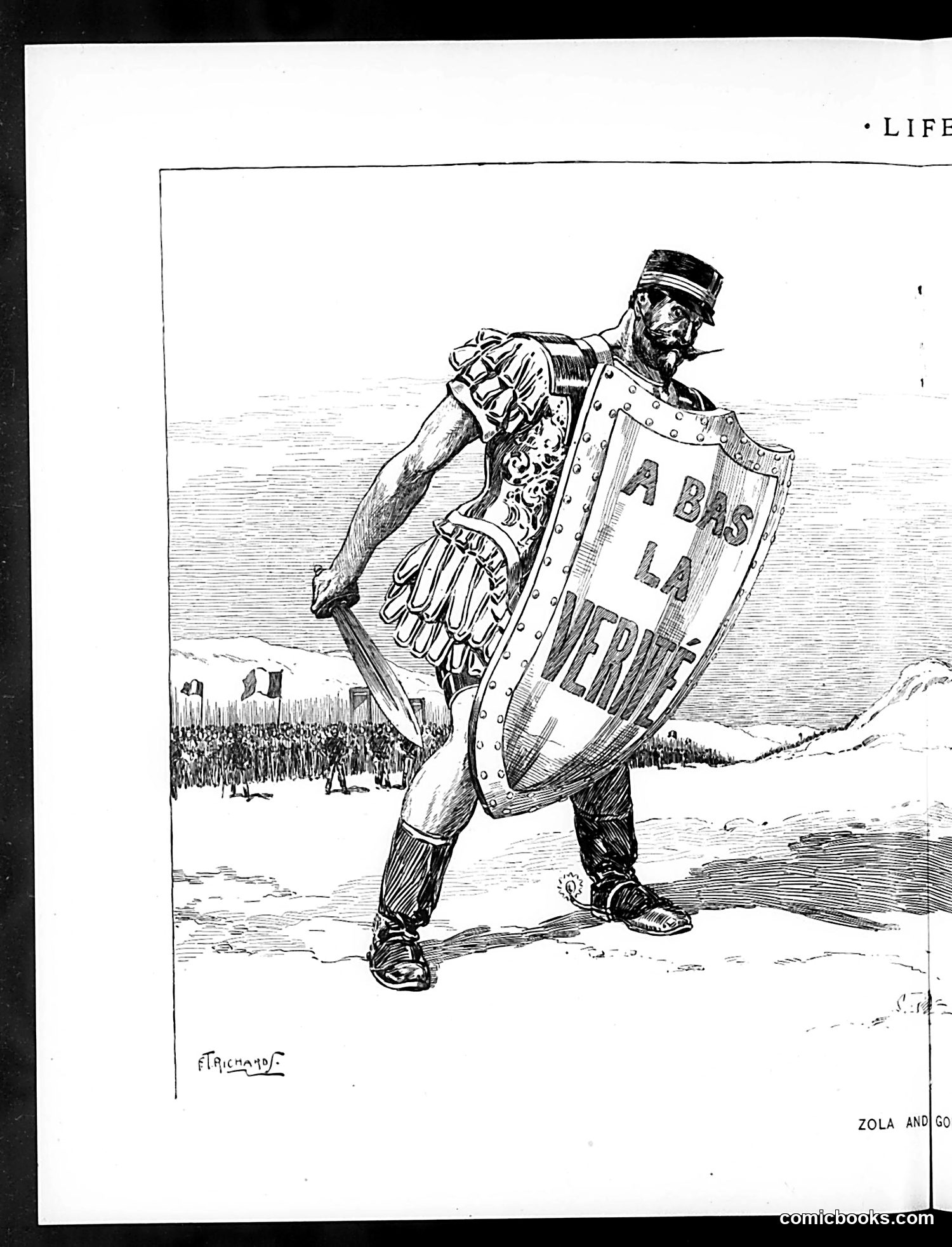
This is a political cartoon from *Life* magazine (visible in the top right corner). The image shows a military figure in ornate uniform and cap carrying a large shield labeled "A BAS LA PERTE" (French for "Down with Loss/Defeat"). The cartoon appears to be satirizing a French military or political leader during a period of military conflict or national concern. The gathered crowds in the background suggest a moment of national mobilization or public address. The figure's exaggerated, almost comic posture—straining under the weight of the shield—suggests the cartoon critiques how leaders present themselves as defenders against national disaster while the burden may be unsustainable. The artist's signature reads "Firchardt" (or similar). Without a visible date or clearer context, the specific historical event referenced remains unclear, though it likely relates to French military or political affairs from the late 19th or early 20th century.
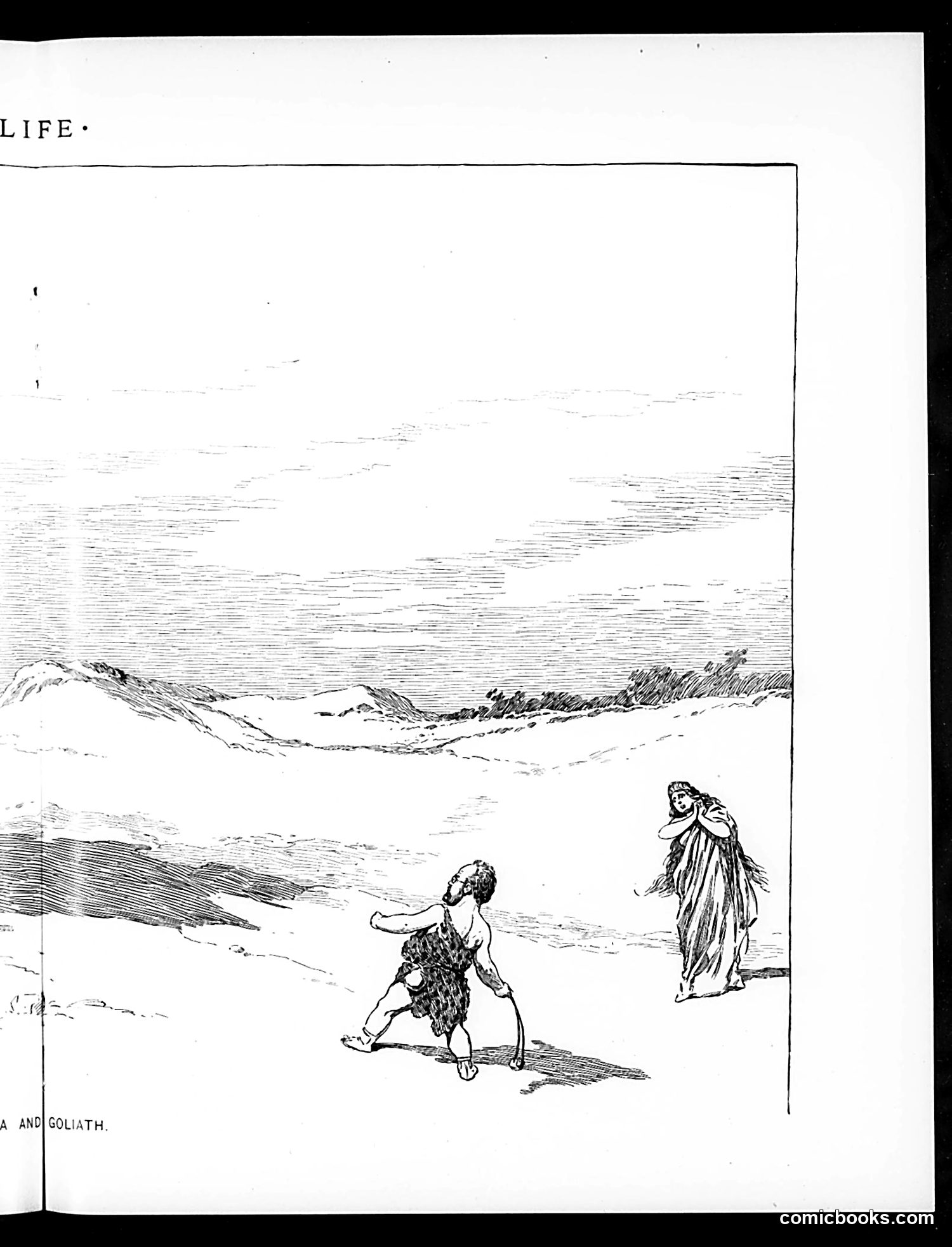
This page illustrates the biblical story of David and Goliath. The image shows a small, lightly-armored figure (David) in a defensive stance confronting a much larger robed figure (Goliath) across an open landscape. The composition emphasizes the dramatic size disparity between the two opponents. The page heading "LIFE" and caption reference "A AND GOLIATH" confirm the biblical narrative. This appears to be a straightforward illustration rather than political satire—likely used to accompany a story, poem, or article in Life magazine exploring themes of courage, the triumph of the underdog, or faith overcoming apparent odds. The engraving style is consistent with early-to-mid 20th century magazine illustration.
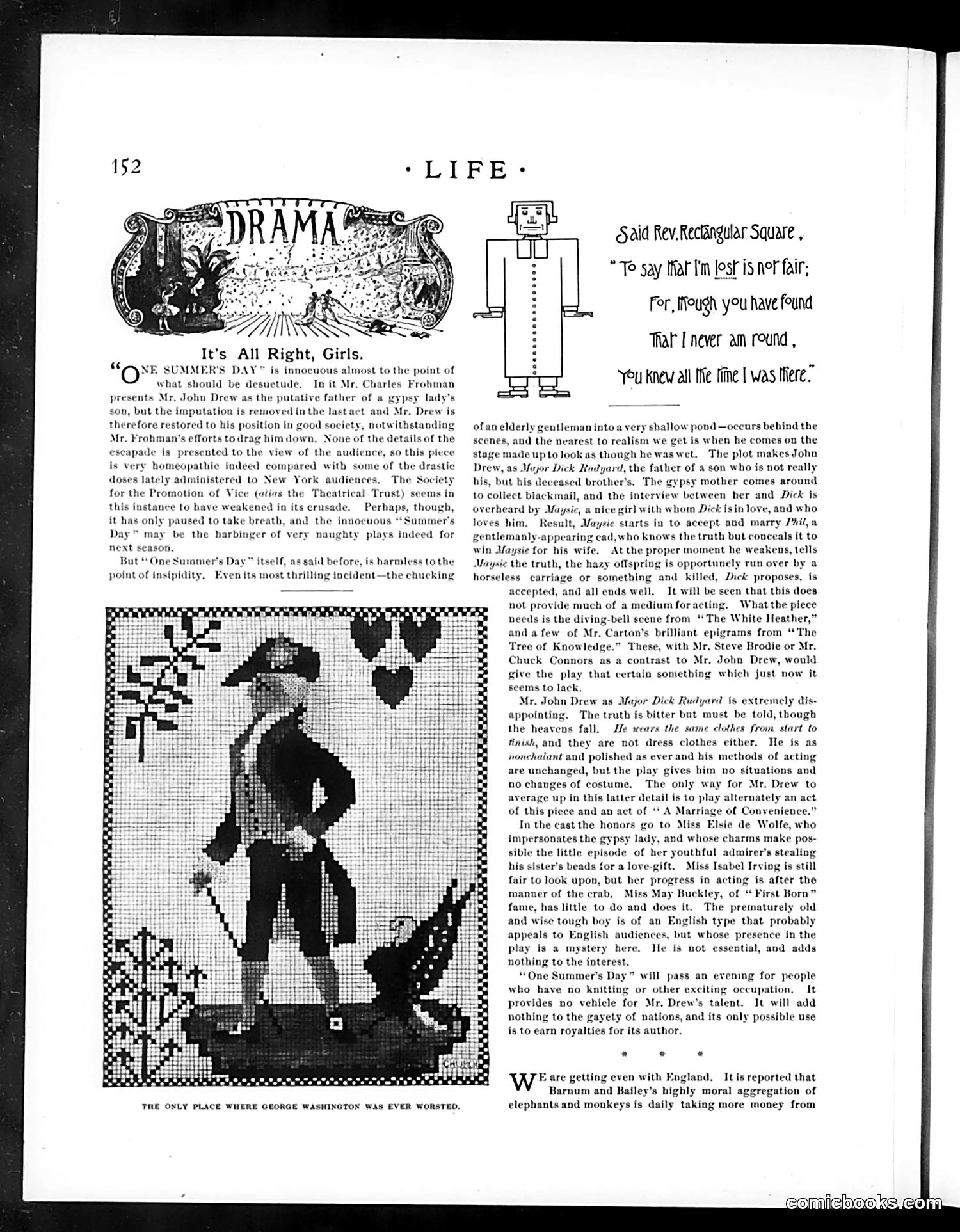
This page reviews a play called "It's All Right, Girls," described as presenting "One Summer's Day" — a comedy about a gypsy lady's son. The review critiques the production's weakness: despite promising material involving blackmail and romantic complications, the play lacks substance. The central image is a silhouette illustration captioned "THE ONLY PLACE WHERE GEORGE WASHINGTON WAS EVER WORSTED," showing a figure (presumably representing George Washington or American values) being defeated by what appears to be a woman in period costume — likely satirizing either the play's plot or contemporary gender dynamics. The review suggests the play provides entertainment value but little else of merit, making it suitable only for audiences seeking mindless diversion rather than artistic substance.
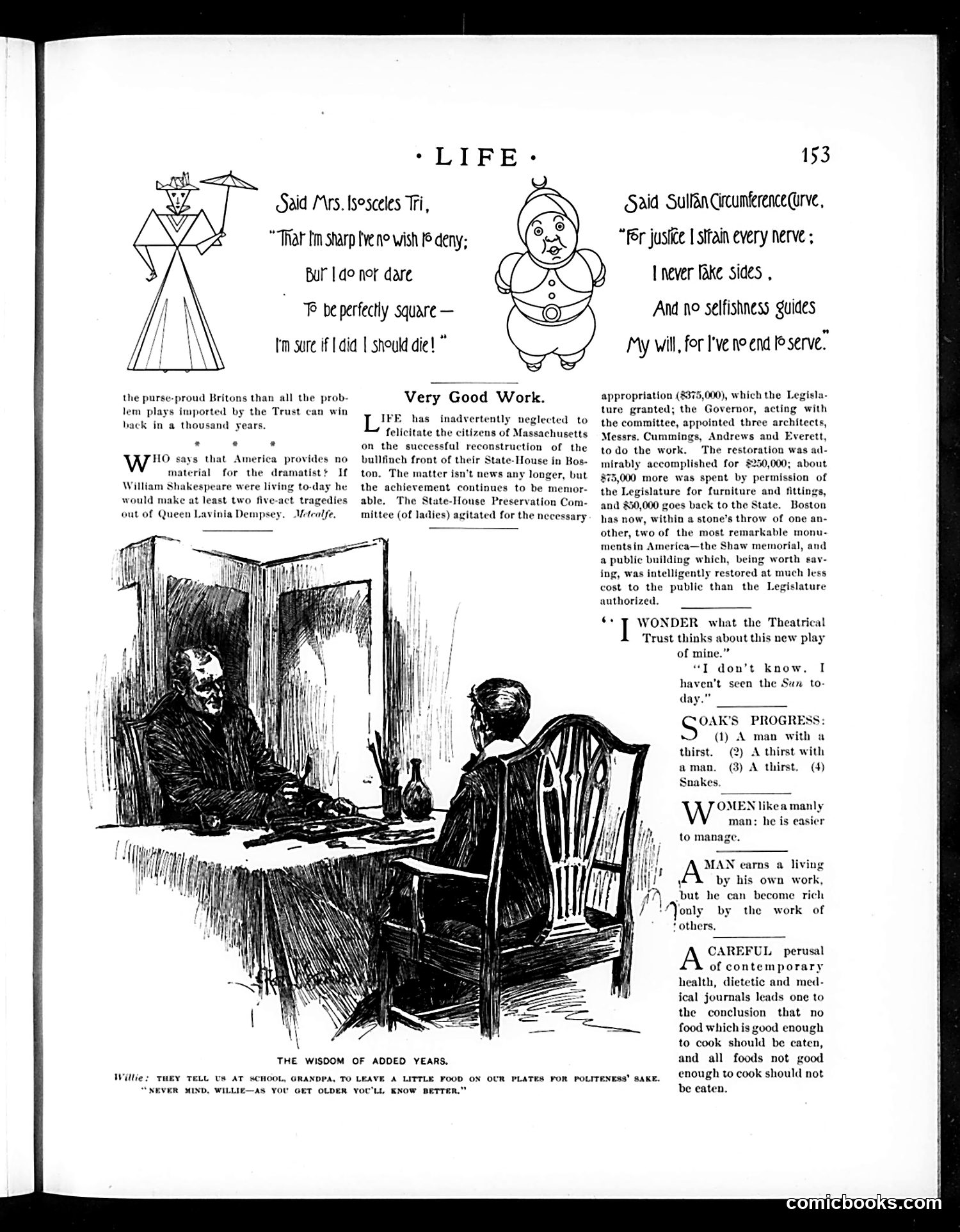
This page contains several satirical pieces typical of Life's humor: **Top cartoons**: Geometric female figures ("Mrs. Isosceles Tri" and "Sultan Circumference Curve") make puns about their mathematical shapes while expressing personality traits—the triangle fears being "perfectly square," the circle claims perfect impartiality. The satire mocks pretentious women who use abstract concepts to justify their behavior. **"The Wisdom of Added Years"**: A grandfather tells his grandson to ignore rules about leaving food on his plate, implying older people disregard etiquette. The humor critiques generational hypocrisy. **"Very Good Work"**: Praises Massachusetts's successful State-House restoration, noting women's committees achieved it under budget—an implicit compliment to female civic organization. **Various aphorisms** ("Oaks Progress," observations on women, health journals) offer cynical social commentary typical of Life's format. The page reflects early 20th-century American satirical magazine conventions: mathematical/geometric humor, gender commentary, architectural boosterism, and philosophical cynicism presented as brief, illustrated quips.
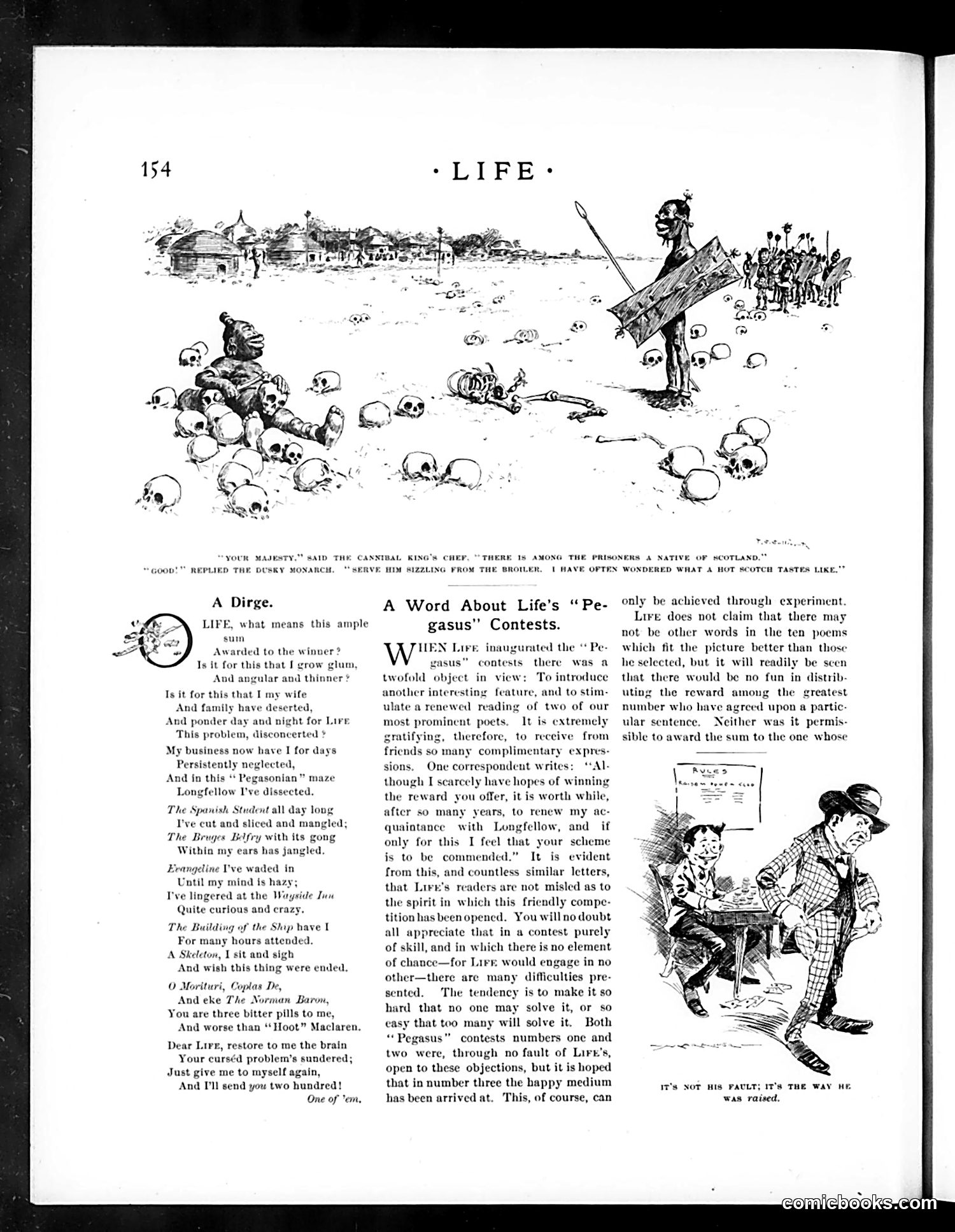
This page presents Life's "Pegasus" poetry contests—readers compete to identify missing words in passages from famous poets like Longfellow and Evangeline. The upper cartoon depicts a cannibal king dining on prisoners, including a Scotsman, making a crude joke about "hot Scotch." The main content addresses contest complaints. The "Dirge" poem humorously depicts a contestant driven mad by intensive study—he's neglected business and family while obsessively analyzing literary texts, now begging Life magazine to restore his sanity in exchange for payment. The editorial explains the contest's design philosophy: it aims to encourage poetry reading while presenting a challenge that's neither impossibly hard nor trivially easy. The editors defend against accusations that their word choices were unfair, insisting the contests require genuine skill rather than luck. The lower cartoon shows a poorly-dressed man, captioned "It's not his fault; it's the way he was raised"—a social commentary on poverty and circumstance. Overall, the page combines literary entertainment with gentle satire about intellectual obsession and social conditions.
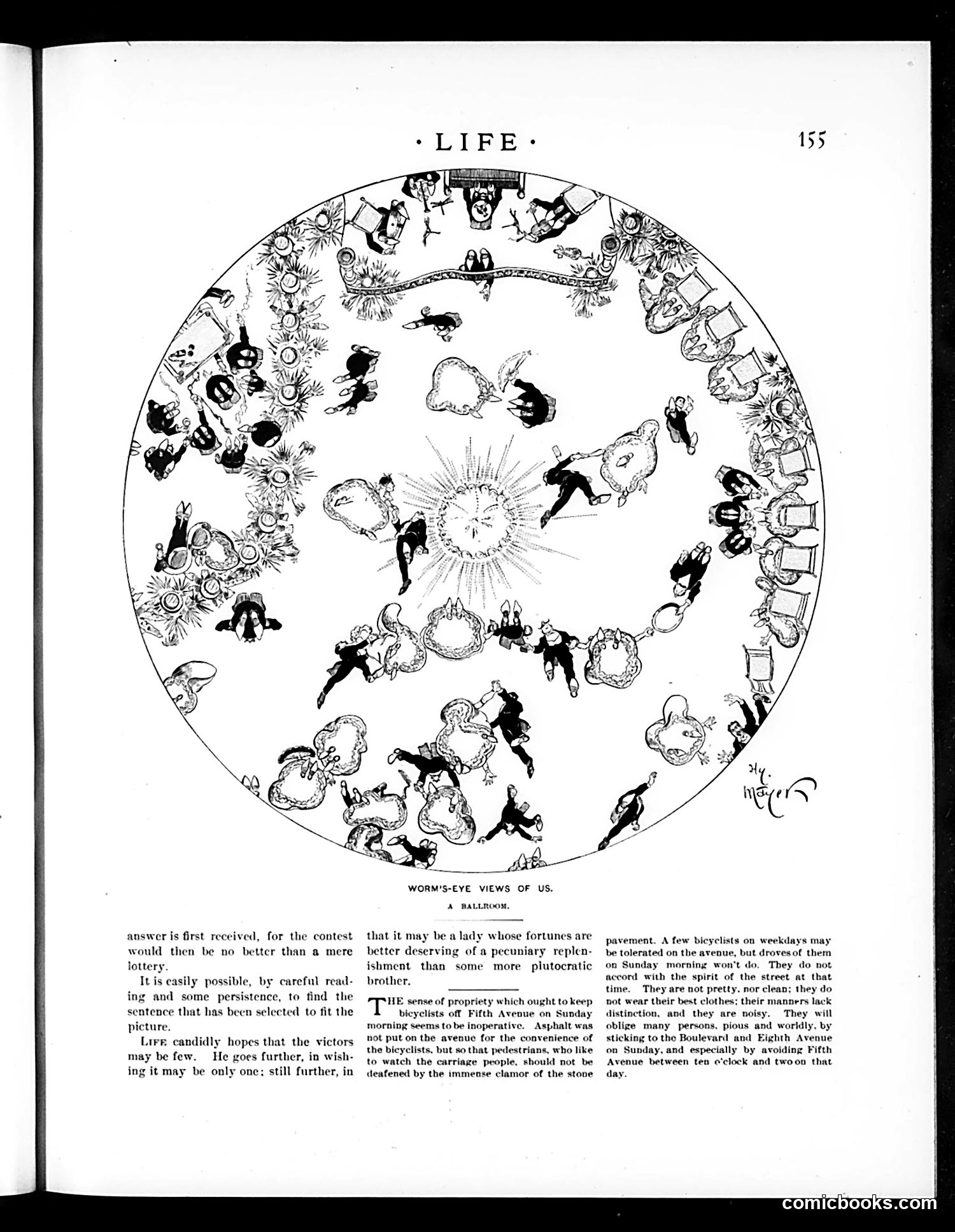
This page satirizes early 1900s New York City social pretension and class anxiety. The circular illustration, titled "Worm's-Eye Views of Us. A Ballroom," depicts an overhead view of wealthy people at an elegant social gathering—a bird's-eye perspective that undercuts their dignity. The accompanying text criticizes working-class bicyclists who ride on Fifth Avenue on Sunday mornings. The author argues they're unsuitable because they're "not pretty, nor clean" and lack "distinction"—revealing the era's class snobbery. Fifth Avenue was a wealthy pedestrian district where the affluent watched carriages. The complaint exemplifies how early cycling, though increasingly popular, was viewed as lower-class and incompatible with elite neighborhoods. The satire mocks this rigid class consciousness while documenting real social conflict over shared urban space during the bicycle boom era.
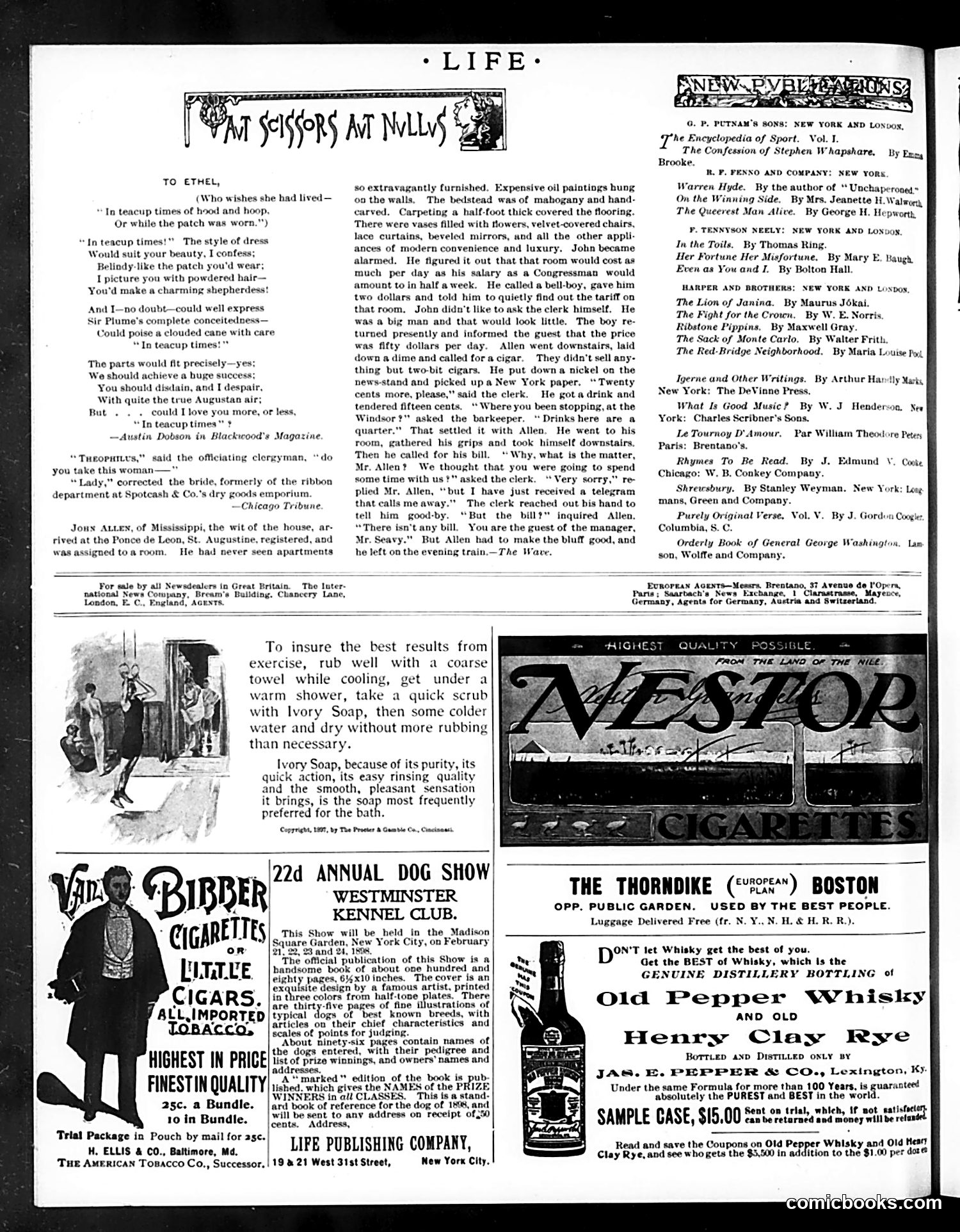
This page consists primarily of **book advertisements and literary notices** rather than political satire. The main content includes: **"Tm Scissors at Nulls"** — A humorous short story about a man named Allen who checks into an expensive hotel room (the "Windsor") and is shocked by the luxury and costs. The joke: when he learns the room costs $50/day (matching a Congressman's weekly salary), he embarrassedly leaves, making increasingly obvious attempts to hide his modest means from hotel staff. The satire targets **wealthy pretension and class anxiety** — poking fun at both the lavish hotel industry and the social embarrassment of appearing poor before servants. The remainder of the page advertises books, cigars, whisky, and dog shows typical of 1890s-era Life magazine. No specific political figures are caricatured on this page; it's primarily commercial and entertainment content.
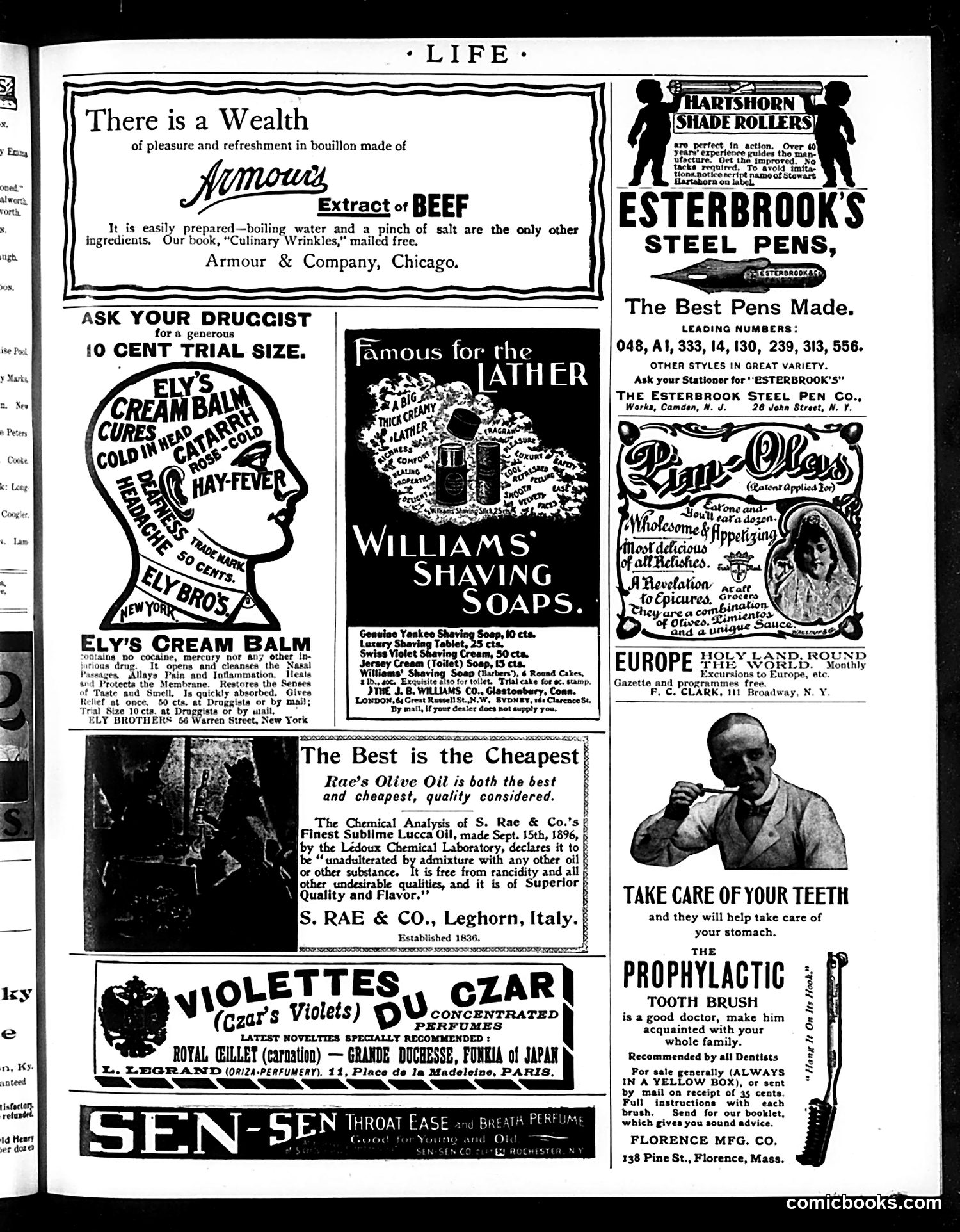
This is primarily an **advertisement page**, not a satirical cartoon. It features various consumer product ads typical of early-20th-century American magazines, including: - **Armour's Beef Extract** (bouillon) - **Ely's Cream Balm** (nasal treatment) - **Williams' Shaving Soaps** - **Esterbrook Steel Pens** - **Rae's Olive Oil** - **Prophylactic Toothbrush** - **Various European travel and perfume products** The page reflects the era's advertising approach: products made exaggerated health claims (Ely's cures colds and hay fever; the toothbrush helps digestion). The Prophylactic toothbrush ad includes a photo of a man demonstrating proper brushing technique—standard for the period. No political satire or cartoon commentary is present. This is a straightforward commercial page showcasing consumer goods, many emphasizing "quality" and scientific legitimacy—common marketing tactics of the 1890s-1910s.
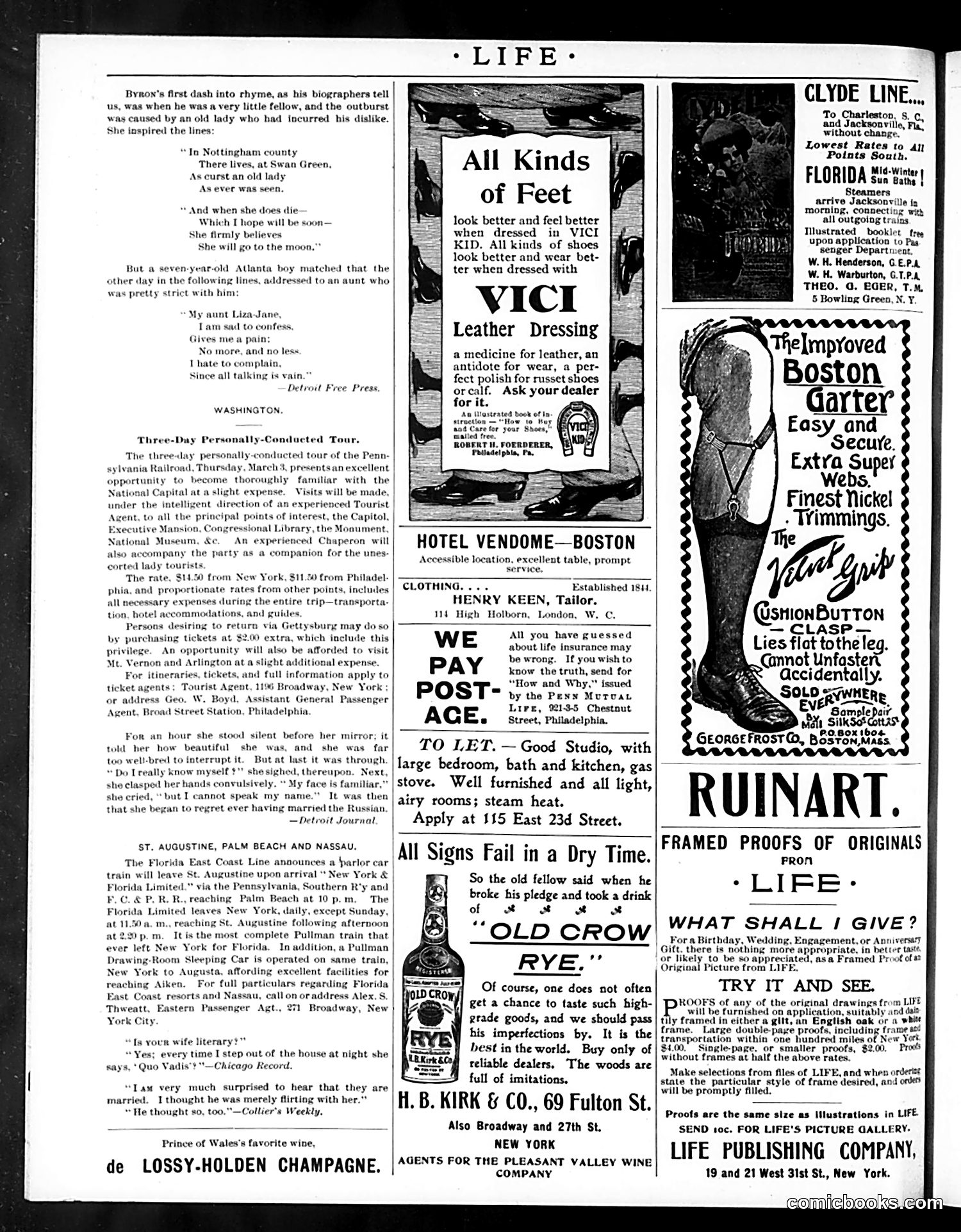
This is a **commercial advertising page** from *Life* magazine, not a political cartoon. It contains: **Main content**: Several unrelated short humorous anecdotes and advertisements, typical of the magazine's format. Notable items include: 1. **A Byron comparison**: A literary joke comparing the young Romantic poet Byron's childhood satirical verses about an old lady to a modern Atlanta boy's complaint poem to his strict aunt. 2. **Travel advertisements**: Three-day Washington D.C. tours and Florida East Coast vacation packages. 3. **Product ads**: Vici leather dressing for shoes, champagne, a Boston garter, and framed prints from *Life*. 4. **Light humor snippets**: Brief jokes about vanity, marriage, and literature. **No political satire** is present. This page exemplifies *Life's* blend of light cultural commentary, social humor, and commercial advertising aimed at affluent readers—typical of early 20th-century American magazines.
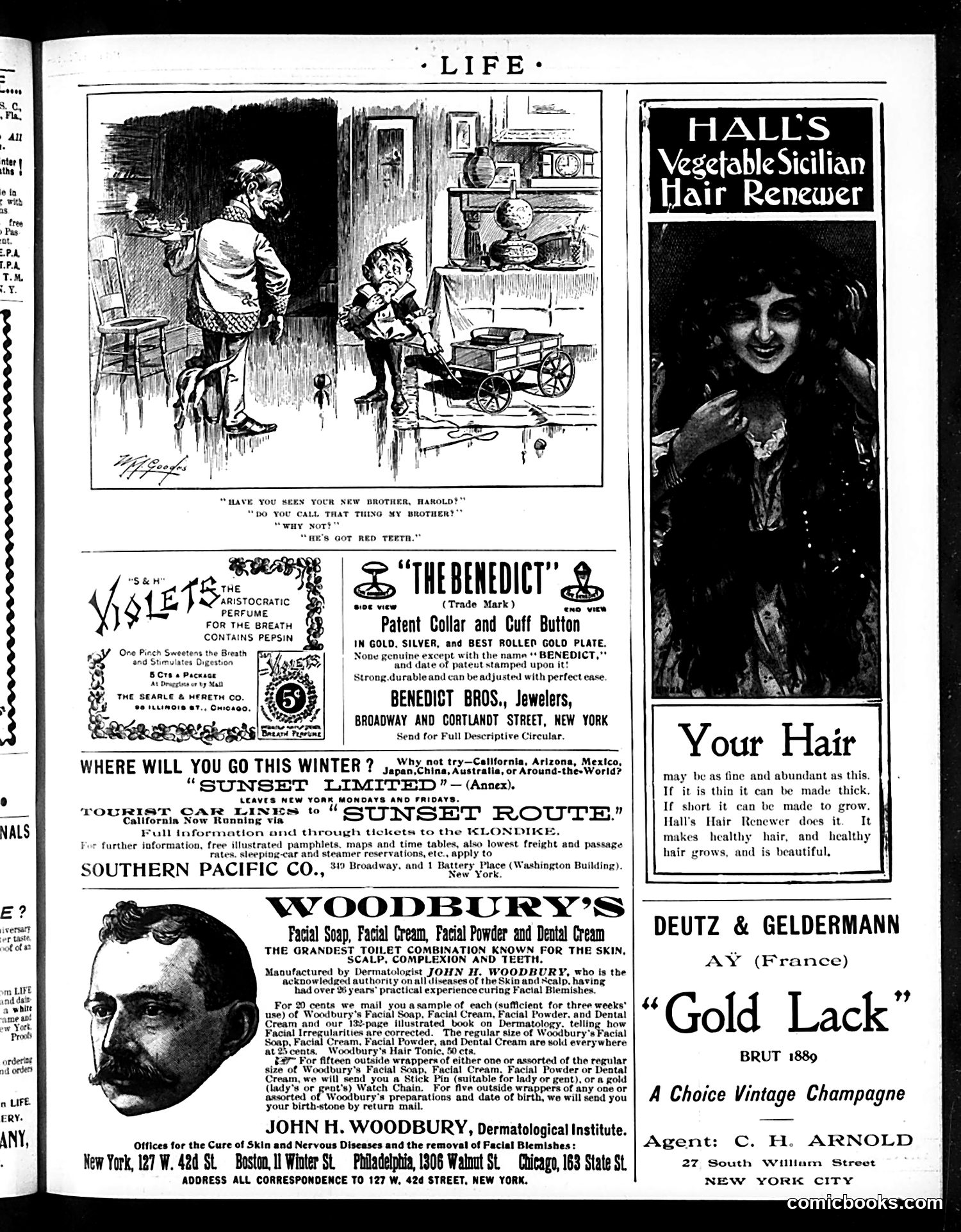
The main cartoon depicts a domestic scene where a man presents a small child to a woman, claiming it's her "new brother, Harold." The woman reacts with disgust, refusing to acknowledge the child and insulting it—particularly noting its "red teeth." The joke relies on period class attitudes: the child appears to be from a lower socioeconomic background (suggested by its appearance and the domestic setting), and the woman's revulsion reflects the era's social hierarchies and prejudices about poor families. The caption's dialogue ("Why not?") suggests the cartoon satirizes snobbery and the arbitrary nature of family obligation or social acceptance based on appearance or class status. The remainder of the page is primarily **advertisements** for products like Woodbury's skincare, Hall's Hair Renewer, Violets perfume, and champagne—typical of Life's revenue model. These ads reveal period beauty standards and consumer culture rather than political commentary.
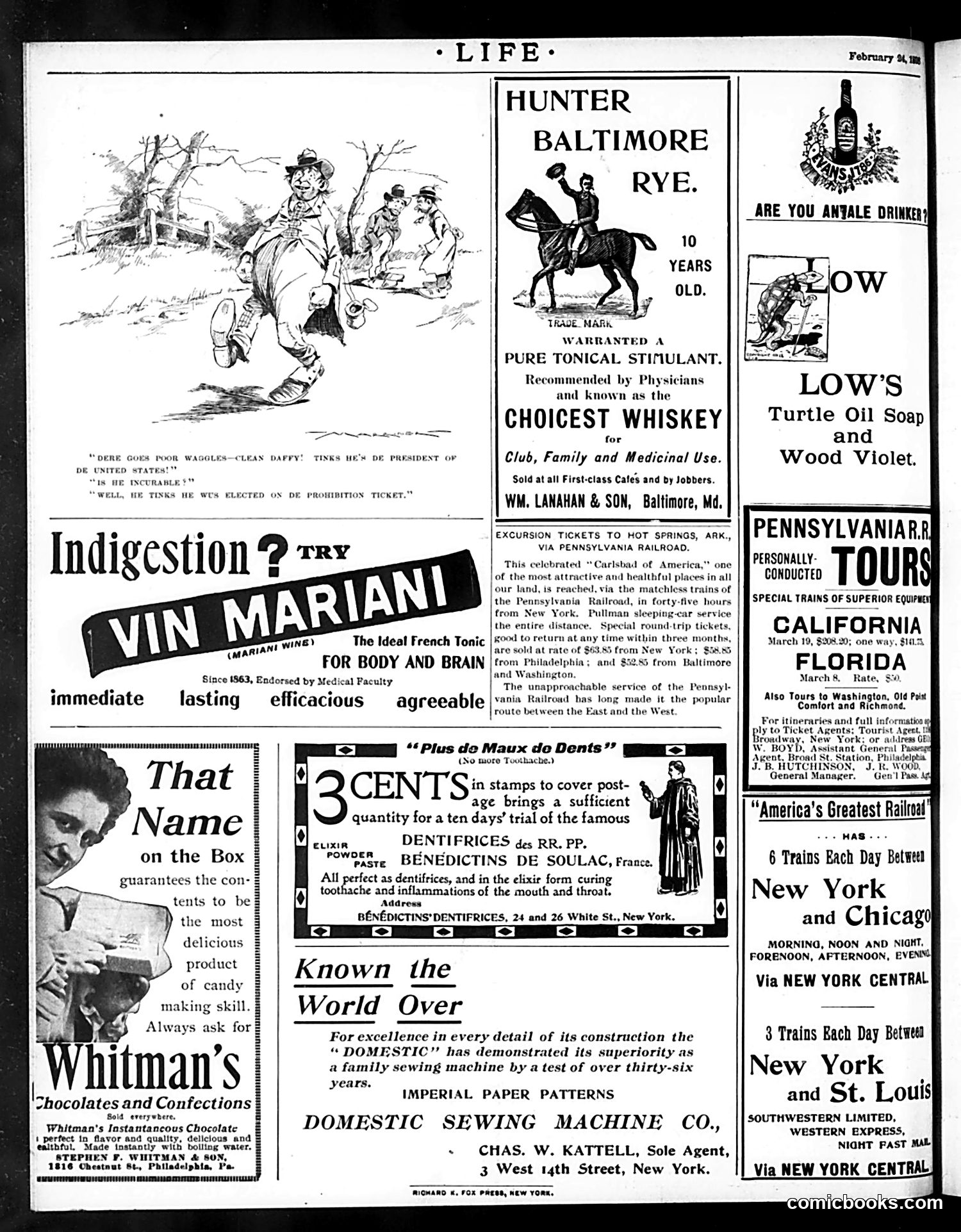
The cartoon depicts a figure named "Poor Waggles" being led away by two men. The dialogue indicates Waggles is described as "clean daffy" (crazy/foolish) and "incurable." The punchline references him being "elected on the Prohibition ticket"—suggesting he's so addled that voting for Prohibition (a temperance/anti-alcohol platform) proves his mental incompetence. This is satire of early 1900s American Prohibition debates. The joke equates supporting alcohol prohibition with insanity, mocking the temperance movement. The irony is sharp: while the page simultaneously advertises whiskey as medicinal tonic and French wine, the cartoon ridicules anyone advocating against alcohol as delusional. The piece reflects pre-Prohibition attitudes when such positions faced ridicule from commercial interests and social skeptics.