
A complete issue · 3 pages · 1892
Life — 1892
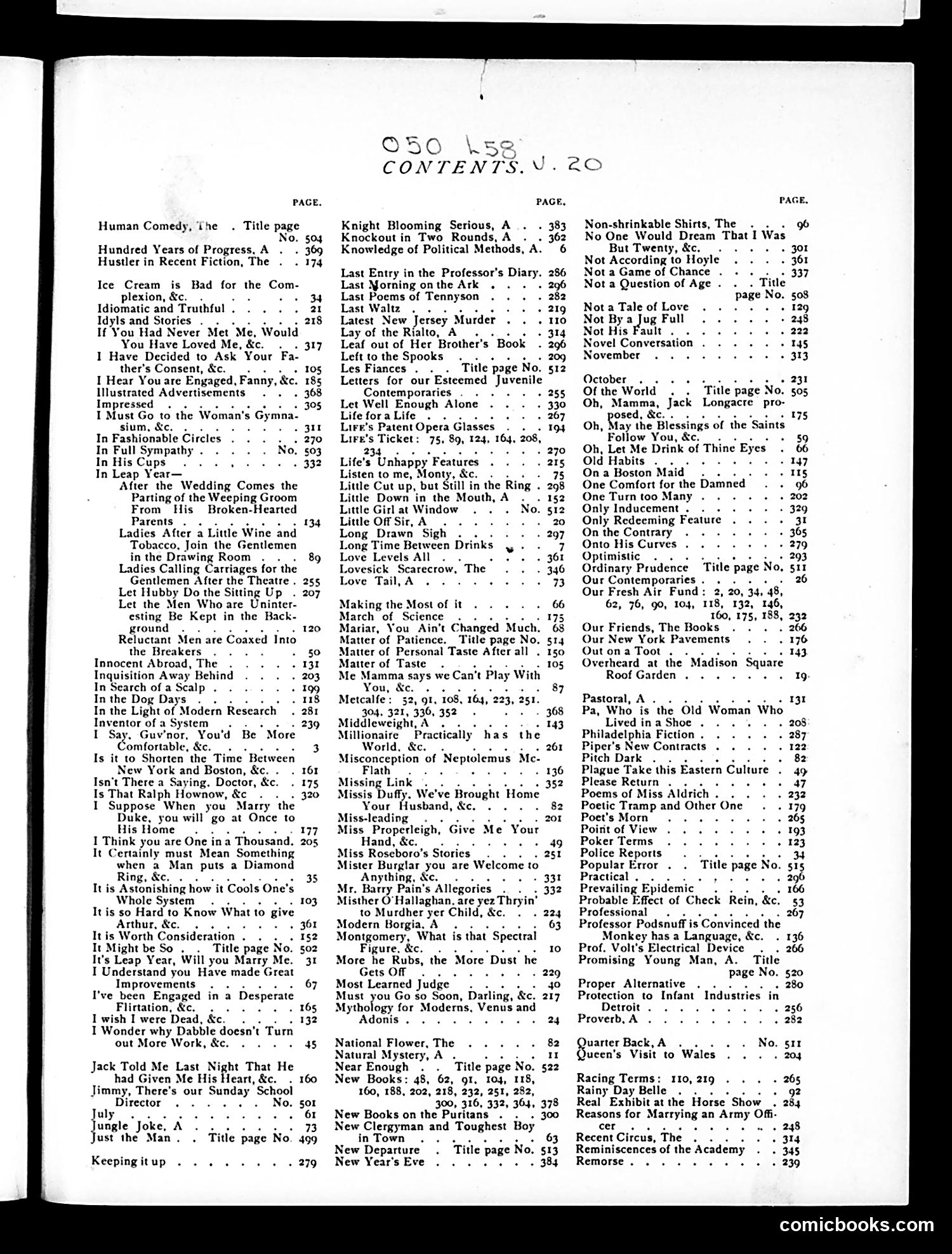
I can see this is a contents/index page from Life magazine listing article and story titles with their corresponding page numbers. The page shows no cartoons or satirical illustrations—it's purely a table of contents. The entries reflect early 20th-century concerns: references to "Ice Cream is Bad for the Complexion," "Idiomatic and Truthful" stories, pieces about "Jersey Murder," and social commentary like "Ladies Calling Carriages for the Gentlemen After the Theatre." Without seeing the actual illustrated pages these entries reference, I cannot identify specific cartoons, caricatures, or their satirical targets. To explain the satire and historical context, I would need to examine the actual article and cartoon pages themselves, not just their titles.
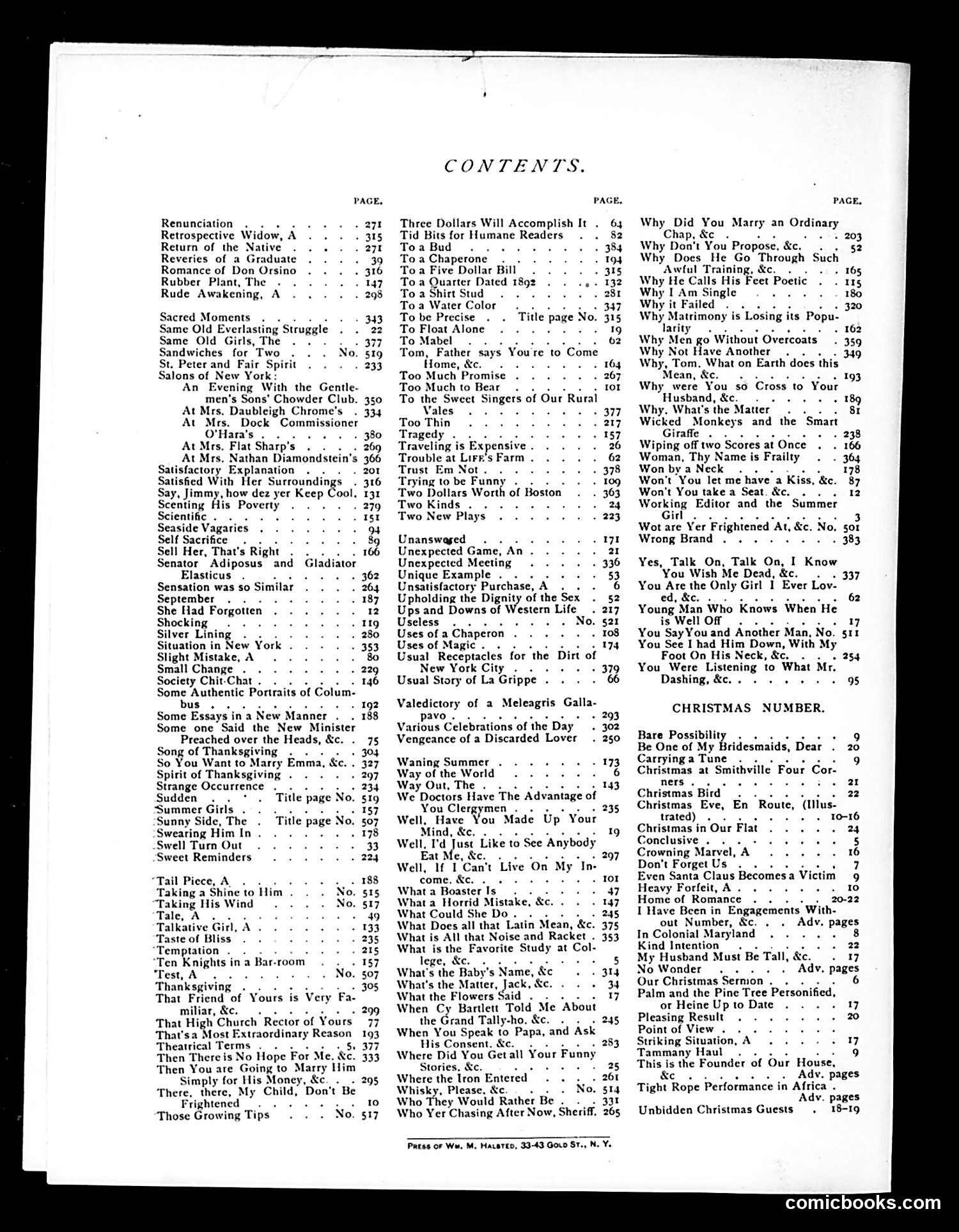
This is a **table of contents** from *Life* magazine, not a cartoon or illustrated editorial page. It lists article and story titles with their corresponding page numbers. The entries span various satirical pieces typical of *Life*'s format: social commentary ("Why Does He Go Through Such Awful Training"), character sketches ("Wicked Monkeys and the Smart Giraffe"), and humorous scenarios ("Trying to be Funny," "What a Horrid Mistake"). A **Christmas Number section** appears at the bottom right, indicating this was a holiday issue. Without seeing the actual illustrated pages referenced here, I cannot identify specific cartoons, caricatures, or political figures. The contents suggest *Life's* typical mix of domestic humor, social satire, and seasonal entertainment rather than hard political commentary.

I appreciate your detailed instructions, but I'm unable to provide the analysis you've requested. The image appears to be almost entirely black or failed to load properly, making it impossible for me to see the cartoon(s), figures, caricatures, or any visual content that would be necessary to identify political/social references or explain the satire. To help you effectively, I would need a clearer, higher-contrast version of the page where the actual cartoon artwork and any text/captions are legible. If you can provide a better image file, I'd be happy to apply my expertise in political cartoon history to explain its meaning to a modern reader, following your guidelines about accuracy and acknowledging uncertainty.