
A complete issue · 16 pages · 1892
Life — December 15, 1892
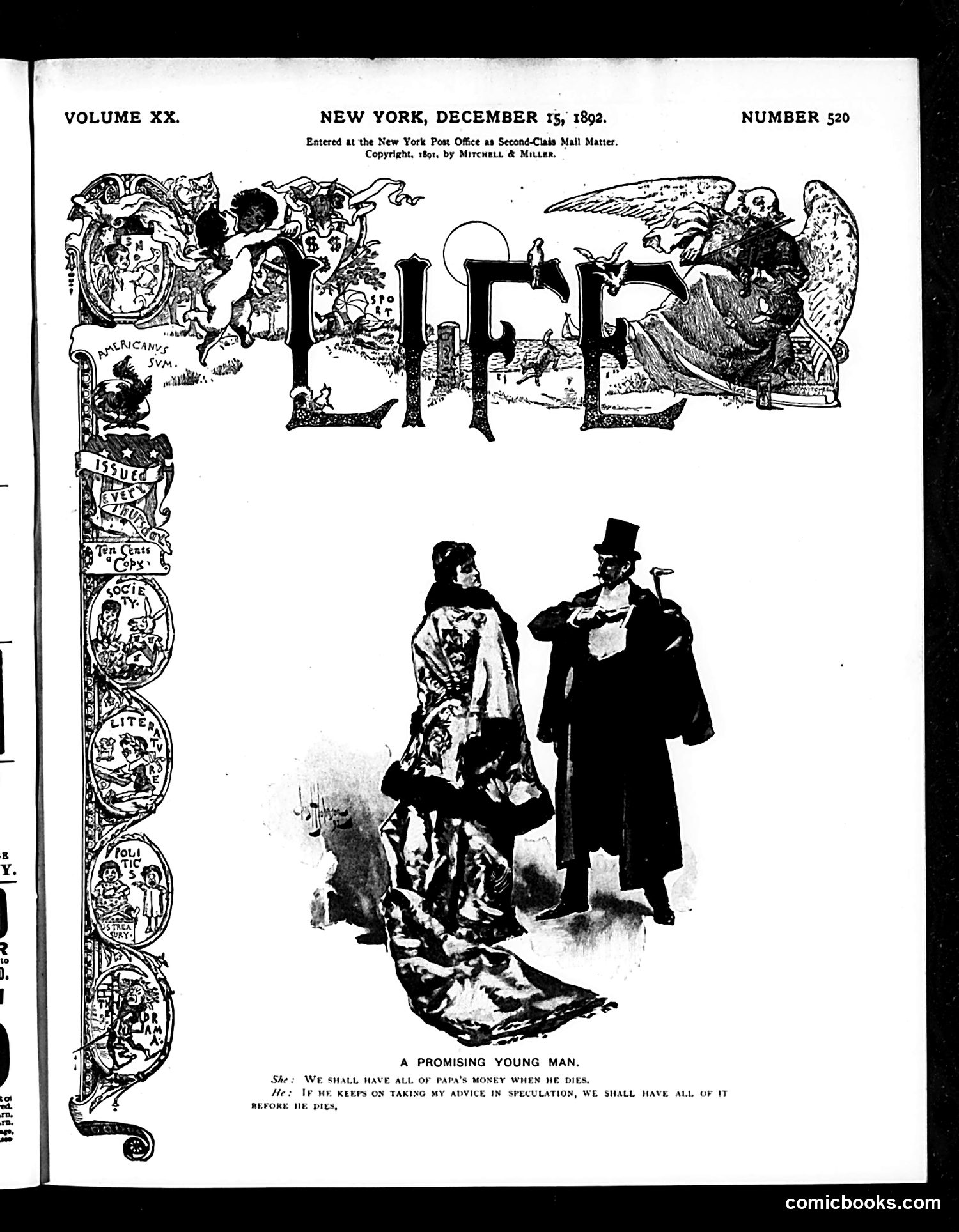
This cartoon satirizes a conversation between a woman and a well-dressed man in a top hat, seemingly about inheritance and financial security. The caption reveals the joke: The woman says they'll have "all of papa's money when he dies," while the man responds that if he continues taking her advice on financial speculation, they'll have "all of it before he dies." The satire targets the era's common practice of young men marrying into wealth, then squandering family fortunes through poor investments and speculation—often influenced by wives or mistresses. The "promising young man" is promising only in his ability to waste money. This reflects 1890s anxieties about inherited wealth being lost through reckless financial behavior rather than prudent stewardship.
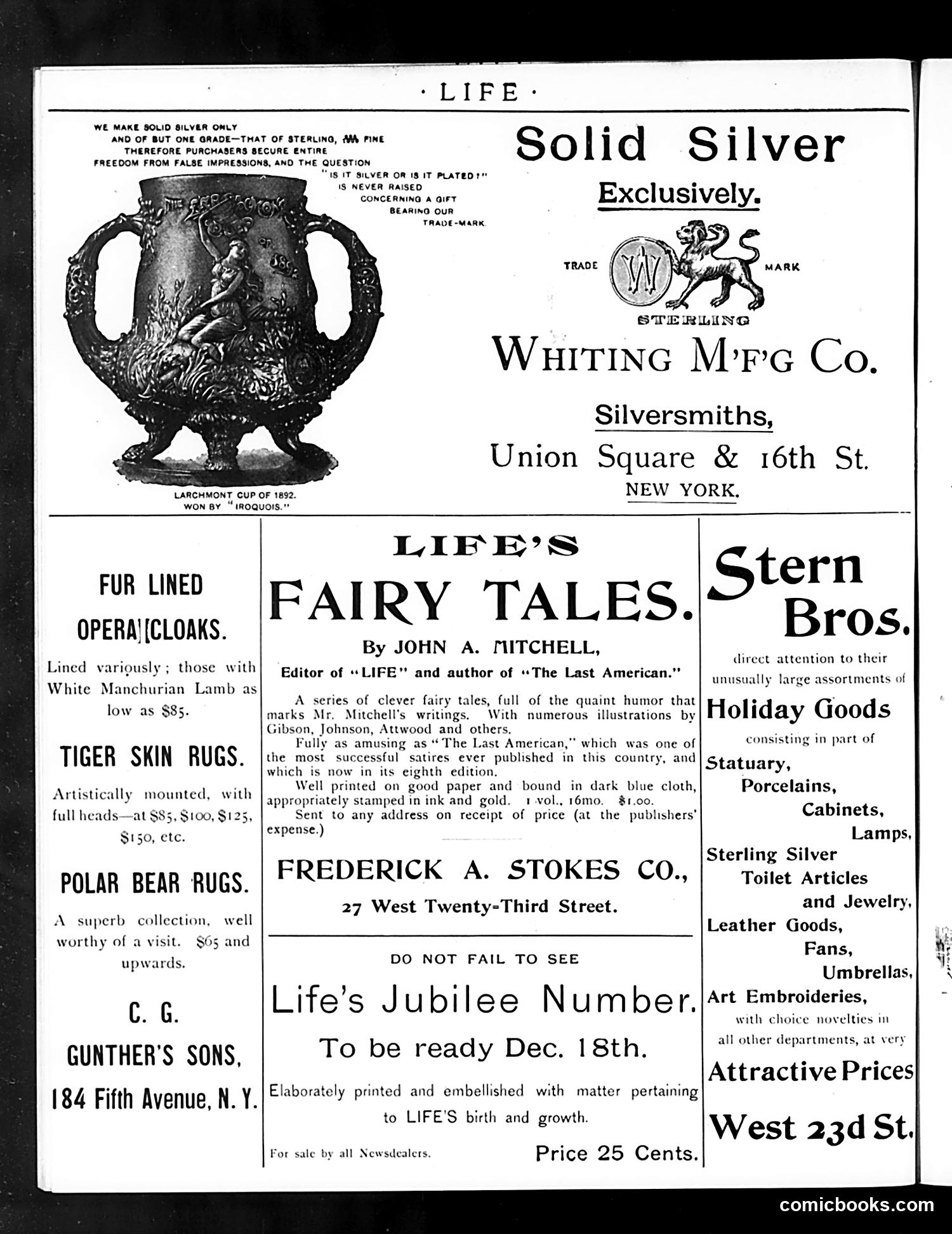
This page is primarily **advertising**, not political satire or cartooning. It contains multiple ads for luxury goods (silver items, fur-lined cloaks, tiger and polar bear rugs) typical of a wealthy late-19th-century readership. The only illustrated content is an ornamental **silver cup labeled "Larchmont Cup of 1892, won by 'Iroquois'"** — likely a prestigious yacht racing trophy. This image serves as a decorative advertisement for Whiting Manufacturing Company's sterling silver goods, emphasizing craftsmanship and prestige through association with high-society competition. The remaining content advertises a John A. Mitchell fairy tale collection and announces Life's upcoming "Jubilee Number" (December 18th), a special commemorative issue. No political commentary or satirical intent is evident on this page.
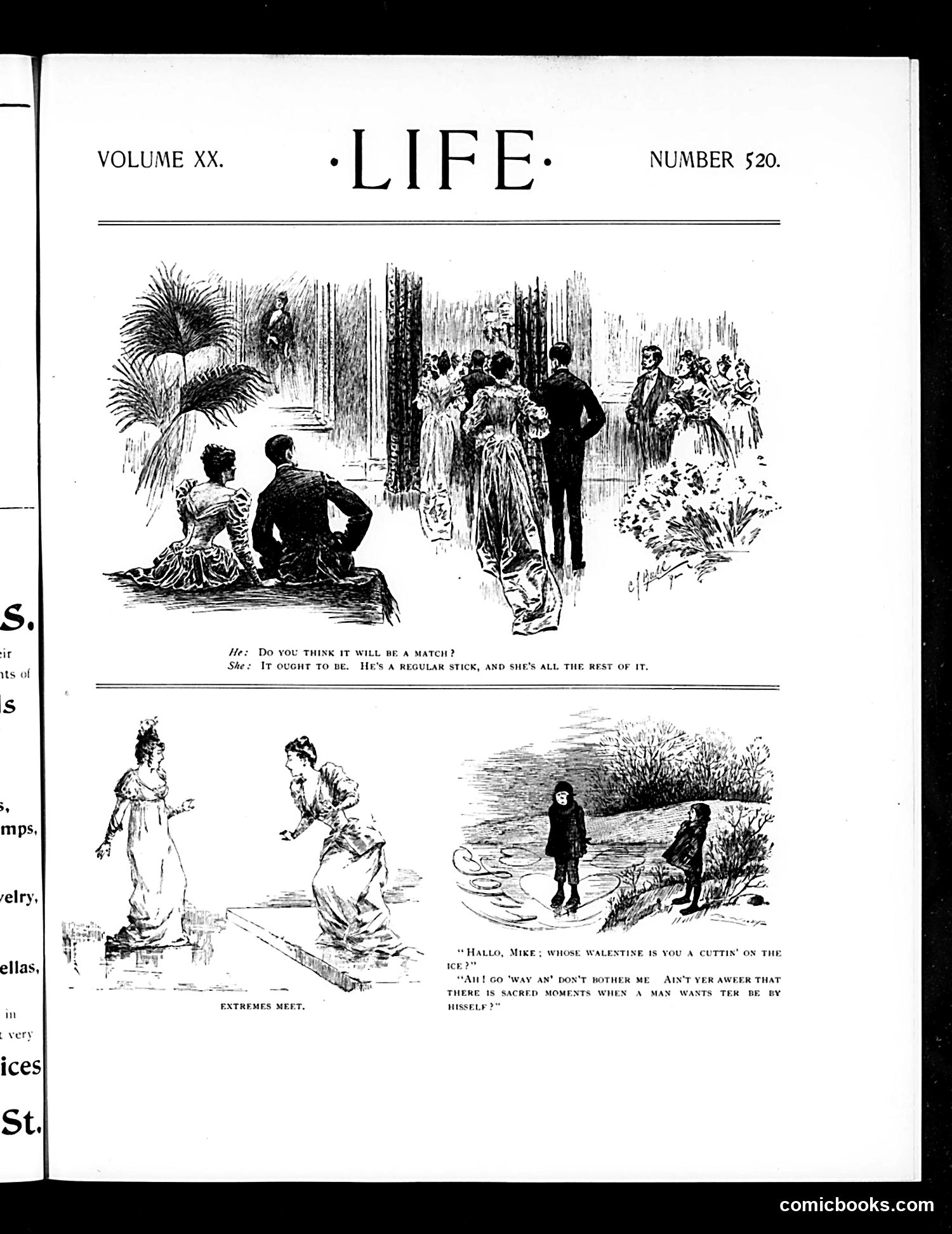
This page contains three separate humorous vignettes from early 20th-century American life: **Top panel**: A social gathering where a man and woman discuss whether a gentleman will "be a match." The joke plays on marriage prospects and social compatibility. **Middle panel ("Extremes Meet")**: Two women encounter each other on what appears to be a narrow plank or board, likely satirizing social awkwardness between people of different classes or backgrounds. **Bottom panel**: Two figures on ice, with dialogue about "Hallo, Mike" and Walestine. Mike complains about sacred moments being interrupted by men wanting attention, suggesting satire about romantic interruptions or male persistence in courtship. The overall page uses domestic and social scenarios to gently mock courtship customs, class interactions, and gender relations typical of its era's middle-class society.
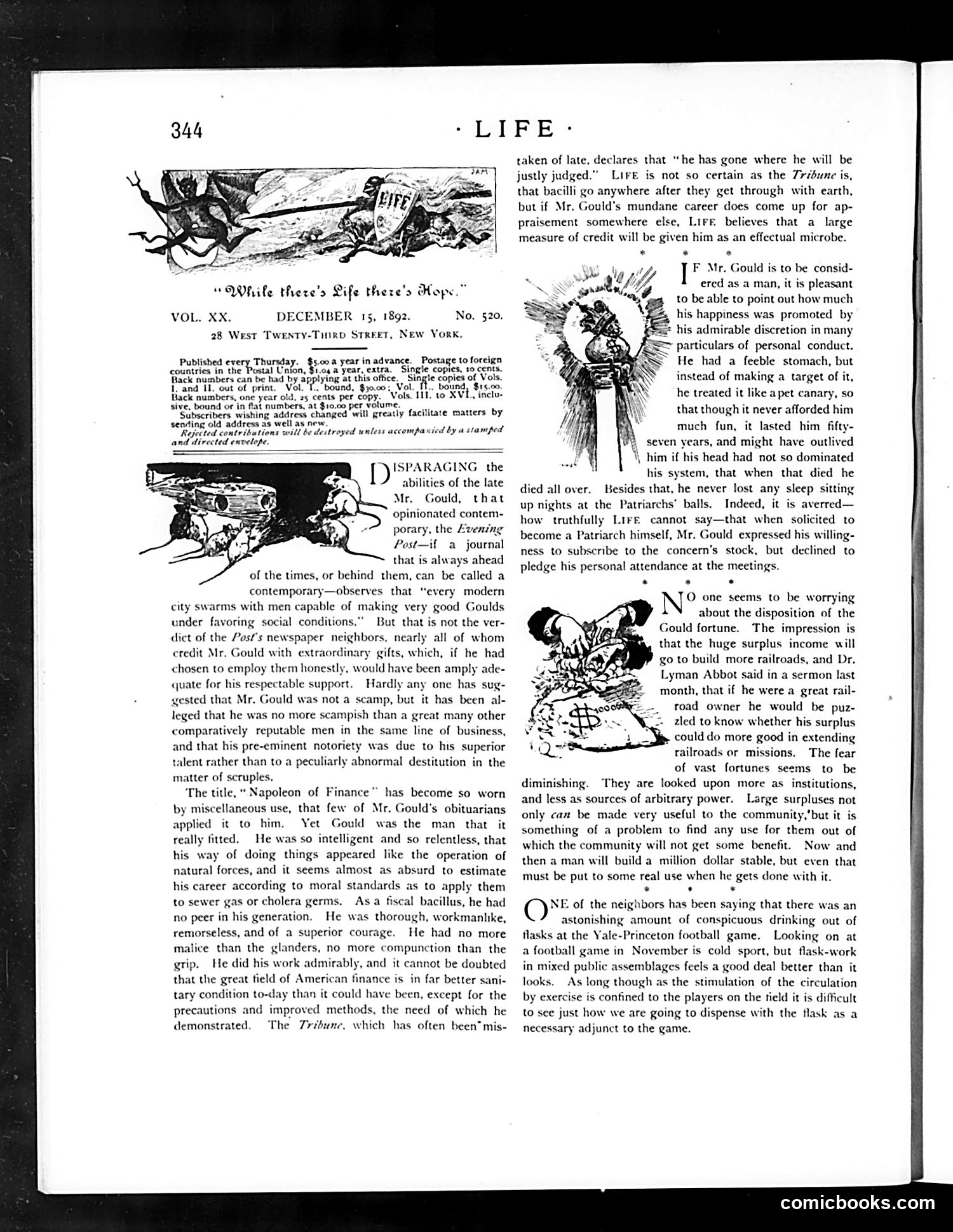
This page discusses the late Mr. Gould, likely **Jay Gould**, the prominent railroad magnate and financier who died in 1892. The text praises his business acumen while gently mocking his reputation. The cartoons satirize Gould's wealth and influence: one depicts him reclining luxuriously, another shows him with money bags. The satire centers on the paradox of his enormous fortune—the article notes neighbors questioned whether such vast wealth could truly benefit the community, and whether Gould's competitive, ruthless business methods justified his success. The piece reflects contemporary anxieties about **Gilded Age inequality**: celebrating his financial genius while questioning whether accumulating such fortunes served public good or merely private greed.
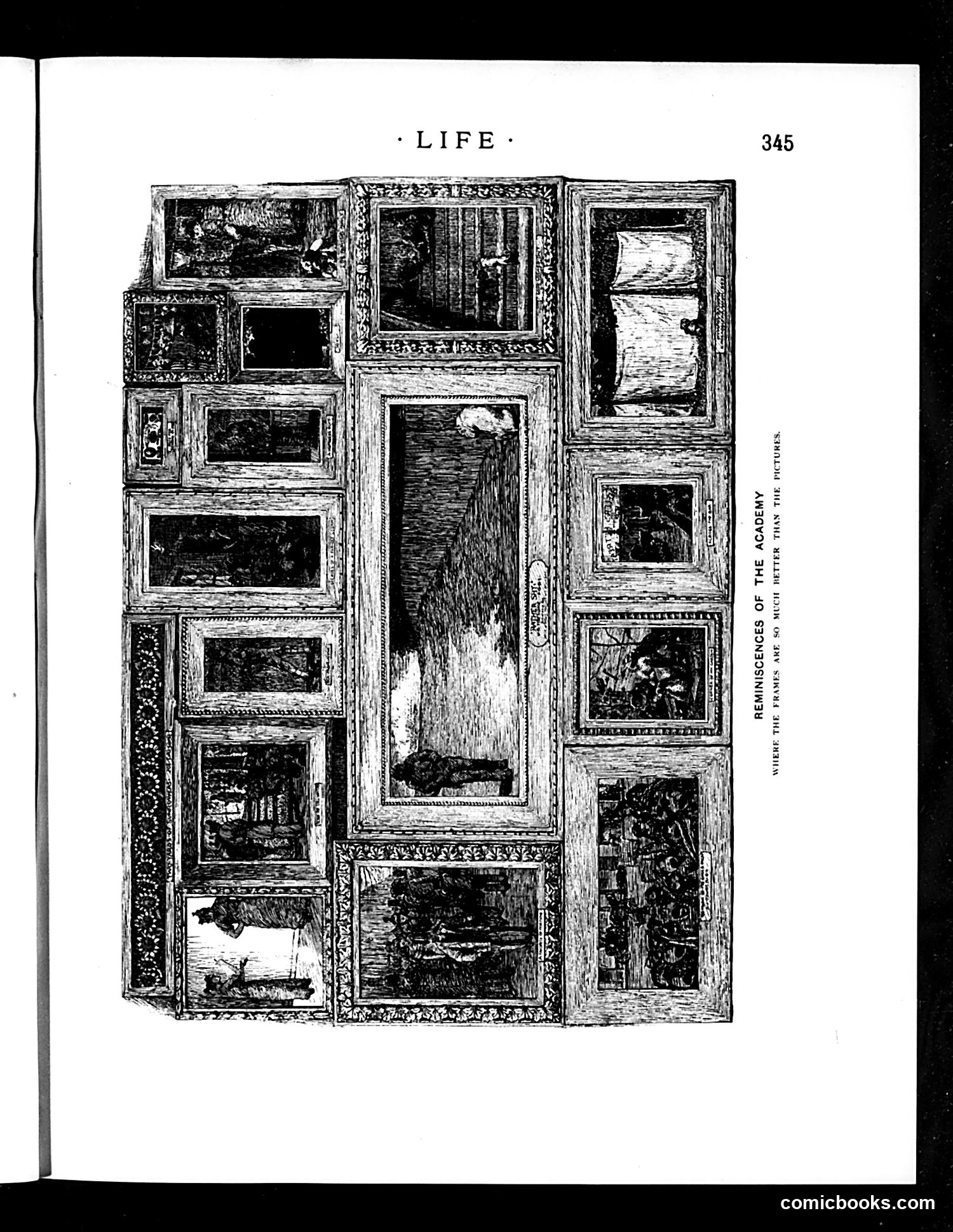
I cannot read the complete caption from the image, but this appears to be a satirical artwork titled "Reminiscences of the Academy," likely referencing the National Academy of Design or similar artistic institution. The image shows an assemblage of picture frames of various sizes arranged together, creating a collage effect. This compositional choice likely satirizes academic art institutions—mocking either: - The pretentiousness of formal art academies - How academic institutions display/organize artwork - The commercialization of "proper" art training The crowded, chaotic arrangement of frames suggests commentary on how institutions present themselves or how artists were trained in rigid, formulaic ways. Without the complete caption, the specific target of satire remains unclear, but the satirical intent is evident.
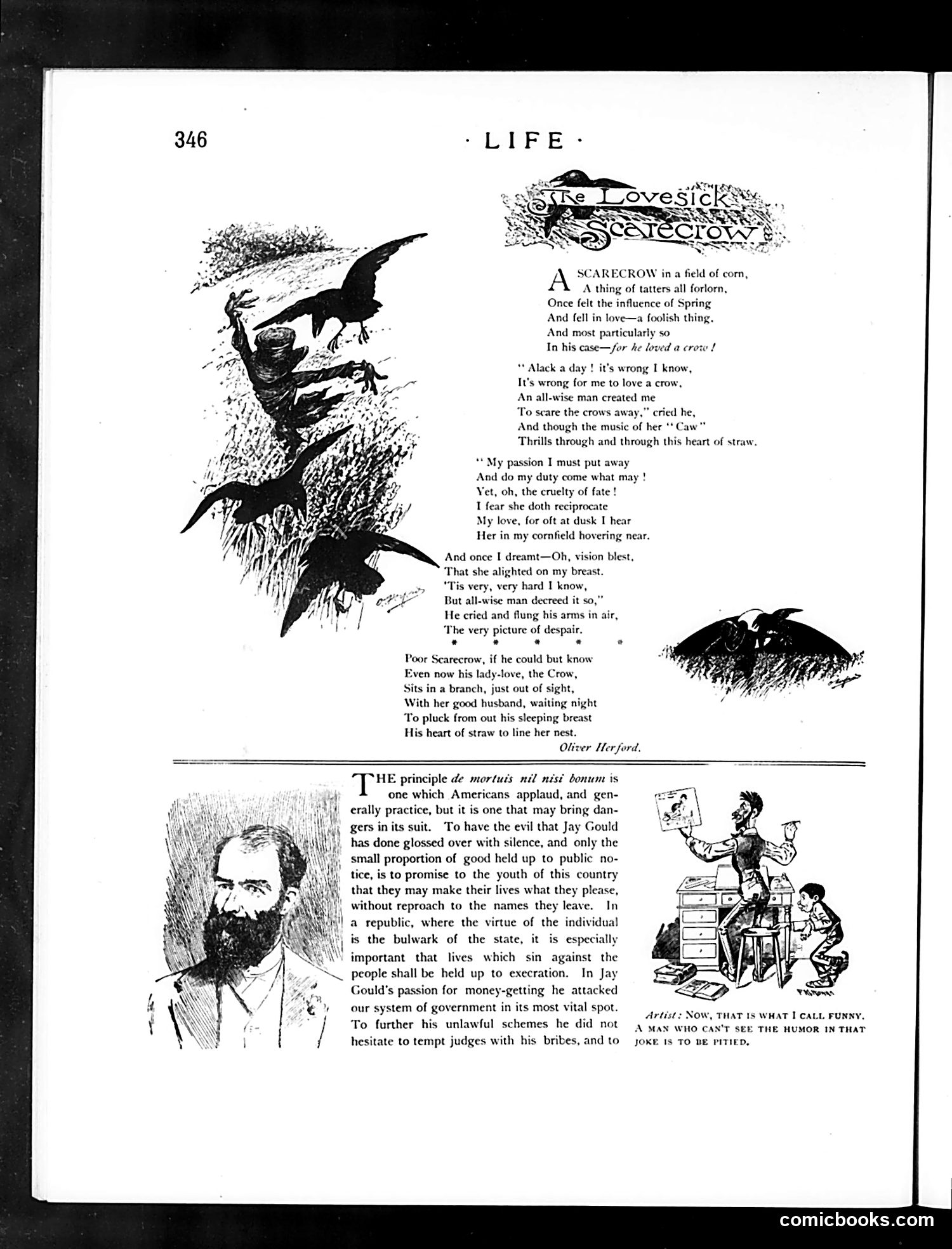
**The Poem:** Oliver Herford's romantic verse tells of a scarecrow who falls in love with a crow, creating an impossible romance. The scarecrow must choose between his duty (scaring crows) and his passion, ultimately accepting the "cruelty of fate." **The Political Section:** Below discusses the principle *de mortuis nil nisi bonum* (speak no ill of the dead). It criticizes Jay Gould's corruption—specifically his bribery of judges and attacks on government integrity regarding money-getting schemes. The text argues that exposing such villainy is necessary in a republic, despite the maxim against speaking ill of the deceased. **The Cartoon:** A small illustration shows an artist joking with a client about humor in art—likely satirizing pretentious artistic claims.
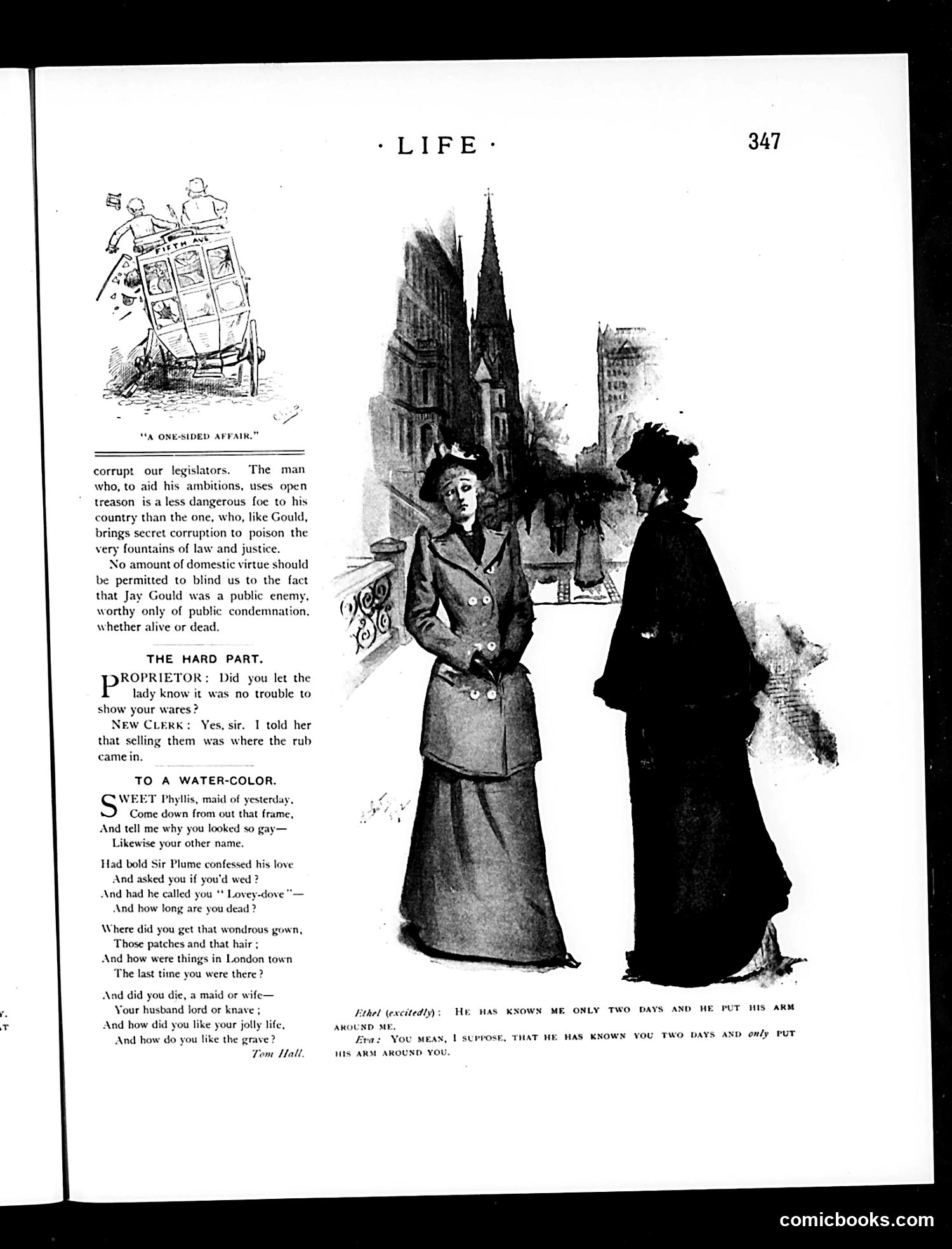
**Top Cartoon ("A One-Sided Affair"):** Shows figures loading a barrel labeled with comic panels onto a cart, satirizing sensationalized newspaper/comic content being mass-produced and distributed. **Main Illustration & Dialogue:** Depicts a woman and man in what appears to be an urban setting with a Gothic cathedral. The dialogue references "Jay Gould," a notorious 19th-century railroad magnate and robber baron known for corruption and ruthless business practices. **Political Context:** The accompanying text criticizes Gould as a "public enemy" and corrupt legislator, arguing that secret corruption ("the one...who likes law") poses greater danger than open treason. The satire attacks wealthy industrialists who corrupted American institutions through bribery and manipulation rather than direct criminal acts. **Overall Point:** Mocking elite hypocrisy and the public's tolerance of wealthy criminals.
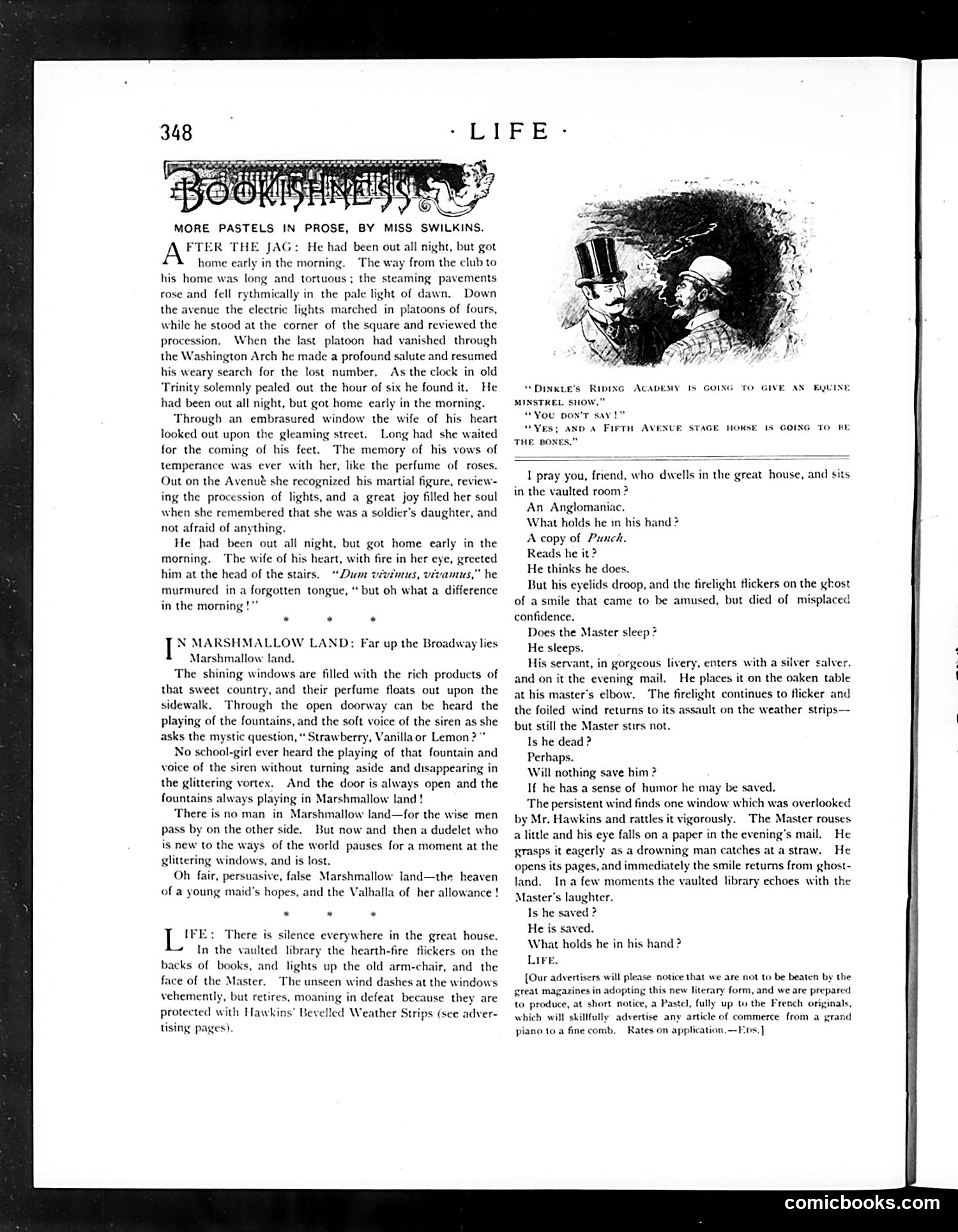
This page contains literary content rather than political cartoons. The main feature is "More Pastels in Prose, by Miss Swilkins"—a serialized short story collection. The visible content includes two prose passages: "After the Tag" (describing a soldier's homecoming) and "In Marshmallow Land" (a whimsical piece about a Broadway shop window). On the right side is a humorous dialogue apparently mocking Victorian-era literary pretension, with exchanges about what a gentleman in a "great house" might be holding (a copy of *Punch* magazine, apparently). The page appears to be from Life's literary/humor section rather than its political cartoon section. Without additional context about the author "Miss Swilkins" or the specific publication date, the precise satirical targets remain unclear.
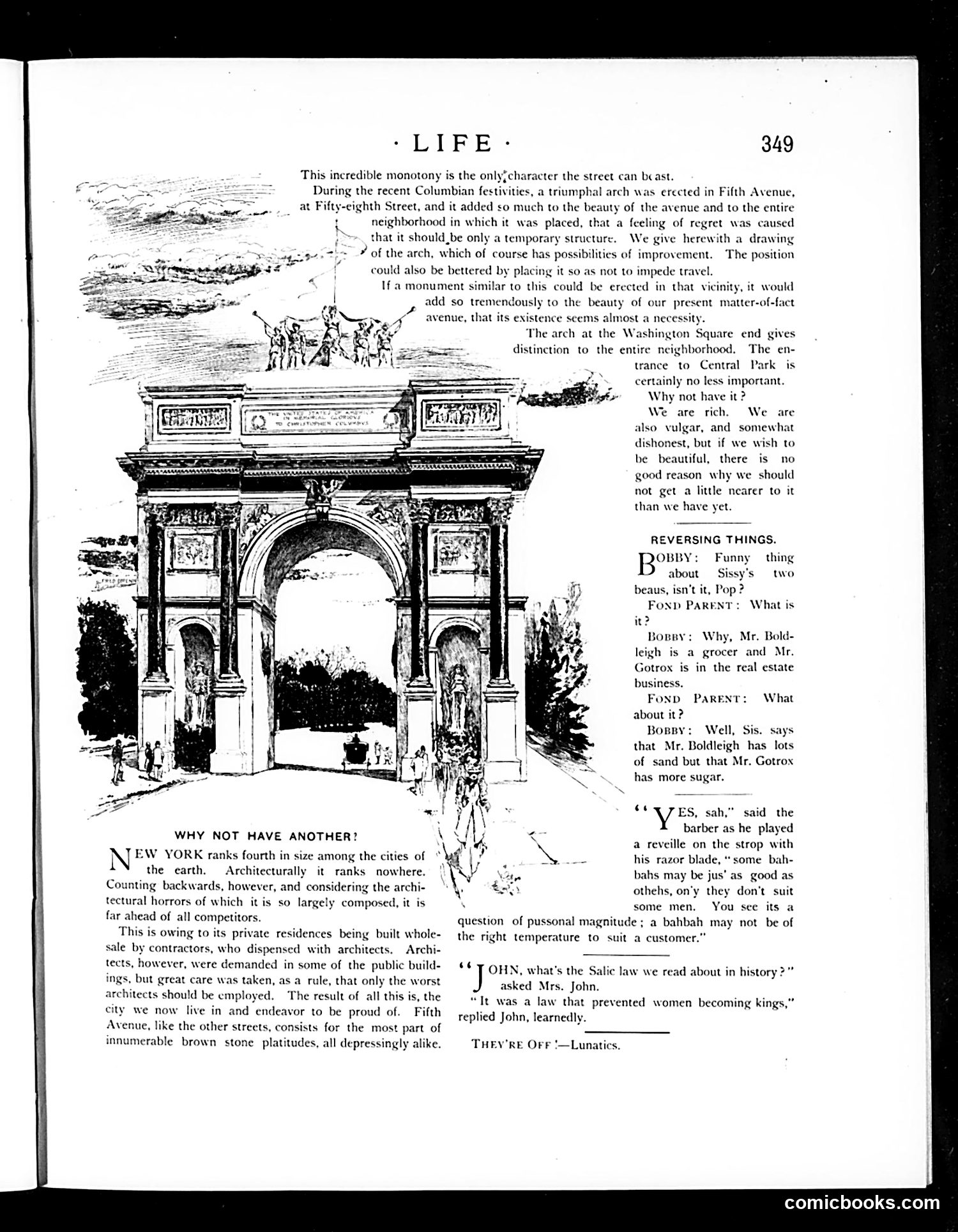
This page features a large architectural illustration of a triumphal arch (likely the Washington Square arch in New York) alongside commentary about urban beautification. The left text argues New York needs more monumental architecture like this arch, claiming the city ranks "fourth in size" but architecturally ranks "nowhere." The author criticizes New York's reliance on private residences and brownstone buildings rather than grand public structures, asserting that only the worst architects are employed for public buildings. The right column contains a humorous dialogue ("Reversing Things") mocking social pretensions—characters confuse a grocer with a real estate businessman, and make jokes about "babbabs" (barbers) and Salic law. The satire appears to target class confusion and false sophistication among ordinary New Yorkers.
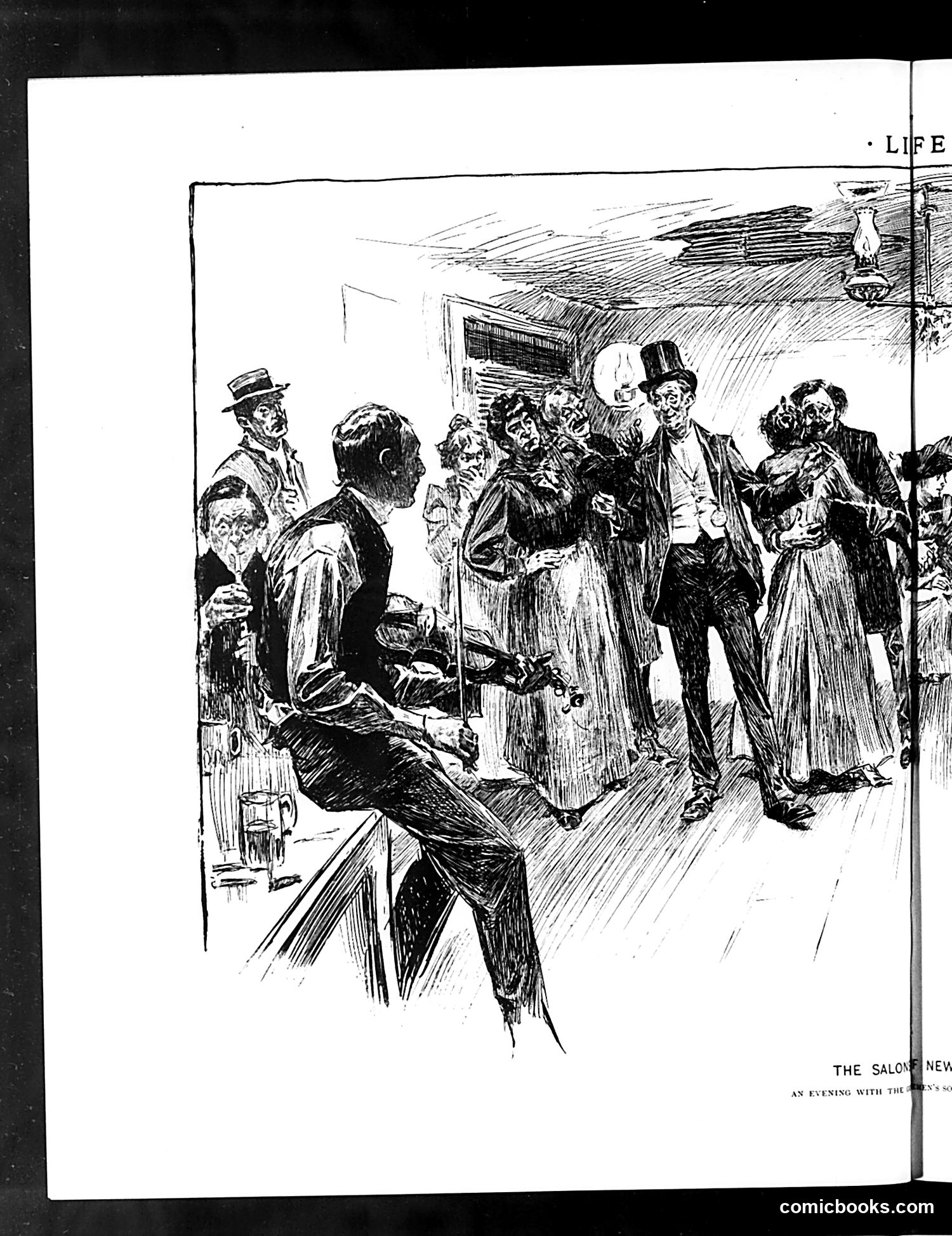
This Life magazine illustration depicts a social gathering, likely satirizing the artistic or literary "salon" culture popular among the upper classes and bohemian circles of the early 20th century. The sketch shows well-dressed figures—men in top hats and suits, women in long gowns—gathered indoors, appearing to engage in intellectual discourse. The exaggerated facial expressions and caricatured features suggest mockery of salon attendees as pretentious or affected. The title "An Evening with the New" likely references the salon's focus on modern or avant-garde ideas, which Life's satirists frequently ridiculed as pretentious posturing by wealthy dilettantes attempting to appear cultured and progressive. The crowded, animated composition emphasizes the theatrical nature of such gatherings.
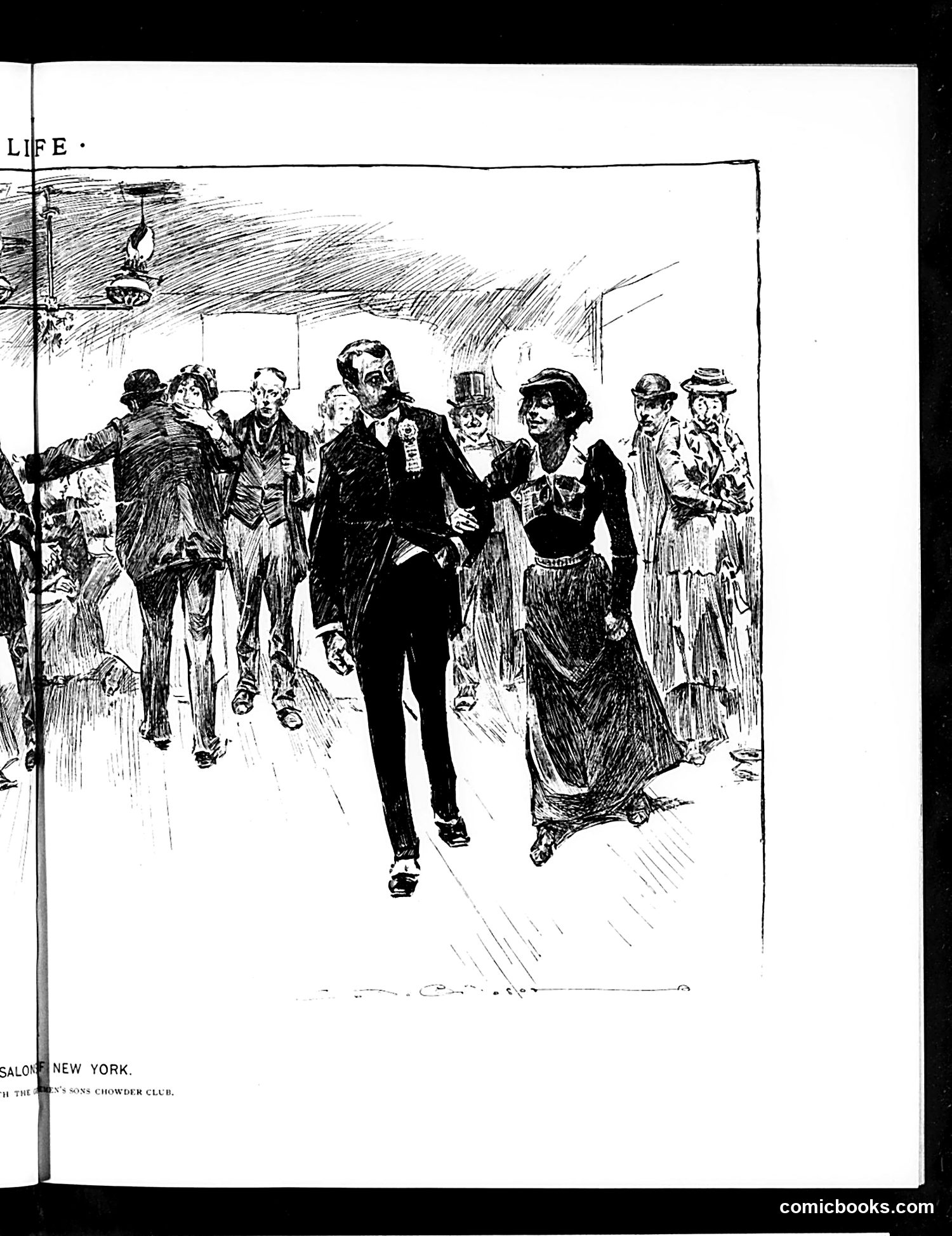
This appears to be a satirical scene set in an exclusive New York salon or social club (the text references "THE SONS CHOWDER CLUB"). The illustration depicts a formal gathering of well-dressed men and women from high society. The cartoon likely satirizes the pretensions and social dynamics of New York's elite social establishments of the early 20th century. The exaggerated character sketches and theatrical poses suggest mockery of the artificial formality and posturing typical of such exclusive clubs. Without clearer identification of specific individuals or captions, the exact political or social commentary remains somewhat unclear, though the overall tone is one of gentle ridicule toward upper-class social conventions and club culture.
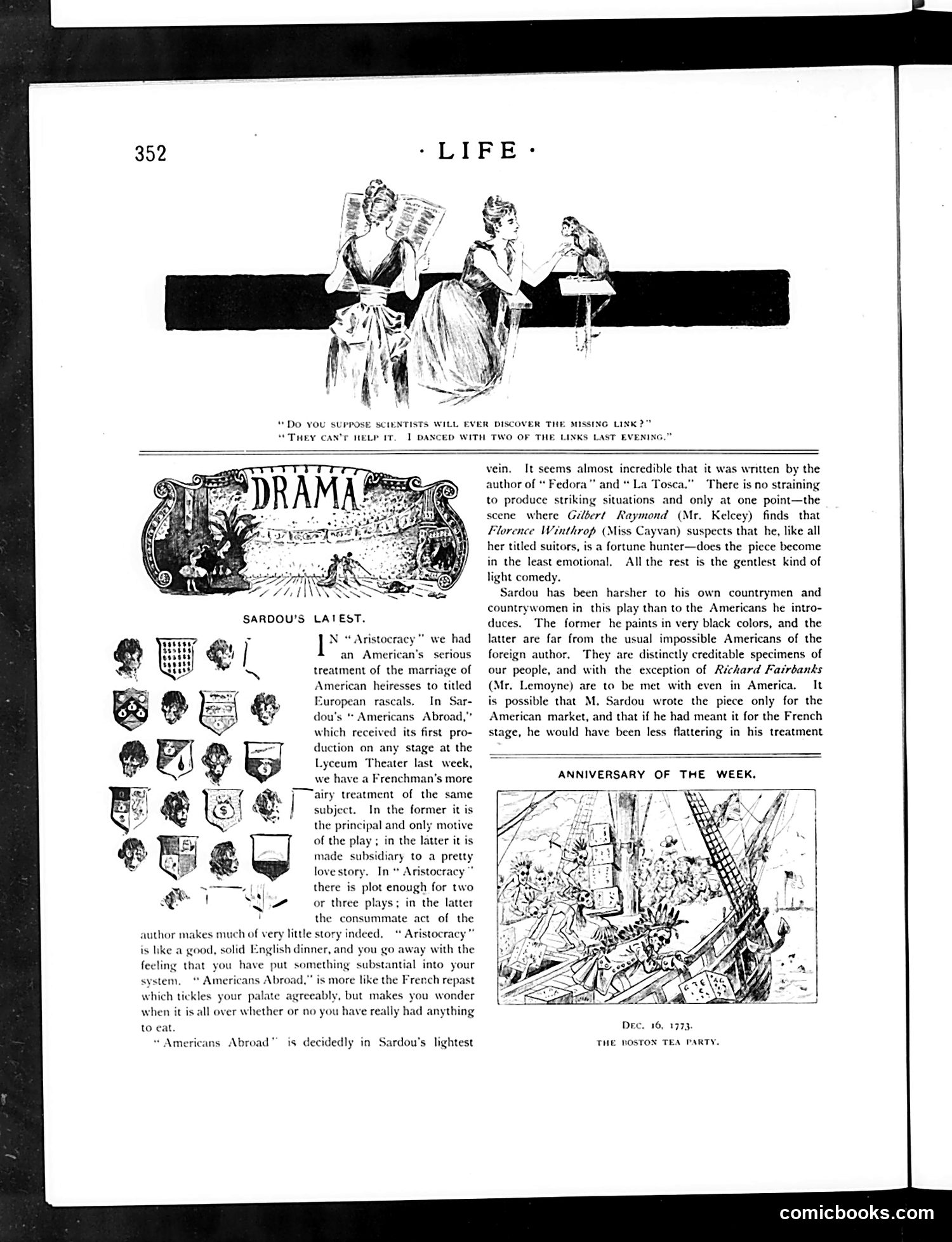
**The Cartoon:** The top illustration shows three women in conversation, with one asking if scientists will discover the "missing link," to which another replies she "danced with two of the links last evening." This is a joke about "missing links"—the evolutionary connection between apes and humans, a hotly debated topic in the late 19th century. The humor works by treating fashionable men as primitive ("links" in the evolutionary chain), sardonically suggesting that American high society contains specimens barely more evolved than animals. **The Drama Review:** The main text discusses Sardou's play "Americans Abroad," comparing it to his earlier play "Aristocracy." Both concern American heiresses marrying titled European men. The critic praises Sardou for treating Americans more fairly and sympathetically than the "usual impossible Americans of the foreign author"—suggesting European playwrights typically portrayed Americans as ridiculous or uncultured. **The Historical Anniversary:** The illustration at bottom right marks December 16, 1773—the Boston Tea Party, a Revolutionary War-era protest against British taxation.
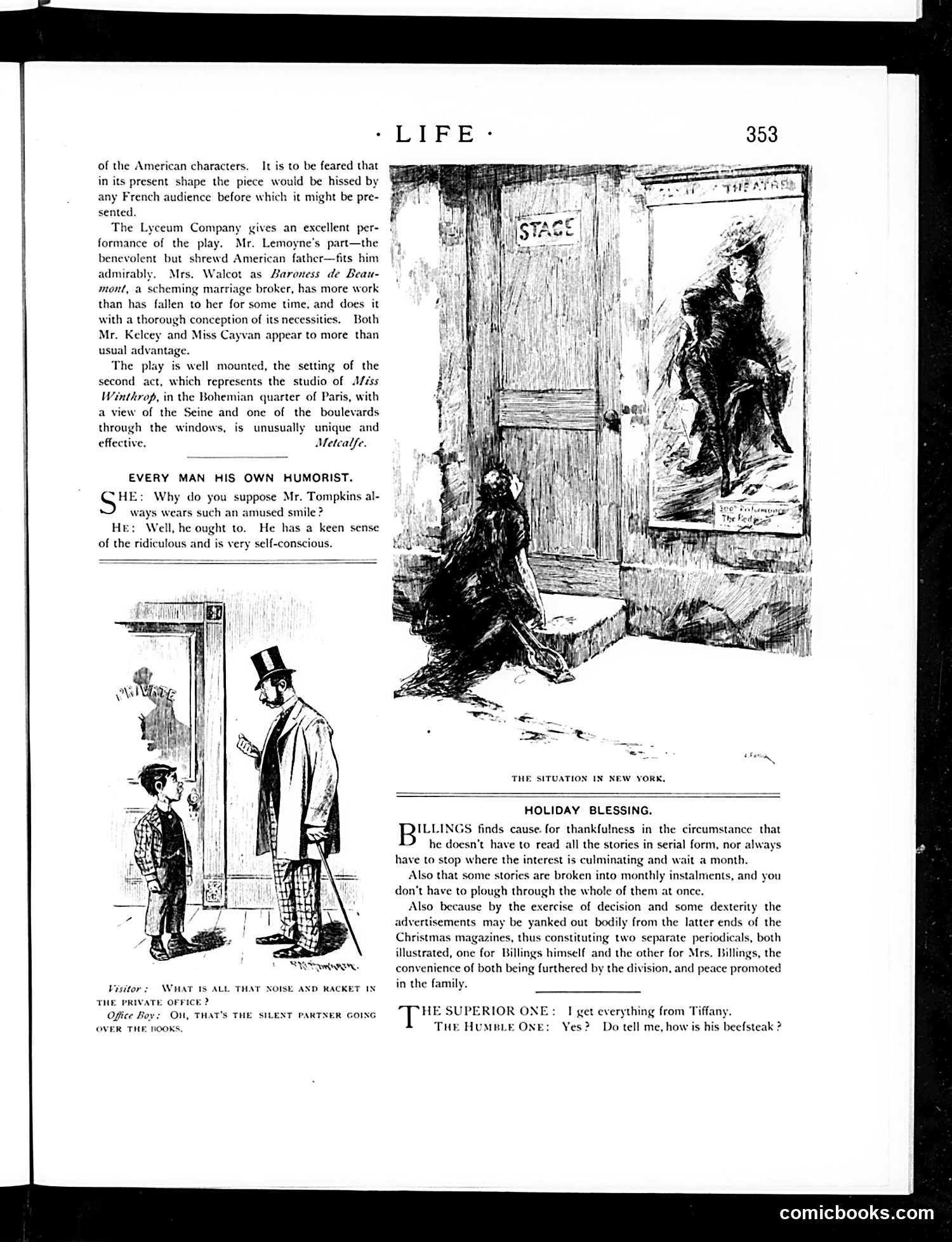
This page contains a theater review and several brief satirical comics typical of Life magazine's humor section. The main review discusses a play featuring American characters performed by the Lyceum Company, with praise for the cast and sets depicting Parisian locations. Below are three separate comic strips: 1. **"Every Man His Own Humorist"**: A joke about Mr. Tompkins wearing an amused smile—the punchline being he has "a keen sense of the ridiculous and is very self-conscious," suggesting he finds everything funny due to his own vanity. 2. **"The Silent Partner"**: An office boy explains noise in the private office by saying "that's the silent partner going over the books"—a pun, since the partner is supposed to be silent but is making noise. 3. **"Holiday Blessing"** and **"The Situation in New York"**: Humorous observations about magazine reading habits and domestic life, including jokes about serial stories and a couple of different social classes discussing luxury goods (Tiffany vs. beefsteak).
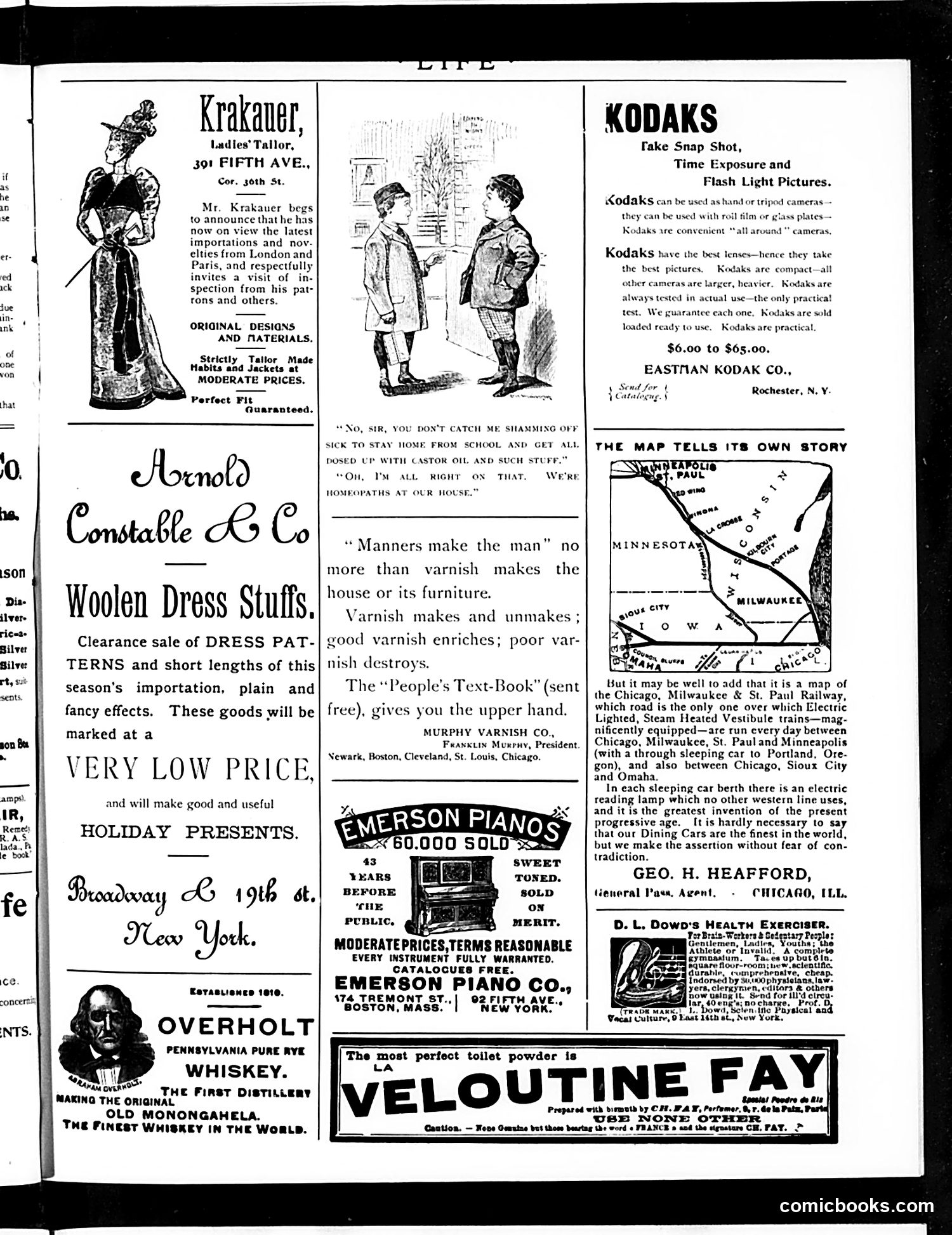
This is primarily an **advertising page** with one cartoon strip. The single cartoon depicts a humorous domestic scene: two boys discuss avoiding school by feigning illness. One boy rejects the scheme, saying he won't fake sickness to stay home and endure castor oil treatments—his family uses homeopathy instead. The joke reflects late-19th/early-20th-century medical debates. **Homeopathy** (treatment with highly diluted substances) was a popular alternative to conventional medicine's aggressive treatments like castor oil. The cartoon satirizes this by suggesting homeopathy is so mild it won't even make a child sick—thus defeating the boy's plan to skip school. It's social commentary on competing medical philosophies of the era. The remainder consists of period advertisements for Kodak cameras, Emerson pianos, Overholt whiskey, Krakauer tailoring, and other goods—typical of Life magazine's revenue model.
This is primarily an **advertising page** from Life magazine, not a political cartoon. The page contains various commercial advertisements typical of late 19th/early 20th-century American publications. Notable ads include: - **Tennyson New Year's Spoon** (J.H. Johnston & Co.): A luxury silver spoon quoting Tennyson's "In Memoriam," marketed as an upscale holiday gift - **Cancer treatment** (E. Brown & Son): Claims of "permanent cure," reflecting the era's dubious medical advertising - **Haviland China**: Fine porcelain marked for import - **Aerated Oxygen**: A patent medicine claiming to cure various ailments through "aerated oxygen"—typical of the era's unregulated medical snake oil - **Fischer Pianos**, **Lievig Extract of Beef**, **Carmel Soap**, and other consumer goods The "Jubilee Number of Life" announcement references the magazine's tenth anniversary, coming December 18th. The page reflects the advertising landscape of an era before FDA regulation, when exaggerated health claims were common.