
A complete issue · 14 pages · 1892
Life — July 7, 1892
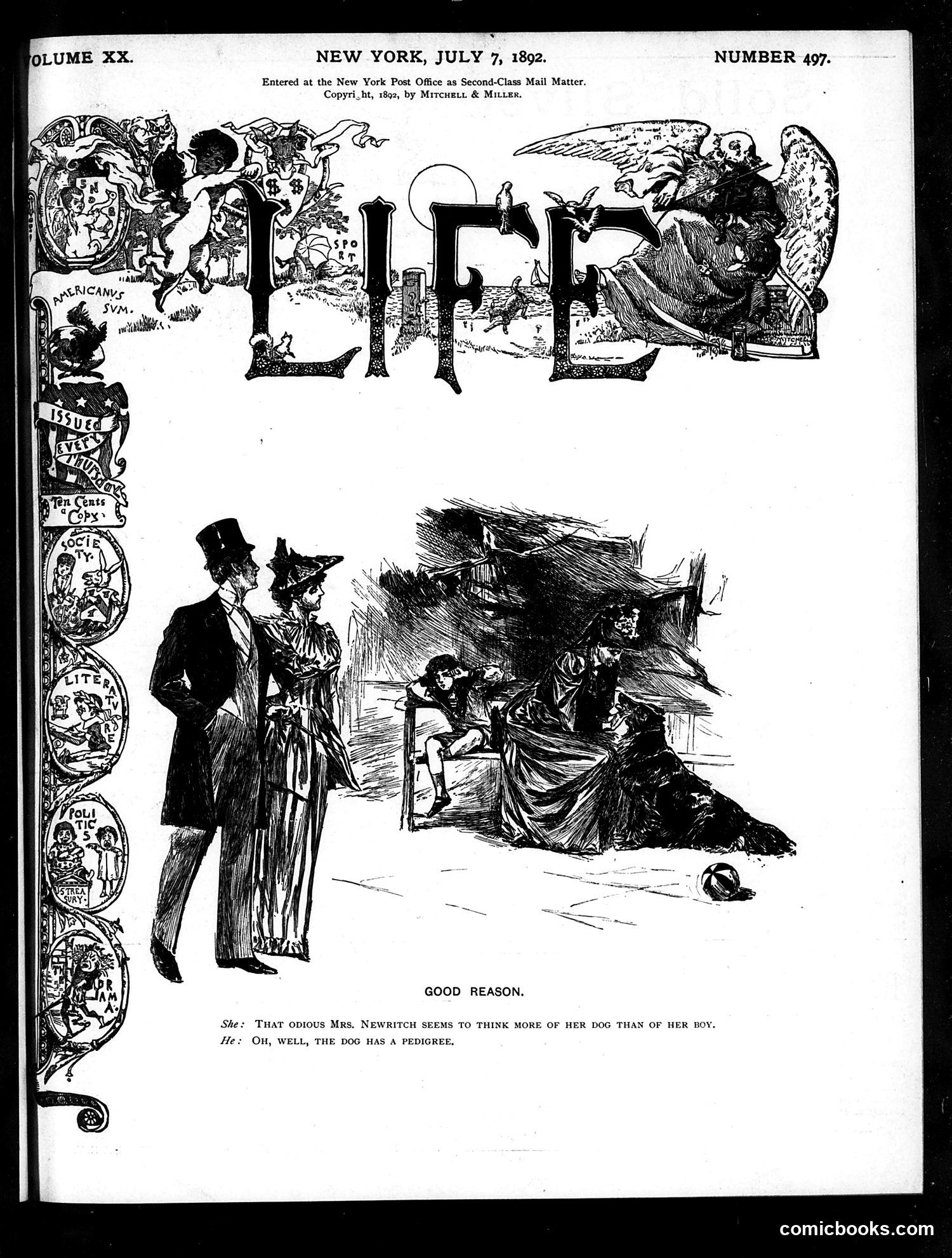
This cartoon satirizes social hypocrisy regarding class and propriety in the 1890s. A well-dressed couple observes a woman (Mrs. Newbritch) neglecting her young son to attend to her dog. The dialogue reveals the joke: she thinks more of her dog than her boy, which the man dismisses with "the dog has a pedigree." The satire targets the wealthy's obsession with pedigree and bloodline as markers of social status. By suggesting the dog's pedigree justifies preferring it to a human child, the cartoonist mocks how absurdly the upper classes valued breeding and ancestry over genuine human relationships and parental responsibility. The woman's neglect becomes comedic commentary on misplaced priorities among the elite.
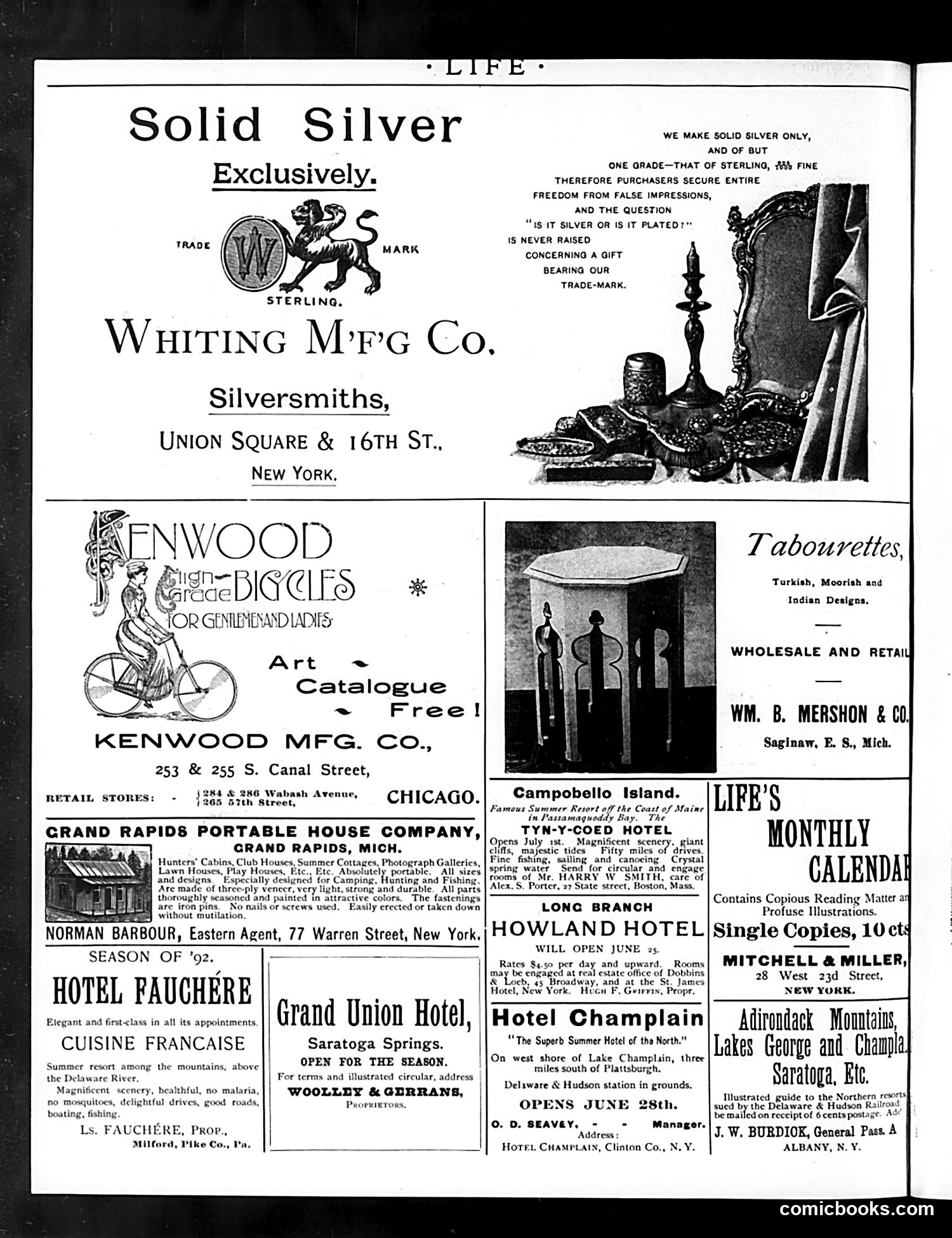
This page is primarily **advertising**, not political satire. It contains multiple commercial advertisements from the 1890s era, including: - **Whiting M'fg Co.**: A sterling silver manufacturer emphasizing their solid silver products - **Kenwood Bicycles**: High-wheel bicycles marketed to gentlemen and ladies - **Grand Rapids Portable House Company**: Prefabricated homes - **Hotel advertisements**: Including the Hotel Fauchère, Grand Union Hotel (Saratoga Springs), Howland Hotel, Hotel Champlain, and others The only notable visual element is a decorative Art Nouveau illustration accompanying the Kenwood Bicycles ad. There are **no political cartoons or satirical commentary** present. This appears to be a standard advertising page from Life magazine's commercial section, targeting late-19th-century affluent readers interested in luxury goods and travel.
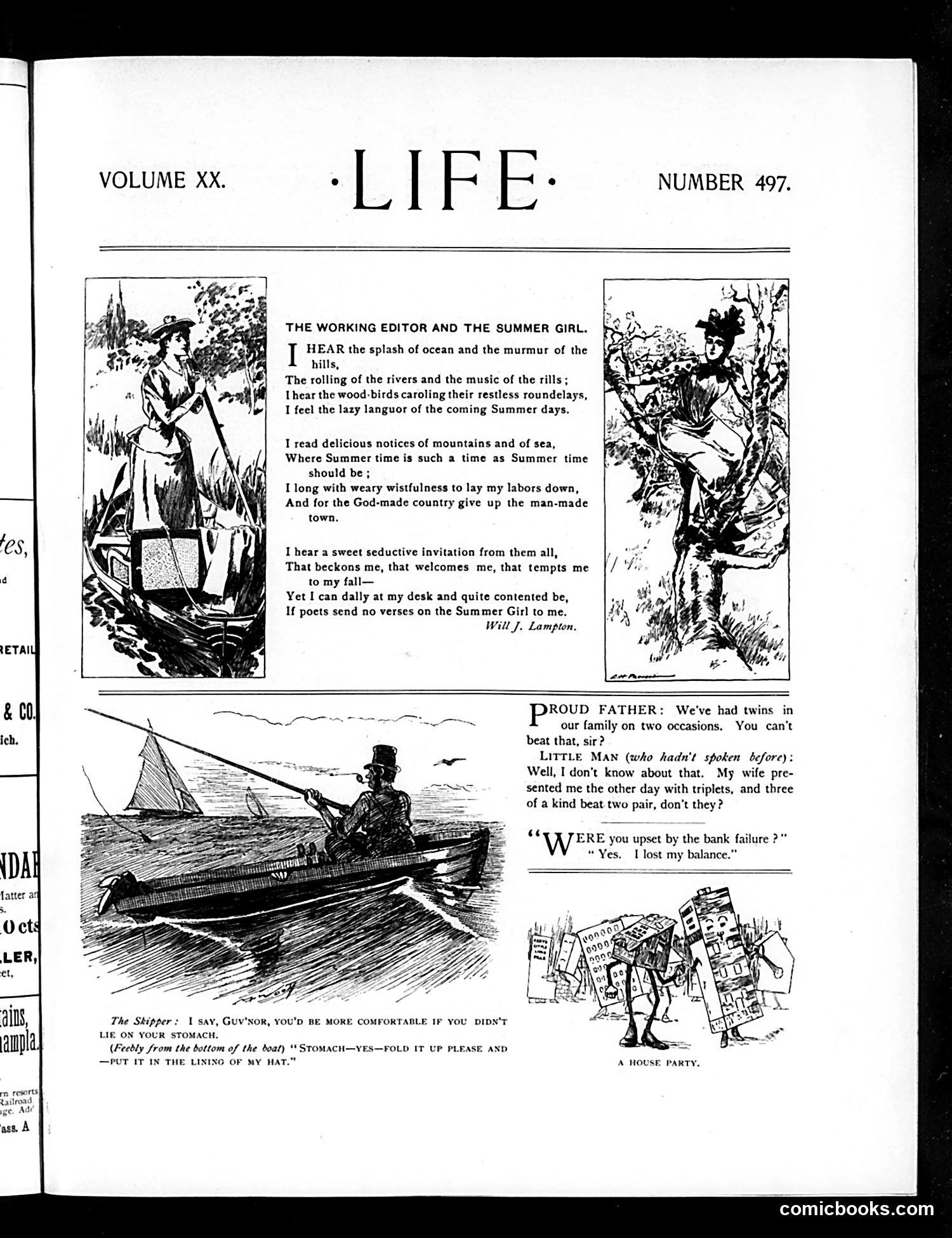
This page contains **literary and humorous content** rather than political satire: **Top section**: A poem titled "The Working Editor and the Summer Girl" by Will J. Lampson, contrasting an editor's desk work with the allure of summer nature and romance. Two illustrations accompany it—a working woman and a girl in nature. **Middle section**: A humorous dialogue between a "Proud Father" and a "Little Man" about twins and triplets, followed by a joke about bank failure: "Were you upset by the bank failure?" / "Yes. I lost my money." **Bottom**: A cartoon titled "A House Party" showing figures amid stacked belongings, illustrating residential moving or domestic chaos. The page emphasizes **lighthearted humor and gentle social observation** rather than sharp political commentary.
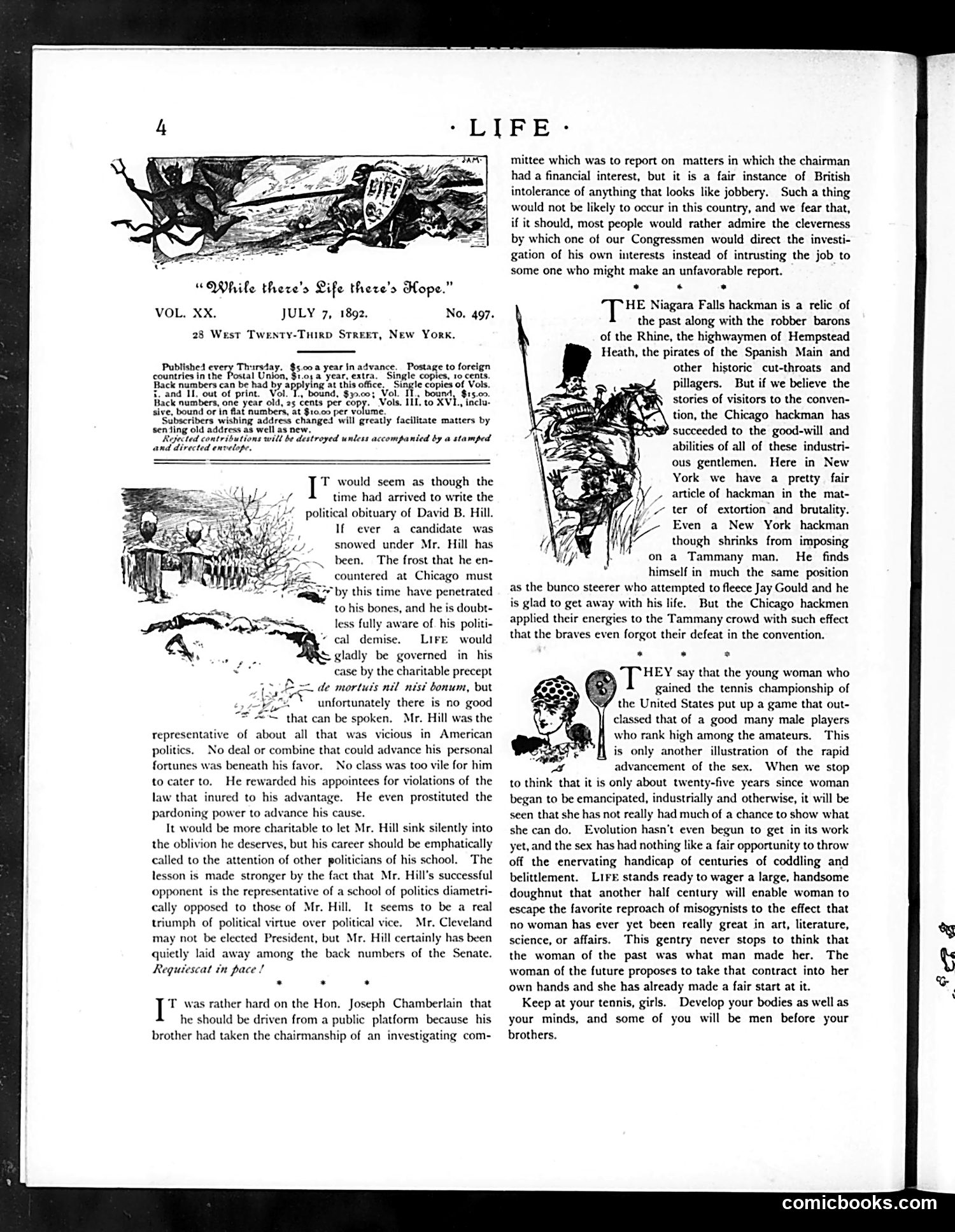
This page contains editorial commentary rather than cartoons. The main text critiques **David B. Hill**, a prominent New York politician, discussing whether *Life* should write his political obituary. The piece argues Hill's career represents the worst of American politics—using public office for personal gain and rewarding loyalists who violated the law. The editorial also notes **Joseph Chamberlain's** removal from a public platform due to his brother chairing an investigating committee (suggesting conflict of interest). A secondary article celebrates women's advancement in athletics, specifically tennis championships, arguing this demonstrates women's capacity for achievement beyond domestic roles—a progressive stance for 1892.
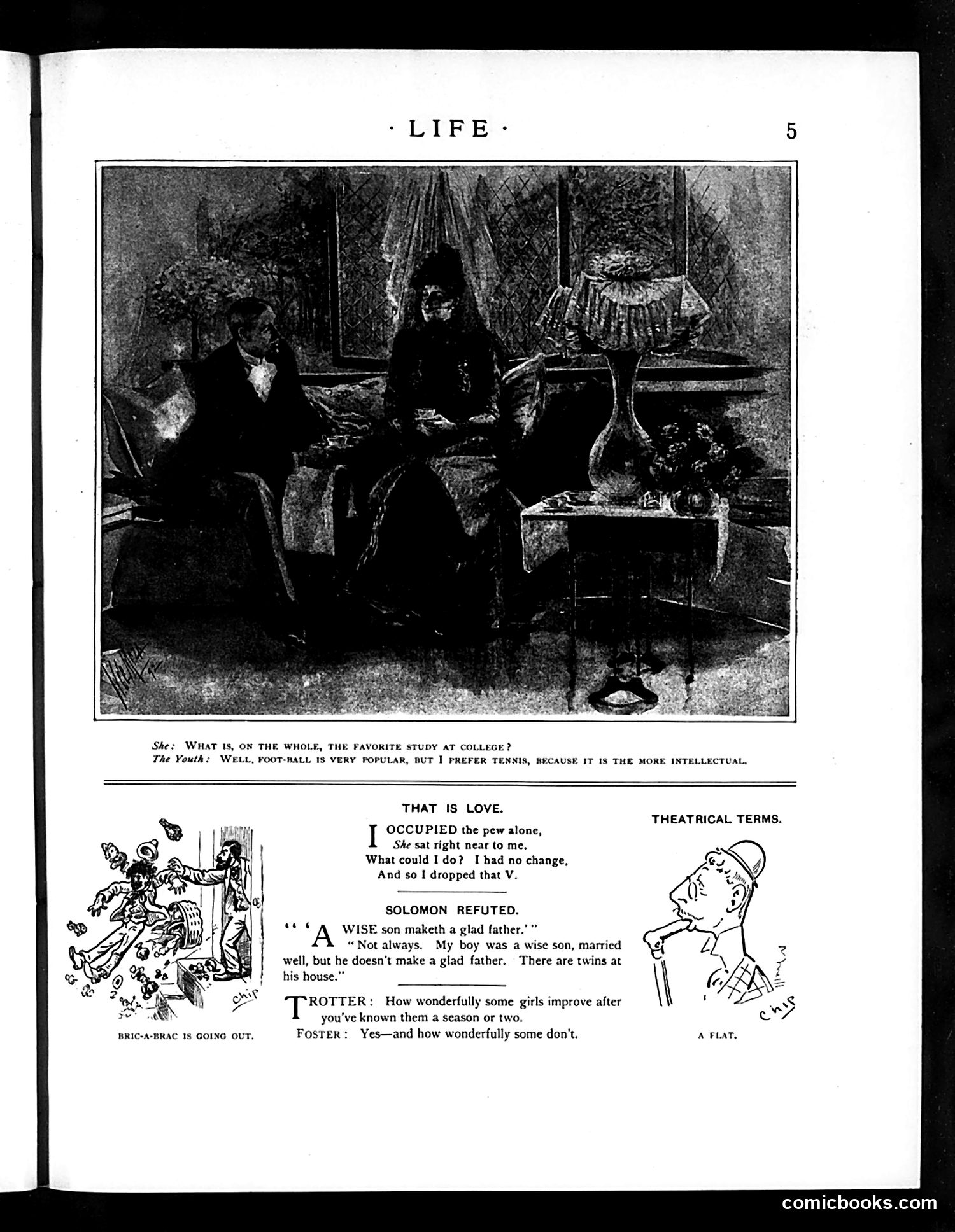
**Main Image:** A photograph showing what appears to be a college social scene with young people in formal dress discussing athletics and intellectual pursuits—the caption humorously presents a youth claiming tennis is "more intellectual" than football. **"That is Love":** A short poem about romantic hesitation, with an illustration labeled "BRIC-A-BRAC IS GOING OUT" showing cherubs in disarray. **"Solomon Refuted":** A brief joke contradicting the proverb "A wise son maketh a glad father," noting that even wise sons can disappoint parents—illustrated with a figure labeled "A FLAT." **"Theatrical Terms":** A short dialogue between characters named Trotter and Foster joking about how some girls improve after knowing them a season, while others don't. The page blends romance, humor about youth behavior, and social commentary typical of early 20th-century satirical magazine content.
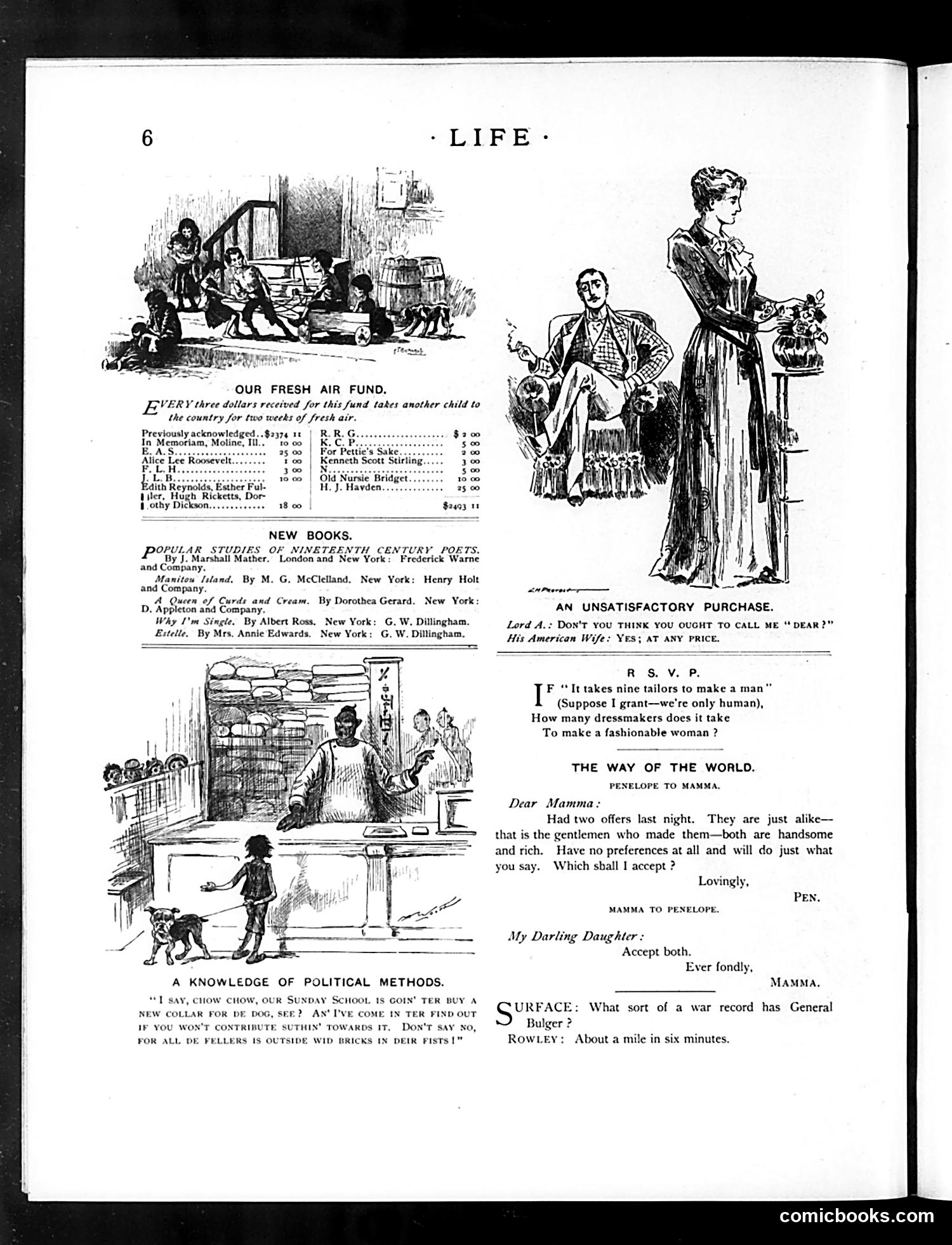
This page contains several satirical pieces typical of early Life magazine humor: **"An Unsatisfactory Purchase"**: A cartoon mocking the phrase "dear" in marriage. The joke plays on a husband calling his wife "dear" only at the price of expensive purchases. **"R.S.V.P."**: A brief verse sardonically commenting on gender and fashion—suggesting it takes nine tailors to make a man, but questions how many it takes to make a fashionable woman, implying women's fashion is unnecessarily complex or frivolous. **"The Way of the World"**: An advice column where "Penelope" seeks guidance choosing between two wealthy suitors. Mamma pragmatically advises accepting both, satirizing materialistic marriage motivations. **"A Knowledge of Political Methods"**: A cartoon depicting a child and dog at a shop window, with dialogue mocking political corruption through the analogy of forced contributions. The page blends domestic satire with social commentary on gender roles and politics.
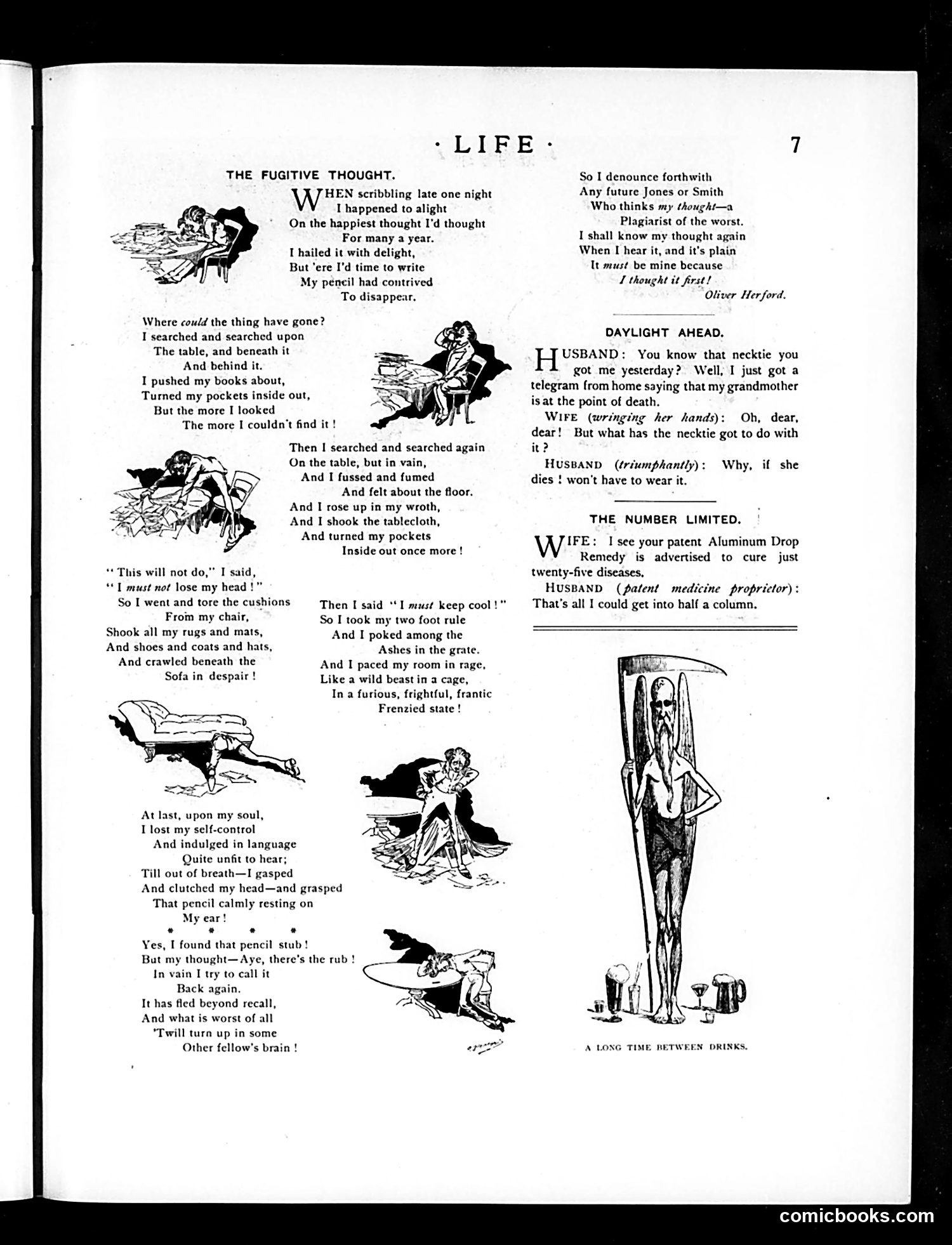
This page contains three separate pieces of humor: **"The Fugitive Thought"** (left): A poem with illustrations depicting a writer's frantic search for a forgotten idea. The humor relies on the relatable experience of losing a brilliant thought before writing it down—showing the author increasingly disheveled while searching through papers, pockets, and furniture. **"Daylight Ahead"** (top right): A brief domestic comedy sketch where a husband callously suggests his dying grandmother won't need her necklace anymore, shocking his wife with his mercenary attitude. **"The Number Limited"** (bottom right): A patent medicine satire where a husband dismisses his wife's advertisement for a cure-all tonic, noting it claims to treat twenty-five diseases—implying such broad claims reveal its fraudulence. The accompanying illustration shows an absurdly tall, skeletal figure labeled "A Long Time Between Drinks."
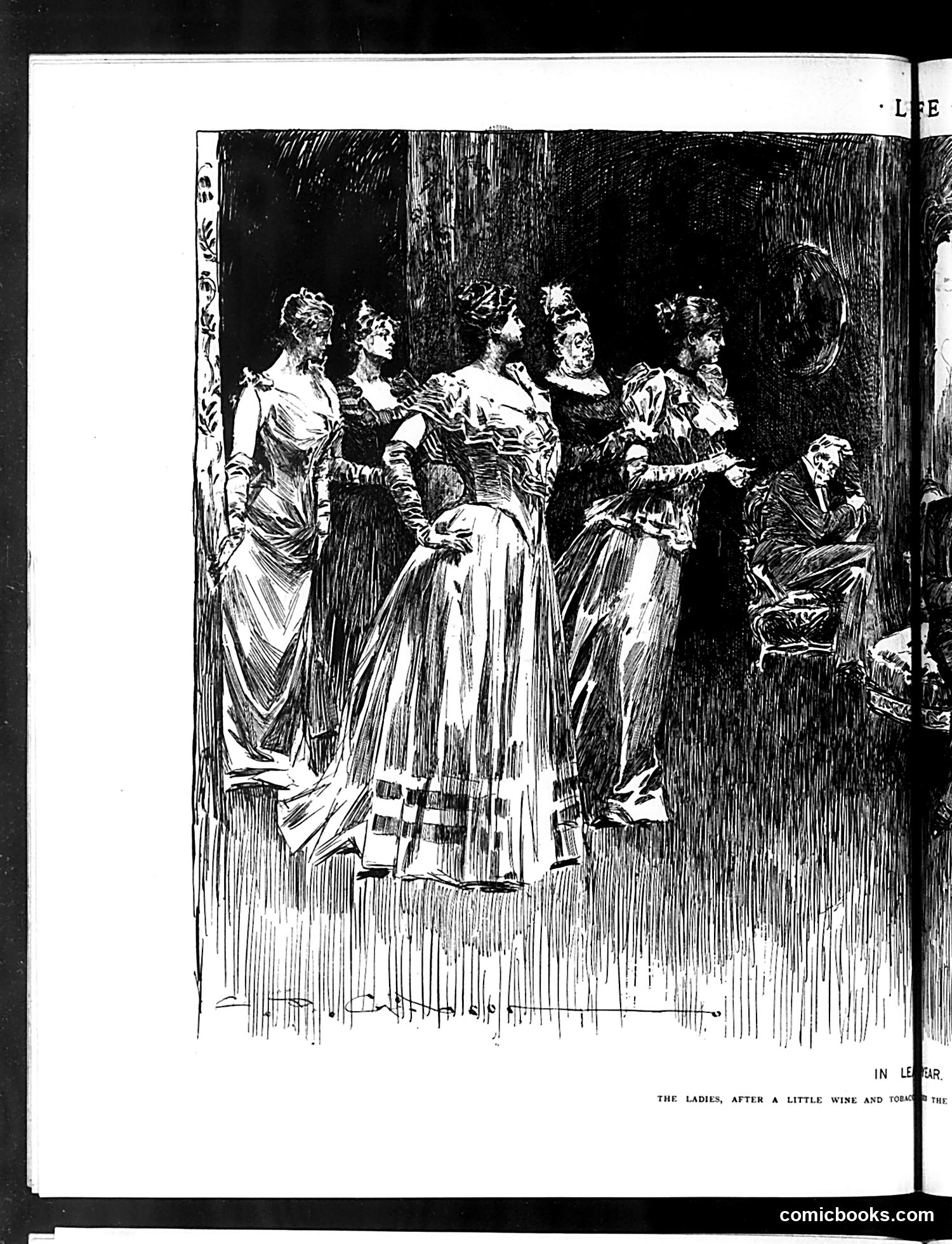
This illustration depicts a social scene satirizing women's behavior and propriety in what appears to be the late 19th or early 20th century. The caption suggests that after consuming wine and tobacco—substances considered improper for "respectable" women of the era—the ladies become rowdy, animated, and lose their composure. The sketch shows multiple women in various states of exaggerated expression and gesture, clustered together in animated conversation. The satire targets Victorian/Edwardian social conventions by implying that genteel femininity is merely a facade easily shed with alcohol and tobacco use. The joke reflects period anxieties about women's propriety and the emerging women's suffrage and independence movements, presenting female behavior outside strict social boundaries as ridiculous or scandalous.
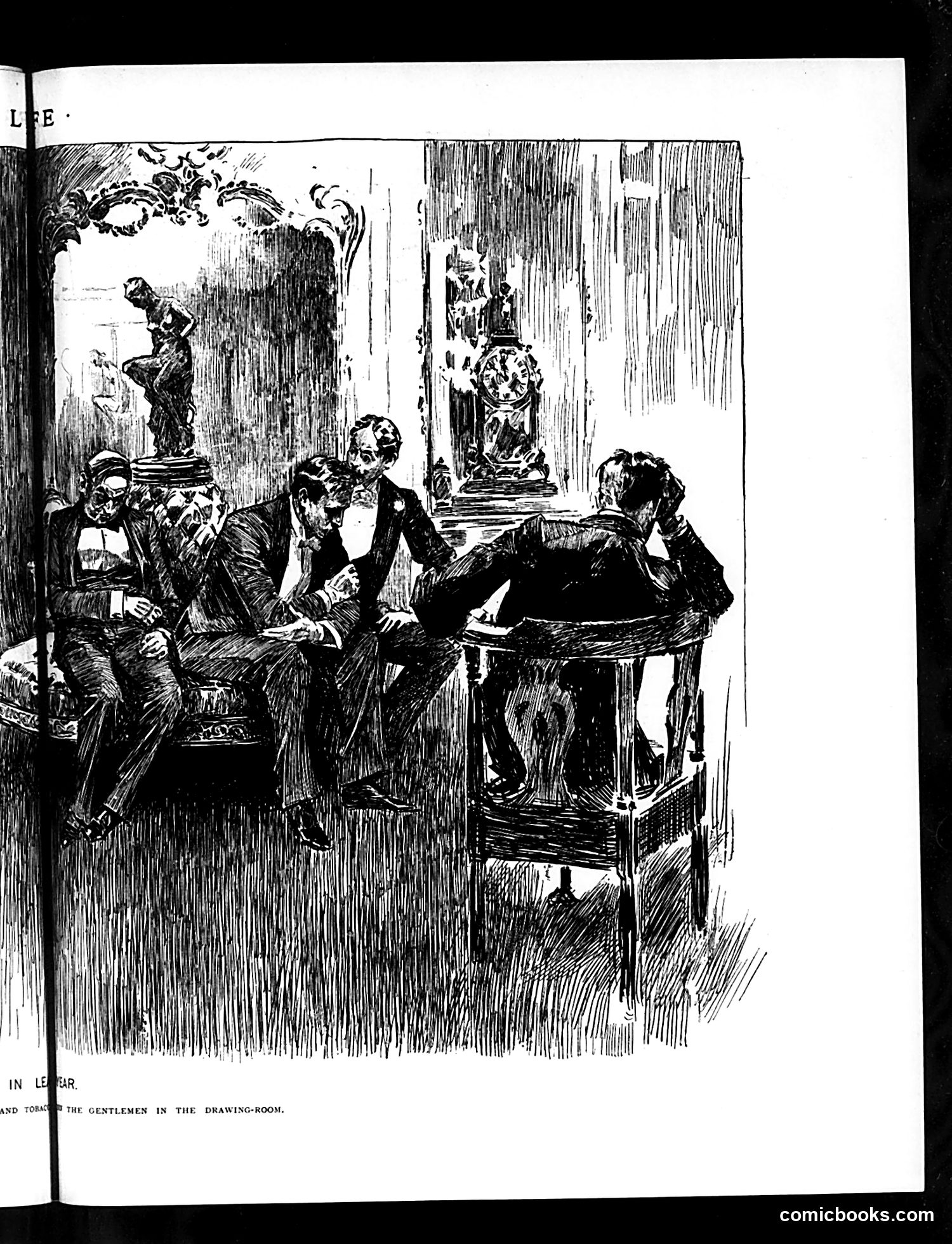
This is a sketch titled "AND TOBACCO IN THE DRAWING-ROOM" depicting gentlemen in a formal Victorian or Edwardian-era drawing room. The satirical point appears to concern the social practice of smoking tobacco indoors among upper-class men in what would typically be a refined domestic space. The cartoon likely mocks either the prevalence of this habit among gentlemen or reactions to it—possibly commenting on how smoking had become so normalized in polite society that it occurred even in drawing rooms (traditionally spaces for refined conversation and socializing). The detailed interior with its ornate furnishings and statuary emphasizes the contrast between the elegant setting and the casual tobacco use depicted. Without additional context from the magazine issue, the specific satirical target remains unclear.
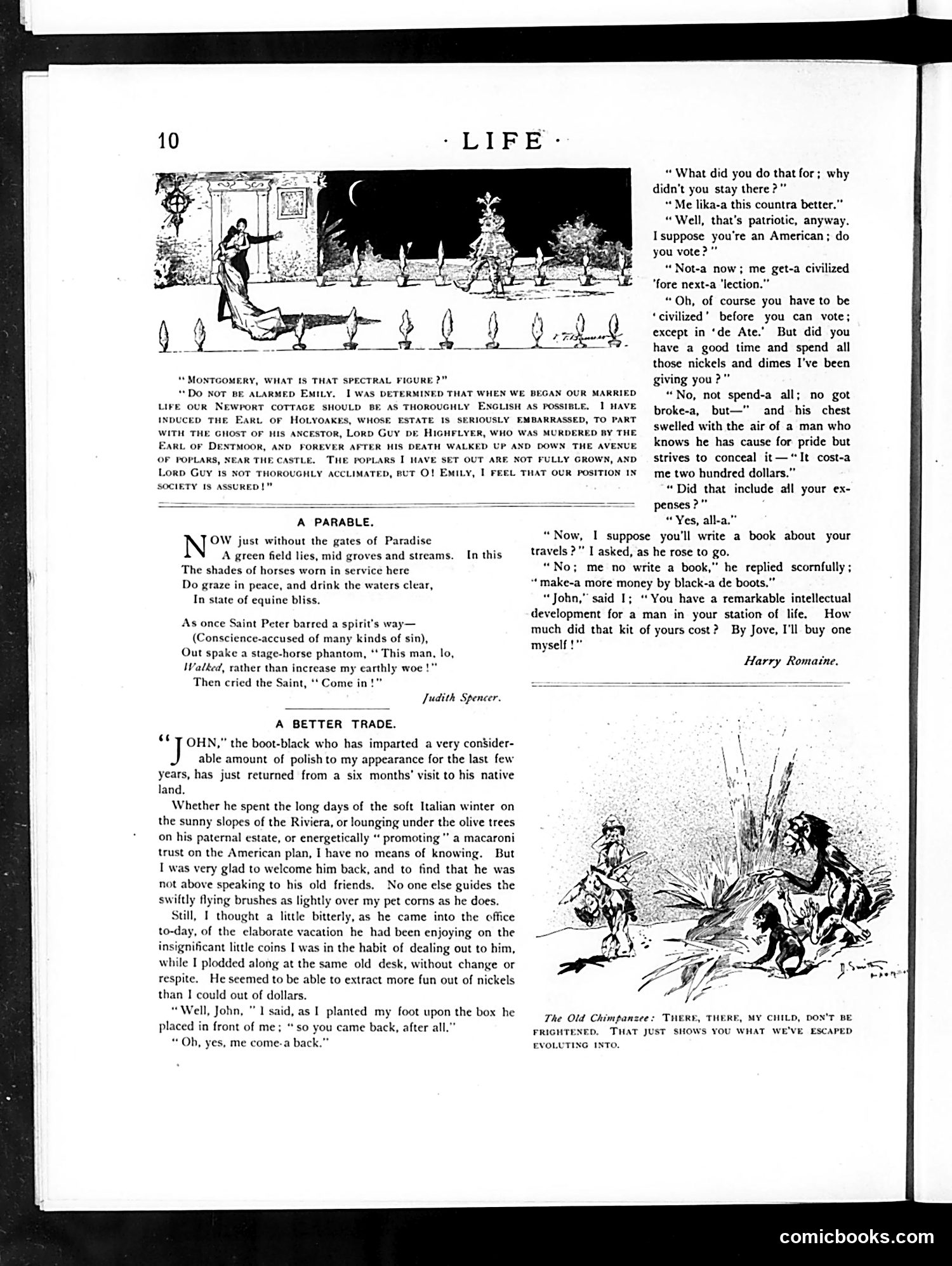
This page contains three satirical pieces targeting early 20th-century American social attitudes: **Top section**: A dialogue mocking an upper-class man who invited a poor ancestor's ghost to his home to establish respectability. The satire criticizes social climbing and pretense. **"A Parable"** (by Judith Spencer): A poem about horses grazing in Paradise, interrupted by a stage-coach phantom demanding higher "earthly woe." The satire appears to critique materialism and discontent with one's station. **"A Better Trade"**: A humorous anecdote about "John," a boot-black recently returned from Italy, who extracted money from the narrator by flattering his "intellectual development." The piece satirizes both the working-class character's cunning and the narrator's vanity—mocking how easily wealthy people's egos make them vulnerable to manipulation. The overall theme targets class pretensions and self-deception.
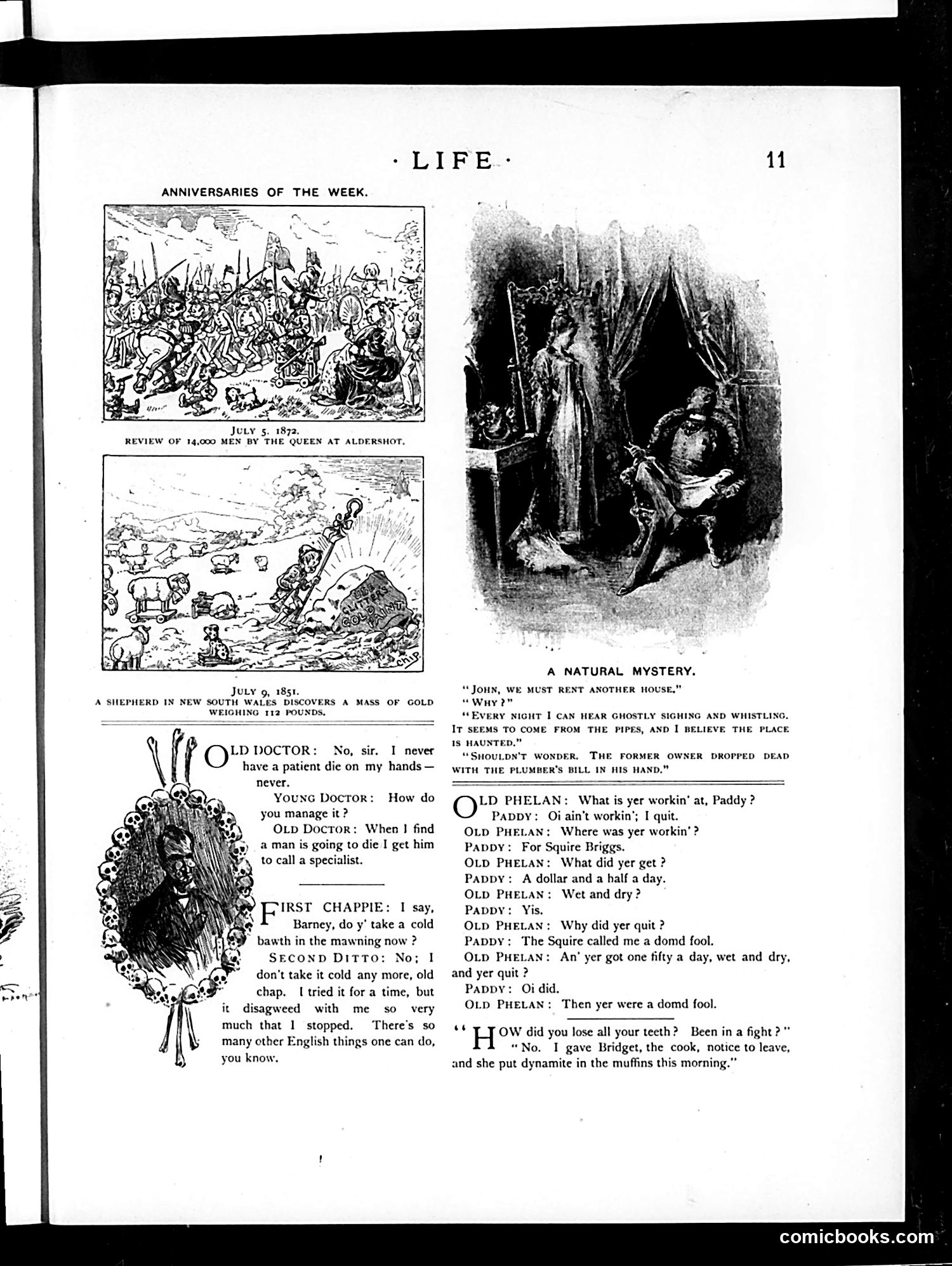
This page from Life magazine contains several distinct humor pieces: **Top section:** Two historical engravings commemorate anniversaries—a July 5, 1872 military review and a July 9, 1851 gold discovery in New South Wales. **Center right:** "A Natural Mystery" depicts a haunted house scenario, with dialogue suggesting supernatural occurrences (piping sounds, whistling) that the previous owner left unexplained, likely a plumber's unpaid bill. **Left side:** Two brief comedic dialogues—one between an Old Doctor and Young Doctor about managing dying patients, and another between First and Second Ditto characters debating whether cold baths are beneficial English custom. **Bottom right:** "Old Phelan" interrogates "Paddy" about his employment and a missing worker ("Squire Briggs"), culminating in a dark joke about dynamite in muffins—likely referencing 1880s Irish dynamite campaign violence.
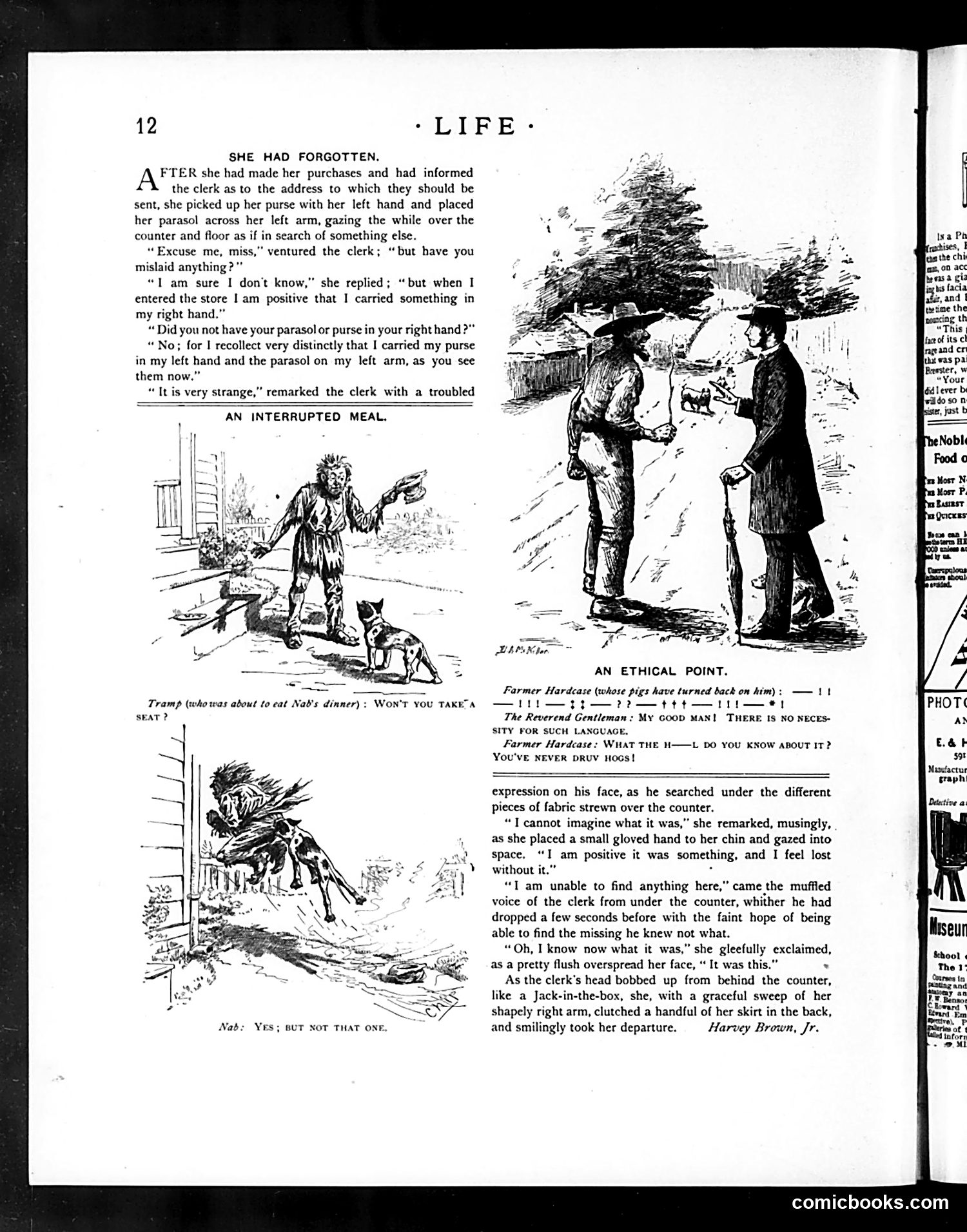
This page contains three satirical comic vignettes from early 20th-century Life magazine: **"She Had Forgotten"**: A scatterbrained woman searches for a missing item she carried into a store, insisting it wasn't her purse or parasol (which she's holding). The punchline: she'd forgotten she was holding her own skirt. The humor targets absent-minded femininity and women's fashion (the voluminous skirts requiring manual adjustment). **"An Interrupted Meal"**: A tramp about to eat a farmer's pig dinner is interrupted by a reverend gentleman objecting to the tramp's profanity. The farmer responds that the clergyman has no right to lecture about language—he's "never druv hogs," meaning he doesn't understand the frustrations of farm work. The satire mocks clergy as out-of-touch moralizers ignorant of working-class hardship. **"An Ethical Point"**: (illustrated below) Shows the same scene, emphasizing the social hypocrisy: the reverend judges the desperate man's language while ignoring his hunger. These cartoons reflect period attitudes about class, gender, and religious authority.
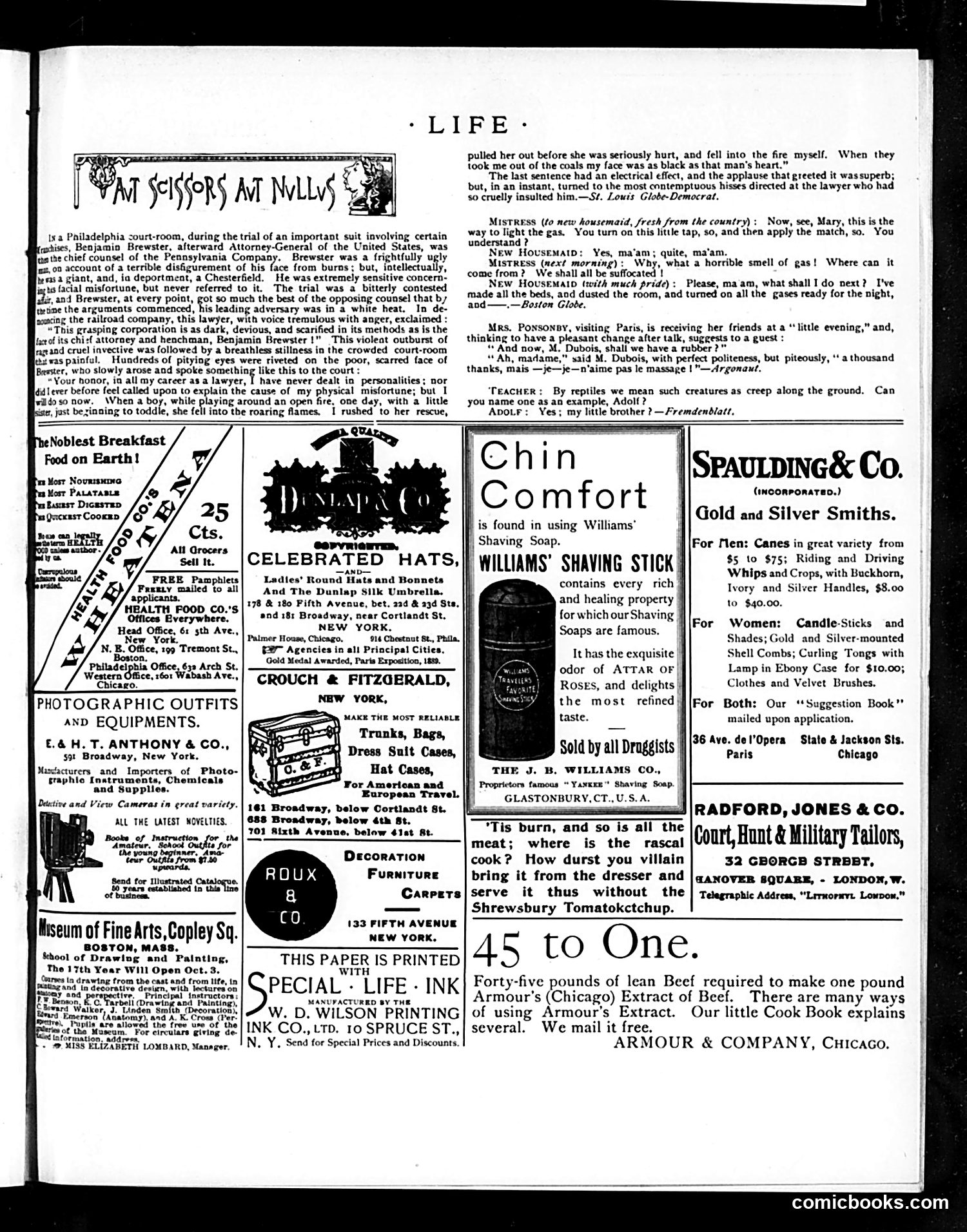
This page primarily contains **humorous anecdotes and advertisements** rather than political cartoons. The main story recounts Benjamin Brewster (who later became U.S. Attorney General) in a Philadelphia courtroom trial. An opposing lawyer cruelly insults Brewster's scarred face. Brewster responds with a devastating comeback: he reveals the scars came from rescuing his sister from a fire as a boy, then delivers the punchline that the lawyer's heart is "as black as that man's face." The anecdote celebrates wit triumphing over cruelty—a common Victorian theme of moral comeuppance. Below are three brief humorous pieces: a housemaid misunderstanding gas-lamp instructions, a Frenchman misinterpreting "rubber" (card game) as massage, and a child calling his brother a "reptile" (something that crawls). The advertisements promote shaving products, furniture, photographic equipment, and other period goods. No significant political content is present on this page.
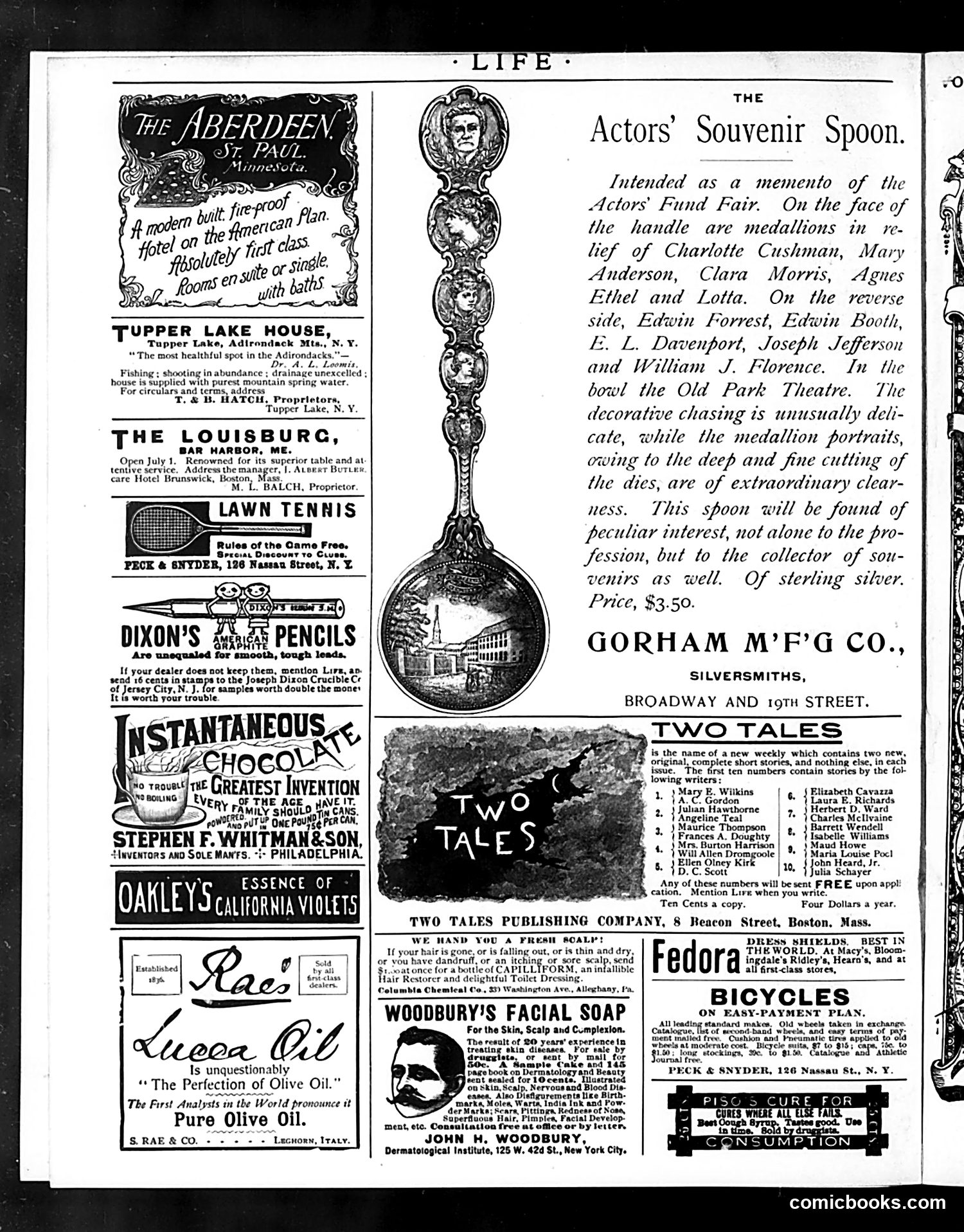
This page is primarily **advertising**, typical of late 19th-century American magazines. The content is a collection of commercial notices with minimal satirical content. The one noteworthy item is the **"Actors' Souvenir Spoon"** advertisement—a sterling silver commemorative spoon from the Gorham Manufacturing Company. It features relief medallions of famous actors including Charlotte Cushman, Edwin Forrest, Edwin Booth, Joseph Jefferson, and others. The spoon commemorates the **Actors Fund Fair**, a benefit event for the theatrical profession. It cost $3.50 and appeals both to theatre professionals and collectors of souvenir silverware. Other ads include hotel promotions, pencils, chocolate, olive oil, lawn tennis equipment, facial soap, bicycles, and a new weekly magazine called *Two Tales* featuring short stories. There are no political cartoons or satirical illustrations on this page—it reflects the advertising-heavy format common in Life magazine of this period.