
A complete issue · 14 pages · 1891
Life — August 13, 1891
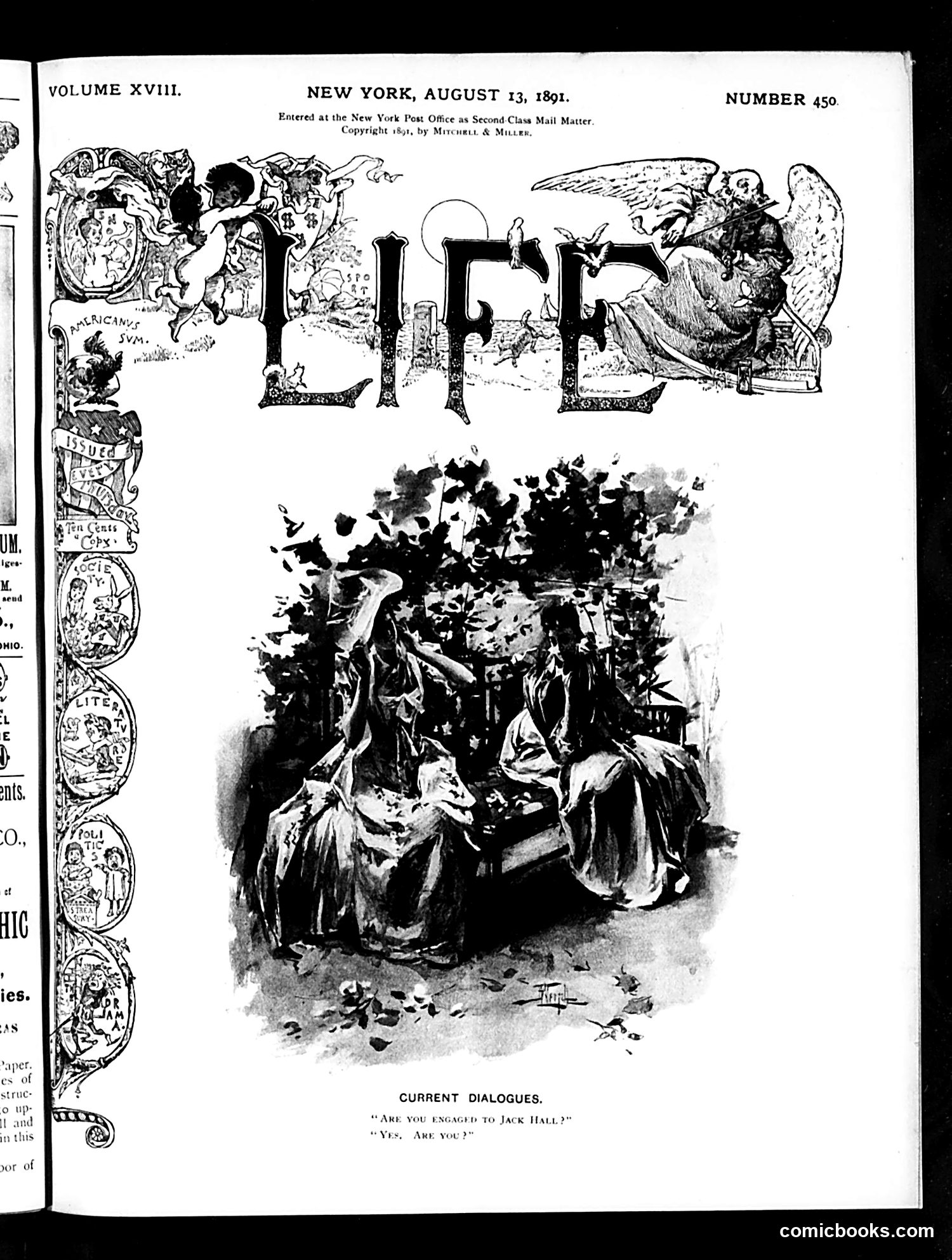
This page features a satirical illustration titled "Current Dialogues" with the caption: "Are you engaged to Jack Hall?" / "Yes, are you?" The image depicts multiple women gathered around what appears to be a bonfire or burning pile, rendered in dark, dramatic sketch style. The joke relies on a contemporary social scandal or gossip involving a man named Jack Hall who apparently has multiple simultaneous engagements to different women—a satirical commentary on infidelity or romantic deception. The elaborate decorative border on the left margin (common to Life's design) contains small illustrated vignettes typical of the magazine's ornamental style. Without additional context about Jack Hall's specific identity, the cartoon's primary humor targets the absurdity of one man maintaining multiple secret engagements and the women discovering each other's existence.
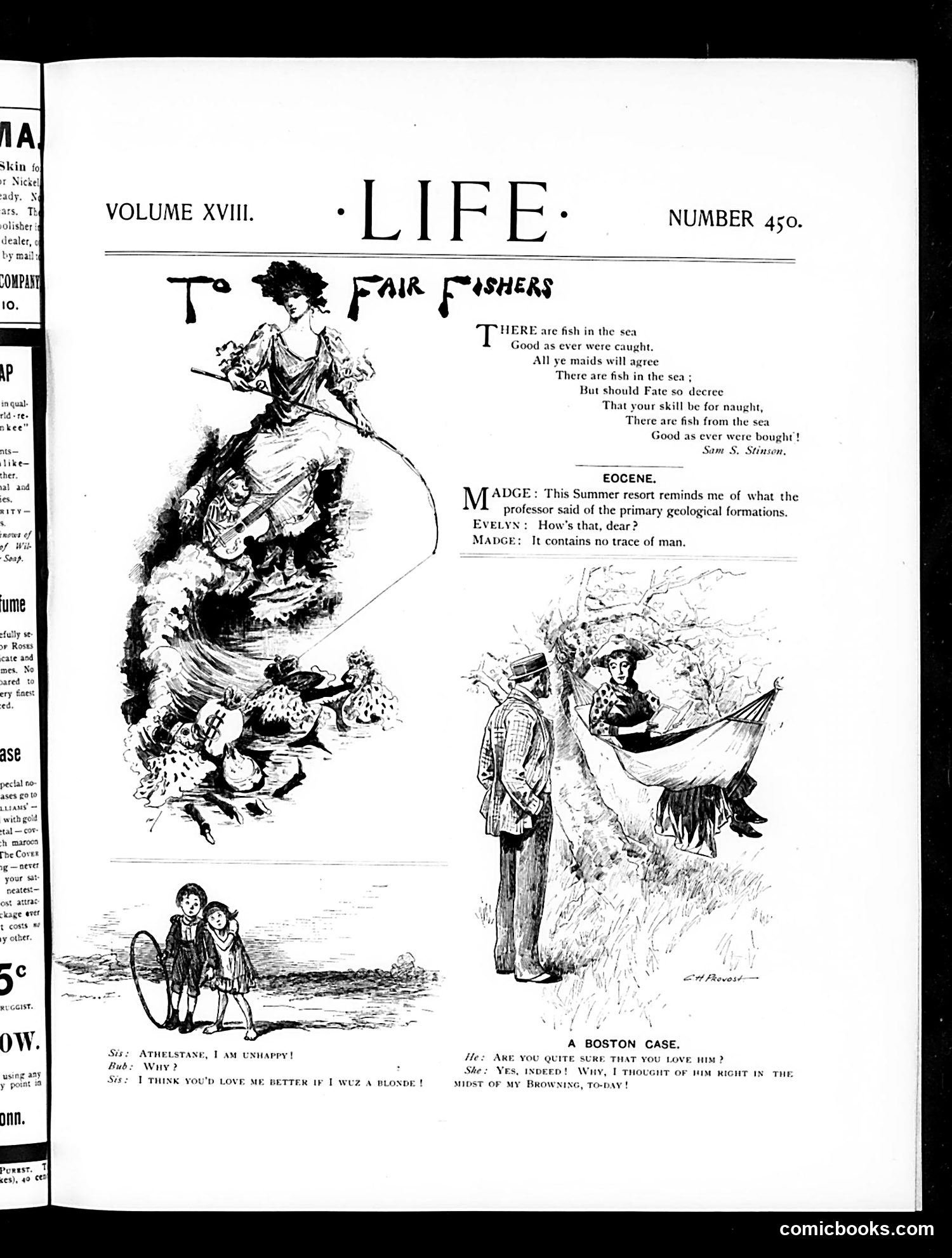
This page contains three separate comic vignettes about romance and courtship, typical of Life's satirical humor of this era. **"To Fair Fishers"** features a woman with fishing equipment, accompanying a poem about catching fish—a metaphor for romantic conquest. **"Eocene"** is a brief dialogue between characters named Madge and Evelyn discussing a summer resort, with a geological/scientific joke about the Eocene epoch containing "no trace of man." **"A Boston Case"** shows a couple's domestic disagreement: the husband asks if she's sure of his fidelity; the wife responds she thought of him "in the midst of my browsing, to-day!"—a humorous dig at inattentive husbands during leisure time. The cartoons mock courtship conventions and marital dynamics of the early 1900s through romantic and domestic humor.
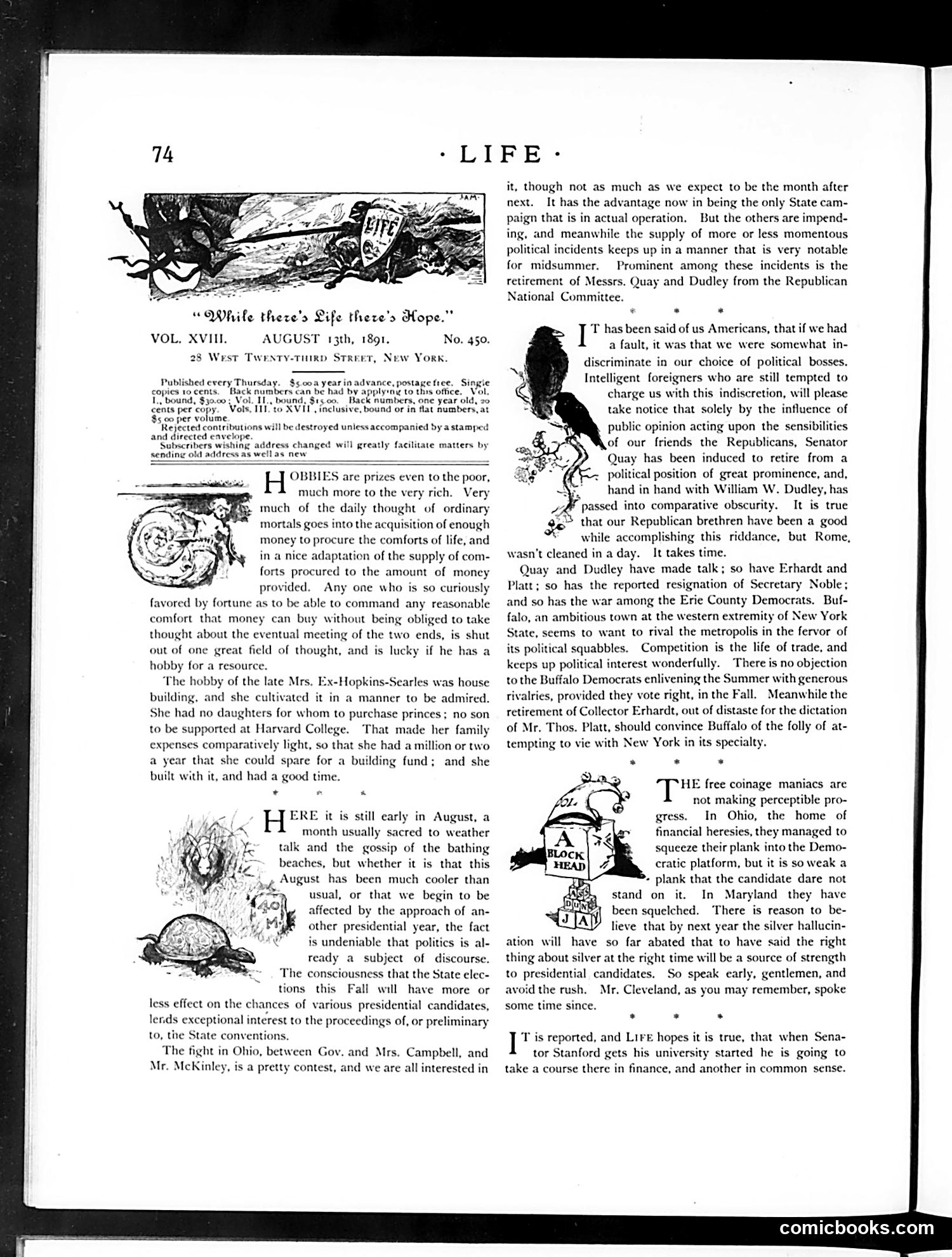
The page contains editorial commentary on 1891 American politics rather than discrete cartoons. The text discusses Republican political setbacks, specifically mentioning the retirement of Senator Quay and William W. Dudley from prominent positions, which the author frames as damage to Republican standing. The small decorative illustrations (a turtle, a raven, a child) appear to be generic ornamental elements rather than political cartoons with specific targets. The main political points target: Democratic gains in various states, the "free coinage" silver debate affecting candidates, and criticism of Republican leadership for poor candidate selection. The tone suggests Republicans facing electoral headwinds entering the 1892 campaign. The page is primarily text-based political commentary rather than visual satire.
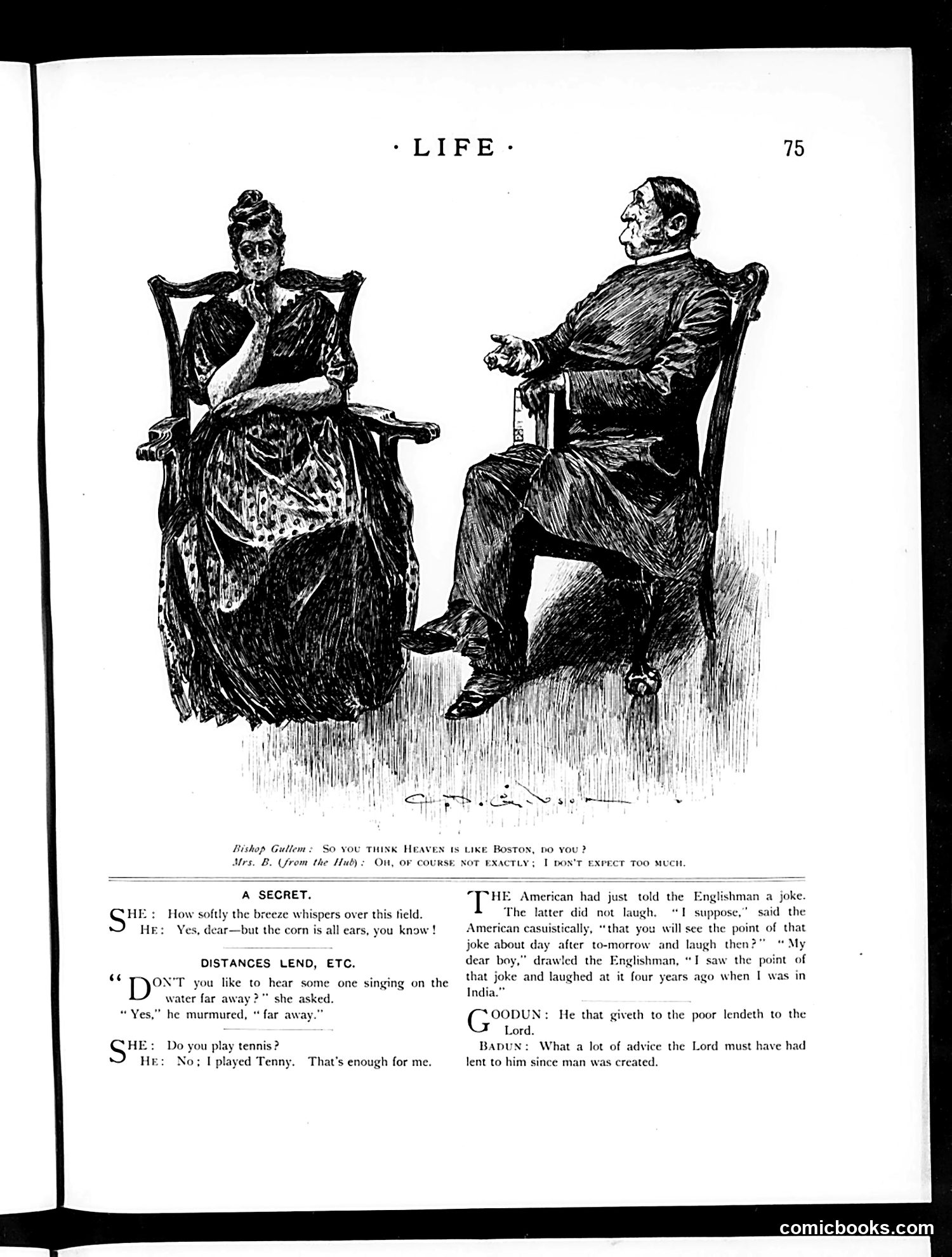
This page contains three separate satirical pieces typical of early 20th-century Life magazine humor: 1. **Top cartoon**: Shows a bishop and woman in conversation. The caption identifies "Bishop Galleon" asking if Heaven is "like Boston." The woman's reply about corn being "all ears" is a visual pun. 2. **Middle sections** ("A Secret," "Distances Lend, Etc."): Brief comedic dialogues about domestic life—a couple discussing field whispers, singing, and tennis. These are gentle marital humor, not political satire. 3. **Bottom section**: Mentions "the American" and "the Englishman" discussing a joke about India, likely satirizing Anglo-American relations or British colonial attitudes circa the early 1900s. The overall tone is lighthearted social commentary rather than hard political satire.
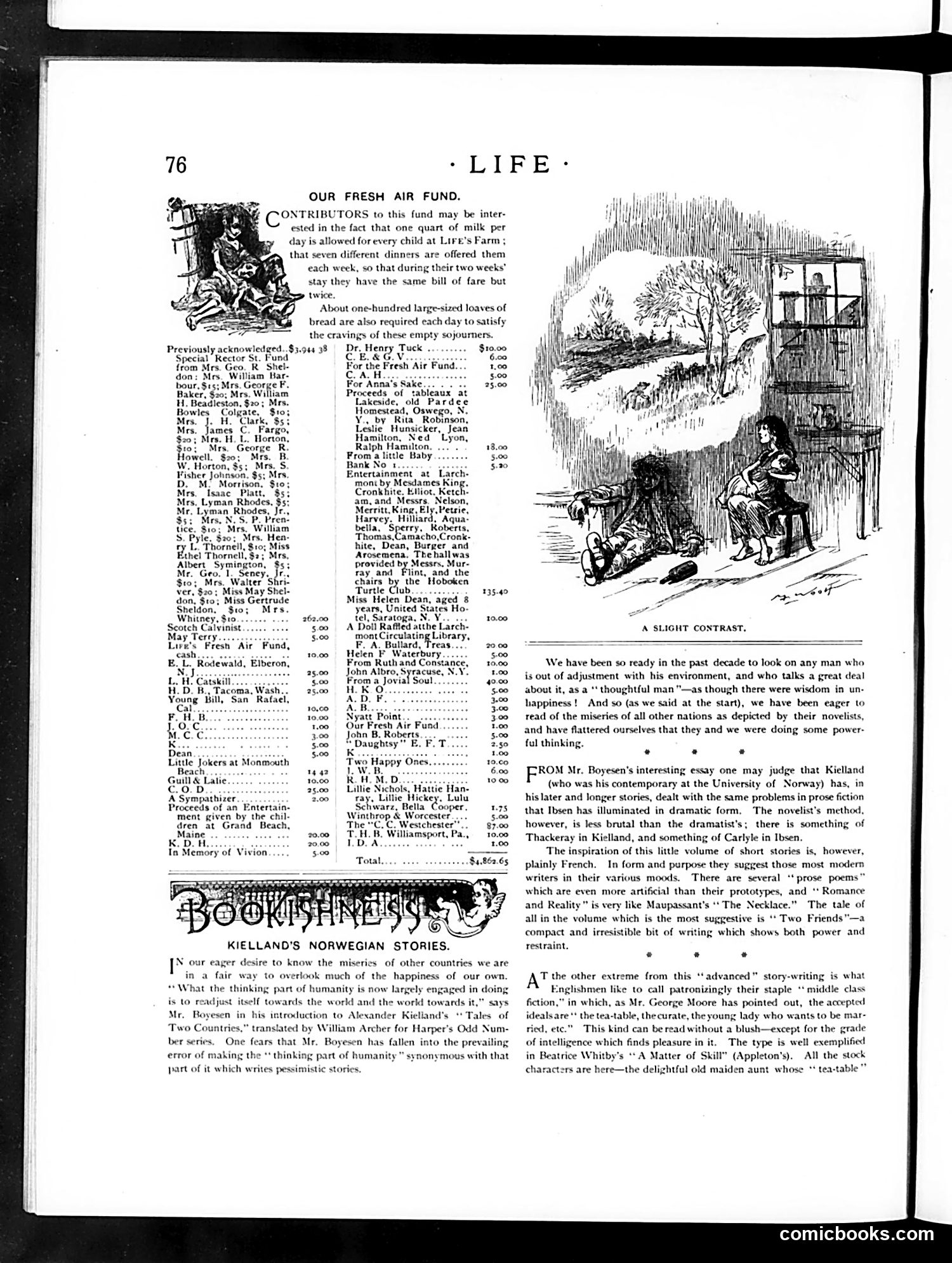
This page contains two main elements: a charitable fundraising list ("Our Fresh Air Fund") and a literary essay titled "A Slight Contrast." The **cartoon illustration** (titled "A Slight Contrast") depicts an interaction between what appears to be a wealthy person in formal dress and working-class children in an urban setting. The image illustrates the essay's theme about social inequality and the divide between those comfortable in their environment and those displaced or struggling within it. The accompanying essay discusses Kielland's Norwegian stories, contrasting "advanced" literary realism (which Mr. Boyesen praises for depicting ordinary life) with more conventional "middle class fiction." The piece critiques sentimentalized portrayals of social issues, advocating instead for honest artistic treatment of human misery and environmental displacement—the very contrast the cartoon visually represents.
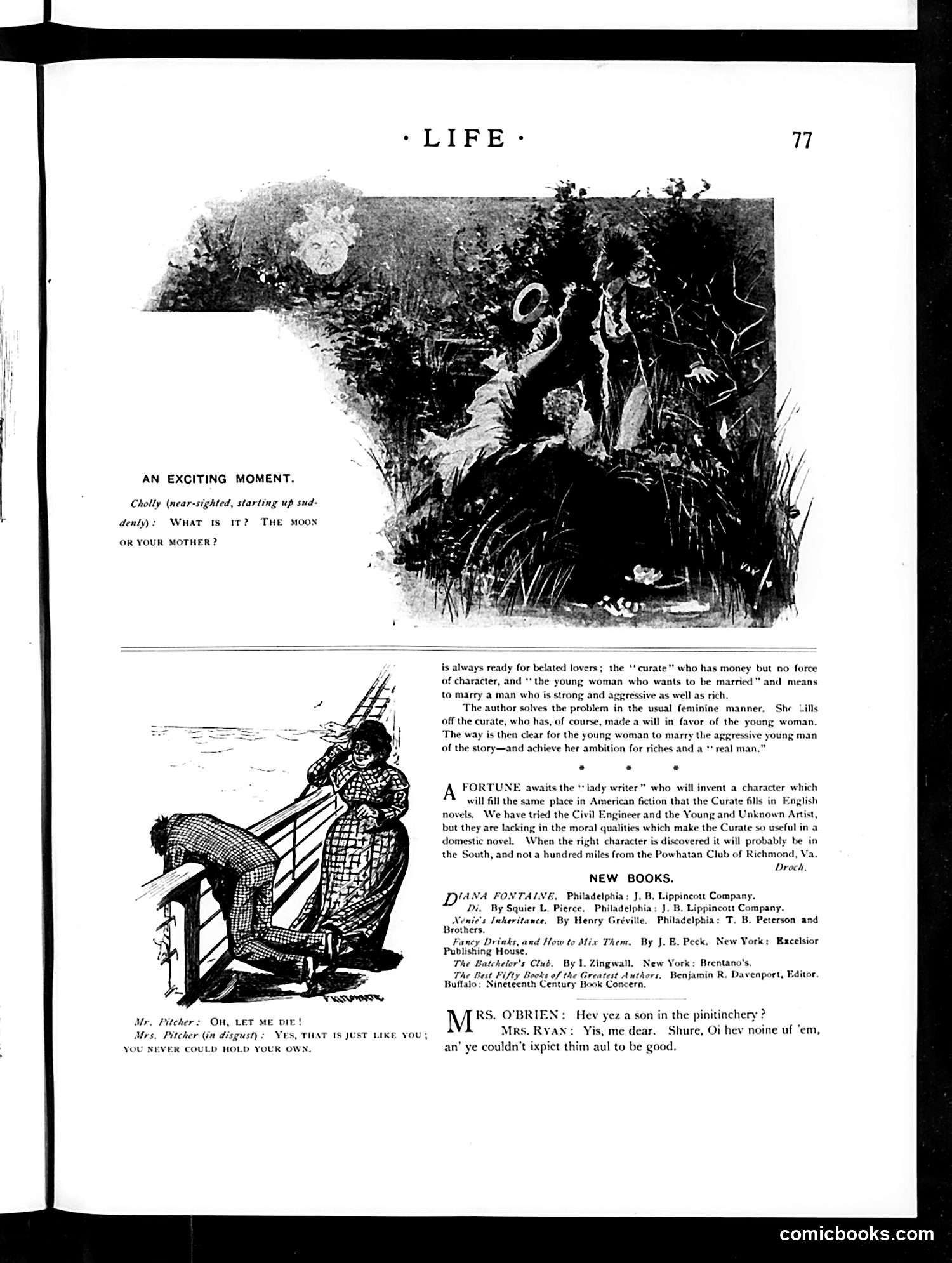
This page contains two distinct illustrations separated by text discussing literary criticism. **Top illustration**: Titled "An Exciting Moment," it depicts a woman (Cholly, described as "near-sighted") looking upward, asking "What is it? The moon or your mother?" The scene appears set in natural surroundings with figures in the background. The joke plays on mistaken identity and poor vision for comedic effect. **Bottom illustration**: Shows a sailor on a ship's rigging. The accompanying dialogue between "Mr. Fletcher" and "Mrs. Fletcher" uses Irish dialect ("Hey yez a son in the pinitenchery?"), making an ethnic-based joke about criminality and poor family circumstances. The page's main text discusses American fiction and literary character development, unrelated to the cartoons' humor.
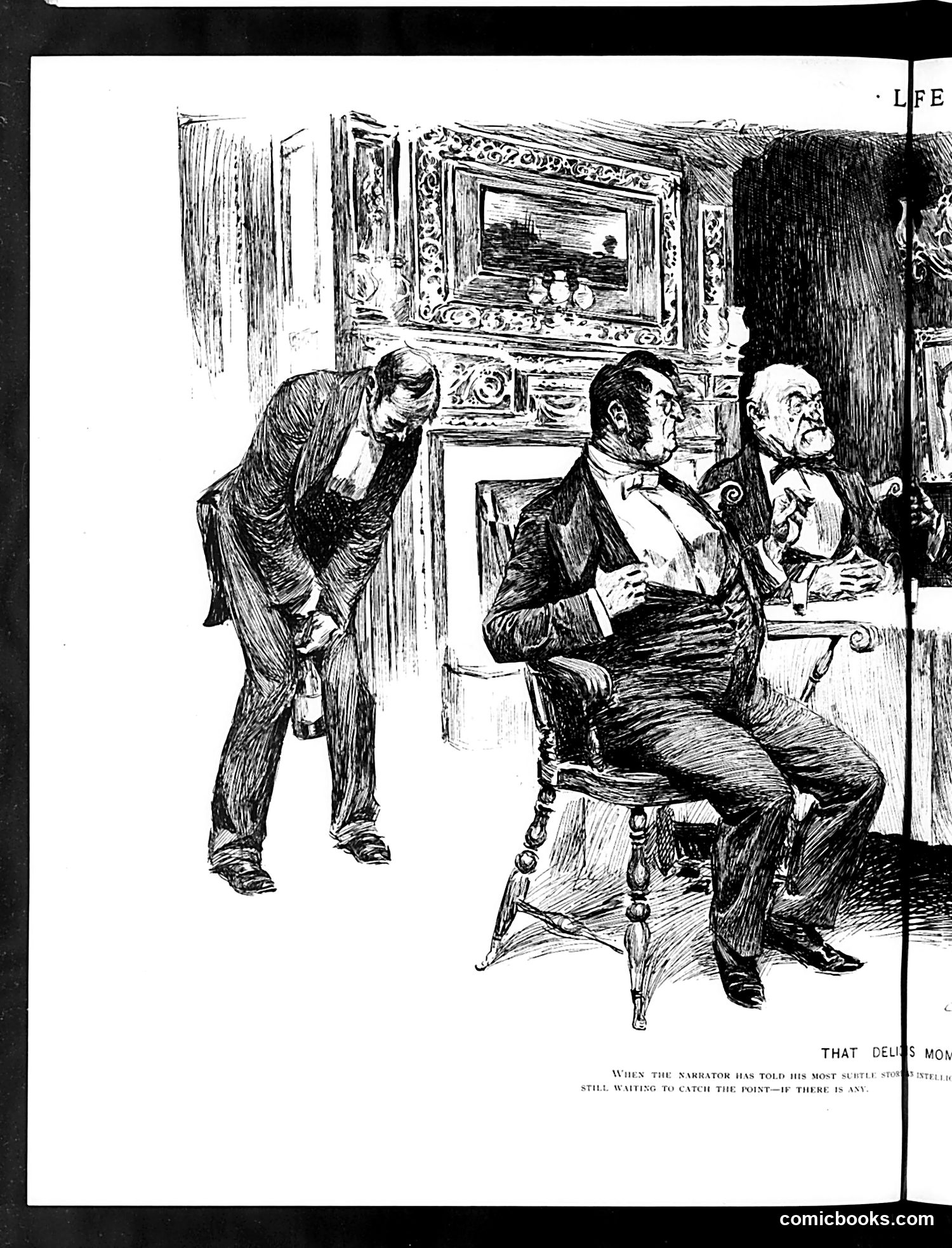
This is a satirical illustration depicting a social scene in an ornate interior, likely from a gentlemen's club or drawing room. The caption indicates a narrative moment: "When the narrator has told his most subtle story still waiting to catch the point—if there is any." The satire targets a common social experience—someone telling a lengthy, supposedly clever anecdote that the audience fails to understand or find amusing. The three seated men display varying reactions: skepticism, confusion, or polite tolerance. The standing figure on the left bends forward awkwardly, perhaps awaiting laughter that never comes. The joke critiques verbose storytelling and the gap between a speaker's confidence in their wit and actual audience reception. It's social commentary on pretension and the awkwardness of failed humor in formal settings.
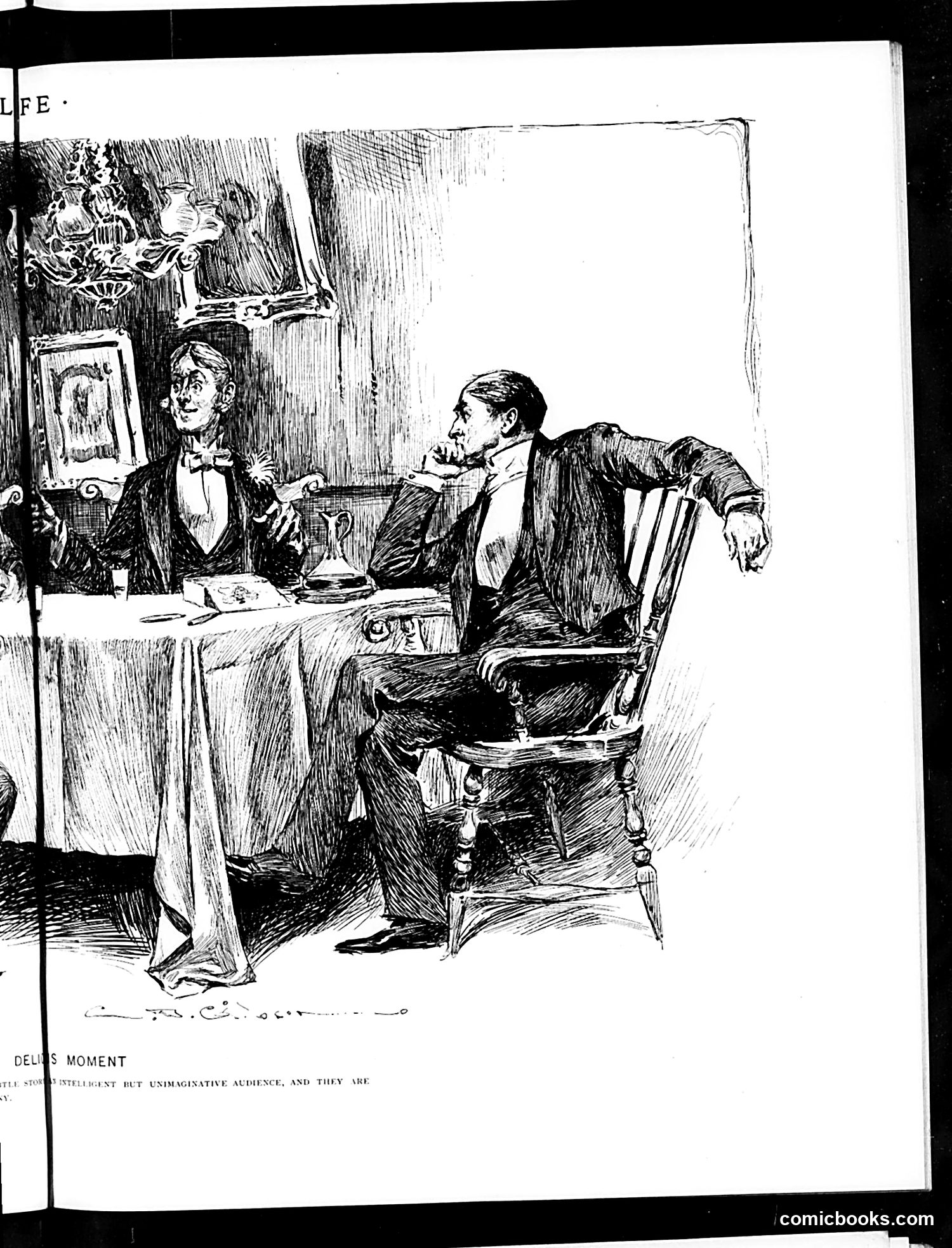
This appears to be a satirical illustration titled "Deulis Moment" (or similar—OCR unclear). The caption references figures described as "intelligent but unimaginative audience." The scene depicts two well-dressed men in formal attire at what appears to be an elegant dinner or social gathering. One man is seated while another stands or reclines nearby. The setting includes a white tablecloth, period furnishings, and decorative wall elements suggesting an upscale venue. The satire likely critiques the social pretensions or intellectual pretense of upper-class society—mocking either the audience members' lack of genuine sophistication despite their appearance, or perhaps the superficiality of their social interactions. However, without the complete caption text, the specific target of the satire remains unclear.
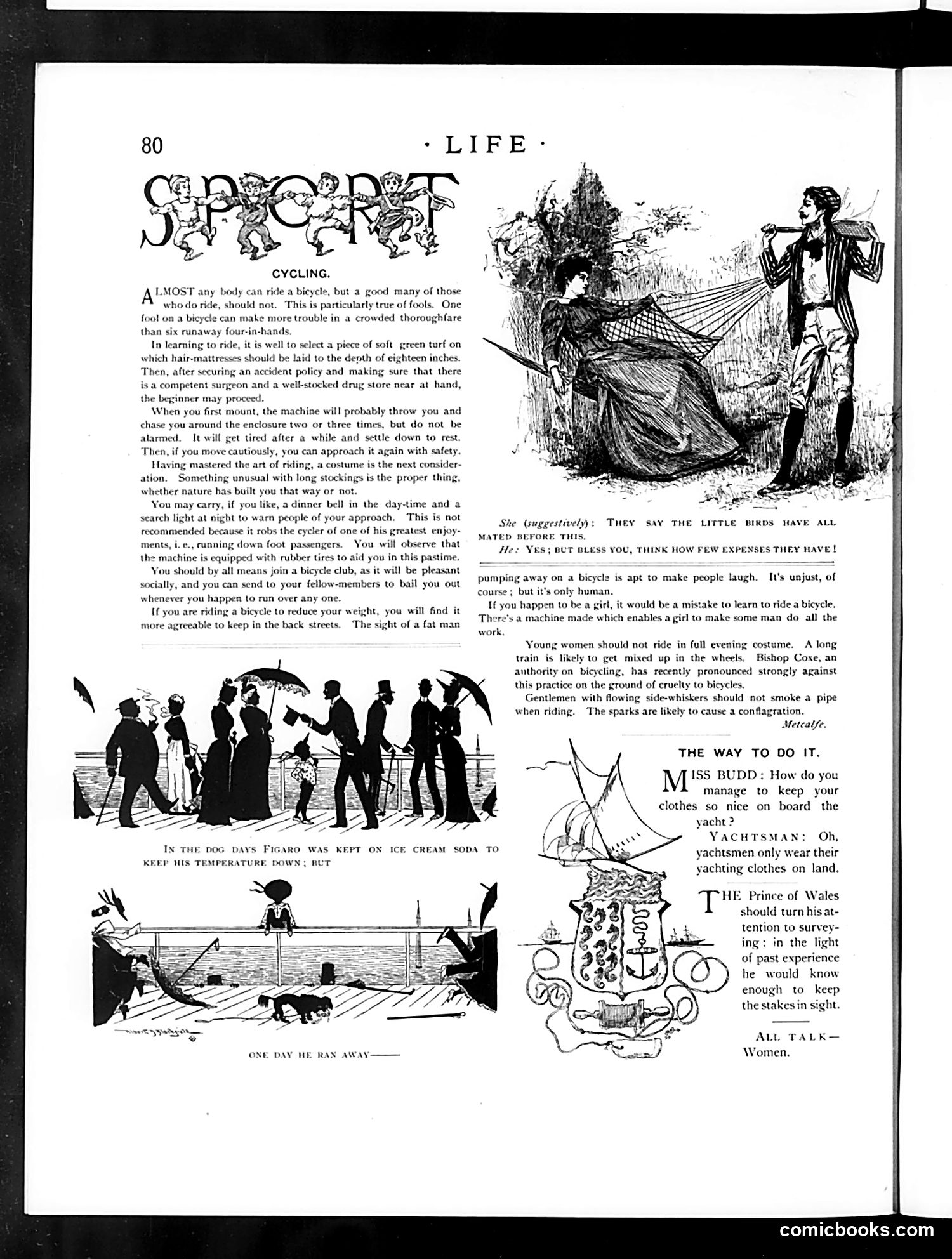
This page satirizes bicycle culture and etiquette during the late 19th-century cycling boom. The main article "SPORT: CYCLING" offers practical advice for beginners while mocking novice riders' clumsiness and fashion choices. The cartoons illustrate common cycling mishaps: one shows a crowded scene with umbrellas (suggesting cyclists colliding with pedestrians), another depicts someone who "ran away" (likely after an accident). The dialogue mocks gender conventions—a woman asks about keeping clothes clean on a yacht, but the male response suggests women shouldn't ride bicycles in full evening dress. There's also commentary about the "indecorous" practice of riding and the Prince of Wales' attention to yachting (a leisure pursuit). The humor targets both the absurdity of early cyclists' accidents and Victorian attitudes about propriety and gender-appropriate recreation.
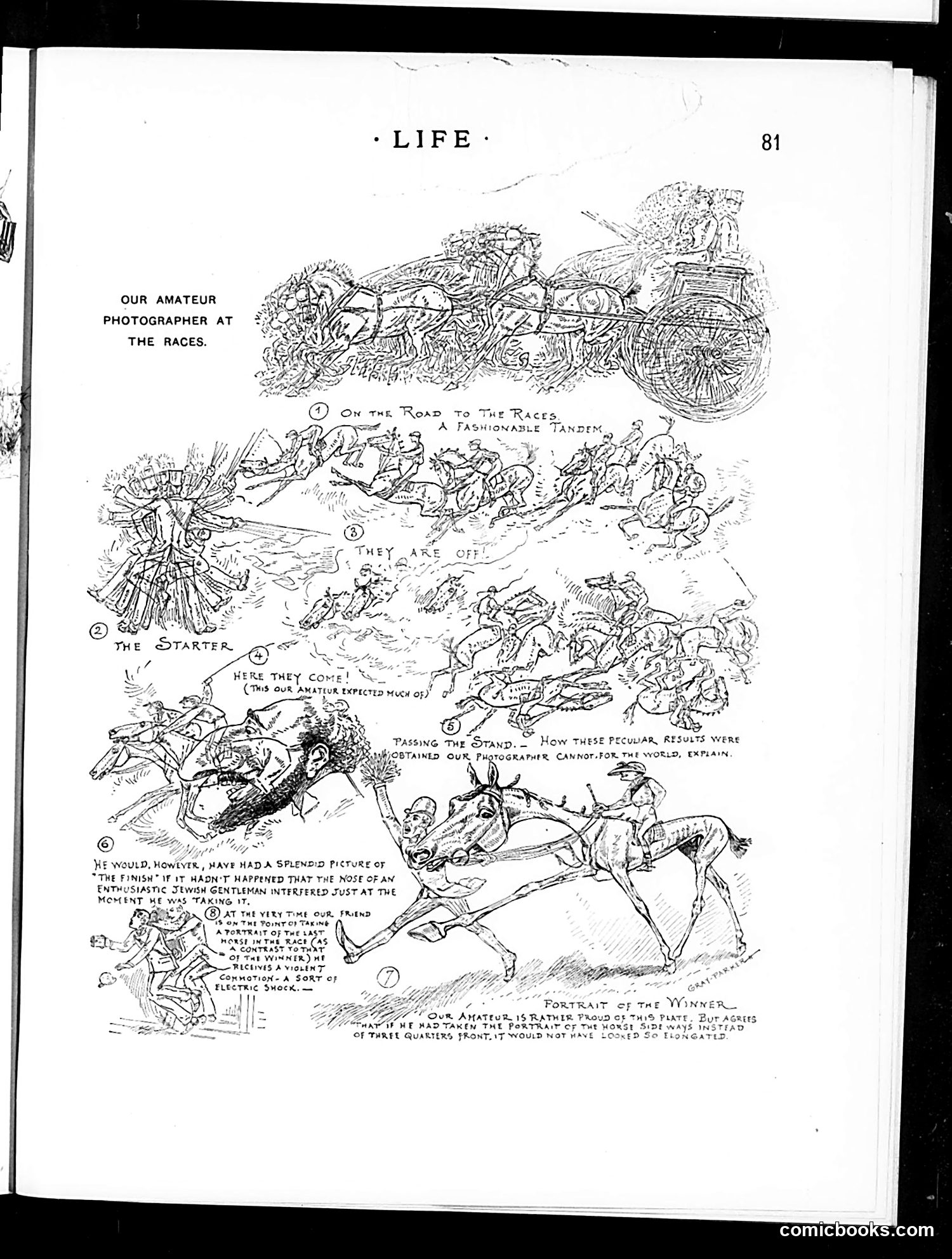
This is a humorous illustrated sequence showing a amateur photographer's misadventures at a horse race event. The numbered panels follow the photographer from preparation through disaster: 1. A fashionable tandem (two-seater carriage) heads to the races 2. "The Starter" begins the race 3. Horses are off 4. The photographer attempts to capture action shots 5. Results from passing the stand show chaotic photography 6. A near-miss moment where an enthusiastic spectator nearly ruins the shot 7. The final panel shows the photographer knocked down by a horse, with a caption noting his portrait efforts would have been ruined anyway The satire mocks amateur photographers' ambitions and the chaos of attempting action photography at sporting events.
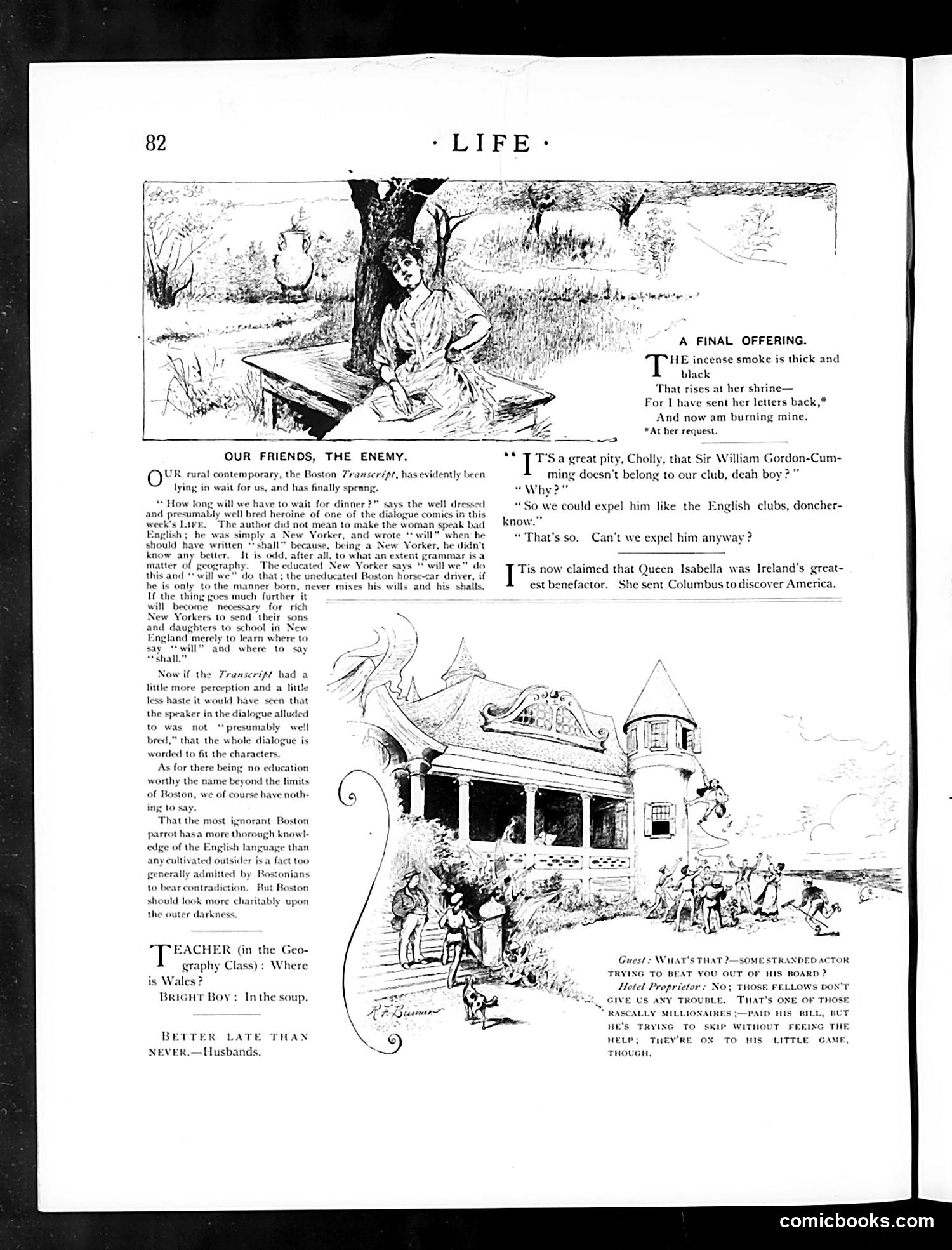
This page contains multiple unrelated satirical pieces typical of Life magazine's format: **"Our Friends, the Enemy"** mocks Boston's *Transcript* newspaper for criticizing a Life comic's grammar ("will" vs. "shall"). The piece argues the speaker's poor grammar was intentional—fitting her character—and defends New York speech patterns while sarcastically suggesting Boston considers itself the arbiter of proper English. **Geography joke**: A student answers "Where is Wales?" with "In the soup"—a pun on "Wales" sounding like "whales," likely served in soup. **Gordon-Cumming reference**: Appears to reference Sir William Gordon-Cumming, a real British aristocrat involved in a cheating scandal (the 1890s "Baccarat scandal"), making him a social pariah even wealthy clubs wouldn't admit. **Isabella/Columbus quip**: A tongue-in-cheek claim that Queen Isabella was Ireland's greatest benefactor for sponsoring Columbus—absurd since Isabella was Spanish. **Hotel scene**: Contrasts a deadbeat actor trying to avoid paying staff tips against a wealthy "rascally millionaire" who paid his bill but is similarly stingy—satirizing hypocrisy across social classes.
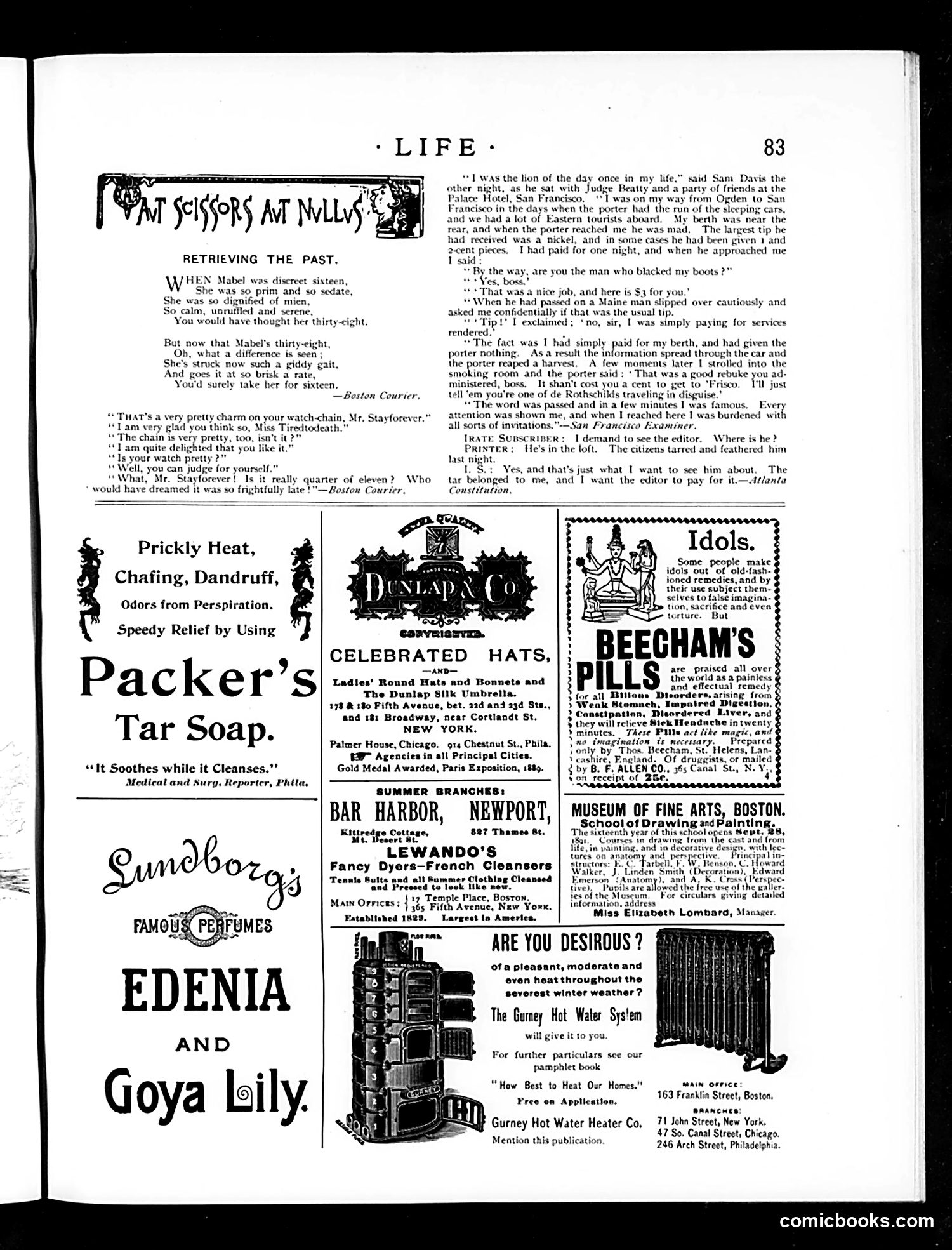
This page is primarily **advertisements and filler content**, typical of Life magazine's format. The main illustrated content is a brief poem titled "Retrieving the Past" about a woman named Mabel who transforms from prim and proper at sixteen to wild and unrestrained at thirty-eight—a gentle satire on aging and changing social behavior. The accompanying anecdote about "Sam Davis" describes a railway porter who receives only small tips until Davis gives him $3, after which the porter spreads word that Davis is a wealthy Rothschild traveling "in disguise." This causes other passengers to shower Davis with attention and invitations. The satire mocks both social climbing and the pretense of wealth—how quickly people's behavior changes based on perceived status. The remainder of the page consists entirely of period product advertisements (Packer's Tar Soap, Beecham's Pills, Dunlap Hats, etc.), which was standard for Life magazine of this era.
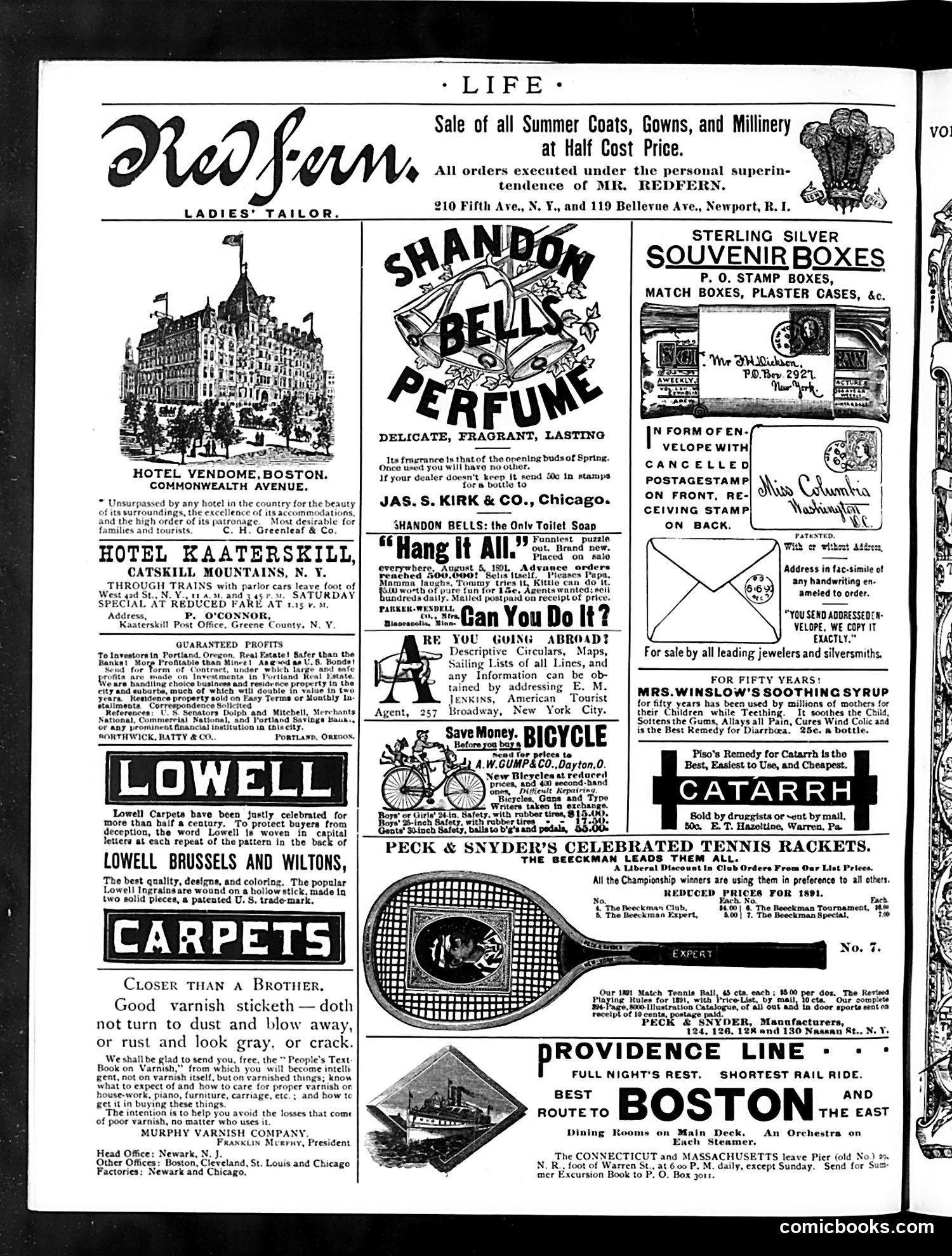
This is primarily an **advertising page**, not a satirical cartoon page. The content consists almost entirely of commercial advertisements from the 1890s, with no discernible political or social satire. Notable ads include: - **Red Fern** (ladies' tailor) - **Shandon Bells perfume** and toilet soap - **Hotels** (Vendome in Boston, Hotel Kaaterskill in Catskills) - **Lowell Carpets** (emphasizing trademark authenticity) - **Peck & Snyder's tennis rackets** (claiming championship use) - **Mrs. Winslow's Soothing Syrup** (a patent medicine for teething children) - **Bicycles** and various other merchandise The only visual humor appears to be small product illustrations. This page reflects late-19th-century American consumer culture and advertising practices, where *Life* magazine subsidized satirical content through extensive paid advertisements.