
A complete issue · 16 pages · 1891
Life — July 16, 1891
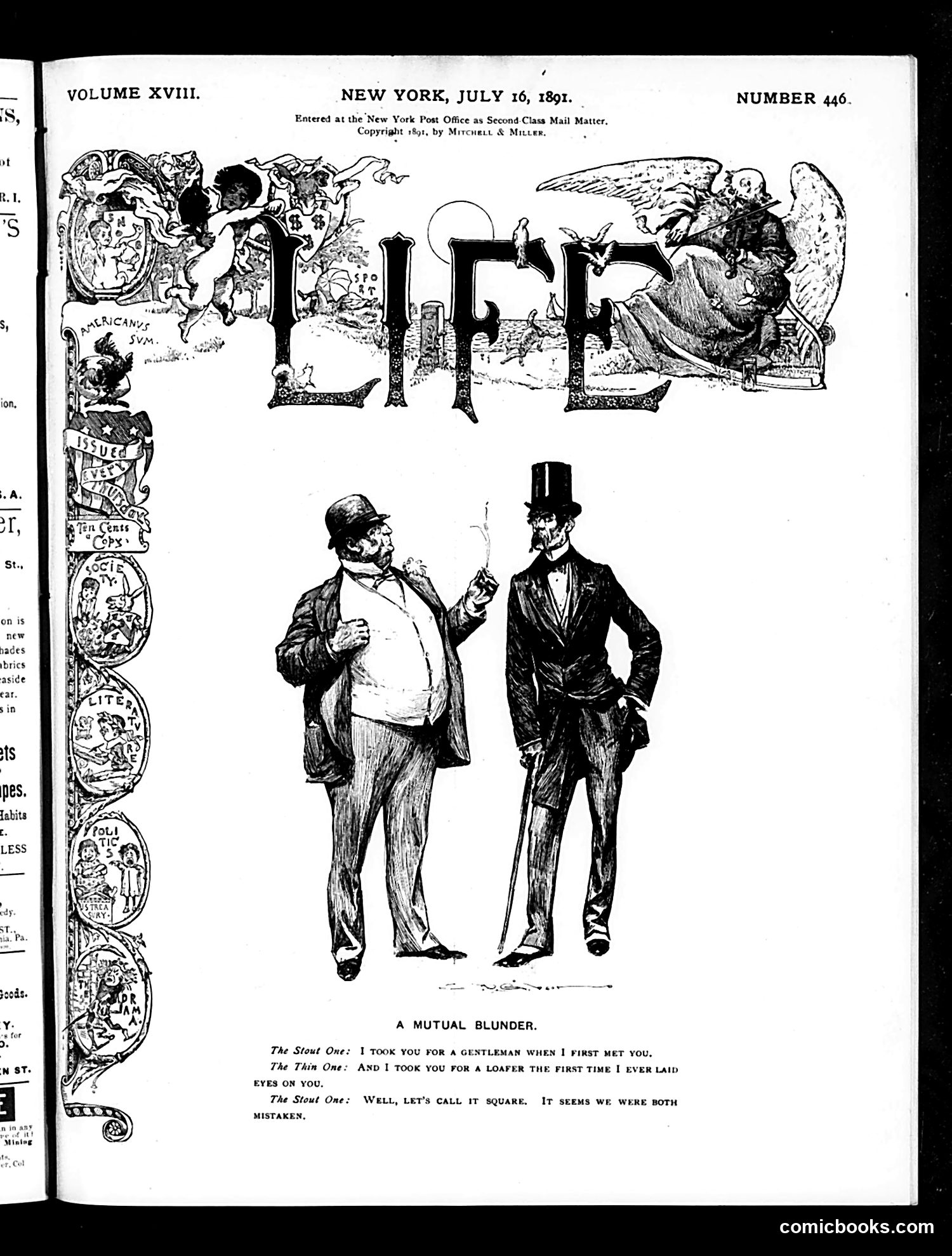
This cartoon depicts two well-dressed gentlemen acknowledging they've misjudged each other. The dialogue reveals mutual social miscalculation: one man initially mistook the other for a gentleman, while the second mistook the first for a loafer. Recognizing both were wrong, they decide to "call it square." The satire likely comments on the difficulty of judging character by appearance or first impressions in Gilded Age society. The formal dress and top hats of both men suggest class ambiguity—appearances can be deceiving regardless of wealth or presentation. The humor lies in how easily even seemingly obvious social markers fail to reveal true character, a pointed critique of Victorian society's reliance on superficial judgments.
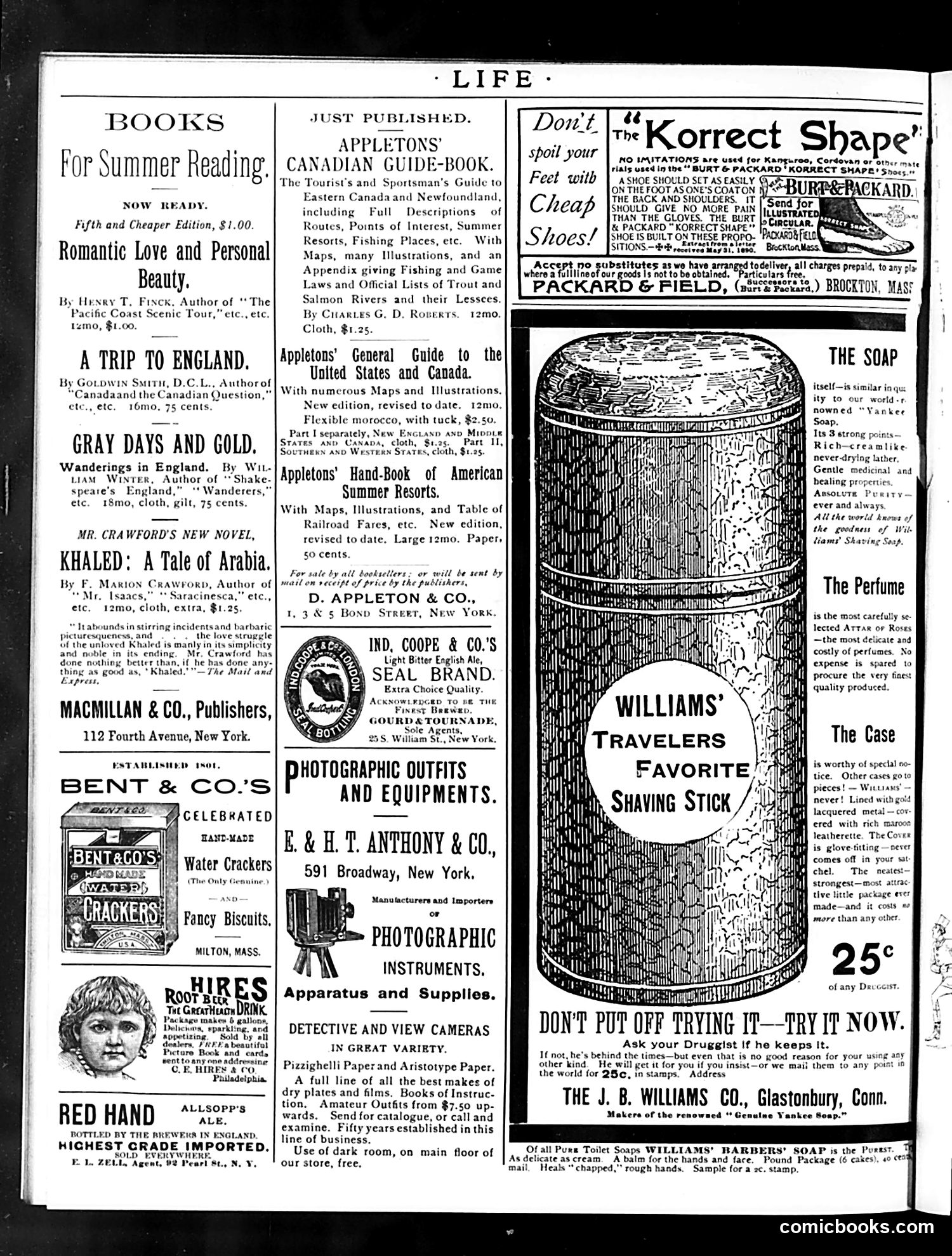
This page is **primarily advertising**, not political satire. It contains book advertisements (including travel guides and novels), product ads for items like crackers, photographic equipment, and prominently features a large advertisement for **Williams' Travelers Favorite Shaving Stick** occupying the right half of the page. The only illustration with potential satirical content is a small **Hires Root Beer advertisement** featuring a cherubic child's face—this appears to be standard product branding of the era rather than political commentary. The page represents typical *Life* magazine content from this period: a mix of commercial advertisements alongside editorial material. Without additional context about specific political events referenced in the book titles or ads, I cannot identify particular satirical targets or social commentary in this particular layout.
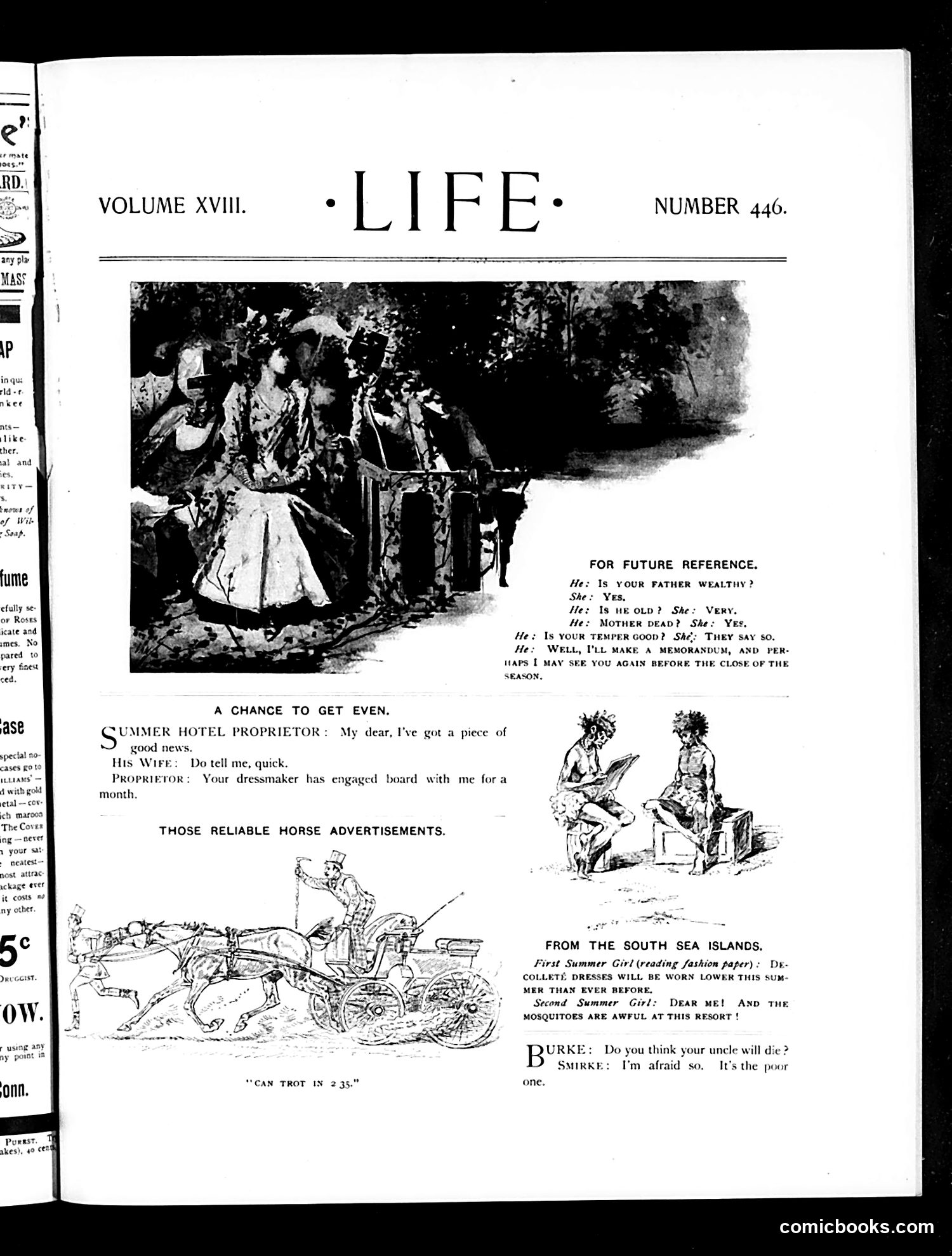
This page contains three brief satirical sketches typical of Life's humor: 1. **"A Chance to Get Even"**: A hotel proprietor jokes about a dressmaker who boarded with him—he'll "make a memorandum" to settle accounts before season's end, implying unpaid debts. 2. **"Those Reliable Horse Advertisements"**: A visual joke about exaggerated horse advertisements, showing an absurdly overloaded cart pulled by horses, mocking the unrealistic claims in classified ads. 3. **"From the South Sea Islands"**: A brief exchange where a summer girl complains about mosquitoes, and someone named Smirke darkly jokes that her uncle will likely die—"it's the poor one"—suggesting morbid humor about inheritance. These represent genteel, turn-of-century American magazine humor targeting everyday social hypocrisies and minor tragedies.
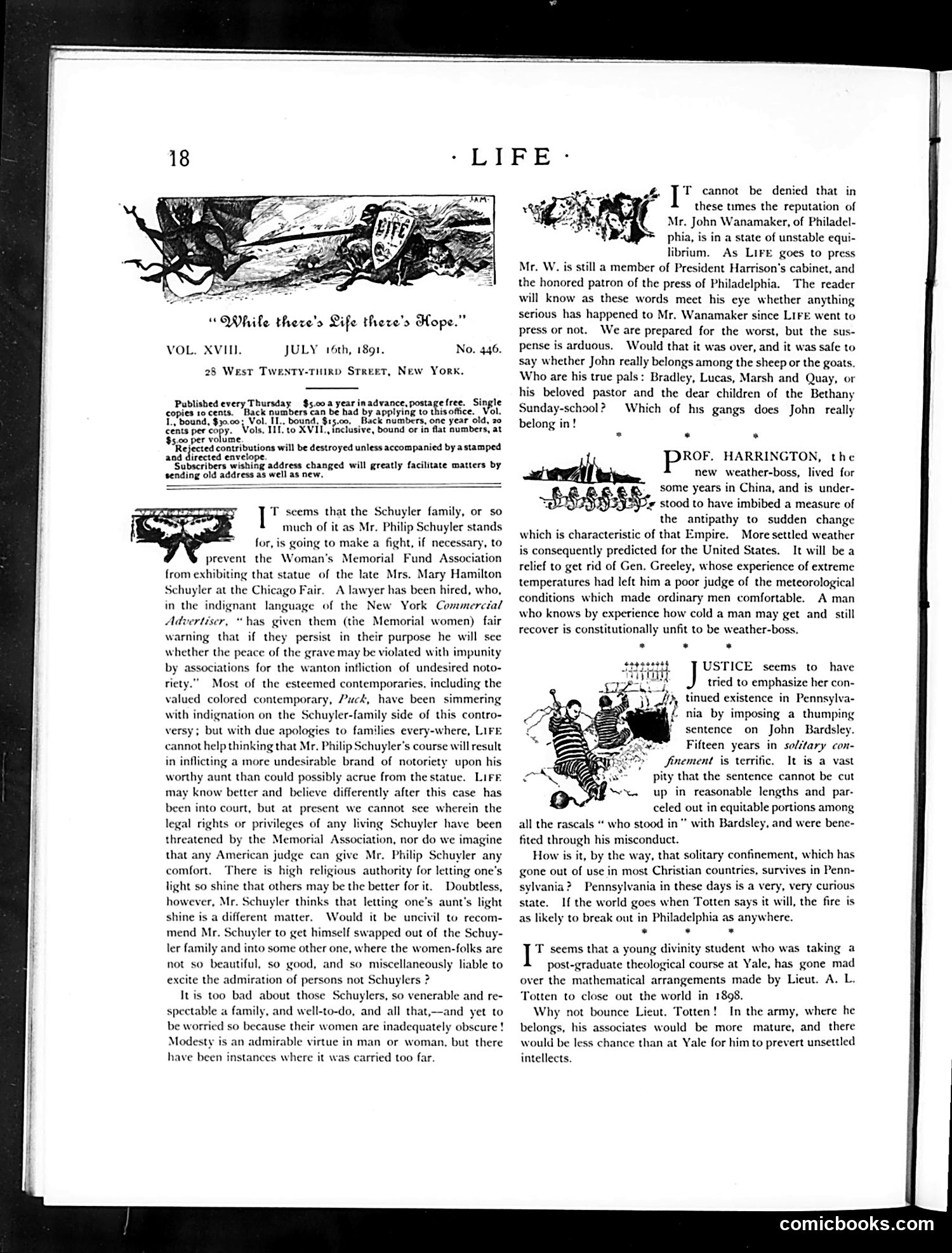
The page contains three distinct commentary sections on contemporary scandals, rather than traditional political cartoons. The first discusses John Wanamaker's reputation being damaged by involvement with *Life* magazine—questioning whether his character can withstand scrutiny. The second critiques the Schuyler family's legal battle to prevent a Woman's Memorial Fund exhibition featuring Mary Hamilton Schuyler's portrait at the Chicago Fair. *Life* argues the family's attempt to suppress the display through legal action represents excessive modesty and questions whether their objections are truly justified. The third section attacks a Yale theology student (likely Lieut. A.L. Totten) for mathematical arguments about closing the world in 1898, sarcastically suggesting the Army might be a better place for him than academia. All three pieces use satirical commentary to mock public figures' pretensions and questionable judgment.
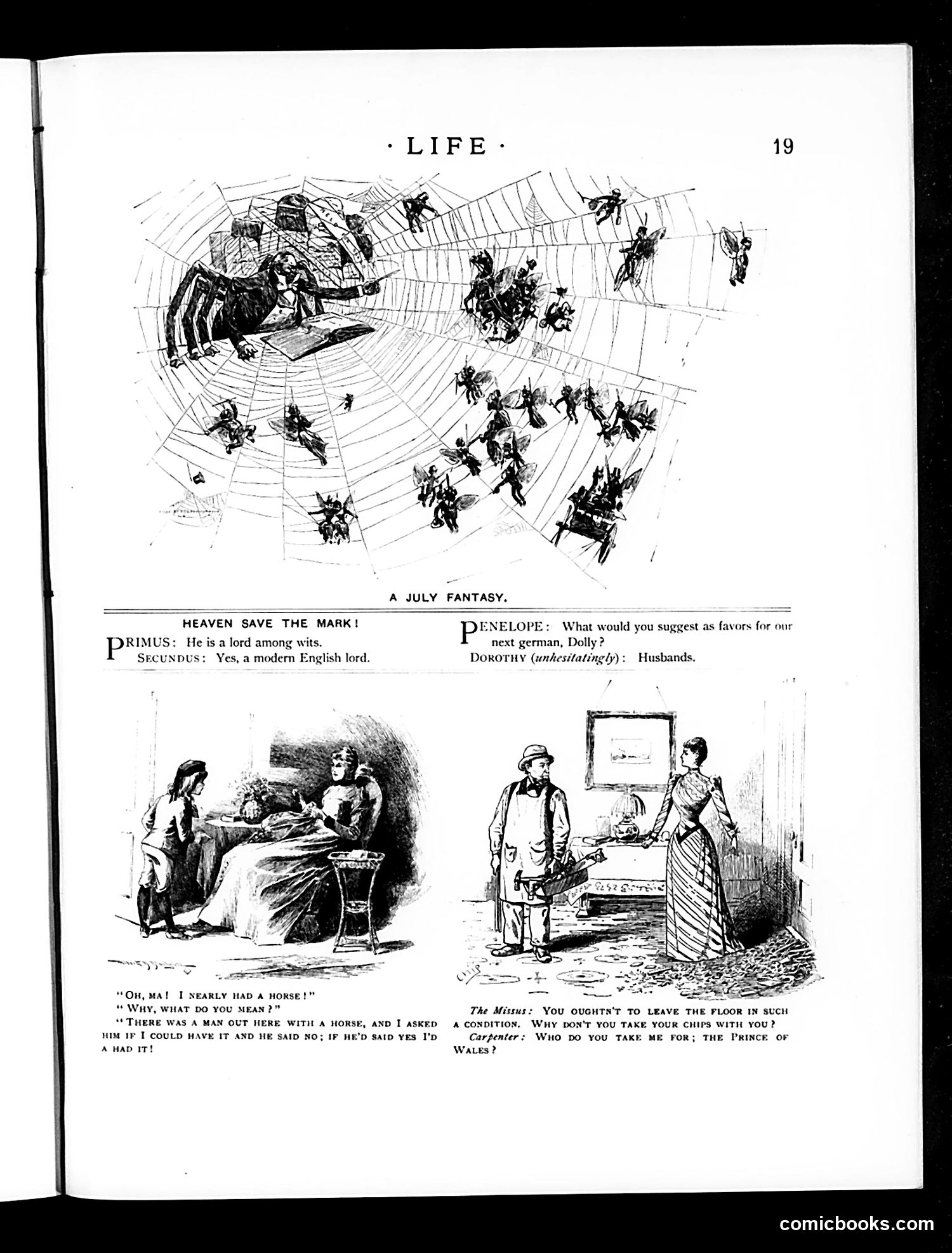
This page contains two distinct pieces of satire: **Top: "A July Fantasy"** depicts a spider web filled with figures caught like flies. The spider (left) appears to represent a predatory force—likely German militarism or imperial ambition, given the web's menacing nature and the historical context suggesting WWI-era publication. **Bottom: Two comic scenes** with dialogue satirizing domestic situations: - Left panel jokes about a man nearly acquiring a horse through a conditional bargain - Right panel depicts a working-class couple, with the woman scolding a carpenter about leaving chips on the floor The humor targets everyday marital dynamics and class relationships typical of early 20th-century Life magazine satire. The "Heaven Save the Mark!" heading suggests mockery of foolishness in ordinary matters, contrasting sharply with the darker imperial commentary above.
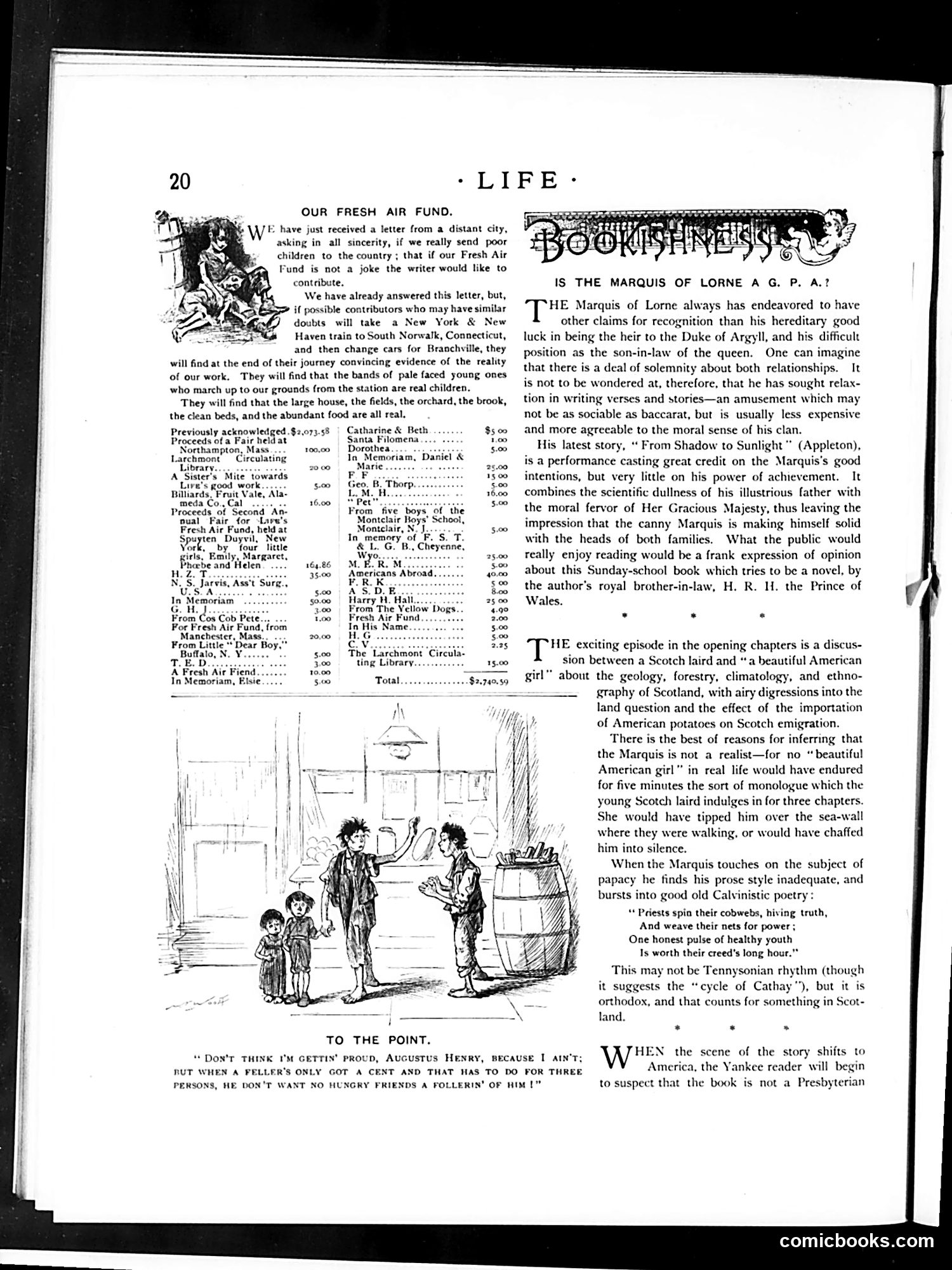
This page contains a book review (not political cartoon) of "From Shadow to Sunlight" by the Marquis of Lorne. The illustrated sketch shows what appears to be a family group—adults and children in Victorian-era clothing in an interior setting. The review critiques the Marquis's literary work as morally earnest but aesthetically limited. The satirical point is gentle: the reviewer suggests the Marquis's writing, while well-intentioned, lacks the realism and engaging prose needed for popular fiction. The page also includes "Our Fresh Air Fund"—a charitable fundraising section listing donors and contributions for sending poor urban children to the countryside, a genuine philanthropic effort rather than satire.
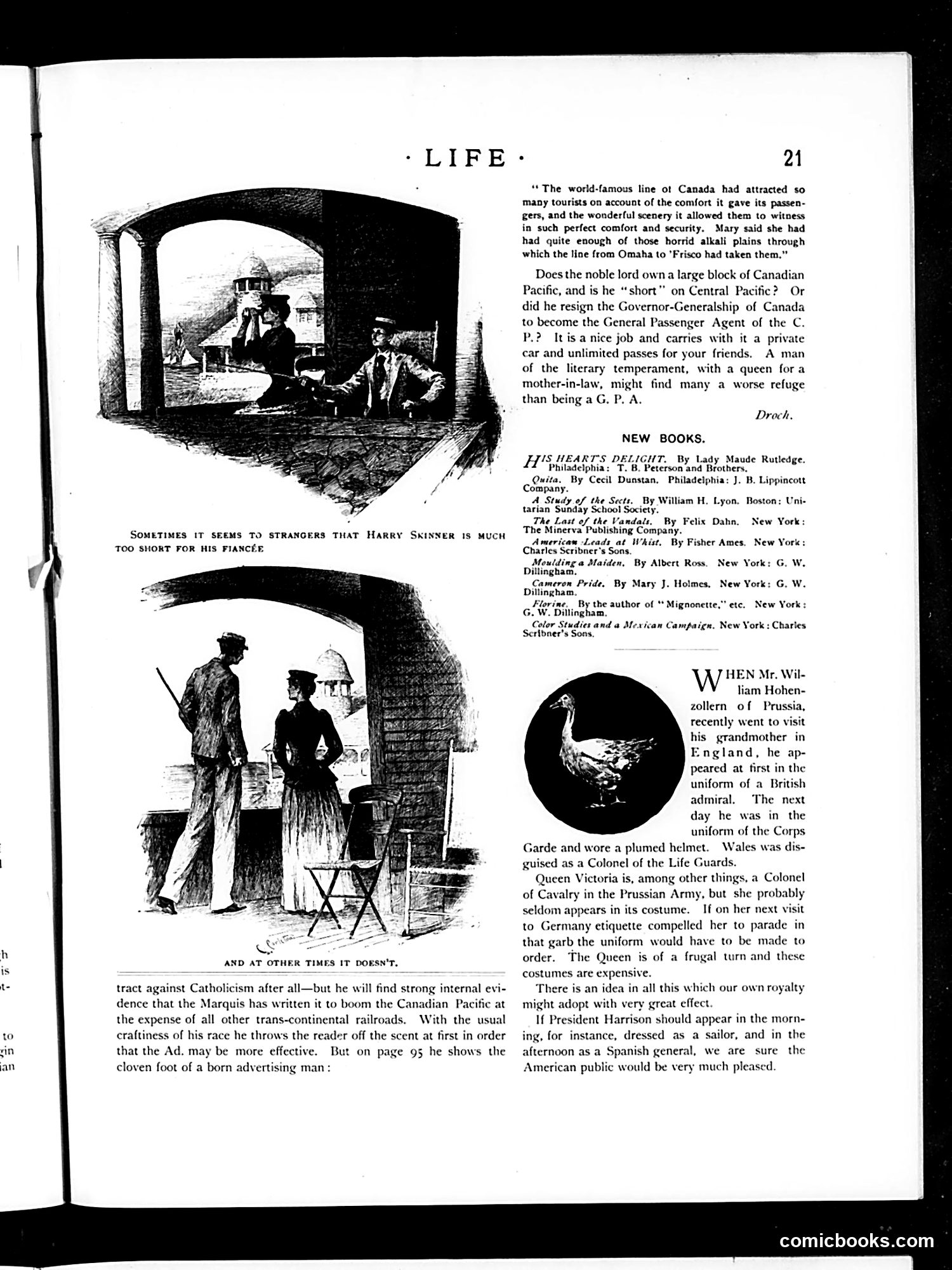
This page contains two cartoon panels satirizing Harry Skinner's height relative to his fiancée. The caption reads: "Sometimes it seems to strangers that Harry Skinner is much too short for his fiancée" and "And at other times it doesn't." The first panel shows Skinner appearing notably shorter when standing beside his tall fiancée; the second shows them seated, where the height difference becomes invisible. The humor derives from this physical contrast and how perspective and positioning can dramatically alter perceptions of relative size. The page also features a "New Books" section listing contemporary publications, and a satirical piece about Prussian Wilhelm Hohenzollern appearing in British military uniform when visiting his grandmother in England, mocking the absurdity of such costume changes and international royal etiquette.
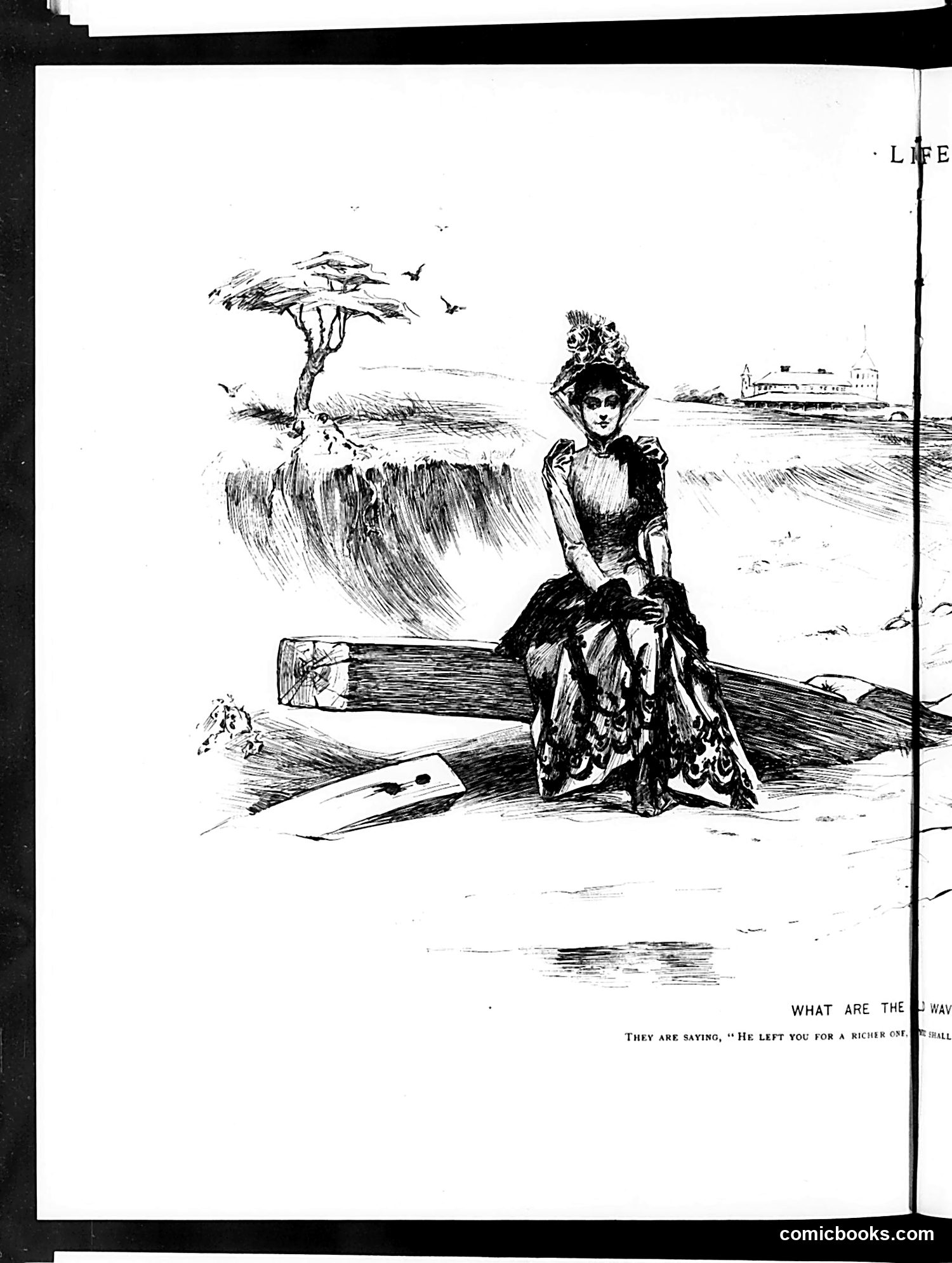
This illustration depicts a fashionably dressed woman sitting on a beach or shoreline, surrounded by abandoned items—a log, oars, and what appears to be wreckage. The caption reads: "WHAT ARE THE...WAYS. THEY ARE SAYING, 'HE LEFT YOU FOR A RICHER ONE.'" The satire appears to target romantic abandonment and class-based infidelity. The woman's elegant clothing and composed demeanor contrast with her desolate circumstances, suggesting she has been left behind—literally and figuratively—by a romantic partner who pursued someone wealthier. The background shows a steamship and distant shore, implying departure and separation. This reflects early 20th-century satirical commentary on marriage, wealth, and social mobility, mocking both the fickleness of romantic relationships and the mercenary nature of courtship among certain social classes.
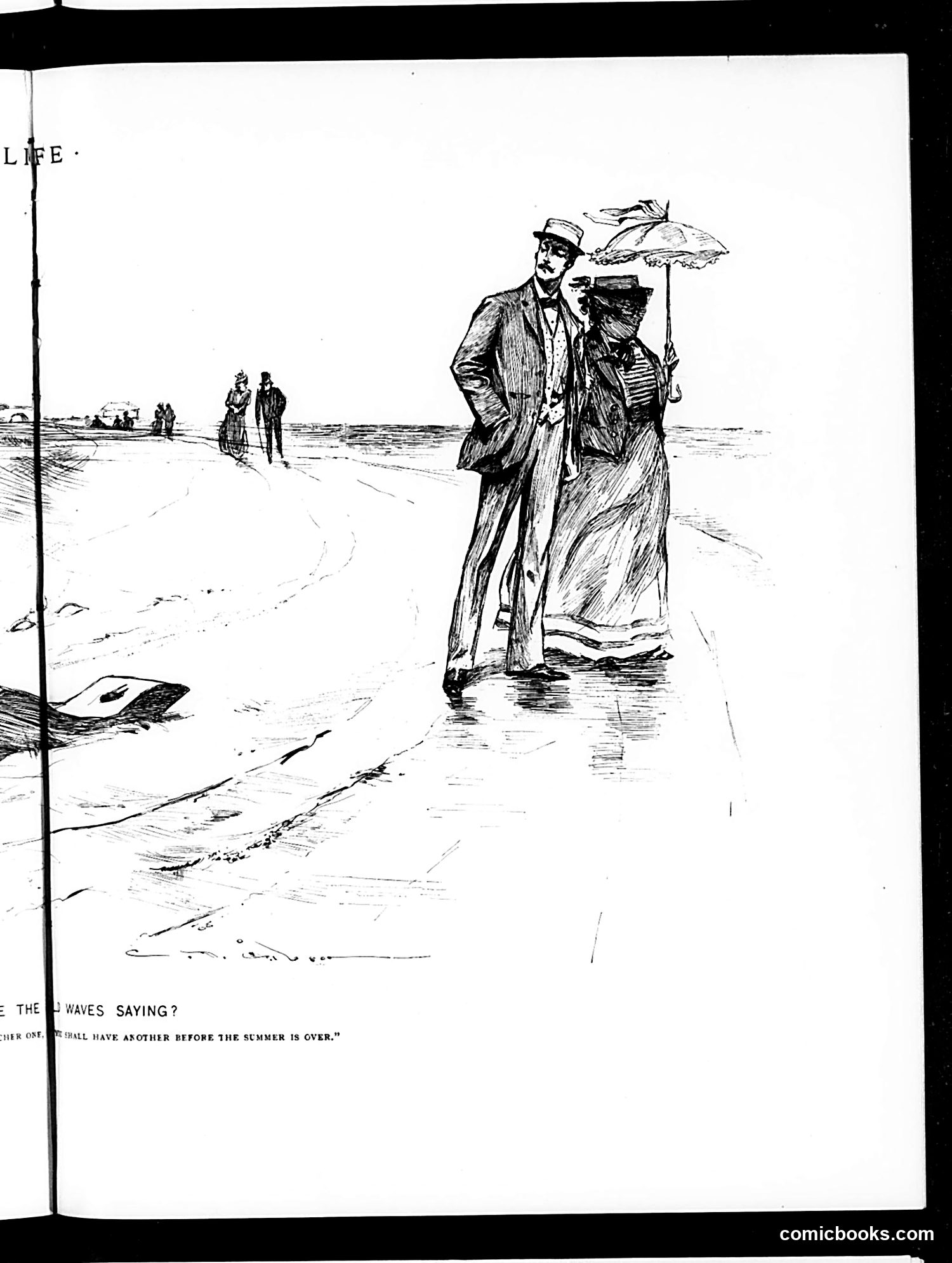
This illustration depicts a fashionably dressed couple wading in the ocean at a beach. The man holds an umbrella for the woman as they stand in shallow water. Other beachgoers appear in the background. The visible text fragment reads: "THE WAVES SAYING?" and "...BALL HAVE ANOTHER BEFORE THE SUMMER IS OVER." This appears to be a satirical commentary on summer leisure activities and romantic courtship among the upper classes. The couple's formal attire and the parasol suggest they're wealthy enough to vacation at the beach. The joke likely plays on the genteel pretense of seaside romance—the couple maintaining their fashionable appearance while wading, which would have been humorous to Life's readers. Without the complete caption, the specific social critique remains unclear, though it likely mocks either romantic conventions or leisure-class affectations of the era.
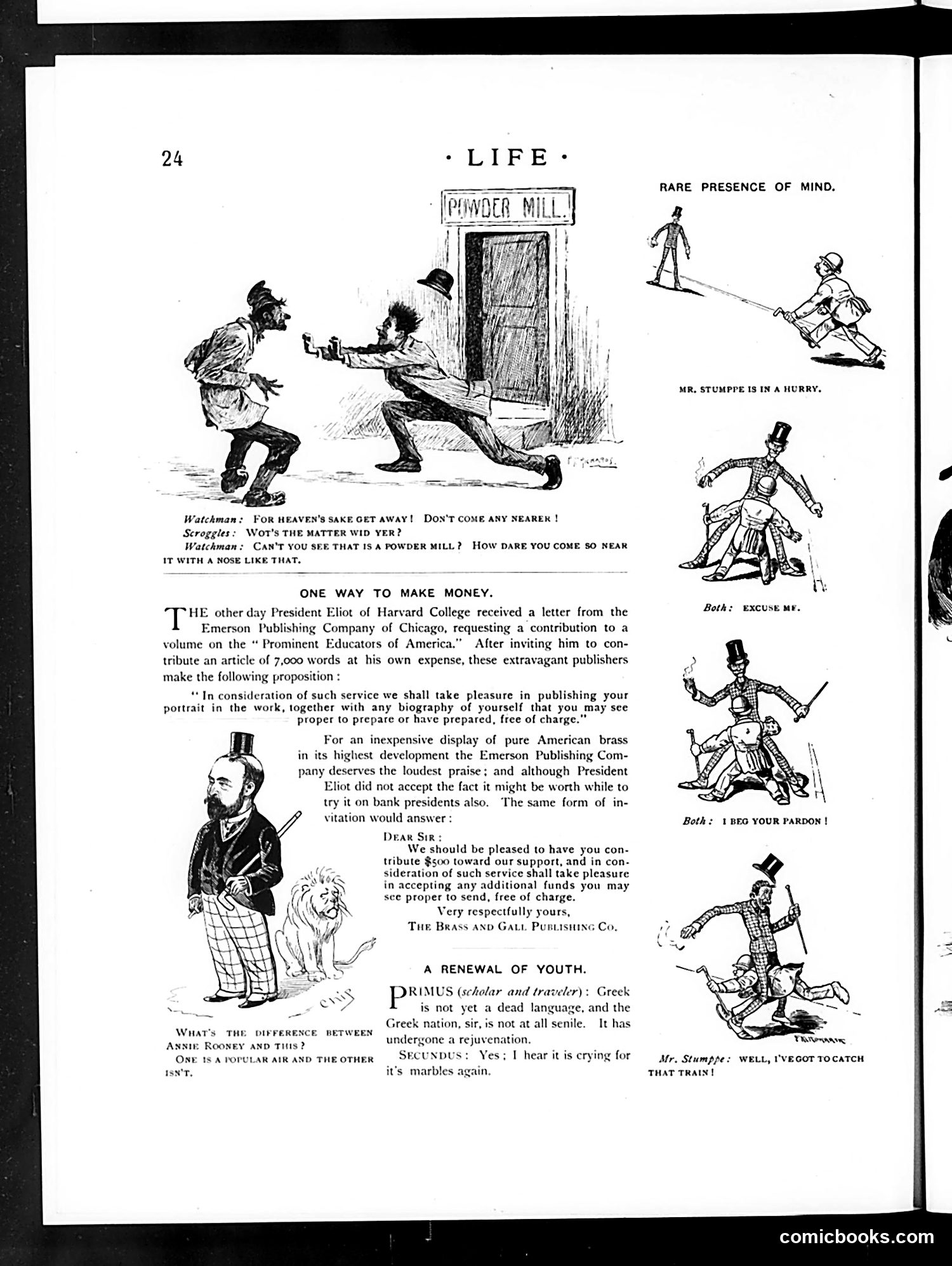
This page contains several satirical elements: **Top cartoon**: A slapstick scene at a "Powder Mill" where a watchman confronts a scruffy character, warning him away from the dangerous facility. The humor relies on physical comedy and the character's defiant response. **"One Way to Make Money"**: A satirical article mocking the Emerson Publishing Company's solicitation letter to Harvard President Charles Eliot. The publishers offer to publish his portrait "free of charge" while requesting a $500 contribution. The satire exposes the dubious financial practices of publishing companies disguised as flattery. **Right side**: Small comic vignettes titled "Rare Presence of Mind" showing Mr. Stumpie in various physical predicaments, captioned with humorous one-liners about avoiding embarrassment. **Bottom section**: Brief classical references and wordplay jokes.
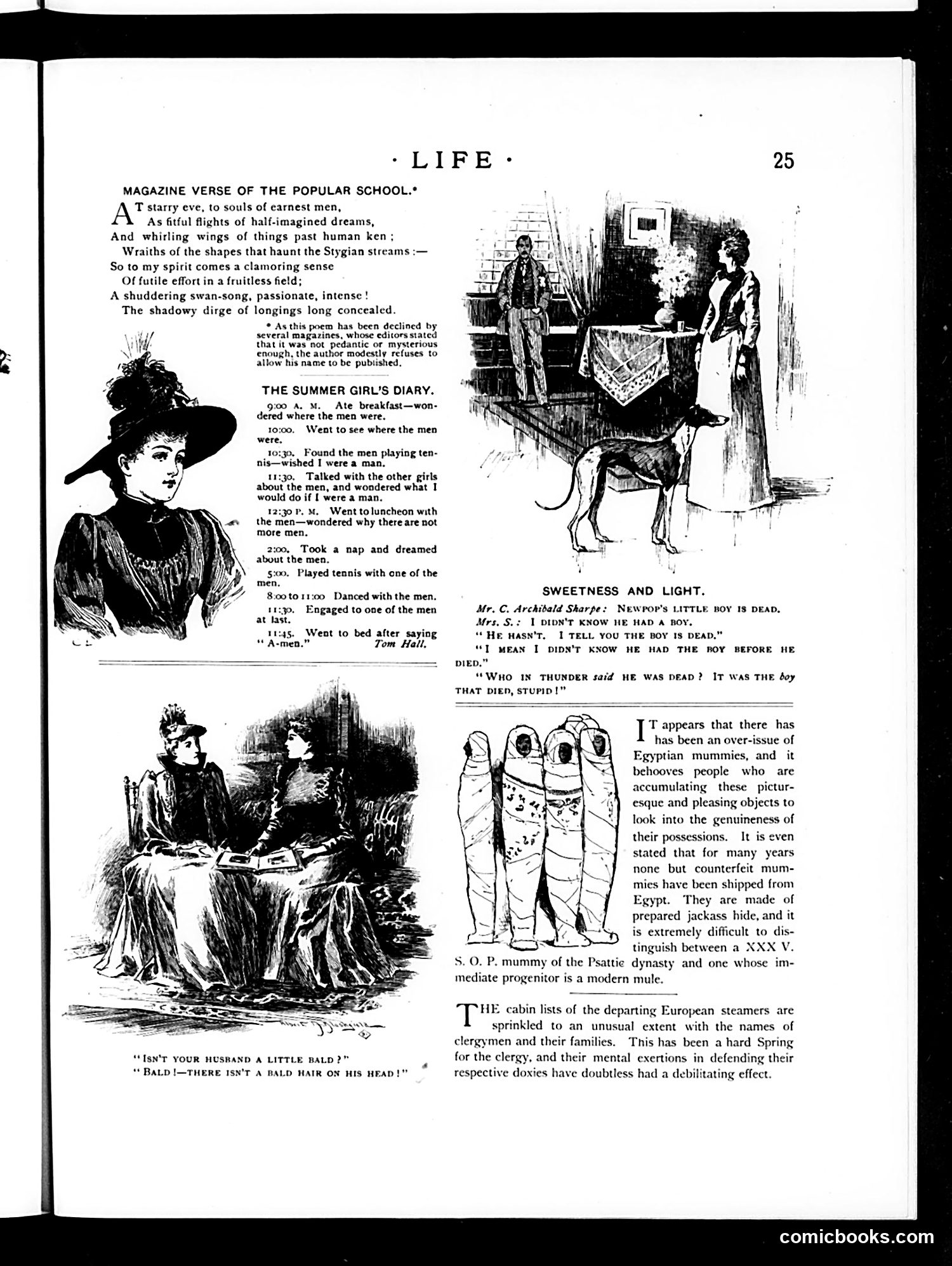
This page contains satirical sketches and humorous writing typical of early Life magazine's social commentary. **"Magazine Verse of the Popular School"** is a poem mocking sentimental, overwrought Victorian poetry—the kind that dominated popular publications. The satirical target is the pretentious, melodramatic style itself. **"The Summer Girl's Diary"** humorously documents a woman's daily activities (tennis, lunch, dancing, napping) centered entirely around finding and pursuing men, satirizing the leisure activities and romantic preoccupations of upper-class women of the era. The sketch at bottom left shows a couple, with the caption "Isn't your husband a little bald?" / "Bald!—there isn't a bald hair on his head!"—likely mocking either vanity or marital disputes over appearance. The Egyptian mummy discussion is a brief antiquarian note, unrelated to the satire.
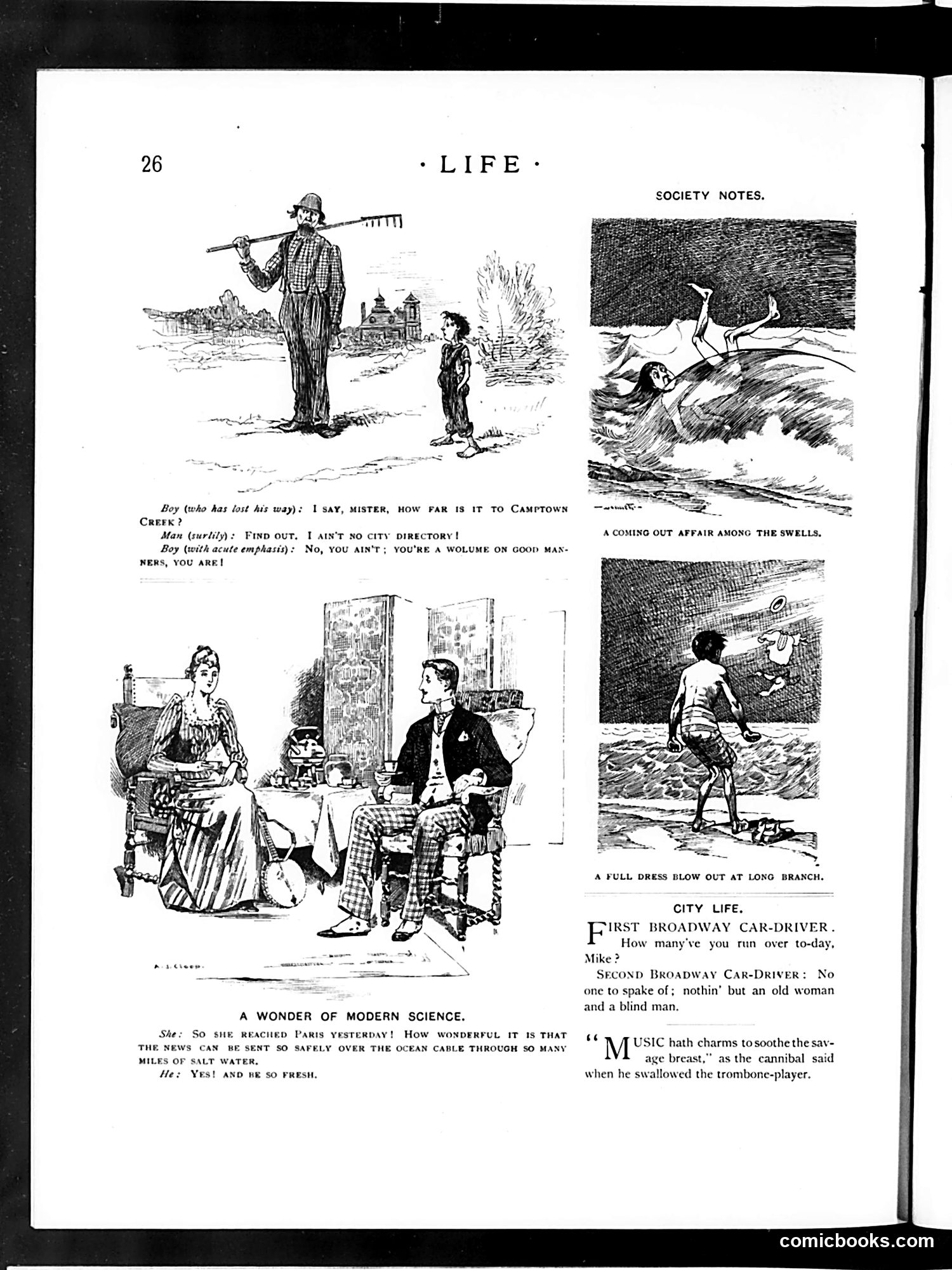
This page contains several satirical cartoons mocking social manners and urban life: **Top left**: A well-dressed man rebuffs a lost boy asking directions. The boy retorts that the man IS a "volume on good manners"—sarcastically suggesting the man's rudeness contradicts any claim to civility. The joke targets hypocritical gentlemen who lack actual courtesy. **Bottom left**: "A Wonder of Modern Science" celebrates the transatlantic telegraph cable's ability to send news rapidly across the ocean while keeping it "fresh"—a pun on literal freshness applied metaphorically to news. **Right side**: Two "Society Notes" jokes. One depicts a woman at a beach resort ("Long Branch"—a fashionable New Jersey destination). Another features two Broadway streetcar drivers casually discussing running over pedestrians—an old woman and blind man—as routine occurrences, darkly satirizing urban indifference and the dangers of new mass transportation. The final joke equates music's soothing effect on "savage breasts" with a cannibal eating a trombone-player, mocking both sentimentality and racist stereotypes.
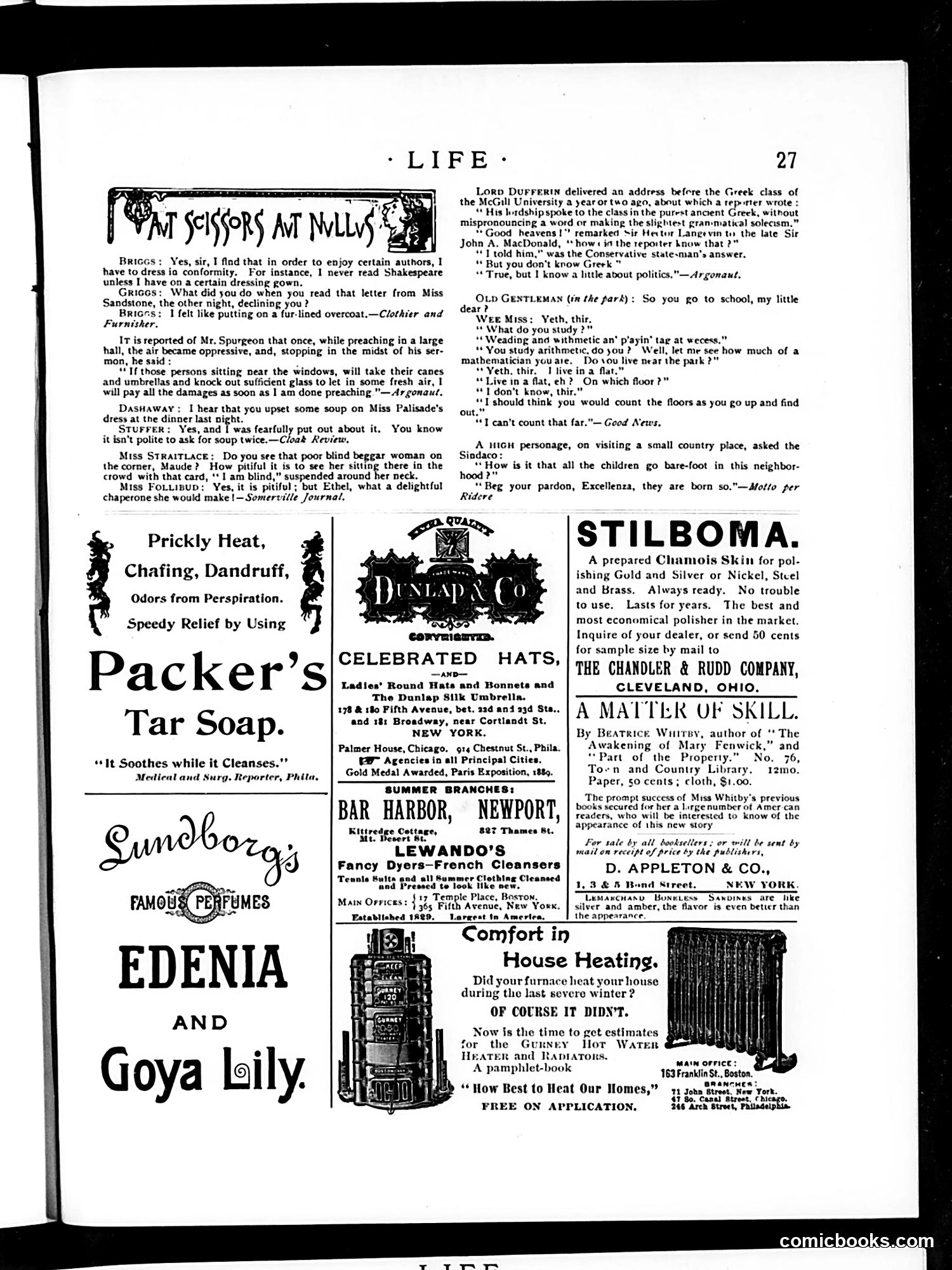
This page from *Life* magazine consists primarily of **humorous anecdotes and advertisements** rather than political cartoons. The jokes satirize social pretension and absurdity. One anecdote mocks a man who claims he needs specific clothing to read Shakespeare—revealing vanity masquerading as refinement. Another ridicules a woman who sees a blind beggar woman as a potential "chaperone," exposing callous social climbing. A third jokes about a politician's ignorance: when asked how he knew ancient Greek wasn't mispronounced, he admits "I know a little about politics"—implying political corruption blinds one to facts. The final anecdote about a high official asking why village children go barefoot, receiving the reply "they are born so," is deadpan absurdist humor. The page is otherwise dominated by period advertisements for soap, perfume, hats, dyers, and heating equipment—typical of *Life's* commercial content in this era.
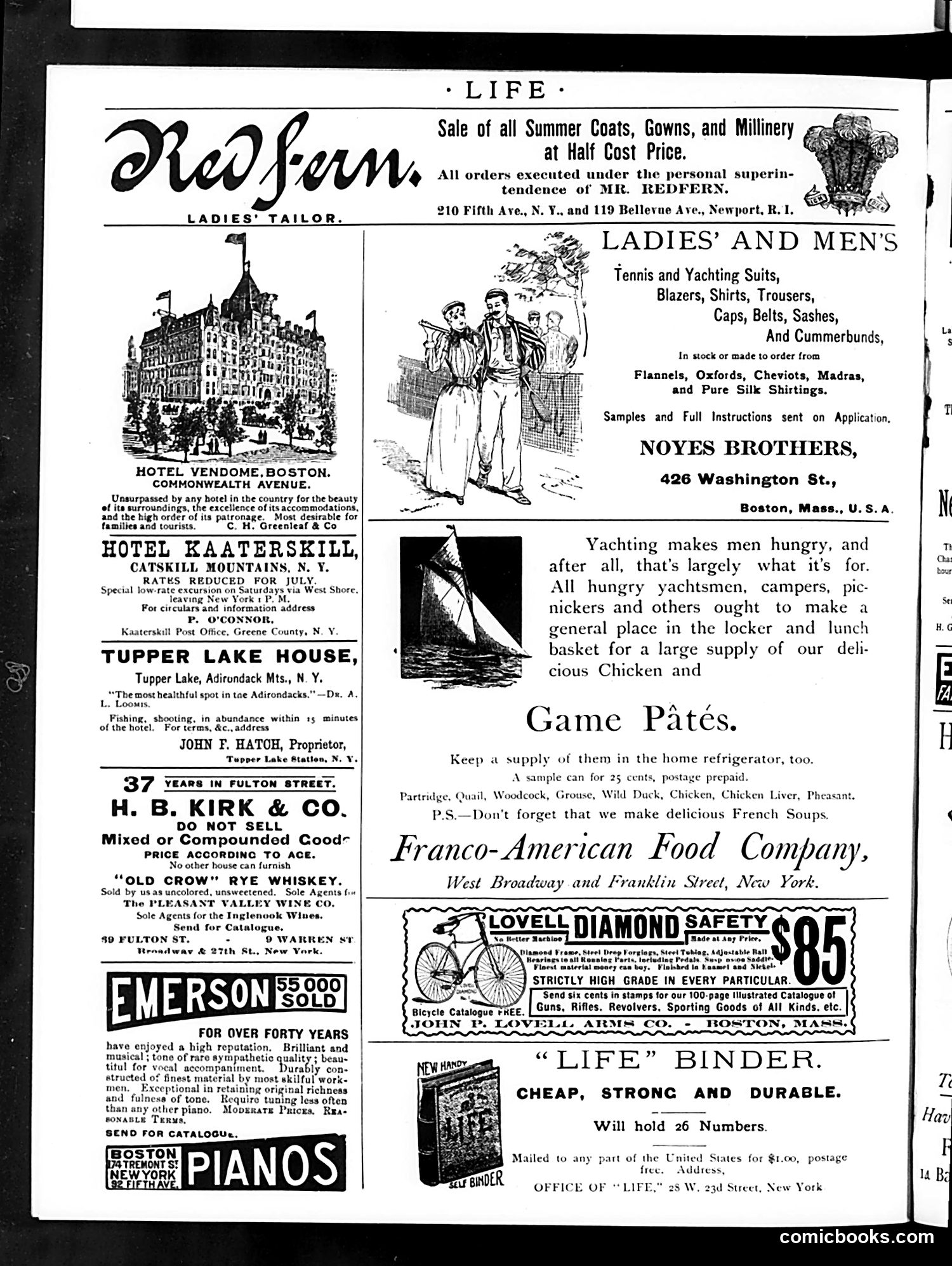
This is primarily an **advertising page** from Life magazine, not a satirical cartoon page. The content consists entirely of commercial advertisements for luxury goods and services aimed at wealthy Americans, likely from the Gilded Age era (late 1800s). **Key advertised items include:** - High-end tailoring and summer fashions (Redfern, Noyes Brothers) - Exclusive resort hotels (Hotel Vendome Boston, Hotel Kaaterskill in the Catskills, Tupper Lake House in the Adirondacks) - Specialty foods (Franco-American Game Pâtés for yachtsmen) - Whiskey, wine, and spirits - Bicycles and sporting goods (Lovell Diamond Safety bicycle) - Pianos (Emerson brand) - A "Life" magazine binder **The implicit satire** lies in Life's editorial approach: by juxtaposing advertisements for luxury leisure activities—yachting, fine dining, resort vacations—the magazine subtly mocks the conspicuous consumption of the wealthy leisure class. The humor is understated but present in the sheer concentration of luxury goods marketed to an affluent readership.
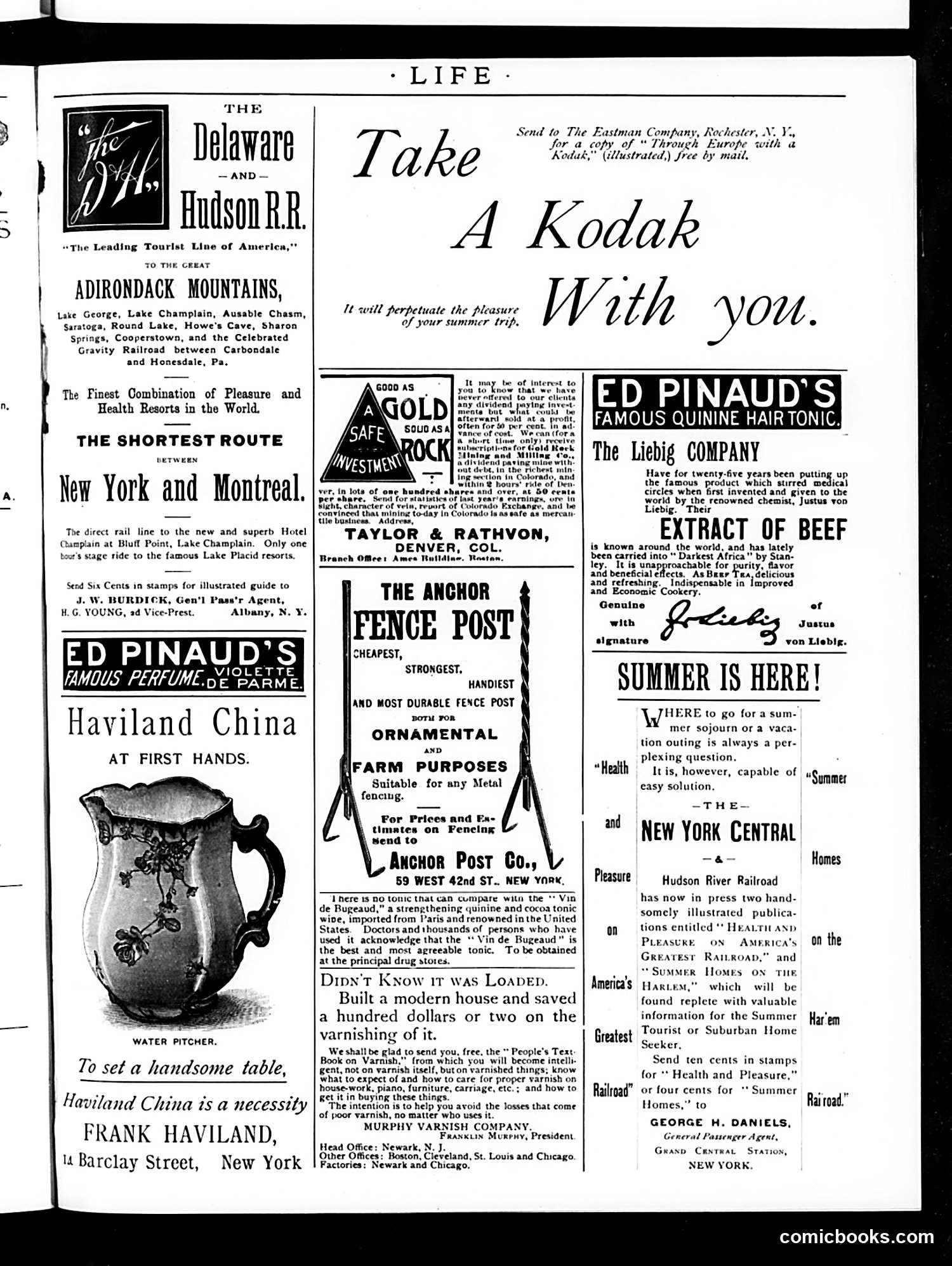
This is primarily an **advertising page**, not a satirical cartoon page. It contains multiple product and travel advertisements typical of early-to-mid American commercial magazines. Notable ads include: - **Delaware and Hudson Railroad**: promoting Adirondack Mountain tourism - **Kodak cameras**: encouraging documentation of summer trips - **Haviland China**: table settings for the home - **Ed Pinaud products**: perfume and hair tonic (appears twice) - **Murphy Varnish Company**: a humorous ad about unknowingly saving money on varnish when building a house - **Liebig Extract of Beef**: marketed as a restorative tonic and cooking ingredient - **New York Central Railroad**: promoting summer travel guides The page reflects **late 19th-century American consumer culture**, emphasizing leisure travel, home goods, and patent medicines/tonics. There is **no political satire** visible—this appears to be a standard advertising section of Life magazine from this era.
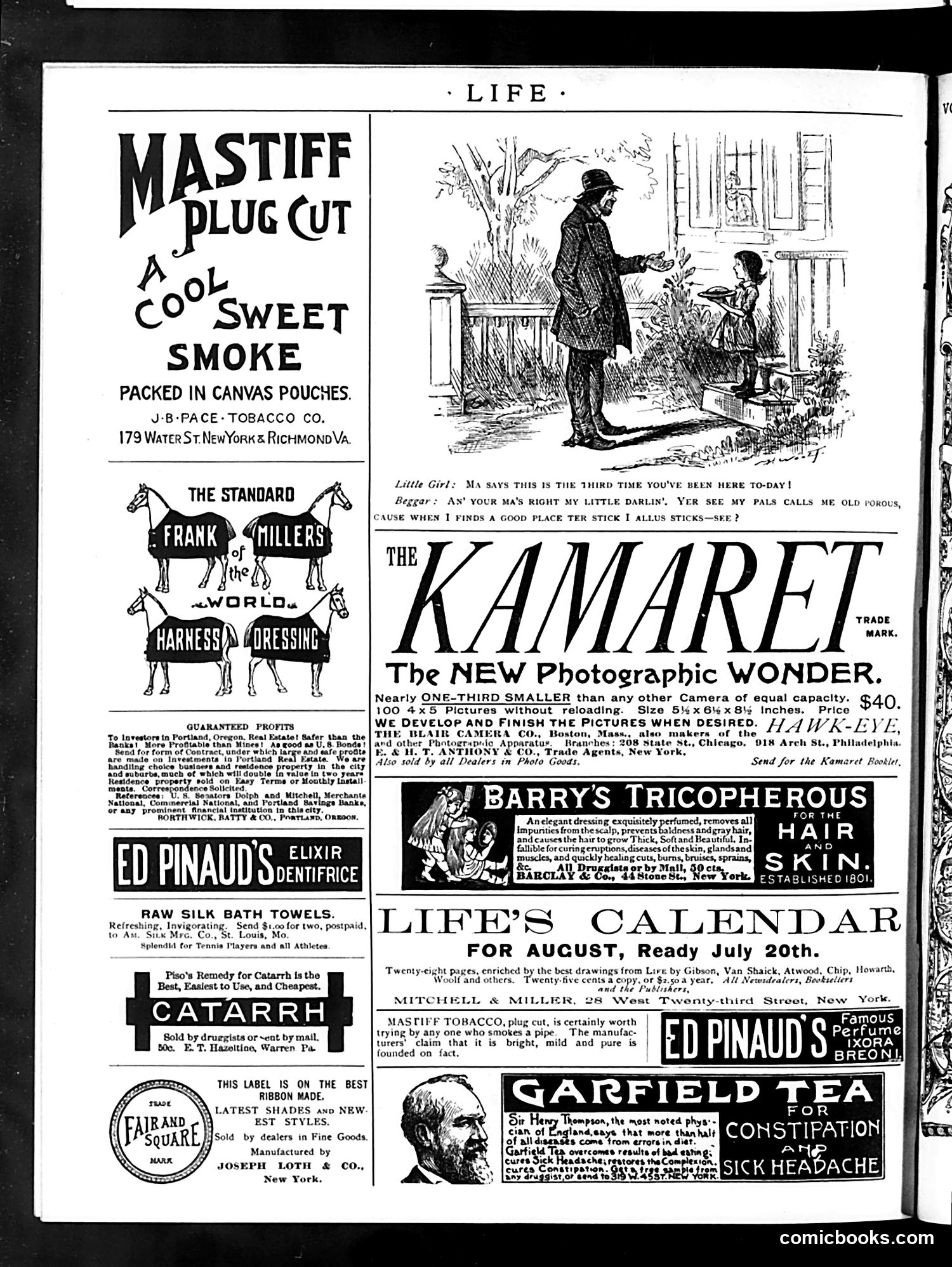
This page is primarily **advertisements** with one small satirical cartoon. The main cartoon depicts a beggar repeatedly visiting a house, telling the little girl who answers that her mother is right—he keeps coming back because "when I finds a good place ter stick I allus sticks." The joke is a crude pun: the beggar has found a sympathetic household and exploits their charity through repeated visits. It's social satire about panhandling and the exploitation of middle-class generosity in the late 19th/early 20th century. The bulk of the page showcases patent medicines and consumer products typical of the era: Mastiff tobacco, the Kamaret camera, Barry's hair tonic, Ed Pinaud's dentifrice, and Garfield Tea. These advertisements reflect the pre-FDA era when such products made expansive health claims without regulation. The calendar advertisement for *Life* itself suggests this is likely a July or August 1906 issue.