
A complete issue · 18 pages · 1891
Life — May 28, 1891
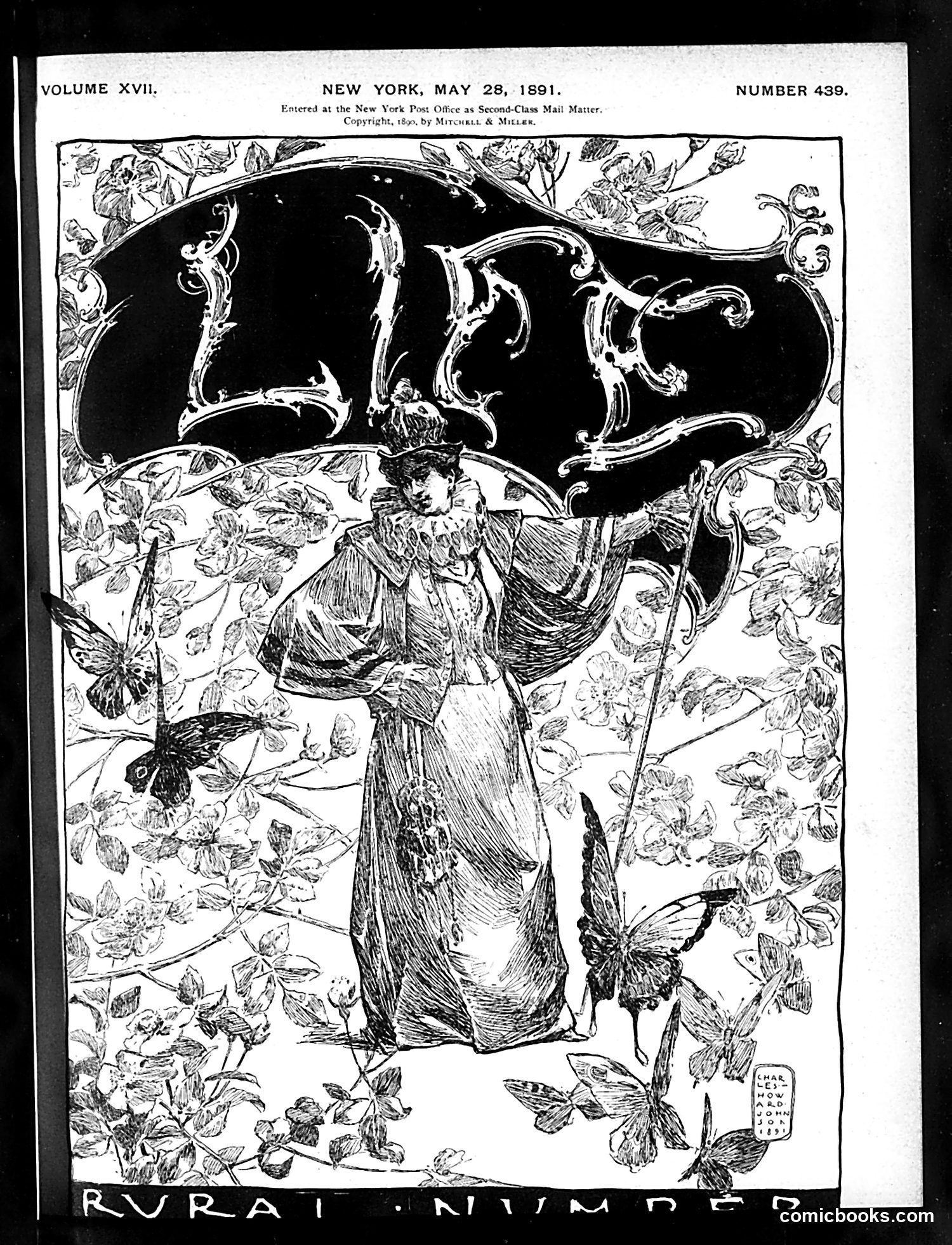
This appears to be a cover illustration for Life magazine's "Rural Number" issue (visible at bottom). The image shows a elegantly dressed woman in Victorian attire standing amid flowering plants and butterflies, holding what appears to be a decorative parasol or fan above her head with ornate scrollwork. The illustration likely celebrates rural or pastoral themes—a common subject for late 19th-century American magazines. The woman's refined dress contrasts with the natural garden setting, possibly satirizing urban society's romanticized view of country life, or celebrating the "new woman" engaging with nature. The decorative, art nouveau-influenced style with flowing lines and natural motifs was fashionable in 1891. Without additional context from the magazine's contents, the specific satirical point remains unclear.
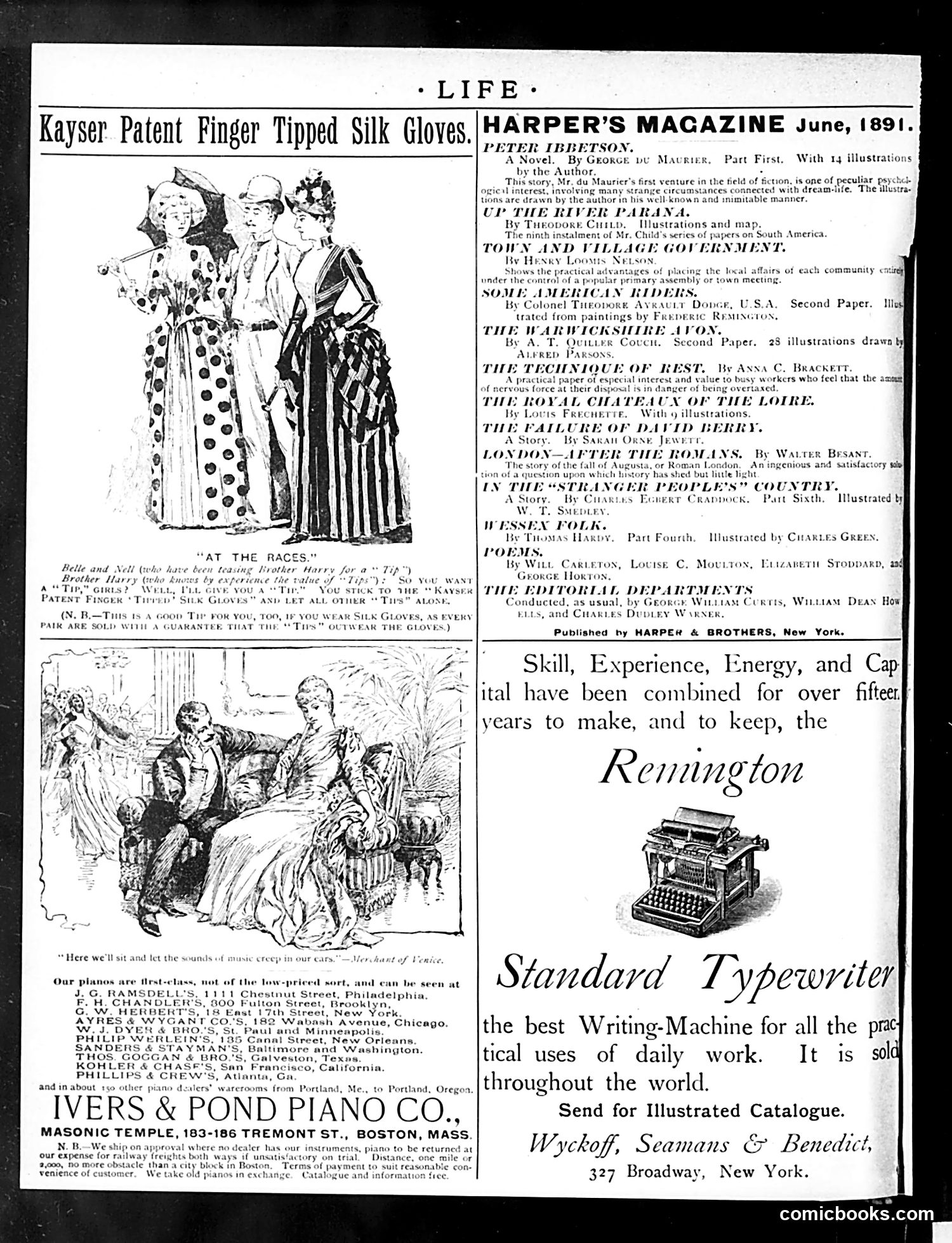
This June 1891 *Life* magazine page is primarily **advertising and literary content**, not political satire. The top half features ads for **Kayser Patent Finger Tipped Silk Gloves** with fashion illustrations, and **Ivers & Pond Piano Co.** The bottom half advertises the **Remington Standard Typewriter**. The illustrations appear to be generic Victorian fashion and domestic scenes rather than satirical political cartoons. The caption "Here we'll sit and let the sounds of music creep in our ears" references *The Merchant of Venice*. The page demonstrates how *Life* magazine—while known for satirical content—also carried substantial advertising and literary serialization, including installments of novels and poetry from contemporary writers.

I can see this is a page from Life magazine, but the image is almost entirely black or severely degraded, making it impossible to discern any cartoons, illustrations, or text clearly enough to analyze them accurately. The only barely visible elements are some partial text fragments on the left margin (including what appears to be "391," "Cap," and "feet"), and a "comicbooks.com" watermark at the bottom right. The main content area is too dark to read or interpret. To provide the historical analysis you're requesting, I would need a clearer, higher-contrast scan of this page. I cannot responsibly guess at the cartoon's meaning, figures, or satirical intent without being able to see it.

I can see this is a page from Life magazine with the address "327 Broadway, New York" visible at the top. However, the image quality is extremely poor—the page appears almost entirely black with only a faint circular element barely visible in the center. The OCR text provided is incomplete and doesn't give context about the cartoon's subject matter, figures, or satirical intent. Without being able to read the text clearly or discern details in the image, I cannot reliably identify what political or social commentary this page contains, who any figures represent, or what the joke or satire is meant to convey. To properly analyze this historical cartoon, a higher-quality image or clearer text would be necessary.
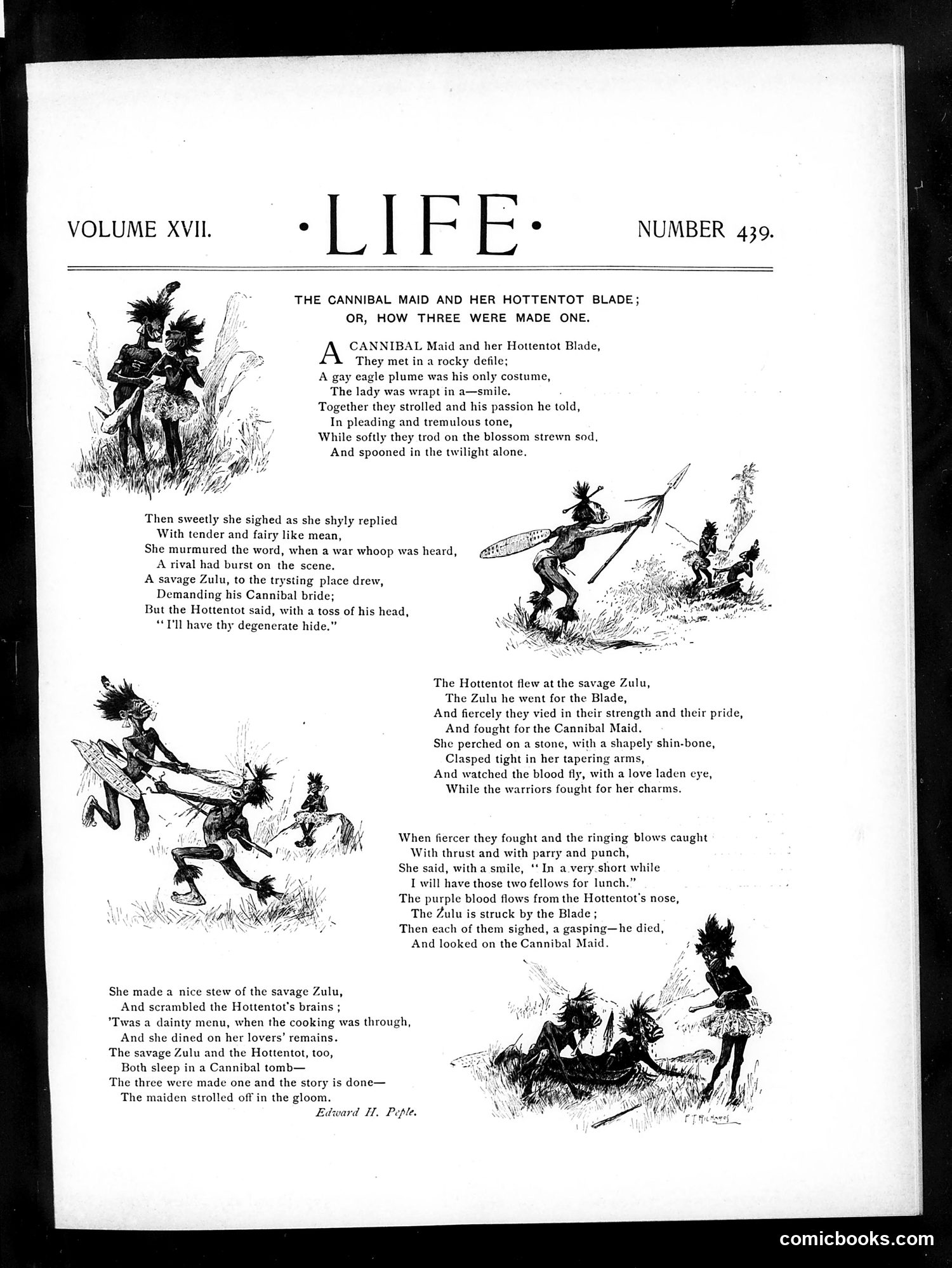
This page presents a humorous poem titled "The Cannibal Maid and Her Hottentot Blade; Or, How Three Were Made One," accompanied by satirical illustrations depicting indigenous African figures in a violent scenario. The content appears to be a Victorian-era satirical piece using racist caricature and stereotype. It portrays African peoples as cannibals engaged in brutal conflict, reflecting the dehumanizing attitudes common in 19th-century American media. The poem's dark humor derives from its violent subject matter and crude depiction of non-European peoples. Without additional contextual information about the specific issue or historical moment, I cannot identify whether this satirizes a particular event or political issue. The attribution reads "Edward H. [illegible]." The piece exemplifies how Life magazine used racist imagery and stereotypes as comedic material during this period.
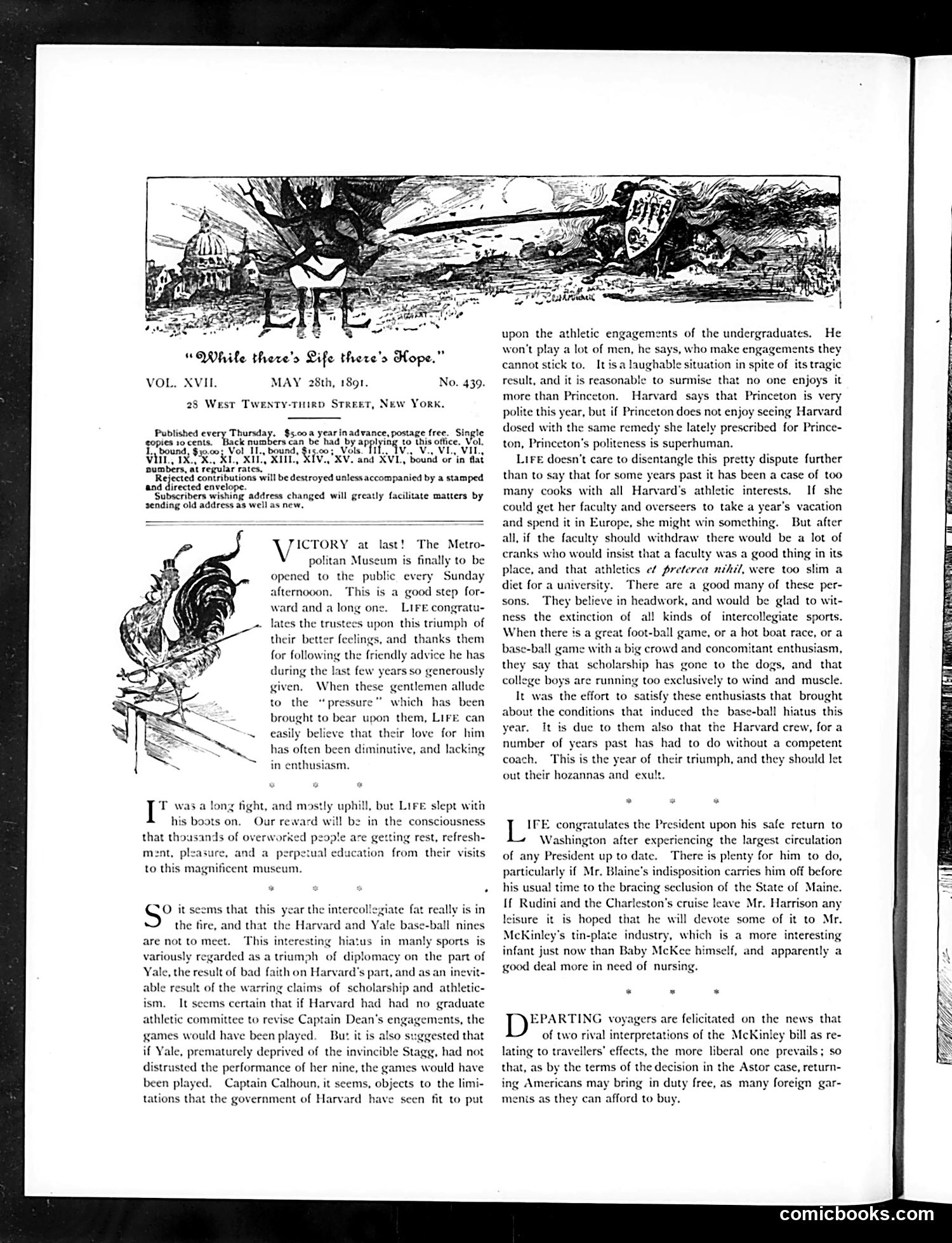
The main cartoon depicts a rooster crowing triumphantly, captioned "While there's Life there's Hope." This appears to be Life magazine's self-congratulatory mascot celebrating the Metropolitan Museum's opening to the public on Sundays—described in the accompanying text as a victory after years of effort. The article praises this achievement while critiquing Harvard and Yale's athletic rivalry, particularly their baseball competition. The text discusses whether collegiate sports have become too dominant, debating whether athletic prowess overshadows academic values. It mentions Harvard's successful crew team and disputes over baseball management between the universities. The rooster symbolizes Life's role as a voice championing public access to cultural institutions and reasonable perspectives on collegiate athletics.
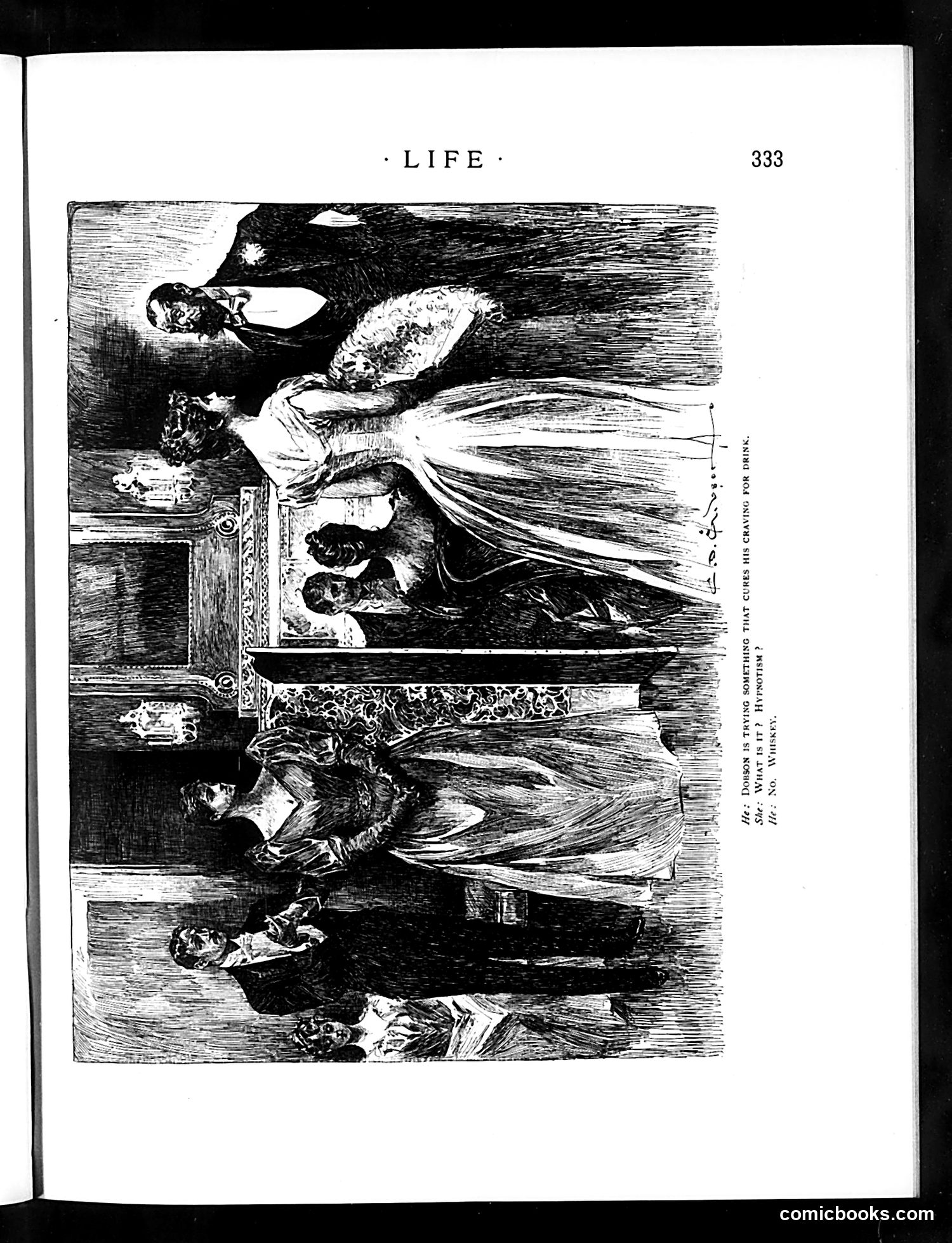
I can see this is page 333 from Life magazine featuring a black and white engraving or sketch. The image appears to show multiple figures in what looks like an interior domestic scene, rotated 90 degrees on the page. However, the OCR text provided is minimal and doesn't include a caption or title that would explain the specific political or social reference. Without legible accompanying text identifying the figures or the satirical subject matter, I cannot reliably determine what event, public figures, or social commentary this cartoon addresses. The artistic style and composition suggest social satire typical of Life's editorial content, but identifying the specific targets and point of the joke would require either clearer caption text or additional contextual information I don't have access to from this image alone.
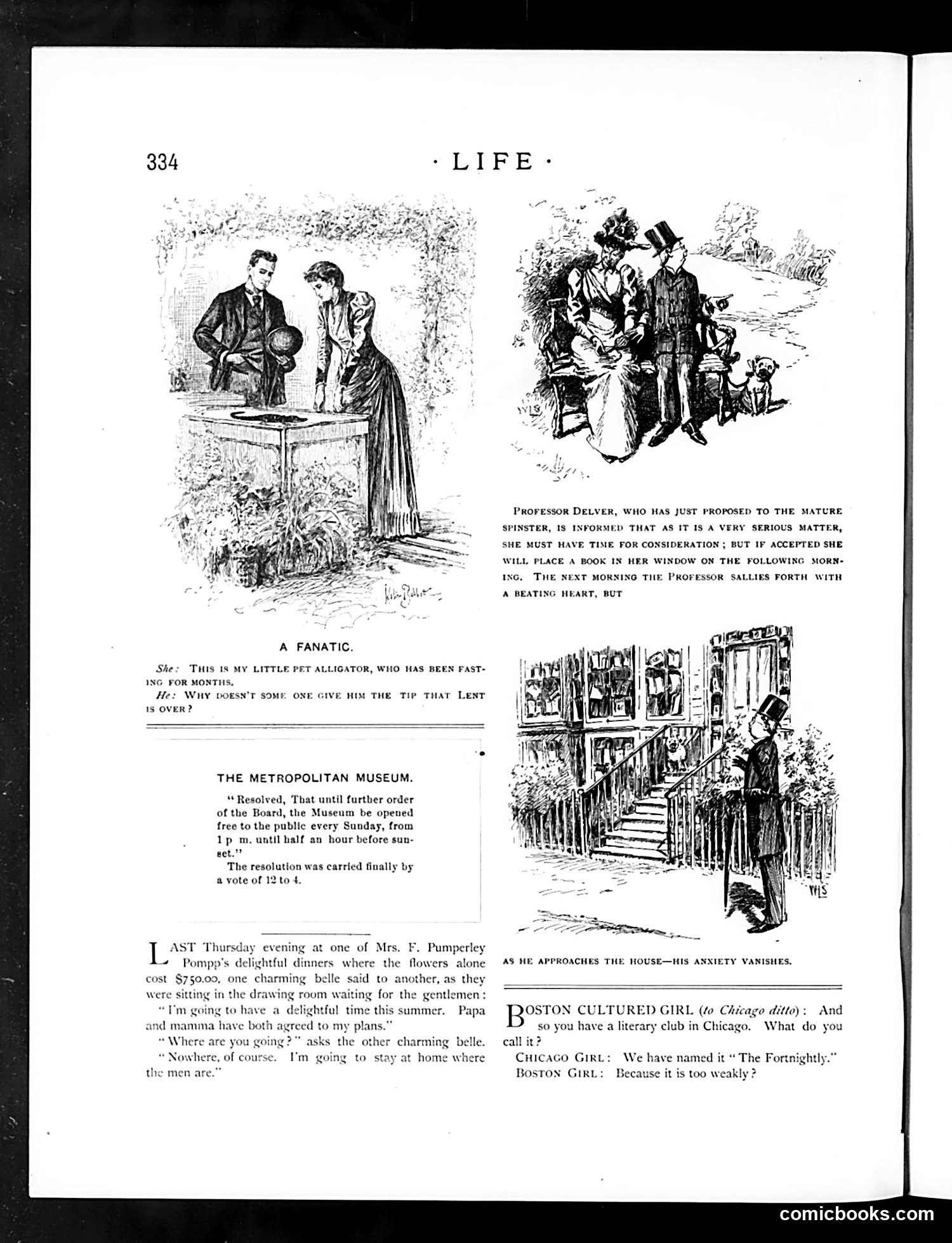
This page from *Life* magazine contains three separate satirical pieces: 1. **"A Fanatic"** (top left): A cartoon showing a woman who has been fasting for months asking a man why someone doesn't "give him the tip that Lent is over"—mocking extreme religious asceticism as unreasonable. 2. **"The Metropolitan Museum"** (middle): A brief note about a Board resolution to open the museum free to the public on Sundays until sunset, passed by a narrow 12-to-4 vote—suggesting contentious debate over public access. 3. **"Boston Cultured Girl" (bottom)**: A humorous exchange where a Boston girl's literary club names itself "The Fortnightly," which a Chicago girl mocks as "too weakly"—poking fun at pretentious East Coast intellectual circles and regional differences in American culture.
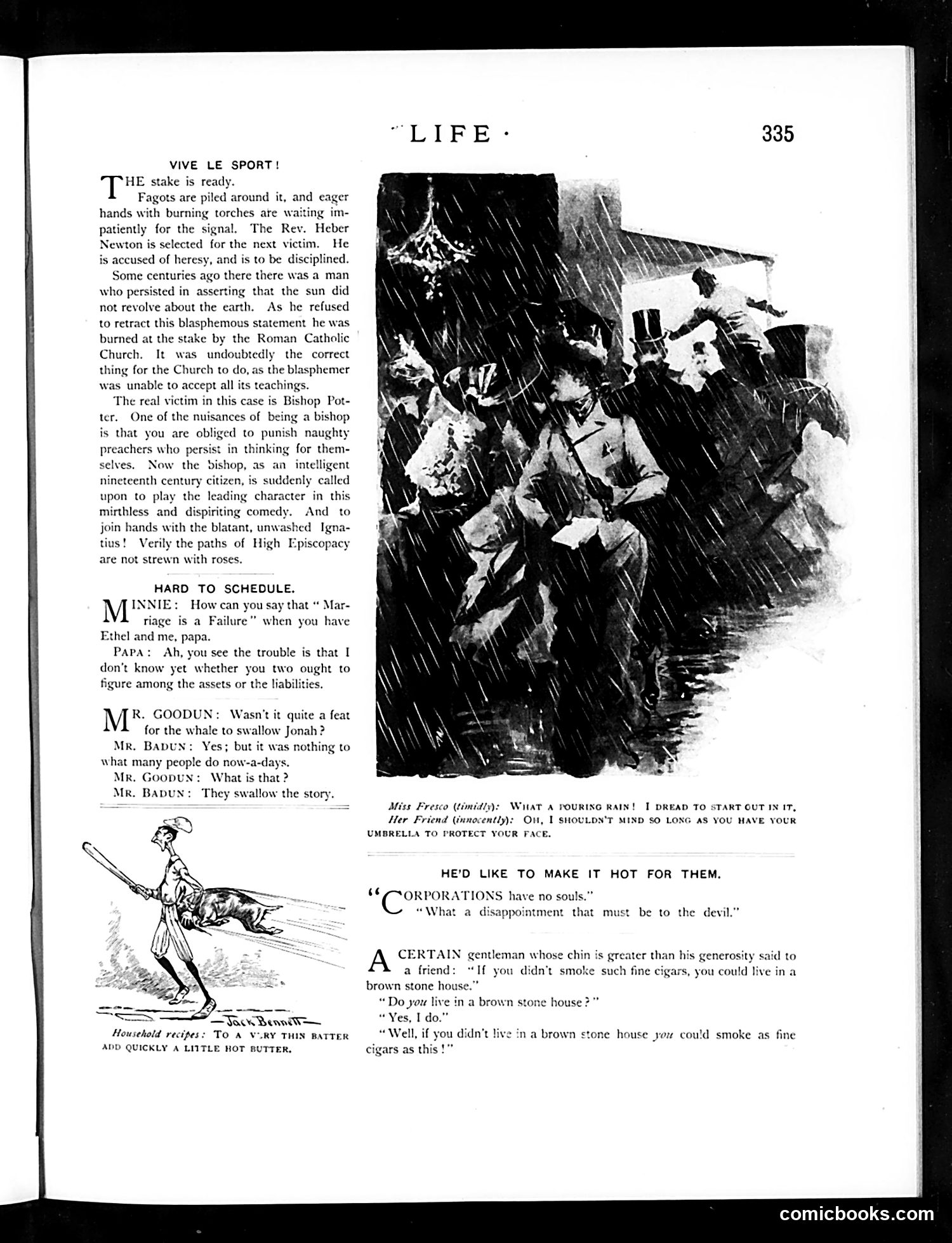
This page contains satirical sketches and humorous dialogue rather than political cartoons. The content includes: **"Vive Le Sport!"** — A narrative mocking religious hypocrisy, referencing Rev. Heber Newton accused of heresy, and Bishop Potter forced to discipline wayward clergy. The satire targets how the Church must discipline its own members. **"Hard to Schedule"** — A domestic comedy dialogue between Minnie, Papa, and others debating whether marriage constitutes "failure" and the difficulty of accounting for one's time. **Lower section** — A drawing captioned about batting technique, plus a brief joke about a gentleman living in a "brown stone house" and smoking cigars, with a quip about corporations lacking souls. The overall tone is light social satire rather than serious political commentary.
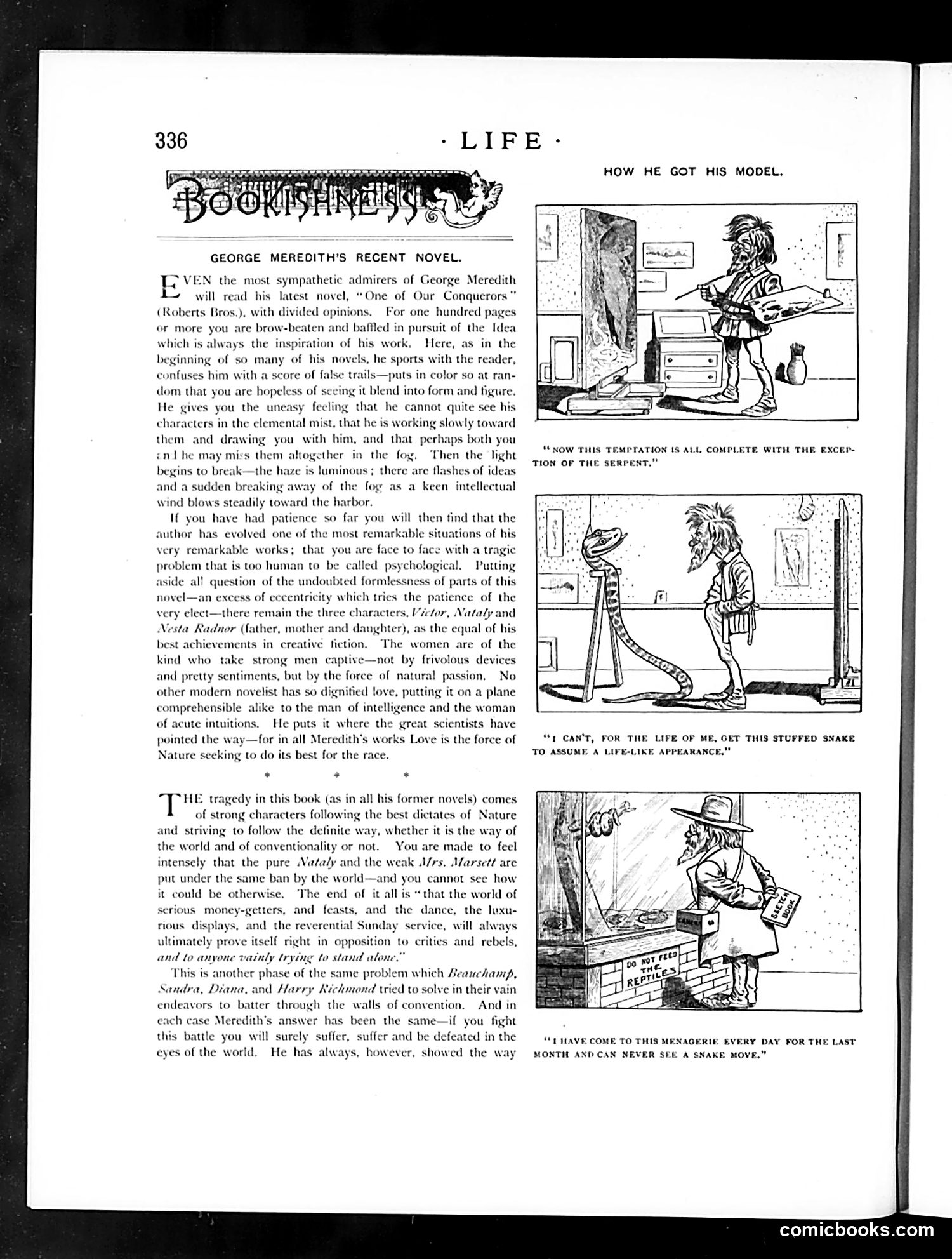
This page reviews George Meredith's recent novel "One of Our Conquerors" (Roberts Bros. publisher). The text criticizes the work for its complexity and false narrative trails that confuse readers, though it praises Meredith's exploration of psychological themes and love as a natural force. The three accompanying cartoons appear to illustrate scenes from the novel, showing character interactions. The captions suggest domestic or romantic situations: one mentions "temptation," another references "a stuffed snake," and the third alludes to a "messianic" visit and inability to see "a snake move." The satire critiques Meredith's writing style as deliberately obscure and overly complicated, making his narratives difficult to follow despite their intellectual merit.
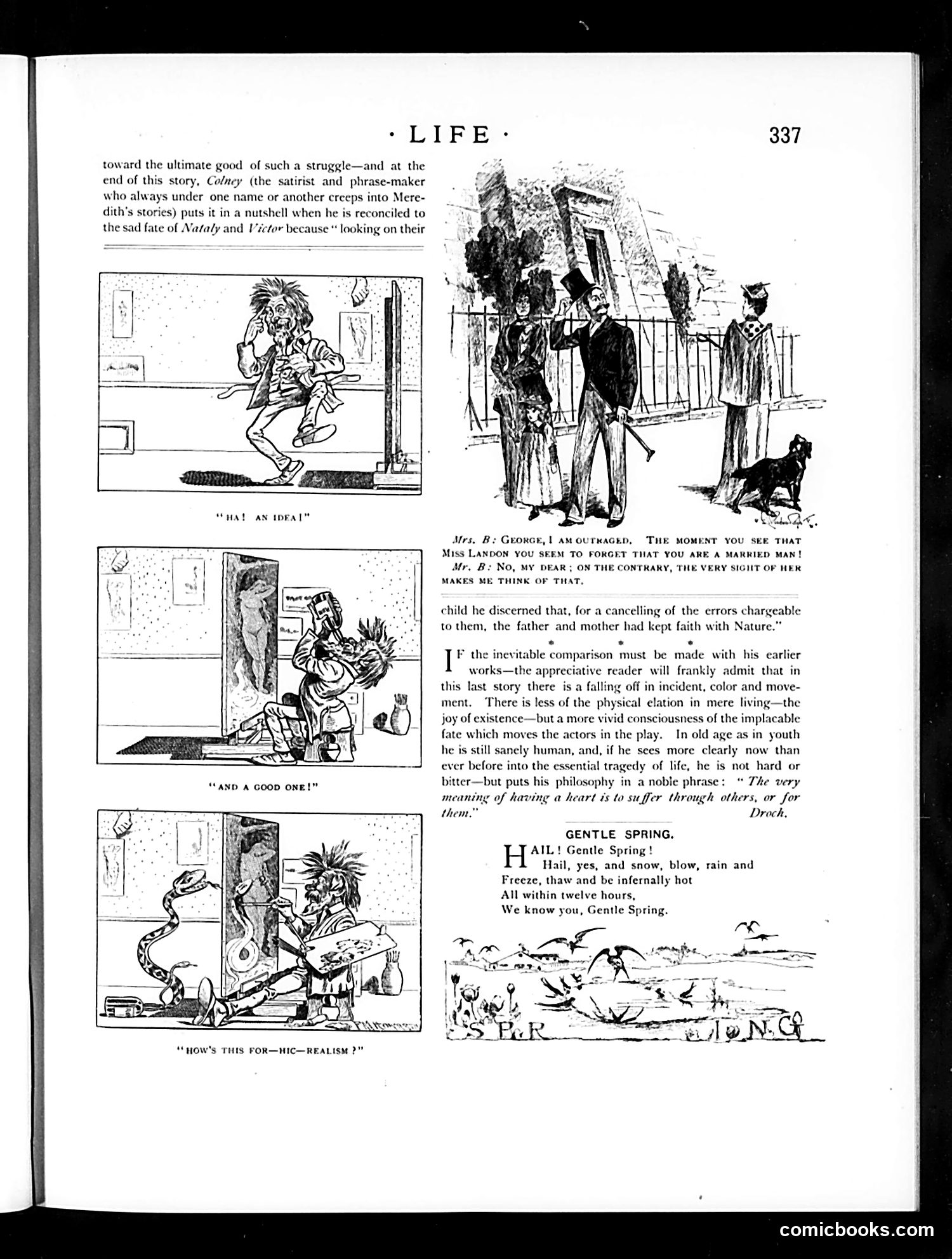
This page contains three untitled comic panels (top left) and a poem called "Gentle Spring" (bottom right). The three panels appear to be satirical vignettes mocking idealistic or absurd situations: 1. "Ha! An Idea!" - depicts someone having an excited revelation 2. "And a Good One!" - shows the idea being acted upon 3. "How's This For—Hic—Realism?" - suggests the idea's humorous or drunken conclusion The specific target of satire is unclear from the image alone, though the progression from inspiration to comic failure suggests mockery of impractical schemes or artistic pretension. The captions' tone indicates social or cultural satire typical of Life magazine's comedic approach. The "Gentle Spring" poem below offers seasonal verse unrelated to the cartoons.
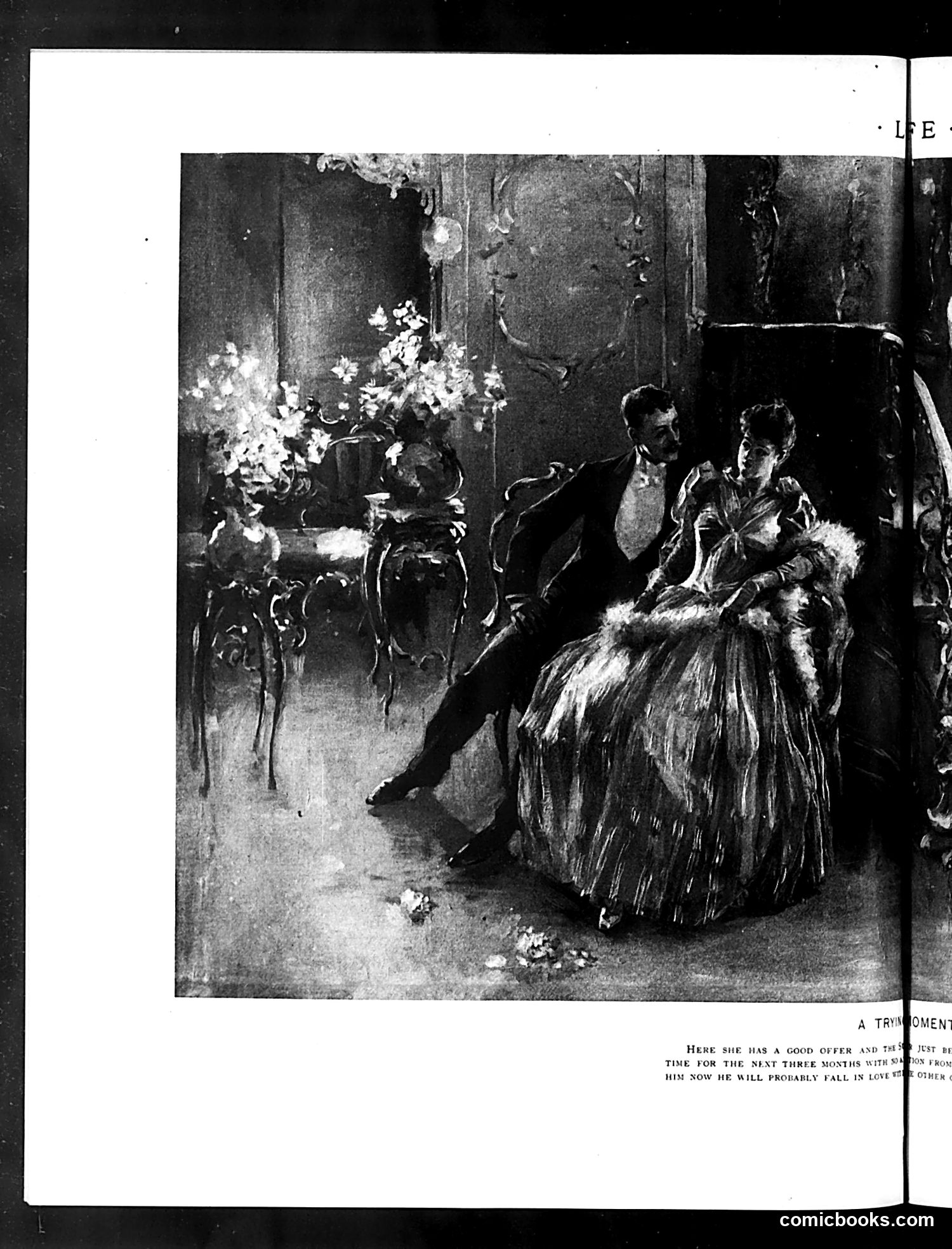
This appears to be a satirical scene depicting a marriage negotiation or proposal. The caption suggests a woman has received "a good offer" and is being advised to secure a commitment "for the next three months," with the cynical prediction that "he will probably fall in love with her" by then. The scene shows an elegantly dressed woman in a luxurious interior setting with floral arrangements, conversing with well-dressed men. The satire targets matrimonial customs of the period—specifically the transactional nature of courtship and marriage among the wealthy classes, where financial arrangements preceded genuine romantic attachment. The cartoon mocks both the calculated courtship strategies of the era and men's predictable susceptibility to feminine charm once commitment was formalized.
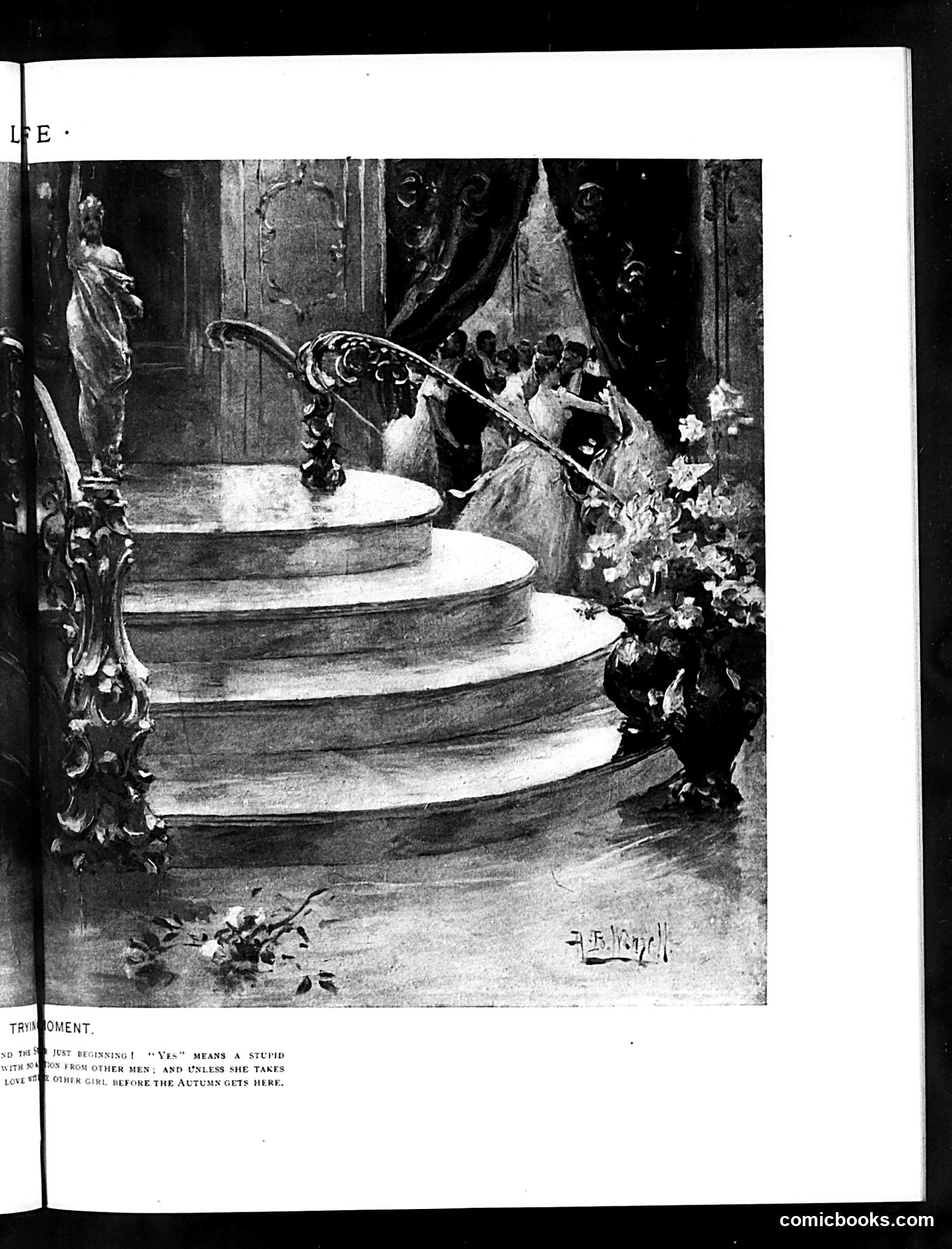
This appears to be a satirical illustration titled "Triumphant" showing a woman descending a grand staircase in an ornate interior, with other figures visible in the background. The incomplete OCR text references a woman saying "yes" to a marriage proposal, mentioning she must "take another girl before the autumn gets here." The satire likely critiques romantic competition or matrimonial maneuvering among society women. The triumphant woman descending the stairs suggests she has "won" in some romantic competition—possibly securing an engagement before a rival. The ornate classical setting and formal dress indicate this concerns upper-class courtship rituals. The humor appears to target the superficiality of society marriage market and women's strategic social positioning, typical of *Life* magazine's satirical commentary on Gilded Age social conventions.
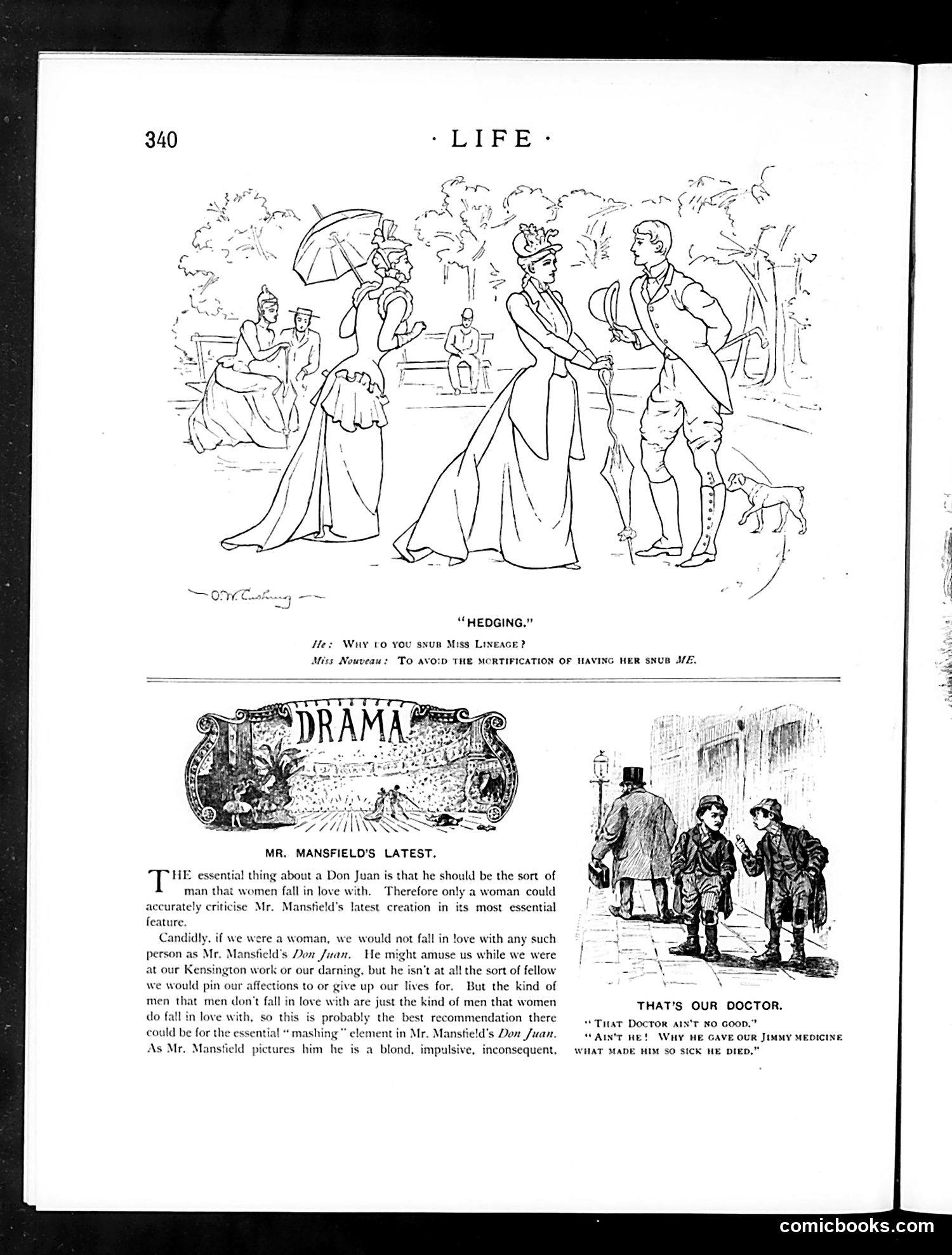
**Top Cartoon ("Hedging"):** A wealthy woman (Miss Nouveau, suggesting new money) explains she snubs men preemptively to avoid being snubbed herself—a defensive social strategy among the nouveau riche anxious about their social standing. **Drama Section:** Critiques actor Richard Mansfield's portrayal of Don Juan. The reviewer argues that while the character should attract women, Mansfield's blond, impulsive version lacks genuine seductive power—though this may paradoxically make him more appealing to actual women, who don't fall for the stereotypical "masher" types that men imagine. **Bottom Cartoon ("That's Our Doctor"):** Dark humor about a incompetent doctor whose medicine killed a child (Jimmy). The parent sarcastically defends him ("ain't no good"), implying the doctor is actually terrible but perhaps the parent is denying responsibility or the diagnosis was hopeless anyway. All three items satirize pretense, social anxiety, and self-deception among Gilded Age Americans.
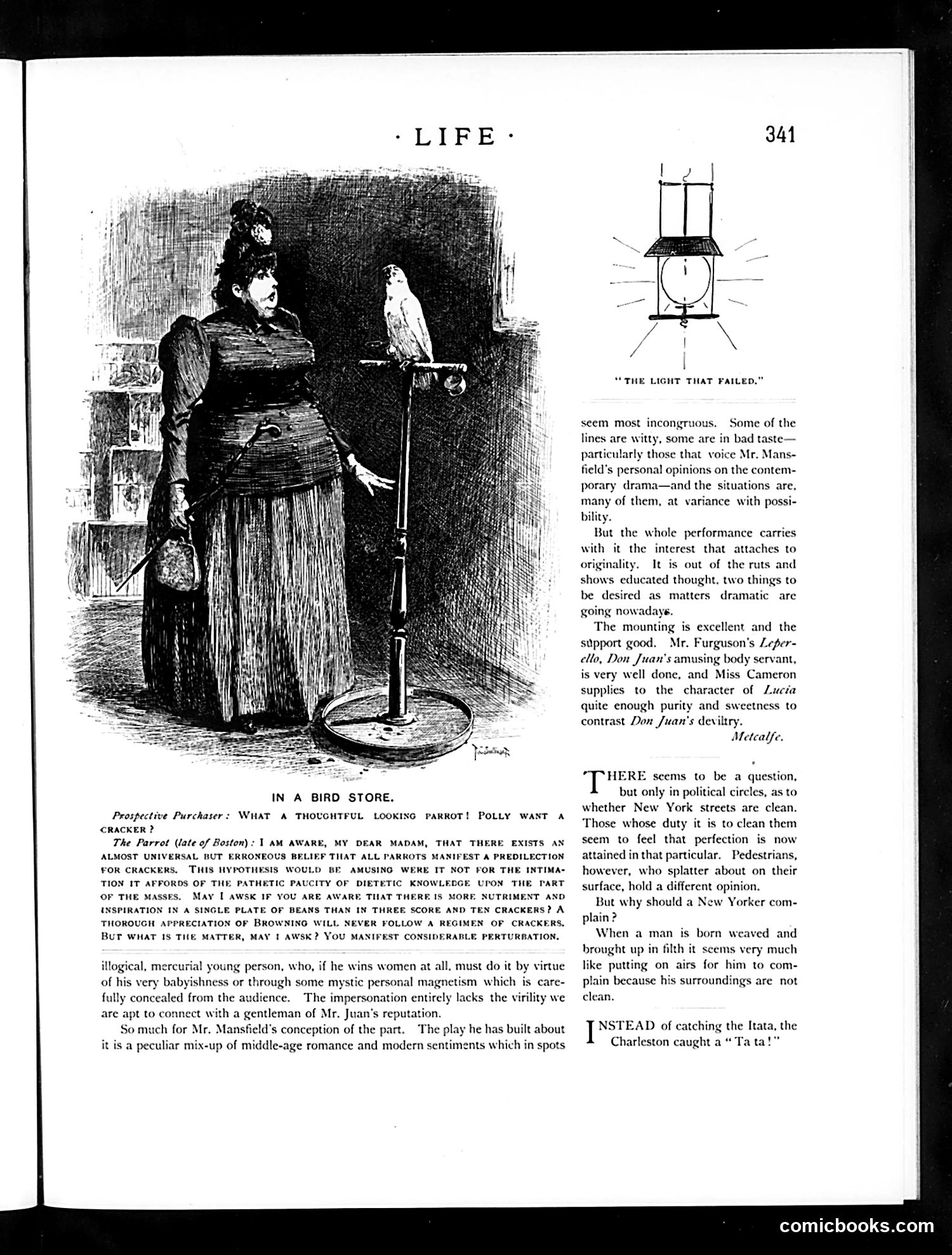
This page contains a satirical cartoon titled "In a Bird Store" that mocks pretentious intellectualism. A woman asks a parrot the conventional phrase "Polly want a cracker?" The parrot—identified as "late of Boston"—responds with a pompous lecture rejecting crackers as nutritionally inferior to beans, and insisting that appreciating poetry requires proper diet. The joke ridicules affected, pedantic speech and snobbish superiority, likely targeting Boston's reputation for intellectual pretension. The parrot's verbose disdain for common knowledge mirrors how intellectuals of the era displayed superiority through affected language. The page also contains theater reviews and a brief political comment about New York street cleanliness, unrelated to the cartoon. The overall tone is characteristic of *Life* magazine's satirical approach to social and cultural criticism.
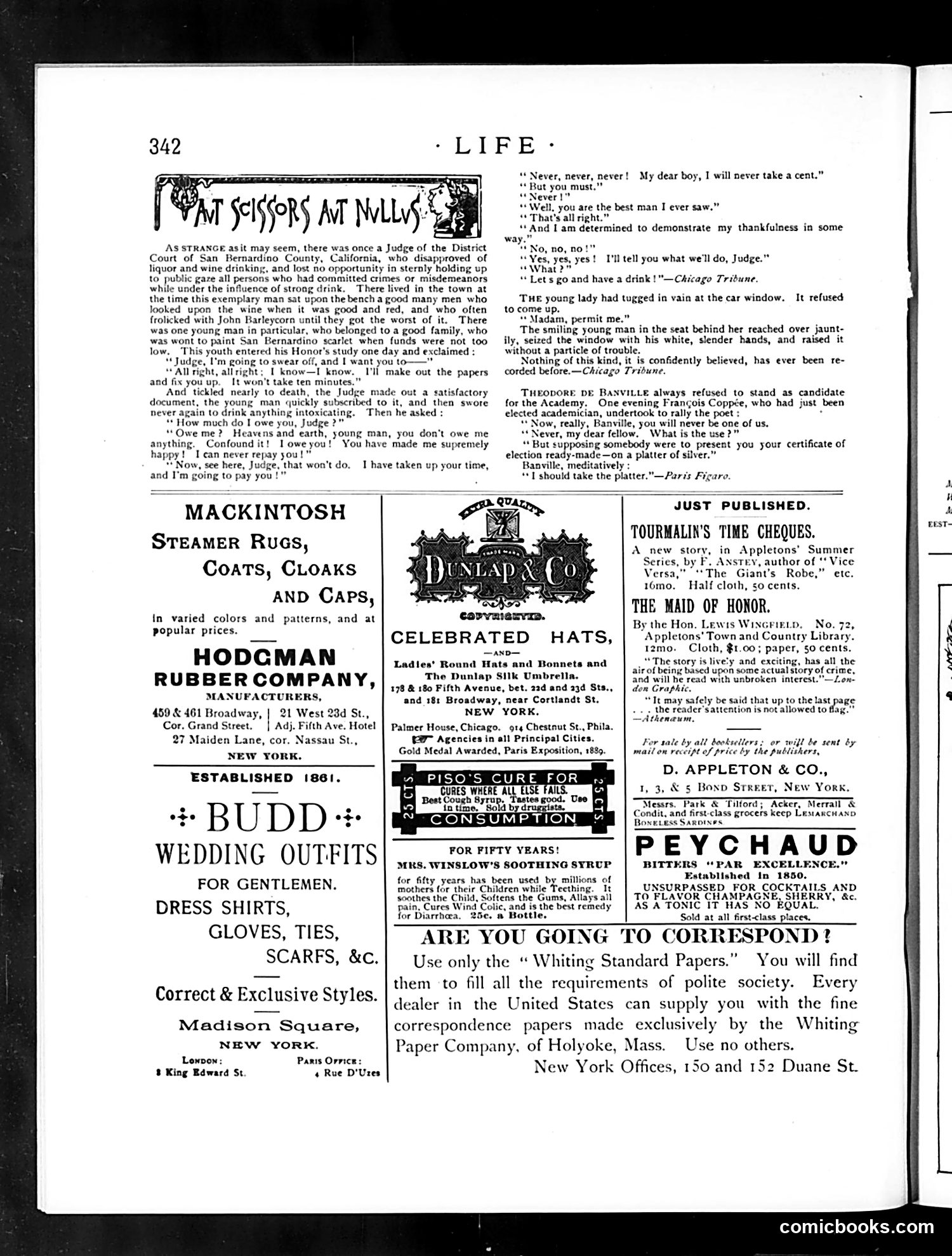
This page contains three satirical anecdotes, likely from the 1880s-90s, plus advertisements. **The cartoons:** The main story "At Scissors at Nully's" mocks temperance hypocrisy. A moralistic judge who publicly condemns drinking helps a young man swear off alcohol—then the young man celebrates by inviting the judge for a drink. The satire exposes the judge's obvious self-interest (he "never repay[s]" the favor) and suggests his temperance stance may be performative rather than principled. The second anecdote gently mocks gender roles: a young man helps a woman with a stuck car window, and the narrator sarcastically notes this gesture of male chivalry seems unprecedented—likely satirizing either exaggerated courtesy or women's helplessness. The third piece, about French poet Théodore de Banville, jokes that he cares more about material reward (the platter) than honors like Academy membership—mocking vanity disguised as principle. **Context:** These reflect late-19th-century concerns with moral hypocrisy, evolving gender dynamics, and artistic pretension.
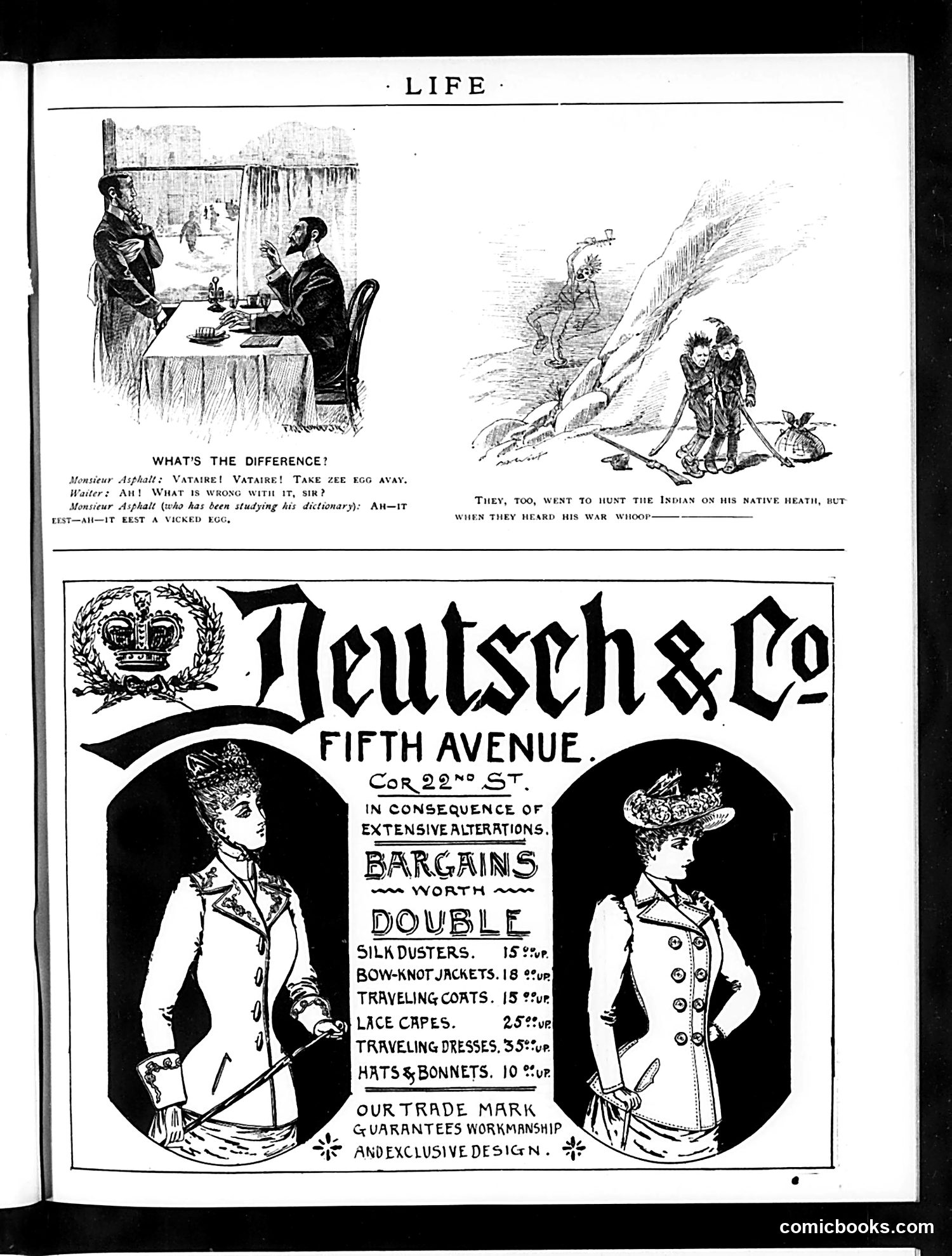
**Top Cartoon ("What's the Difference?"):** This satirizes French affectation and pretension. A Frenchman (Monsieur Asphalt) complains about an egg to a waiter in broken English, using exaggerated French pronunciation ("Vataire"). The joke's punchline appears to contrast civilized French dining complaints with Native Americans hunting—suggesting both situations involve similar crude behavior, undermining French superiority. The Frenchman's dictionary-studying implies his affected manner masks simple ignorance. **Bottom Section:** This is a department store advertisement for Deutsch & Co., located at Fifth Avenue and 22nd Street in New York. It advertises women's clothing (silk dusters, jackets, traveling coats, capes, dresses, hats, bonnets) at reduced prices due to "extensive alterations." The trade mark guarantees "workmanship and exclusive design." This is primarily commercial content rather than political satire.
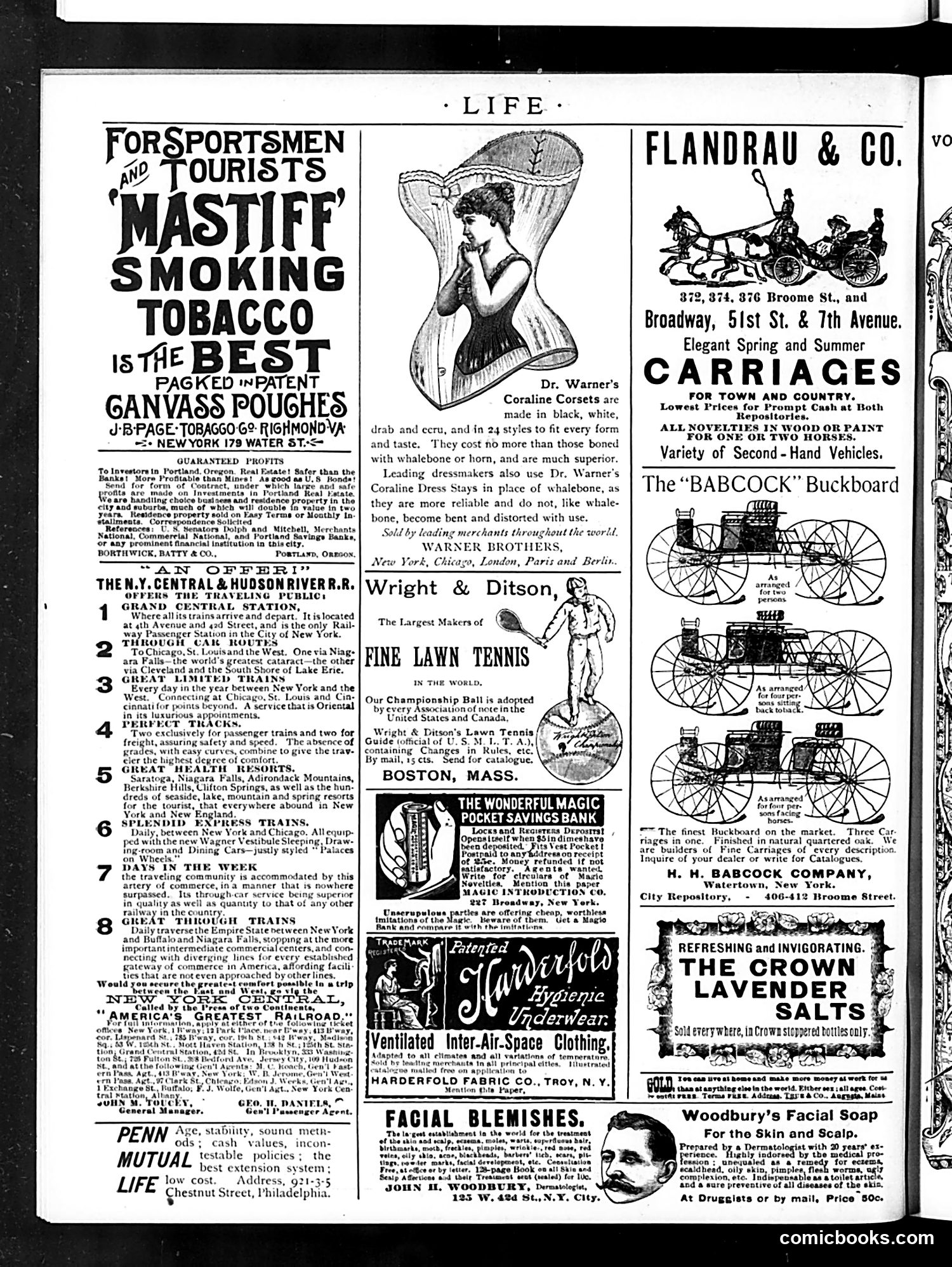
This is primarily an **advertising page** from Life magazine, not a satirical cartoon. It features various commercial advertisements typical of the late 19th century, including: - **Mastiff Smoking Tobacco** (top left) - **Dr. Warner's Coraline Corsets** (center) - **Flandrau & Co. Carriages** (top right) - **NY Central & Hudson River Railroad** (detailed listings of train service) - **Wright & Ditson Lawn Tennis** equipment - **Babcock Buckboard** vehicles - Various other products (corset stays, facial soap, underwear, savings banks) The page reflects the **consumer culture and transportation infrastructure of Gilded Age America**—advertising luxury goods, rail travel amenities, and patent medicines/fashion items popular with affluent audiences. There is **no political satire visible** on this page. Life magazine did publish satirical content, but this particular page is a straightforward commercial section showcasing products and services to its middle-to-upper-class readership.