
A complete issue · 16 pages · 1890
Life — October 2, 1890
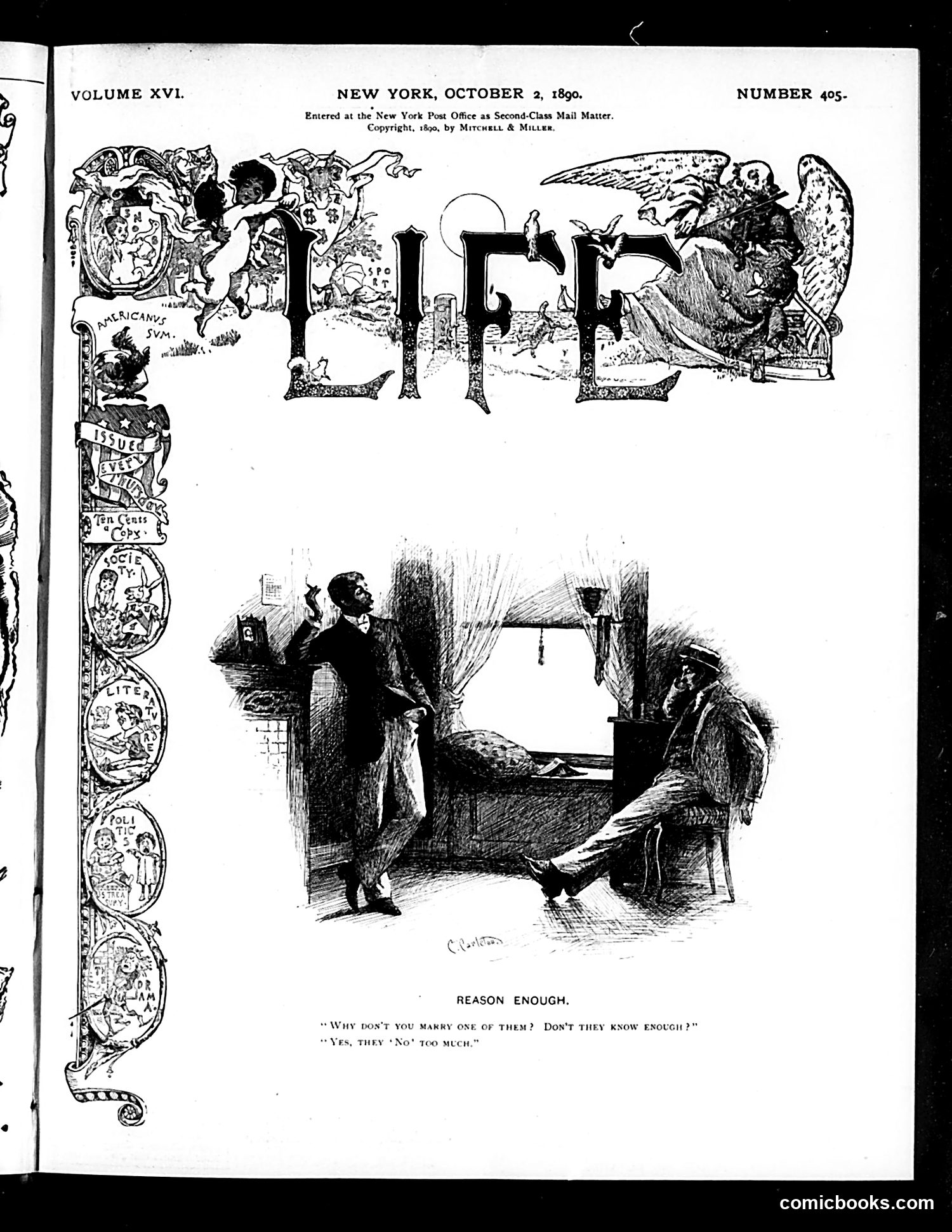
This cartoon satirizes bachelor resistance to marriage. A well-dressed man stands uncomfortably while a woman sits nearby in what appears to be a parlor. The dialogue reads: "Why don't you marry one of them? Don't they know enough?" to which he replies, "Yes, they 'No' too much." The joke plays on a double meaning: women know too much (are too educated or opinionated), but more directly, they say "no" excessively—perhaps to marriage proposals or to the man's advances. This reflects late-Victorian anxieties about educated women's independence and their ability to refuse unwanted suitors. The cartoon mocks bachelors' frustration with women's agency while seemingly sympathizing with their predicament.
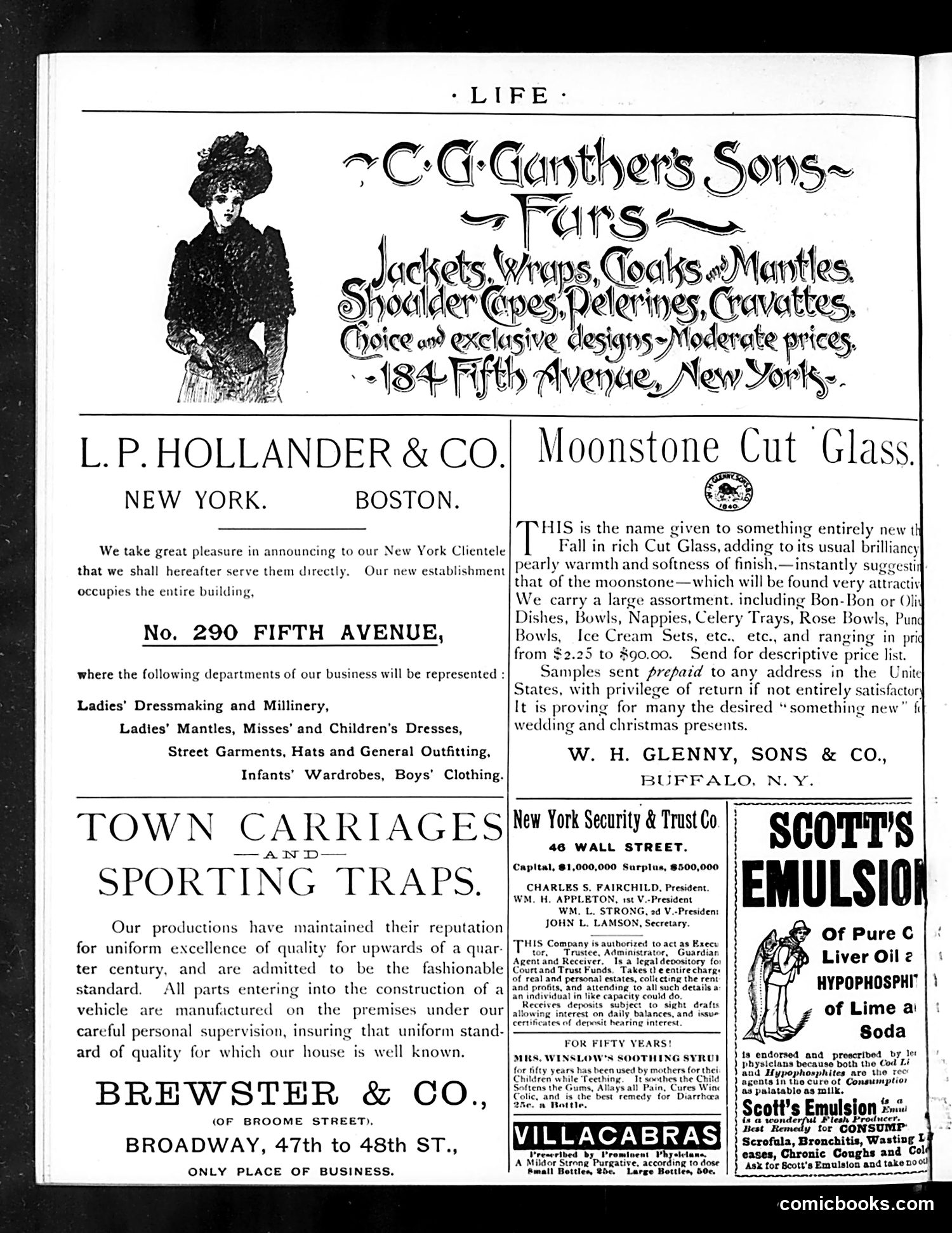
This page is **primarily advertising** from what appears to be an early 20th-century issue of Life magazine. The content includes: - **C.G. Ganthers Sons** advertisement for women's furs and cloaks at 184 Fifth Avenue - **L.P. Hollander & Co.** announcement of their New York dressmaking establishment at 290 Fifth Avenue - **Brewster & Co.** advertisement for town carriages and sporting traps (horse-drawn vehicles) - **Moonstone Cut Glass** by W.H. Glenny, Sons & Co. (Buffalo) - Various other commercial advertisements for financial services, medicinal products (Scott's Emulsion liver oil), and Villacabras cigars There are **no identifiable political cartoons or satirical commentary** visible on this page. It functions as a commercial advertising section rather than editorial content.
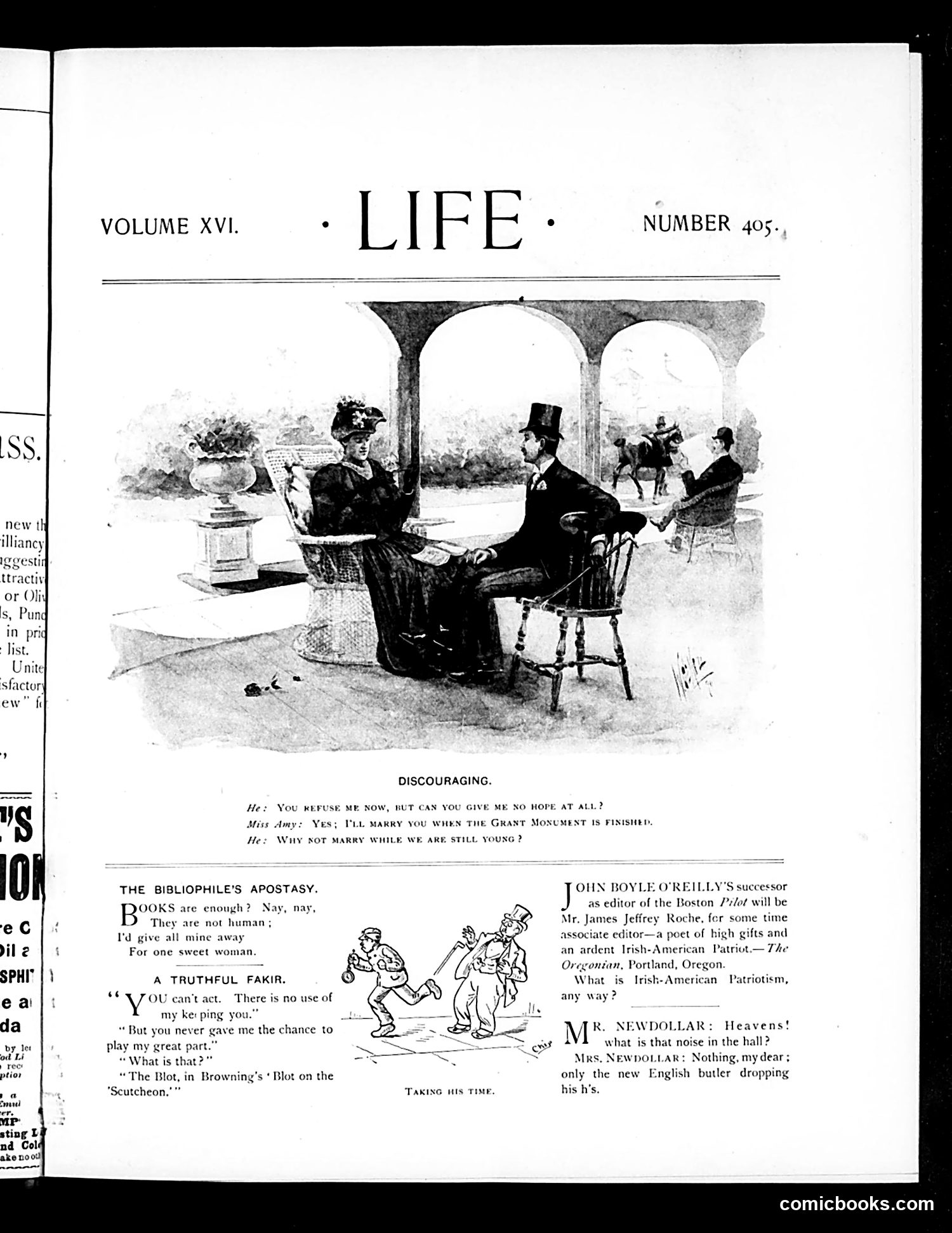
The main cartoon, titled "Discouraging," depicts a romantic scene beneath an archway where a man in a top hat proposes to a woman. She refuses, saying she'll marry him only when "the Grant Monument is finished." He protests that this offers "no hope at all," and asks why they can't marry while young. This satirizes the prolonged construction of the Grant Monument in New York City—a project notorious for delays and cost overruns in the late 1800s. The joke suggests the monument's completion is so perpetually distant that using it as a condition for marriage is practically refusing him. The lower section contains brief humorous pieces unrelated to the main cartoon.
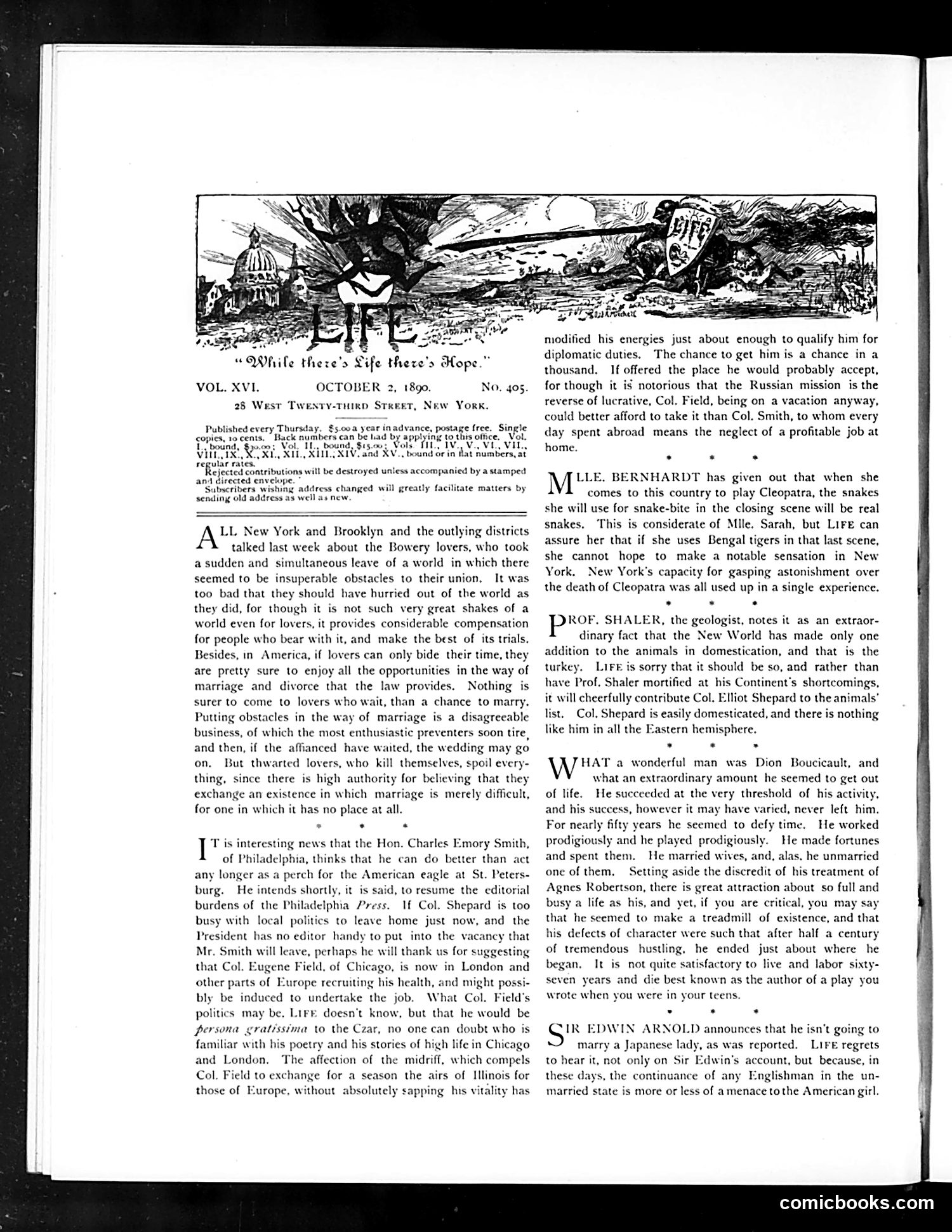
The masthead cartoon at top depicts a chaotic scene with classical and modern elements colliding—appearing to satirize the contrast between Old World culture and New World chaos. The imagery suggests commentary on American society's relationship with European refinement. The text discusses several topics typical of Life's satirical approach: marriage and divorce among New York's elite, the impracticality of romantic love, and various society figures. Notably, it mentions Hon. Charles Emory Smith's editorial role at the Philadelphia *Press*, Dion Boucicault (a famous 19th-century dramatist), and Sir Edwin Arnold's rumored engagement to a Japanese woman—which Life treats skeptically, suggesting xenophobic attitudes of the era about "Englishmen in the unmarried state" being a "menace to the American girl." The overall tone mocks both upper-class pretensions and contemporary anxieties about foreign influence.
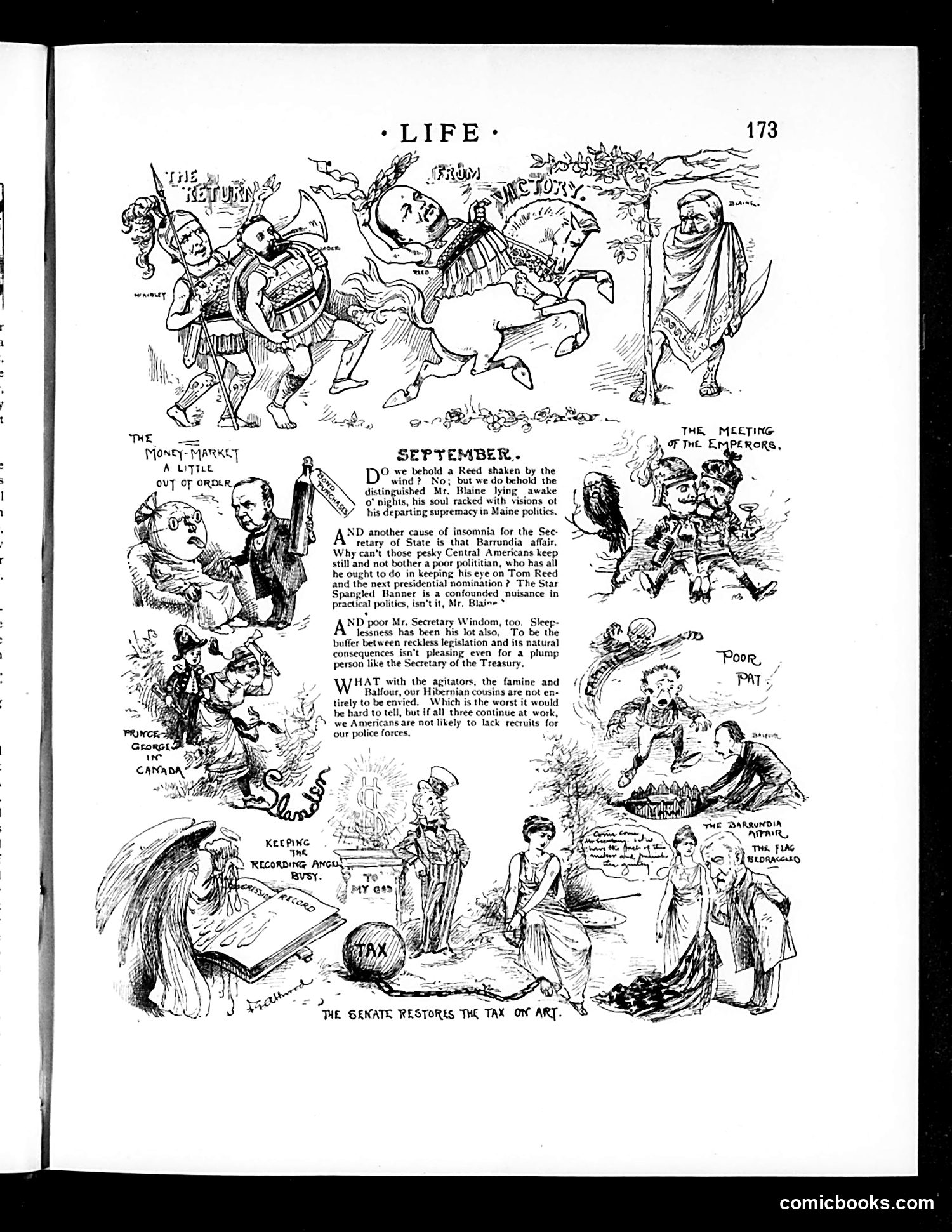
This page satirizes September 1903 American politics through multiple cartoons. The text discusses the Blaine-Spooner disagreement in Maine politics, critiques Secretary of State Hay and Secretary of the Treasury Shaw, and references agitators, famine, and the Hibernian question. The cartoons employ exaggerated caricatures mocking political figures and their controversies. "The Money-Market" cartoon appears to lampoon financial/political corruption. "The Senate Restores the Tax on Art" (bottom) depicts the Senate as an angel keeping watch over taxation policy. The overall theme criticizes incompetence and infighting among Republican officials while satirizing their responses to economic and social issues. Without identifying specific individuals with certainty, the page reflects Turn-of-the-Century Progressive Era skepticism toward political establishment.
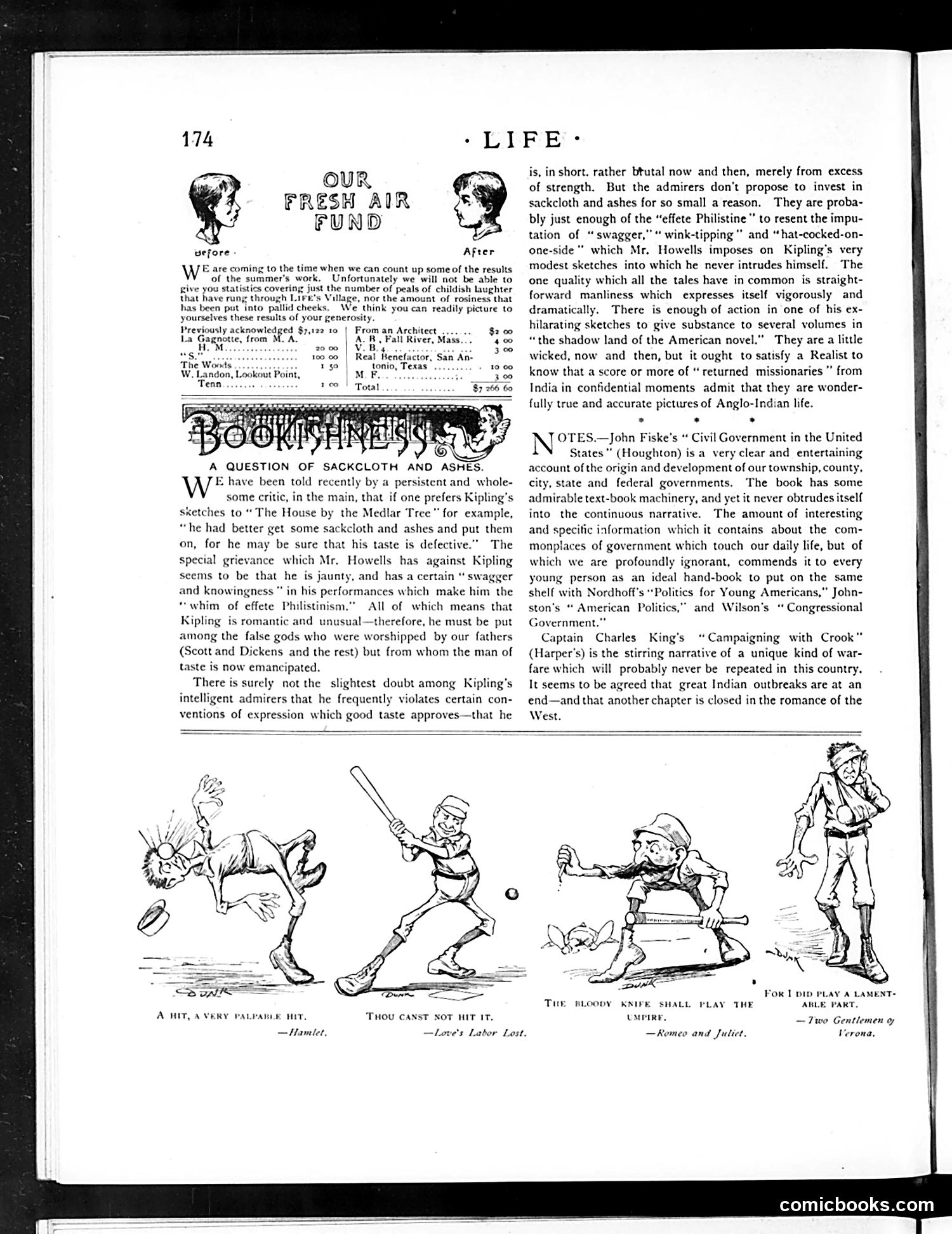
This page contains **two distinct sections**: 1. **"Our Fresh Air Fund"** - A charity appeal soliciting donations for children's outings, with a before/after illustration showing a child's improvement from fresh air exposure. 2. **"A Question of Sackcloth and Ashes"** - A literary critique discussing Rudyard Kipling's sketches, particularly "The House by the Medlar Tree." The reviewer criticizes Kipling for excessive "swagger" and romanticized language, arguing his work violates good taste conventions, though acknowledging his vivid storytelling. 3. **Four baseball-themed illustrations** with Shakespeare quotations, appearing to be humorous commentary comparing baseball plays to dramatic scenes (Hamlet, Lord's Labor Lost, Romeo and Juliet, Two Gentlemen of Verona). The page primarily serves literary and social commentary rather than political satire.
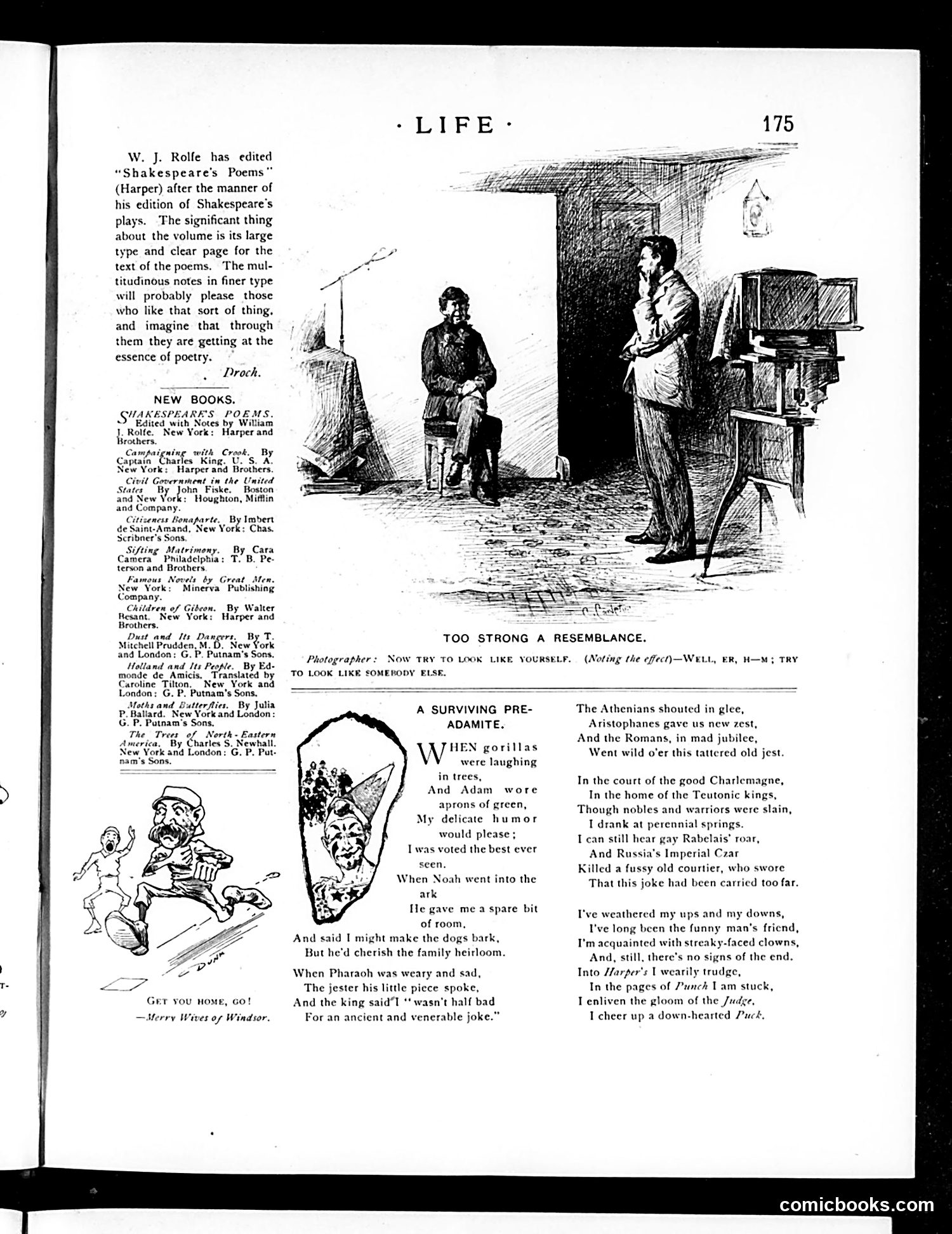
This page contains two distinct satirical elements: **Top cartoon ("Too Strong a Resemblance"):** Shows a photographer directing two men to pose. The caption jokes about one man being instructed to "look like yourself" while trying to avoid resembling "somebody else"—a visual gag about difficult photography or perhaps about physical similarity causing social awkwardness. **Bottom section ("A Surviving Pre-Adamite"):** A poem-and-illustration piece about a jester or fool character who has survived through history, from biblical times (Noah's ark, Pharaoh) through classical antiquity (Romans, Greeks) to modern era. The accompanying cartoon shows a comical fool figure. It's a humorous meditation on how foolishness and jesters persist eternally across civilizations—a timeless satirical observation about human nature.
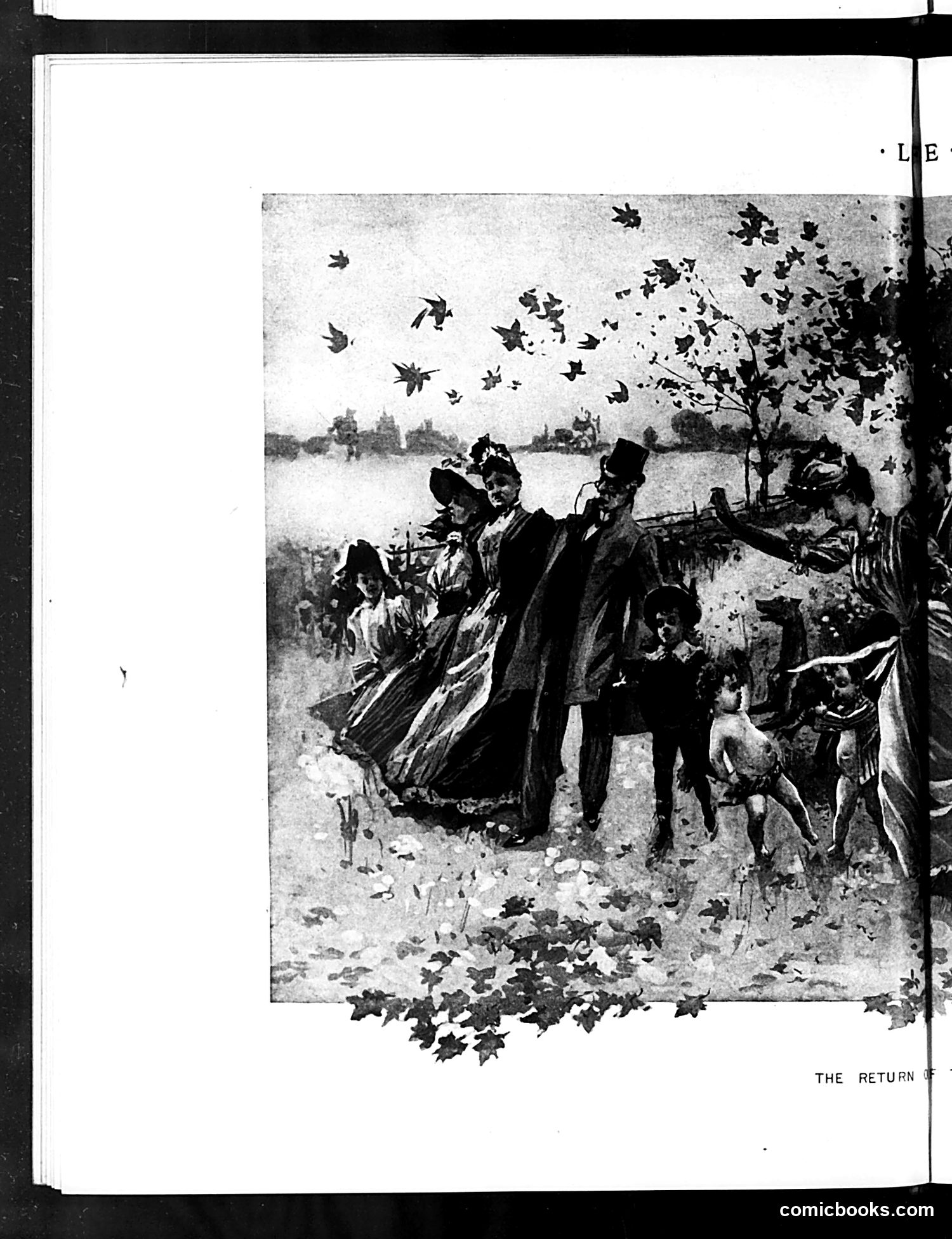
This black and white illustration depicts a Victorian-era scene by a riverbank, titled "The Return." A well-dressed gentleman in a top hat stands with several women and children in period clothing. Decorative leaf motifs frame the image. Without additional context from the page's text or surrounding content, the specific satirical meaning remains unclear. The scene could reference a literary work, social commentary about class dynamics, or a commentary on romantic entanglements typical of Life magazine's satirical humor. The gentleman's formal attire contrasts with what appears to be a domestic or family situation, possibly suggesting irony about propriety, infidelity, or return from travel. The exact political or social point eludes identification without the article's accompanying text.
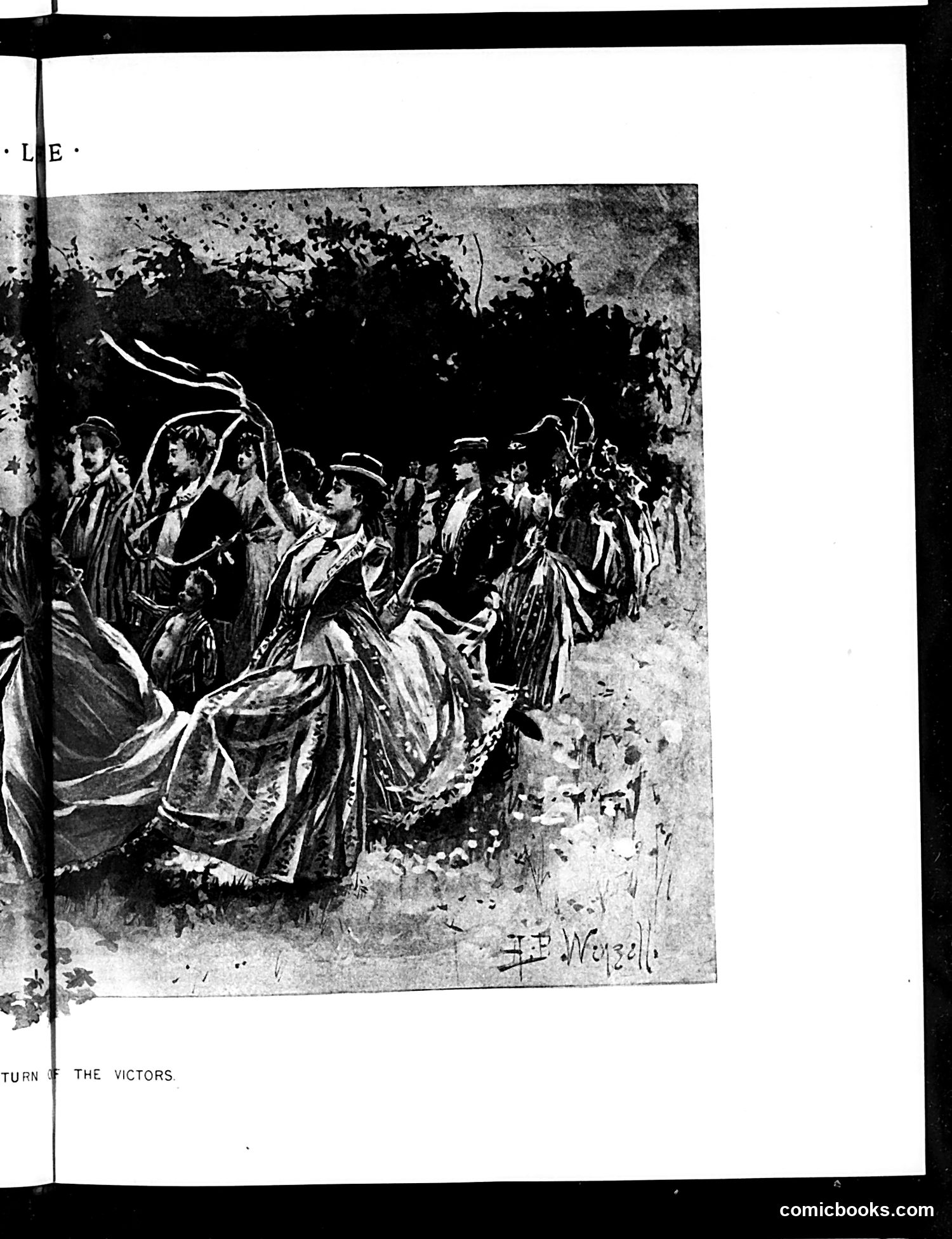
This appears to be a satirical illustration by E. Worsell showing a procession of figures in period costume (likely 18th or 19th century dress) processing through what seems to be a cave or dark passage. The caption "Turn of the Victors" suggests this depicts victorious political or military figures. Without additional context from the magazine issue, the specific identities and contemporary references remain unclear. The formal dress, procession format, and dark setting suggest this may be commenting on political power transfer or triumph, possibly mocking the self-importance or theatrical nature of victorious political figures. The satirical style typical of *Life* magazine suggests social or political commentary, but the precise historical event being referenced cannot be definitively determined from the image alone.
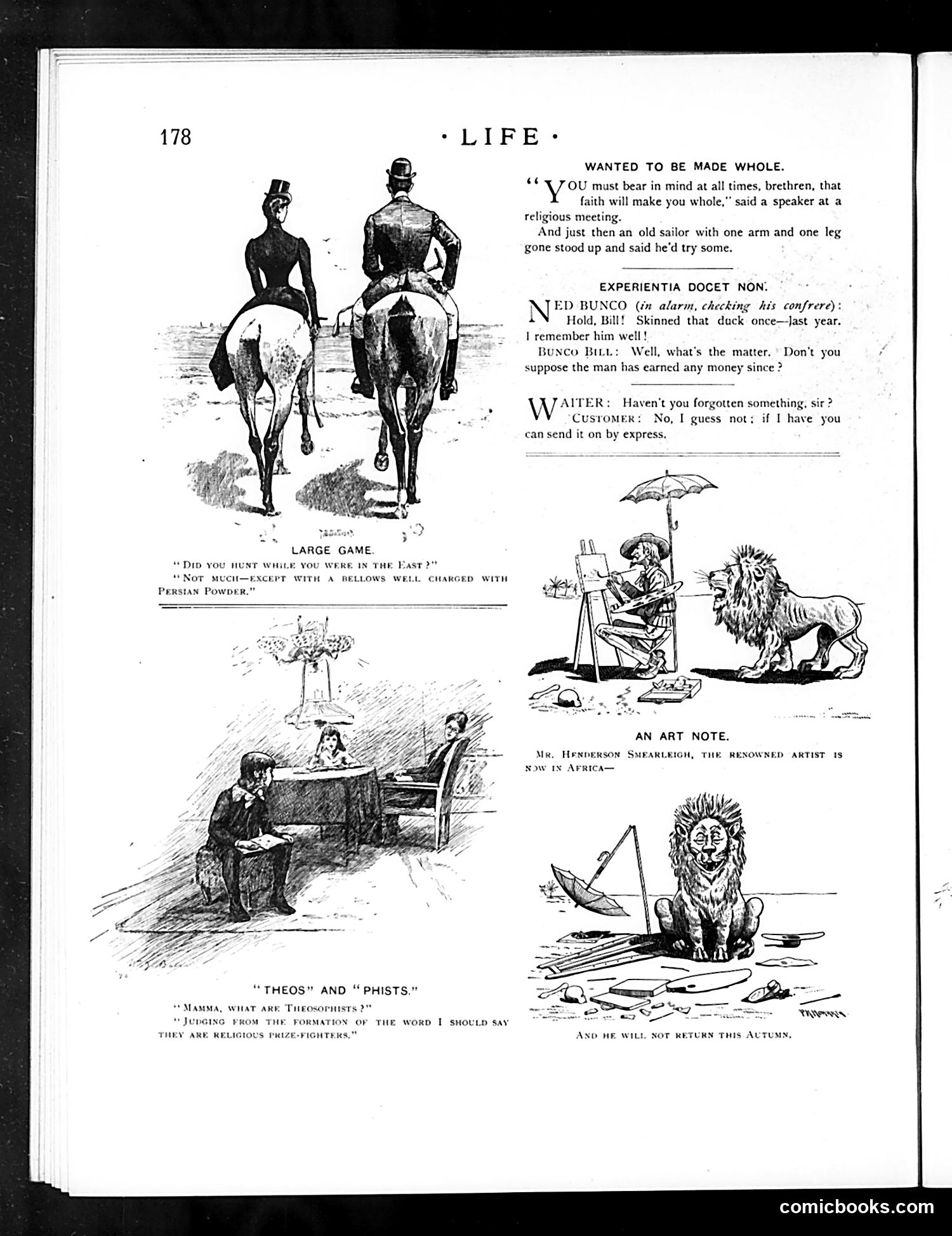
This page contains several unrelated satirical sketches typical of Life's humor format: 1. **"Large Game"**: Two riders on horseback discuss hunting in the East with "Persian Powder"—likely mocking British imperial hunting expeditions and exotic weaponry. 2. **"Experientia Docet Non"**: A dialogue between Ned Bunco and Bill about unpaid earnings, satirizing financial hardship or unreliable debtors. 3. **Waiter/Customer exchange**: A brief joke about forgotten items and express delivery service. 4. **"Theos" and "Phists"**: A mother asks about theosophists; the reply puns on "theos" (God) and "phists," calling them "religious prize-fighters"—mocking Theosophy as a pretentious spiritual movement. 5. **"An Art Note"**: Sarcastically notes artist Henderson Shearleigh's African sojourn, with an illustration of a lion artist who "will not return this autumn"—dark humor about colonial adventures.
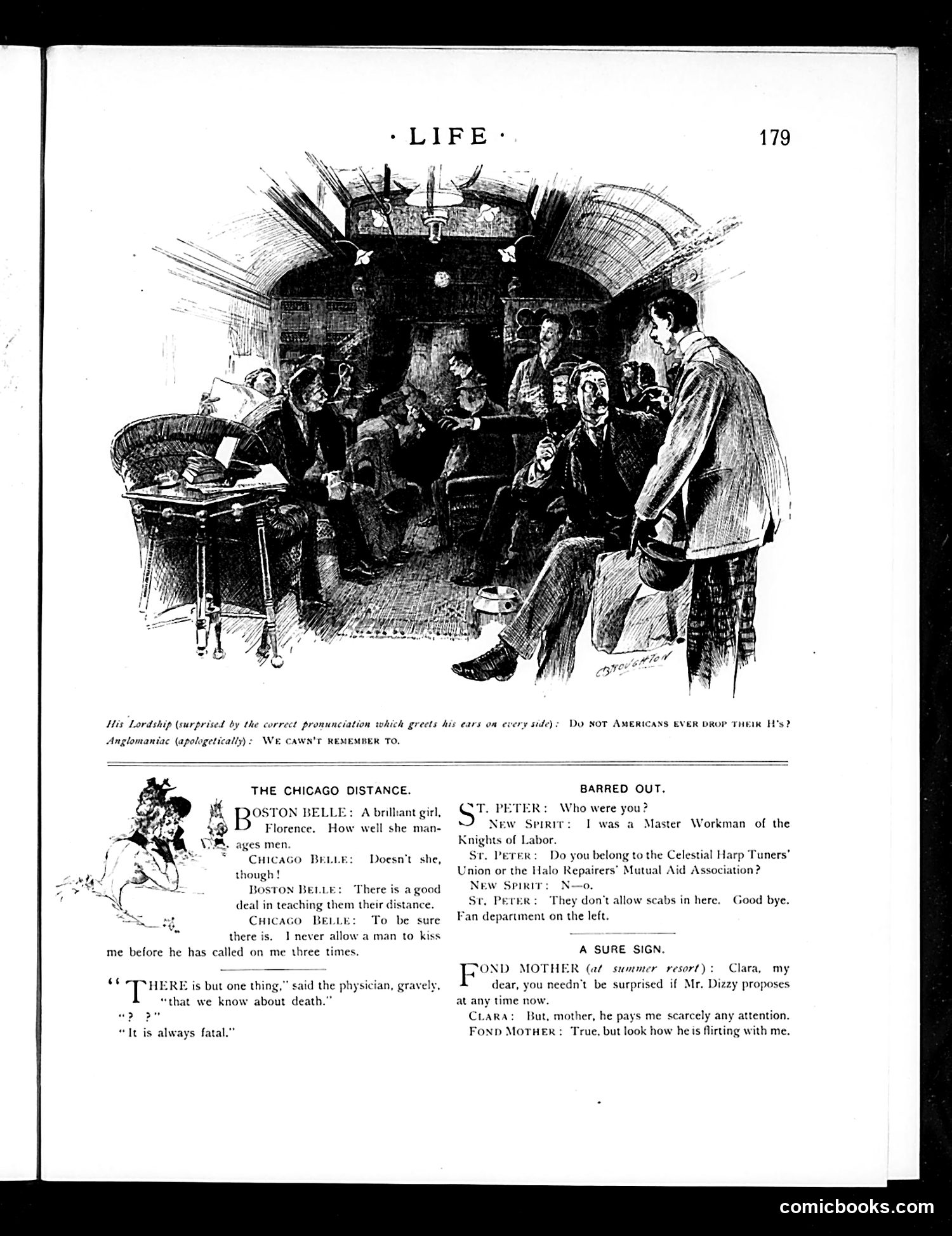
The main illustration depicts a crowded interior scene, likely a saloon or bar, with working-class figures engaged in conversation. The caption jokes about American pronunciation of "H's"—a common ethnic stereotype about immigrants dropping the letter H from speech (a trait associated with certain accents). Below are three separate humorous sketches: 1. **"The Chicago Distance"**: A Boston woman boasts about teaching men proper manners, establishing rules about kissing etiquette. 2. **"Barred Out"**: A labor union worker is rejected entry somewhere, satirizing union exclusivity and sectarian divisions. 3. **"A Sure Sign"**: A mother observes a man flirting with her daughter, interpreting it as a marriage proposal imminent. These appear to be general humor pieces about contemporary social customs and class dynamics rather than specific political commentary.
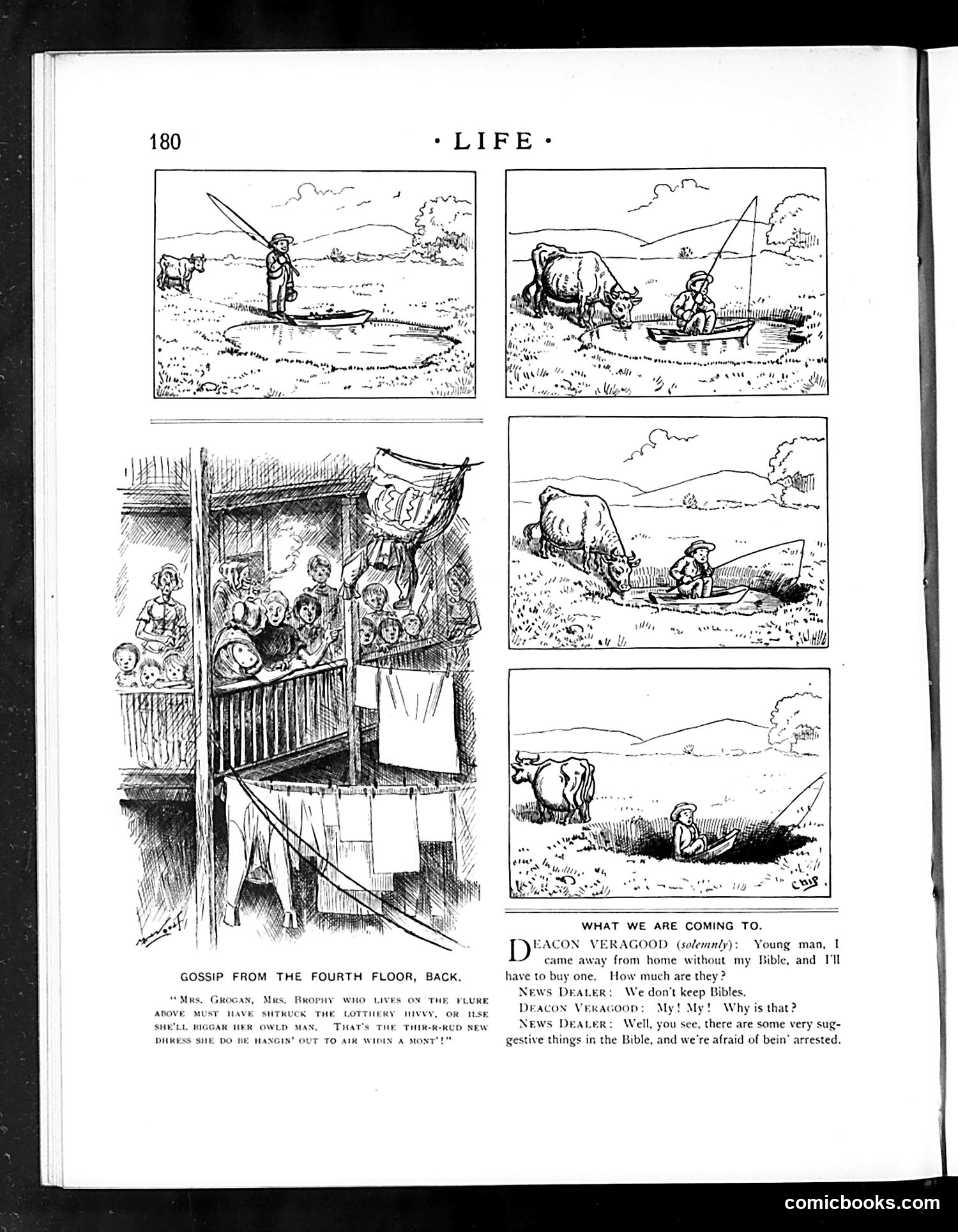
This page contains two satirical pieces mocking social anxieties of the era. **Top left ("Gossip from the Fourth Floor, Back"):** Working-class women gossip in Irish dialect about a neighbor's newfound wealth, suspecting she either won the lottery or is cheating on her husband—evidenced by her buying three new dresses. The satire mocks both class assumptions about sudden prosperity and the petty surveillance culture of tenement living. **Bottom right ("What We Are Coming To"):** A deacon seeks to buy a Bible but a news dealer refuses to stock them, claiming the Bible contains "suggestive things" risking arrest. This satirizes the era's obscenity concerns and censorship panic, where even religious texts faced suppression under broad "morality" laws. The joke highlights the absurdity of banning the Bible itself as potentially indecent.
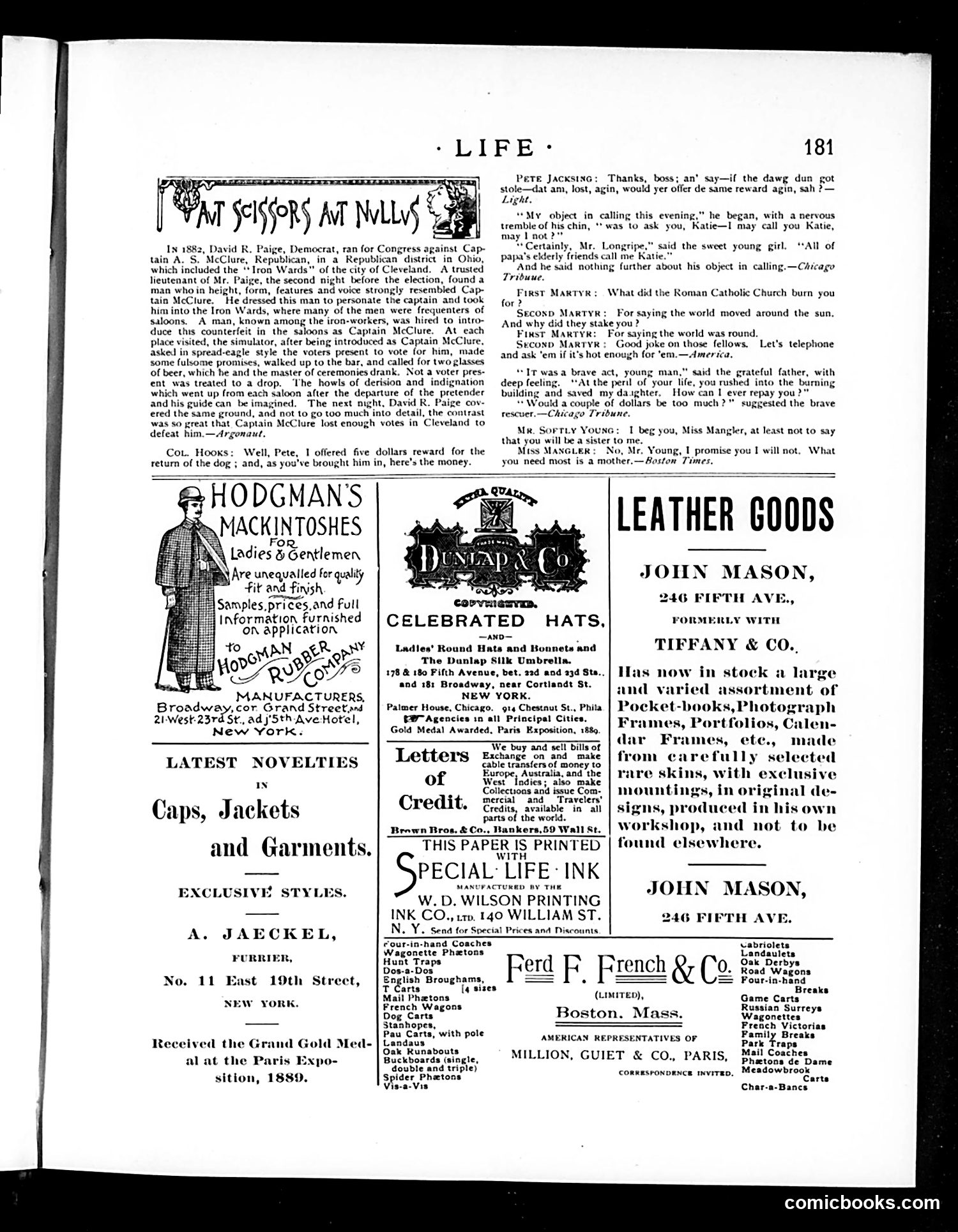
This page is primarily **advertisements and brief satirical anecdotes** rather than a political cartoon. The main content includes humorous short pieces, such as: - A story about an 1880 Ohio election where a Democratic operative hired a lookalike to impersonate Republican Captain McClure, having him buy no drinks for voters—the deception backfired spectacularly when the real McClure later visited, creating such contrast he lost the election. - A joke about two historical martyrs debating whether Galileo or Copernicus had it worse (one burned for heliocentrism, one for heliocentricity), making light of religious persecution of scientists. - Romantic comedies in brief form about a stammering suitor and a young man's failed proposal. The advertisements (Hodgman's mackintoshes, Dunlap hats, John Mason leather goods) occupy significant space. The note at bottom explains the paper uses "Special Life Ink" by W.D. Wilson Printing Ink Co. This represents typical **turn-of-century American magazine content**: light satire mixed with commercial announcements.
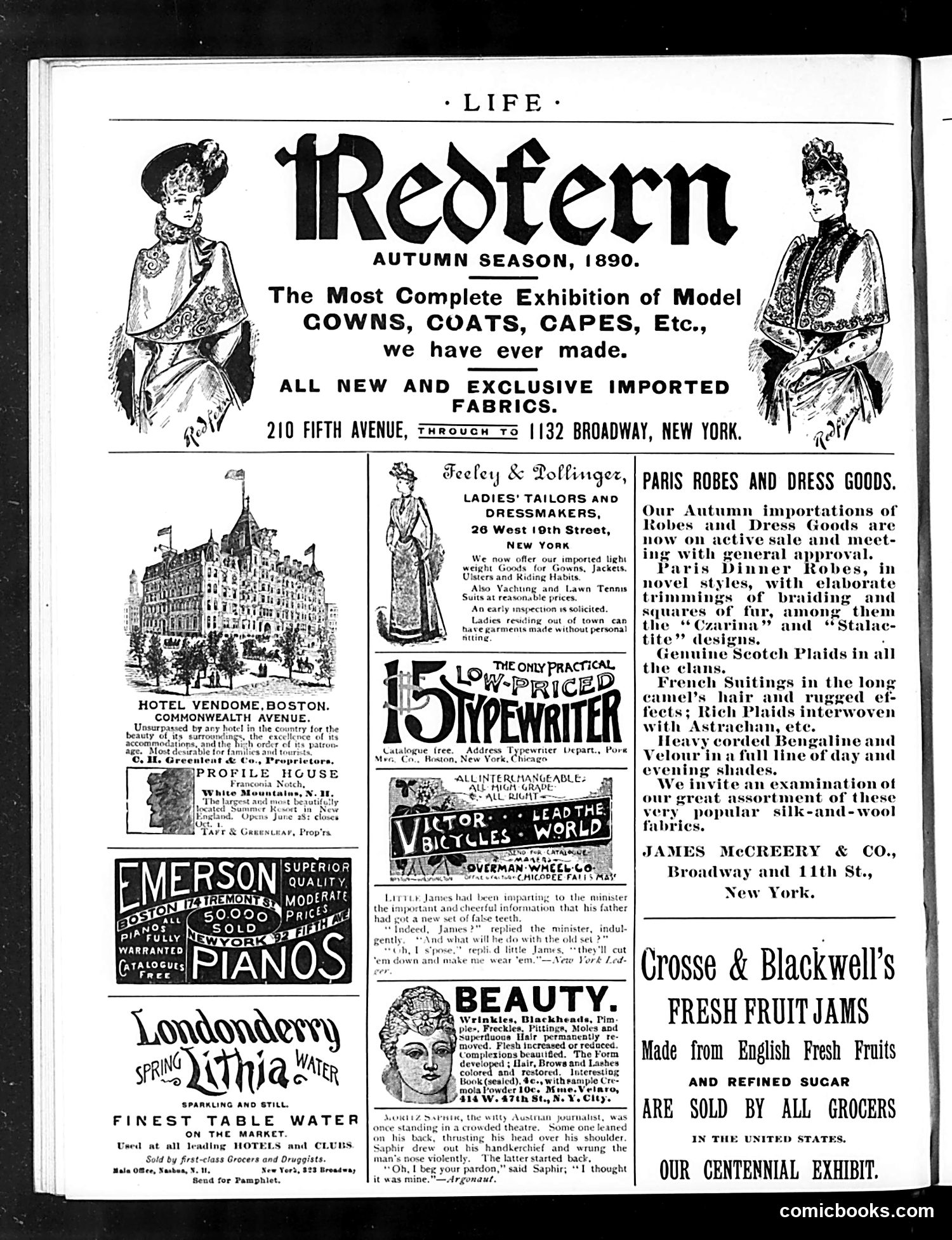
This is primarily a **advertisements page** rather than editorial content or political satire. The page promotes luxury goods typical of 1890s New York high society: fashionable women's clothing (Redfern gowns, Paris robes, tailored suits), pianos, typewriters, beauty products, and imported foods. The small illustrated anecdote about "Saphir" (bottom center) is a humorous aside: a man wrings out his handkerchief in a crowded theater, then apologizes, claiming he thought it was his own—a mild joke about absent-mindedness or social awkwardness. The illustrated female figures wearing elaborate 1890s dress serve as fashion models showcasing the season's styles. This reflects the era's emphasis on conspicuous consumption and women's fashion as status markers. There is **no political satire** evident on this page—it represents straightforward commercial advertising aimed at wealthy, urban audiences.
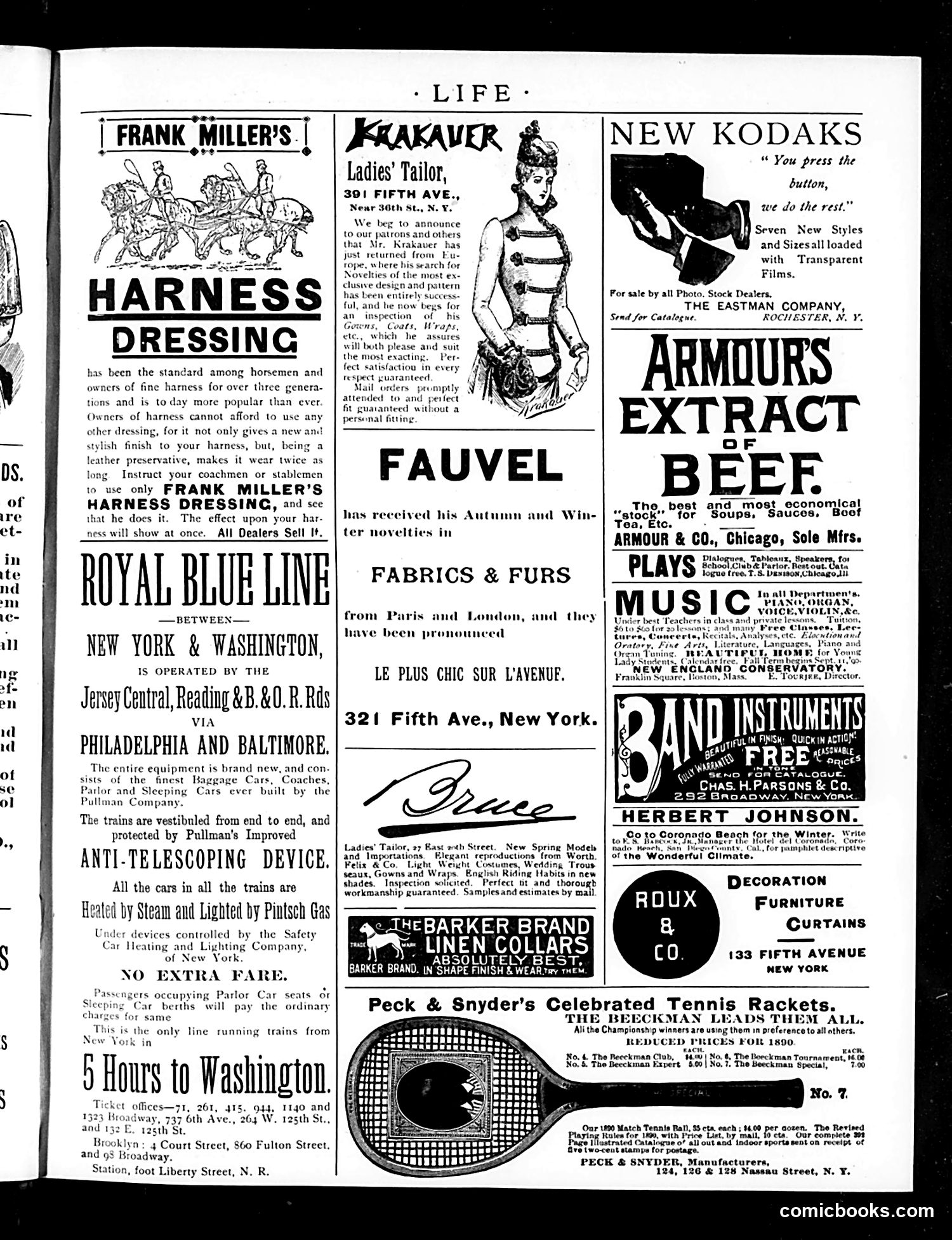
This is primarily an **advertising page** from Life magazine, featuring luxury goods and services catering to wealthy late-19th-century New Yorkers. There are **no political cartoons or satire** on this page. The ads showcase: - **High-end fashion**: Ladies' tailors (Kraka, Fauvel) promoting imported fabrics from Paris and London - **Transportation**: The Royal Blue Line railroad advertising fast trains between New York and Washington - **Emerging technology**: Kodak cameras with the famous slogan "You press the button, we do the rest" - **Luxury goods**: Harness dressing for carriages, beef extract, band instruments, furniture The page reflects **Gilded Age consumer culture**—advertising reflects what wealthy urban Americans could purchase. Items like imported couture, new photographic technology, and railroad travel represent aspirational luxury for the magazine's affluent readership. There is no satirical commentary visible; this is straightforward commercial advertising.
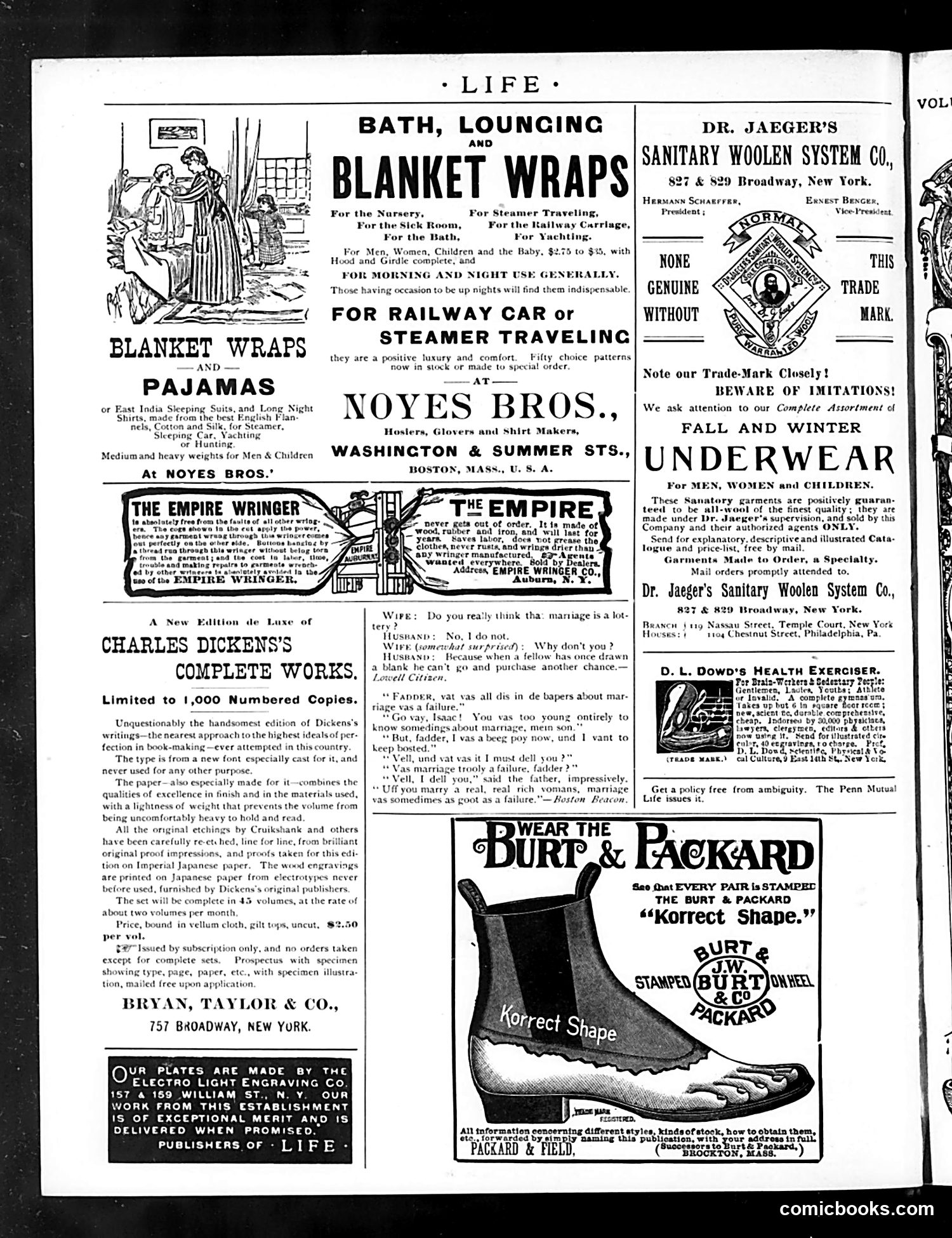
This page is primarily **advertising** for late 19th-century products—blanket wraps, pajamas, underwear, and household goods—with minimal satirical content. The one identifiable **cartoon/joke** appears mid-page: a dialogue between "Wife" and "Husband" about whether marriage is a "lottery," followed by a separate ethnic humor piece featuring characters with German accents ("vat vas," "fadder") discussing marriage as a "failure." These represent period humor stereotyping German immigrants through dialect comedy—common in Life magazine but considered offensive today. The page otherwise showcases Dr. Jaeger's wool undergarments, The Empire Wringer washing machine, Burt & Packard shoes, and a luxury edition of Dickens's complete works. The advertisements emphasize product quality and mail-order availability, typical of Life's revenue model. **Context:** Life functioned simultaneously as satirical magazine and advertising vehicle. The ethnic dialect jokes reflect widespread 19th-century attitudes toward immigrant groups.