
A complete issue · 16 pages · 1890
Life — July 24, 1890
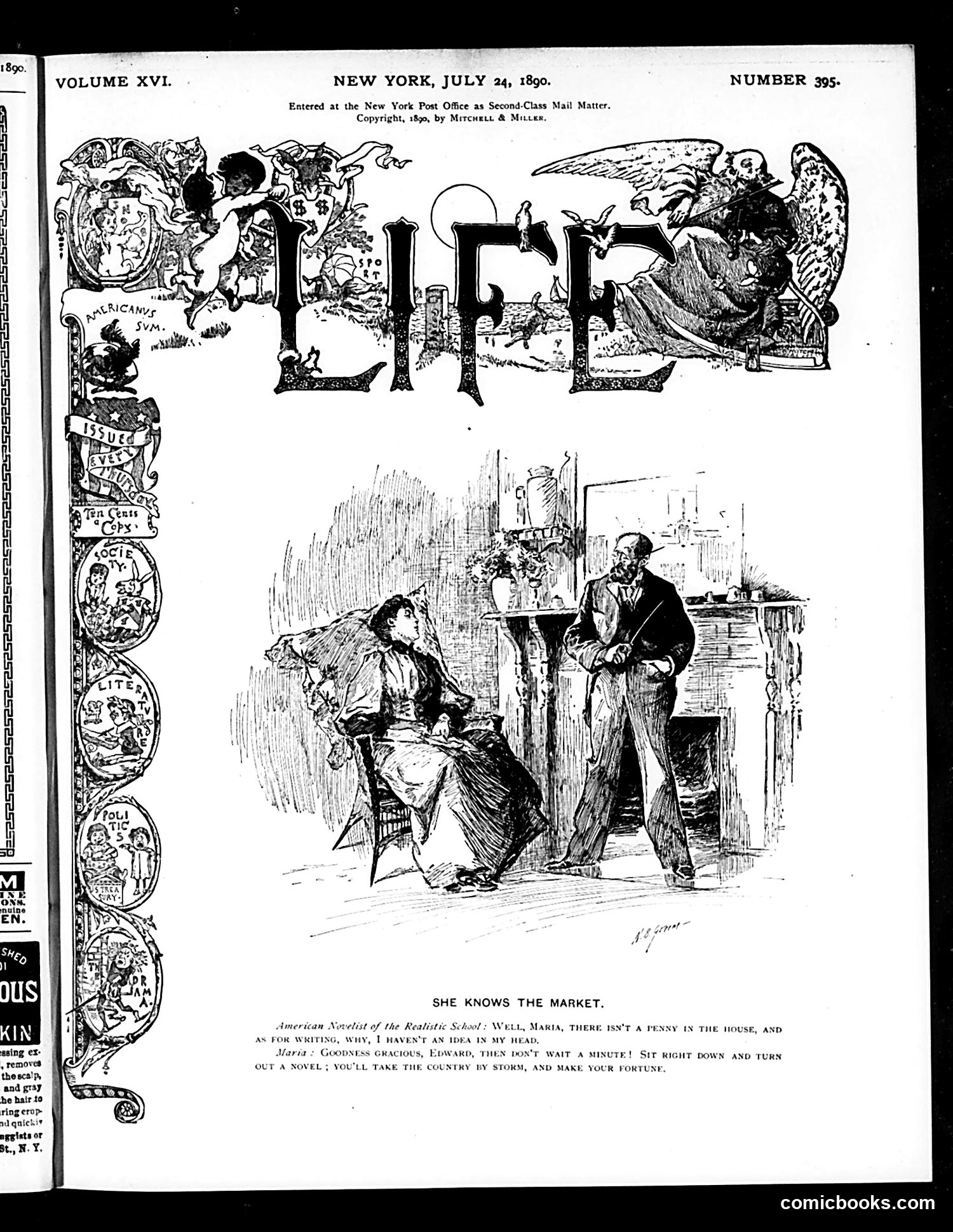
This page from Life (July 24, 1890) contains a satirical illustration titled "She Knows the Market," presented as an "American Novelist of the Realistic School." The cartoon depicts a woman seated while a man stands nearby in what appears to be a waterfront or dock setting. The accompanying text mocks the literary advice being given: a character named Maria is told she needn't wait to experience life—instead, she should "sit right down and turn out a novel; you'll take the country by storm, and make your fortune." The satire targets late-19th-century "realistic" novelists (a literary movement emphasizing authentic social observation) by suggesting they produce commercial fiction without genuine life experience. The joke critiques both the superficiality of popular novels and female authors' supposed shortcuts to literary success.
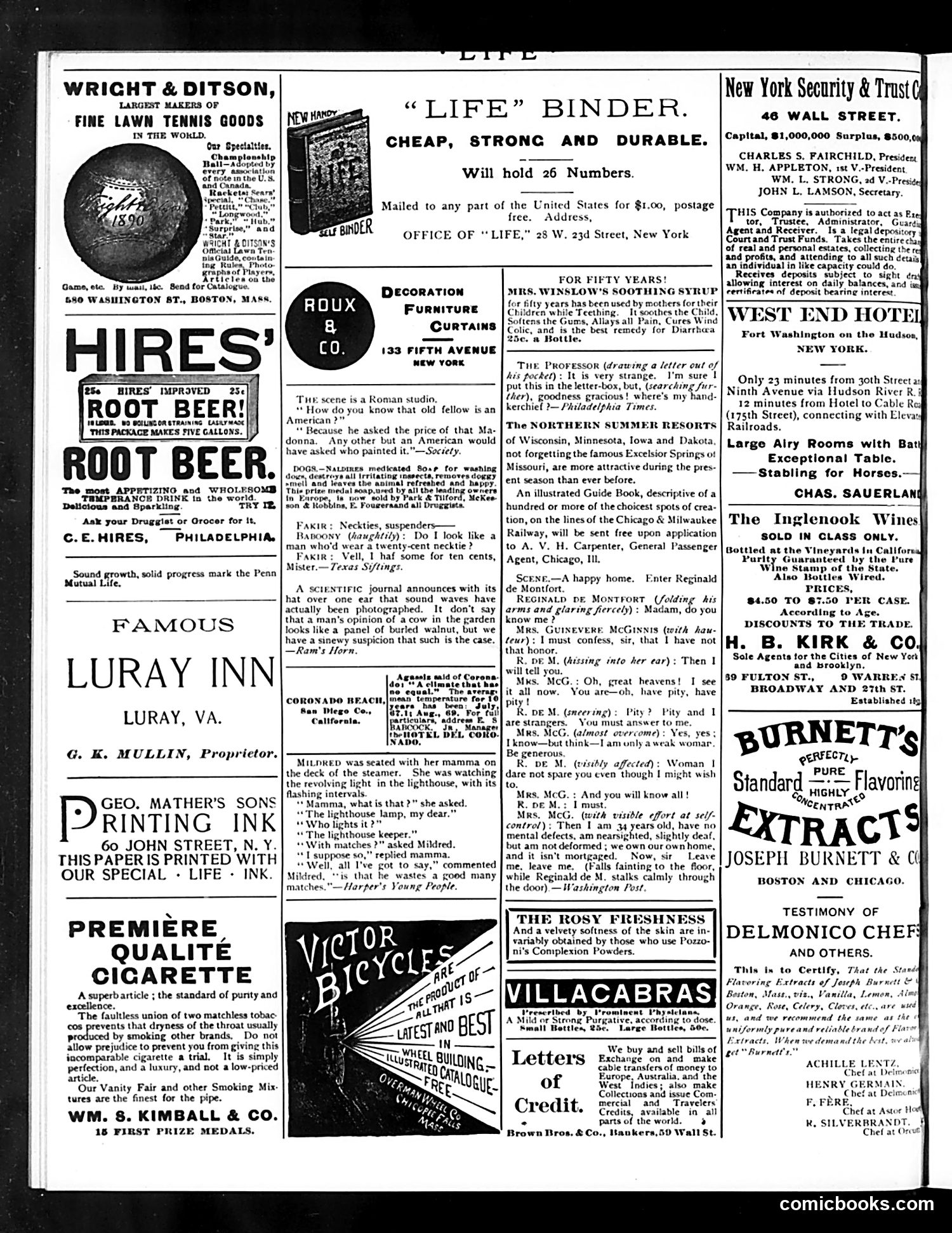
This page is primarily **advertisements** rather than political cartoons or satirical content. The ads promote consumer goods typical of the early 20th century: lawn tennis equipment, root beer, printing ink, bicycles, cigarettes, wine, and furniture. The one narrative element is a dialogue labeled "Decoration Furniture Curtains" featuring characters discussing a Roman studio painting. A woman asks a man about the price of artwork; he claims an American artist painted it but won't identify the artist, calling it a "Society" piece—apparently satirizing pretentious art collecting and the social importance placed on prestigious (or mysterious) artistic provenance among wealthy buyers. The rest is straightforward commercial messaging.
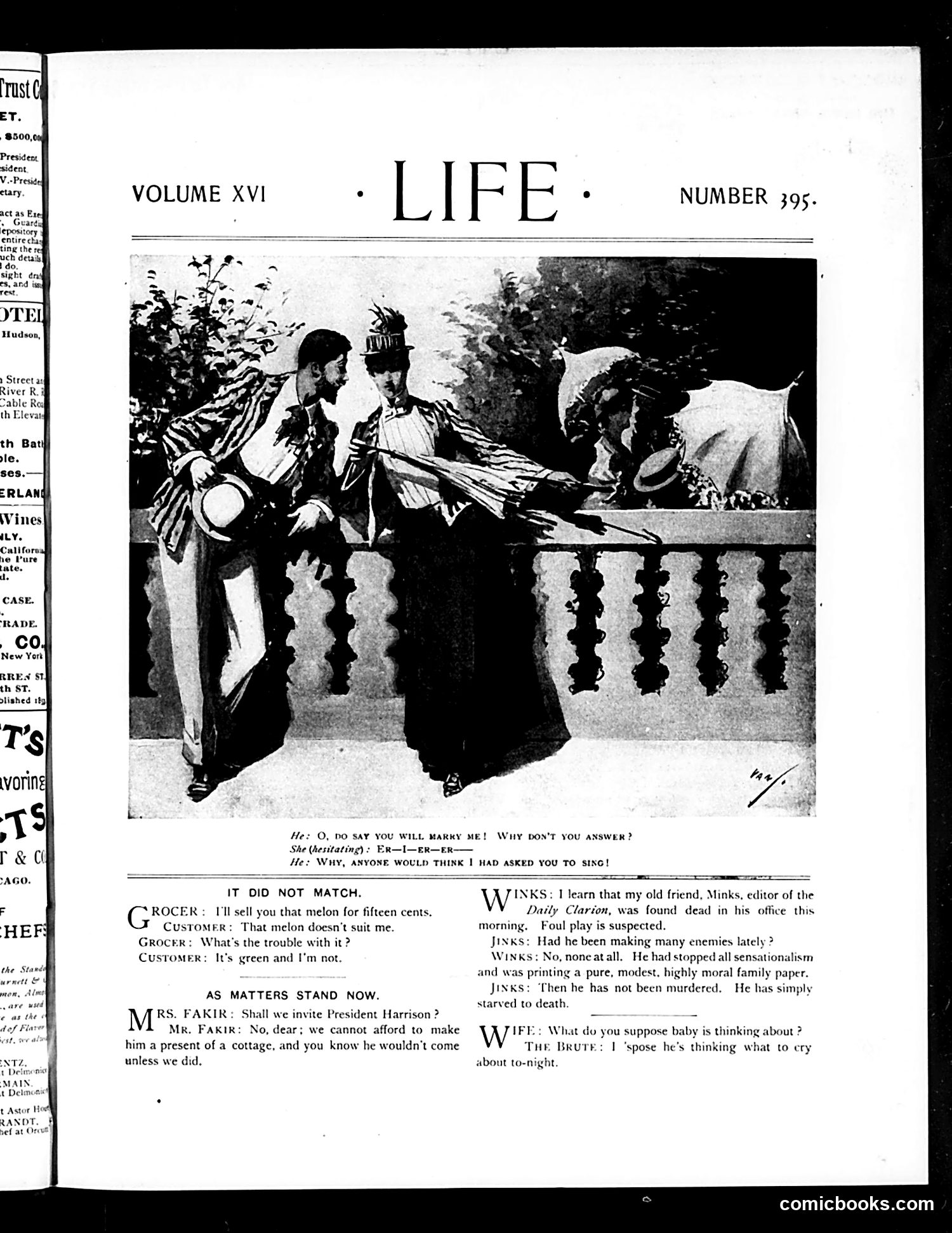
This page from *Life* magazine (Volume XVI, Number 295) contains three satirical pieces: **Top cartoon**: A romantic scene where a man proposes to a woman on a balcony, but she refuses to answer his question. The humor relies on her silent, dismissive response to his earnest proposal. **"It Did Not Match"**: A grocer-customer dialogue about a melon purchase. The joke is a simple pun—the customer complains the melon doesn't suit them because it's green, while they are not. **"As Matters Stand Now"** and subsequent dialogues: These appear to reference contemporary social/political figures (possibly including President Harrison based on the text mentioning "President Harrison"), though the specific context and identities aren't entirely clear from this page alone. The humor throughout is genteel, wordplay-based satire typical of early 20th-century American humor magazines.
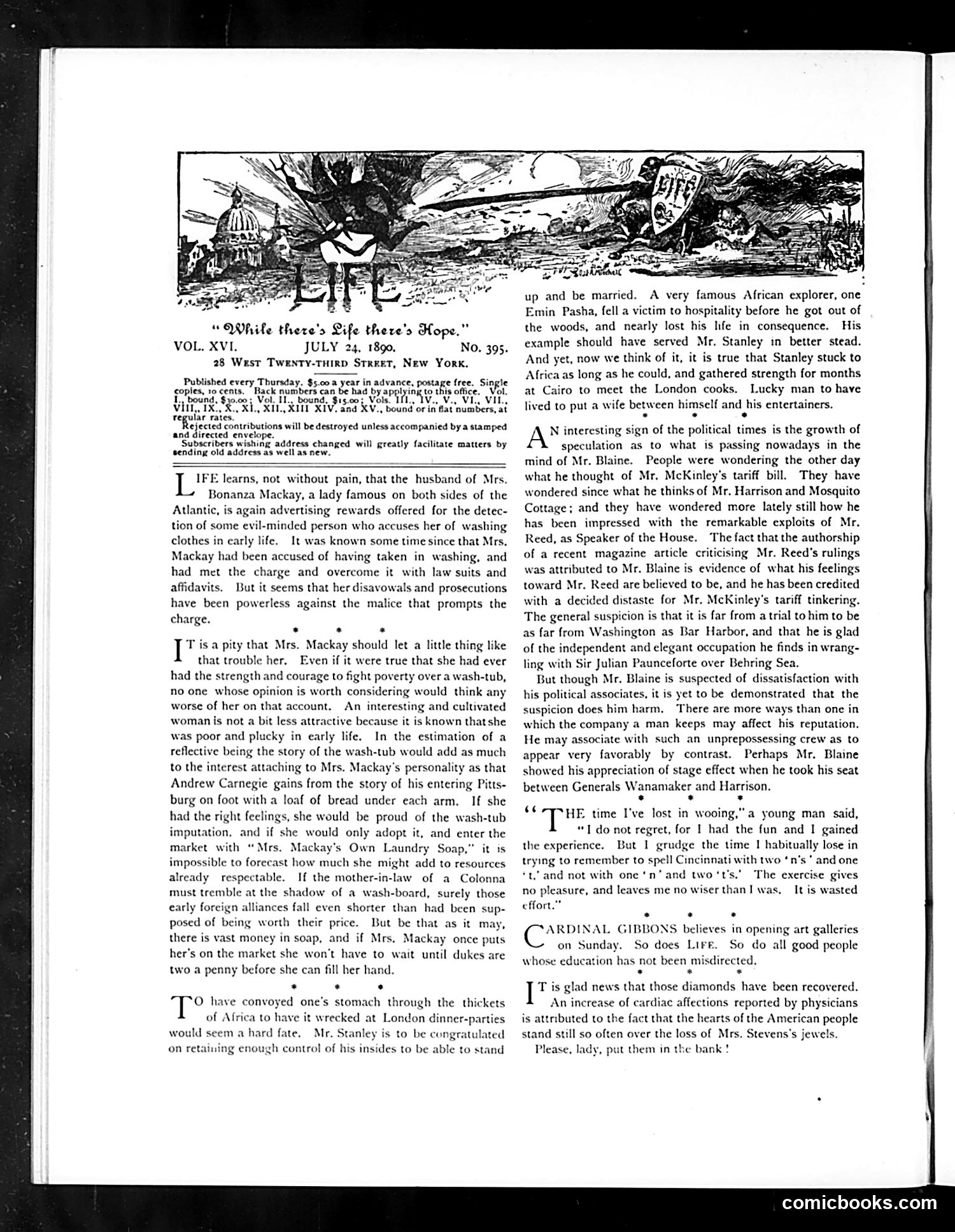
The header cartoon depicts a figure labeled "Life" emerging from or associated with a nighttime landscape featuring a domed building (likely the Capitol) and a crescent moon. The text discusses several contemporary scandals and figures: **Mrs. Mackay's lawsuit** involves her accusations against someone regarding stolen laundry and clothing—a domestic servant dispute that apparently reached court, prompting reward advertisements. **Mr. Blaine** (likely James G. Blaine, a prominent politician) faces speculation about his views on McKinley's tariff bill. The text notes people wonder whether he supports the tariff or opposes it. **Mr. Stanley** (likely explorer Henry Morton Stanley) is congratulated for maintaining composure during African travels—a reference to his recent expeditions. The satire targets how political figures' private opinions become subjects of public speculation and gossip.
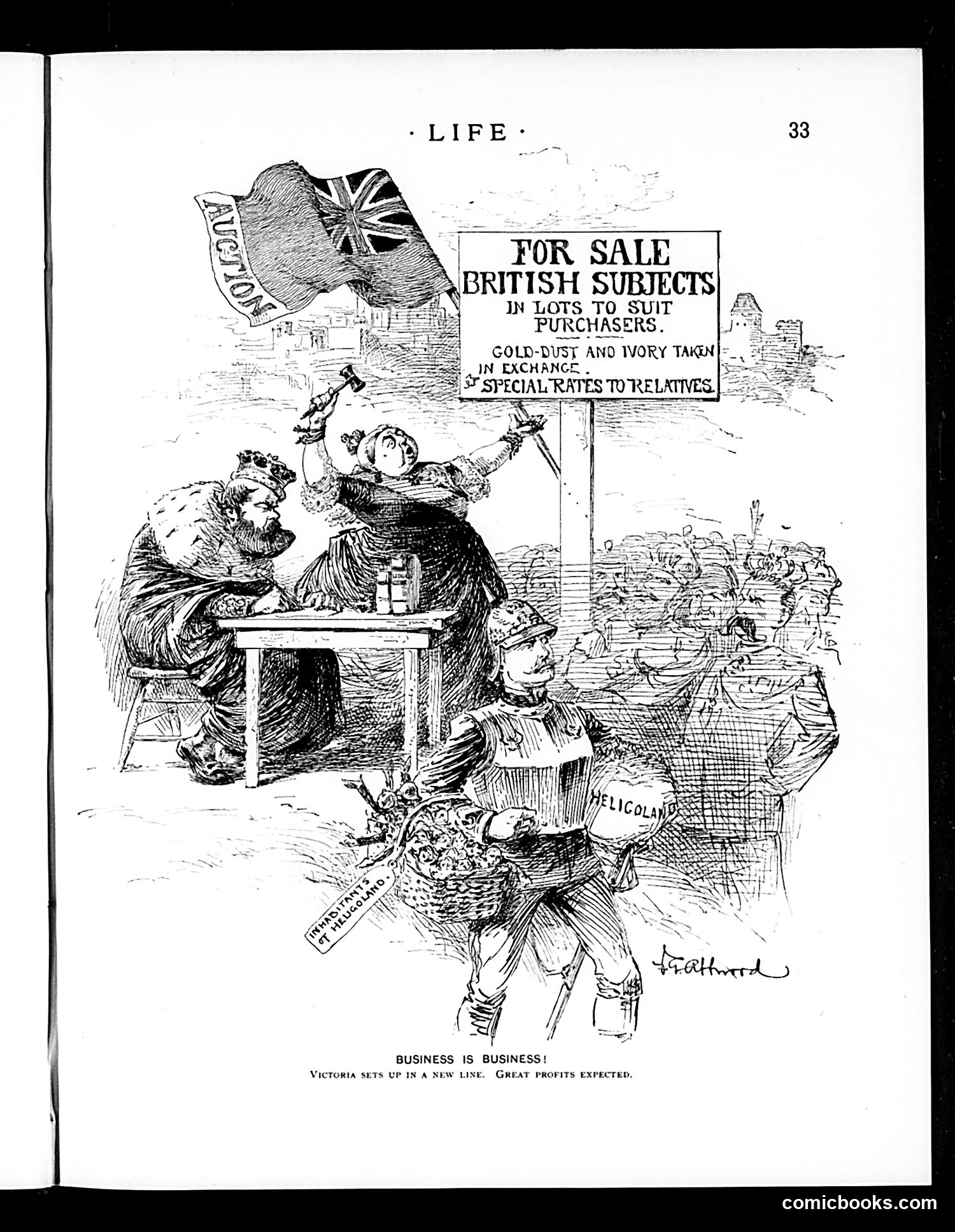
This satirical cartoon critiques British imperial exploitation during the colonial era. The sign advertises "British Subjects" for sale "in lots to suit purchasers," with payment in "gold-dust and ivory"—a darkly ironic reference to how colonized peoples and resources were extracted for profit. The figures appear to represent British colonial administrators conducting what's presented as a commercial transaction. The labeled regions (Helgoland, Helicoland, etc.) reference actual territories Britain controlled or acquired. The masses of people depicted in the background suggest populations being commodified. The caption "Business is Business! Victoria sets up in a new line. Great profits expected" attributes this to Queen Victoria's era, satirizing how the British Empire operated through systematic exploitation disguised as legitimate commerce. The cartoon condemns colonialism's dehumanizing logic.
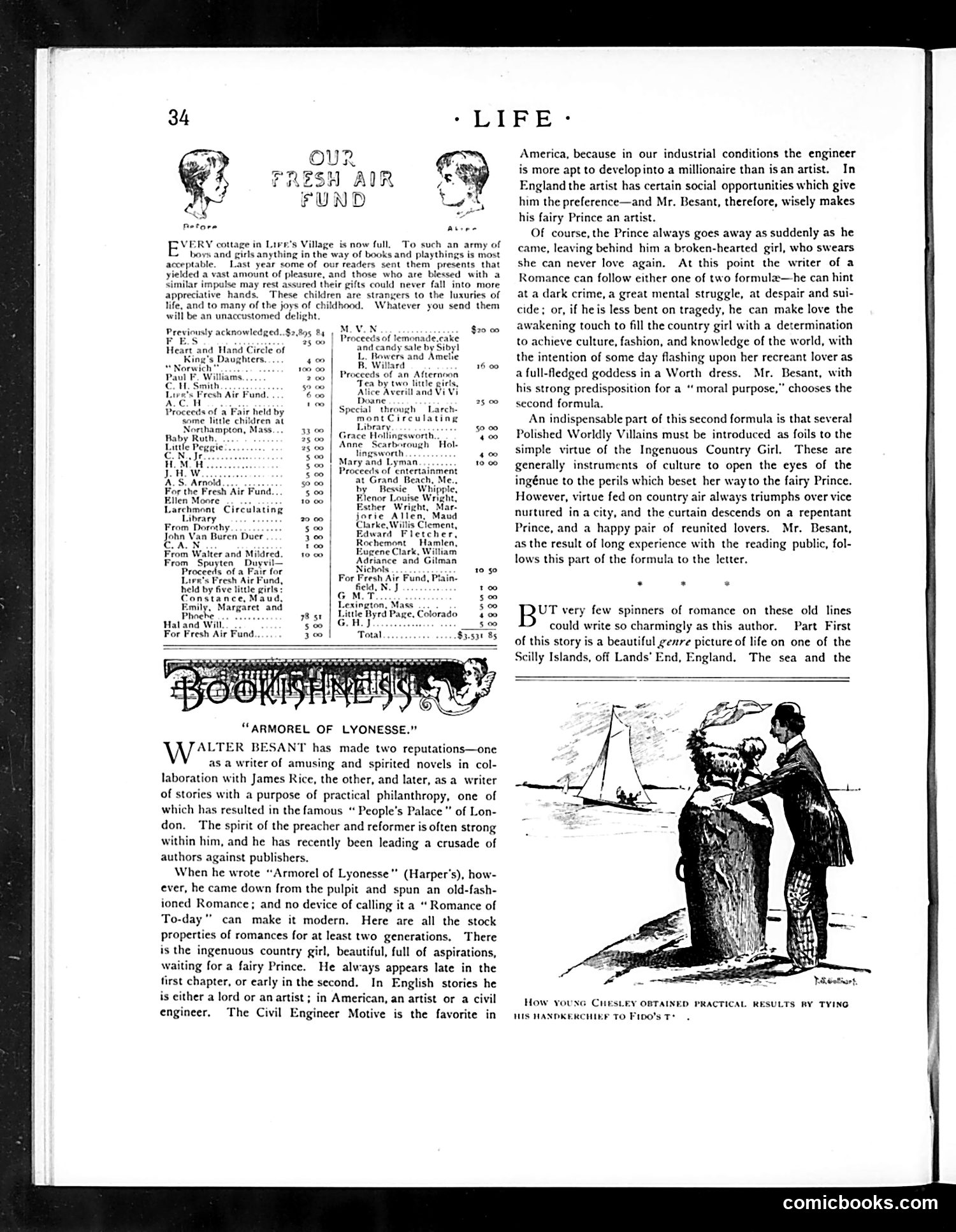
This page contains a literary discussion and book advertisement rather than political cartoons. The main content reviews Walter Besant's novel "Armorer of Lyonesse," a romance set in the Scilly Islands off England's coast. The text critiques Besant's use of traditional romance formulas—the beautiful country girl waiting for a fairy-tale prince. The reviewer notes that while such stories worked for previous generations, Besant wisely adapts the formula for modern readers by having the heroine educated and cultured, prepared to become "a full-fledged goddess in a Worth dress." A small illustration shows a young woman at a seaside location with a sailing vessel, consistent with the story's island setting. The left side lists donations to a "Fresh Air Fund," a genuine charitable organization providing rural recreation for poor urban children.
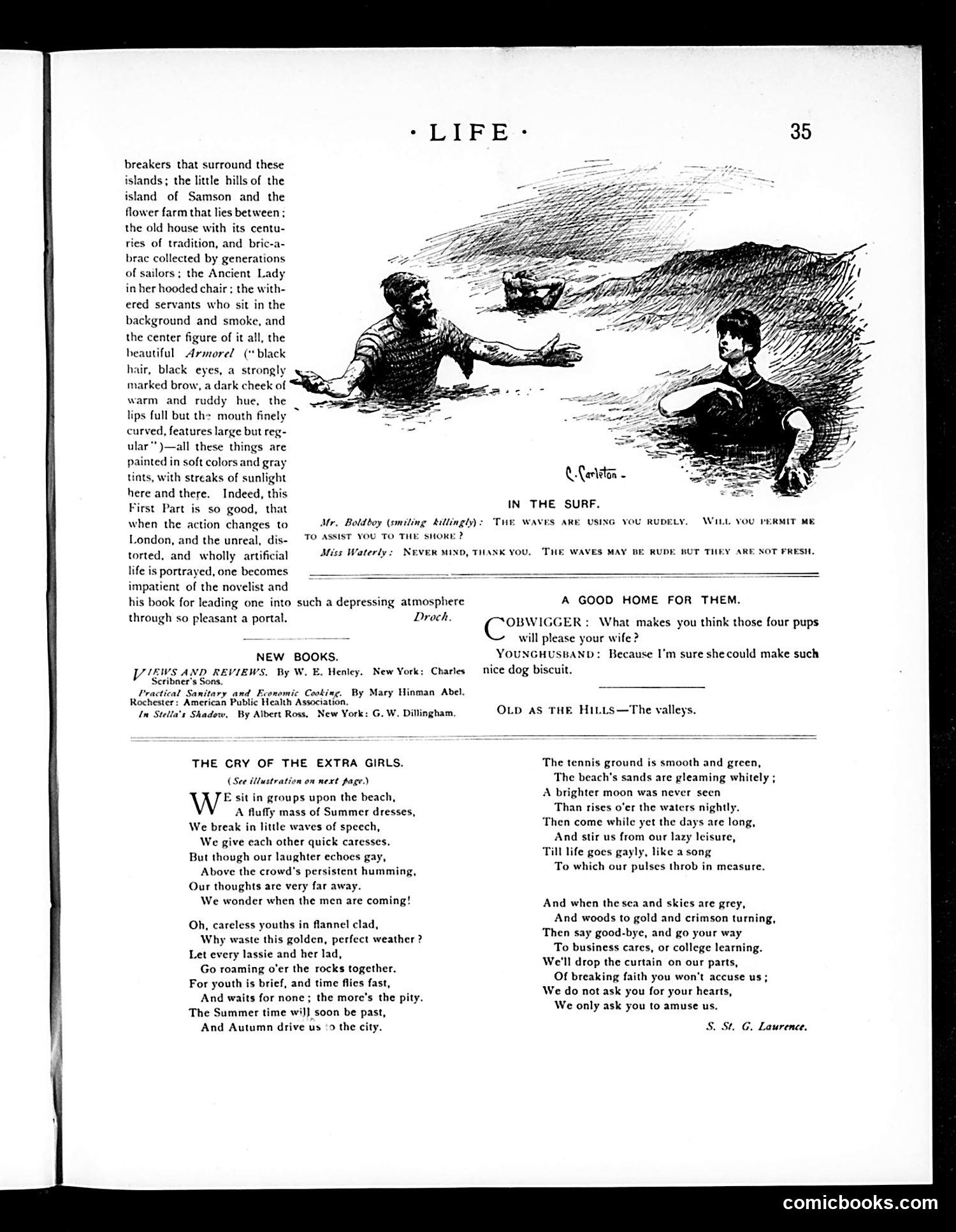
This illustration depicts a lighthearted beach scene with two figures in water. The dialogue reveals a flirtation between a man and woman: he's attempting to assist her to shore, but she's rejecting his help, claiming the waves—though rude—aren't fresh (implying they're not offensive). The humor relies on the woman's clever wordplay and her independence, refusing assistance despite appearing to need it. This reflects early 20th-century attitudes toward courtship and female autonomy at leisure settings like beaches, which were increasingly popular social venues. The subsequent dialogue about "four pups" and "dog biscuit" continues the playful, domestic tone, suggesting marriage prospects. The poetry sections that follow emphasize summer romance and youthful transience—typical Life magazine themes celebrating seasonal leisure culture.
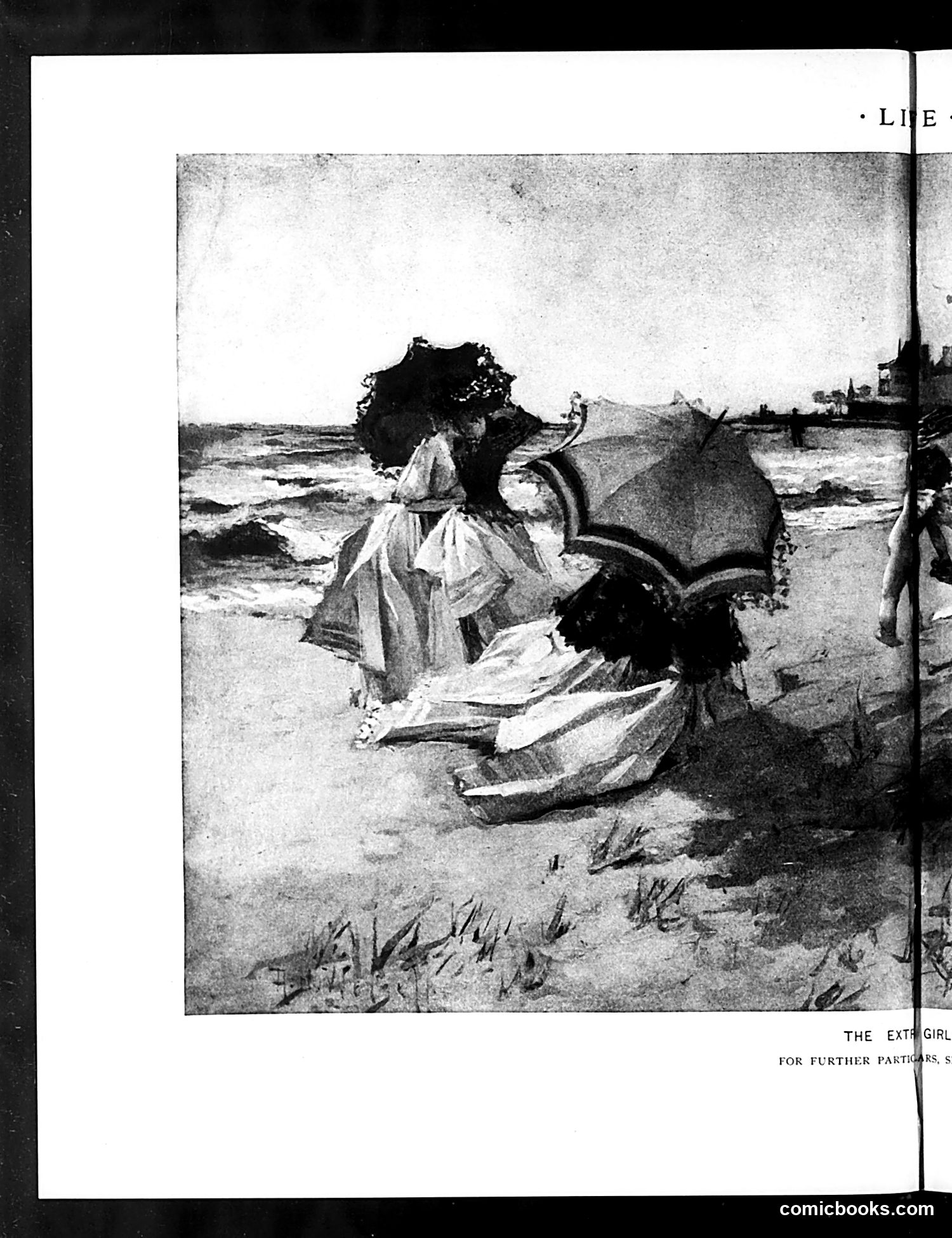
This page from *Life* magazine appears to show a beach scene with a woman in period dress (early 20th century) sitting near small boats. The partial caption reads "THE EXTRA GIRL" with text mentioning "FOR FURTHER PARTICULARS, S[EE]..." Without the complete caption or article text, the exact satirical point is unclear. However, "extra girl" was period slang for women working as background actors in early cinema. The image likely satirizes either: the film industry's treatment of minor actresses, or a social commentary on women seeking work in entertainment during this era. The sandy beach setting and boats suggest either a coastal community or a film set. The satire's specific target—whether social, political, or industry-focused—cannot be determined from the visible portion alone.
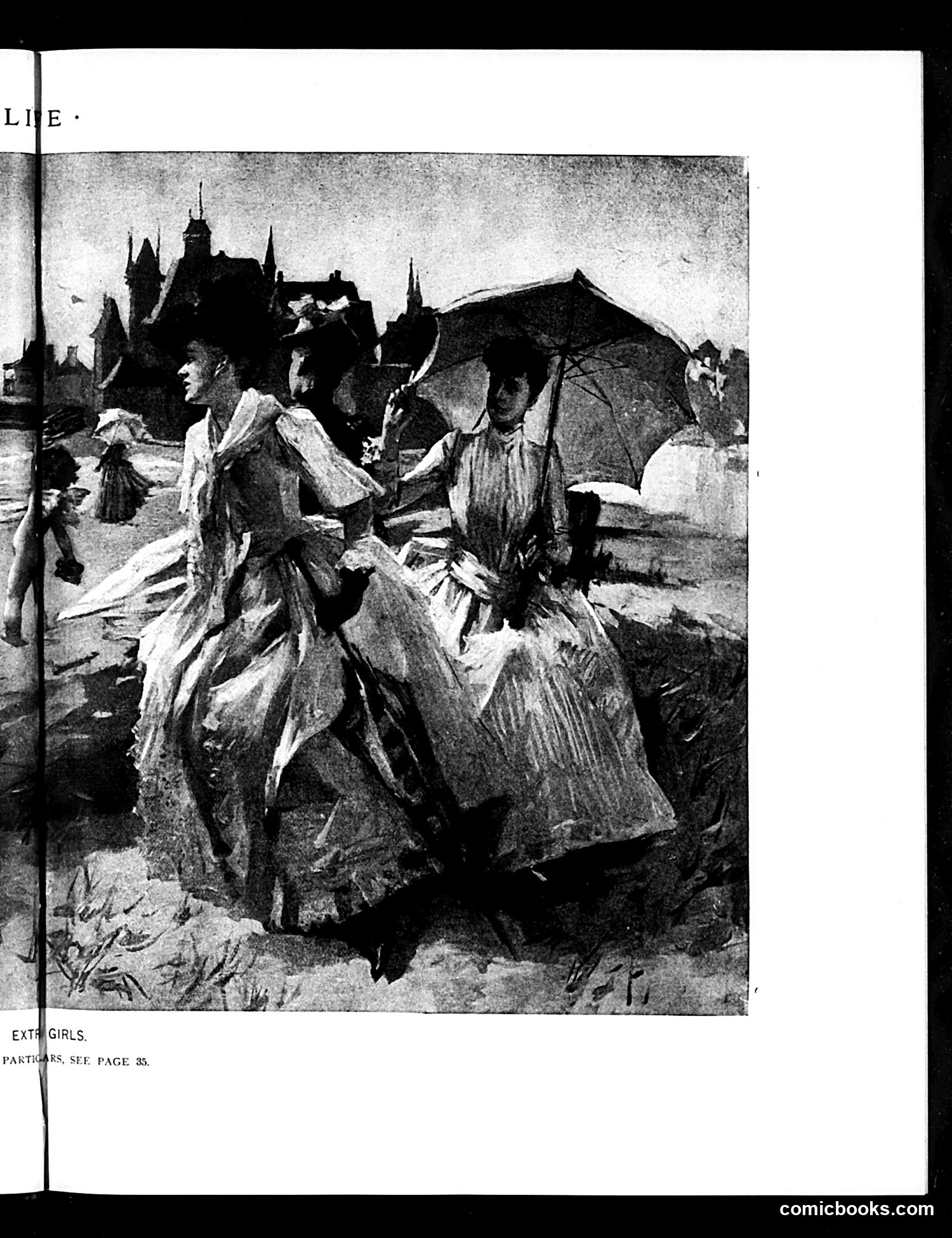
This appears to be a page from *Life* magazine featuring a photograph labeled "EXTRA GIRLS" with a reference to "PART[ICULARS], SEE PAGE 35." The black-and-white photograph shows women in Edwardian-era dress (long skirts, elaborate hats, umbrellas) posed outdoors with a castle or cathedral visible in the background. The styling and composition suggest this is likely either: 1. A theatrical or film production still, given the reference to "extra girls" (background actors) 2. A satirical commentary on women's fashion or social conventions of the period Without access to page 35 or additional context, I cannot definitively identify the specific reference, event, or satirical point. The image itself documents early 1900s women's fashion and appears to document theatrical production practices of that era.
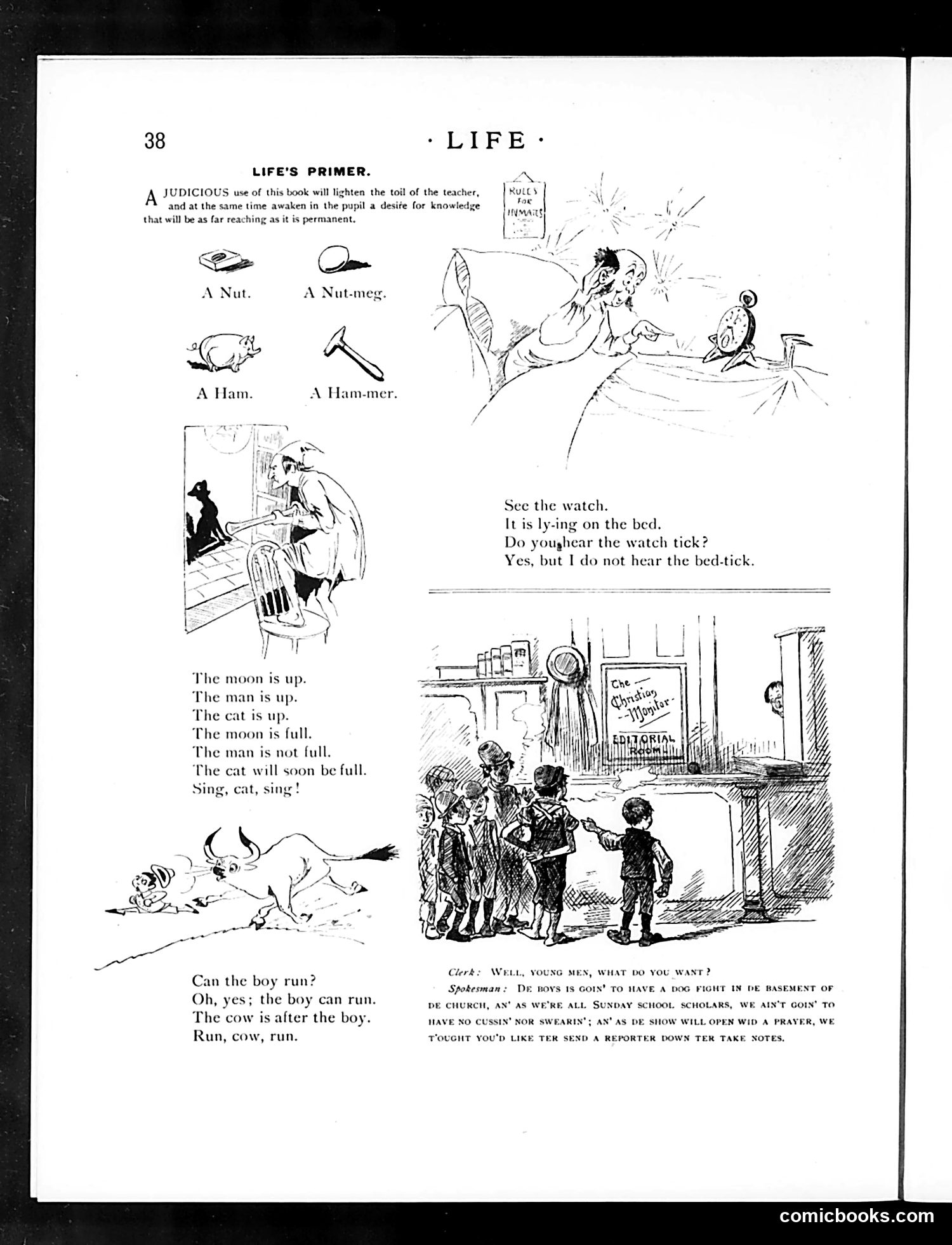
This is an educational humor page teaching children basic reading through puns and wordplay. The top section uses visual puns: "A Nut" (walnut), "A Nut-meg" (nutmeg with magnifying glass), "A Ham" (pig), and "A Ham-mer" (hammer). The main cartoon depicts children outside a church basement where a "dog fight" is occurring. A clerk confronts young men about the commotion, who justify it as innocent boys' activity. The satire mocks hypocrisy: these supposedly "Sunday school scholars" are actually involved in dog fighting—a brutal blood sport—while claiming religious propriety with phrases like "we will offer with a prayer." The page also contains simple educational reading exercises about watches, the moon, and running cows—typical primer content for young learners of that era.
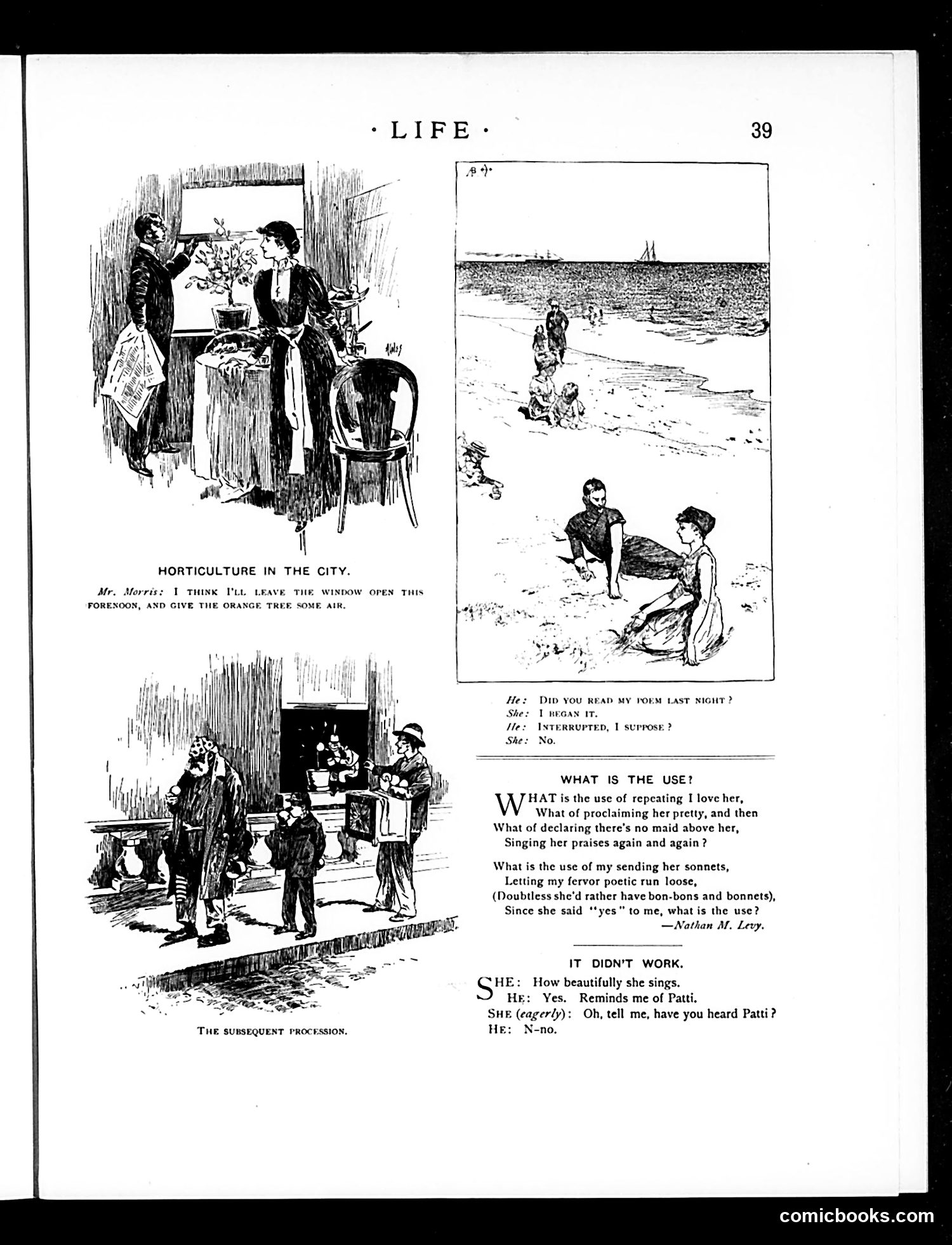
This page contains three separate satirical items: 1. **"Horticulture in the City"** (top left): A man proposes leaving a window open to give an orange tree "some air," mocking urban attempts at gardening in cramped city conditions. 2. **"The Subsequent Procession"** (bottom left): Shows what appears to be a funeral or formal procession, likely satirizing social pretension around formal rituals. 3. **Beach scene** (right): Depicts people at the seaside. The dialogue suggests romantic or social awkwardness—a man asks if a woman read his poem, she says she began it, he interrupts, she denies it. This satirizes earnest romantic gestures (poetry) and the gap between intention and reception. 4. **"What is the Use?"** and **"It Didn't Work"**: Poems and dialogue about failed romantic efforts, mocking sentimental courtship traditions. The overall theme: urban life, failed romance, and social pretension.
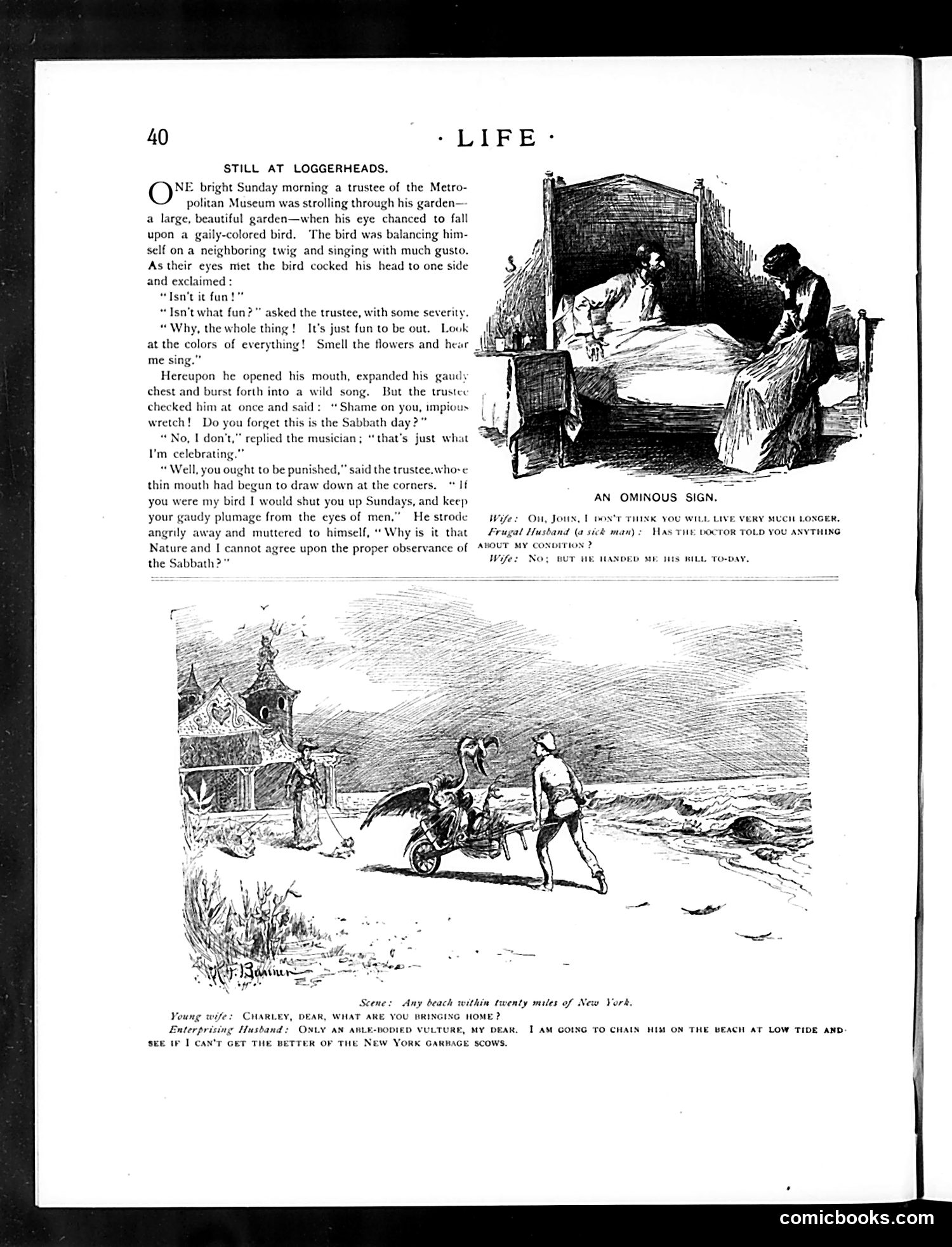
This page contains three separate satirical pieces mocking rigid Sabbath observance and urban absurdity. **Top story**: A Metropolitan Museum trustee confronts a singing bird on Sunday, condemning it for celebrating instead of respecting the Sabbath. The satire targets religious hypocrisy—the trustee's joyless interpretation of religious duty versus nature's innocent exuberance. The bird represents freedom and natural happiness; the trustee represents Victorian-era strictness about Sunday observance. **Middle cartoon** ("An Ominous Sign"): A doctor's refusal to discuss a sick man's condition but immediate presentation of a bill darkly suggests the patient won't recover—a joke about medical indifference and mercenary doctors. **Bottom cartoon**: A man plans to chain a vulture on a beach at low tide to fight New York garbage scows—absurdist humor about the city's notorious waste-management problems and the desperation of dealing with them. The page satirizes religious rigidity, medical cynicism, and urban dysfunction typical of early 20th-century Life magazine's social commentary.
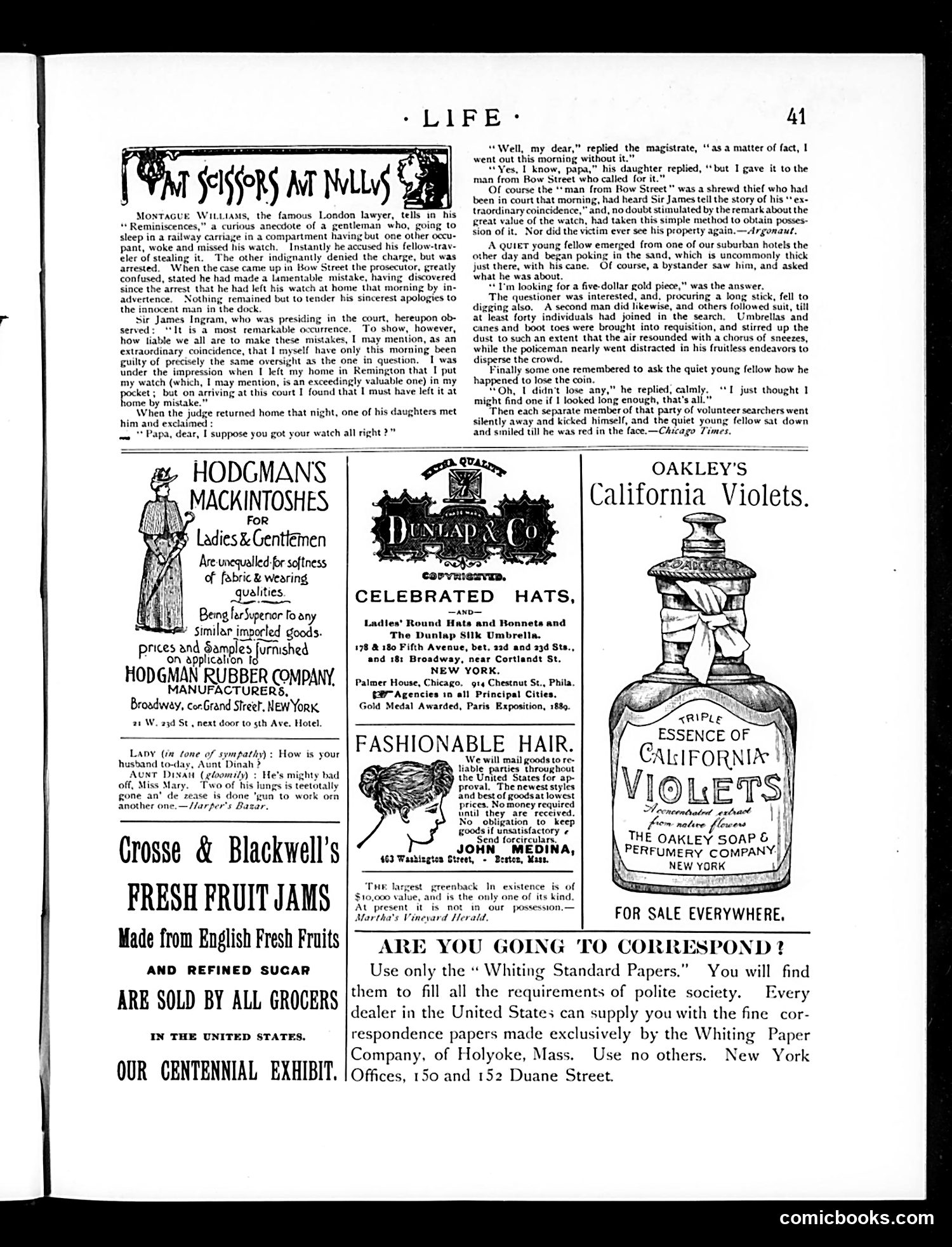
This page contains two humorous anecdotes rather than political cartoons. The main story concerns Sir James Ingram, a London magistrate, who publicly tells a court how he forgot his own watch that morning—a self-deprecating anecdote meant to comfort an innocent man wrongly accused of theft. A clever thief overhears this story, learns the watch is valuable, and subsequently steals it from the judge's home. The satire targets the irony of good intentions backfiring: the judge's attempt at compassion and humility directly enables his own victimization. The second anecdote mocks gullibility. A young man claims to be searching for a lost five-dollar gold piece in sand; others join the fruitless search until he reveals he never lost anything—he merely suspected he *might* find one. The joke ridicules how easily crowds can be manipulated into pointless effort by suggestion alone. Both stories are morality tales about human folly: excessive trust and excessive credulity. The page is otherwise filled with period advertisements for mackintoshes, hats, and other goods.
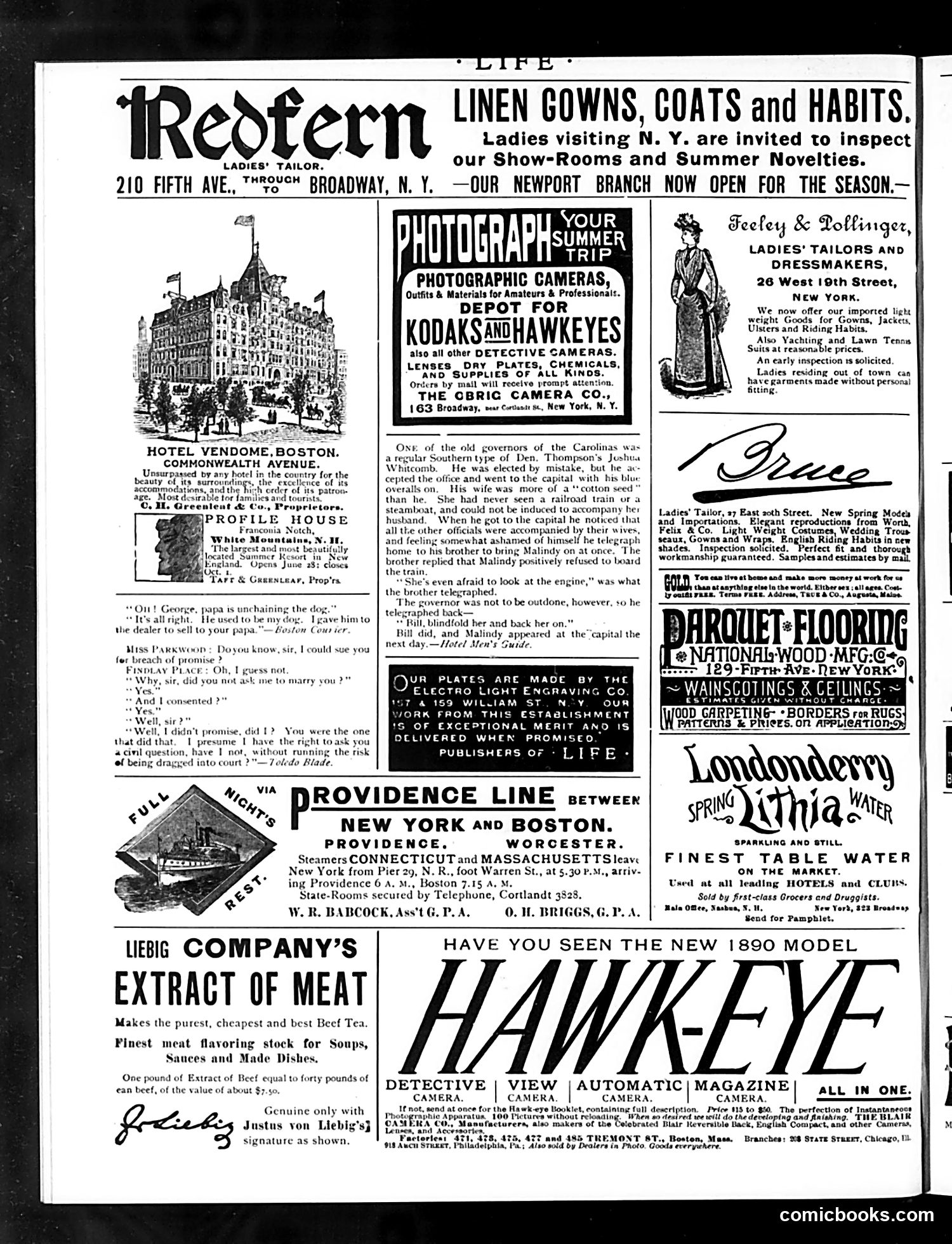
This is primarily an **advertising page** from Life magazine (circa 1890, based on the "1890 Model Hawkeye" camera advertisement). The page contains mostly commercial notices with minimal satirical content. The one notable **cartoon/joke** is a brief dialogue between "Miss Parkwood" and "Findlay Place" about a breach-of-promise suit. The humor relies on a legal technicality: she claims he promised marriage, but he argues *she* made the promise by consenting—so he has the right to ask without legal obligation. This satirizes the era's **marriage-proposal conventions and legal protections**, poking fun at how both parties could interpret romantic negotiation differently. The remainder consists of advertisements for linen clothing, photographic equipment, hotels, steamship lines, and household goods—reflecting 1890s consumer culture and the magazine's business model.
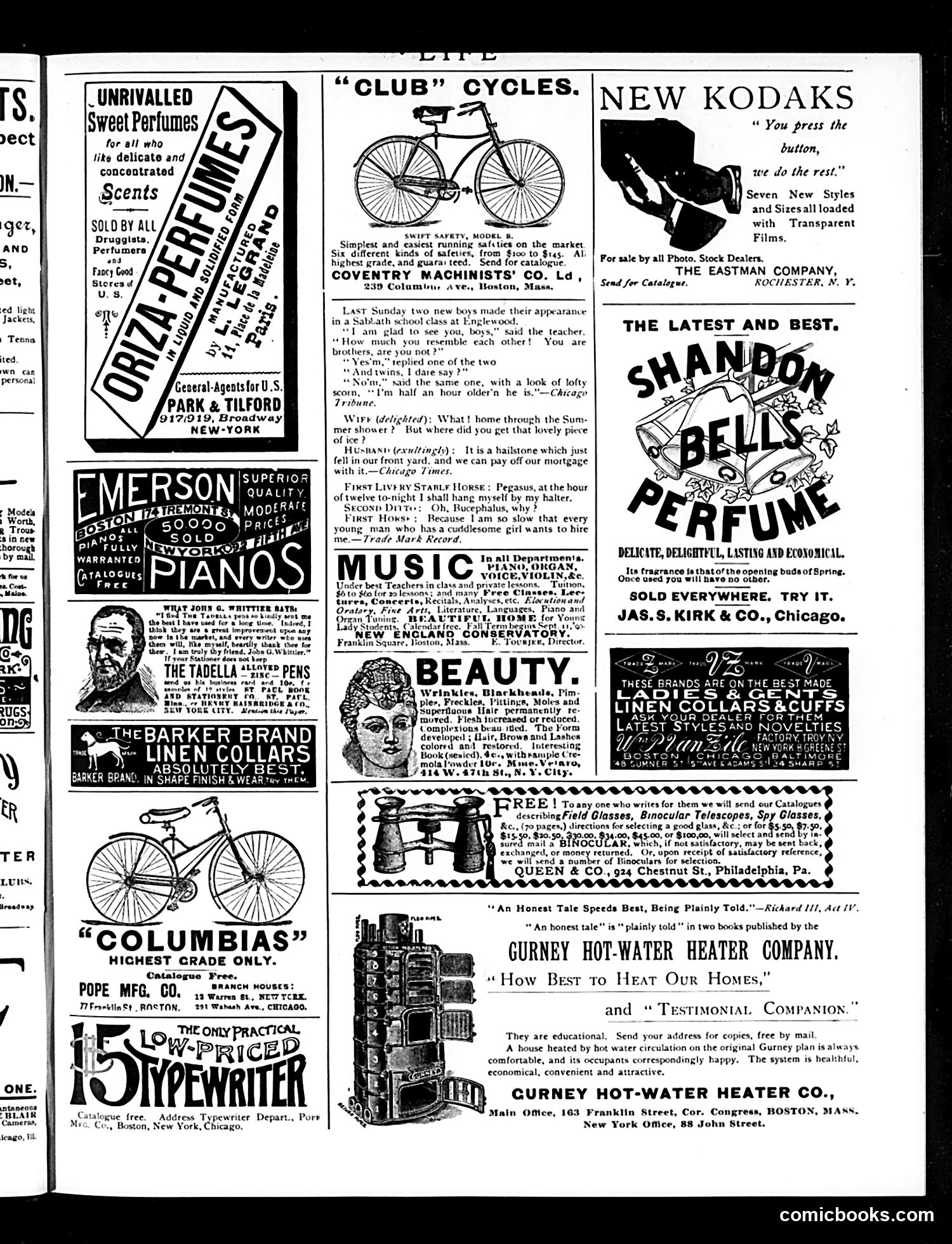
This is primarily an **advertising page** from Life magazine, not a political cartoon. It contains testimonials and product ads typical of late 19th/early 20th-century periodicals. The notable content includes: **John G. Whittier testimonial** (top left): The famous American poet endorses typewriters, lending his credibility to the product. **Humorous vignettes** (middle): Brief comedic dialogues—twins at Sunday school claiming one is "half an hour older," a husband joking about paying off his mortgage with a hailstone—represent the satirical content Life magazine featured. **Product advertisements**: Bicycles ("Columbia," "Club" cycles), pianos, perfumes, cameras (Kodak's famous "You press the button, we do the rest"), typewriters, and beauty treatments dominate the page. The satire here is **not political** but rather reflects consumer culture humor and gentle social observation. The page illustrates how advertising and light humor were interwoven in early Life magazine content.
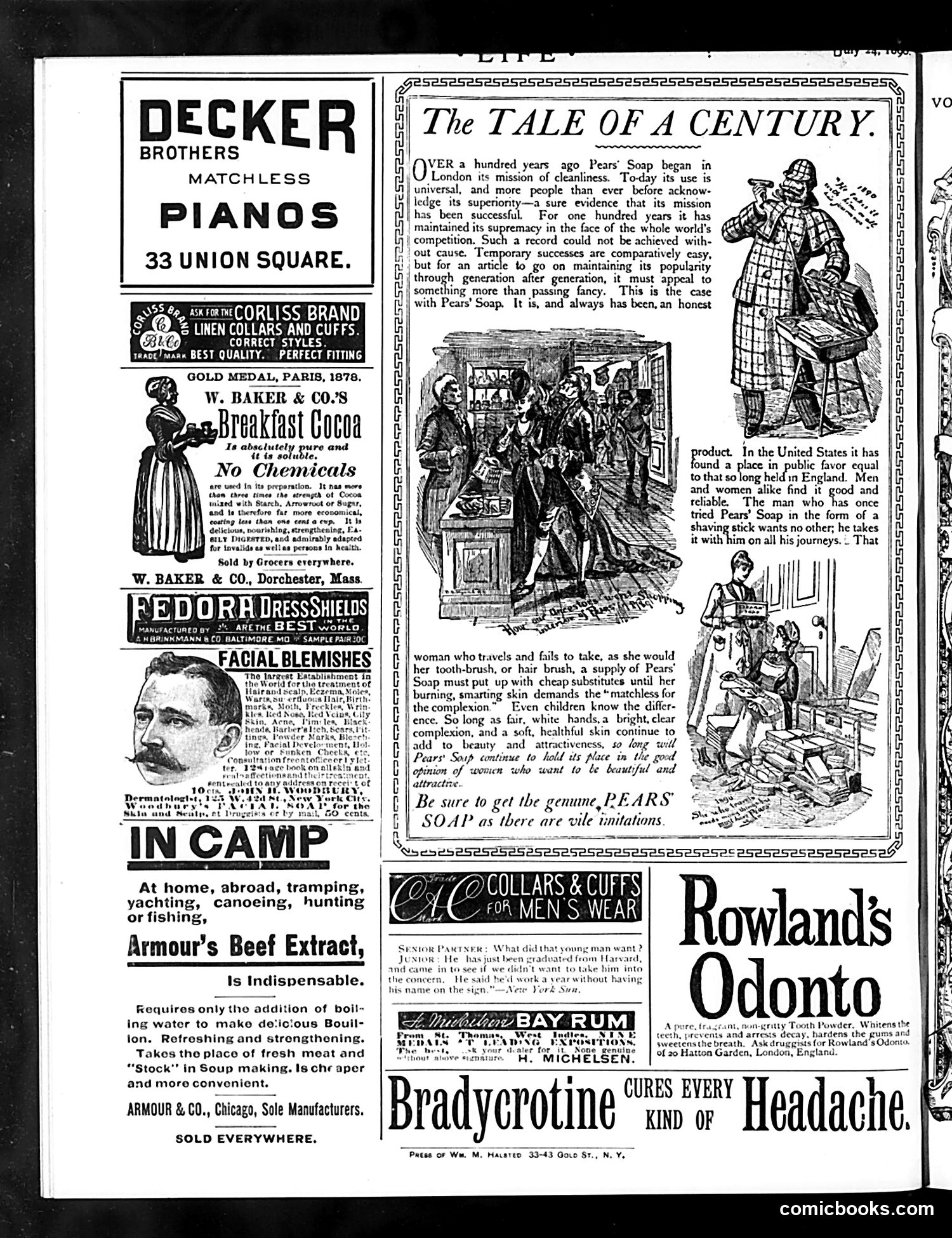
This page is primarily a **Pears' Soap advertisement** disguised as editorial content. The central illustration depicts the soap's 100-year history, showing scenes of its use across different eras and social classes—from Victorian travelers to working people—establishing it as a product of universal appeal and proven longevity. The satirical framing presents the soap's century-long market dominance as evidence of superior quality and honest marketing, contrasting it with "temporary successes" and "cheap substitutes." The advertisement explicitly warns readers: "Be sure to get the genuine, PEARS SOAP as there are vile imitations," suggesting competitor knockoffs were common. The surrounding ads (Decker Pianos, Baker's Cocoa, Armour's Beef Extract) follow similar appeals to middle-class aspirations: refinement, health, and reliability. The page reflects **turn-of-century advertising strategies** that blended promotional content with pseudo-historical narratives to build brand prestige and consumer loyalty.