
A complete issue · 16 pages · 1889
Life — July 18, 1889
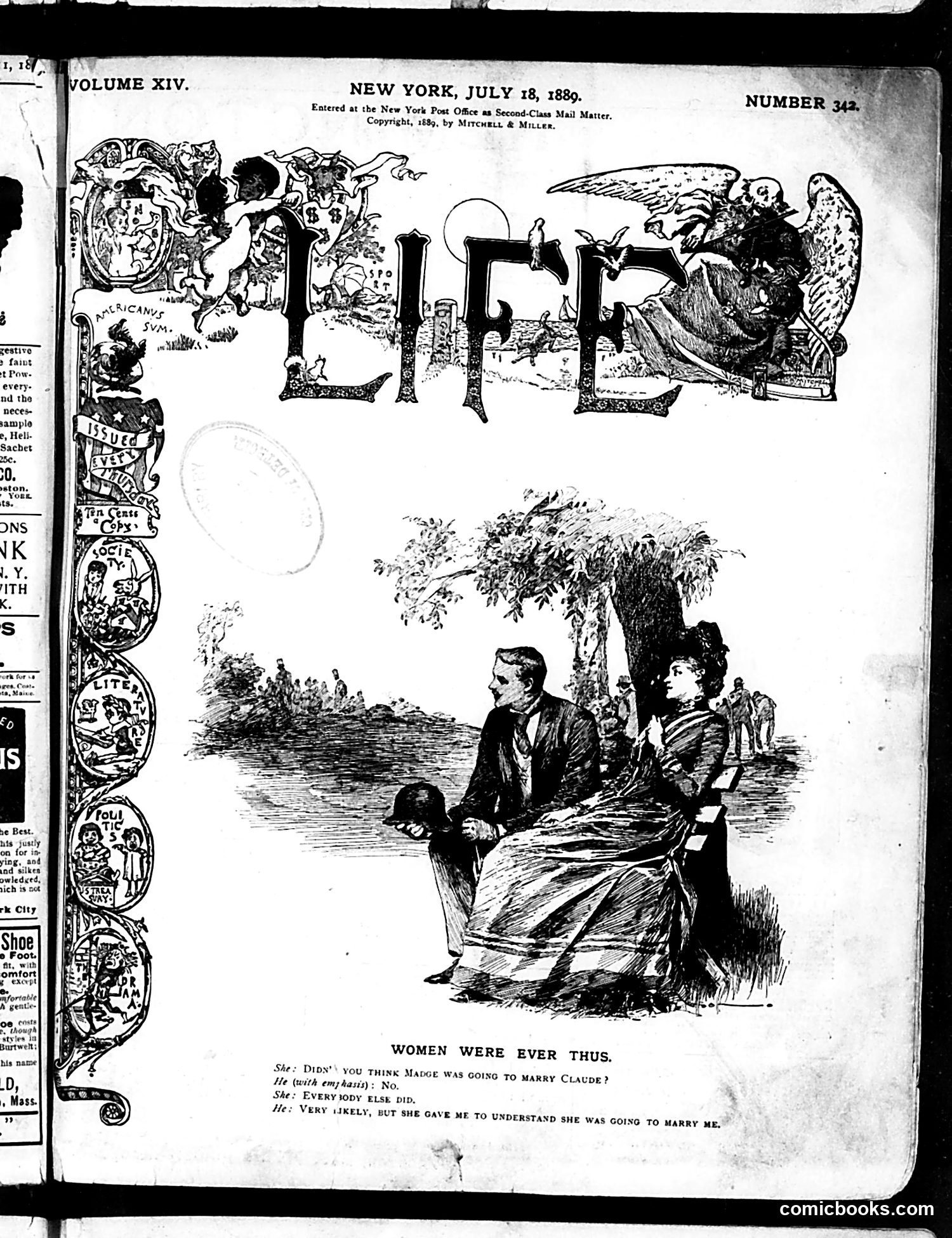
This satirical cartoon depicts a conversation between a man and woman sitting by a river. The caption presents a domestic dialogue where the woman denies thinking Madge would marry Claude, while the man responds that "everybody else did." The woman then claims she gave him no reason to expect marriage. The satire targets female social behavior and romantic deception of the era—specifically the accusation that women were inconsistent or misleading in romantic matters. The title "Women Were Ever Thus" suggests this was viewed as timeless female behavior. The joke relies on the premise that women's words and actions regarding marriage prospects were unreliable or contradictory, a common satirical theme in 19th-century humor magazines.
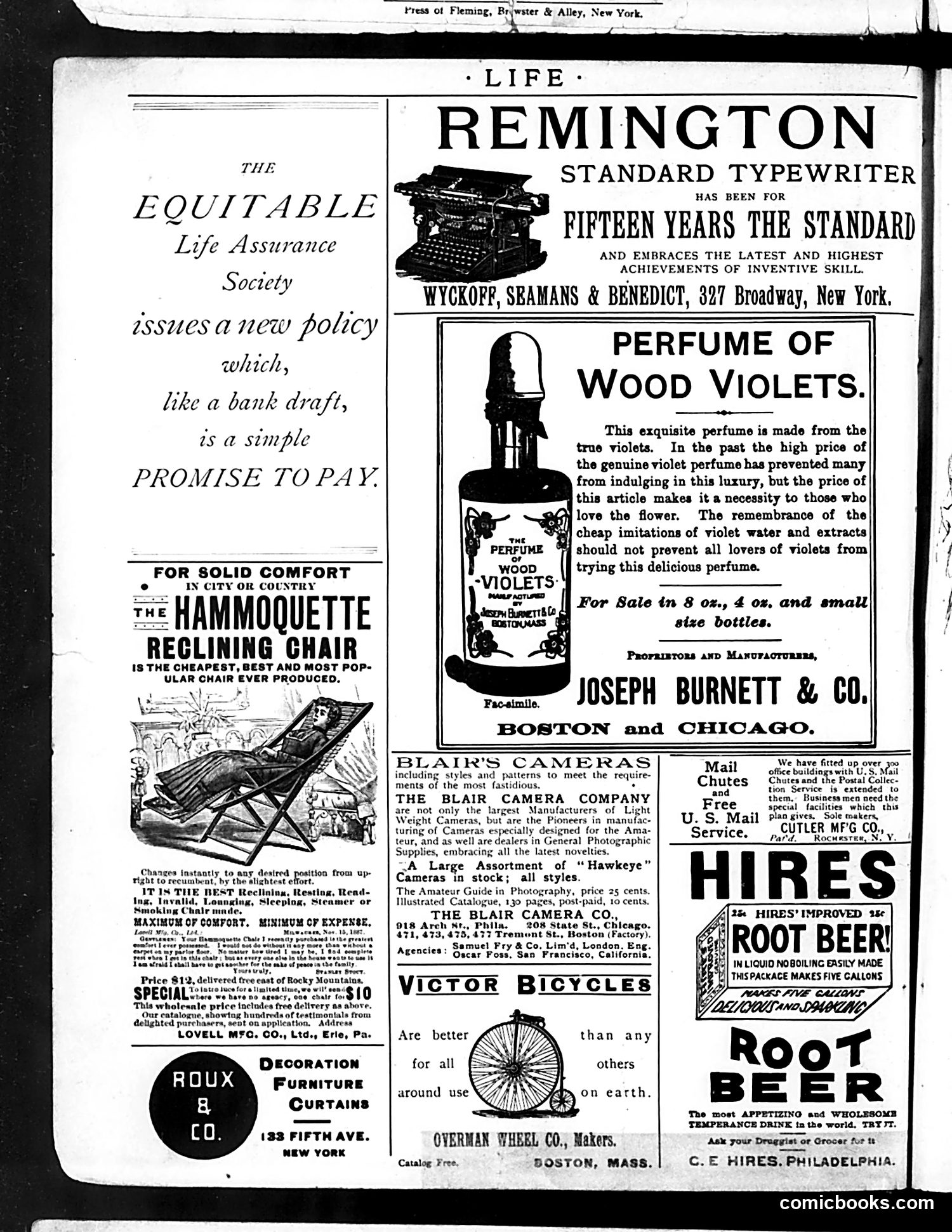
This page is primarily **advertising**, not satire or political commentary. It contains commercial ads for products typical of the late 19th/early 20th century: - Life Assurance Society (insurance) - Hammoquette Reclining Chair (furniture) - Remington Standard Typewriter - Perfume of Wood Violets - Blair's Cameras - Victor Bicycles - Hires Root Beer - Roux Decoration & Furniture Curtains The only potentially humorous element is the Victor Bicycles ad's claim that they are "better than any others for all around use on earth"—a playful exaggeration typical of period advertising. There is no political cartoon or social satire visible on this page; it represents straightforward commercial content from Life magazine's advertising section.
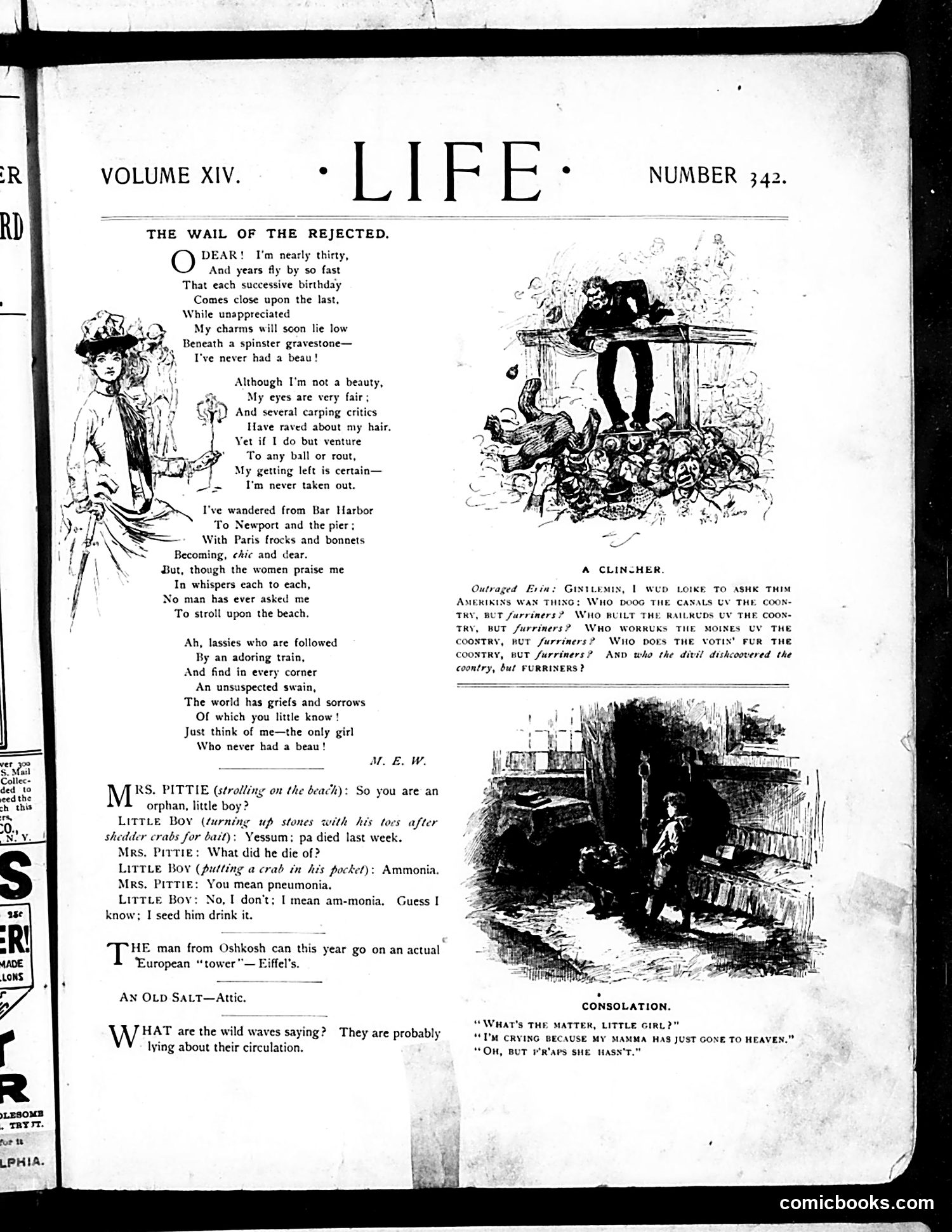
This page satirizes unmarried women's frustrations through poetry and humor. "The Wail of the Rejected" is a poem from a woman's perspective lamenting her single status—she's nearly thirty, unpretty, and has traveled widely but remains unmarried despite her efforts. The cartoon "A Clin-Her" depicts an angry, rejected woman in an exaggerated pose, likely mocking women who pursued romantic relationships unsuccessfully. The separate sketch "Consolation" shows a young girl crying over her mother's death, providing darkly humorous contrast. The page reflects late Victorian/Edwardian anxieties about matrimony—women's limited options and the social shame of remaining unmarried. The humor depends on period attitudes treating single women as objects of pity or ridicule rather than autonomous individuals.
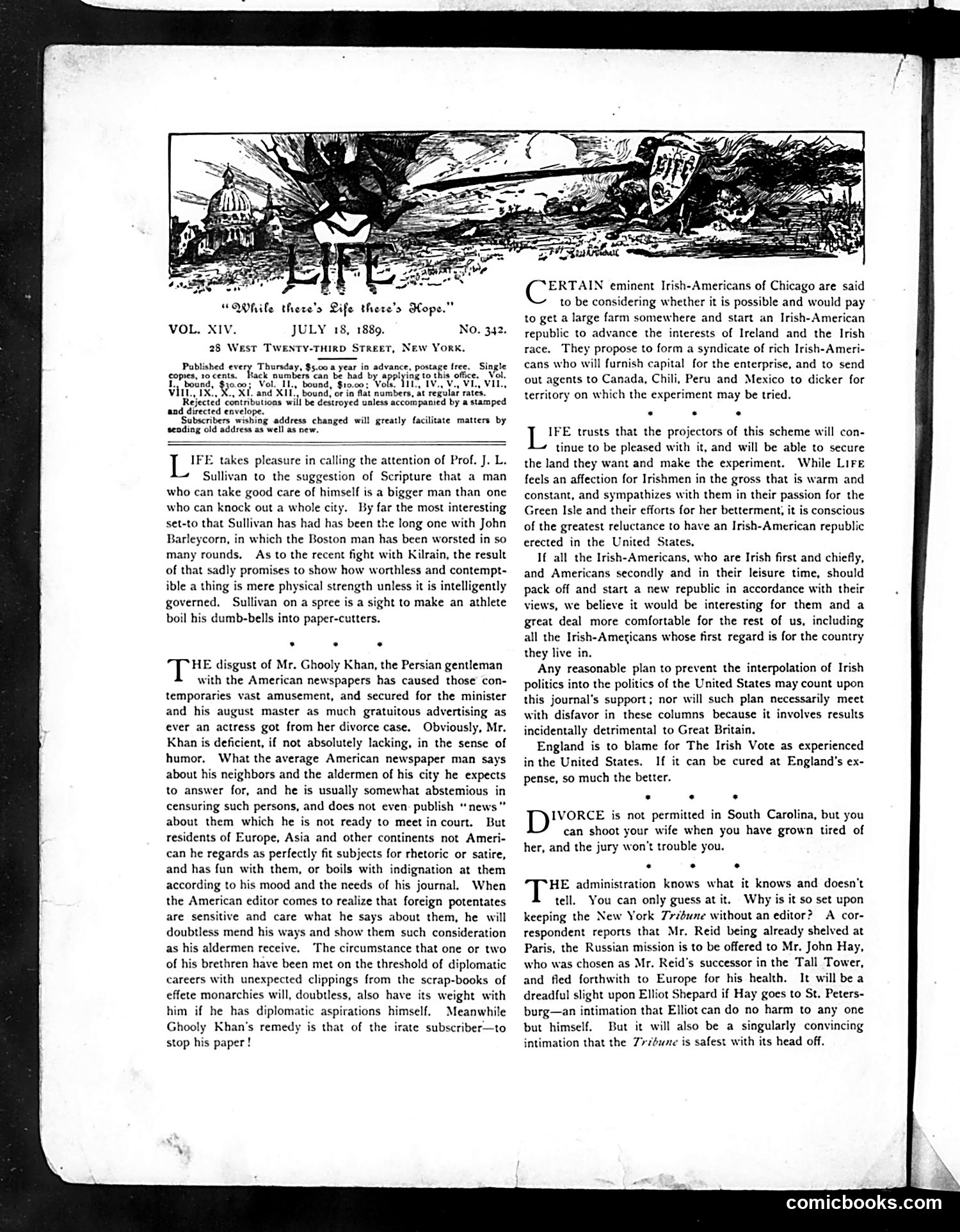
The masthead cartoon shows a figure labeled "White there's Life there's Scope," depicting an Irishman with exaggerated features characteristic of 19th-century ethnic caricature. The accompanying articles mock a scheme by Irish-American businessmen in Chicago to establish an independent Irish-American republic abroad (apparently in Canada, Chile, or Mexico). The satire ridicules both the impracticality of the venture and American newspaper sensationalism around it. A separate piece lampoons Ghooly Khan, a Persian gentleman whose marital disputes received excessive American press coverage, satirizing how foreign figures' personal scandals became trivialized entertainment in U.S. media. The tone suggests Life's editors viewed both the Irish-American colonization scheme and American journalism's coverage of international figures as worthy subjects for mockery.
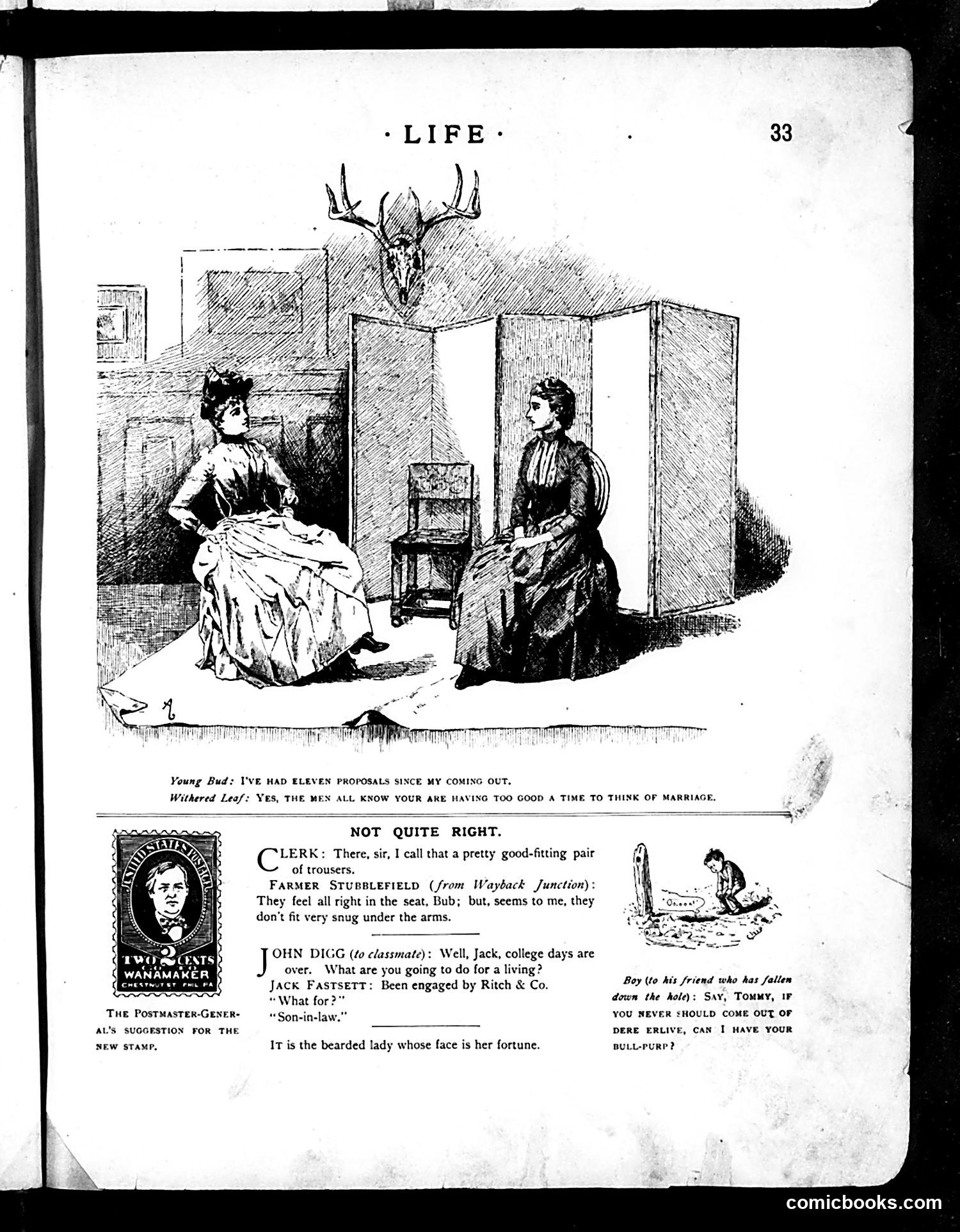
The top cartoon depicts two women in a domestic setting, with a mounted deer head above them. The caption references "eleven proposals" and marriage prospects, suggesting social satire about women's marriageability and courtship in this era. Below, "Not Quite Right" contains several brief humorous exchanges. A clerk and farmer named Stubblefield discuss poorly-fitting trousers. John Digg asks his classmate Jack Fastett about post-college employment; Fastett mentions engagement to "Ritch & Co." as a "son-in-law"—satirizing men marrying into wealthy families for financial security rather than genuine employment. A small illustration shows a boy with a fallen kite, with text joking about a "bull-pup." The page includes a postage stamp advertisement promoting a new design. The humor targets Victorian-era courtship conventions, economic anxieties, and class concerns.
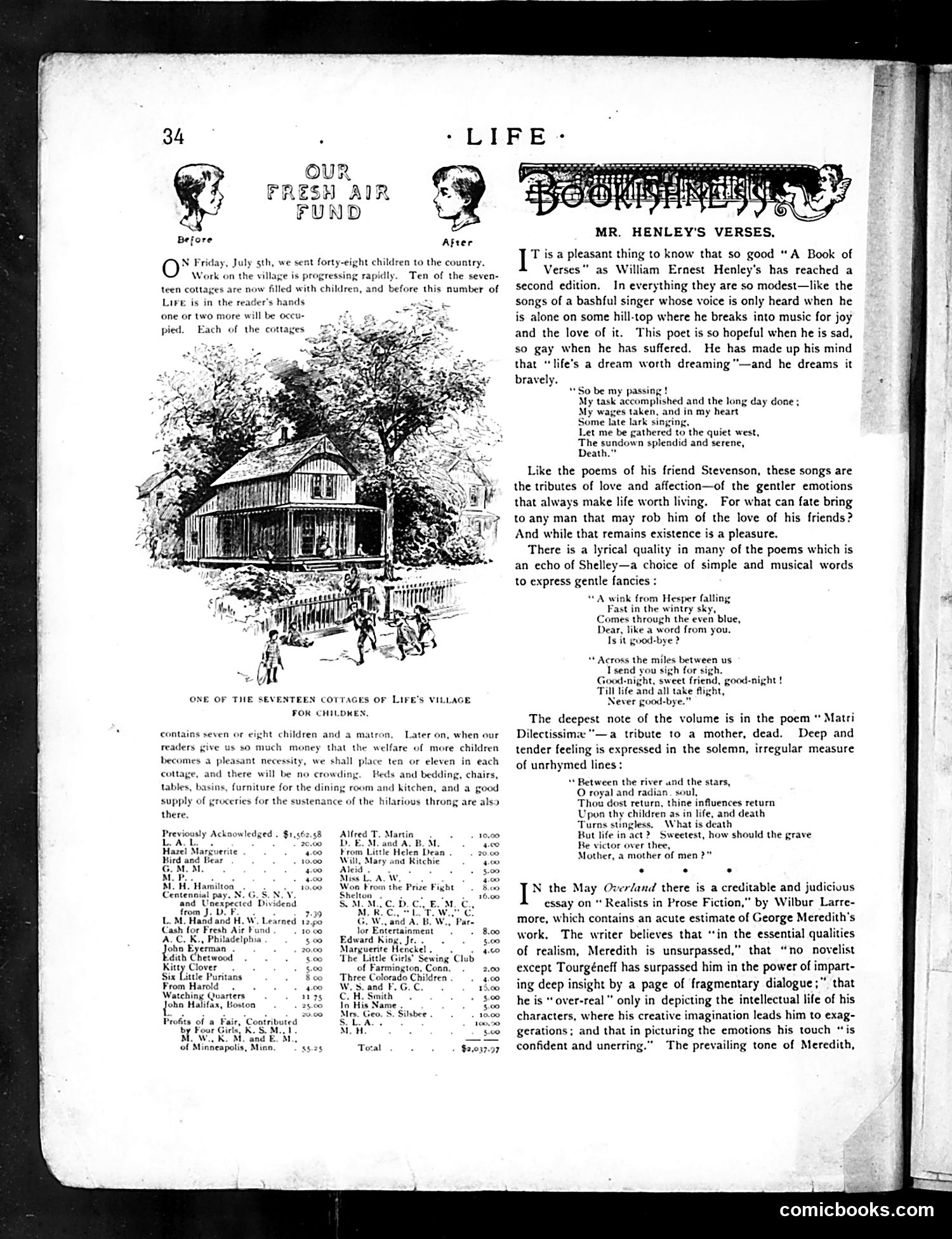
This page contains **no political cartoon**. Instead, it features two distinct sections: 1. **"Our Fresh Air Fund"** (left): A nostalgic illustration of a cottage with children playing outside, accompanied by text describing Life magazine's charitable initiative sending 48 children to the country. The accompanying donation list shows contributions from readers supporting this welfare program. 2. **"Mr. Henley's Verses"** (right): A literary review praising William Ernest Henley's poetry collection, with quoted verses and critical analysis. The reviewer compares Henley's work favorably to Stevenson and Shelley, emphasizing its emotional and musical qualities. The page is primarily **philanthropic and cultural content** rather than satirical commentary.
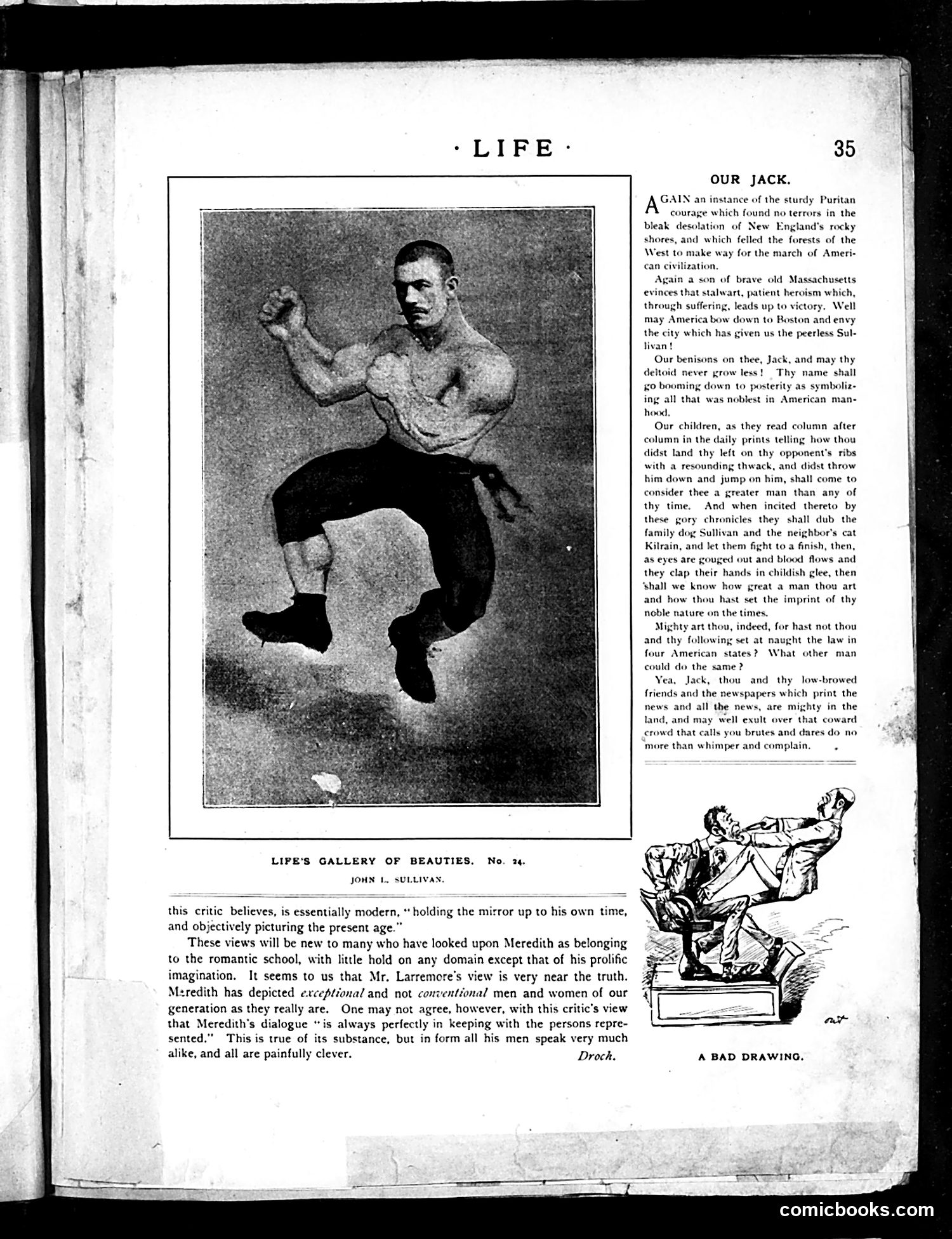
**Main Image**: "Life's Gallery of Beauties No. 34" features boxer **John L. Sullivan**, a famous heavyweight champion of the late 19th century, displayed as a muscular physique specimen. **"Our Jack" Article**: The accompanying text is a patriotic celebration of Sullivan as embodying American heroism and "noble" manhood. It sarcastically elevates his boxing prowess to national significance, suggesting children will learn of his fighting achievements as part of American heritage. **"A Bad Drawing"**: The small cartoon appears to mock artistic incompetence—likely editorial commentary on poor illustration quality. **Context**: This represents the widespread lionization of boxers in late-19th-century American popular culture, when prize fighters were celebrated as national heroes symbolizing American vigor and superiority.
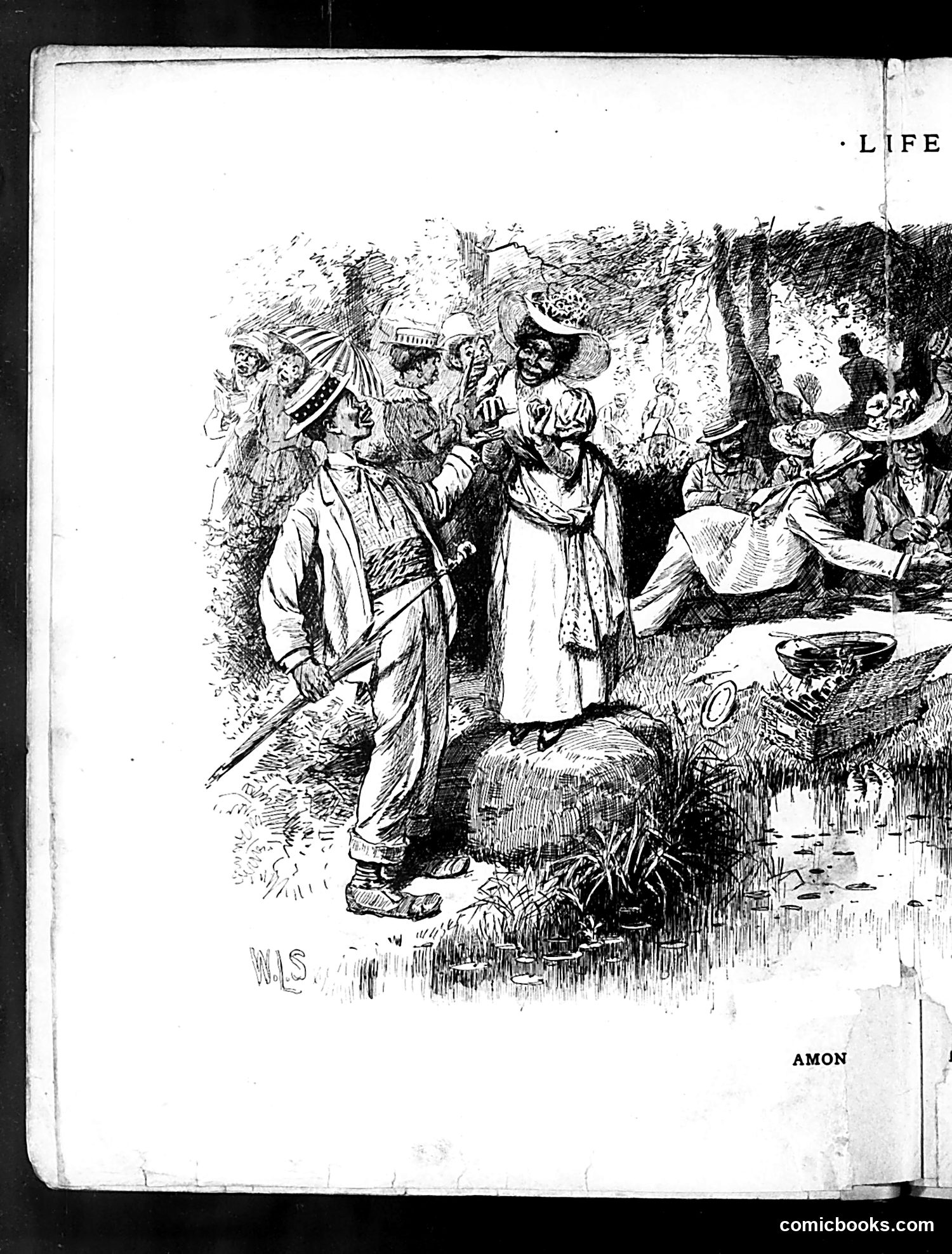
This appears to be a satirical illustration from *Life* magazine depicting a social gathering or picnic scene. The image shows well-dressed figures in period clothing (likely late 19th or early 20th century) engaged in what seems to be an outdoor social event, with people seated and standing around a water's edge or marshy area. The specific political or social commentary is unclear without additional context or caption text that may be missing from this OCR. The artist signature appears to read "AMON" (bottom right), but the precise target of the satire—whether social class dynamics, courtship customs, leisure activities, or contemporary political figures—cannot be determined from the image alone. The formal dress amid rustic surroundings might suggest irony about pretension or social pretense.
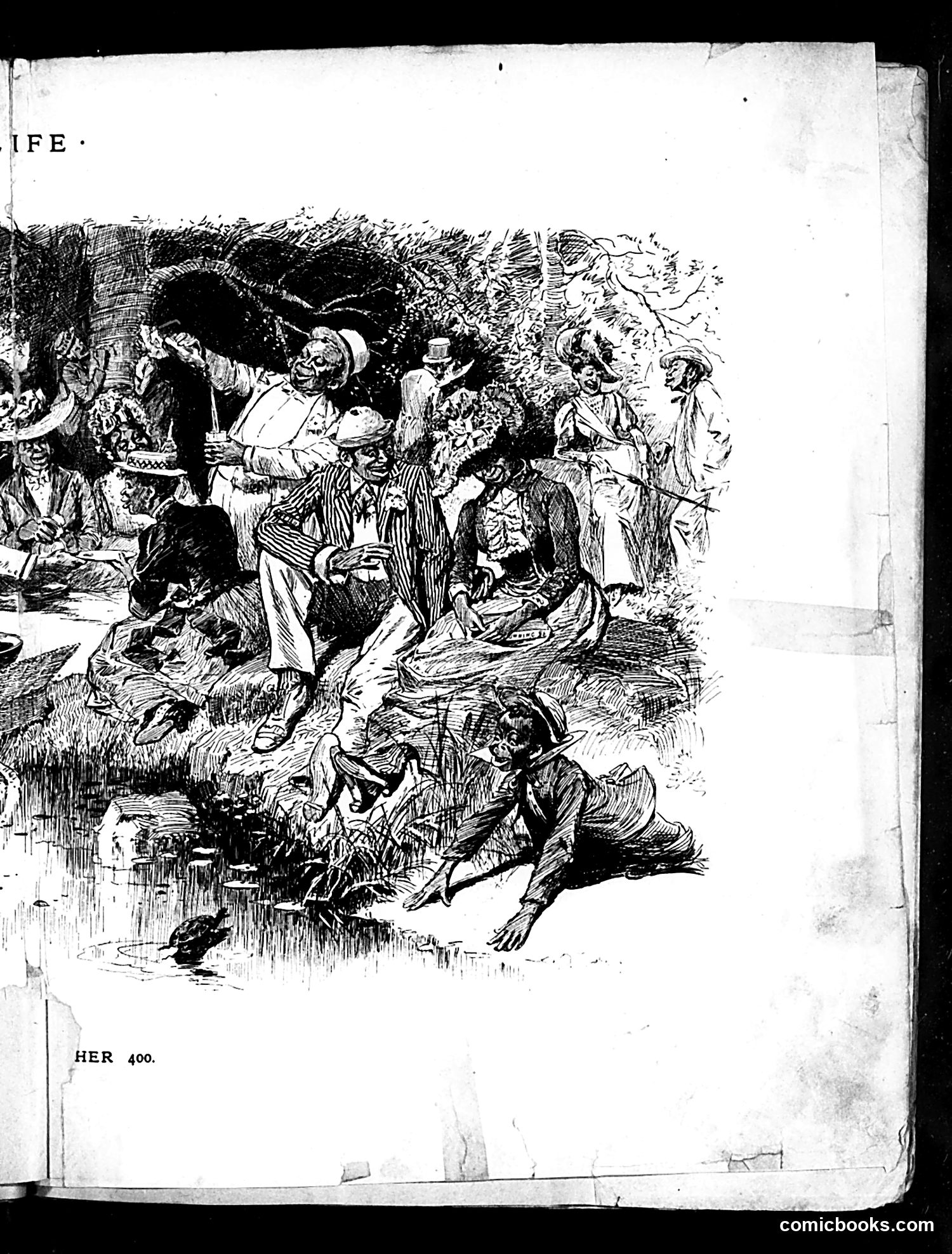
This page from *Life* magazine shows a satirical illustration labeled "HER 400," depicting a crowded outdoor social gathering or picnic scene. The sketch uses exaggerated caricatures typical of late 19th/early 20th-century satirical art. The title "HER 400" likely references the famous "Four Hundred"—the exclusive list of New York's most prominent society families, popularized by Mrs. Astor's social circle. The cartoon appears to satirize high society gatherings, showing well-dressed figures in various states of social interaction and activity. The crowded, chaotic composition suggests mockery of pretension and artificial social hierarchies among the wealthy elite. Without additional context or visible byline, the specific artist and exact historical moment remain unclear, but the satire targets aristocratic exclusivity and social posturing.
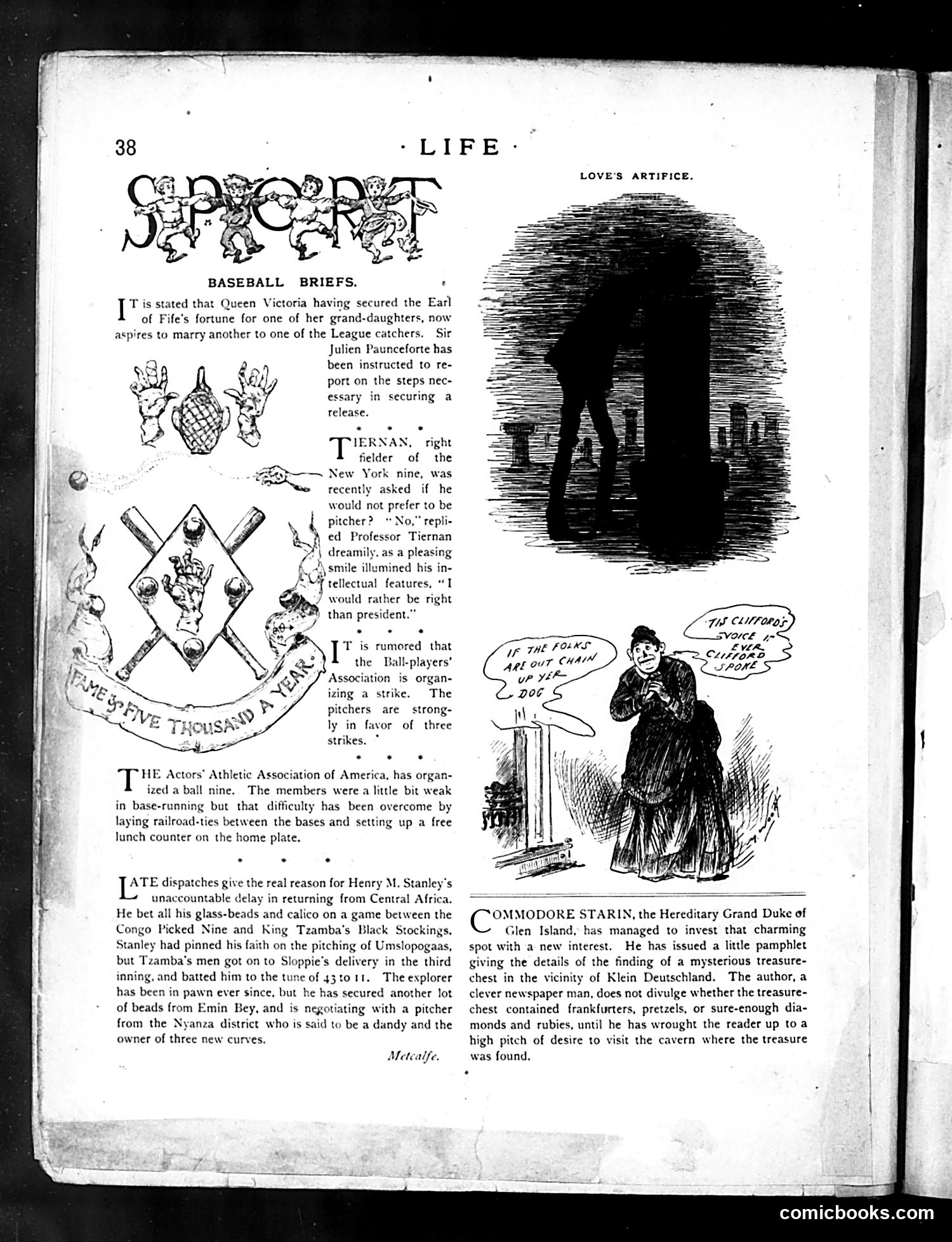
This page from *Life* magazine contains a cartoon titled "Love's Artifice" showing a silhouetted couple in a romantic archway, paired with a sketch of a woman at a cliff edge. The woman says "If the folks are out, there's nothing UP YET, Doc's" and the man responds "TIS CLIFFORD, SINCE I'VE BEEN COMING." The joke appears to concern a couple's romantic rendezvous at a dangerous cliff location. The cartoon satirizes either reckless courting behavior or the woman's casual attitude toward perilous circumstances for romantic purposes. The title "Love's Artifice" suggests the satire targets artificial or contrived romantic gestures. The specific reference to "Doc" remains unclear without additional context.
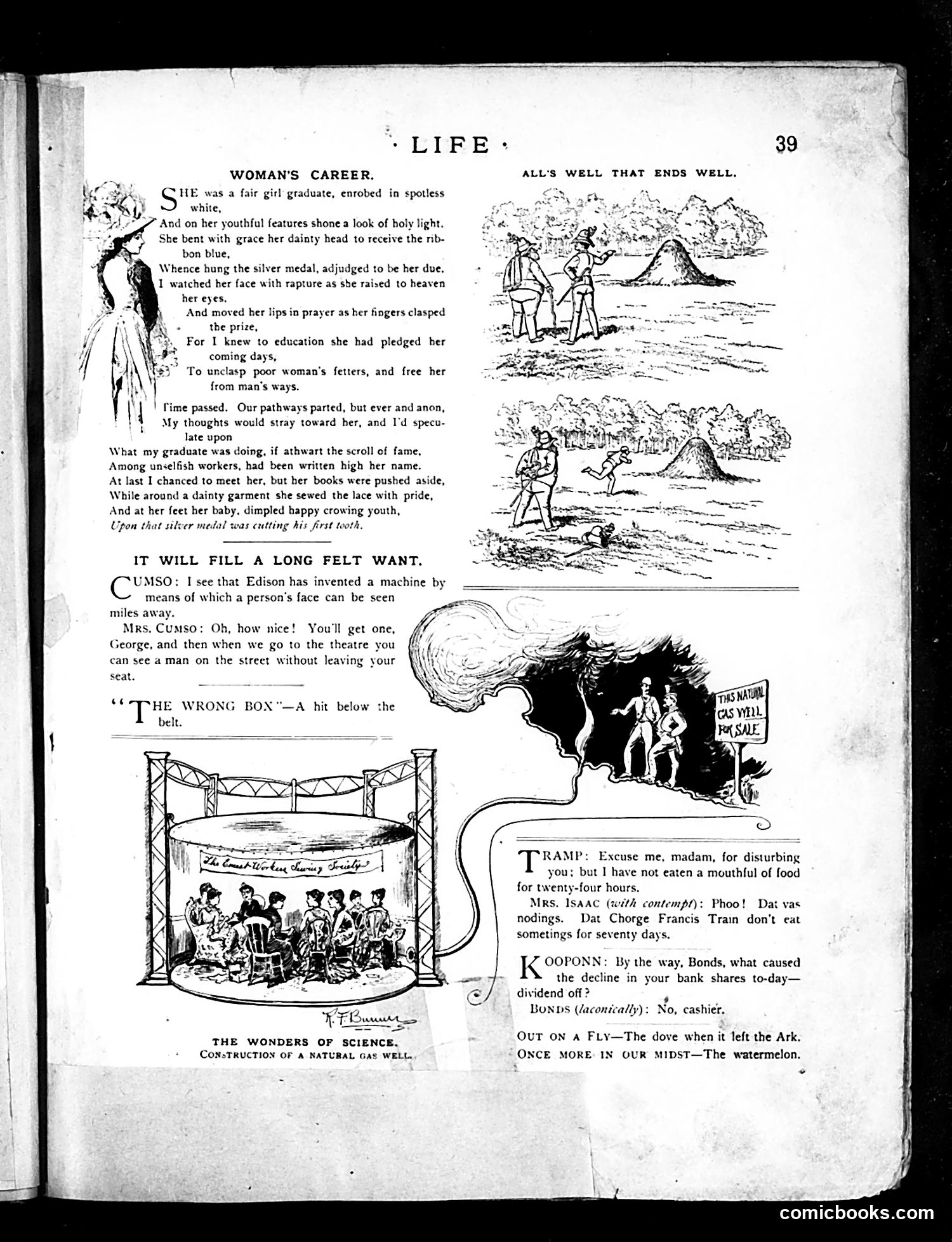
This page contains several satirical pieces: **"Woman's Career"** (left): A poem praising a female graduate's accomplishments—her education, charitable work, and medal—before revealing she's abandoned it all for motherhood ("her first tooth"). The satire mocks society's expectation that women's professional achievements matter less than domestic life. **"The Wonders of Science"** (bottom left): A cartoon showing a theatrical audience viewing Edison's invention allowing distant face-viewing (likely referring to early television/telegraphy concepts). The satire appears to mock both technological enthusiasm and theater culture. **"The Wrong Box"** and dialogue pieces (right): Brief comedic exchanges about theaters, tramps, and financial matters—general humor content typical of Life magazine's format. The page primarily satirizes gender roles and contemporary attitudes toward women's education and careers.
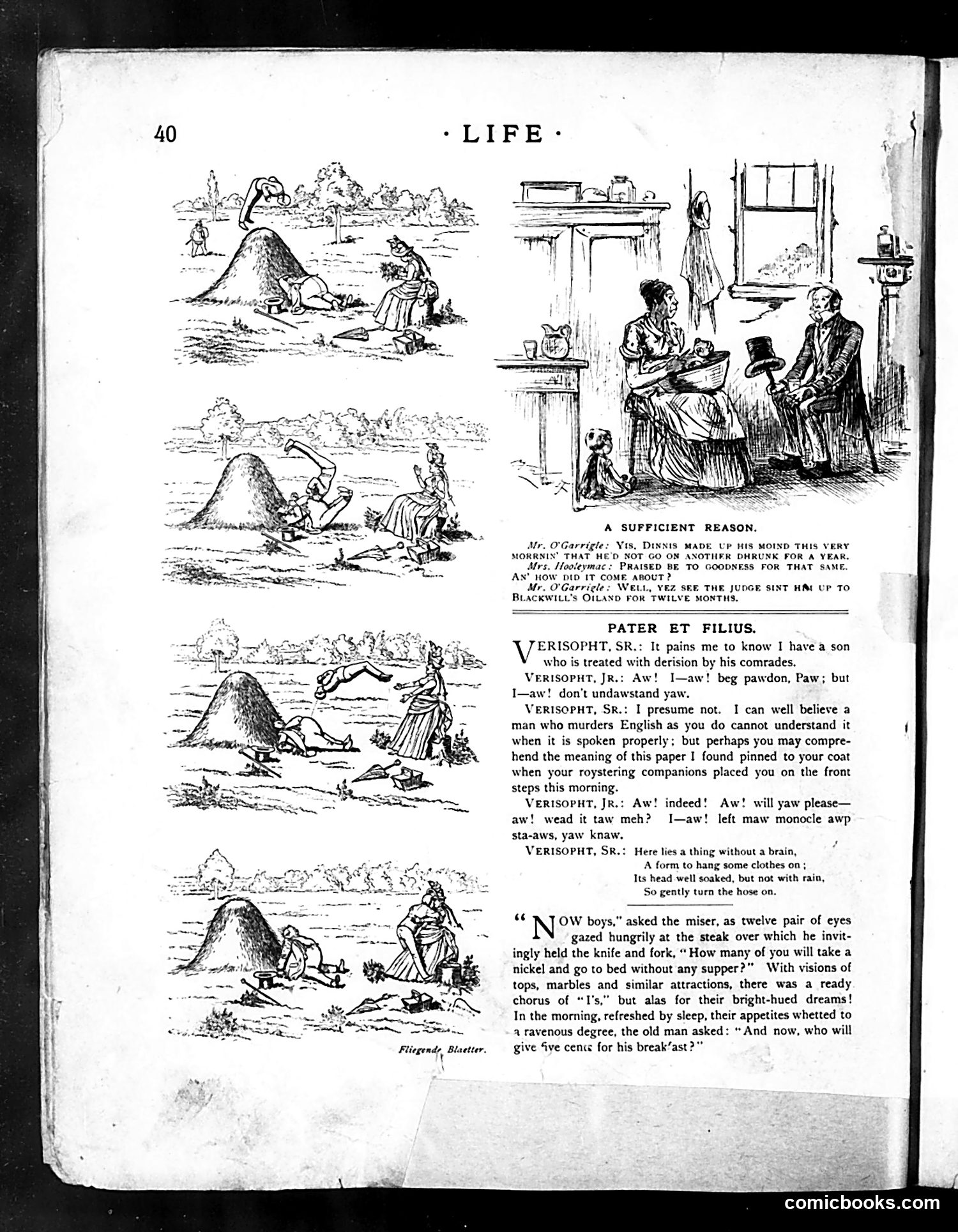
**"A Sufficient Reason"** (top right): Two Irish-American women discuss a man named Dennis who's sworn off drinking for a year because a judge sentenced him to twelve months in Blackwell's Island (a penitentiary). The humor relies on Irish dialect humor and the implicit threat of incarceration as the only effective deterrent to alcoholism—satirizing both drinking culture and the judicial system's harshness. **"Pater et Filius"** (middle): A father confronts his dissolute son about a cruel note pinned to his coat by drinking companions. The son's exaggerated affectation (dropping g's, mispronouncing words, monocle) satirizes upper-class pretension. The father reads a mocking verse about the boy being brainless and drunk—the satire targets both drunken excess and affected upper-class mannerisms. **"The Miser" (bottom): An elderly miser offers street boys nickels to skip supper, then the next morning demands payment for breakfast—exploiting their hunger and poverty. This satirizes greed and the cruel exploitation of poor children.
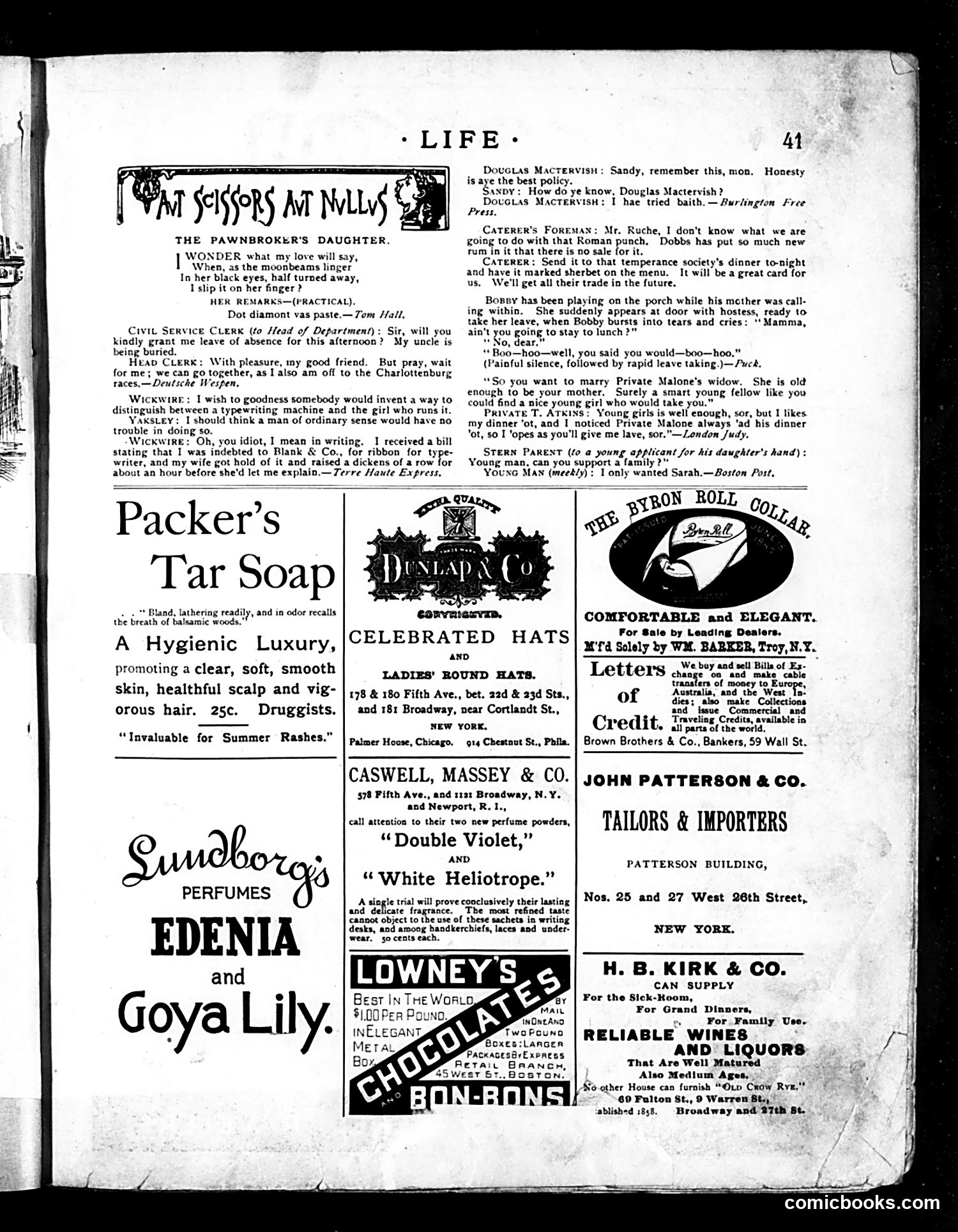
This page from *Life* magazine contains brief satirical vignettes mocking Victorian social conventions and human nature: **Key jokes:** 1. **The diamond engagement ring**: A man proposes romantically, imagining his beloved's emotional response—but she practically comments "that diamond was paste" (fake). Satire on materialism and romantic disappointment. 2. **Civil Service absurdity**: A clerk requests afternoon leave because his uncle is being buried; his boss grants it cheerfully, adding he's also leaving for horse races. Mocks bureaucratic indifference and hypocrisy. 3. **The temperance society scam**: A caterer suggests relabeling cheap, over-alcoholic "Roman punch" as "sherbet" to sell it to temperance advocates. Satirizes moral hypocrisy. 4. **Child's emotional manipulation**: A boy prevents his mother's departure by crying she promised lunch, creating awkward silence. Gentle mockery of parental weakness. 5. **Soldier's priorities**: A soldier seeking to marry a widow for her cooking rather than love. Social commentary on practicality versus romance. The page is primarily **advertisements** below, selling soaps, perfumes, hats, and financial services typical of the era.
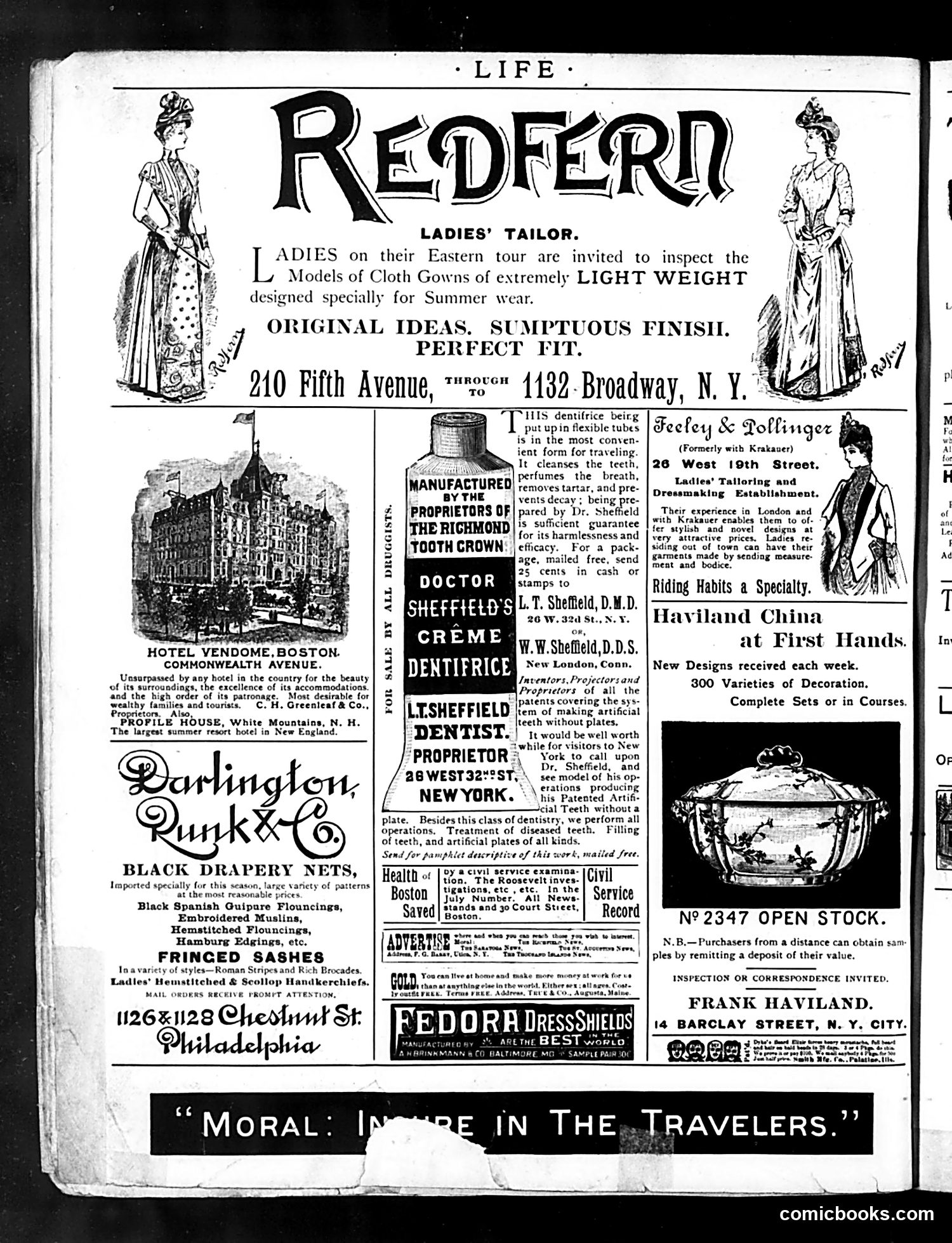
This is primarily an **advertising page**, not a satirical cartoon page. The title "LIFE" at the top indicates this is from *Life* magazine, a satirical publication, but this particular page is devoted almost entirely to commercial advertisements. The ads target **wealthy travelers**, particularly women on "Eastern tour[s]" (likely Grand Tour-style journeys). Featured products include: - **Redfern**: A ladies' tailor offering lightweight summer gowns for travelers - **Dr. Sheffield's Dentifrice**: Toothpaste in travel-friendly flexible tubes - **Hotels** (Vendome in Boston, Profile House in White Mountains): luxury accommodations - **Dressmakers, china, fabrics**: Luxury goods for affluent customers The page's motto at bottom—**"Moral: Insure in the Travelers"**—appears to be an insurance company advertisement, making an ironic pun about travel-related products. There is **no political satire or cartoon content** visible here; this is a straightforward advertiser-supported magazine page targeting the wealthy leisure class of the Gilded Age.
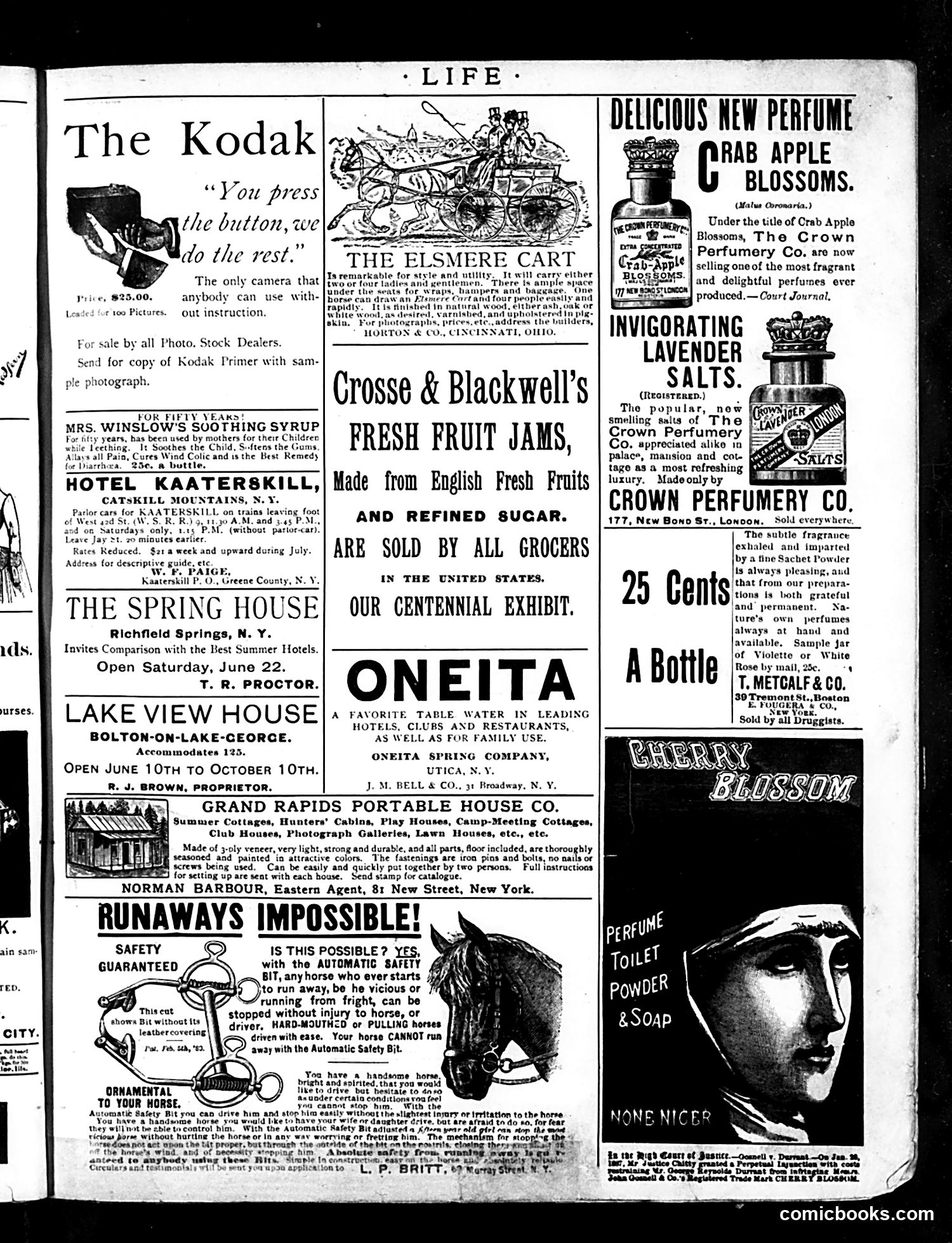
This page is primarily **advertisements** with no significant political cartoon or satirical content to analyze. The ads promote typical late-19th-century products: the Kodak camera ("You press the button, we do the rest"), Mrs. Winslow's Soothing Syrup for children, hotel and resort accommodations, jams and bottled water, perfumes and toiletries, and portable houses. The one item with messaging beyond product description is the **"Runaways Impossible!" advertisement** for the Automatic Safety Bit (a horse bridle). It uses testimonial-style copy to persuade skeptical readers that this device genuinely prevents runaway horses—addressing anxieties about horse control that modern readers would find unfamiliar. The rhetorical strategy ("IS THIS POSSIBLE? YES") suggests contemporary skepticism needed countering. Otherwise, this is a straightforward commercial page reflecting consumer goods and services of the Gilded Age.
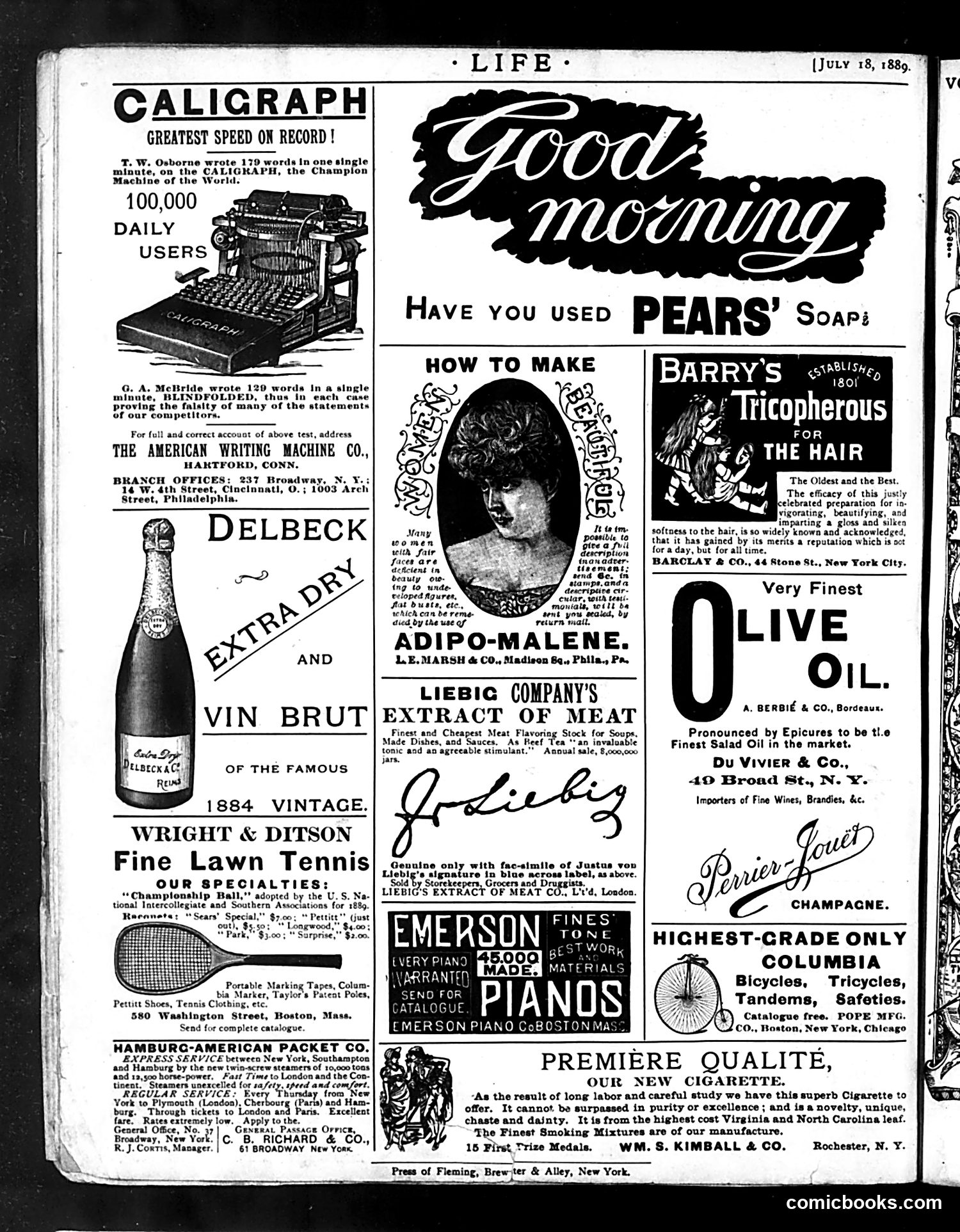
This is primarily an **advertisement page**, not a satirical cartoon page. It contains various commercial ads typical of late 1880s America, with no political satire. The ads showcase period products and services: typewriters (Caligraph), champagne (Delbeck), tennis equipment (Wright & Ditson), steamship service (Hamburg-American), hair products (Barry's Tricopherous), meat extract (Liebig), pianos (Emerson), bicycles (Columbia), and cigarettes (Première Qualité). Notably, **Adipo-Malene** advertises as a "remedy" for women with "undeveloped figures," reflecting 1880s beauty standards and the era's unregulated patent medicine market. The ads emphasize modernity—the Caligraph boasts "100,000 daily users" and speed records, while Columbia bicycles promoted the new "safety" design. This reflects Life's dual function: satirical editorial content paired with revenue-generating advertisements targeting affluent, urban readers.