
A complete issue · 14 pages · 1888
Life — September 6, 1888
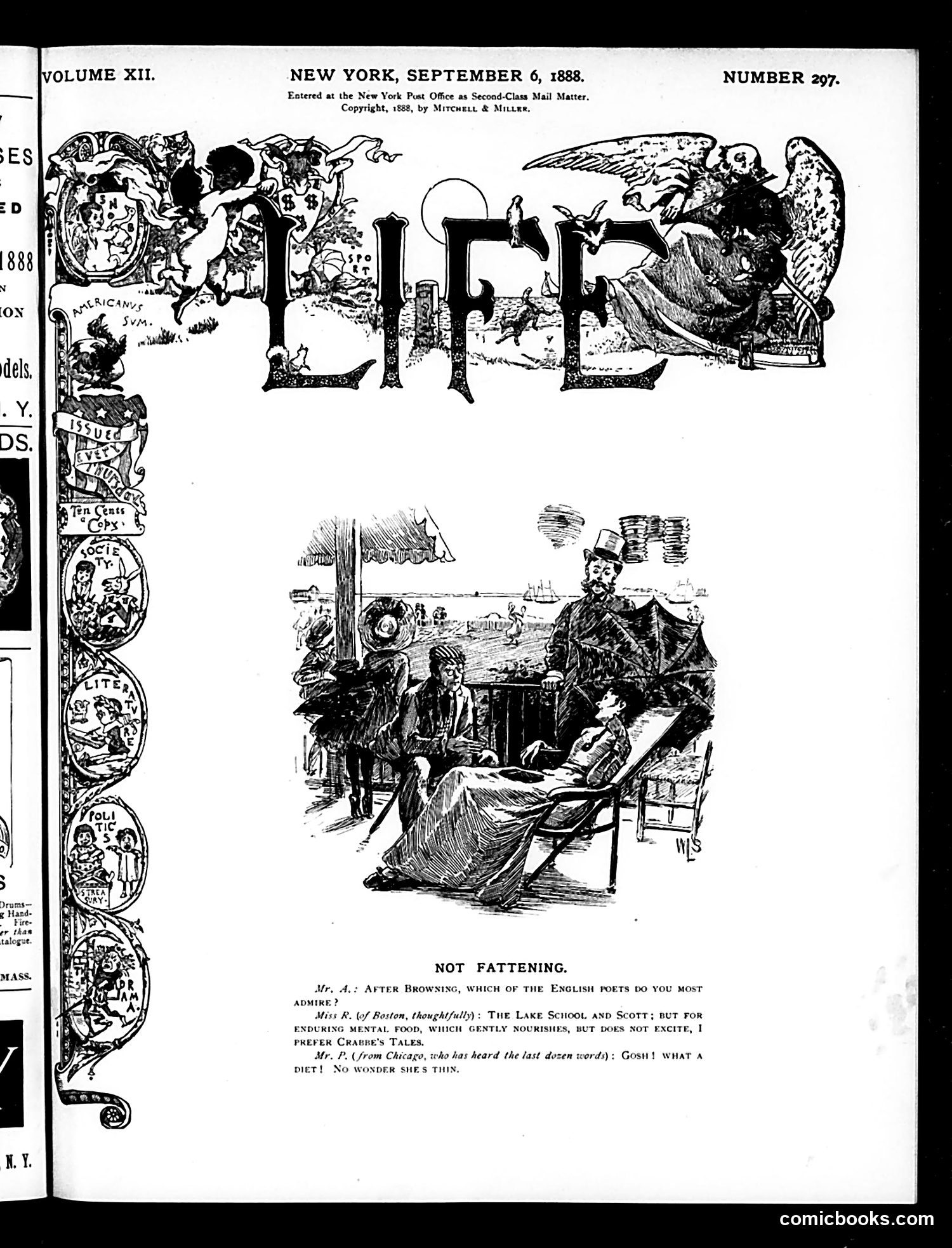
The page features a section titled "NOT FATTENING" presenting a humorous exchange about literature preferences. Mr. A. (from somewhere) asks Miss R. of Boston which English poets she most admires. She responds that she prefers "The Lake School and Scott" for their "enduring mental food," but dismisses other writers as insufficiently stimulating. Mr. P. from Chicago, having heard "the last dozen cords" (likely a reference to recent literary discussion), comments sarcastically: "Gosh! what a diet! No wonder she's thin." The joke satirizes both pretentious literary taste and the notion that mental sustenance from "serious" literature is less nourishing than other forms of reading—implying that Miss R.'s intellectual diet literally fails to fatten her. It's a Victorian-era jab at highbrow literary snobbery.
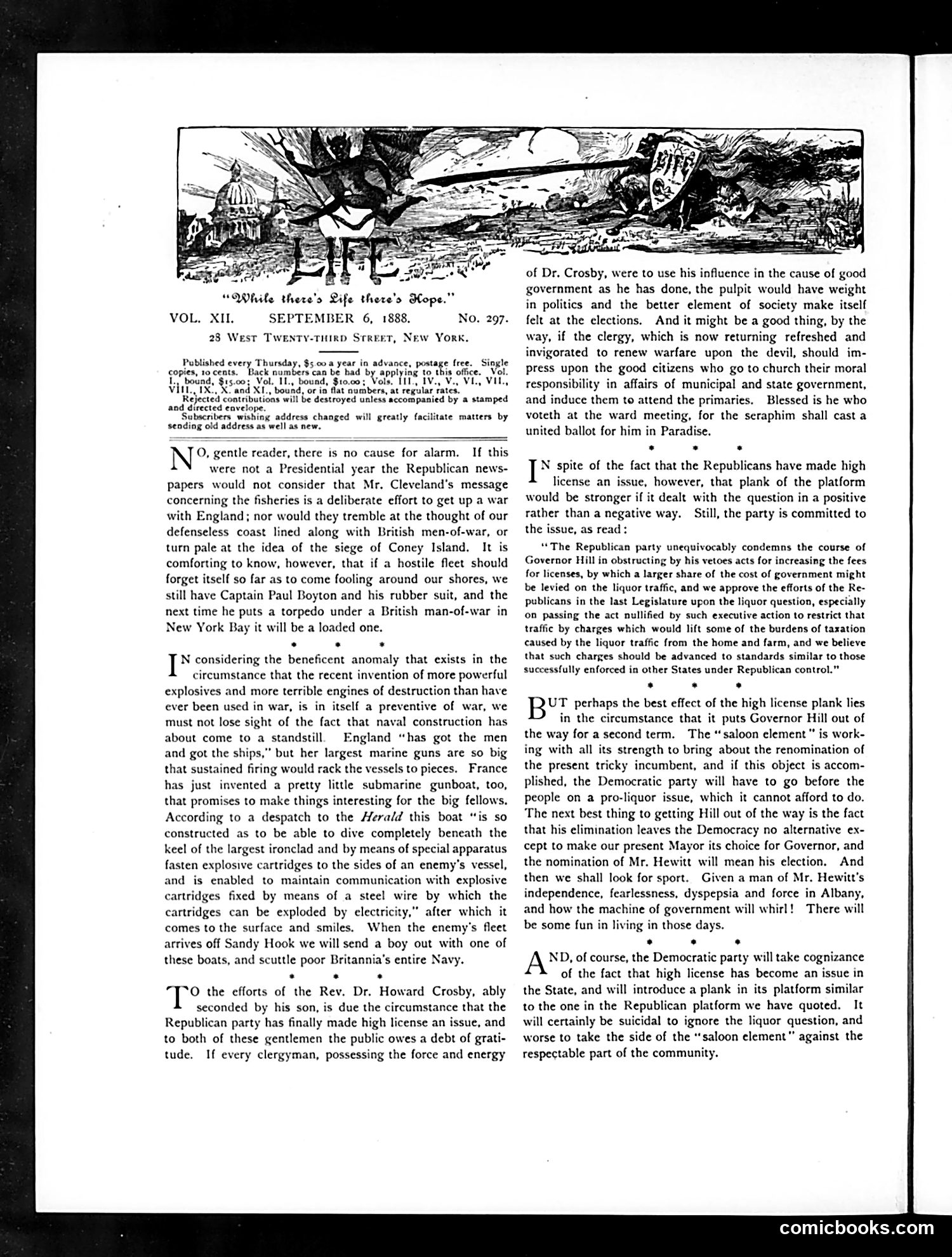
**The Header Cartoon:** The illustrated masthead shows a classical landscape with "Life" and the motto "Where there's Life there's Hope," typical of the magazine's design. **The Political Content:** The article discusses Cleveland's message on fisheries disputes with England, expressing confidence rather than alarm about potential naval conflict. It then shifts to Republican Party politics, specifically criticizing Governor Hill's veto of liquor license fee increases. The text argues this positions Republicans to campaign against the "saloon element" while Democrats counter-position themselves. The satire targets the cynical political maneuvering by both parties around the liquor licensing issue—using it as a wedge issue for the upcoming election rather than addressing substantive governance.
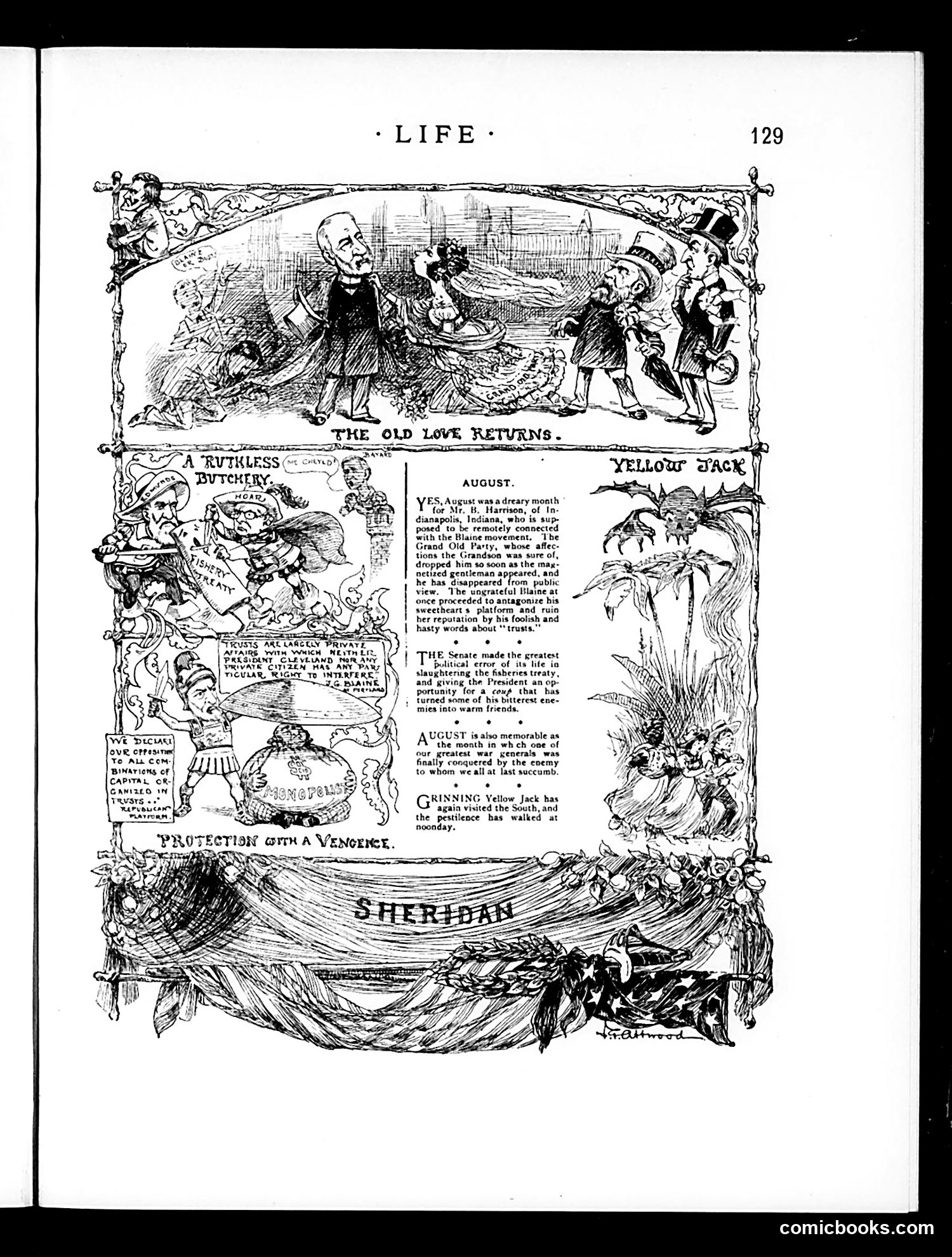
This Life magazine page from August contains three political cartoons mocking late 19th-century American politics: **"The Old Love Returns"** (top) depicts what appears to be a reconciliation between political factions, with figures in formal dress greeting each other. **"A Ruthless Butchery"** (left) satirizes political violence or corruption, showing figures engaged in brutal conduct—likely referencing either party politics or an actual violent incident. **"Yellow Jack"** (right) uses disease imagery (yellow fever) as metaphor for political contamination, showing the plague spreading among people. **"Protection with a Vengeance"** references protective tariff policy debates of the era. The cartoons collectively critique Republican and Democratic political maneuvering, party betrayals, and destructive policies from this period. The specific August reference and Mr. Harrisen mention suggest a particular 1890s political event, though the exact context isn't entirely clear from this page alone.
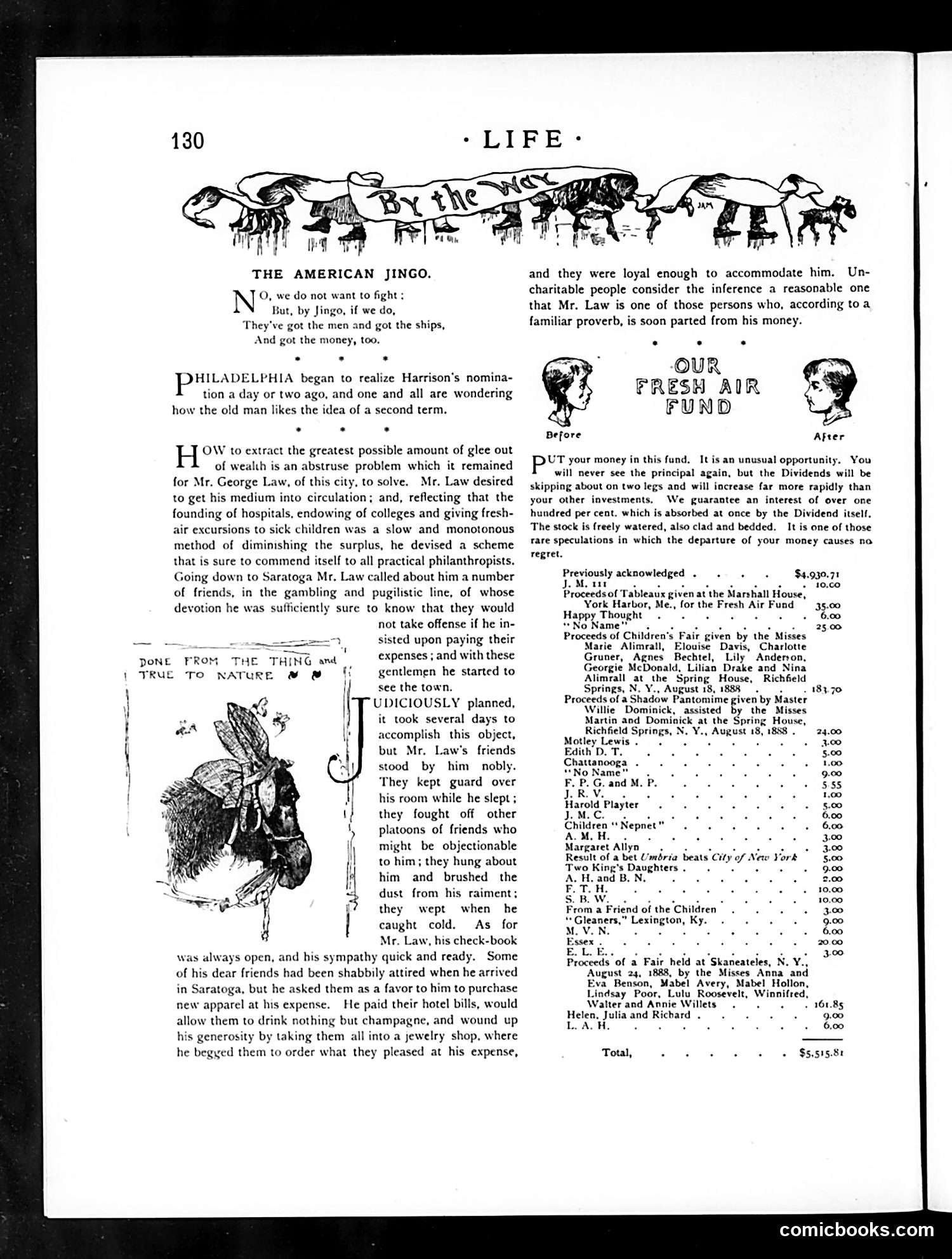
This page contains two distinct elements: **"The American Jingo"** (top): A satirical poem criticizing American jingoism and militarism. The verse mocks bellicose nationalism, suggesting war enthusiasts prioritize conflict over diplomacy ("No, we do not want to fight / But, by Jingo, if we do, / They've got the men and got the ships, / And got the money, too"). **"Our Fresh Air Fund"** (right): A charitable fundraising section documenting donations for a children's fresh air program. The list records contributions from various donors and events, with a total of $5,515.81 raised. **Left illustration**: An untitled sketch labeled "Done from the Thing and True to Nature" depicts what appears to be a figure in period dress, likely satirizing some contemporary type or character, though the specific target remains unclear from the text alone. The page juxtaposes political satire with charitable reporting typical of Life's content.
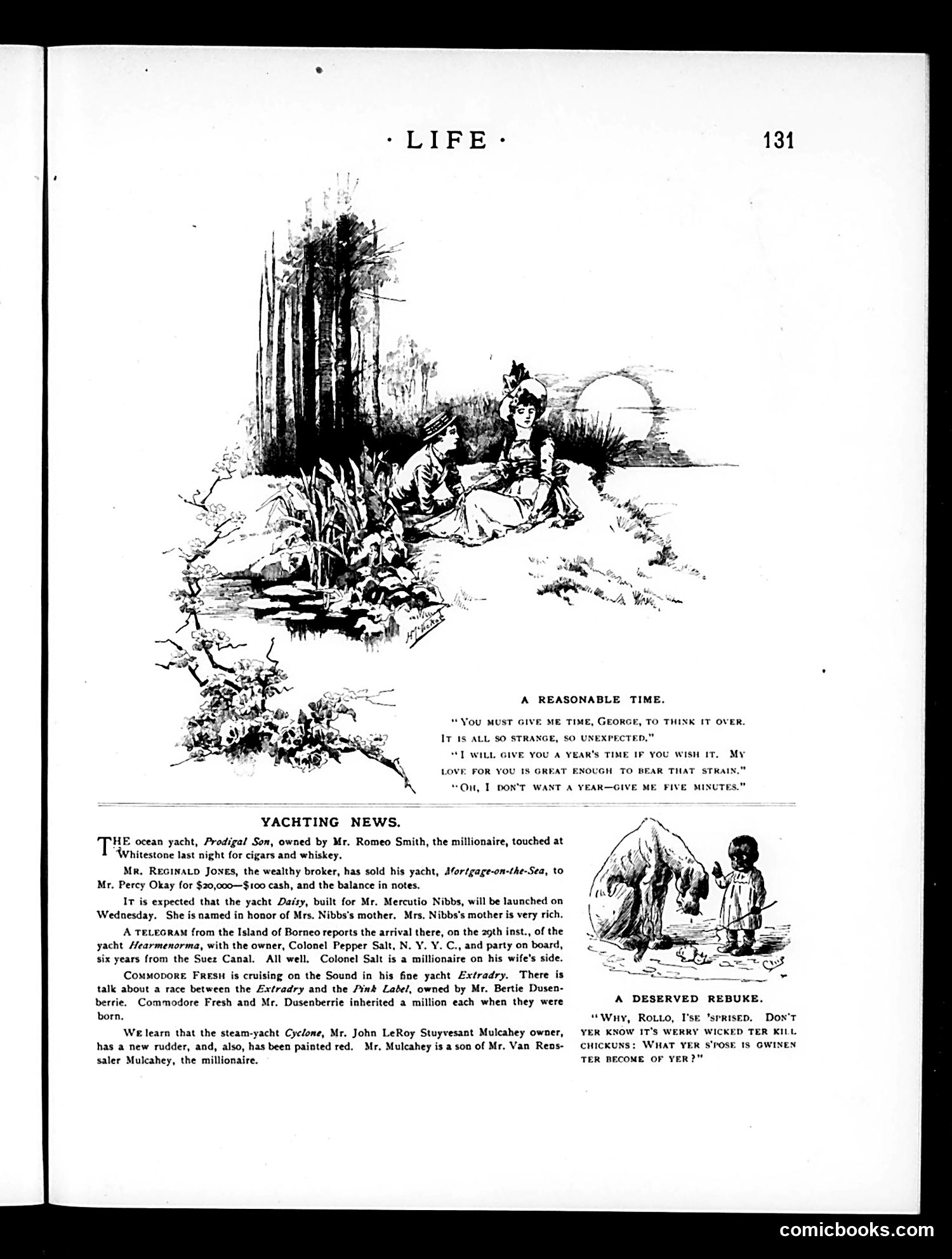
This page contains two distinct sections: **"A Reasonable Time"** (top): A romantic illustration showing a couple by water with reeds. The dialogue concerns a man (George) asking a woman for time to reconsider their relationship. She offers "a year's time," but he requests only "five minutes," suggesting he's already decided. This appears to be a sentimental romantic vignette rather than satire. **"Yachting News"** (middle): Gossip items about wealthy Americans' yachts and their owners—millionaires like Romeo Smith, Reginald Jones, and Mercutio Nibbs. The items report yacht purchases, launches, and modifications. This is straightforward society reporting. **"A Deserved Rebuke"** (bottom right): A brief humorous exchange where "Rollo" is mocked for his pretentious speech patterns, suggesting satirical commentary on affected upper-class affectation.
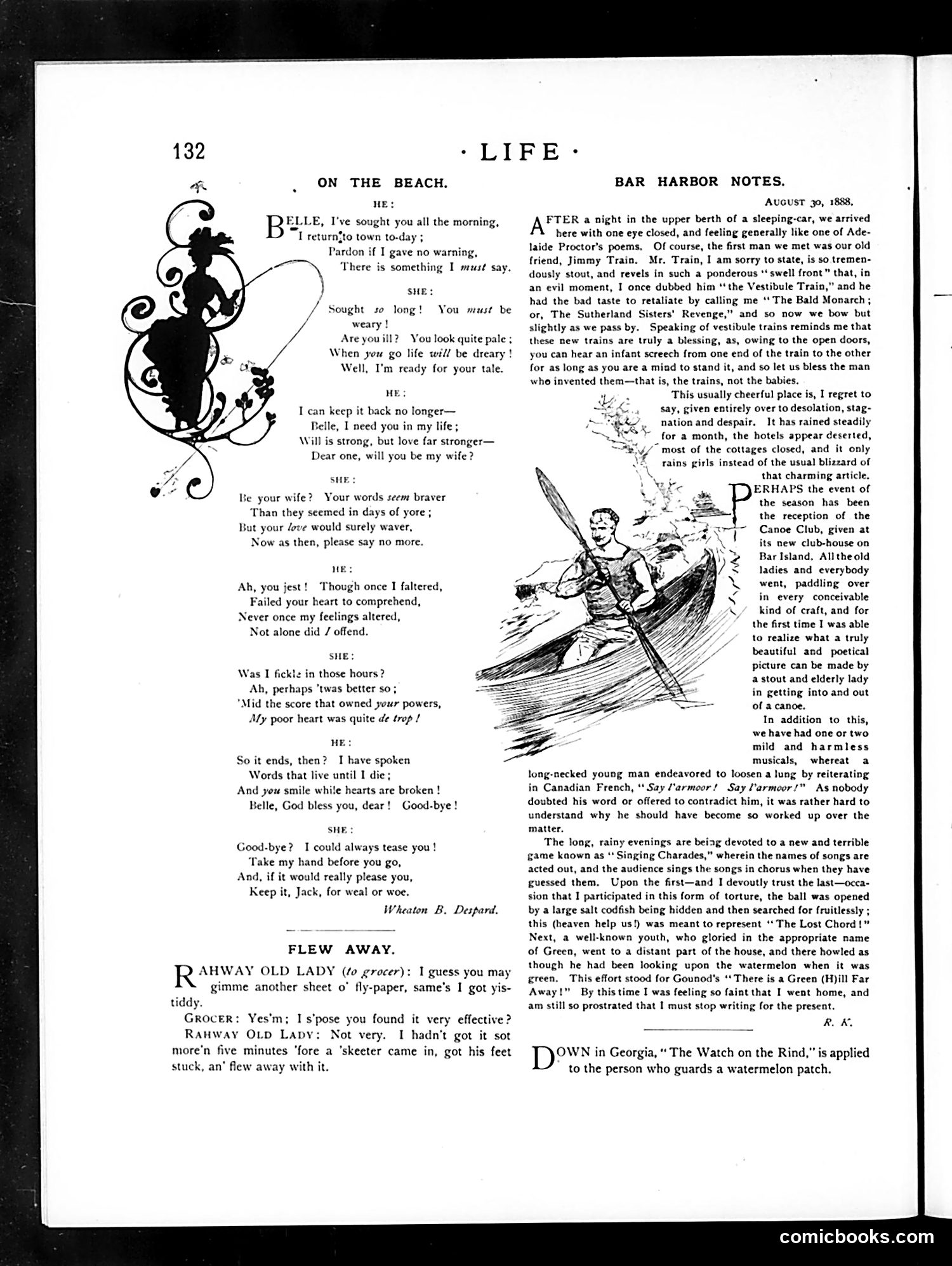
**"On the Beach"** presents a romantic dialogue between a man and woman, likely reflecting turn-of-the-century courtship conventions. The ornate art nouveau illustration frames their poetic exchange about love and marriage—the man pleads "Will it be strong, but love far stronger— / Dear one, will you be my wife?" while the woman tests his devotion. This sentimental poem satirizes Victorian-era romantic idealism through its overwrought language and melodramatic tone. **"Flew Away"** is a brief comic sketch mocking an elderly woman's failed attempt to use newspaper as a fly-swatter, with a grocer observing her ineffectual technique. The humor derives from the absurdity of her method and her indignant response when questioned. The **"Bar Harbor Notes"** section provides social commentary on summer resort life, mentioning new entertainments like canoeing and "Singing Charades," satirizing upper-class leisure activities circa August 1898.
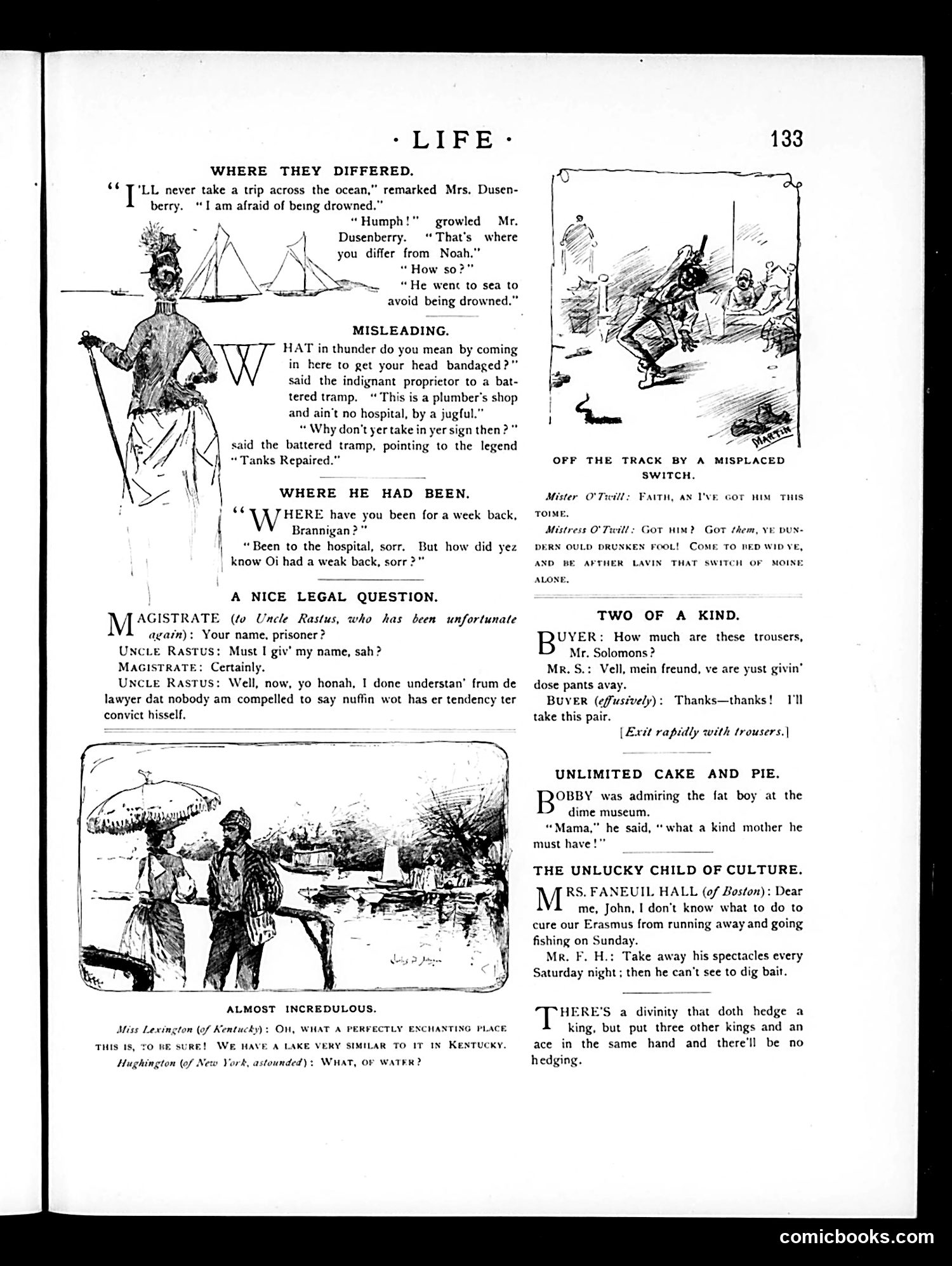
This page contains several unrelated humorous anecdotes and sketches typical of Life's satirical format: **"Where They Differed"** jokes about ocean travel fears—Mrs. Dusenberry fears drowning while her husband went to sea to *avoid* drowning. **"Misleading"** depicts a plumber mistaken for a hospital patient due to his bandaged head. **"A Nice Legal Question"** shows Uncle Rastus claiming a lawyer cannot compel him to confess guilt—a joke playing on stereotypical dialect and legal absurdities. **"Off the Track by a Misplaced Switch"** illustrates a train accident caused by improper signaling. The remaining items are brief witticisms about museums, culture, and superstitions. The page reflects early 20th-century American humor conventions, including period dialect humor and everyday mishaps presented as comic scenarios.
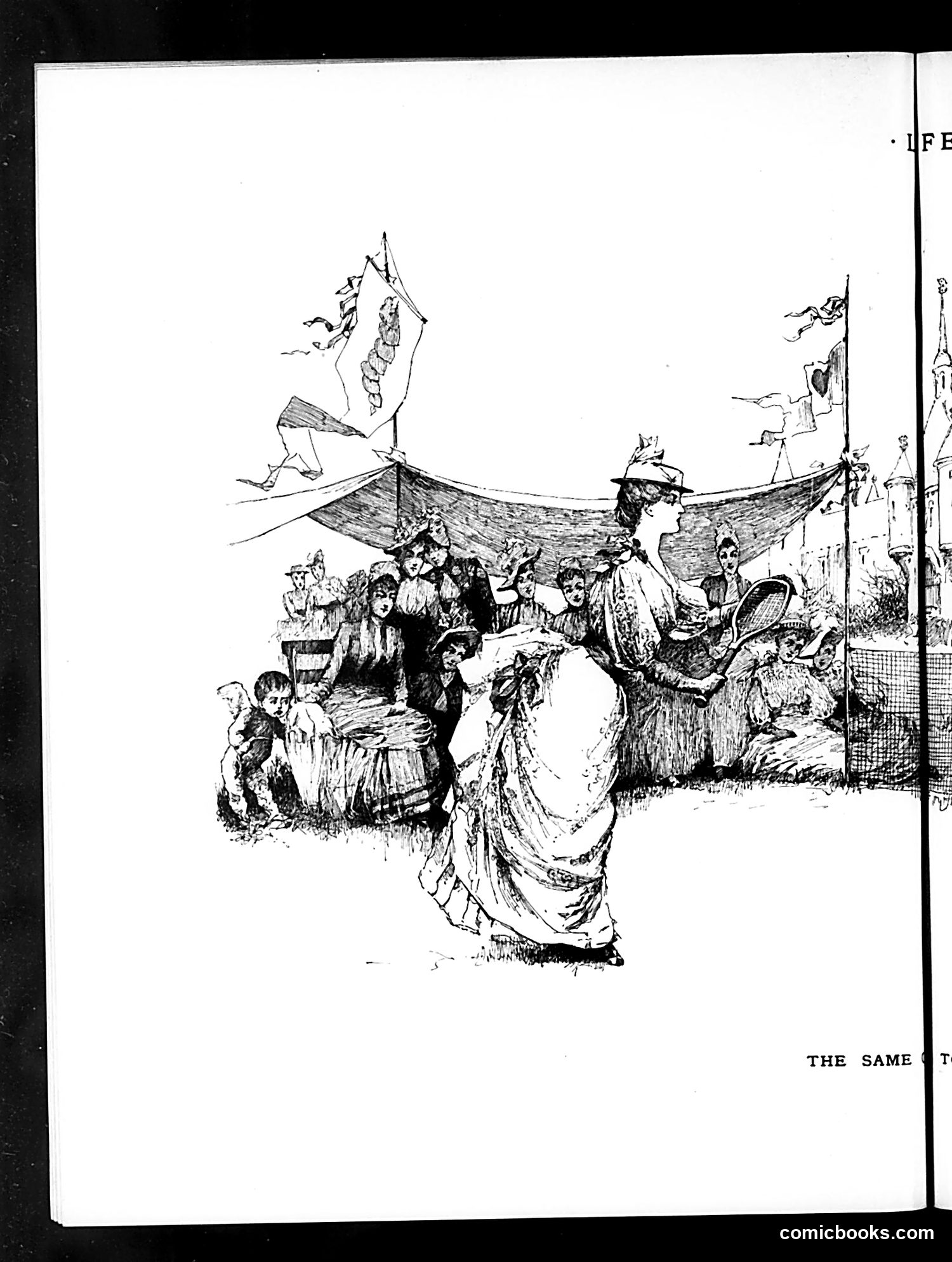
This illustration depicts a circus or carnival scene, with a woman in the foreground (wearing flowing robes and a headpiece) as the apparent center of attention. She appears to be performing or being presented to an assembled crowd beneath a tent. The visible text reads "THE SAME" at the bottom, suggesting this may be part of a comparative series or commentary on repetition. Without additional context from surrounding pages or the specific issue date, the precise satirical target remains unclear. However, the composition—with an exotic or elaborately costumed figure displayed before an audience—suggests social commentary on performance, spectacle, or possibly the treatment of women as entertainment objects. The circus setting may reference popular culture trends of the era. The full satirical intent requires knowledge of the publication date and related content to identify with confidence.
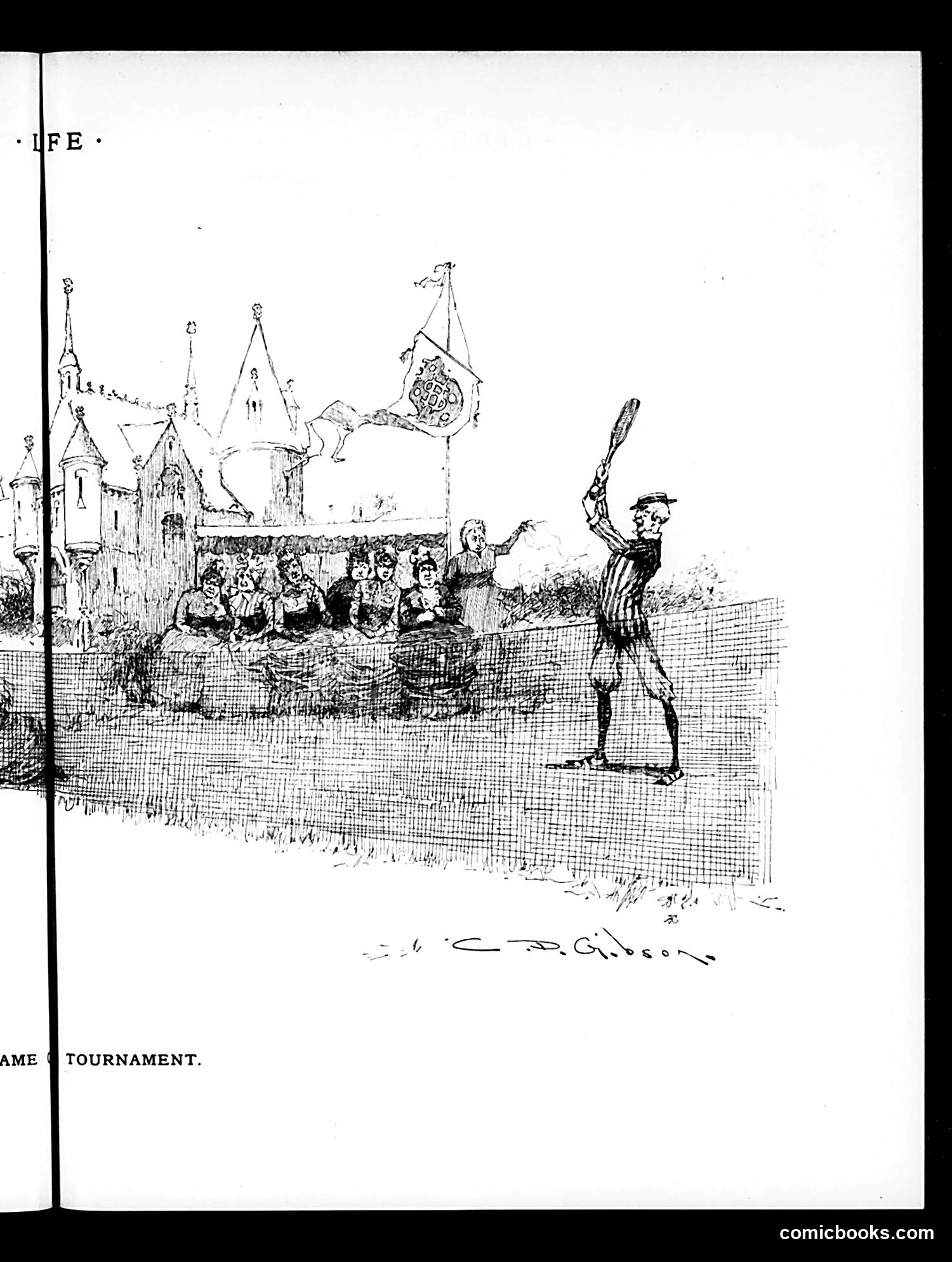
This illustration depicts a tennis match at what appears to be a fashionable late 19th-century sporting event. A player on the right holds a tennis racket in an exaggerated pose mid-swing, while spectators (appearing to be well-dressed women and men) watch from behind the net in the background. An ornate castle or grand pavilion structure dominates the left side. The satire likely mocks the social pretensions of lawn tennis—a game that had recently become fashionable among the upper classes. The elaborate architectural backdrop and formally-dressed crowd suggest the sport's association with wealth and status rather than athletic merit. The cartoonist appears to be satirizing how tennis functioned as a social performance for the elite rather than genuine competition.
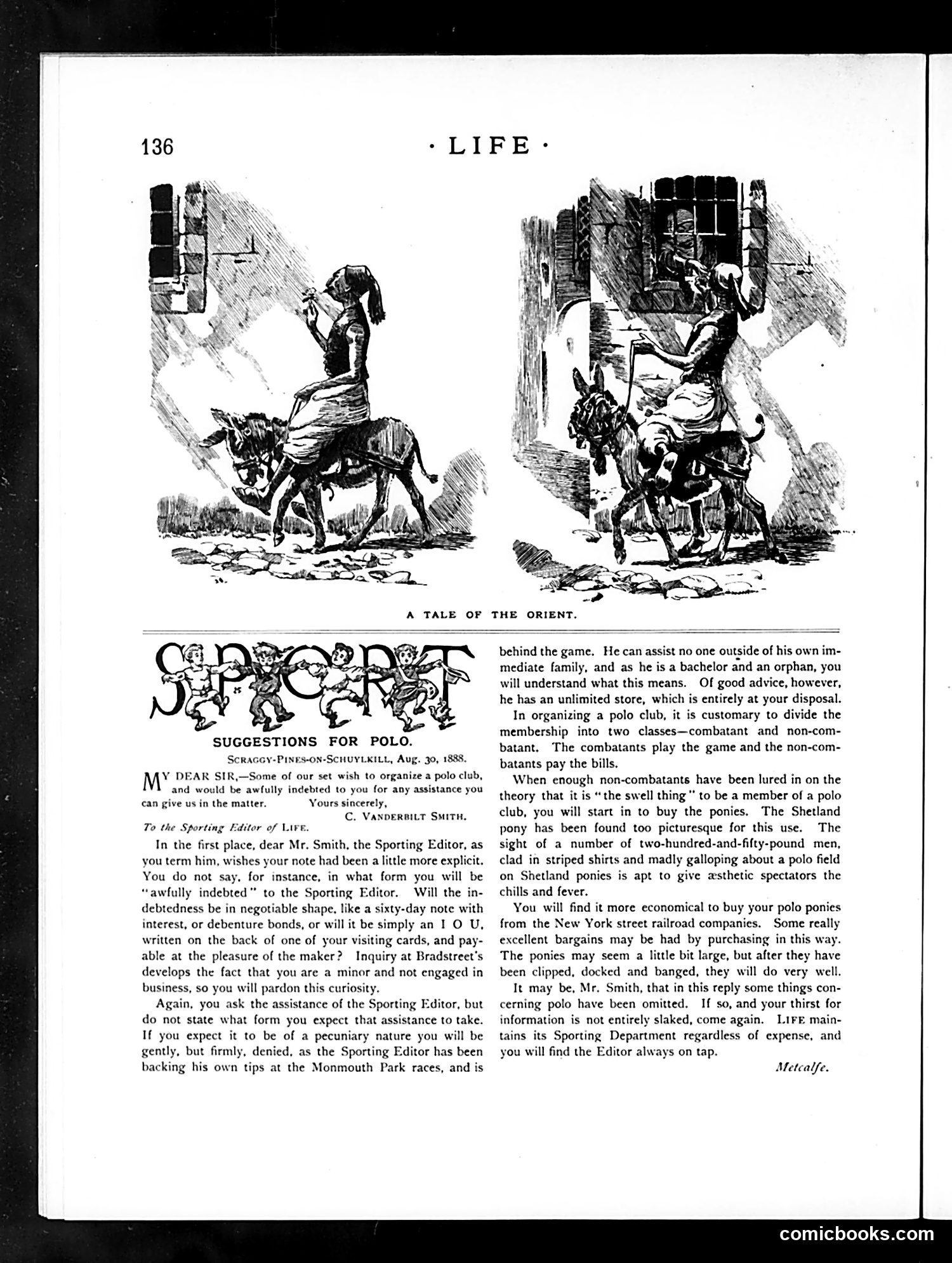
This page contains advice on organizing a polo club, addressed to C. Vanderbilt Smith by the Sporting Editor of Life. The two illustrations at top labeled "A Tale of the Orient" show mounted players in polo action. The satirical content concerns the class divisions in polo: the editor advises that membership be divided into "combatants and non-combatants," with combatants playing while non-combatants pay the bills. The humor targets wealthy elites organizing exclusive sports clubs—mocking how some members fund the activity without participating. The editor also jokes about buying polo ponies cheaply from New York railroads and notes that Shetland ponies, though small, work well for aesthetics. The satire gently pokes fun at the financial and social pretensions surrounding polo club organization among the wealthy.
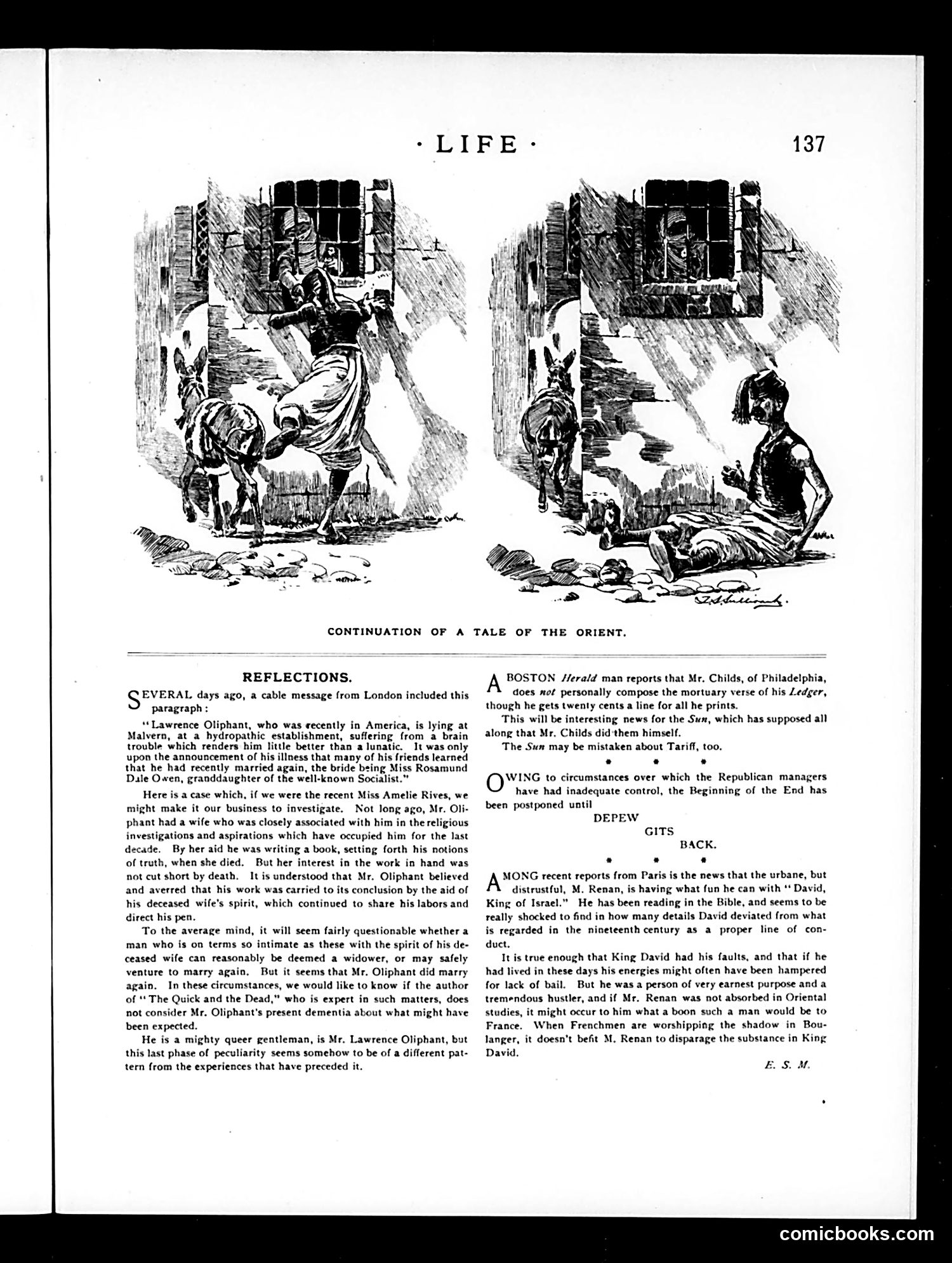
This page contains three separate satirical commentary pieces, not traditional cartoons: **"Continuation of a Tale of the Orient"** (top illustrations): Two sketches depicting an exotic scene, likely referencing contemporary orientalist literature or debate. **"Reflections" section**: Three brief satirical items: 1. **Lawrence Oliphant**: Mocks the writer/diplomat for marrying a second time while claiming his deceased first wife's spirit continued collaborating with him on his book. The satire questions whether someone maintaining such intimate spiritual communion with a dead spouse should remarry. 2. **Mr. Childs' poetry**: Ridicules the Philadelphia *Ledger* owner for claiming authorship of paid mortuary verses he doesn't actually write himself. 3. **Renan on King David**: Critiques French scholar Ernest Renan's moral disapproval of biblical King David's conduct. The piece defends David as an effective leader, implying Renan should admire such "hustlers" rather than criticizing ancient standards through modern Victorian morality—particularly given France's contemporary fascination with General Boulanger. All three pieces employ mock-serious tone to satirize contemporary intellectual and public figures.
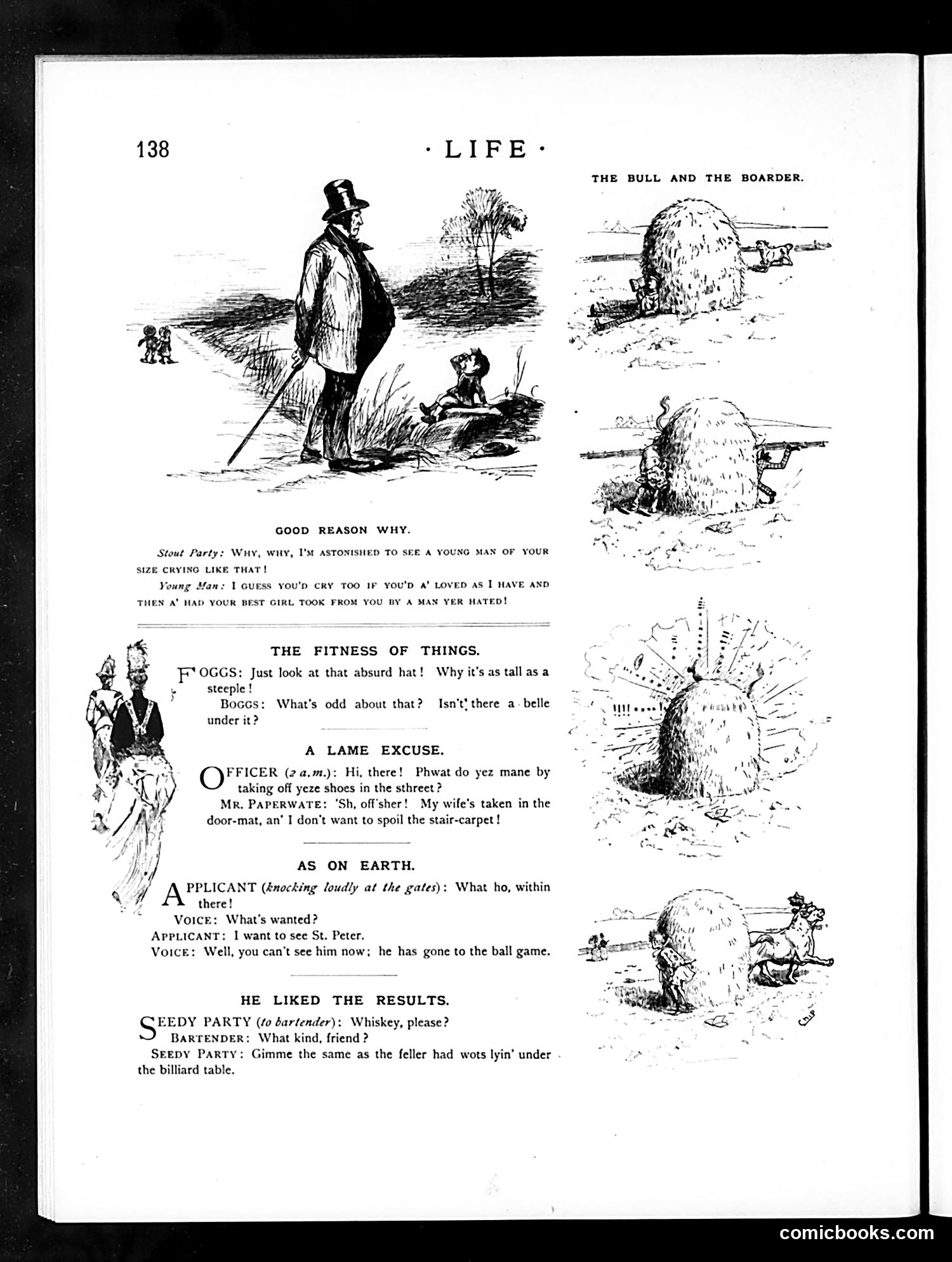
This page from *Life* contains six separate jokes typical of late 19th/early 20th-century American humor: 1. **"Good Reason Why"**: A sentimental joke about a young man weeping over lost love to a skeptical stranger. 2. **"The Fitness of Things"**: A pun-based joke where a tall hat looks absurd until someone notes there's an attractive woman ("belle") wearing it—making it worthwhile. 3. **"A Lame Excuse"**: An Irish-accented policeman confronts a drunk man removing his shoes at 2 a.m. The excuse plays on domestic anxiety (spoiling carpet). 4. **"As on Earth"**: A heavenly gatekeeper joke where St. Peter has abandoned his post for a baseball game—satirizing Americans' obsession with the sport. 5. **"He Liked the Results"**: A drunk orders whiskey matching what an unconscious man drank, suggesting the alcohol's effect was desirable. The right side shows unrelated illustrations about bulls and boarders. These are light, topical gags for middle-class readers, relying on puns, ethnic dialect humor, and domestic situations.
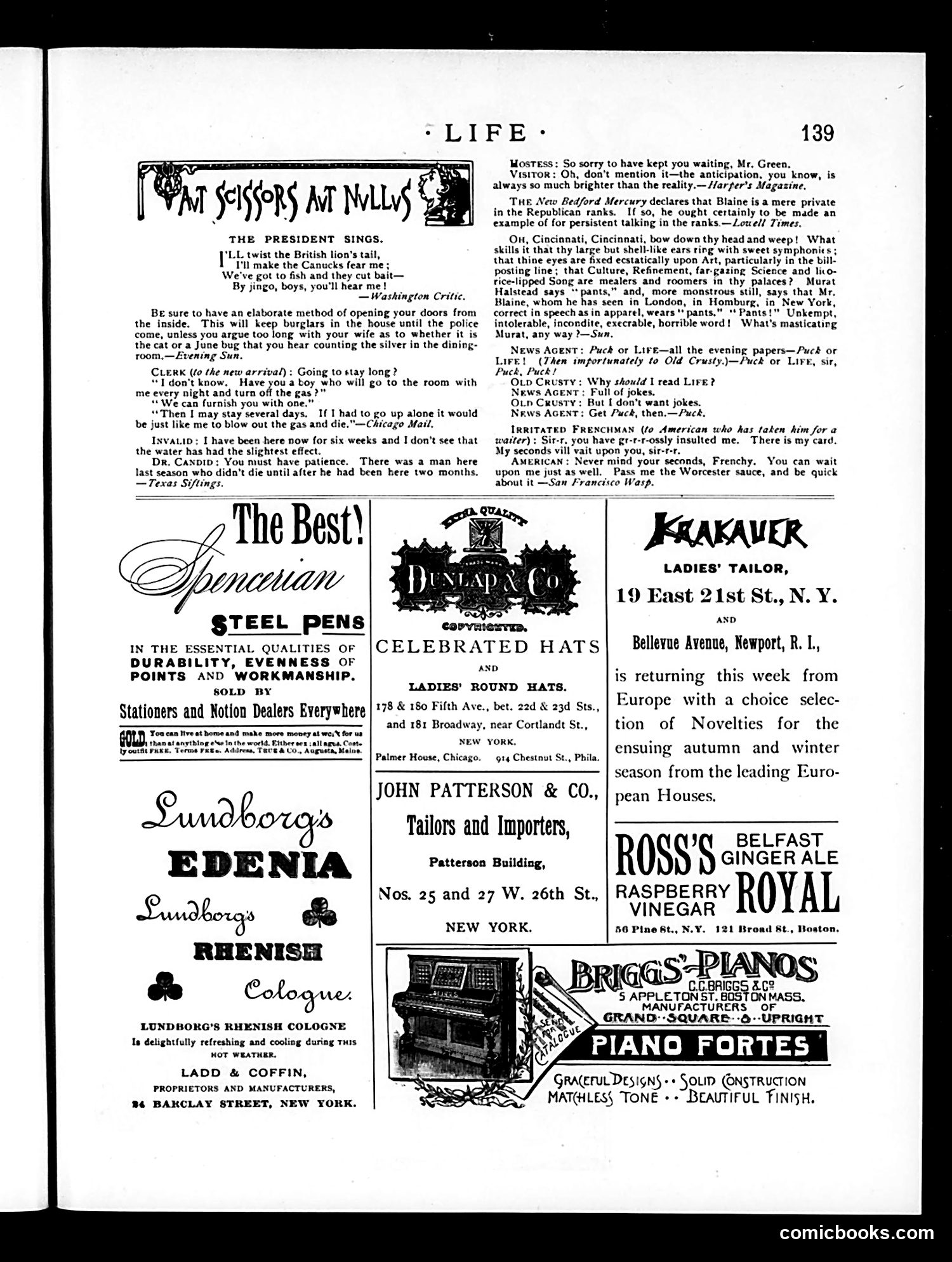
This page from *Life* magazine (a 19th-century satirical publication) contains multiple brief humorous pieces rather than a single political cartoon. **"The President Sings"** at top appears to mock a U.S. president's aggressive foreign policy rhetoric—references to "twist the British lion's tail" and intimidating Canada ("Canucks") reflect contemporary jingoistic political talk, likely from the 1880s-90s based on the Blaine references below. **Other jokes target:** - Domestic absurdities (burglars, gas safety) - James G. Blaine's speaking style (the "New Bedford Mercury" and Cincinnati references mock him using "pants" instead of formal language—a class/refinement criticism) - Minor cultural observations about newspapers and French honor codes **The bulk of the page is advertising** for steel pens, cologne, tailors, hats, and pianos—typical of *Life*'s revenue model. The humor assumes readers recognize contemporary political figures and debates about American assertiveness abroad and class-conscious speech patterns at home.
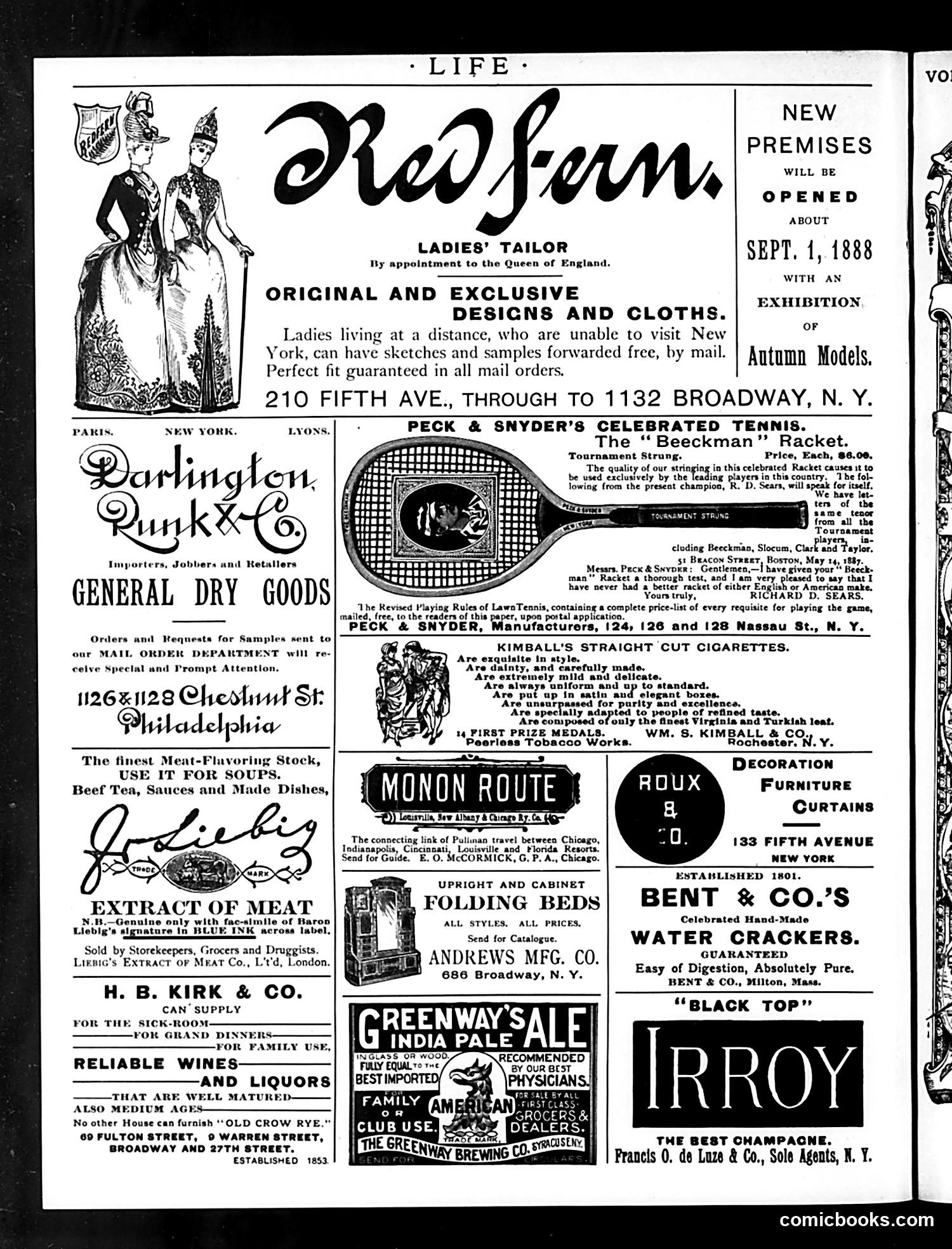
This is primarily a **commercial advertisement page** rather than editorial or satirical content. The page showcases various luxury goods and services marketed to wealthy New York consumers in the 1880s. Notable advertisements include: - **Red Fern**: A ladies' tailor operating "by appointment to the Queen of England," relocating to new premises in September 1888 - **Sporting goods**: Peck & Snyder's tennis rackets, endorsed by champion R.D. Sears - **Food products**: Liebig's Extract of Meat, Bent & Co.'s water crackers, Kimball cigarettes - **Furniture**: Andrews folding beds - **Beverages**: H.B. Kirk wines, Greenway's India Pale Ale, Arroy champagne - **The Monon Route**: Railroad service connecting Midwest cities The page reflects Gilded Age consumer culture, emphasizing imported goods, celebrity endorsements, and mail-order convenience for wealthy customers unable to visit showrooms in person.