A complete issue · 36 pages · 1936
Judge — October 1936
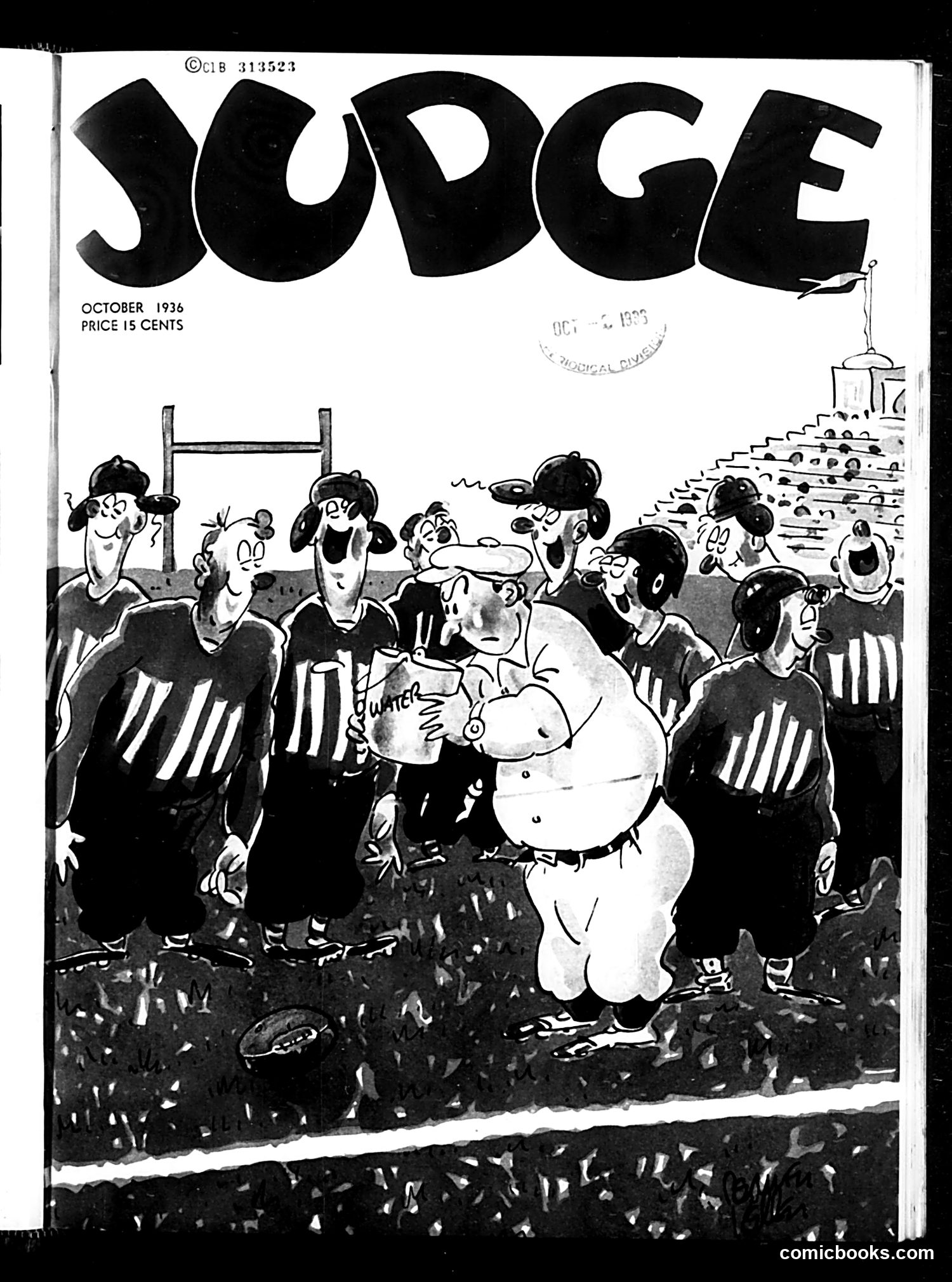
# Judge Magazine, October 1936 This cover satirizes a group of uniformed figures (appearing to be soldiers or paramilitary members) surrounding a large, rotund central figure. The cartoon likely comments on political or military themes relevant to October 1936—a significant moment when the Spanish Civil War began and fascist movements were gaining prominence in Europe. The exaggerated, caricatured style typical of Judge magazine suggests mockery of either authoritarian leadership or contemporary political figures. The central figure's prominence and the surrounding uniformed group suggest commentary on power dynamics, possibly depicting how leaders were surrounded by military or party apparatus. Without clearer identification of the specific figures, the exact political reference remains unclear, though the date and visual language suggest European political tensions of the mid-1930s.
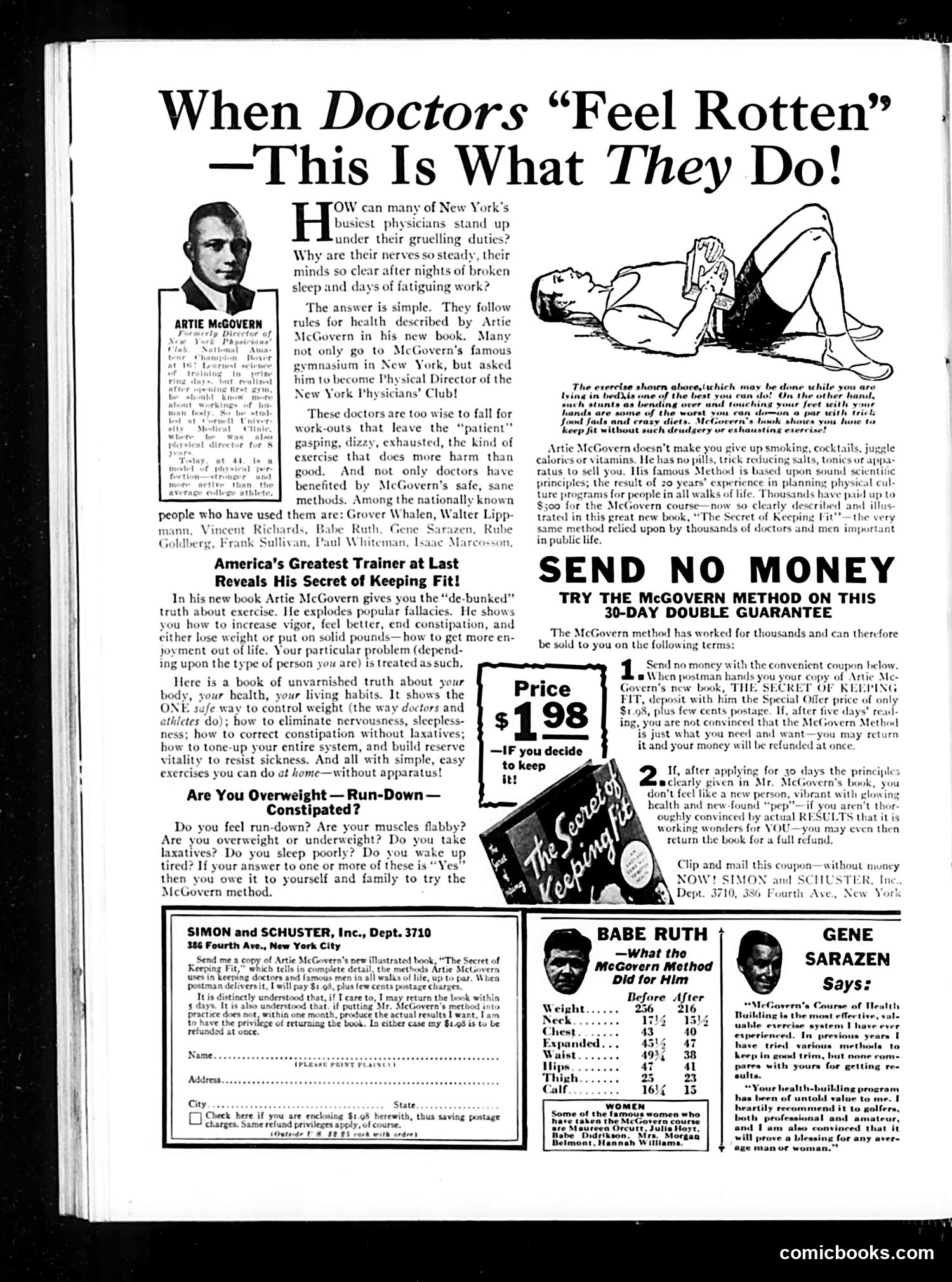
# Analysis This page is primarily **advertising for Artie McGovern's fitness and health book**, not political satire. McGovern was a real New York physician and fitness trainer who ran a gymnasium catering to wealthy clients. The ad uses testimonials from celebrities (Babe Ruth, Gene Sarazen) to promote McGovern's exercise methods for doctors and busy professionals feeling "run-down." The pitch emphasizes that McGovern's "safe, sane methods" can increase vigor, improve sleep, and aid weight loss without exhaustion. The page includes a mail-order coupon ($1.98 for the book) and a form for ordering. While *Judge* was satirical, this particular page functions as straightforward commercial promotion rather than political commentary or social satire.
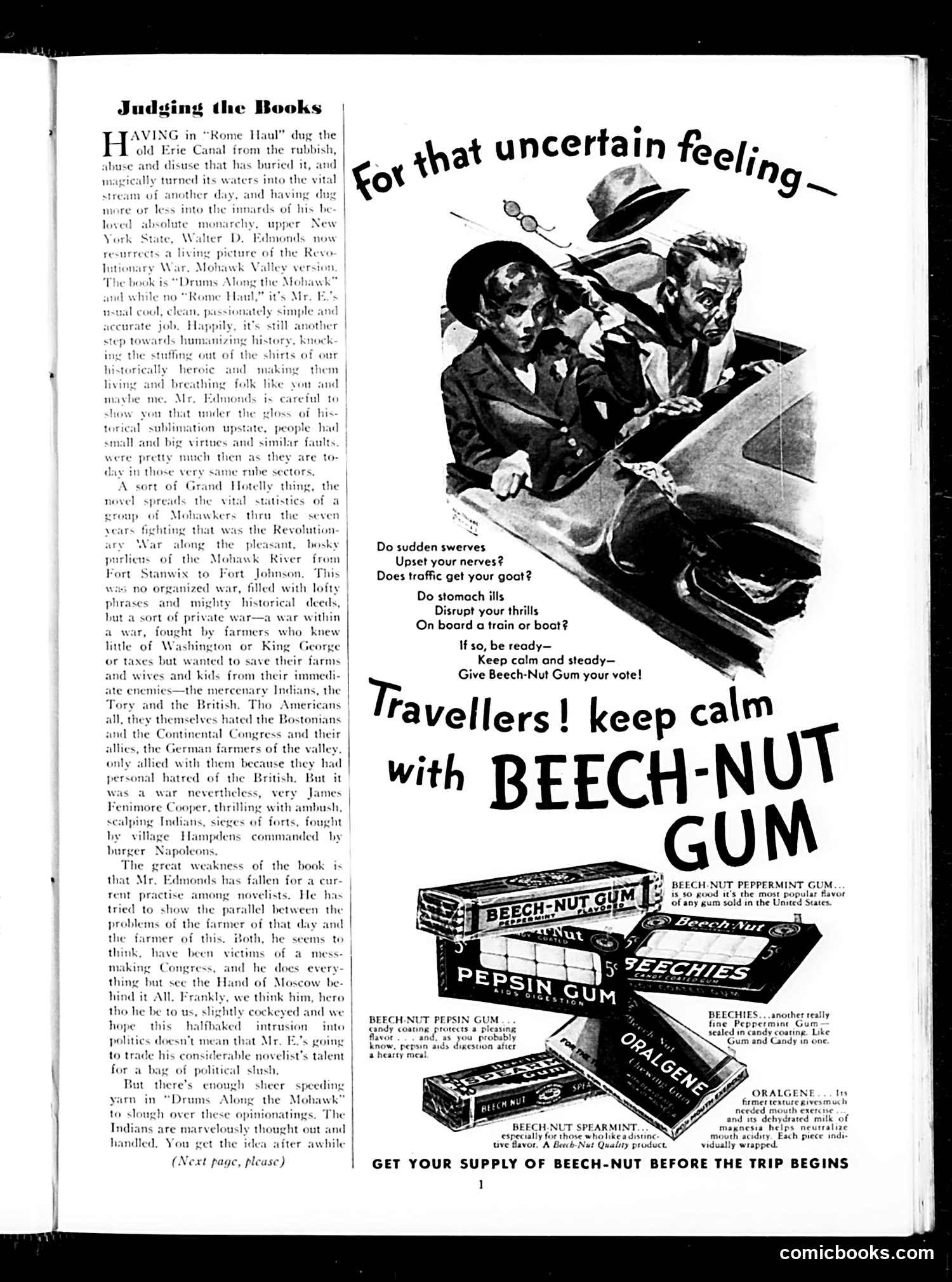
# Analysis This page is primarily **advertising, not satire**. The left column contains a book review of "Drums Along the Mohawk" by E.E. Edmonds (a Revolutionary War novel). The dominant content is a large advertisement for **Beech-Nut Gum**, featuring a nervous traveler experiencing anxiety ("sudden swerves upset your nerves?"). The ad's humor is situational rather than political—it markets gum as a remedy for travel-related stress. The illustrated figure appears to be a generic anxious passenger, not a specific caricatured public figure. The advertisement emphasizes that Beech-Nut Gum offers various products (Peppermint, Pepsin, Sparmint, Opalene) and encourages readers to purchase supplies "before the trip begins." This is straightforward commercial marketing rather than political commentary.
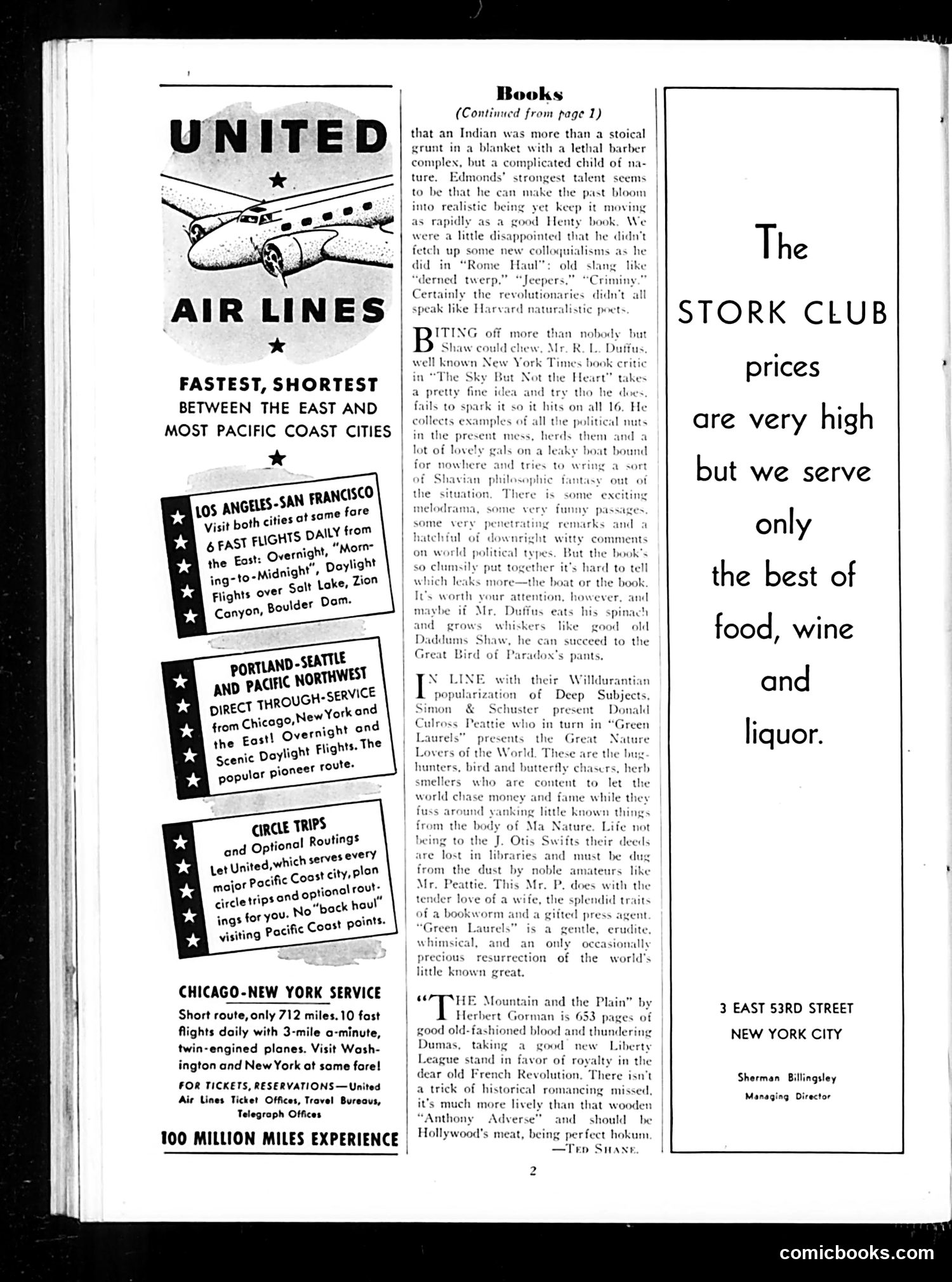
# Page Analysis This page is primarily **advertising and book reviews**, not political satire. The left side features United Airlines advertisements promoting cross-country flights with routes between Los Angeles-San Francisco, Portland-Seattle, Chicago-New York, and circle trips along the Pacific Coast. The right side contains book reviews discussing works like R.L. Duffus's "The She-Bum Not the Heart," Donald Culross Peattie's "Green Laurels," and Herbert Gorman's "The Mountain and the Plain." The Stork Club restaurant advertisement appears on the far right. There are **no political cartoons or caricatures visible**. This is a standard magazine page mixing transportation advertising with literary criticism—representative of Judge's mid-20th century format blending humor, ads, and cultural commentary.
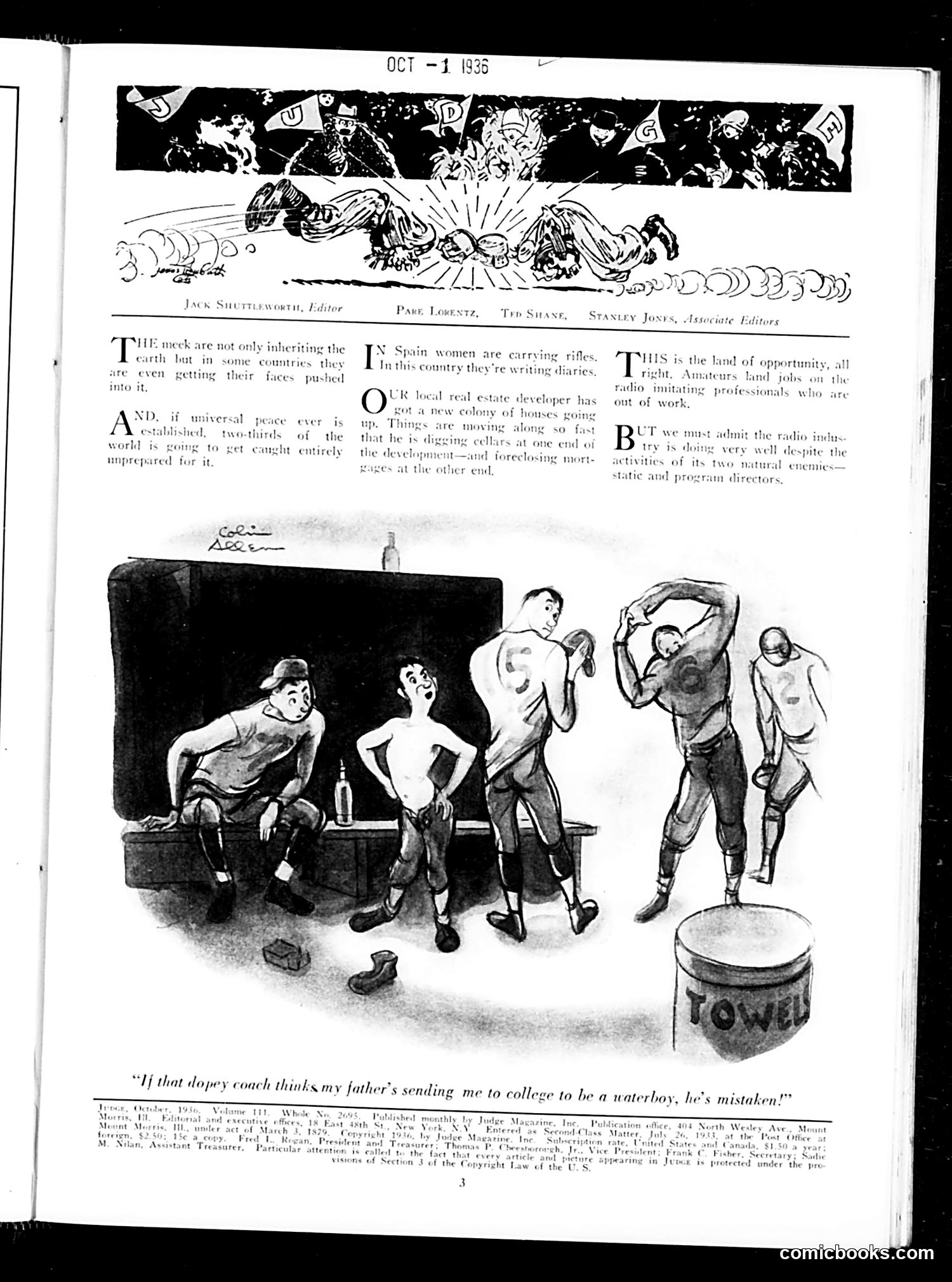
# Analysis of Judge Magazine Page (October 1, 1935) The main cartoon depicts young boys undressing near a bathing towel, with one boy's father apparently sending him to college to become a "waterboy" rather than pursue athletics seriously. The joke plays on the double meaning: the father thinks college will make his son into an actual waterboy (lowly athletic assistant), when the boy clearly aspires to competitive sports. The page's editorial commentary references contemporary 1935 events: Spanish women bearing rifles (Spanish Civil War beginning), real estate development, and radio industry operations. These brief items suggest Judge was addressing current political and economic concerns of the era to its educated readership. The overall tone reflects upper-class satirical humor typical of the magazine.
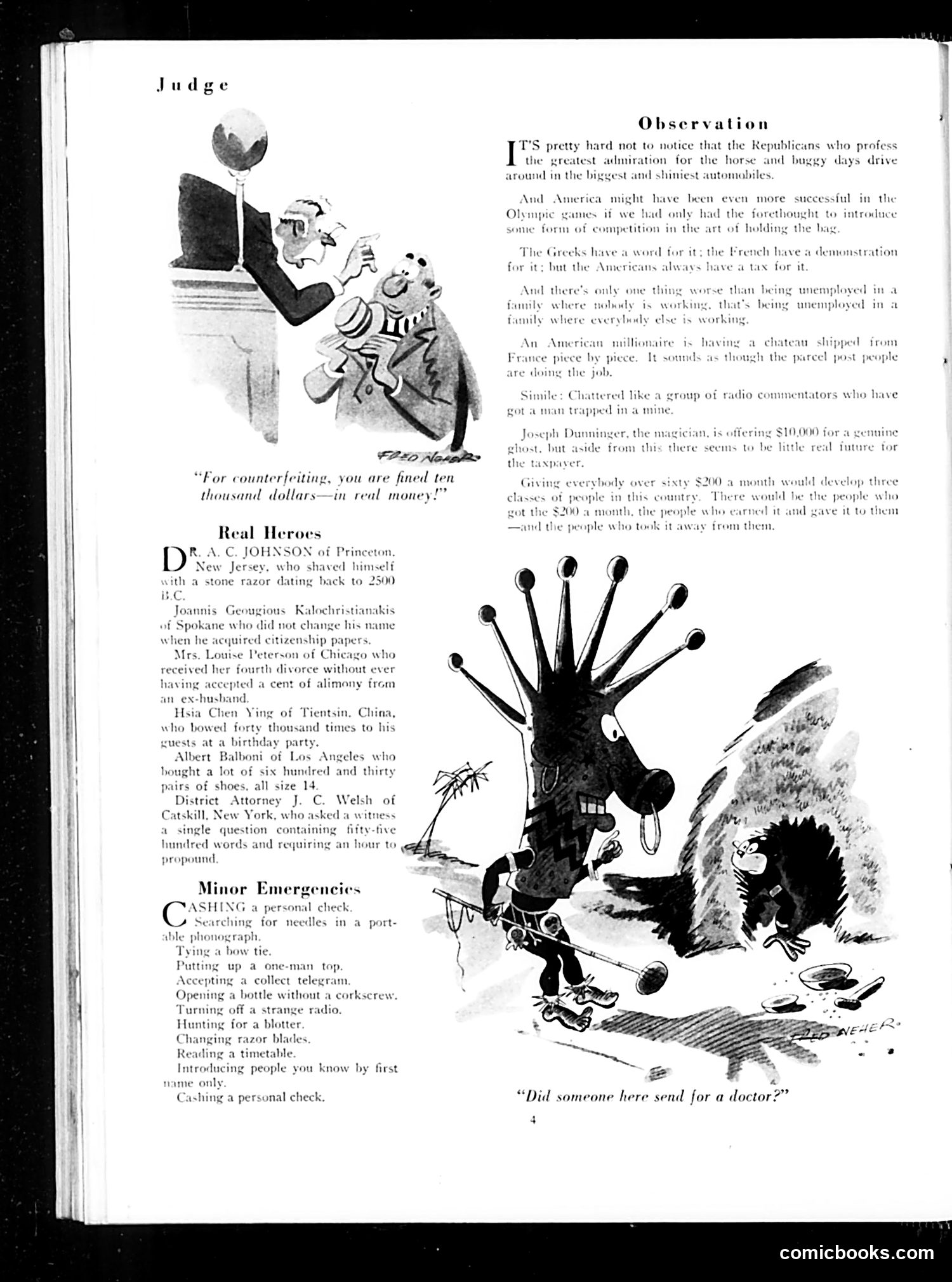
# Analysis of Judge Magazine Page The top cartoon satirizes Republican hypocrisy about unemployment. It depicts a well-dressed Republican judge sentencing someone to a $10,000 fine for counterfeiting, while the accompanying "Observation" section criticizes Republicans who claim to admire hard work and self-reliance yet drive expensive automobiles—implying they profit from the economic system while ordinary workers suffer. The "Real Heroes" section and "Minor Emergencies" list appear to be satirical commentary on American priorities and absurdities, listing trivial concerns alongside actual accomplishments. The bottom cartoon shows a figure injured by an explosion or catastrophe, with the caption "Did someone here send for a doctor?"—likely commenting on delayed or inadequate responses to crises, possibly referencing contemporary political failures.
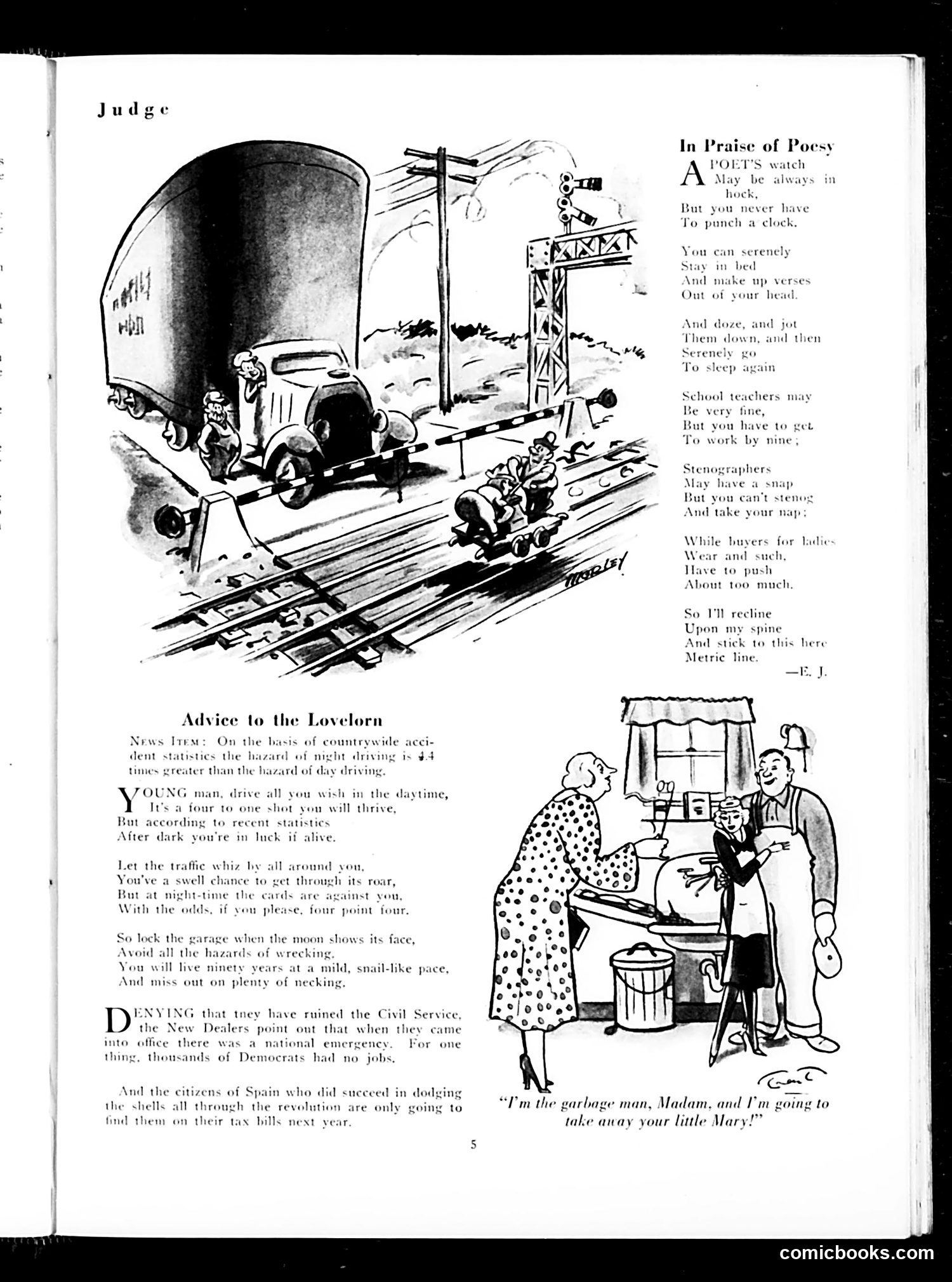
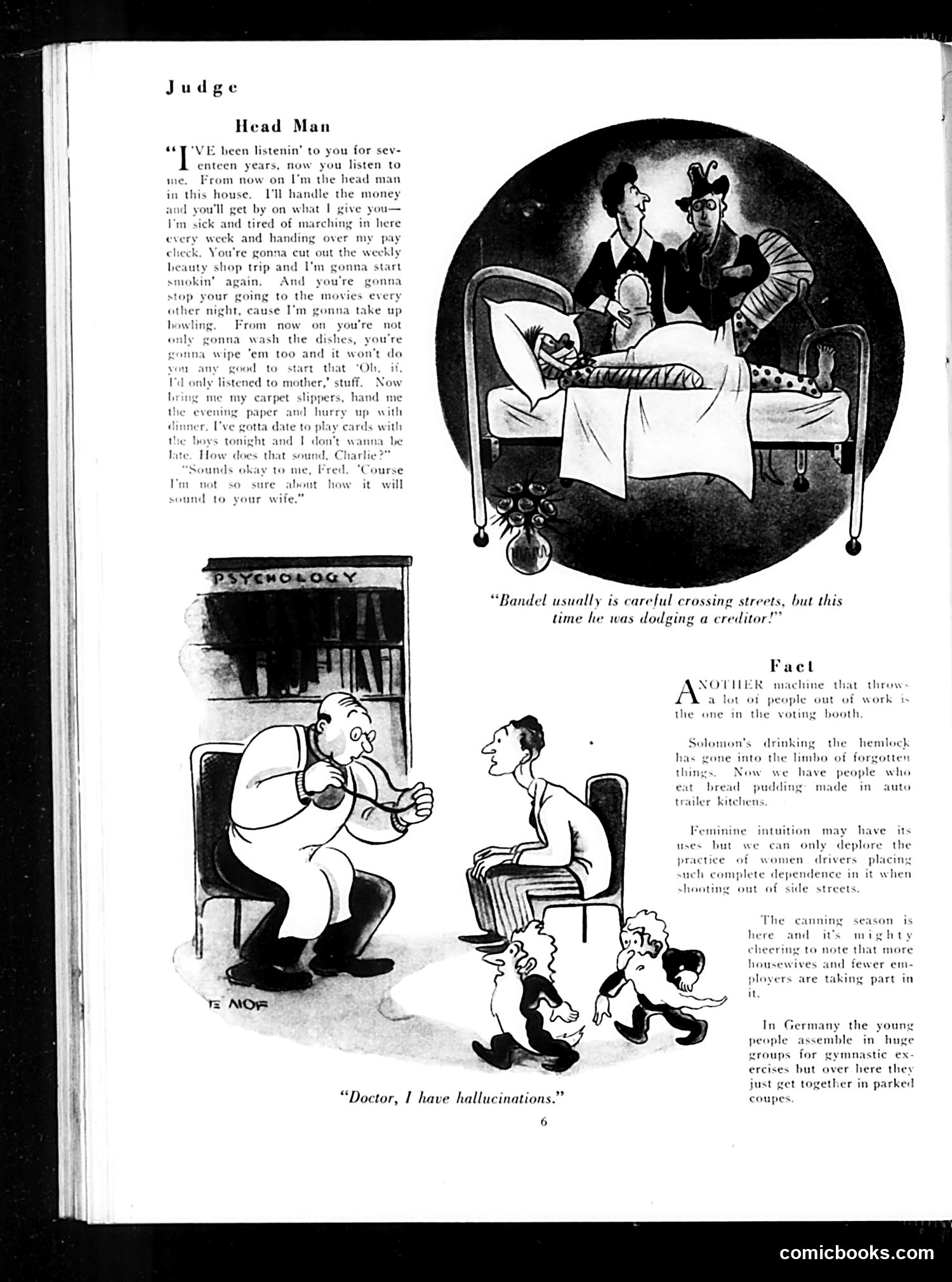
# "Judge" Page Analysis This page contains two satirical cartoons and commentary from Judge magazine. **"Head Man"** (top): A domestic comedy about a husband asserting authority over his wife. He announces new rules: she'll manage household tasks (dishes, laundry), stop shopping and movies, and accept his evening plans. The joke targets the era's gender dynamics and male insistence on domestic control, likely satirizing husbands who overreach in "managing" wives. **"Doctor, I have hallucinations"** (bottom): A psychology joke showing a rotund man claiming hallucinations to a doctor, while two small figures (children or demons) cavort nearby. The humor relies on the patient's obvious delusion or exaggeration about his symptoms. The accompanying "Fact" section offers miscellaneous social commentary on voting, women drivers, and leisure activities—typical Judge magazine filler humor.
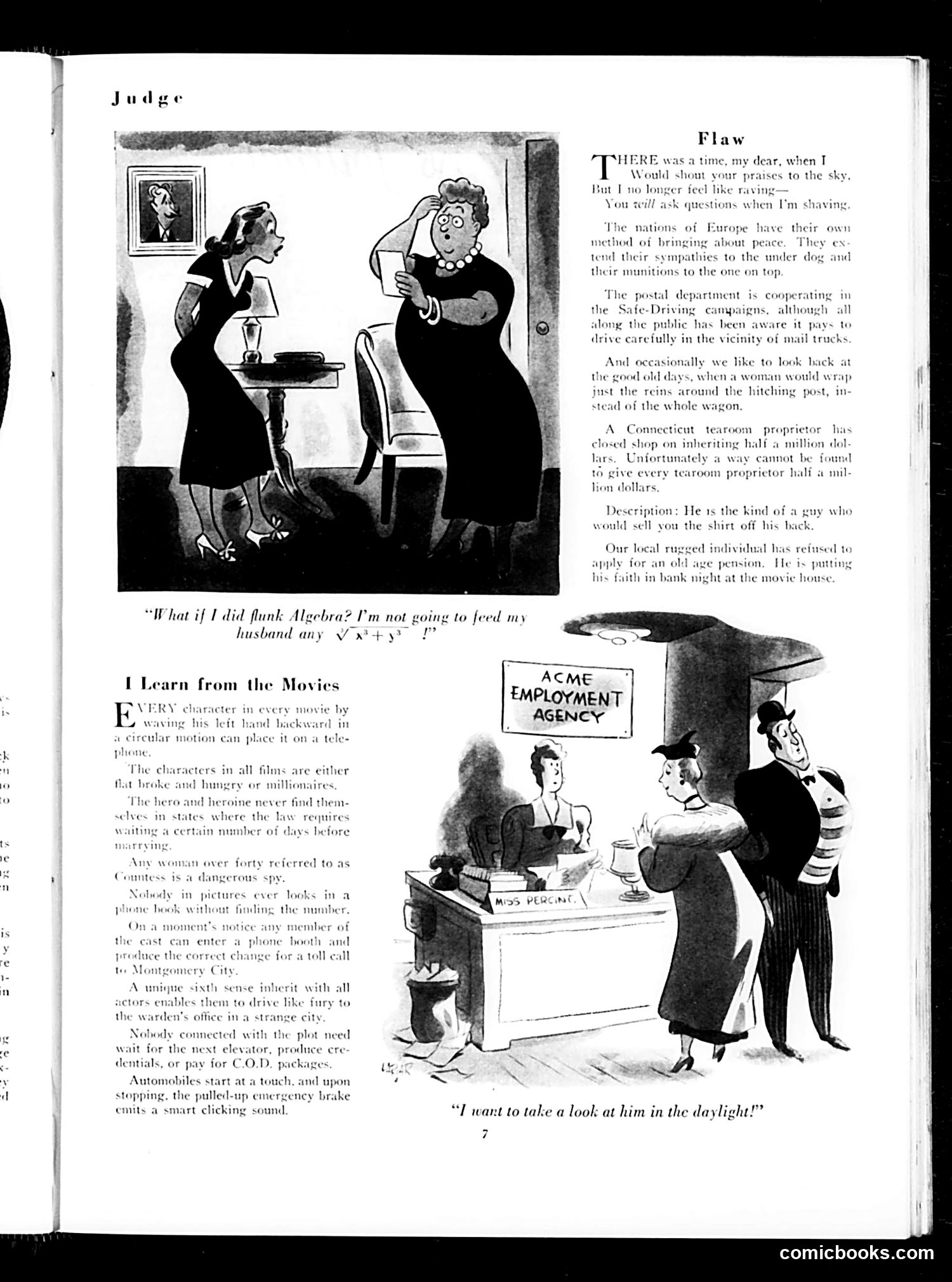
# Analysis of Judge Page 7 This page contains two separate satirical pieces: **"Flaw"** (top): A cartoon mocking women's unrealistic expectations in marriage. A wife threatens to withhold praise if her husband doesn't stop asking questions while shaving—a domestic complaint about male behavior. **"I Learn from the Movies"** (bottom): A humorous essay satirizing Hollywood film conventions—characters waving their left hands in circles to mime telephone motion, heroes and heroines always wealthy, spies identified as Countesses, automobiles starting with a "smart clicking sound," etc. The accompanying cartoon shows an employment agency scene. The overall page mocks both domestic gender relations and the absurd tropes audiences absorbed from cinema during this era. Both pieces use exaggeration to critique real social observations about marriage and popular entertainment's unrealistic portrayals of modern life.
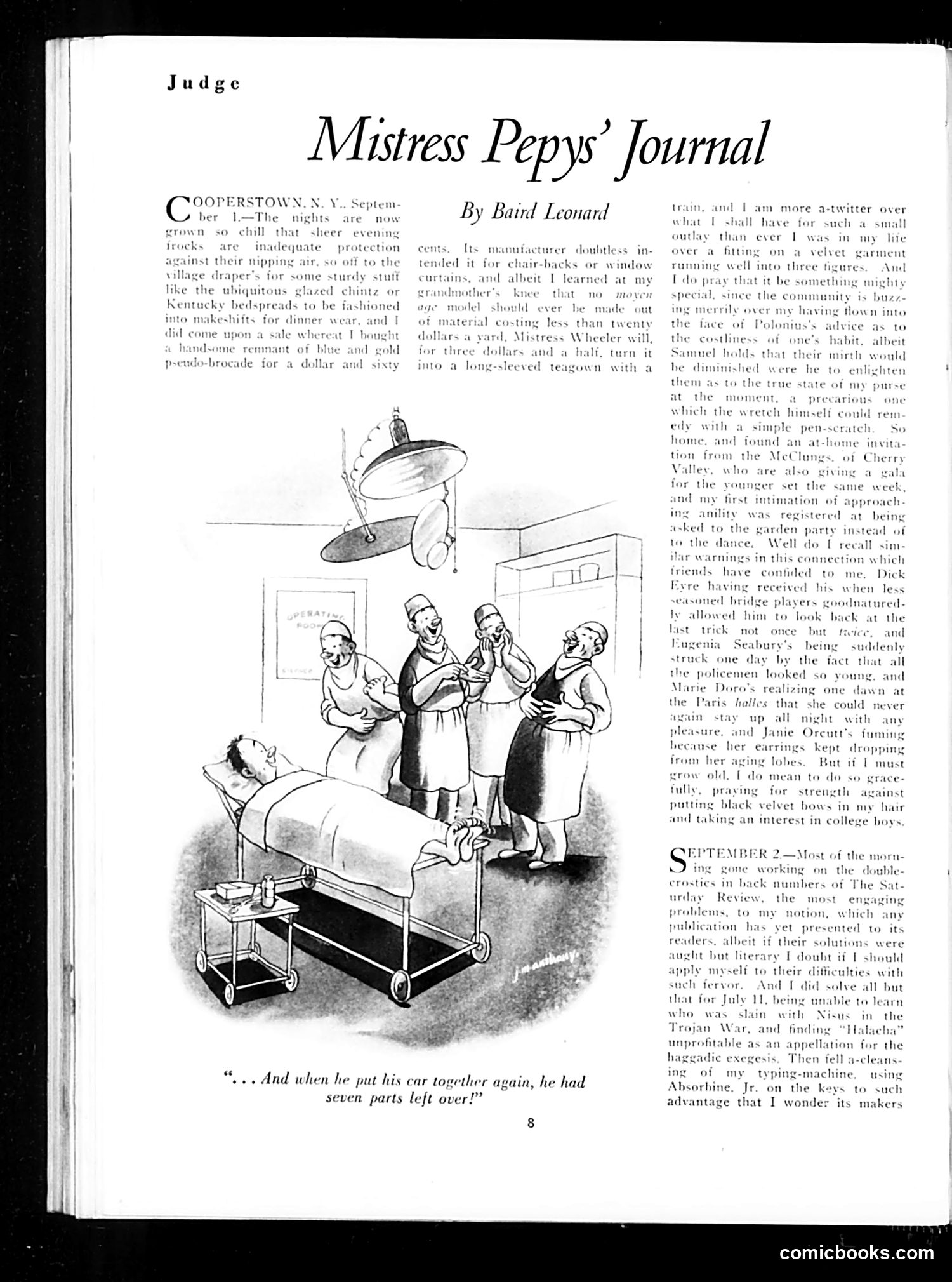
# "Mistress Pepys' Journal" - Explanation for Modern Readers This is a humorous column by Baird Leonard presenting fictional diary entries from a society woman in Cooperstown, New York. The main cartoon illustrates the column's running joke: a woman shows friends a reassembled automobile with the caption "And when he put his car together again, he had seven parts left over!" The joke targets early automobile mechanics' incompetence—a common satirical theme in 1920s America when cars were still relatively new and unreliable. The woman's bewilderment at having leftover parts suggests the mechanic either didn't properly reassemble her vehicle or was confused about its construction. The accompanying diary text is light social satire about upper-middle-class women's concerns: thrifty fashion purchases, gossip about friends, bridge games, and romantic interests. It's gentle mockery of leisured society life during this era, presented through the persona of a woman recording trivial domestic and social observations.
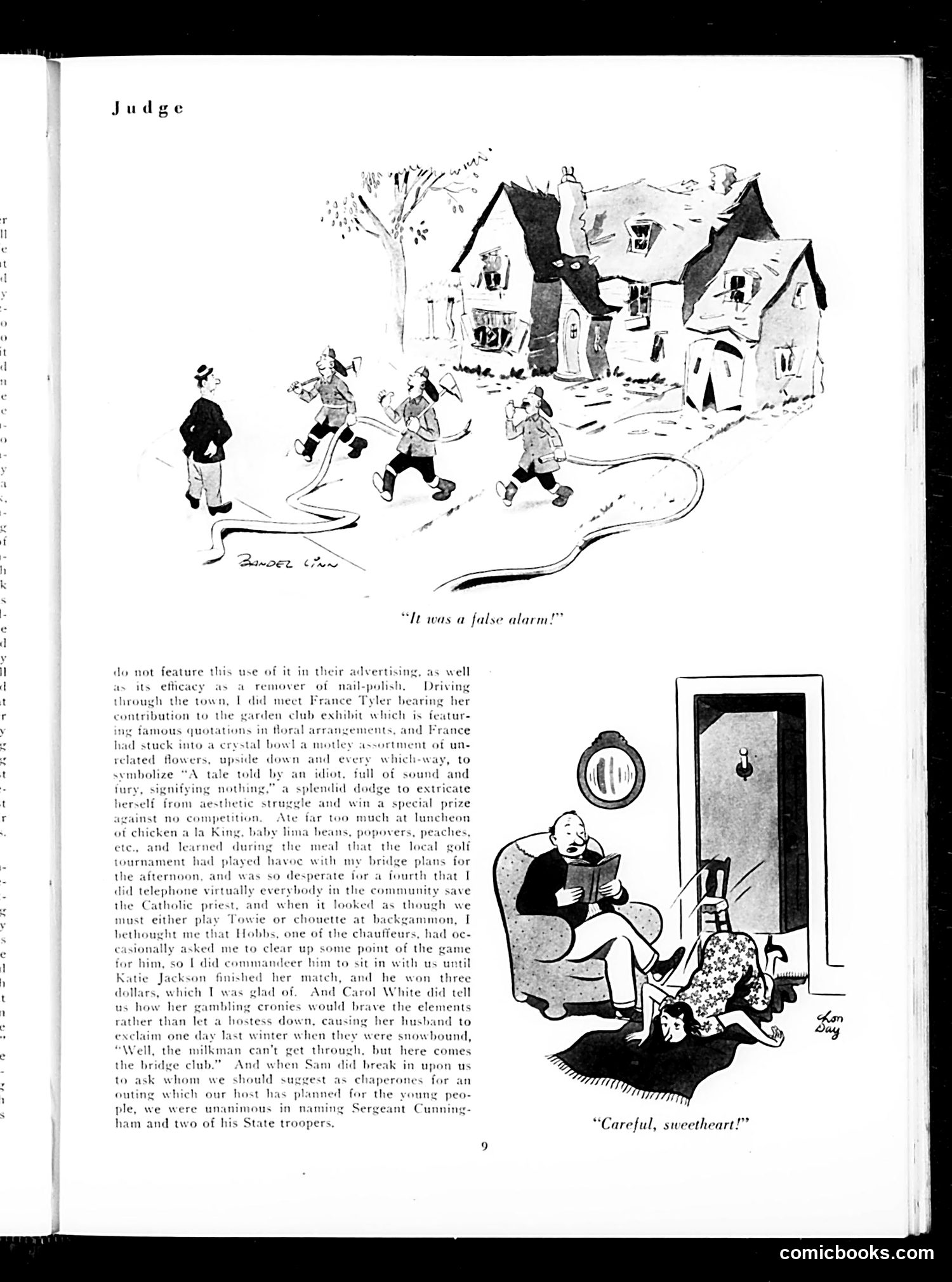
# Explanation for Modern Readers This page from *Judge* magazine contains two cartoon illustrations satirizing early 20th-century American social life. The top cartoon, "It was a false alarm!", depicts children responding to what appears to be a fire or emergency at houses, suggesting overreaction to rumors or pranks in small-town communities. The bottom cartoon, "Careful, sweetheart!", shows a woman reading while a man sleeps nearby, with what appears to be a clock or timing device—likely mocking domestic life and the tension between leisure activities and responsibilities. The lengthy text discusses the author's social activities: attending a garden club exhibit, playing bridge, and a golf tournament disrupting plans. It's a humorous society column critiquing the busy, gossipy social scene of well-to-do townspeople and their priorities (entertainments over practical concerns). The references to local figures, the Catholic priest, and State troopers ground this in a specific community's social hierarchy.
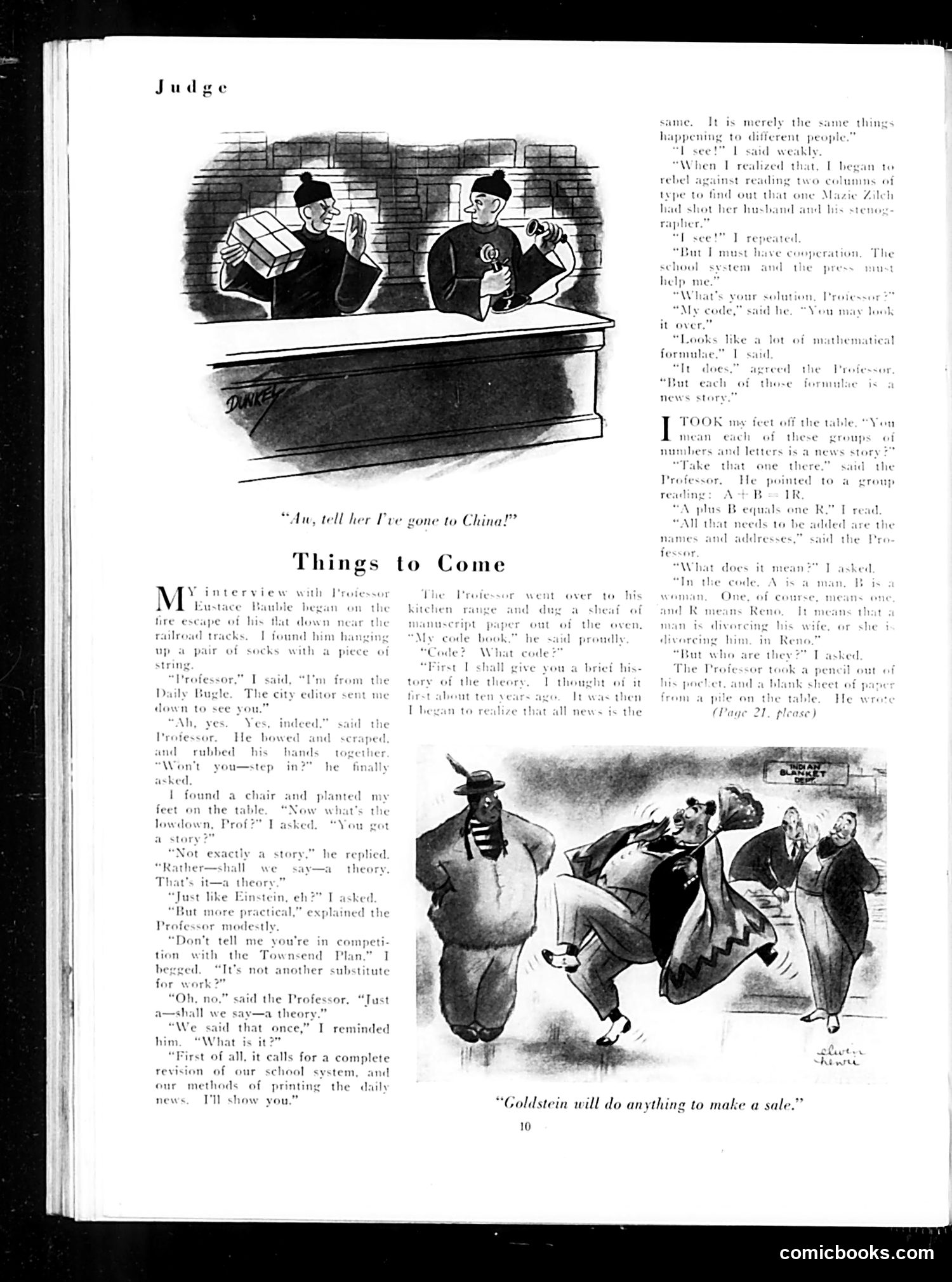
# Judge Magazine Page Analysis This page contains a satirical article titled "Things to Come" featuring an interview between a journalist and a Professor Eustace Bauble about a proposed reform to the school system and newspaper printing methods. The top cartoon shows two men at a desk with the caption "Aw, tell her I've gone to China!"—a joke about a husband using an extreme excuse to avoid his wife. The lower cartoon depicts a salesman named Goldstein with the caption "Goldstein will do anything to make a sale," showing him in an exaggerated, undignified pose to land a customer. This reflects period stereotypes about Jewish salesmen and the lengths they'd pursue profit—a form of ethnic caricature typical of early 20th-century American humor magazines. The Professor's discussion of mathematical "codes" encoding news stories represents satirical commentary on modernist approaches to information and education reform popular in that era.