
Judge, 1936-10 · page 20 of 36
Judge — October 1936 — page 20: what you’re looking at
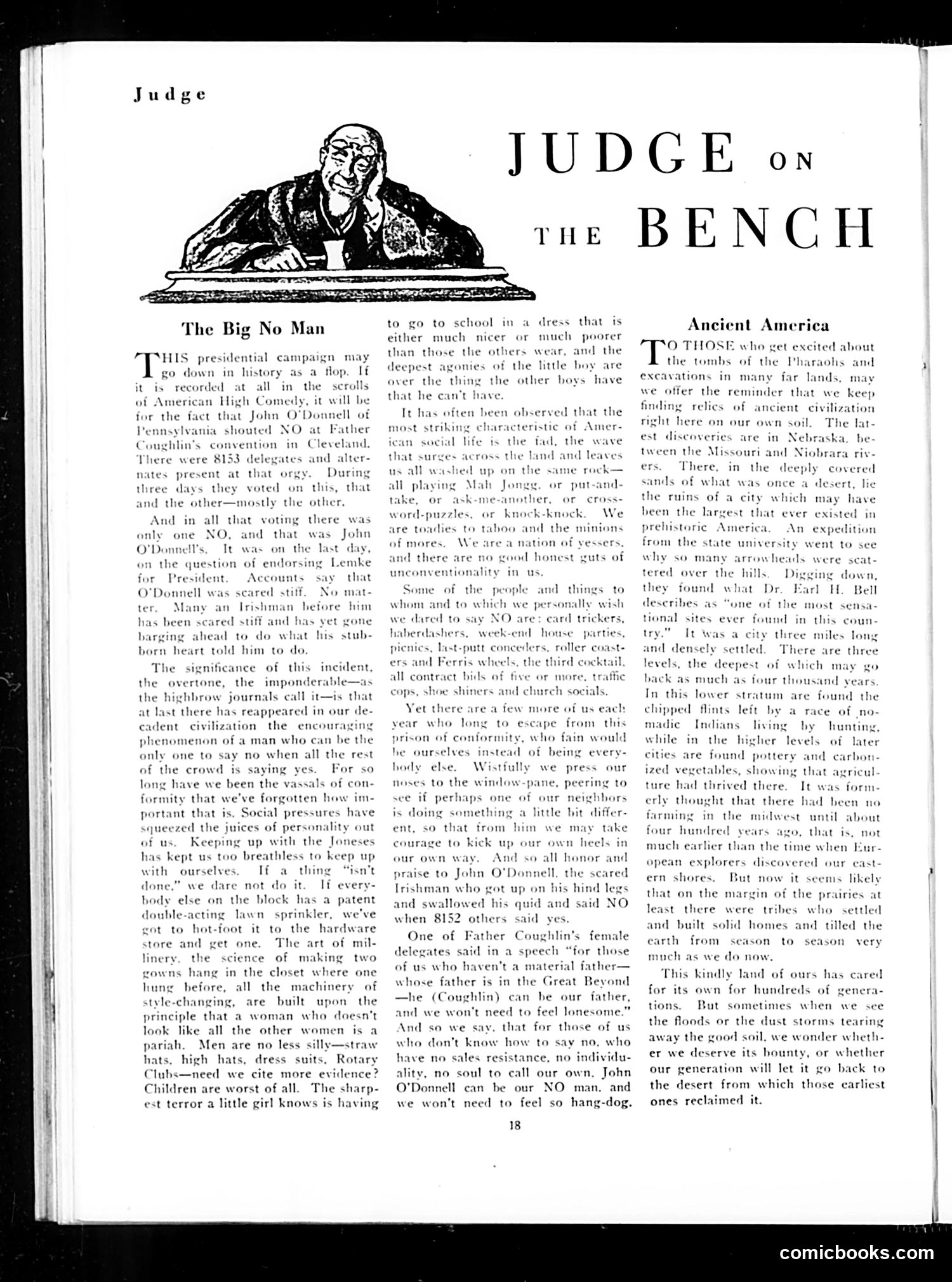
A restored page from Judge, 1936-10. Page through the whole issue in the reader above.
📄 Transcribed text from this page (OCR, searchable)
Machine-transcribed from the original scan — historical spelling and the odd misread are preserved.
The Big No Man ees presidential ¢ go down in history as a flop. [f mpaign may it is recorded at all in’ the scrolls of American High Comedy, it will be for the fact that John O'Donnell of Pennsylvania shouted NO at Father Coughlin’s ¢ vention in Cleveland. ites and alter- During three days they voted on this, that and the other—mostly the other, Phere were 8153 deles nates present at that orgy And in all that voting there only one NO, and that was J O'Donnell’s. Tt was on the last on the question of endorsing Lemke f O'Donnell was seared st Hay, ccounts say that rt President o mat- ter. Many an Irishman before h has be barging ahead to do what born heart told him to do. n seared stiff and has yet gone s stub- The significance of this incident, the overtone, the im the highbrow journals call it—is that at last there has reappeared in our de- adent civilization the encouraging erable. phenomenon of a man who can be the ly of the crowd is saying yes. For so long 1 formity that we've forgotten h ne to say no when all the rest ave we been the vassals of con- im- portant that is, Social pressures have reezed the juices of personality out of us eping up with the Joneses has kept us too breathless to keep up with ourselves. If a thing “isn't If every- body else on the block has a patent done.” we dare not do it double-acting lawn sprinkler, we've t to hot-foot it to the hardware The art of mil- science of making two wns hang in the closet where one store and get one. linery, the hung before, all the machinery of -chan styl prince ing, are built upon the ple that a woman who doesn't look like all the other women is a pariah. Men are no less silly—straw hats. high hats, dress suits, Rotary Clubs—need we cite more evidence? Children are worst of all. The sharp- est terror a little girl knows is having to go to school in a dress that is either much nicer or much poorer than those the others wear, and the of the little boy are over the that he ¢ It has often been observed that the most striking characteristic of Amer- ican social li s the fad, the wave that surges across the land and leaves wd all playing Mal knock. We word-puzzles, or knock are toadies to ts » and the minions of mores. We are a nation of vessers. and there are vod honest ts of une entiona in us. Iv wish to say NO are: card trickers, erdashers, week-end hotse 1 rs. roller coast- ries, Tast-putt conce ers and Ferris wheels. the tird cocktail . traffic cops, shoe shiners and chureh socials. all contract bids of five or mori Yet there are a few more of us each year who long to escape from. this prison ¢ 1 conformity, who fain would ve ourselves astea hody else. Wistfully we press our hoses to the window-pane, peering to sve if perhaps one of our neighbors is doing somet! v little bit differ- ent, so that trom e may take our own way, A so all honor and I. the scared praise to John O'Donne Irishman who ¢ yt up on s hind legs and swallowed his quid and said NO when 8152 others said yes One of F. delegates said in a speech ther Cou hlin’s female “for those of us who haven't a material father— her is in the Great Beyond —he (Coughlin) can be our father, and we won't need to feel lonesome.” whose And so we say, that for those of us on't know how to say no, who sales resistance, no individu- ality, no soul to call our own, John O'Donnell can be our NO man. and we won't need to feel so hang-dog. have n 18 Ancient America . lr? THOSE who get excited about the tombs of the Pharaohs and exe ions in many far lands, may we offer the reminder that we kee finding relics of ancient. civilizati there The lat- t discoveries are in Nebraska, be tween the Missouri and Niobrara riv- rig nour own 5 € ers. There, in the deeply covered nds « what was once a desert, lie the ruins of city which may have been the larg I from the state university went to see st that ever existed in istoric America. An expedition hy so many arrowheads were scat- tered over the hills. Digging down, they found what Dr. Earl H. Bell deseri st sensa- s “one of the a 1 tional sites ever fe id in this coun try.” It Was a city three miles long and densely settled. There are three levels, the deepest of which may go back as much as four lousa 1 years In this lower stratum are found tl chipped ts left by a race of no- madic Indians liv by huntin ter levels of later while in the hb cities are found pottery and carbon- ized vegetables, showing that agricul ture had thrived there. erly thou Tt was for t that there had been no ming in the midwest until about four h dred years ayo, that is, much ear rthan the time when Eur- opean explore rs discovered our cast ern shores. But now it seems likely that on the margin of the prairies at least there were tribes who settled and built solid homes and tilled the h from season to season very much as we do now. This kindly land of ours has cared for its own for hundreds of genera- tions. But sometimes when we see the floods or the dust storms tearing away the ¢ vod soil, we wonder whet! er we deserve its bounty, or whether our generation will let it go back to the desert from which those earliest ones reclaimed it. comicbooks.com