A complete issue · 36 pages · 1936
Judge — February 1936
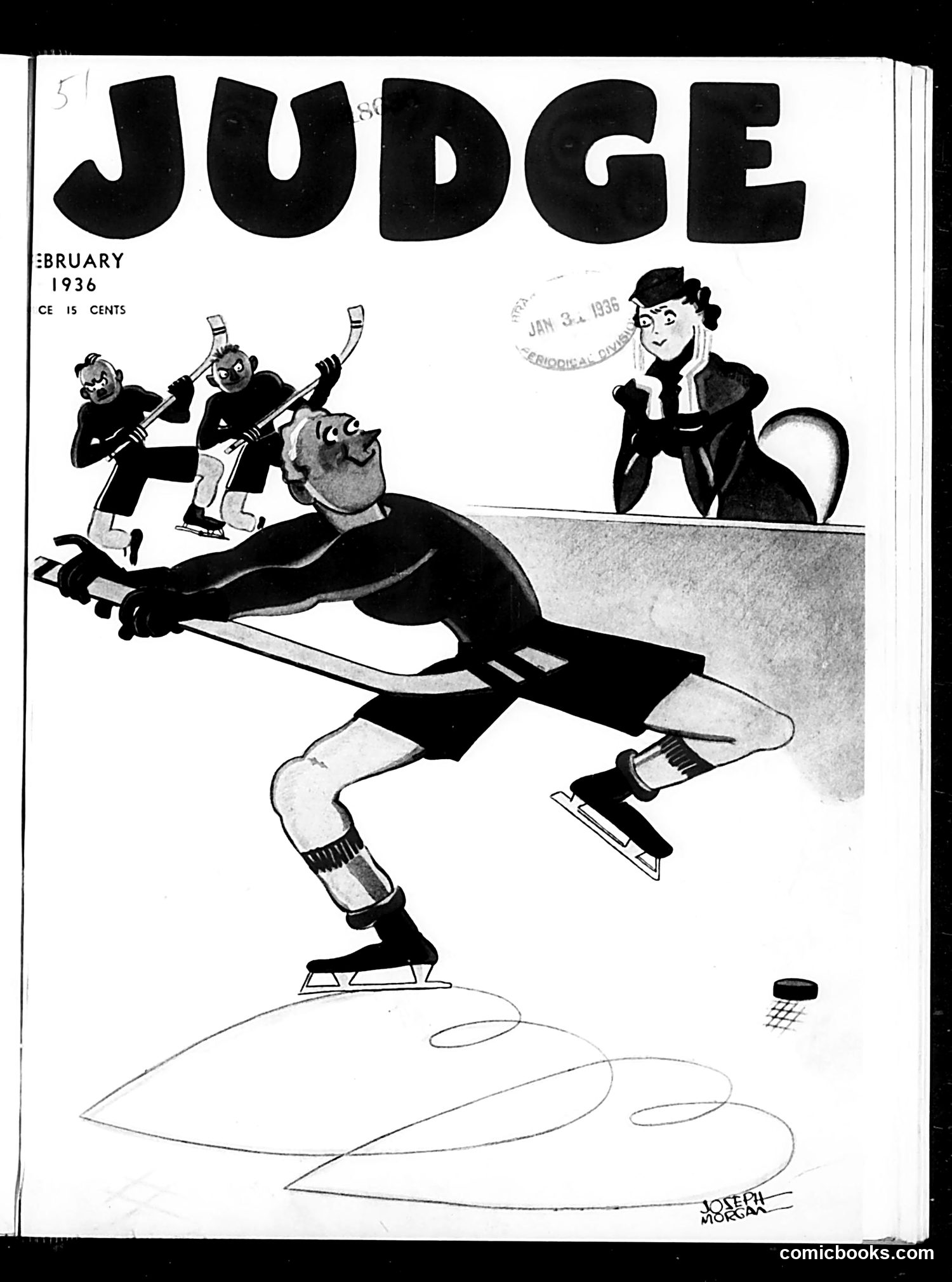
# Judge Magazine Cover, February 1936 This cover depicts an ice hockey scene with satirical commentary. A player performs an exaggerated athletic maneuver on ice skates while two smaller figures with hockey sticks pursue him in the background. A woman observes from behind a barrier. The specific political or social reference is unclear from the image alone. However, given Judge magazine's satirical nature and the 1936 date, this likely comments on contemporary sports, politics, or social behavior. The exaggerated physical comedy and the woman's reaction suggest the humor derives from the absurdity of the main figure's dynamic pose rather than a specific identifiable person or event. Without additional context about 1936 news events or Judge's editorial focus that month, the precise satirical target remains uncertain.
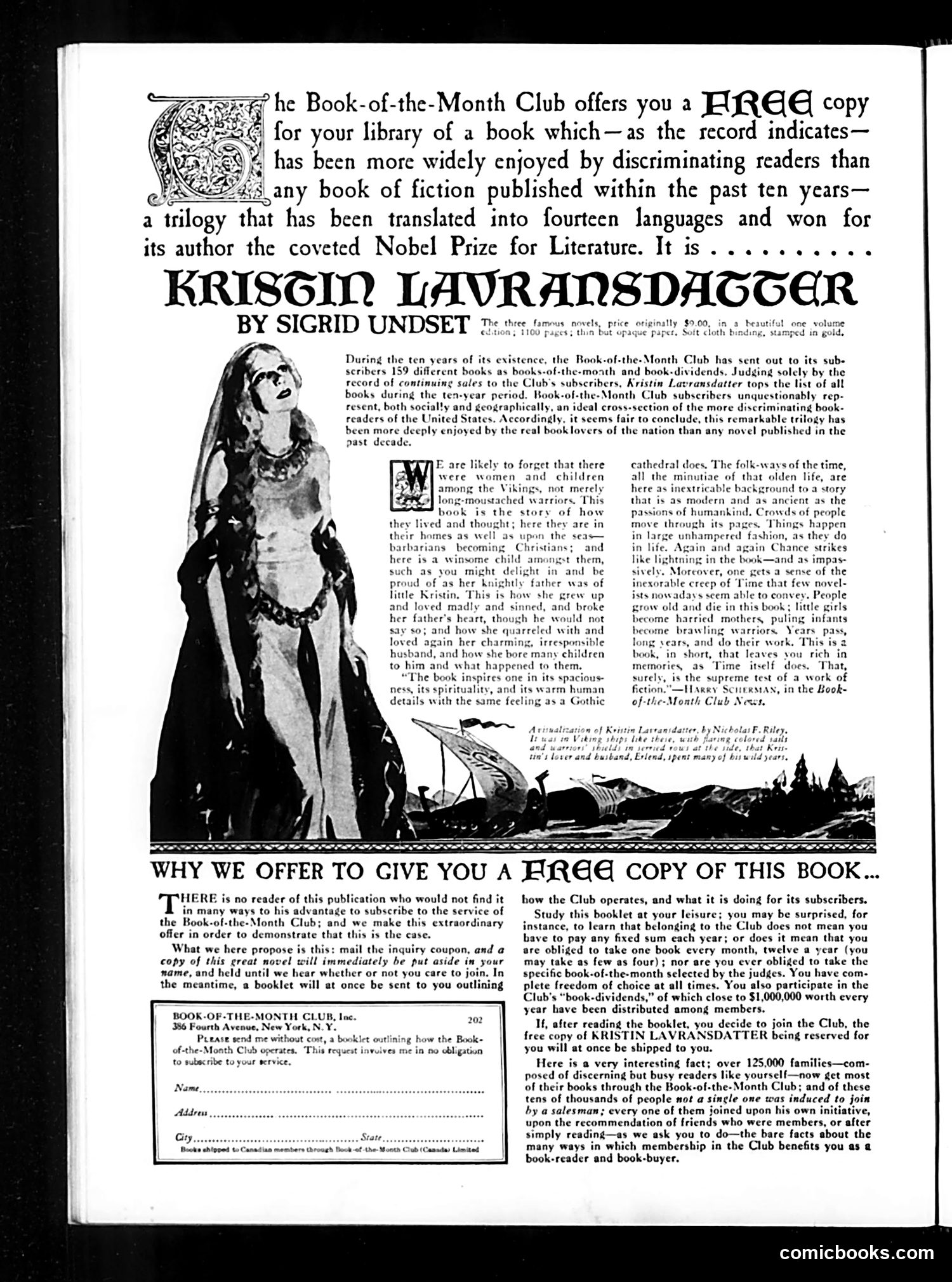
# Analysis This page is primarily **advertising**, not satirical content. It promotes the Book-of-the-Month Club's offer of a free copy of *Kristin Lavransdatter* by Sigrid Undset, a Norwegian novel that had won the Nobel Prize for Literature and been translated into fourteen languages. The illustration shows a woman in medieval Norse dress, reflecting the novel's Viking-era setting. The text emphasizes the book's popularity among "discriminating readers" over the past decade and highlights the Club's role in distributing quality literature to subscribers nationwide. The bottom section contains membership information and a reply coupon. This is a straightforward commercial promotion rather than political satire—typical Judge magazine content that subsidized the publication through paid advertising.
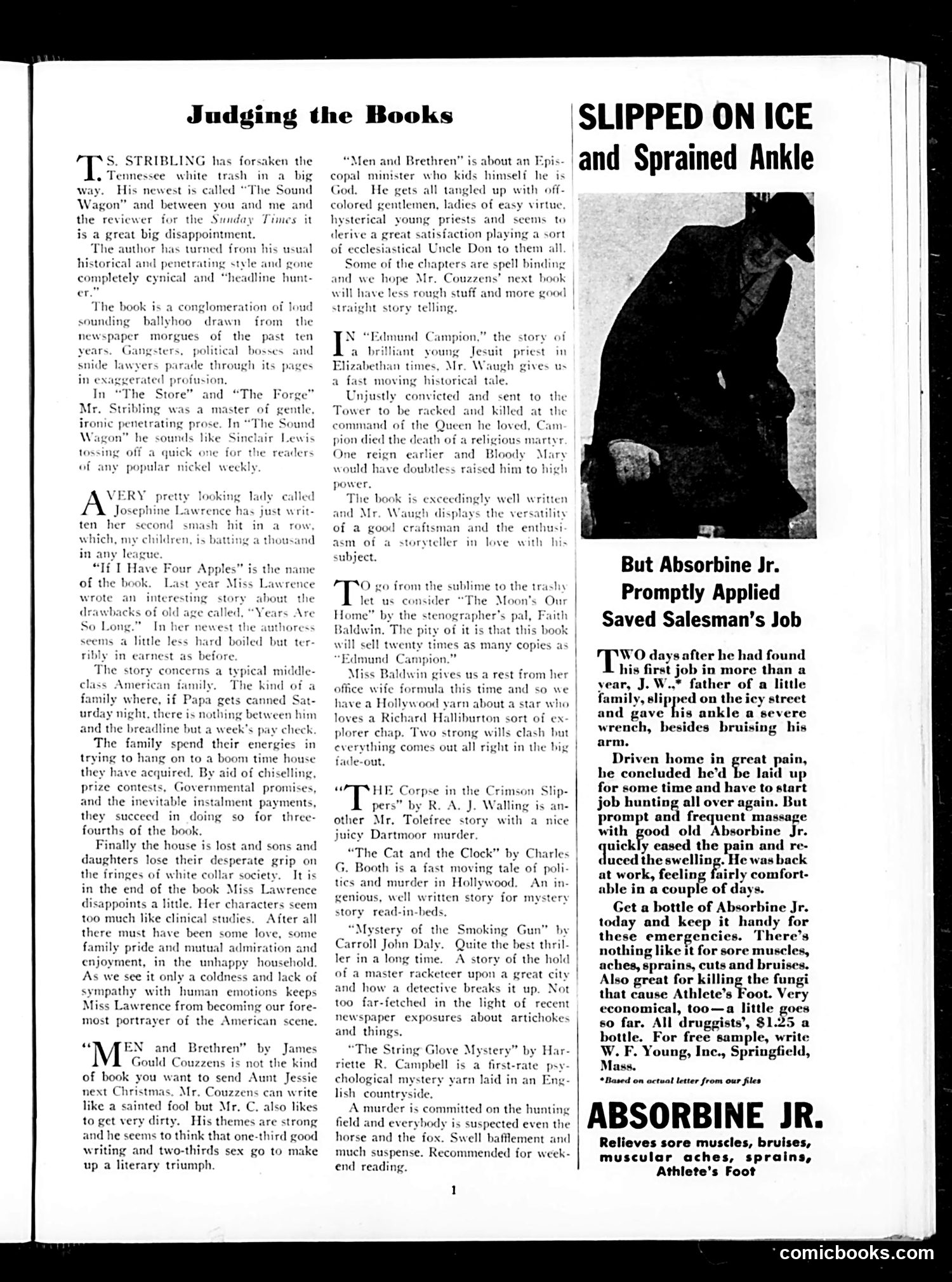
# Page Analysis This page is primarily a **book review section** titled "Judging the Books," with **advertising** occupying the right column. The left side reviews several novels, including works by T.S. Stribling, James Gould Couzens, and Josephine Lawrence. The reviews are literary criticism rather than satire. The right side features a **paid advertisement** for "Absorbine Jr.," a liniment product. The accompanying illustration shows a man in apparent pain, with text describing how the product helped a salesman recover from a workplace ankle injury. The ad emphasizes the product's pain-relief properties for "sore muscles, aches, sprains, athlete's foot." This is **not political satire** but rather a standard magazine layout combining editorial content with commercial advertising—typical of Judge magazine's revenue model.
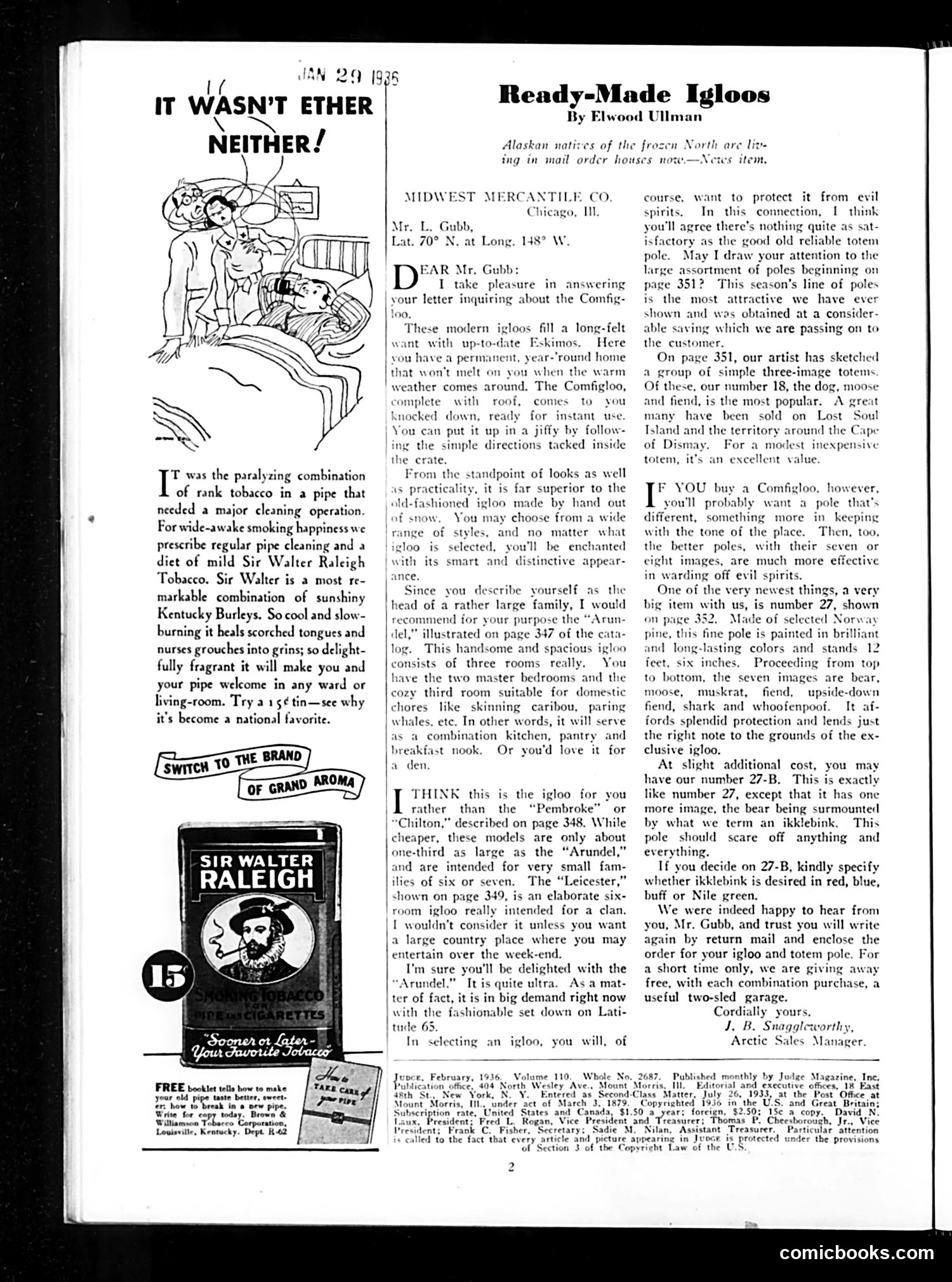
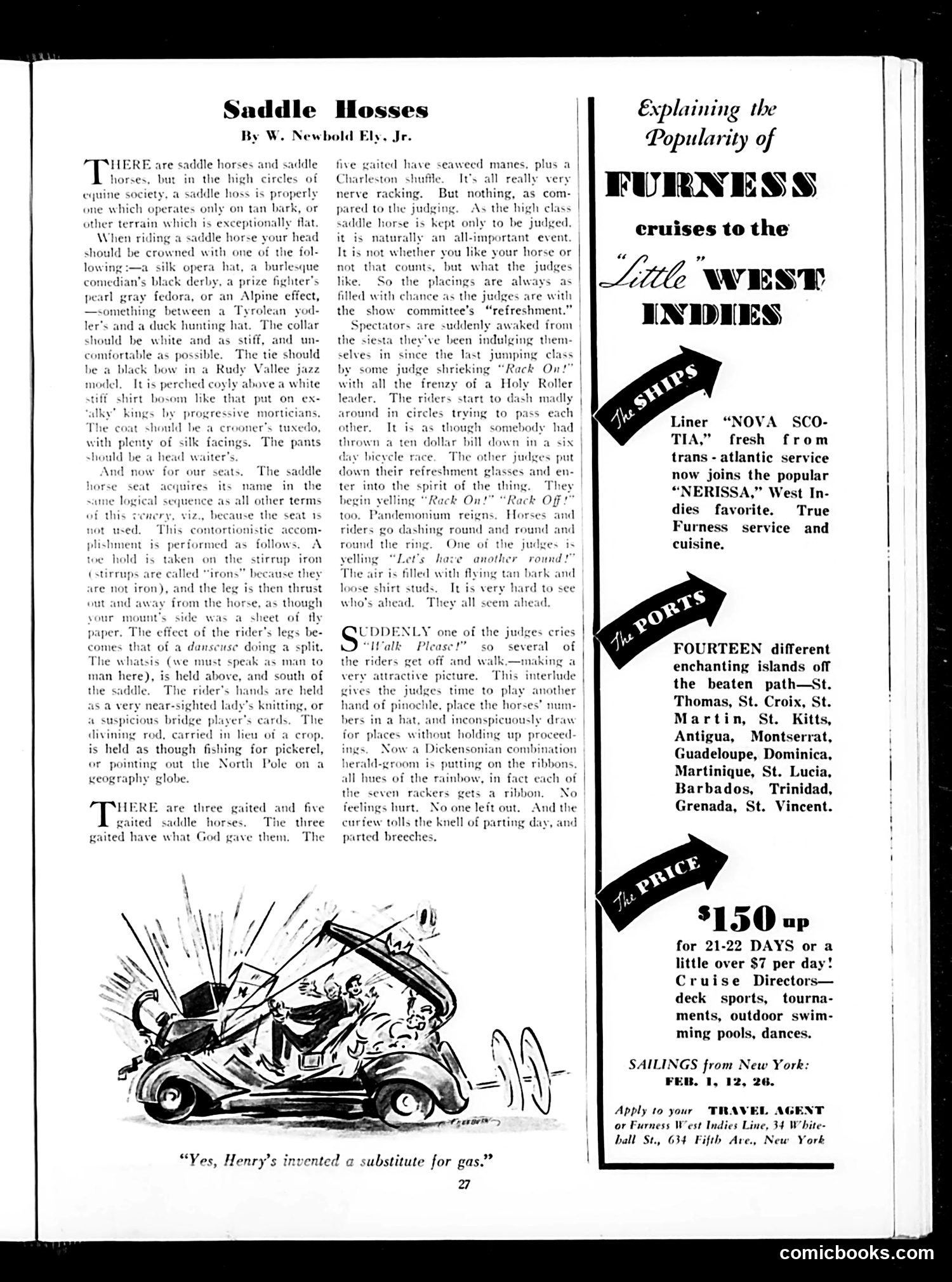
# Analysis of Judge Magazine Page (June 29, 1935) The page contains primarily advertising and a mail-order catalog section. The prominent cartoon "It Wasn't Either—Neither!" depicts a domestic scene where a couple argues over household items, with one figure pointing accusingly. The satire appears to mock marital disputes over trivial matters—a common Judge theme of the era. The main editorial content is Elwood Ullman's "Ready-Made Igloos," responding to a reader inquiry about mail-order igloo kits. This is clearly satirical, presenting prefabricated igloos as modern consumer goods. The humor mocks both mail-order culture and urban Americans' fascination with exotic goods. The Sir Walter Raleigh cigarette advertisement occupies substantial space, typical of 1930s publications.
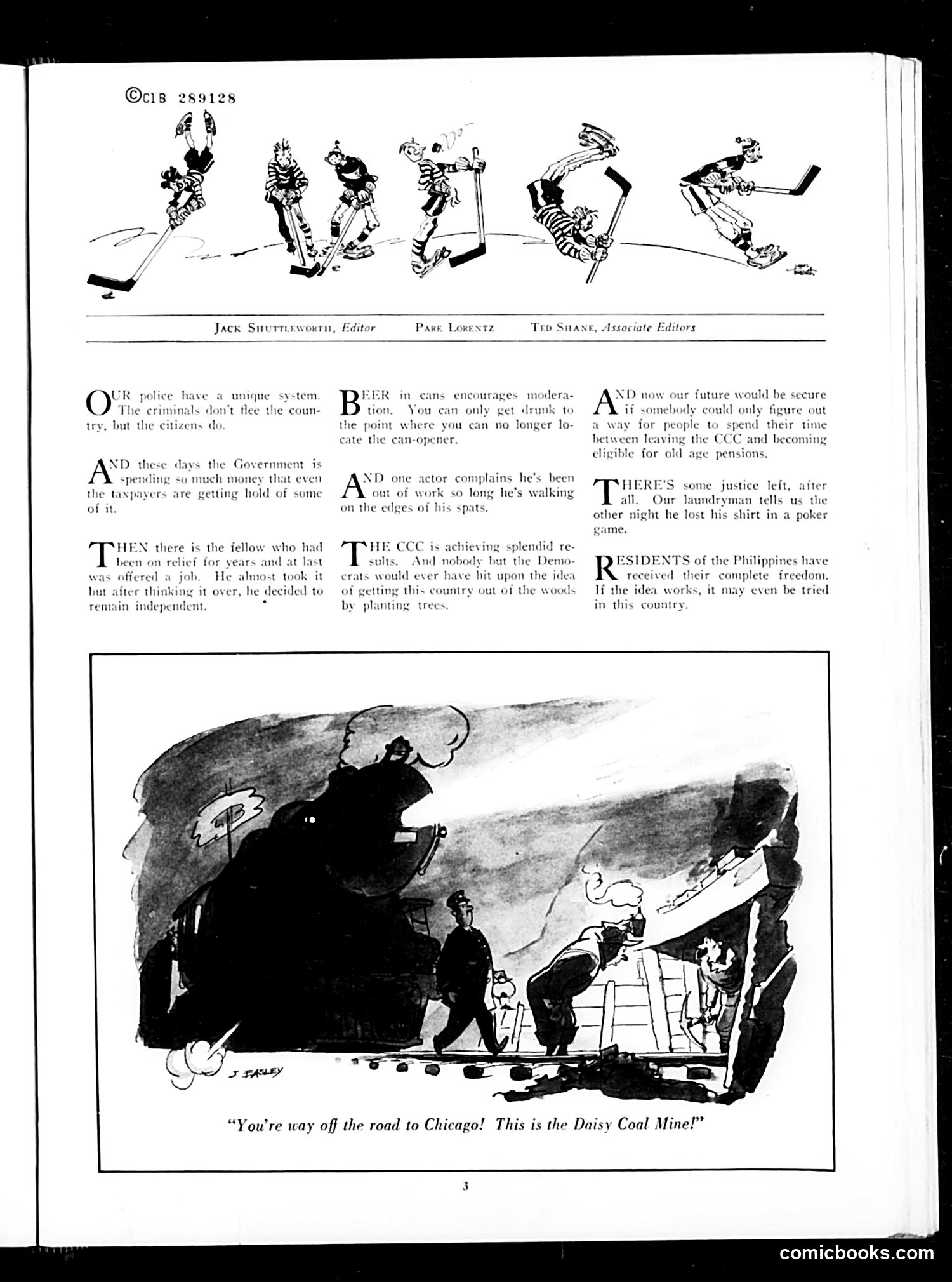
# Analysis of Judge Magazine Page This page contains satirical commentary on American governance and social issues, likely from the 1930s (based on the CCC reference and relief-era context). The top cartoon strip depicts hockey-playing figures, appearing to satirize government inefficiency or political maneuvering. The prose commentary criticizes: - Police systems and enforcement - Government spending during relief programs - A man rejecting relief work to remain independent - The CCC (Civilian Conservation Corps) achievements - Democratic political failures The main cartoon depicts a coal mine, with the caption "You're way off the road to Chicago! This is the Daisy Coal Mine!" This appears to satirize someone lost or misguided—possibly criticizing a politician or policy direction, using the mine as a metaphor for being in dangerous/wrong territory. Overall, the page reflects Depression-era critiques of New Deal programs and government effectiveness.
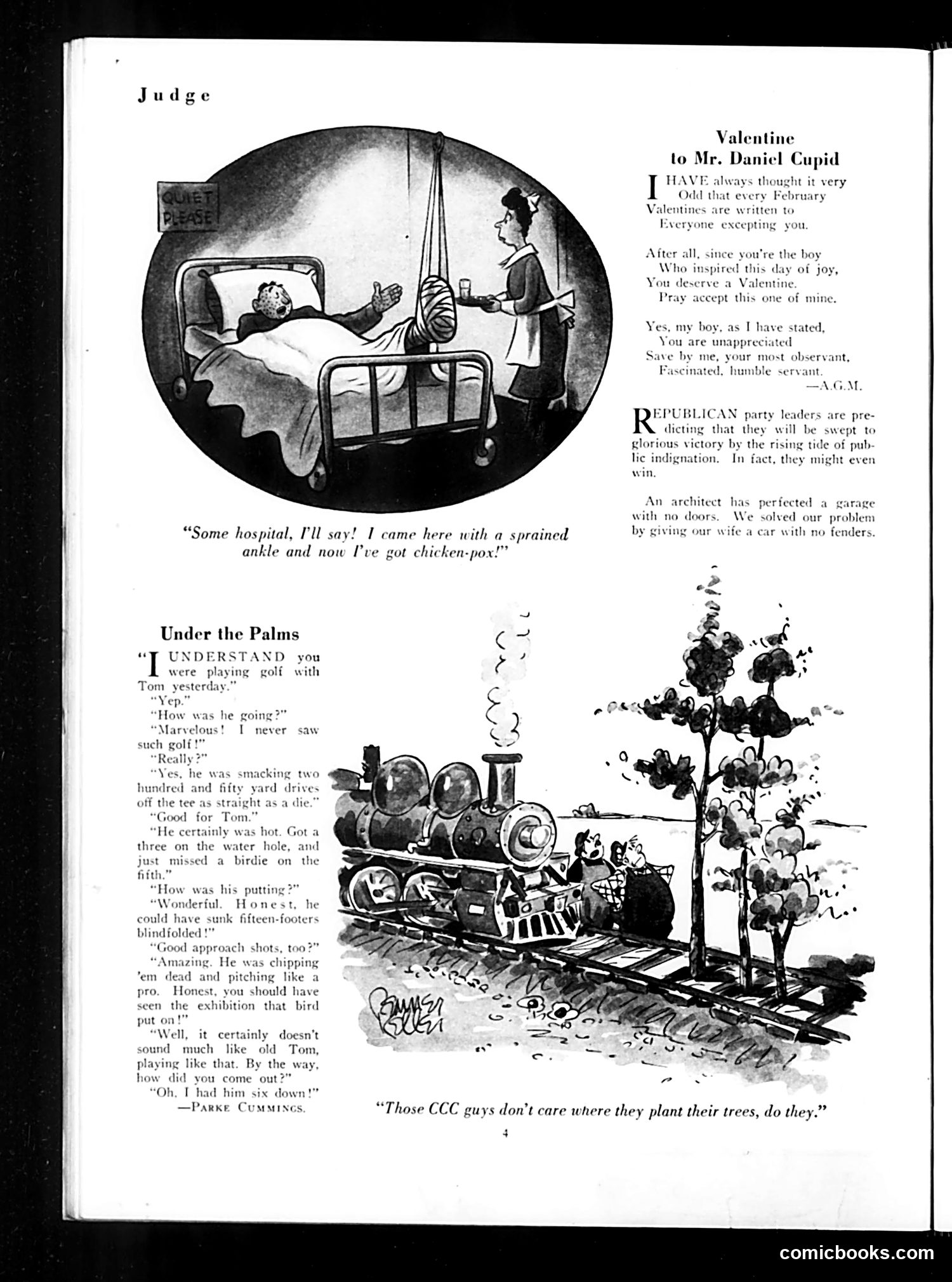
# Analysis of Judge Magazine Page **Top Cartoon ("Judge"):** A hospital scene where a patient in traction claims he came in with a sprained ankle but now has "chicken-pox." This is straightforward slapstick humor about hospital misadventures—no political content. **"Valentine to Mr. Daniel Cupid":** A poem mocking someone (unclear who specifically) for never receiving valentines, sarcastically suggesting he "deserves" one. The tone is insulting rather than affectionate. **"Under the Palms":** A golf anecdote attributed to "PARKE CUMMINGS" where someone named Tom hit impressively long drives. The final caption about "CCC guys" references the Civilian Conservation Corps, suggesting Depression-era New Deal criticism—the joke being they plant trees carelessly. All content appears humorous/satirical rather than hard-hitting political commentary.
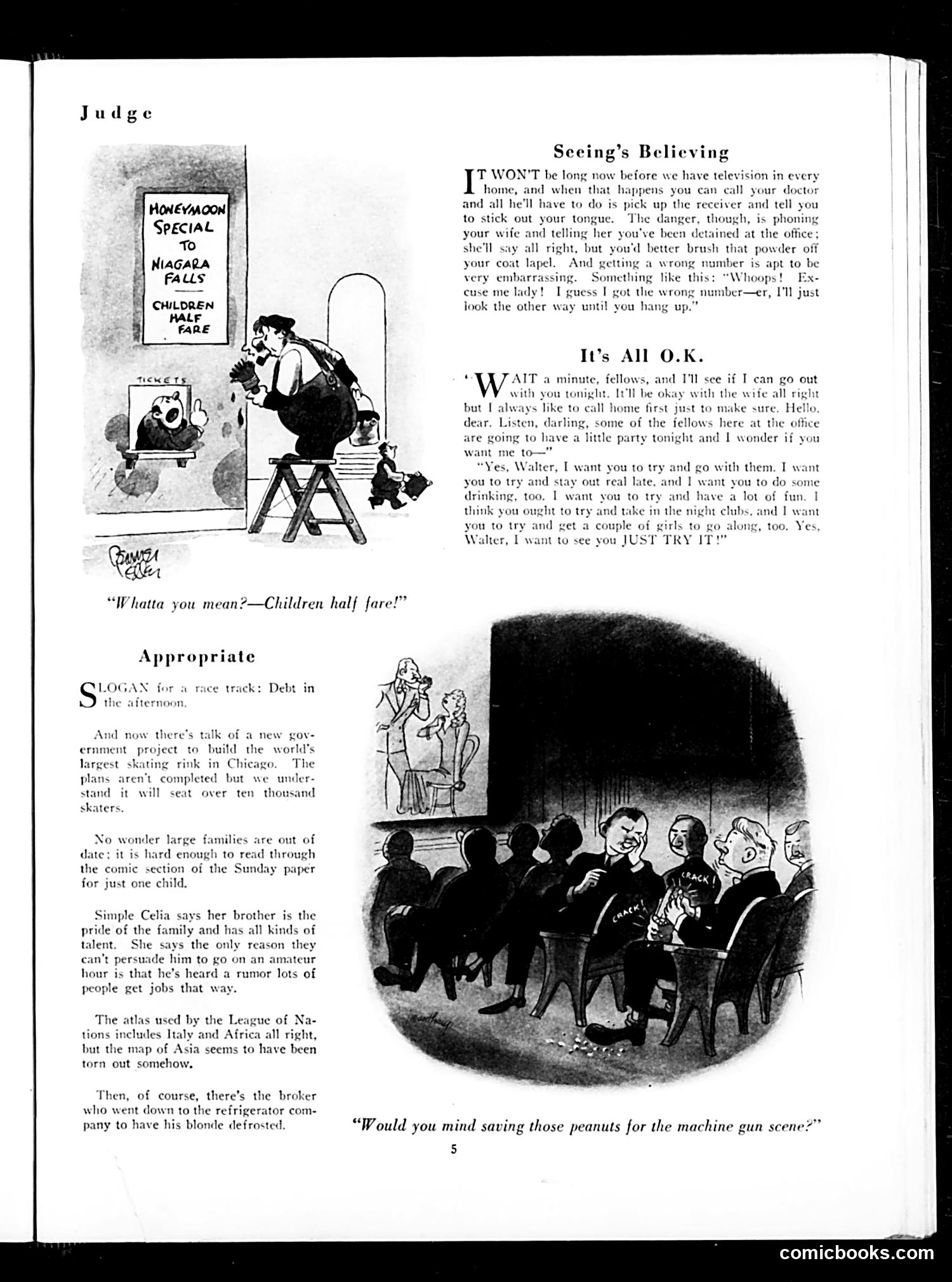
# Page Analysis: Judge Magazine, Page 5 **Top Cartoon ("Whatta you mean?—Children half fare!"):** A man on a ladder posts a sign advertising "Honeymoon Special to Niagara Falls—Children Half Fare." He's being confronted by what appears to be an angry ticket agent or inspector. The joke satirizes absurd travel advertising—offering reduced fares for children on honeymoon trips is nonsensical, since newlyweds typically travel alone. The humor targets both misleading promotional language and the confusion it creates. **Lower Section:** Contains short humor items ("Judge" column) about everyday absurdities: a government skating rink project in Chicago, family dynamics, and administrative incompetence (a broker visiting a refrigerator company to have his blonde "defrosted"). **Bottom Cartoon:** Shows theater-goers asking someone to save peanuts for a "machine gun scene"—satirizing both audience behavior during films and the violence depicted in contemporary movies.
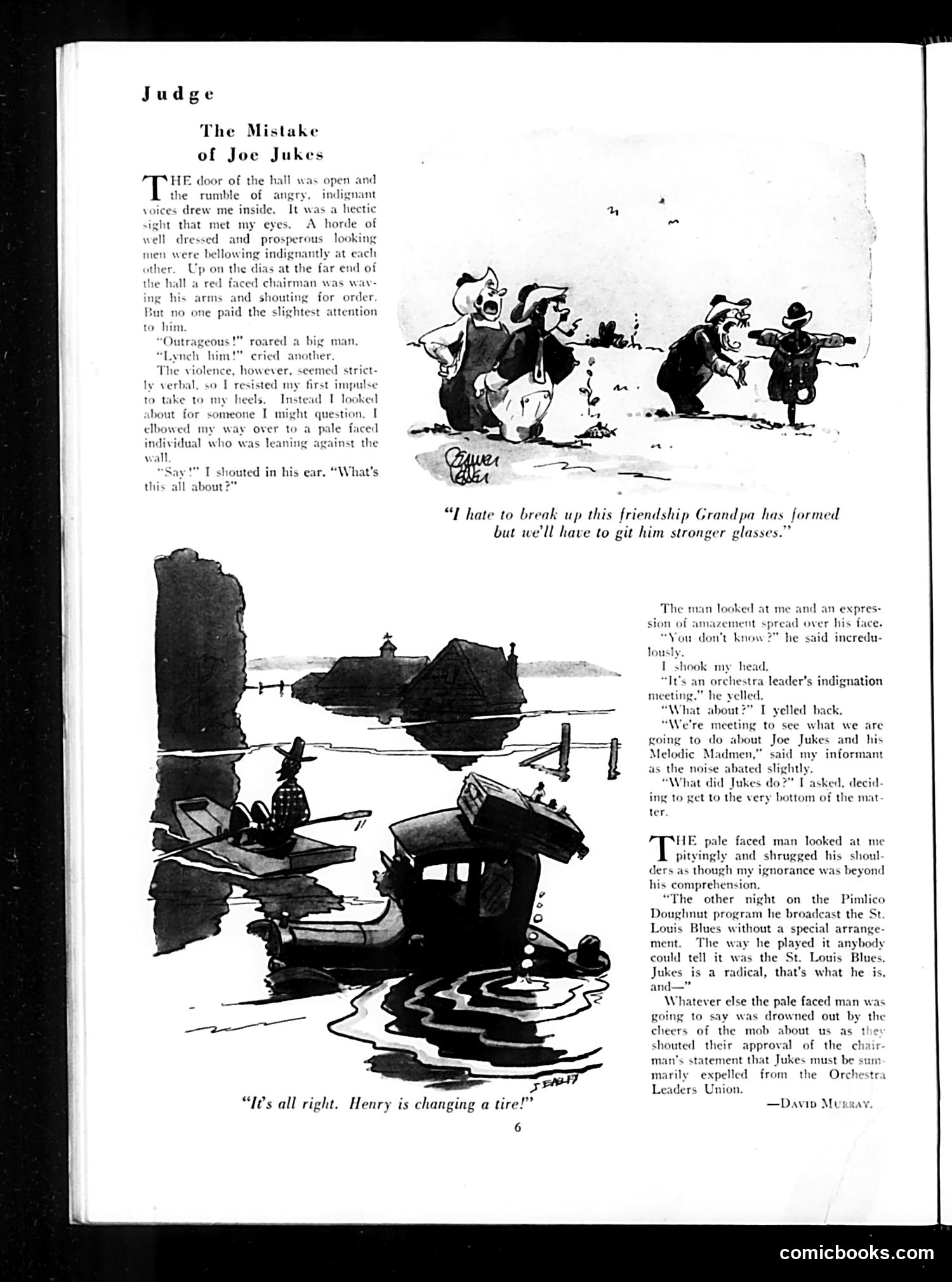
# Analysis of "The Mistake of Joe Jukes" This story by David Murray satirizes Joe Jukes, a jazz musician who apparently broadcasted the "St. Louis Blues" on the Pimlico radio program without authorization. The narrative mocks an Orchestra Leaders Union meeting where angry members confront the narrator about Jukes's transgression. The cartoon illustrations depict the chaotic confrontation—men arguing and gesticulating in an auditorium. The satire targets both jazz music (viewed skeptically by establishment figures) and labor union politics of the era. Jukes is portrayed as a "radical" for playing unauthorized music on radio, suggesting tensions between musicians' unions and emerging broadcast technology. The joke hinges on treating an informal musical performance as a serious contractual violation warranting organizational action.
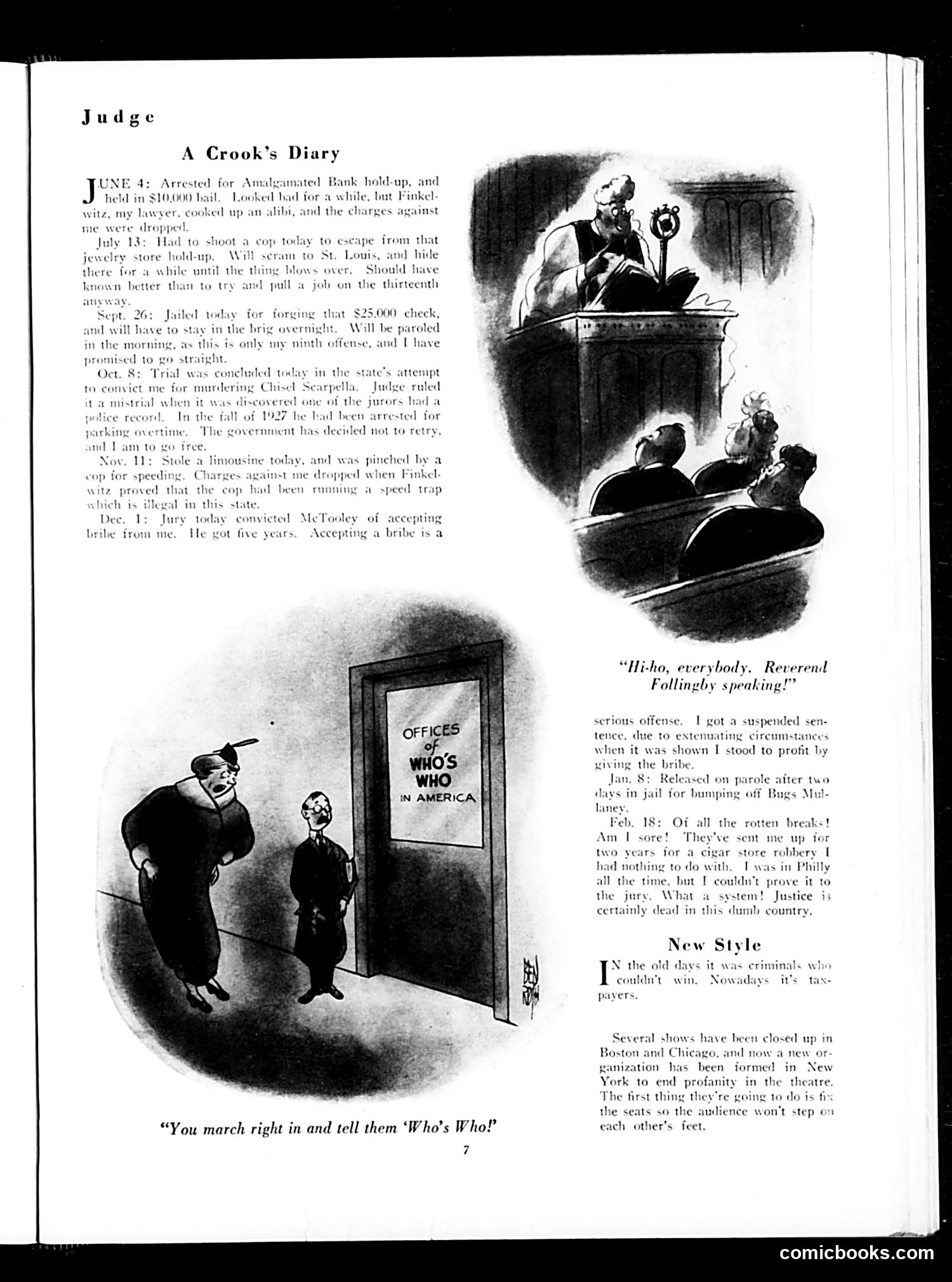
# "A Crook's Diary" - Judge Magazine Satire This page satirizes American criminal justice through a fictional criminal's diary entries (June through February). The diarist boasts of evading consequences for bank robbery, attempted murder, forgery, and bribery—each crime dismissed, reduced, or unpunished through legal technicalities, lawyer intervention, or corrupt officials. The two cartoons reinforce this critique: one shows a man entering an office labeled "Offices of Who's Who in America," satirizing how criminals achieve social respectability; the other depicts a courtroom scene with the caption "Hillo, everybody. Reverend Follinsby speaking!"—mocking the absurdity of judicial proceedings. The satire's central point: the American legal system protects wealthy criminals while justice remains illusory. The "New Style" section at bottom suggests organized crime now operates like legitimate business.
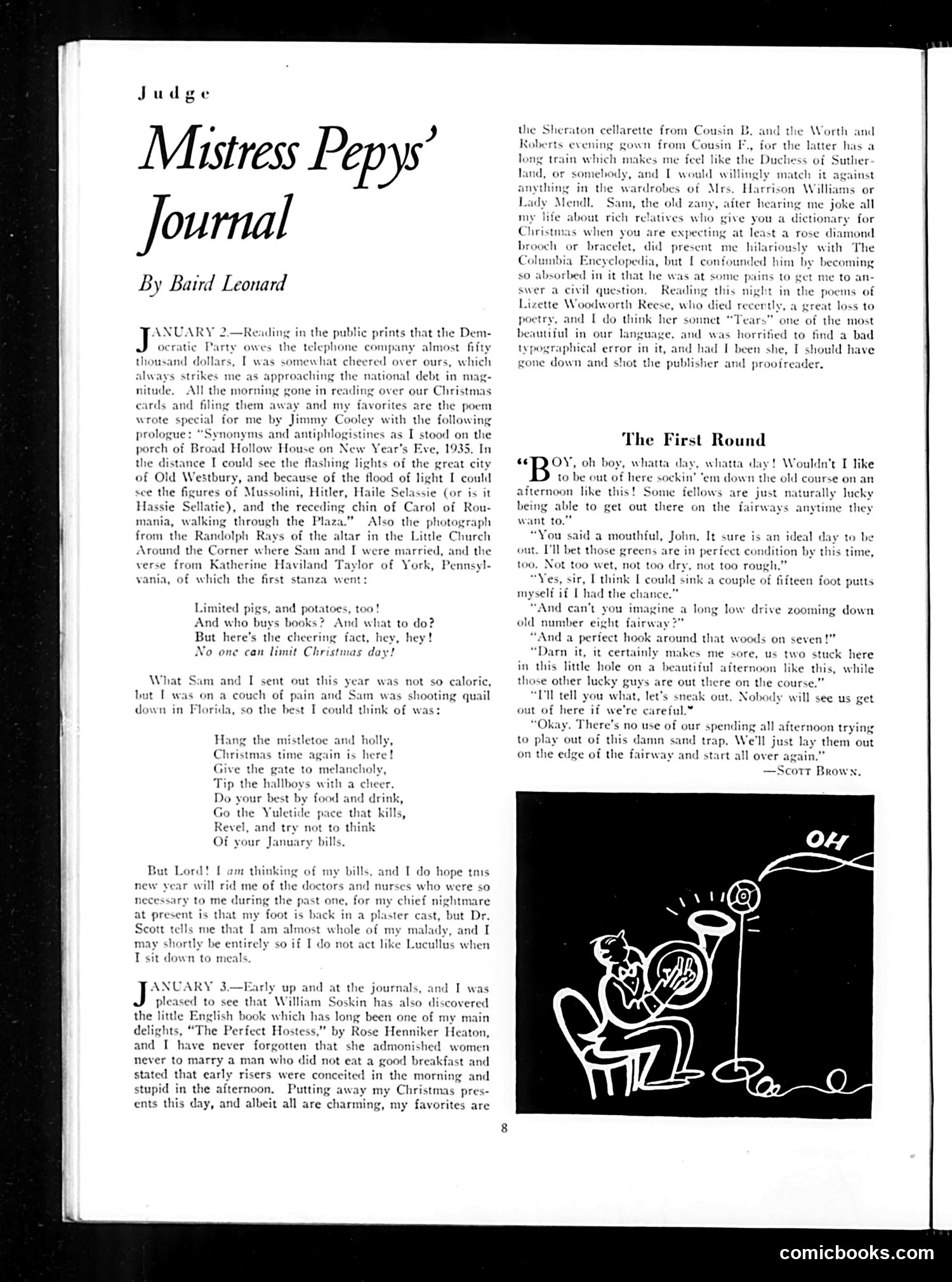
# "Mistress Pepys' Journal" - Analysis This is a society gossip column mimicking Samuel Pepys' famous diary, written by Baird Leonard for *Judge* magazine. The January 1936 entries humorously chronicle upper-class complaints and observations. The content satirizes wealthy leisure-class anxieties: unpaid bills, medical ailments (the author's foot cast), Christmas gift-giving etiquette, and social hierarchies. References to "rich relatives who give you a dictionary" mock miserly gift-giving among the wealthy. The small cartoon shows golfers frustrated by weather, linking to "The First Round"—a dialogue where men discuss being stuck golfing on a poor day, longing to escape to better courses. The satire targets the genteel boredom and petty concerns of the leisure class during Depression-era America. The Pepys parody format allows *Judge* to mock society's self-absorption through mock-serious documentation of trivial domestic drama.
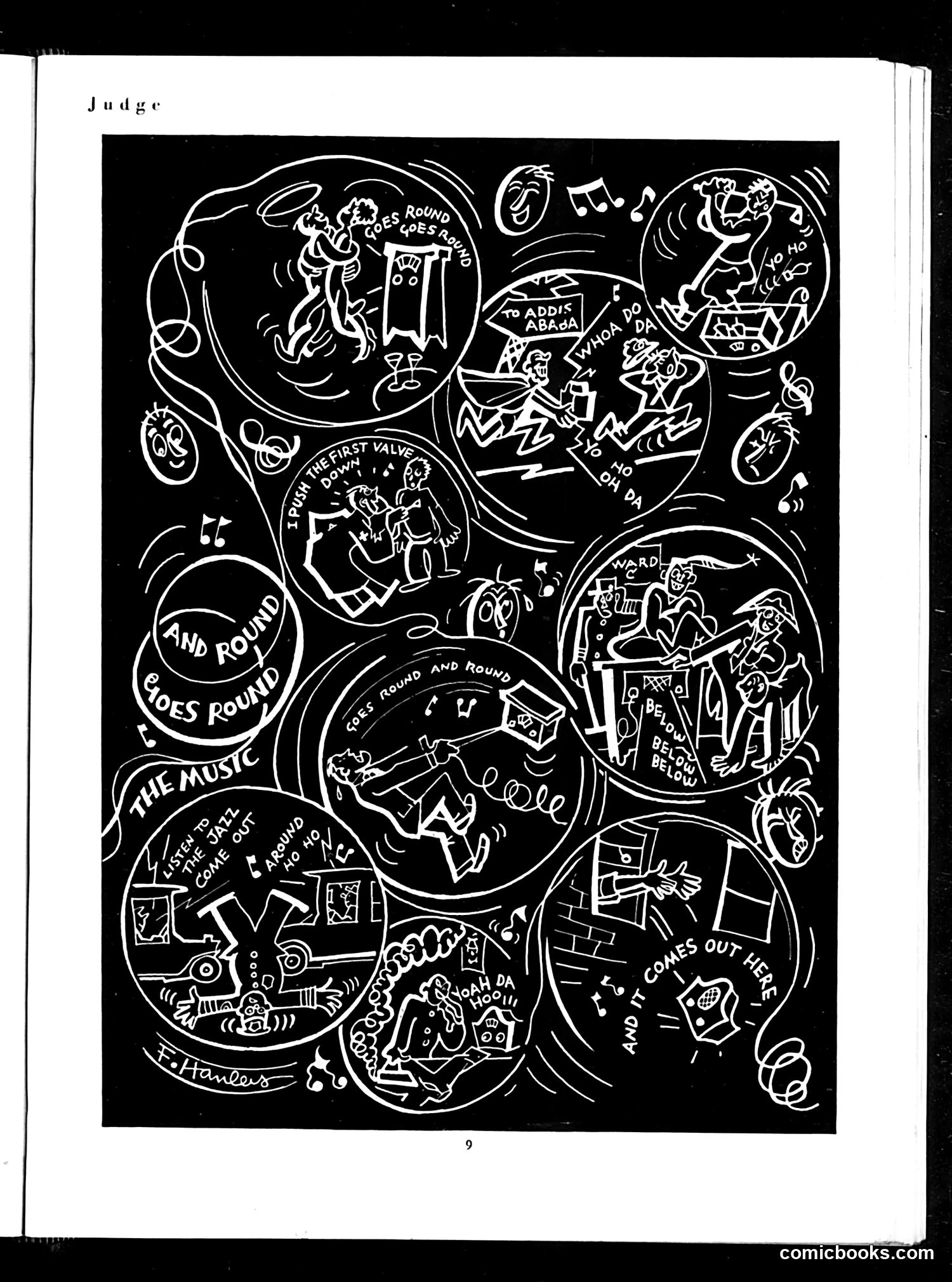
# "Judge" Page Analysis This is a whimsical, circular-panel cartoon about music and entertainment. The central theme appears to be "the music goes round and round," referencing what was likely a popular song or phrase of the era. Multiple overlapping circular vignettes show characters dancing, performing, and enjoying various musical activities—including what appears to be nightclub or vaudeville scenes. Text fragments visible include "GOES ROUND AND ROUND," "AND ROUND," "TO ADDIS ABABA," "WORD," and "COMES OUT HERE," suggesting a playful narrative about music's circulation through society. The cartoon's humor seems to derive from the universal appeal and cyclical nature of popular music and entertainment culture. The artist's signature appears to be "Handels" or similar. The satirical intent isn't overtly political—rather, it's social commentary on the pervasiveness of popular music in American life.
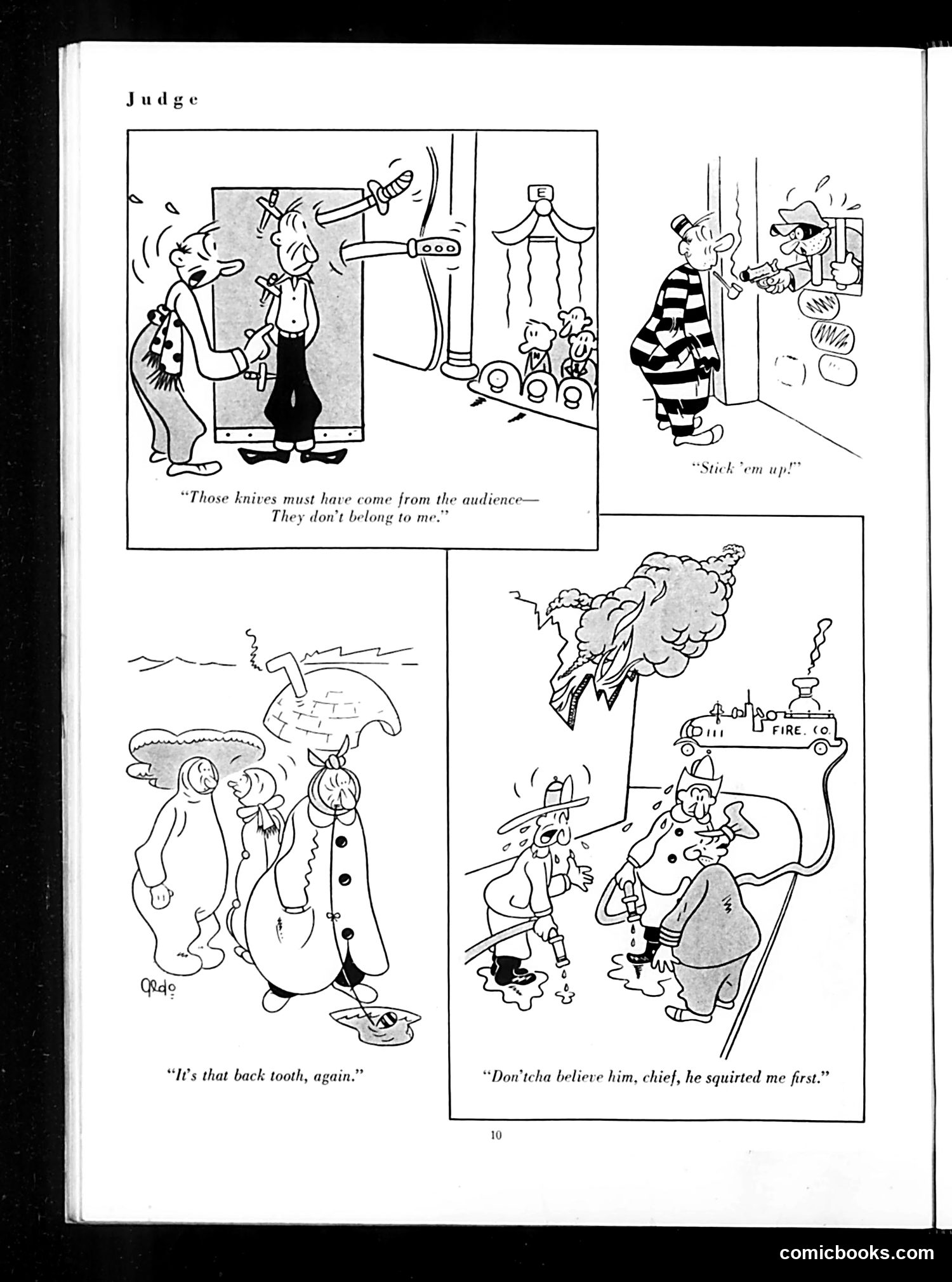
# Judge Magazine Comic Page Analysis This page contains four unrelated gag cartoons typical of Judge magazine's satirical humor: 1. **Top left**: A knife-throwing act gone wrong—the performer claims flying knives came from the audience rather than his act, deflecting blame. 2. **Top right**: "Stick 'em up!"—appears to be a robbery or holdout scenario with comedic exaggeration. 3. **Bottom left**: "It's that back tooth, again"—depicts what appears to be a dental or medical complaint, likely about a problematic tooth causing repeated issues. 4. **Bottom right**: "Don'tcha believe him, chief, he squirted me first"—shows a fire truck scene where someone disputes another's account, suggesting a dispute over who was at fault in an incident. The cartoons use visual exaggeration and physical comedy typical of early-to-mid 20th century American humor. Without publication date information, the specific topical references remain unclear.