
Judge, 1936-02 · page 8 of 36
Judge — February 1936 — page 8: what you’re looking at
What you’re looking at
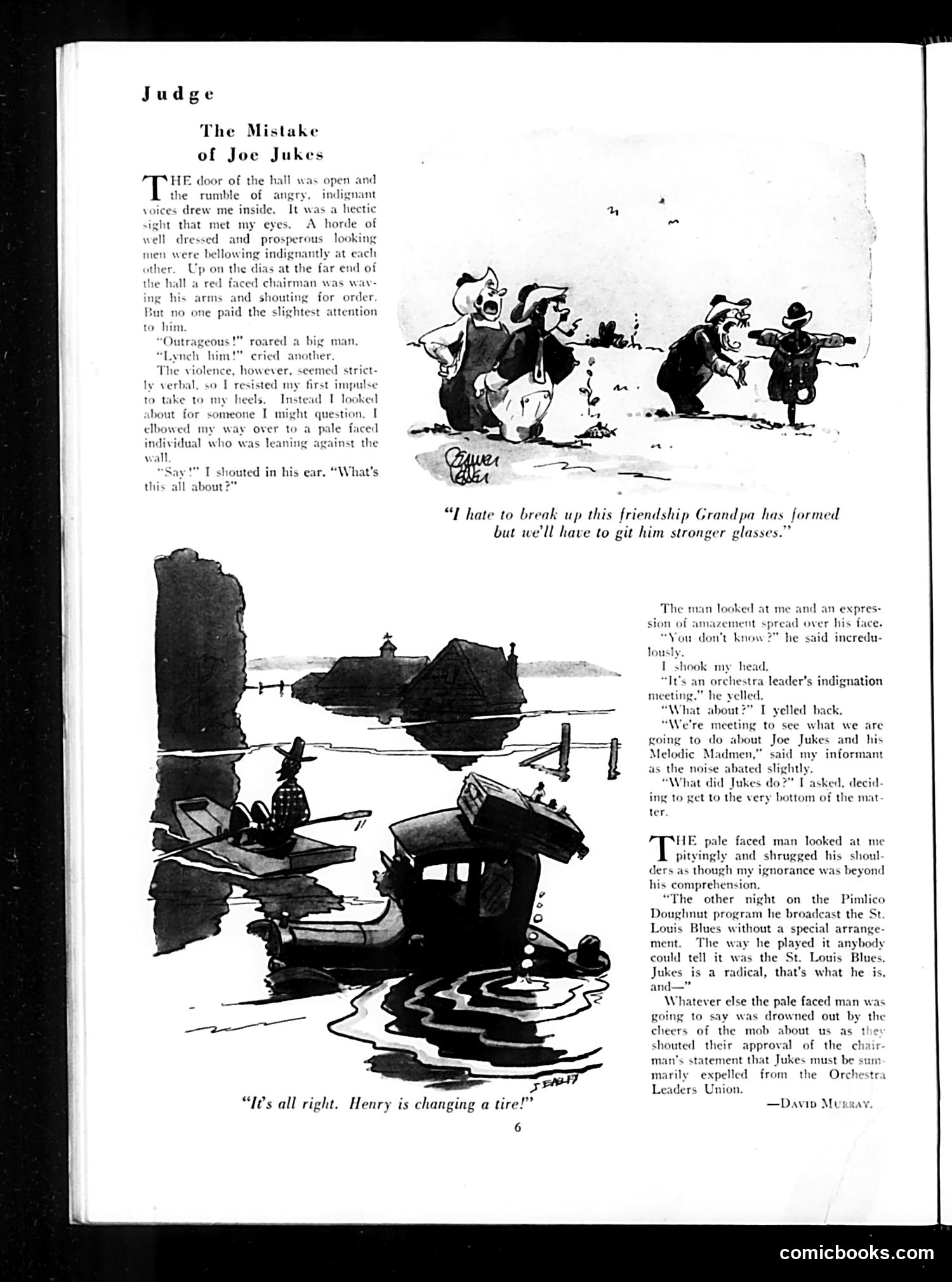
# Analysis of "The Mistake of Joe Jukes" This story by David Murray satirizes Joe Jukes, a jazz musician who apparently broadcasted the "St. Louis Blues" on the Pimlico radio program without authorization. The narrative mocks an Orchestra Leaders Union meeting where angry members confront the narrator about Jukes's transgression. The cartoon illustrations depict the chaotic confrontation—men arguing and gesticulating in an auditorium. The satire targets both jazz music (viewed skeptically by establishment figures) and labor union politics of the era. Jukes is portrayed as a "radical" for playing unauthorized music on radio, suggesting tensions between musicians' unions and emerging broadcast technology. The joke hinges on treating an informal musical performance as a serious contractual violation warranting organizational action.
📄 Transcribed text from this page (OCR, searchable)
Machine-transcribed from the original scan — historical spelling and the odd misread are preserved.
Judge The Mistake of Joe Jukes ; : HE door of the hall was open and the rumble of angry, indignant s drew me inside. It was a hectic uy ight that met my eyes. A horde of ” well dressed and prosperous looking men were bellowing indignan other. Up on the dias at the ly at each end of Ma red faced chairman was wav- ing 1} rms and shouting for order But no one paid the slightest attention » him, Outrageous!" roared a big man, him!” cried The violence, however, seemed strict- ly verbal, so T resisted my first impulse to take to my heels. Instead I looked bout for someone I might question. I elbowed my way over to a pale faced another, individual who was leaning against the wall "Say!" 1 this all abou uted in his ear. “What's “1 hate to break up this friendship Grandpa has formed but we'll have to git him stronger glasses.” The man looked at me and an expres- sion of amazement spread over his face. You don't know?” he said incredu- lously. I shook my head. “It’s an orchestra leader’s indignation meeting.” he yelled. “What about?” T yelled back. “We're meeting to see what we are going to do about Joe Jukes and his Melodic Madmen,” said my informant as the noise abated slightly. “What did Jukes do?” [ asked, decid- to get to the very bottom of the mat pale faced man looked at me y and shrugged his shoul ders as though my ignorance was beyond his comprehension. “The other night on the Pimlico Doughnut program he broadcast the St. Louis Blues without a special arrange- ment. The way he played it anybody could tell it was the St. Louis Blues. Jukes is a radical, that’s what he is, and—”" Whatever else the pale faced man was going to say was drowned out by the cheers of the mob about us as shouted their approval of the c¢ man’s statement that Jukes must be sum marily expelled from the Orchestra Leaders Union “Tes all right. Henry is changing a tire!” 6 —Davio Mursay. comicbooks.com