A complete issue · 36 pages · 1930
Judge — December 6, 1930
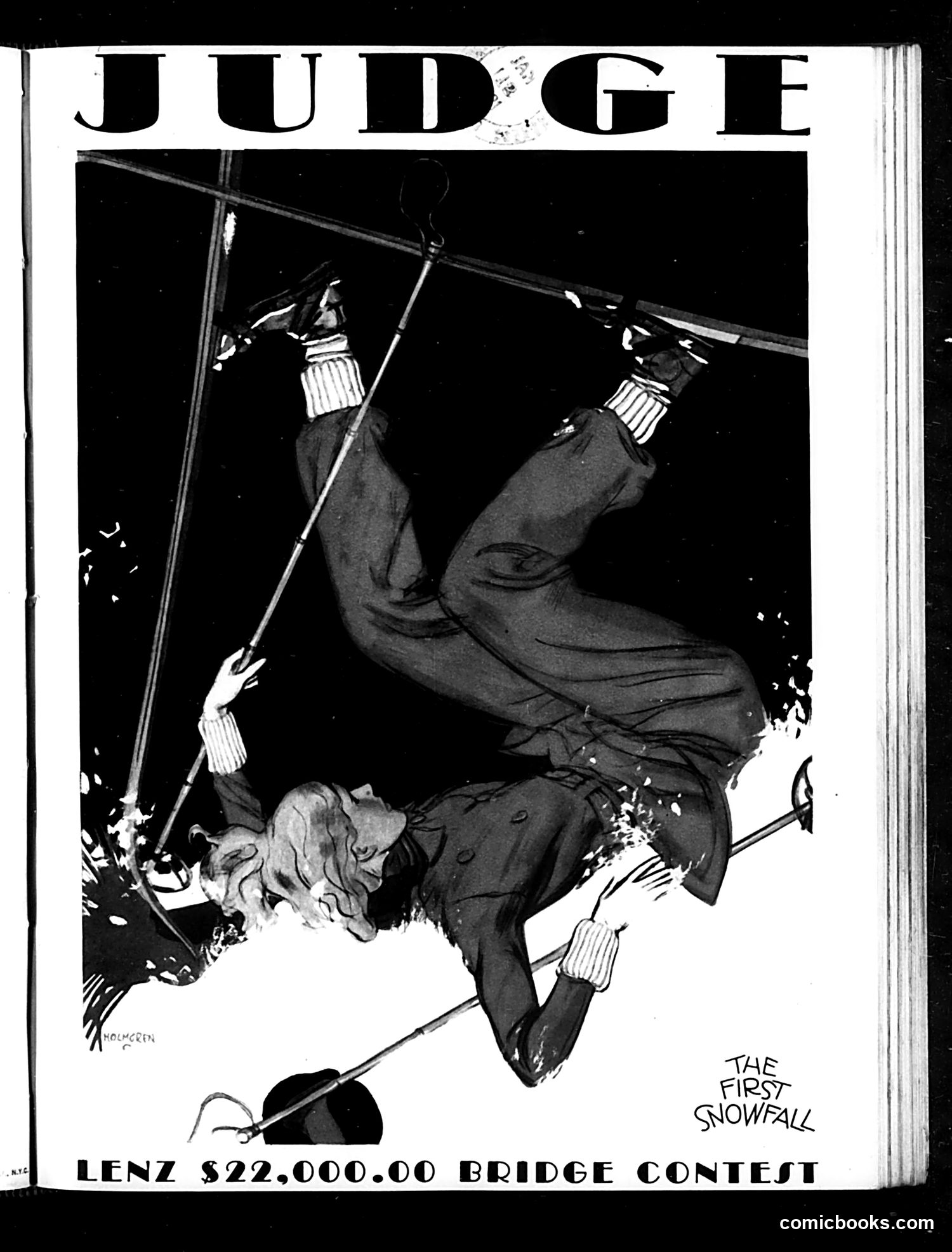
# Analysis of Judge Magazine Page This appears to be a cover or advertisement page for Judge magazine featuring a cartoon titled "The First Snowfall." The image shows a figure in military dress (identifiable by the ornate epaulettes on the shoulders) who has fallen or been knocked over in the snow, lying on their back in an undignified position. The page advertises a "Lenz $22,000.00 Bridge Contest," suggesting this was a promotional or contest-related issue. Without additional context about the specific historical period or the "Lenz" reference, the exact political satire remains unclear. However, the juxtaposition of a dignified military figure in an embarrassing, fallen position suggests mockery of military authority or a specific public figure—a common theme in Judge's satirical content.
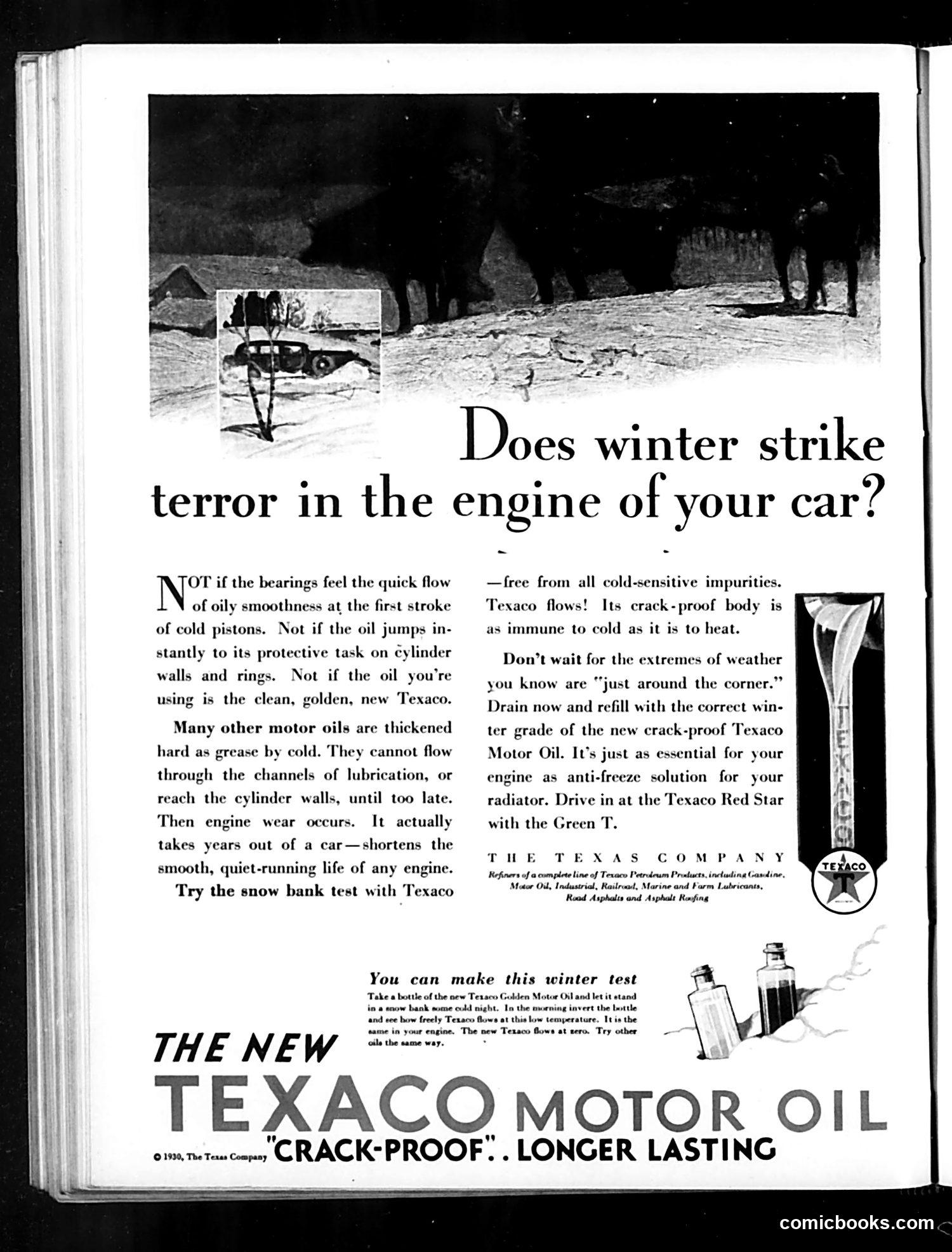
# Analysis This is **not a political cartoon or satire**, but rather a **straightforward advertisement** for Texaco Motor Oil from 1935 (copyright visible). The ad addresses a genuine consumer concern of the era: winter engine problems. It claims Texaco's "crack-proof" motor oil remains fluid in cold weather, unlike competitors' oils that thicken and fail to lubricate properly—causing engine wear. The visual elements include: - A snowy rural scene with a stalled car and cattle - An inset photo of an old vehicle in snow - A product bottle illustration - A "snow bank test" demonstrating the oil's cold-weather performance The ad's language ("terror in the engine," "immune to cold") uses dramatic rhetoric typical of 1930s marketing to emphasize product superiority. This represents early automotive advertising targeting seasonal maintenance concerns.
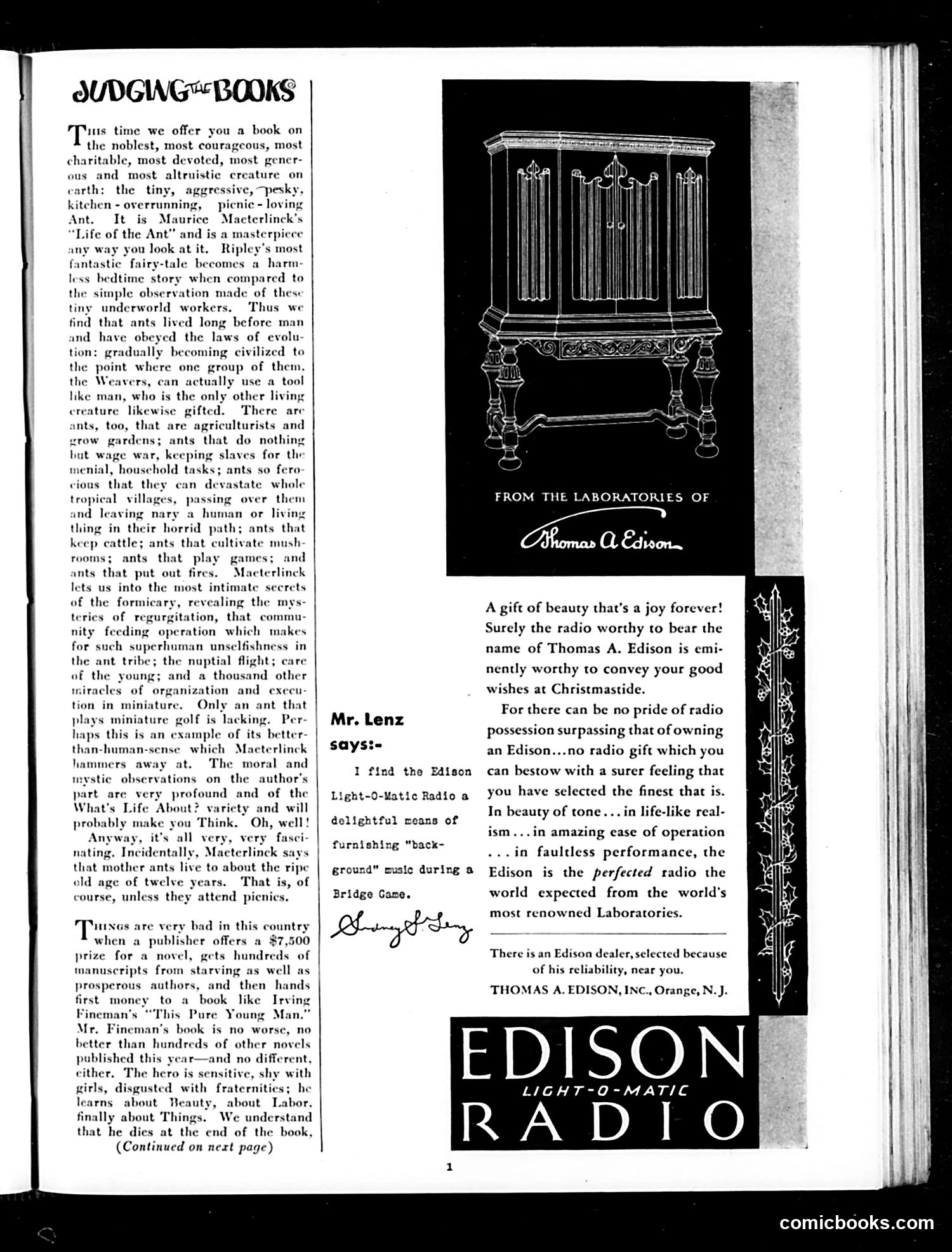
# Page Analysis This page is primarily **advertising**, not satirical content. The left column contains a book review column titled "Judging the Books," discussing Maurice Maeterlinck's "Life of the Ant" and Irving Fineman's "This Pure Young Man." The right side features a full-page **Edison Light-O-Matic Radio advertisement**. It includes an ornate radio cabinet illustration and testimonial from "Mr. Lenz" praising the radio's sound quality for background music during bridge games. The advertisement emphasizes the radio as a luxury gift item worthy of bearing Thomas Edison's name, positioning it as the "perfected radio the world expected from the world's most renowned Laboratories." This reflects early 1920s radio commercialization and Edison's brand prestige. There is **no political cartoon or satire** on this page.
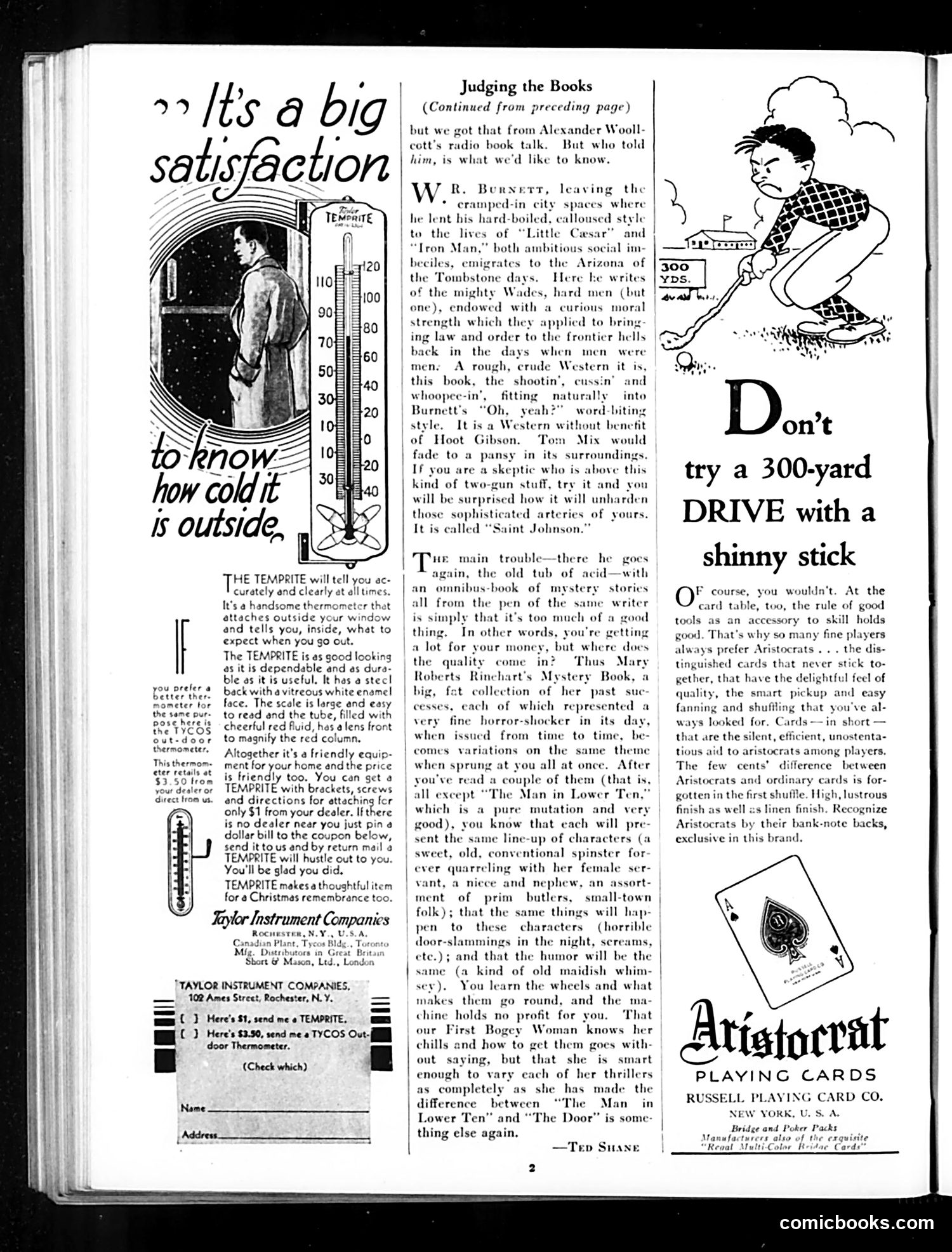
# Page Analysis This page is primarily **book reviews and advertisements** rather than political satire. The main content features **"Judging the Books,"** a column reviewing recent publications including W.R. Burnett's Western novel "Saint Johnson" and Mary Roberts Rinehart's mystery collection. Critic Ted Shane discusses how mystery stories have become formulaic—characters and plot devices repeat across different books, making them predictable despite their popularity. The advertisements include a **Tempite thermometer** (left) and **Aristocrat Playing Cards** (right). The cartoon "Don't try a 300-yard drive with a shinny stick" (center-right) appears to be a humorous sports illustration unrelated to the book reviews, likely cautioning against using inferior equipment for golf. The page demonstrates Judge's mix of literary criticism and commercial advertising typical of 1920s-30s magazines.
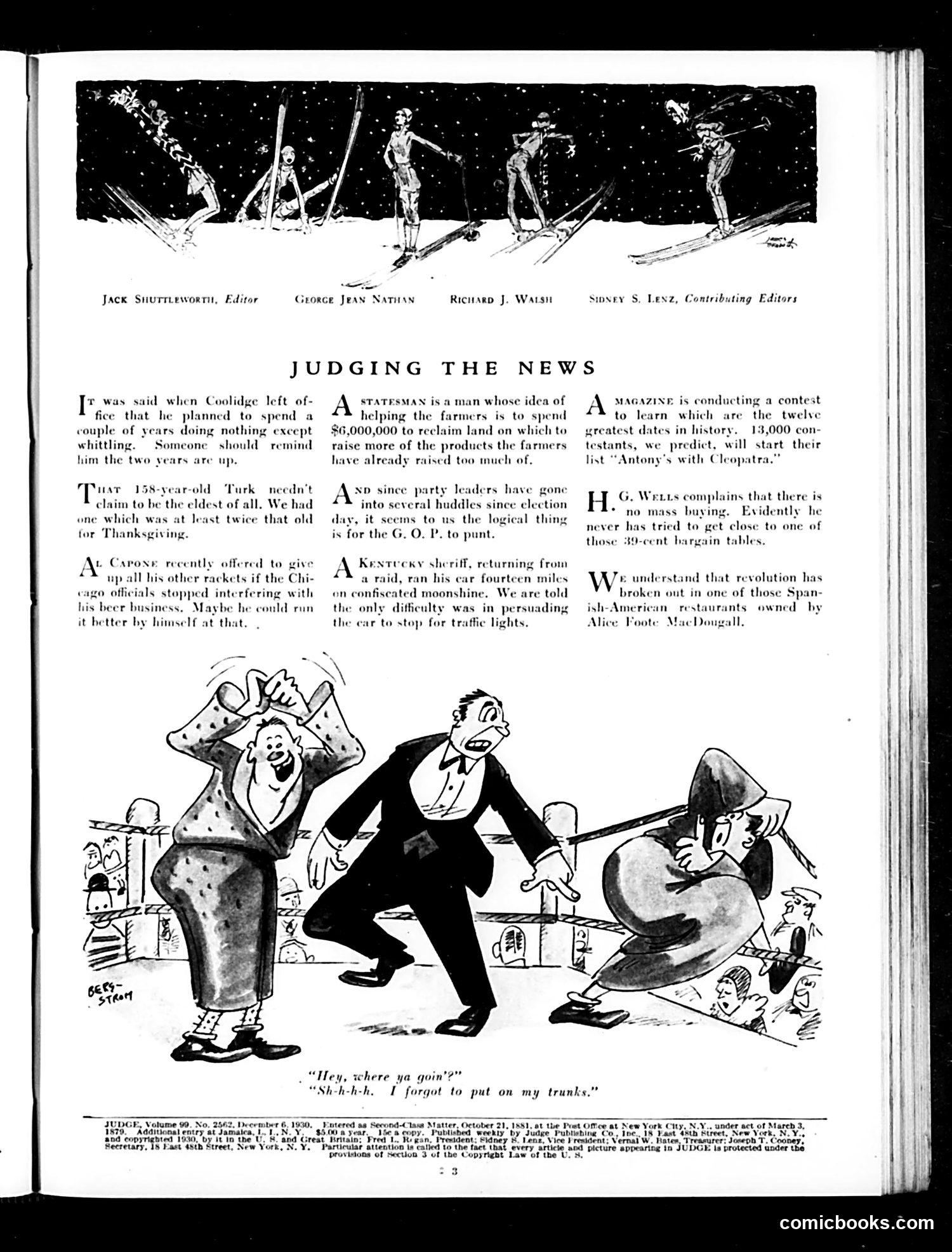
# "Judging the News" - December 6, 1930 This page contains brief satirical commentary on recent news items alongside a cartoon. The visible jokes mock political figures and institutions: references to Coolidge's idleness, a statesman's plan to spend $6 million reclaiming farmland, party leaders' post-election "huddles," complaints about lack of mass buying, and a revolution at a Spanish-American restaurant. The main cartoon depicts a domestic scene: a man in formal wear appears caught between two women arguing, with the caption "Hey, where ya goin'?" / "Sh-h-h. I forgot to put on my trunks." This is likely a marital infidelity joke, suggesting the man is sneaking away for an illicit encounter. The cartoon's humor relies on 1930s social conventions around propriety and marriage.
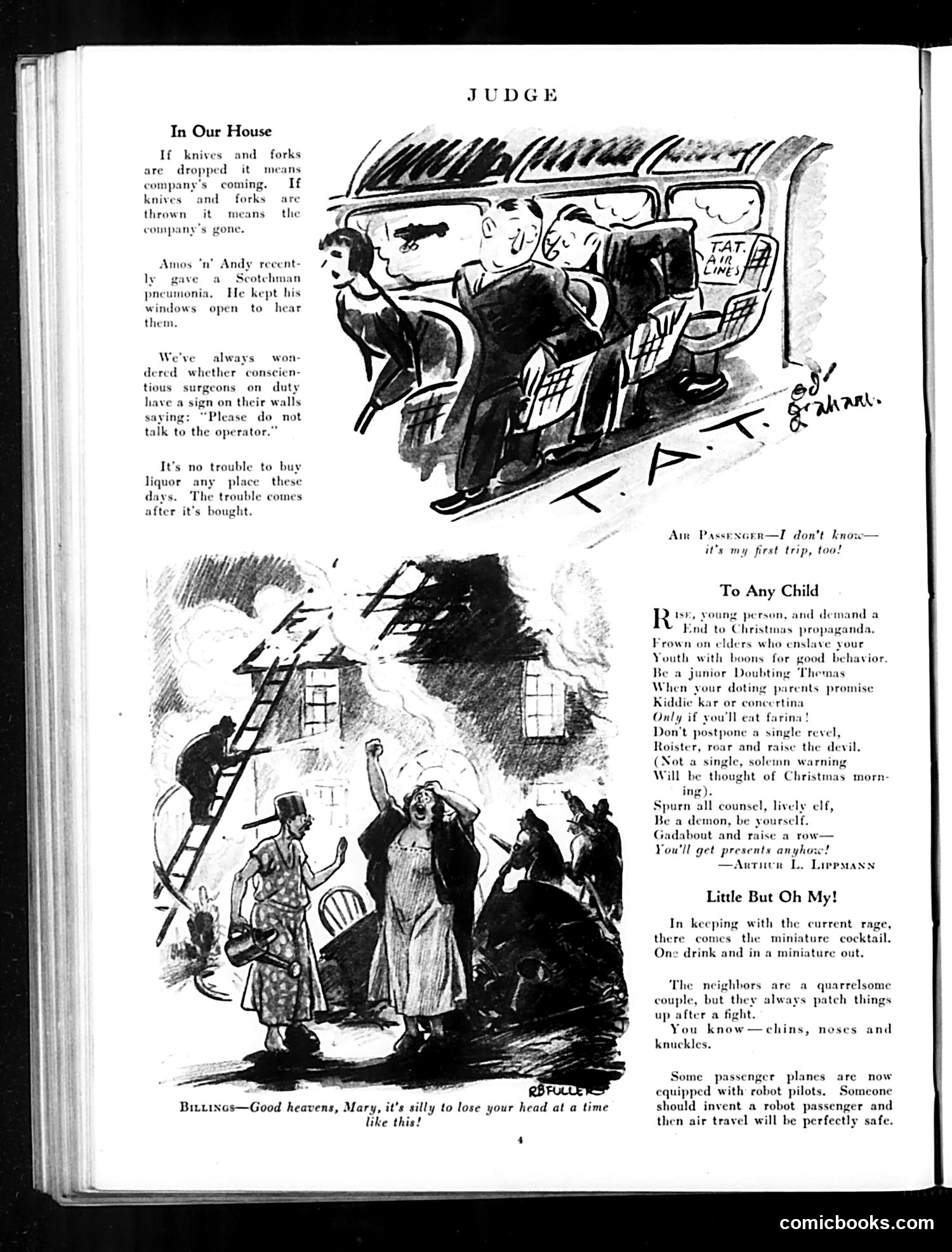
# Analysis of Judge Page This page contains three separate satirical pieces: **"In Our House"** mocks Prohibition-era social hypocrisy—dropping silverware signals company arrival, but the real concern is purchasing illegal liquor afterward. The joke highlights how Americans circumvented alcohol bans through informal networks. **"Judge as Air Passenger"** (top cartoon) depicts crowded, chaotic train travel, with the caption humorously suggesting a first-time passenger. It satirizes overcrowded transportation conditions of the era. **"To Any Child"** by Arthur L. Lippmann sarcastically urges children to misbehave during Christmas, inverting parental warnings. It's humorous social commentary on holiday expectations. **"Billings"** (bottom) shows domestic chaos—a woman losing her head literally—satirizing marital discord and domestic violence through absurdist humor typical of Judge's style. The page reflects 1920s American concerns: Prohibition enforcement, transportation infrastructure, and family dynamics.
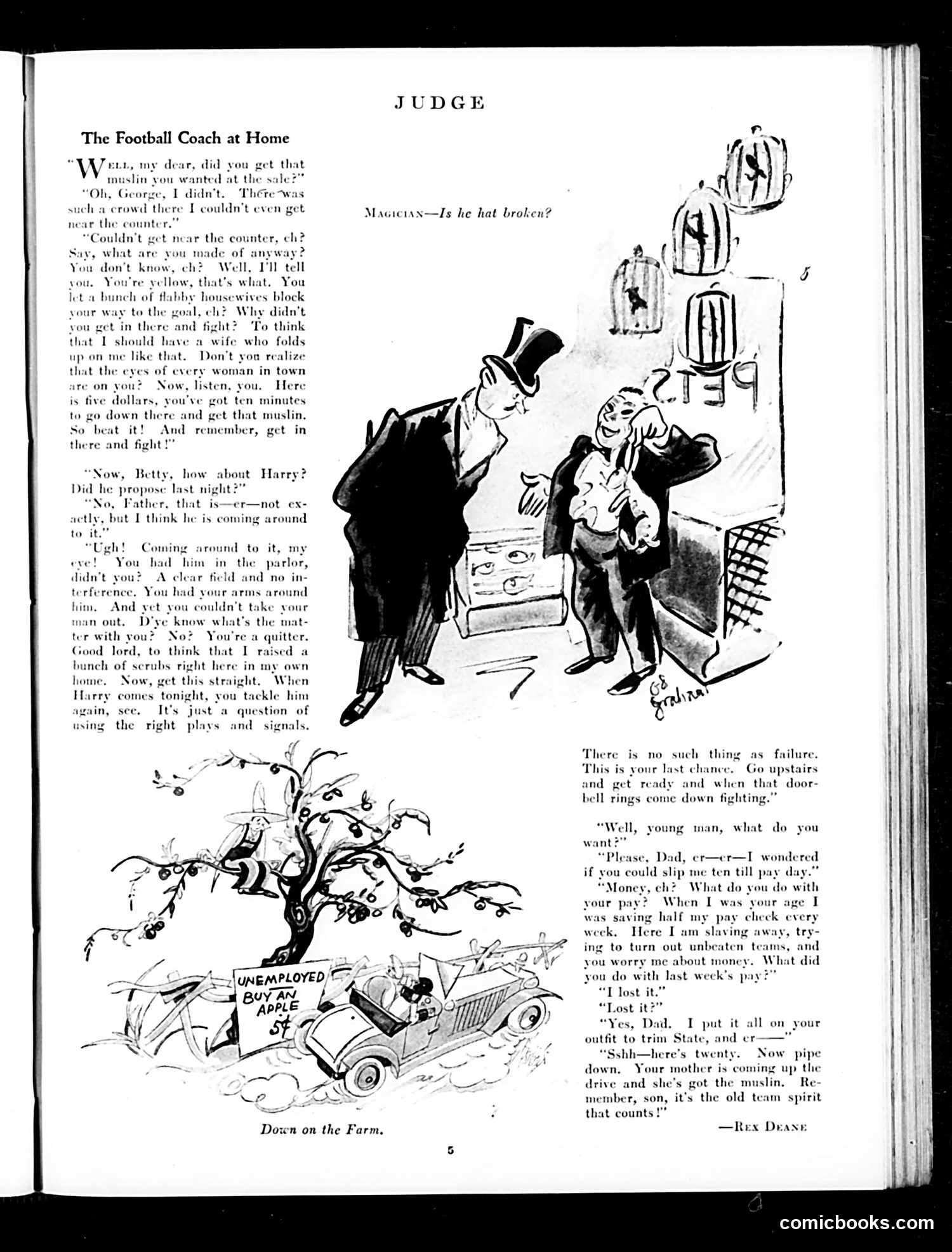
# "The Football Coach at Home" - Judge Magazine This satirical piece depicts a stern football coach lecturing his son Harry about masculine toughness and fighting spirit. The coach uses football metaphors—"tackle him," "right plays and signals"—to pressure his son into aggressive behavior, claiming real men don't back down. The humor lies in the contradiction: the coach demands Harry be tough and combative, yet earlier discovers his son couldn't propose to a girl because he was intimidated by onlookers' judgment. The coach's own anxieties about social perception undermine his tough-guy posturing. The accompanying "Down on the Farm" cartoon satirizes unemployment during economic hardship, showing an "unemployed apple" in a disabled vehicle—likely Depression-era commentary on joblessness and agricultural distress.
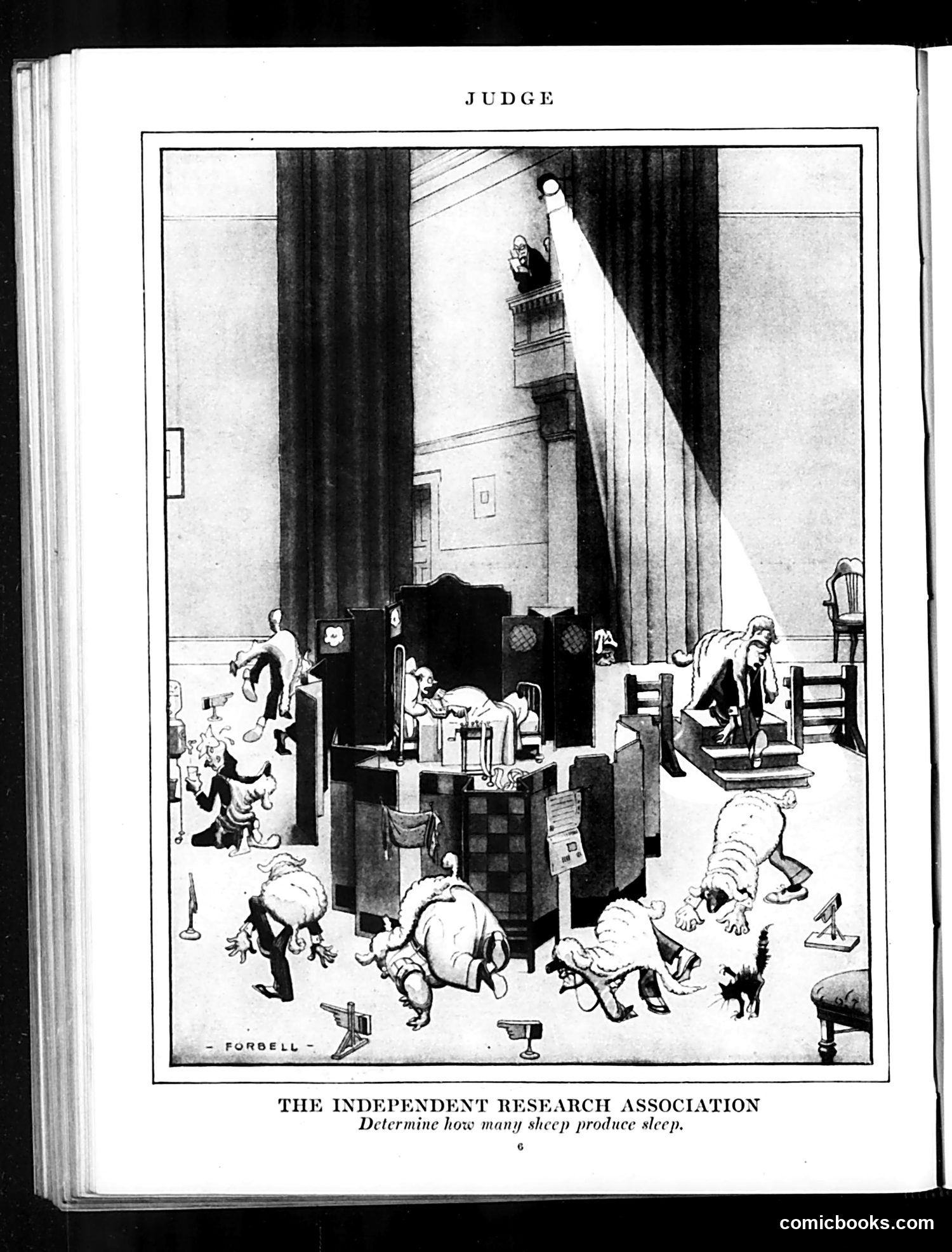
# Judge Magazine Cartoon Analysis This is a satirical cartoon titled "The Independent Research Association: Determine how many sheep produce sleep." The artist is Forbell. The cartoon depicts a courtroom scene where various figures (appearing as caricatured men in suits) are conducting an absurd "research" experiment. Men in the foreground are bent over on all fours, apparently acting as "sheep" while being studied by suited observers above them. The joke plays on the common expression that "counting sheep" helps produce sleep—by literalizing it as an actual research question requiring formal investigation and a courtroom setting. The satire appears to mock pseudo-scientific organizations and their ridiculous pursuits, suggesting that the "Independent Research Association" engages in frivolous, nonsensical studies dressed up in official-sounding language and formal proceedings.
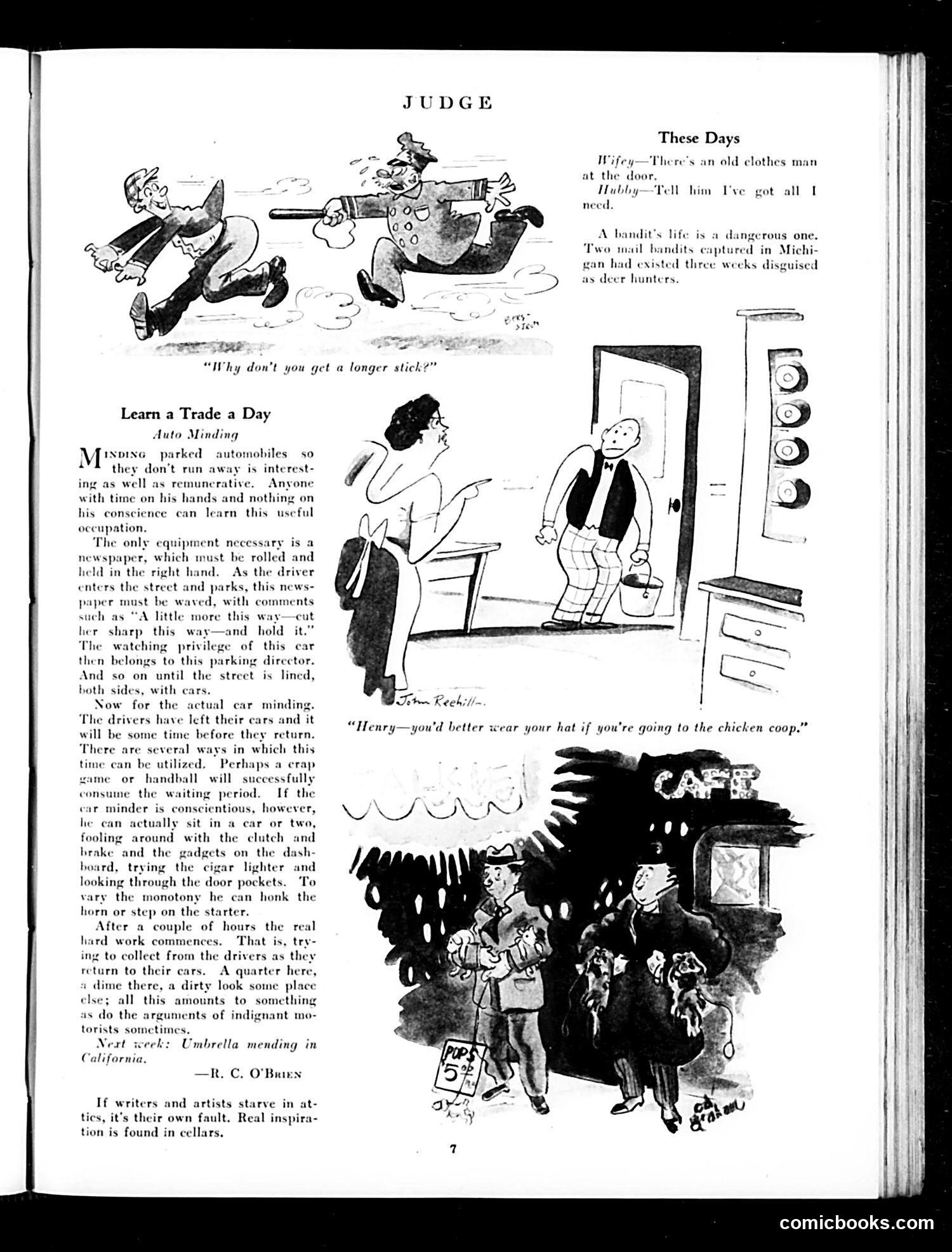
# Explanation for Modern Readers This Judge magazine page contains three satirical pieces: **"These Days" (top):** A husband dismisses an old clothes dealer at the door, claiming he has everything he needs. The accompanying anecdote jokes darkly about two Michigan mail bandits who posed as deer hunters for three weeks—satirizing how desperate criminals must become. **"Learn a Trade a Day: Auto Minding":** This is the page's main satirical article, mocking the informal "parking attendant" hustle of the era. Men would stand in streets with rolled newspapers, directing parked cars' positioning, then demand tips from returning drivers. The piece sarcastically presents this as a legitimate "trade," describing how attendants occupy waiting time with gambling, gambling, or tinkering with cars they don't own—then hassle drivers for payment. It's satire on both petty street hustles and the gullibility of car owners. **Bottom cartoons:** Minor domestic humor about visiting a chicken coop and writers starving in cities. The overall tone mocks working-class economic desperation and informal street-economy schemes of the 1920s-era.
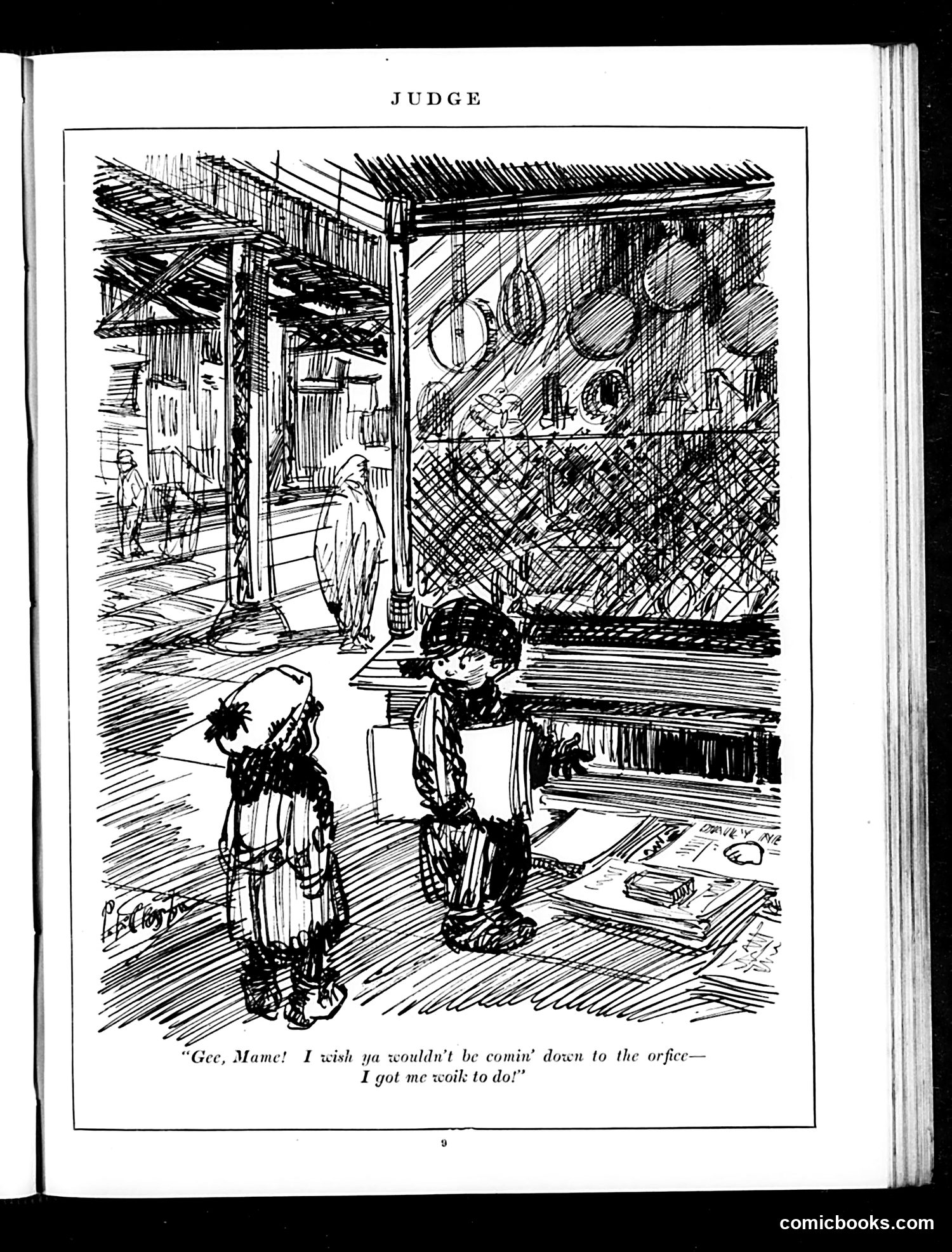
# "Judge" Cartoon Analysis This single-panel cartoon depicts a domestic scene in what appears to be a judge's office or legal workspace. A child speaks to an adult woman (presumably his mother, "Mame"), expressing reluctance about her visiting his workplace: "Gee, Mame! I wish ya wouldn't be comin' down to the office—I got me woik to do!" The humor lies in the contrast between the formal legal setting and the child's casual, working-class dialect. The satire likely mocks either nepotism in the legal profession (a parent visiting/interfering with a child's job) or the incongruity of a young person working in such an official environment. The casual speech pattern emphasizes class differences, a common Judge magazine theme satirizing workplace dynamics and social pretension.
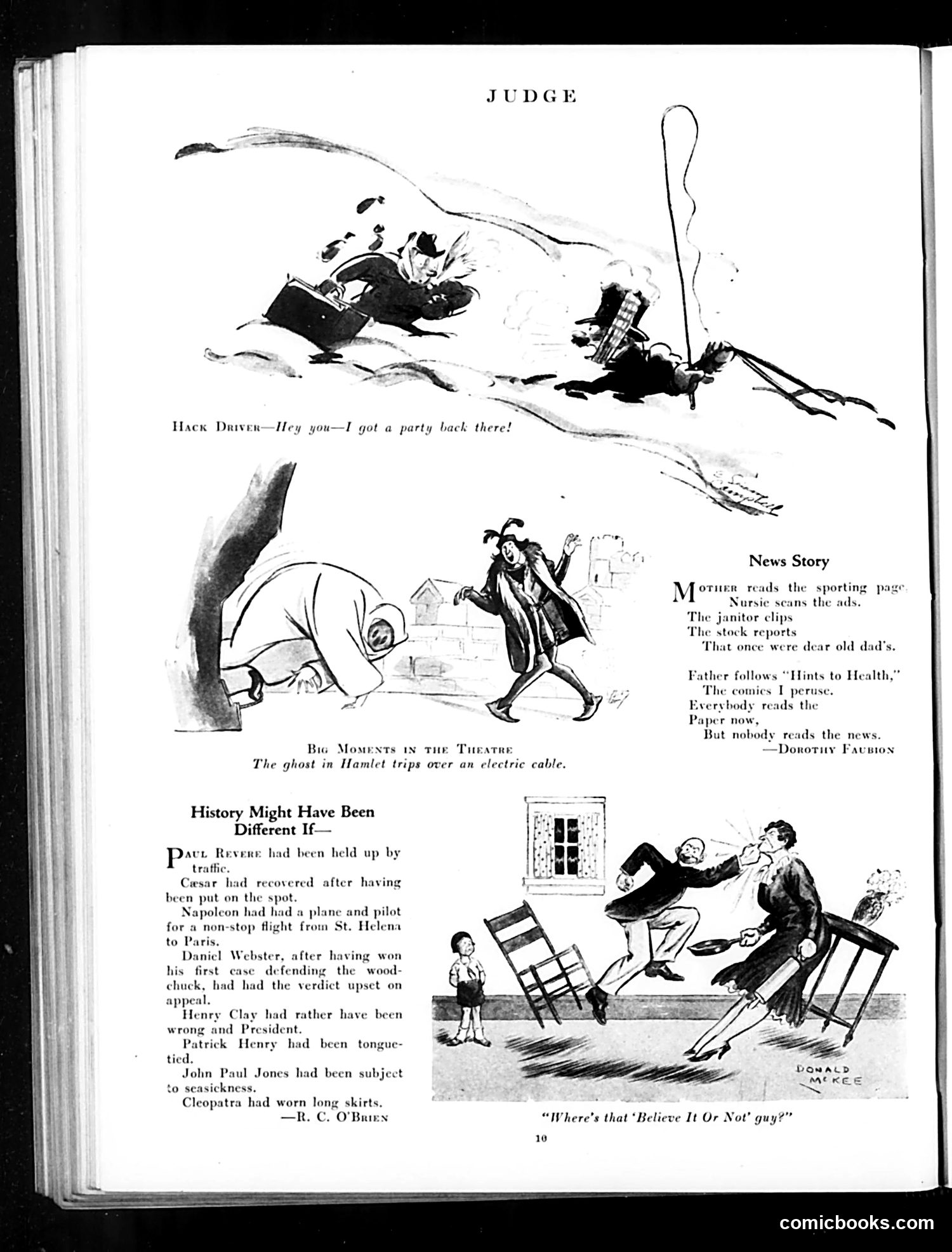
# Judge Magazine Page Analysis This page contains three distinct satirical pieces: **"News Story"** (poem by Dorothy Fabison): Mocks how modern newspaper readers selectively consume content—everyone reads sports, ads, comics, and financial sections, but deliberately avoids actual news. This reflects early 20th-century cynicism about public disinterest in substantive journalism. **"Big Moments in the Theatre"**: A single-panel joke about Hamlet's ghost tripping over an electric cable—anachronistic humor contrasting Shakespeare's supernatural drama with modern electrical technology. **"History Might Have Been Different If"**: A humorous counterfactual list suggesting absurd alternate histories (Paul Revere delayed by traffic, Napoleon with an airplane, etc.). The final entry appears to reference a contemporary phenomenon or person ("Believe It Or Not guy"), likely alluding to Robert Ripley's famous odditorium column popular in that era. The cartoons criticize media consumption habits and use theatrical/historical references for comedic effect typical of Judge's satirical approach.