
Judge, 1930-12-06 · page 18 of 36
Judge — December 6, 1930 — page 18: what you’re looking at
A restored page from Judge, 1930-12-06. Page through the whole issue in the reader above.
📄 Transcribed text from this page (OCR, searchable)
Machine-transcribed from the original scan — historical spelling and the odd misread are preserved.
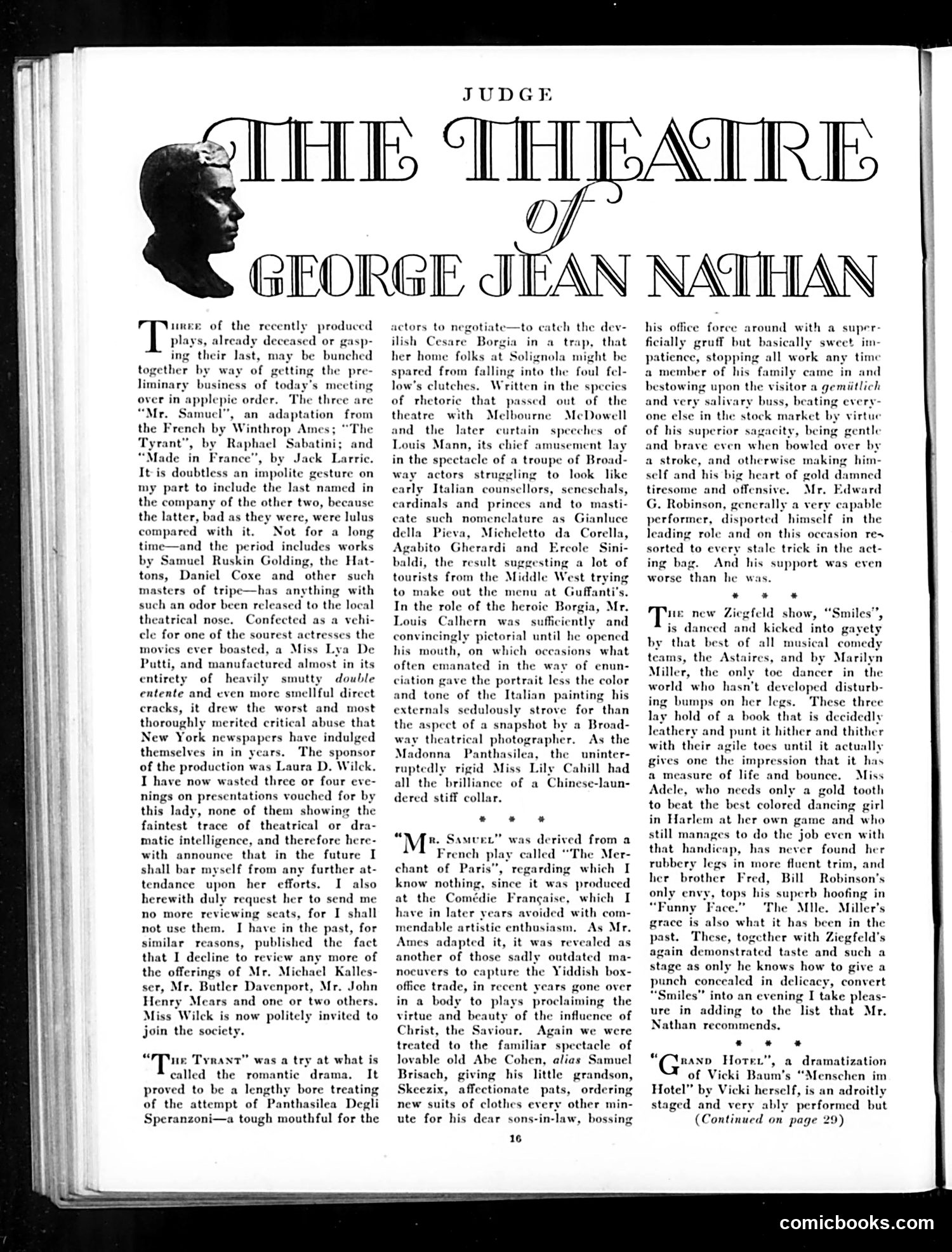
JUDGE cTHE THEATRE GEORGE A NATHAN unre of the recently produced ed or gasp- ing their last, may be bunched ther by way of getting the pre- ary business of today’s meeting over in applepie order. The three are “Mr. Samuel”, an adaptation from the French by Winthrop Ames; “The Tyrant”, by Raphael Sabatini; and “Made in France”, by Jack Larric. It is doubtless an impolite gesture on my part to include the last named in the company of the other two, because the latter, bad as they were, were lulus ared with Not for a long and the period includes works by Samuel Ruskin Golding, the Hat- tons, Daniel Coxe and other such masters of tripe—has anything with such an odor been released to the local theatrical nose. Confected as a vehi- cle for one of the sourest actresses the movies ever boasted, a Miss Lya De Putti, and manufactured almost in its entirety of heavily smutty double entente and even more smellful direct cracks, it drew the worst and most thoroughly merited critical abuse that New York newspapers have indulged themselves in in years. The sponsor of the production was Laura D. Wilck. I have now wasted three or four eve- nings on presentations vouched for by this lady, none of them showing the faintest trace of theatrical or drs matic intelligence, and therefore here- with announce that in the future I shall bar myself from any further at- tendance upon her efforts. I also herewith duly request her to send me no more reviewing seats, for I shall not use them. I have in the past, for similar reasons, published the fact that I decline to review any more of the offerings of Mr. Michael Kalles- ser, Mr. Butler Davenport, Mr. John Henry Mears and one or two others. Miss Wilck is now politely invited to join the society. “Mur Tyrant” was a try at what is called the romantic drama, It proved to be a lengthy bore treating of the attempt of Panthasilea Degli Speranzoni—a tough mouthful for the actors to negotiate—to catch the dev- ilish Cesare Borgia in a trap, that her home folks at Solignola might be spared from falling into the foul fel- low's clutches. Written in the species of rhetoric that passed out of the theatre with Melbourne MeDowell and the later curtain speeches Louis Mann, its chief amusement in the spectacle of a troupe of Bro: way actors struggling to look like carly Italian counsellors, seneschals, cardinals and princes and to masti- cate such nomenclature as G della Pieva, Micheletto da Corella, y, ito Gherardi and Ercole Sini- baldi, the result suggesting a lot of tourists from the Middle West trying to make out the menu at Guffanti's. In the role of the heroic Borgia, Mr. Louis Calhern was sufficiently and convincingly pictorial until he opened his mouth, on which oceasions what often emanated in the way of enun- ciation gave the portrait less the color and tone of the Italian painting his externals sedulously strove for than the aspect of a snapshot by a Broad- way theatrical photographer. Ay the Madonna ninter- ruptedly. rigi hill had all the brilli: hinese-laun- dered stiff collar. nluce kr. Samvec” was derived from a M French play called “The Mer- chant of Paris”, regarding which I know nothing, since it was produced at the Comédie Fran which I have in later years avoided with com- mendable artistic enthusiasm, As Mr. Ames adapted it, it was revealed another of those sadly outdated ma- nocuvers to capture the Yiddish box- office trade, in recent years gone over in a body to plays proclaiming the virtue and beauty of the influence of Christ, the Saviour. Again we were treated to the familiar spectacle of lovable old Abe Cohen, alias Samuel affectionate pats, ordering new suits of clothes every other min- ute for his dear sons-in-law, bossing 16 his office force around with a super- ficially gruff but basically sweet im- patience, stopping all work any time a member of his family came i bestowing upon the visito! and very salivary buss, be one else in the stock market by virtue of his superior sagacity, being gentle and brave even when bowled over by a stroke, and otherwise maki self and his big heart of gold d tiresome and offensive. Mr. EF G. Robinson, generally a very performer, disported himself in the leading ro! and a gemiitlich ting every- and on this occasion res sorted to every stale trick in th t- ing bag. And his support was even worse than he was. TT new Ziegfeld show, “Smiles”, is danced and kicked into gayety by that best of all musical comedy teams, the Astaires, and by Marilyn Miller, the only toe dancer in the world who hasn't developed disturb- ing bumps on her legs. These three lay hold of a book that is decidedly and punt it hither and thither with their agile toes until it actualls gives one the impression that it has a measure of life and bounce. Miss Adele, who needs only a gold tooth to beat the best colored dancing girl in Harlem at her own game and who still manages to do the job even with that handicap, has never found her rubbery legs in more fluent trim, and her brother Fred, Bill Robinson's only envy, tops his superb hoofing in “Funny Face.” The Mlle. Miller's grace is also what it has been in the past. These, together with Ziegfeld’s again demonstrated taste and such a stage as only he knows how to give a punch concealed in delicacy, convert “Smiles” into an evening I take pleas- ure in adding to the list that Mr. Nathan recommends, * * « “( SRanD Hotei”, a dramatization of Vicki Baum’s “Menschen im Hotel” by Vicki herself, is an adroitly staged and very ably performed but (Continued on page 29) comicbooks.com