
Judge, 1930-12-06 · page 21 of 36
Judge — December 6, 1930 — page 21: what you’re looking at
A restored page from Judge, 1930-12-06. Page through the whole issue in the reader above.
📄 Transcribed text from this page (OCR, searchable)
Machine-transcribed from the original scan — historical spelling and the odd misread are preserved.
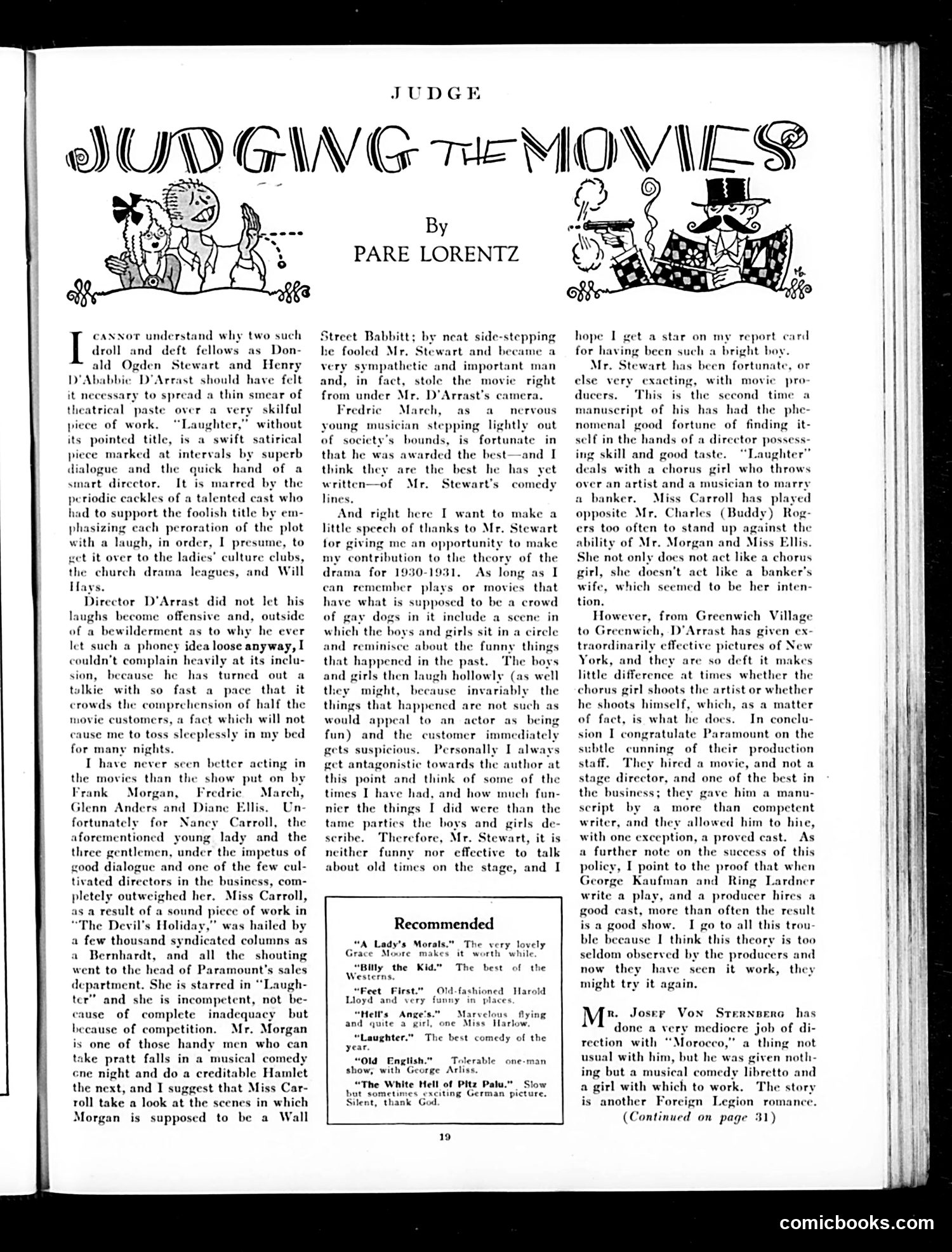
JUDGE ¢ IUDGWG T=MOVILES CANNov understand why two such droll and deft fellows as Don- ald Ogden Ste and Henry D'Ababbie D'Arrast should hi felt it necessary to spread a thin smear of theatrical paste over a very skilful piece of work. “Laughter,” without its pointed title, is a swift satirical piece marked at intervals by superb dialogue and the quick hand of a smart director. It is marred by the periodic cackles of a talented cast who had to support the foolish title by em- phasizing each peroration of the plot ha laugh, in order, I presume, to get it over to the ladies’ culture clubs, the church drama | es, and Will Hays. Director D'Arrast did not let his laughs become offensive and, outside of a bewilderment as to why he ever let such a phoney idea loose anyway, I couldn't complain heavily at its inclu- sion, because he has turned out a tulkie with so fast a pace that it crowds the comprehension of half the movie customers, a fact which will not cause me to toss sleeplessly in my bed for many nights. I have never seen better acting in the movies than the show put on by Frank Morgan, Fredric March, Glenn Anders and Diane Ellis. Un- fortunately for Nancy Carroll, the aforementioned young lady and the three gentlemen, under the impetus of good dialogue and one of the few cul- tivated directors in the business, com- pletely outweighed her. Miss Carroll, as a result of a sound piece of work in “The Devil's Holiday,” was hailed by a few thousand syndicated columns as a Bernhardt, and all the shouting went to the head of Paramount's sales department. She is starred in “Laugh- ter” and she is incompetent, not be- cause of complete inadequacy but because of competition. Mr. Morgan is one of those handy men who can take pratt falls in a musical comedy cne night and do a creditable Hamlet the next, and I suggest that Miss Car- roll take a look at the scenes in which Morgan is supposed to be a Wall By PARE LORENTZ Street Babbitt; by neat side-stepping he fooled Mr. Stewart and became a very sympathetic and important man and, in fact, stole the movie right from under Mr. D'Arrast’s Fredric March, as nervous young 1 stepping lightly out of society's bounds, is fortunate in that he was awarded the best—and I think they are the best he has yet written—of Mr. Stewart's lines. And right here I want to make a little speech of thanks to Mr. Stewart ing me an opportunity to make my contribution to the theory of the drama for 1930-1931, As long as I can remember plays or movies that have what is supposed to be a crowd of gay dogs in it include a scene in which the boys and girls sit in a circle and reminisce about the funny things that happened in the past. The boys and girls then laugh hollow as well they might, because ably the things that happened are not such as would appeal to an fun) and the gets suspicious. mera, musi comedy invs tor as being immediate Personally I alway get antagonistic towards the author at this point and think of some of the times I have had, and how much fun- nicer the things I did were than the tame parties the boys and girls de- Therefore, Mr. Stewart, it is neither funny nor effective to talk about old times on the stage, and I Recommended “A Lady's Morals.” The very lovely Grace Moore makes it worth while Billy the Kid." Westerns. customer scribe. The best of the st.” very f Old-fashioned ny in places. Feet Harold Lloyd and “Hell's Ange’ Marvelous flying and quite a girl, one Miss Harlow, “Laughter.” year. “Old English.” Tolerable show, with George Arliss. “The White Mell of Pitz Palu.” Slow hut sometimes exciting German picture. Silent, thank God. The best comedy of the one-man hope I get a star on my report card for having been such a bright boy. Mr. $ art has been fortunate, or else very exacting, with movie pro ducer: This is the second time a manuscript of his has had the phe- nomenal good fortune of finding it- self in the hands of a director possess- ing skill and good te aughter” deals with a chorus girl who throws over an artist and a musician to marry a banker. Miss Carroll has_playe opposite Mr, Charles (Buddy ers too often to stand up ability of Mr. Morgan and Miss Ellis. She not only does not act like a chorus girl, she doesn’t act like a banker's wife, which seemed to be her inten- tion. However, from Greenwich Village to Greenwich, D'Arrast has given ex- traordinarily effective pictures of New York, and they are so deft it makes little difference at times whether the chorus girl shoots the artist or whether he shoots himself, which, matt of fact, is what he does. In conclu- sion I congratulate Paramount on the subtle cunning of their production staff. They hired a movie, and not a stage director, and one of the best in the business; they gave him a manu- script by a more than competent writer, illowed him to hire, -ption, a proved cast. As a further note on the success of this policy, I point to the proof that when orge Kaufman and Ring Lardner write a play, and a producer hires a good cast, more than often the result is a good show. I go to all this trou- ble because I think this theory is too seldom observed by the producers and now they have seen it work, they might try it again. M*. Joser Von Sterneerc has done a very mediocre job of di- rection with “Morocco,” a thing not usual with him, but he was given noth- ing but a musical comedy libretto and is another Foreign Le; (Continued on page 31) comicbooks.com