
A complete issue · 12 pages · 1924
Judge — November 29, 1924
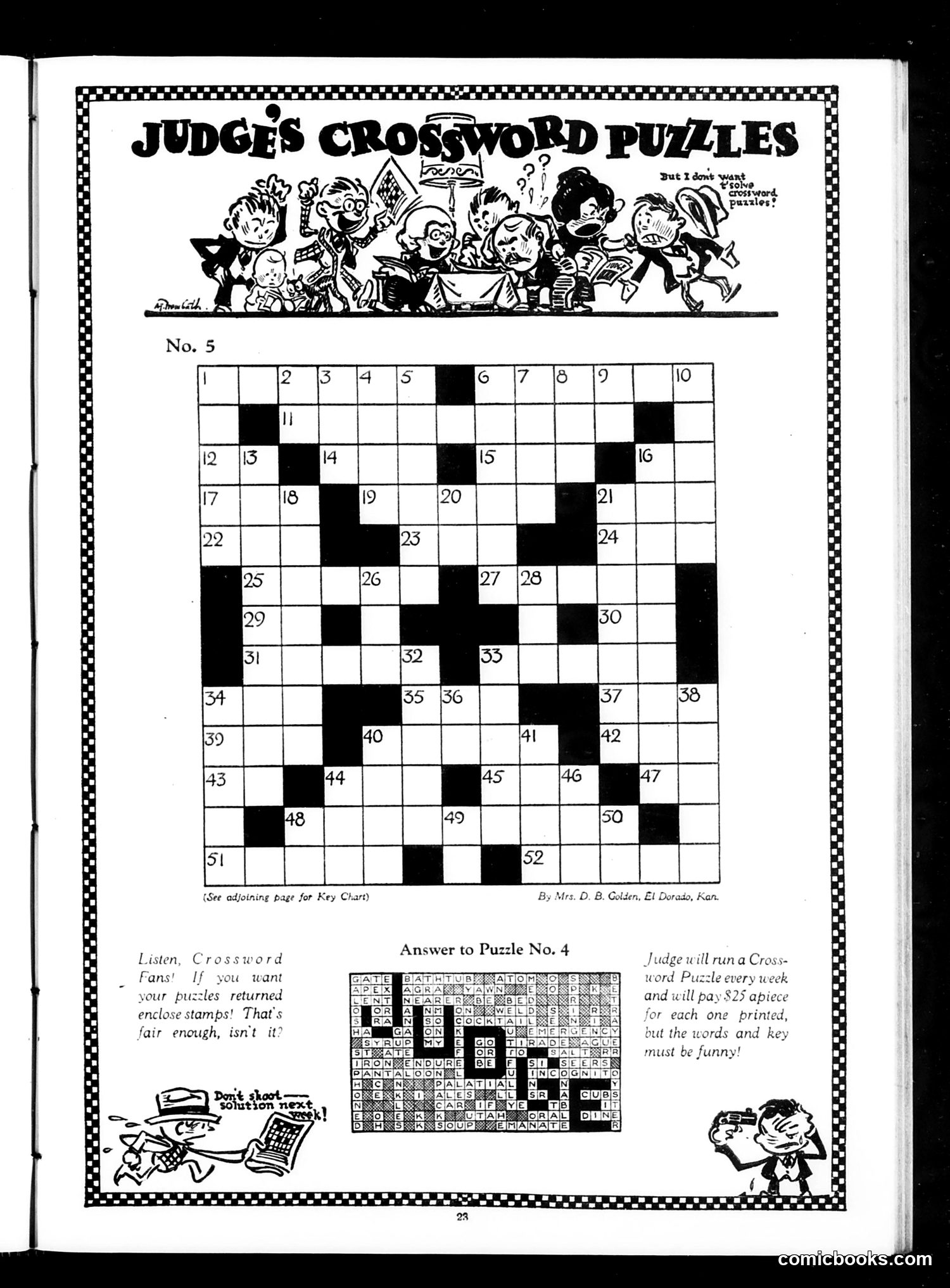
This page primarily contains a crossword puzzle (No. 5) by Mrs. D. B. Golden of El Dorado, Kansas, along with the answer key to the previous week's puzzle (No. 4). The header features cartoon characters in playful poses, typical of Judge magazine's mascot-style branding. The text below the puzzle is a standard editor's note encouraging readers to submit their own crossword puzzles, offering stamps as compensation. There's a small cartoon figure of a man with a newspaper and calculator marked "Solution next," which humorously suggests solving crosswords requires calculation. The content is primarily entertainment-focused rather than satirical or political—it's a leisure puzzle feature rather than commentary.
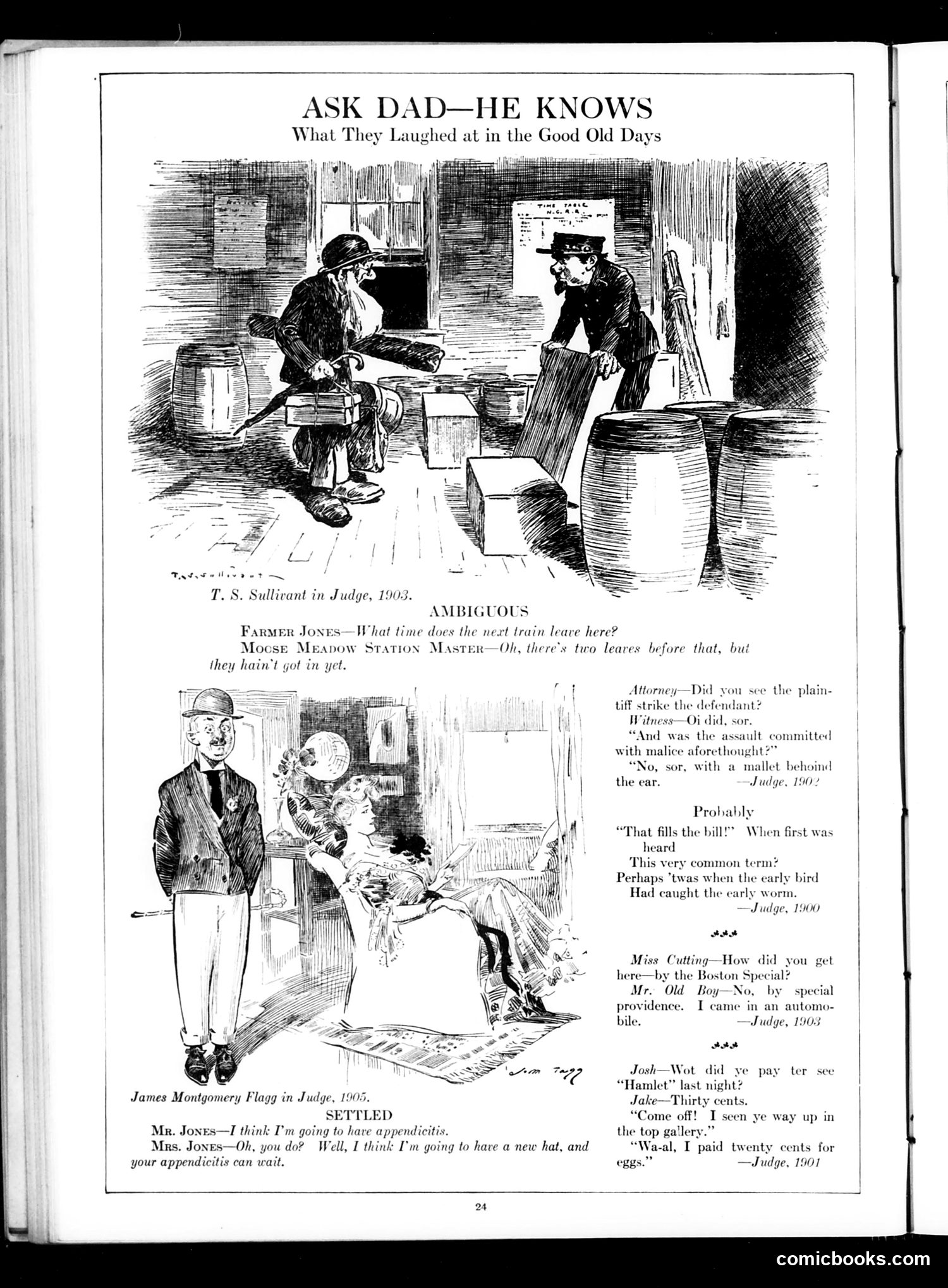
This page collects humorous anecdotes labeled "Ask Dad—He Knows," featuring vintage comic sketches from early 1900s Judge magazine. The top cartoon by T.S. Sullivant (1903) shows two men at a train station discussing departure times—a setup for wordplay about trains "leaving" (departing versus abandoning). The middle sketch by James Montgomery Flagg (1905) depicts a domestic dispute where Mr. Jones claims appendicitis while Mrs. Jones counters she's getting a new hat—satirizing marital conflict over household expenses and health complaints as excuses. Below are brief joke exchanges touching on familiar period themes: train schedules, courtroom testimony about violence, theatrical prices, and modest meal costs. These represent typical early-20th-century humor: wordplay, domestic squabbles, and class-based observations about American life.
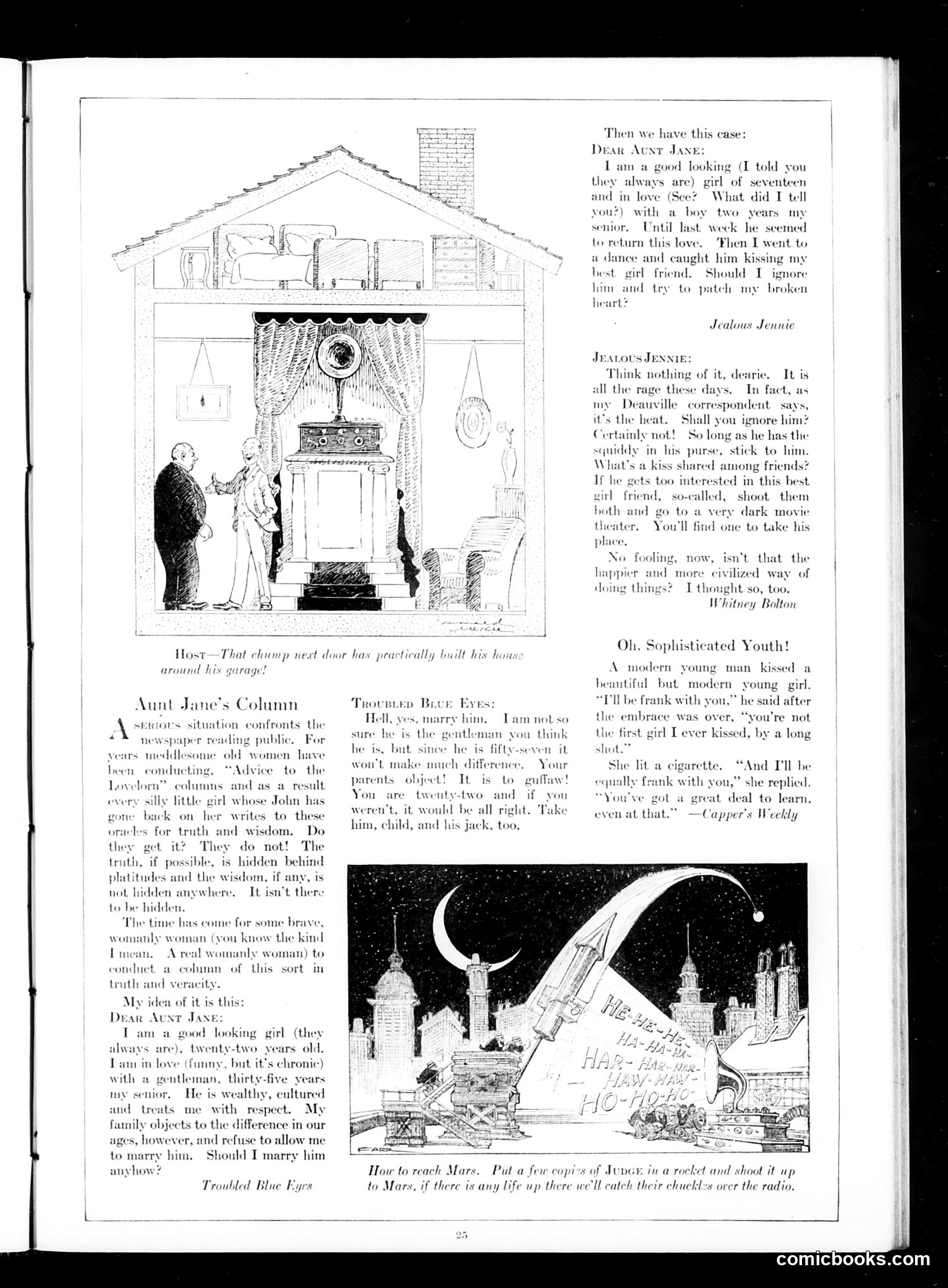
This page contains **Aunt Jane's advice column** addressing romantic dilemmas from young women. The illustrated cartoon at top shows a domestic interior, likely illustrating one of the letters. The main advice concerns a young woman torn between a wealthy, cultured older suitor and a poor but honest younger one. Aunt Jane and the columnists (including "Jealous Jennie" and "Whitney Bolton") counsel pragmatism—one suggests ignoring the younger man and focusing on financial security; another sardonically recommends the couple go to a "dark movie theater" to discourage excessive interest. The bottom illustration shows a humorous sci-fi scene of sending a Judge magazine to Mars via rocket, joking about spreading American popular culture. The page satirizes both romantic naivety among young women and early 20th-century materialism in courtship.
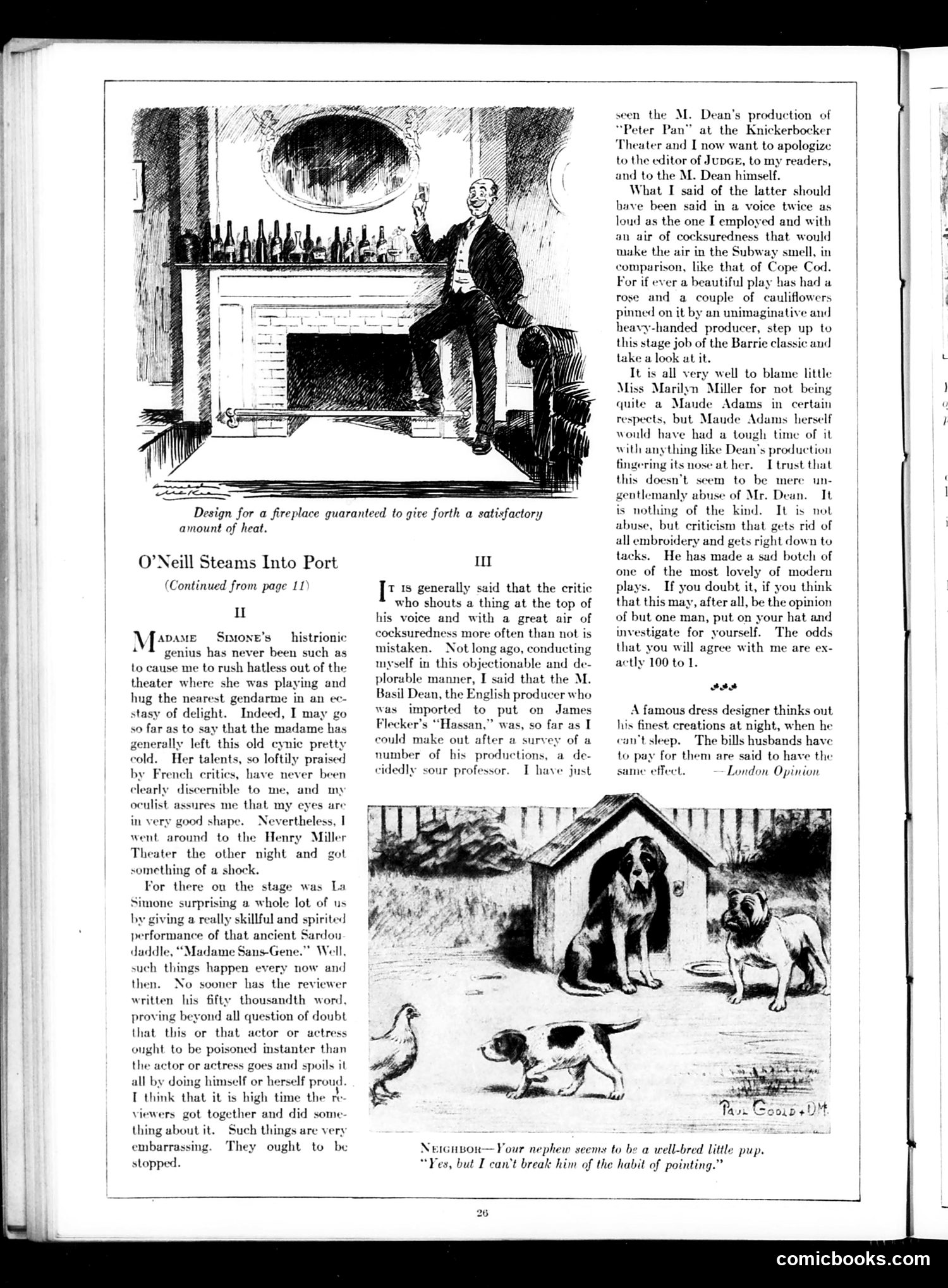
This page contains theatrical criticism rather than political satire. The main article critiques M. Dean's production of "Peter Pan" at the Knickerbocker Theater, with the author apologizing for earlier harsh comments about the staging and set design. The accompanying illustration shows a fireplace design meant to provide adequate heat—likely commenting on poor theater conditions. Below is an unrelated illustration by Paul Gosse depicting hunting dogs and a duck, with the caption about a neighbor's "well-bred little pup" that has developed a pointing habit. The content is primarily entertainment-focused cultural commentary typical of Judge magazine, rather than political satire. No specific political figures or events are referenced on this page.
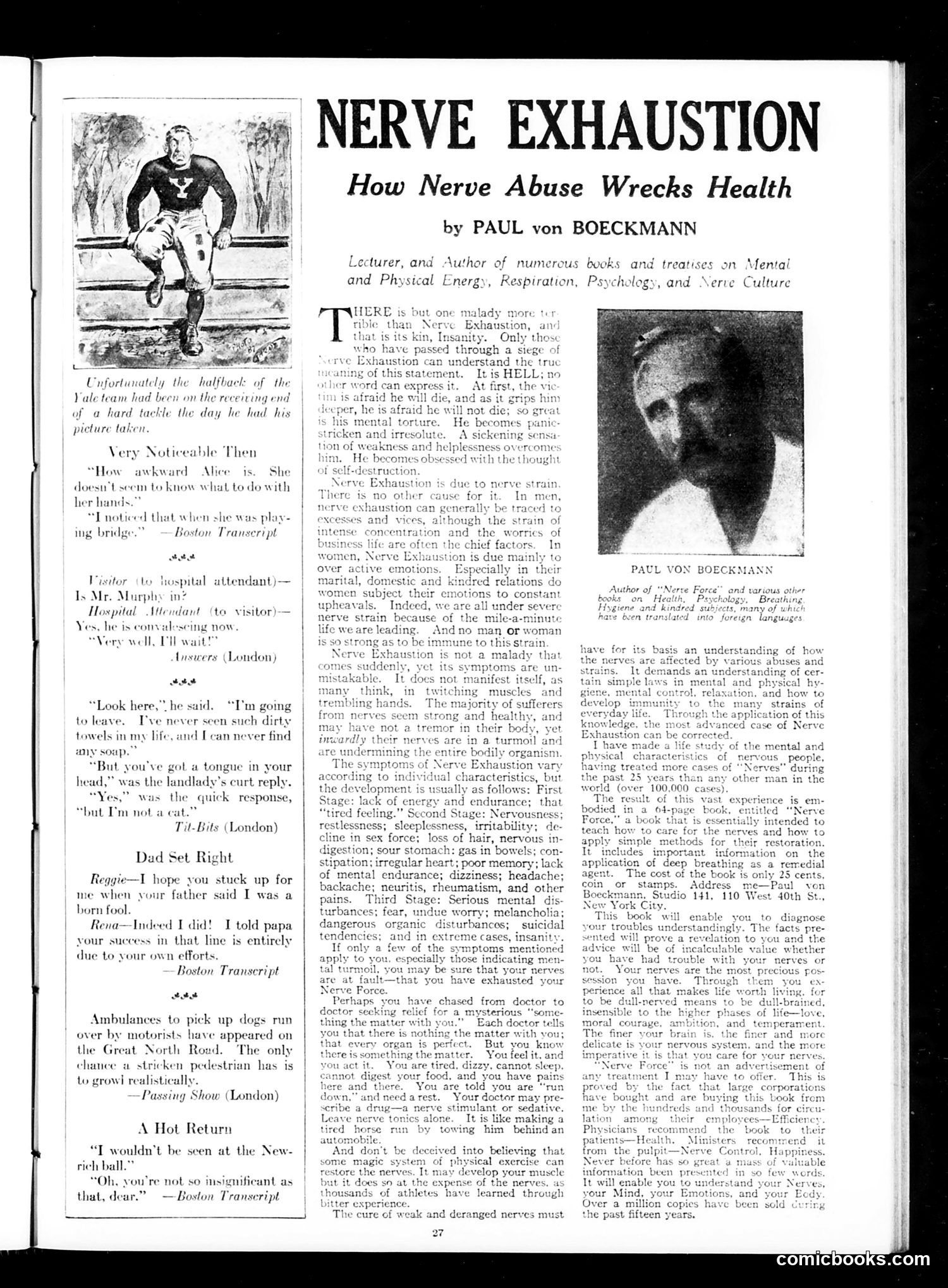
This page contains an article by Paul von Boeckmann about "Nerve Exhaustion"—a diagnosis common in early 20th-century medicine describing nervous collapse from overwork and stress. The accompanying illustration shows a man in athletic pose, likely contrasting physical vigor with mental/nervous depletion. The anecdotal quotes (from "Boston Transcript," "London," etc.) humorously illustrate how widespread this condition was perceived to be, affecting people from various walks of life. The satire suggests that "Nerve Exhaustion" was becoming a fashionable diagnosis—so prevalent that nearly everyone claimed to suffer from it. The article discusses symptoms (trembling hands, insomnia, anxiety) and treatment, reflecting period anxieties about modern life's mental toll. This represents contemporary skepticism about whether the condition was genuine medical illness or merely a trendy excuse for fatigue.
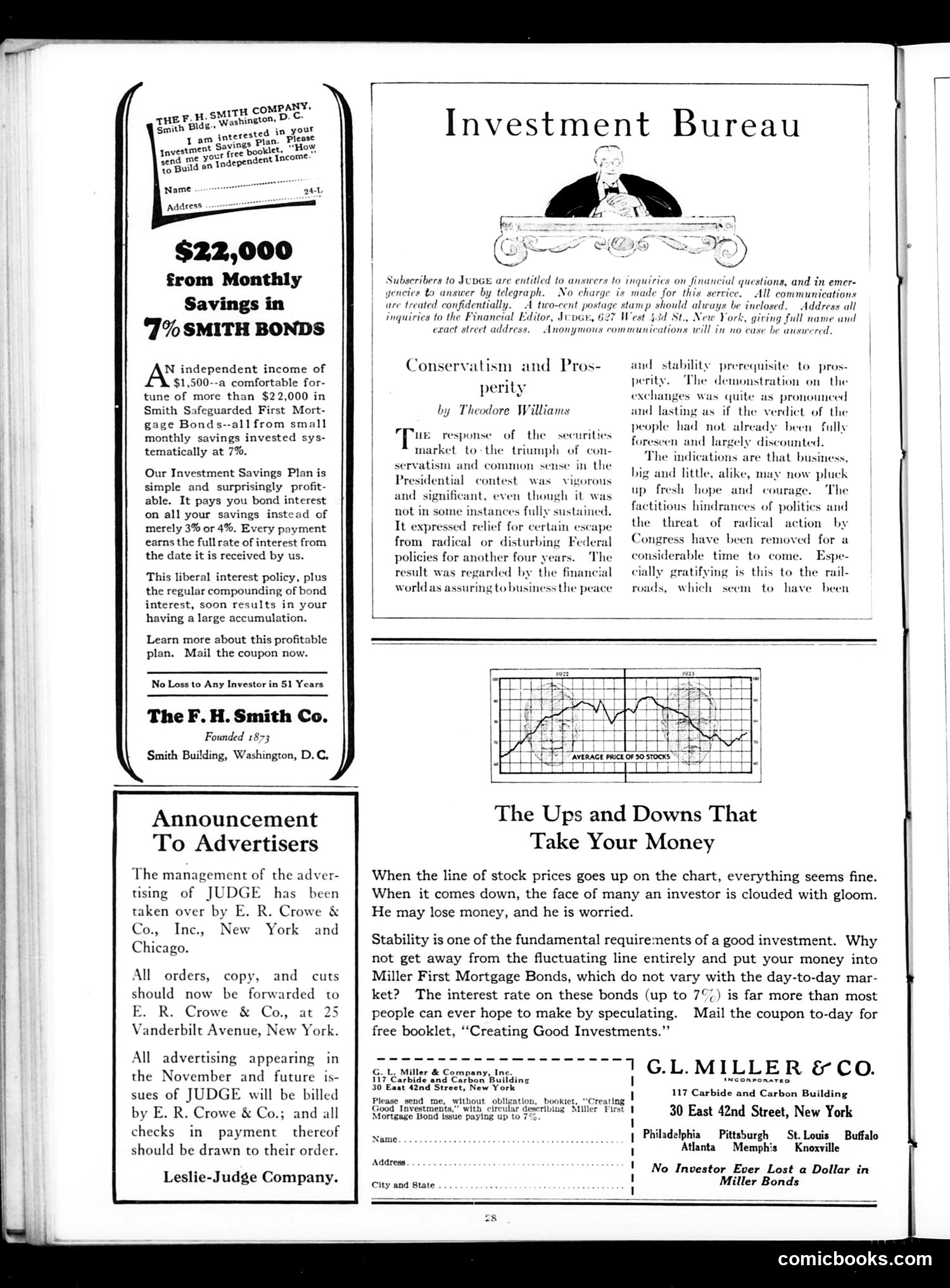
This page is primarily **advertising with one article**, not political satire. The "Investment Bureau" section features an article titled "Conservatism and Prosperity" by Theodore Williams, discussing the securities market's response to the recent Presidential election. The piece argues that business confidence has returned and radical political threats have been removed. Below sits a chart labeled "The Ups and Downs That Take Your Money," accompanied by text promoting Miller First Mortgage Bonds as a stable investment alternative to volatile stock speculation. The advertisements promote investment products: F.H. Smith Company bonds and G.L. Miller & Co. bonds—typical of the era's investment solicitations to middle-class readers. There is no political cartoon on this page; rather, the content reflects early 20th-century financial advertising and economic commentary.
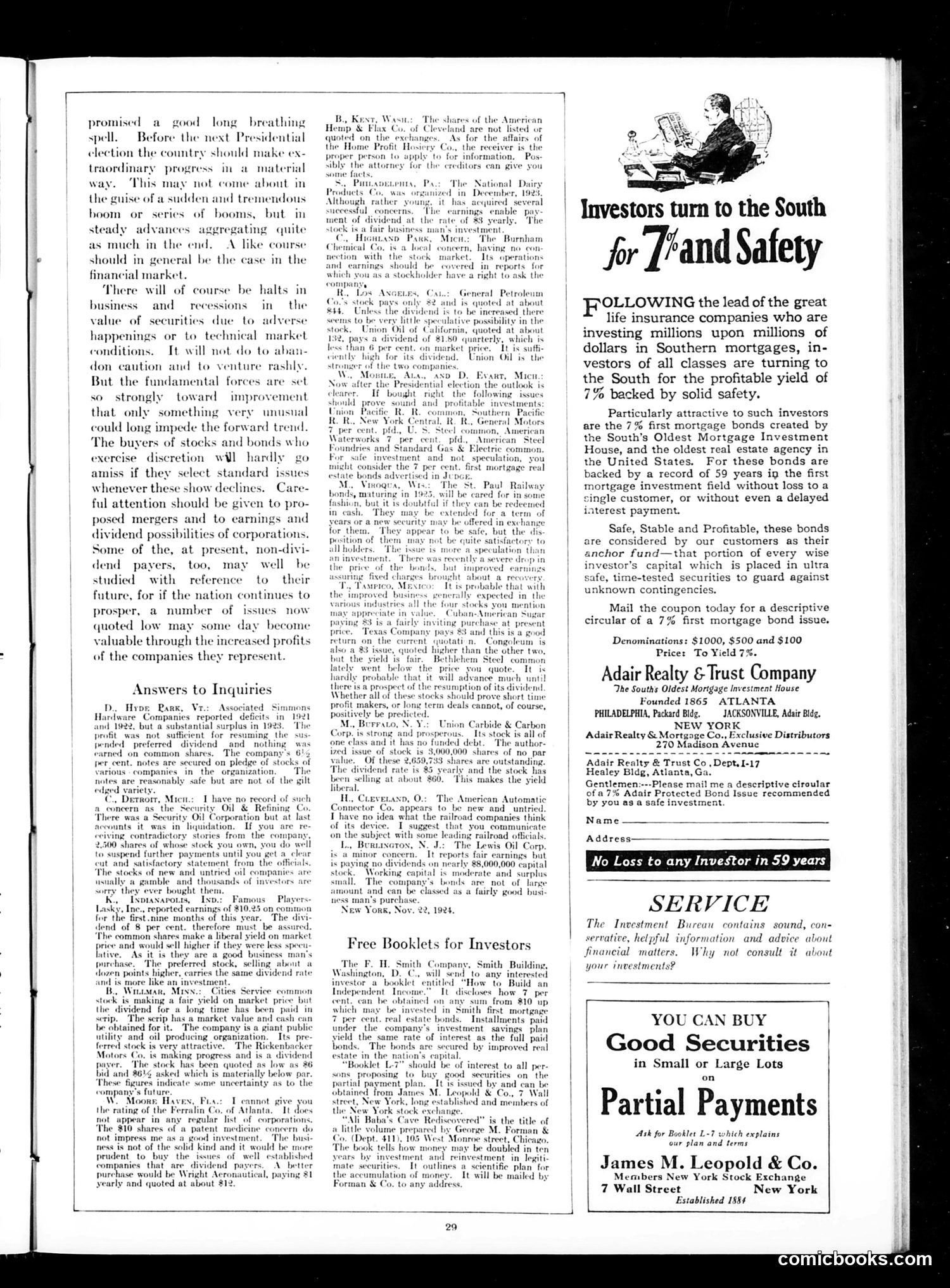
This page is primarily **financial advertising** rather than satirical content. The main illustration shows a businessman at a desk, accompanying an advertisement for Adair Realty & Trust Company's 7% mortgage bonds targeted at Southern real estate investors. The headline "Investors turn to the South for 7% and Safety" reflects the post-WWI economic period when Northern investors sought profitable ventures in the developing South. The ad emphasizes safety and guaranteed returns—standard investor reassurance language of the 1920s era. The right side contains investment advice columns and other financial service advertisements from James M. Leopold & Co. and F.H. Smith Company, typical of Judge's revenue model mixing satire with lucrative advertising. No political satire is evident on this page.
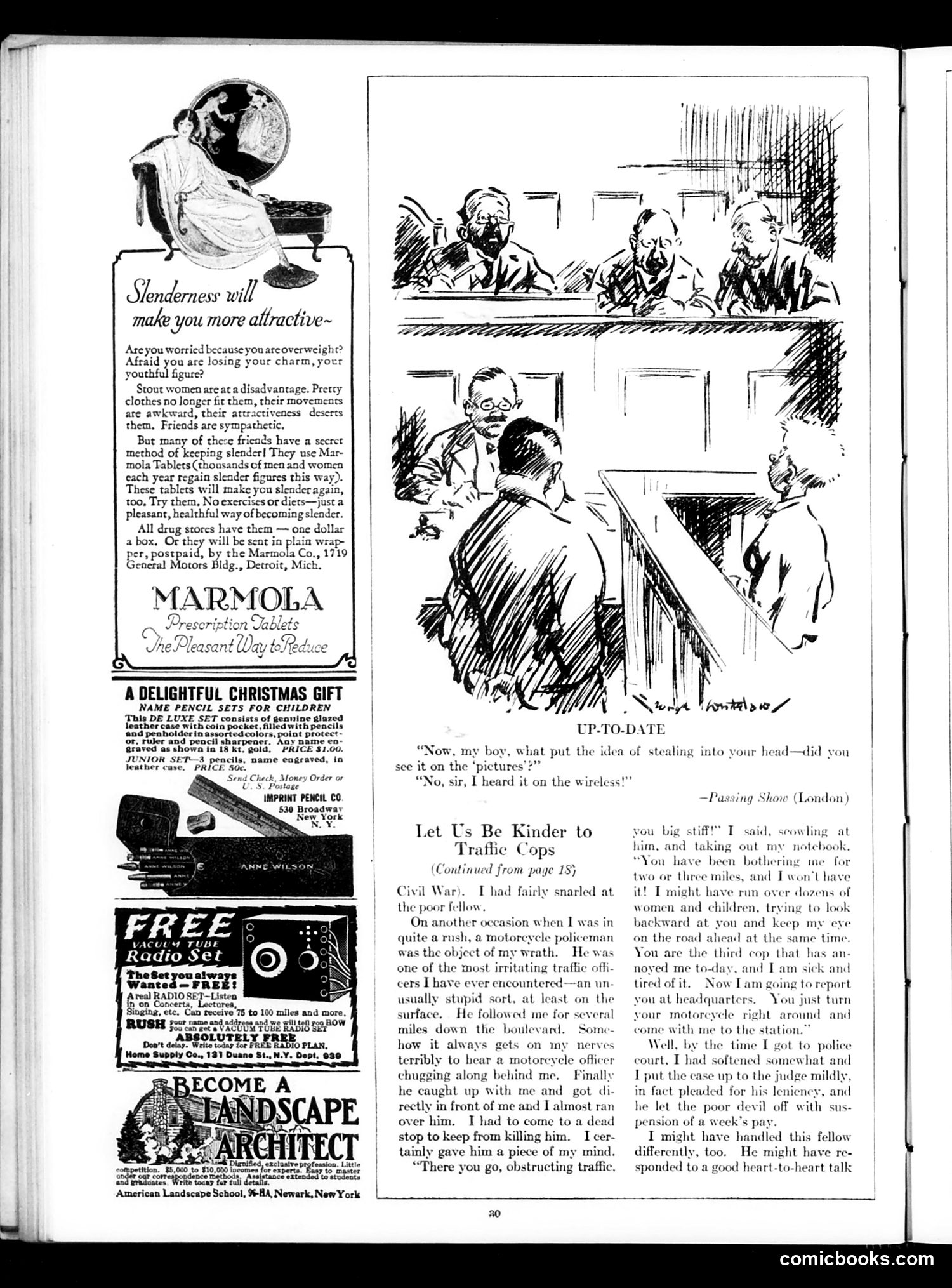
This page contains primarily **advertisements** rather than political cartoons requiring historical context. The main notable item is a brief **comic caption** (credited to *Passing Show*, London) depicting a child asked why he stole something. The joke's point: the child claims he heard about it "on the wireless" (radio) rather than from movies—a topical reference to early 1920s concerns about mass media influencing youth behavior. Radio was still relatively new technology, and this reflects anxieties about its social impact. The rest is commercial advertising: **Marmola tablets** (weight-loss pills marketed to women on conventional beauty standards), **pencil sets**, and **correspondence school promotions** (landscape architecture, radio repair). The article excerpt "Let Us Be Kinder to Traffic Cops" is a humorous personal essay about road rage, not political satire. The page reflects 1920s consumer culture and emerging media concerns rather than partisan politics.
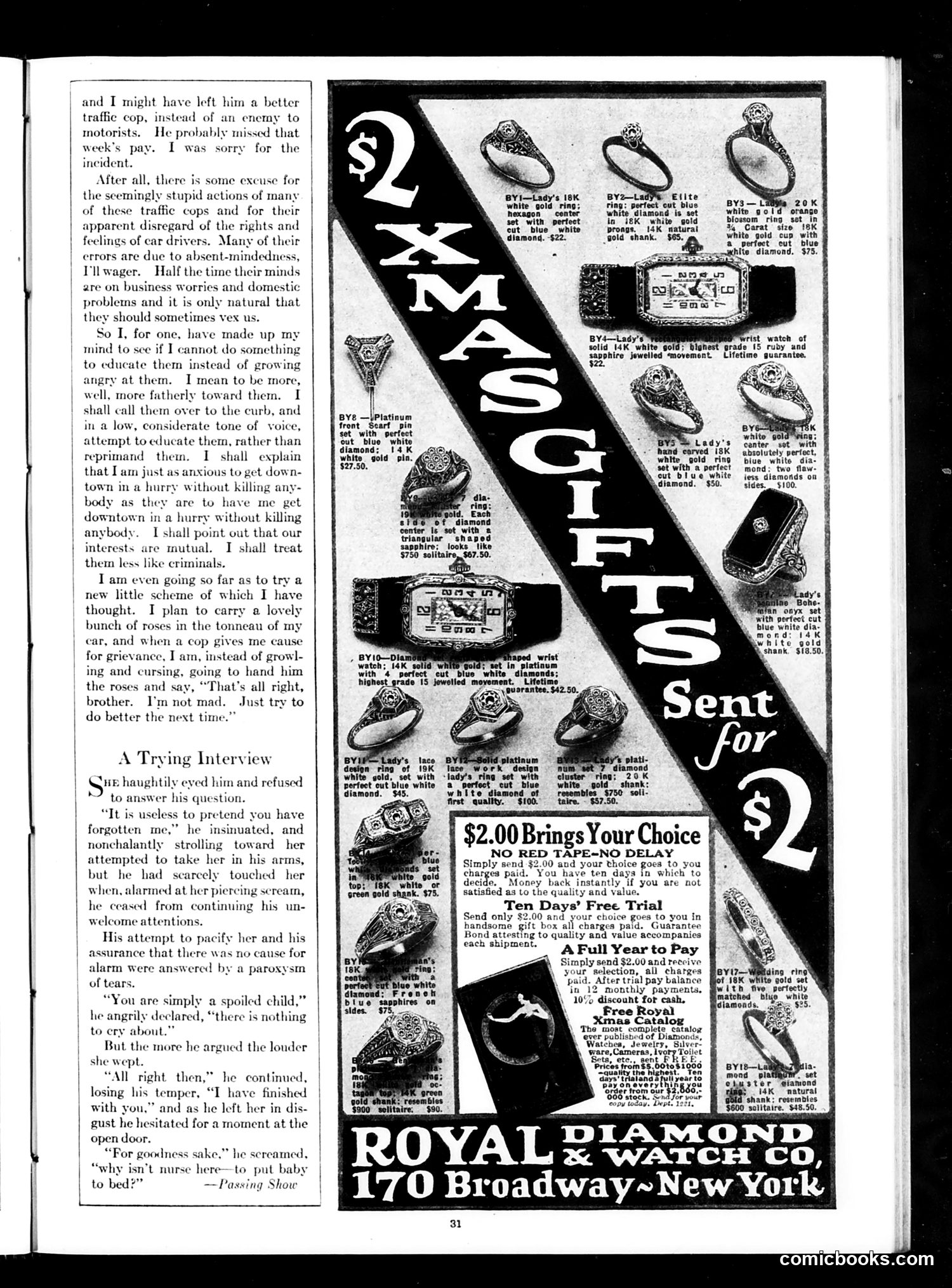
**Content Overview:** This page mixes editorial commentary with a substantial jewelry advertisement. The left column contains two distinct pieces: a traffic enforcement anecdote and a short satirical story titled "A Trying Interview." **The Satire:** The main satirical content appears to be "A Trying Interview"—a brief domestic scene mocking male entitlement and emotional manipulation. A man attempts unwanted physical contact with a woman, who rejects him with distress. When she cries, he dismissively calls her a "spoiled child," then exits—only to ask why the nurse isn't present to put "baby" to bed. The satire targets his hypocrisy: he treats her as an adult to be controlled, yet infantilizes her emotionally, ending with absurdist irony about childcare. **Historical Context:** This reflects early-20th-century gender dynamics and Judge's satirical commentary on male behavior and relationship power imbalances. **Dominant Feature:** The Royal Diamond & Watch Company advertisement overwhelms the page with product photographs and sales terms, indicating this is primarily a commercial publication funding its editorial content through advertising.
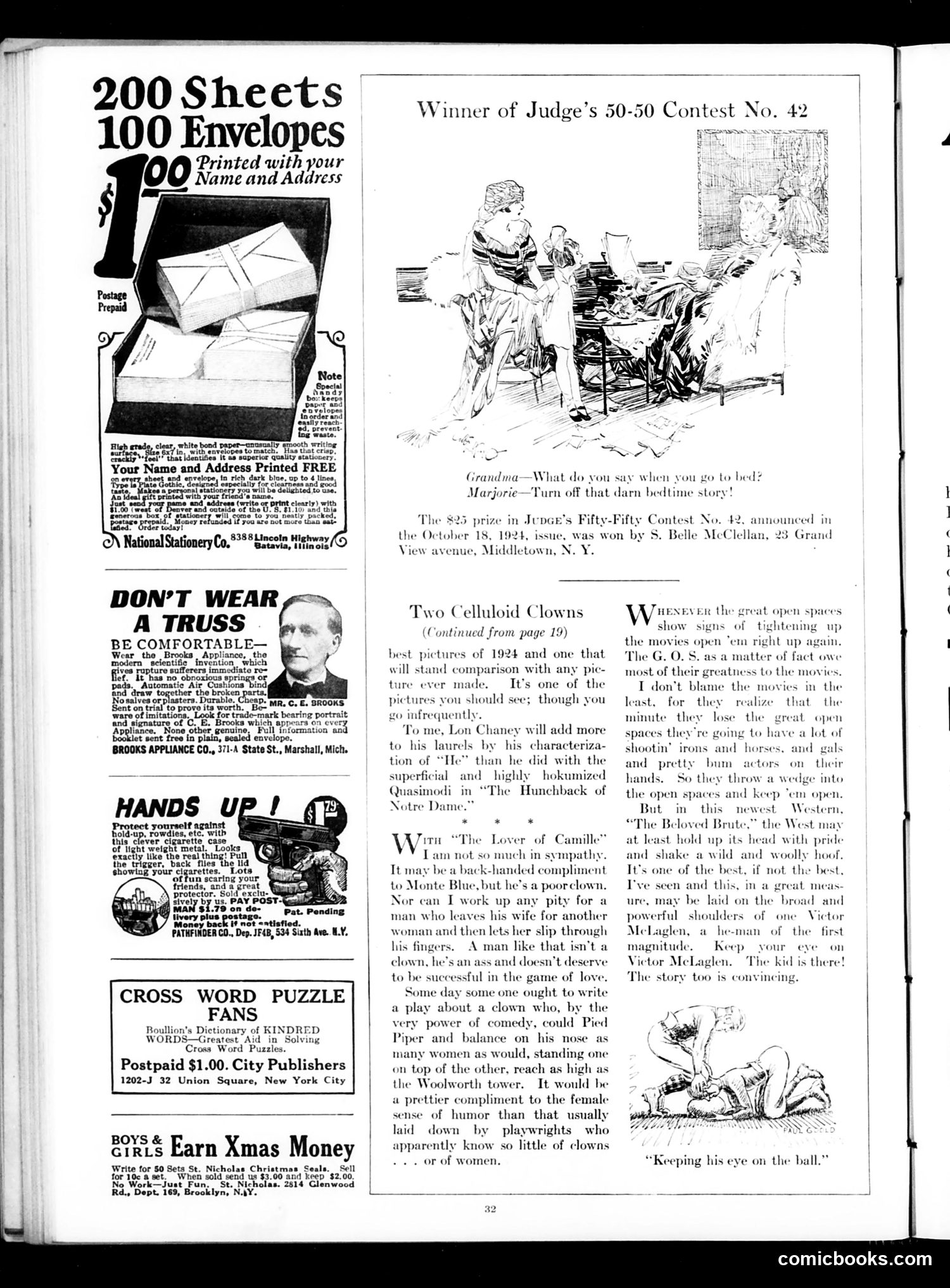
This page from Judge magazine (October 1924) is primarily **advertisements and filler content** with one substantial film review. **The Main Content:** A critic reviews recent 1924 films, discussing Lon Chaney's performance in "He" (favorably) versus his earlier "Hunchback of Notre Dame," and critiquing Monte Blue in "The Lover of Camille" as a "poor clown." The reviewer argues that comedians don't deserve success if they're morally bankrupt (abandoning wives). **The Western Film Section:** The critic defends Western movies against criticism that they're repetitive—acknowledging they rely on "shootin' irons and horses" and "pretty bum actors"—but praises "The Beloved Brute" as an exception that allows the West to "hold up its head." **The Humor:** A caption shows a grandmother and granddaughter, where the girl admits she tells her grandmother to "Turn off that darn bedtime story!"—a joke about modern children finding old-fashioned storytelling boring. The rest comprises period advertisements (stationery, medical devices, cigarette cases, crossword puzzle books).
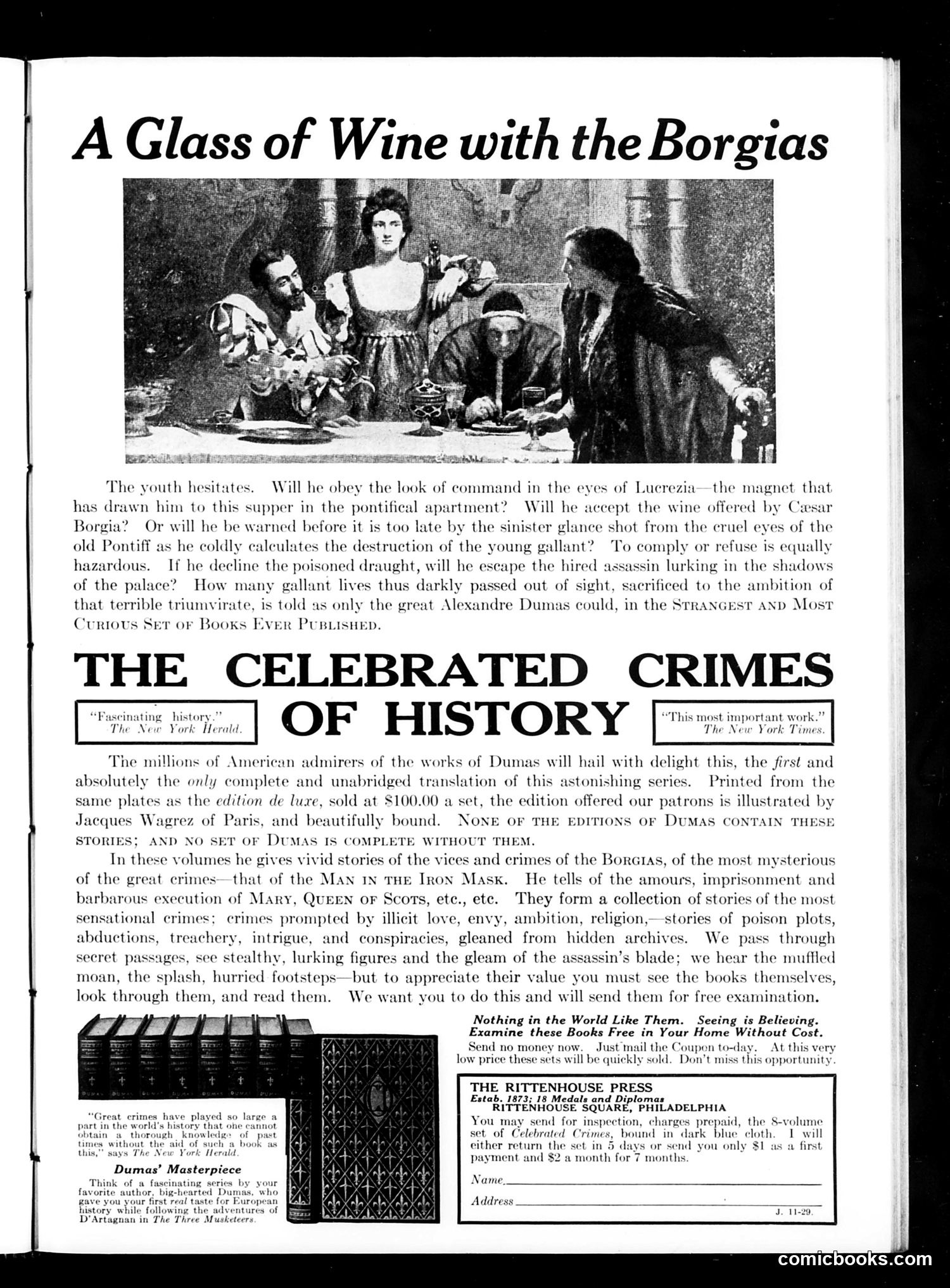
This is primarily an **advertisement**, not satire. The page promotes a book set: Alexandre Dumas's *Celebrated Crimes*, a historical account of notorious historical figures and events. The dramatic illustration and accompanying text describe a scene from the Borgia family (Renaissance Italy's notorious clan associated with poison, murder, and political intrigue). The narrative teases a suspenseful moment—a young man uncertain whether to drink poisoned wine offered by Cesare Borgia, while threatened by assassins. This serves the advertisement's purpose: to entice readers with lurid tales of historical crimes, conspiracy, poison plots, and executions involving figures like Mary Queen of Scots and the Man in the Iron Mask. The Rittenhouse Press offers this "first complete unabridged translation" at a low price with a mail-order coupon, promising free examination before purchase. The sales pitch emphasizes these stories as thrilling, sensational content unavailable elsewhere.
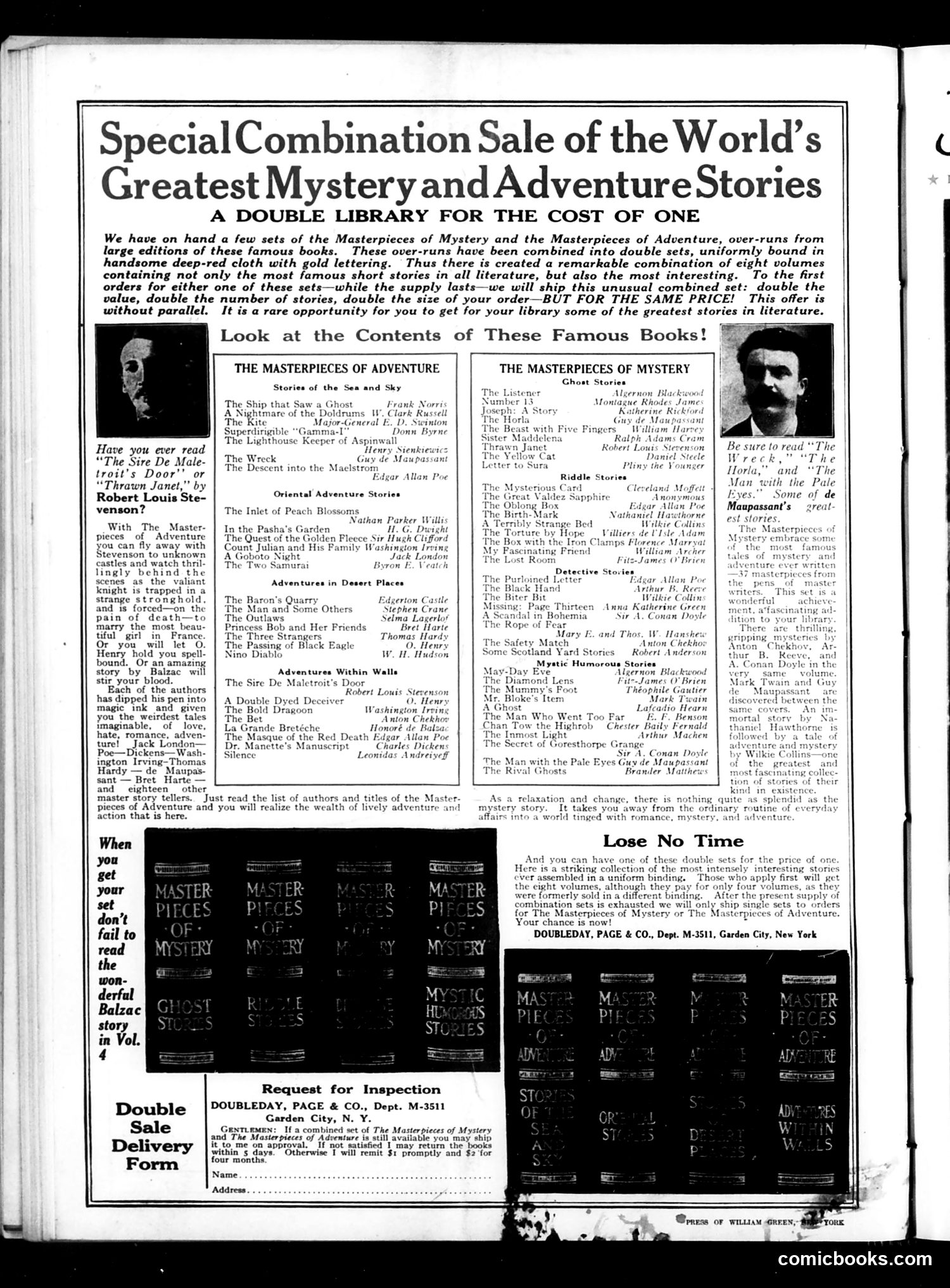
This is a **book publisher advertisement**, not a political cartoon. It appears on a page from *Judge* magazine promoting a special offer from Doubleday, Page & Co. The ad announces a "double library for the cost of one"—two complete sets of classic literature (*Masterpieces of Mystery* and *Masterpieces of Adventure*) combined into uniformly bound volumes and sold as a single package. The appeal is straightforward: readers get eight volumes of famous stories by celebrated authors (Stevenson, de Maupassant, O. Henry, Balzac, Jack London, Poe, Dickens, and others) at the price of ordering one set. The page lists story titles and authors to demonstrate the collection's value, emphasizing that readers can own works by "eighteen other master story tellers." The "Request for Inspection" form at bottom invites interested customers to examine the books before payment. This is essentially mass-marketing literature during an era when such bundled collections were a common way to build home libraries—no satire or political content is present.