
A complete issue · 16 pages · 1909
Judge — June 12, 1909
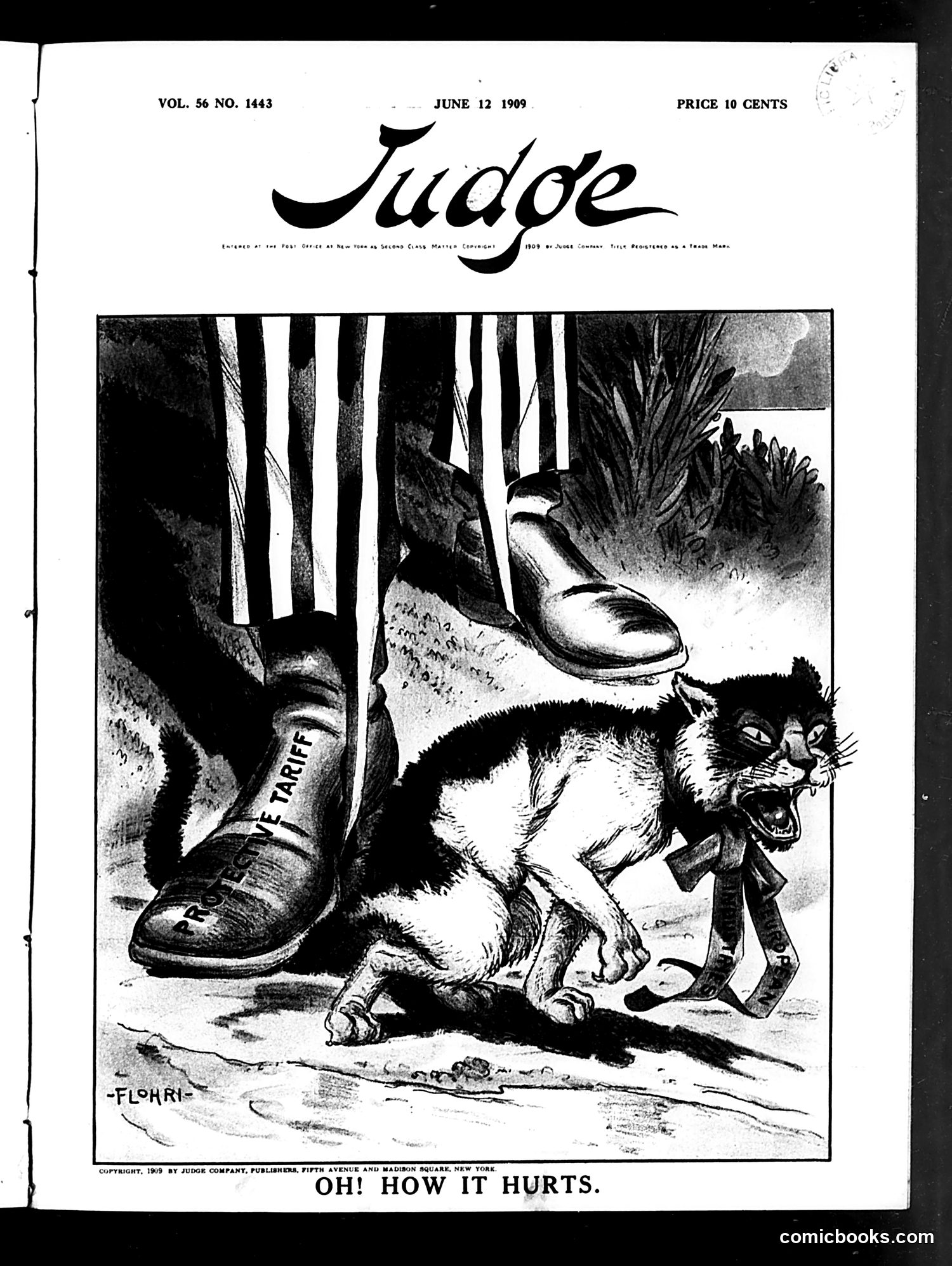
This cartoon depicts a small dog being stepped on or kicked by a person wearing striped pants labeled "TARIFF." The title "OH! HOW IT HURTS" conveys the dog's suffering. This is likely political satire about the tariff controversy of 1909. The dog probably represents American consumers or small businesses being harmed by tariff policies—the "foot" of protective tariffs crushing them. The striped pants suggest governmental authority or policy implementation. The artist (signed "FLOHR") uses the vulnerable dog as a sympathetic figure to critique how tariff legislation causes real economic pain to ordinary Americans, a common theme in early 20th-century progressive political cartoons.
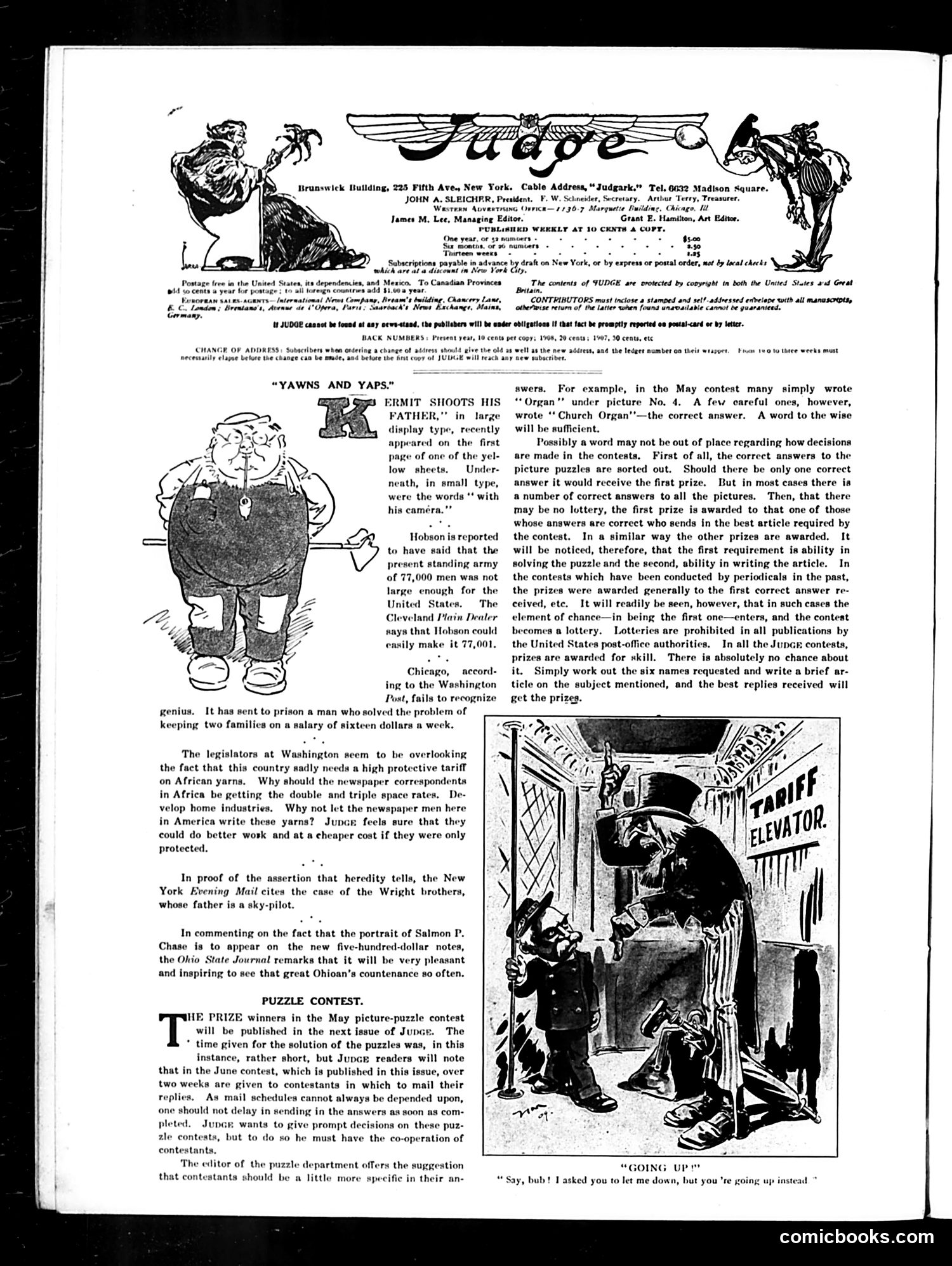
This cartoon satirizes wealth inequality and class dynamics in early 20th-century America. The image depicts an elevator operator (in uniform) speaking to a well-dressed gentleman, saying "Say, hub? I asked you to let me down, but you're going up instead." The joke plays on double meaning: the operator literally cannot lower the elevator, but the phrase also suggests the wealthy passenger is socially "going up" while the working-class operator remains stuck. The satirical point critiques how wealthy people ignore workers' requests or concerns—the operator's plea is dismissed because their social station doesn't matter to those above them. This reflects Judge magazine's typical commentary on labor relations and class stratification of the era.
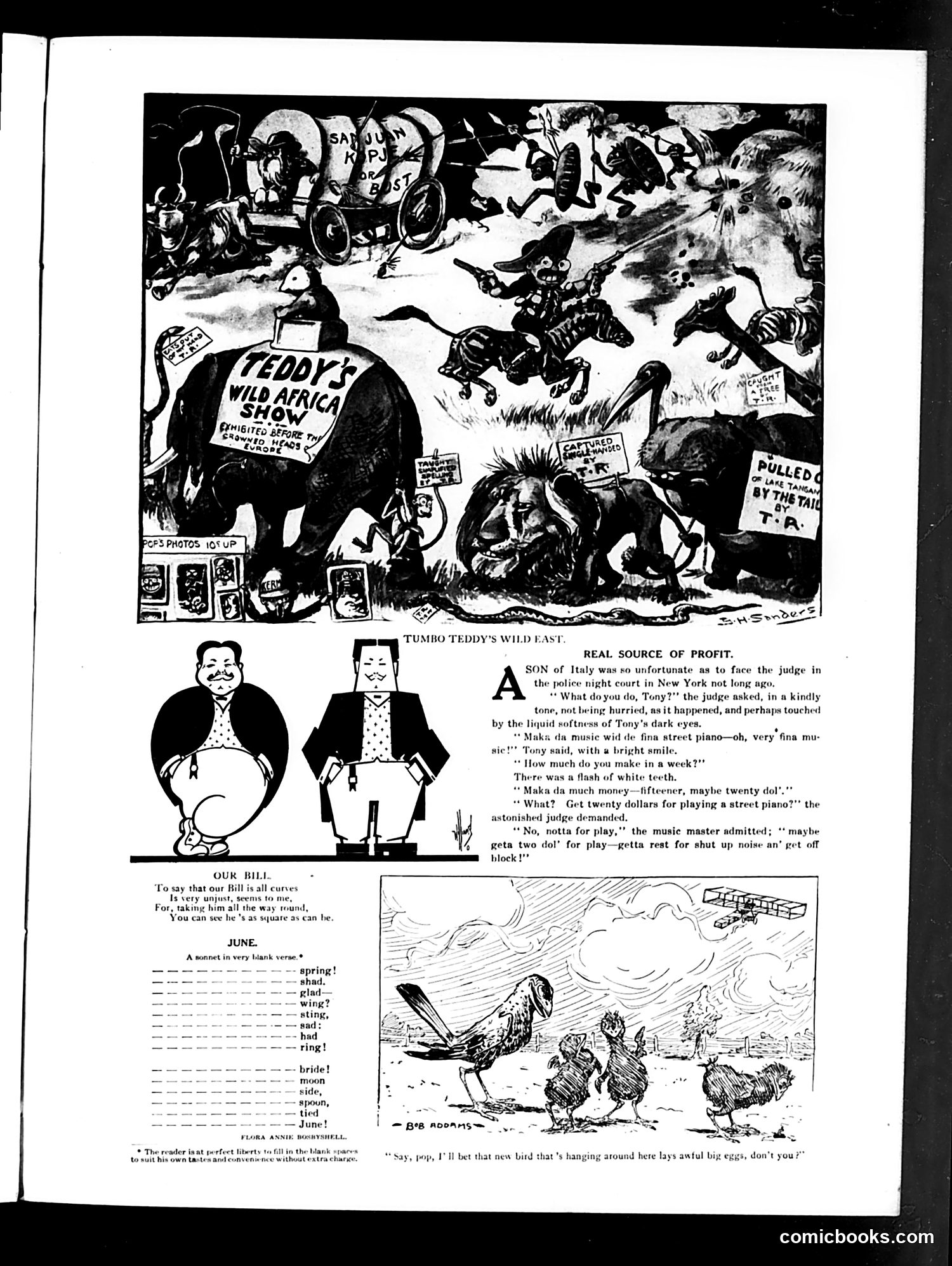
**Top Cartoon - "Tumbo Teddy's Wild East":** This appears to be satirizing Theodore Roosevelt's famous "Wild West" persona and showmanship. The cartoon depicts a circus-like "Wild Africa Show" with various animals and performers, suggesting Roosevelt's theatrical approach to hunting and adventure exhibitions. The title's play on "Wild West" mocks his carefully curated public image. **Middle Section - "Real Source of Profit":** A story about a street musician earning money playing piano. The judge questions how he profits, discovering he makes money from neighbors paying him to *stop* playing—satirizing terrible street musicians and the economics of noise pollution. **Bottom Cartoons:** Include a poetry section ("June") and what appears to be a nature or animal-related illustration unrelated to political commentary.
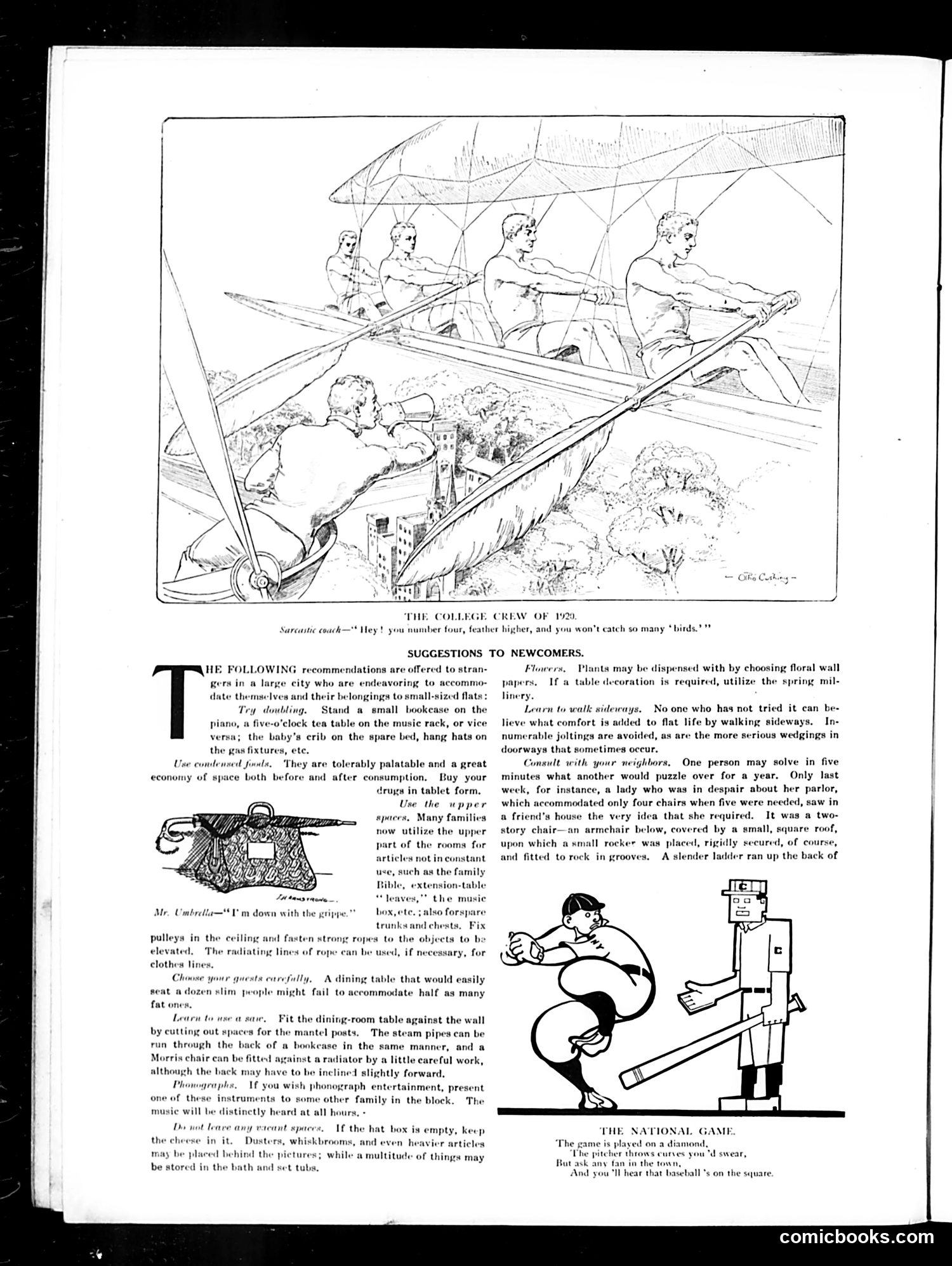
The top cartoon depicts "The College Crew of 1923," showing rowers in a boat with the captain's quote: "Hey! you number four, feather higher, and you won't catch so many 'birds.'" This is a straightforward sporting joke about college rowing. A "bird" in rowing slang refers to catching crabs (when an oar gets stuck), causing the boat to lurch. The humor lies in the captain's ironic suggestion that feathering (rotating) the oar higher will somehow prevent catching birds—when in fact poor technique causes them. The rest of the page offers domestic advice to apartment dwellers under "Suggestions to Newcomers," covering furniture, storage, and dining solutions. At bottom, "The National Game" presents brief baseball humor verses.
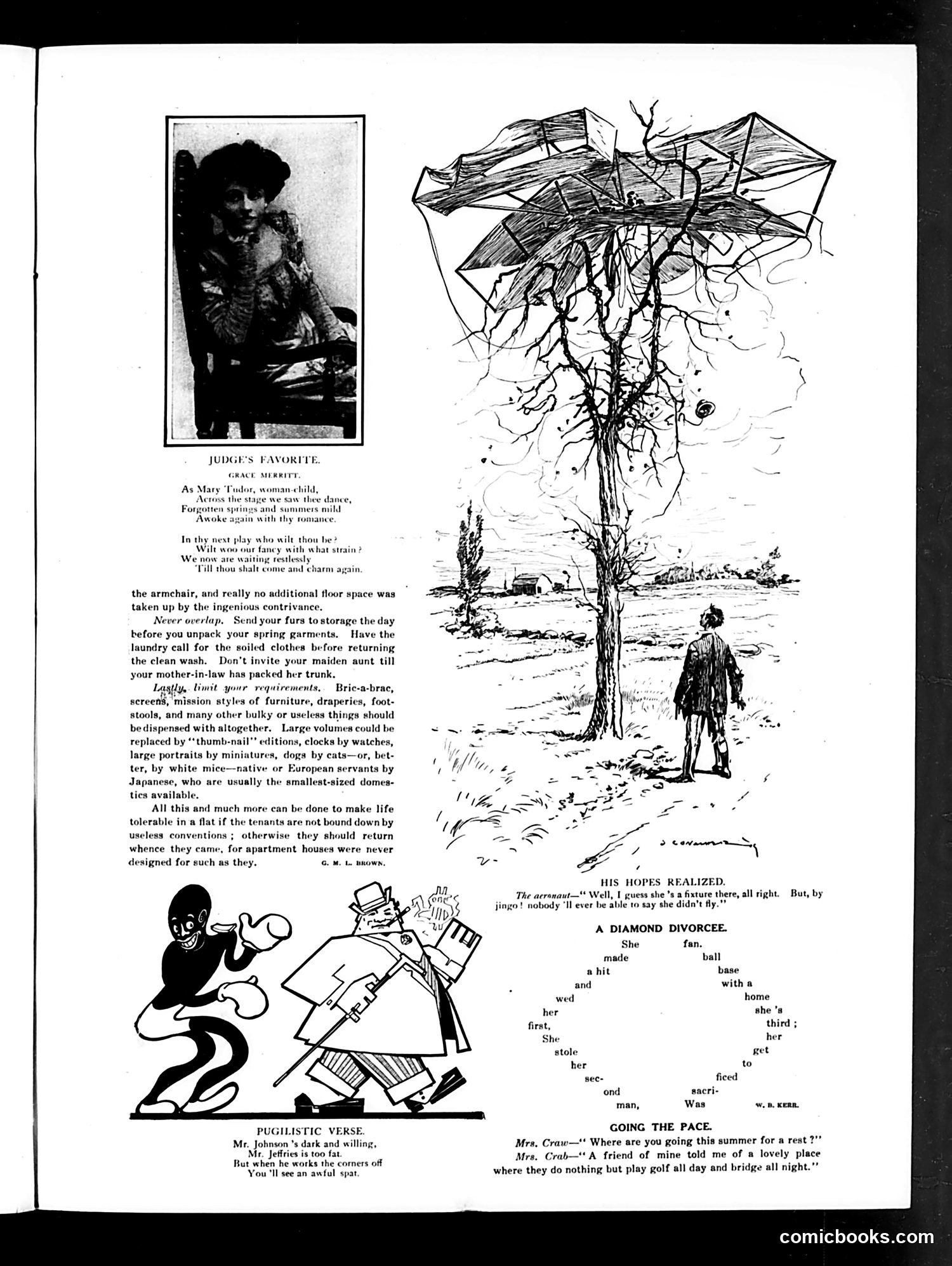
This page contains several distinct satirical pieces: **"Judge's Favorite"** features a portrait of Mary Tydon (likely a contemporary figure) with domestic advice about managing household storage and tenant relations—satirizing overly detailed homemaking guidance. **"His Hopes Realized"** depicts a man with a woman, using dialogue to mock romantic expectations and disappointment. **"A Diamond Divorce"** presents a visual poem about a woman who "made a hit," "stole her second man," and became "third" wife—satirizing serial divorce and women's marital instability among the wealthy. **"Pugilistic Verse"** mocks boxer Mr. Johnson with crude rhymes about his fighting style. **"Going the Pace"** features a brief conversational joke about leisure activities. The page reflects early 1900s Judge magazine's blend of domestic humor, social commentary on marriage and class, and sports satire.
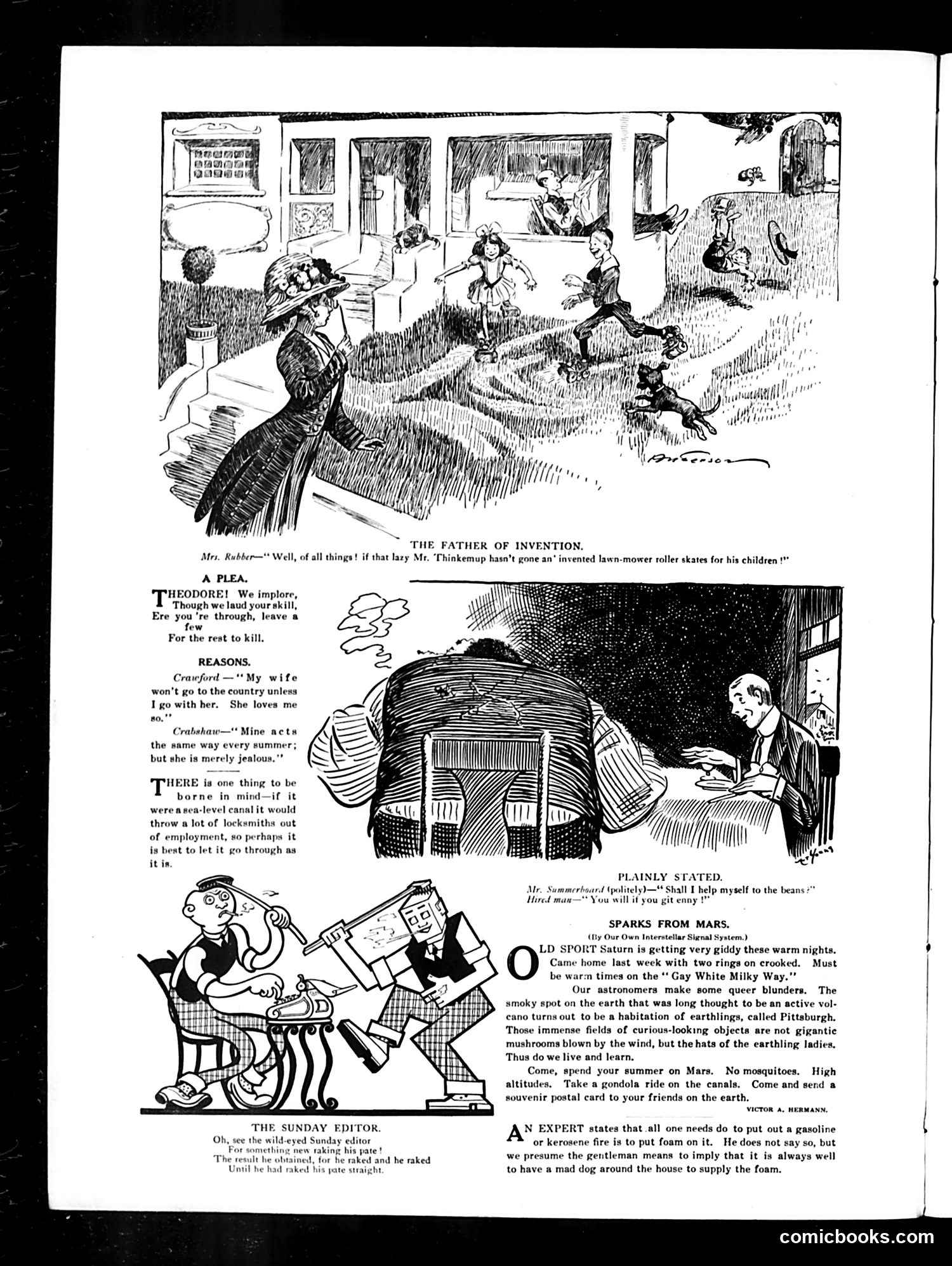
**"The Father of Invention"** mocks Mr. Thinkemup for inventing frivolous gadgets (lawn-mower roller skates for children), suggesting endless minor inventions waste resources while missing truly useful innovations. **"A Plea"** and **"Reasons"** humorously contrast marital dynamics: Crawford's wife demands his company out of love; Crabshaw's wife acts similarly but from jealousy—the satire suggests wives' motivations differ despite identical behavior. **"Sparks from Mars"** offers whimsical astronomical commentary, notably mocking Pittsburgh as a "habitation" mistaken for volcanic activity, and ridiculing women's large hats as observable from space. This reflects contemporary anxieties about industrialization and women's fashion. **"Plainly Stated"** shows class dynamics: a hired man refuses a guest's polite offer to self-serve beans, implying the guest can only eat if he helps himself—a sarcastic rebuke to presumed entitlement. The **Sunday Editor** joke references foam as fire suppression and absurdly suggests using a "mad dog" to supply it—nonsensical humor typical of period comedy.
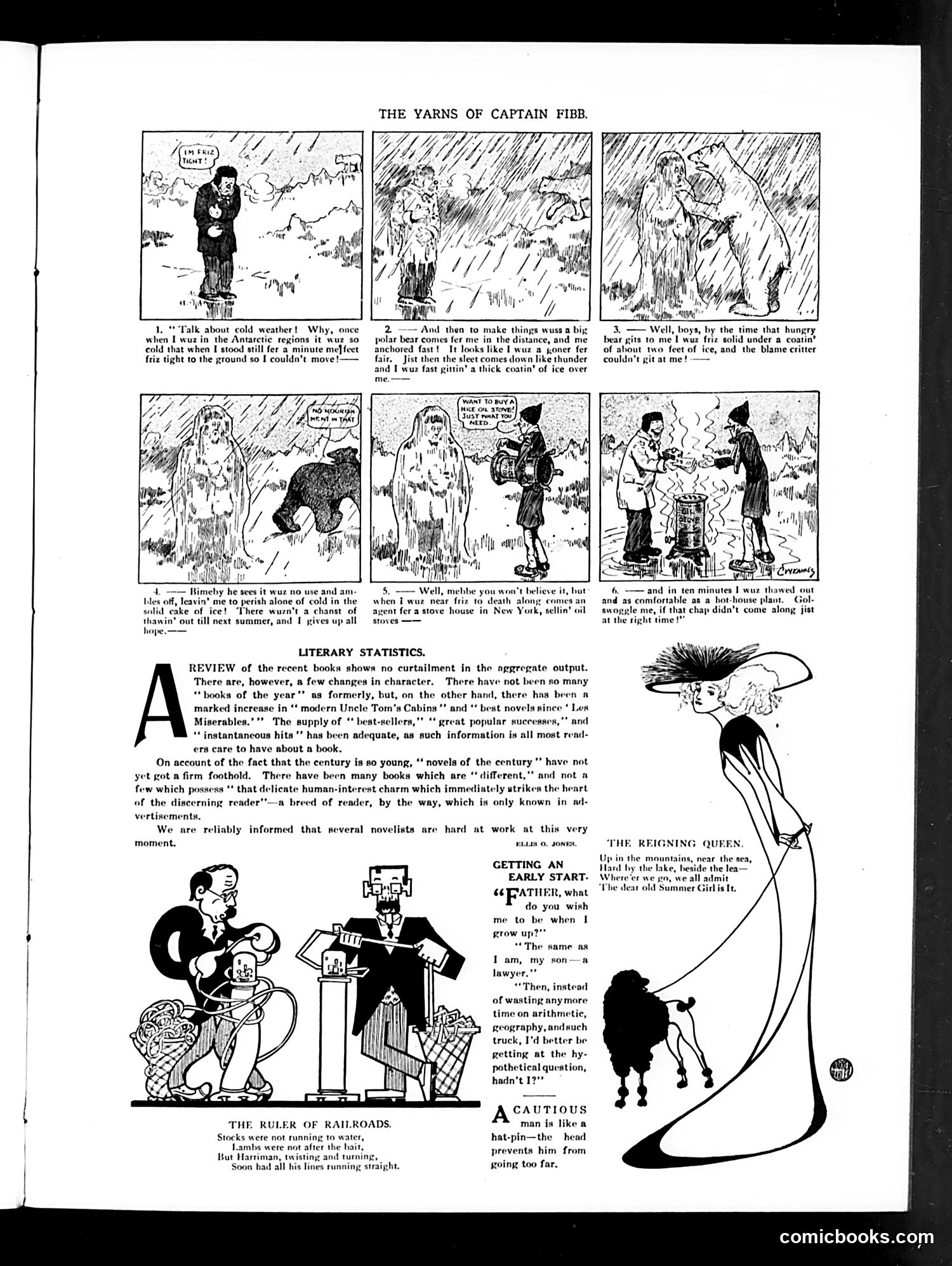
**"The Yarns of Captain Fibb"** is a tall-tale comic strip mocking exaggerated frontier storytelling. Captain Fibb spins increasingly absurd stories about Antarctic survival—freezing solid, being coated in ice, rescued by a convenient oil stove salesman. The humor lies in the obvious fabrication: each panel escalates the impossibility, and the final panel reveals the joke's structure through the character's own admission that the timing was suspiciously perfect. **"Literary Statistics"** is a satirical essay critiquing publishing industry hyperbole. It mocks how publishers label every new book as a "best-seller" or "great popular success," and notes the absurd category "novels of the century" doesn't yet apply to recent works. The tone suggests publishers cynically market books to readers who only care about promotional labels, not actual merit. **Minor cartoons** include "Getting an Early Start" (a father wants his son to study law immediately rather than waste time on basic subjects) and "The Ruler of Railroads" (likely satirizing railroad magnate E.H. Harriman's market manipulations).
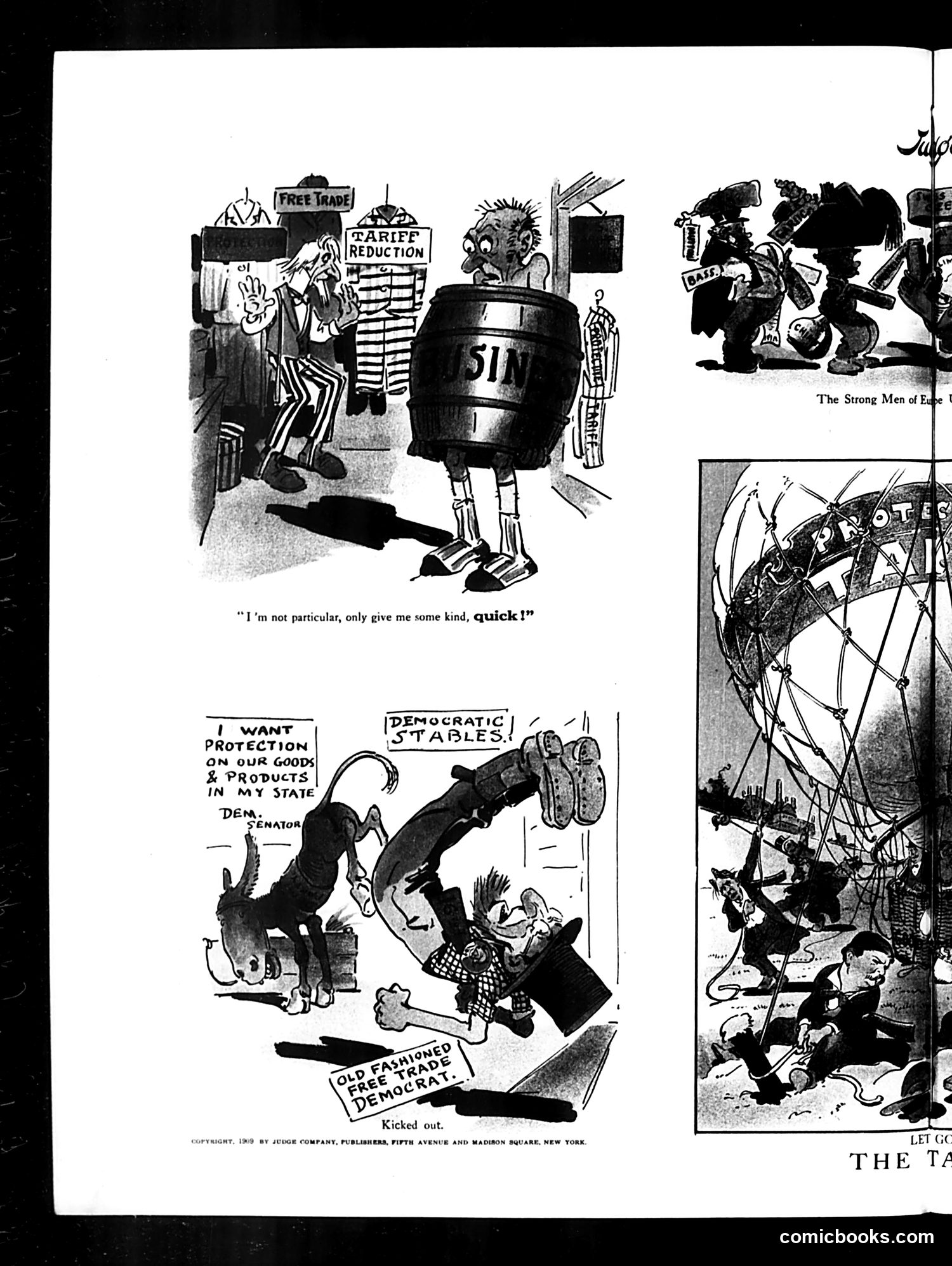
This Judge magazine page contains two satirical cartoons about trade policy disputes, likely from the early 1900s. **Top cartoon:** A barrel labeled "SIN" with legs begs politicians for "some kind, quick" tariff reduction. Signs reading "FREE TRADE" and "TARIFF REDUCTION" surround it, suggesting protectionists viewed tariff cuts as morally corrupting commerce. **Bottom cartoon:** Titled "Democratic Stables," it depicts a donkey (the Democratic Party symbol) kicking out a Democratic senator who demands state protections for local goods. The "Old Fashioned Free Trade Democrat" label indicates the cartoonist mocks Democrats for abandoning their traditional free-trade principles to satisfy regional protectionist demands. The overall message critiques politicians—particularly Democrats—for inconsistently abandoning stated principles under pressure from constituents seeking protective tariffs.
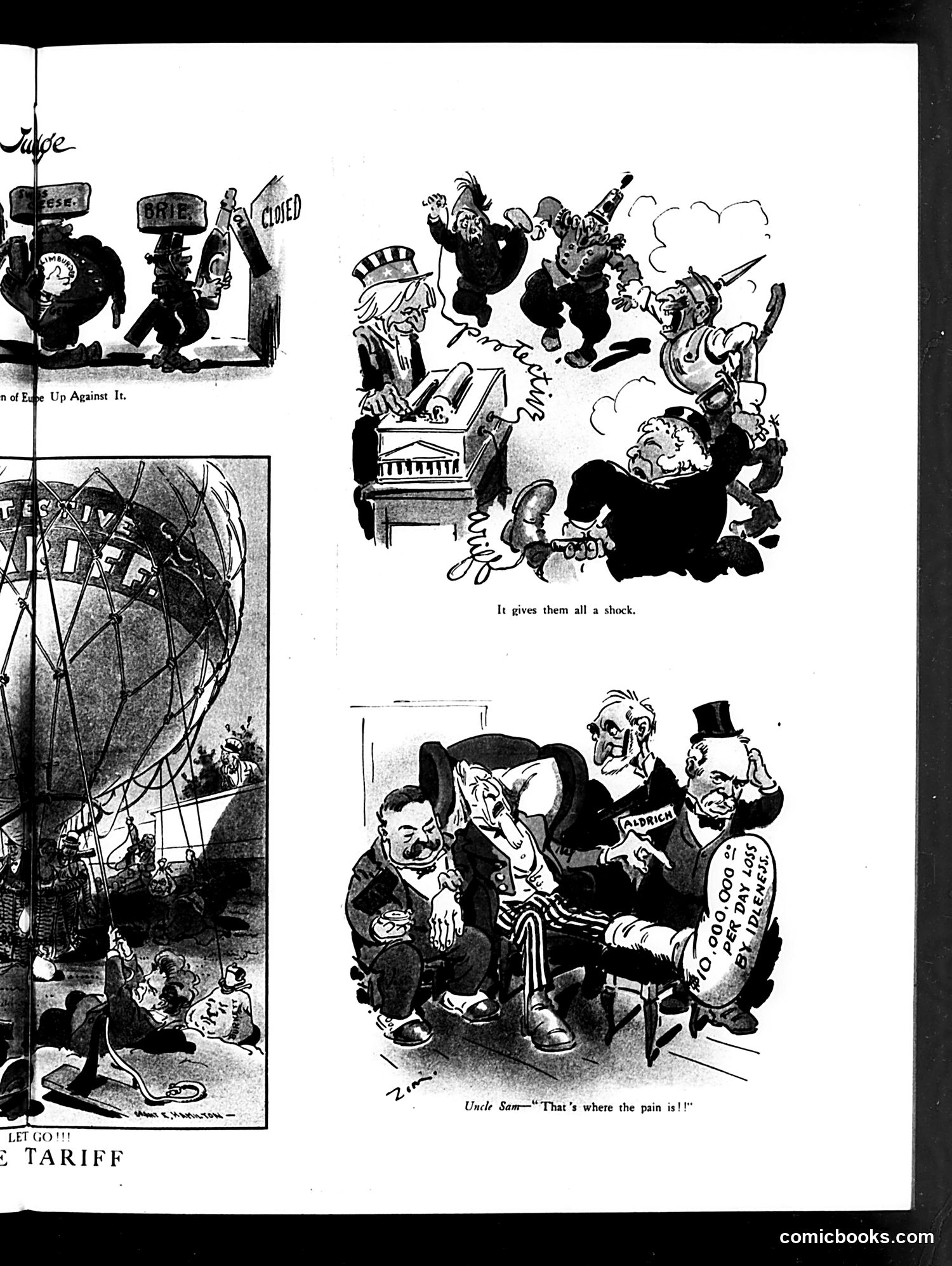
This page satirizes the **tariff debate** in American politics. The top cartoon shows various political figures reacting with shock to Uncle Sam's actions, captioned "It gives them all a shock." The bottom cartoon depicts Uncle Sam identifying "where the pain is" — pointing to a tariff-related wound. The figure labeled "Aldrich" (likely Senator Nelson Aldrich, a prominent Republican associated with tariff policy) appears distressed. The left panel, titled "Let Go!!! Tariff," shows a tangled mass of industrial/commercial interests, suggesting tariffs created complex, difficult-to-untangle economic problems. **Context**: This appears to critique the Payne-Aldrich Tariff (1909), which raised duties on imports. The satire suggests tariffs caused widespread economic pain for various constituencies while benefiting specific interests — a common Progressive Era criticism of protectionist policies.
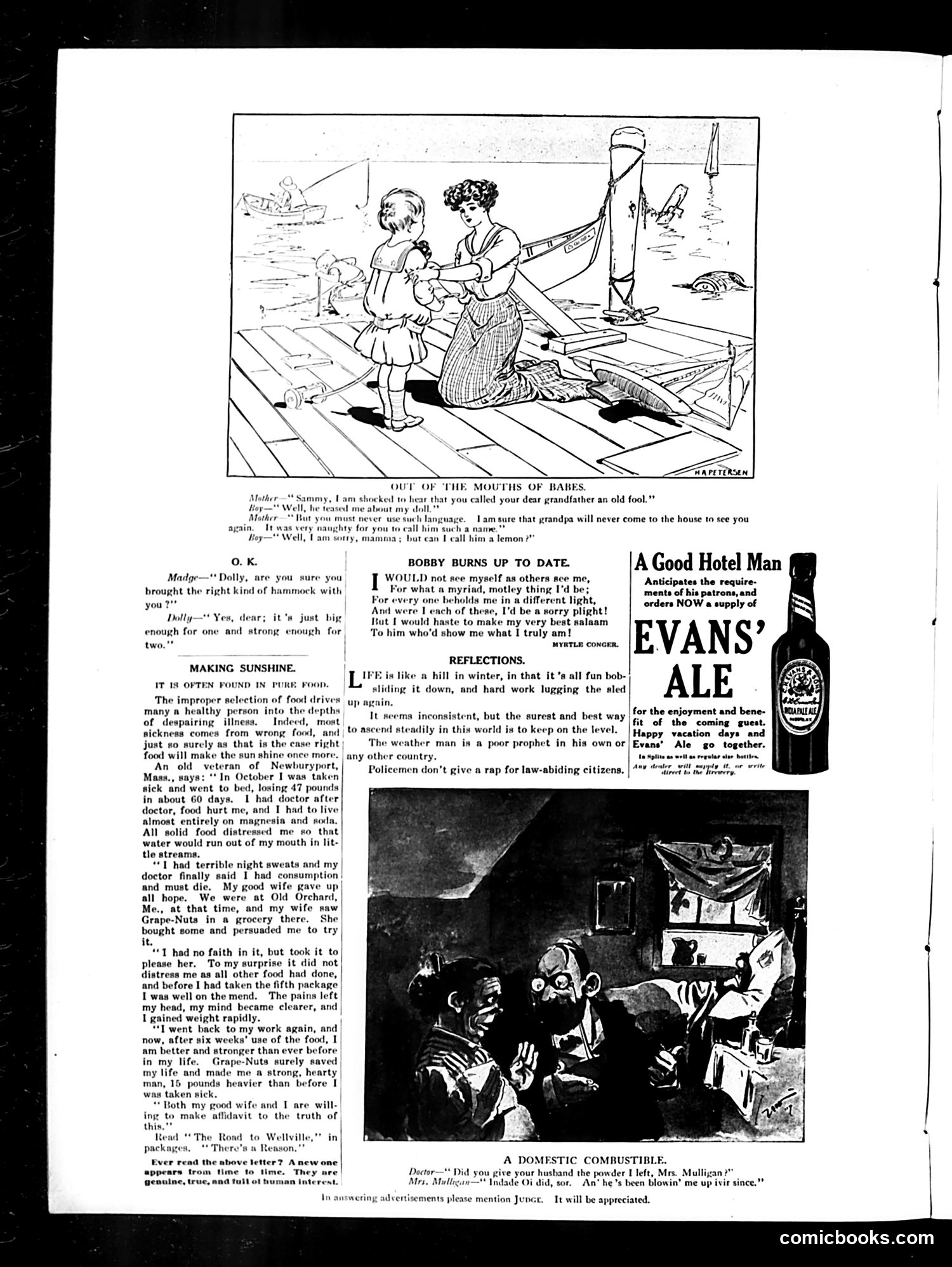
This page from *Judge* contains several distinct satirical pieces: **Top cartoon**: A mother scolds her daughter for calling grandfather "an old fool," warning it will offend him. The daughter defends herself by saying she merely repeated what the mother taught her—satirizing parental hypocrisy and children's literal interpretation of adult behavior. **"Making Sunshine"**: This is a Grape-Nuts cereal advertisement disguised as editorial content, featuring testimonial from a Massachusetts veteran claiming the food cured his consumption. This reflects early 20th-century marketing tactics where miracle-cure food products made dubious health claims. **"Bobby Burns Up to Date"**: A poem loosely referencing the Scottish poet, reflecting on self-perception and authenticity. **Bottom cartoon**: A domestic humor piece where a wife gave her husband "powder" that made him angry ("blowin' me up"), likely a double entendre about combustibility and marital strife. The page mixes advertising, light humor, and poetry—typical *Judge* content blending satire with commercial promotion.
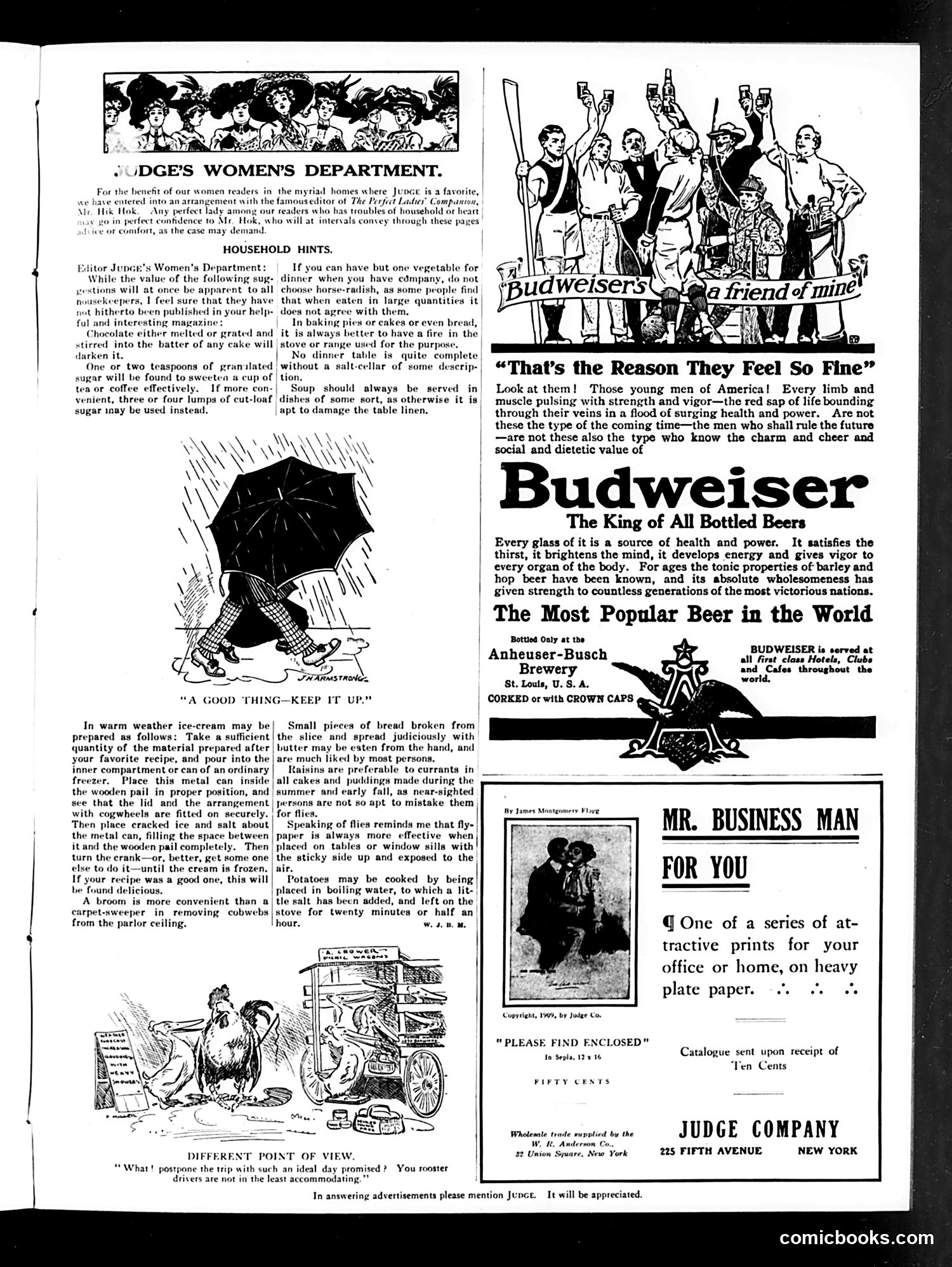
This page combines household advice with period advertising. The left side features "Judge's Women's Department," offering practical domestic tips (ice cream preparation, fly-paper placement, potato cooking). The cartoons include a woman with an umbrella labeled "A Good Thing—Keep It Up" and a domestic scene captioned "Different Point of View," satirizing the disconnect between husbands' promises and reality. The dominant content is a Budweiser beer advertisement featuring young athletic men. The ad conflates beer consumption with health, vigor, and national strength—claiming beer provides "health and power" and connects it to "victorious nations." This reflects early-1900s advertising practices before alcohol's health risks were widely acknowledged, and pre-Prohibition attitudes when beer was marketed as nutritious and wholesome rather than as mere indulgence. The ad targets "business men" with promises of vitality.
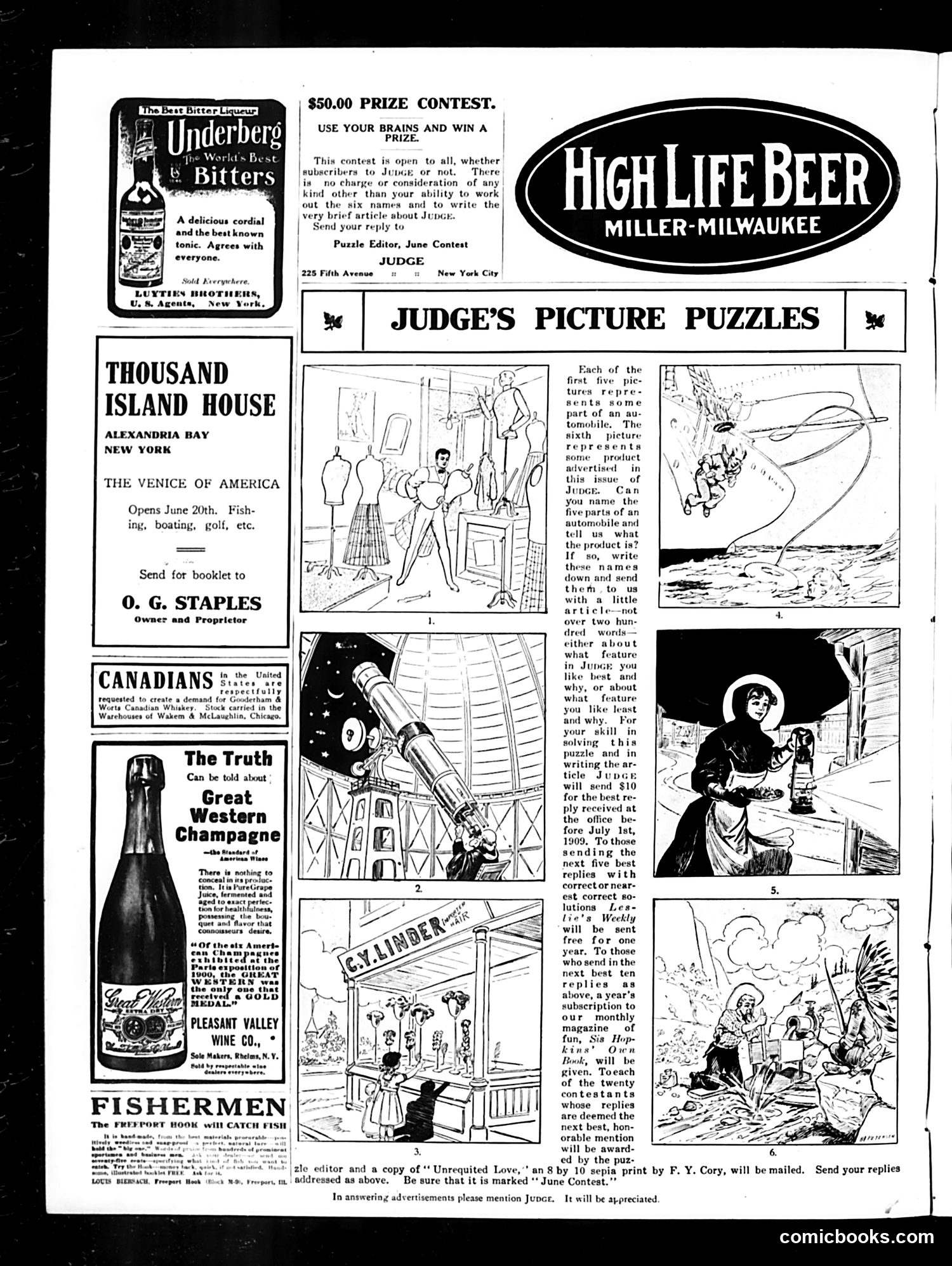
This page is primarily **advertising and contest material** rather than satirical editorial content. The dominant feature is Judge's "$50.00 Prize Contest"—a puzzle competition inviting readers to identify five automobile parts from sketched images (pictures 1-5), then write a brief article about the product. The contest offers cash prizes ($10 for the best entry by July 1, 1909) and free magazine subscriptions as rewards. The page is surrounded by **period advertisements**: Underberg Bitters (a digestive tonic), High Life Beer (Miller-Milwaukee), the Thousand Island House resort in upstate New York, Canadian whiskey, Great Western Champagne, and fishermen's guides. Picture 6 appears to show people in a rural/outdoor setting, likely illustrating a scene for readers to caption or analyze as part of the puzzle. **For modern readers**: This reflects early-1900s magazine culture where contests engaged readers while promoting products and encouraging magazine subscriptions—a common revenue strategy before mass advertising dominated publications.
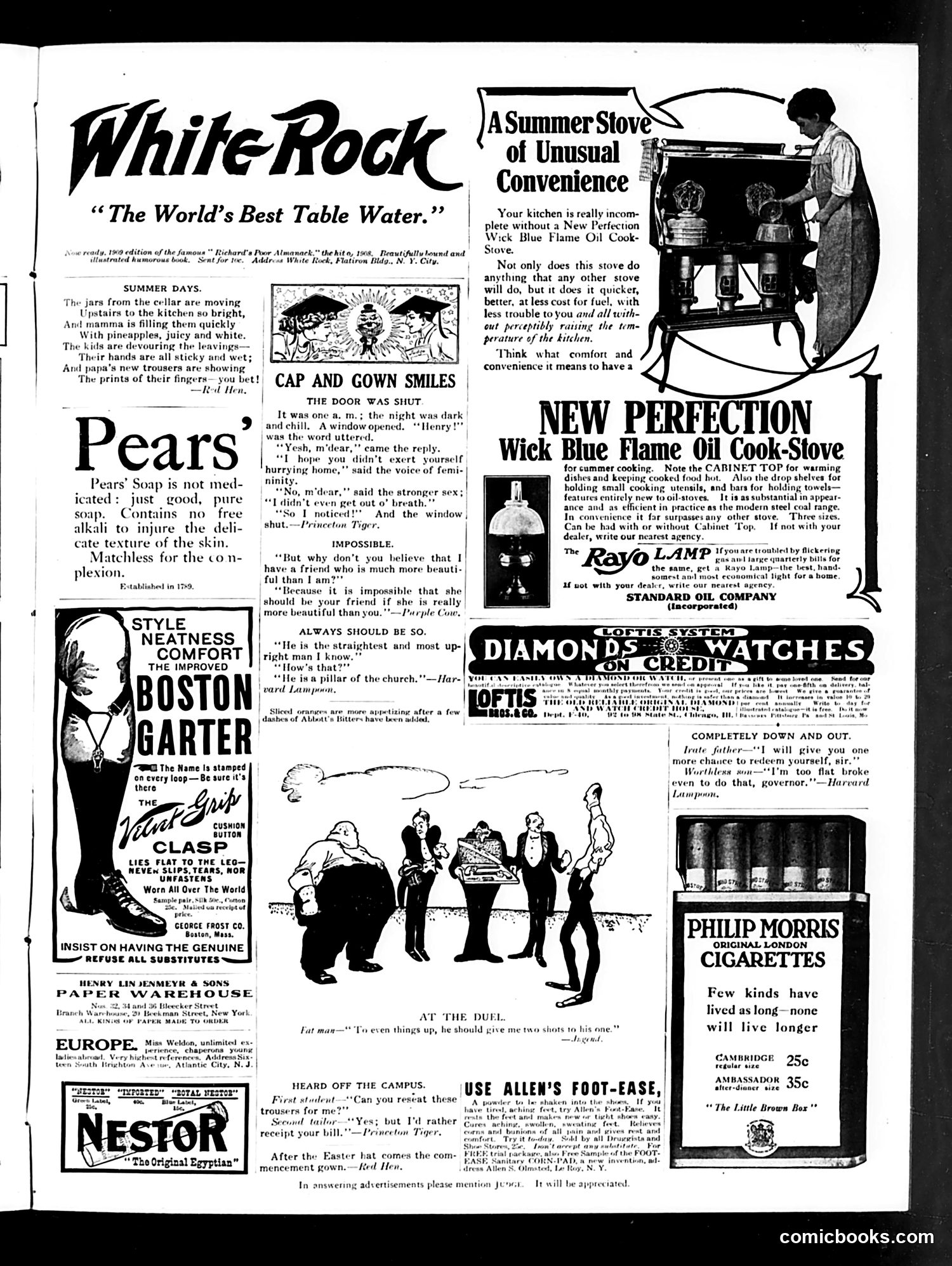
This page is primarily **advertising** with light satirical content interspersed. The major advertisements include White Rock table water, Pears' soap, Boston Garter suspenders, and the New Perfection oil cooking stove. The small cartoon vignettes use gentle humor typical of early 1900s magazines: - **"Cap and Gown Smiles"** and **"Heard off the Campus"** are college-themed jokes poking fun at student life and romance (a young man sneaking to a window at 1 a.m.; students asking tailors to mend clothes). - **"The Duel"** depicts a portly gentleman and thin man in a confrontation—absurdist humor about fairness in combat. The satirical content is minimal and non-political. Instead, the page reflects **early 20th-century domestic life**: concerns about summer cooking, personal grooming, and fashion (garters were essential for men's socks). The humor targets universal human situations—marital life, student mishaps, appearance—rather than specific political figures or events.
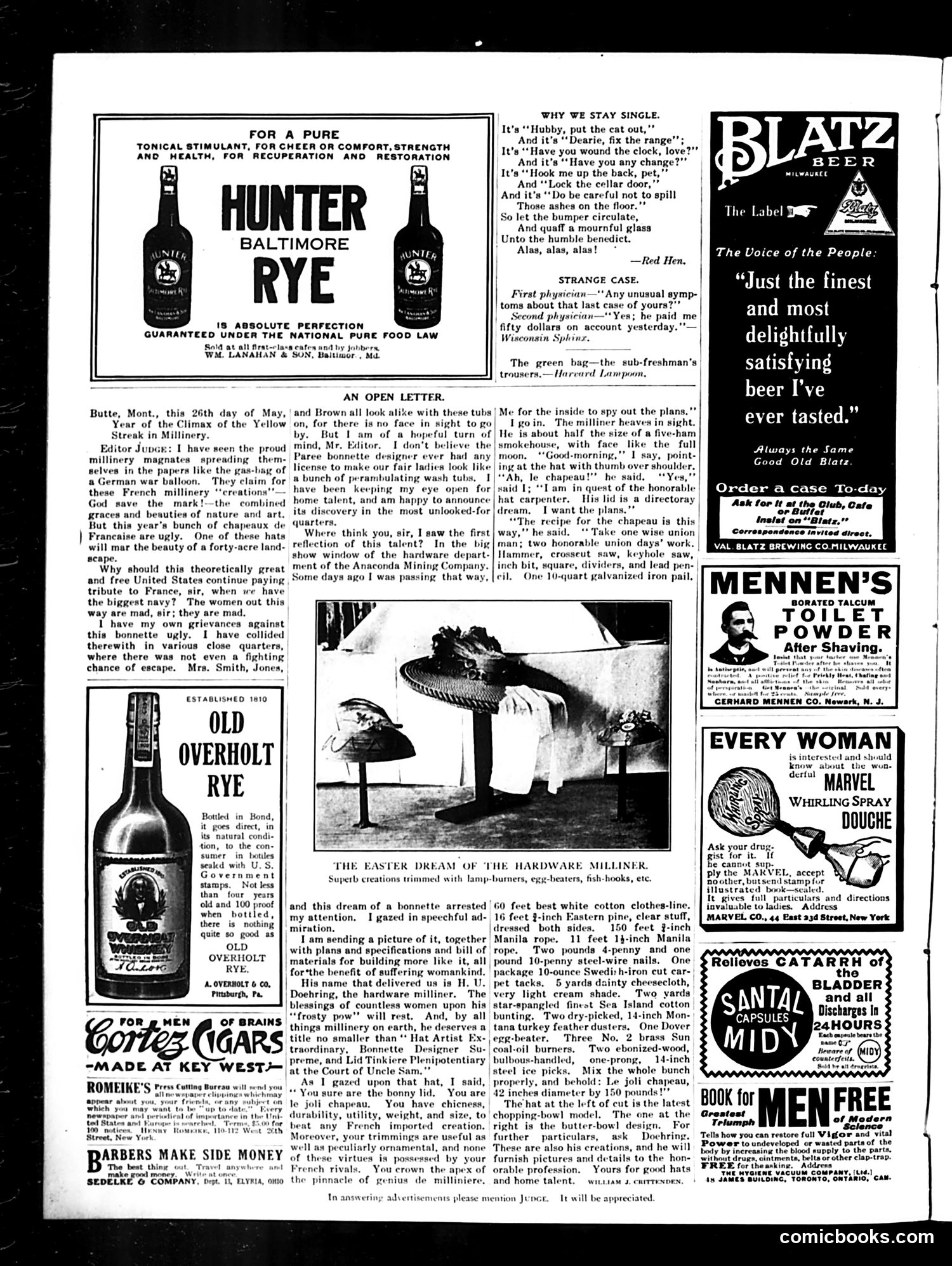
This page is primarily **advertising and humor columns** rather than political satire requiring historical context. The main illustrated piece, "The Easter Dream of the Hardware Milliner," is a visual joke: a satirical drawing showing an absurdly impractical hat constructed from hardware store items (lamp-burners, egg-beaters, fish-hooks, cotton line, nails, rope, etc.). The accompanying letter criticizes extravagant French millinery fashion as ugly and wasteful, arguing American manufacturers could design better hats. The joke contrasts high-fashion pretension with practical, common materials—suggesting American practicality outweighs French style. The page also includes several humor columns ("Why We Stay Single," "Strange Case") and period advertisements for rye whiskey, cigars, and various products. **No specific political figures or events are referenced.** This appears to be general social commentary on early-20th-century fashion excess and American cultural attitudes toward European imports.
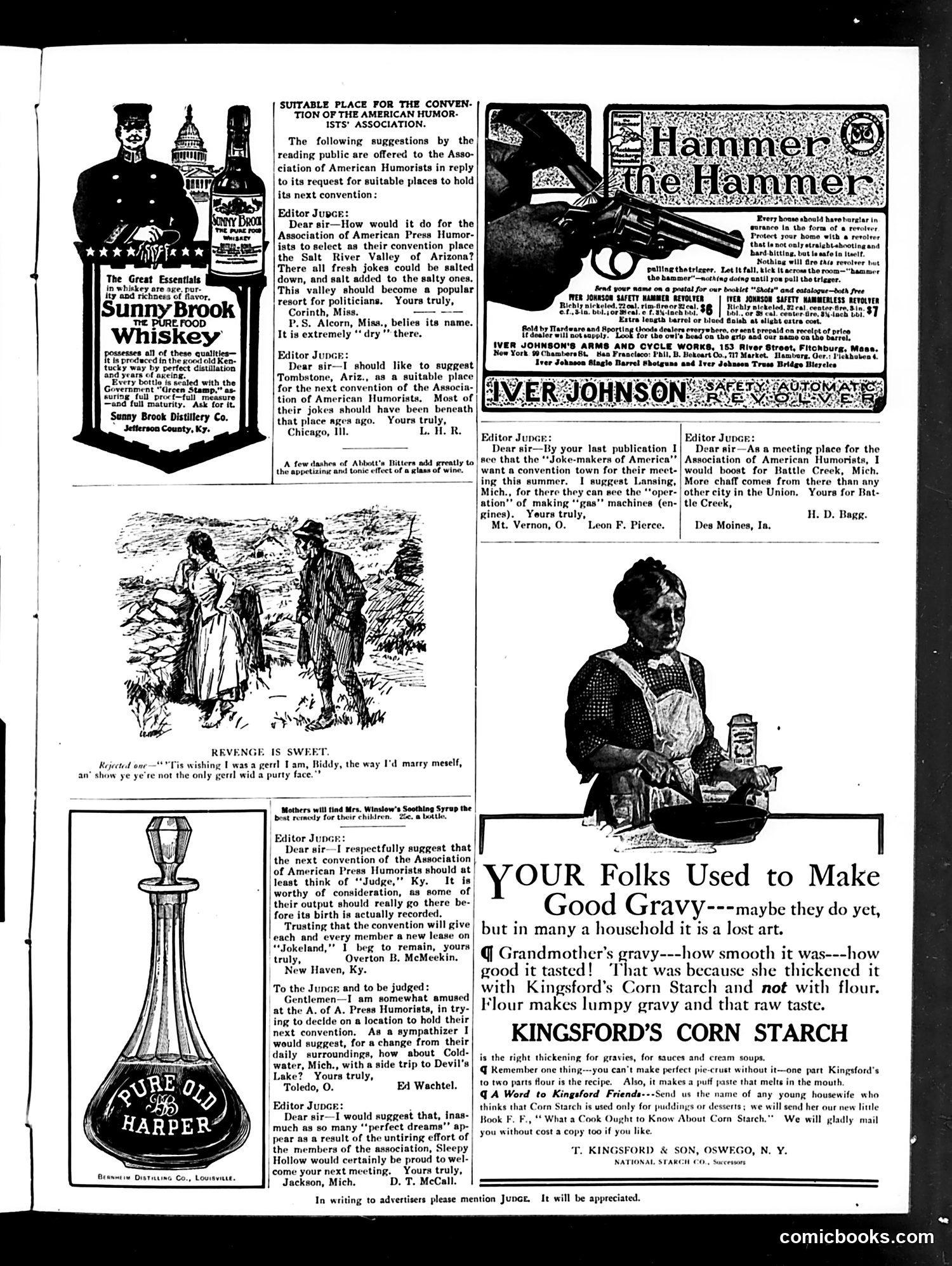
This page primarily consists of **humorous reader suggestions** for where the "Association of American Press Humorists" should hold their convention—a satirical premise itself. The joke structure is consistent: each letter writer suggests a city with a pun-based insult to that location. For example: - **Salt River Valley, Arizona**: A place to "salt down" fresh jokes (implying Arizona humorists are bland) - **Tombstone, Arizona**: Their old jokes belong buried there - **"Judge, Kentucky"**: Where bad jokes should go "before its birth is actually recorded" - **Coldwater, Michigan** with side trip to **Devil's Lake**: Sarcastic suggestions - **Sleepy Hollow**: For those producing "perfect dreams" (implying dreamlike/nonsensical humor) - **Battle Creek, Michigan**: "More chaff comes from there than any other city" The satire mocks both regional American stereotypes and the pretensions of the humorists themselves. The page also contains period advertisements (whiskey, firearms, corn starch) typical of the era. **This is essentially early 20th-century "roasting" humor**—gentle geographic mockery presented as convention advice.
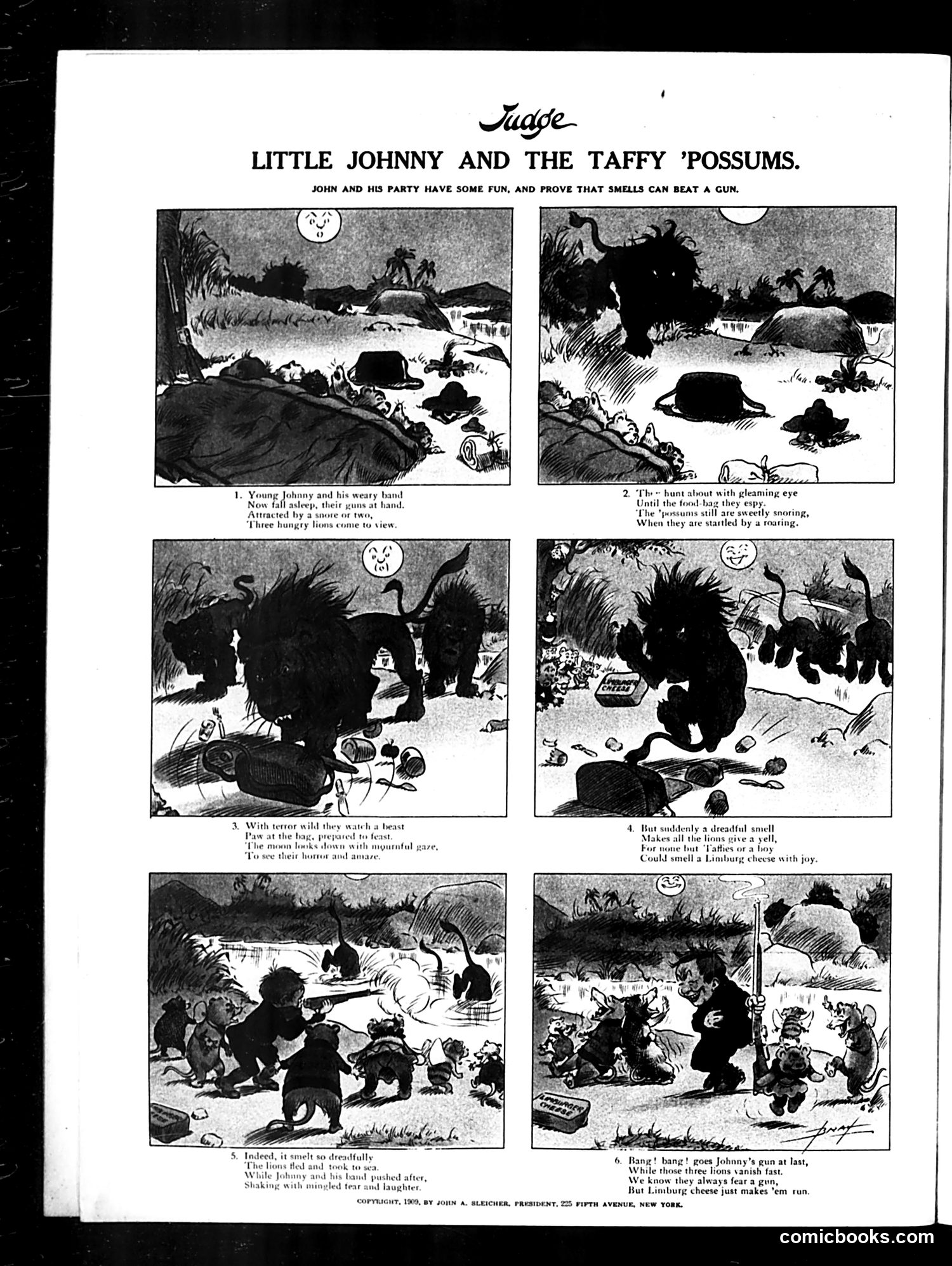
This 1909 Judge comic strip appears to be a children's adventure story rather than political satire. "Little Johnny" and his party encounter wildlife (described as possums, though depicted as large dark creatures) on what appears to be a hunting expedition. The humor hinges on an unconventional solution: instead of gunfire, the group defeats the animals using smell—specifically Limburg cheese, known for its pungent odor. The strip's subtitle claims "smells can beat a gun," suggesting the joke is that a powerful stench proves more effective than weapons. The satirical target, if any, remains unclear from the image alone. It may simply be lighthearted nonsense humor typical of Judge's entertainment content, or possibly commentary on hunting methods or wildlife management—though no specific political figures or events are identifiable.