
A complete issue · 20 pages · 1909
Judge — February 13, 1909
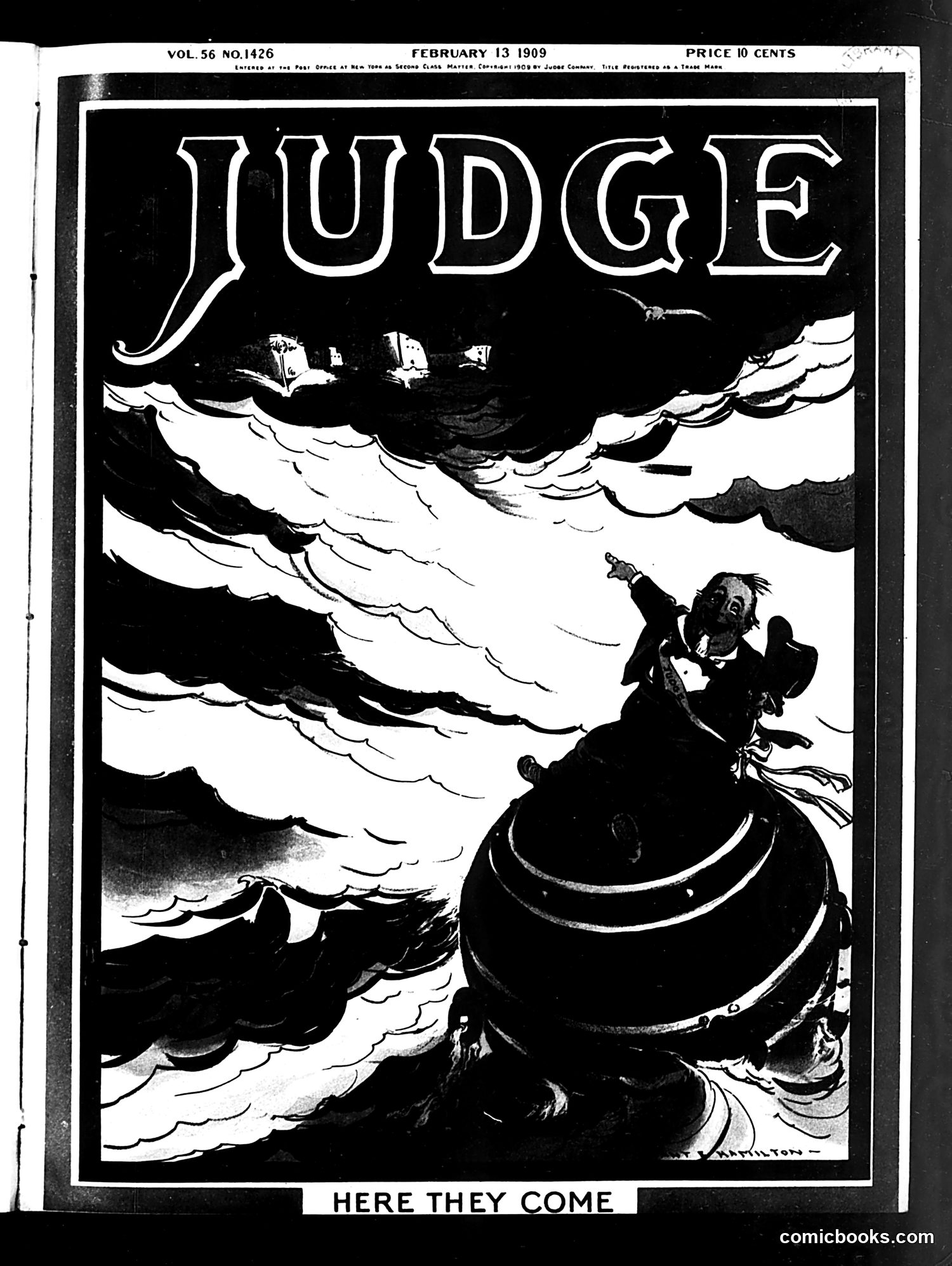
This is the cover of *Judge* magazine (February 13, 1909). The title "HERE THEY COME" suggests an impending arrival or threat. The illustration depicts a figure riding atop a large bomb or explosive device emerging from clouds, pointing forward urgently. The dramatic, dark artistic style emphasizes danger or catastrophe approaching. Without additional text identifying the specific figure or political context, I cannot definitively state who is depicted or what exact event this references. However, the imagery clearly uses the bomb as a metaphor for some feared consequence or crisis about to materialize. The urgent gesturing and stormy sky convey alarm and foreboding. To accurately explain the specific political or social satire intended, I would need clearer contextual information or visible caption text identifying the figures and referenced events.
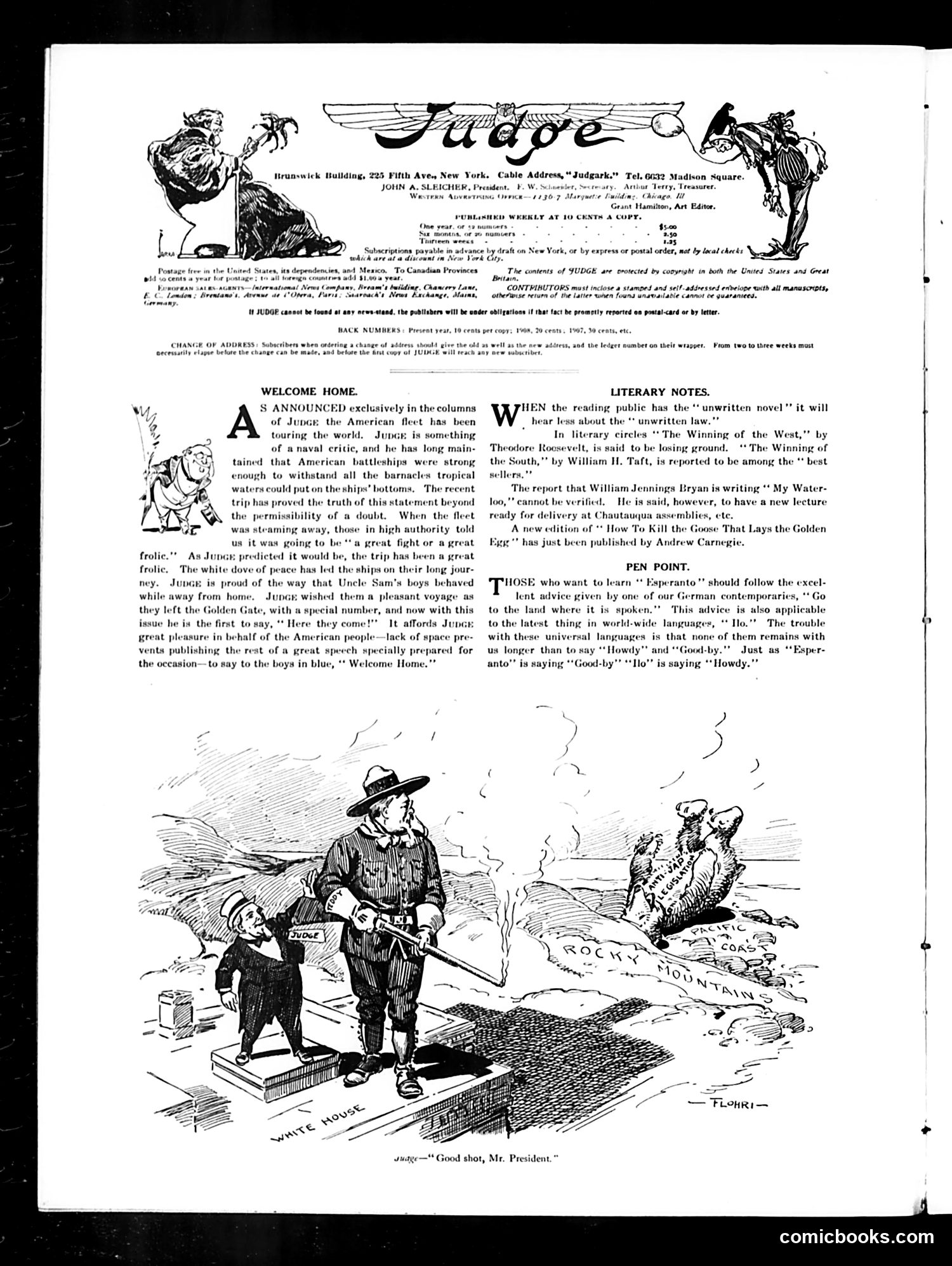
This political cartoon titled "Good shot, Mr. President" depicts a hunting scene with satirical intent. A tall figure in hunting attire (likely representing a U.S. President, though the specific president is unclear from the image alone) stands with a rifle aimed at targets labeled "Rocky Mountains" and what appears to be "White House." A smaller figure beside him, possibly a hunting guide or advisor, offers approval of the shot. The satire likely critiques the President's policies or actions—perhaps regarding conservation, western expansion, or domestic affairs. The "White House" target suggests self-inflicted political damage or ironic policy decisions. Without additional context about the publication date, the specific meaning remains somewhat ambiguous, though the cartoon clearly mocks presidential judgment or decision-making.
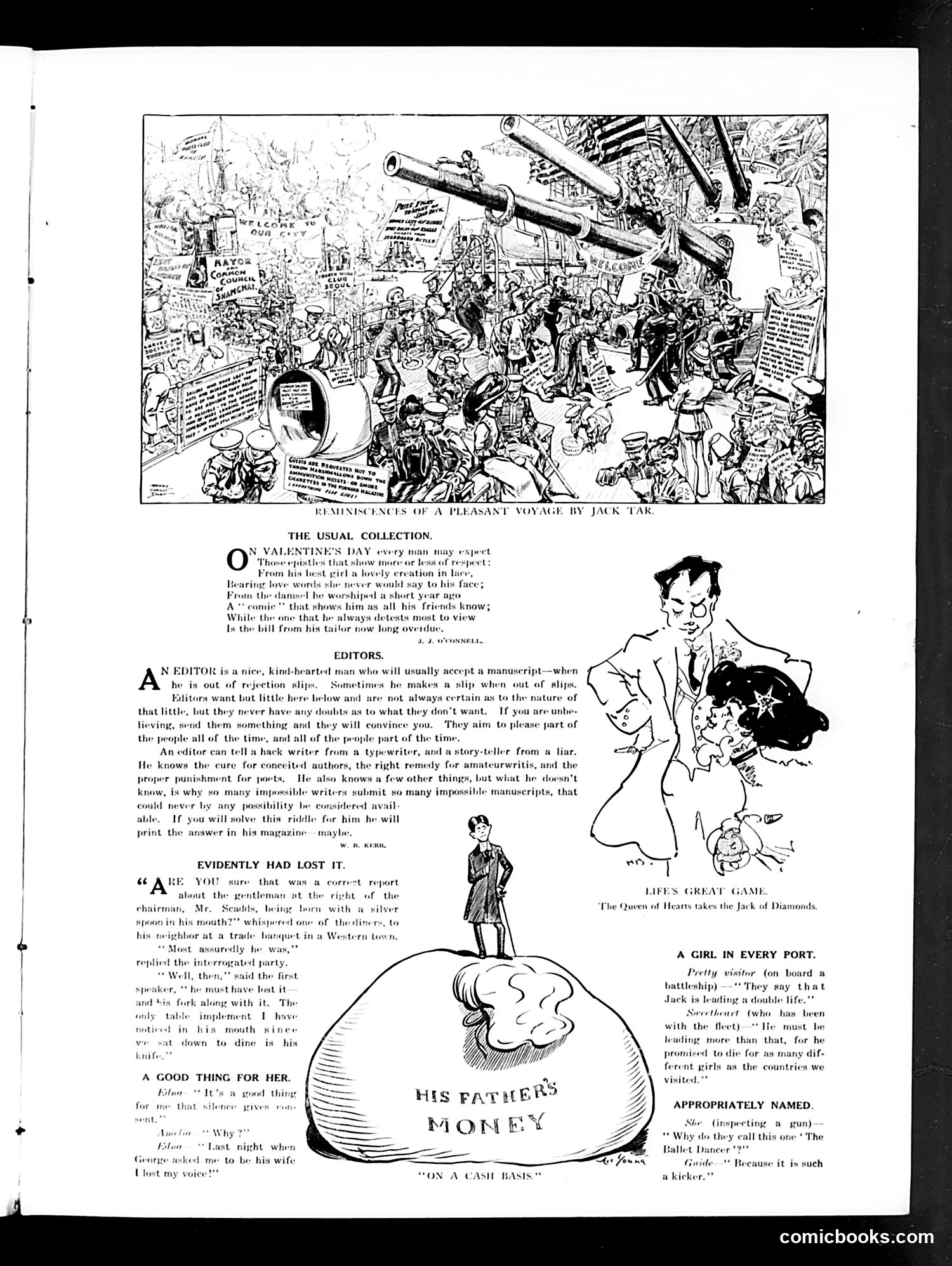
The page features multiple short humorous pieces typical of early 20th-century satirical magazines. **Top illustration**: "Reminiscences of a Pleasant Voyage by Jack Tar" appears to be a crowded ship scene with numerous figures and annotations—likely satirizing tourist travel or naval life, though specific references are unclear from the OCR text provided. **Main content** consists of brief comedic vignettes about editors, lost items, and romantic situations ("A Girl in Every Port"). These are generic humor pieces playing on common social situations rather than targeting specific political figures or events. **Notable illustration**: A large money bag labeled "His Father's Money—On a Cash Basis" accompanies jokes about courtship and marriage, satirizing materialism in romantic relationships—a recurring Judge magazine theme. The page is primarily **entertainment-focused social satire** rather than political commentary.
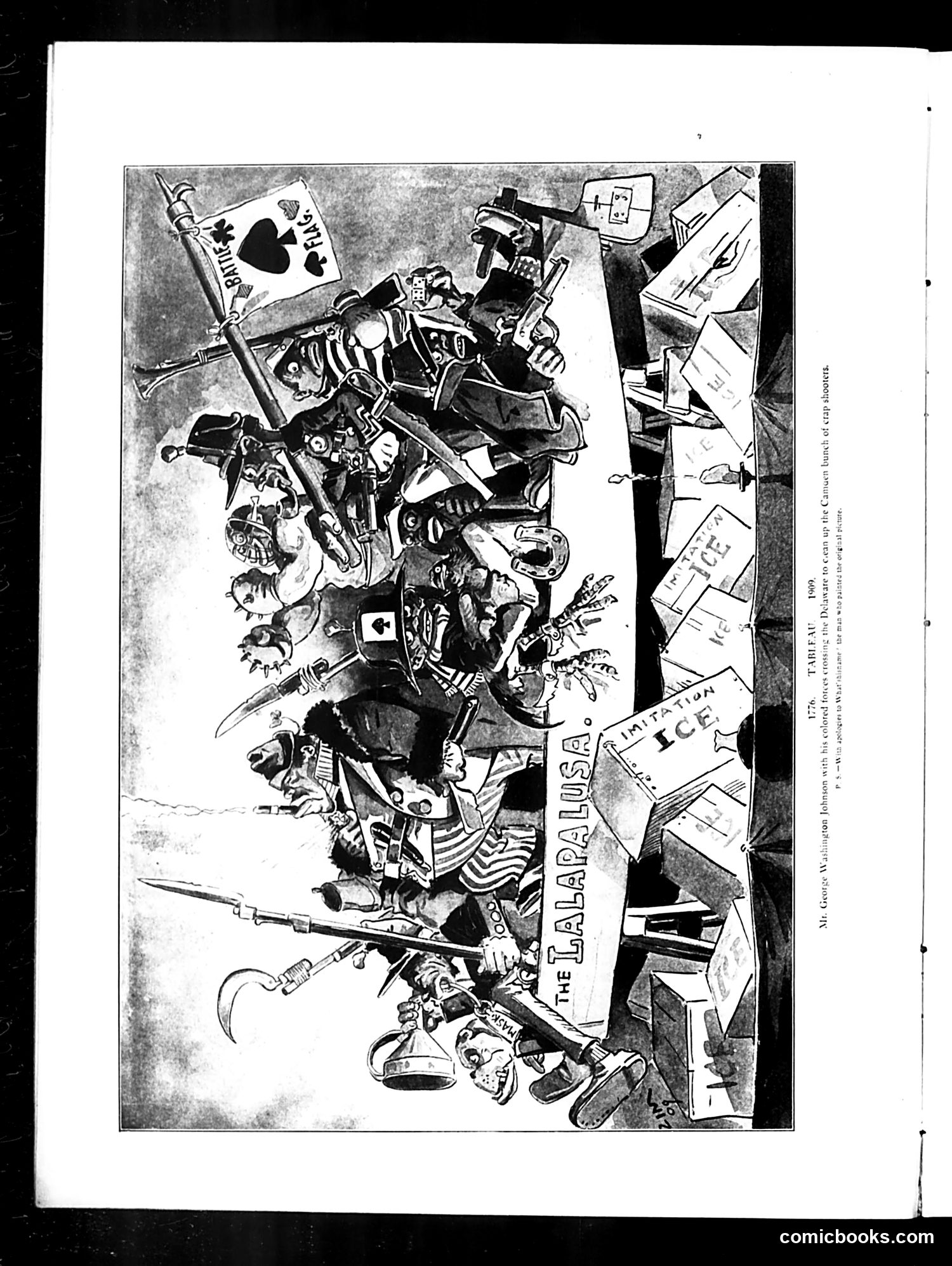
This appears to be a satirical cartoon titled "The Tammany Imitation" depicting the corrupt New York political machine Tammany Hall. The central figure appears to be a grotesque caricature engaged in chaotic, destructive activity surrounded by various symbolic elements. The cartoon shows numerous figures in apparent disarray, with what appears to be political documents or blueprints scattered on the right side. A flag bearing the Tammany Hall emblem is visible, along with various tools and weapons suggesting political corruption and violence. The satire criticizes Tammany Hall's notorious reputation for bribery, election fraud, and organized crime. The chaotic composition emphasizes the disorder and moral decay the cartoonist associates with the organization's control of New York politics during this era. However, without clearer identification of specific figures or a visible date, precise details remain uncertain.
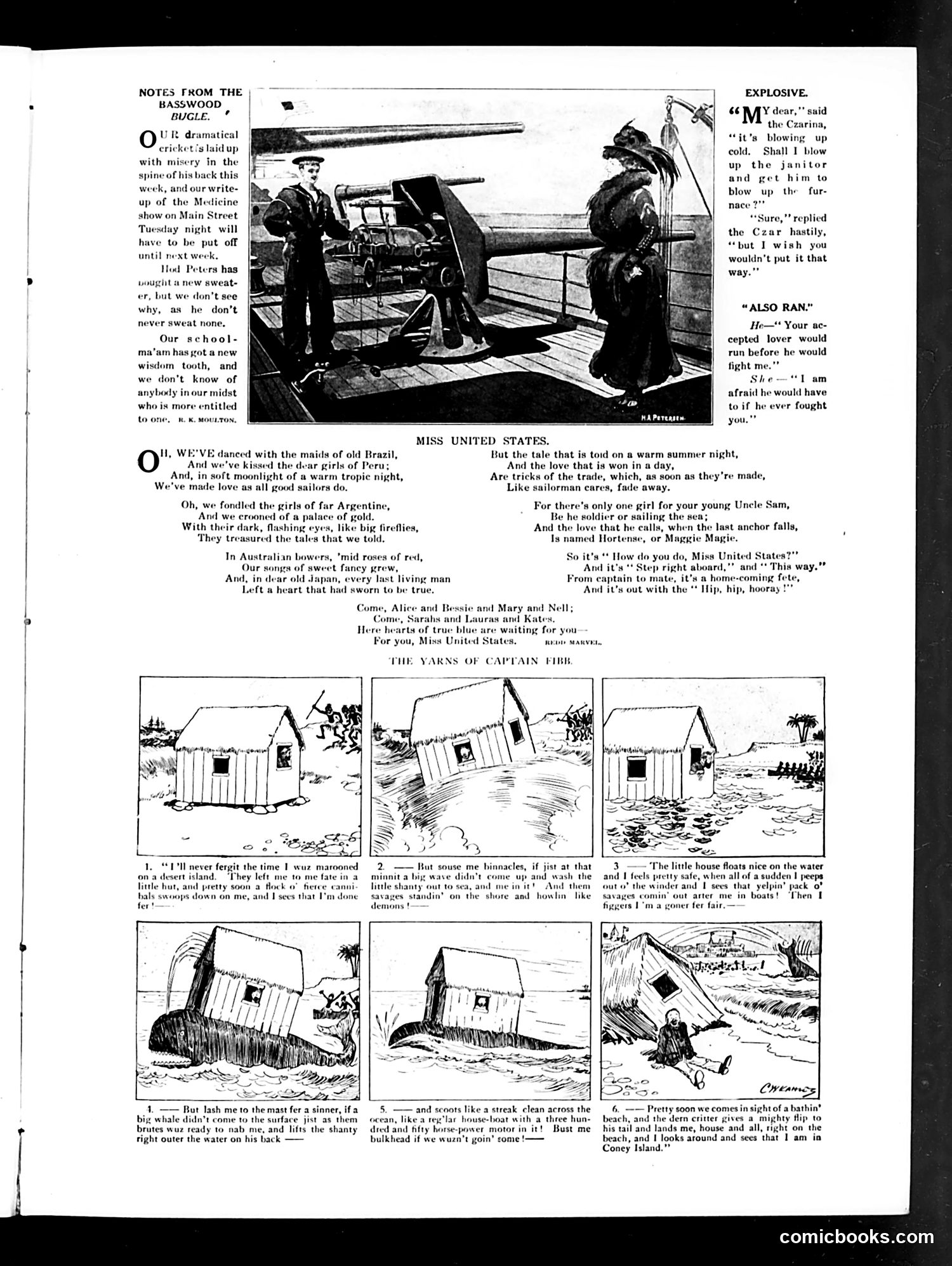
This page contains three distinct pieces of content: **"Notes from the Basswood Bugle"** (top left) is a gossip column about a small town, mentioning a cricket player's back injury and school developments—typical small-town humor. **"Miss United States"** (center) is a poem about a young woman named Uncle Sam's romantic interest, using romantic conquest as metaphor for American territorial/imperial expansion across Latin America (Argentina, Peru). The poem ironically treats colonial relationships as love affairs. **"The Yarns of Captain Fihr"** (bottom) is a sequential comic strip showing a house on a desert island being destroyed by various natural disasters—apparently humorous exaggeration of misfortune. The page reflects early 20th-century Judge magazine's mix of satirical commentary on American imperialism and lighthearted domestic humor.
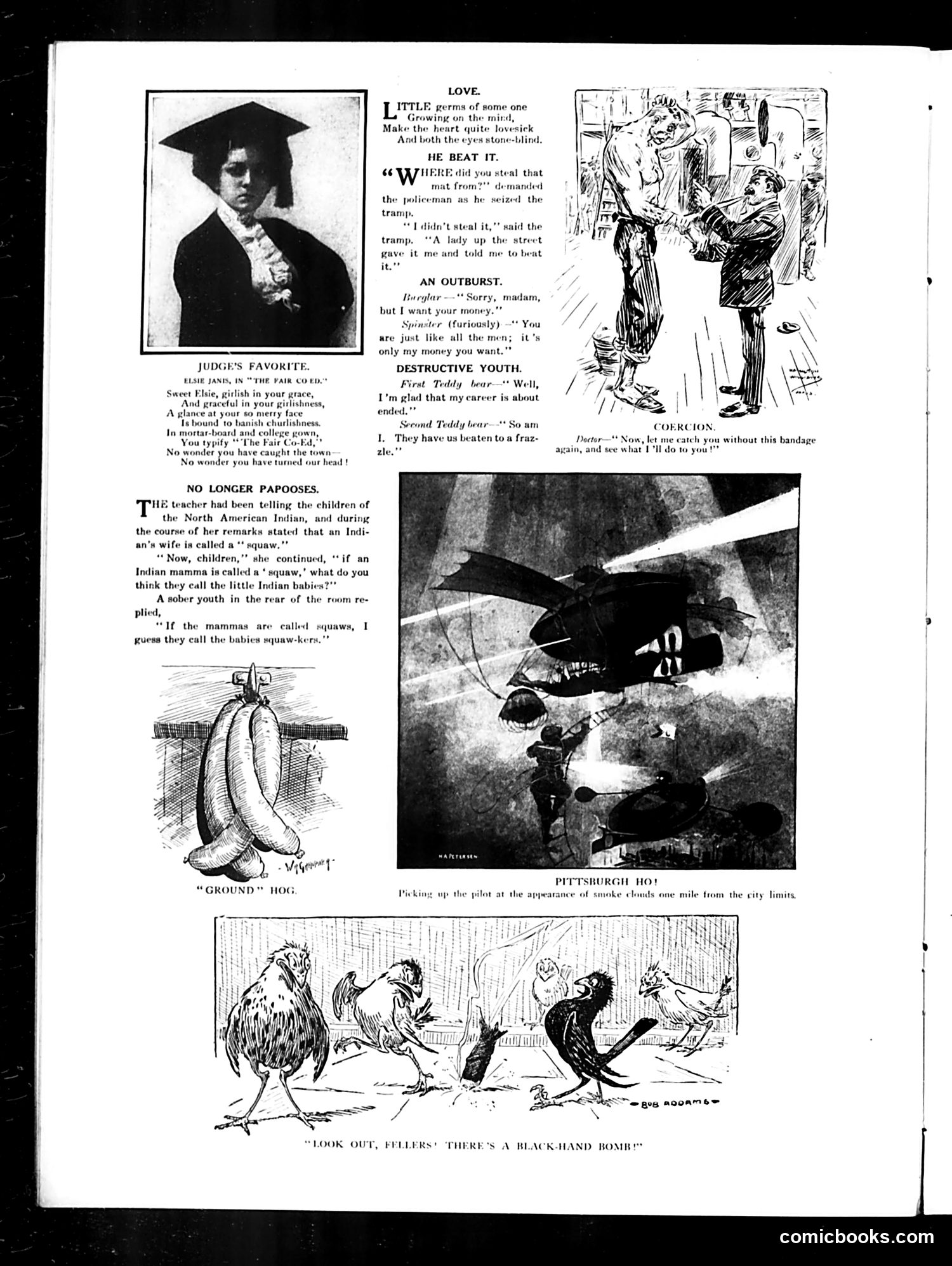
This page contains several short satirical pieces typical of early 20th-century humor: **"Love" and "He Beat It"**: Joke about a tramp who received a mat from a lady who told him to "beat it"—a pun on the literal instruction to beat/strike the mat for cleaning. **"An Outburst"**: A spinster burglar victim complains that the criminal—like all men—only wants her money, a jab at gender relations and male materialism. **"Judge's Favorite"**: References Elsie Janis, a real entertainer of the era, in "The Fair Co-ed." **"Destructive Youth"**: Depicts "Teddy bears" (toys named after President Theodore Roosevelt) damaged by rough play—commentary on destructive childhood behavior. **"No Longer Papooses"**: A schoolroom joke playing on the term "squaw" (Native American woman), with a student's crude pun about baby names—reflecting period attitudes toward Native Americans. **"Pittsburgh Ho!"**: Aerial photograph of industrial Pittsburgh with smoke clouds. **Bottom cartoon**: Animal characters (appearing to be birds/poultry) discussing an anarchist "black-hand bomb"—referencing early 1900s anarchist violence concerns.
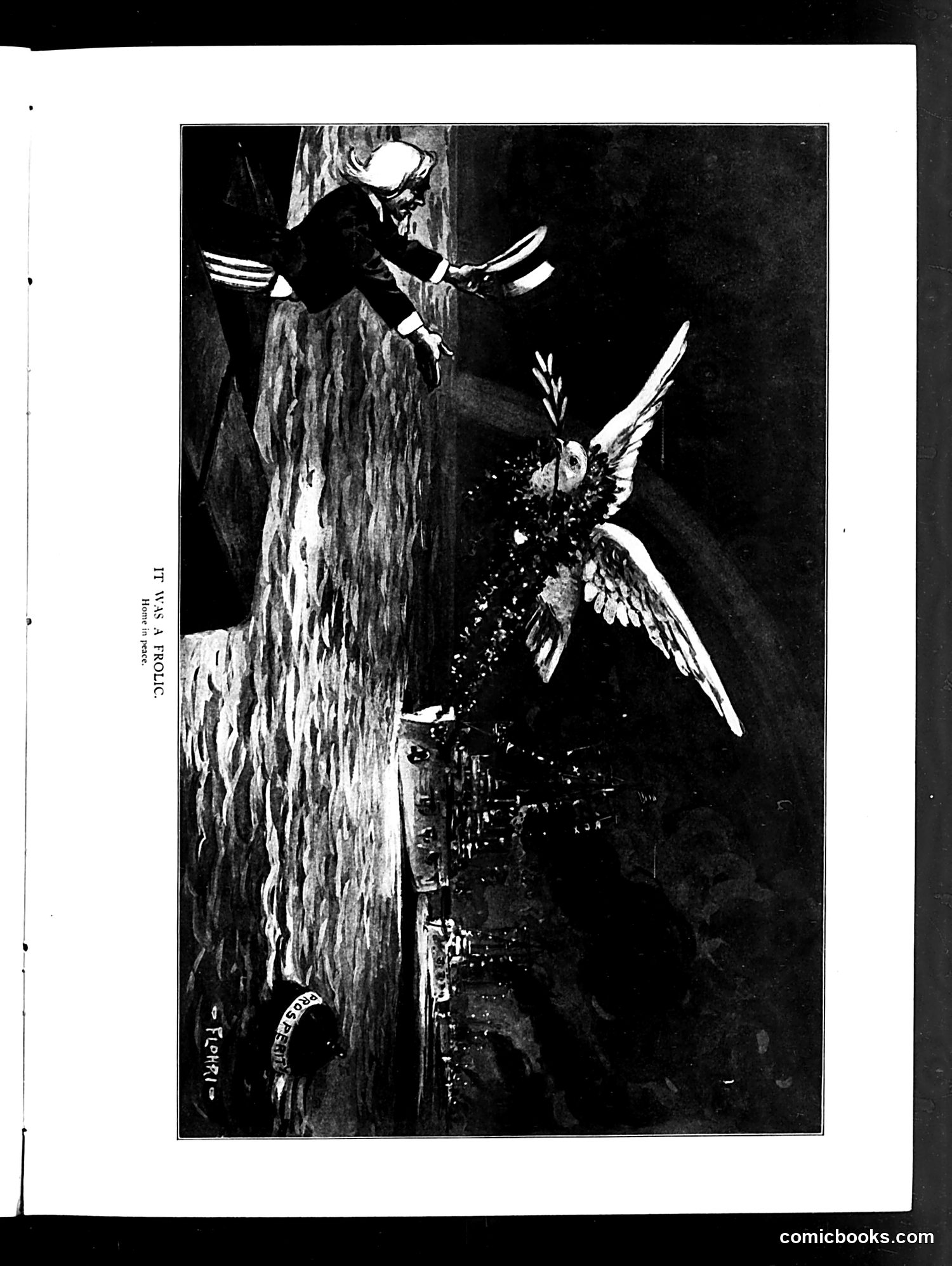
This appears to be a political cartoon from Judge magazine showing a figure in formal dress (top left) confronting what looks like an eagle or bird of prey that's being struck or attacked. The formal attire and positioning suggest this depicts a political or diplomatic confrontation. The text fragment "Fleet" and "a = Fleet" is unclear but may reference naval matters. Without clearer caption text or date information visible on this page, I cannot definitively identify the specific political figures, historical event, or satirical point being made. The imagery suggests conflict or confrontation between authority and power, but the precise historical context—whether this concerns U.S. foreign policy, military matters, or domestic politics—remains uncertain from the visible elements alone.
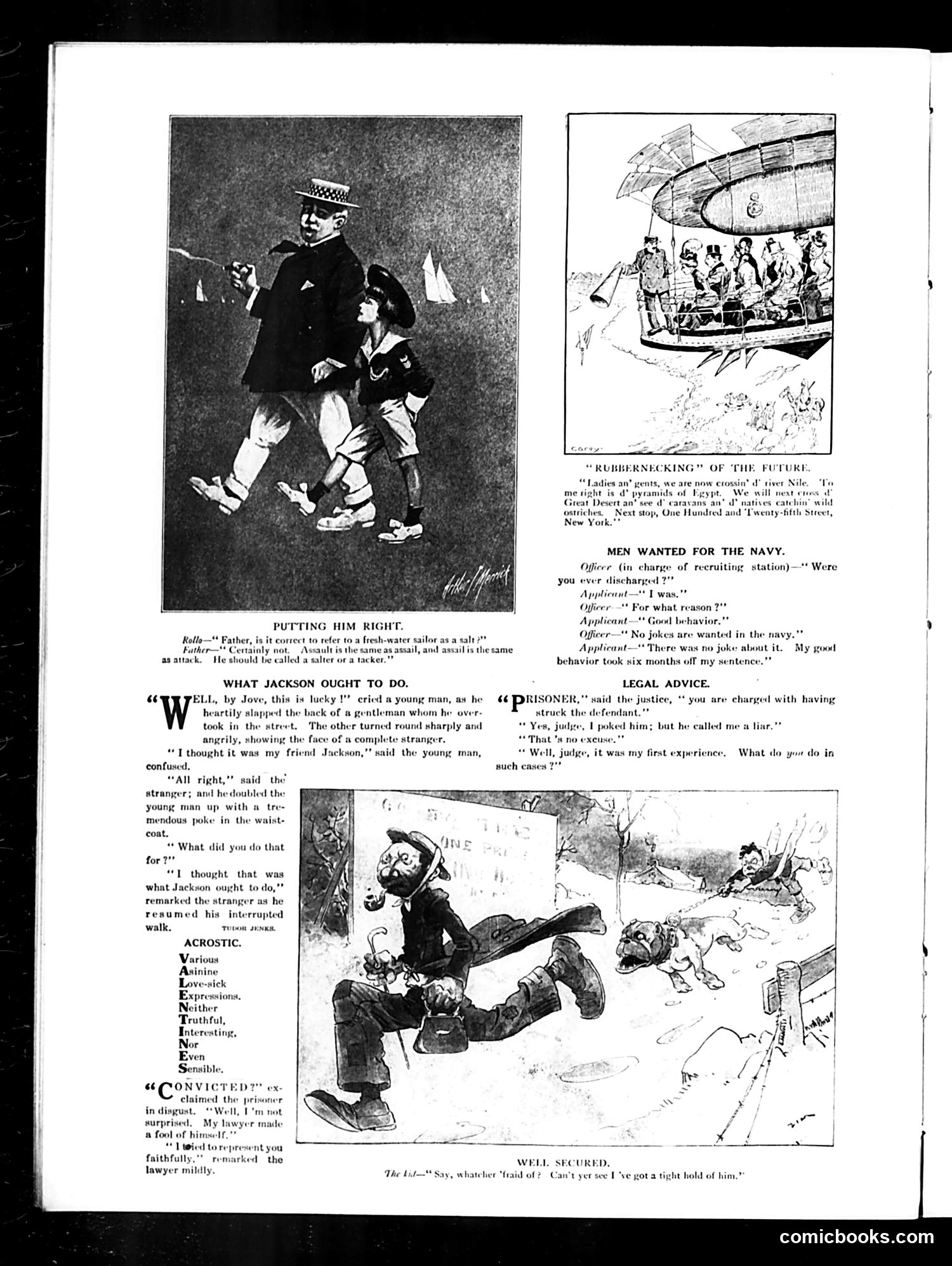
This page contains several unrelated satirical vignettes typical of Judge's humor: **"Putting Him Right"** mocks a pedantic father correcting his son about nautical terminology—the joke being that his distinction between "salt" and "tacker" is absurdly unnecessary. **"What Jackson Ought to Do"** appears to reference Andrew Jackson (likely the 7th president, known for aggressive behavior), satirizing a young man who assumes beating up a stranger is what "Jackson ought to do"—the humor lying in the stranger's violent retaliation. **"Men Wanted for the Navy"** satirizes Navy recruiting by showing applicants with comically bad records being rejected. One applicant's "good behavior took six months off my sentence" suggests prison time. **"Legal Advice"** and **"Well Secured"** are brief joke exchanges about courtroom and custody matters. **"Rubbernecking of the Future"** (top right) shows a fantastical airship touring Egypt, satirizing American tourists' obsession with sightseeing. The overall tone is lighthearted domestic and social humor rather than hard political commentary.
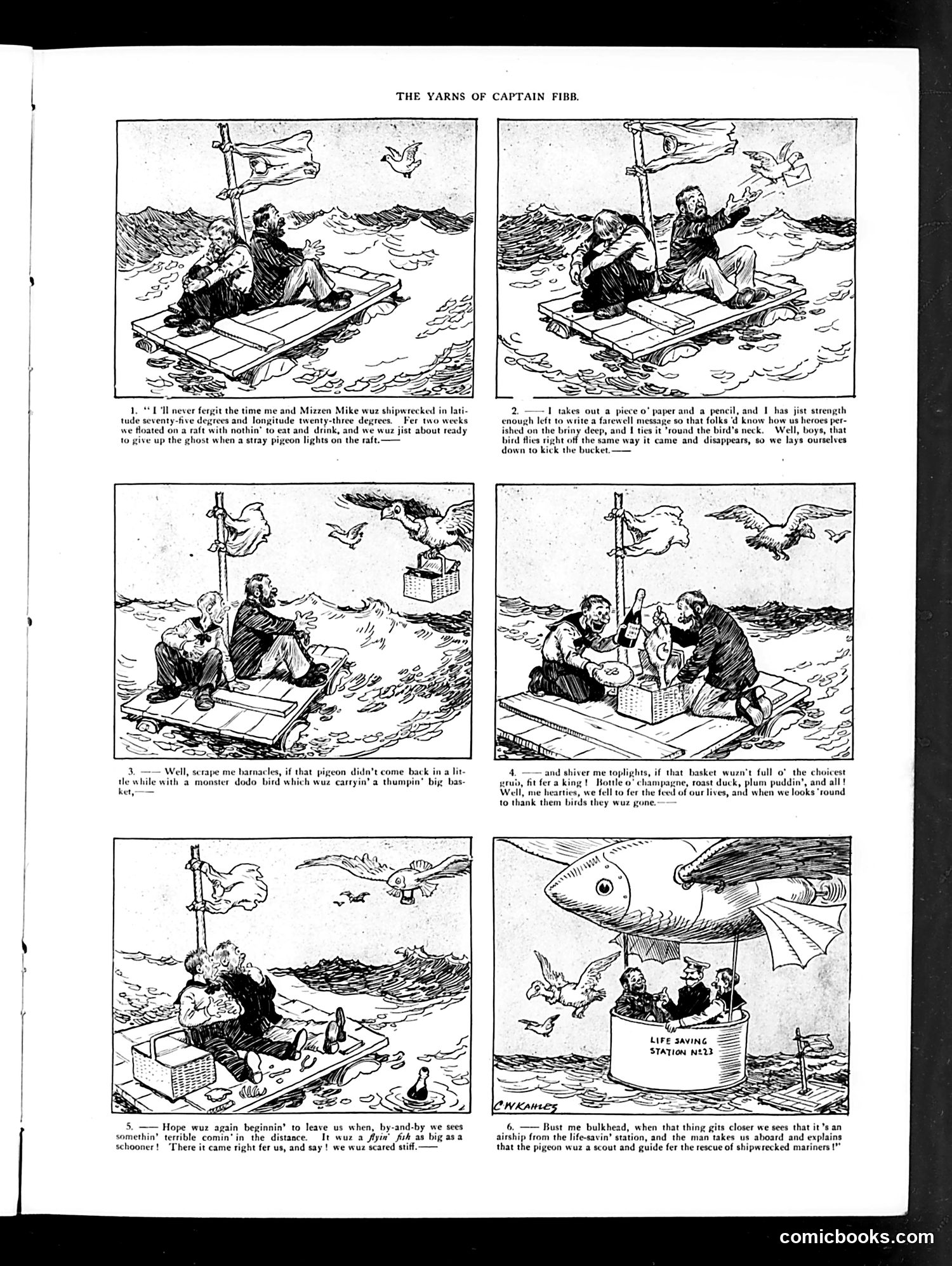
This is a tall-tale comic strip featuring an exaggerated seafaring yarn. Captain Fibb and his companion Mizzen Mike are shipwrecked with no food or water. A pigeon lands on their raft; Fibb ties a farewell message to it. The bird encounters a giant dodo bird carrying a basket of gourmet food (champagne, roast duck, plum pudding), which somehow reaches the starving men. Later, a massive flying fish appears—but it's actually an airship from a life-saving station. The punchline reveals the pigeon was a "scout and guide" for maritime rescue operations. The humor relies on escalating absurdity: improbable animal encounters, impossible scale, and the fake-serious delivery typical of sailor's tall tales. The final panel's reveal (the flying fish is an airship) mocks both the implausibility of the preceding narrative and, likely, contemporary interest in early aviation and mechanical rescue technology. It's gentle nonsense humor rather than political satire.
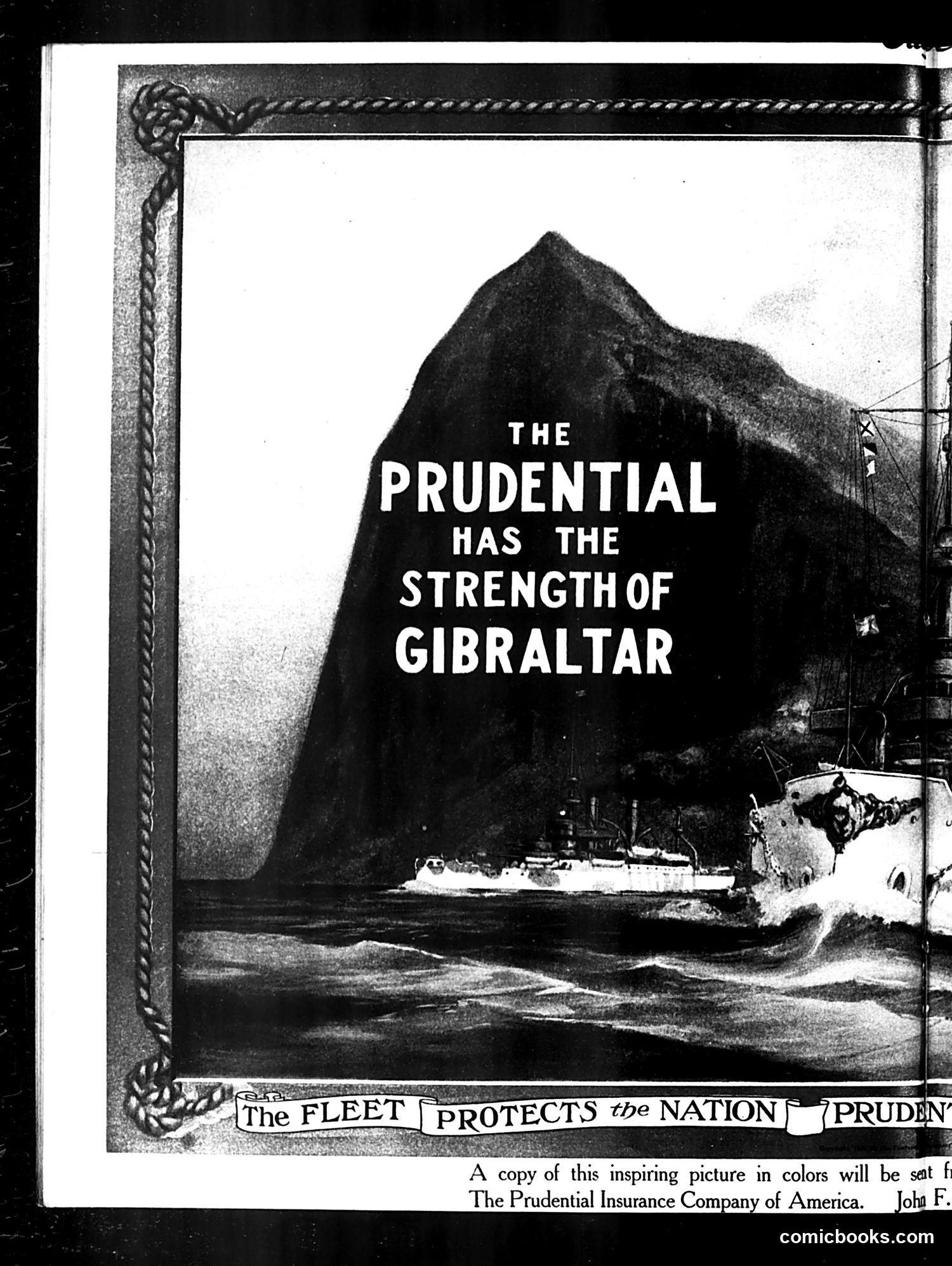
This is a Prudential Insurance Company advertisement rather than satirical content. The ad uses the Rock of Gibraltar—a famous natural fortress at the entrance to the Mediterranean Sea—as a metaphor for strength and stability. The image shows a naval vessel passing the imposing rock formation, with text claiming "The Prudential has the strength of Gibraltar." The tagline "The Fleet Protects the Nation" connects maritime/military power to insurance reliability. For modern readers: this leverages Gibraltar's historical reputation as an impregnable strategic stronghold to suggest Prudential is equally unshakeable and trustworthy with customers' financial security. It's essentially early 20th-century corporate branding through patriotic and architectural symbolism.
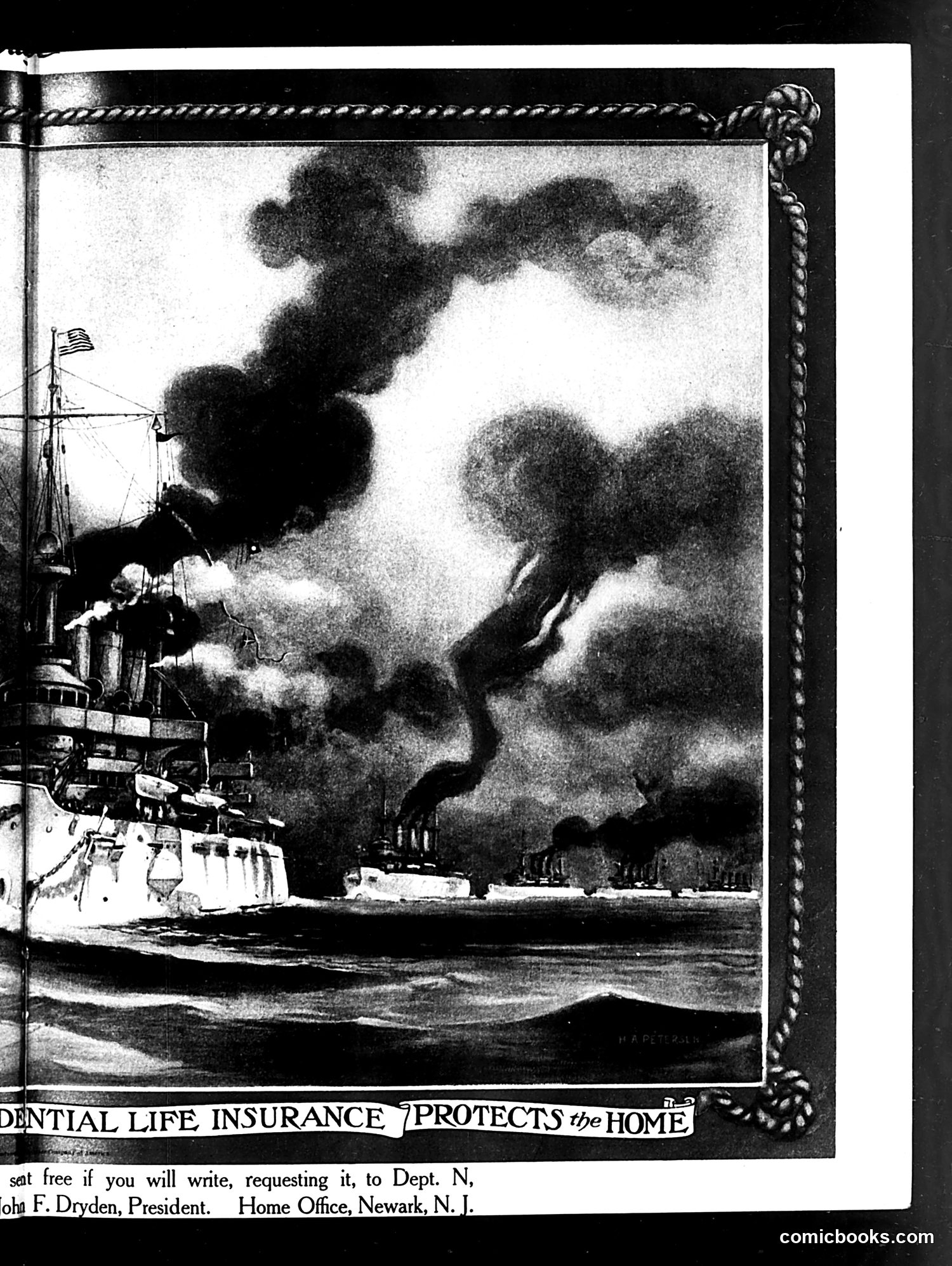
This page is primarily an **advertisement**, not satirical content. It shows a warship (flying an American flag) in distress, with heavy smoke billowing from explosions or fires, while another vessel appears damaged nearby. The ad's message uses a dramatic naval disaster scenario to sell life insurance. The tagline "PRUDENTIAL LIFE INSURANCE PROTECTS the HOME" suggests that just as ships need protection at sea, families need financial protection from life insurance. The advertisement is for Prudential Insurance Company, with President John F. Dryden offering free materials from their Newark, New Jersey office. This appears designed to evoke anxiety about sudden tragedy—a common insurance marketing tactic—implying that life insurance provides security for one's family against unexpected catastrophe.
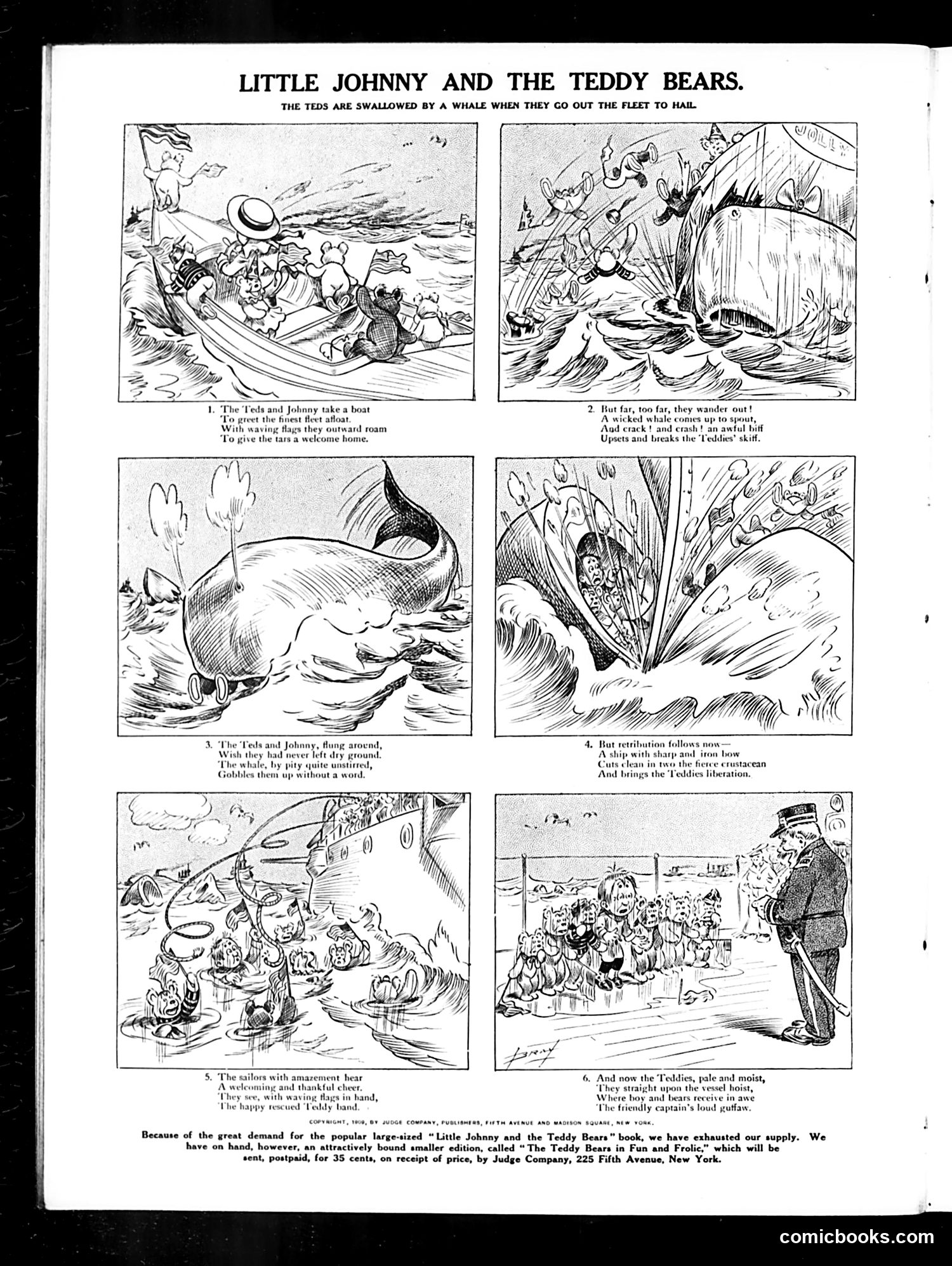
This is a serialized children's story promoting "Teddy Bears"—toys named after President Theodore Roosevelt, who was popular during his presidency (1901-1909). The narrative follows "Little Johnny" and toy bears who encounter a whale while visiting a naval fleet. The comic appears to be primarily **advertising content** disguised as entertainment. The bottom text explicitly promotes the book "Little Johnny and the Teddy Bears," with a notice that a smaller edition called "The Teddy Bears in Fun and Frolic" is available for 35 cents. The story itself contains no obvious political satire—it's wholesome children's adventure material capitalizing on the "Teddy Bear" craze of the early 1900s. The whale swallowing sequence and subsequent rescue by sailors provides the narrative tension and humor for young readers. This represents Judge magazine's commercial side: using its platform to sell branded merchandise tied to contemporary cultural figures.
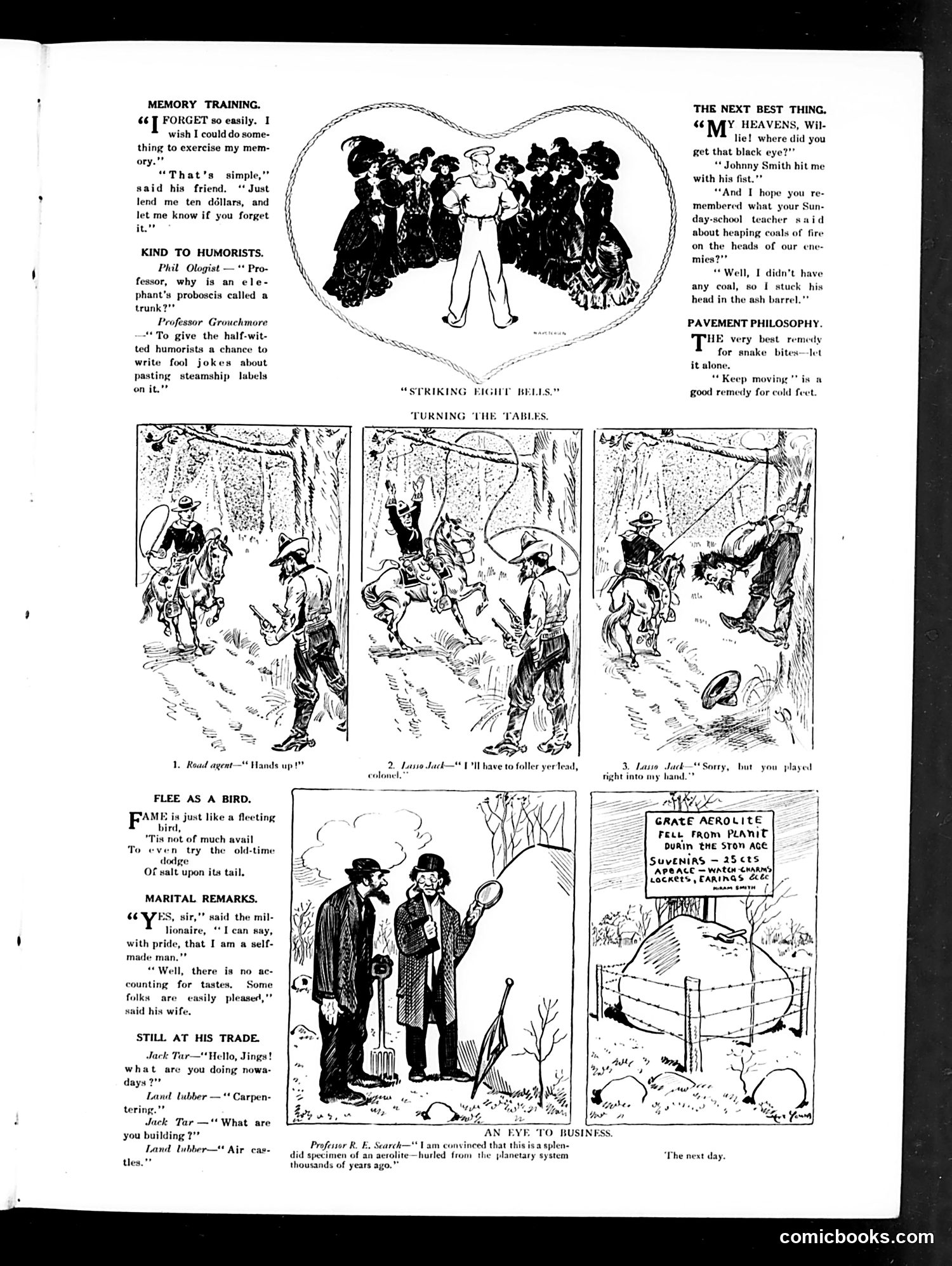
This page contains short humorous sketches typical of early 20th-century American satirical magazines. The jokes rely on wordplay and ironic reversals: **"Memory Training"** plays on lending money as a memory aid—implying the lender won't forget. **"Kind to Humorists"** mocks elephants' trunks as an easy target for bad jokes (a tired pun even then). **"The Next Best Thing"** subverts Sunday school morality: a child, told to "heap coals of fire" on enemies, literally shoves one into an ash barrel instead—dark humor about misapplied wisdom. **"Pavement Philosophy"** offers contradictory folk remedies presented as wisdom. **"Marital Remarks"** uses the wife's cutting response to deflate a self-made man's pride. **"Still at His Trade"** contrasts a sailor becoming a carpenter with "building air castles"—building nothing substantial, wasting effort. **"Turning the Tables"** shows a lasso-themed comic sequence (text unclear). **"An Eye to Business"** depicts someone presenting a meteorite as a planetary artifact—obvious fraud played for laughs.
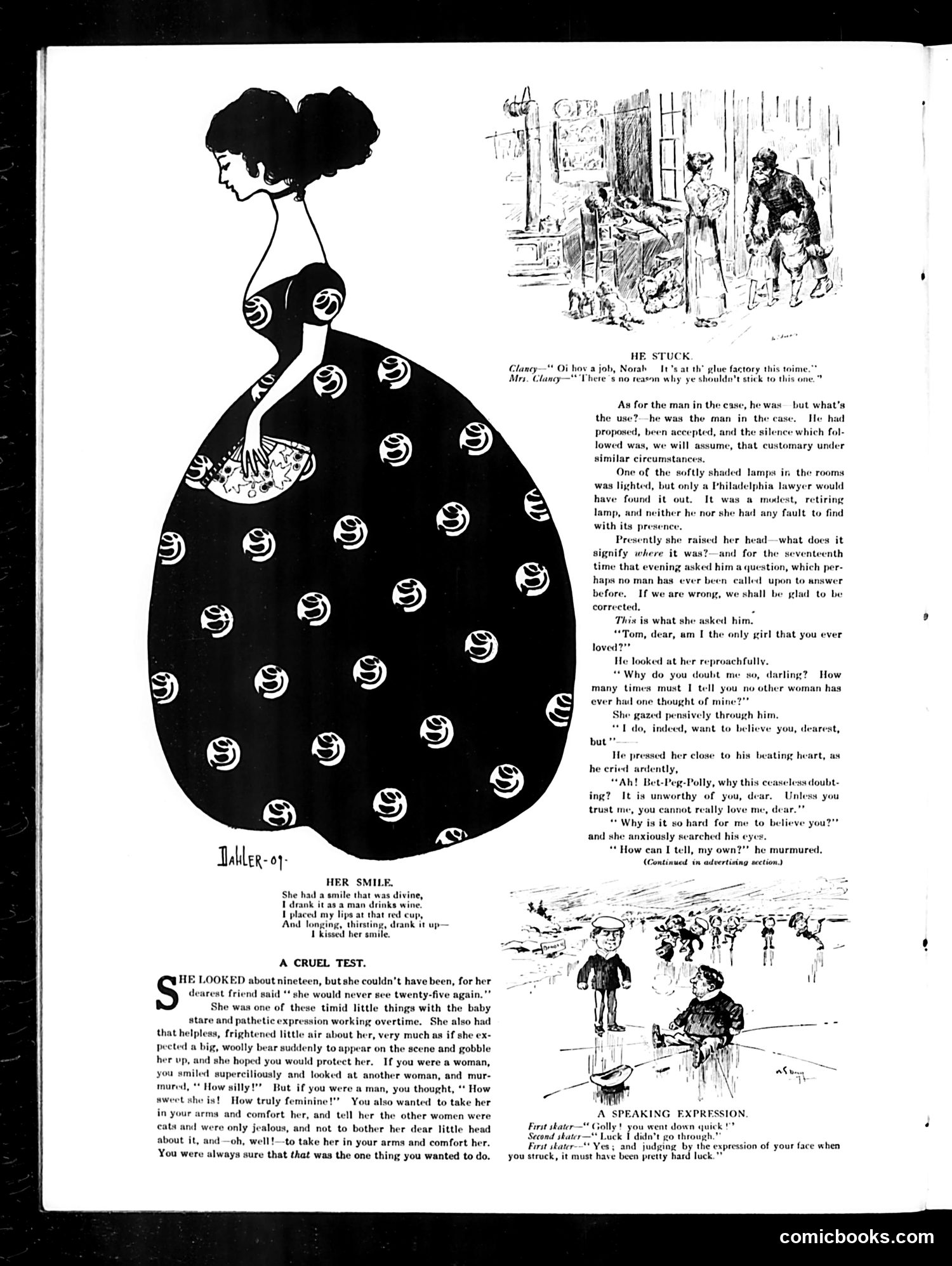
This page contains three distinct satirical pieces typical of Judge's social commentary: **"He Stuck"** (top right): A domestic drama where a man deflects his girlfriend's direct question about whether she's his only love. The satire targets male evasiveness and romantic dishonesty—he uses flattery and emotional pressure ("Unless you trust me, you cannot really love me") to avoid answering honestly. The title's double meaning (the glue factory reference in the preceding dialogue) suggests he's stuck in his own web of lies. **"Her Smile"** (left): A sentimental poem mocking romantic excess and clichéd expressions of desire, presented with an elegant illustration of a woman in an elaborate gown. **"A Cruel Test"** (bottom): Satirizes the "helpless feminine" archetype—the young woman who acts timid and vulnerable to appeal to men's protective instincts. Judge mocks both the performance and male susceptibility to it, noting men find such artificiality "sweet" and "truly feminine" while women recognize it as calculated silliness. The page satirizes gender dynamics, romantic pretense, and period attitudes toward femininity.
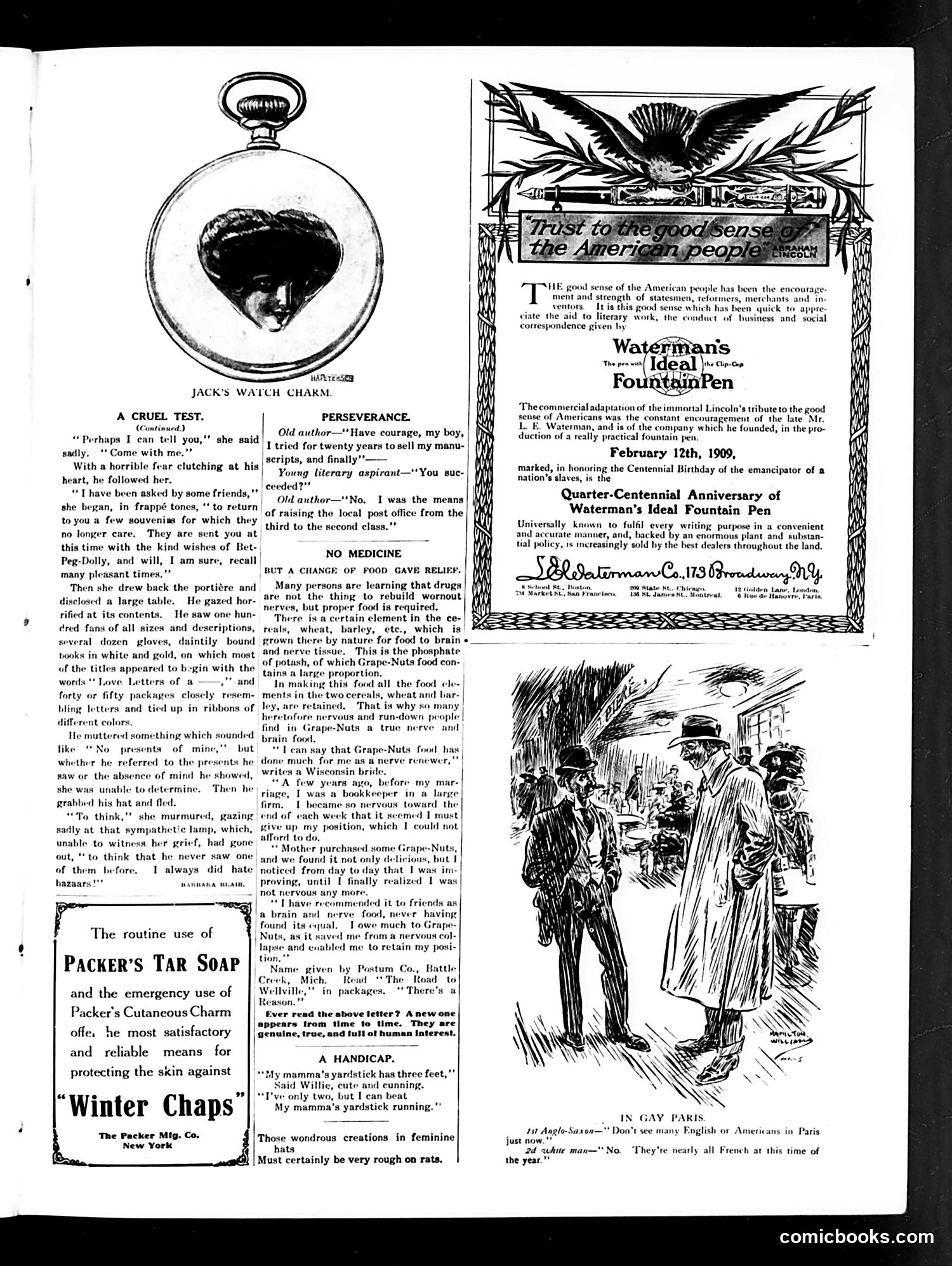
This page contains multiple satirical pieces typical of early 1900s Judge magazine: **"Jack's Watch Charm"** (main story) mocks romantic fickleness. A man discovers his former romantic interest has collected dozens of souvenirs he'd given her—fans, gloves, love letters—symbolizing his serial romances. The cruel joke: he'd forgotten about these women entirely, yet she's preserved evidence of his past attention. **"A Cruel Test"** jokes about struggling writers. An old author reveals his "success" was merely raising the local post office's classification by volume of rejected manuscripts—a bitter commentary on publishing rejection. **"No Medicine But a Change of Food"** advertises Grape-Nuts cereal through a testimonial about nerve restoration (common early 1900s health claims before FDA regulation). The **Waterman's Ideal Fountain Pen** advertisement celebrates Lincoln's centennial birthday (February 12, 1909) as context for promoting this writing instrument—linking the pen to American statesmanship. Lower sections include light humor about "winter chaps" (skin condition) and feminine hat fashions. The page blends editorial satire with period advertising reflecting early 20th-century concerns and marketing approaches.
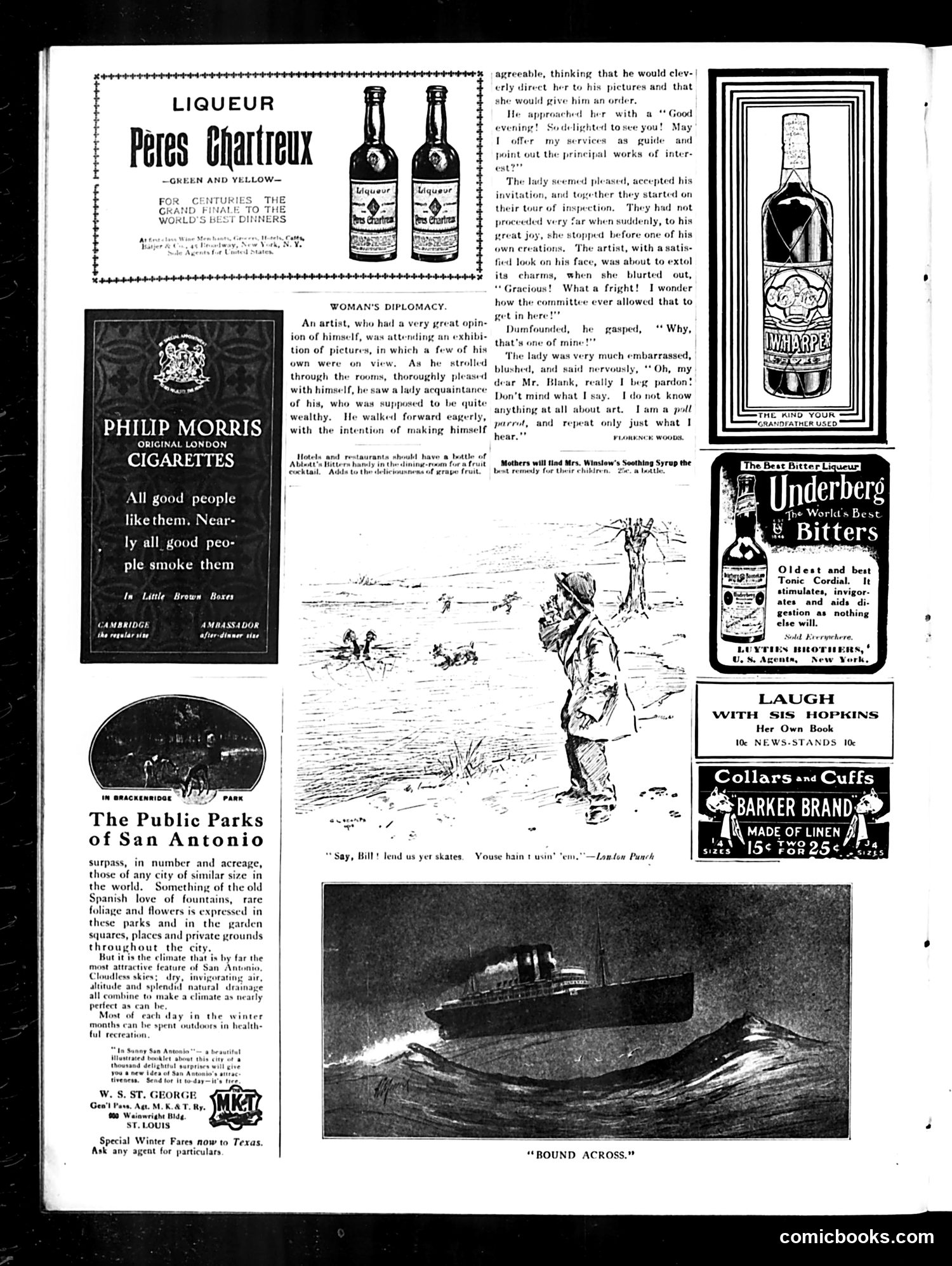
This page contains primarily **advertising and light humor** rather than political satire. The main content is a short comedic story titled "Woman's Diplomacy" about an artist showing his paintings to a wealthy female acquaintance. When she recoils in horror at one of his own works, calling it "a fright," he's mortified—until she tactfully explains she's merely a parrot who repeats what others say and knows nothing of art. The humor relies on the woman's clever deflection to spare the artist's feelings while insulting his work. The rest of the page consists of period advertisements for liqueurs, cigarettes (Philip Morris), bitters, children's books, collars, and tourist information about San Antonio's public parks—typical of early 20th-century magazine content. There is no significant political commentary or caricature visible.
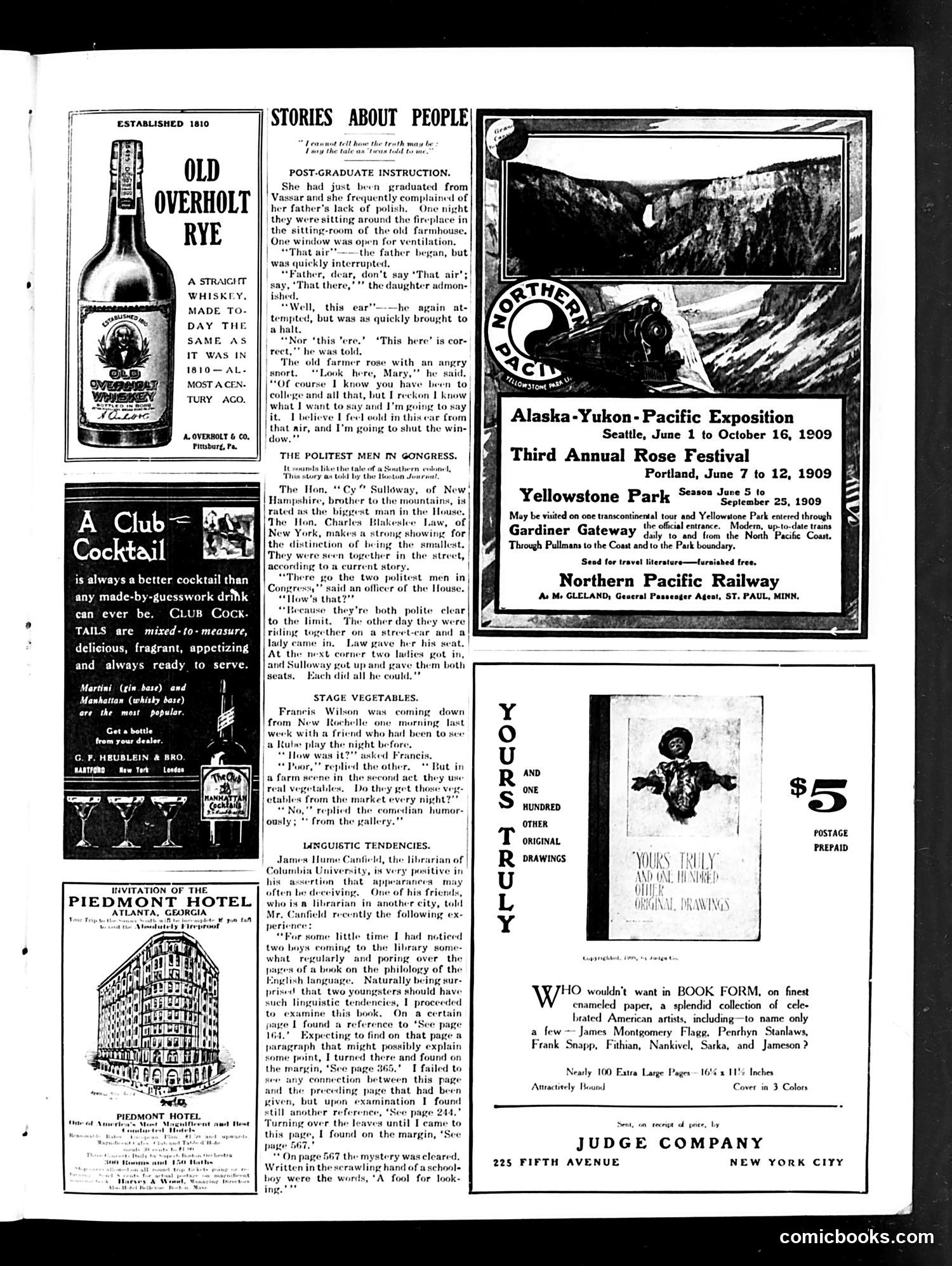
This page is primarily **advertising and notices** rather than political satire. The main content includes: **"Stories About People"** section features three anecdotal humor pieces: 1. A Vassar graduate criticizing her father's unpolished speech ("that air" vs. "this here"), mocking upper-class pretension about language 2. A brief reference to congressmen's politeness (unclear details in OCR) 3. An anecdote about Francis Wilson and stage vegetables **The satire** is mild social commentary on class anxiety—the newly educated daughter's embarrassment at her working-class father's dialect represents early 1900s tensions about social climbing and "proper" English. **Remainder of page**: Advertisements for Old Overholt Rye whiskey, Club Cocktails, the Piedmont Hotel (Atlanta), and travel/exposition notices for the Alaska-Yukon-Pacific Exposition, Rose Festival, and Yellowstone Park. There's also an advertisement for a book of drawings by American artists. The page reflects Judge's mixed format of light humor paired with commercial advertising targeting affluent readers.
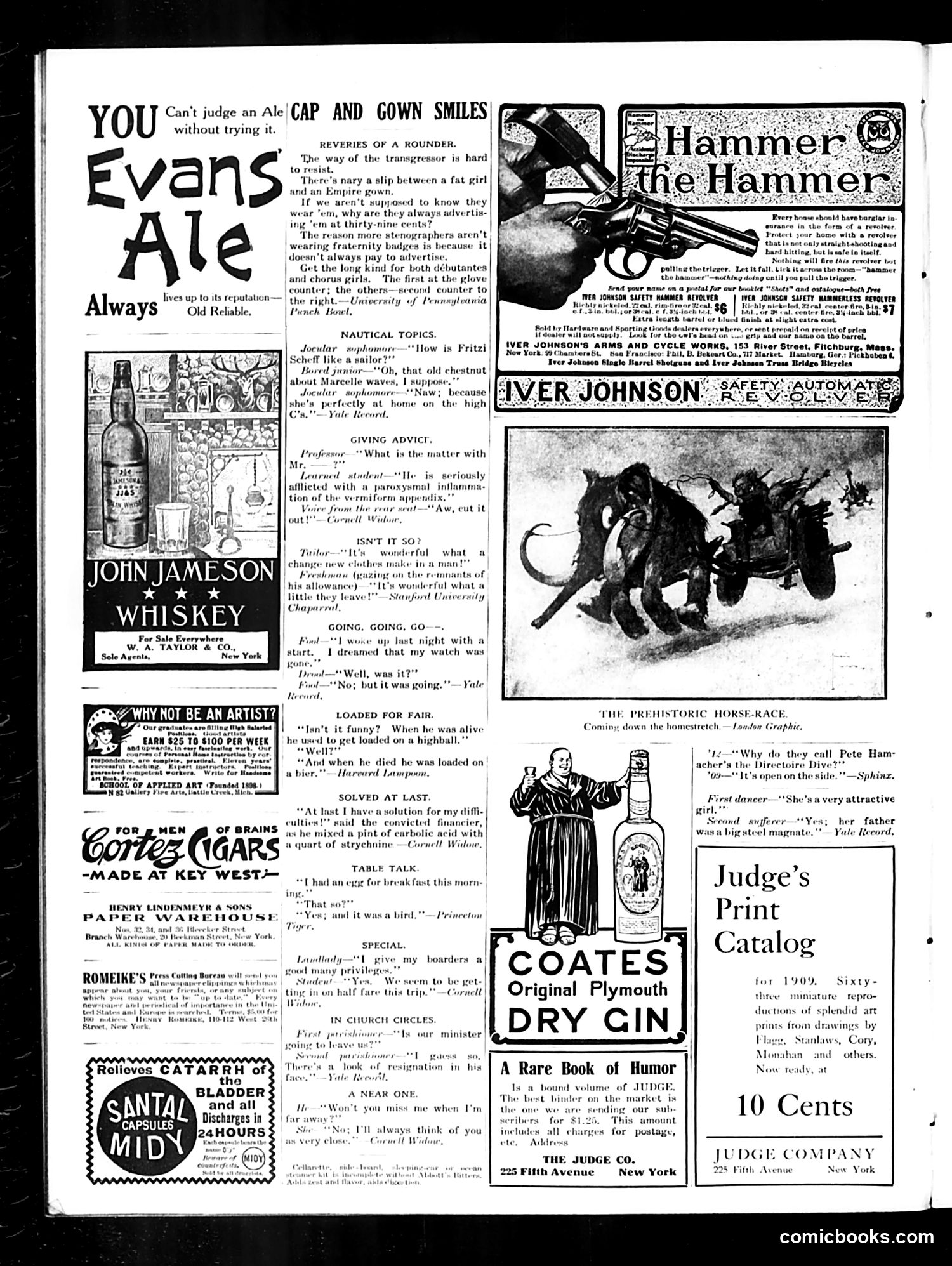
This page from Judge magazine (circa 1909) is primarily **advertising with brief satirical humor pieces**. The main content includes: ## Humor Sections Multiple short jokes attributed to college publications (Yale, Cornell, Princeton, Stanford). These mock collegiate life—absent-minded professors, lovestruck students, and wordplay about watches and intoxication. The humor reflects early 1900s campus culture. ## Key Advertisement The prominent "Hammer the Hammer" revolver ad features a firearm with exaggerated safety claims. The illustration depicts a cartoonish figure, likely meant to emphasize the gun's reliability through visual pun. ## Other Ads - **John Jameson Whiskey** and **Coates Dry Gin**—alcohol prominently advertised despite Prohibition looming (passed 1920) - **Judge's Print Catalog** (10 cents)—offering art reproductions - Various other period products ## Notable Context The page reflects pre-Prohibition America's casual alcohol advertising and early 20th-century consumer culture. The collegiate humor relies on insider academic references that anchor Judge's readership among educated, urban audiences.
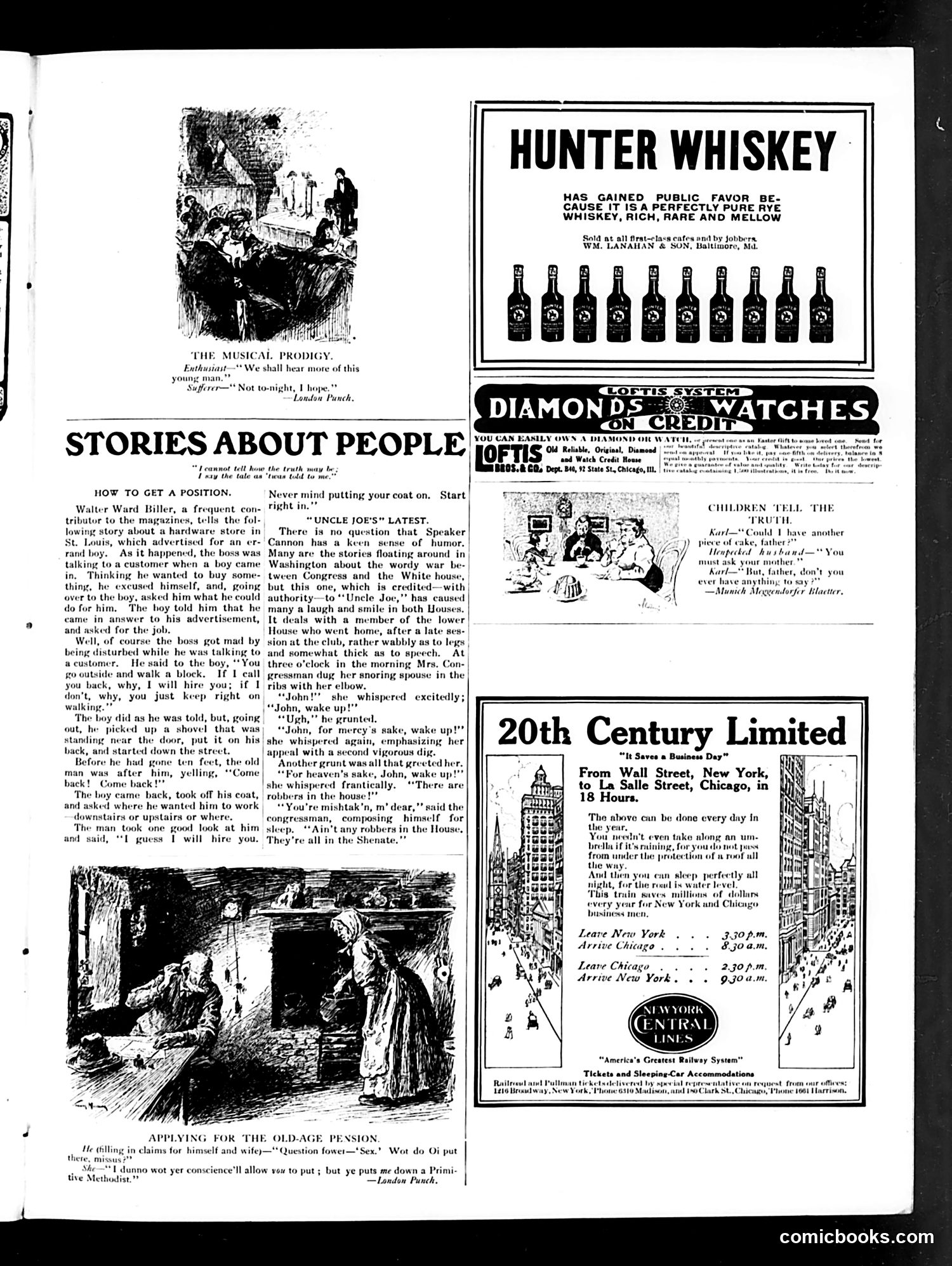
This page from *Judge* magazine contains three distinct elements: **"Stories About People"** presents anecdotes mocking social pretension and incompetence. The first story satirizes a job applicant whose desperation (carrying a shovel, ready to work immediately) impresses a hardware store owner more than proper etiquette. The second joke credits Speaker Joseph Cannon with witty wordplay about a congressman's marital discord—likely referencing contemporary congressional politics, though specific context is unclear. **Advertisements** occupy significant space: Hunter Whiskey emphasizes "pure rye," appealing to quality-conscious consumers; Loftis Diamond watches offer credit purchasing; and the 20th Century Limited railroad advertisement highlights efficiency ("saves a business day" between New York and Chicago). **"Children Tell the Truth"** presents a child innocently correcting adult pretense about dessert, a common satirical device of the era. The overall message reflects *Judge*'s recurring themes: mocking social climbing, celebrating practical common sense over gentility, and poking fun at public figures like Cannon.
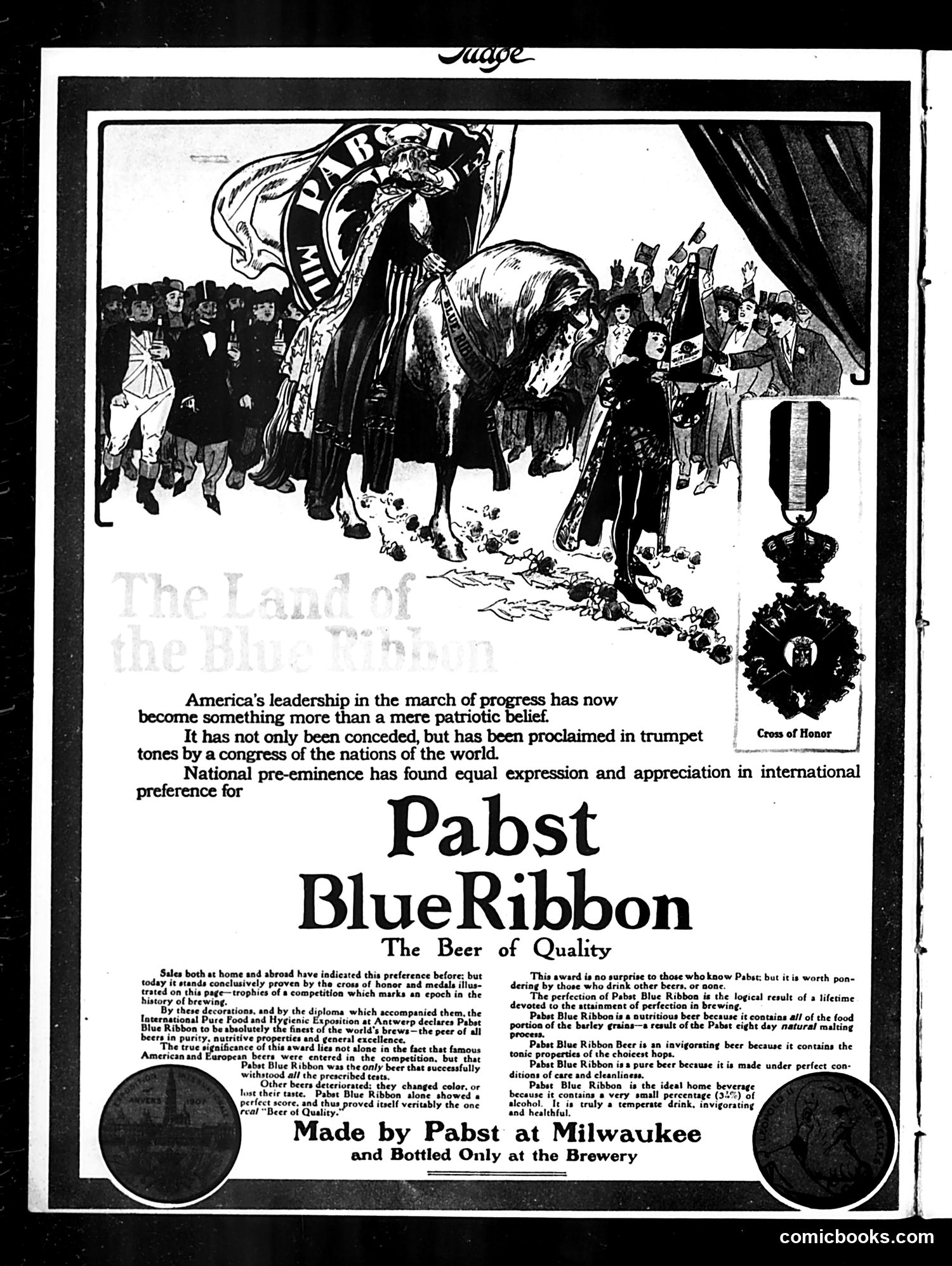
This is primarily **advertising, not satire**. The page features a Pabst Blue Ribbon beer advertisement disguised as editorial content in Judge magazine. The illustration depicts an elaborate international ceremony or parade with a crowned figure on horseback, crowds, and banners—meant to evoke prestigious international competitions and awards. The accompanying text claims Pabst won at an "International Hygienic Exposition at Antwerp," allegedly beating European beers and earning medals and diplomas. The satirical *framing* (typical of Judge) is subtle: the ad sarcastically presents American commercial superiority as proof of national greatness. The overwrought language about America's "leadership in the march of progress" being "proclaimed in trumpet tones by a congress of nations" inflates a beer competition into a matter of national prestige—mocking both American boosterism and advertisers' grandiose claims. The extensive text listing health benefits (temperance, nutrition, purity) reflects early 20th-century beer marketing tactics before Prohibition.